





Highlights
-
• Bilingual children can be primed to use structures specific to one language
-
• Priming and the activation of the other language drive cross-linguistic effects
-
• Implicit learning shapes across- and within-language priming via different processes
-
• Age and language dominance affect across- and within-language priming differently
-
• The data show interconnectedness of syntactic representations in bilingual minds
1. Introduction
Several studies on bilingualism and second language acquisition have attempted to understand the mechanisms of cross-linguistic influence (CLI, henceforth) from one language to the other (van Dijk et al., Reference van Dijk, van Wondereden, Koutamanis, Koostra, Dijkstra and Unsworth2021, for a review). CLI refers to the process whereby certain linguistic properties of a bilingual’s language (e.g., phonological or morphosyntactic features) are used or accepted in the other language. For example, French–English bilingual children may produce or accept an adjective-noun phrase in contexts in which the use of a noun-adjective phrase would be required in French as an effect of CLI from English (Nicoladis, Reference Nicoladis2006).
Among the most influential theoretical accounts of CLI, Sharwood Smith and Truscott (Reference Sharwood Smith and Truscott2014) propose that CLI depends on the activation level of certain lexical, phonological or morphosyntactic structures within a bilingual’s processing system. In the example mentioned above, the use of ungrammatical adjective-noun phrases in French may be motivated by the high activation of these structures in a French–English bilingual’s mind. This activation may depend, for instance, on the recent use of adjective-noun phrases in English or the fact that adjective-noun phrases overlap between the two languages: French allows both adjective-noun and noun-adjective phrases (albeit under different semantic conditions), whereas English only allows adjective-noun phrases. As a result, bilinguals may produce the structure for which both languages provide converging evidence. According to Sharwood Smith and Truscott (Reference Sharwood Smith and Truscott2014), if a structure is associated with a high activation, it becomes more accessible to the processing system and wins over competing structures. As a result, the speaker may use this structure even in the language where it is inappropriate or ungrammatical (Sharwood Smith, Reference Sharwood Smith2017; Sharwood Smith & Truscott, Reference Sharwood Smith and Truscott2014).
Structural priming experiments provide a testing ground for examining the relationship between CLI and the activation of a morphosyntactic structure. Structural priming is generally defined as speakers’ tendency to reuse a morphosyntactic structure that they have previously produced, heard or read (Branigan & Pickering, Reference Branigan and Pickering2017; Pickering & Branigan, Reference Pickering and Branigan1998; Pickering & Ferreira, Reference Pickering and Ferreira2008). For example, after hearing a passive sentence, speakers are more likely to describe an event involving an agent and a patient using a passive sentence rather than an active one (see, e.g., Bock, Reference Bock1986). By employing structural priming in a bilingual mode (i.e., cross-linguistic priming), one can enhance the activation of a morphosyntactic structure in Language A (e.g., an adjective-noun phrase) and observe whether this leads to an increased use of the same structure in Language B. However, most existing cross-linguistic priming experiments do not allow us to determine whether the use of the target structure in Language B is related to its activation in Language A or to the activation of Language A itself. It is possible that simply exposing a speaker to Language A triggers the activation of morphosyntactic structures associated with it (Sharwood Smith & Truscott, Reference Sharwood Smith and Truscott2014: 199). For example, the adjective-noun order may be activated by the use of English alone, independently of recent actual use of an adjective-noun phrase in this language. To understand to what extent language activation, structure activation or both affect CLI, the present study triangulates evidence from across-language (e.g., from Language A to Language B) and within-language (e.g., from Language B to Language B) priming experiments. Through across-language priming experiments, one can investigate the extent to which the target structure (e.g., adjective-noun phrases in French) is produced in Language B following the activation of the target structure in Language A or the activation of Language A itself, independently of the target structure. Through within-language priming experiments, one can explore how frequently the target structure in Language B is produced after being primed in Language B. Specifically, we aim to investigate whether the activation of the structure in Language B, the activation of Language A and the activation of the structure in Language A, lead to the production of the target structure in Language B. This is assessed by focusing on both trial-by-trial priming effects and cumulative effects within the same experiment.
The present study aims to investigate the relationship between CLI, structure activation and language activation by testing Greek–Italian bilingual children using structural priming experiments both within and across languages. To conduct this investigation, we capitalize on a word-order difference at the sentence level between Greek and Italian (i.e., the availability of the verb-subject-object order in Greek, but not in Italian), extending previous studies that mostly focused on word-order within the nominal phrase.
2. Background literature
2.1. Cross-linguistic effects: New insights from priming experiments
In bilingualism research, several attempts have been made to predict the occurrence and direction of CLI between languages. One of the most influential proposals has been formulated by Hulk and Müller (Reference Hulk and Müller2000) and Müller and Hulk (Reference Müller and Hulk2001), who introduced two necessary conditions for CLI to occur. First, the linguistic phenomenon in question is situated at the interface between two modules of grammar. For example, the production of referring expressions such as pronouns involves the interplay between morphosyntactic and discourse information (see, e.g., Serratrice et al., Reference Serratrice, Sorace and Paoli2004; Torregrossa et al., Reference Torregrossa, Andreou, Bongartz and Tsimpli2021). Second, there is partial structural overlap between the two languages concerning the phenomenon at stake. For example, Italian allows both null and overt pronouns in the subject position, whereas English permits only overt pronouns. As a result, CLI from English to Italian is expected, leading to the overproduction (or overacceptance) of overt pronouns in Italian in discourse contexts where null pronouns would be more appropriate (Sorace et al., Reference Sorace and Serratrice2009; Torregrossa & Bongartz, Reference Torregrossa and Bongartz2018). However, two decades of research have shown that CLI can occur independently of the two abovementioned conditions. For example, CLI has been observed in structures which are not at the interface between morphosyntax and discourse (e.g., compounds produced by English–Persian bilinguals, as shown in Foroodi-Nejad & Paradis, Reference Foroodi-Nejad and Paradis2009) or where no structural overlap exists between the two languages. For example, Nicoladis (Reference Nicoladis2006) found not only the overproduction of adjective-noun phrases in French due to English influence (see the previous section), but also the production of ungrammatical noun-adjective phrases in English as a result of CLI from French. This result is unexpected based on Müller and Hulk (Reference Müller and Hulk2001), as the noun-adjective order does not overlap between the two languages, being possible only in French (see also Nicoladis, Reference Nicoladis2012 on the production of possessive structures by English–French bilinguals).
In recent years, research has shifted from focusing on the conditions that enable CLI to exploring the psycholinguistic mechanisms underlying it. Recent studies account for CLI in terms of cross-linguistic structural priming related to language co-activation (Serratrice, Reference Serratrice2016, Reference Serratrice and Messenger2022). Structural priming refers to the tendency of speakers to reuse a structure that they have recently processed, whether in comprehension or production (e.g., Branigan, Reference Branigan2007). For example, English monolingual speakers are more likely to use a double object dative (John gave Mary the flowers) rather than a prepositional object dative (John gave the flowers to Mary) after hearing, reading or producing another double object dative (Peter sent Ann a book) – see, e.g., Bock and Griffin (Reference Bock and Griffin2000) and Pickering and Branigan (Reference Pickering and Branigan1998). In this sense, CLI can be understood as structural priming occurring across languages (Serratrice, Reference Serratrice2016): after using a structure in Language A, a speaker may replicate the same structure in Language B.
Many studies that have employed cross-linguistic structural priming have investigated the extent to which overlapping structures between a bilingual’s two languages are “shared” across these languages. For example, Hartsuiker et al. (Reference Hartsuiker, Pickering and Veltkamp2004) tested L1 Spanish-L2 English adult speakers using a confederate scripting methodology in which the confederate and the participant had to describe cards to each other. The confederate did it in Spanish, whereas the participant was asked to use English. The study found that the participants tended to produce a greater number of passive sentences in English after hearing a passive sentence in Spanish, compared to when the confederate used an intransitive sentence or a subject-verb-object transitive sentence. Vasilyeva et al. (Reference Vasilyeva, Waterfall, Gámez, Gómez, Bowers and Shimpi2010) and Gámez and Vasilyeva (Reference Gámez and Vasilyeva2020) obtained similar results with Spanish–English bilingual children, using the same methodology as Hartsuiker et al. (Reference Hartsuiker, Pickering and Veltkamp2004) and focusing on the same structure (passive sentences). Similarly, Wolleb et al. (Reference Wolleb, Sorace and Westergaard2018) observed an increase in the production of double object structures (versus prepositional object structures) in Norwegian by English–Norwegian bilingual children, as a result of across-language priming from English to Norwegian.
The results of these studies suggest that certain syntactic representations are shared across a bilingual’s two languages: the use of a passive sentence in Spanish (e.g., El camión es perseguido por el taxi “The truck is chased by the taxi,” as in Hartsuiker et al., Reference Hartsuiker, Pickering and Veltkamp2004) activates both the verb (perseguir “chase”) and the associated combinatorial nodes (either an active or a passive sentence). Assuming these combinatorial nodes are shared across both languages, speakers tend to rely on the most activated node (in this case, the passive sentence) when providing a new description in English. Notably, the activation of the combinatorial node seems to occur regardless of whether the Spanish prime sentence features a translation equivalent or a completely different verb compared to the newly produced English sentence, although the priming effect is stronger when a translation equivalent is involved (see Hartsuiker et al., Reference Hartsuiker, Pickering and Veltkamp2004; Pickering & Branigan, Reference Pickering and Branigan1998; Pickering & Ferreira, Reference Pickering and Ferreira2008, for a discussion of the lexical boost effect). Most of the studies advocating for shared syntactic representations in a bilingual’s mind examine structures which overlap, superficially at least, across the two languages, as in the abovementioned cases of passive sentences in Spanish and English or double object structures in Norwegian and English. However, a different picture may emerge when considering the priming of sentences that are grammatical in one language but ungrammatical or inappropriate in the other.
Some of these studies have supported a “shared-syntax” account. For example, Hsin et al. (Reference Hsin, Legendre and Omaki2013) report the results of a cross-linguistic priming experiment – based on a picture-description task – demonstrating that English–Spanish bilingual children, aged 4 to 5 years, were more likely to produce adjective-noun phrases in Spanish (e.g., the ungrammatical sequence el abierto libro “the opened book”) after hearing an adjective-noun phrase in English (e.g., the red book) compared to a condition in which the English prime involved a different structure (i.e., a predicative structure, such as the book was red). A shared-syntax account is also proposed in Hervé et al. (Reference Hervé, Serratrice and Corley2016). The authors tested English–French bilingual children, aged 5;4 to 6;7, with two within-language priming experiments (English-to-English and French-to-French) that targeted the use of left dislocations in both languages. They compared the bilinguals’ performance with that of two monolingual groups. They found that in the English-to-English task, the bilingual children produced more (inappropriate) left dislocations in English than the monolinguals, particularly when primed with this structure and when they had less exposure to English. They interpreted this result in terms of CLI from French, where left dislocations are used in a broader range of discourse contexts compared to English. While interpreted in terms of a shared-syntax account, the study also revealed that English–French bilinguals were sensitive to the pragmatic inappropriateness and lower frequency of English left dislocations, as the priming effect was significantly stronger in the French-to-French task than in the English-to-English one.
Other studies have provided experimental evidence that does not fully support the shared-syntax account. For example, van Dijk and Unsworth (Reference van Dijk and Unsworth2023) report the results of an experiment conducted with French–Dutch bilingual children aged 4 to 8 years, in which noun-adjective phrases were primed from French – where these structures are possible – to Dutch – which allows only adjective-noun phrases. The authors found that the ungrammatical noun-adjective order tended to be primed in Dutch if the corresponding adjective had a translation equivalent in French that is typically associated with a noun-adjective order. In other words, the priming of ungrammatical structures appears to be lexically constrained. Based on these results, van Dijk and Unsworth (Reference van Dijk and Unsworth2023) proposed a “separate-but-connected-syntax-account,” suggesting that combinatorial nodes are not always shared across languages. Instead, the activation of a combinatorial node results from the activation of a lemma in one language and its translation equivalent in the other.
Under a shared-syntax account, one would expect that within-language and across-language priming experiments would yield similar magnitudes of priming effects. The existing literature has investigated this issue, focusing on structures that overlap between bilinguals’ two languages. For example, the study by Schoonbaert et al. (Reference Schoonbaert, Hartsuiker and Pickering2007) on the priming of double object and prepositional object datives from English to English as well as Dutch to English among L1-Dutch-L2-English speakers found similar priming effects in both experiments, supporting a shared-syntax account. In contrast, the study by Cai et al. (Reference Cai, Pickering, Yan and Branigan2011) on the priming of double object and prepositional object datives among Cantonese–Mandarin bilingual adults showed that priming was more likely to occur in within-language experiments than in across-language ones. However, these results do not appear to contradict a shared-syntax account if one assumes that language-specific lemmas are more activated in within-language experiments than in across-language ones, due to greater activation of the language itself (Cai et al., Reference Cai, Pickering, Yan and Branigan2011).
However, no study to date has compared the magnitude of priming between within-language and across-language priming experiments using structures that are not shared between the two languages. According to Hsin et al. (Reference Hsin, Legendre and Omaki2013)’s shared-syntax account, one would expect ungrammatical noun-adjective phrases in English (i.e., the book red) to be primed to the same extent among English–French bilinguals, regardless of whether the prime is an ungrammatical noun-adjective phrase in English or a grammatical noun-adjective phrase in French. In both scenarios, the relevant noun-adjective combinatorial node would be present (as a result of language co-activation) and would become activated. However, it is possible that these two conditions could yield different priming effects. In the abovementioned across-language priming experiment, participants would be exposed to a structure that is allowed in Language A (French) but not in Language B (English). In contrast, in the corresponding within-language experiment, they would encounter an ungrammatical structure in English.
Some studies conducted with monolingual adults or children demonstrated that it is possible to prime ungrammatical or dispreferred structures within a language. In other words, ungrammatical/dispreferred structures can be primed independently of bilingualism. For example, Ivanova et al. (Reference Ivanova, Pickering, McLean, Costa and Branigan2012) examined the production of ungrammatical double object structures in English associated with verbs that select only prepositional objects, such as donate (e.g., The dancer donates the soldier the apple). The study showed that adult participants might produce these sentences after being primed with similar ungrammatical sentences featuring the same verb (in this case, donate). These results indicate that for the priming of ungrammatical structures to occur, it is necessary to activate a specific lemma-combinatorial node representation rather than just a combinatorial node. Similarly, Skarabela and Serratrice (Reference Skarabela and Serratrice2009) found that 4-year-old English monolingual children produced of-genitive structures with a human possessor and a human possessee (e.g., the mother of the doctor) instead of the preferred structure featuring an s-genitive (the doctor’s mother), after hearing an of-genitive prime. This effect was observed without any lexical overlap between the prime and target sentence.
These findings suggest that further conceptual and empirical work is needed to understand the mechanisms underlying the priming of ungrammatical structures in a language. The present study capitalizes on the abovementioned observation that ungrammatical/dispreferred structures can be primed. This serves as a preliminary step in examining whether this priming occurs in a one-language mode (as in within-language priming experiments), a two-language mode (as in across-language priming experiments) or both. Additionally, the comparison between within-language and across-language priming experiments is relevant for evaluating the shared syntax account and gaining insights into the relationship between CLI and the activation of specific structures in a bilingual’s processing system. While within-language priming involves the activation of a structure (either grammatical or ungrammatical), across-language priming entails the activation of both a structure and the bilingual’s other language, which is expected to lead to a higher magnitude of CLI.
2.2. Factors affecting monolingual and bilingual children’s priming behaviour
Among the studies investigating monolingual children’s sensitivity to structural priming, chronological age has often been identified as a relevant factor. Several studies have focused on very young monolingual children (see Contemori, Reference Contemori and Messenger2022, for a review). For example, the experiments reported in Bencini and Valian (Reference Bencini and Valian2008) and Peter et al. (Reference Peter, Chang, Pine, Blything and Rowland2015) successfully primed 3-year-old children with passive sentences and double object (or prepositional object) structures, respectively. Notably, several priming experiments found that younger children are more sensitive to structural priming than their older counterparts. This result has been interpreted in terms of error-based implicit learning (Bock & Griffin, Reference Bock and Griffin2000; Chang et al., Reference Chang, Dell and Bock2006): when primed with infrequent structures (such as passives), young children appear to experience a greater “surprisal effect” than older children, resulting from a mismatch between their predictions about an upcoming stimulus and an actual linguistic input (Jaeger & Snider, Reference Jaeger and Snider2013). Older children, having more exposure to these infrequent structures, may be less surprised and, consequently, less affected by priming. In other words, the surprisal effect serves as a trigger for learning. With repeated exposure to the target structure, the system begins to perceive it as increasingly likely to occur, leading to a more entrenched representation (Chang, Reference Chang2008). Crucially, learning can occur throughout the course of the experiment, whereby participants are more likely to produce the target structure at the end of the experiment (when the structure is more entrenched) compared to the beginning (when the structure triggers the surprisal effect). This phenomenon is referred to as the “cumulative effect” of priming (Hartsuiker & Westenberg, Reference Hartsuiker and Westenberg2000; Jaeger & Snider, Reference Jaeger and Snider2013). This effect has been shown to persist across experimental sessions or in post-tests conducted some time after the initial priming experiment (e.g., Heyselaar & Segaert, Reference Heyselaar and Segaert2022; Kaschak, Reference Kaschak2007; Kootstra & Doedens, Reference Kootstra and Doedens2016), with effects lasting for up to a month in some studies (Savage et al., Reference Savage, Lieven, Theakston and Tomasello2006). While the abovementioned studies suggest that priming is affected by chronological age, a different outcome may arise when priming an ungrammatical (or inappropriate) structure. In this case, both younger and older children might find the corresponding structure “surprising,” making them equally susceptible to the effects of priming. To our knowledge, no studies have specifically investigated the effect of age on the priming of ungrammatical structures. Some studies suggest that speakers’ ability to align with their (fictitious or actual) interlocutors likely modulates the magnitude of priming effects (Costa et al., Reference Costa, Hernández and Sebastián-Gallés2008), with stronger aligners demonstrating heightened sensitivity to priming. Crucially, the ability to align with interlocutors increases with age (see, e.g., Epley et al., Reference Epley, Keysar, Van Boven and Gilovich2004). Consequently, the proposal linking priming to alignment abilities suggests predictions that differ from those of the error-based implicit learning hypothesis, particularly in predicting that older children may be more sensitive to priming. Furthermore, no studies have examined the effect of age on bilingual children’s sensitivity to priming in cross-linguistic structural priming experiments. This situation becomes even more complex when considering that chronological age may correlate with development in children’s societal language but not necessarily in their home language (see Paradis, Reference Paradis2011; Torregrossa et al., Reference Torregrossa, Caloi, Listanti and Romano2023b for discussion). As a result, age may modulate children’s sensitivity to priming in the societal and home languages to varying degrees, depending on how deeply a target structure is entrenched in their mental grammar.
Another important factor to consider when testing bilinguals in cross-linguistic structural priming experiments is language dominance. Several studies have shown that dominance in one language can significantly affect bilingual children’s language acquisition trajectories and outcome(s) (e.g., Tsimpli, Reference Tsimpli2014; Unsworth, Reference Unsworth2013, for discussion). Here, we define language dominance in terms of a complex construct encompassing “a linguistic proficiency component, an external component (input) and a functional component (context of use)” (Montrul, Reference Montrul, Nicoladis and Montanari2016:16). In other words, the concept of dominance refers to speakers’ abilities (e.g., lexical or syntactic) as well as their exposure to and use of one over the other across various contexts over time (see also Torregrossa & Bongartz, Reference Torregrossa and Bongartz2018; Torregrossa et al., Reference Torregrossa, Andreou, Bongartz and Tsimpli2021).
According to some studies, the degree of dominance a speaker has in a language modulates the effects of CLI from their other language. For example, French–English bilingual children who are more dominant in French are more likely to produce ungrammatical noun-adjective phrases in English (Nicoladis, Reference Nicoladis2006; see also Argyri & Sorace, Reference Argyri and Sorace2007; Bernandini, Reference Bernandini and Müller2003; Chondrogianni & Schwartz, Reference Chondrogianni and Schwartz2020; Yip & Matthews, Reference Yip and Matthews2000; Unsworth, Reference Unsworth2013 on the relationship between dominance and CLI in relation to different linguistic phenomena). However, an effect of dominance on CLI has not always been found (e.g., Fernández et al., Reference Fernández, De Souza and Carando2017; Müller & Hulk, Reference Müller and Hulk2001).
In the previous section, we defined CLI in terms of across-language priming, suggesting that dominance should modulate the effects of cross-linguistic priming. The results of previous studies do not consistently support this conclusion. On the one hand, the abovementioned within-language priming study by Hervé et al. (Reference Hervé, Serratrice and Corley2016) indicated that children with less dominance in English (based on language exposure) were more likely to produce inappropriate left-dislocations in this language. On the other hand, the across-language priming study by Hsin et al. (Reference Hsin, Legendre and Omaki2013) did not find any effect of dominance in English (measured through receptive vocabulary knowledge) on the production of ungrammatical adjective-noun phrases in Spanish. Notably, observing an effect of dominance on our priming experiments would align with the concept of CLI concerning language and structure activation. Higher dominance in a language should correlate with greater activation of that language and its associated combinatorial nodes, thereby enhancing the magnitude of priming from this language to the other.
2.3. The target structure: Verb-Subject-Object sentences in Greek and Italian
The present study focuses on the production of verb-subject-object (VSO) sentences in broad-focus contexts in Greek and Italian. Broad focus sentences convey all-new information and can be conceived as responses to questions like “What happened?” In this context, the word-order used corresponds to the unmarked word-order of a language (Torregrossa, Reference Torregrossa2012). For transitive sentences, Italian employs the order subject-verb-object (SVO) as the unmarked one. In contrast, Greek allows two possible word-orders under the same conditions, i.e., SVO and VSO – see Roussou and Tsimpli (Reference Roussou and Tsimpli2006) and Torregrossa et al. (Reference Torregrossa, Andreou and Bongartz2020). This is shown in (1a)–(1d). The example is adapted from Roussou and Tsimpli (Reference Roussou and Tsimpli2006):318).


The pattern in (1a)–(1d) exemplifies a situation of partial structural overlap between the two languages, with the SVO order allowed in both languages and the VSO order exclusive to Greek.
It is important to note that VSO is allowed in certain contexts in Italian. It is used to mark the subject as conveying new or contrastive information, while the object expresses information that can be inferred from the context (López, Reference López2009). For example, (1b) could be used to answer a question such as “Who was responsible for technical repairs?” or to correct information in a previous statement such as “Paul was responsible for technical repairs.” In these cases, the use of VSO corresponds to a marked word-order, with the subject being situated in a low focus position (Belletti, Reference Belletti and Rizzi2004) and the object being marginalized (i.e., adjoined to the right of the clause; see López, Reference López2009). Furthermore, the corresponding sentence is associated with marked intonation (e.g., a fall–rise on the subject and an optional pause after it; see Belletti, Reference Belletti and Rizzi2004; Grice et al., Reference Grice, D’Imperio, Savino, Avesani and Sun-Ah2005; Torregrossa, Reference Torregrossa2012). In contrast, Greek allows VSO with neutral intonation. Therefore, VSO is allowed in Italian but only in specific discourse contexts. The use of VSO in unmarked, broad-focus contexts is considered inappropriate (i.e., infelicitous from a discourse perspective).
Regarding the use of VSO in Greek, Roussou and Tsimpli (Reference Roussou and Tsimpli2006) considered the production of SVO and VSO in broad-focus sentences to be fully optional. However, it seems that VSO is used less frequently than SVO. Based on an analysis of a written corpus, Lascaratou (Reference Lascaratou1989) found that SVO was the most common word-order for transitive sentences (49.2% of total utterances), whereas VSO was very infrequent (only 1.1%). Therefore, the use of VSO is grammatical but infrequent in Greek. This difference in frequency should be considered when interpreting the results of our study. However, it is important to note that Lascaratou’s (Reference Lascaratou1989) figures refer to all transitive sentences, regardless of their information status (e.g., whether they occurred in broad-focus or narrow-focus contexts). The difference in frequency between SVO and VSO likely influences the timing of the emergence of these word-orders in language acquisition, yet, to our knowledge, no studies have investigated this issue so far.
3. The study
The present study investigated Greek–Italian bilingual children who were exposed to Italian between birth (if they came from bilingual families) and the age of 72 months (upon entering school) and were attending an Italian immersion school in Greece at the moment of testing. The aim of the study was to explore how far an inappropriate VSO structure could be primed in broad-focus contexts in Italian under two conditions:
-
• when the prime sentence is a (grammatical) VSO in Greek;
-
• when the prime sentence is an (inappropriate) VSO in Italian.
Furthermore, we sought to determine the extent to which the activation of Greek – a language where VSO is possible – would lead to the production of VSO sentences in Italian even when the prime sentence was not a VSO. Specifically, we addressed the following research questions:
-
1. Do Greek–Italian bilingual children produce VSO sentences in Italian when primed with VSO in Italian, SVO in Greek or both (VSO in Greek)? Does the likelihood of producing VSO in Italian vary across these three conditions?
By investigating these questions, we also aimed to examine whether the production of VSOs increased cumulatively throughout the within- and across-language priming experiments, thereby providing evidence of implicit learning over the course of the experiments (Section 2.2).
Furthermore, we explored which additional factors influenced the production of VSO in Italian, focusing particularly on the roles of age and language dominance. Our second research question was
-
2. Do age and language dominance in Greek affect the production of VSO sentences in Italian?
In answering these questions, we aim to provide new insights into the mechanisms underlying CLI, particularly regarding the activation of a structure, a bilingual’s other language or both. If the magnitude of CLI varies depending on the type of activation, this would support the view of CLI as a gradable phenomenon, consistent with proposals by Serratrice (Reference Serratrice2016, Reference Serratrice and Messenger2022) and Sharwood Smith and Truscott (Reference Sharwood Smith and Truscott2014), as discussed in the introduction.
4. Method
4.1. Participants
Thirty-six Greek–Italian bilingual children (15 females) aged between 7 years and 5 months and 11 years and 8 months (M: 9 years and 7 months; SD: 13 months) participated in this study. The sample included 18 simultaneous bilinguals (i.e., exposed to both Italian and Greek from birth), 15 early sequential bilinguals (i.e., 11 first exposed to Italian at the age of 3 and 4 first exposed to Greek at the age of 3) and 2 late sequential bilinguals (i.e., first exposed to Italian at the age of 6). This kind of information from one child was missing.
The children were recruited from an Italian immersion school in Greece. In this school, Italian was the main medium of instruction, with a total of 24 hours of Italian instruction per week. All subjects were taught in Italian, whereas Greek was taught as an additional language for 5 hours per week. Before conducting the study, we obtained approval from the school director, and parental consent was secured for all participants. Each child was tested individually during school hours. The parents and the teachers reported that none of the participants had any identified speech, hearing or visual impairment.
4.2. Research instruments
4.2.1. Vocabulary scores and background questionnaires
We employed the combination between a proficiency measure and a measure of language exposure to assess participants’ dominance in one or the other language (see Montrul, Reference Montrul, Nicoladis and Montanari2016; Torregrossa et al., Reference Torregrossa, Andreou, Bongartz and Tsimpli2021, for a similar procedure).
We used two vocabulary tasks (i.e., one for each language) as a measure of participants’ verbal abilities. We relied on the Renfrew Expressive Vocabulary Test (Renfrew, Reference Renfrew1995) in both languages (following Andreou et al., Reference Andreou, Torregrossa and Bongartz2020). For each task, the participants were asked to name 50 pictures representing different commonplace objects. If no correct answer was given, we provided the participant with a semantic cue in order to disambiguate the picture or avoid its misperception. If the participants were still not able to give any answer, we provided them with a phonemic cue consisting of the first syllable of the target word.
We assessed participants’ dominance of exposure in one or the other language by relying on questionnaires that were administered to the parents before conducting the study (see Torregrossa & Bongartz, Reference Torregrossa and Bongartz2018; Caloi & Torregrossa, Reference Caloi and Torregrossa2021; Torregrossa et al., Reference Torregrossa, Eisenbeiß and Bongartz2023a, from which the questionnaire was adapted). The questionnaire was designed to tap into language exposure across different contexts over time. In particular, we considered participants’ home language history (i.e., the amount of language exposure before the age of three, between three and six and after six) and current language use (language currently used with family members, friends and other adults during after-school activities). The questionnaires were also used to extract children’s demographic data. In Appendix 1 of the Supplementary Materials, we describe the structure and analysis of the questionnaire information.
4.2.2. Within- and across-language priming experiments
We designed two structural priming experiments to address the first research questions in Section 3, specifically whether VSO sentences are produced depending on the activation of the VSO structure, the Greek language or both. To this end, we implemented the following tasks:
-
• an Italian-to-Italian task. This task assessed to what extent an inappropriate VSO order can be primed in Italian independently of Greek activation and
-
• a Greek-to-Italian task. This task evaluated to what extent an inappropriate VSO order in Italian can be primed following a VSO prime in Greek and whether VSO is produced in Italian when the prime in Greek is not a VSO.
Additionally, we tested the participants using a Greek-to-Greek task, in order to control whether VSO could successfully be primed in Greek (see Results Section).
We designed a picture description task using OpenSesame (Mathôt et al., Reference Mathôt, Schreij and Theeuwes2012). The pictures presented to the participants were selected from animated films to make the task more engaging. Each experimental block featured a series of images from a single cartoon (e.g., Robin Hood), maintaining thematic coherence throughout the block. Each picture depicted a different character performing an action (see Figure 1 for an example).
A sequence of slides from the Greek-to-Italian structural priming task.

In the Greek-to-Italian task, the participants were asked to look at a picture on the computer screen, listen to its description in Greek and repeat it in Greek. The descriptions were pre-recorded by a female native speaker and delivered with neutral intonation through headphones. After repeating the Greek sentence, participants were prompted with an Italian question (i.e., E cosa succede qua? “And what happens here now?”), which elicited the description of a new picture (see Figure 1). In Appendix 2 of the Supplementary Materials, we report the instructions for each experiment.
The Italian-to-Italian and the Greek-to-Greek tasks followed the same structure as the Greek-to-Italian task. In both tasks, participants were asked to look at a picture, listen to its description and repeat it. This description was followed by the question: E cosa succede qua? for the Italian-to-Italian task, and Και τι συμβαίνει εδώ; for the Greek-to-Greek task (both meaning “And what is happening here?”), which prompted the description of a new picture in Italian or Greek, respectively. Thus, in the Italian-to-Italian task, both the prime and target sentences were in Italian, and in the Greek-to-Greek task, they were in Greek – see Appendix 2 in the Supplementary Materials for a more detailed description of the tasks and a list of all stimuli.
We used both VSO and SVO sentences as primes. Each task targeted the production of 40 sentences, 20 preceded by a VSO prime and 20 by an SVO prime. All sentences (targets and primes) contained transitive verbs. To ensure that the children produced the expected transitive sentences and to minimize the impact of their lexical knowledge on the results, we provided the verb they were required to use. The stimuli for the prime sentences consisted of three constituents: subject, transitive verb and object (see example (2) for two Greek primes and example (3) for two Italian primes).


The pictures used in the two within-language priming experiments were the same (but with different verbs), whereas different pictures were used in the across-language priming task. This ensured that participants described different pictures in Italian in the within- and across-language priming tasks.
We did not include any filler sentences to reduce the cognitive load for the children. Additionally, we deliberately avoided using the same lexical item in both the prime and the target sentences to prevent structural priming from being influenced by lexical-boost effects.
4.3. Procedure
The participants were tested individually. They were seated next to the examiner in front of the computer screen and wore headphones. They were instructed to look at a picture and listen to its description. Following this, they were required to repeat the sentence they had just heard, ensuring their attention to the prime. While the use of repetition may reduce the ecological validity of the task, it enables us to asses both sentence comprehension and production, enhancing the reliability of inferences about the underlying abstract representations (Branigan & Pickering, Reference Branigan and Pickering2017). After repeating the sentence, a new picture appeared on the screen, and participants were asked to describe it using the verb provided. Each session lasted approximately 20 minutes. Children were tested in different sessions, one week apart from each other. We decided to administer the Italian-to-Italian task to all children first, as it was the only condition priming an inappropriate structure. This ensured control for any learning effects related to exposure to an unexpected inappropriate structure (see Section 2.2). The remaining two tasks were administered at least one week apart from the Italian-to-Italian task and from each other, with the order of the Greek-to-Greek and Greek-to-Italian tasks counterbalanced across participants.
5. Data analyses
5.1. Analysis of vocabulary scores and background questionnaires
In the analysis of the vocabulary task, we assigned 1 point to correct answers, regardless of whether a semantic cue was provided, 0.5 points to correct answers following a phonemic cue and 0 points to incorrect or missing answers. To assess participants’ dominance in terms of vocabulary, we calculated the difference between their vocabulary scores in Italian and Greek, with a positive score indicating Italian dominance and a negative score indicating Greek dominance. Measures of language exposure in different contexts over time (i.e., home language history and current language use) were also represented as differential scores, calculated as the difference between the proportion of responses in the questionnaire related to Italian use and those related to Greek use, as detailed in Appendix 1 of the Supplementary Materials.
We conducted an exploratory factor analysis (EFA) to determine whether the three variables (dominance in vocabulary, home language history and current language use) loaded onto a single factor corresponding to the construct of dominance used in this study, which integrates both proficiency and language-experience components. We refer to Appendix 3 of the Supplementary Materials for the preparatory steps of the EFA. Specifically, we extracted the loadings for each variable reflecting their contributions to the factor (Hartmann et al., Reference Hartmann, Krois and Waske2018). The loading for vocabulary dominance was 0.73, for home language history 0.87 and for current language use 0.80. For each child, we calculated a weighted sum of the values for the three dominance-related variables (home language history, current language use and vocabulary score), using the EFA loadings as weights. This weighted sum was considered a composite measure of participants’ language dominance. Compared to the individual variables, this composite score demonstrated good reliability, with an overall Cronbach’s alpha of .87. Figure A3.2 in the Supplementary Materials presents the distribution of dominance scores across participants, where positive scores indicate Italian dominance, and negative scores indicate Greek dominance. As expected, most participants were Greek-dominant, given that Greek is the societal language. The few Italian-dominant participants had dominance values closer to zero compared to the Greek-dominant ones. A score of zero indicates balanced proficiency between the two languages.
5.2. Analysis of the within- and across-language priming experiments
We transcribed the sentences produced by the participants after the primes in an Excel file. In the first step, we excluded all sentences produced after no or incorrect repetition of the prime sentence, to ensure that the children listened correctly to the prime. Specifically, we excluded repetitions that were either incomplete, as in (4) or (5), or exhibited a different word-order from the prime, as in (6):


In contrast, minor deviations from the prime, such as hesitations, omissions or substitutions of articles or lexical words, were included in the analysis. The sentences excluded based on these criteria comprised 2.43% of the total targets in the Greek-to-Italian task, 6.32% in the Italian-to-Italian task and 4.79% in the Greek-to-Greek task. In the second step, we proceeded to select the relevant structures based on the exclusion criteria reported in Appendix 4 of the Supplementary Materials. The sentences excluded according to the criteria of the second step comprised 25.27% of the total targets in the Greek-to-Italian task, 37.06% in the Italian-to-Italian task and 24.61% in the Greek-to-Greek task. The final analysis was conducted on 1047 targets in the Greek-to-Italian task, 849 targets in the Italian-to-Italian task and 1039 targets in the Greek-to-Greek task.
We focused our analysis on the production of inappropriate VSO sentences in Italian (see Research Question 1 in Section 3). Therefore, we present the results from the Italian-to-Italian and the Greek-to-Italian tasks. We refer the reader to Appendix 5 of the Supplementary Materials for the results that include the Greek-to-Greek task.
5.3. Statistical analyses
For the statistical analysis of the priming experiments, we used R (R Core Team, 2024) and the lme4 package (Bates et al., Reference Bates, Maechler and Bolker2015) to fit a series of generalized linear mixed-effects models, each related to the predictors of interest for answering our research questions. For each model, we considered the use of SVO versus VSO (coded as 0 and 1, respectively) in Italian as the dependent variable. In the first model, we included the type of prime (SVO versus VSO), type of task (Italian-to-Italian versus Greek-to-Italian), and trial order as predictors. We specified by-participant random slopes for the type of prime. We did not specify random intercepts for items, as the model failed to converge. In particular, we compared different models in which the predictors were considered as main effects or in interaction with each other using the likelihood ratio test based on the analysis of variance (ANOVA) function in R (Winter, Reference Winter2013). This analysis showed that the best-fitting model features type of task as a main effect and the interaction between type of prime and trial order as predictors (see Appendix 6 of the Supplementary Materials for model selection).Footnote 1 We used sum contrast coding (−.50/+.50) for both the type of prime and the type of task factors, and we scaled the values related to trial order. In the second model, we considered the impact of participants’ age and dominance, in addition to the factors considered in the first model, addressing our second research question. Specifically, we fitted a model in which participants’ age and dominance scores (derived as shown in Section 5.1) were included in interaction with the predictors considered in the first model.Footnote 2 By contrast, we did not consider the interaction between age and dominance scores because we did not have any specific hypothesis related to this interaction, and more generally, we aimed to avoid interpreting a four-way interaction (see Appendix 7 of the Supplementary Materials for correlations between age and dominance score; no correlations were found between these two variables). As with the previous model, we used sum contrast coding (−.50/+.50) for both the type of prime and the type of task and scaled the values related to trial order, age and dominance scores. For both of the abovementioned models, we calculated the Coefficient of Discrimination for model performance assessment using the r2_tjur() function of the “performance” package (Lüdecke et al., Reference Lüdecke, Patil, Ben-Shachar, Wiernik, Waggoner and Makowski2021).
6. Results
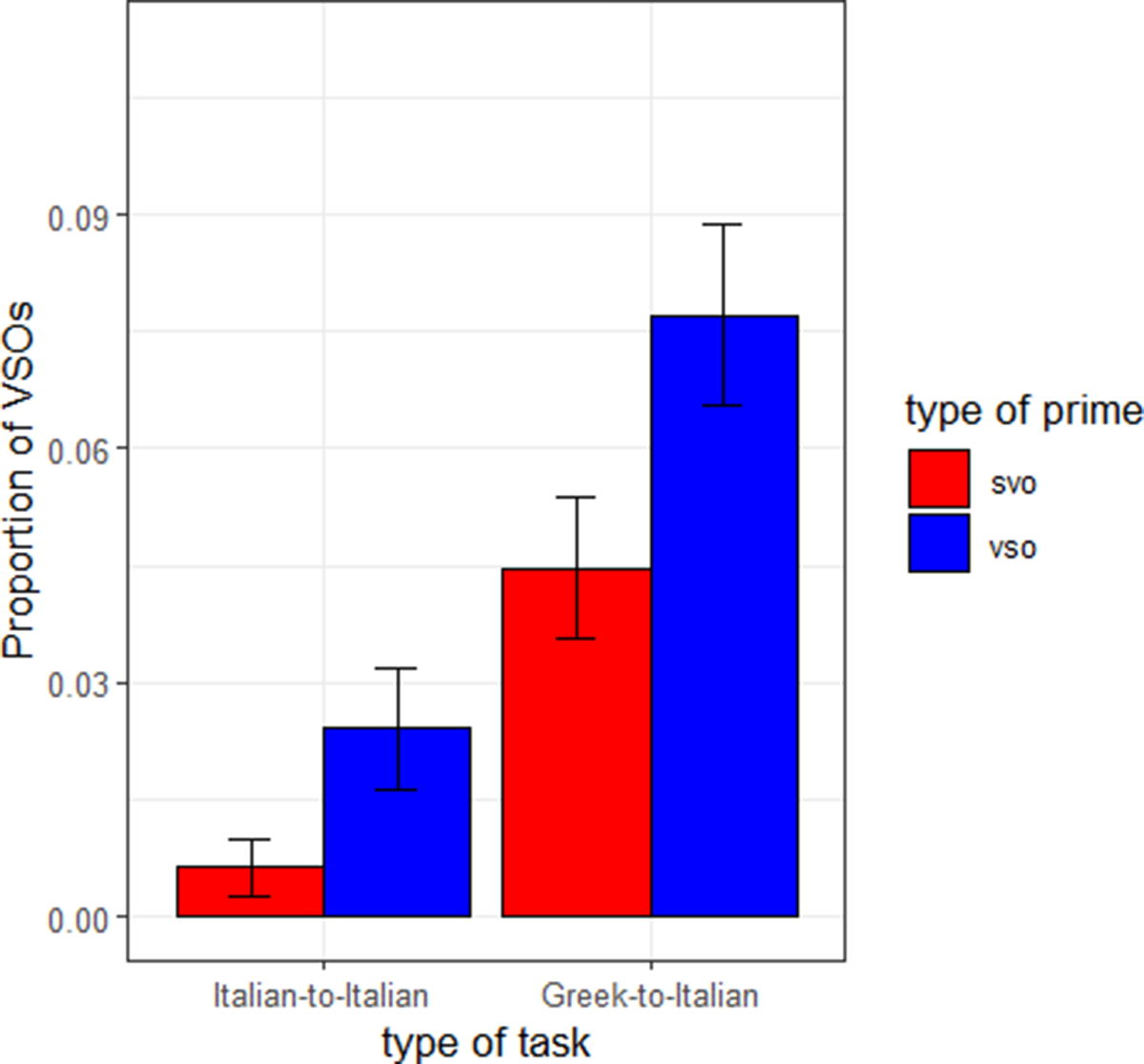
The bar plot in Figure 2 depicts the proportion of VSO sentences produced following SVO and VSO primes across the two tasks: the Italian-to-Italian and the Greek-to-Italian task (out of the total number of produced sentences per condition). In the Italian-to-Italian task, the proportion of VSO sentences following an SVO prime was 0.006 (SD = 0.079), compared to 0.024 (SD = 0.153) following a VSO prime. In the Greek-to-Italian task, the proportion of VSO sentences was 0.045 (SD = 0.207) following an SVO prime and 0.077 following a VSO prime (SD = 0.267) in the Greek-to-Italian task. These results indicate that VSO primes elicited a higher proportion of VSO sentence production than SVO primes in both tasks, with this effect being more visible in the Greek-to-Italian task.
Proportion and standard errors (+/− 1) of produced VSOs across primes (SVO versus VSO) and tasks (Italian-to-Italian and Greek-to-Italian).

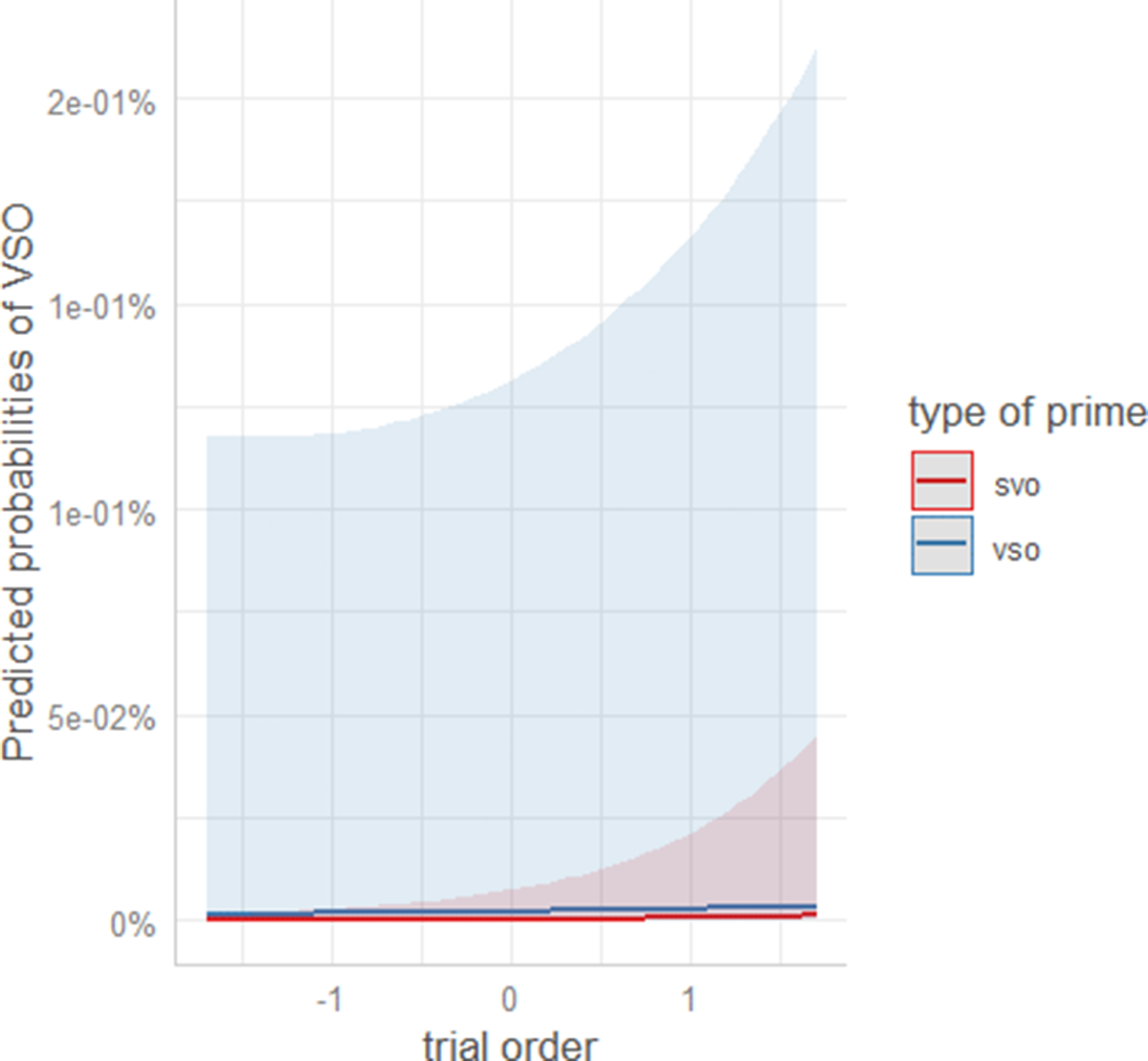
Table 1 presents the results of the first model, as discussed in Section 5.3. The analysis revealed no significant effect of the VSO-prime, but a significant effect of trial order, indicating that the participants produced an increasing number of VSO sentences as the experiment progressed. This suggests a cumulative priming effect within the task, while no trial-by-trial priming effect was observed. Additionally, a significant effect of the Greek-to-Italian task was found, showing that the participants produced more VSO sentences in this task. Moreover, an interaction between VSO prime and trial order was identified, revealing that the effect of trial order was more pronounced following SVO primes than VSO primes, as suggested by the negative estimate and the observation of Figure 3. It is important to note that the predicted probabilities in Figure 3 correspond to very small values, with considerable data dispersion, as indicated by the standard error values. The coefficient of discrimination associated with the fixed effects in the model is 60%.
Parameters of the generalized linear mixed-effects model predicting the likelihood of producing a VSO sentence based on prime type (SVO versus VSO), trial order and task type (Italian-to-Italian versus Greek-to-Italian)

Predicted probability of VSO sentence production as a function of prime type (SVO versus VSO) and trial order. Shaded areas represent 95% confidence intervals. Predicted probabilities were derived using the ggpredict() function from the “ggeffect” package (Lüdecke, Reference Lüdecke2018) and plotted. Trial order values have been scaled.

The second research question explored whether participants’ age and dominance in Greek influenced the production of VSO sentences. The results of the second model (m2 in footnote 2), presented in Table 2, corroborate the findings from Table 1, confirming significant effects of task type and trial order. However, the previously significant interaction between prime type and trial order was no longer significant. Additionally, we found significant interactions between task type and age, as well as between task type and dominance scores. Figure 4 (on the left side) visualizes the interaction between task type and age, showing that younger children exhibited a greater tendency to produce VSO sentences in the Greek-to-Italian task. In contrast, older children produced more VSO sentences in the Italian-to-Italian task. Notably, the significance of this interaction appears to be influenced more by data dispersion than by the average tendency, as indicated by the shaded confidence intervals. A similar pattern holds for the interaction between task type and dominance scores, as shown in Figure 4 (on the right side). The production of VSO sentences is more pronounced among Greek-dominant participants (on the left of the x-axis) in the Italian-to-Italian task and slightly more visible among Italian-dominant participants (on the right of the x-axis) in the Greek-to-Italian task.
Parameters of the generalized linear mixed-effects model predicting the likelihood of producing a VSO sentence based on task type (Italian-to-Italian versus Greek-to-Italian), and the interaction between prime type (SVO versus VSO) and trial order, as well as their respective interactions with age ad dominance

On the left: Predicted probability of VSO sentence production as a function of task type (Italian-to-Italian versus Greek-to-Italian) and age. Age values have been scaled. On the right: Predicted probability of VSO sentence production as a function of task type (Italian-to-Italian versus Greek-to-Italian) and dominance scores. Dominance scores have been scaled, with lower values indicating greater dominance in Greek. Shaded areas represent 95% confidence intervals. Predicted probabilities were derived using the ggpredict() function from the “ggeffect” package (Lüdecke, Reference Lüdecke2018) and plotted.

7. Discussion
7.1. Implicit learning and the connected-syntax account
The first key finding from this study is that certain structures in bilingual children can be primed after cumulative exposure, either within a single language (Italian) or from one language to another (Greek to Italian), even if these structures are inappropriate in the target language (Italian). In Section 2.3, we highlighted that VSO is a pragmatically inappropriate word-order in Italian. Nevertheless, we observed a progressive increase in VSO production in both the Italian-to-Italian task (after children were primed with inappropriate VSO structures in Italian) and the Greek-to-Italian task (after being primed with appropriate VSO structures in Greek), as shown by a significant effect of trial order (Section 6, Table 1). In contrast, no immediate, trial-by-trial priming effect emerged. Notably, this trend appeared in both the Italian-to-Italian and the Greek-to-Italian tasks. Additionally, a significant interaction between trial order and type of prime suggested that the increase in VSO production was especially notable following SVO primes. This interaction may account for the lack of a direct trial-by-trial priming effect, as VSO structures tended to follow both VSO and SVO sentences.
These findings suggest that VSO is learned implicitly over the course of the experiment (Chang et al., Reference Chang, Dell and Bock2006; Jaeger & Snider, Reference Jaeger and Snider2013). Specifically, the production of VSO sentences after SVO primes indicates that participants learned to use VSO in broad-focus contexts, regardless of the type of prime to which they were exposed. In Section 2.1, we discussed “surprisal effects” in language learning, where language input that does not align with participants’ predictions is initially perceived as surprising. As the experiment progresses, the processing system adapts to these new stimuli, resulting in increased production of the target structure (see reference to cumulative priming in Section 2.2). While implicit learning plays a role in both the Italian-to-Italian and the Greek-to-Italian tasks, the mechanisms driving this process differ substantially between the two conditions.
In the Italian-to-Italian task, only Italian is activated. This activation naturally reinforces SVO structures, as SVO is the only possible word-order in broad-focus contexts with transitive verbs. However, children are also exposed to a “new” structure, VSO, which is inappropriate in broad-focus contexts in Italian. Despite this, they seem to acquire it progressively throughout the experiment. This finding aligns with previous studies on adult monolingual speakers, demonstrating the possibility of priming inappropriate structures (Ivanova et al., Reference Ivanova, Pickering, McLean, Costa and Branigan2012). One possible explanation for children’s increased production of VSO is CLI from Greek, where this structure is allowed (as shown in the study by Skarabela & Serratrice, Reference Skarabela and Serratrice2009, based on within-language priming experiments). In other words, children may associate VSO in Italian with a “residual” activation of the corresponding structure in Greek. This hypothesis could be tested by comparing the magnitude of priming between the bilingual children in this study and Italian monolingual children. If the bilingual group produced VSO more frequently than the monolingual group, this would provide evidence in favour of CLI from Greek.
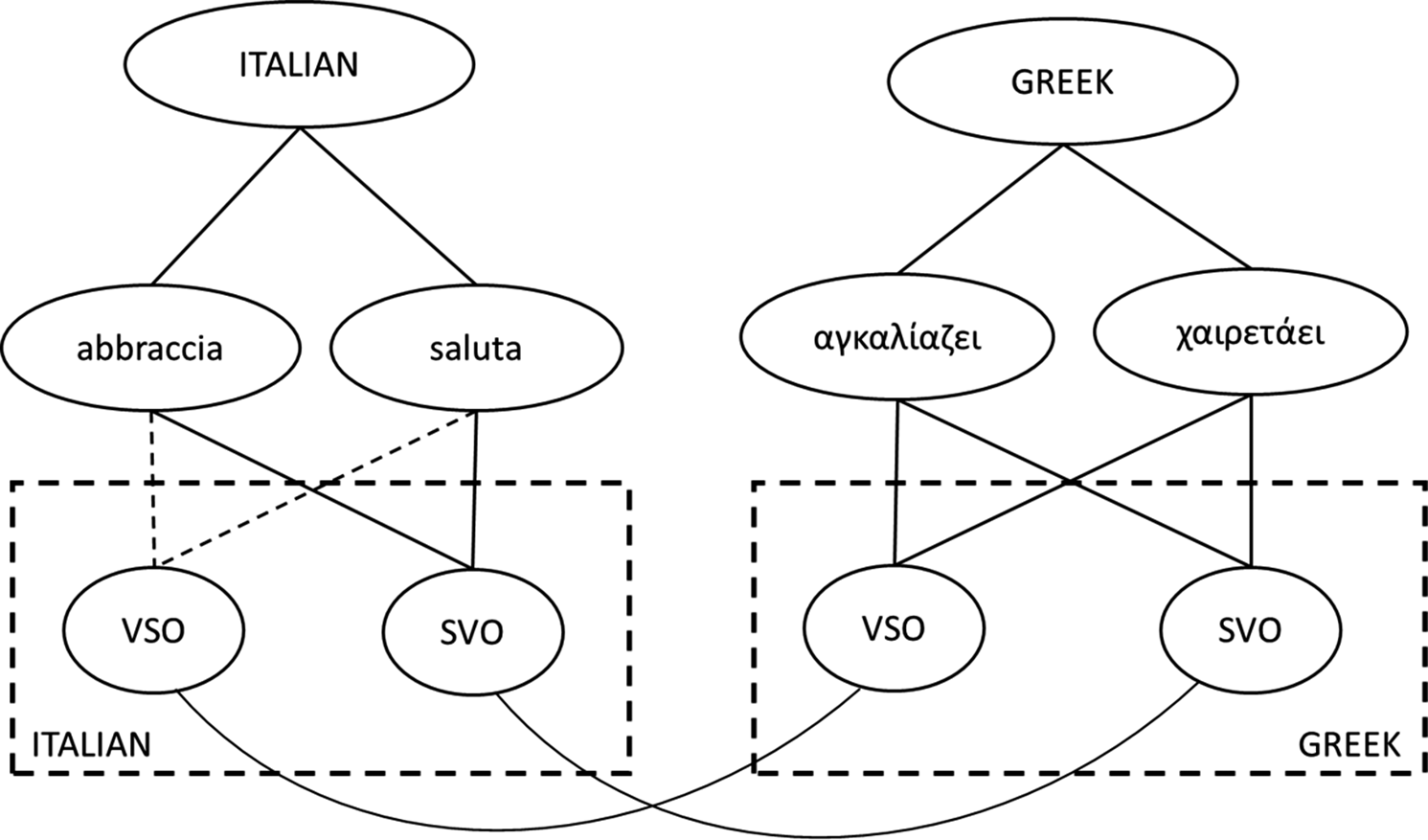
In the Greek-to-Italian task, both Greek and Italian are activated simultaneously. Because Greek allows both VSO and SVO in broad-focus contexts, the activation of Greek grammar likely strengthens the activation of both structures. The fact that children produced VSO in Italian suggests that the Greek VSO combinatorial node is linked to its Italian counterpart, even though VSO is generally contextually inappropriate in Italian (see Figure 5 for a visual representation). This supports the idea that combinatorial nodes are interconnected across languages, with the implicit learning of VSO in Italian being facilitated by the heightened activation of the VSO combinatorial node in Greek.
Model representing the VSO and SVO word orders in Italian and Greek among Greek–Italian bilinguals, following the connected-syntax account (adapted from Kantola & van Gompel, Reference Kantola and van Gompel2011, p. 280, Figure 3).

In summary, implicit learning of VSO in the Italian-to-Italian task appears to be driven by a “surprisal” effect caused by exposure to an unexpected structure, potentially reinforced by residual activation of VSO in Greek. In contrast, in the Greek-to-Italian task, implicit learning of VSO is primarily facilitated by the concurrent activation of VSO in Greek, which strengthens its representation in Italian.
Notably, our analysis reveals that these two learning mechanisms are associated with different magnitudes of priming, with a stronger effect observed in the Greek-to-Italian task. One possible explanation is that the Italian-to-Italian task was always administered first (see the Method section), meaning that children may have been more likely to produce VSO in the Greek-to-Italian task simply because they had already learnt the structure in the Italian-to-Italian task. Alternatively, this difference may stem from the activation of Greek in the Greek-to-Italian task, which could have enhanced CLI (see Section 7.3).
The present study design does not allow us to distinguish between these two hypotheses definitively. However, we lean towards the CLI-related explanation, as it aligns more closely with some empirical observations. First, even if we assume that the baseline level of VSO production differs between the Italian-to-Italian and Greek-to-Italian experiments due to task order, our results indicate that children continue to learn VSO throughout the Greek-to-Italian task. This suggests that the increased activation of Greek, rather than mere task order effects, plays a crucial role (as previously argued), as learning occurs regardless of whether children are exposed to Greek SVO or Greek VSO primes. Second, we conducted a post hoc analysis to examine whether the production of VSO sentences in the Greek-to-Italian and Greek-to-Greek tasks varied depending on their order of administration. As shown in Appendix 8 of the Supplementary Materials, this analysis found no effect of task order on VSO production in these two tasks. If task order influenced priming in the Italian-to-Italian and Greek-to-Italian tasks, one would expect a similar effect in the Greek-to-Italian and Greek-to-Greek tasks. The absence of such an effect makes it difficult to attribute the difference in priming magnitude solely to task administration order, further supporting the CLI-related hypothesis.
If future studies adopting a different design – where task administration order is manipulated – confirm our hypotheses, this would challenge a shared-syntax account, which predicts similar priming effects in both within-language (our Italian-to-Italian task) and across-language tasks (our Greek-to-Italian task; see Research Question 1 in Section 3 and Figure 2 above). Such findings would suggest that while VSO representations in Italian and Greek are structurally distinct, they remain interconnected, as evidenced by the production of VSO in Italian when the corresponding structure in Greek is activated. Nonetheless, the present study highlights the importance of testing the same children in both within- and across-language priming experiments (see Unsworth, Reference Unsworth2023 for a similar recommendation).
7.2. The role of age and language dominance
We examined how participants’ age and dominance in one language or the other influenced their production of VSO sentences across tasks. Two key findings emerged from the analysis. However, these results should be interpreted with caution, given the significant data dispersion observed in the results. First, we observed an interaction between task type and age, where younger children produced more VSO sentences in Italian during the Greek-to-Italian task. This result aligns with the earlier observation that VSO sentences are subject to implicit learning. In general, younger children are more receptive to learning than older ones (Section 2.2). In Section 2.3, we noted that although VSO is appropriate in Greek, it is less frequent than SVO, which likely generates a greater surprisal effect, especially for younger children with less language experience. Thus, our results suggest that younger children progressively learn VSO in Greek throughout the task and connect it to the corresponding combinatorial node in Italian. This is reflected in their increased production of VSO in Italian in the Greek-to-Italian task. Crucially, we did not observe this pattern in the Italian-to-Italian task, where no age effect was found. In fact, Figure 4 (on the left side) suggests a slight increase in the probability of producing VSO among older children. Since Greek is not activated in the Italian-to-Italian task and VSO is inappropriate in Italian, both younger and older children may find VSO equally surprising, leading to similar priming effects. Older children may be slightly more likely to reproduce the surprising structure because the VSO combinatorial role in Greek, to which they may link the VSO combinatorial role, is more entrenched in their grammar. Another possibility is that they are more able to align with their fictional interlocutor, as discussed in Section 2.2 (Costa et al., Reference Costa, Hernández and Sebastián-Gallés2008).
Regarding the role of dominance, Figure 4 (on the right side) shows that the more dominant the children were in Greek, the greater the number of VSO structures they produced in the Italian-to-Italian task. This finding is expected under the assumption that the VSO combinatorial node in Italian is connected to the corresponding node in Greek. In the Italian-to-Italian task (where Greek is not activated), this link is likely stronger among children more dominant in Greek. In other words, Greek is more strongly activated for these children, even though it is not directly involved in the task. It is therefore not surprising that the effect of dominance in Greek did not appear in the Greek-to-Italian task, as shown by the significant interaction between task type and dominance (Table 2). This result is anticipated, given that Greek is already strongly activated in the Greek-to-Italian task.
7.3. The implications for a theory of cross-linguistic effects
We suggest that the results of the present study have implications for understanding the mechanisms underlying CLI. However, before delving into our interpretations, it is important to acknowledge that the absence of an Italian monolingual group limits our ability to draw definitive conclusions regarding the interpretation of the Italian-to-Italian task. Further research is needed in this area. Regarding our findings, we argue that they provide new empirical evidence suggesting that partial structural overlap between languages is not a necessary condition for CLI to occur (pace Müller & Hulk, Reference Müller and Hulk2001): VSO does not overlap between Greek and Italian, as it is only a possible structure in broad-focus contexts in Greek. This aligns with Nicoladis’ (Reference Nicoladis2006) observation that noun-adjective phrases were produced in English by English–French bilingual children, despite the lack of overlap in word-order between English and French. In this sense, the present study extends Nicoladis’ findings from the nominal to the clausal domain.
Additionally, the results from the Italian-to-Italian and Greek-to-Italian tasks support an account of CLI in which both the activation of a morphosyntactic structure and the activation of bilinguals’ other language play a role, as suggested by Sharwood Smith and Truscott (Reference Sharwood Smith and Truscott2014) and Serratrice (Reference Serratrice2016, Reference Serratrice and Messenger2022). In the Italian-to-Italian priming experiment, the VSO structure was activated and became accessible within the children’s processing system, occasionally “winning” over competing structures (i.e., SVO). In the Greek-to-Italian task, both the VSO structure and the Greek language were activated. This dual activation led to an increasing production of VSO throughout the task and possibly to a greater magnitude of VSO production compared to the Italian-to-Italian task (provided that the issue of task administration order, raised above, is taken into account).
As discussed in Section 1, the activation of a bilingual’s other language may trigger the activation of morphosyntactic structures linked to it, even if those structures are not possible in the target language (Sharwood Smith & Truscott, Reference Sharwood Smith and Truscott2014:199). In this sense, our study – particularly the significant interaction between the type of prime (SVO and SVO) and trial order shown in Table 1 – is the first to show that the production of an inappropriate target structure (VSO in Italian) depends not only on the activation of the corresponding structure in the other language (VSO in Greek) but also on the activation of the other language itself (see also Westergaard, Reference Westergaard2019, Reference Westergaard2021 for a similar activation-related account in third language acquisition).
Furthermore, our study provides new evidence on the mechanisms underlying across-language priming. In particular, the finding that activation of Greek led to the production of VSO sentences in Italian suggests that the VSO combinatorial nodes in Greek and Italian are connected. Moreover, it indicates that the Greek language node is linked to the combinatorial node for VSO in Greek, which in turn connects to the corresponding VSO in Italian, as illustrated in Figure 5. Additionally, we observed that Greek-dominant children tended to produce a greater number of VSO structures in the Italian-to-Italian task, further supporting the idea of a cross-linguistic link between combinatorial nodes. We also provided indirect evidence for a connected-syntax account, mainly based on the different magnitude of priming observed in the Greek-to-Italian task compared to the Italian-to-Italian task, which would be difficult to explain only through task administration order effects. Finally, we contributed new empirical evidence on the relationship between priming and learning, demonstrating that the target structures are increasingly produced over the course of the experiment, especially by younger children. The next section will address the limitations of the study, focusing on the unanswered questions and areas for further investigation.
8. Limitations of the study
This study is one of the first ones to conduct within-language and across-language priming experiments with bilingual children, providing empirical evidence in support of an account of CLI based on language and structure activation. However, it should be considered exploratory in nature. First, the sample size is relatively small, which is a consequence of the difficulty in finding a representative set of participants from the target population. As a result, the investigation of individual variation in VSO production considering age and dominance should be interpreted with caution, as it was not based on a proper power calculation. Moreover, in several parts of the paper, we interpreted the production of VSO in the Italian-to-Italian task in terms of CLI from Greek, based on the assumption that the VSO combinatorial node is shared across Greek and Italian. However, we do not know whether monolingual children would behave similarly in the Italian-to-Italian task as the bilingual children in this study. If monolinguals were to produce the same results, a cross-linguistic account of VSO production would need to be revised. We decided not to include monolingual children in this study, opting instead to test bilingual children in one-language (Italian-to-Italian and Greek-to-Greek) and two-language modes to observe how the mode of testing affects their language outcomes. In this regard, the observation that our manipulation of structure and language activation led to different ways to implicitly learn the target structure (VSO) contributes to a deeper understanding of the mechanisms underlying CLI in bilingual sentence processing.
Supplementary material
The supplementary material for this article can be found at http://doi.org/10.1017/S1366728925000379.
Data availability statement
The data that support the findings of this study are openly available in OSF at https://osf.io/fz3pr/?view_only=978ec6bc4c184ddc8795fbe89ecb9ddf.
Acknowledgements
We are grateful to the Scuola Statale Italiana di Atene, its headmaster and the teachers who allowed us to collect data during the school hours. This research would not have been possible without the collaboration of the students who participated in this study with great enthusiasm, as well as their parents, who completed the questionnaires with great interest.
Competing interests
The authors declare none.
Ethical standard
The authors assert that all procedures contributing to this work comply with the ethical standards of the relevant national and institutional committees on human experimentation and with the Helsinki Declaration of 1975, as revised in 2008.






 Open access

