




During the Late Carboniferous, much of the land masses known today as Europe and North America were positioned near the equator. Warm, humid, swamp-forested and lacustrine environments covered their landscapes, represented in the geology today as coal measures (Clack Reference Clack2012). These environments were conducive to the diversification of non-marine insects, invertebrates and vertebrates, indicated by the increase in species richness seen throughout the Carboniferous fossil record (Dunne et al. Reference Dunne, Close, Button, Brocklehurst, Cashmore, Lloyd and Butler2018); these localities varied in water depth, local flora and proximity to oceans, resulting in a plethora of differing habitat types supporting diversification (Greb et al. Reference Greb, DiMichele, Gastaldo, Greb and DiMichele2006; Clack Reference Clack2012).
The Scottish Coal Measures are a widespread geological unit representing the diverse swamp forests and lacustrine environments of the Late Carboniferous. These coal measures are strata found in the Central Coalfield of the Midland Valley, Scotland, between the cities of Glasgow and Edinburgh (Elliott Reference Elliott2014). A subsection of these coal measures, the Scottish Lower Coal Measures, is dated to the Langsettian (319–318 million years ago (mya), also known as Westphalian A), a regional substage of the Westphalian (319–307 mya) (Elliott Reference Elliott2014). The Scottish Lower Coal Measures are notable for their excellent preservation of tetrapod and fish fossils, especially as the Langsettian is a globally undersampled substage for vertebrate fossils (Elliott et al. Reference Elliott, Challands and Smithson2023).
Scotland has an extensive record of tetrapod material, exemplified by prolific localities such as the East Kirkton Quarry, a limestone deposit of Viséan age (mid-Early Carboniferous) near the town of Bathgate (Clack et al. Reference Clack, Smithson and Ruta2022). However, the Scottish fossil record from the Westphalian stage is sparse. Only two major tetrapod groups have been previously found in Scottish Westphalian localities: Embolomeri and Baphetoidea (Table 1; Smithson Reference Smithson1985a). Tetrapod groups with temporal ranges encompassing the Westphalian from elsewhere that have yet to be discovered in Scottish Westphalian localities include Aïstopoda, Temnospondyli, Seymouriamorpha, Microsaura, Lysorophia, Nectridea, Colosteidae and Amniota (Clack Reference Clack2012).
Updated stratigraphic record of tetrapod genera found in Carboniferous Scotland localities. Ages of specimens and formations are according to the listed publications, Browne et al. (Reference Browne, Gould, Akhurst, Monaghan and Reeves2025) and the British Geological Survey.

Table 1 Long description
The table presents the stratigraphic record of tetrapod genera found in Carboniferous Scotland localities. It includes columns for Genus, Group, Formation, Regional substage, Regional stage, Global stage, and Description. The table has 40 rows and 7 columns. Row 1: Genus, Group, Formation, Regional substage, Regional stage, Global stage, Description. Row 2: Baphetes, Baphetoidea, Middle Coal Measures; Upper Coal Measures, Langsettian; Duckmantian; Bolsovian, Westphalian, Bashkirian; Moscovian, Beaumont (1977), Milner & Lindsay (1998). Row 3: Megalocephalus, Baphetoidea, Lower Coal Measures; Middle Coal Measures, Langsettian; Duckmantian; Bolsovian, Westphalian, Bashkirian; Moscovian, Beaumont (1977). Row 4: Anthracosaurus, Embolomeri, Middle Coal Measures, Duckmantian, Westphalian, Bashkirian, Panchen (1977). Row 5: Pholiderpeton, Embolomeri, Lower Coal Measures; Middle Coal Measures, Langsettian; Duckmantian, Westphalian, Bashkirian, Panchen (1972), Clack (1987). Row 6: Palaeorhpeton, Embolomeri, Lower Coal Measures, Langsettian, Westphalian, Bashkirian, Panchen (1964). Row 7: Albadris, Nectridea, Lower Coal Measures, Langsettian, Westphalian, Bashkirian, gen. nov. Herring et al. (Fig. 1a-f). Row 8: Proterogyrinus, Embolomeri, Limestone Coal, Pendleian, Namurian, Serpukhovian, Smithson (1986). Row 9: Adelogyrinus, Adeiospondyli, Limestone Coal, Pendleian, Namurian, Serpukhovian, Andrews & Carroll (1991). Row 10: Caerorhachis, Indeterminate, Limestone Coal, Pendleian, Namurian, Serpukhovian, Ruta et al. (2001). Row 11: Acherontiscus, Indeterminate, Limestone Coal, Pendleian, Namurian, Serpukhovian, Carroll (1969), Clack et al. 2019. Row 12: Dorygnathus, Indeterminate, Limestone Coal, Pendleian, Namurian, Serpukhovian, Smithson (1980), Smithson & Clack (2013). Row 13: Loxomma, Baphetoidea, Lower Limestone; Lower Coal Measures; Middle Coal Measures, Brigantian; Langsettian; Duckmantian, Viséan; Westphalian, Bashkirian, Beaumont (1977). Row 14: Eoherpeton, Embolomeri, Lower Limestone; Limestone Coal, Brigantian; Pendleian, Viséan; Viséan, Panchen (1975), Smithson (1985b), Porro et al. (2024). Row 15: Crassigyrinus, Indeterminate, Lower Limestone; Limestone Coal, Brigantian; Pendleian, Viséan; Viséan, Panchen (1985), Clack (1997), Herbst & Hutchinson (2019), Porro et al. (2022). Row 16: Pholidogaster, Colosteidae, Lower Limestone, Brigantian, Viséan, Viséan, Panchen (1975). Row 17: Balanerpeton, Temnospondyli, West Lothian Oil-Shale, Brigantian, Viséan, Viséan, Milner & Sequeira, (1993). Row 18: Ophiderpeton, Astopoda, West Lothian Oil-Shale, Brigantian, Viséan, Viséan, Milner (1993). Row 19: Palaeomolgophis, Adeiospondyli, West Lothian Oil-Shale, Asbian, Viséan, Viséan, Andrews & Carroll (1991). Row 20: Dolichopareias, Adeiospondyli, West Lothian Oil-Shale, Asbian, Viséan, Viséan, Andrews & Carroll (1991). Row 21: Adelogyrinus, Adeiospondyli, West Lothian Oil-Shale, Asbian, Viséan, Viséan, Andrews & Carroll (1991). Row 22: Westlothiana, Indeterminate, West Lothian Oil-Shale, Brigantian, Viséan, Viséan, Smithson et al. (1993). Row 23: Silvanerpeton, Indeterminate, West Lothian Oil-Shale, Brigantian, Viséan, Viséan, Ruta & Clack (2006). Row 24: Eldeceeon, Indeterminate, West Lothian Oil-Shale, Brigantian, Viséan, Viséan, Smithson (1993), Ruta et al. (2020). Row 25: Eoarctos, Indeterminate, West Lothian Oil-Shale, Brigantian, Viséan, Viséan, Clack (1998). Row 26: Kirktonecta, Indeterminate, West Lothian Oil-Shale, Brigantian, Viséan, Viséan, Clack (2011). Row 27: Termonperpeton, Indeterminate, West Lothian Oil-Shale, Brigantian, Viséan, Viséan, Clack et al. (2022). Row 28: Spathicephalus, Baphetoidea, Anstruther; Limestone Coal, Asbian; Pendleian, Viséan; Viséan, Beaumont & Smithson (1998), Smithson et al. (2017). Row 29: Cusineria, Indeterminate, Gullane, ?Asbian, Viséan, Viséan, Paton et al. (1999). Row 30: Lethiscus, Astopoda, Gullane, ?Holkerian-Asbian, Viséan, Viséan, Wellstead (1982). Row 31: Tantiilongnathus, Indeterminate, Ballagan, ?Tournaisian, ?Tournaisian, ?Viséan, Chen et al. (2017). Row 32: Mesanerpeton, Indeterminate, Ballagan, Indeterminate, Tournaisian, Tournaisian, Smithson & Clack (2017). Row 33: Aytonerpeton, Indeterminate, Ballagan, Courcyean, Tournaisian, Tournaisian, Clack et al. (2016). Row 34: Diploradus, Indeterminate, Ballagan, Courcyean, Tournaisian, Tournaisian, Clack et al. (2016). Row 35: Osirrus, Indeterminate, Ballagan, Courcyean, Tournaisian, Tournaisian, Clack et al. (2016), Smithson et al. (2024). Row 36: Perittodus, Indeterminate, Ballagan, Courcyean, Tournaisian, Tournaisian, Clack et al. (2016). Row 37: Kolops, Indeterminate, Ballagan, Courcyean, Tournaisian, Tournaisian, Clack et al. (2016). Row 38: Pederpes, Indeterminate, Ballagan, Courcyean, Tournaisian, Tournaisian, Clack (2002).
We here describe material recently discovered in the Scottish Lower Coal Measures. The material includes eight disarticulated fossils belonging to four major tetrapod groups: Nectridea, Embolomeri, Baphetoidea and Temnospondyli. The nectridean fossil is the first of its group discovered in Scotland and belongs to a new genus and species, whose affinities we studied using a phylogenetic analysis. These new discoveries prompted us to review the Scottish Carboniferous tetrapod fossil record and provide an updated catalogue of specimens arranged stratigraphically.
1. Materials and methods
1.1. Geological setting
The fossils included in this study were collected from coal waste tips of two redundant collieries within the Central Coalfield of the Midland Valley of Scotland:
-
(1) Ardenrigg, at Wester Bracco [55.870131, −3.877097]
-
(2) Calderhead, near Shotts [55.834885, −3.793959].
The fossils were collected from shales associated with the Drumgray Coals, lying within the Communis Chronozone (Elliott et al. Reference Elliott, Challands and Smithson2023). These two localities fall within the Scottish Lower Coal Measures Formation of Langsettian age (Browne et al. Reference Browne, Dean, Hall, McAdam, Monro and Chisholm1999; Elliott Reference Elliott2014; Elliott et al. Reference Elliott, Challands and Smithson2023). The shales are rich with molluscs, brachiopods, arthropods and crustaceans, indicating that these specific localities were once shallow, freshwater or brackish environments (Elliott et al. Reference Elliott, Challands and Smithson2023; Elliott & Giles Reference Elliott and Giles2024).
1.2. Specimen preparation and study
All fossil specimens described in this study are accessioned at the National Museums Scotland, abbreviated as NMS throughout the text.
The fossils were collected from finely laminated carbonaceous shales, siltstones and mudstones. Collected blocks were split using sharp wood-chisels, and a Swann-Morton scalpel with a no. 25 blade was used to separate thinly laminated layers and remove unwanted matrix.
Photographs of smaller specimens were taken using a Leica IC80 HD camera fitted to a Leica M80 routine stereo zoom microscope. Photo dimensions were 2,048 × 1,536 pixels with a horizontal and vertical resolution of 300 dpi. Photos of larger specimens were taken using a Kodak Z740 digital zoom camera with two x10 macro close-up lenses connected in tandem. Camera sensitivity was set at ISO 80 with f/8 and exposure time of 1 to ¼s. All illustrative figures were prepared using Inkscape v1.3.2.
One specimen (NMS G.2025.13.23) was scanned by means of X-ray computed microtomography (µCT) at the Grant Institute, University of Edinburgh School of GeoSciences. Data were acquired at a peak energy of 120 keV, a target power of 17 W with 2,000 projections of 2 s exposure collected through a full 360° rotation of the sample. Tomographic reconstruction was by filtered back projection using Octopus v8.9 software. The scan data were initially processed in Fiji image processing software before being imported into Mimics 25.0 segmentation software. Three-dimensional models were made in Mimics using multiple slice editing techniques.
1.3. Systematic palaeontology
Albadris smithsoni gen. et sp. nov. Type specimen NMS G.2025.13.23. (a) Lower jaw of Albadris smithsoni seen in medial view. (b) Line drawing of same lower jaw showing ornamentation. (c) Impression of lower jaw of Albadris smithsoni and counterpart of specimen from (a). (d) Line drawing of same counterpart showing ornamentation. (e) Anatomical interpretation of same lower jaw. Abbreviations: ang = angular; art = articular; cor = coronoid; d = dentary; prt = prearticular; sa = surangular; sl = splenial; smph = symphysis. (f) µCT scan reconstruction of same lower jaw. Key: ang = purple; art = green; cor = orange; d = yellow; prt = red; sa = pink; sl = cyan; smph = magenta. Scale bar represents 2.0 mm.

Etymology. Albadris: compound word formed from Alba, the Scottish Gaelic word for Scotland, and dris, the Scottish Gaelic word for thorn; smithsoni: after palaeontologist Dr. Timothy R. Smithson, for his contribution to the discovery and description of tetrapods and other faunas from the Carboniferous of Scotland.
Holotype. NMS G.2025.13.23. Nearly complete lower left mandible (Fig. 1a) and counterpart (Fig. 1c).
Locality and horizon. Shale overlying the Drumgray Coals, Ardenrigg, at Wester Bracco, North Lanarkshire, Scotland [55.870131, −3.877097]
Diagnosis. Autapomorphies of Albadris among Nectridea: single enlarged fang at anterior end of toothrow; coronoid elongate with large dentition along posterior; angular elongate and dorsally expanded.
Potential clade synapomorphies. Diplocaulidae features: short, stout mandible; dentary with conical to peg-like dentition along half of margin; large coronoid dentition; expanded prearticular; large, crested and posteriorly expanded surangular; well-developed retroarticular process; broad symphysis (Carroll et al. Reference Carroll, Bossy, Milner, Andrews and Wellstead1998; Milner & Ruta Reference Milner and Ruta2009).
Urocordylidae features: expanded prearticular with denticles, splenial fenestrae, size of dentary dentition increasing anteriorly (Carroll et al. Reference Carroll, Bossy, Milner, Andrews and Wellstead1998).
Discussion. A mandible is preserved in medial view (Fig. 1a). The mandible is stout, narrowing slightly anteriorly. The dentary contains eight teeth of varying size with room for six to 12 more. The front tooth is an enlarged fang while all others are conical or peg-shaped. A single coronoid is present, with four to five coronoid teeth preserved on the posterior half of the bone and of comparable size to the dentary teeth. The anterior half of the coronoid was partially damaged when the shale was split, making the distinction between the coronoid and dentary unclear. The surangular is large, dorsally crested, and features grooves for articulation with the prearticular. The prearticular is fractured, missing much of its posterior half where it looks to have overlapped with the surangular and angular, although small denticles are present on what is preserved of the anterior half. The articular is small, wedged between the surangular and angular. The retroarticular process is well developed though damaged and located below the dentary tooth row. The angular is large and dorsally expanded, with grooves for articulation with prearticular. The splenial is small and reduced, and the anterior portion is obscured by the rock matrix. The splenial appears to have two thin fenestrae, obscured by the rock matrix but visible in the µCT scan (Fig. 1f). The symphysis is broad at the anterior end of the mandible and assumed to not be tightly sutured as the right half of the mandible is not present. Fragments of the mandible, such as an anterior portion of the coronoid, are preserved in the counterpart of the specimen (Fig. 1c). The anteroposterior length is 10.7 mm and the dorsoventral width is 3.3 mm.
The short, stout shape of the mandible, shorter marginal tooth row, peg-like dentition, single coronoid with large teeth, crested surangular, expanded prearticular, absence of a postsplenial and broad symphysis are diagnostic mandibular characters of diplocaulid nectrideans (Carroll et al. Reference Carroll, Bossy, Milner, Andrews and Wellstead1998; Milner & Ruta Reference Milner and Ruta2009). The retroarticular process positioned relatively below the dentary tooth row is also shared by more derived diplocaulids (Carroll et al. Reference Carroll, Bossy, Milner, Andrews and Wellstead1998). The general shape and size of the fossil, notably the stoutness of the jaw, is comparable with diplocaulid Diploceraspis, along with the peg-like dentition (Beerbower Reference Beerbower1963, fig. 7). However, Diploceraspis does not have large posterior coronoid dentition, denticles on the prearticular or splenial fenestrae (Beerbower Reference Beerbower1963); prearticular denticles and splenial fenestrae have previously only been observed in nectrideans belonging to Urocordylidae, not Diplocaulidae (Carroll et al. Reference Carroll, Bossy, Milner, Andrews and Wellstead1998). Other diplocaulid nectrideans also do not have such a prominent fang at the front of the mandible and do not exhibit such a large discrepancy in dentition size, unlike urocordylids (Carroll et al. Reference Carroll, Bossy, Milner, Andrews and Wellstead1998). The combination of a stout jaw, large posterior coronoid teeth, prearticular denticles and splenial fenestrae seen in Albadris is unique among nectrideans, as is the enlarged fang.
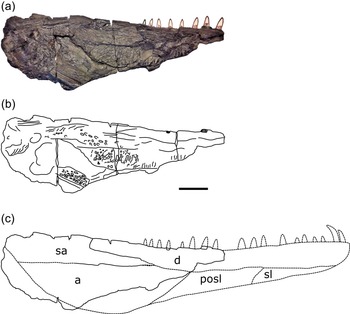
(a) Lower jaw, NMS G.2025.13.2, of a baphetoid, with hypothetical teeth added to distinguish the tooth sockets. (b) Line drawing of same lower jaw showing ornamentation. (c) Reconstruction of same lower jaw (bottom, based on Baphetes from Beaumont Reference Beaumont1977). Abbreviations: a = angular, d = dentary, posl = postsplenial, sa = surangular, sl = splenial. Scale bar represents 20 mm.

Locality and horizon. Shale overlying the Drumgray Coals, Ardenrigg, at Wester Bracco, North Lanarkshire, Scotland [55.870131, −3.877097]
Discussion. A partial mandible (NMS G.2025.13.2) is preserved in lateral view (Fig. 2a). The surangular is mostly intact, only missing the posterodorsal corner where the surangular meets the articular. The dentary is partially preserved, missing the anterior half. The angular is mostly preserved though the anteroventral portion is missing. The postsplenial is mostly or entirely missing while the splenial is entirely missing. Sutures are difficult to identify by nature of the cracking in the specimen, but partial sutures for the dentary and surangular and the surangular and angular are identified. The stumps of eight teeth are noticeable within the dentary, two of which are clearly fluted. The lateral line is identifiable on the ventral portion of the angular. There is prominent pit-and-ridge ornamentation present on the angular and surangular portions. The mesial surface is unpreserved. The length of the preserved portion of the mandible is 158 mm with a maximum jaw depth of 57 mm.
The jaw closely resembles Baphetes for its size, its large, conical, fluted dentary teeth, lateral line sulci along its margin and pit-and-ridge ornamentation covering the lateral surface of the angular and surangular (Beaumont Reference Beaumont1977, fig. 24e). Based on comparison with previously described Baphetes specimens, the total length of the mandible would have been around 235 mm (Beaumont Reference Beaumont1977; Clack Reference Clack2003). The lower jaws of many baphetoids are either unknown or partially known, so there is not enough information to confidently classify the specimen to a genus.
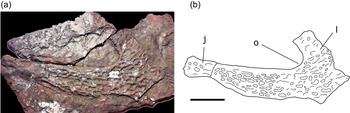
(a) Partial lacrimal and jugal, NMS G.2025.13.3, of a baphetid. (b) Line drawing of same lacrimal and jugal showing ornamentation. Abbreviations: j = jugal, l = lacrimal, o = orbital margin. Scale bar represents 20 mm.

Locality and horizon. Shale overlying the Drumgray Coals, Ardenrigg, at Wester Bracco, North Lanarkshire, Scotland [55.870131, −3.877097]
Discussion. Portions of the right lacrimal and jugal (NMS G.2025.13.3) of a baphetoid are preserved in dorsal view (Fig. 3). The orbital margin is a ‘keyhole’ shape, diagnostic of the baphetoids (Beaumont Reference Beaumont1977). Lacrimal margins with maxilla, nasal, and possibly prefrontal, are present. The suture between lacrimal and jugal is obscured by dermal ornament. Pit-and-ridge ornamentation is present across the entire surface. No lateral lines are discernible. The anteroposterior length is 97 mm and the lateral width is 41 mm.
The size of the specimen, shape of the orbital margin and pit-and-ridge ornamentation are similar to previously described specimens of Baphetes (Beaumont Reference Beaumont1977, fig. 21; Milner & Lindsay Reference Milner and Lindsay1998, fig. 1), though genus-level identification is not certain because of the paucity of material. The length of the specimen from posterior to dorsal end is 97 mm; if the entire length of the lateral orbital margin is preserved, then, based on the dimensions of Baphetes (Beaumont Reference Beaumont1977), the specimen is estimated to have had a total midline skull length of 330 mm.
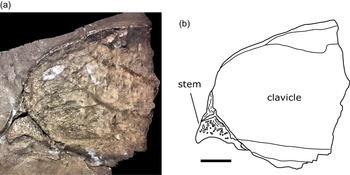
(a) Clavicle (NMS G.2025.13.3) of a probable embolomere in dorsal view. (b) Line drawing of same clavicle showing ornamentation. The left edge of the figure is lateral. Scale bars represent 20 mm.

Locality and horizon. Shale overlying the Drumgray Coals, Ardenrigg, at Wester Bracco, North Lanarkshire, Scotland [55.870131, −3.877097]
Discussion. A slender, crescentic clavicle (NMS G.2025.13.3) featuring the portion of a clavicular stem is preserved in dorsal (internal) view (Fig. 4). The clavicle is broken on its medial margin. The dorsal surface is smooth, lacking dermal ornament. The clavicle curves dorsally at the anterior and posterior margins. The stem of the clavicle is fractured where it would otherwise be received by the cleithrum. The anteroposterior length of the clavicle is 100 mm and the lateral width (excluding the stem) is 91 mm. The cross-sectional length of the stem is 28 mm and the cross-sectional width is 28 mm.
The size and shape of the clavicle, the shape of the clavicular stem and the smoothness of the internal clavicular surface are comparable to the clavicle of the contemporary Pholiderpeton (Clack Reference Clack1987, figs. 28, 29) and Lower Carboniferous embolomere Proterogyrinus (Holmes Reference Holmes1984, fig. 25; Smithson Reference Smithson1986, fig. 9).
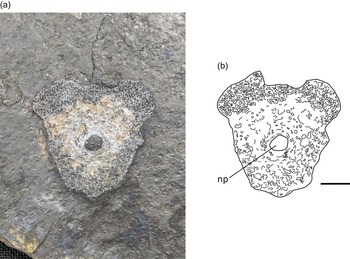
(a) Pleurocentrum (NMS G.2025.13.39) of an embolomerous vertebra in posterior view. (b) Line drawing of same pleurocentrum showing ornamentation. The top edge of the figure is dorsal. Abbreviations: np = notochordal pit. Scale bar represents 5.0 mm.

Locality and horizon. Shale overlying the Drumgray Coals, Ardenrigg, at Wester Bracco, North Lanarkshire, Scotland [55.870131, −3.877097]
Discussion. A pleurocentrum (NMS G.2025.13.39) from the vertebra of an embolomere is preserved in posterior view (Fig. 5). The pleurocentrum is fully embolomerous as it is enlarged and completely fused to form a ring-like structure. The pleurocentrum has two large, symmetrical laterodorsal facets for articulation with the neural arch. The interior texture is spongy and denser towards the centre, indicating that the surface of the bone has been slightly eroded to reveal the interior bone marrow. There is a large notochordal pit in the centre. The dorsoventral length is 19.3 mm and the lateral width is 21.1 mm. The maximum diameter of the notochordal pit is 3.0 mm, while the minimum diameter is 2.7 mm.
The size and structure of the fossil are comparable to the embolomerous pleurocentra of the contemporary embolomere Pholiderpeton and Permian embolomere Archeria (Clack Reference Clack1987, figs. 20, 21).
(a) Dermal scale (NMS G.2025.13.51) of an embolomere in internal view. (b) Line drawing of same scale showing ornamentation. Scale bar represents 4.0 mm.

Locality and horizon. Shale from the Drumgray Coal, Calderhead, near Shotts, North Lanarkshire, Scotland [55.834885, −3.793959]
Discussion. A ventral dermal scale (NMS G.2025.13.51), or scute, is preserved in internal view (Fig. 6). The scale is shaped like a wedge, with one end broadly spatulate and the other end tapering narrowly. There is a prominent though shallow sigmoid ridge on the surface forming a Y-shaped structure, which may have attached to the dermis. The length is 25.7 mm and the width is 9.2 mm.
The fossil bears strong resemblance in size and shape to many of the scales of the contemporary embolomere Pholiderpeton (also known as Eogyrinus) (Panchen Reference Panchen1972, fig. 15; Clack Reference Clack1987, fig. 31).
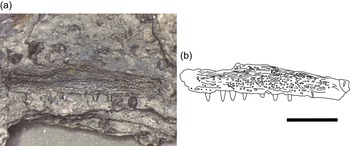
(a) Fragment of temnospondyl maxilla (NMS G.2025.13.6). (b) Line drawing of same maxilla fragment showing ornamentation. The right edge of the figure is posterior. Scale bar represents 3.0 mm.

Locality and horizon. Shale overlying the Drumgray Coals, Ardenrigg, at Wester Bracco, North Lanarkshire, Scotland [55.870131, −3.877097]
Discussion. The posterior half of a maxilla (NMS G.2025.13.6) is preserved in lateral view (Fig. 7). Pit-and-ridge ornamentation is uniform across the entire fossil. The teeth are straight, conical and non-fluted. Four teeth are exposed and the impressions of three more are visible in the matrix; there is space for an extra tooth between each tooth present. The dorsal margin for articulation with the jugal is straight and seems to be broken around the anterior margin of the jugal. The maxilla is broken at the anterior and posterior ends. No lateral line sulci are present. The anteroposterior length is 10.1 mm and the dorsoventral width (not including dentition) is 1.9 mm. The longest exposed tooth is 0.5 mm.
The size of the maxilla, the size and shape of the teeth and the density of pit-and-ridge ornamentation are comparable to Dendrerpeton and Dendrysekos, small temnospondyls found in Langsettian deposits in Ireland and Nova Scotia (Milner Reference Milner1980, fig. 2; Godfrey et al. Reference Godfrey, Fiorillo and Carroll1987, fig. 1; Holmes et al. Reference Holmes, Carroll and Reisz1998, fig. 3; Schoch & Milner Reference Schoch and Milner2014, fig. 16).
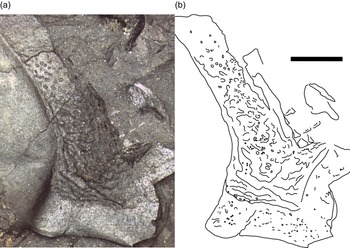
(a) Partial pterygoid of a temnospondyl in ventral view (NMS G.2025.13.46). (b) Line drawing of same pterygoid showing ornamentation. The left edge of the figure is medial. Scale bar represents 2.0 mm.

Locality and horizon. Shale overlying the Drumgray Coals, Ardenrigg, at Wester Bracco, North Lanarkshire, Scotland [55.870131, −3.877097]
Discussion. A partial left pterygoid (NMS G.2025.13.46) is exposed in ventral view (Fig. 8). The lateral and posterior margin of the interpterygoid vacuity is present. Denticles cover most of the pterygoid and these denticles are dense anteriorly and sparse posteriorly. The lateral edge of the pterygoid is broken, so the margin where the pterygoid meets the ectopterygoid is not visible, though small remnants of the ectopterygoid appear to be present. Additionally, the posterior end of the pterygoid is broken where a posterolateral flange would be expected. The anteroposterior length is 10.4 mm, the lateral width of the posterior end is 6.3 mm and the lateral width of the anterior end is 1.5 mm.
The size of the pterygoid, the curvature of the margin for the interpterygoid vacuity and the density of the denticles are comparable to the pterygoids of Dendrerpeton and Dendrysekos (Milner Reference Milner1980, fig. 4; Godfrey et al. Reference Godfrey, Fiorillo and Carroll1987, fig. 2; Holmes et al. Reference Holmes, Carroll and Reisz1998, fig. 4; Schoch & Milner Reference Schoch and Milner2014, fig. 17).
2. Phylogenetic analysis of Albadris smithsoni
2.1. Data matrices
To test the phylogenetic position of Albadris, we conducted phylogenetic analyses using two data matrices: those published by Milner & Ruta (Reference Milner and Ruta2009) and Ahlberg & Clack (Reference Ahlberg and Clack1998).
We first used the data matrix from Milner & Ruta (Reference Milner and Ruta2009), a descriptive revision of Scincosaurus that included a phylogenetic analysis of nectrideans. It is the most up-to-date and broadest scale phylogenetic dataset for nectrideans. The data matrix includes the stem tetrapod Eucritta melanolimnetes (designated as the outgroup), an embolomere, two temnospondyls, a microsaur, three aïstopods and 11 nectrideans. A total of 173 characters were included (109 cranial characters and 64 postcranial characters). Our only change to the published dataset was the inclusion of the newly described Albadris smithsoni (Fig. 1; see supplementary material available at https://doi.org/10.1017/S1755691026101042 for the updated character information). The second data matrix used was from Ahlberg & Clack (Reference Clack1998) and included 26 early tetrapods and 50 characters only pertaining to the lower jaw. We chose to also use this dataset because its rich sampling of lower jaw characters is well suited for testing the phylogenetic position of Albadris, as its holotype is simply a lower jaw. Similar to the first analyses, our only change was the inclusion of Albadris smithsoni.
We subjected the Milner & Ruta (Reference Milner and Ruta2009) data matrix to both Bayesian and parsimony analyses. We performed Bayesian Inference MCMC (Markov chain Monte Carlo) phylogenetic analyses using MrBayes v3.2.7 (Ronquist et al. Reference Ronquist, Teslenko, van der Mark, Ayres, Darling, Höhna, Larget, Liang, Suchard and Huelsenbeck2012). Four Markov chains were run for 10,000,000 generations, sampling every 1,000 generations. The first 25 % of samples were discarded. The majority consensus tree composed of the 99 % credibility interval of the posterior density was used (Fig. 9). Effective sample size was checked to be greater than 200 to confirm that sample size was large enough accounting for autocorrelation and burn-in. Clade support was assessed using posterior probabilities. We then performed parsimony analyses using TNT v1.6 (Goloboff et al. Reference Goloboff, Farris and Nixon2008). A ‘New Technology’ search was conducted, with default parameters for sectorial search, ratchet, tree drift and tree fusion. The minimum tree length was recovered in ten replicates, returning three most parsimonious trees (steps = 392, consistency index = 0.531, retention index = 0.648). The trees were subject to an additional round of tree bisection and re-connection (TBR) branch swapping, although this recovered no new trees. The three most parsimonious trees were then combined into a strict consensus tree (Fig. 10). Clade support was assessed using jackknife resampling (1,000 replicates, 36 % character removal) and Bremer support values.
Consensus topology from the Bayesian Inference analysis using the Milner & Ruta (Reference Milner and Ruta2009) matrix. Posterior probabilities are indicated at each node.

Strict consensus of three most parsimonious trees retrieved from the parsimony analysis conducted using the Milner & Ruta (Reference Milner and Ruta2009) matrix (steps = 392, consistency index = 0.531, retention index = 0.648). Bremer and jackknife support values are indicated at each node.

Figure 10 Long description
A phylogenetic tree diagram showing the relationships among various tetrapod genera found in Carboniferous Scotland localities. The tree starts with Tetrapoda and branches out into different groups, including Lepospondyli and Aistopoda. Each branch is labeled with the genus names such as Eucritta, Dendrerepeton, Balanerpeton, Proterogyrinus, Microbrachis, Lethiscus, Phlegethontia, Ophiderpeton, Sauropleura, Crossotelos, Urocordylus, Ptyonius, Ctenerpeton, Scincosaurus, Keraterpeton, Batrachiderpeton, Diceratosaurus, Diplocaulus, Albadris, and Diplocerapsis. The diagram includes Bremer and jackknife support values indicated at each node, showing the strength of the relationships between the different genera.
These Bayesian and parsimony methods were repeated using the Ahlberg & Clack (Reference Clack1998) matrix. The Bayesian analysis was conducted using the same parameters and a majority consensus tree was recovered (Fig. 11). For the maximum parsimony analysis, the minimum tree length was recovered in ten replicates following a ‘New Technology’ search with the same parameters, returning 21 most parsimonious trees (steps = 113, consistency index = 0.504, retention index = 0.723). The trees were subject to additional TBR branch swapping though no new trees were recovered. The 21 most parsimonious trees were then combined into a strict consensus tree (Fig. 12).
Consensus topology from the Bayesian Inference analysis using the Ahlberg & Clack (Reference Clack1998) matrix. Posterior probabilities are indicated at each node.

Strict consensus of 20 most parsimonious trees retrieved from the parsimony analysis conducted using the Ahlberg & Clack (Reference Clack1998) matrix (steps = 113, consistency index = 0.504, retention index = 0.723). Bremer and jackknife support values are indicated at each node.

Figure 12 Long description
A phylogenetic tree diagram showing the relationships among various tetrapod genera found in Carboniferous Scotland localities. The tree includes branches representing different genera, with labels indicating their names. The branches split and connect at nodes, each marked with Bremer and jackknife support values. The diagram illustrates the evolutionary relationships and divergence of these genera over time.
2.2. Phylogenetic results
The resulting Bayesian tree (Fig. 9) and maximum parsimony tree (Fig. 10) developed using the matrix from Milner & Ruta (Reference Milner and Ruta2009) largely conform to the tree developed using a maximum parsimony analysis in the original 2009 study. Nectrideans form two sister clades: taxa belonging to Urocordylidae (Urocordylus, Ptyonius, Ctenerpeton, Sauropleura and Crossotelos) and Diplocaulidae (Keraterpeton, Batrachiderpeton, Diceratosaurus, Diploceraspis and Diplocaulus). The placements of these groups, along with the placements of the aïstopods and outgroups, are supported by high posterior probabilities. Albadris was placed within the diplocaulid clade. Specifically, it is included within a clade with Diceratosaurus, Diploceraspis and Diplocaulus. The nectridean and diplocaulid positions of Albadris are strongly supported by high posterior probabilities, but some of the lower-level relationships within Diplocaulidae are more poorly supported.
Our maximum parsimony analysis (Fig. 10) using the Milner & Ruta (Reference Milner and Ruta2009) matrix largely conformed to the Bayesian analysis. The nectridean and diplocaulid positions of Albadris are strongly supported by reasonable jackknife and Bremer values. The relationships with diplocaulids are slightly different from the Bayesian tree, however, as in the parsimony analysis Albadris and Diploceraspis are placed as sister taxa, rather than Diplocaulus and Diploceraspis as sister taxa in the Bayesian analysis and previous nectridean analyses using parsimony (Milner & Ruta Reference Milner and Ruta2009). However, the jackknife and Bremer values indicate that diplocaulid interrelationships are not well supported.
The Bayesian tree (Fig. 11) and maximum parsimony tree (Fig. 12) developed using the matrix from Ahlberg & Clack (Reference Clack1998) largely conformed to the maximum parsimony analysis conducted in the 1998 study. The tetrapods Ophiacodon, Eocaptorhinus, Sauropleura and Diploceraspis form a clade in all three of these analyses, with Albadris joining the clade in our two updated trees. Our maximum parsimony tree was the only analysis to recover a nectridean clade, which included Diploceraspis, Sauropleura and Albadris. Within this clade, Sauropleura and Albadris were recovered as sister taxa, though with low support (Fig. 12).
2.3. Phylogenetic discussion
In the analyses performed using the Milner & Ruta (Reference Milner and Ruta2009) matrix, both the Bayesian analysis and maximum parsimony analysis grouped all nectrideans together in one clade, including the new nectridean genus Albadris. The analyses also recovered the aïstopods as a sister clade to the nectrideans, supporting their grouping with the microsaur Microbrachis within Lepospondyli as found in Milner & Ruta (Reference Milner and Ruta2009). Albadris was grouped within the diplocaulid subclade rather than the urocordylid subclade, as Albadris shares diplocaulid synapomorphies such as a short, stout mandible, a well-developed retroarticular process and a broad symphysis (Carroll et al. Reference Carroll, Bossy, Milner, Andrews and Wellstead1998). Albadris is expected to be more closely related to the more derived diplocaulids Diceratosaurus, Diplocaulus and Diploceraspis, rather than to the more basal Keraterpeton and Batrachiderpeton, because of the jaw articulation position relatively below the dentary tooth row (Carroll et al. Reference Carroll, Bossy, Milner, Andrews and Wellstead1998). However, the exact positions of the diplocaulids are poorly supported, indicated by the low posterior probabilities and Bremer and jackknife support values.
In the analyses performed using the Ahlberg & Clack (Reference Clack1998) matrix, the Bayesian analysis failed to recover a nectridean clade, but maximum parsimony analyses grouped the three recognised nectrideans together (Diploceraspis, Sauropleura and new genus Albadris). However, contrary to the results from the Milner & Ruta (Reference Milner and Ruta2009) matrix analyses, Albadris was found to be more closely related to the urocordylid Sauropleura than the diplocaulid Diploceraspis. The relationship observed between Sauropleura and Albadris is attributed to the presence of denticles on the prearticular arranged in a longitudinal band (Carroll et al. Reference Carroll, Bossy, Milner, Andrews and Wellstead1998). However, the nodal support for these relationships is low, indicated by the lack of recovered relationships among nectrideans in the Bayesian analysis and the low jackknife support values in the maximum parsimony analysis.
The differences in the fine-level relationships of the nectrideans between the two analyses can probably be attributed to the limited morphological data available, especially for Albadris, which could only be scored for a small number of characters relating to the lower jaw. On account of the discordance between the analyses conducted with the two matrices, we refrain from assigning Albadris to a nectridean family. More precise taxonomic assignment may become possible with the discovery of new material preserving more character information.
3. Biostratigraphical and geographical distribution
Our description of this new tetrapod fauna encouraged us to compile an updated catalogue of tetrapod discoveries from the Scottish Carboniferous (Table 1).
The fossils described here include two notable new records for the Scottish Carboniferous, helping to reframe our knowledge and understanding of tetrapod distribution. Albadris smithsoni is the first nectridean found in Scottish deposits, making it an important new record for a major clade in Scotland (Fig. 13, Table 1). The Albadris specimen is also among the earliest nectridean fossils discovered globally: no nectrideans have been found older than Langsettian in age, though other Langsettian nectrideans have been found in England and Ireland (Carroll et al. Reference Carroll, Bossy, Milner, Andrews and Wellstead1998). Nectrideans have been discovered in later Westphalian deposits in the United States, France and Czech Republic (Carroll et al. Reference Carroll, Bossy, Milner, Andrews and Wellstead1998). The temnospondyl fossils are also the first temnospondyls discovered in Westphalian Scottish deposits, as prior to this discovery the Scottish temnospondyl fossil record was limited to the Viséan-age East Kirkton locality (Fig. 13, Table 1) (Clack Reference Clack2012).
Updated Carboniferous Scotland faunal distribution of four major tetrapod groups. Key: B = Baphetoidea; E = Embolomeri; T = Temnospondyli; N = Nectridea; solid black = prior known discovery (see Table 1); blue = first discovery of group in geologic stage of Scotland; red = first discovery of group in Scotland from any time. Timescale modelled after Aretz et al. (Reference Aretz, Herbig, Wang, Gradstein, Agtergerg and Ogg2020). Stage and substage ages are according to the ICS and British Geological Survey.

4. Associated fauna
Other fauna found in the Ardenrigg and Calderhead deposits include sarcopterygian fishes, actinopterygian fishes, lungfish, ostracods, brachiopods and worms (Elliott Reference Elliott2014, Reference Elliott2023; Elliott et al. Reference Elliott, Challands and Smithson2023). The diversity of both vertebrates and invertebrates and the sedimentology of the thinly laminated black shales suggest these fossil localities were once small, shallow, freshwater or brackish environments, rather than tree-dominated coal swamps (Elliott et al. Reference Elliott, Challands and Smithson2023; Elliott & Giles Reference Elliott and Giles2024).
5. Conclusion
The eight fossils we described from the Scottish Lower Coal Measures reveal that a diverse community of tetrapods thrived in Scotland ∼319–318 million years ago. One specimen represents the first nectridean discovered in Scottish deposits and belongs to a new genus and species. Two of the specimens discovered are the first temnospondyls to be found in Scottish Westphalian deposits. These fossils provide key information into the anatomy and characteristics of these early transitionary tetrapods, and the medley of specimens found in this assemblage corroborates previous discoveries showing Scotland was a hotspot for non-marine diversification during the beginnings of the Late Carboniferous. The nectridean is among the oldest known members of its group worldwide, contemporary with specimens from nearby England and Ireland. Continued excavation of the Scottish Lower Coal Measures is likely to yield more finds that will contribute to our understanding of this period in life history. Carboniferous tetrapods are critically important for telling the story of the vertebrate water-to-land transition, and their rarity contributes to the importance of each new tetrapod fossil discovery.
6. Supplementary material
The supplementary material for this article can be found at https://doi.org/10.1017/S1755691026101042.
7. Acknowledgements
We thank Timothy Smithson, Jason Pardo, Marcello Ruta, Sam Giles, Matt Friedman, Zach Lyons-Weiler and Caleb Bohus for lending their expertise on Carboniferous fauna and helping with fossil identification. We thank Stig Walsh for overseeing the accessioning of the specimens into the NMS collection and for access to comparative specimens at the National Museums Collection Centre in Granton, Edinburgh, and Mathew Lowe for access to comparative specimens at the Museum of Zoology in Cambridge. We thank Donald MacDonald for consultation on Scottish Gaelic.
8. Competing interests
The author(s) declare none.





 Open access

