




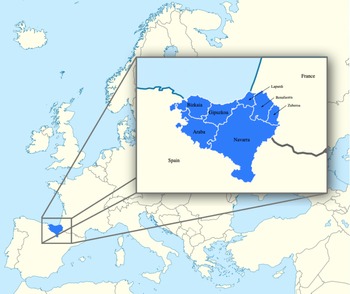
This Illustration of the IPA describes the sound system of the local dialect of Basque (euskara, euskera, IS0-639-3 eus) spoken in the town of Markina-Xemein, in the province of Bizkaia (Biscay), within the Basque Autonomous Community of Spain (see maps in Figures 1 and 2). Speakers of this local variety of Basque refer to it as markiñarra or Markiñeko euskerie.
Location of the Basque Country and the province of Bizkaia within it.
Author: Gabriel Trisca, CC-BY-SA, https://commons.wikimedia.org/wiki/File:Basque_Country_Location_and_Provinces_in_Europe_Map.svg

Markina-Xemein municipality in the province of Bizkaia (Biscay), in red.
Author: Ikimilikiliklik, CC BY-SA 3.0, https://en.wikipedia.org/wiki/Markina-Xemein#/media/File:Bizkaia_municipalities_Markina.PNG

Markina-Xemein is a town of about 5000 inhabitants situated in the Lea-Artibai area of the province of Bizkaia, on the border with Gipuzkoa. According to official census data, over 87% of the population speak Basque. All Basque speakers are also fluent in Spanish, except for young children.
Traditionally, the speech of Markina has had considerable prestige within Bizkaia. This was especially true before the development of Standard Basque, due to the existence of a written tradition in the Markina dialect, starting at the beginning of the 19th century with the literary work of J. A. Mogel. For his classification of Basque dialects, sub-dialects and varieties, Louis-Lucien Bonaparte commissioned a translation of some biblical passages into Markina Basque (Uriarte 1882). Because of its perceived prestige at the time, the British linguist W. Rollo also chose the dialect of Markina for his University of Leiden dissertation on Basque (Rollo Reference Rollo1925). All of this has contributed to making Markina Basque one of the best documented local varieties of Basque for the last two hundred years.
This Illustration is based on the speech of young speakers from Markina. In particular, the sound recordings accompanying this Illustration were produced by the first author, a female native speaker of this Basque variety in her twenties. She acquired Markina Basque as her native language, and learned Standard Basque and also became bilingual in Spanish through the school system.
For comparison with earlier stages, besides the work by Rollo (Reference Rollo1925) mentioned above, Baraiazarra (Reference Baraiazarra Txertudi1985) includes a phonetic transcription and analysis of a recording by a speaker born in 1934 and useful notes on the sound system reflected in the texts of earlier authors who wrote in the variety of Markina.
Linguistic work on neighboring varieties include Rotaetxe (Reference Rotaetxe1978) for the dialect of Ondarroa (less than 12 km away), Hualde, Elordieta & Elordieta (Reference Hualde, Elordieta and Elordieta1994), for the dialect of Lekeitio (15 km away), and Aramaio (Reference Aramaio2001), for Berriatua, situated between Markina and Ondarroa, as well as other studies dealing with specific aspects of the phonology, morphology and syntax of these varieties (e.g. G. Elordieta Reference Elordieta, Martínez-Gil and Morales-Font1997; A. Elordieta Reference Elordieta2001; Arregi Reference Arregi2002, Reference Arregi, Ignacio Hualde and Lakarra2006).
Nowadays, Standard Basque is having some influence on the local dialect of Markina, like elsewhere in the Basque Country. The speech of the coastal town of Ondarroa, which has a larger population, also seems to be a source of innovation for Basque speakers in Markina.
Consonants
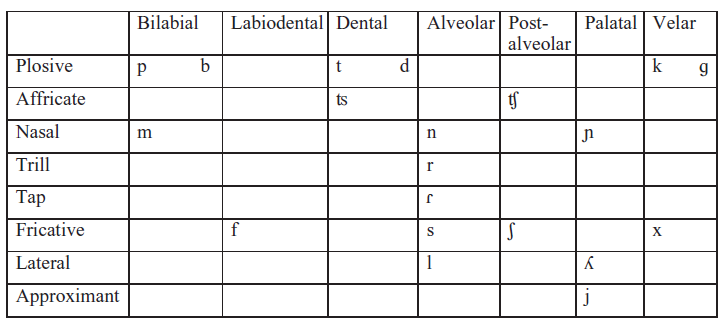
Whereas all the phonemes in the table can be found in word-internal intervocalic position, some of the consonants are excluded or are very rare in word-initial position, being found only in a few borrowings. For this reason, we give examples of the consonant phonemes both in word-initial and in word-medial position:
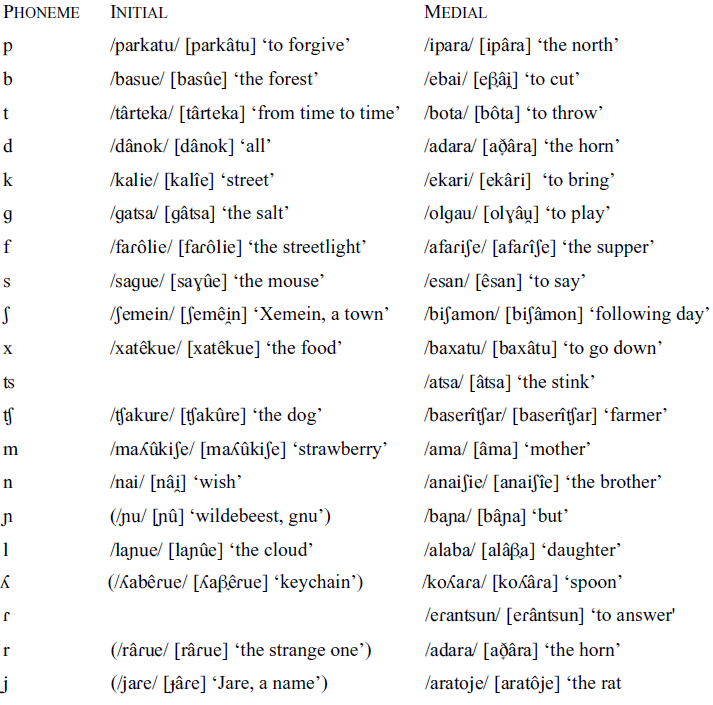
In the examples that we provide in this list, the following vowel is /a/, unless there are no examples with the relevant sequence. Examples are in parentheses if the consonant is only exceptionally found in that position. For the diacritic used to indicate accent and for their presence in only some phonological representations, see ‘Word prosody’ section below. In the phonemic representations above, only lexical accents are represented. In the phonetic representations, on the other hand, postlexical or phrase-level accents are also indicated. Note that all words in isolation carry an accent on the surface (since they constitute phrases by themselves). The contrast between lexical and postlexical accents can only be appreciated in longer utterances.
Note that /ts/, and /ɾ/ are never found word-initially and that the palatals /ɲ/, /ʎ/ and /j/ as well as the trill /r/ only occur word-initially in borrowings.
The consonantal system of Markina Basque and the distribution of the consonants in this variety is similar to what we find in other Basque dialects; in particular, it is fairly representative of Western Basque. Compared to the neighboring variety of Lekeitio (Hualde et al. Reference Hualde, Elordieta and Elordieta1994), Markina Basque lacks the postalveolar voiced fricative /ʒ/. This Lekeitio consonant systematically corresponds in Markina to the voiceless velar fricative /x/ (as in Lekeitio /ʒatekûa/ ‘the food’ vs. Markina /xatêkue/) in word-initial position, and usually to the voiceless postalveolar fricative /ʃ/ in word-medial position, as in Lekeitio /mendiʒa/ vs. Markina /mendiʃe/ ‘the mountain’. Markina Basque also lacks the voiced alveolar affricate /dz/ marginally found in Lekeitio in some words of onomatopoetic origin.
In contrast to the Navarrese Basque variety of Goizueta described in the Illustration of the IPA in Hualde, Lujanbio & Zubiri (Reference Hualde, Lujanbio and Joxe Zubiri2010), Markina Basque, like all other Basque varieties spoken in Bizkaia and Araba and also many Gipuzkoan varieties, has merged the contrast between the old apico-alveolar and predorso-alveolar fricatives (represented in the standard spelling as <s> and <z>, respectively), in favor of an apico-alveolar /s/ [s˽], and also the parallel contrast in place of articulation in affricates, in this case in favor of lamino-dental (or, rather, lamino-dentialveolar) [ʦ̪]. In addition, the voiceless palatal stop /c/ has merged with the voiceless postalveolar affricate /ʧ/, in favor of the latter. Markina Basque thus has a smaller number of consonantal phonemes than the varieties of either Lekeitio or Goizueta. Again, its consonantal inventory is, on the other hand, typical for a western Basque dialect.
As mentioned, some consonants are either very rare or completely missing in word-initial position. In word-final position the inventory is even more reduced. We will give details as we discuss each class of consonants in the following subsections.
Plosives
Syllable-initially there are six contrastive plosives, voiceless /p t k/ and voiced /b d ɡ/. Although we do not have articulatory data to back this up, the place of articulation of /t/ and /d/ appears to be the same as in Castilian Spanish; that is, ‘laminal denti-alveolar and not purely dental’ (Martínez-Celdrán, Fernández-Planas & Carrera-Sabaté Reference Martínez-Celdrán, Fernández-Planas and Carrera-Sabaté2003: 257).
Voiceless stops are realized as unaspirated (short VOT) in all positions. See Figure 3, /parkatu/ [parkâtu] ‘to forgive’, which contains all three voiceless stops in onset position (all spectrograms have been made in Praat – Boersma & Weenink Reference Boersma and Weenink2021). For the tokens of /p t k/ in onset position that appear in the recording of ‘The North Wind and the Sun’ that we have made for this Illustration, we have obtained the following average VOT values: /p/ (n = 9) =14.7 ms (st.dev. 7.5), /t/ (n = 16) = 18.6 ms (st.dev. 5.2),Footnote 1 /k/ (n = 14) = 31.6 ms (st.dev. 8.4). These values all fall within the typical VOT range of unaspirated voiceless stops (for Spanish, see e.g. Castañeda Reference Castañeda1986, Rosner et al. Reference Rosner, López-Bascuas, García-Albea and Fahey2000). As is also typically the case, the velar has longer VOT than the labial and the dental voiceless plosives. These values are also almost identical to those reported for unaspirated voiceless stops by Mounole (Reference Mounole2004), for the Eastern Basque dialect of Zuberoa (Soule). (Unlike the variety that we are describing here and most other Basque dialects, Zuberoan Basque has a three-way phonological contrast involving voiceless aspirated, voiceless unaspirated and voiced plosives.)
/parkatu/ [parkâtu] ‘to forgive’. Example containing /p k t/ in onset position and a preconsonantal trill.

Voiced plosives are generally produced with prevoicing phrase-initially (see Figure 4, /biʃer/ [bîʃer] ‘tomorrow’, St. Bq. bihar). Exceptionally there may be no prevoicing, causing some ambiguity in the signal. Nasal leak during the occlusion is another strategy to maintain voicing in the case of utterance-initial voiced plosives (see Ohala’s Reference Ohala2011 Aerodynamic Voicing Constraint, AVC). This variation in the realization of phonologically voiced utterance-initial plosives is similar to what has been described for both Spanish and French (Solé Reference Solé2018). Determining how much inter-speaker variation there is in this respect in Markina or any other Basque variety requires further research.
/biʃer/ [bîʃer] ‘tomorrow’. Example of /b/ prevoicing and word-final trill.

As noted in Hualde et al. (Reference Hualde, Lujanbio and Joxe Zubiri2010: 115–116), occasional phonetic ambiguity between phonologically voiced and voiceless plosives in utterance-initial position may lead to rephonologization of word-initial consonants, thus explaining dialectal variation in Basque in a number of lexical items, e.g. bake ∼ pake ‘peace’ < Lat. pace, bizar ∼ pizar ‘beard’, etc. Less commonly, a word-initial voiced plosive has become nasal in words where the only source of nasality would be AVC-induced prenasalization, as in bakail(a)o ∼ makail(a)u ‘cod’. Note that the Basque name of Biarritz, in the French Basque Country, is Miarritze.
Voiced plosives are typically realized with incomplete occlusion, usually as approximants, between vowels and after a nonhomorganic consonant; that is, in the same contexts as in Castilian Spanish (see Martínez-Celdrán et al. Reference Martínez-Celdrán, Fernández-Planas and Carrera-Sabaté2003): /ebai/ [eβ̞âi̯] ‘to cut’, /adara/ [að̞âra] ‘the horn’, /aɡertu/ [aɣ̞êrtu] ‘to appear’. The degree of constriction of intervocalic /b d ɡ/ is very variable and may be conditioned in part by contextual factors (for Spanish, see e.g. Carrasco, Hualde & Simonet Reference Carrasco, Ignacio Hualde and Simonet2012 and references therein); in particular, in the speech sample recorded for this Illustration, the velar tends to be very constricted in accented syllables. An example of a typical realization of intervocalic /d/ is given in Figure 5, /adâra/ ‘the horn’.
adarra /adara/ [að̞âra] ‘the horn’. Example of intervocalic /d/ realized as approximant and intervocalic /r/ with three occlusions.

An original intervocalic /ɡ/ has been lost in some words, as in /ebai/ ‘to cut’ from older ebagi, still found in other local varieties (Rollo Reference Rollo1925 gives ebai as preferred form in Markina and ebagi as an alternative), and can be variably deleted in some other words, in a lexically-conditioned manner, e.g. eguzkixe [eɣ̞ûskiʃe] ∼ [êu̯skiʃe] ‘the sun’ (St. Bq. eguzkia), but not as frequently as in the neighboring dialect of Leketio (Hualde et al. Reference Hualde, Elordieta and Elordieta1994: 34–35).
In the also neighboring variety of Ondarroa, intervocalic /d/ has become [ɾ] almost with complete generality, leading to neutralization with the independent phoneme /ɾ/ (Hualde Reference Hualde1991: 76–77), and in Lekeitio we also find a strong tendency for this rule to apply variably (Hualde et al. Reference Hualde, Elordieta and Elordieta1994: 34–35). In Markina, however, this is only a sporadic phenomenon, affecting only a few lexical items, e.g. edan [êð̞an] ∼ [êɾan] ‘to drink’, but edarixe [eð̞âɾiʃe] ‘the drink’, not *[eɾâɾiʃe] (St. Bq. edaria). Sporadically /d/ has also been lost in some lexical items, e.g. /sure/ [sûre] ‘the nose’ compare St. Bq. sudurra.
Except for recent borrowings, there are no plosives in word-internal coda position.
Word-finally, only /t/ and /k/ are found. The only example of final /p/ is the interjection [êu̯p], used as a greeting. The lexical incidence of final /t/ and /k/ is also rather low, as there are no nouns or adjectives ending in a plosive in their uninflected form. In contrast, the textual frequency of word-final /t/ and /k/, on the other hand, is very high in all Basque varieties, since a number of inflectional suffixes end in one of these two consonants (including ergative /-k/, plural absolutive /-ak/, ablative /-tik/, benefactive /-tsat/ and first person singular /-t/). Word-final plosives are often elided before another consonant. (For a corpus study of word-final plosive reduction in the Basque dialect of Azpeitia, see Hualde et al. Reference Hualde, Beristain, Icardo Isasa, Zhang, Sasha Calhoun, Tabain and Warren2019, Reference Hualde, Beristain, Icardo Isasa and Zhang2021.) In careful style, however, both consonants may be pronounced, sometimes resulting in excrescent vowels between the two, as in our recording of /lâɡunek dâtos/ [lâɣ̞uneɡeð̞âtos] ‘the friends are coming’.Footnote 2
Word-initial voiced plosives undergo optional devoicing after a voiceless consonant within certain domains, even if the trigger is deleted on the surface. The phenomenon affects primarily conjugated verbal forms and grammatical particles, e.g. guk be [ɡûpe] ‘we-ergative too’, horregaitik ba [orêɣ̞ai̯ʧipa] ‘for that reason’, ez dakit [estâkit] ‘I don’t know’, ez dator [estâtor] ‘s/he is not coming’ (orthographic <z> is a voiceless fricative).
Affricates
Markina Basque has two voiceless affricate phonemes in its consonant inventory, dental (or denti-alveolar) /ts/ and postalveolar /ʧ/. The dental affricate is excluded from word-initial position. It may occur both intervocalically, as in /atso/ ‘yesterday’ and postconsonantally, as in /ântsara/ ‘the goose’, including in word-final position, /ɡats/ ‘salt’, /ants/ ‘resemblance’.
The postalveolar affricate /ʧ/ is particularly frequent after the vowel /i/, where it has historically resulted from the palatalization of /t/, through /it/ > /ic/ > /iʧ/, where the intermediate stage is found in the transcriptions of Markina Basque in Baraizarra (Reference Baraiazarra Txertudi1985), as well as, for instance, in present-day Goizueta (Hualde et al. Reference Hualde, Lujanbio and Joxe Zubiri2010). To illustrate with a few examples, we provide the spelling of the words in Standard Basque followed by their phonological representation in Markina: aita /aiʧe/ ‘father’, iturri /iʧuri/ ‘spring, fountain’, ohitura /oiʧuɾa/ ‘habit, costum’, argitasun /arɡiʧasun/ ‘clarity’, egiten /eiʧen/ ‘to do, imperfective participle’, aditu /aiʧu/ ‘to understand, perfective participle’.
Although, as in the examples just given, the postalveolar affricate has resulted in many cases from the palatalization of /t/, it cannot be reduced to an allophone of /t/, since, on the one hand, it is by no means restricted to the context after /i/ (compare txakurra /ʧakure/ ‘the dog’, etxe /eʧe/ ‘house’ – again, orthographic forms correspond to Standard Basque), and, on the other, there are exceptions to the palatalization sound change, where the sequence /it/ is found, e.g. kapitulua /kapitûlue/ [kapitûlue] ‘the chapter’, dakit /dakit/ [dâkit] ‘I know’, kapitaina /kapitaɲe/ [kapitâɲe]‘the captain’.Footnote 3
There is, nevertheless a morphophonological alternation between /ʧ/, after /i/, and /t/, after another vowel, with a number of suffixes, both inflectional and derivational; e.g. menditik /mêndiʧik/ ‘from the mountain’, morphophonemically //mendi-^tik//,Footnote 4 vs. basotik /bâsotik/ ‘from the forest’; argitasun /arɡiʧasun/ ‘clarity’ vs. iluntasun /iʎuntasun/ ‘darkness’; baserritar /baserîʧar/ ‘farmer’ vs. kaletar /kalêtar/ ‘town dweller’. The copula (e)ta ‘and’ also shows palatalization after /i/, e.g. bi eta hiru /biʧe iɾu/ ‘two and three’.
Palatalization of /t/ also takes place in the sequences /ilt/, /int/, e.g. pintatu /pinʧau/ [piɲʧâu̯] ‘to paint, perfective participle’. The voiced plosive /d/ also palatalizes in /ld/ and /nd/, indarra /indara/ ∼ /inɟera/ [iɲɟêra] ‘the strength’, bildurra /biʎure/ [biʎûre] ‘the fear’, but not directly after /i/, where it is realized as an approximant instead, idia /idiʃe/ [ið̞îʃe] ‘the ox’.
Fricatives
Markina Basque has four fricative phonemes, all four voiceless: labiodental /f/, apico-alveolar /s/, postalveolar /ʃ/ and velar or postvelar /x/. Of these, only alveolar /s/ has an unrestricted distribution.
Labiodental /f/ is restricted to onset position. The only word containing this consonant word-finally is /buf/ ‘buff, neck gaiter’, which is a recently coined brand name that, nevertheless, has been adopted as a common noun and is used by younger speakers, e.g. /lau buf/ ‘four buffs’, /bufe/ ‘the buff’. There are no other examples of final /f/. Even in onset position, /f/ is a phoneme of relatively recent introduction in Markina Basque, inverting an older tendency to replace /f/ with /p/ in borrowings (Baraiazarra Reference Baraiazarra Txertudi1985).
The alveolar fricative /s/ is usually realized as apico-alveolar [s˽]; that is, it is produced with the tongue tip raised towards the alveolar region, unlike in the lamino-alveolar articulation of /s/ that is more common in languages like English and French. By coarticulation with a back vowel, in words like /basu/ [bas˽û] ‘the forest’, /sure/ [s˽ûre] ‘the nose’, the apex may be somewhat more retracted, producing an acoustic effect that perceptually may sound like [ʃ].
As in other Western Basque varieties, apico-alveolar /s/ has resulted from the historical merger between apico-alveolar and lamino-alveolar fricatives, which are still contrasting phonemes in areas further to the east (see e.g. Hualde et al. Reference Hualde, Lujanbio and Joxe Zubiri2010). For a recent study of the spectral characteristics of alveolar fricatives in merging and non-merging Basque varieties, see Beristain (published online 20 April 2021).
The postalveolar fricative /ʃ/ is mostly found in intervocalic position, especially after /i/, as a result of either historical palatalization of /s/ in this context, haizea > /aiʃie/ [ai̯ʃ̈e] ‘the wind’, isilik > /iʃilik/ ‘silent, quiet’ (see above for /ʧ/) or epenthesis, mendia > /mendiʃe/ ‘the mountain’ (see ‘Vowel interaction rules’ section below and the examples therein). Nevertheless, there are a few words where it occurs after other vowels, as in axe /aʃe/ ‘that one’, with the intensive suffix /-ʃe/. Word-initially it is only found in proper names, such as the toponym Xemein /ʃemein/. It does not occur word-finally. Representative spectral slices for the fricatives /s/ and /ʃ/ are shown in Figure 6.
Spectral slices of /s/ in /esan/ ‘to say’ (left panel) and /ʃ/ in /biʃer/ ‘tomorrow’. The spectra were obtained in Praat with standard settings near the point of maximum intensity in the fricative.

Finally, the velar or postvelar fricative /x/ occurs mostly word-initially, where it has resulted primarily from the consonantization of a word-initial palatal glide, with the same evolution as in Spanish (i.e. /j/ > /ʒ/ > /ʃ/ > /x/), e.g. jan ‘to eat’, Goizueta /jan/, Lekeitio /ʒan/, Markina /xan/. In word-medial onset position it is mostly found in borrowings from Spanish, like bajatu /baxatu/ ‘to lower’.
There is a synchronically striking alternation between /x-/ and /ʧ-/ in verbal forms, as in etorri jaku /etori xaku/ ‘it has come to us’ vs. ez jaku etorri /eʧaku etori/ ∼ /esxaku etori/ ‘it has not come to us’. The historical explanation must be that the negative form has preserved the stage before velarization of the prepalatal, /es ʃaku/ [eʧaku], where a synchronic rule replacing /s-ʃ/ with /ʧ/ applied.Footnote 5 After velarization of [ʃ], but not of [ʧ], this has resulted in an unusual alternation between consonants.
Nasals
There are three nasal consonant phonemes, bilabial /m/, alveolar /n/ and palatal /ɲ/: /ama/ ‘mother’, /anaiʃie/ ‘the brother (of a male)’, /araɲe/ ‘the fish’. In the coda, all contrasts in place are neutralized. Before a consonant, a nasal assimilates to the place of articulation of the following consonant, /kanpo/ [kâmpo] ‘outside’, /kantau/ [kan̪t̪âu̯] ‘to sing’ (where the diacritic represents a denti-alveolar articulation, see above), /anʧe/ [âɲʧe] ‘right there’, /anɡo/ [âŋɡo] ‘of there’. Word-finally only [n] is found, except that, after /i/, both alveolar and palatal nasals are found in variation. A given lexical item can be pronounced with either [-in] or [-iɲ] by the same speaker: /min/ [m̈n] ∼ [m̈ɲ] ‘pain’. (There are no studies on sociolinguistic variation in this respect.)
In word-medial intervocalic position after /i/, alveolar /n/ is relatively rare, due to palatalization, like in the case of other alveolar and dental consonants, e.g. Markina /markiɲe/, mina /miɲe/ ‘the pain’, hagina /aɡiɲe/ ‘the tooth’, Sp. afición > /afisiɲo/ ‘fondness’. But, there are some words with /n/ in this context: /ipini/ ‘to put’ (both preceded and followed by /i/), Sp. minero > /mineɾue/ ‘the miner’.
Laterals
The apico-alveolar lateral /l/ is produced without velarization in any context. In onset position, it is found in both word-initial and word-medial onsets, either as a simple onset or in a cluster with a non-dental plosive or /f/: /laɡune/ ‘the friend’, /alabie/ ‘the daughter’, /klaɾu/ ‘clear’, /plântak ein/ ‘to clown around’, /flana/ ‘the flan’. It may also occur in both word internal and word-final coda position /talde/ [tal̪ðe] ‘group’ (with lenition of /d/ in the recorded example), /asal/ ‘skin’.
There is, in addition, a palatal lateral /ʎ/, but with a much more restricted distribution. Word-initially it is only found in a few borrowings like /ʎabêɾue/ [ʎaβ̞êɾue] ‘the key chain’ < Sp. llavero. Word-medially, it has mostly resulted from palatalization of /l/ after /i/ (and in the sequence /ild/) iluna > /iʎune/ ‘the dark one’, bildurra > /biʎure/ ‘the fear’; but not when both preceded and followed by /i/: /iʃilik/ ‘silent’, /familiʃie/ ‘the family’. It is, nevertheless, also found in other intervocalic contexts not preceded by /i/, /maʎûkiʃe/ ‘the strawberry’, Mallabia /maʎebi/ [maʎêβ̞i] ‘name of a town near Markina’. Like elsewhere in the Basque Country nowadays, there is a tendency for /ʎ/ to become delateralized.
The voiced palatal central consonant
In the above list of examples, we have included a phoneme /j/ in the inventory, that may be illustrated with proper names like Jare and Julen in word-initial position, and, in intervocalic word-medial position, with a word like [aratoje] ‘the rat’, inflected form of /aratoi/ [aratoi̯]. The phonological status of this consonant is unclear. In a possible analysis, it is a consonantal realization of the vowel phoneme /i/ when it appears in onset position (either word-initially before a vowel or intervocalically). It ranges in its degree of constriction from approximant or fricative to stop. See Figures 7, Julen /julen/ and 8, arratoie /aratoje/ ‘the rat’. Leaving aside proper names of recent introduction like Julen, which can be considered borrowings from Standard Basque, this consonant is not found in word-initial position in Markina Basque, since historically word-initial /j/ underwent the series of sound changes mentioned above (ultimately resulting in /x/).
Julen /julen/ [ɟûlen] ‘a name’. Example of /j/ in word-initial position realized as a voiced stop.

/aratoje/ [aratôʝe] ‘the rat’. Example of /j/ realized as an approximant in intervocalic position. Note also the three brief occlusions in the intervocalic trill /r/.

Rhotics
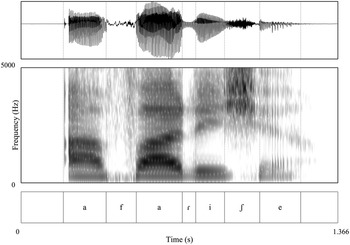
There are two rhotic phonemes, alveolar tap /ɾ/ as in /uɾe/ ‘the water’ and alveolar trill /r/, as in /urie/ ‘the gold’. The trill is usually produced with two or three contacts (see Gaminde et al. Reference Gaminde, Aintzane Etxebarria, Romero and Iglesias2017). The contrast between phonemic tap and trill can be observed by comparing, on the one hand, Figures 5, /adara/ ‘the horn’ and 8, /aratoje/ ‘the rat’, both of which contain trills with three brief occlusions, and, on the other, Figure 9, /afaɾiʃe/ ‘the supper’, with a phonemic tap realized with a single occlusion. Note that although the instance of /ɾ/ in Figure 9 has greater duration than a typical tap, thus resembling a short [d], in Basque the phoneme /d/ would normally be realized instead as an approximant [ð̞] in intervocalic position. Nevertheless, as mentioned above (under Plosives), in Basque, and, in particular, in the varieties around Markina, we find a tendency for intervocalic /d/ and /ɾ/ to be lexically redistributed.
/afaɾiʃe/ ‘the supper’. Example of tap /ɾ/.

As in Spanish, the contrast between the two rhotic consonants is only found in word-internal intervocalic position. Nevertheless, the distribution of the rhotics also has important differences with respect to Spanish. To begin with, neither rhotic appears word-initially, except for recent borrowings from Spanish with a word-initial trill, like /rôsie/ ‘the pink one’ < Sp. rosa, and /râɾue/ ‘the strange one’ < Sp. raro. Older borrowings with initial trills in Spanish show vowel epenthesis, Sp. rueda > /erubeɾie/ ‘the wheel’.
Secondly, unlike in most Spanish varieties, coda rhotics are realized as trills, not as taps, both preconsonantally /parkatu/ ‘to forgive’ (see Figure 3 above), /sartu/ ‘to enter’, /târteka/ ‘in between’ and before pause, /biʃer/ ‘tomorrow’ (see Figure 4 above). Phrase-final trills may undergo devoicing, see the example in Figure 4.
In a number of lexical items and suffixes, an intervocalic /ɾ/ is optional or has been lost. Similar to the deletion of intervocalic /d/ and /ɡ/, this is a lexically conditioned phenomenon.
Vowels
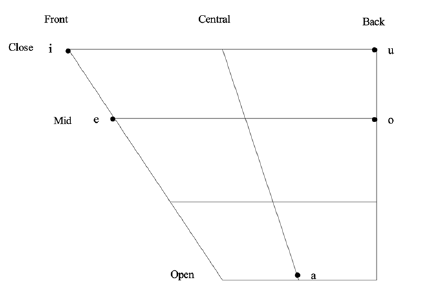
Like in most Basque dialects, there are five vowel phonemes, /i e a o u/, as in the first syllable of the following words:
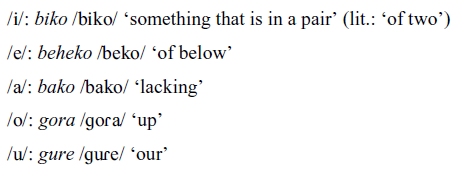
The mid vowels are slightly lower than IPA [e] and [o] and higher than IPA [ɛ], [ɔ]. The low or open vowel has a central position, but phonologically behaves like a front vowel, as it alternates with /e/ following /i/ or /u/, as explained below.Footnote 6
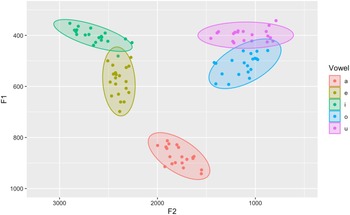
The vowel plot in Figure 10 has been obtained by taking first and second formant measurements at the middle point of 20 tokens of each vowel in words recorded for this Illustration, including the five words mentioned at the beginning of this section. The plot was made with the graphics package ggplot2 (Wickham Reference Wickham2016) running in R (R Core Team 2020) and RStudio (RStudio Team 2019).
Vowels in F1 × F2 space. Measurements in Hz.

Vowel sequences
Sequences of two vocoids where the second one is high are pronounced as falling diphthongs. The following falling diphthongs are found:
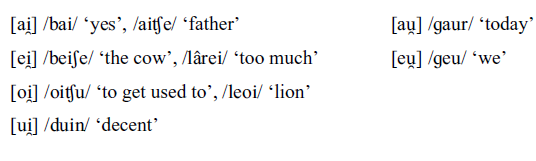
Sequences of rising sonority, on the other hand, are normally pronounced in hiatus:
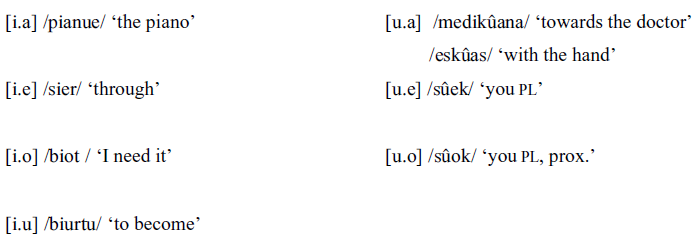
The contrast between diphthong and hiatus is not necessarily reflected in the duration of the sequence, but, rather, in that of its two components. For instance, in Figure 11 /ɡaur/‘today’, the sequence /au/ has a duration of 362 ms, and in Figure 12 /sûek/ ‘you pl’, /ue/ has a duration of 368 ms. However, as can be observed in the figures, the relative proportion of both elements is rather different in the two sequences. The difference in duration between the two vocalic elements is much smaller in the hiatus sequence /ue/ than in the diphthong /au/ [au̯]. The difference in syllabification between these types of sequences is phonologically relevant for the accent-assignment rules.
/ɡaur/[ɡau̯r] ‘today’.

/sûek/ [su.ek] ‘you pl’.

Vowel interaction rules: Morphophonogical processes affecting vowel sequences
Vowel sequences arising in morpheme concatenation undergo a number of changes. These are most conspicuous in sequences arising from the affixation of the definite article, historically always /a/, to nouns and adjectives. Local Basque varieties vary substantially in the treatment of these sequences (see Hualde & Gaminde Reference Hualde and Gaminde1998).
In the examples in (1), illustrating the treatment of inflectional vowel sequences in Markina Basque, we show the uninflected form, the absolutive singular form and the absolute plural form for nouns and adjectives ending in each of the five vowels, as well as ending in consonants after non-high and high vowels. The examples are in broad phonetic transcription.
(1) Vowel sequences in inflected forms
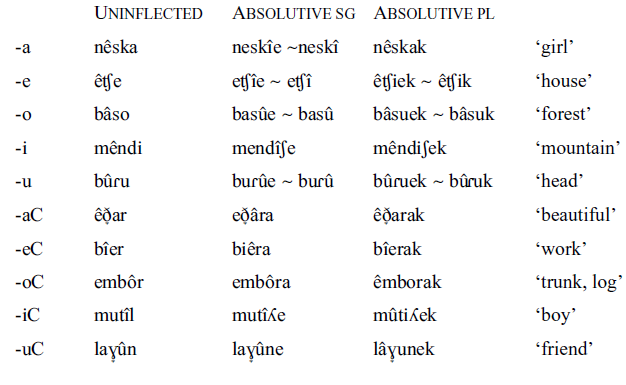
A note on accentuation: All noun and adjective stems in the examples are lexically unaccented. Starting with the absolutive singular, the examples show the application of a default rule that assigns an accent to the penultimate syllable of the phrase; except that, as can be seen in (1) above, the accent surfaces on the last syllable if the last vowel is deleted (by an optional rule). The fact that this is a post-lexical or phrase-level accent assigned to the penultimate syllable of the phrase can be observed by comparing, for instance [laɣ̞ûne] ‘the friend’ and [laɣ̞uneð̞âtor] ‘the friend is coming’ (in Figure 19 below). In the absolutive plural, the plural suffix introduces a morphological or lexical accent, which normally surfaces on the antepenultimate syllable of the word. The accent of the plural does not shift when the word is phrase-medial. Finally, uninflected forms never occur in isolation (except for vocatives). Our transcription shows how they were pronounced in the sound files that were recorded and show variability between penultimate and final accent with consonant-final uninflected forms.
As shown in the examples in (1), a number of sound changes have combined to produce complex alternations between uninflected and inflected forms. Leaving stems in /-a/ aside, for the moment, the treatment of the sequence is the same in the singular and the plural. The rules that apply to the sequences in (1) are the following:
(2) Rules in vowel sequences
-
a. Stem-final mid vowels raise to high before the article.
-
b. If the stem ends in /i/, epenthetic /ʃ/ is inserted.
-
c. The vowel of the suffix is /e/ after a high vowel, with or without intervening consonants, and /a/ elsewhere.
-
d. /e/ is optionally deleted in hiatus after another vowel.
Many words ending in a palatal offglide [i̯] in uninflected words behave as if they ended in /e/ rather than /i/ in not triggering /ʃ/-epenthesis, as in /aratoi/ [aratôi̯] ‘rat’, /aratoje/ [aratôje] ‘the rat’ (St. Bq. arratoi, arratoia) vs. for instance, /bei/ [bêi̯] ‘cow’, /beiʃe/ [bêi̯ʃe] ‘the cow’ (St. Bq. behi, behia), /ɡoi/ ‘top’, /ɡoiʃe/ ‘the top’ (St. Bq. goi, goia). This reflects the fact that the difference between historical sequences like /oe/ and /oi/ has been neutralized; e.g. /aratoe/ > /aratoi/; /aratoea/ > /aratoja/ > /aratoje/ ‘the rat’. In a more abstract analysis, forms like //aratoe// ‘rat’ vs. //ɡoi// ‘top’, could be proposed as underlying representations to account for the alternations that arise in suffixation. Some Markina speakers reduce word-final [oi̯] to /o/.
The fact that stems ending in /-o/ and /-u/ have identical endings in their definite forms, has produced some fluctuation, e.g. /lau esku/ ∼ /lau esko/ ‘four hands’ (which has been resolved in neighboring Ondarroa by complete merger of these two classes of words).
With stems ending in /a/, we find different phenomena in the singular and in the plural. Both comparison with other dialects and the historical records show that, in the singular, there was an initial dissimilation of the sequence /aa/. Step-by-step, we have: /neska-a/ > /neskea/ > /neskia/ > /neskie/ > /neski/ ‘the girl’ (or, perhaps, through epenthesis, /neskaa/ > */neskaia/ > /neskea/ …). In the plural, on the other hand, the sequence of two identical vowels was contracted: /neska-ak/ > /nêskak/. Except for the first, dissimilatory change /a-a/ > /ea/ in singular inflected forms, which is found already in our first texts for Western Basque in the 16th century and even earlier sources, the rest of the sound changes in these evolutions are very recent. Early 19th century sources for Markina Basque show singular forms like /neskia/ vs. plural forms like /neskaak/. The difference in accentuation between plural forms like /lâgunek/ ‘the friends’ and /alâbak/ ‘the daughters’ shows that the shift of lexical accents to the antepenultimate syllable is older than the contraction of the sequence /aa/ (e.g. /alâbaak/, with antepenultimate accent, > /alâbak/, Hualde Reference Hualde2000).
The deletion of postvocalic /e/, which, as shown in (1), is an optional process in Markina, takes place obligatorily in neighboring Ondarroa.
Prosody
Word prosody
The accentual system of Markina Basque was described in detail in Hualde (Reference Hualde2000), see also Gandiaga Ibarzabal (Reference Gandiaga Ibarzabal2014). Like in many other Bizkaian varieties, there is an underlying contrast between accented and unaccented words or morphemes (Hualde Reference Hualde1988, Reference Hualde1991). Accented words bear an accent on a given syllable (mostly the antepenultimate in Markina) in all contexts. Unaccented words, on the other hand, are only subject to rules of phrasal accentuation. In isolation, all words carry an accent, but this accent will be preserved phrase-medially only if it is lexical. As already mentioned (regarding the examples in (1) above), a default rule assigns prominence to the penultimate syllable of the phrase.Footnote 7
In lexically accented words, the accent may be an underlying property of either the stem or an inflectionl suffix. If the stem is lexically accented, all forms of its inflectional paradigm will be accented. Lexically accented stems include many borrowings, compounds and derived words. For instance, using examples from the list at the start of the ‘Consonants’ section, the word /ʎabêɾue/ [ʎaβêɾue] ‘the keychain’ (morphophonemically, //^ʎabeɾu-a//) is a lexically accented borrowing (from Sp. llavero), and /xatêkue/ ‘the food’ is a derived word (from /xan/ ‘to eat’). Their accentual pattern can be compared to that of unaccented /basue/ ‘the forest’ (morphophonemically //baso-a//) and /saɡue/ ‘the mouse’, which, as shown in Table 2, in citation form surface as [basûe], [saɣ̞ûe] with phrase-penultimate accent.
Underlyingly accented suffixes include all plural suffixes, the ablative //-^tik// and the comitative //-^as//. Words containing a lexically unaccented stem will have a lexical accent if they carry an accented inflectional suffix. Lexical accents usually surface on the antepenultimate syllable of the word, even if they are introduced by a suffix, e.g. //mendi-^ak// [mêndiʃek]. For more details, see Hualde (Reference Hualde2000), and for the neighboring variety of Leketio, where the distribution betwen lexically accented and unaccented morphemes is essentially the same as in Markina, but the rules determining the position of accents are different, Hualde et al. (Reference Hualde, Elordieta and Elordieta1994), G. Elordieta (Reference Elordieta, Martínez-Gil and Morales-Font1997).
In broad focus declarative sentences where all words are lexically unaccented, there is an initial tonal rise (LH-, sometimes H-) loosely associated with the second syllable of the phrase and a final fall (H*L) (postlexical accent) associated with the syllable with default nuclear accent, with a high plateau created by interpolation between both events (see G. Elordieta Reference Elordieta1998, Elordieta & Hualde Reference Elordieta, Ignacio Hualde, Solé, Recasens and Romero2003b, Reference Elordieta, Ignacio Hualde and Jun2014). This is what we see in Figure 13, gure abadiana da /ɡuɾe abadianâ da/ ‘it is the one of our priest’ and Figure 14, lagunan alabie etorri da /laɡunan alab̈e etori da/ ‘the friend’s daughter has come’. Whereas in the rest of the paper phonemic representations of words include accent marks only in lexically accented words, in order to indicate the accented vs. unaccented lexical contrast, in this section we indicate both lexical and postlexical accents with a circumflex diacritic in our phonemic representations of sentences for greater clarity.
gure abadiana da /ɡuɾe abadianâ da/ ‘it is the one of our priest’. The H*L accent is postlexical.

lagunan alabie etorri da /laɡunan alabîe etori da/ ‘the friend’s (sg) daughter has come’. The H*L accent is postlexical.

In Markina, in sentences with analytical verbs (participle + auxiliary), the rule of default nuclear accent generally places the accent on the penultimate syllable of the constituent preceding the verb, as we can observe in Figure 14. On the other hand, if the verb is synthetic, as in the sentence in Figure 13, the verb forms a single prosodic unit with the preceding constituent and the accent goes on the penultimate syllable of that unit.Footnote 8
Lexically accented words display an accent in all positions. In the sentence in Figure 15, lagúnen alabie etorri da /laɡûnen alab̈e etori da/ ‘the friends pl’ daughter has come’, which forms a minimal pair with the example in Figure 14, the genitive plural word /laɡûnen/ ‘of the friends’ is lexically accented, like all plurals, and bears an accent that causes downstepping of the nuclear, postlexical, accent on /alab̈e/ ‘the daughter’.
lagúnen alabie etorri da /laɡûnen alabîe etori da/ ‘the friends’(pl) daughter has come’. The first H*L accent is lexical and the downstepped !H*L accent is postlexical.

A second minimal pair illustrating the contrast between lexically unaccented and accented words is given in Figure 16 and 17. In Figure 16, Fidelen alabie ikusi dot /fidelen alabîe ikusi dot/ ‘I saw Fidel’s daughter’, the only accentual event is the postlexical nuclear accent on the penultimate syllable of the immediately preverbal word /alabîe/ ‘the daughter’. In contrast, in Figure 17, Fidélan alabie ikusi dot /fidêlan alabîe ikusi dot/ ‘I saw Fidela’s daughter’, the preverbal phrase /fidêlan alabîe/ contains two accents,with downstep of the second one, since the name /fidêla/ is lexically accented.
Fidelen alabie ikusi dot /fidelen alabîe ikusi (d)ot/ ‘I saw Fidel’s daughter’. The H*L accent is postlexical.

Fidélan alabie ikusi dot /fidêlan alabiê ikusi (d)ot/ ‘I saw Fidela’s daughter’. The first H*L accent is lexical and the downstepped second accent is postlexical.

As shown in the figures, the most salient cue of accent is a tonal peak on the accented syllable and a post-accentual fall in pitch. Other features such as duration do not seem to be a consistent correlate of accent in the Basque dialects of this area, although they are sometimes present (see Hualde, Smiljanić & Cole Reference Hualde, Smiljanić and Cole2000, where data from a speaker from Markina and a speaker from Bermeo are analyzed, G. Elordieta & Hualde Reference Elordieta and Ignacio Hualde2001, 2003a, based on data from Lekeitio speakers, and Rodríguez-Ordóñez Reference Rodríguez-Ordóñez2019 for Gernika; see also Hualde et al. Reference Hualde, Elordieta, Gaminde, Smiljanić, Gussenhoven and Warner2002).
A question that arises in the context of this Illustration of the IPA is how to represent accent. As in other work in Northern Bizkaian Basque prosody (G. Elordieta Reference Elordieta1998, G. Elordieta & Hualde Reference Elordieta, Ignacio Hualde and Jun2014, etc.), in the figures we are using an autosegmental representation H*L, following the conventions of the Autosegemental-Metrical framework (Pierrehumbert Reference Pierrehumbert1980, Ladd Reference Ladd2008). As a diacritic in phonological transcriptions, on the other hand, we are using the IPA circumflex diacritic. We have chosen this diacritic because, as shown in the figures, the accentual contour often shows both a rise on the accented syllable and a following fall to a low tone. Sometimes, however, the pitch is completely flat from a phase-initial rise and there is no visible additional rise on the accented syllable.
In the data that we have recorded for this illustration, a remarkable feature is the delay of the peak from the first syllable of phrase-initial words in some examples. An example is given in Figure 18, lágunek etorri di /lâɡunek etori di/ ‘the friends have come’. Note the displacement of the peak of the lexical accent on the first syllable of /lâɡunek/ ‘the friends’ to the second syllable. Perceptually, however, accentual prominence is on the initial syllable. Similar phenomena of accent peak delay in phrase-initial words have been reported for other Basque dialects, as well as for other languages (For Lekeitio Basque, see Ito, G. Elordieta & Hualde Reference Ito, Elordieta, Ignacio Hualde, Recasens and Romero2003). Duration appears to be a relevant cue to accent in this context. In this respect, it is relevant to point out that there is substantial variation among local varieties in this area regarding accent assignment rules (see Hualde Reference Hualde1988, Reference Hualde1991, Reference Hualde2000), which can be explained by occasional or frequent ambiguity in the anchoring of pitch accents with specific syllables.
lágunek etorri di /lâɡunek etori di/ ‘the friends have come’. The H*L accent is lexical and is phonologically associated with the initial syllable. Note the displacement of the accentual peak.

Intonation: Statements and questions
In simple neutral statements, there is a low tone extending from the drop in pitch associated with the last accent, lexical or postlexical, to the end of the sentence. As was already mentioned, in sentences containing only unaccented words, a postlexical (default nuclear) accent is normally associated with the penultimate syllable of the preverbal constituent, This is the pattern in sentences where the verbal form contains a participle and an auxiliary, as in Figures 14, lagunan alabie etorri da /laɡunan alabîe etori da/ ‘the friend’s sg daughter has come’, and Figure 16, Fidelen alabie ikusi dot /fidelen alabîe ikusi (d)ot/ ‘I saw Fidel’s daughter’.
Only a handful of verbs are conjugated synthetically, without an auxiliary. In sentences with a synthetic verb, the location of the nuclear accent is different, as shown in Figure 13, gure abadiana da ‘it is the one of our priest’, and Figure 19, lagune dator /laɡune dâtor/ ‘the friend is coming’. In such sentences, the final fall starts on or right after the penultimate syllable of the prosodic domain that contains the verb and the preceding constituent.
lagune dator /lagune dâtor/ ‘the friend is coming’. The H*L accent is postlexical and is phonologically associated with the penultimate syllable of the phrase.

Leaving aside the specific syllable where the final fall starts, the intonational pattern is the same in the declarative sentences in Figures 13–19.
Yes–no questions have the same syntax as statements, but intonationally differ from them.Footnote 9 Interrogativity is signalled by an upstepped circumflex (rise–fall) contour on the final syllable of the sentence, as in Figure 20, lagune etorri da? /laɡûne etori ↑ðâ/ ‘did the friend come?’ and Figure 21, lagune dator? /laɡune da↑tôr/ ‘is the friend coming?’ Note that in Figure 20 there are two accents and that the second one, which conveys interrogative force is upstepped. In Figure 21, there is only one accent, since the lexically unaccented noun /laɡune/ and the lexically unaccented synthetic verb /dator/ constitute a single prosodic unit. Comparing the declarative sentence in Figure 19, /laɡune dâtor/ ‘the friend is coming’, and its interrogative counterpart in Figure 21, /laɡune da↑tôr/ ‘is the friend coming?’, note the difference in the position of the tonal rise and fall (penultimate vs. final syllable) and the much wider movement in the interrrogative sentence. In addition, the final syllable is lengthened in interrogative sentences.
lagune etorri da? /laɡûne etori ↑dâ/ ‘did the friend come?’ Both accents are postlexical.

lagune dator? /laɡune da↑tôr/ ‘is the friend coming?’. The accent on /-tor/ is postlexical.

Transcription of ‘The North Wind and the Sun’ (‘Ipar haizea eta Eguzkia’)
We include four versions of the same passage. First, we offer a transcription of the text in Basque orthography, but adapted to the dialect of Markina. This is the version that was used as a transcript for the reading task. Secondly, we offer this text in a phonemic IPA transcription. In third place, we include a phonetic transcription of the recording. Finally, we also provide a literal version in Standard Basque, in order to make it easier for interested readers to check the meaning of specific words and also for easier comparison with other Basque dialects, such as Goizueta Basque (Hualde et al. Reference Hualde, Lujanbio and Joxe Zubiri2010). (Note that, as explained above, /t/, /d/ and /ts/ are normally denti-alveolar. In our phonetic transcription of the recording we use the dental diacritic under these phonemes only in sequences such as /nd/ where a preceding nasal assimilates in place to the following consonant.)
Orthographic transcription (in Basque orthography adapted to the dialect)
Ipar haixie eta eguzkixe, indartsuena zein zan diskutitzen zebizela oñezko bat pasau zan kapa lodi baten batute. Erabakiben indartsuena lehenengo oñezkuai kapie kentzotzena izengo zala. Ordun, ipar haixiek beran indar (indder) gustixaz hasi zan joten, baña zemat eta gogorrau jo, ibiltarixek orduen eta estuau eustotzen beran kapiai. Azkenien, ipar haixíek, etsitxe, ahalegiñek eitxiai itxitzen. Gero, eguzkixe gogor berotzen hasi zan, eta oñezkuek laster kenduban beran kapioi. Eta holan, ipar haixiek onartu ein biher izeban eguzkixe zala bixen artien indartsuena.
Phonemic/broad phonetic transcription in IPA
ipar aiʃie eta eɡûskiʃe indarʦûena sein san diskûtiʦen sebisela | oɲesko bat pasau san kâpa lodi baten bâtute || erabakîben indarʦûena lênenɡo oɲeskuai kâpie kenʦotsena isênɡo sala || ordun | ipar aiʃiek beran indar ɡustîʃas asi san xôten || baɲa semat eta ɡoɡôrau xo || ibiltaɾiʃek orduen eta estûau êustoʦen beran kapiai|| askenien | ipar aiʃiek etsiʧe| alêɡiɲek eiʧiai iʧitsen || ɡero eɡûskiʃe ɡoɡor bêroʦen asi san |eta oɲeskuek laster kenduban beɾan kapioi ||eta olan | ipar aiʃiek onartu ein bier iseban eɡûskiʃe sala bîʃen artien indarʦûena.
Phonetic transcription of recording
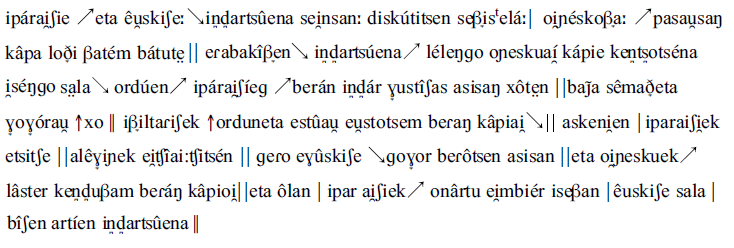
Literal adaptation to Standard Basque
Ipar haizea eta eguzkia, indartsuena zein zen diskutitzen zebiltzela, oinezko bat pasatu zen kapa lodi batean batuta. ᴇrabaki zuten indartsuena lehenengo oinezkoari kapa kentzen ziona izango zela. Orduan, Ipar haizeak, bere indar guztiekin hasi zen jotzen, baina zenbat eta gogorrago jo, ibiltariak orduan eta estuago eusten zion bere kapari. Azkenean, ipar haizeak, etsita, ahaleginak egiteari utzi zion. Gero, eguzkia gogor berotzen hasi zen, eta oinezkoak laster kendu zuen bere kapa hori. ᴇta horrela, ipar haizeak onartu egin behar izan zuen eguzkia zela bien artean indartsuena.
Acknowledgements
We are grateful to Editor Marija Tabain, Associate Editor Matthew Gordon and two anonymous reviewers for many comments and suggestions that have improved the quality of this paper.
Supplementary material
To view supplementary material for this article, (including audio files to accompany the language examples), please visit https://doi.org/10.1017/S0025100322000032





 Open access



