





1 Introduction
Driven by an increasing demand for photonic applications in remote sensing, medicine, telecommunications and defense[ Reference Jackson 1 , Reference Zhou, Wang, Ma, Lü and Liu 2 ], research into developing efficient mid-infrared (mid-IR) laser systems has attracted extensive attention in recent years. In particular, mid-IR lasers operating in the 3–5 μm wavelength range cover the characteristic absorption peaks of many important gas molecules (known as the molecular fingerprint region), such as CO2, CH4, CO and NO2. Mid-IR lasers offer unique advantages for environmental gas monitoring due to their ability to precisely identify and quantify various gases[ Reference Grassani, Tagkoudi, Guo, Herkommer, Yang, Kippenberg and Brès 3 – Reference Jaworski, Krzempek, Kozioł, Wu, Yu, Bojęś, Dudzik, Liao, Knight and Abramski 5 ]. High-performance mid-IR lasers are also ideal tools for scientific research, including nonlinear optics, silicon photonics and metrology. For instance, mid-IR optical frequency combs can further enhance the performance of spectroscopic and imaging systems due to their full instantaneous spectral coverage and high spectral resolution[ Reference Schliesser, Picqué and Hänsch 6 , Reference Hoghooghi, Xing, Chang, Lesko, Lind, Rieker and Diddams 7 ]. The diverse application demands continuously drive the development of mid-IR laser systems, ultimately leading to their practical implementation in real-world scenarios.
Among the various methods for generating mid-IR lasers, fiber lasers are an ideal choice due to their compactness, high conversion efficiency and excellent beam quality[ Reference Jackson 8 , Reference Zhang, Wu, Guang, Guo, Qiao, Wei, Yang, Wang, Li, Copner and Li 9 ]. Fiber lasers based on rare-earth-ion-doped silica glass fibers have already achieved high power outputs, currently exceeding 100 kW[ Reference Shcherbakov, Fomin, Abramov, Ferin, Mochalov and Gapontsev 10 ]. However, the phonon energy of silica glass is high (~1000 cm–1), so the relatively high phonon energy quenches rare-earth ion transitions in the mid-IR and long-wave infrared (IR) spectral range, thus limiting the laser operating wavelength of silica glass optical fiber to less than 2.5 μm wavelength[ Reference Sanghera, Shaw and Aggarwal 11 ]. Employing low-phonon-energy fluoride glass fibers, such as ZBLAN and indium fluoride (InF3), makes it possible to manufacture rare-earth-ion-doped mid-IR fiber lasers[ Reference Zhang, Fu, Sheng, Luo, Zhang, Shi and Yao 12 , Reference Majewski, Woodward, Carreé, Poulain, Poulain and Jackson 13 ]. In 2022, a dual-wavelength-pumped all-fiber continuous-wave (CW) laser operating at 3.55 μm that reached an output power of 14.9 W was demonstrated in an Er3+:ZrF4 passive fiber. In 2024, an all-fiber laser emitting 1.7 W at 3.92 μm was experimentally demonstrated in a Ho3+:InF3 fiber, which is the highest fiber laser output power in the region of 4 μm. Notably, these lasers based on fluoride glass fibers are currently limited to wavelengths within the 4 μm region. Chalcogenide glass fibers have much lower phonon energies, as low as 300 cm–1[ Reference Sanghera, Shaw and Aggarwal 11 ], which allows mid-IR rare-earth transitions that are typically quenched in silica and fluoride glasses to become active. Thus, fiber lasers based on chalcogenide glass have the potential to operate in the 4–10 μm wavelength range. In 2021, from high-purity Tb3+-doped selenide core glass and Ge18As22S60 clad glass, an active chalcogenide fiber with a total diameter of 400 μm and a core diameter of 18 μm was drawn, and the threshold of 5.38 μm lasing with a spike structure was reached in chalcogenide fiber for the first time[ Reference Shiryaev, Sukhanov, Velmuzhov, Karaksina, Kotereva, Snopatin, Denker, Galagan, Sverchkov, Koltashev and Plotnichenko 14 ]. However, such chalcogenide glass fiber lasers have not yet achieved high-power output operation, as the maximum output power is only at the level of hundreds of milliwatts[ Reference Koltashev, Denker, Galagan, Snopatin, Sukhanov, Sverchkov, Velmuzhov and Plotnichenko 15 ].
Fiber lasers utilizing gas-filled hollow-core fibers (HCFs) have emerged in recent years as a novel solution for achieving high-power mid-IR light sources. By filling the HCFs with gas gain media, mid-IR laser outputs can be achieved through optical pumping method. Anti-resonant hollow-core fibers (AR-HCFs) could achieve significantly low transmission losses in the mid-IR spectral region[ Reference Yu, Song, Wu, Birks, Bird and Knight 16 , Reference Fu, Jasion, Xu, Richardson, Poletti, Davidson and Wheeler 17 ], which facilitates efficient interaction between light and the gain gas. Fiber gas lasers based on population inversion between molecular vibrational-rotational energy levels exhibit lower pump thresholds, making them more favorable for CW output operation. C2H2, CO2, HBr and CO are primarily used as the gain medium in the 3–5 μm wavelength range[ Reference Jones, Nampoothiri, Ratanavis, Fiedler, Wheeler, Couny, Kadel, Benabid, Washburn, Corwin and Rudolph 18 – Reference Jones, Fourcade-Dutin, Mao, Baumgart, Nampoothiri, Campbell, Wang, Benabid, Rudolph, Washburn and Corwin 20 ]. Xu et al. [ Reference Xu, Yu and Knight 21 ] first reported research on a watt-level C2H2 fiber gas laser operating at 3.1 μm in 2017. In 2022, Huang et al. [ Reference Huang, Wang, Zhou, Cui, Li, Pei, Wang and Chen 22 ] demonstrated a 3.1 μm C2H2-filled HCF light source with an output power of 8 W by designing a water-cooled low-pressure gas cell to solve the problem of high-power coupling. In 2024, a 20-W-level C2H2-filled AR-HCF amplified spontaneous emission (ASE) source was reported at 3.1 μm with a slope efficiency of 25.1% relative to the absorbed pump power. The fabrication of an eight-tube nested AR-HCF with excellent multimode characteristics at the pump wavelength and a transmission loss of 0.1 dB/m at 3.1 μm played a key role in improving conversion efficiency and output power in mid-IR sources[ Reference Song, Zhang, Zhang, Hou and Wang 23 ]. In 2019, Cui et al. [ Reference Cui, Huang, Wang, Wang, Zhou, Li, Gao, Wang and Wang 24 ] first reported a CO2-filled AR-HCF mid-IR CW light source with an optical power of 82 mW at 4.3 μm. Recently, a 6.6 W ASE source based on CO2-filled nested AR-HCF was reported, which is the highest output power for such gas-filled AR-HCF light sources in the 4–5 μm range. The optical-to-optical conversion efficiency is limited to 9.35% due to the enhanced self-absorption effect in the 4.3 μm band under high-power conditions[ Reference Song, Yao, Zhang, Zhang, Hou, Wu and Wang 25 ]. The utilization of HBr enables a broad mid-IR tuning range. In 2022, a HBr-filled AR-HCF ASE source achieving a widely tunable mid-IR output spanning from 3.8 to 4.5 μm was reported, with a maximum output power of 500 mW[ Reference Zhou, Wang, Huang, Cui, Li, Wang, Xi, Gao and Wang 19 ]. In 2022, a record average output power of 3.1 W was achieved by a HBr-filled AR-HCF ASE source operating at 4.16 μm; further power scaling requires solving the issue of heat accumulation[ Reference Zhou, Huang, Cui, Li, Pei, Li, Li, Wang and Wang 26 ]. The emission lines of CO molecules are capable of extending to longer wavelengths, enabling coverage of the 4.5–5.2 μm spectral region theoretically. Li et al. [ Reference Li, Yang, Zhou, Li, Li, Pei, Huang, Shi, Lei, Wang and Wang 27 ] reported a 4.8-μm CO-filled AR-HCF laser with a maximum power output of 46 mW for the first time. However, due to the difficulty in obtaining corresponding high-power 2.3 μm pump sources, it is quite challenging to achieve high-power output for CO-filled AR-HCF lasers. From the above research, it is known that for the generation of high-power mid-IR gas lasers beyond 4 μm, issues such as low optical-to-optical conversion efficiency and heat accumulation in sealed AR-HCF gas cells still limit further power scaling. The construction of high-performance pump sources and efficient coupling of the pump source to the HCF are key to further increasing the output power and versatility of such mid-IR light sources.
In this paper, we demonstrate a high-power CW mid-IR light source operating at 4.16 μm based on HBr-filled AR-HCF. A maximum output power of 10.4 W with a slope efficiency of 20.0% relative to the absorbed pump power is reached at gas pressure of 9.9 mbar. By adopting a strategy of gas filling with gradient distribution, the thermal effect is effectively mitigated and the optical-to-optical conversion efficiency is improved. The impact of gas pressure on signal output characteristics has been investigated experimentally and theoretically. Besides, detailed measurements and analyses have been conducted on the output spectrum, beam quality and temporal properties, indicating that the light source has excellent beam quality and long-term operational stability. To the best of our knowledge, this is the highest output power for silica-based fiber light sources beyond 4 μm currently.
2 Pump source and mid-infrared light source system
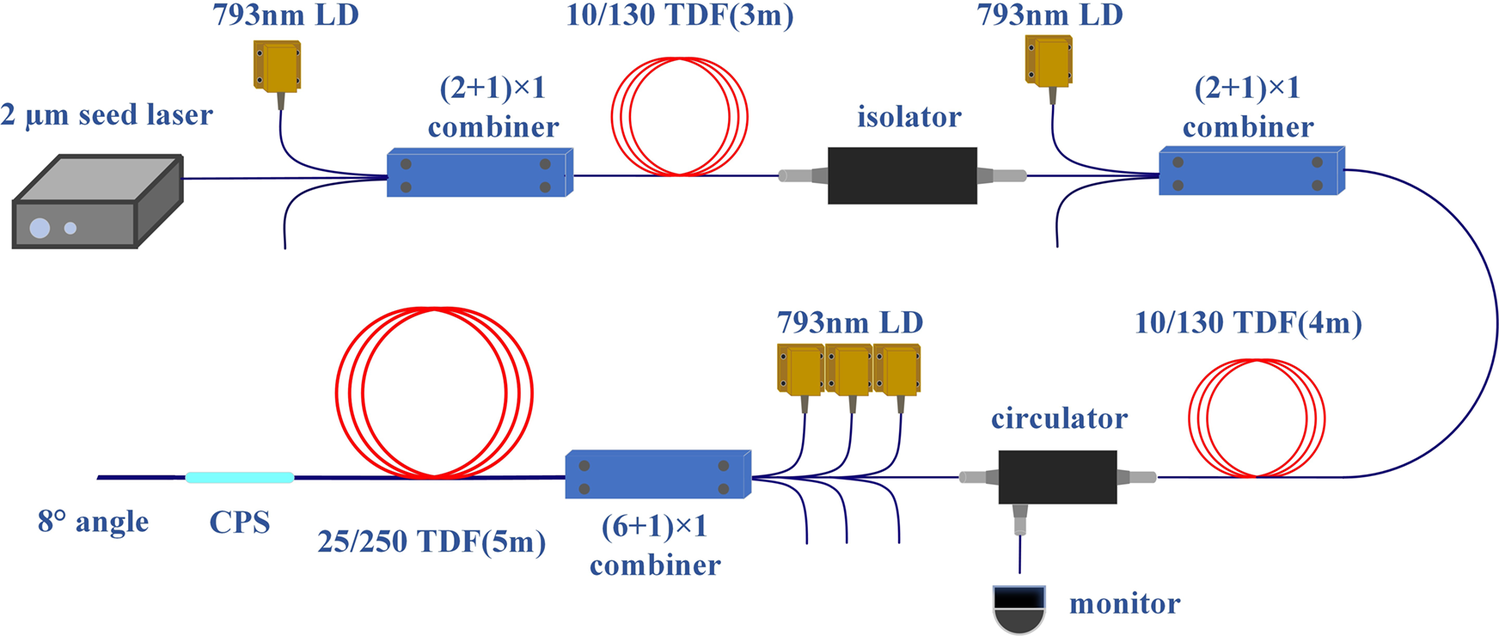
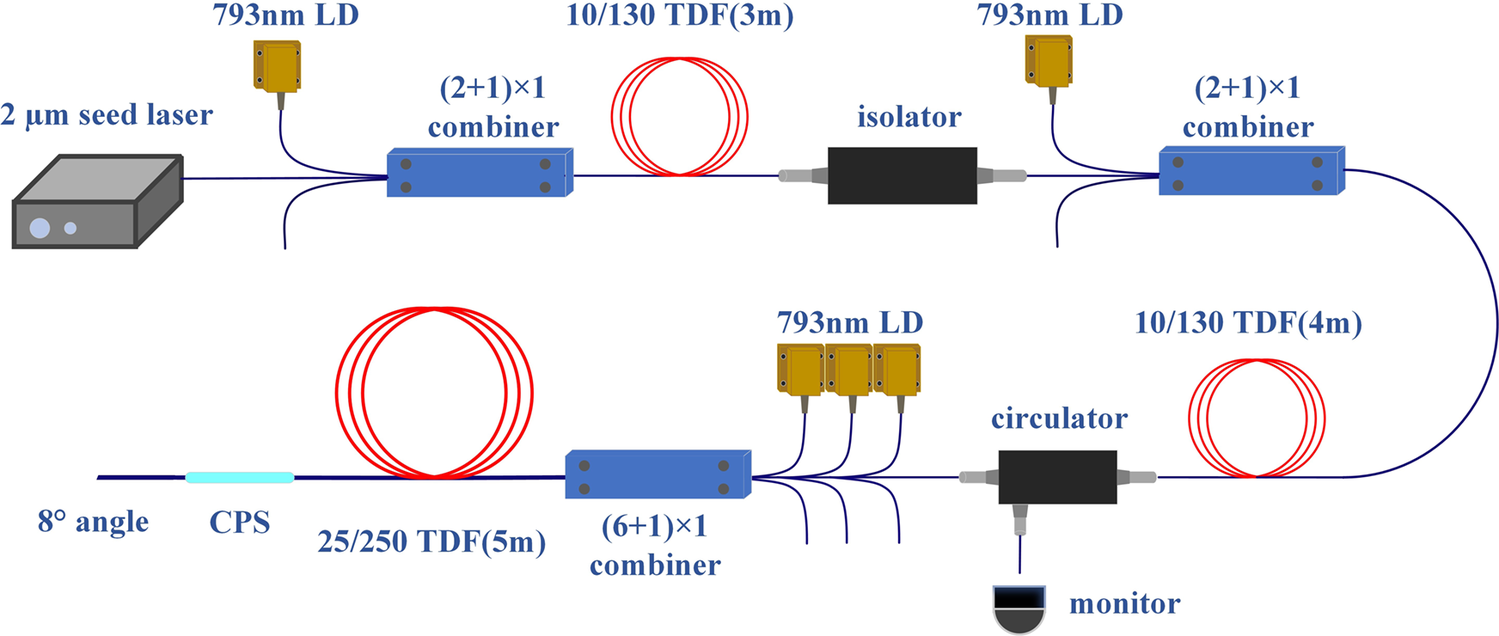
For mid-IR laser sources based on HBr-filled HCFs, it is essential to employ narrow-linewidth lasers operating in the 2 μm spectral band as pump sources. These pump lasers should exhibit spectral linewidths of the order of hundreds of MHz or narrower and possess precise central wavelength tunability of less than 1 pm to ensure optimal pump absorption by the gas lasing medium. To fulfill these requirements, a hundred-watt-level, CW narrow-linewidth thulium-doped fiber amplifier (TDFA) was custom-developed as the pump source. The experimental setup of the narrow-linewidth TDFA is illustrated in Figure 1. A single-frequency fiber laser (AP-SF, Advalue Photonics) operating at a central wavelength of 1971.5 nm (tunable within ±0.5 nm via external control) was employed as the seed laser, providing a 3 dB spectral linewidth of less than 50 kHz and 50 mW output power for subsequent amplification stages. The wavelength of the 2 μm pump source precisely covers the first overtone transition R(2) absorption line (1971.67 nm) from the ground vibrational state ν = 0 to the excited vibrational state ν = 2 of H79Br molecules. H79Br and H81Br are two isotopic forms of the hydrogen bromide molecule, with almost equal natural abundances of 50.678% and 49.306%[ 28 ], respectively. The pump source was implemented through a three-stage power amplifier architecture. The seed laser is amplified to 4.5 W by a two-stage preamplifier. A circulator (MCHCIR-1985, MClasers) is connected after the preamplifier for the extraction of the back-reflected light. In the main amplification stage, three laser diodes (LDs) operating at 793 nm are coupled into the active fiber through one (6 + 1) × 1 pump combiner (LightComm); the active fiber (CJTDF-25/250, Wuhan Changjin Photonics Technology) is a 5 m long double-clad thulium-doped fiber (TDF). The pump absorption coefficient of the TDF is approximately 4.8 dB/m at 793 nm and the core numerical aperture (NA) value is approximately 0.1. After the power amplifier, one cladding pump stripper (CPS) is utilized to remove the residual cladding light. The output fiber end-face is 8° angle-cleaved to reduce the ratio of backward light, and the maximum output power is measured to be 117 W.
Experimental schematic of the hundred-watt-level 2 μm narrow-linewidth TDFA.
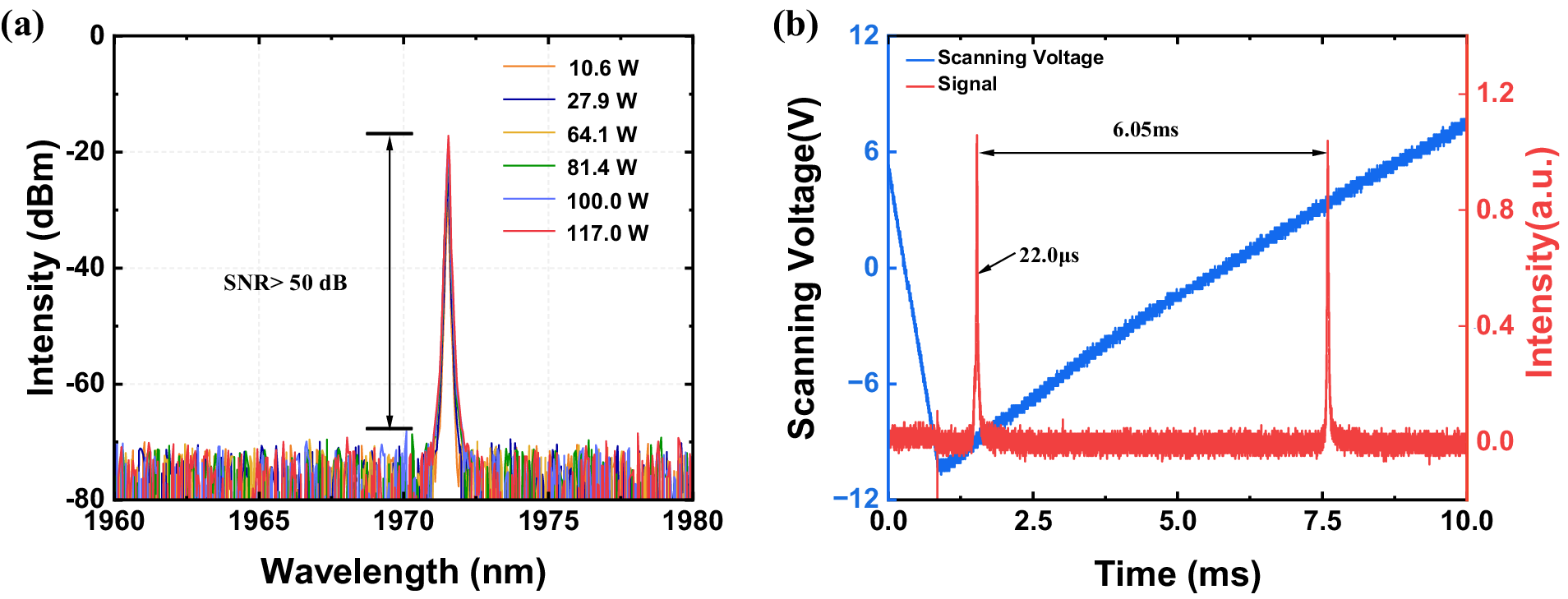
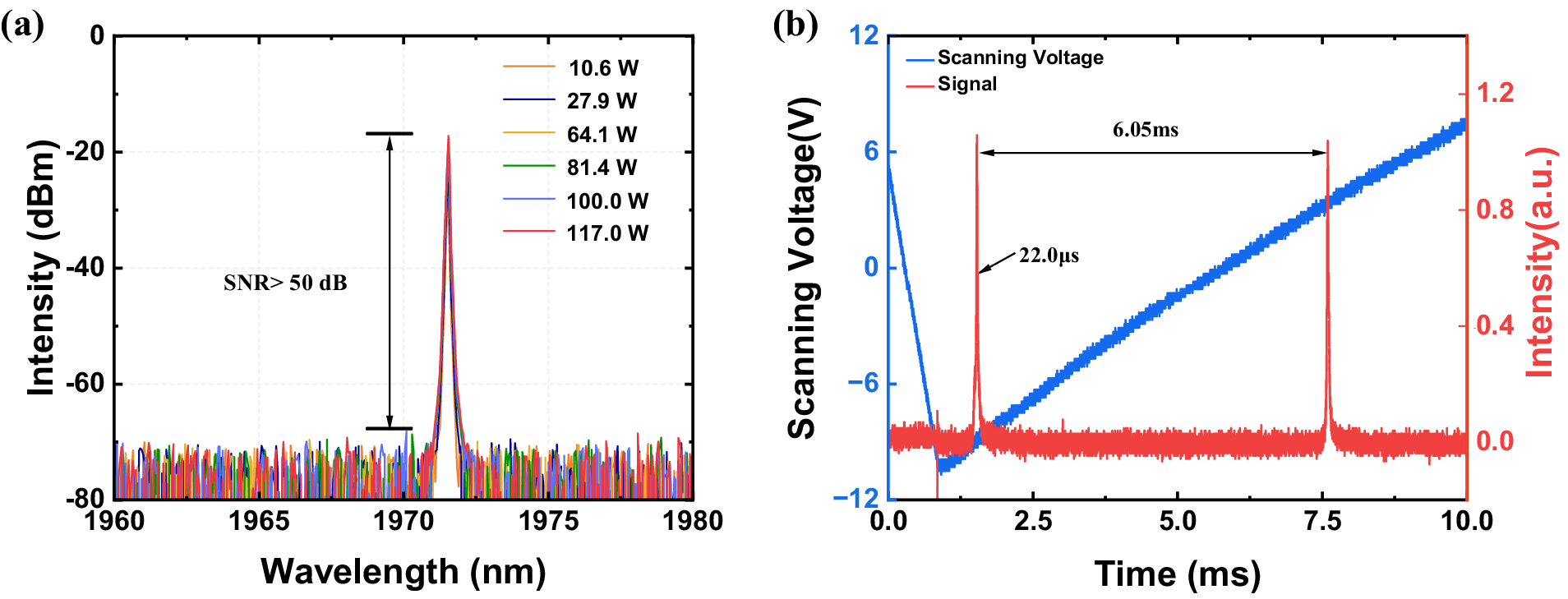
The output spectra of the TDFA corresponding to different output powers were measured, as shown in Figure 2(a). It can be seen that as the output power scales from 10 to 117 W, the spectrum remains stable without observable broadening and maintains a good optical signal-to-noise ratio (OSNR > 50 dB). The spectral linewidth of the pump source was further measured by a Fabry–Pérot (FP) interferometer with a free spectral range of 1.5 GHz, as shown in Figure 2(b). Limited by the finite resolution of the FP cavity, the result is estimated to be less than 7.5 MHz, indicating that the pump source possesses extremely narrow linewidth. A narrow linewidth can enhance the absorption of the pump by improving the match with the Doppler-broadened linewidth associated with the absorption transitions of HBr gas molecules, thereby maximizing the optical pump efficiency. In addition, the beam quality of the pump source is measured to be $M^2_x$
= 1.03 and
$M^2_x$
= 1.03 and $M^2_y$
= 1.12 through a scanning slit beam profiler system. The near-diffraction-limited beam quality will promote the optical coupling efficiency of the 2 μm pump source into the AR-HCF.
$M^2_y$
= 1.12 through a scanning slit beam profiler system. The near-diffraction-limited beam quality will promote the optical coupling efficiency of the 2 μm pump source into the AR-HCF.
(a) Output spectra at different output power of the 2 μm pump laser. (b) Measured spectral linewidth of the pump laser at the maximum output power.
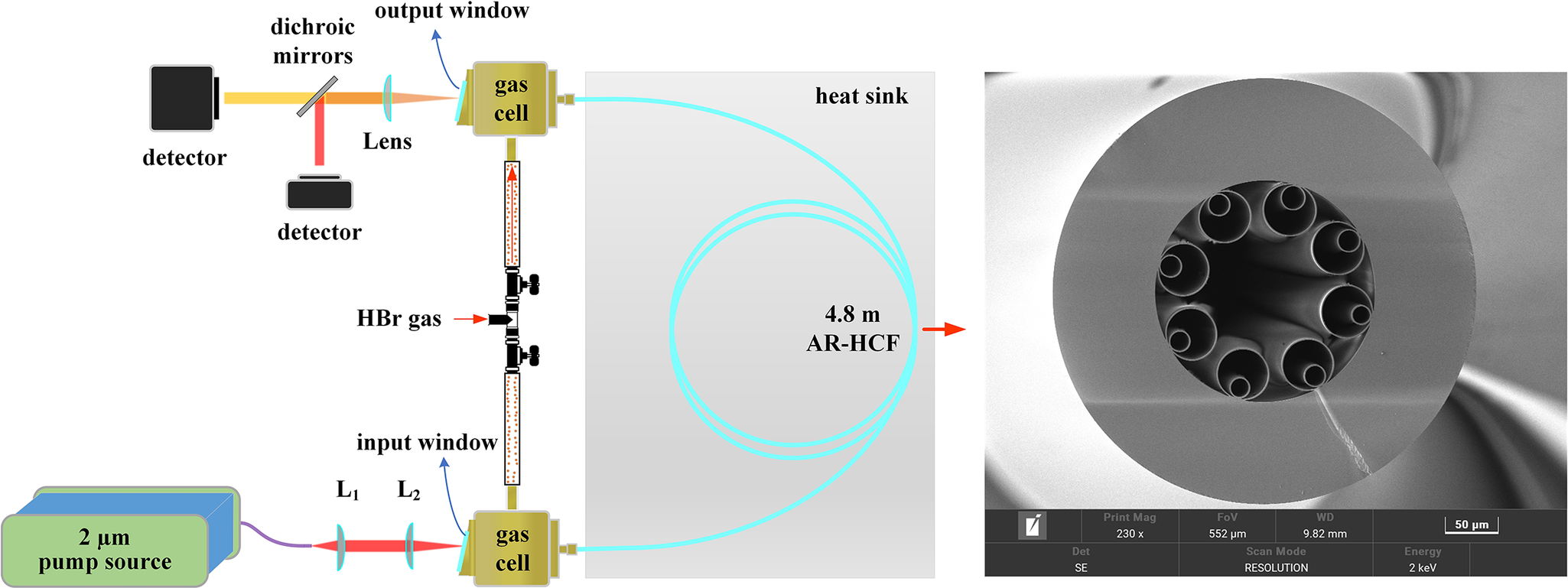
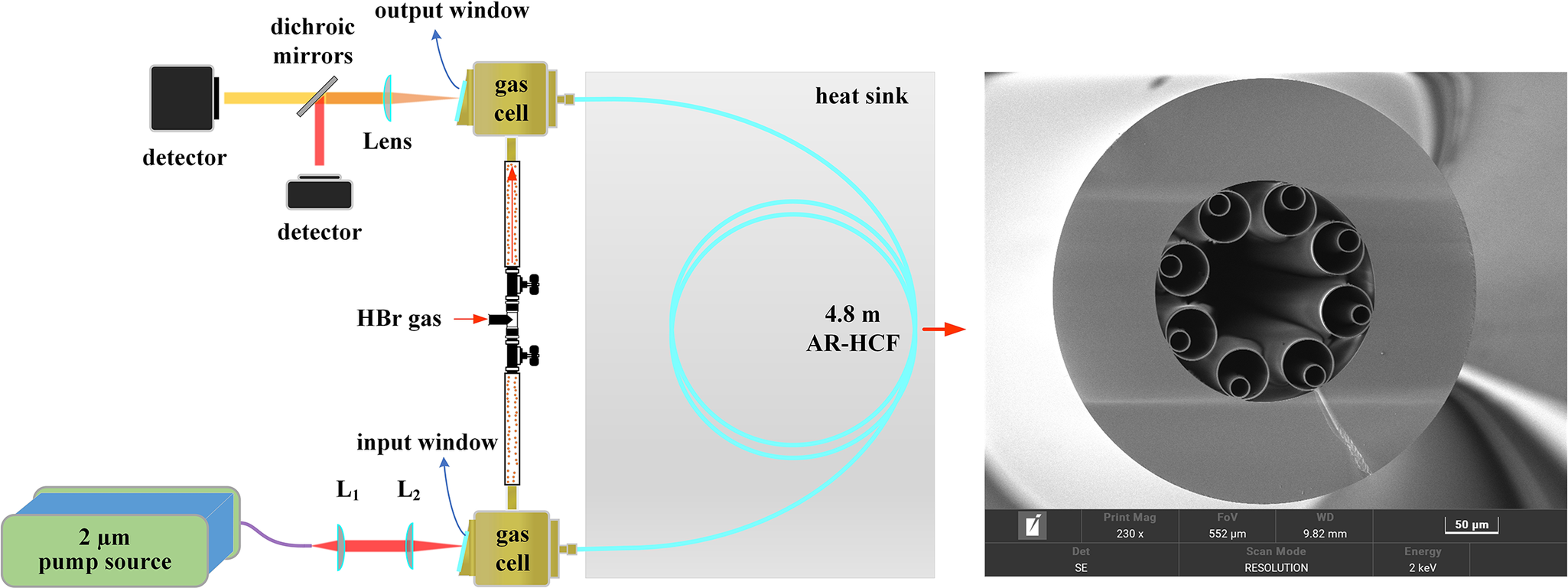
The experimental setup of the 4.16 μm HBr-filled AR-HCF light source is illustrated in Figure 3. Through two plano-convex lenses with 15 mm (L1) and 50 mm (L2) focus length, respectively, the pump light is coupled into the AR-HCF with coupling efficiency of approximately 85% (excluding fiber loss). To ensure system stability and prevent thermal damage, both the input and output ends of the HCF are placed in a gas cell that is well-sealed and equipped with water-cooling for heat dissipation. A specially customized input window that has high transmittance at 2 μm is utilized to ensure optimal optical coupling efficiency. Due to the limited tolerance of the TDFA to high-level back-reflected light, the window on the gas cavity is placed at an 8° angle to reduce potential damage from reflections to the pump source system. At the output end of the HCF, the output window is a broadband sapphire window with more than 90% transmission at 1.97 μm and more than 96% transmission at 4.16 μm. A CaF2 plano-convex lens is positioned after the output window to simultaneously collimate the 4 μm signal light and residual pump light. To effectively separate the residual pump light from the 4 μm signal light, we placed a dichroic mirror at a 45° angle in the output optical path. It achieves a reflectance of 98% at the 2 μm band and a transmittance of 97% at the 4 μm band. The input and output ends of the AR-HCF are firstly evacuated to a near-vacuum environment using a turbomolecular pump. Then low-pressure HBr gas is filled into the AR-HCF from the output end.
Experimental setup of the high-power 4.16 μm HBr-filled AR-HCF light source and a scanning electron microscope (SEM) image of the AR-HCF cross-section.
Considering that HBr gas exhibits smaller absorption and emission cross-sections compared to other gases, such as acetylene, a uniform gas filling scheme was typically employed to enhance pump extraction efficiency in previous work[ Reference Zhou, Huang, Cui, Li, Pei, Li, Li, Wang and Wang 26 ]. The system could sustain CW pump powers up to 50 W under this configuration. However, for higher pump power, the combined thermal accumulation resulting from gas absorption, coupling losses and other factors at the pump injection end will affect the stability of high-power systems. To achieve efficient mid-IR output, the careful balancing among gas pressure, pump power and loss is still to be explored. A nonuniform gas filling approach was implemented in this work. Here, HBr gas is filled from the output-end gas cell, enabling unidirectional gas flow. Then, it will be possible to maintain a gas pressure gradient between the input and output ends of the AR-HCF.
The gas pressure gradient distribution ensures that the HBr gas concentration is higher in the latter part of the fiber compared to the front part. Then the absorption of the pump at the input end of the HCF will be reduced, and the lower thermal accumulation is beneficial for coupling. A 4.8-m-long, eight-tube nested AR-HCF (the same one used in Ref. [Reference Song, Yao, Zhang, Zhang, Hou, Wu and Wang25]) is employed as an efficient interaction platform for pump light and HBr gas, with a scanning electron microscope (SEM) image of the AR-HCF cross-section presented on the right-hand side of Figure 3. The designed eight-tube nested AR-HCF in this work is fabricated using a modified stack-and-draw method and it exhibits good multimode performance at 2 μm. The core diameter of the AR-HCF is approximately 110 μm and the cladding diameter is approximately 400 μm. In order to minimize the loss of pump and signal light in the HCF, the transmission spectrum is specifically designed to support dual-band operation in the mid-IR region, covering the 2 and 4 μm wavelength windows with low attenuation characteristics. The cut-back measurements of the AR-HCF from 49 to 5 m using a supercontinuum light source indicate a loss value of approximately 0.1 dB/m at 1971 nm. For the mid-IR region, an optical parametric generator system tunable from 3.4 to 4.3 μm with an interval of 100 nm is utilized to measure the transmission loss value. The fabricated AR-HCF has achieved broadband low-loss transmission with a loss lower than 70 dB/km in the 3.4–4.1 μm wavelength region.
3 Experimental results
HBr is a diatomic molecule and consequently has only one vibrational normal mode. The vibrational normal mode can be described by the vibrational quantum number ν, which takes on integer values starting from zero. For each vibrational state, there exists a series of rotational states due to rotation of the molecule, characterized by the rotational quantum number J. The transition of H79Br molecules that correspond to the 4.16 μm light emission spectrum occurs between the ν = 2 and ν = 1 vibrational states. Then, the population of the ν = 1 vibrational state is transferred back to the vibrational ground state ν = 0 through vibration relaxation caused by intermolecular collisions. According to selection rules (∆J = ±1), the molecules will decay from the J = 3 rotational state of the ν2 vibrational state to the J = 2 and J = 4 rotational states of the ν 1 vibrational state, resulting in the emission of two spectral lines R(2) and P(4) in the 4 μm region[ 28 ].
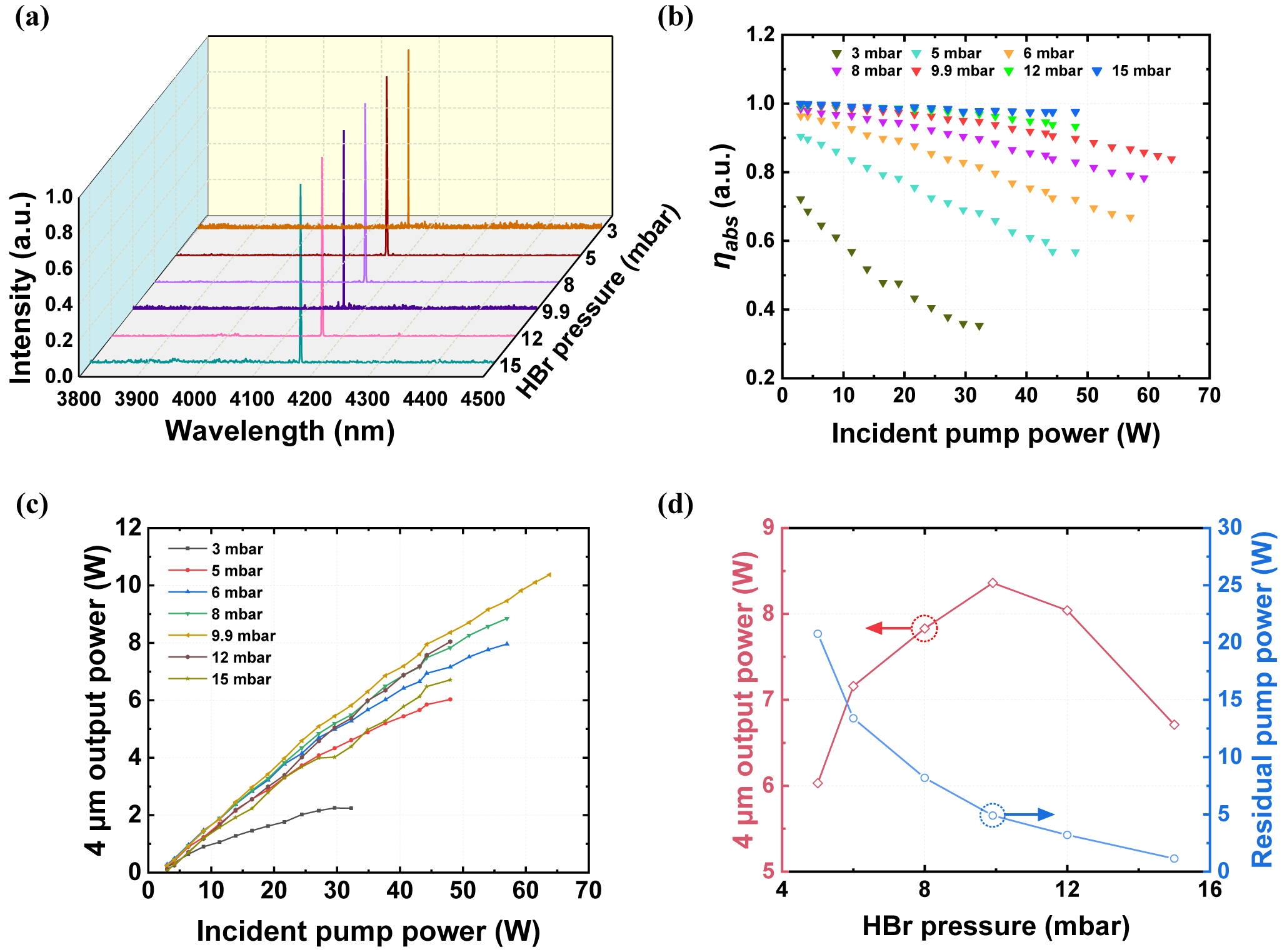
The output optical spectra were measured by a Fourier transform IR spectrometer. As shown in Figure 4(a), the measured mid-IR spectra under maximum pump power conditions are plotted as a function of HBr pressure. The spectral line centered at 4165.3 nm is observed within the 3.0–15.0 mbar pressure range, clearly assigned to the P(4) branch transition (ν = 2 → 1, J = 3 → 4), while the R(2) branch transition at 3977 nm was not observed at all configured pressure conditions. At the maximum output power of 10.4 W, the measured spectra at gas pressure of 9.9 mbar exhibit high purity, with only the P(4) branch transition observed at a wavelength of 4165.3 nm. This absence could be attributed to the higher Einstein A coefficients and larger emission cross-sections of the P-branch compared to the R-branch; thus, P-branch spectral line competition prevails under higher gas pressure conditions[ Reference Zhou, Huang, Cui, Li, Pei, Li, Li, Wang and Wang 26 ].
(a) Output spectra varying with HBr pressure obtained at each maximum incident pump power. (b) The pump absorption ratio varies with the incident pump power under different gas pressures. (c) Signal power curve at different gas pressures. (d) Maximum output signal power and residual pump power as a function of HBr pressure obtained at incident pump power of approximately 48 W.
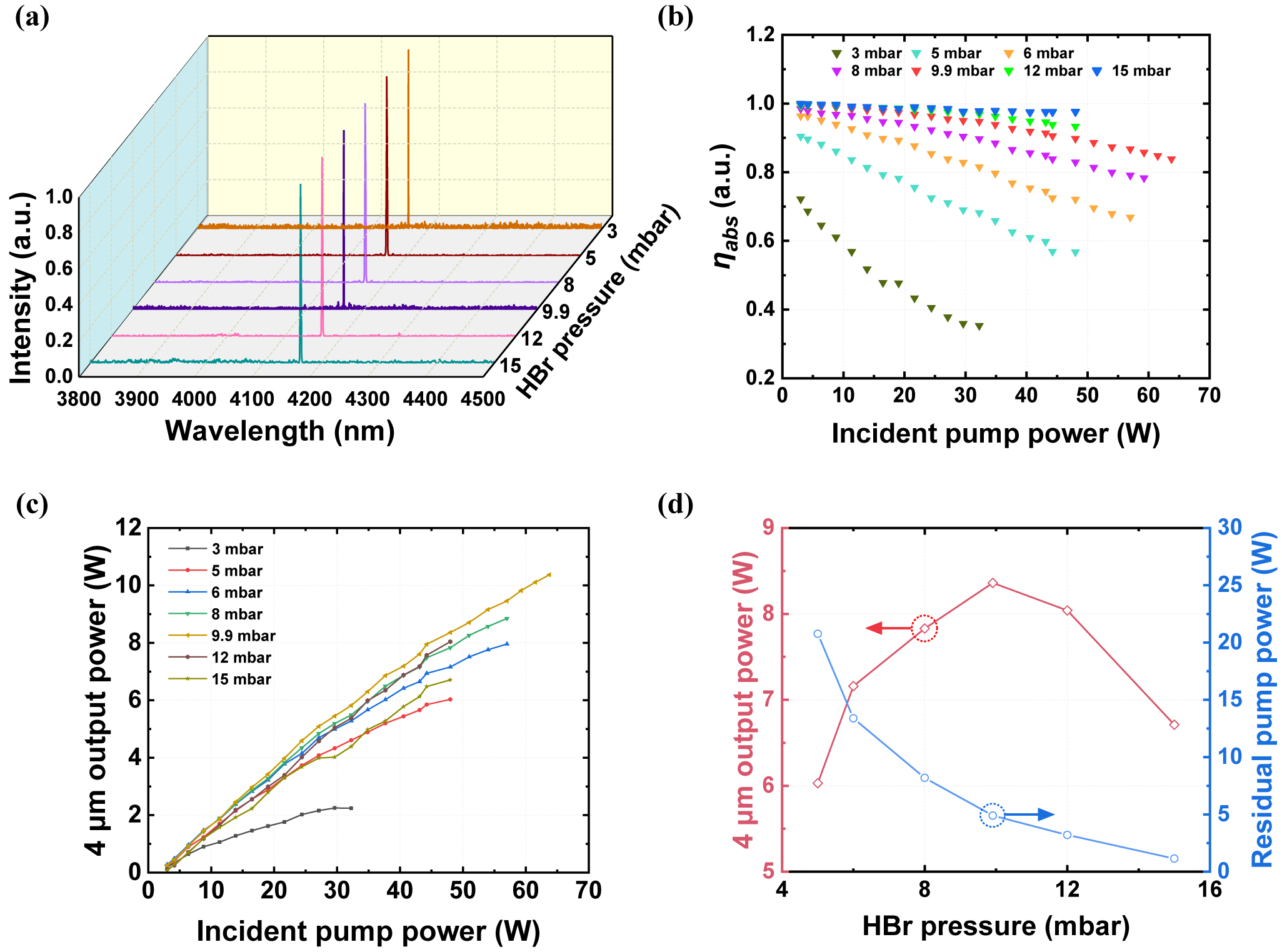
The 4 μm output power and 2 μm residual pump power were measured by two power meters. To maximize the output efficiency of the 4 μm output, the HBr gas pressure was set as a variable in the experiment, and the signal power output characteristics were measured under pressure conditions ranging from 3.0 to 15.0 mbar. For different HBr gas pressure conditions, the HCF exhibits varying absorption capabilities for the pump light. To accurately characterize the pump absorption performance of gas-filled HCF, a parameter of pump absorption ratio η abs= P abs/P in can be defined, where P abs denotes the pump power absorbed by the gas-filled AR-HCF (calculated by subtracting the residual pump power and fiber losses from the coupled pump power) and P in represents the pump power coupled into the HCF. Figure 4(b) describes the variation of η abs with incident pump power at different gas pressures. Under the high pressure of 15.0 mbar, η abs decreases slowly as the injected pump power increases, indicating that the gas-filled HCF has a stronger absorption for the pump light. In contrast, at 3.0 mbar, η abs is lower overall and decreases more rapidly with increasing pump power, reflecting weaker absorption of the pump light at lower pressures. The measured 4 μm output power at different gas pressures as a function of the incident pump power is shown in Figure 4(c). The incident pump power refers to the power of the 2 μm TDFA pump source coupled into the AR-HCF. As explained in Figure 4(c), at different pump power conditions, the output power at 4 μm increases as the gas pressure increases within the pressure range of 3.0–9.9 mbar, reaching maximum output power at 9.9 mbar. The maximum output power is relatively low at pressures higher than 9.9 mbar. The corresponding residual pump power decreases with the increase of gas pressure. With increasing HBr pressure, the molecular density is increased, resulting in more pump absorption with rapidly decreased residual pump power.
It can be inferred that HBr gas pressure significantly determines the output efficiency. As the gas pressure increases, the density of gas molecules in the HCF rises, which enhances the absorption of the pump light. However, the probability of collisions between molecules will increase. This results in a gradual decrease in the net gain of the light source, which ultimately causes a reduction in maximum output power. At gas pressure of 15.0 mbar, the residual pump power corresponding to incident pump power of 48 W is 1.15 W, whereas the output power of 4 μm is only 6.71 W. For comparison, the residual pump power is 4.9 W at gas pressure of 9.9 mbar, whereas the output power at 4 μm reaches 8.36 W. Figure 4(d) further summarizes the output power and residual pump power at different pressures with approximately 48 W incident pump power. The maximum output signal power exhibits a trend of initially increasing and then decreasing. As the gas pressure increases, the higher gas molecule density enhances pump absorption, but the relaxation caused by molecular collisions also intensifies. Determining the optimal gas pressure is critical for balancing the gain enhancement and collision-induced loss.
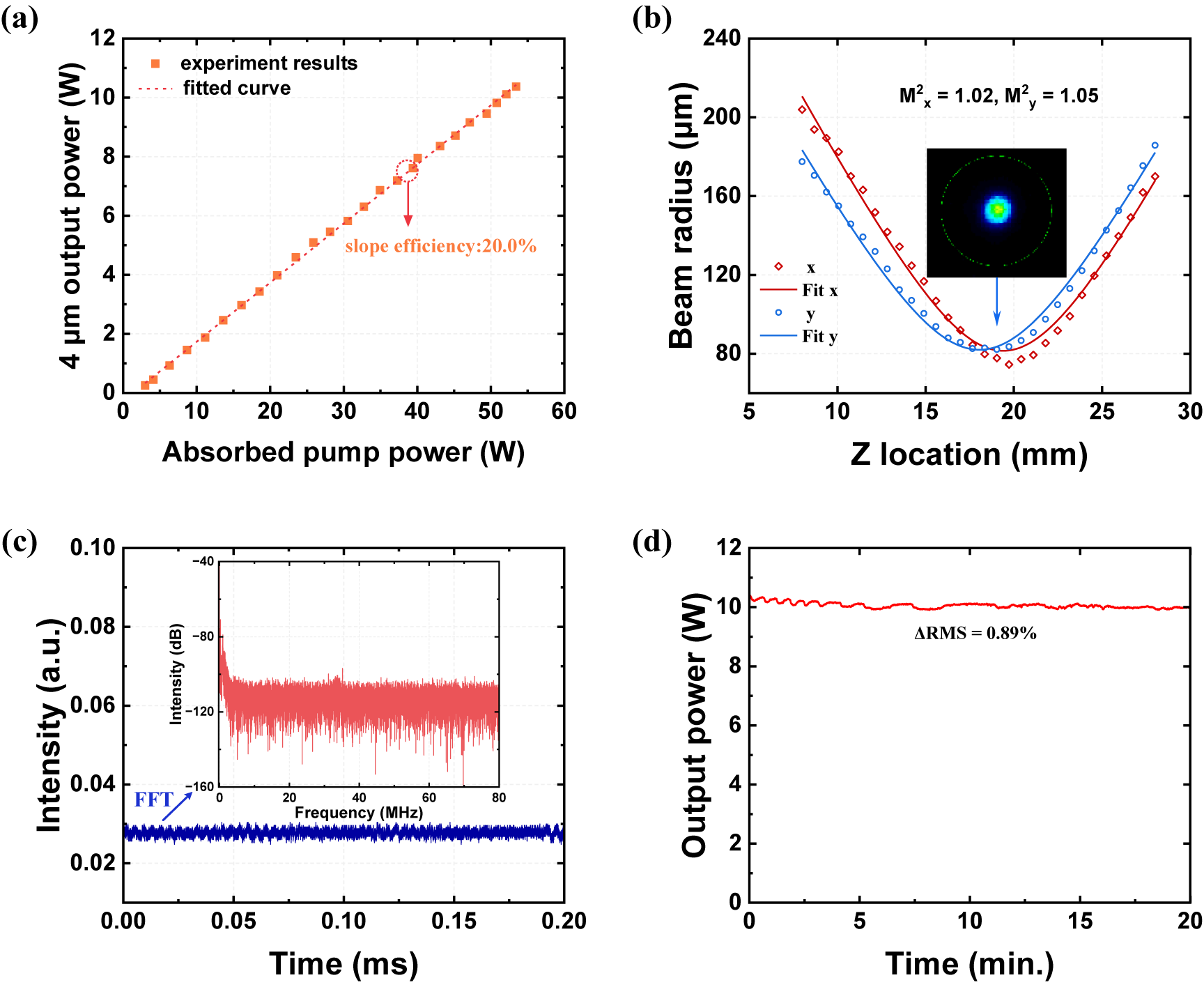
Figure 5(a) plots the output signal power at gas pressure of 9.9 mbar versus absorbed pump power. At the optimal gas pressure of 9.9 mbar, the output signal power increases approximately linearly with the absorbed pump power, and no gain saturation has been observed yet. The maximum output power of 10.4 W has been achieved at the absorbed pump power of 54 W, setting a record for a fiber light source operating beyond 4 μm. At the maximum output power of 10.4 W, the slope efficiency relative to the absorbed pump power is 20.0%. In addition, the beam quality of the signal light was measured through a charge-coupled device (CCD) camera. The collimated light beam was focused by a plano-convex lens with a 100 mm focal length. As shown in Figure 5(b), the beam quality factor was measured to be $M^2_x$
= 1.02 and
$M^2_x$
= 1.02 and $M^2_y$
= 1.05 in the horizontal and vertical directions, respectively.
$M^2_y$
= 1.05 in the horizontal and vertical directions, respectively.
(a) Evolution of signal power with absorbed pump power at 9.9 mbar HBr pressure. (b) Beam quality measurement based on the light beam diameter as a function of propagation distance. Inset: beam waist profile. (c) Temporal property of the signal light at the maximum output power. (d) Output power stability of the mid-IR light source over time.
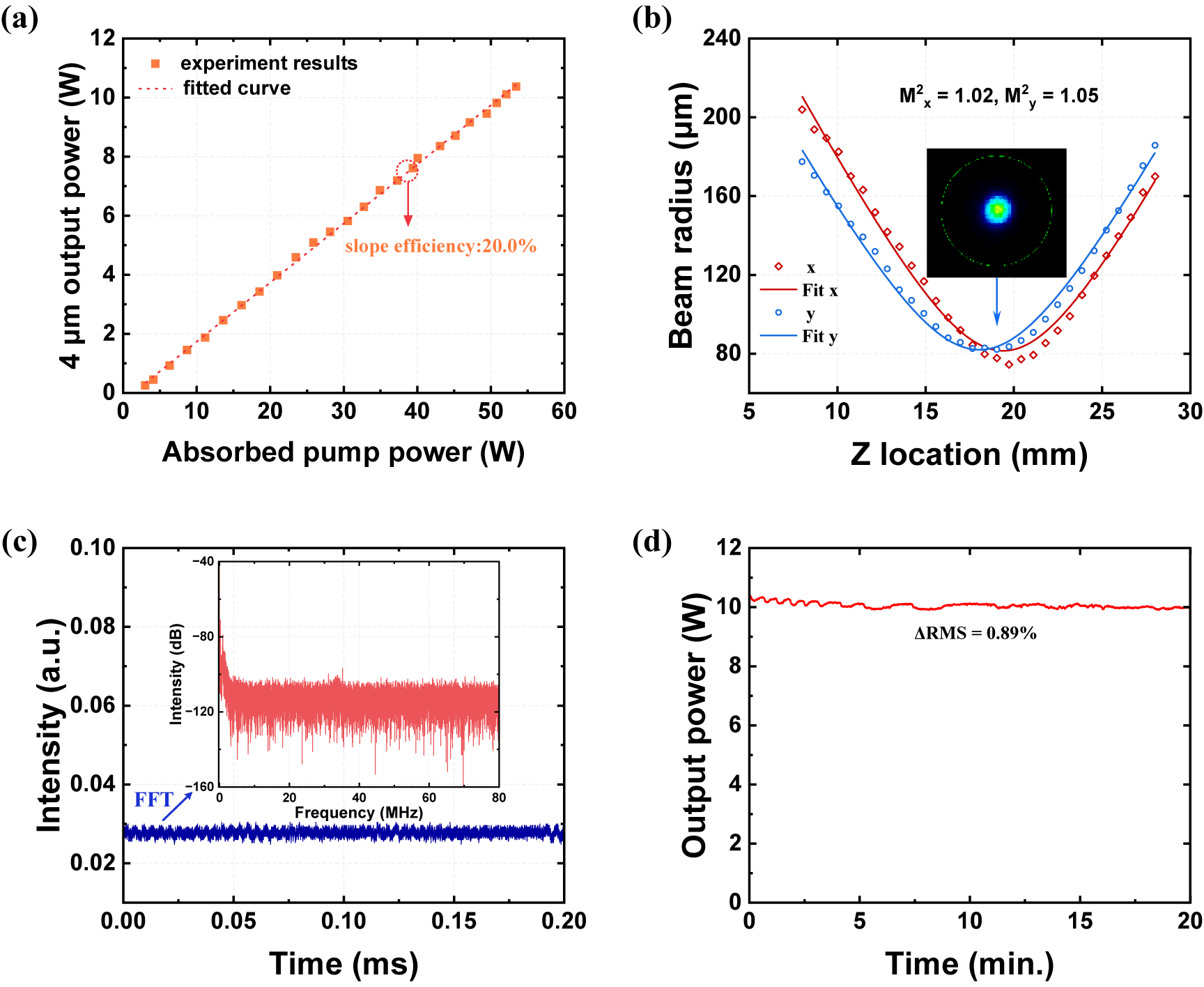
The temporal characteristics of the signal light were also measured and recorded across different time scales. As shown in Figure 5(c), the temporal variations of signal light at maximum output power were recorded utilizing a HgCdTe photodetector (100 MHz bandwidth) and an oscilloscope over millisecond timescales, with an inset showing the corresponding frequency-domain information obtained via fast Fourier transform (FFT). It is evident that, with environmental vibrations and other disturbances suppressed, the signal output exhibits minor fluctuations on the millisecond time scale, which corresponds to characteristic frequency components spanning 0–4 MHz in the frequency domain. The temporal fluctuations may partially originate from instabilities of the pump coupling and dynamic minor drifts of the pump wavelength. Figure 5(d) illustrates the output power stability of the mid-IR light source over time. At the maximum incident pump power of 63.75 W, the mid-IR output power remains stable at an average of 10.05 W for over 20 min, with a root-mean-square (RMS) deviation of 0.89%. The above result indicates that the HBr-filled HCF light source can provide stable continuous power output over extended periods, which is crucial for various applications requiring stable output.
4 Discussion
In HBr-filled AR-HCFs, the primary factors influencing the gain and loss of signal light are various relaxation processes among different vibrational and rotational energy levels of gas molecules. These relaxation processes, induced by collisions between molecules and collisions between molecules and the fiber tube walls, convert pump power into signal power or thermal energy[ Reference Wei, Yu, Lei, Wang and Wang 29 ]. Notably, prior studies have demonstrated that rotational relaxation within the same vibrational level redistributes populations, leading to population inversion between different energy levels, thus generating multiple transition lines. Recent research on HBr-filled fiber gas light sources underscores the critical influence of multi-level rotational relaxation dynamics on output characteristics[ Reference Zhou, Huang, Cui, Li, Pei, Wang and Wang 30 ]. Considering the relaxation processes among multi-levels will make the simulation more consistent with actual experimental results. In our study, the HBr gas was introduced solely through the gas cell at the output end. The gas molecules flow from the high-pressure end to the input end of the AR-HCF, and after a certain period of time, the internal distribution will reach a dynamic balance. This process is essentially the directional migration of molecules within a confined space, driven by a pressure gradient, but retarded by collisions with the tube walls and intermolecular collisions. Finally, a longitudinally decreasing pressure gradient from the output to input of the fiber is established. The gas pressure in the simulation is approximately set to decrease linearly from high to low (match readings of vacuum gauge: fiber output approximately 0.8 mbar; fiber input approximately 9.9 mbar). The multi-level relaxation model established in Ref. [Reference Wei, Yu, Lei, Wang and Wang29] was applied to simulate gain dynamics under this nonuniform pressure distribution.
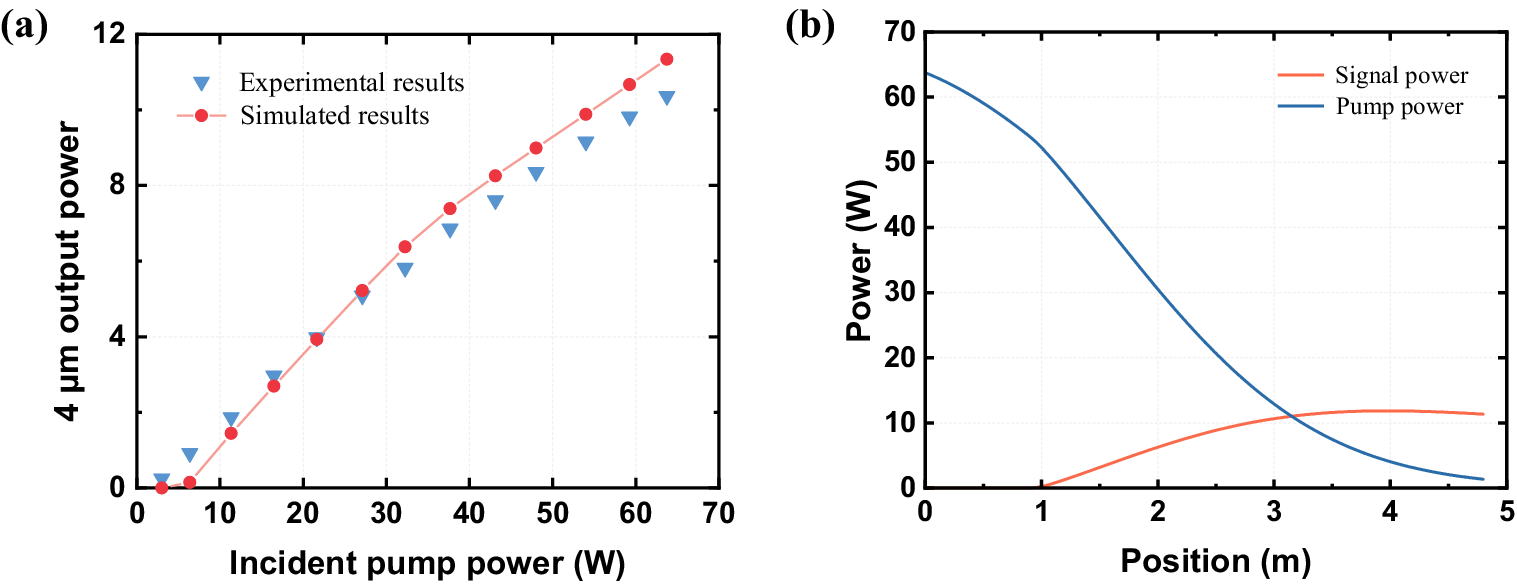
Figure 6(a) compares the simulated and experimental signal power versus incident pump power at the pressure end of 9.9 mbar. It can be seen that the simulated results align well with the experimental results, but as the pump power increases, the simulated results gradually exceed measured ones. Figure 6(b) illustrates the power evolution of the pump and signal light at different positions along the fiber with the incident pump power of 63.75 W and gas pressure of 9.9 mbar. The signal emission initiates at approximately 1 m fiber length and gradually increases. At the position of 3.96 m, the signal light reaches its maximum power of 11.85 W, and then slightly decreases to 11.34 W at the fiber output end of 4.8 m. The decrease in power may be attributed to the net gain being positive before 3.96 m, while beyond this length, the transmission loss at 4.16 μm in the fiber continues to increase, causing the loss to be greater than the gain and consequently resulting in a decrease in signal output power.
(a) The simulated and experimental signal power varying with pump power at gas pressure of 9.9 mbar. (b) The pump and signal power distribution along the AR-HCF with the incident pump power of 63.75 W.
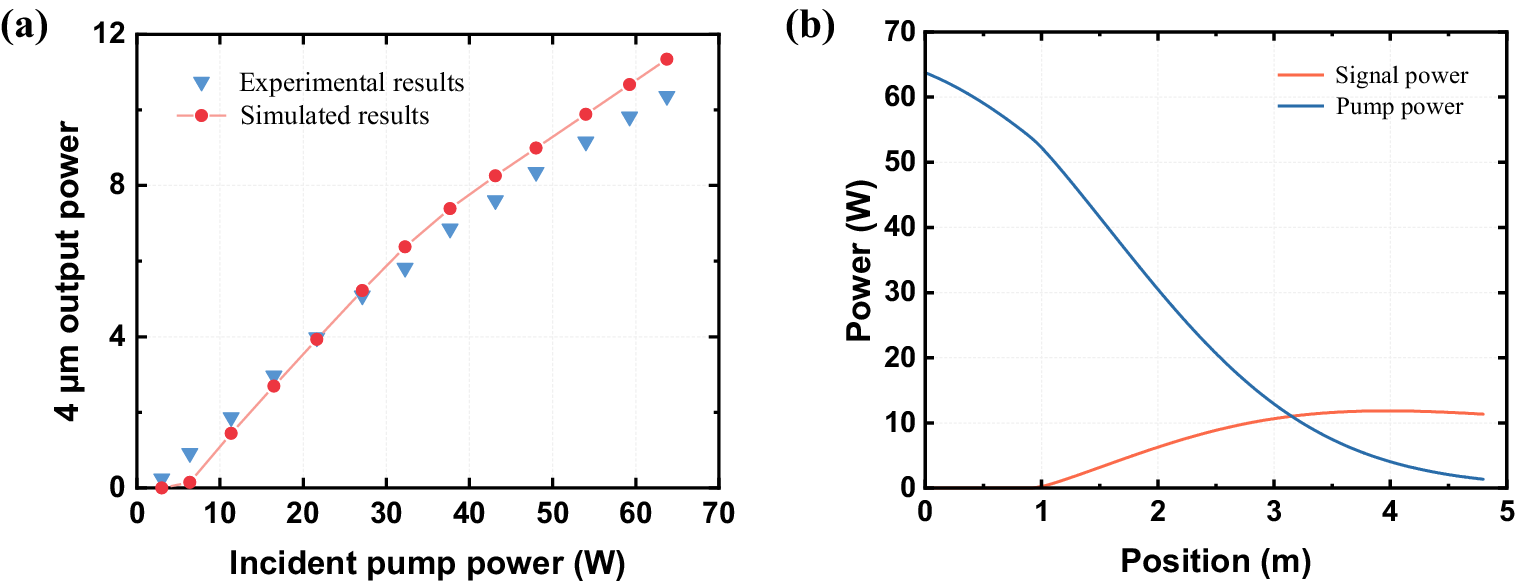
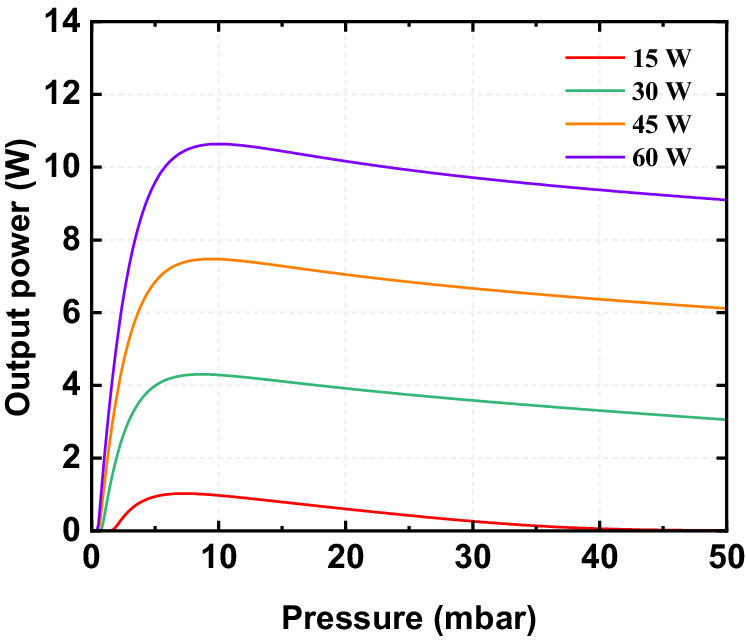
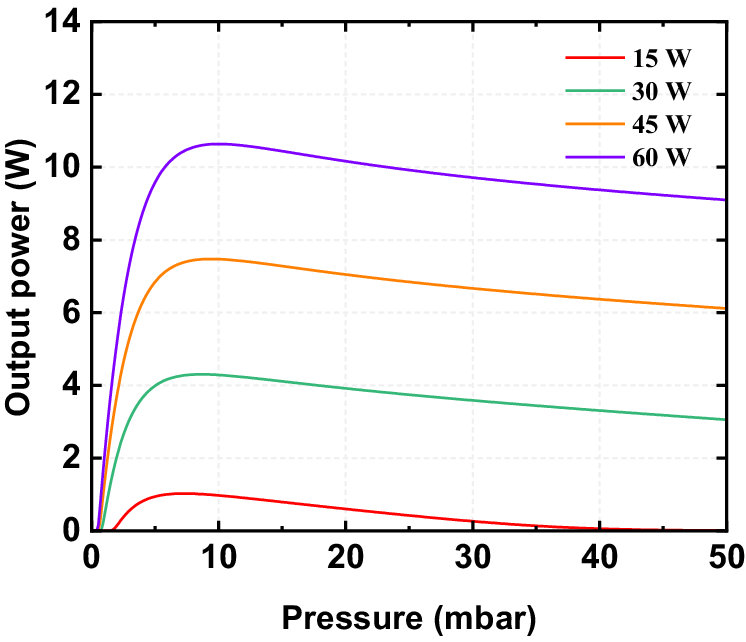
Figure 7 illustrates the dependence of output power on gas pressure under varying pump powers (15, 30, 45 and 60 W). The length of the AR-HCF set in the simulation is 4.8 m, which is consistent with that in the experiment. At a low pump power of 15 W, the optimal pressure for maximum output is observed at approximately 6.3 mbar, with output power dropping to negligible levels when the gas pressure exceeds 50 mbar. As the pump power increases, the optimal pressures shift to 7.9 mbar (30 W), 9.1 mbar (45 W) and 9.6 mbar (60 W). When the gas pressure exceeds these optimal values, the output power gradually declines with rising pressure. In high gas pressure conditions, the effect of rotational relaxation among gas molecules intensifies, thereby affecting gain. However, increasing the pump power will ensure the necessary population inversion required for signal transitions, thereby enabling efficient operation at higher optimal pressures. In summary, the optimal output efficiency is determined jointly by the interaction of HBr gas pressure, pump power and fiber transmission loss.
The simulated maximum output power varying with HBr gas pressure under 15, 30, 45 and 60 W pump power, respectively.
5 Conclusion
In conclusion, a 10.4 W, 4.16 μm mid-IR light source enabled by optically pumped HBr-filled AR-HCF has been demonstrated experimentally for the first time. By utilizing a large-mode-area AR-HCF combined with a nonuniform gas filling strategy, the thermal effect at the input of fiber was effectively suppressed. At a maximum incident pump power of 63.75 W, a mid-IR output power of 10.4 W was achieved, which appears to be the highest result reported so far beyond 4 μm. In a 4.8-m-long AR-HCF filled with HBr gas, the mid-IR light source exhibits a slope efficiency of 20.0% relative to the absorbed pump power. The impact of HBr gas pressure and pump power on the output efficiency of the mid-IR light source was investigated experimentally. Further theoretical discussions have explored the impact of rotational relaxation on output characteristics. The beam quality and temporal characteristics of the mid-IR light source were also characterized, indicating that the light source exhibits near-diffraction-limited characteristics and maintains good stability over prolonged periods of operation. Overall, this work demonstrates a viable approach to achieving high-power mid-IR light sources with high beam quality beyond 4 μm and also provides a good reference for power scaling of mid-IR fiber light sources based on AR-HCF.
Acknowledgements
This work is supported by the Science and Technology Innovation Program of Hunan Province (Grant No. 2021RC4027) and the Youth Independent Innovation Science Fund of National University of Defense Technology (Grant No. ZK23-23).

 Open access

