

Introduction
There are many factors that determine the job search behaviours of workers. One of the important ones among these is the discouraged worker effect. Although this effect is defined in different ways in the literature, it can be broadly explained as follows: the discouraged worker effect occurs during periods of high unemployment rates when the monetary and psychological costs of the job search process exceed the benefits obtained from job searching, leading the individual to lose hope of finding a job, give up the job search, and exit the labour market (Borjas Reference Borjas2012, 71; Dagsvik et al Reference Dagsvik, Kornstad and Skjerpen2013, 402; Ehrenberg and Smith Reference Ehrenberg and Smith2011, 219; Kaya Bahçe and Memiş Reference Kaya Bahçe and Memiş2014).
The discouraged worker effect has significant consequences for both economies and individuals. On a macro scale, discouraged individuals do not actively participate in the labour market, leading to the inefficient utilisation of one of the most crucial inputs of production. Individually, while they are not officially classified as unemployed, this does not alter the fact that they remain jobless and without income and may face similar issues to those officially classified as unemployed. Unemployment is associated with higher crime rates (Maddah Reference Maddah2013; Raphael and Winter-Ebmer Reference Raphael and Winter-Ebmer2001) and greater psychological distress, substance abuse, and addiction (Harris and Morrow Reference Harris and Morrow2001; Henkel Reference Henkel2011; Nagelhout et al Reference Nagelhout, Hummel, De Goeij, De Vries, Kaner and Lemmens2017), while also worsening mental health and increasing suicide risk (Córdoba-Doña et al Reference Córdoba-Doña, San Sebastián, Escolar-Pujolar, Martínez-Faure and Gustafsson2014; Frasquilho et al Reference Frasquilho, Matos, Salonna, Guerreiro, Storti, Gaspar and Caldas-de-Almeida2016; Huikari and Korhonen Reference Huikari and Korhonen2021; Virgolino et al Reference Virgolino, Costa, Santos, Pereira, Antunes, Ambrósio, Heitor and Vaz Carneiro2022). On the other hand, even those who do not experience these issues may face another significant challenge, further hindering their ability to find employment, especially after a year, when individuals tend to earn lower wages and experience skill deterioration (Bejaković and Mrnjavac Reference Bejakovıć and Mrnjavac2018; Nichols et al Reference Nichols, Mitchell and Lindner2013). Since discouraged workers are not actively seeking jobs, finding enough motivation to re-enter the labour market becomes crucial, making finding a job even more challenging for them. Understanding their withdrawal is key to developing policies that prevent discouragement or reduce the time it takes to re-enter the labour market.
This study analyses the discouraged worker effect in Türkiye during 2020–2021. The Covid-19 pandemic severely impacted labour markets. According to the International Labour Organization (ILO) (2022, 23), global unemployment rose from 5.4% in 2019 to 6.6% in 2020, while labour force participation dropped from 60.5% to 58.6%. In 2021, participation increased slightly to 59.0%, with unemployment at 6.2%. In Türkiye, unemployment declined from 13.7% in 2019 to 13.2% in 2020, while the labour force participation rate fell from 53% to 49.3%, according to the Turkish Statistical Institute (TURKSTAT) (2021). By 2021, participation rose to 51.4%, and unemployment decreased to 12% (TURKSTAT 2022a).Footnote 1
The discouraged worker effect is typically studied in economic downturns, where job scarcity causes individuals to lose hope and exit the labour market. However, the Covid-19 pandemic had a far deeper impact. Beyond economic deterioration, the constant threat of infection might have created persistent fear – not only for an individual’s own health but also for their loved ones. As Erin and Gökçek (Reference Erin and Gökçek2023, 1832) describe, strict quarantines separated people from their families, funerals could not be held properly, and distressing images of overcrowded hospitals and patients dying due to insufficient medical equipment were widely circulated. The relentless exposure to death, combined with soaring death tolls, might force individuals to confront their own mortality, intensifying psychological distress. This heightened awareness and fear of death are referred to as death anxiety (Barrett Reference Barrett, Gellman and Turner2013, 541).
Increased awareness and fear of death can shape various economic decisions and behaviours. Studies link these factors to savings and retirement choices (Garmendia et al Reference Garmendia, Topa, Herrador and Hernández2019; Zaleskiewicz et al Reference Zaleskiewicz, Gasiorowska and Kesebir2013), consumption preferences (Ferraro et al Reference Ferraro, Shiv and Bettman2005; Kasser and Sheldon Reference Kasser and Sheldon2000; Mandel and Smeesters Reference Mandel and Smeesters2008), risk attitudes (Landau and Greenberg Reference Landau and Greenberg2006; Tomkins Reference Tomkins2022), and altruistic behaviours such as organ donation (Wu et al Reference Wu, Tang and Yogo2013). Given this, the prolonged pandemic period may have similarly affected job search behaviours.
During the pandemic, death anxiety likely influenced individuals in two distinct ways regarding job search behaviour. Some individuals, overwhelmed by continuous exposure to mortality, might have altered their perception of life and begun to see it as meaningless, leading to behaviours that deviate from societal norms (Menzies and Menzies Reference Menzies and Menzies2020). When life is perceived as lacking purpose, efforts traditionally deemed essential – such as seeking employment – may lose their significance. As a result, these individuals might find little value in the struggle to secure a job, accelerating their withdrawal from the labour market.Footnote 2 In contrast, according to Terror Management Theory, some individuals may respond to heightened death awareness by reinforcing attachment to cultural and materialistic values as a defence mechanism against fear (Kasser and Sheldon Reference Kasser and Sheldon2000, 348; Pyszczynski et al Reference Pyszczynski, Rothschild and Abdollahi2008, 318). Instead of abandoning the job search, they may seek employment to reaffirm control and purpose. If this is the prevailing response, there may be less concern about the labour market. However, if the first scenario dominates, further policies are needed to develop interventions that prevent individuals from losing hope and exiting the labour market.
In addition to the psychological impacts of death awareness, the pandemic period introduced significant disruptions to both labour demand and supply. As in many countries, restrictions on international and domestic travel, along with limitations on leaving homes, severely curtailed economic activities in Türkiye.Footnote 3 These restrictions led to a sharp decline in the demand for labour, as production in many sectors was reduced or entirely halted (Aldan et al Reference Aldan, Çıraklı and Torun2021). At the same time, the pandemic also caused a reduction in labour supply. In addition to the labour demand contraction typically seen during economic crises, individuals were more reluctant to enter the labour market due to health concerns and the fear of virus infection (Aum et al Reference Aum, Lee and Shin2021). Many routine activities, such as using public transportation or entering crowded environments, increasingly became actions to be avoided unless absolutely necessary, particularly for individuals with chronic illnesses or conditions related to Covid-19. Undoubtedly, such circumstances may have influenced individuals’ job search behaviours, and it seems quite plausible that some chose to withdraw from the labour market altogether due to concerns about infection. Additionally, those who were infected with the virus, especially during the early stages of the pandemic when its effects were more severe, faced long and difficult illness periods. Even when the illness progressed mildly, quarantine measures requiring individuals to stay at home for up to 14 days were imposed (AA 2021a). In some cases, individuals were obliged to remain in quarantine even if they were not directly infected but had a household member who tested positive. These are experiences rarely encountered in everyday life outside of the pandemic, and they may have adversely affected individuals’ willingness or ability to seek employment.
As in many other countries, the Turkish government provided financial assistance during the pandemic to those who were laid off, experienced income loss due to temporary business closures, or were otherwise economically vulnerable (AA 2021b; AA 2021c; AA 2021d). Previous studies in the literature have shown that an increase in unemployment insurance can alter job search behaviour, leading individuals to take longer to re-enter the labour market or to secure new employment (Røed and Zhang Reference Røed and Zhang2003; Rotar and Krsnik Reference Rotar and Krsnik2020). Therefore, these financial support mechanisms may also have influenced individuals’ decisions to search for jobs or remain actively engaged in the labour market.
Further, in different types of jobs, most likely including those in hiring departments, the rapid transition to remote work necessitated a shift in job search methods, pushing many job seekers to manage the job search process online. However, the effectiveness of this shift may have varied depending on individuals’ familiarity with technology and their access to the internet. For some, this digital transition presented challenges, limiting their ability to search effectively for jobs. Additionally, the suspension of in-person education and the shift to online education meant that many parents were at home, responsible for supervising their children during school hours. As a result, these individuals likely had less time and effort to devote to their job search, further hindering their ability to find employment.
We are not able to disentangle these effects with the dataset we are using for this study, so instead, we will aim to understand the overall impact of the pandemic on discouragement using TURKSTAT Labour Force Statistics Micro Data (2018–2021) (TURKSTAT 2022b). The pre-pandemic (2018–2019) and pandemic (2020–2021) periods are compared through probit regression analysis. There are some studies in the literature on the subject (see Miranti et al Reference Miranti, Sulistyaningrum and Mulyaningsih2022; Mondal et al Reference Mondal, Govindarajan and Chandra2023; Roychowdhury et al Reference Roychowdhury, Bose and De Roy2022). While these present a comparable topic to this study, the first two focus their analysis on labour force participation rates and adopt a macroeconomic perspective, whereas the last one focuses exclusively on women and examines a different phase of the pandemic. This study distinguishes itself from the existing literature on labour markets by employing micro-level data, offering an original contribution through this methodological difference. Our dataset includes direct questions on the discouraged worker effect, allowing for a detailed microeconomic analysis. While most prior studies have examined labour force participation rates using macro-level indicators at the national or regional level, such approaches often overlook heterogeneity in individual decision-making and demographic characteristics. However, participation decisions are highly sensitive to personal circumstances, such as age, gender, education, and marital status, which vary substantially across population groups. Leveraging micro-level data, this study offers deeper insight into how these factors influence labour market behaviour. The findings help bridge the gap between aggregate trends and individual realities and offer a stronger empirical foundation for more targeted and effective policy interventions. Moreover, given limited resources, governments must often prioritise among population groups. Identifying which groups should be targeted requires insights that only micro-level analyses can provide. Therefore, individual-level studies are essential not only for understanding behavioural differences, but also for designing fairer and more efficient labour market policies. The analysis in this study is based on data from the Turkish labour market. Although Türkiye is a Muslim-majority country, it adopts a secular system of governance. In this sense, it represents a unique case. Moreover, the Turkish labour market has its own structural problems that contribute to the gender gap. These issues are undoubtedly linked to societal norms and the societal structure of the country, which can differ significantly from those found in typical Muslim-majority or secular countries. Therefore, the labour market on which this study is based can be expected to contribute to the literature, given the context and findings it offers.
According to the results obtained from the probit regression analysis, the discouraged worker effect during the pandemic period is higher than in the pre-pandemic period. The probability of a job seeker becoming discouraged is 1.6% higher during the pandemic period compared to the pre-pandemic period. Higher education levels reduced the likelihood of discouragement, while age showed a diminishing negative effect. Single women were more adversely affected than single men and married women than married men.
The results indicate that the negative impact of the pandemic on discouragement was greater than that of a typical economic downturn, aligning with the possible reasons and explanations outlined earlier. Additionally, the effects on individuals were not uniform across different groups. Regardless of the pandemic, single men were less likely to be discouraged than single women and married men less than married women. During the pandemic, the same pattern continued: women were generally more negatively affected than men, and among married individuals, women were more likely to be discouraged than men. These gender-based results are believed to be explained by Türkiye’s societal structure.
In the following section of the study, the relevant literature is discussed. Subsequently, the dataset and methodology used in the study are explained, followed by an analysis of the study’s results. Finally, the discussion and concluding remarks section summarises the study and discusses the findings.
Literature review
A review of the literature on the discouraged worker effect reveals that a significant number of studies focus on exploring the actual existence of the discouraged worker effect. For instance, Darby et al (Reference Darby, Hart and Vecchi2001) studied the discouraged worker effect using OECD data for France, Sweden, the USA, and Japan for the period between 1970 and 1995. The results of the study indicate that the discouraged worker effect is applicable to women aged 45–54 during economic crisis periods. On the other hand, the findings of Blundell et al (Reference Blundell, Ham and Meghir1998) for the period between 1981 and 1984 in the United Kingdom show that 10% of the labour force became discouraged workers due to fixed costs and 15% due to job search costs. According to Boeri and van Ours (Reference Boeri and van Ours2008), who studied the period between 1995 and 2000, the discouraged worker effect was found to be 0.7% for Belgium, 0.4% for Denmark and Finland, 1.3% for Ireland, 0.2% for Portugal, and 0.3% for the United Kingdom.
Another area of research in the literature on discouraged workers is the comparison between the added worker effectFootnote 4 and the discouraged worker effect. These studies typically investigate whether these effects exist or which effect is more dominant. For example, Scherer (Reference Scherer1978) examined data from Australia covering the years 1966 to 1974 and found no evidence of the added worker effect but identified the presence of the discouraged worker effect for some years. Lenten (Reference Lenten2000) analysed the relationship between unemployment rates and labour force participation rates in Australia from 1979 to 1998, finding a negative relationship between these two variables, which he attributed to the discouraged worker effect. No evidence of the added worker effect was found. In Kuch and Sharir’s (Reference Kuch and Sharir1978) study of Canada from 1953 to 1974, the discouraged worker effect was identified for most age and gender groups, except those aged 25–44, for whom no evidence of either effect was found. Another study by Janko (Reference Janko2023) on Canada examined the long-term relationship between unemployment rates and labour force participation rates. The results indicated the dominance of the added worker effect for men and the discouraged worker effect for women. Türk and Ak (Reference Türk and Ak2019) investigated these two effects for several European countries during the European debt crisis. The study found that the discouraged worker effect was more pronounced in Ireland, the United Kingdom, and Portugal, while the added worker effect was more dominant in Italy and Spain.
The literature also includes studies focused on the discouraged worker effect within the context of the Turkish labour market. The results of Başlevent and Onaran’s (Reference Başlevent and Onaran2003) study, covering the period between 1988 and 1994, indicate that the added worker effect was more dominant than the discouraged worker effect during the 1994 crisis in Türkiye. Karaoğlan and Ökten (Reference Karaoğlan and Ökten2012) examined the labour force participation behaviour of women whose spouses lost their jobs for the period between 2000 and 2010. According to the results of the study, the added worker effect was predominant for those women, while the discouraged worker effect emerged when employment conditions in their regions deteriorated. Yenilmez and Kılıç (Reference Yenilmez and Kılıç2018) also investigated these effects for Türkiye during the period from 2014 to 2017. The results of the study show that the added worker effect was predominant for vocationally educated women, while no evidence was found of either of these effects for men.
These studies have examined the relationships between unemployment rates and labour force participation rates either over the long term or by focusing on specific economic crisis periods. Although rare, there are studies in the literature on the discouraged worker effect and/or labour force participation rates during the pandemic period. For example, Roychowdhury et al (Reference Roychowdhury, Bose and De Roy2022) analysed the impact of the pandemic on the Indian labour market. The dataset used for the study starts from 2017 and covers the end of 2020, which is the first year of the pandemic. The study found that the number of discouraged workers regularly increased throughout 2020, other than in the months of April and May. Miranti et al (Reference Miranti, Sulistyaningrum and Mulyaningsih2022) examined how women in Indonesia were affected by the pandemic. The study found that the discouraged worker effect was predominant for women at the beginning of the pandemic, while there was an increase in female employment in 2021 with the economic recovery. The researchers attributed this increase to the added worker effect. Although these two studies appear similar to our study in terms of subject matter, they both base their analyses on labour force participation rates and adopt a macroeconomic approach. In contrast, the dataset we used for our study includes direct questions and information related to the discouraged worker effect, allowing for a microeconomic analysis. Mondal et al (Reference Mondal, Govindarajan and Chandra2023) examine the discouraged worker effect among Indian women. The analysis is based on data from household surveys conducted across various regions of India between November 2021 and January 2022. The findings confirm the significant presence of the ‘marriage effect’ as a discouraging factor for female labour force participation. Moreover, this effect appears to be more pronounced among the younger age cohort of 18–24. In addition, the study identifies a non-linear, U-shaped relationship between education level and female labour force participation. Lim and Zabek (Reference Lim and Zabek2024) examine how women from different demographic groups were affected by the Covid-19 pandemic in terms of labour market outcomes in the United States. The study focuses on the period from September 2020 to February 2021 and relies on monthly data from the Current Population Survey (CPS). The findings indicate that women with children under the age of six exited the labour market at significantly higher rates than women without children. The study also reveals that labour force exits were more pronounced among women employed in low-wage jobs, as well as among Black and Latina women, compared to White women. On the other hand, Aina et al (Reference Aina, Brunetti, Mussida and Scicchitano2025) focus on individuals classified as Not in Education, Employment, or Training (NEET) during the pandemic period in Italy. The study covers the period from the first quarter of 2019 to the second quarter of 2020. According to the findings, in the second quarter of 2020, the probability of being NEET increased by 1.7%, with individuals aged 25–34 experiencing the largest rise (+2.2%). High institutional quality significantly reduced the probability of being NEET for this group. This suggests that an environment characterised by a strong sense of public spirit generates positive externalities that encourage young adults to enter the labour market. Although these studies are based on micro-level analysis, they either focus on overall labour force participation without distinguishing discouragement or they rely on an analysis limited to women only. As our study spans four years and includes the most severe phases of the pandemic, we believe it can reveal the impact of the pandemic more clearly.
Data
In this study, data obtained from the Labour Force Statistics Micro Data Set by TURKSTAT were used (TURKSTAT 2022b). The dataset includes basic information about individuals, such as whether they are employed, the region they live in, gender, age, education level, and marital status. For people who are employed, it contains information such as their job status, occupations, and working hours. For those who are unemployed, the data includes information such as their job search duration, the job categories they are searching for, and the reasons for stopping their job search if applicable.
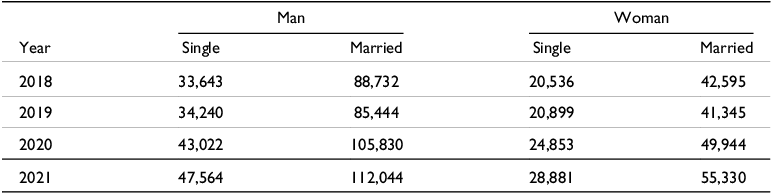
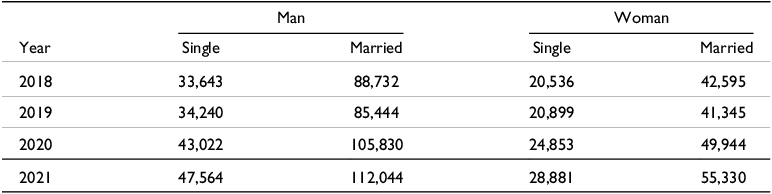
The study was conducted using data from 2018 to 2021 obtained from the Labour Force Statistics Micro Data Set (TURKSTAT 2022b). In the survey conducted by TURKSTAT, participants were asked about their reasons for not being part of the labour force. One of the provided options was ‘No hope of finding a job’ (TURKSTAT 2023), a response which directly measures the discouraged worker effect. The data from 2018 and 2019 was included in the study in addition to the pandemic years of 2020 and 2021 to better understand the impact of the pandemic by presenting the pre-pandemic situation. The analyses were conducted on individuals aged 15-64 (Harasty and Ostermeier Reference Harasty and Ostermeier2020), being the active working-age population. The analyses were performed on a total of 834,902 observations: 185,506 in 2018, 181,928 in 2019, 223,649 in 2020, and 243,819 in 2021. Among the individuals included in the analysis, 284,383 were women, 550,519 were men, 253,638 were single, and 581,264 were married. The number of individuals by gender and marital status over the years is presented in Table 1.
Number of individuals by gender and marital status over the years, 2018–2021
Source. Calculated based on data from TURKSTAT (2022b).
Method
To investigate the discouragement impact of the pandemic on individuals, the model included those who are employed, those who are unemployed but still actively seeking work, and those who are not employed but are considered part of the potential labour force with no hope of finding a job. The analysis was conducted using probit regression.
Probit regression can be shown as (Greene Reference Greene2012, 710): $P\left( {Y = 1|X} \right) = \phi \left( {x,\beta } \right)$ $P\left( {Y = 0|X} \right) = 1 - \phi \left( {x,\beta } \right)$
The dependent variable Y takes the value of either 1 or 0. X is a vector consisting of explanatory variables that affect the dependent variable. β represents the coefficients of the explanatory variables.
The probit regression, which shows the probability of individuals’ discouragement, is formulated as follows: $ P(discouraged worker)=\alpha +\beta X+\epsilon $
For the purposes of this model, a person is considered ‘discouraged’ where they have stopped looking for a job and provided ‘loss of hope’ as the basis for that decision. These individuals are included in the group where the value of the dependent variable is 1 (discouraged worker = 1). If the individual is employed or if the individual continues to actively seek work but has not yet found a job, the dependent variable is 0 (discouraged worker = 0). The pandemic dummy variable in vector X measures the effect of the Covid-19 pandemic on individuals in terms of the discouraged worker phenomenon. Regional unemployment rates show the structural characteristics of the labour market and provide insight into overall economic conditions (see Aina et al Reference Aina, Brunetti, Mussida and Scicchitano2025; Gong Reference Gong2010; Karaoğlan and Ökten Reference Karaoğlan and Ökten2012; Van Ham et al Reference Van Ham, Mulder and Hooimeijer2001). In addition, an interaction term between the unemployment rate and the pandemic period is used to test whether the pandemic had differential effects depending on unemployment levels. This interaction term is intended to reflect both spatial and temporal variation. For spatial variation, the study uses unemployment rates at the NUTS-2 levelFootnote 5 in Türkiye. For temporal variation, we use the pre-pandemic years (2018–2019) and pandemic years (2020–2021) to construct the interaction term. The aim of this term is to observe whether the effect of unemployment rates on the likelihood of being a discouraged worker changed during the pandemic period.
Moreover, vector X includes variables that reflect demographic characteristics influencing individuals’ labour force participation. Since similar studies emphasise that different age groups may have different labour force participation preferences, both age and a squared age term are included in the model to test for a potential non-linear relationship (see Epetia et al Reference Epetia, Ocbina and Librero2023; Karaoğlan and Ökten Reference Karaoğlan and Ökten2012; Lim and Zabek Reference Lim and Zabek2024). Studies conducted during the pandemic suggest that the most affected sectors, such as accommodation and food services and wholesale and retail trade, employ a large proportion of young people, and therefore, young people were more severely affected by the pandemic (see ILO 2020a; ILO 2020b). The inclusion of age and squared age aims to capture a possible non-linear relationship between age and the probability of being a discouraged worker during the pandemic period.
Gender and marital status are also expected to influence individuals’ labour force participation decisions. For this reason, marital status by gender variables are included in the model to identify the likelihood of becoming discouraged for married men, single men, and married women compared to single women. Single women are selected as the reference group, a choice motivated by several conceptual and empirical considerations. In the pre-pandemic years of 2018 and 2019, women accounted for only 31.4% and 31.8% of all employed people in Türkiye, the lowest female employment rate among OECD countries (OECD 2023). Labour force participation in the Turkish labour market was also markedly unequal. In 2018, it stood at 78.6% for men and 38.3% for women, while in 2019 it was 78.2% for men and 38.7% for women (TURKSTAT 2020). While the number of employed men in Türkiye was around 22 million in both years, the number of employed women was approximately 10 million (TURKSTAT 2020). These figures indicate that the Turkish labour market is predominantly male. To clearly observe effects on the group constituting this majority, we did not select men as the reference group. We chose single women rather than married women as the reference group because previous studies have shown that married women are more vulnerable in the labour market compared to single women. We also wished to observe the net effect on married women, as marriage is one of the most important factors influencing women’s labour force participation decisions in the Turkish labour market (Dayıoğlu and Kırdar Reference Dayıoğlu and Kırdar2010; Kömüryakan Reference Kömüryakan2021; Tatoğlu Reference Tatoğlu2022). Furthermore, due to the dynamics brought about by the pandemic (for example, remote education requiring them to take care of children), we sought to express the effects on married women more clearly; therefore, we selected single women as the reference group. Studies on the Turkish labour market, particularly those examining the discouraged worker effect and labour force participation, also show that single women are commonly identified as the reference group (see Aldan and Öztürk Reference Aldan and Öztürk2020; Başlevent and Onaran Reference Başlevent and Onaran2004; Dayıoğlu and Kırdar Reference Dayıoğlu and Kırdar2010; Değirmenci Reference Değirmenci2023; Kömüryakan Reference Kömüryakan2021; Özerkek and Özbal Reference Özerkek and Özbal2017). Ultimately, having a different reference group would not alter the interpretation but only the numerical values obtained relative to the reference group.
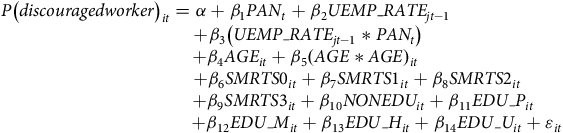
To determine the effect of educational attainment on the likelihood of being discouraged, the model includes variables representing individuals’ education levels. The model can be represented as follows:
 $$\eqalign{
& P{\left( {discouragedworker} \right)_{it}} = \alpha + {\beta _1}PA{N_t} + {\beta _2}UEMP\_RAT{E_{jt - 1}} \cr
& \quad \quad \quad \quad \quad \quad \quad \quad \quad \quad \quad + {\beta _3}\left( {UEMP\_RAT{E_{jt - 1}}*PA{N_t}} \right) \cr
& \quad \quad \quad \quad \quad \quad \quad \quad \quad \quad \quad + {\beta _4}AG{E_{it}} + {\beta _5}{\left( {AGE*AGE} \right)_{it}} \cr
& \quad \quad \quad \quad \quad \quad \quad \quad \quad \quad \quad + {\beta _6}SMRTS{0_{it}} + {\beta _7}SMRTS{1_{it}} + {\beta _8}SMRTS{2_{it}} \cr
& \quad \quad \quad \quad \quad \quad \quad \quad \quad \quad \quad + {\beta _9}SMRTS{3_{it}} + {\beta _{10}}NONED{U_{it}} + {\beta _{11}}EDU\_{P_{it}} \cr
& \quad \quad \quad \quad \quad \quad \quad \quad \quad \quad \quad + {\beta _{12}}EDU\_{M_{it}} + {\beta _{13}}EDU\_{H_{it}} + {\beta _{14}}EDU\_{U_{it}} + {\varepsilon _{it}} \cr} $$
$$\eqalign{
& P{\left( {discouragedworker} \right)_{it}} = \alpha + {\beta _1}PA{N_t} + {\beta _2}UEMP\_RAT{E_{jt - 1}} \cr
& \quad \quad \quad \quad \quad \quad \quad \quad \quad \quad \quad + {\beta _3}\left( {UEMP\_RAT{E_{jt - 1}}*PA{N_t}} \right) \cr
& \quad \quad \quad \quad \quad \quad \quad \quad \quad \quad \quad + {\beta _4}AG{E_{it}} + {\beta _5}{\left( {AGE*AGE} \right)_{it}} \cr
& \quad \quad \quad \quad \quad \quad \quad \quad \quad \quad \quad + {\beta _6}SMRTS{0_{it}} + {\beta _7}SMRTS{1_{it}} + {\beta _8}SMRTS{2_{it}} \cr
& \quad \quad \quad \quad \quad \quad \quad \quad \quad \quad \quad + {\beta _9}SMRTS{3_{it}} + {\beta _{10}}NONED{U_{it}} + {\beta _{11}}EDU\_{P_{it}} \cr
& \quad \quad \quad \quad \quad \quad \quad \quad \quad \quad \quad + {\beta _{12}}EDU\_{M_{it}} + {\beta _{13}}EDU\_{H_{it}} + {\beta _{14}}EDU\_{U_{it}} + {\varepsilon _{it}} \cr} $$
In Equation 4, P(discouraged worker)it is the dependent variable that indicates whether individual i is discouraged in year t. The pandemic dummy variable PANt takes the value of 1 for the years 2020 and 2021 and 0 for the years 2018 and 2019. The variable UEMP_RATEjt-1 represents the one-year lagged unemployment rate in the region where the individual lives.Footnote 6 As unemployment increases, the likelihood of individuals becoming discouraged is theoretically expected to rise as well. A higher probability of discouragement may, in turn, lead individuals to withdraw from the labour market, resulting in lower measured unemployment rates. Therefore, given the potential bidirectional relationship between these two variables and the possibility of endogeneity, we preferred to use one-year-lagged regional unemployment rates in our analysis. The interaction term UEMP_RATEjt-1*PANt captures the effect of the one-year-lagged unemployment rate during the pandemic period. The age variable AGEit represents the age of the individual, while the square of the age variable AGEit*AGEit is included in the model to determine if there is a possible non-linear relationship. The marital status by gender variable consists of four subgroups. If the individual is a single woman, SMRTS0it takes the value of 1; otherwise, it takes the value of 0. If the individual is a single man, SMRTS1it takes the value of 1; otherwise, it takes the value of 0. If the individual is a married woman, SMRTS2it takes the value of 1; otherwise, it takes the value of 0. If the individual is a married man, SMRTS3it takes the value of 1; otherwise, it takes the value of 0. The education variable consists of five subgroups. If the individual has not completed any school, NONEDUit takes the value of 1; otherwise, it takes the value of 0. If the individual has completed primary school, the education_primary variable EDU_Pit takes the value of 1; otherwise, it takes the value of 0. If the individual has completed middle school, the education_middle variable EDU_Mit takes the value of 1; otherwise, it takes the value of 0. If the individual has completed high school, the education_high variable EDU_Hit takes the value of 1; otherwise, it takes the value of 0. If the individual has completed university, the education_university variable EDU_Uit takes the value of 1; otherwise, it takes the value of 0.
Results
Descriptive statistics
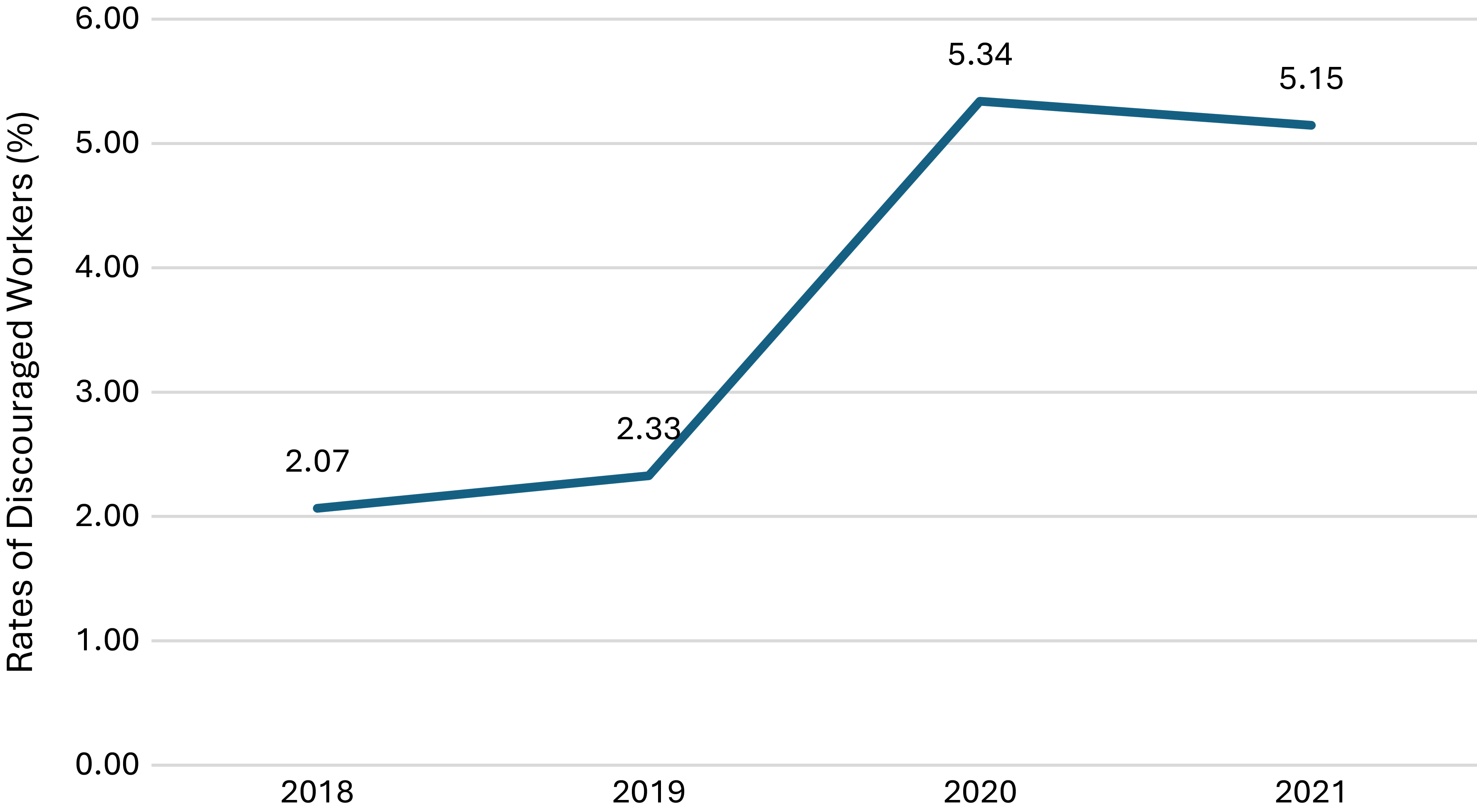
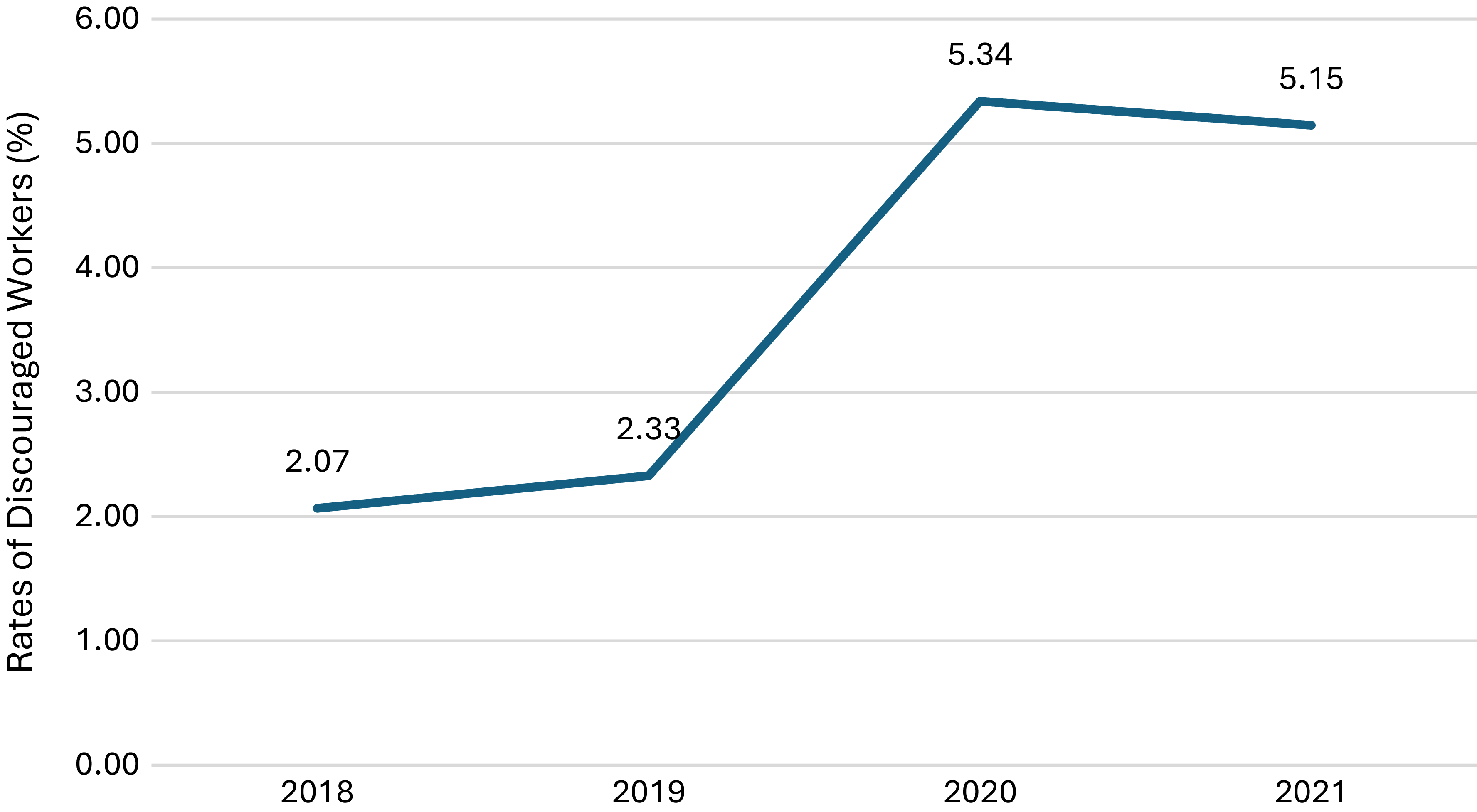
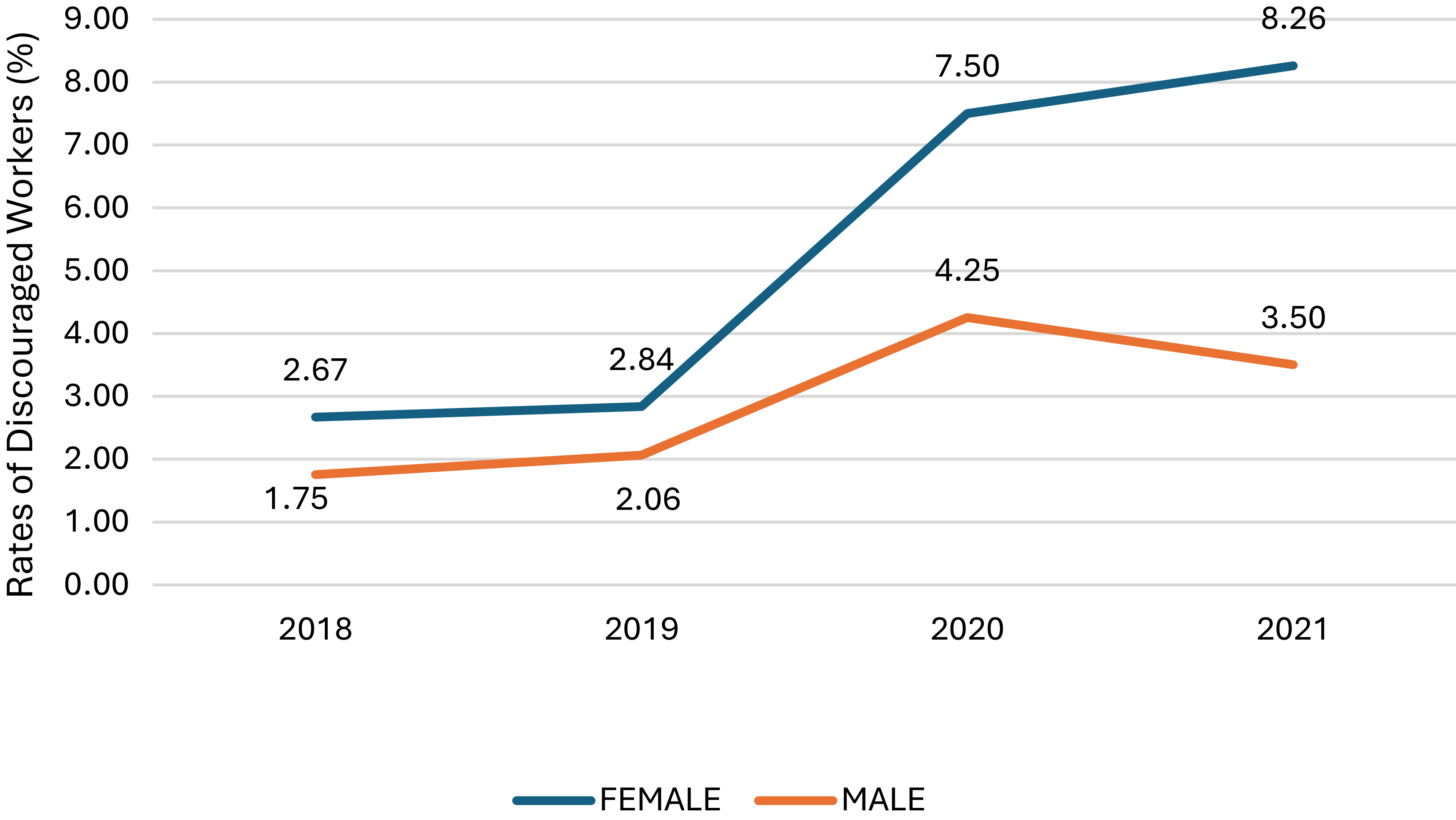
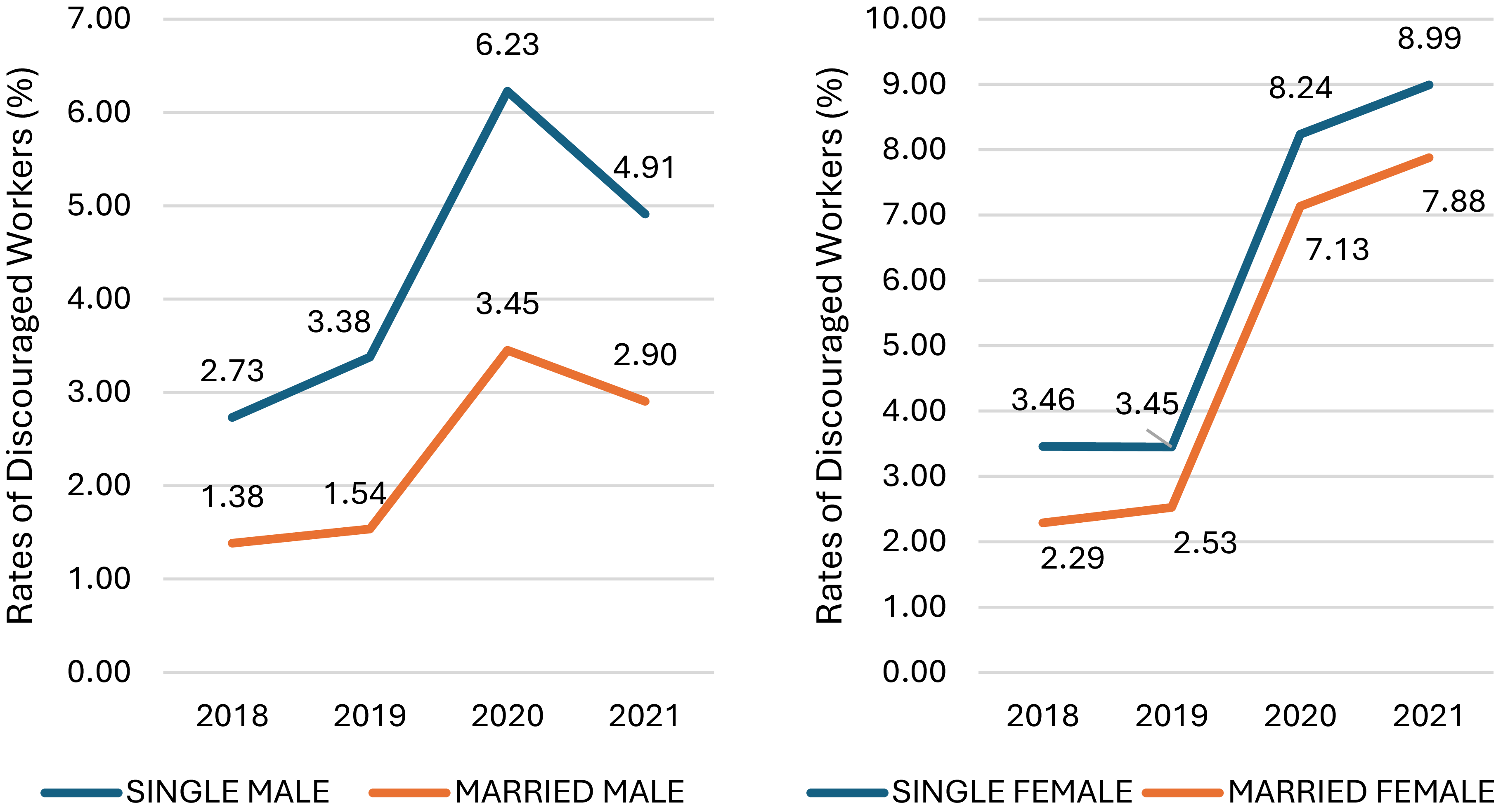
The numbers of discouraged workers included in the study by year are 3,832 in 2018, 4,235 in 2019, 11,942 in 2020, and 12,546 in 2021. The ratio of discouraged workers to the number of observations by year is shown in Figure 1. This shows the ratio of discouraged workers more than doubled in 2020, considered the start of the pandemic, compared to the previous year, 2019. Figure 2 shows the change in the ratio of discouraged workers by gender between 2018 and 2021. Of the men in the study, there were 2,147 discouraged workers in 2018, 2,470 in 2019, 6,332 in 2020, and 5,590 in 2021. For women, the figures were 1,685 discouraged workers in 2018, 1,765 in 2019, 5,610 in 2020, and 6,956 in 2021. During the pandemic period, there is an increase in the number of discouraged workers for both men and women. From the beginning of the pandemic in 2020, while the ratio of discouraged workers continued to increase for women, it decreased for men. The ratio of discouraged female workers was 2.84% in 2019; 7.50% in 2020, the start of the pandemic; and 8.26% in 2021, still during the pandemic. For men, the ratio of discouraged workers was 2.06% in 2019; 4.25% in 2020, the first year of the pandemic; and decreased to 3.50% in 2021, the continuation of the pandemic.
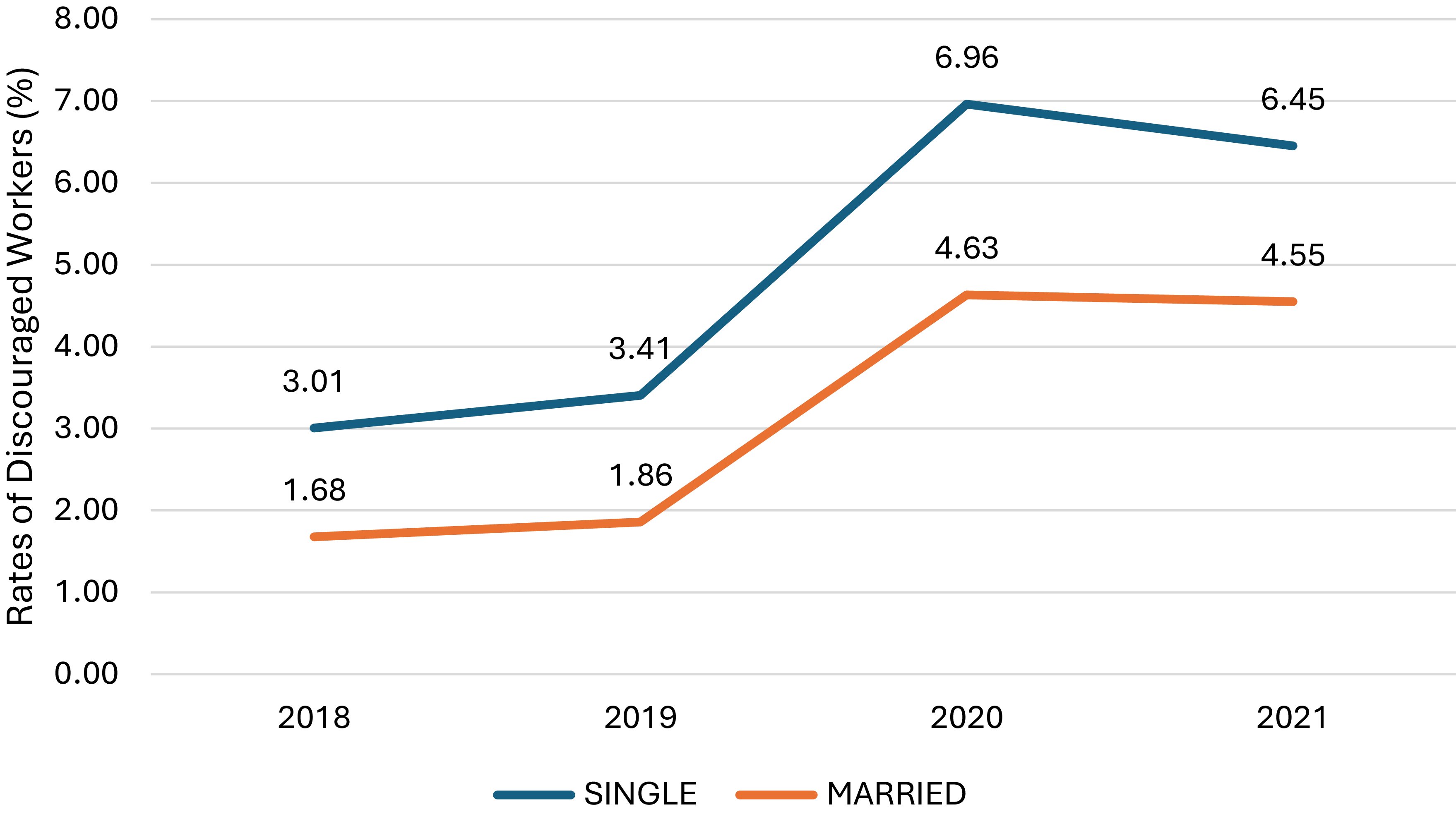
Rates of discouraged workers over the years 2018–2021.
Source. Calculated based on data from TURKSTAT (2022b).
Rates of discouraged workers by gender over the years 2018–2021.
Source. Calculated based on data from TURKSTAT (2022b).
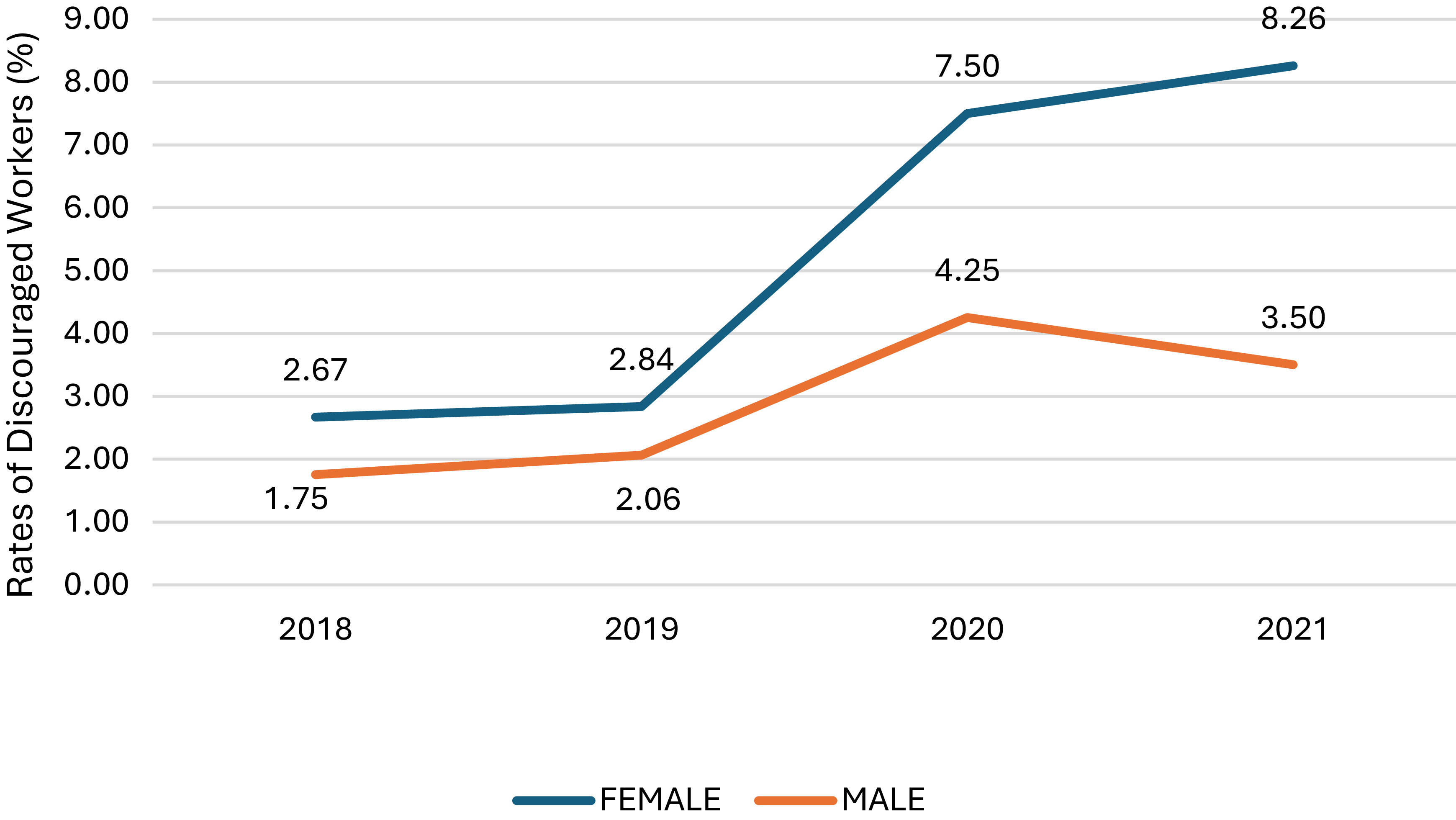
Figure 3 shows the change in the ratio of discouraged workers by marital status between 2018 and 2021. In 2018, among discouraged workers, there were 2,203 married workers and 1,629 single workers. In 2019, those figures were 2,357 married workers and 1,878 single workers. For 2020, there were 7,216 and 4,726 married and single discouraged workers, respectively, and in 2021, the numbers were 7,613 and 4,933. The number of discouraged married workers is higher than the number of discouraged single workers by marital status. When the ratio of discouraged workers to the number of observations by marital status is examined, there was an increase in both married and single workers in 2020, the first year of the pandemic, compared to the previous year, 2019. In the second year of the pandemic, the ratio of discouraged workers decreased for both married and single workers. The ratio of discouraged single workers decreased by 7.32% in 2020 to 6.45%, and the ratio of discouraged married workers decreased by 1.73% to 4.55%.
Rates of discouraged workers by marital status over the years 2018–2021.
Source. Calculated based on data from TURKSTAT (2022b).
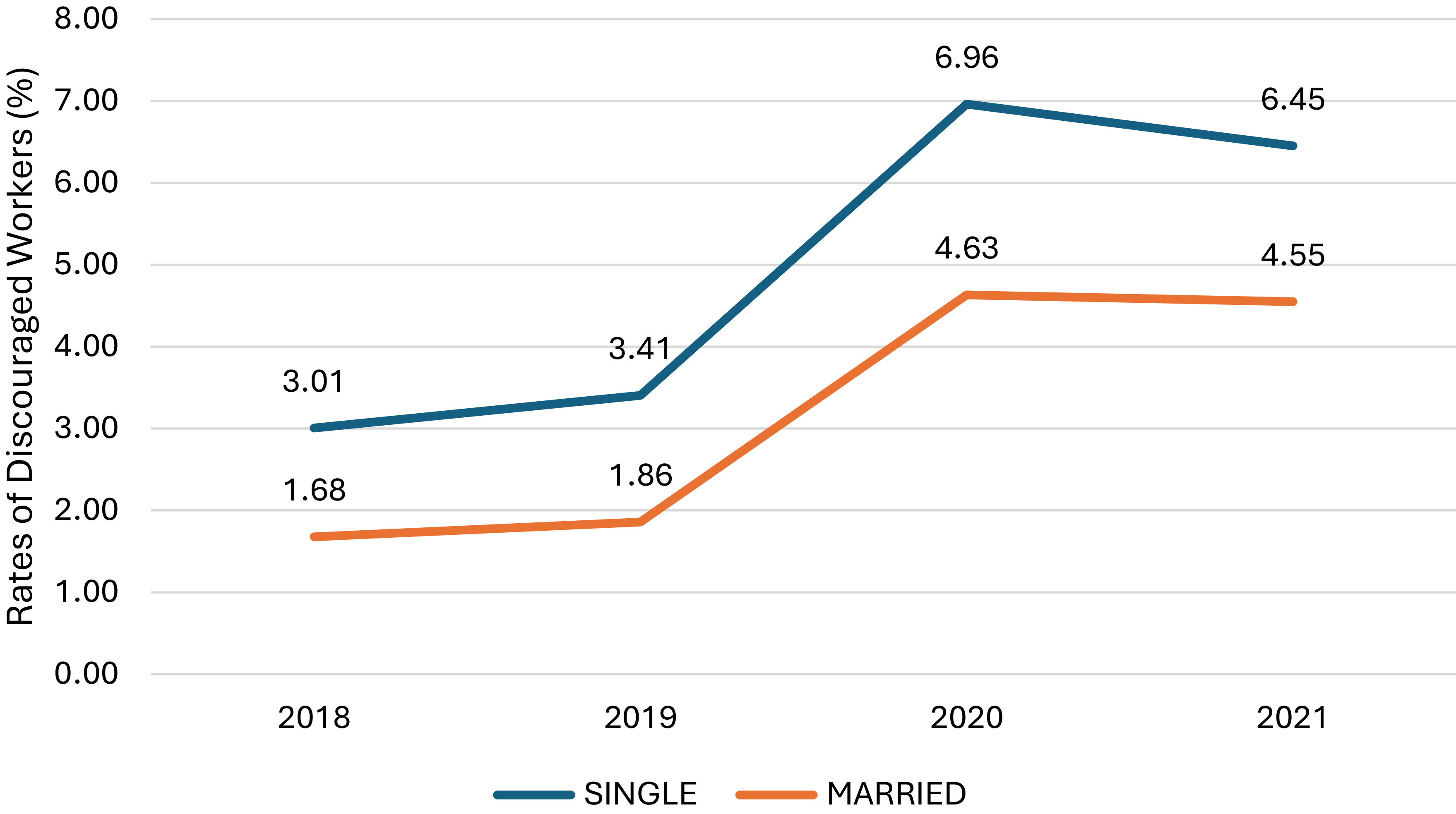
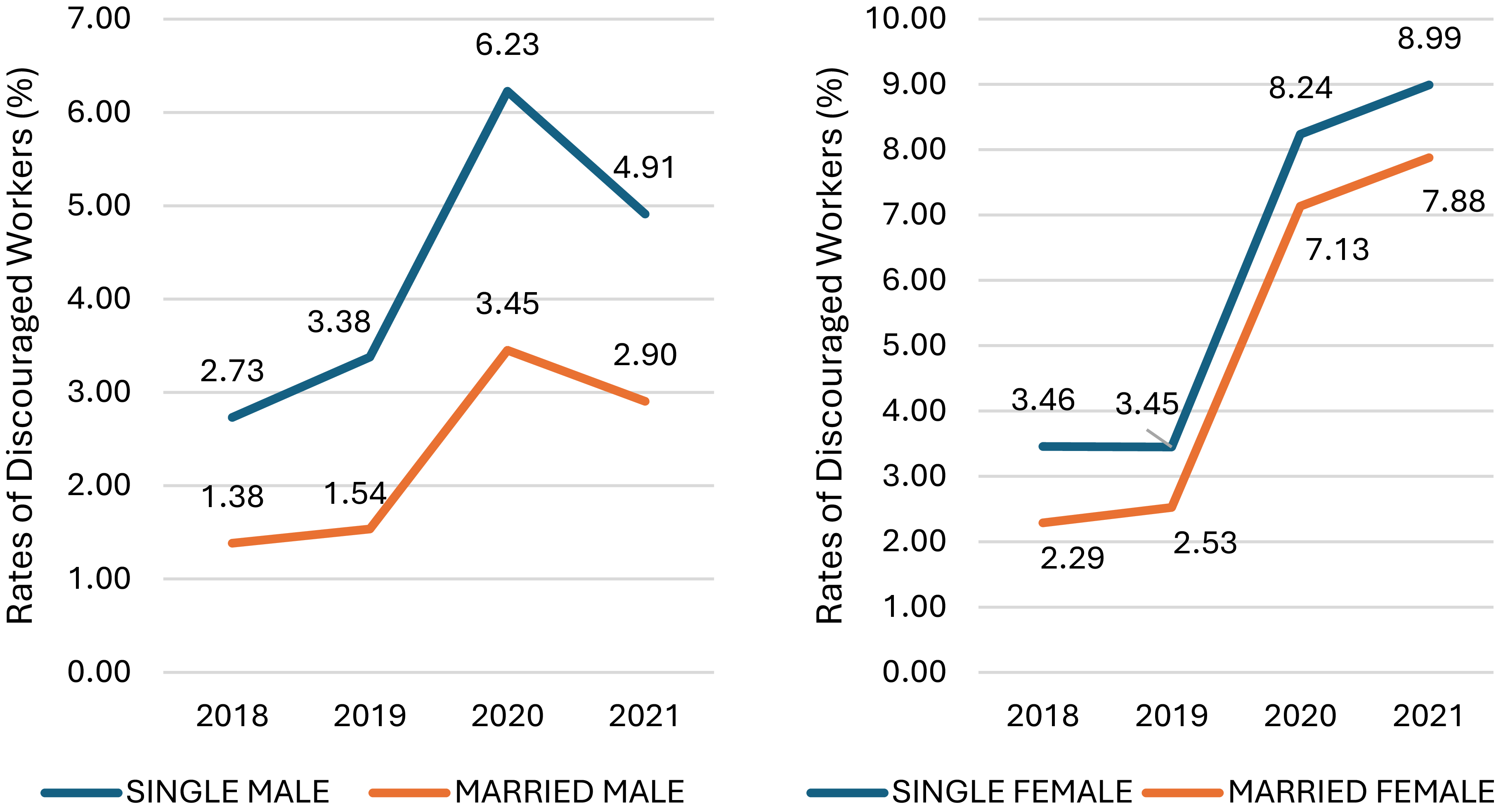
Figure 4 shows the change in the ratio of discouraged workers by gender and marital status between 2018 and 2021. The ratio of discouraged workers is higher in single men compared to married men. In 2020, compared to 2019, the ratio of discouraged workers increased in both single and married men. The ratio of discouraged workers was 6.23% in single men and 3.45% in married men in 2020. In 2021, the ratio of discouraged workers decreased in both single and married men, with the ratio being 4.91% in single men and 2.90% in married men. The ratio of discouraged workers is also higher in single women compared to married women. In the first year of the pandemic, 2020, the ratio of discouraged workers increased in both single and married women compared to 2019. This increase continued in parallel in the second year of the pandemic, 2021. The ratio of discouraged workers in single women increased from 8.24% in 2020 to 8.99% in 2021, and in married women, the ratio increased from 7.13% in 2020 to 7.88% in 2021.
Rates of discouraged workers by gender and marital status over the years 2018–2021.
Source. Calculated based on data from TURKSTAT (2022b).
Empirical analysis
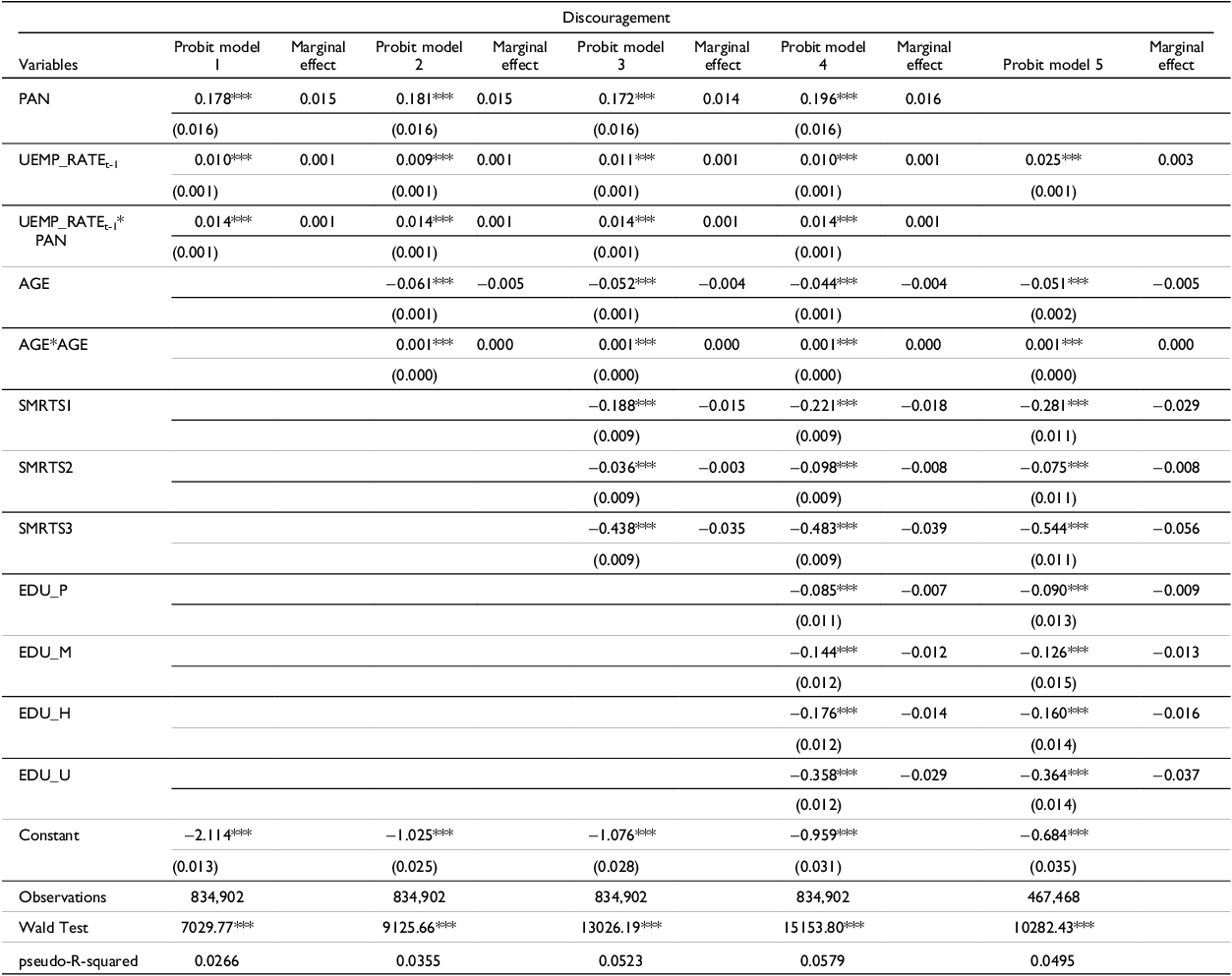
To investigate the impact of the pandemic on individuals’ discouragement, analyses were conducted on individuals aged 15–64, who are considered the active working population. The analysis included those who are employed, unemployed but still actively seeking work, and those who do not have a job and are part of the potential labour force but have no hope of finding a job. Analyses were conducted using probit regression on pooled cross-sectional annual data for the period 2018–2021. The analysis results are shown in Table 2. In Table 2, the 2nd, 4th, 6th, 8th, and 10th columns show the probit model analysis results, while the 3rd, 5th, 7th, 9th, and 11th columns show the marginal effects of the variables included in the probit model.Footnote 7
Probit model and marginal effects, ages 15–64, 2018–2021
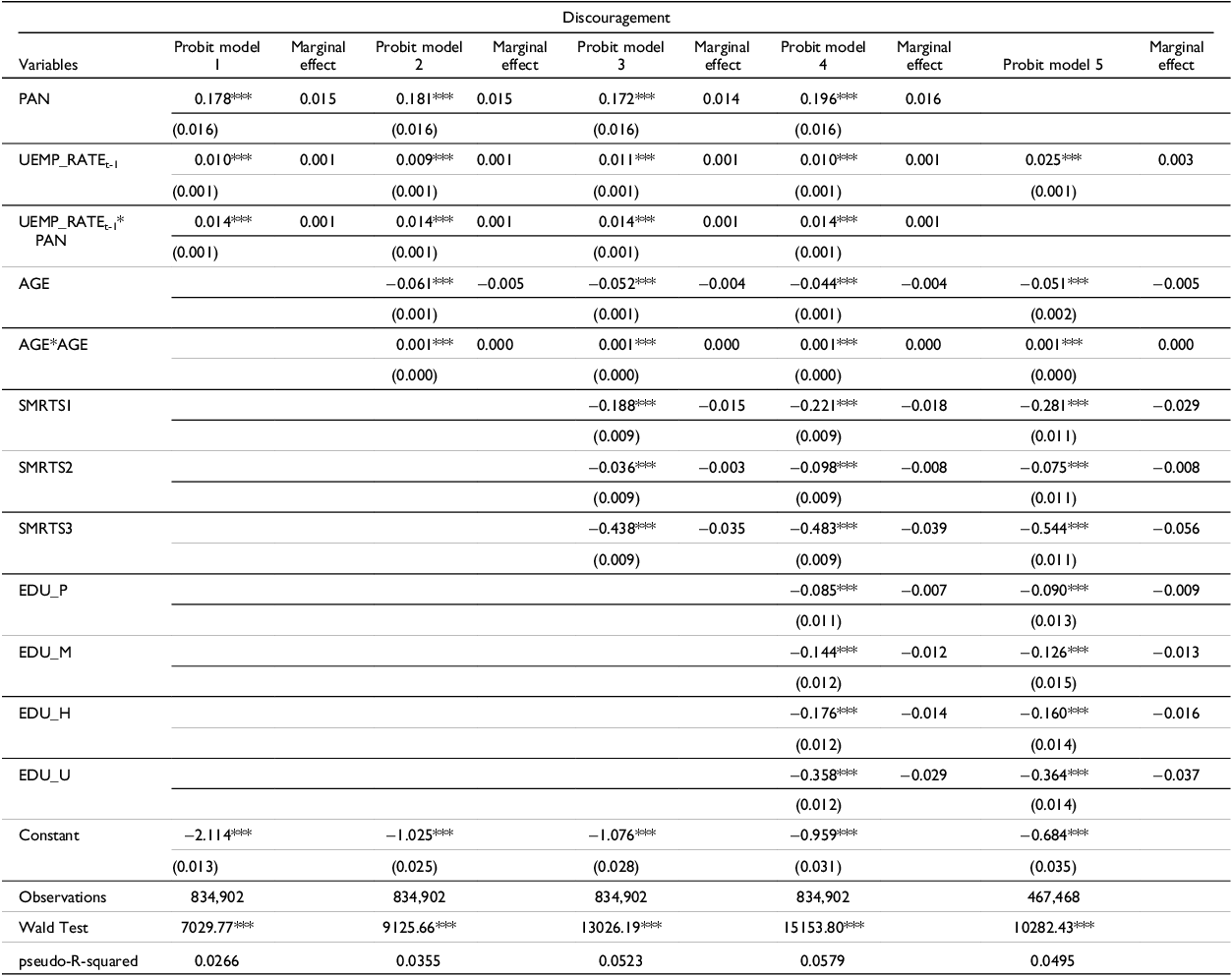
Notes. Robust standard errors in parentheses. ***p<0.01, **p<0.05, *p<0.1. PAN takes the value 1 for the years 2020–2021 and 0 for the years 2018–2019. UEMP_RATE represents the one-year-lagged unemployment rate at the NUTS-2 level. UEMP_RATE*PAN represents the one-year-lagged unemployment rate during the pandemic period. AGE represents the individual’s age. AGE*AGE represents the square of age. SMRTS1 takes the value 1 if the individual is single and male, and 0 otherwise. SMRTS2 takes the value 1 if the individual is married and female, and 0 otherwise. SMRTS3 takes the value 1 if the individual is married and male, and 0 otherwise. EDU_P takes the value 1 if the individual has completed primary education, and 0 otherwise. EDU_M takes the value 1 if the individual has completed middle school, and 0 otherwise. EDU_H takes the value 1 if the individual has completed high school, and 0 otherwise. EDU_U takes the value 1 if the individual has completed university, and 0 otherwise.
Source. Calculated based on data from TURKSTAT (2022b).
The analyses consist of five models. Model 1 examines the impact of the pandemic, the one-year-lagged unemployment rate, and their interaction during the pandemic period on individuals’ discouragement. According to Model 1, the effect of the pandemic on the discouragement of unemployed individuals is positive and significant. The likelihood of an individual being discouraged increases by 1.5% during the pandemic. The effect of the one-year-lagged unemployment rate on individuals’ discouragement is positive and significant. A 1% increase in the one-year-lagged unemployment rate increases the likelihood of an individual being discouraged by 0.1%. The effect of the one-year-lagged unemployment rate during the pandemic period, as captured by the interaction term, on individuals’ discouragement is also positive and significant. A 1% increase in the one-year-lagged unemployment rate increases the likelihood of an individual being discouraged by 0.1% during the pandemic period, compared to a 1% increase in the pre-pandemic unemployment rate.
In Model 2, the variables of age and the square of age were added to analyse their impact on individuals’ discouragement. The results showed that the effects of the pandemic, the one-year-lagged unemployment rate, and its interaction with the pandemic on individuals’ discouragement were consistent with the results obtained in Model 1. The coefficient of the age variable is negative and significant, while the coefficient of the square of the age variable is positive and significant. Since the coefficients of the age and the square of the age variables have opposite signs, this effect decreases with age, resulting in a non-linear relationship.
In Model 3, marital status variables by gender were added to the previous model for analysis. The results showed that the impact of the pandemic, the one-year-lagged unemployment rate, and its interaction with the pandemic, age, and the square of age on individuals’ discouragement were consistent with the results obtained in Models 1 and 2. The variable representing women and singles, SMRTS0it, was omitted. Being single and male reduces the likelihood of an individual being discouraged by 1.5% compared to single and female individuals. Married women’s likelihood of being discouraged is lower than that of single women. Married men’s likelihood of being discouraged is also lower than that of single women.
In Model 4, education variables were added to the previous model for analysis. The variable representing those without any education, NONEDUit, was omitted. The coefficient of the pandemic on individuals’ discouragement is still positive and significant. The likelihood of an individual being discouraged during the pandemic is 1.6% higher compared to the pre-pandemic period. The coefficient of the one-year-lagged unemployment rate on individuals’ discouragement is positive and significant as well. A 1% increase in the one-year-lagged pre-pandemic unemployment rate increases the likelihood of an individual being discouraged by 0.1%. The effect of the one-year-lagged unemployment rate on individuals’ discouragement during the pandemic is also positive and significant. A 1% increase in the one-year-lagged unemployment rate during the pandemic increases the likelihood of an individual being discouraged by 0.1 percentage points more compared to the pre-pandemic period. On the other hand, single men are 1.8% less likely to be discouraged compared to single women. Married women are 0.8% less likely to be discouraged compared to single women. Married men are 3.9% less likely to be discouraged compared to single women. When examining the education variables, it is seen that primary school, middle school, high school, and university graduates are less likely to be discouraged compared to those without any education. Primary school graduates are 0.7% less likely to be discouraged compared to those without any education. For middle school graduates, the figure increases to 1.2%; for high school graduates, 1.4%; and for university graduates, 2.9%.Footnote 8
In Model 5, the likelihood of an individual being discouraged was analysed only for the pandemic period to better understand the dynamics of that period. As in the previous models, the effect of the one-year-lagged unemployment rate on individuals’ discouragement is positive and significant. A 1% increase in the one-year-lagged unemployment rate increases the likelihood of an individual being discouraged by 0.3%. During the pandemic period, the effect of the age variable on the likelihood of an individual being discouraged is negative and significant, while the effect of the square of the age variable is positive and significant. Since the coefficients of the age and the square of age variables have opposite signs, this effect decreases with age, resulting in a non-linear relationship. Single men are 2.9% less likely to be discouraged than single women, while married women are 0.8% less likely to be discouraged compared to single women. Married men are also 5.6% less likely to be discouraged compared to single women. During the pandemic period, married men are less likely to be discouraged compared to married women.Footnote 9 When examining the education variables, it is seen that educated individuals are less likely to be discouraged. Primary school graduates are 0.9% less likely to be discouraged compared to those without any education. For middle school graduates, the figure increases to 1.3%; for high school graduates, it is 1.6%; and for university graduates, it is 3.7%.
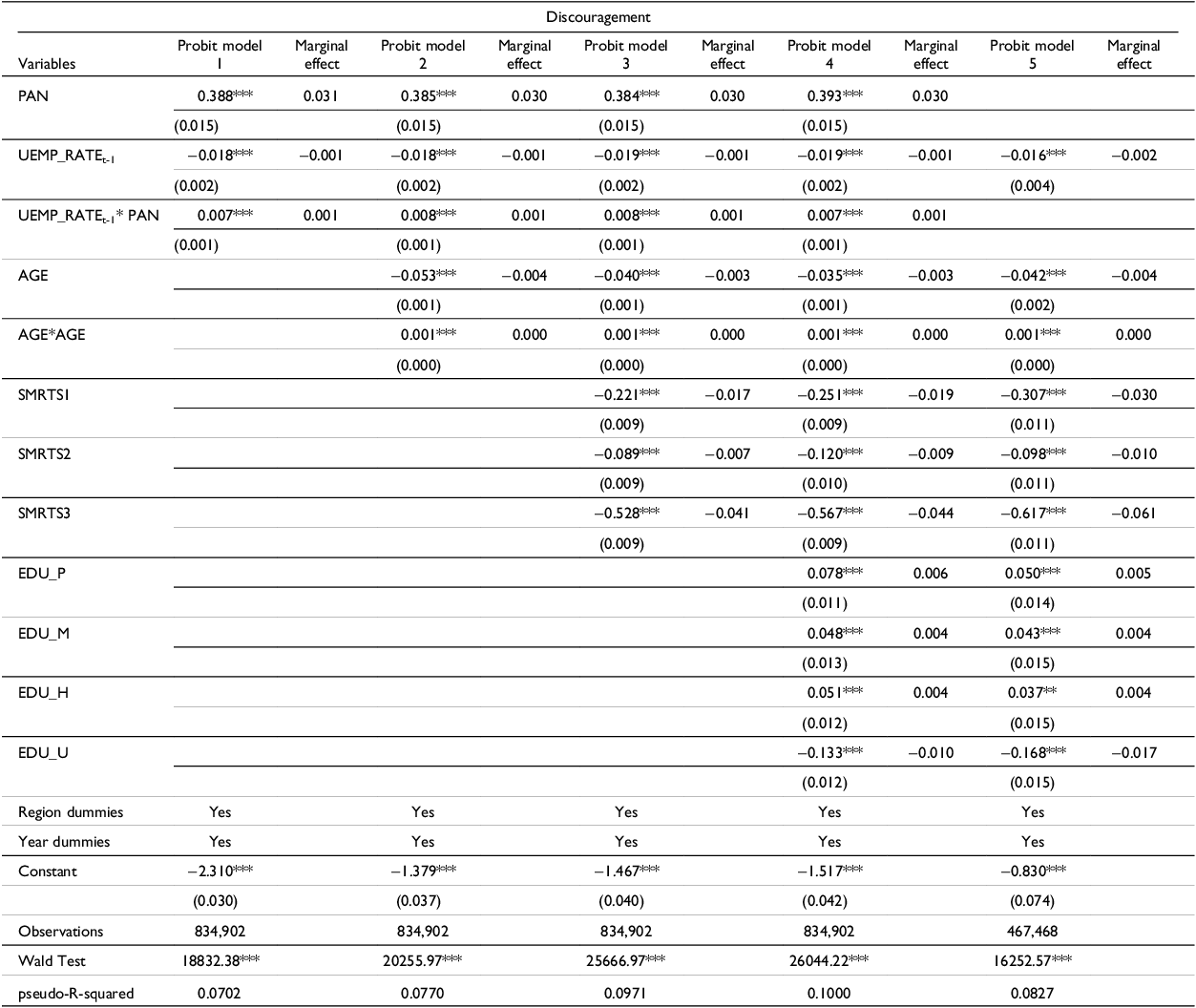
In addition to our main model, we conducted robustness checks by incorporating region and year fixed effects. The results of these analyses are presented in Table 3. When these fixed effects are included, the coefficient of the one-year-lagged unemployment rate shifts from positive to negative. In theory, higher unemployment rates are expected to increase the likelihood of individuals becoming discouraged. However, once region fixed effects are included in the model, the coefficient of regional unemployment turns from positive to negative. This reversal may be attributed to several data- and context-related factors. First, the regional unemployment rates used in the analysis are annual averages, which may fail to capture short-term variations or transitions into and out of discouragement within a given year. Second, previous studies suggest that in regions where unemployment remains persistently high, individuals may gradually ‘normalise’ this situation, leading to weaker behavioural or psychological responses to joblessness (Chen and Hou Reference Chen and Hou2019; Clark Reference Clark2003; Kanlıoğlu and Dumludağ Reference Kanlıoğlu and Dumludağ2022; Torche and Daviss Reference Torche and Daviss2025). Although the pandemic affected all regions of Türkiye, structural, economic, and cultural heterogeneity across regions may have generated differential local impacts, which the fixed effects absorb once included in the model. Our dataset does not contain regional-level indicators of pandemic severity such as case numbers or mortality rates, which likely varied across locations. As such data is unavailable to merge with our current dataset, the inclusion of fixed effects could lead to different results.
Probit model and marginal effects with region and year fixed effects, ages 15–64, 2018–2021
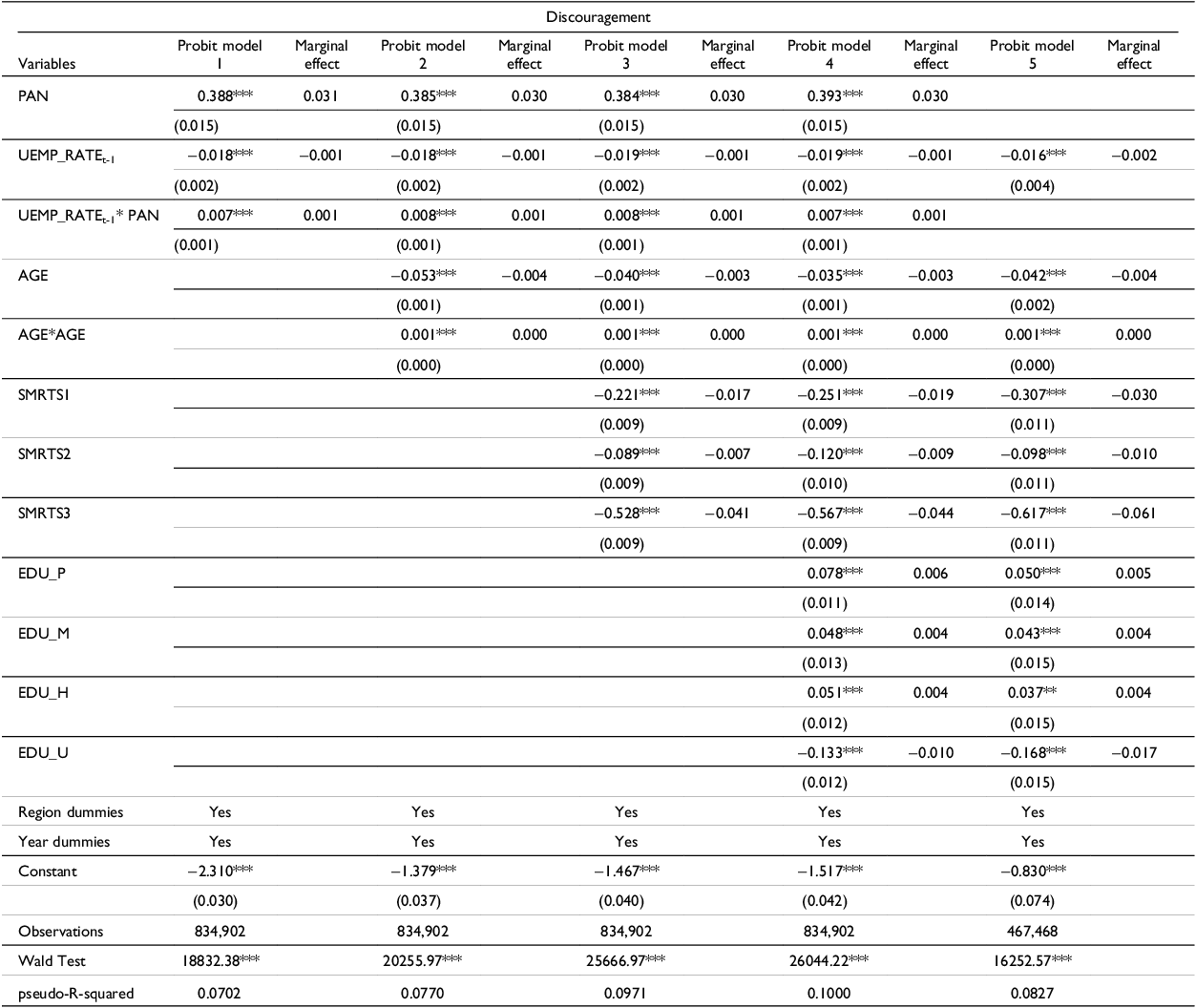
Notes. Robust standard errors in parentheses. ***p<0.01, **p<0.05, *p<0.1. PAN takes the value 1 for the years 2020−2021 and 0 for the years 2018–2019. UEMP_RATE represents the one-year-lagged unemployment rate at the NUTS-2 level. UEMP_RATE*PAN represents the one-year-lagged unemployment rate during the pandemic period. AGE represents the individual’s age. AGE*AGE represents the square of age. SMRTS1 takes the value 1 if the individual is single and male, and 0 otherwise. SMRTS2 takes the value 1 if the individual is married and female, and 0 otherwise. SMRTS3 takes the value 1 if the individual is married and male, and 0 otherwise. EDU_P takes the value 1 if the individual has completed primary education, and 0 otherwise. EDU_M takes the value 1 if the individual has completed middle school, and 0 otherwise. EDU_H takes the value 1 if the individual has completed high school, and 0 otherwise. EDU_U takes the value 1 if the individual has completed university, and 0 otherwise.
Source. Calculated based on data from TURKSTAT (2022b).
Discussion and concluding remarks
This study analyses the discouraged worker effect during the pandemic period. The study focused on the Turkish labour market, and data for the period between 2018 and 2021 was obtained from the relevant public institution (TURKSTAT 2022b). While the discouraged worker effect is mostly studied in the literature for periods of economic downturn (increases in unemployment rates), the pandemic period was the focus of this study because many people experienced such a pandemic period for the first time in their lives, and it may have created different effects beyond the ordinary economic downturn effects on individuals.
The study first analyses the general impact of the discouraged worker effect by considering the pandemic variable and then specifically analyses the discouraged worker effect during the pandemic period. According to the results of the study, the discouraged worker effect during the pandemic period is higher compared to the pre-pandemic period. In this respect, it seems consistent with the few studies in the literature focusing on this issue, such as Roychowdhury et al (Reference Roychowdhury, Bose and De Roy2022), partially Miranti et al (Reference Miranti, Sulistyaningrum and Mulyaningsih2022), and Mondal et al (Reference Mondal, Govindarajan and Chandra2023). It is not possible within the scope of this study to clearly identify the reason behind this increase. The increase may be due to the increased awareness of death during the pandemic process, as explained in the study, or it may be that the measures taken by governments during the pandemic period, especially lockdowns, affected individuals’ job search processes. Regardless, the likelihood of individuals being discouraged during the pandemic period is 1.6% higher compared to the pre-pandemic period. According to our main model, an increase in the regional unemployment rate increases the likelihood of an individual being a discouraged worker. During periods of labour market deterioration, reduced job prospects may lower individuals’ hopes of finding employment, thereby leading to discouragement. Additionally, the increase in the regional unemployment rate during the pandemic period affects individuals more than the increase in the regional unemployment rate during an ordinary economic downturn. This also indicates differences in individuals’ perceptions of economic downturns during the pandemic period. However, when we conduct robustness analysis by adding region and year fixed effects to our main model, the effect of the regional unemployment rate on the likelihood of an individual being a discouraged worker turns negative. The reversal of this effect may be due to regional socio-economic and psychological conditions, as well as the varying intensity of the pandemic across different regions.
On the other hand, regardless of the pandemic, it was found that men are less likely to be discouraged compared to women, and married men are less likely to be discouraged compared to married women. This is consistent with the previous findings about the Turkish labour market, which has long been characterised by a significant structural gender gap and inequality. Results from the pre-pandemic years covered in our analysis – 2018 and 2019 – reveal that the share of women among all employed individuals was only 31.4% in 2018 and 31.8% in 2019, making Türkiye the country with the lowest female employment rate among OECD members (OECD 2023). Labour force participation rates also reflect a significant gender disparity: in 2018, the participation rate was 78.6% for men and 38.3% for women, while in 2019, it was 78.2% for men and 38.7% for women (TURKSTAT 2020). These statistics are consistent with those from previous years. Another important indicator of gender inequality in the labour market is the prevalence of unpaid family workers, among whom women are significantly over-represented (Hızıroğlu Aygün et al Reference Hızıroğlu Aygün, Köksal and Uysal2024; İlkkaracan Reference İlkkaracan2012; İlkkaracan and Memiş Reference İlkkaracan and Memiş2021). This undoubtedly presents a major barrier to women’s economic independence in the labour market, as such jobs often either go unpaid or are compensated with extremely low wages. These structural issues in the labour market are further reinforced by Türkiye’s patriarchal cultural structure (Dildar Reference Dildar2015) and the gender roles shaped by societal norms, which assign domestic and familial responsibilities predominantly to women. In Turkish society, many individuals, though not all, perceive the man’s role as that of the breadwinner, while women are expected to take care of the home and children (Atasoy Reference Atasoy2017; Dildar Reference Dildar2015; Parlak et al Reference Parlak, Çelebi Çakıroğlu and Öksüz Gül2021). As a result, especially among women with lower levels of education, even when there is a necessity to work, their primary responsibilities are perceived as homemaking and childcare. Therefore, these women often find themselves having to work part-time or engage in low-paid home-based jobs simply to contribute to the household income (Dedeoğlu Reference Dedeoğlu2010).
When looking specifically at the pandemic period, the results are similar to those of the pre-pandemic era. Developments in the labour market during the pandemic also negatively affected women more than men. During this period, men were less likely to be discouraged compared to women, and married men were less likely to be discouraged compared to married women. Studies show that women were among the groups most adversely affected in labour markets during the pandemic (Abraham et al Reference Abraham, Basole and Kesar2021; Kotera and Schmittmann Reference Kotera and Schmittmann2022). This may partly explain why women were more likely to become discouraged than men. The gender gap and related issues in the Turkish labour market could also be the main reason behind these results. For example, educational activities were temporarily suspended in Türkiye during the pandemic and later resumed through online learning. The necessity for someone, typically women, to stay home and care for children due to remote education may be one of the underlying causes of this outcome. Indeed, the findings of İlkkaracan and Memiş (Reference İlkkaracan and Memiş2021) and Hızıroğlu Aygün et al (Reference Hızıroğlu Aygün, Köksal and Uysal2024) support this interpretation, showing that school closures were a major factor influencing women’s job search behaviour during the pandemic and exacerbated existing gender inequalities in the Turkish labour market.
The results of our study are consistent with previous research conducted in other countries. For example, Hansen et al (Reference Hansen, Sabia and Schaller2022) showed that the reopening of K–12 schools in the United States led to higher employment and working hours among married mothers with school-aged children, whereas no significant impact was found on the labour supply of childless women, custodial fathers, or unmarried women. Similarly, Amuedo-Dorantes et al (Reference Amuedo-Dorantes, Marcén, Morales and Sevilla2020) reported that school closures in the United States led to a greater reduction in weekly working hours for mothers than for fathers. The results of Couch et al (Reference Couch, Fairlie and Xu2022), based on the U.S. labour market, also align with these findings: they found no evidence that childless women were more adversely affected than childless men, but mothers with school-aged children experienced disproportionately larger declines in employment compared to women without children, a phenomenon they referred to as ‘the Covid Motherhood Penalty’. Similar patterns are not limited to developed countries such as the United States but are also observed in less developed countries. For example, Hlasny et al (Reference Hlasny, Rizk and Rostom2024) noted that women in the MENA region spent 4.7 times more hours on unpaid work than men and took on 90% of child-schooling and household duties during lockdowns, thereby intensifying the negative effects of the pandemic on women’s employment. Likewise, Alon et al (Reference Alon, Coskun, Tertilt, Koll and Doepke2022) found that in Nigeria, employment losses during the pandemic were most pronounced among mothers of school-aged children, mainly due to greater childcare responsibilities arising from school closures. Finally, Ducanes and Ramos (Reference Ducanes and Ramos2023) found that in the Philippines, the hard lockdown reduced the likelihood of paid employment by about 15.3 percentage points for women with children compared to 11.3 percentage points for those without children.
The findings obtained in our study, as well as those reported in the research, appear to be consistent with theoretical expectations. For instance, Becker (Reference Becker1993) suggests that, in order to maximise household utility, the spouse with lower potential earnings is more likely to specialise in domestic work, while the spouse with higher potential earnings remains in the labour market. This specialisation ultimately enhances family welfare (see Bianchi et al Reference Bianchi, Milkie, Sayer and Robinson2000; Oppenheimer Reference Oppenheimer1997; Syrda Reference Syrda2023). Moreover, according to dual labour market theories and the concept of gender segregation, women are often concentrated in low-wage, low-skilled, or female-dominated occupations that are primarily in the secondary sector. From the perspective of maximising household welfare, it is therefore consistent that men, who generally earn higher wages, remain in the labour market, whereas women, who tend to earn less, withdraw due to household or childcare responsibilities (Doeringer and Piore Reference Doeringer and Piore1971; Leoncini et al Reference Leoncini, Macaluso and Polselli2024; Mehra and Gammage Reference Mehra and Gammage1999). Undoubtedly, this situation arises not as a matter of women’s choice but rather as a consequence of structural problems in the labour market, gender-based discrimination, institutional constraints, and prevailing social and cultural norms. In line with these theoretical perspectives, during the pandemic, the closure of schools and childcare facilities increased domestic responsibilities, forcing many women to withdraw from the labour market, interrupt job search activities, or abandon hope of finding employment that compensates for the opportunity cost of staying at home, thus becoming discouraged. Moreover, even in cases where women earn more than men, these results remain consistent with theories suggesting that women are more likely to perceive tasks such as childcare as their primary responsibility due to socially constructed gender roles (Akerlof and Kranton Reference Akerlof and Kranton2000; Andrew et al Reference Andrew, Cattan, Costa Dias, Farquharson, Kraftman, Krutikova, Phimister and Sevilla2022; Farré et al Reference Farré, Fawaz, González and Graves2022). In this context, although women may appear to have made such choices due to prevailing social norms, this does not preclude the possibility that they became discouraged because their reservation wages increased and the difficulty of finding jobs that matched their desired wage levels rose.
Our results also show certain consistencies with those from previous economic crises in Türkiye. Başlevent and Onaran’s (Reference Başlevent and Onaran2003) study, covering 1988–1994, found that the added worker effect was more dominant than the discouraged worker effect during the 1994 crisis. However, as their focus was on married women, the findings may not fully reflect gender-based issues across all women in the Turkish labour market. Although women’s labour force participation increased during the crisis, the study also found a negative relationship with the number of children, likely linked to traditional gender roles. On the other hand, Kaya Bahçe and Memiş (Reference Kaya Bahçe and Memiş2013), focusing on the 2008–09 financial crisis, found that a 1 percentage point rise in a spouse’s unemployment risk increased women’s total work time by 5% and men’s by 1%. However, women’s unpaid work rose about four times more than men’s, with gender disparities more pronounced in urban areas. From this perspective, including our study, it can be said that crises tend to widen the gender gap in the labour market, at least for certain groups of women.
Another result obtained from the study is the negative relationship between age and the likelihood of being discouraged, both generally and during the pandemic period. In other words, as individuals’ age increases, their likelihood of being discouraged decreases. However, since the coefficients of the age and square of age variables have opposite signs, this effect decreases with age, resulting in a non-linear relationship. This result can also be interpreted as younger individuals being more likely to be discouraged compared to relatively older individuals. Since the sectors most affected by the restrictions, especially at the beginning of the pandemic, were the accommodation and food sectors, where younger populations typically work, younger individuals were more likely to be unemployed for a longer period (ILO 2020a). ILO’s (2020b) report also found that at the beginning of the pandemic period, the likelihood of the 15–24 age group being unemployed was three times higher compared to the 25+ age group (ILO 2020b).
Education level also appears as a factor affecting the likelihood of individuals being discouraged. Here, a negative relationship can be identified. Regardless of the pandemic, the likelihood of individuals being discouraged decreases as their education level increases. Similar results were found specifically for the pandemic period. It has already been observed that individuals with low education levels were also highly affected by the pandemic in labour markets (Aum et al Reference Aum, Lee and Shin2021; Hoshi et al Reference Hoshi, Daiji and Kenichi2021; Pouliakas and Branka Reference Pouliakas and Branka2020). This may be a result of individuals with low education levels mostly working in the service sectors heavily affected by the pandemic, as well as the remote work introduced by the pandemic. Since processes such as job applications and interviews over internet platforms require internet access and usage knowledge, the job search processes of individuals with low education levels may have been interrupted, resulting in relatively higher discouragement (Ranzani and Kern Reference Ranzani and Kern2022). From this perspective, the study’s results appear reasonable.
Unfortunately, the study has limitations. Firstly, the dataset we have does not include important information such as whether the participants’ spouses are working. This is naturally an important variable that could affect an individual’s likelihood of being discouraged. Secondly, as in many countries during the pandemic period, the government provided financial assistance to individuals to help address the problems created by the economic downturn caused by the pandemic. This non-labour income also seems likely to affect individuals’ job search behaviour, as other non-labour income payments such as unemployment benefits have been seen to affect this behaviour (see Beranek and Kamerschen Reference Beranek and Kamerschen2010; Card et al Reference Card, Chetty and Weber2007; Lalive and Zweimüller Reference Lalive and Zweimuller2004). However, our dataset does not include information on who received support or in what amount. Analysing this information would undoubtedly yield more meaningful results.
The discouraged worker effect created by the pandemic period should be studied further. Currently, there are very few studies in the literature on this subject. As discussed above, the effects of the pandemic on individuals may differ from the effects of an ordinary economic downturn. Discouraged individuals need to return to the labour market economically, socially, and personally. This period should be shortened as much as possible. Therefore, future research should also examine how long it takes for individuals to return to the labour market in an ordinary economic crisis and how long it takes during the pandemic period. If this period is longer due to the psychological damage caused by the pandemic, governments and relevant institutions will need to develop extra policies and support programmes in this regard. These potential policies and support programmes should also be studied and discussed in the literature.
Data availability statement
Our dataset spans the years 2018 to 2021. Unfortunately, we are unable to share the data with other researchers due to TURKSTAT regulations. However, researchers can access the same dataset by applying directly to TURKSTAT at no cost or for a nominal fee.
Acknowledgments
All analyses in our study were conducted using the Labour Force Statistics Micro Data Set obtained from the Turkish Statistical Institute (TURKSTAT). We thank TURKSTAT for providing the micro data and TURKSTAT staff for their support. All findings and ideas in the study belong to the authors and do not reflect official statistics in any way.
Statements and declarations
Ethical approval and informed consent statement Not applicable. The authors did not receive ethical approval and informed consent statement because they used secondary data during the research of this article.
Declaration of conflicting interests
The authors declared no potential conflicts of interest with respect to the research, authorship, and/or publication of this article.
Funding
The authors received no financial support for the research, authorship, and/or publication of this article.
Identifying information
We confirm that our contribution is original, has not been published previously, and is not under consideration for publication elsewhere. Lastly, we would like to note that we used ChatGPT solely for language purposes, such as translation and proofreading.
Competing interests
The authors declare none.

 Open access

