


INTRODUCTION
Fairness concerns are important for politics in many areas; however, different social groups may have different perceptions of fairness, which can dramatically shape their political views and preferences. For example, political support for redistribution reflects, in part, a difference in perceptions regarding the fairness of market outcomes and the underlying sources of income inequality, whether they be individualistic or systemic (Alesina and Angeletos Reference Alesina and Angeletos2005). Indeed, the public’s perceptions of fairness and the belief that luck, rather than hard work, determines one’s income has been found to be correlated with a country’s social spending (Alesina, Glaeser, and Sacerdote Reference Alesina, Glaeser and Sacerdote.2001). With regards to taxation, one’s perception of the fairness of their own outcome relative to others is an important determinant of tax policy preferences. In both France and the United States, the perception that others are better off than oneself is associated with greater support for progressive income tax policies (Lü and Scheve Reference Lü and Scheve2016). Welfare policy preferences are also shaped by perceptions of fairness. In particular, the beliefs that Black Americans’ poverty reflects a lack of effort and that, economically, Black people have gotten what they deserve are strong predictors of white Americans’ opposition to welfare programs like food stamps and unemployment (Gilens Reference Gilens1995). Such research emphasizes the importance of race, racial groups, and moral values in shaping support for domestic policies.
However, international relations (IR) scholars have been relatively slow to theorize how race influences foreign policy and public support for foreign policy (Zvobgo and Loken Reference Zvobgo and Loken2020). Though scholars have recently begun to examine how race affects support for trade (Guisinger Reference Guisinger2017; Mutz, Mansfield, and Kim Reference Mutz, Mansfield and Kim2021) and security issues (Green-Riley and Leber Reference Green-Riley and Leber2023), we argue that connecting the moral values literature to critical race scholarship is essential for beginning to understand the mechanisms driving Black Americans’ distinct interpretation of political fairness and its effects on attitudes toward international trade. A deeper understanding of how race structures moral perceptions, which consequently shape domestic and foreign policy preferences, is important because it can inform policy development and communication strategies in an era of increasing social polarization (Mason Reference Mason2015).
We know that moral values, like fairness, play a role in shaping foreign policy preferences (Kertzer et al. Reference Kertzer, Powers, Rathbun and Iyer2014), but how these interact with racial groups’ distinct interpretations of morality remains an open question. Recent work in political science has established that standard conceptions of ideology, like “liberal” and “conservative,” may be understood differently by specific racial groups, leading to imprecise or incorrect inferences about political preferences among such groups (Jefferson Reference JeffersonForthcoming). We expect the same to be true with the concept of fairness. We argue that those sociodemographic groups that have experienced histories of sociopolitical and distributional disadvantage are likely to have a distinct perception of fairness compared to those who have typically occupied a dominant or privileged position in society. In the U.S. context, we focus on the different perceptions of fairness held by Black and white Americans, with a particular interest in how these groups’ perceptions of fairness affect their assessments of U.S. trade policy. This research builds on an expanding literature in American politics that emphasizes the importance of understanding how different racial groups interpret core political concepts (Jefferson Reference JeffersonForthcoming) and takes up the call for a broader research agenda on race and Black preferences in IR and foreign policy (Green-Riley and Leber Reference Green-Riley and Leber2023; Zvobgo and Loken Reference Zvobgo and Loken2020). We also respond to critical legal scholars who have called for a reorientation of critical race theory (CRT) away from just the legal world toward the social world (Carbado and Roithmayr Reference Carbado and Roithmayr2014; Crenshaw Reference Crenshaw2011).
When it comes to concerns for fairness, behavioral economists have identified inequality aversion as a mechanism by which the perceived fairness of one’s outcome relative to others leads to systematic differences in trade preferences (Fehr and Schmidt Reference Fehr and Schmidt.1999).Footnote 1 This form of inequality aversion has two distinct parts. Advantageous inequality aversion is the loss individuals incur when others have worse material outcomes, whereas disadvantageous inequality aversion is the loss individuals incur because others have better outcomes than they do. Lü, Scheve, and Slaughter (Reference Lü, Scheve and Slaughter2012) find that U.S. support for sector-specific trade protection depends on both advantageous inequality aversion and disadvantageous inequality aversion. However, we argue that white and Black Americans view inequality through divergent lenses that were shaped by the country’s well-documented history of systemic racism.
To understand how white Americans’ and Black Americans’ distinct perceptions of fairness shape trade preferences, we build upon recent work by Brutger and Rathbun (Reference Brutger and Rathbun.2021), who argued that Americans have an egotistically biased sense of fairness, what they call “asymmetric fairness.” Brutger and Rathbun’s theory built upon earlier works that connected fairness to trade (Herrmann, Tetlock, and Diascro Reference Herrmann, Tetlock and Diascro.2001; Lü, Scheve, and Slaughter Reference Lü, Scheve and Slaughter2012), but none of these works theorized how race, fairness, and trade attitudes interacted. Consequently, Brutger and Rathbun’s theory focused on the American mass-public, without addressing potential racial heterogeneity. For our purposes, the most important point of Brutger and Rathbun’s theory of asymmetric fairness is that Americans are concerned with “falling behind” and view it as especially unfair if they receive less, or give up more, than another country. The mechanism underlying asymmetric fairness is consistent with the concept of disadvantageous inequality aversion, namely, individuals are “more sensitive to the unfairness of outcomes that leave them behind than those that are disadvantageous to others” (Brutger and Rathbun Reference Brutger and Rathbun.2021, 887). The American public, they argue, views it as much more unfair when they are at a disadvantage, as opposed to when others are at a disadvantage.
However, we expect that Black Americans do not share white Americans’ concerns for falling behind. Thus, this study explores racial heterogeneity in American conceptions of fairness and support for U.S. trade policy. We ask, how do white and Black Americans compare in how they view fairness and inequality in international trade? We build on existing work of racial divides in trade policy preferences by incorporating the cultural, historical, and political context that has constructed divergent psychological and political predispositions of white and Black Americans (Berger and Luckmann Reference Berger and Luckmann1966; Lazarsfeld, Berelson, and Gaudet Reference Lazarsfeld, Berelson and Gaudet.1948). First, drawing on CRT and the cognitive psychology literature, we argue that the causal mechanism underlying asymmetric fairness—disadvantageous inequality aversion—is applicable to white Americans but less plausible for Black Americans. We then outline our hypotheses and present the data and methods we use to test our theory. We find that, unlike their white counterparts, Black Americans do not exhibit asymmetric fairness. Instead, they view trade through a more principled lens of fairness, perceiving trade policies that benefit both the home and foreign country as the most fair, rather than prioritizing an “America First” trade agenda.
CONNECTING RACE, FAIRNESS, AND TRADE
The central premise of the asymmetric fairness argument is that individuals do not want to feel as though they are being left behind (Brutger and Rathbun Reference Brutger and Rathbun.2021). However, there exists substantial evidence to suggest that in the U.S. this phenomenon is primarily relevant to white American culture, which has maintained hegemonic dominance given the centrality and pervasiveness of racism in American society (Crenshaw Reference Crenshaw1988; Reference Crenshaw2011; Gramsci Reference Gramsci, Hoare and Smith1971). Critical race scholars take seriously that the law, racial hierarchy, and democratic politics have been intertwined since the country’s founding, and that race is one of the most important cleavages in American life. Expectation of social privilege among white Americans can be traced back to the era of chattel slavery, when white identity and white skin became the basis of property rights that guaranteed sources of privilege and protection (Harris Reference Harris1993; Tillery Reference Tillery2009). Chattel slavery created a “qualitatively distinct form of oppression” (Jagmohan Reference Jagmohan2022, 670) that influenced America’s social and racial hierarchies for years to come. From the founding of the country through the Civil Rights era, African Americans, and other people of color, had occupied a separate and unequal status in the United States, while white Americans had benefited from a position of relative privilege. Thus, we observe white American fear of being left behind, or losing such privilege gained from the country’s founding, continuing through the Civil Rights movement. Given white Americans’ position of privilege, they are likely to be particularly susceptible to concerns about policies that are perceived as reducing one’s position in society, which is consistent with loss aversion theory (Tversky and Kahneman Reference Tversky and Kahneman1991). Consequently, we argue that white Americans are likely to perceive “unfavorable” trade policies as being unfair, since they undermine their position of privilege, whereas Black Americans will likely view such policies as a perpetuation of the status quo that has historically placed them as a disadvantage.
White Privilege under the Law
Critical legal scholars advance two theories that help us understand how white American interests were prioritized during and following the Civil Rights era, and why white Americans are more likely to view the world through an asymmetric fairness lens. First, in accordance with Tocqueville’s ([1835] Reference Tocqueville and Lawrence1988) view on how the law plays a central role in the construction of racial categories and group inequalities in America, “Racial Realism” argues that to be realistic about American society, one must realize that the law and outcomes in democratic politics typically reflect the supremacy of white privilege (Bell Reference Bell1992; Delgado Reference Delgado2003). According to racial realists, racial equality through the law is not a realistic goal because the courts were designed to preserve a status quo with racist origins. Instead, proponents of racial realism argue that civil rights activists should understand and respond to the recurring aspects of Black people’s subordinate status in American society, marked by higher rates of poverty, joblessness, and insufficient healthcare compared to other ethnic populations.
Since the end of the Civil War, advances toward Black liberation have consistently been met with formidable political and judicial backlash (Anderson Reference Anderson2016). Thus, we can observe how white Americans’ interest in not falling behind relative to other groups has been perpetuated and protected by American legal and democratic institutions, while similar protections have been denied to Black Americans (Matsuda Reference Matsuda1987; Roberts Reference Roberts2019). The effect is that Black Americans have largely come to expect that America’s institutions will continue to place them at a relative disadvantage.
The persistence of racial biases in the making, and interpretation, of the law have led critical race scholars to advance a theory known as “interest convergence” theory, which argues racial progress in civil rights is inexorably linked to white self-interest (Bell Reference Bell1980; Delgado and Stefancic Reference Delgado and Stefancic.2001; Graham Reference Graham2007). In the United States, civil rights gains come about when the interests of white Americans would be either advanced or not harmed, thus maintaining white privilege. For example, in the case of Brown v. Board of Education, the Supreme Court’s break with its long-held position on racial segregation cannot be understood without consideration of white policymakers’ realization that state-sponsored segregation served as a barrier to further industrialization in the American South (Bell Reference Bell1980). Dudziak (Reference Dudziak2000) further developed interest convergence theory by arguing that racial justice was not in the self-interest of white Americans until the Soviet Union used the race issue in globally influential anti-American propaganda (Delgado and Stefancic Reference Delgado and Stefancic.2001). Interest convergence theory underscores that meaningful changes that reduce racial hierarchies under the law are rare, and unlikely to significantly erode many of the privileges provided to white Americans. Under these circumstances, Black Americans have become accustomed to running the race of life from behind, such that falling behind, or being held back, due to government policy is unlikely to raise the same level of concern among Black Americans as it would for white Americans.
We argue that interest convergence theory suggests the deliberative process by which white Americans have been socialized to having their interests prioritized by the State during moments of policy change, relative to the interests of Black Americans. The State’s repeated protection and prioritization of white American interests has produced widespread disadvantageous inequality aversion among this group—they have learned to feel a loss when they perceive other groups to have better opportunities or outcomes than they do. Thus, we expect that white Americans will exhibit greater disadvantageous inequality aversion than Black Americans, since Black Americans have been socialized to a position of structural disadvantage.Footnote 2
From Privilege to Preferences: How Systemic Racism Shapes Attitudes by Race
How does the broader social and material world systematically affirm, and perpetuate, such treatment of Black people under the law? Furthermore, how do Black Americans respond to such conditions? As we discuss in the following paragraphs, we argue that the existence of often segregated Black and white American communities, shaped by widespread, persistent power and privilege disparities, serve as the conduits through which contrasting narratives, norms, and values shape divergent views of fairness.
Recent research in cognitive psychology has uncovered the unconscious processes by which we should expect white people to develop a more asymmetric fairness view and Black people to develop a more principled fairness view in the context of systemic racism in America. Social comparison theory suggests that we are evolutionarily predisposed to assess our abilities in comparison to others and to identify social power hierarchies as means of distributing resources among interdependent individuals (Bergh et al. Reference Bergh, Davis, Hudson, Sidanius, Suls, Collins and Wheeler2020; Keltner et al. Reference Keltner, Van Kleef, Chen and Kraus2008; Sidanius and Pratto Reference Sidanius and Pratto.1999; Suls, Martin, and Wheeler Reference Suls, Martin and Wheeler2002). Furthermore, social identity theory (SIT) argues that people strive for a positive self-view and use social comparisons with other groups to proclaim superiority of their own group, which filters down to perceptions of self (Hogg Reference Hogg, Jerry and Wheeler2000; Tajfel and Turner Reference Tajfel, Turner, Stephen and Austin1979). When one’s group is perceived to be at a disadvantage, individuals either dis-identify or distance themselves from that group or seek to challenge the social hierarchy (e.g., through social creativity or collective action) if their identification remains strong (Bettencourt et al. Reference Bettencourt, Charlton, Dorr and Hume2001; van Zomeren, Postmes, and Spears Reference van Zomeren, Postmes and Spears2008).
SIT highlights the importance of examining variations in beliefs about fairness—which often concern social inequality—in the context of deeply entrenched racial cleavages in American society. Racialized political subcultures, reflected in segregated social networks, are a mechanism for the reproduction of contrasting political attitudes, values, and beliefs within larger American culture (Walton and Smith Reference Walton and Smith.2000; White and Laird Reference White and Laird.2020). Recent data from the American Values Survey show that the average white American’s social network is 91% white and 1% Black. In fact, 75% of white Americans have entirely white networks without any minority presence (Jones Reference Jones2014). Meanwhile, for the average Black person living in a metropolitan area like Detroit, Chicago, or Washington, D.C., 8 out of every 10 people she is likely to come in contact with will also be Black (White and Laird Reference White and Laird.2020).
Researchers have recently identified five systemic factors in the United States, operating from the interpersonal to the cultural level, that contribute to the production and reinforcement of hierarchy-enhancing (Bergh et al. Reference Bergh, Davis, Hudson, Sidanius, Suls, Collins and Wheeler2020) racial biases in children and adults: power and privilege disparities, cultural narratives and values, segregated communities, shared stereotypes, and nonverbal messages (Skinner-Dorkenoo et al. Reference Skinner-Dorkenoo, George, Wages, Sánchez and Perry.2023). These systemic factors influence individual attitudes and behaviors, which in turn reinforce and perpetuate these systemic factors. Children who are socialized in an unequal society, without systemic explanations for why power and privilege have been concentrated among certain groups, often internalize that system (Roberts and Rizzo Reference Roberts and Rizzo2021). Thus, racial inequality in the U.S. predisposes children to infer that white people are better than and more deserving than people of color (Perry et al. Reference Perry, Skinner-Dorkenoo, Wages and Abaied2021). Meanwhile, racial progress that challenges ingrained expectations of inequality can intensify individual-level racial bias (Craig, Rucker, and Richeson Reference Craig, Rucker and Richeson2018; Skinner and Cheadle Reference Skinner and Cheadle2016).
Because power and privilege are concentrated among white people in the United States, this group largely writes the historical narratives, sets the norms, and defines the values of American society. This widespread centering of whiteness contributes to individual-level biases favoring white people and broadly conveys that people of color do not merit the same status as white people (Skinner-Dorkenoo et al. Reference Skinner-Dorkenoo, George, Wages, Sánchez and Perry.2023). According to the cultural-psychological perspective, colorblind ideology, the latest iteration of systemic racism, acts as a hierarchy-enhancing mechanism that perpetuates racism both systemically and in the preferences, practices, and actions of individual Americans (Bonilla-Silva Reference Bonilla-Silva2006; Salter, Adams, and Perez Reference Salter, Adams and Perez2018). People preferentially select some representations of the past while declining to select others, thereby investing in racism-affording constructions of reality that serve white hegemony (Lipsitz Reference Lipsitz2006).
Segregation in U.S. neighborhoods (Rothstein Reference Rothstein2017), workplaces (Ferguson and Koning Reference Ferguson and Koning2018), and schools (Francis and Darity Reference Francis and Darity.2021) is another systemic influence on individual racial bias. Ongoing segregation limits intergroup contact between ethnic and racial groups, one of the most reliable predictors of reduced individual-level racial bias (Skinner and Meltzoff Reference Skinner and Meltzoff2019). Studies have shown that when white people do live in close geographic proximity to people of color, but do not form close relationships with them, individual racial bias may actually increase (Rae, Newheiser, and Olson Reference Rae, Newheiser and Olson2015; Rae et al. Reference Rae, Skinner-Dorkenoo, Reiman, Schmid and Hewstone2022). The existence of segregated Black and white American communities, shaped by widespread, persistent power and privilege disparities, facilitates the perpetuation of contrasting narratives, norms, and values that shape divergent views of fairness. While white communities largely maintain colorblind ideologies of meritocracy and equality of opportunity to justify their dominant position in the status quo (Kraus, Rucker, and Richeson Reference Kraus, Rucker and Richeson2017), Black communities maintain a collective memory that anchors past racial injustice to their present preferences for greater equality (Carter Reference Carter2019; Dawson Reference Dawson1994; Reference Dawson2001; Walters Reference Walters2009). This acute awareness of enduring, lived unfairness conditions Black Americans to come to a different view of fairness compared to their white counterparts.
The cognitive psychology perspective is congruent with reference-dependent theory, which notes that one’s preferences are influenced by one’s reference point (Tversky and Kahneman Reference Tversky and Kahneman1991). As evidenced by rising concerns of group status threat (Craig and Richeson Reference Craig and Richeson2014; Mutz Reference Mutz2018), many white Americans have internalized their dominant position in the status quo as fair.Footnote 3 By contrast, Black Americans view their position in the status quo as unfair (Avery Reference Avery2006; Nunnally Reference Nunnally2012). Reference-dependent theory suggests that policies that perpetuate the status quo are likely to be viewed as fair by white Americans and unfair by Black Americans. Moreover, when policies are perceived as reducing one’s group position, then those are likely to be viewed as especially unfair, consistent with loss aversion theory (Tversky and Kahneman Reference Tversky and Kahneman1991). Thus, we expect white Americans to view “unfavorable” policies as especially unfair since it is perceived as a loss to their position in society. Conversely, Black Americans will not view “unfavorable” policies as especially unfair because this is perceived as a perpetuation of the status quo, rather than as a loss. In other words, we should expect asymmetric fairness assessments from white Americans, but not from Black Americans.
Racial Divides in Trade and Fairness Attitudes
Existing evidence on Black-white differences in trade preferences is consistent with CRT and SIT. Guisinger (Reference Guisinger2017) argues that support for U.S. trade protection is driven by sociotropic concerns about benefits that accrue to others. Political ad campaigns over the last three decades have overwhelmingly presented working-class white males as the beneficiaries of trade protection. Results from a survey experiment show that when white workers are presented as the beneficiaries of trade protectionism, white Americans are 11 percentage points more likely to support trade protectionism than when Black workers are presented as the beneficiaries of trade protectionism (Guisinger Reference Guisinger2017, chapter 6). These results are indicative of interest convergence theory and demonstrate white Americans’ preference to have their status and interests protected.
Though there are important racial differences in campaign advertisements, which can influence support for trade, Mutz, Mansfield, and Kim (Reference Mutz, Mansfield and Kim2021) underscore the psychological underpinnings of racialized trade opinions, namely the mechanisms of prejudice, social dominance, and national attachment. Minority group members are generally more accepting of majority group members than majority group members are of minorities. For example, national survey data show that Black Americans are over 20 percentage points more accepting of white Americans than white Americans are of Black Americans (Davenport Reference Davenport2018). Mutz, Mansfield, and Kim (Reference Mutz, Mansfield and Kim2021) argue that because minorities exhibit less prejudice toward racial outgroups than white individuals, they tend to be more supportive of trade. Furthermore, members of the nation’s dominant group tend to feel more ownership of the nation than those of lower-status groups (Sidanius et al. Reference Sidanius, Feshbach, Levin and Pratto1997). By comparison, Black Americans see themselves as less “typically American” than white people and exhibit lower levels of national pride (Citrin et al. Reference Citrin, Lerman, Murakami and Pearson.2007; Huddy and Khatib Reference Huddy and Khatib.2007; Theiss-Morse Reference Theiss-Morse2009). Scholars of race have invoked W.E.B. Du Bois’s (Reference Du Bois1903) theory of “double consciousness” to describe the internal difficulties that come with retaining one’s identity as a Black person and trying to reconcile that with a national identity that conspires against Black incorporation (Carter Reference Carter2019; Johnson Reference Johnson2018), suggesting a complicated relationship between race and nationalism.
While Mutz, Mansfield, and Kim (Reference Mutz, Mansfield and Kim2021) argue that nationalism is a mechanism through which racial differences in support for trade are reproduced, we argue that race, as a social construct (Omi and Winant Reference Omi and Winant.2014; Smedley and Smedley Reference Smedley and Smedley.2005), is associated with distinct perceptions of fairness that shape fairness assessments of trade policy, in addition to the effect of national attachment. Similarly, even though Black Americans have predominantly voted for Democrats and supported more liberal policies (Luks and Elms Reference Luks and Elms2005; White and Laird Reference White and Laird.2020), we demonstrate that partisanship and political ideology cannot explain the white-Black divide in evaluations of international trade.
Through our original data collection of a sample of over 5,000 Americans, we find that perceptions of what constitutes fairness are indeed fundamentally different between white and Black respondents.Footnote 4 In an omnibus study fielded on a diverse set of respondents using Survey Sampling International, we asked respondents to reflect upon how they think of fairness. Specifically, we asked “which of these comes closest to what fairness means to you,” with three response options. Black respondents were significantly more likely than white respondents to select “treating everyone equally” (p < 0.025), whereas white respondents were significantly more likely to select, “rewarding those who contribute the most and work the hardest” (p < 0.001).Footnote 5 These results affirm that white and Black Americans understand fairness in different ways.
But how does the collectivist ethos of Black Americans, compared to the outgroup resentment of white Americans (Kinder and Winter Reference Kinder and Winter2001), translate to differences in attitudes toward trade? Existing research shows that Black and white Americans diverge on a range of policy issues, including support for gay civil liberties (Lewis Reference Lewis2003), support for financial restitution for victims of police brutality (Israel-Trummel and Streeter Reference Israel-Trummel and Streeter.2022), and support for reparations for slavery (Reichelmann, Roos, and Hughes Reference Reichelmann, Roos and Hughes2022). If lower levels of prejudice and greater openness to outgroups contribute to pro-trade views among minorities (Mutz, Mansfield, and Kim Reference Mutz, Mansfield and Kim2021), then we should expect Black Americans’ support for egalitarian policies (Jardina and Ollerenshaw Reference Jardina and Ollerenshaw2022) to translate into greater support for trade agreements that benefit both countries equally. By contrast, white Americans tend to favor protectionism and an “America First” trade agenda.Footnote 6 This hypothesis is compatible with recent work in IR showing that those with more egalitarian values emphasize community and a broad concern for others, whether national or international (Brutger Reference Brutger2021; Rathbun Reference Rathbun2007).
DATA AND METHODS
To test our expectations, we rely on the replication data from Brutger and Rathbun’s survey experiment (Reference Brutger and Rathbun.2021), with the addition of individual-level respondent characteristics. These data allow us to examine how white and Black respondents perceive the fairness of international trade agreements that result in favorable, unfavorable, or equal tariff concessions.Footnote 7 The experiment was fielded on a diverse population of Americans using Survey Sampling International (SSI) in the fall of 2017. We subset Brutger and Rathbun’s data to only include white and Black respondents, which provides a sample of 2,674 respondents. The sample is broadly representative based on demographics such as age, education, income, and gender, and we provide the demographic breakdown and survey wording in section 2 of the Supplementary Material. As is common in online studies, the sample somewhat underrepresents Black respondents, relative to the national population, which may be due to the respondent pool, or the specific self-identification question, which we discuss in section 3.1 of the Supplementary Material. In our sample, 8% are Black respondents, and 92% are white respondents.Footnote 8
To evaluate whether white and Black Americans differ in their concern for disadvantageous inequality, we begin by analyzing data from the experiment that randomized the relative concessions made by the U.S. and another country during a trade negotiation.Footnote 9 The study had three treatment conditions of interest—whether the tariff concessions are Equal, Favorable, or Unfavorable. Footnote 10 In the equal treatment condition, both parties make the same concessions. In the favorable treatment condition, the other country makes a larger concession than the U.S., whereas in the unfavorable treatment condition, the U.S. makes a larger concession than the other country. To create these treatment conditions, the study randomly varied the concessions each side made, such that each party could make a 30%, 60%, or 90% cut to their tariffs. Thus, the equal treatment includes equal concessions of 30/30, 60/60, and 90/90 by both sides. The favorable treatment includes concessions of 30/60, 60/90, and 30/90, where the first number is the percent tariff cut by the U.S. and the second is the percent cut by the other country. The unfavorable treatment is the inverse of the favorable treatment. After reading the brief text about the trade agreement, participants were asked how fair they thought the trade agreement was, with responses ranging from “very unfair” to “very fair” on a five-point scale. Respondents were also asked whether they would support or oppose the agreement, with responses ranging from “strongly oppose” to “strongly support” on a five-point scale.
As discussed earlier, the literature on race and racial bias in America suggests that white Americans have been socialized to exhibit greater disadvantageous inequality aversion than Black Americans, who have been socialized to be behind in society on a number of material and political dimensions. Thus, we test the following hypotheses in our analysis.Footnote 11 First, we expect that Black Americans will exhibit significantly less asymmetric fairness than white Americans (H1), meaning that the gap in perceived fairness between favorable and unfavorable agreements should be larger for white than Black respondents. In its purest form, the theory also implies that Black Americans will exhibit a principled fairness logic (H2), rather than an asymmetric fairness logic. This should manifest in Black Americans evaluating favorable trade balances and unfavorable trade balances to be equally (un)fair.
FINDINGS
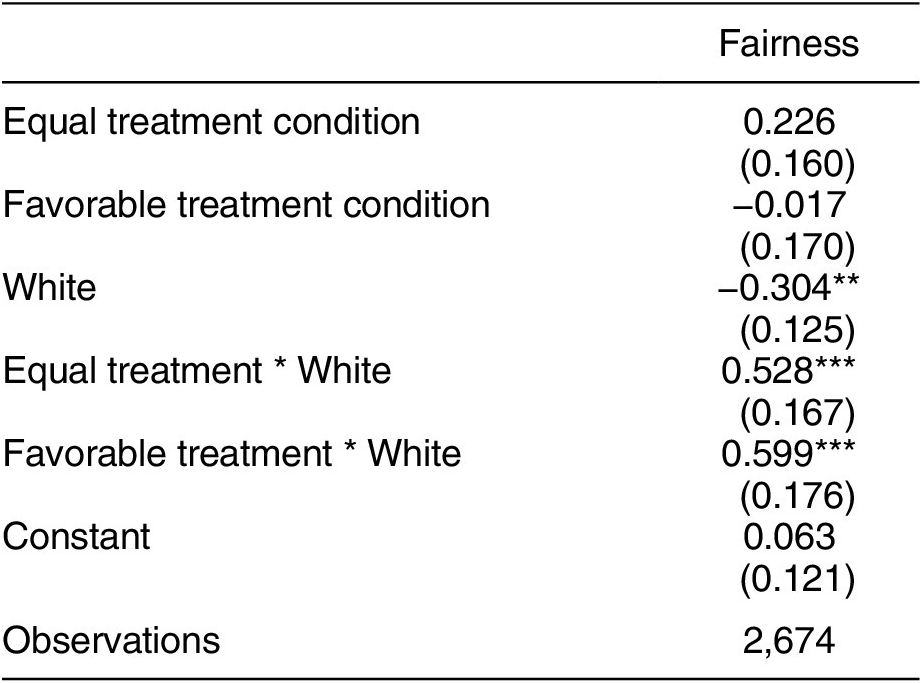
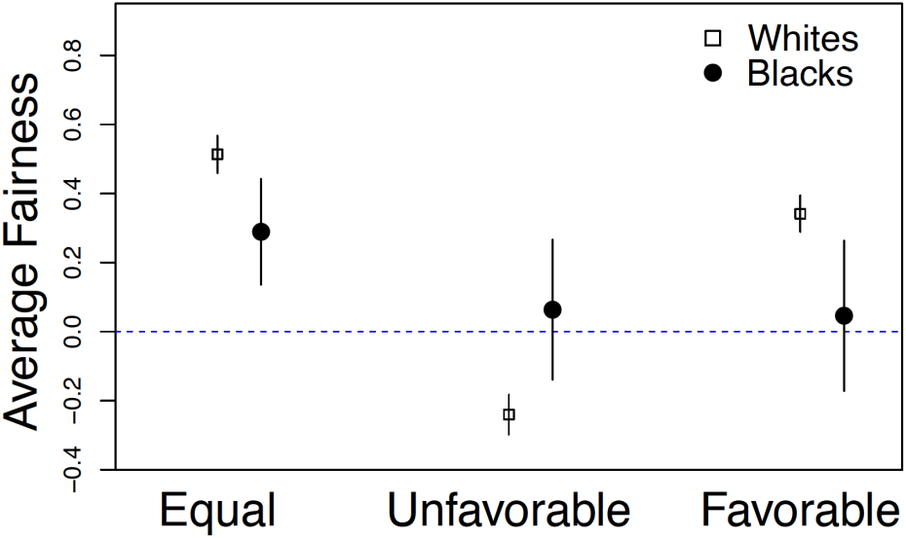
We begin our analysis by comparing white and Black respondents’ perceptions of fairness across the treatment conditions in the first study. To formally test whether the treatments have divergent effects among white and Black Americans, we regress the fairness measure on the equal and favorable treatment conditions, along with an interaction term for the treatments and respondent’s race. The results of these OLS regressions are shown below in Table 1, where the baseline is the unfavorable treatment, and the average fairness scores are displayed in Figure 1.
OLS Regression of Fairness Assessment on Equal and Favorable Treatment Conditions and Race

Note: Fairness assessment based on a scale from −2 (Very Unfair) to 2 (Very Fair). Standard errors are included in parentheses. The sample consists of those who identify as white or Black. * p < 0.1; ** p <0.05; ***p <0.01.
Fairness Evaluations of White and Black Respondents
Note: Figure displays the average fairness score by treatment type, measured from −2 (Very Unfair) to 2 (Very Fair), with 95% confidence intervals. Higher values represent greater perceived fairness of the trade agreement. The results are divided based on whether respondents identified as white or Black.

Our first hypothesis expects that Black Americans will exhibit significantly less asymmetric fairness than white Americans, which means that the gap in perceived fairness between the favorable and unfavorable agreements should be larger for white respondents than Black respondents. As predicted, we find that white Americans exhibit a large asymmetry in their fairness evaluations of favorable and unfavorable trade agreements, and this asymmetry is much larger among white respondents than Black respondents, as illustrated with the significant interaction term with the favorable treatment (0.599, p < 0.01). Consistent with the idea that white Americans are concerned with falling behind, we find that white respondents view it as especially unfair when the U.S. makes larger concessions than the other country. However, it is worth noting that white Americans are not simply justifying any outcome that favors them as being fair. Consistent with Brutger and Rathbun’s aggregate results (Reference Brutger and Rathbun.2021), we find that white Americans view the trade agreement with equal concessions to be the fairest, as shown in Figure 1. White respondents rate the equal agreement as significantly fairer than the favorable trade agreement (0.17, p < 0.001).
We also find evidence in support of our more demanding second hypothesis, which is that Black Americans engage in a principled fairness assessment, and thus they should view the favorable and unfavorable agreements as being equally (un)fair. Indeed, we find that there is not a significant difference between Black respondents’ fairness evaluations of the favorable and unfavorable trade agreements (−0.017, p < 0.92) and the result is substantively zero. These results support our argument: Black Americans exhibit a more principled fairness logic than white Americans. As shown in Figure 1, they consider trade deals with equal outcomes to be slightly more fair than favorable deals, and they assess the fairness of both favorable and unfavorable deals equally.Footnote 12
Another important result from Table 1, is that white respondents view the baseline unfavorable treatment condition as being significantly less fair than Black respondents do (−0.304, p < 0.02). This is consistent with white Americans believing it is especially unfair when they are falling behind or placed in an unfavorable position. The substantively large and significant effects confirm that asymmetric fairness evaluations are prominent among white Americans and that Black Americans do not view trade through an asymmetric fairness lens, since they do not appear to have the same fear of falling behind as white Americans.Footnote 13
We next connect our results to the line of work that focuses on support for trade, moving to our second dependent variable, which is a five-point measure of support for the trade agreement. We find that the favorable treatment results in the highest level of support from white respondents, as shown in Figure 2. White Americans’ support for the favorable condition is 0.09 (p < 0.07) higher than the equal treatment and 0.65 (p < 0.001) higher than the unfavorable treatment. By contrast, we find that Black respondents have somewhat higher support scores for the equal and favorable conditions, compared to the unfavorable condition, but there is no difference in support for the favorable and equal treatments among Black respondents (−0.01, p < 0.95). Though the interpretation of the results among Black respondents warrants some caution given the sample size, this is a clear case where the two estimates of support are substantively identical, and so we feel confident that Black Americans do not have higher support for the favorable trade concessions compared to the equal concessions.
Support for Trade Agreement of White and Black Respondents
Note: Figure displays the average support score by treatment type, measured from −2 (Strongly Oppose) to 2 (Strongly Support), with 95% confidence intervals. Higher values represent greater levels of support for the trade agreement. The results are divided based on whether respondents identified as white or Black.

To understand the connection between fairness evaluations and trade support, we draw from existing theories of public support for international trade. We know that Americans often evaluate trade through an economic lens, which includes both individual and sociotropic concerns (Guisinger Reference Guisinger2017; Mutz, Mansfield, and Kim Reference Mutz, Mansfield and Kim2021).Footnote 14 This type of evaluation would assume that Americans would prefer favorable agreements, since the public will view the favorable agreements as being more materially beneficial to themselves and/or their broader group. However, by incorporating fairness concerns into an evaluation of trade agreements, we generate more precise expectations. Since white Americans view favorable agreements as being reasonably fair, we would expect that economic and fairness concerns would both lead to high levels of support for favorable agreements. By contrast, since Black respondents view favorable and unfavorable trade deals as being equally unfair, we would expect that fairness concerns would lead to less support for favorable agreements, even though economic concerns may lead to higher support for favorable trade agreements. This suggests that material and moral concerns are likely in tension with one another when Black Americans evaluate favorable trade agreements.
To assess the relative importance of fairness versus economic concerns, we follow Brutger and Rathbun’s approach and conduct a mediation analysis. We focus on the effect of moving from the baseline unfavorable condition to the favorable treatment condition, since the asymmetric and principled fairness lenses predict divergent fairness evaluations for this comparison. We follow Brutger and Rathbun’s approach, using mediation analysis (Tingley et al. Reference Tingley, Yamamoto, Hirose, Keele and Imai.2014) to evaluate the average direct effect (ADE) and the average causal mediation effect (ACME) of the favorable treatment, compared to the unfavorable condition.Footnote 15 The mediation analysis supports our theory’s expectations, as shown in Figure 3. The average mediation effect identifies the effect of the mediator (fairness) on support for the trade agreement, whereas the ADE is the part not explained by the mediator, which we expect is driven by economic concerns. For Black Americans, there is no ACME, which is what the principled fairness theory would predict since Black Americans view the unfavorable and favorable deals as equally (un)fair. The increase in support for Black Americans is entirely driven by the direct effect (significant at p < 0.1). By contrast, white Americans’ increase in support for the favorable condition is driven by both the ACME and the ADE. We find that 66% of the increase is due to the mediating effect of fairness, and the additional increase is due to the direct effect. These results highlight that fairness does influence support for trade but in different manners for white and Black Americans.
Support for Trade Agreement of White and Black Respondents
Note: Figure displays the ACME, ADE, and total effect of the favorable treatment compared to the unfavorable baseline condition. Perceived fairness is the mediator and support for the trade agreement is the dependent variable, measured from −2 (Strongly Oppose) to 2 (Strongly Support), with 95% confidence intervals. Higher values represent greater levels of support for the trade agreement. The results are divided based on whether respondents identified as white or Black.

The fact that we observe Black Americans evaluating trade agreements through a principled fairness lens, on the one hand, and their increased support for trade deals that are equal or favorable to the U.S., on the other, is consistent with both moral and material concerns influencing policy evaluations. As noted above, this result suggests that Black Americans have reasons to support favorable trade deals for their material benefits, while simultaneously having moral reasons to not support such deals, due to their unfairness. We view this article as providing an important first step toward understanding the social and psychological processes that shape how Black Americans integrate material, moral, and national concerns into their evaluations of trade, though we recognize that disentangling these historical and contemporary processes will require further research beyond this article.
Testing Mechanisms
Next, we analyze the study with a focus on disentangling the mechanisms at play. First, we use respondents’ individual-level perception of what fairness means to them to evaluate whether distinct conceptions of fairness contribute to divergent assessments of fairness in trade. Brutger and Rathbun (Reference Brutger and Rathbun.2021) asked the same question as we discussed earlier, measuring what fairness means to each respondent, so we use the responses to test the micro-level foundations of our theory. We examine whether individual differences in perceptions of fairness moderate our treatment effects, as shown in section 5 of the Supplementary Material. We expect that those who view fairness in terms of equality should exhibit less of an asymmetric fairness evaluation than those who do not. Because the asymmetric and principled fairness perspectives generate divergent implications for the comparison of favorable and unfavorable treatments, we continue to focus on this comparison in our examination of mechanisms. We find that those who think of fairness in terms of equality exhibit significantly less asymmetric fairness, as expected. For respondents who do not think of fairness in terms of equality, they have dramatically larger asymmetric fairness evaluations when comparing the favorable to the unfavorable condition (0.264, p < 0.01).Footnote 16 These findings are consistent with our theory that individuals’ core perceptions of what fairness means to them affect their evaluations of trade, and that those who have been socialized to think of fairness in terms of equality are less likely to evaluate trade through an asymmetric fairness lens.
Next, we evaluate the connections between nationalism, race, and trade attitudes. This is an important step since our initial results are broadly consistent with the findings of Mutz, Mansfield, and Kim (Reference Mutz, Mansfield and Kim2021), who note that white Americans view trade through a nationalistic lens (Mutz, Mansfield, and Kim Reference Mutz, Mansfield and Kim2021, 560), and thus they prefer deals that favor the United States. However, we are also interested in whether white and Black respondents view trade differently, even after controlling for individuals’ level of nationalism. To disentangle these effects, we use a measure of national attachment that is a composite of two frequently used measures (Herrmann, Isernia, and Segati Reference Herrmann, Isernia and Segatti2009), which ask “When someone says something bad about American people, how strongly do you feel it is as if they said something bad about you?” and “How much do you feel that what happens to America in general will be your fate?” Each question has a five-point response scale with higher values corresponding to greater national attachment. We sum the responses from the two questions, which creates our measure of national attachment. The distributions of national attachment for white and Black respondents are displayed in section 6 of the Supplementary Material, which shows that national attachment is relatively similar between the two groups in our sample, with each group having the same quartile and median cut-points, though average national attachment is 0.29 higher among white respondents than Black respondents. For the remaining analysis, we sum the national attachment responses and rescale them from zero-to-one for ease of interpretability.
The main effects of our treatments are remarkably robust, even when controlling for nationalism, as shown in Table 2. We find that the main effects and interaction effects all maintain their signs and significance with the additional control. We do find that nationalism exerts a significant effect on its own, but it does not undermine the significant interactions between race and our treatments.
OLS Regression of Fairness Assessment on Equal and Favorable Treatment Conditions and Race, Controlling for Nationalism

Note: Fairness assessment based on a scale from −2 (Very Unfair) to 2 (Very Fair). Standard errors are included in parentheses. The sample consists of those who identify as white or Black. *p < 0.1; **p <0.05; ***p <0.01.
We also test whether nationalism has significant interaction effects with our treatments, and the relative magnitude of the interaction effects, with the interactions reported in section 6 of the Supplementary Material. To examine if nationalism has a significant effect on whether people interpret trade through an asymmetric or principled fairness lens, Table 5 in the Supplementary Material interacts nationalism with the favorable treatment condition (compared to the unfavorable baseline). We find that those who are highly nationalistic do respond with a larger shift in fairness evaluations to the favorable condition than respondents who are low in nationalism (0.473, p < 0.026), thus exhibiting more of an asymmetric fairness outlook than their low-nationalism counterparts. This suggests that nationalism does influence whether people embrace an asymmetric fairness perspective, though the magnitude of this interaction effect is about 20% smaller than the interaction effect between race and the favorable condition.Footnote 17 Taken together, our analysis demonstrates that nationalism plays an important role in shaping public perceptions of the fairness of trade agreements, but race, and specifically the distinct histories of white Americans and Black Americans, also plays an important role in shaping public perceptions of international trade.
Though the evidence suggests race plays an important role in determining how individuals evaluate fairness, another alternative explanation for our results could be the political orientations of white and Black Americans. We know that Black Americans are more likely to vote for Democrats than Republicans and embrace liberal ideology,Footnote 18 so it may be that our racial indicators are proxying for the ideological or political preferences of respondents. Furthermore, Democrats and liberals in the United States are more likely to embrace liberal egalitarianism and evaluate fairness in terms of equality (Brutger Reference Brutger2021; Powers et al. Reference Powers, Kertzer, Brooks and Brooks2022). This raises the possibility that race is not the driving force behind the different fairness evaluations of white and Black Americans, and instead ideological or political preferences may be the primary causal mechanisms.
The alternative explanation of ideology, or partisanship, as the driving force behind racial differences in perceptions of fairness of trade has corollaries in existing scholarship. For example, Appleby and Federico (Reference Appleby and Federico2018) found that white Americans’ beliefs about the fairness of elections, specifically of Barack Obama, differed across partisan and ideological divides. They found that white conservatives and Republicans were less likely to believe the 2008 and 2012 elections were conducted fairly, which is consistent with a racially biased view of fairness. More broadly, studies based on predominantly white respondent pools find that liberals and Democrats are more likely to support foreign policy decisions that embrace egalitarian norms (Brutger Reference Brutger2021). Given this, we would expect white liberals and Democrats to view the world—and trade—through a more principled fairness lens, similar to their Black counterparts. We test this alternative explanation by comparing the favorable to the unfavorable conditions among white respondents, with the results shown in Table 3.Footnote 19
OLS Regression of Fairness Assessment of White Respondents by Partisanship and Ideology

Note: Table displays the results for respondents who identify as white, broken into subgroups based on political party and ideology. Fairness assessment based on a scale from −2 (Very Unfair) to 2 (Very Fair). Ideology is measured on a five-point scale from 1 (extremely liberal) to 5 (extremely conservative). Those who selected 1 or 2 are considered liberals, and those who selected 4 or 5 are considered conservative. Standard errors are included in parentheses. * p < 0.1; ** p < 0.05; ***p < 0.01.
We find that the fairness evaluations of white Americans across the political and ideological spectrum are inconsistent with an evaluation based on principled fairness. Instead, we see that white Americans—even those who identify as liberals and/or Democrats—consistently view the world through an asymmetric fairness lens, as shown by the significant positive effects of the favorable treatment across all models in Table 3. Though we find white liberals and Democrats exhibit somewhat less asymmetric fairness than their more conservative counterparts, there is no question that even liberal white Americans evaluate trade through an asymmetric fairness lens, as opposed to a principled fairness lens. These results affirm the dominance of the asymmetric fairness lens among white Americans and demonstrate that political orientation and ideology do not account for the difference between white and Black Americans’ perceptions of fairness.
Finally, we test whether respondents’ sector of employment moderates their assessment of fairness in trade. If white and Black respondents experience different levels of exposure to the risks of trade due to their lines of work, then it may be that race is proxying for concerns about import competition (Mayda and Rodrik Reference Mayda and Rodrik2005). To evaluate this alternative mechanism, we leverage respondents’ self-reported sectors of employment. We matched each respondent’s employment industry to trade and production data from the Organization for Economic Cooperation and Development (OECD).Footnote 20 We then coded an indicator variable, called “import-competing,” which equals one for sectors with an import-share in the top quartile of the import-shares for all sectors. As shown in section 10 of the Supplementary Material, we do not find that working in an import-competing sector has a significant interaction with the favorable treatment condition. These results help us rule out the potential that differing exposure to trade competition based on employment sector is driving the divergent results between white and Black respondents.
Discussion
Social perceptions of fairness shape policy preferences in many areas of politics. Building on recent work on trade attitudes, this study explored racial differences in the relationship between American conceptions of fairness and trade attitudes. Using experimental evidence from a national survey experiment, we show how contrasting perceptions of fairness among white and Black Americans lead to distinct evaluations of trade policy. Consistent with the findings of Brutger and Rathbun (Reference Brutger and Rathbun.2021), we find that white Americans exhibit “asymmetric fairness” in their assessment of U.S. trade deals. They consider equal trade deals between the U.S. and another country to be the most fair, followed closely by trade deals that are more favorable to the U.S. than another country. Trade deals that are unfavorable to the U.S. are considered to be unfair by white Americans. Ultimately, white Americans are most supportive of trade deals that are most favorable to the United States. In contrast to white Americans, we find that Black Americans consider trade deals with equal outcomes to be the most fair, while showing no differences in fairness assessment between trade deals that are favorable or unfavorable to the United States. Thus, Black Americans exhibit a principled fairness logic, rather than an asymmetric fairness logic, in their assessment of trade policy.
Leveraging the literature on CRT and cognitive psychology, we argue that Black Americans’ historically subordinate position in systemically racist American society has made them less susceptible to asymmetric fairness assessments. The experience of being further behind in American society, often because of the actions of the State, contributes to Black American perceptions that an “America first” trade policy is relatively less fair. The collective memory of Black communities, which anchors historical racial injustice to contemporary preferences for equality, serves as a mechanism that sustains a principled fairness logic among this group. A belief in fairness as equality extends beyond in-group favoritism for Black Americans, contributing to the assessment of trade deals that favor either the home or foreign country as being equally (un)fair. Meanwhile, white Americans have been socialized to having their interests privileged and protected by the State, contributing to this group being more supportive of trade policies that keep America, and themselves, ahead. Persistent power and privilege disparities advantaging white people, segregated communities that limit intergroup interaction, and colorblind narratives, norms, and values about America, serve as mechanisms that unconsciously affirm an asymmetric fairness outlook among this group. Put simply, one does not exhibit a fear of falling behind if one has been behind from the start. Thus, this fear of falling behind is indicative of a historically privileged social position.
This study provides new insights into racial divides in trade preferences by focusing on a single minority group, Black Americans, to understand the distinct cultural, historical, and political bases that inform this group’s view on fairness and trade policy. This analytical focus moves us closer to understanding the mechanisms underlying divergent policy preferences between social and political groups. Our analysis tested a variety of potential competing explanations that could shape racial divides in perceptions of fairness and trade. We find that individual differences in ideology, nationalism, employment industry, and education cannot explain the divergent perceptions of fairness between white and Black Americans. These findings help us not only adjudicate between competing mechanisms but also leave some questions unanswered. Future studies of Black American trade policy preferences might examine how such preferences are influenced by the identity of specific trading partners.Footnote 21 If the trading country is a majority Black nation from the Global South, for example, how might that shape Black Americans’ fairness assessments of different concession arrangements? Future research might also take a more inductive approach to understanding how, exactly, historical experiences of racism have shaped and continue to shape the fairness logics of Black Americans. What sorts of changes in Black (and white) American fairness logics might we observe if we are able to curb the effects of systemic racism and Black subordination in the contemporary period?
Ultimately, our findings provide additional empirical support for the theoretical distinction between white American political subculture and Black American political subculture in public opinion research. The different perspectives and meanings held by groups with different experiences of distributional disadvantage, even beyond the boundaries of race, have important implications for how both domestic and foreign policies will be received and understood across the United States and other stratified societies. Thus, we provide a general theoretical framework for investigating public opinion of other issue areas beyond trade, like tax policy or social welfare spending, in other contexts outside the United States. More specifically, however, our findings serve as a call to action for IR scholars to consider racism and resulting racial cleavages when examining American preferences for international policies, especially to the extent that such preferences are mediated by socially constructed moral principles, like fairness.
SUPPLEMENTARY MATERIAL
To view supplementary material for this article, please visit http://doi.org/10.1017/S0003055425000012.
DATA AVAILABILITY STATEMENT
Research documentation and data that support the findings of this study are openly available at the American Political Science Review Dataverse: https://doi.org/10.7910/DVN/2M3NCJ.
ACKNOWLEDGEMENTS
The authors would like to thank Omar Wasow, Desmond Jagmohan, Alexandra Guisinger, and Rebekah Jones for their helpful advice and comments on this research. We are also grateful to those who provided feedback at the UChicago International Relations Colloquium, the Berkeley MIRTH Colloquium, the Berkeley Economy and Society Initiative, and the 2023 International Political Economy Society Conference. Lastly, we would like to thank Jonathan Monroe, Abby Morris, and Sabreen Nuru Tuku for their research assistance.
CONFLICT OF INTEREST
The authors declare no ethical issues or conflicts of interest in this research.
ETHICAL STANDARDS
The authors declare that the human subjects research in this article was reviewed and approved by the UC Berkeley Institutional Review Board and certificate numbers are provided in the Supplementary Material. The authors affirm that this article adheres to the principles concerning research with human participants laid out in APSA’s Principles and Guidance on Human Subject Research (2020).


 Open access


Comments
No Comments have been published for this article.