

Introduction
Becoming invisible or transparent in old age is a well-documented phenomenon (Szukalski Reference Szukalski2015; Menezes et al. Reference Menezes, Woolrych, Sixsmith, Makita, Smith, Fisher, Garcia-Ferrari, Lawthom, Henderson and Murray2021). Invisibility can be understood at the intersection of aesthetics, which relates to perceptions and politics, encompassing power dynamics (Brighenti Reference Brighenti2007). A growing body of literature has highlighted the gendered dimensions of ageing and social (in)visibility (Cecil et al. Reference Cecil, Pendry, Ashbullby and Salvatore2022; Schladitz et al. Reference Schladitz, Förster, Wagner, Heser, König, Hajek, Wies, Pabst, Riedel-Heller and Löbner2022). While these studies have made important contributions, older women continue to be marginalized in comparison to men and are frequently seen as a ‘burden’ or a social issue in need of intervention. This neglect translates into systemic barriers, as public services frequently fail to provide older women with essential resources, such as financial support, health care or social safety nets, which would significantly improve their quality of life (Age International 2022). Moreover, the political and social marginalization of older women is reflected in their limited representation in leadership roles and their frequent exclusion from decision-making processes. This invisibility is rooted in societal norms that often expect women to prioritize domestic responsibilities, limiting their public and political engagement (Bertini Reference Bertini2015). Older women tend to lose visibility regardless of their sexual orientation (Westwood Reference Westwood2023). The societal focus on youthful bodies as markers of attractiveness, femininity and sexual desirability has contributed to diminished self-esteem and a heightened sense of invisibility among older women (Westwood Reference Westwood2023). Regardless of their age, lesbiansFootnote 1 often go unnoticed in the collective social awareness, with their experiences disregarded and the intricate facets of their identities overlooked, potentially leading to mental health challenges (Soares et al. Reference Soares, Rodrigues, Nogueira and Mattos2025). The intersection of prevailing societal norms regarding sexuality, lesbianism, gender and age contributes to the marginalization of older lesbians within and beyond the lesbian community (Westwood Reference Westwood, Bamford and Watson2013; Traies Reference Traies2017) as well as the notable under-representation of older women within the LGBT community (EL*C 2023). Conversely, some studies highlight that escaping the stigma of ageism has allowed women to explore new forms of self-expression through fashion and appearance (Cecil et al. Reference Cecil, Pendry, Ashbullby and Salvatore2022). Scholarship has demonstrated that it not only moves beyond the gender binary but also shifts the focus away from youth and the male gaze (Westwood Reference Westwood2023; Bennett et al. Reference Bennett, Welch and Fischer2024). This perspective emphasized the benefits of remaining inconspicuous. Moreover, experiences in the second half of life offer opportunities to reframe gender stereotypes and to observe contemporary shifts towards greater gender equality (Ayalon and Lir Reference Ayalon and Lir2022). Ageing presents a chance to break free from a narrow perception rooted in physical looks and conformity to societal norms: ‘She can at last tran- scend the body that was what other people principally valued her for . . . this new invisibility, like calm and indifference, is a desirable condition’ (Greer Reference Greer2018: 266). However, the experience, negotiation and management of sexual identities among older lesbian women are shaped not only by personal factors but also by historical shifts and the relational and community contexts they are embedded in. These contexts can either empower or constrain individuals in constructing meaningful identities and lifestyles (National Academies of Sciences, Engineering and Medicine Reference White and MJ and Patterson CJ2020). This article examines the experiences of social invisibility and visibility among older lesbians in Israel and explores how these women respond to these dynamics. The analysis is situated within the specific context of a country where religiosity and traditional gender roles coexist with relatively supportive legislation and public services for the LGBTQ+ community. The study this article draws on addresses the following question: how do older lesbian women in Israel describe their experiences of visibility and invisibility across various social contexts? What strategies do they employ in navigating and responding to the intersecting dynamics of ageism, sexism and homophobia? The study relies on three theories: the concept of intersectionality (Crenshaw Reference Crenshaw2017b), the psychology of invisibility (Fryberg and Townsend Reference Fryberg, Townsend, Adams, Biernat, Branscombe, Crandall and Wrightsman2008) and the theory of weak resistance (Majewska Reference Majewska2021).
Literature review and theoretical framework
The review first situates visibility and invisibility in social and political contexts, then examines lesbian identities with a focus on the experiences of older lesbians. By considering the Israeli socio-cultural context, the article highlights how local and national factors uniquely shape recognition and invisibility. Integrating the psychology of invisibility, intersectionality and weak resistance, the framework illuminates how ageing, gender and sexuality intersect, offering new insights into how older lesbian women navigate and construct meaning in the context of invisibility. The following sections present the study’s findings, discussion, limitations and implications for future research.
(In)visibility
Visibility, as a category in the social sciences, is situated at the intersection of aesthetics (perception-based relationships) and politics (power-based relationships) (Brighenti Reference Brighenti2007). Visibility connotes individuals’ perceptions of themselves, shaped by self-presentation and preferences, taking into account their abilities and skills (Buchanan and Settles Reference Buchanan and Settles2019). In turn, visibility functions as a social dimension where thresholds between competing social forces are drawn, defining the boundaries of recognition, legitimacy and exclusion (Brighenti Reference Brighenti2007). Mass media platforms serve as prominent spaces that can bestow visibility on individuals who become part of them (Brighenti Reference Brighenti2007).
Unlike visibility, invisibility involves the absence of both positive and negative representation for marginalized communities (Fryberg and Townsend Reference Fryberg, Townsend, Adams, Biernat, Branscombe, Crandall and Wrightsman2008). This phenomenon manifests in various ways and affects different under-represented populations, such as racial and ethnic minorities (Hayes et al. Reference Hayes, Riley, Radley and McCarthy2017; Syed et al. Reference Syed, Santos, Yoo and Juang2018), as well as gender and sexual minorities (Hayfield Reference Hayfield, Maliepaard and Baumgartner2020). The significance of social visibility and its effects on minority groups’ interactions with the mainstream cannot be overstated, as the lack of acknowledgement results in racial and sexual minorities going unnoticed (Brighenti Reference Brighenti2007). The consequences of social invisibility are multifaceted and encompass various aspects, including economic disparities (Balachandran Reference Balachandran2021), limited medical services (Giannou and Ioakimidis Reference Giannou and Ioakimidis2020), psychological impacts (Lawson Reference Lawson2019), shared stereotypes and prejudice (Westwood Reference Westwood2023) and gender discrimination that mostly affects women (Wong et al. Reference Wong, Kirby, Rink and Ryan2022; Westwood Reference Westwood2023). The boundaries between visibility and invisibility are highly complex, giving rise to unpredictable and frequently conflicting consequences (Lamble Reference Lamble2009).
Lesbians and older lesbians
The conventional use of the term ‘lesbian’ to describe women attracted to other women does not fully encompass the diverse ways in which individuals understand and express themselves (Hagai and Seymour Reference Hagai and Seymour2022). When contemplating lesbian visibility, it is imperative to recognize that gender, physical appearance and sexuality constitute distinct components of individuals’ identities, occasionally intertwining and intersecting in intricate and non-linear manners (Cardenas-Soto Reference Cardenas-Soto2023). Simultaneously, heterosexism and homophobia, including internalized forms of these biases, play a central role in producing the social invisibility of lesbians (D’haese et al. Reference D’haese, Dewaele and Houtte2016; Spooner and Cleveland Reference Spooner and Cleveland2023). Lesbian sexuality discourse intersects with sexism and the broader women’s sexuality discourse, resulting in silencing and distorting effects on lesbians’ experiences (Soares et al. Reference Soares, Rodrigues, Nogueira and Mattos2025). The concept of the invisible lesbian suggests that women are generally seen as sexually invisible without a male presence, shaping the perception of lesbian sexuality as an inadequate or incomplete aspect of one’s sexual identity. This, in turn, influences the formation of lesbians’ internalized sense of self (Soares et al. Reference Soares, Rodrigues, Nogueira and Mattos2025). Lesbian sexuality is not simply overlooked by the state – it is deliberately ignored, along with other queer identities (Lamble Reference Lamble2009).
There has been a significant increase in LGBTQ+ (lesbian, gay, bisexual, transgender, queer, with the ‘+’ symbol representing non-cisgender and non-straight identities that are not explicitly covered by the acronym) ageing research globally over the past ten years. However, the issue of lesbian invisibility in this field remains essential. Older women within the LGBTQ+ community are notably under-represented in current scientific understanding (EL*C 2023; Westwood Reference Westwood, Bamford and Watson2013). Moreover, the widely recognized concept of a ‘triple invisible minority’ (Kehoe Reference Kehoe1986), which addresses intersectional discrimination against older lesbians based on age, gender and sexual orientation, has long led researchers (Averett et al. Reference Averett, Yoon and Jenkins2011; Traies Reference Traies2017) to view invisibility as a negative phenomenon. Influenced by feminist ideas from the 1960s, older women often experience greater acceptance, if not outright appreciation, within lesbian social circles, where attractiveness is seen as extending beyond physical appearance (Simpson Reference Simpson and Goldberg2016). However, it remains important to acknowledge that this view is somewhat idealized, as no community, including LGBT groups, is entirely immune to ageism (Simpson Reference Simpson and Goldberg2016). Additionally, lesbians may internalize both Western beauty standards and the cultural norms of their own community, which can lead to internal conflicts and a sense of inadequacy within these circles (Bennett et al. Reference Bennett, Welch and Fischer2024).
The Israeli context of the LGBTQ+ movement
Over the past two decades, there has been a notable surge in LGBTQ+ visibility in Israel. This heightened visibility has been attributed to a combination of liberal legal efforts, which primarily advocate for equal rights within gay families, for parents and partners alike (Preser Reference Preser2011). Simultaneously, the emergence of gay pride parades has increased LGBTQ+ activism, and the proliferation of academic and mainstream discussions surrounding gay-related topics has all significantly contributed to the integration of these issues into the broader Israeli public discourse. In line with this trend, legal actions against sexual discrimination on behalf of homosexuals have increased, and lesbian organizations, supported by feminist and academic groups, have intensified their activities (Gvion and Luzzatto Reference Luzzatto and Gvion2004). There are numerous small local lesbian groups and a few major organizations, including Beshela, which are dedicated to older non-heterosexual women. However, as research shows, older LGBT people, compared to the general population, still cannot count on similar family support or availability of health and social services (Shnoor and Berg-Warman Reference Shnoor and Berg-Warman2019).
Still, attitudes towards homosexuality in Israel vary considerably depending on one’s level of religious engagement (Snellings Reference Snellings2019; Sasson-Levy Reference Gilly and Sasson-Levy2021). Ultra-Orthodox (Haredi) communities often express sentiments of exclusion, condemnation and hostility towards non-heterosexual individuals (Snellings Reference Snellings2019). As a result, religiously motivated opposition to homosexuality in Israel is evident not only in the lack of legal recognition for same-sex marriage and the obstruction of progressive legislative initiatives but also in the prevalence of discriminatory practices and acts of violence (Snellings Reference Snellings2019).
Researchers have also examined the phenomenon of Tel-Aviv and its portrayal as the ‘Gay Capital of the Middle East’ in the context of city branding (Snellings Reference Snellings2019) and the concept of pinkwashing, which downplays Mizrahi gay culture and Arab culture and distracts from the occupation of Palestine (Gilly and Sasson-Levy Reference Gilly and Sasson-Levy2021). However, it is worth noting that this branding has primarily revolved around the image of a gay man, mainly because of the limited visibility of the lesbian community (Snellings Reference Snellings2019). Scholars frequently engage in discourse that juxtaposes Tel-Aviv and Jerusalem, characterizing the latter as a more nationally and religiously oriented city, possibly construed as less accommodating of the LGBTQ+ community – a characterization that might have oversimplified the complexity of the real state of affairs (Snellings Reference Snellings2019). Moreover, this discourse often disregards other urban centres, such as Haifa or Beer-Sheva, where the LGBTQ+ community maintains a formal and active presence.
The reviewed literature demonstrates that (in)visibility is a complex and relational social process shaped by power, recognition and exclusion. While increased visibility can lead to social and political inclusion, it often reproduces dominant norms and selectively includes only certain identities, rendering others invisible. Older lesbians, positioned at the intersection of age, gender and sexuality, experience a form of compounded invisibility that affects their access to representation, resources and community belonging. Despite the growing body of LGBTQ+ ageing research, older lesbians remain under-represented, both globally and within specific national contexts such as Israel. Likewise, although visibility of the LGBTQ+ community in Israel has increased, it predominantly centres on urban, male and often privileged identities, leaving older lesbians’ experiences marginalized. These dynamics call for intersectional analyses that account for how age, gender and sexuality shape visibility and social recognition in later life.
The theoretical framework
Three theories are used to frame older lesbians’ experiences. The first is the psychology of invisibility (Fryberg and Townsend Reference Fryberg, Townsend, Adams, Biernat, Branscombe, Crandall and Wrightsman2008), which initially referred to systemic racism in the United States. Within this theory, individuals continuously adapt to the absence of a predefined social representation. They integrate past and present experiences, drawing inspiration and opportunities to shape their future selves during social interactions (Fryberg and Townsend Reference Fryberg, Townsend, Adams, Biernat, Branscombe, Crandall and Wrightsman2008). The two dimensions of social invisibility include relative invisibility and absolute invisibility of particular groups, depending on the availability of social representations. Social representations are a distinct aspect of social cognition specifically adapted to address the complexities of modern societal changes (Fryberg and Townsend Reference Fryberg, Townsend, Adams, Biernat, Branscombe, Crandall and Wrightsman2008). However, they also affect the individual level, influencing everyday existence and interpersonal connections. People who exist in a state of relative invisibility often have to contend with unfavourable portrayals, while those who are completely unnoticed have to fashion or cultivate potential self-identities because they lack any pre-existing self-concepts as a foundation (Fryberg and Townsend Reference Fryberg, Townsend, Adams, Biernat, Branscombe, Crandall and Wrightsman2008). One can encounter situations involving both absolute and relative invisibility (Fryberg and Townsend Reference Fryberg, Townsend, Adams, Biernat, Branscombe, Crandall and Wrightsman2008), which appears appropriate for conceptualizing the individual experiences of older lesbians.
The second theory is intersectionality, which explains how different classifications such as race, age, socio-economic status and gender are interrelated and how their overlapping intersections can influence the discrimination or privilege that individuals and groups experience (Oxford English Dictionary 2023). Scholars emphasize that analysing categories such as race and gender separately may have limitations, as individuals often experience these identities concurrently (Bauer et al. Reference Bauer, Churchill, Mahendran, Walwyn, Lizotte and Villa-Rueda2021). Furthermore, within each of these socially constructed categories there is an element of inequality or power dynamics, and acknowledging these disparities or power imbalances is crucial for intersectional examination (Else-Quest and Hyde Reference Else-Quest and Hyde2016). Kimberlé Crenshaw (Reference Crenshaw2017b), who coined the term ‘intersectionality’, described it as ‘a lens through which you can see where power comes and collides, where it interlocks and intersects’. Intersectionality is often linked with qualitative research methods because of its emphasis on providing a voice, achieved through means such as focus groups or narrative interviews (Atewologun Reference Atewologun2018). Following the insights of King et al. (Reference King, Almack and Jones2019), the present study utilizes these theoretical frameworks to examine the intricate interplay between ageing, gender and sexuality in the lives of older lesbians.
The choice of the third theory of weak resistance (Majewska Reference Majewska2021) is justified by an attempt to understand the rebellious behaviours and resistance strategies of individuals belonging to a marginalized group of older non-heterosexual and queer-oriented women. The theory of weak resistance pertains to those perceived as diverging from the prevailing white, Western, masculine, heterosexual and privileged norm. It includes ordinary, unexceptional and everyday forms of resistance. While these actions primarily involve enduring and surviving, their ultimate consequence frequently encompasses the subversion, rejection and transformation of established norms (Majewska Reference Majewska2021). The concept initially emerged in the context of women’s protests against abortion laws in Poland. According to Majewska (Reference Majewska2021: 55), ‘ordinary, non-heroic agencies can become vital components of contemporary resistance’.
The present study
This study, which this article draws on, investigates the experiences of (in)visibility among older lesbian women in Israel, with particular attention to how these women narrate their positions within both heteronormative ageing discourses and LGBTQ+ communities. Grounded in the psychology of invisibility (Fryberg and Townsend Reference Fryberg, Townsend, Adams, Biernat, Branscombe, Crandall and Wrightsman2008), the concept of intersectionality (Crenshaw Reference Crenshaw2017b) and the theory of weak resistance (Majewska Reference Majewska2021), the study examines how age, gender and sexual identity intersect to shape forms of symbolic exclusion and everyday agency. (1) How do older lesbian women in Israel describe their experiences of visibility and invisibility in various social contexts? (2) What strategies do they employ in navigating and responding to the intersecting dynamics of ageism, sexism and homophobia?
Methods
The recruitment process began with contacting LGBTQ+ organizations, followed by posting an advertisement on Facebook, and ultimately moved to the snowball method. Individual participants were encouraged to identify potential participants from their social networks. Data were collected through in-depth, semi-structured interviews that ranged from 90 to 150 minutes in length and were conducted online (11) or in person (10) at participants’ homes or workplaces. The individual interviews were conducted from June to September 2023. The researcher familiarized the participants with an interview guide, which included a list of potential themes and questions. Since the study initially focused on the sexual identity and life satisfaction of non-heterosexual women aged over 50, the topic of invisibility emerged without direct prompting. Interviews began with the prompt ‘What does old age mean to you?’ and included additional questions, for example ‘What symptoms of ageing have you noticed?’; ‘How do you experience the process of ageing?’; ‘How would you describe your sexual identity today?’; ‘Which identity is most significant to you these days?’
Participants
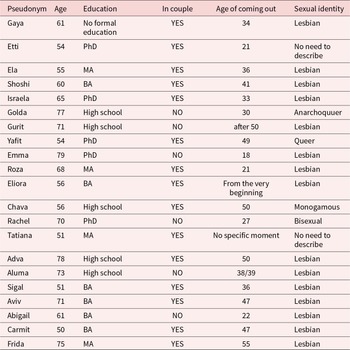
Inclusion criteria were women over the age of 50 who declared a non-heterosexual orientation or a non-heteronormative identity, including lesbian, bisexual, pansexual and women with no specific sexual identity who had experiences of same-sex relationships. The lower age threshold reflected the average age at which women in Israel enter menopause. The authors assigned pseudonyms to each participant. The women were diverse regarding their age, age of coming out, level of education, current profession, couple situation and sexual orientation (Table 1). A total of 21 participants took part in this study. Participants ranged in age from 51 to 79, with a mean age of 63.6. Within the studied cohort of women, diverse self-identifications were reported, encompassing descriptions of some as lesbians (15), others as bisexual (1), queer (2) or monogamous (1). Additionally, two women expressed a reluctance to categorize their sexual identity or orientation.
Characteristics of the participants

Ethical considerations
The research aimed to explore the psychosexual development of older lesbians in Israel. A secondary goal was to examine how they experienced ageing in middle and late adulthood. The study was approved by the Ethics Committee of the School of Social Work at Bar-Ilan University. All the participants provided written informed consent. The participants’ ability to leave the study at any time without consequences was emphasized.
Data analysis
All interviews were fully transcribed. The lead author read and reread all interviews to become familiar with the material and the participants. Each transcript was read line by line, and notes were made alongside it to capture preliminary categories. The first author coded, organized and analysed the qualitative data. Discussions with the second author were held to ensure consensus on the emerging patterns from the data and the fundamental units of meaning.
Using a thematic analysis approach, the identified themes were directly derived from the data (Braun and Clarke Reference Braun and Clarke2022). Thematic analysis involves recognizing, examining and documenting patterns (known as themes) within a dataset (Braun and Clarke Reference Braun and Clarke2022). The analysis was conducted within the interpretative framework that focuses on ‘what has been presented, told, but also in the context of what has been left, unsaid or hinted at’ (Kulas Reference Kulas2014: 113).
Findings
A recurring theme was visibility, invisibility and the range of opportunities for action, particularly at the intersection of being a woman, a lesbian and an older person. The thematic analysis of participants’ statements allowed for the identification of two main themes: (1) interpersonal invisibility, whereby the source of personal freedom that comes with older age was related to a greater ability to negotiate or defend against the social expectations placed upon older lesbians; and (2) intrapersonal visibility, that is, increasing acceptance of one’s own sexual and gender identities, including femme, butch and non-binary.
Interpersonal invisibility: the source of personal freedom
Each of the 21 participants described the role of ageing and the impact that their age, gender and sexual orientation has on their relationships with society. As women age, they report acquiring the capacity to navigate and counteract societal expectations associated with older age. Even though they are aware of the societal expectations placed upon them, they consciously describe breaking these expectations because, in a unique way, they feel immune to punishment, which bolsters their self-confidence:
More free of society. How do you call that? Social expectations? Yes, if today I stand in a shop and I hear a song, and I want to sing it really loud because I don’t care about embarrassment, [I can] because I know I’m free and I’m normal, and all those who wouldn’t like the song, but they’re not singing themselves, they have a problem. If today I want to get mad at someone who’s lying to me, nothing holds me back from getting mad at him, mostly, it’s him. When I was younger, I felt more compelled to stay conformed, and I feel that that got lost with menopause. (Chava, 56)
Chava suggests that, as she has grown older, she has gained the confidence to express herself openly and display her emotions. She highlights menopause as a transformative period that gave her a sense of empowerment. Some participants describe their experience of menopause as generally liberating, bringing relief from menstrual cycles and work-related pressures while fostering greater self-confidence. Meanwhile, other participants reflect on their engagement with social invisibility and the patronizing attitudes often directed at older women. They adopt resistant and subversive strategies to navigate the effects of social invisibility:
I am so happy to be invisible, and that I go out in the street, and I sing, and I know that nobody notices me at all. I am an old woman, and nobody sees me. And it’s a relief. You know, as a family, I used to get all kinds of, you know, war paints on my face, red in my hair, skirts, and, you know, you name it, I was a walking circus. They were saying that I’m like a red light in the street. You know that car will stop, but it is an old woman. So, okay, first, my passion for all these colours and clothing is not as … It’s not as much. It’s not as big as before, my passion for it. And also, because I’m an old woman, nobody sees me anyway. (Golda, 77)
Subversive invisibility is conceptualized as a condition in which an individual gains visibility through unconventional behaviours that are not inherently linked to their social status, resulting in confusion and surprise among observers. From Golda’s perspective, people in her environment tend to interpret her behaviour and eccentric clothing as typical for her age, which, in turn, allows her to act according to her desires without attracting societal criticism or judgement. Subversive invisibility is also related to how a couple’s lesbian identity is socially perceived and often reinterpreted in ways that do not emphasize or label their relationship explicitly:
Usually, we hid it. Yes, we hid it. Everybody knew, but we didn’t talk about it with the neighbours. I mean, they knew, but we just didn’t discuss it. At work, I hid it too. Even though she came with me to most meetings and events, we didn’t show everyone that we were a couple. We didn’t talk about it. That was another difference. If someone saw us together, we would usually say we were cousins. (Ellora, 56)
The couple were assigned a new, more acceptable category that allowed them to function without violating social norms. Nevertheless, interactions with others in public spaces remained limited, as the pressure to remain invisible and the societal disregard for older women persisted. Even when her actions provoked surprise or confusion, she recounts that prevailing norms ultimately framed her identity primarily through the lens of age:
It’s really easy to say the world is for young people. But the facts are, when you are younger, you have less power, less money, more people tell you what to do. When the policeman arrests you, you are afraid because he’s there. You know he’s older than you. Like, age has lots to do with power. And when you’re getting older, there are fewer people like that, having the power. Policemen are usually younger, and so they don’t scare you so much. When I see soldiers now, I’m not afraid like I used to [be] when I was a kid …. I’m not afraid of him so much …. And I felt it really when I was 40. I felt that, like it’s easier now, you know, because of that. (Sigal, 51)
Sigal’s account highlights that ageing reduced her fear of authority figures and increased her sense of personal power, making everyday interactions easier and less threatening than in her youth.
In the interviews, women highlight disparities in their self-confidence and in their willingness to engage in spontaneous, uninhibited behaviours during their youth compared to middle and old age. This transformation also represents a triumph over societal pressure on women to conform to the ‘nice’ ideal during their younger years, ultimately enabling them to fully embrace the depths of their authentic selves. Sigal further emphasizes this point in her subsequent statement:
When you’re getting older, it’s like they drop off you, you know, like sometimes you drop them, like you take them off like a coat. They say, ‘I don’t want it anymore.’ And sometimes it’s just a joke, like, you know, like a snake shedding its skin. You understand what I am saying? It’s like sometimes you don’t want it, but it happens. And you reveal yourself, your inner self, and not always, it’s not always good. Look, it’s not always for the best. It’s not only like you’re becoming more and more yourself; it’s like a spiritual, amazing process.
According to Sigal, ageing involves gradually letting go of external expectations, which allows her to reveal a more authentic version of herself. She acknowledges that this unfolding is not always comfortable, yet she experiences it as a significant and meaningful shift.
Overall, these accounts show that ageing redefines women’s agency and emotional freedom, enabling them to contest gendered expectations and leverage invisibility for both protection and subversion. This suggests that older lesbians derive some benefits from invisibility in the context of sexuality and age norms. Based on this analysis of shifting agency through invisibility, the following section examines intrapersonal visibility, focusing on how participants describe, recognize and accept their own gendered and sexual identities.
Intrapersonal visibility: acceptance in experiencing one’s own gender identity
Some lesbians have not conformed to prevailing societal norms regarding femininity, assuming the identity of a tomboy, which can serve as a justification for masculine-type behaviour in girls and women, thereby shielding them from assumptions about their sexual reputation and sexual orientation (Craig and Lacroix Reference Craig and Lacroix2011). Consequently, they report requiring more time, particularly during the middle and later stages of life, to explore and come to terms with their understanding and acceptance of femininity, aligning with their gender identity. Sexual orientation refers to the individuals to whom one is romantically, emotionally and sexually attracted. It is distinct from gender identity, which relates not to whom one is attracted but to one’s sense of self as a male, female, genderqueer or another identity. A lack of language to describe non-heteronormativity, combined with societal norms around gender roles, made it difficult for some lesbians to understand their sexual desires and their sense of self in relation to gender. For some participants, accepting a lesbian identity brought greater clarity regarding their gender identification.
But since I became a lesbian, I started wearing more – can I say – ladylike or feminine clothes than before. I felt like a real woman. I don’t know why, but somehow, wearing a mini made me feel that way. Suddenly, I started buying different clothes. I don’t know what happened, but my husband – well, my ex-husband – told my dad, ‘I don’t understand. You tell me you’re trying to be a woman, and suddenly you’re dressing more like a woman than before.’ (Aviv, 71)
Aviv explained that she had not always identified as a lesbian, and her understanding of her sexual identity evolved over time. Her narrative illustrates a clash between identity and expectations, both internal and external (from her ex-husband), concerning the role of a woman in the context of her changing sexual orientation. Some women, whose non-heterosexual identities began emerging in mid-life, often referred to as ‘late bloomers’, exhibit a heightened awareness of the transformative influence of lesbian self-identification on their conceptions of femininity.
I think that I have become a woman when I let my husband go out, that was the time that I felt like a woman. … So, I went to a group in Jerusalem. So … it was a party, and I danced with women, I felt so woman. (Gurit, 71)
Several women in the study asserted that, due to contemporary societal awareness and the lexicon available for describing a spectrum of gender identities, had they been born in the present era, they might have identified themselves as transgender, queer or non-binary:
I think that if I were young now, I might say I’m non-binary. My kid, one of my kids, is non-binary, but I don’t feel like either a woman or a man. But I don’t even connect to the term ‘non-binary’. In many ways, I feel more like a man than a woman. (Aluma, 73)
I don’t know if I’m binary, but fluid. Fluid, say, yeah, fluid but in the way I dress. It did help me to find a category that I fit into. (Israela, 65)
Another woman shared a similar story, noting that people react to her clothes and expression with suspicion and misunderstanding. The coexistence of male attributes and a female body creates tension, motivating individuals to define their sexual identity using contemporary terminology that enables them to position themselves on a spectrum:
I think had I grown up these days, maybe I would have chosen non-binary. So, I don’t think I’m even in the middle between male and female. I think I’m more towards females, but I’m definitely not this or that. I’m definitely not binary. So, it was very hard for so many years to say. I mean, sometimes I had my hair very, very well shaved. There was a time that I rode a motorcycle. So, I had this leather jacket that was covering, you know, you couldn’t see it, and I would go into a public bathroom, and some women liked that, you know. So, there’s definitely a very strong masculine projection that comes from me … So, I think I probably would have adapted to non-binary. (Abigail, 61)
In the past, the categories of ‘butch’ and ‘femme’ dominated gender expression within the lesbian community. At the same time, rigid definitions of lesbian identity – rooted in a fixed concept of ‘woman’ – have given rise to identities such as butches, bisexuals, trans individuals, queer and non-binary people, all of whom challenge traditional notions of lesbian visibility (Hord Reference Hord2022). Abigail consciously recognizes that her behaviour conveys masculine traits, which has led her to identify as non-binary. However, she continues to identify as a lesbian, emphasizing the possibility of a non-binary lesbian identity (Hord Reference Hord2022). Regardless of how they define their gender, participants consistently expressed no desire to undergo gender-affirming surgery.
Without gender, I could act like men, like women. OK, so something between, not between. You know I prefer women, … if I dress, I like to dress with ties. I don’t act like a man, not like a lady. … I don’t want to be a man. No, not at all. And just acting, acting more like this. (Adva, 78)
This shift highlights the fluidity of the lesbian identity, where expressions of masculinity, femininity and other forms are not rigid but exist on a broad spectrum of personal freedom. While the lesbian identity traditionally referred to women who are attracted to other women, some non-binary individuals also feel a strong affiliation with it and use this term as part of their experience.
Discussion
The study demonstrates the impact of social invisibility on both interpersonal and intrapersonal functioning among older lesbians. To conceptualize these experiences, three theoretical perspectives are applied: the psychology of invisibility (Fryberg and Townsend Reference Fryberg, Townsend, Adams, Biernat, Branscombe, Crandall and Wrightsman2008), intersectionality (King et al. Reference King, Almack and Jones2019) and the concept of weak resistance (Majewska Reference Majewska2021).
This research identifies participants’ predominantly adaptive strategies and positive experiences related to invisibility, their resilience in relation to societal standards of women’s roles, and their perceptions of their sexuality. The narratives of older Israeli lesbians provide deeper insights into how this group of women function in conditions of absolute and relative invisibility (Fryberg and Townsend Reference Fryberg, Townsend, Adams, Biernat, Branscombe, Crandall and Wrightsman2008) and how they negotiate and construct meaning around their roles. For both non-heterosexual women and the general population, invisibility is tied to age and traditional female roles, such as that of a grandmother (Westwood Reference Westwood2023). However, older lesbians face a unique form of invisibility, characterized by the disregard or even denial of their sexuality and body image (Bennett et al. Reference Bennett, Welch and Fischer2024). This article extends existing research by demonstrating that invisibility among older Israeli lesbians is not only an imposed social condition but also an interpretive space that some women mobilize as a form of subversive agency, shaped by the Israeli cultural context. By analysing how participants negotiate sexuality, age and family roles, the study deepens theoretical understandings of invisibility as an intersectional and culturally situated process rather than a uniform experience across older women.
It is essential to acknowledge that the broader consequences of invisibility for older lesbians are not overlooked. Instead, the focus is placed on the less immediately visible aspects of invisibility within lesbian communities, particularly on the forms of empowerment that could emerge in the context of ageing. Based on the interviews, two key themes were identified. This study introduced the concept of subversive invisibility, a term that highlights the non-obvious strategies older lesbians employ to navigate social invisibility. ‘Subversive invisibility’ encompasses both interpersonal and intrapersonal aspects, with personal freedom arising on the interpersonal level, and acceptance of one’s own sexual identity on the intrapersonal level. The historical exclusion of older women from public life, often enforced by laws, may have prompted resistance in which women acted not through open heroism but through everyday, individual actions (Majewska Reference Majewska2021). In the case of older lesbians, due to their significant invisibility, this propensity for resistance may manifest with heightened intensity. Numerous participants describe their later years as a time of freedom and personal growth, aligning with research showing that older lesbians perceive themselves as wiser and less concerned with social norms (Putney et al. Reference Putney, Leafmeeker and Hebert2016), and some express relief and enjoy the freedom to express their individuality through unconventional attire and behaviour.
The results of this study suggest that the primary response to social invisibility involves subversive, rebellious and surprising behaviours aimed at asserting impunity from normative expectations. This concept of subversive invisibility aligns with research indicating that older women use masquerades to hide or reject visible markers of their age, thereby expressing their authentic selves (Cecil et al. Reference Cecil, Pendry, Ashbullby and Salvatore2022). Furthermore, menopause, often framed as a rite of passage (de Salis et al. Reference de Salis, Owen-Smith, Donovan and Lawlor2018), is observed as a symbolic beginning of the ageing process, representing not only a biological transition but also a chance for empowerment and greater self-acceptance within a society that tends to overlook older women. Some studies suggest that lesbians navigate menopause with greater ease than their heterosexual counterparts, benefiting from stronger communication in their relationships and increased support from their partners (Turcan et al. Reference Turcan, Pokorny, Kvintova, Kepic, Sedlata Juraskova and Langova2022). While empirical research confirms that older women commonly experience diminished social standing and encounter challenges to their authority (Portillo Reference Portillo2010), as elucidated by one participant, the ageing process may have concurrently led to increased personal empowerment and reduced apprehension towards state institutions. For example, one of the interviewees described that, with age, she no longer feels fear when interacting with soldiers, reflecting a growing sense of personal agency in navigating social structures. Subversive invisibility also applies to sexual orientation when social norms or prevailing understandings undermine or ignore the sexual and romantic nature of a lesbian relationship. Researchers (Fullmer et al. Reference Fullmer, Shenk and Eastland1999; Mernitz et al. Reference Mernitz, Perez, Frost and Russell2022) describe this as social invisibility. However, this study highlights that older lesbians can use their invisibility to their advantage, adopting substitute labels like sisters or cousins to exist as a couple without fear of social rejection.
In conclusion, this subversive invisibility could also be viewed as a means of resisting the challenges associated with ageing and intersectional discrimination (Crenshaw Reference Crenshaw2017b; King et al. Reference King, Almack and Jones2019). Simultaneously, the feelings of joy, emotional expression of freedom and self-confidence reported by the participants may potentially signify heightened resilience against the manifestations of sexism, ageism or homophobia to which older lesbians are exposed. These findings partially align with prior research that has identified successful ageing trends within the LGBTQ+ community (Westwood et al. Reference Westwood, Bamford and Watson2013; Fredriksen-Goldsen et al. Reference Fredriksen-Goldsen, Kim, Bryan, Shiu and Emlet2017) and underscore the presence of certain aspects of the non-heterosexual experience, such as coping with stigma, that may facilitate adjustment to ageing (Putney et al. Reference Putney, Leafmeeker and Hebert2016; Koziara et al. Reference Koziara, Mijas, Galbarczyk, Wycisk, Pliczko, Krzych-Miłkowska and Grabski2022).
Limitations and implications for future research
This article contributes to the field by shedding light on the mixed nature of (in)visibility experienced by older lesbians, which offers significant benefits, such as protective spaces for self-expression and resilience, but may also hinder full recognition and acceptance of their identities in broader social contexts.
Participants’ narratives highlight their ability to draw on lifelong experiences of resistance, reinvention and subversion of normative roles as key strategies for negotiating age-related stigma and societal erasure. Most importantly, this study contributes to enhancing the visibility of older lesbians – both within academic discourse, where their experiences have often been marginalized or rendered invisible, and within broader LGBTQ+ communities that frequently privilege youth-centric narratives (EL*C 2023; Soares et al. Reference Soares, Rodrigues, Nogueira and Mattos2025). By centring the voices and experiences of this group, the intention is to challenge normative assumptions about sexuality, ageing and gender, and to advocate for more inclusive and intersectional understandings of lesbian ageing that acknowledge both the empowering and the limiting aspects of invisibility.
During the design phase, it became clear that participants’ geographic origins and ages at the time of immigration to Israel needed to be considered, as these factors could significantly influence their experiences of invisibility and visibility during childhood and adulthood. Several participants from the United States, Argentina and Germany immigrated to Israel at age 50 or older, which poses challenges for comparing their experiences with those of native-born Israelis who have lived in the country their entire lives.
Additionally, the research is limited by its sample, consisting of Caucasian Ashkenazi women. It restricts the generalizability of the findings to the broader population of older Israeli lesbians. Future research would benefit from purposive and stratified sampling strategies that account for participants’ diverse cultural backgrounds. This includes the intentional inclusion of older lesbians from under-represented groups, such as Mizrahi, Sephardi, Ethiopian and Arab women, as well as bisexual, transgender, non-binary individuals and women with disabilities. Such sampling would allow for a more comprehensive investigation of how intersecting social categories – including ethnicity, age at immigration, class and religiosity – shape experiences of (in)visibility in later life.
Acknowledgements
The data that support the findings of this study are available on request from the corresponding author. This study was supported by a PhD ‘Sandwich’ scholarship from Bar-Ilan University, which was awarded to Olga Żukowicz. The authors would like to acknowledge and give their warmest thanks to the 21 women who participated in interviews. Without their trust and meaningful insights, this article couldn’t have been written.
Ethical standards
The study was approved by the Ethics Committee of the School of Social Work at Bar-Ilan University. All the participants provided written permission.

 Open access

