


Introduction
Protected areas are currently the most important mechanism for preserving species and ecosystems (Pyke, Reference Pyke2007; Butchart et al., Reference Butchart, Walpole, Collen, Van Strien, Scharlemann and Almond2010). According to Aichi Biodiversity Strategic Goal C, parties to the United Nations Convention on Biological Diversity should improve their biodiversity status by safeguarding ecosystems, species and genetic diversity, with Target 11 setting a goal of 17% of land area being protected by 2020 and Target 12 setting a goal of improving the conservation status of threatened species by 2020 (Convention on Biological Diversity, Reference Convention on Biological Diversity2010). By 2018, a total of 238,563 protected areas had been established worldwide, covering 14.9% of the total land area (UNEP-WCMC et al., 2018). However, few studies have assessed whether the established protected areas remain effective in supporting their original conservation target, given the environmental changes in recent decades (Song et al., Reference Song, Hansen, Stehman, Potapov, Tyukavina, Vermote and Townshend2018).
China supports an exceptional diversity of species and ecosystems, but human population growth and rapid economic development have resulted in conflict between development and environmental protection (Wu et al., Reference Wu, Long, Malanson, Garber, Zhang and Li2014). China has been an active party to the Convention on Biological Diversity since 1993 and hosted Part 1 of the 15th Conference of the Parties (COP15) in Kunming in October 2021. China has many types of protected areas, including nature reserves, national parks, scenic zones, and world natural and cultural heritage sites (Cao et al., Reference Cao, Peng and Liu2015). National parks aim to protect large natural ecosystems and are expected to eventually absorb smaller protected areas such as nature reserves within their expanding boundaries, bringing them under unified management (Zhou & Grumbine, Reference Zhou and Grumbine2011). Yet to date, the most important type of protected area is the nature reserve, which is under the strictest level of protection. By 2017, China had established 2,750 nature reserves. At that time, the total area covered by all types of protected areas in China was c. 20% (Xu et al., Reference Xu, Pimm, Du, Su, Fan and An2019). Many of these protected areas were established to protect iconic flagship species such as the giant panda Ailuropoda melanoleuca (Li & Pimm, Reference Li and Pimm2016) and tiger Panthera tigris (Qin et al., Reference Qin, Nyhus, Larson, Carroll, Muntifering and Dahmer2015). The distribution range of some flagship species can change substantially over time, in response to changing environmental conditions or because of increasing population size. However, few nature reserves have had their effectiveness re-assessed or management strategies adjusted in response to the changing distributions of these flagship species. Here we present a case study of Asian elephant Elephas maximus conservation in Xishuangbanna Dai Autonomous Prefecture (hereafter Xishuangbanna), south-west China, to illustrate the need for continuous reassessment of reserve effectiveness in meeting conservation goals and for consequent adjustment of conservation management strategies even outside nature reserves.
Xishuangbanna National Nature Reserve was established in 1958 and became part of the UNESCO Man and the Biosphere Reserve Network in 1993. One target for the Reserve has been to protect one of the region's iconic species, the Asian elephant (Yunnan Forestry and Grassland Administration, Reference Yunnan Forestry and Grassland Administration2016). Combined with strict policies and laws to control poaching and the illegal trade in elephant products, the Reserve has successfully maintained a population of Asian elephants. The estimated number of Asian elephants in China has increased from 225 in 1983 to 313 in 2017, with 85% of them distributed in Xishuangbanna (Wang et al., Reference Wang, Tao, Li, Dong, Yan and Yang2017). Asian elephants can consume c. 10% of their body weight (170–200 kg) per day (Prajapati, Reference Prajapati2008) and their varied diet comprises herbs, shrubs and trees (Campos-Arceiz et al., Reference Campos-Arceiz, Lin, Htun, Takatsuki and Leimgruber2008). They prefer early successional plant species, particularly monocotyledons, to late successional plant species (Chen et al., Reference Chen, Deng, Zhang and Bai2006). As Asian elephants have large home ranges (Fernando et al., Reference Fernando, Wikramanayake, Janaka, Jayasinghe, Gunawardena and Kotagama2008; Alfred et al., Reference Alfred, Ahmad, Payne, Williams, Ambu, How and Goossens2012; Wilson et al., Reference Wilson, Gray and Sofyan2020), the increasing elephant population in the Reserve requires more food and habitat. However, the boundaries of the Reserve have remained unchanged for nearly half a century, whereas the land cover in Xishuangbanna has changed dramatically both inside and outside the Reserve over the same period (Chen et al., Reference Chen, Yi, Dietrich, Antje, Philip and Christoph2016a; Liu et al., Reference Liu, Wen, Harich, He, Wang and Guo2017a; Zhang et al., Reference Zhang, Corlett and Zhai2019). In the past c. 25 years, there have been a number of dispersal events whereby elephants established new home ranges in the surrounding areas outside the Reserve, expanding the local elephant distribution range (Liu et al., Reference Liu, Wen, Harich, He, Wang and Guo2017a; Wang et al., Reference Wang, Tao, Li, Dong, Yan and Yang2017). Elephant movements northwards to Kunming and southwards to Xishuangbanna Tropical Botanical Garden also indicate that the growing elephant population needs a larger habitat range (Campos-Arceiz et al., Reference Campos-Arceiz, de la Torre, Wei, Wu, Zhu and Zhao2021). Recent incidences of severe human–elephant conflict (e.g. loss of crops, cash plantations and property, and human casualties caused by wild elephants) in Xishuangbanna (Chen et al., Reference Chen, Marino, Chen, Tao, Sullivan, Shi and Macdonald2016b) reflect the elephants’ tendency to move out of the Reserve to feed on crops, highlighting the need to manage the elephant population outside the Reserve. Immobile nature reserves are thus no longer sufficient for protecting this highly mobile flagship species.
The 19th National Congress of the Communist Party of China updated the protected areas system in the country such that national parks will now represent the principal protection category (Chen et al., Reference Chen, Tang, Wang, Wang, Sun and Sun2019). In recent years, China has established 10 pilot national parks covering > 220,000 km2 (Zhou & Grumbine, Reference Zhou and Grumbine2011; He et al., Reference He, Gallagher, Su, Wang and Cheng2018). A national park specifically for the conservation of the Asian elephant is currently under consideration (Chen et al., Reference Chen, Sun, Wang, Huang, Chen and Liu2021). To support the planning for and establishment of this national park, our study aimed to determine the current potential distribution range of Asian elephants inside and outside Xishuangbanna National Nature Reserve. Based on their distribution range, we identified key habitat patches that are suitable for elephant conservation outside the Reserve.
Information on the food resource requirements of the target species is important for wildlife management but is often lacking. To fill this gap and evaluate the conservation priority of each key habitat patch, we calculated the biomass of the plant species comprising the natural diet of Asian elephants. Our study demonstrates the necessity of identifying key habitat patches according to the distribution of a flagship species and makes a first attempt to use dietary plant biomass to indicate the conservation priority of key habitat patches, which will provide useful information for the ongoing planning of the new Asian elephant national park.
Study area
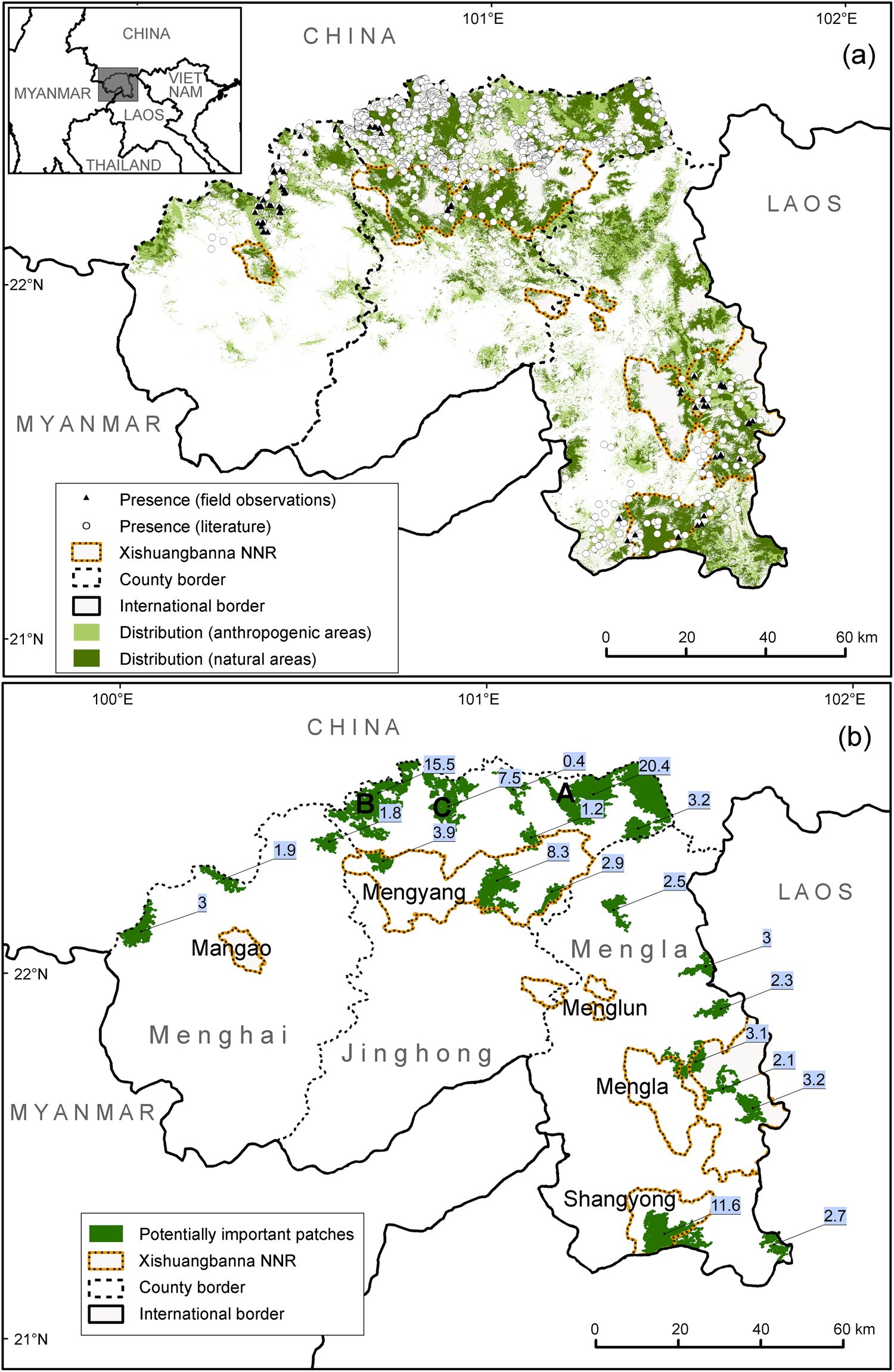
Our study area is located in Xishuangbanna, Yunnan Province, south-west China (Fig. 1). Xishuangbanna is one of the most biodiverse regions in China. It has two dry seasons (dry-cool season: November–February; dry-hot season: March–April) and a rainy/wet season (May–October; Zhang & Cao, Reference Zhang and Cao1995). Xishuangbanna National Nature Reserve was established with the aim of conserving elephants and the associated tropical ecosystem, and includes five geographically distinct sub-reserves: Mangao, Menglun, Mengyang, Mengla and Shangyong (Fig. 1). Economic development and the ensuing land transformation from traditional agriculture to rubber and tea plantations have led to severe deforestation and fragmentation of the landscape in Xishuangbanna since the 1980s (Liu et al., Reference Liu, Yin, Liu, Cheng, Yang and Li2017b).
(a) Presence points from field observations and the literature, and predicted distribution ranges of the Asian elephant Elephas maximus in Xishuangbanna Dai Autonomous Prefecture, south-west China. (b) Potentially important habitat patches for Asian elephants identified during this study. For each patch, the per cent of the total dietary plant biomass for Asian elephants in Xishuangbanna is shown. A, B and C represent the three key habitat patches. The names of the sub-reserves of Xishuangbanna National Nature Reserve (NNR) are given in black font on the map, and county names in grey font.
Methods
To model the potential distribution of Asian elephants in Xishuangbanna, a research team led by one of the authors (Q-YW) from the Research Institute of the Nature Reserve first collected data on the presence of Asian elephants. The research team recorded dung piles and footprints along 21 randomly selected transect lines (of varying lengths as dictated by the survey area; range 2–20 km), both inside and outside the Reserve, during March–June 2017. Each transect line was surveyed only once. In addition, we also obtained presence data from publications documenting elephant location data collected during 2003–2017. We searched the Web of Science (Clarivate, Philadelphia, USA) using the keywords ‘Asian elephant’, ‘Asian elephants’, ‘elephant’ or ‘elephants’ and ‘China’ in both English and Chinese and obtained eight references containing presence point data of Asian elephants in Xishuangbanna (Lin et al., Reference Lin, Zhang, Luo, Wang and Zhang2011; Yang & Zhang, Reference Yang and Zhang2012; He et al., Reference He, Wu, Xu, Guo, Zhu, Hong, Bogaert and Min2014; Chen et al., Reference Chen, Marino, Chen, Tao, Sullivan, Shi and Macdonald2016b; Li et al., Reference Li, Liu, Guo, Wang, Wang and Yu2018; Wang et al., Reference Wang, Chen and Shi2018; Huang et al., Reference Huang, Li, Hu and Jiang2019a,Reference Huang, Li, Khanal and Jiangb). However, because in two of these references (Chen et al., Reference Chen, Marino, Chen, Tao, Sullivan, Shi and Macdonald2016b; Li et al., Reference Li, Liu, Guo, Wang, Wang and Yu2018) presence points were given as the location of the home villages of people who had reported elephants, rather than actual presence points of elephants, we did not include these references in our analysis. We also removed duplicates of presence points (i.e. those included in more than one reference) from further analysis.
We used the maximum entropy model to predict the potential distribution of elephants in Xishuangbanna. To minimize spatial autocorrelation, we overlaid a 1 × 1 km grid onto the study area and retained a single randomly selected presence point in cells that contained multiple points. The predictive variables included in the models were land cover, aspect, elevation, slope, distance to nearest water source, distance to nearest road, distance to the nearest Reserve boundary (for presence points outside the Reserve only; this was set to zero for presence points inside the Reserve), and kernel distribution of settlements. Land-cover data were provided by the Research Institute of the Reserve; they originated from Landsat 8 Operational Land Imager images from February 2014 and comprised 19 land-cover categories (Supplementary Table 1, Supplementary Fig. 1). The overall accuracy of the classification was 86.3%. Land cover changed less after 2014 than before that year; therefore, the 2014 classification is a fair representation of the land cover for 2010–2021 (Zhang et al., Reference Zhang, Corlett and Zhai2019). We tested for multi-collinearity using the psych package (Revelle, Reference Revelle2019) in R 3.4.1 (R Core Team, Reference R Core Team2013) to determine whether the variables were highly correlated (|r| > 0.7). We found no multi-collinearity between the variables. We used the K-fold of five groups to subset the data for model training and model testing. To minimize uneven sampling effort, we manipulated the sampling effort by adding a species bias file when running the maximum entropy model (Kramer-Schadt et al., Reference Kramer-Schadt, Niedballa, Pilgrim, Schröder, Lindenborn and Reinfelder2013), where the bias file represented the record density and was created using the ENMeval package (Kass et al., Reference Kass, Muscarella, Galante, Bohl, Pinilla-Buitrago and Boria2021) in R. We then performed maximum entropy modelling in R, using the dismo package (Hijmans et al., Reference Hijmans, Phillips, Leathwick and Elith2017). We used the area under the receiver operating characteristics curve to assess model performance. In dismo, we applied spec_sens as a threshold to define the potential distribution range of Asian elephants, at which the sum of sensitivity (true-positive rate) and specificity (true-negative rate) is the highest (Liu et al., Reference Liu, White and Newell2013).
We then identified important habitat patches for Asian elephants in Xishuangbanna based on the predicted elephant distribution. We used the FragPatch algorithm (Kilheffer & Underwood, Reference Kilheffer and Underwood2018) to delineate key patches, for which we set the spur (minimum width of habitat patch) and gap (maximum width of non-habitat between habitat patches) threshold at 100–300 m, with 50-m intervals. We selected 100 m as the minimum value according to the typical flight response distance of the Asian elephant (derived from the experience of Q-YW), and 300 m as the maximum value in case no patch was identified by the FragPatch algorithm. We retained those patches that scored 10 in the FragPatch analysis as important habitat patches and excluded patches < 25 km2.
To determine the available food biomass for Asian elephants, we first compiled an inventory of the species’ dietary plants (Supplementary Table 2) from the literature (45 plant species; Chen et al., Reference Chen, Deng, Zhang and Bai2006) and field observations (110 plant species). We applied random sampling to survey the dietary plant biomass of Asian elephants in 10 land-cover types, excluding six anthropogenic land-cover types (urbanized area, cropland, tea plantation, rubber plantation, orchard and other tree plantation) and three land-cover types that were not suitable for Asian elephants or were too small (limestone monsoon forest, mossy evergreen broad-leaved forest and savannah shrub grassland; Supplementary Table 1). We also excluded water as a land-cover type. We combined warm bamboo forest with hot bamboo forest in the dietary plant biomass survey, as bamboo forest. For non-tree dietary plant species, we chose 900 m2 quadrats (30 × 30 m), within which we established five 9 m2 sample plots (3 × 3 m) at each corner and at the centre of each quadrat (95 samples in total; see Supplementary Table 3 for sample size details). We weighed the edible portions of fresh dietary plants in the sample plots. When weighing the edible portions of tree species, we eliminated trees with a height > 10 m or diameter at breast height > 15 cm, because elephants usually do not select such large trees when foraging (Feng & Zhang, Reference Feng and Zhang2005). Based on field observations and the experience of one of the authors (Q-YW), we weighed all edible parts of these tree species, such as the roots or leaves. We took all measurements during February 2016–November 2017.
As the amount of food available in the dry season limits the Asian elephant population in Xishuangbanna (Zhang et al., Reference Zhang, Wang, Wang and Ma2003), we used dry season biomass when estimating the dietary plant biomass for elephants in the study area. However, we collected some of our samples in the wet season. Because the activity range of Asian elephants in search of food can be twice as large in the dry compared to the wet season (Zhang et al., Reference Zhang, Wang, Wang and Ma2003), we divided the dietary plant biomass obtained in the wet season by two to represent the food biomass in dry season. For tree species, we applied linear regression in R using paired diameter at breast height and weight data collected in the dry season to estimate the dietary plant biomass of the tree species sampled in each quadrat. To calculate the food biomass of each land-cover type, we added the total weight of both non-tree and tree species and then averaged this value across the number of samples of each land-cover type. We then calculated the total dietary plant biomass in the proposed protected areas by multiplying the area of each land-cover type in each proposed protected area by our estimate of the food plant biomass in that land-cover type. We then calculated the per cent of dietary plant biomass in each potential protected area to determine its conservation priority.
Results
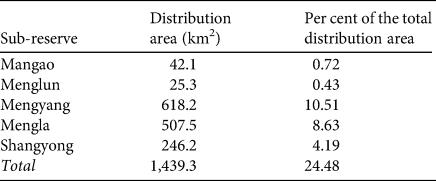
In total we obtained 1,004 presence points of Asian elephants inside and outside the Reserve (Fig. 1a). Our model generated a reliable predicted potential distribution range of Asian elephants, with the area under the receiver operating characteristics curve equal to 0.795. The spec_sens threshold value was 0.521; we defined cells with a value higher than this as part of the potential Asian elephant distribution range. The Xishuangbanna National Nature Reserve included 24.5% of the potential Asian elephant distribution range, and 75.5% of the potential distribution range was outside the Reserve (Table 1).
Predicted distribution ranges of the Asian elephant Elephas maximus inside the sub-reserves of Xishuangbanna National Nature Reserve, south-west China (Fig. 1).
Distance to the Reserve contributed the most to our model (33.3%), followed by land-cover type (22.6%), distance to the nearest road (12.7%) and elevation (11.9%). Kernel distribution of settlements contributed 8.5%, slope 7.1%, distance to nearest water source 3.0% and aspect 0.8% to the model. Of the 19 land-cover types in Xishuangbanna, monsoon evergreen broad-leaved forest occupied the largest area (6,996 km2, 36.6% of Xishuangbanna), followed by rubber plantation (4,834 km2, 25.3%) and cropland (2,215 km2, 11.6%). Amongst natural habitats, the distribution probability of Asian elephants was the highest in warm–hot coniferous forest and shrub; in anthropogenic landscapes, it was highest in cropland, tea plantations and other tree plantations.
During our fieldwork, we recorded 110 plant species that Asian elephants consume in Xishuangbanna (Supplementary Table 2). These belong to 42 families, amongst which Gramineae (21 species), Moraceae (11 species) and Zingiberaceae (10 species) comprised 38% of the dietary plant species. Shrub, which represents secondary regrowth after clearance, had the highest biomass of dietary plants per area (0.63 kg/m2), followed by montane rainforest (0.29 kg/m2), seasonal rainforest (0.15 kg/m2), monsoon evergreen broad-leaved forest (0.15 kg/m2), deciduous monsoon forest (0.15 kg/m2) and warm deciduous broad-leaved forest (0.14 kg/m2).
The results of the FragPatch analysis showed that three key habitat patches with high proportions of estimated dietary plant biomass fell outside the Nature Reserve (Fig. 1b). Patch A (320.1 km2) contained 20.4% of the total dietary plant biomass for elephants in Xishuangbanna, Patch B (199.7 km2) contained 15.5% and Patch C (121.9 km2) contained 7.5%. Mengyang sub-reserve had a large predicted elephant distribution range (618.2 km2) but the patches in this sub-reserve only contained 15.0% of the dietary plant biomass for Asian elephants in Xishuangbanna. Shangyong sub-reserve had a predicted elephant distribution range of 246.2 km2 and the habitat patches in this sub-reserve contained 11.6% of the dietary plant biomass (Table 1, Fig. 1b).
Discussion
Our results demonstrate the dynamic nature of socio-ecological systems and the importance of updating knowledge for effective conservation. We evaluated ongoing changes in the geographical distribution of a flagship species in relation to the boundaries of a protected area established half a century ago. According to our distribution model, 75.5% of the potential distribution range of Asian elephants in Xishuangbanna fell outside Xishuangbanna National Nature Reserve, and the available dietary plant biomass inside the Reserve was considerably less than outside. As one of the primary aims of the Reserve was to protect Asian elephants (Yunnan Forestry and Grassland Administration, Reference Yunnan Forestry and Grassland Administration2016), the mismatch between the location of the Reserve and the Asian elephant distribution range illustrates that the current protected area is no longer sufficient to support the Asian elephant population in Xishuangbanna, as is the case for other protected areas throughout the species’ range (Leimgruber et al., Reference Leimgruber, Gagnon, Wemmer, Kelly, Songer and Selig2003; de la Torre et al., Reference de la Torre, Wong, Lechner, Zulaikha, Zawawi and Abdul-Patah2021; Fernando et al., Reference Fernando, De Silva, Jayasinghe, Janaka and Pastorini2021).
Some research suggests that landscape changes inside the Reserve could be driving elephants to areas outside its boundaries (Wang et al., Reference Wang, Tao, Li, Dong, Yan and Yang2017). However, our findings demonstrate that distance to the Reserve contributed the most (having a negative effect) to the species distribution model, with a higher distribution probability of Asian elephants nearer the Reserve. This suggests that the current Reserve still functions as a refuge for Asian elephants. The Reserve has played an important role in protecting Asian elephants since its establishment, which could be one of the reasons for the increasing Asian elephant population in China. However, given the increasing population of Asian elephants (Wang et al., Reference Wang, Tao, Li, Dong, Yan and Yang2017), their range expansion outside the Reserve (Campos-Arceiz et al., Reference Campos-Arceiz, de la Torre, Wei, Wu, Zhu and Zhao2021) and the highly fragmented habitats in Xishuangbanna (Liu et al., Reference Liu, Wen, Harich, He, Wang and Guo2017a,Reference Liu, Yin, Liu, Cheng, Yang and Lib), it is time to consider expanding the current protected area coverage to connect the currently separated subpopulations of Asian elephants.
The three key habitat patches identified in this study are vital for preserving the habitat and natural food resources for Asian elephants. These habitat patches are food-rich, containing 43.3% of the total dietary plant biomass in the important habitat patches in Xishuangbanna. Overall, our study is consistent with previous research on the habitat preferences of Asian elephants in China (Zhang et al., Reference Zhang, Dong, Lin, Feng, Yan and Wang2015; Huang et al., Reference Huang, Li, Hu and Jiang2019a,Reference Huang, Li, Khanal and Jiangb), and we detected key habitat patches based not only on habitat suitability modelling but also on the availability of dietary plants. Integrating suitable habitats outside the Reserve into a protected areas network could reduce the intensity of intraspecific competition amongst Asian elephants. As a new Asian elephant national park is now under consideration, we hope that this study can contribute to the design and management of this future park, with the key habitat patches being protected through their incorporation into the national park as core areas. Shangyong sub-reserve contained 11.6% of the total dietary plant biomass in the important habitat patches identified in Xishuangbanna, and this area is adjacent to Laos, supporting the transboundary movements of Asian elephants (Lv et al., Reference Lv, Zheng, Zhu, Tang, Jiang, Li and Chen2019). We therefore suggest that Sino–Laos cooperation should be promoted to achieve effective transboundary conservation of Asian elephants (Wang et al., Reference Wang, Yang, Bai, Lu, Corlett and Tan2021).
There are several limitations to our study. Firstly, it is challenging to estimate dietary plant biomass for species with a diverse diet, such as the Asian elephant. Taking into consideration the relative food preferences of Asian elephants could make such an estimate more robust, but such information is not available. Our study included as many local dietary plant species of Asian elephants as possible, to improve the accuracy of the estimated availability of natural food resources for the species in the region. Secondly, given that dietary plant weight can change considerably between the dry and rainy seasons, simply dividing the weight of samples obtained in the rainy season by two (as described in the Methods section) is not ideal for estimating dietary plant biomass. Future research should obtain data on the weight of dietary plants in the dry season, to accurately calculate dietary plant biomass for Asian elephants. Finally, because of time limitations, the samples of dietary plant biomass for each land-cover type in our study may have been insufficient to generate robust results, which must be considered when interpreting our results. However, based on our findings, protecting the areas identified as important habitat patches could help save the last refuges for Asian elephants in Xishuangbanna, mitigating the effects of the rapid land conversion that has occurred over the last decade (Liu et al., Reference Liu, Wen, Harich, He, Wang and Guo2017a,Reference Liu, Yin, Liu, Cheng, Yang and Lib).
Our distribution model predicted Asian elephants to occur in both natural and human-made land-cover types, reflecting the fact that Asian elephants in Xishuangbanna are able to occupy highly human-dominated landscapes and consume crops as part of their food resources, which has caused damage to local communities (Chen et al., Reference Chen, Marino, Chen, Tao, Sullivan, Shi and Macdonald2016b). With the increasing population of Asian elephants and expansion of their range, it is predicted that conflict between people and elephants will escalate unless effective management strategies are implemented that keep people safe from Asian elephants (Campos-Arceiz et al., Reference Campos-Arceiz, de la Torre, Wei, Wu, Zhu and Zhao2021). Expanding protected areas plays an important role in preserving habitat for this growing Asian elephant population. Simultaneously, human–elephant conflict mitigation (e.g. insurance compensation, elephant-proof fences, early-warning systems) needs to be improved to help ensure the safety and protect the livelihoods of local communities (Chen et al., Reference Chen, Yi, Campos-Arceiz, Chen and Webb2013, Reference Chen, Marino, Chen, Tao, Sullivan, Shi and Macdonald2016b).
Similar attention needs to be paid to the nature reserves established for other flagship species in China. There are 428 national nature reserves in China, of which 299 were established before 2000 and 67 have a particular focus on wild fauna conservation (Zhu et al., Reference Zhu, Huang, Xiao and Wang2018). Some of these nature reserves serve as refuges for protected animal species. These animal populations could thus increase and some are likely to reach the carrying capacity of the reserves, leading to their geographical expansion outside protected areas. However, some of the established nature reserves are affected by human disturbance or climate change (Liu et al., Reference Liu, Linderman, Ouyang, An, Yang and Zhang2001). In response to the changing environment, some flagship animals could move outside of the nature reserves; this applies especially to mammals and birds, which are often highly sensitive to habitat quality and deterioration (Xu et al., Reference Xu, Xiao, Zhang, Yang, Zhang and Hull2017). In such cases, immobile protected areas may no longer be sufficient to maintain the populations of the target animals. Animal movements away from protected areas demonstrate the need to adjust management strategies to ensure efficient conservation.
In conclusion, as most of the protected areas in China were established more than 20 years ago, our study highlights the importance of assessing the conservation effectiveness of protected areas over time and adjusting management policies as necessary, particularly if target animals move away from protected areas. This is applicable not only to the Asian elephant but also to the conservation of other flagship species whose distributions are sensitive to environmental changes and whose habitats are being transformed rapidly under pressures from social and economic development.
Acknowledgements
We thank the staff from the Research Institute of Xishuangbanna National Nature Reserve, its sub-reserves, Mengwang Forestry Station and Menge Forestry Station for their support; and R. Corlett, L. Wang, H. Li, M. Zhang, C. Huang and F. Commercon for their advice on writing the article. This work was supported by the Transboundary Cooperation on Biodiversity Research and Conservation in Gaoligong Mountains (No. E1ZK251), the Major Science and Technique Programs in Yunnan Province (202102AA310055), the Biodiversity Investigation, Observation and Assessment Program (2019–2023) of the Ministry of Ecology and Environment of China (grant number: 8-2-3-4-5), the CAS 135 Program (grant number: 2017 XTBG-F03), the Forestry National Nature Reserves subsidy (2015) and the Asian Elephant Conservation Project in Xishuangbanna (2016).
Author contributions
Study design: L-LL, Q-YW, R-CQ; fieldwork: Q-YW, H-PY, Y-XT, L-XW, Z-BY; data analysis and writing: L-LL, AC-A, R-CQ.
Conflicts of interest
None.
Ethical standards
This research abided by the Oryx guidelines on ethical standards.


 Open access

