





Introduction
The popularity of keeping reptiles as pets and in zoological collections has undergone a significant increase in recent decades worldwide. This trend encompasses a diversification of the species kept and a substantial rise in the number of individual reptiles housed in a captive environment (Robinson et al. Reference Robinson, Griffiths, John and Roberts2015; Auliya et al. Reference Auliya, Altherr, Ariano-Sanchez, Baard, Brown, Brown, Cantu, Gentile, Gildenhuys and Henningheim2016). While this growing interest reflects a fascination with herpetofauna, it also presents unique challenges related to animal husbandry and health management.
In captivity, reptiles are often exposed to environmental conditions that differ considerably from their natural habitats. These artificial settings can, therefore, impose a variety of non-natural stressors, such as spatially restricted enclosures, elevated population densities, frequent human interaction during maintenance and handling, and the potential for compromised hygiene protocols (Pasmans et al. Reference Pasmans, Bogaerts, Braeckman, Cunningham, Hellebuyck, Griffiths, Sparreboom, Schmidt and Martel2017; Azevedo et al. Reference Azevedo, Guimarães, Ferraz, Whiting and Magalhães-Sant’Ana2021). The cumulative effect of these stressors may significantly impact the physiological well-being of captive reptiles, increasing their susceptibility to various health problems. Among these, infectious diseases constitute a significant concern, particularly parasitic infections, which represent a highly prevalent category (Walden et al. Reference Walden, Greiner, Jacobson, Jacobson and Garner2020). The proximity of reptile individuals within enclosures can facilitate the transmission of both ecto- and endoparasites, leading to morbidity and, in severe cases, mortality (McAllister et al. Reference McAllister, Upton, Jacobson and Kopit1995; Modrý and Koudela Reference Modrý and Koudela1995; Sloboda and Modrý Reference Sloboda and Modrý2006). Therefore, effective parasite management is paramount for maintaining captive reptile populations’ health and welfare.
Endoparasites encompass diverse taxa, each with its own life cycle and pathogenic potential (Walden et al. Reference Walden, Greiner, Jacobson, Jacobson and Garner2020). Within this group, coccidia (Apicomplexa: Eimeriidae) are frequently identified as common enteric parasites in captive reptiles (Wolf et al. Reference Wolf, Vrhovec, Failing, Rossier, Hermosilla and Pantchev2014; Schmidt-Ukaj et al. Reference Schmidt-Ukaj, Hochleithner, Richter, Hochleithner, Brandstetter and Knotek2017; Šlapeta et al. Reference Šlapeta, Modrý, Johnson, Doneley, Monks, Johnson and Carmel2017; Walden et al. Reference Walden, Greiner, Jacobson, Jacobson and Garner2020). These obligate intracellular protists undergo direct life cycles, often involving the shedding of environmentally resistant oocysts in the host’s faeces, which can contaminate the environment and lead to further infections through ingestion. Specific genera and species of coccidia are recognized for their high pathogenicity (Modrý and Koudela Reference Modrý and Koudela1995; Sloboda and Modrý Reference Sloboda and Modrý2006; Roberts et al. Reference Roberts, Janovy and Nadler2013; Szczepaniak et al. Reference Szczepaniak, Tomczuk, Lojszczyk-Szczepaniak and Lopuszynski2016; Walden and Mitchell Reference Walden and Mitchell2021), capable of causing significant intestinal damage, malabsorption of nutrients, dehydration, and ultimately, increased susceptibility to secondary infections. Furthermore, the prevalence of specific coccidian species can be notably high in captive reptiles, potentially due to the confined living conditions and opportunities for faecal-oral transmission (Hallinger et al. Reference Hallinger, Taubert, Hermosilla and Mutschmann2019).
Coccidia are frequently identified in various reptile taxa, particularly in bearded dragons (Pogona spp.). The most common coccidian genera in these lizards include Isospora and Choleoeimeria, with Isospora amphiboluri and Choleoeimeria pogonae being frequently reported species (Papini et al. Reference Papini, Manetti and Mancianti2011; Stöhr et al. Reference Stöhr, Globokar-Vrhovec and Pantchev2020; Duszynski Reference Duszynski2021; Guardone et al. Reference Guardone, Marigliano, Mancianti and Perrucci2024). These parasites primarily inhabit the gastrointestinal tract and can cause significant morbidity (Hallinger et al. Reference Hallinger, Taubert, Hermosilla and Mutschmann2019). Given the potentially severe consequences of coccidial infections for the health and longevity of captive reptiles, a comprehensive understanding of their transmission modes and identifying potential risk factors are essential for developing effective preventative and control strategies. While direct faecal-oral transmission between reptile hosts is a well-established route (Chinnadurai and DeVoe Reference Chinnadurai, DeVoe, D and Brandao2009), indirect transmission may also play a significant role (Walden et al. Reference Walden, Greiner, Jacobson, Jacobson and Garner2020) and warrant detailed investigation. One such potential route involves live feeder insects, a common dietary item for many omnivorous, insectivorous and carnivorous reptile species in captivity. Feeding these insects in large numbers creates a significant risk of contact with coccidian oocysts in their environment. Consequently, unattended insects could consume infected faecal material and act as passive mechanical vectors, facilitating the parasite’s spread.
Therefore, this study aims to address a critical knowledge gap using the experimental evaluation of the capacity of three commonly fed insect taxa – the Argentine cockroach (Blaptica dubia), the banana cricket (Gryllus assimilis), and the larval stage of the superworm (Zophobas morio) – to act as mechanical vectors for monoxenous coccidia. Specifically, we sought to determine whether the oocysts of these parasites can survive passage through the digestive tract of these insects, thereby posing a potential risk of transmission to reptiles upon ingesting the contaminated feeder insects. The findings of this research contribute to the knowledge on the possible role of feeder insects in the epidemiology of coccidial infections in captive reptiles and to the development of enhanced biosecurity measures in reptile husbandry.
Materials and methods
Collection of coccidia-positive samples for experimental infection
Coccidia-positive faecal samples were collected from a small household breeding group of three bearded dragons (Pogona vitticeps) with a confirmed coccidial infection. Samples were collected into 50 mL tubes containing a 4% (w/v) potassium dichromate preservation solution (K2Cr2O7) as soon as possible after defecation and stored at 4°C for a maximum of two weeks before processing. Before use in the experimental inoculation, faecal samples were cleaned by centrifugation: the faeces were placed in a centrifuge tube, brought to a total volume of 12 mL with tap water, and centrifuged at 1540× g for 10 minutes. This procedure was repeated two to three times to ensure complete removal of the K2Cr2O7.
Determination of coccidian species from faecal samples
Species identification of coccidia in the collected samples was performed using morphological and molecular approaches. Morphological determination of the coccidian species was based on comparisons with previous descriptions of coccidia identified in members of the family Agamidae (Supplementary Table 1). Oocysts were morphologically and morphometrically analysed using light microscopy (Olympus BX53 microscope) at 10 × 40 magnification, equipped with a DP-73-1-51 high-resolution, cooled digital camera, and Olympus cellSens Standard 1.13 imaging software (Olympus, Tokyo, Japan).
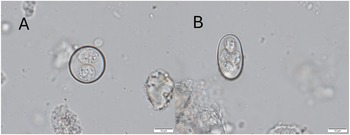
Two distinct species of coccidia were microscopically identified in faecal samples of the bearded dragons (Figure 1): I. amphiboluri and C. pogonae. The species identity was further verified by Sanger sequencing of the partial 18S rDNA and COI genes (for detailed methodology, see Trefancová et al. Reference Trefancová, Kvičerová, Mácová, Stanko, Hofmannová and Hypša2021).
Reptilian coccidia of morphotypes Isospora (A) and Eimeria (B) (photo: Jakub Žahourek).

Quantification of oocysts in the faecal samples
The number of oocysts in the samples was determined using the oocysts per gram (OPG) method by counting in a standard haematological Bürker counting chamber (Kváč et al. Reference Kváč, Ondráčková, Květoňová, Sak and Vítovec2007). Centrifuged faecal samples were weighed in grams to two decimal places. One mL of phosphate-buffered saline (PBS) solution was added to 1 g of the sample. The mixed suspension of the sample and buffer was loaded onto the Bürker chamber’s counting surface using a Pasteur pipette. Coccidian oocysts were counted under a light microscope at a magnification of 200× in a total of 50 small squares (25 consecutive small squares in each of the two counting grids of the chamber). According to Bürker’s rule, all oocysts lying on or touching a square’s lower or left side were counted, while those lying on or touching the upper or right side were excluded (Gunetti et al. Reference Gunetti, Castiglia, Rustichelli, Mareschi, Sanavio, Muraro, Signorino, Castello, Ferrero and Fagioli2012; Kudlová Reference Kudlová, Bj, Das, Drábek, Džubák, Hajdúch, Koberna, Ligasová, Mistrík, Bautista de Sanctis and Srovnal2021). The OPG was then calculated using the following formula:
 \begin{equation*}OPG = \frac{N}{X}df\,cf\end{equation*}
where OPG = number of coccidian oocysts per gram of faeces; N = average number of coccidian oocysts per small square; X = weight of faeces in grams; df = dilution factor (here, multiplied by 2); cf = coefficient converting volume of the small square (surface: 0·0025 mm2 and depth: 0·1 mm) per 1 mL (here multiplied by 2500).
Experimental inoculation of feeder insects
The cleaned faecal sample, for which OPG had been determined, was again weighed and mixed with fruit purée in a 1:1 ratio, which served as an attractant to enhance sample ingestion. The mixture was then offered to the fasted experimental insects. Commonly available feeder insect species from commercial breeding facilities were used for the experiment. The adults of Argentine cockroach (B. dubia) represented the order Blattodea (cockroaches), the adults of banana cricket (G. assimilis) were selected from the order Orthoptera (grasshoppers, crickets, locusts and allies), and the large larval stage of the superworm (Z. morio) represented the order Coleoptera (beetles). To ensure the absence of coccidia, three individuals of each feeder insect species were randomly selected and examined prior to the experiment, using the procedure described above.
Before sample administration, the insects were deprived of food and water for five days to ensure complete gut evacuation. Subsequently, five individuals of each insect species were moved into individual plastic test boxes (10 cm in diameter, 7 cm in height). These boxes contained fruit purée mixed with a faecal sample, which was supplied ad libitum for two days. A pilot study, using dissection, had previously established that this duration was enough to fully fill the insects’ digestive systems.
Dissection of feeder insects
After offering the parasite infected puree, the insects in each of the five experimental boxes were euthanized with ethanol, and a suspension was prepared from their intestines (posterior half of the midgut and colon). Intestinal material was weighed and centrifuged for 10 minutes at 1540× g. After the supernatant was discarded, the sediment was resuspended in 1 mL of PBS solution per gram of sample, and the OPG was then determined in this suspension as explained above. The OPG in the insect’s intestine was quantified by analysing three subsamples from each individual. Subsequently, the passage rate was calculated as the proportion of the insect’s intestinal OPG, expressed as a percentage, with the bearded dragon’s faecal OPG as the 100% reference point.
Statistical analysis
We tested the differences in passage rates of specific parasites among feeder insects (independent variable) using a Kruskal–Wallis test followed by non-parametric post-hoc comparisons. The analyses were performed in Statistica 14.0 and visualized in SigmaPlot 14.0.
Results
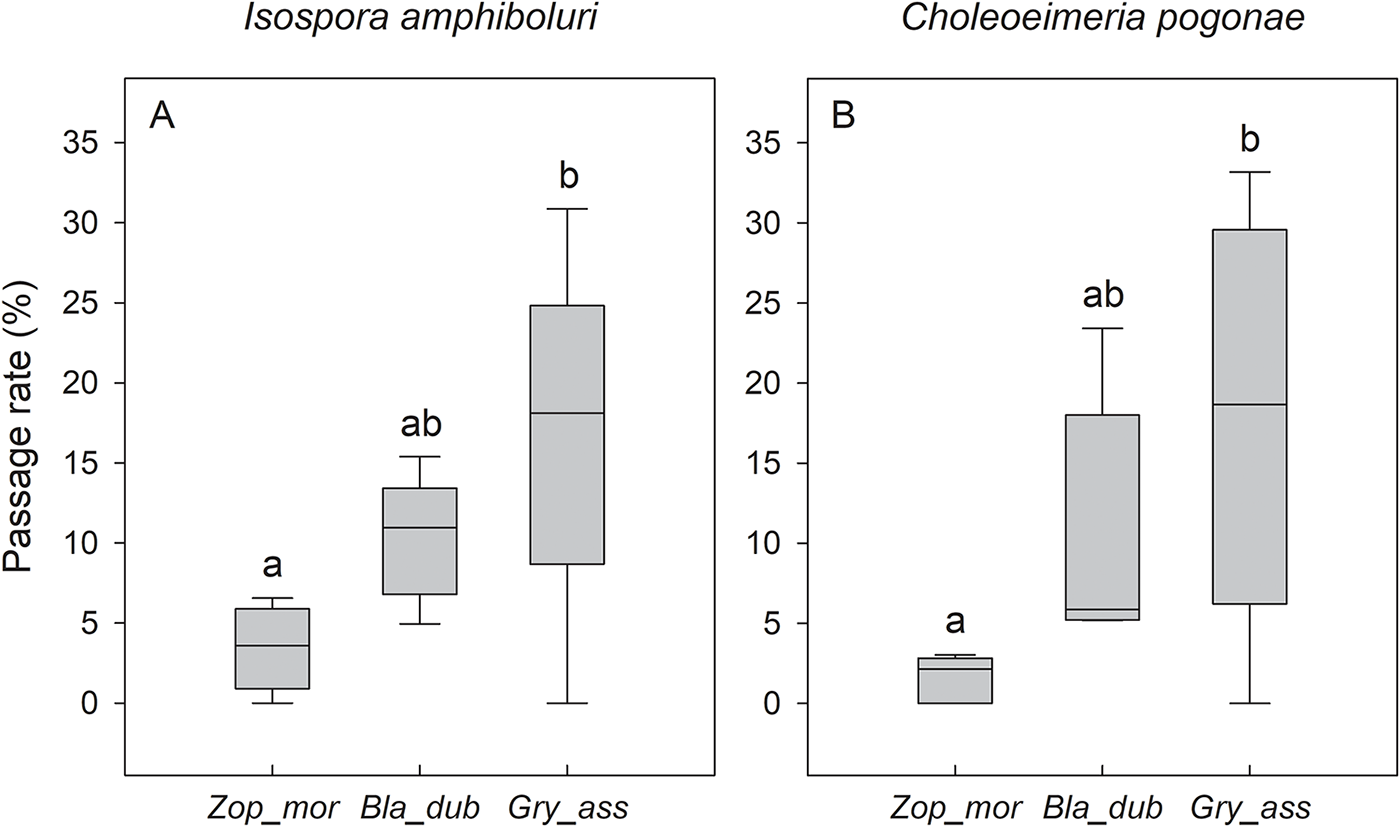
The experimental results confirmed the capacity of B. dubia, G. assimilis and Z. morio to pass viable oocysts of coccidia of the genera Isospora and Choleoeimeria through their gastrointestinal tracts. The highest passage rates for both coccidian species were observed in the digestive tract of the cricket G. assimilis, with an average passage of 18% (IQR: 17–19%) for I. amphiboluri and 19% (IQR: 12–26%) for C. pogonae. The cockroach species B. dubia exhibited an intermediate level of coccidian passage, with an average of 11% (IQR: 9–11%) and 6% (IQR: 5–13%) for I. amphiboluri and C. pogonae, respectively. The lowest passage rates of coccidian oocysts were detected in the larval stage of the beetle Z. morio, with an average passage of 4% (IQR: 2–5%) for I. amphiboluri and only 2% (IQR: 0–3%) for C. pogonae (Figure 2).
Passage rate (%) of Isospora amphiboluri (A) and Choleoeimeria pogonae (B) in different species of feeder insects: Zophobas morio (Zop_mor), Blaptica dubia (Bla_dub) and Gryllus assimilis (Gry_ass). Boxplot: median ± quartiles and 10th–90th percentiles are shown.
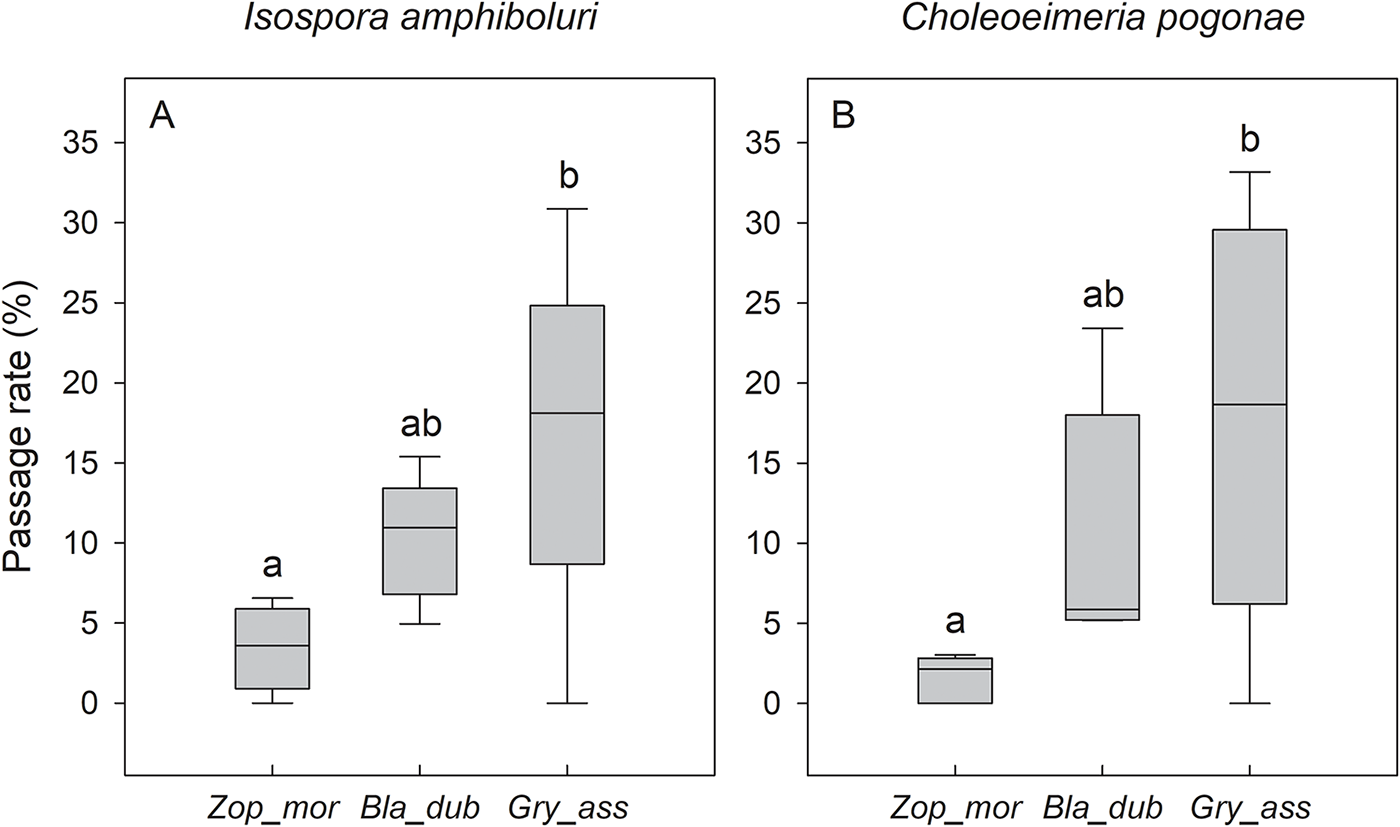
From a statistical standpoint, the passage of both coccidian species I. amphiboluri and C. pogonae differed significantly among the insect species tested (H = 6·15, p = 0·046 and H = 6·79, p = 0·034, respectively). Post-hoc analysis revealed specific, significant variations in transmission rates between the groups. For I. amphiboluri, the passage rate was significantly higher in G. assimilis than in Z. morio (p = 0·049) (Figure 2A). For C. pogonae, the passage rate was also significantly higher in G. assimilis when compared to Z. morio (p = 0·049) (Figure 2B).
Discussion
Morphological analysis of faecal samples of bearded dragons revealed two distinct coccidia, identified as I. amphiboluri and C. pogonae. These two species are commonly found in bearded dragons (Schmidt-Ukaj et al. Reference Schmidt-Ukaj, Hochleithner, Richter, Hochleithner, Brandstetter and Knotek2017; Guardone et al. Reference Guardone, Marigliano, Mancianti and Perrucci2024), and both are potentially pathogenic to them. Infection with I. amphiboluri can harm the intestinal mucosa, potentially leading to decreased absorption of nutrients and fluids, and, consequently, diarrhoea (Kim et al. Reference Kim, Mitchell, Bauer, Poston and Cho2002; Walden and Mitchell Reference Walden and Mitchell2021). Although often asymptomatic in adult bearded dragons, this parasite can cause severe illness and death in juveniles, possibly due to ongoing reinfection if its oocysts persist in the environment (Walden and Mitchell Reference Walden and Mitchell2021). Likewise, infection with Choleoeimeria in bearded dragons has been linked to emaciation and dehydration (Szczepaniak et al. Reference Szczepaniak, Tomczuk, Lojszczyk-Szczepaniak and Lopuszynski2016). Severe infections with Choleoeimeria can result in gallbladder enlargement, localized thickening of the gallbladder wall, the formation of small gallstones and/or debris, blockage of the bile ducts, and, ultimately, death (Stöhr et al. Reference Stöhr, Globokar-Vrhovec and Pantchev2020). Therefore, increased husbandry hygiene and a strict feeding protocol are highly desirable in these cases. The potential for oocyst transmission via feeder insects is also a significant consideration.
Our experiments revealed that three distinct feeder insect species could transmit viable oocysts of both coccidian genera, exhibiting notable variations in their passage rates. Specifically, G. assimilis exhibited higher passage of both I. amphiboluri and C. pogonae than Z. morio. On the other side, B. dubia had a similar passage rate to the other feeder insect species for both parasites.
Given the very limited passage of oocysts through their digestive systems, feeding terrarium animals with Z. morio larvae might pose the lowest risk of coccidial infection. Factors influencing such a low passage rate could include their highly efficient digestion and gut microbiota, which some studies suggest enable them to break down materials like polystyrene and other commercial plastics (Yang et al. Reference Yang, Wang and Xia2020; Pham et al. Reference Pham, Longing and Siebecker2023; Sun et al. Reference Sun, Wang, Wang, Zhao, Shi, Wang, Han, Zhao and Liu2025). Consequently, their digestive processes and feeding habits might disrupt the oocyst structure, damaging the oocyst wall, which is crucial for survival outside a host (Mai et al. Reference Mai, Sharman, Walker, Katrib, Souza, McConville, Wallach, Belli, Ferguson and Smith2009). However, coccidian oocyst passage rates likely vary among different species of tenebrionid beetles. For example, Dunford and Kaufman (Reference Dunford and Kaufman2006) observed the transmission of several pathogens, including coccidia of the genus Eimeria, by the lesser mealworm (Alphitobius diaperinus) in poultry houses, where this specific beetle is considered a pest.
The role of cockroaches in parasite transmission is well-documented (Tatfeng et al. Reference Tatfeng, Usuanlele, Orukpe, Digban, Okodua, Oviasogie and Turay2005; Alzain Reference Alzain2013; Oyeyemi et al. Reference Oyeyemi, Agbaje and Okelue2016). Jarujareet et al. (Reference Jarujareet, Kobayashi, Taira and Ooi2019) further demonstrated the capacity of American cockroaches (Periplaneta americana) in commercial chicken farms to harbor and transmit oocysts of highly pathogenic species Eimeria tenella over an extended period. Their study demonstrated that viable oocysts persisted in the cockroach gut for at least four days post-ingestion and remained infective even after excretion. In our results, the passage of both parasite species was higher than that of Z. morio, but this was not statistically proven. This might be attributed to the unexpectedly high variability in individual passage rates.
Gryllus assimilis was the species with the highest number of passaged oocysts among the three species studied; however, it was also the species with the highest variability of passage rate. Crickets are known carriers of coccidia (Rowe et al. Reference Rowe, López, Robinson, Baudier and Barrett2024) and are frequently identified as a source of coccidiosis in livestock (Day and Rowe Reference Day and Rowe2002; Szelei et al. Reference Szelei, Woodring, Goettel, Duke, Jousset, Liu, Zadori, Li, Styer and Boucias2011; Gałęcki and Sokół Reference Gałęcki and Sokół2019). Gałęcki and Sokół (Reference Gałęcki and Sokół2019) specifically attribute the presence of Isospora spp. in edible insects to poor hygiene standards on insect farms. Our findings suggest that these inadequate hygiene practices can also facilitate the further spread of infections through the digestive tract of crickets. However, the high variability in oocyst passaging ability would merit further research.
Intestinal transit time and the capacity for coccidian oocyst degradation may have significantly contributed to the observed differences. When focusing on the time required for food to reach the rectum, the relative digestive speeds among insects become apparent (due to the absence of precise digestion time data for the three species employed in this study, we used information from the most closely related species available). The lesser mealworm (A. diaperinus) exhibits slow overall passage to the end of the digestive tract, with mean transit times ranging from about 132 to 186 minutes and maximum times reaching up to 300 minutes (Zheng et al. Reference Zheng, Crippen, Sheffield, Poole, Yu and Tomberlin2012). Similarly, the German cockroach (Blattella germanica) needs around 300 minutes for food to reach its rectum after a 2-day starvation period (Day and Powning Reference Day and Powning1949). In contrast, the starved two-spotted cricket (Gryllus bimaculatus) shows the fastest transit, with food being digested in approximately 80 minutes (Woodring and Lorenz Reference Woodring and Lorenz2007). Thus, a higher passage time indicates a higher passage rate.
In conclusion, coccidiosis can be a serious health problem in intensively reared reptiles such as bearded dragons and chameleons. We confirmed the ability of all three species of feeder insects to pass viable oocysts of two coccidian species that are pathogenic in reptile breeding. For the first time, we demonstrated different passaging rates under the same conditions across all three insect species. The observed variations in oocyst passage may stem from differences in the ability of different insect species to harbour and shed parasitic stages. Regardless of the experiment limitations, the consistent finding of the highest percentage of passed oocysts in crickets underscores the critical importance of maintaining stringent hygiene protocols during feeding, particularly when using crickets as a primary food source for captive reptiles. This is not a reason to relax hygiene practices; it reinforces the need for increased awareness and preventative measures to minimize the risk of parasite transmission. Based on our results, we recommend feeding feeder insects more frequently and in smaller quantities. The key rule is to ensure feeding insects never consume droppings from infected captive reptiles. This ensures their rapid consumption while simultaneously prevents their contact with reptile faeces. For an adult bearded dragon, this can be approximately five crickets every other day.
Supplementary material
The supplementary material for this article can be found at https://doi.org/10.1017/S0031182025101005.
Acknowledgements
We gratefully acknowledge the University of South Bohemia in České Budějovice for providing the essential support and resources that made this study possible.
Author contributions
MB: supervision, data analysis, manuscript writing and editing, final reading; GT: doing an experiment, final reading; JŽ: doing an experiment, final reading; JK: manuscript writing and editing, final reading; IŠ: data analysis, manuscript writing and editing, graphical work, final reading.
Financial support
This work was supported by operating funds of the Faculty of Science, University of South Bohemia in České Budějovice.
Competing interests
The authors declare there are no conflicts of interest.
Ethical standards
Not applicable.


 Open access

