




Introduction
In June 2019, in response to a proposed amendment to the extradition law by the Hong Kong government, which would have allowed the transfer of suspected and convicted fugitives from Hong Kong to Mainland China, Hong Kong citizens mobilized waves of massive protests to oppose the government’s proposal. This was dubbed the Anti-Extradition Law Amendment Bill (Anti-ELAB) Movement. Due to various incidents that occurred during the movement, it became radicalized, shifting its focus from primarily opposing the extradition law amendment to becoming a comprehensive anti-authoritarian movement (Lee et al. Reference Lee, Yuen, Tang and Cheng2019). The movement lasted for half a year, but was forced to suspend its activities due to Covid-19 in early 2020. However, it was not completely demobilized until the state exerted severe repression by enacting the National Security Law (NSL) in late June 2020.
As the most violent and persistent protest movement since the transfer of sovereignty in 1997, the Anti-ELAB Movement has attracted significant scholarly attention. The people’s participation in and support for this radical movement were particularly intriguing, as Hong Kong’s political culture has traditionally favoured moderate protests (Ku Reference Ku2007). Research related to this movement covers various aspects, including its radicalization (Lee et al. Reference Lee, Cheng, Liang, Tang and Yuen2022), the coordination of various actions by protestors (Fu Reference Fu2023; Urman, Ho, and Katz Reference Urman, Ho and Katz2021), the mass participation it attracted from citizens across all sectors (Cheng et al. Reference Cheng, Francis, Yuen and Tang2022; Ma and Cheng Reference Ma and Cheng2023), and the sustainability of solidarity among protesters during the radicalization process (Lee Reference Lee2020; Tang and Cheng Reference Tang and Cheng2021).
However, despite Hong Kong being an advanced economy with notorious income inequality, the role of economic grievances in social mobilizations has not received adequate scholarly attention. In particular, the economic roots of mass protests, including the Anti-ELAB Movement, have been largely overlooked.
A review of the protesters’ profiles revealed that 78 percent had attained a tertiary level of educational attainment or higher, yet 42 percent identified as lower class (Lee et al. Reference Lee, Yuen, Tang and Cheng2019). This profile is consistent with the widely discussed issue in Hong Kong regarding limited upward mobility among young people (Lee and Tang Reference Lee, Tang, Keung, Chi and Ming2014; Wong et al. Reference Wong, Chiu, Wan and Zheng2022). Moreover, before the outbreak of the Anti-ELAB Movement, localism was a growing faction within the pro-democracy camp. Unlike traditional pro-democracy activists, localists promoted antagonism against Mainland China, arguing that Mainland Chinese were economically driven to Hong Kong (Ma Reference Ma2015), were culturally inferior, and were exploiting the social welfare and public resources meant for Hong Kong citizens (Tang and Yuen Reference Tang and Yuen2016; Veg Reference Veg2017). Alongside the growth of localism, Hong Kong’s social movements had been undergoing radicalization before the Anti-ELAB Movement (Kwong Reference Kwong2016a). This context should also not be overlooked when reviewing the public support for the radical protests from 2019 to 2020.
However, as the Anti-ELAB Movement was primarily an anti-authoritarian movement rather than an anti-austerity one, the role of economic grievances was not explicit. Moreover, being a total mobilization involving participants from various sectors of the Hong Kong population, the participation of any particular social class was not notably distinct. We argue that people’s subjective socioeconomic status (SES) might have influenced their perceptions of social mobility and social inequality. These perceptions were related to their discontent with various issues associated with Mainland China–Hong Kong integration and may have indirectly led them to support the movement.
This article begins by reviewing the literature on economic grievances and social protests, with an emphasis on people’s perceptions of social mobility and social inequality. The next section will review Hong Kong’s social movement from the perspective of economic grievances and discuss the radicalization of the Anti-ELAB Movement. After introducing the hypotheses, data analysis will be conducted.
Literature review: Economic grievances and social protests
Economic grievances have long been recognized as drivers of social protests (Giugni and Grasso Reference Giugni and Grasso2016; Kurer et al. Reference Kurer, Häusermann, Wüest and Enggist2019; Zárate-Tenorio Reference Zárate‐Tenorio2021). Such grievances arise from poor economic conditions, encompassing personal losses and perceived inequalities within society as a whole (Gurr Reference Gurr1970). According to grievance theory, economic grievances are often attributed to deprivation, which refers to varying socioeconomic conditions and expectations. These grievances typically stem from subjective perceptions of hardship, such as fears of significant income disparities and unemployment when compared to others (Galais and Lorenzini Reference Galais and Lorenzini2017). The concept of deprivation can be traced back to Ted Robert Gurr’s pioneering work, Why Men Rebel. Gurr (Reference Gurr1970) argued that frustration-aggression must be coupled with a sense of “relative deprivation,” defined as the gap between individual expectations and the actual possibilities for satisfaction. When individuals perceive themselves as worse off compared to other segments of society, this unmet expectation generates feelings of anger and resentment, ultimately leading to social protests or even political violence (Kern, Marien, and Hooghe Reference Kern, Marien and Hooghe2015; Solt Reference Solt2015).
Both macro- and micro-level factors related to people’s objective economic situations have been adopted to examine the relationship between economic grievances and social protests. Macro-level factors address country-level data that can be related to people’s economic hardship, such as income disparity and overall unemployment rates (Blais and Dobrzynska Reference Blais and Dobrzynska1998; Solt Reference Solt2008), while micro-level factors focus on individuals’ economic situations, including employment status and income level (Rosenstone Reference Rosenstone1982; Verba and Nie Reference Verba and Nie1972). However, it is also argued that objective economic situation may not be the optimum determinant to explain people’s support and participation in social protests. Instead, people’s economic grievances also depend on how they perceive their relationship with the socioeconomic structure. For instance, people may accept their socioeconomic status as being lower class when they think the society has offered them an opportunity for fair competition (Shariff, Wiwad, and Aknin Reference Shariff, Wiwad and Aknin2016). Additionally, some people can accept work precarity at an early stage of their careers if they foresee an optimistic future for their industry (Chong Reference Chong2020). Therefore, in studying the relationship between economic grievances and social protests, some scholars focus on people’s perceptions rather than their objective economic situation at both the micro and macro levels (Coultas, Reddy, and Lukate Reference Coultas, Reddy and Lukate2023; Helbling and Kanji Reference Helbling and Kanji2018; Hsiao et al. Reference Hsiao, Wong, Wan and Zheng2020).
Subjective SES is a crucial idea examined in this article. For various reasons, people with similar incomes may evaluate their respective socioeconomic status differently due to factors such as job security, occupational position, and educational attainment (Singh-Manoux, Marmot, and Adler Reference Singh-Manoux, Marmot and Adler2005). Research has found that individuals with low subjective SES are more likely to feel powerless to influence the formal political structure and may adopt a “nothing to lose” mentality when challenging authority (Buechler Reference Buechler2000). However, focusing solely on subjective SES may not be sufficient to explain why people can be mobilized to participate in social protests. To develop a more comprehensive conceptualization of economic grievances, associations between subjective SES and other social attitudes should be considered. In particular, this article focuses on perceived social mobility, perceived social inequality, and perceived threats from foreigners.
Unlike objective social mobility, which measures changes in people’s occupational positions and salaries with respect to their ages and educational attainment, perceived social mobility reflects the extent to which individuals believe that they can improve their socioeconomic position through their own efforts. It encompasses two key aspects: the degree to which socioeconomic status can change, and the extent to which such change depends on personal efforts rather than external factors (Day and Fiske Reference Day, Fiske, Jetten and Peters2019; Sagioglou, Forstmann, and Greitemeyer Reference Sagioglou, Forstmann and Greitemeyer2019). As a social attitude, perceived social mobility involves individuals’ perceptions of societal fairness and correlates with other social attitudes. For example, people with higher perceived social mobility are more likely to tolerate a certain degree of income inequality, viewing it as the result of differences in personal effort (Shariff, Wiwad, and Aknin Reference Shariff, Wiwad and Aknin2016). They also tend to exhibit greater satisfaction with the status quo (Chambers, Swan, and Heesacker Reference Chambers, Swan and Heesacker2015).
In addition, subjective SES has been found to be positively related to perceived social mobility (Destin and Debrosse Reference Destin and Debrosse2017; Rapa, Diemer, and Bañales Reference Rapa, Diemer and Bañales2018), with implications for political participation. In South Korea, it was found that parents with lower subjective SES were more dissatisfied with upward social mobility, income disparity, and educational inequality, which in turn encouraged active political engagement in protests (Jo Reference Jo2016).
Perceived social inequality is related to perceived social mobility, but the former refers more to ‘unequal access to valued resources, services, and positions in society’ (Kerbo Reference Kerbo2003, 11), whereas the latter is concerned with the likelihood of changing one’s SES through personal effort. Existing studies generally argue that SES is negatively correlated with perceived social inequality (Arya and Henn Reference Arya and Henn2023; Dubrow, Slomczynski, and Tomescu-Dubrow Reference Dubrow, Slomczynski and Tomescu-Dubrow2008). Moreover, the economic hardship endured by many due to the global financial crisis in 2008 heightened awareness of the oligopolistic economic structure, leading individuals to support the anti-austerity protests (Fominaya Reference Fominaya2017). People with low SES tend to believe that social resources are unequally distributed. This belief is shaped by their experiences and perceptions of class exploitation and workplace domination, which can motivate them to support social protests (Muntaner, Lynch, and Oates Reference Muntaner, Lynch and Oates1999; Quaranta Reference Quaranta2018).
In the present context, a perceived threat refers to an individual’s sense of a threat arising from the distribution of economic output and the extent of intervention in markets (Garrett and Lange Reference Garrett and Lange1986). This is a broad concept associated with hostility towards various economic threats, including new innovations, foreign capital, technological advancement, and newly arrived migrant labour. For instance, people with lower SES tend to see economic integration as a threat to their economic well-being. In Russia, low income, unemployment, and blue-collar work were found to be common attributes associated with the likelihood of supporting deportation measures against new migrant workers (Alexseev Reference Alexseev2011). In Myanmar, lower-class villagers exhibited stronger dissatisfaction with Chinese investment, which they viewed as a threat to their domestic economy (Gong et al. Reference Gong, Kim-Leffingwell, Shen and Yang2024). The experience of democratic countries also reveals that during an economic downturn, lower-class individuals tended to be more cautious of new immigrants and to support rightist parties (Abou-Chadi, Cohen, and Wagner Reference Abou-Chadi, Cohen and Wagner2022; Polacko, Graefe, and Kiss Reference Polacko, Graefe and Kiss2024).
According to social identity theory, perceived threats and in-group identification are associated. During times of economic hardship, people may develop stronger in-group identification, which serves as a psychological and cultural basis for protecting their interests from external threats (Fritsche and Jugert Reference Fritsche and Jugert2017). In extreme cases, this dynamic can lead to the rise of xenophobia towards a specific social group, such as immigrants, refugees, or visitors. In addition, research shows that factors like SES and perceived social mobility exacerbate xenophobia. According to rational choice theory on xenophobia and racism, individuals who perceive themselves as economically vulnerable are more likely to resist interaction and integration with certain social groups (Wimmer Reference Wimmer1997). The argument posits that these vulnerable groups fear competition over resources, such as jobs and economic opportunities, caused by immigrants rather than fearing a loss of social status and identity.
Reviewing social protests in Hong Kong from the perspective of economic grievances
Economic context and Hong Kong’s social protests
Although Hong Kong was dubbed the ‘city of protest’ (Chandler Reference Chandler2000) in the early post-handover period, and social inequality had long been a crucial topic in public discussions, the role of economic grievances in Hong Kong’s social protests has not been systematically addressed. This oversight is partly due to Hong Kong being traditionally seen as a democratizing state and a hybrid regime, where the democratic movement served as the core framing for various social protests (Cheng Reference Cheng2016; Tang and Cheng Reference Tang and Michelle2024). In practice, activist organizations representing various issues tended to collaborate under the umbrella of the pro-democracy camp to participate together in mass mobilizations. For example, the Civil Human Rights Front, which was the major organizer of the 1 July Rally, played a key role in uniting various activist organizations to contribute to the democratic movement, with democracy as a core agenda.
Although the democratic movement might have overshadowed other agendas, the role of economic grievances was apparent across social protests in Hong Kong. In fact, the first 1 July Rally in 2003 took place during an economic recession. Prior to the rally, numerous protests had already occurred against neoliberal civil service reforms, the increasing number of negative equity cases, and the worsening of people’s livelihoods during the severe economic situation (Chen and Pun Reference Chen and Pun2007). In this context, the public had accumulated substantial grievances before the government proposed legislation for Article 23 of the Basic Law, which concerned national security. Thus, the proposed legislation acted as a trigger, unleashing the resentment accumulated due to the economic crisis.
Since the late 2000s, protests related to heritage preservation have sparked public discussions about a further postmaterialist turn in the public agenda among the new generation of Hong Kong residents (Ma Reference Ma2011). Research has found that postmaterialist value orientation is stronger among those with lower perceived social mobility and greater perceived social inequality (Lee Reference Lee2018). Around this period, public discussions grew louder in expressing discontent with the oligopolistic economic structure, driven by the discourse of ‘real estate hegemony’ (Poon Reference Poon2010). Unaffordable housing prices were found to harm the government’s political legitimacy (Wong and Wan Reference Wong and Wan2018). In this context, anti-developmental and postmaterialist demands were partly responses to socioeconomic issues related to social mobility, social inequality, and the unfair economic structure rather than merely a result of generational value change. In addition, although the Umbrella Movement was a widely studied networked movement that fought for democratic political reform, the profile of the protesters reveals that while 79.3 percent of protesters possessed educational attainment of tertiary or higher levels, 48.8 percent identified as lower class (Tang Reference Tang2015). Economic grievances and perceived social mobility might have been significant issues behind the movement, but this has not been sufficiently discussed.
Discourses of localism emerged and became popular in the early 2010s. One of the earliest examples was the Anti-Hong Kong Express Rail Link Movement, which took place in January 2010 and opposed economic integration with China (Fong Reference Fong2013). Unlike traditional pro-democracy activists who insisted on peaceful protests and aimed to communicate with the Beijing government regarding Hong Kong’s democratization, localists advocated a more contentious approach, promoting antagonism against Mainland China and encouraging grassroots radicalism (Kwong Reference Kwong2016b; Reference Kwong2018). Although Hong Kong was not in an economic recession at the time, localist discourses gained traction due to people’s everyday experiences of the negative effects of integration with Mainland China. These experiences included strain on Hong Kong’s public health services, the occupation of public areas for parallel trading activities, and the overwhelming number of visitors from Mainland China, which disrupted local economies in certain districts and led to feelings of discrimination among Hong Kong residents (Tang and Yuen Reference Tang and Yuen2016; Wong, Zheng, and Wan Reference Wong, Zheng and Wan2016). Additionally, the inflow of talent from Mainland China also caused anxiety among Hong Kong’s middle-class professions, who perceived the Mainland Chinese to be a threat to their career opportunities and upward mobility (Nagy Reference Nagy2015). Therefore, the rise of localism can be seen as an expansion of in-group identification, with Hong Kong citizens seeking to protect the interests of their fellow citizens from perceived threats posed by Mainland Chinese during the economic integration process (Ma Reference Ma2015). However, resentment towards economic integration was not always framed in economic terms. Instead, the term ‘Mainlandization’ emerged as a broader public discourse expressing discontent with the blurring of the boundaries between Hong Kong and Mainland China in various respects (Chan, Nachman, and Mok Reference Chan, Nachman and Mok2021).
Radicalization and solidarity exhibited in the Anti-ELAB Movement
The brief historical review above aims to demonstrate that economic grievances have always played a crucial role in significant protests and the overall trend of radicalization over the past two decades. Regarding the Anti-ELAB Movement, its trajectory of radicalization was unquestionably due to various incidents that occurred during the movement and aroused public sentiment, altering the dynamics among the militant protesters, the general protesters, the movement organizations, and the government. However, while Hong Kong has a deeply rooted political culture of appraising peaceful protests, the solidarity exhibited across the movement and among various groups of the population was nevertheless a puzzling phenomenon that piqued scholarly curiosity. From the perspective of relational radicalization, the incidents that occurred during the movement shifted public perception of the original relationship between the state and the society, leading people to tolerate the militant protesters (Lee et al. Reference Lee, Cheng, Liang, Tang and Yuen2022). Lee (Reference Lee2020) explained this solidarity by the demographics of the protesters, their collective experiences during the movement, and the discursive effects of the movement’s framing. Focusing on the political attitudes of the senior citizens, Tang and Cheng (Reference Tang and Cheng2021) argued that the cross-generational solidarity stemmed from guilt among the elderly.
However, although economic grievances played a crucial role in Hong Kong’s social protests, the primary focus of the Anti-ELAB Movement was to oppose the government’s proposed amendment to the extradition law. Additional demands, including an independent investigation into police brutality and democratic reforms, were incorporated into the movement’s framework. Concurrently, as protest actions radicalized, radical claims such as Hong Kong’s independence emerged among some protesters (Lee et al. Reference Lee, Tang, Yuen and Cheng2020). However, economic grievances did not play any obvious role in the claim-making process.
Social movement unionism emerged in the later stages of the movement. Activists and movement supporters were enthusiastic about forming new labor unions as an extended form of contention within the movement. They engaged in the social movement unionism driven by various motivations, including facilitating mobilizations on a sectoral basis. Many new unions were established for persistent contention, and in the long run they aimed to win more than half of the seats in the legislature, in particular three seats in labor sector of functional constituency. The reason was the votes for some seats related to sectoral interests were counted by labor unions rather than company votes in other business sectors (Chan and Lau Reference Chan and Lau2023; Pringle Reference Pringle2021). Social movement unionism was able to articulate discourses related to economic hardship to a certain extent, and labor strikes were mobilized in specific sectors, but their influence was still incomparable to the overarching anti-authoritarian framing.
Hypotheses 1 and 2 are proposed to explore a potential mechanism by which economic grievances may be associated with support for radical protests. Conceptually, economic grievances stem from people’s resentment over their economic situation in society. This includes both how they make sense of their current economic situation and how they are treated within society. Perceived social mobility and perceived social inequality contribute significantly to how one assesses one’s economic situation. For example, individuals who perceive greater social mobility are more accepting of a lower socioeconomic status because they are optimistic about enhancing their economic situation through their own efforts (Shariff, Wiwad, and Aknin Reference Shariff, Wiwad and Aknin2016). Conversely, those who view society as unequal are more inclined to endorse or participate in group actions that seek to disrupt the existing order (Chambers, Swan, and Heesacker Reference Chambers, Swan and Heesacker2015). Moreover, people with lower perceived social mobility and higher perceived social inequality are more prone to xenophobia, as their perceived socioeconomic situation heightens their sensitivity to potential threats and competition from foreigners (Fritsche and Jugert Reference Fritsche and Jugert2017). In the light of the above, the first set of hypotheses aims to validate the overall atmosphere of economic grievances by examining the relationship between subjective SES, perceived social mobility, and perceived social inequality.
Hypothesis 1 (H1): Subjective SES is positively related to perceived social mobility.
Hypothesis 2 (H2): Subjective SES is negatively related to perceived social inequality.
Hypotheses 3–5 address people’s discontent with Mainland Chinese in their everyday lives. Before and during the Anti-ELAB Movement, although not all protesters identified as localists, xenophobia against Mainland Chinese had increasingly permeated everyday life, coinciding with the wide penetration of localist discourses and the rise of localist activists. In the public discourse, various conflicts arising from the economic integration of Mainland China and Hong Kong were described as ‘intrusions from Mainland China’ (Chan, Nachman, and Mok Reference Chan, Nachman and Mok2021). However, the simultaneous discontent of Hong Kong residents regarding social mobility and social inequality should not be overshadowed by the rise of localism. In this context, the economic grievances underlying the discontent with the Mainland Chinese in Hong Kong should also be addressed:
Hypothesis 3 (H3): Subjective SES is negatively related to discontent with Mainland Chinese in Hong Kong.
Hypothesis 4 (H4): Perceived social mobility is negatively related to discontent with Mainland Chinese in Hong Kong.
Hypothesis 5 (H5): Perceived social inequality is positively related to discontent with Mainland Chinese in Hong Kong.
Although the Anti-ELAB Movement was framed as an anti-authoritarian movement radicalized by various incidents of police brutality, its roots in public discontent due to the economic integration of Hong Kong with Mainland China should not be overlooked. Indeed, this public discontent significantly contributed to the rise of localism before the movement. Therefore, the final set of hypotheses aims to address the potential relationship between economic grievances and their support for the movement. Hypotheses 6–8 suggest that people with stronger economic grievances and a heightened belief in xenophobic discourse are more likely to disrupt the status quo.
Hypothesis 6 (H6): Perceived social mobility is negatively related to support for the Anti-ELAB Movement.
Hypothesis 7 (H7): Perceived social inequality is positively related to support for the Anti-ELAB Movement.
Hypothesis 8 (H8): Discontent with Mainland Chinese in Hong Kong is positively related to support for the Anti-ELAB Movement.
Based on the relationships among the variables in H1 to H8, perceived social mobility, perceived social equality, and discontent with Mainland Chinese in Hong Kong – being perceptions of the social situation potentially influenced by people’s subjective SES – may act as mediators between subjective SES and support for the Anti-ELAB Movement. These indirect effects can elucidate how individuals’ perceptions of their SES, along with the consequent grievances, may lead them to support a radical protest that was not initially framed as economically motivated. Although perceived social mobility and perceived social inequality may be interrelated, it is conceptually challenging to determine which causes the other. Therefore, they are analysed separately in the design of the hypotheses.
Hypothesis 9 (H9): An indirect relationship exists between subjective SES and support for the Anti-ELAB Movement, mediated by perceived social mobility and discontent with Mainland Chinese in Hong Kong.
Hypothesis 10 (H10): An indirect relationship exists between subjective SES and support for the Anti-ELAB Movement, mediated by perceived social inequality and discontent with Mainland Chinese in Hong Kong.
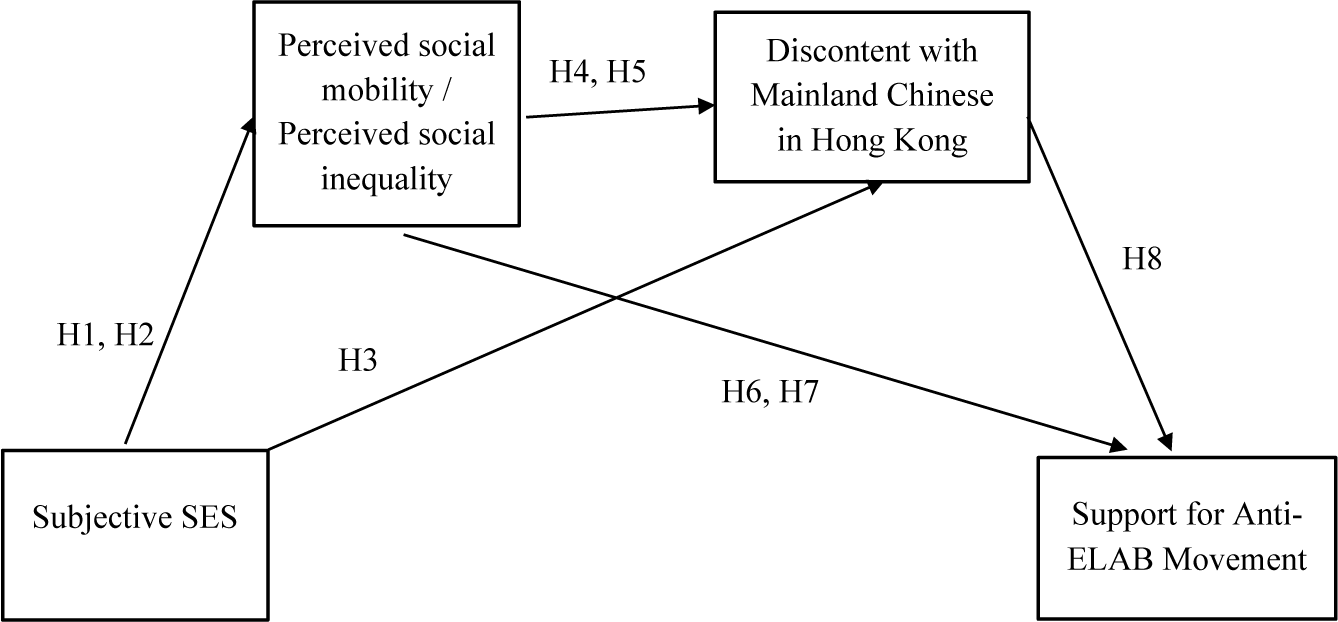
Figure 1 presents the conceptual framework for the relationship among these variables, as outlined from H1 to H8. The two-mediator models stipulated by H9 and H10 are also demonstrated in this figure.
Conceptual framework of the relationships among the key variables, illustrating H1 to H8.

Data and methods
The survey data reported in this article were collected via a telephone survey conducted by a research centre at a university in Hong Kong from May to June 2020. This period coincided with the suspension of the Anti-ELAB Movement due to the outbreak of Covid-19. However, since the movement was not yet demobilized by the NSL, many people still perceived the movement to be ongoing and attempted to maintain its momentum through various means, including political consumerism (Chan and Pun Reference Chan and Pun2020), with a few small-scale mobilizations occurring in the first half of 2020.
The target population for the survey consisted of Cantonese-speaking Hong Kong residents aged 15 and older. The sampling process involved creating a telephone number database by combining the prefixes for landline and mobile numbers currently in use with the full set of possible suffixes. Specific numbers were then randomly selected by a computer program during fieldwork, and calls were made to these numbers. For mobile numbers, the individual who answered the call was the target respondent. For landline numbers, the most recent birthday method was used to select the target respondent. A total of 1,574 interviews were completed. The response rate was 29 percent, calculated according to the American Association for Public Opinion Research (AAPOR) Response Rate 3 formula.
Males comprised 47.3 percent of the sample. The respondents were grouped into age categories from 1 (ages 15–19) to 7 (ages 70 and older), with the mean age being 4.32 (SD = 1.75). A total of 34.3 percent of respondents had attained an educational level of tertiary or higher. Regarding monthly family income, 38.7 percent earned less than HK$30,000, while 35.0 percent earned more than HK$50,000. Additionally, 57.4 percent of the respondents or their family members were homeowners, and 72.9 percent were born in Hong Kong.
Measures
Subjective SES
The respondents were asked to indicate the social class to which they believed they belonged. Their responses were captured on a five-point Likert scale, where 1 = “lower class” and 5 = “upper class”. Among the respondents, 29.5 percent identified as belonging to the lower class, and 36.2 percent identified as lower-middle class. Additionally, 4.5 percent considered themselves to be upper-middle or upper class. The mean score for subjective SES was 2.09 (SD = 0.88).
Perceived social mobility
The operationalization of the perception of social mobility was adopted from a relevant study (Tang, Lee, and Tsang Reference Tang, Lee and Tsang2022). Respondents were asked if they agreed with three statements: 1) in Hong Kong society, everyone enjoys equal opportunities; 2) in Hong Kong, personal efforts and abilities are the most important determinants of a person’s success; and 3) social institutions in Hong Kong are generally fair. Their responses were captured on a five-point Likert scale (1 = “strongly disagree” to 5 = “strongly agree”), and the answers were averaged (α = 0.77, M = 2.91, SD = 1.03).
Perceived social inequality
The operationalization of the perception of social inequality was adopted from a relevant study (Tang, Lee, and Tsang Reference Tang, Lee and Tsang2022). Respondents were asked if they agreed with three statements: 1) Hong Kong society is controlled by big business corporations; 2) many people cannot share in the prosperity of Hong Kong; and 3) the distribution of wealth in Hong Kong is very unreasonable. Their responses were captured on a five-point Likert scale (1 = “strongly disagree” to 5 = “strongly agree”), and the answers were averaged (α = 0.64, M = 3.85, SD = 0.88).
Discontent with Mainland Chinese in Hong Kong
The operationalization of this variable was based on major controversies related to the economic integration of Mainland China with Hong Kong (Tang and Yuen Reference Tang and Yuen2016). Respondents were asked if they had a strong feeling of dissatisfaction regarding the following situations that occurred in “recent years” during the survey. Their responses were captured on a five-point Likert scale (1 = “no such feeling” to 5 = “very strong feeling”): “the increase in Mainland Chinese working and buying housing in Hong Kong” and “the increase in Mainland Chinese occupying public spaces while consuming in Hong Kong.” Additionally, respondents were asked if they felt a strong sense of unfairness because “Mainland Chinese were utilizing more public resources in Hong Kong in recent years.” The same scale was used for these responses. The answers to the three items were averaged (α = 0.90, M = 3.53, SD = 1.24).
Support for Anti-ELAB Movement
Respondents were asked if they supported or were against the Anti-ELAB Movement. Their responses were captured on a five-point Likert scale, on which 1 = “strongly against” and 5 = “strongly support” (M = 3.61, SD = 1.50). A total of 58.3 percent of respondents answered ‘support’ or ‘strongly support’ to this question. In similar surveys conducted by a research institute in December 2019 and March 2020, 59.2 percent and 57.7 percent of respondents, respectively, expressed support for the movement (Chung et al. Reference Chung, Pang, Lee and Edward2020). Although this survey was conducted during discussions about the NSL initiative in society, the level of citizens’ support for the movement was similar to that observed previously.
Findings and analysis
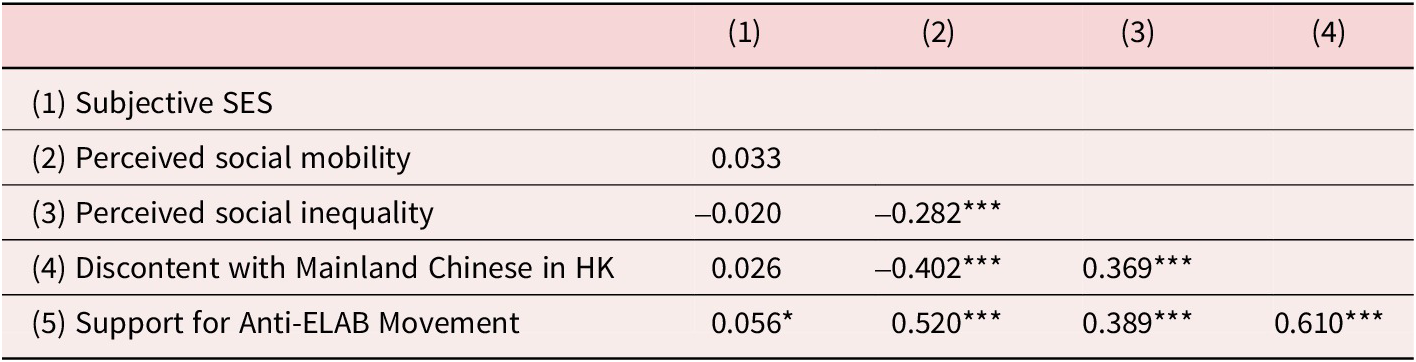
Before proceeding to the regression analysis to examine the hypotheses, the zero-order correlations among the key variables are presented in Table 1. As expected, perceived social mobility and perceived social inequality were negatively correlated (r = –0.282, p < 0.001). Moreover, the relationships among perceived social mobility, perceived social inequality, discontent with Mainland Chinese in Hong Kong, and support for the Anti-ELAB Movement were consistent with those stated in the hypotheses. Without controlling for other variables, the respondents’ subjective SES and their support for the movement were positively related, albeit to a low degree (r = 0.056, p < 0.05).
Zero-ordered correlations of key variables

Note: N = 1,463 – 1,557. *p < 0.05; ***p < 0.001.
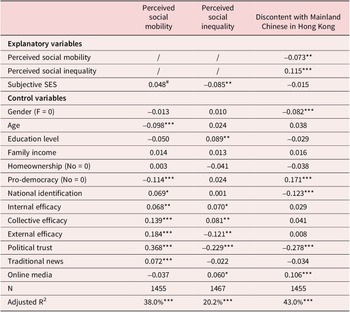
H1 to H8 were examined using regression analysis, as presented in Tables 2 and 3. Individuals perceiving themselves as lower class tended to have stronger perceived social inequality (β = –0.085; p < 0.01). Thus, H2 is confirmed. The relationship between subjective SES and perceived social mobility was positive with a p-value slightly above 0.05 (β = 0.048; p = 0.054). H1 can be marginally confirmed. These results support the overall concept of economic grievances. When individuals consider themselves part of the lower class, they are more likely to question the openness and fairness of the socioeconomic structure.
Regression analysis for perceived social mobility, perceived social inequality, and discontent with Mainland Chinese in Hong Kong

Note: The entries are standardized coefficients. Cases of missing value were deleted pairwise. #p = 0.054; *p < 0.05; **p < 0.01; ***p < 0.001.
Regression analysis for support for Anti-ELAB Movement

Note: The entries are standardized coefficients. Cases of missing value were deleted pairwise. *p < 0.05; **p < 0.01; ***p < 0.001.
The next three hypotheses are examined in the third column of Table 2. People’s subjective SES showed no significant relationship with their discontent towards Mainland Chinese in Hong Kong. However, individuals with lower perceived social mobility and stronger perceived social inequality tended to exhibit stronger discontent towards Mainland Chinese (β = –0.073 and 0.115, respectively; p < 0.01 and 0.001, respectively). Thus, H4 and H5 are supported. These results align with our claim that people’s economic perceptions of their society can influence how they view transborder economic activities and their social impacts. In the context of Hong Kong, the long-discussed issues of social mobility and inequality could serve as underlying factors fuelling discontent towards transborder mobility between mainland China and Hong Kong, with Mainland Chinese perceived as intruding and exploiting public resources meant for Hong Kong citizens.
Table 3 presents the relationships between the proposed independent variables and support for the Anti-ELAB Movement. As the movement evolved into an anti-authoritarian movement, rather than focusing on specific demands (Lee et al. Reference Lee, Yuen, Tang and Cheng2019, Reference Lee2020), the respondents’ political attitudes—including political orientation, national identification, political trust, and political efficacy—significantly contributed to explaining a sizable variance. Therefore, the R² of the models was impressively high.
The results indicate that people’s subjective SES exhibited no significant relationship with their support for the movement, when other variables were controlled (Model 1). Both perceived social mobility and perceived social inequality exhibited no significant relationship with support for the Anti-ELAB Movement (Model 2). Thus, H6 and H7 are not supported. Finally, people with stronger discontent with Mainland Chinese in Hong Kong tended to support the Anti-ELAB Movement (β = 0.095; p < 0.001). Therefore, H8 is supported.
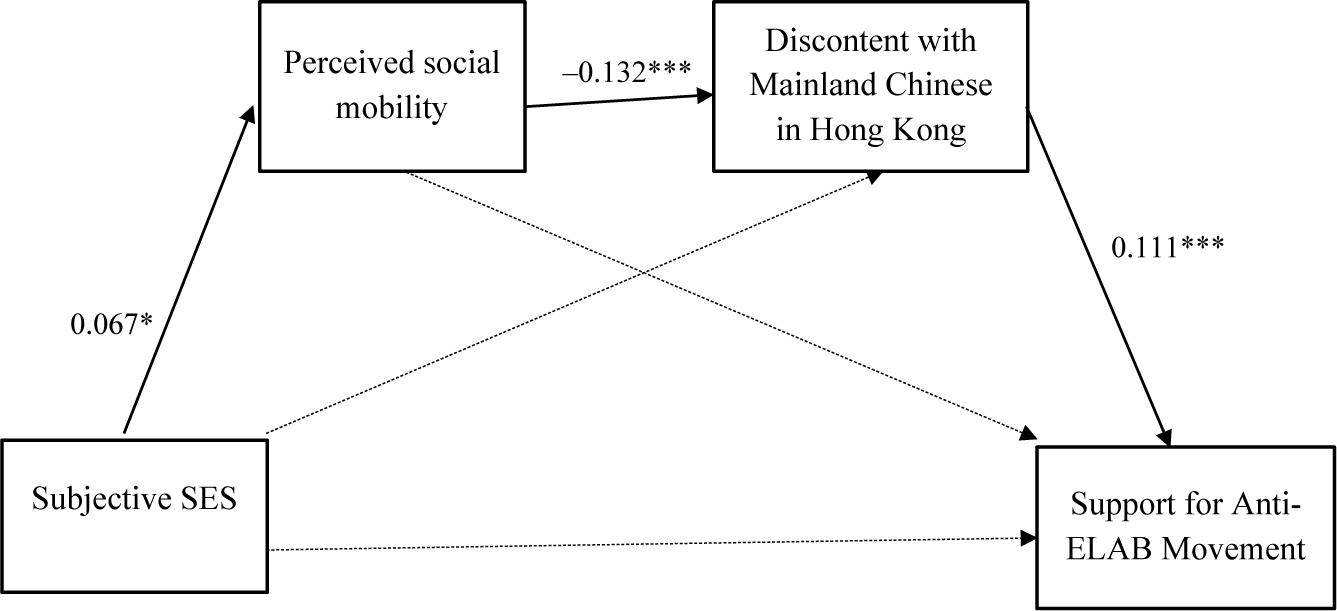
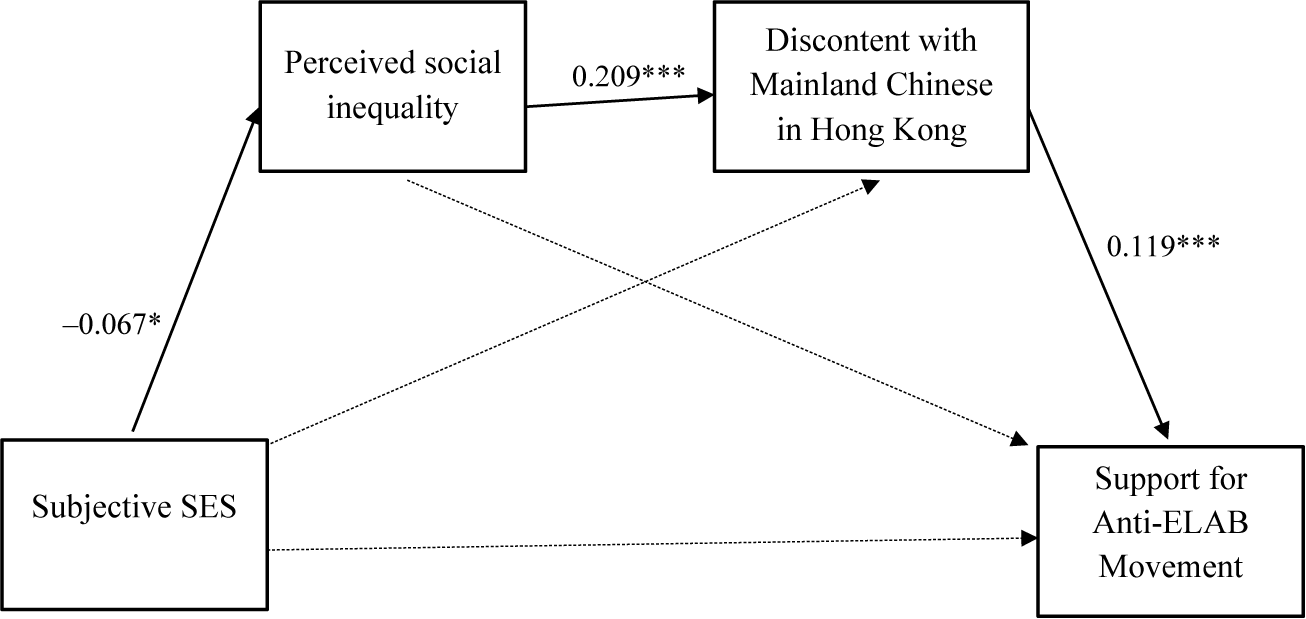
The regression analysis presented in Table 3 is generally consistent with the mediating effects outlined in H9 and H10. The two two-mediator models were examined using the PROCESS method (Model 6) suggested by Hayes (Reference Hayes2017), with 5,000 bootstrap samples. Tables 4 and 5 present the results for H9 and H10. Both paths ‘Subjective SES ➔ Perceived social mobility ➔ Discontent with Mainland Chinese in Hong Kong ➔ Support for Anti-ELAB Movement’, and ‘Subjective SES ➔ Perceived social inequality ➔ Discontent with Mainland Chinese in Hong Kong ➔ Support for Anti-ELAB Movement’ were statistically significant. Thus, H9 and H10 are supported. Graphical illustrations of the mediating effects are shown in Figures 2a and 2b. The figures also present unstandardized coefficients of the significant relationships.
Mediating effects of perceived social mobility and discontent with Mainland Chinese in Hong Kong

Mediating effects of perceived social inequality and discontent with Mainland Chinese in Hong Kong.

Figure 2a illustrates how individuals with a lower subjective SES tended to perceive society as having lower social mobility. This perception of lower social mobility could lead individuals to feel stronger discontent with Mainland Chinese in Hong Kong, subsequently leading them to support the Anti-ELAB Movement more enthusiastically.
Mediating effects of perceived social mobility and discontent with Mainland Chinese in Hong Kong between subjective SES and support for Anti-ELAB Movement.

Figure 2b presents a similar result. Individuals with lower subjective SES tended to perceive society as more unequal. This perceived inequality could lead individuals to feel stronger discontent with Mainland Chinese, which in turn leads them to support the Anti-ELAB Movement.
Mediating effects of perceived social inequality and discontent with Mainland Chinese in Hong Kong between subjective SES and support for Anti-ELAB Movement.

Discussion and conclusion
This article aims to explain how subjective socioeonomic status influenced support for the Anti-ELAB Movement that took place during the movement. Although the movement was a “total mobilization” with participation from citizens across nearly all sectors and was framed primarily as an anti-authoritarian movement, the economic grievances underlying it were not immediately apparent. The results revealed that people’s subjective SES did not have a significant relationship with their support for the Anti-ELAB Movement. However, the “hidden side” of economic grievances was revealed through the mediating effects of attitudinal factors, including perceived social mobility, perceived social inequality, and discontent with Mainland Chinese in Hong Kong. Individuals who perceived themselves as lower class tended to evaluate social mobility and social equality more negatively. These negative evaluations led to stronger discontent regarding the trans-border activities of Mainland Chinese and their use of public resources in Hong Kong, which in turn directly influenced their support for the Anti-ELAB Movement. Therefore, although subjective SES had no direct relationship with support for the movement, it significantly influenced people’s perceptions of society, which in turn could drive them to support the movement.
The results presented in this article offer insights that contribute to a more comprehensive understanding of the Anti-ELAB Movement, as well as the broader narrative of social protests in Hong Kong. While much research focuses on the dynamics among actors and incidents during the movement (Lee et al. Reference Lee, Cheng, Liang, Tang and Yuen2022; Kwong Reference Kwong2024) and discusses radicalization influenced by the macro technology environment (Fu Reference Fu2023; Urman, Ho, and Katz Reference Urman, Ho and Katz2021), the underlying economic grievances are often overlooked. This article adds to the current understanding by highlighting how economic grievances play a crucial role in this movement.
Additionally, the findings of this research provide clues to help flesh out the narratives concerning the relationship between economic grievances and the trajectory of social movements in Hong Kong. To comprehend the development of Hong Kong’s social movements post-sovereignty transfer, major approaches include institutional change, cycles of protest, political opportunities (Chan and Lee Reference Chan and Francis2007; Wong Reference Wong2015), the development of communication technology (Lee and Chan Reference Lee and Chan2018), and changes in values (Ma Reference Ma2015). Regarding the role of economic grievances in Hong Kong’s contentious politics, there have been fragmented studies focusing on social mobility (Lee and Tang Reference Lee, Tang, Keung, Chi and Ming2014; Wong et al. Reference Wong, Chiu, Wan and Zheng2022) and the affordability crisis (Lee and Yu Reference Lee and Yu2012; Wong and Wan Reference Wong and Wan2018); however, a comprehensive account detailing the mechanisms through which people’s self-perception of their socioeconomic situation influences support for radicalism has not been fully explored. While some scholars have attempted to explain Hong Kong citizens’ non-institutional participation from the perspective of economic grievances and relative deprivation, no consistent results have been obtained (Chen, Wu and Fen Reference Chen, Wu and Lin2023; Yang and Wu Reference Yang and Wu2024). Examining how socioeconomic status leads people to support radical protests by outlining a path that includes socioeconomic status, social attitudes, and support for social protests is a relatively novel approach that has not been fully adopted in the study of Hong Kong’s contentious politics. This article provides evidence to narrate Hong Kong’s contentious politics from the perspective of economic grievances.
Further, this article provides evidence connecting the Anti-ELAB Movement with localism, a significant political faction before the movement. During the movement, to maintain solidarity among supporters from various factions, the localist inclination was downplayed (Lee et al. Reference Lee, Yuen, Tang and Cheng2019, Reference Lee2020). The survey results also indicated that support for the movement stemmed from various factors rather than an endorsement of localism as a political affiliation (Wong, Zheng, and Wan Reference Wong, Zheng and Wan2024). However, given that the rise of the localist faction was a critical factor in the political landscape prior to the Anti-ELAB Movement, its role should not be casually dismissed. If localism is characterized by chauvinism and xenophobia, specifically targeting Mainland Chinese in response to intolerable transborder population mobility (Tang and Yuen Reference Tang and Yuen2016; Veg Reference Veg2017), the findings of this research suggest that localism and support for the Anti-ELAB Movement share a common resentment. More importantly, this resentment may be stronger among individuals who perceive themselves as lower class. Thus, although the Anti-ELAB Movement was not thematically a localist movement, it is unsurprising that many protesters resonated with certain localist activists and their narratives (Lee et al. Reference Lee, Tang, Yuen and Cheng2020).
The research results presented in this article also offer an opportunity to further examine the role of economic grievances in Hong Kong’s contentious politics. Movement framings are situation-based and depend on the discursive opportunities available in a particular context. Economic grievances, being more tangible, have the potential to be associated with various discourses. Indeed, in many contexts of protest, economic, political, and social grievances can be intertwining ideas for mobilization (Ajil Reference Ajil2022; Muliavka Reference Muliavka2021). In the pre-NSL period, much of the movement’s framing was dominated by democratization discourses (Cheng Reference Cheng2016; Fong Reference Fong2017; Wong Reference Wong2021). However, the connection between economic grievances, various social attitudes, and movement framings before the Anti-ELAB Movement warrants further review. In the post-NSL period, although public discourses embodying anti-China and anti-government sentiments are suppressed, economic grievances among the populace will persist unless there is substantial improvement in economic redistribution. How economic grievances are actualized among the people and associated with other aspects of grievances and public discourses should be examined to understand the political culture in post-NSL Hong Kong.
This article also contributes to the discussion on the theorization of economic grievances at a broader level. While “relative deprivation” is an overarching concept that explains why people participate in social protests, scholars have proposed various conceptualizations and measurements of this idea. For example, apart from relative deprivation compared to other parts of society, Kurer et al. (Reference Kurer, Häusermann, Wüest and Enggist2019) suggested a temporal dimension of grievances by measuring whether people perceived their current economic hardship as better or worse than in the past. Focusing on people’s subjective perception of economic hardship, this article examines the relationship among several dimensions of economic grievances, including subjective SES, perceived social mobility, and perceived social inequality, as well as their impact on support for radical protests. Indeed, a subjective conception of economic grievances encompasses not only individuals’ personal economic situations but also how they perceive their relationships with society. The latter aspect can be further explored. In addition to the three dimensions covered in this article, further research could enrich the dimensionality of economic grievances and its relationship with other conceptually related ideas, such as life satisfaction, which has been found to motivate people’s engagement in radical protests (Cheng, Chung, and Cheng Reference Cheng, Chung and Cheng2023).
Several limitations of this research should be addressed. First, because it is a cross-sectional survey conducted during the later stages of the movement, it cannot establish clear causality that subjective SES was the cause of people’s support for the movement and radical actions. However, this article demonstrates a potential mechanism through which people’s self-perception of their socioeconomic status can indirectly affect their attitudes towards radical protests, mediated by their perception of society and transborder mobility. This perspective can be crucial for enhancing the current understanding of this critical event in Hong Kong’s history. Additionally, this study focuses primarily on the movement period. Whether the NSL provokes or limits economic grievances among Hong Kong people in the post-movement era remains an important topic for future research.
Second, as a quantitative study, this research cannot capture many nuances needed to fully interpret the relationships among certain variables. In particular, some relationships may involve a transformation of agenda and framing. For instance, the relationship between people’s discontent with Mainland Chinese in Hong Kong and their attitudes towards the movement and radical actions is intriguing. How movement supporters made sense of their everyday life experiences in response to transborder integration within a movement with different framings is a topic that should be analysed by a future qualitative study.
Financial support
This work was supported by Public Policy Research Funding Scheme, Policy Innovation and Co-ordination Office, HKSAR Government (SR2020.B12.002)
Competing interests
The authors declare none.



 Open access

