


Globally, over 55 % of infant deaths from diarrhoeal disease and acute respiratory infections are preventable by appropriate breast-feeding and complementary feeding( 1 ). Suboptimal infant feeding and endemic malnutrition contribute to mortality and morbidity, as well as to detrimental long-term developmental consequences, poorer educational performance and decreased productivity( Reference Horta, Bahl and Martines 2 – Reference Kramer, Guo and Platt 7 ).
Although the potential benefits of exclusive breast-feeding (EBF) through to infant age 6 months are widely recognized, EBF remains low in both developed and developing countries.
Maternal psychosocial factors and intentions to breast-feed have been associated, to varying extents, with infant feeding behaviours in previous literature. A nationally representative US study among 2372 women found that intention to partially or fully breast-feed predicted breast-feeding duration (>6 months)( Reference Piper and Parks 8 ). Similarly, in a cohort of 566 Australian women, intention to breast-feed was also positively associated with breast-feeding duration( Reference Scott, Binns and Oddy 9 ). In separate study among 733 women, attitudes about benefits and barriers to breast-feeding, health-care systems, as well as social support were associated with breast-feeding initiation( Reference Khoury, Moazzem and Jarjoura 10 ).
Over the past two decades, many studies have incorporated the Theory of Planned Behaviour (TPB), a general psychological model for human behaviour, as a theoretical framework to understand determinants of breast-feeding behaviours. According to the TPB, attitudes, subjective norms and perceived behavioural control predict intention to perform a certain behaviour; intention then predicts the behaviour( Reference Ajzen 11 , Reference Ajzen 12 ). In a meta-analytic review of 185 independent studies, 27 % and 39 % of the variance in behaviour and intention, respectively, were accounted for by the TPB framework( Reference Armitage and Conner 13 ).
Among studies assessing maternal psychosocial risk factors relating to suboptimal breast-feeding, sample populations of women have been diverse, yet few are among women in under-resourced countries. Most studies focus on breast-feeding duration (attrition) and initiation; fewer centre on EBF.
Bangladeshi government policies and non-profit programmes have targeted inappropriate infant and young child feeding practices, addressing globally ranked malnutrition indicators (including the 41·3 % of underweight children under 5 years of age)( 14 ). Yet national prevalence of EBF through 6 months still has not improved for over a decade, despite nearly universal breast-feeding initiation( 15 ). There is a need to clarify the aetiology of early EBF attrition. Our objective was to further understand the associations between prenatal maternal psychosocial constructs, intentions and EBF behaviours at 3 months among women and their infants in rural north-eastern Bangladesh.
Methods
We conducted a prospective observational study embedded in a community-based nutrition and infant and young child feeding initiative (Akhoni Shomay – ‘Window of Opportunity’) implemented by CARE Bangladesh in Kishoreganj district, Bangladesh. In one sub-district (Karimganj), pregnant women and mothers with newborn infants were eligible to voluntarily participate in behaviour change communication activities and receive multiple-micronutrient supplementation. Women residing in a non-adjacent sub-district (Katiadi) in the same district (Kishoreganj) were ineligible to participate in the CARE Bangladesh infant and young child feeding programme.
Located approximately 117 km from Dhaka, Karimganj and Katiadi are rural agrarian sub-districts with similar socio-economic and demographic characteristics. Approximately 320 000 individuals in 70 000 households reside in Karimganj. Katiadi has a population of 350 000 individuals in 75 000 households. Average household sizes are similar. Children under 5 years represent 17 % of the total population in Karimganj and 15 % in Katiadi. Both sub-districts are located in the low-lying Haor region of north-eastern Bangladesh, which regularly experiences flooding and food insecurity. Several government and non-profit efforts, including the European Union’s ‘Food Security for the Ultra Poor’ and CARE Bangladesh women’s empowerment programmes, have centred on Karimganj.
Study participants
All field work for the present study was conducted by staff of icddr,b (International Centre for Diarrhoeal Disease Research, Bangladesh). The study protocol approval was granted by the icddr,b Ethical Review Committee. Prior to study enrolment, eligible women were verbally informed about study objectives as well as protocol. Those who willingly signed participation consents were enrolled and interviewed. A team of twenty trained interviewers (eleven male; nine female) conducted the structured home interviews.
Study participants included mother–infant dyads in Karimganj and Katiadi sub-districts, from whom data were collected at approximately seven gestational months into pregnancy and 3 months after birth. Recruitment and enrolment of pregnant women occurred in six randomly selected unions (administrative units immediately above the level of the village) from each sub-district. In Bangladesh, sub-districts are comprised of unions; there are eleven total unions in Karimganj and ten in Katiadi. In each selected union, pregnant women were identified through the assistance of local non-profit organizations with programmatic foci on maternal and child health and that regularly monitor their respective areas for pregnancies. Women 15–49 years of age in their third trimester of pregnancy as computed based on the last menstrual period and permanently residing in the selected sub-districts were eligible. Exclusion criteria included residing for less than 6 months in Karimganj or Katiadi at study enrolment and any known or suspected chronic or congenital diseases. Women were interviewed during their third trimester of pregnancy in three waves, 4 months apart.
Of the 2400 women interviewed, 2397 gave birth to 2411 infants, including fourteen pairs of twins. The three remaining women were not pregnant or did not give birth within a biologically plausible time period. Losses to follow-up prior to interview at infant age 3 months included infant deaths, out-migration and refusal to further participate. Two thousand one hundred and seventy-eight (91 %) women completed the 3-month interview, achieving coverage of >90 % of pregnancies in the target communities.
Expecting regular seasonal migration of some Kishoreganj residents due to flooding and employment opportunities, interviewers maintained contact with study participants via cellular phones, scheduling home visits in advance as necessary. Nearly every study participant either owned or had access to a cellular phone.
Data and variables
Breast-feeding knowledge
We administered a six-item questionnaire to assess knowledge about optimal breast-feeding practices. We created a scale of breast-feeding knowledge (theoretical range 0–6) as the sum of the correct responses.
Attitudes
We used sixteen items from the Breastfeeding Attrition Prediction Tool (BAPT) to assess attitudes towards breast-feeding. Questions included nutrition impacts of EBF and inconveniences and difficulties of EBF for the mother. As interviewers in the first wave asked respondents to rate attitudes according to a scale of 1–3 and in the latter two waves to rate attitudes on a scale of 1–5, we recoded wave 1 items as 1, 3 and 5. We reverse-coded negative-effect items before analysis. We used factor analysis with orthogonal (Kaiser) varimax rotation on the sixteen items and extracted three factors. In confirmatory factor analysis, fifteen of the sixteen attitudinal items had factor loadings >0·5. We created an overall index as a simple sum of scores for these fifteen items (theoretical range 15–75). Additional factor analysis identified three sub-constructs (time management – seven items; privacy concerns – three items; positive view of breast milk – five items); we computed indices for these sub-constructs as simple sums of item scores.
Self-efficacy
We used six items from the BAPT relating to self-efficacy and confidence of mothers regarding breast-feeding. All six self-efficacy questions were predictive of overall variance based on factor analysis loadings (>0·65). We created an index as the simple sum of scores for these six items (theoretical range 6–30). Additional factor analysis identified two sub-constructs (emotional self-efficacy – three items; objective self-efficacy – three items).
Subjective norms
We used five questions from the BAPT about perceived opinions of family members and health professionals regarding infant feeding. Due to lack of construct validity and a high proportion of non-responses, we did not develop an index of subjective norms.
Breast-feeding intention
The woman was asked how she intended to feed her infant. The responses were categorized as: EBF; breast milk with any other foods or liquids; no plan to provide breast milk; or no plans.
Infant diet
Interviews at 3months included data collection on infant diet by 24 h and since-birth recalls. Liquid and food categories were derived from standard Bangladesh Demographic and Health Surveys (BDHS 2007) categories( 16 ). Reported breast-feeding practices (EBF, partial, full) were categorized according to UNICEF and WHO definitions( 17 ). Our definition of prelacteal feeds was similar to most other definitions, i.e. consumption of foods and liquids aside from breast milk (including honey, mustard oil) prior to EBF initiation. Although there is no consensus about the exact standard ‘allowable’ length of time after birth for prelacteals, in the present study we considered any non-breast milk feeds consumed during the first 3d after birth as prelacteals.
Statistical analysis
Descriptive statistics were reported as means and standard deviations or proportions. Crude associations between categorical variables were assessed by Pearson’s χ 2 tests. We used logistic regression analyses to estimate associations between breast-feeding patterns at 3 months (based on 24 h recall) and prenatal intention, knowledge, attitudes and self-efficacy. We adjusted for covariates: maternal age (15–25, 26–35, >36 years), previous births (0, 1, >1), socio-economic status (quintiles based on household assets and durable goods), maternal literacy, any prenatal care for the current pregnancy and sub-district. Inclusion of these potential confounders was based on a priori knowledge from previous literature that establishes associations between each covariate separately with both psychosocial factors and breast-feeding behaviours. Additional potential covariates, specifically focusing on food security, were assessed; however, none were significant predictors of breast-feeding behaviours or confounders of any primary associations. Multivariate regressions were also stratified by sub-district. Analyses were performed using the statistical software package Stata release 10·1. With the final sample size of 2178, the study had 90 % power to detect differences (at P<0·05) of 10 percentage points between groups of women who did, or did not, intend to exclusively breast-feed their infants, assuming the observed prevalence of intention to EBF (85 %) and the overall prevalence of EBF at 3months (45 %).
Results
On average, mothers were 24·8 (sd 5·6) years old. EBF intention was reported by 84·1 % of mothers. Age did not differ by prenatal EBF intention (Table 1). A higher proportion of women in higher wealth quintiles reported EBF intention (P<0·05). Higher proportions of women intending to EBF were literate (67·6 %) relative to those not intending (56·2 %; P<0·05). Accessing prenatal care during pregnancy was higher among women with EBF intention (47·1 %), compared with those without (32·6 %; P<0·05).
Selected characteristics of 2178 women recruited at 7 months’ gestation and interviewed at 3 months postpartum, Kishoreganj District, rural north-eastern Bangladesh, by maternal prenatal exclusive breast-feeding (EBF) intentionFootnote *

* From interview at approximately 7 months’ gestational age.
Mean breast-feeding knowledge was 3·6 (sd 1·3). The mean maternal attitude regarding EBF was 55·8 (sd 8·2) and mean self-efficacy was 25·7 (sd 3·4). Prenatal attitudes and breast-feeding knowledge (both P<0·05), although not self-efficacy (P > 0·05), were significantly associated with maternal EBF intention.
Infant feeding patterns
During their first 0–3 d, many infants received prelacteal feeds (juices or high-sugar liquids 25·0 %, water 11·3 %, animal milk 2·3 %, infant formula 2·2 %). All mothers except one initiated breast-feeding and nearly all (99·6 %) mothers reported giving their infants breast milk in the previous 24 h (Table 2). At every time point ascertained (0–3 d, 4 d, 2 weeks, 1 month, 2 months and 3 months), 1 % or fewer infants were not receiving any breast milk. Among infants not EBF at 3 months, the majority consumed other liquids (water 52·8 %, infant formula 12·4 %, animal milk 9·9 %, juices or high-sugar liquids 7·4 %), with fewer than 5·0 % of infants consuming any soft, semi-solid or solid foods.
Breast-feeding patternsFootnote * of 2178 children aged 3 months in Kishoreganj district, rural north-eastern Bangladesh, as obtained from 24 h recall and history of liquid consumption, by maternal prenatal exclusive breast-feeding (EBF) intention

* EBF: not giving the infant any water or liquids aside from breast milk, or foods. Mixed feeding: breast milk is provided but is not the sole source of nourishment. Predominant breast-feeding: the predominant source of nourishment is breast milk although the infant may have received water and water-based drinks, fruit juice, oral rehydration salt solutions, drop and syrup vitamins, minerals, medicines and ritual fluids. Predominant breast-feeding is a subset of mixed feeding.
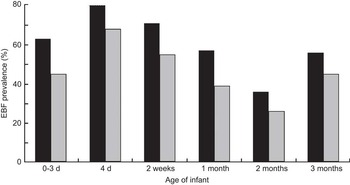
At 3 months, 45·2 % of the infants were EBF and an additional 25·3 % were predominantly breast-fed (Table 2). Between birth and 3months, EBF prevalence peaked at 4d after birth (77·9 %; Fig. 1). A higher proportion of infants were EBF at 3months among mothers reporting EBF intention (47·8 %) compared with those without EBF intention (31·7 %; P<0·05). Similarly at 4d after birth, a higher proportion of infants of intending mothers (79·8 %) were EBF, compared with those of non-intending mothers (67·7 %; P<0·05). Conversely, the proportion of infants with non-intending mothers who were predominantly breast-fed at 3months of age (30·8 %) was higher relative to those of intending mothers (24·3 %; P<0·05).
Exclusive breast-feeding (EBF) prevalence at various ages from birth to 3 months among infants in Kishoreganj district, rural north-eastern Bangladesh, by maternal prenatal intention to exclusively breast-feed ( , EBF intention;
  , no EBF intention)
Prenatal maternal knowledge, attitudes, self-efficacy and intention in relation to breast-feeding at 3 months
Mothers who reported EBF intention were more likely to EBF at 3months (adjusted OR=1·48; 95 % CI 1·14, 1·91; Table 3, model 1). This association was robust to the addition of terms related to maternal knowledge, attitudes and self-efficacy (model 2); as well as in stratified analysis of one sub-district (Karimganj; see online supplementary material, Supplemental Table 1) but not the second sub-district (Katiadi; Supplemental Table 2). Attitudes, self-efficacy and knowledge were not significantly associated with EBF at 3 months, whether considered on their own (Table 3, model 1), in joint models (Table 3, model 2) or stratified by sub-district (Supplemental Tables 1 and 2).
Associations between breast-feeding pattern at 3 months and prenatal maternal intentions, attitudes, self-efficacy and knowledge among 2178 women interviewed during pregnancy and at infant age 3 months in Kishoreganj district, rural north-eastern Bangladesh

EBF, exclusive breast-feeding.
* Model 1, each predictor tested separately; Model 2, all predictors entered into the model simultaneously. All models additionally control for maternal age, previous births, household wealth quintile, maternal literacy, prenatal care during pregnancy and sub-district.
† Maternal EBF intention assessed at 7 months’ gestational age.
‡ Indices for maternal attitudes (from fifteen items), self-efficacy (six items) and knowledge (six items) based on simple sums of relevant questions, according to factor analysis. Continuous maternal indices dichotomized at median values.
As 25·4 % of infants were predominantly breast-fed, we additionally assessed full breast-feeding (defined as either exclusive or predominant) at 3months as the dependent variable. EBF intention was associated with full breast-feeding at 3months (OR=1·34; 95 % CI 1·04, 1·72) in the full model (Table 3, model 1). Maternal knowledge, attitudes and self-efficacy were not significantly associated with full breast-feeding at 3months (P>0·05) in the overall population (Table 3, model 2) or when stratified by sub-district (see online supplementary material, Supplemental Tables 1 and 2).
Discussion
Breast-feeding initiation and exclusivity
We observed universal breast-feeding initiation and approximately 45 % EBF at 3 months of age in rural Bangladesh. These estimates are similar to national statistics. According to the WHO Global Data Bank on Infant and Young Child Feeding, the national prevalence of breast-feeding initiation has remained over 96 % since the 1990s( 15 ); the national prevalence of EBF under 6 months is 42·9 %( 15 ). It is difficult to compare EBF prevalence in our sample with national statistics as all infants in our sample were approximately 3 months old. As EBF prevalence generally declines as infants age, this suggests that EBF prevalence in Karimganj and Katiadi may be lower than the national average.
In the past two decades, national surveys have reported a wide range of EBF prevalence (36·2–58·4 %)( 15 ). Although current national recommendations are to EBF until 6 months, previous recommendations in the early 2000s were only until 5 months of age( Reference Haider, Ashworth and Kabir 18 ). This modified definition likely accounts for some variability of reported EBF prevalence.
Our multivariate regression models reflected a theoretical model derived from the TPB, which hypothesizes that attitudes and self-efficacy drive EBF intention, which translates to behaviours. We modified the classic TPB model by excluding maternal subjective norms due to lack of construct validity in our sample and we included a component of breast-feeding knowledge. While this limits direct comparisons with studies that incorporate all three psychosocial indices in the TPB, our observations are consistent with the TPB conceptual framework in general. We previously showed that maternal prenatal breast-feeding attitudes and self-efficacy were positively associated with EBF intention during the third trimester of pregnancy( Reference Thomas, Yu and Tirmizi 19 ). Our present findings indicate associations between EBF intention and postnatal breast-feeding behaviours, but weaker associations between the underlying prenatal constructs and actual behaviour. Further research is needed to assess intention, psychosocial factors and breast-feeding behaviours while accounting for subjective norms, in a rural Bangladesh context.
Our results suggest that some, but not all, of the psychosocial factors we assessed were predictive of EBF intention among rural Bangladeshi women, which is similar to previous studies in other settings that consider attitudes( Reference Gill, Reifsnider and Lucke 20 , Reference Wambach 21 ) and knowledge( Reference Mitra, Khoury and Hinton 22 ) in relation to breast-feeding intentions. Prenatal attitudes and self-efficacy were not predictive of EBF or full breast-feeding at 3 months of age. On average, women had relatively strong self-efficacy (26·6 on a 0–30 scale); the weak predictive power of breast-feeding behaviours may be related to the low variability (sd 3·4). Earlier studies found that attitudinal indices did not predict breast-feeding duration( Reference Evans, Dick and Lewallen 23 , Reference Lewallen, Dick and Wall 24 ) or exclusivity( Reference Chatman, Hasumi and Roofe 25 ). Some literature suggests that maternal confidence is not predictive of breast-feeding behavioural outcomes( Reference Khoury, Moazzem and Jarjoura 10 , Reference Evans, Dick and Lewallen 23 , Reference Lewallen, Dick and Wall 24 , Reference Lawson and Tulloch 26 ). Similarly, a study among 599 Jamaican women found no influence of maternal knowledge regarding breast-feeding on EBF( Reference Chatman, Hasumi and Roofe 25 ).
On the other hand, many studies indicate that attitudes( Reference Scott, Binns and Oddy 9 , Reference Gill, Reifsnider and Lucke 20 , Reference Wambach 21 , Reference Lawson and Tulloch 26 – Reference Ekwo, Dusdieker and Booth 34 ), self-efficacy( Reference Wambach 21 , Reference Dick, Evans and Arthurs 27 , Reference Mossman, Heaman and Dennis 28 , Reference Janke 31 – Reference O’Campo, Faden and Gielen 33 , Reference Blyth, Creedy and Denis 35 – Reference Dennis 38 ) and knowledge( Reference Khoury, Moazzem and Jarjoura 10 , Reference Mitra, Khoury and Hinton 22 , Reference Wambach, Aaronson and Breedlove 39 ) are predictive of breast-feeding initiation and duration. Differences from our results could stem from difficulties in comparing across disparate breast-feeding behavioural outcomes, since we report on EBF and full breast-feeding rather than initiation and attrition. Additionally, socio-economic differences need to be accounted for as the majority of studies were among women residing in better-resourced (primarily US) settings.
Compared with other psychosocial factors (attitudes, self-efficacy, subjective norms), relatively fewer studies have assessed the extent to which intention to breast-feed predicts infant feeding behaviours of mothers. Among relevant studies, all found positive associations( Reference Piper and Parks 8 , Reference Lawson and Tulloch 26 , Reference Dodgson, Henly and Duckett 36 , Reference Janke 40 ), which aligns with our study findings.
Unlike studies that ascertain maternal intentions retrospectively, our study was prospective, eliminating the possibility that the woman’s responses are altered by future behaviour. Our study had high follow-up through age 3 months, which likely limits participation bias. Efforts were made to minimize cognitive comprehension issues during interviews by acknowledging issues identified in previous literature about differing interpretations of EBF definition and duration( Reference Dennis 38 , Reference Haider, Kabir and Ashworth 41 ). Interviewers asked simple, direct questions about foods and liquids consumed, as well as specified exact times in both days and months. EBF and full breast-feeding categories were created during analysis based on dietary intake, according to consistent breast-feeding definitions.
The survey-based data collection was a potential source of self-report bias and recall bias. Women may have under-reported negative perceptions and behaviours. Accuracy of self-reported dietary recalls relies on mothers correctly remembering the dietary consumption of their infants at specified times prior to the interview.
Despite high expressed maternal intentions to EBF during pregnancy and universal breast-feeding initiation, prevalence of both exclusive and full breast-feeding at 3 months remain lower than WHO recommendations. Our findings indicate associations between EBF intention and postnatal breast-feeding behaviours, suggesting the importance of increasing activities to raise levels of prenatal EBF intention to support optimal infant feeding behaviours.
Acknowledgements
Acknowledgments: This study was embedded in CARE’s community-based initiative to improve infant and young child feeding and nutritional outcomes, known as Akhoni Shomay or ‘Window of Opportunity’, in Bangladesh. The authors would like to thank the field staff and team leads in Bangladesh; the staff of icddr,b and CARE Bangladesh; and the women for their participation. Financial support: This study was supported by a grant from CARE USA (000013123). The authors have no financial relationships relevant to this article to disclose. Conflict of interest: None. Authorship: A.D.S., B.S., S.R. and A.S.G.F. designed the cohort study. A.S.G.F. and S.K.D. supervised the data collection and led field activities. E.A.Y., A.D.S. and B.S. conceived and planned the statistical analysis. E.A.Y., J.S.T., A.O. and N.T. analysed the data. E.A.Y. and A.D.S. wrote the manuscript. All authors critically reviewed the manuscript for important intellectual content and reviewed and approved the final version. Ethics of human subject participation: The study was approved by the Ethical Review Committee of icddr,b.
Supplementary material
To view supplementary material for this article, please visit http://dx.doi.org/10.1017/S1368980014000937



