

INTRODUCTION
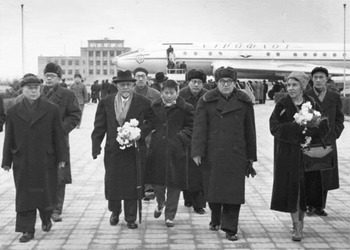
On February 14, 1959, W. E. B. Du Bois and his wife, Shirley Graham Du Bois, arrived in Beijing. The People's Daily (Renmin ribao) report on the array of dignitaries greeting the couple indicated the Chinese Communist Party's (CCP) emphasis on the intellectual, artistic, and ethnic importance of their guests (Figure 1).Footnote 2 The Du Boises' visit was part of their triumphal world tour undertaken after the Supreme Court of the United States had found that denial of passports on political grounds was unconstitutional, thereby benefitting the Du Boises, who immediately applied for and secured their passports (Horne Reference Horne1986; Lewis Reference Lewis2000). The couple sailed from New York in August 1958, spent four weeks relaxing in Paul Robeson's London apartment, and then traveled with Robeson to a warm reception in Moscow. There, Nikita Khrushchev feted them at a New Year's Eve dinner at the Kremlin. Robeson arrived after the Du Boises. When the two men spotted each other they weaved among tables and embraced in the middle of the banquet hall. The crowd applauded as Du Bois and Robeson burst into a joyous laughter (Duberman Reference Duberman1989).
The Du Boises arrive in Beijing from Moscow on February 14, 1959. [W. E. B. Du Bois Papers, Special Collections and Archives, University of Massachusetts Library, Amherst, MA, Reference no. 740]
After that gratifying stop in Moscow, despite the injunction in their treasured new passports that it was “not valid for travel to … those portions of China, Korea and Viet-Nam under Communist control,” the Du Boises traveled to the People's Republic (The New York Times 1959).Footnote 3 Since the United States and China were in conflict because the Korean War, described officially as a “police action,” had never (and still has not) been officially settled, as Du Bois (Reference Du Bois2007) observed in his autobiography, he risked being jailed for “trading with the enemy” (p. 28). During their world tour the couple's home was ransacked in search of incriminating evidence (Horne Reference Horne2000). But Du Bois felt that, as the Chinese government had already invited him in 1956 to come celebrate the 250th birthday of Benjamin Franklin, the trip was an overdue pleasure. Du Bois was pleased that the new invitation came from Guo Moruo, one of China's leading intellectuals and head of the Chinese Academy of Sciences, and Madame Song Qingling (Soong Ching-ling), Vice President of the People's Republic, widow of Sun Yat-sen, and sister of Madame Chiang Kai-shek (Yu Reference Yu1959; Zheng Reference Zheng1959).
When the couple arrived in China, border officials asked if they wanted to keep the visit quiet to avoid irritating the American State Department. Du Bois responded that his wife and he were honored to be invited to China and that the officials could let the whole world know. His words received rapid and universal approval in China (Du Bois Reference Du Bois1971). The FBI took note and canceled the couple's passports upon their return to the United States.Footnote 4
The Du Boises' trip to China is well known but scholars have not given it much importance. For examples, David Levering Lewis, Du Bois's most significant biographer (Lewis Reference Lewis2000), views Du Bois's 1959 visit as naïve. Yet by looking at the official Chinese coverage of the event, it could be said that the time in China was mutually beneficial for the Du Boises and their hosts. In the midst of Great Leap Forward, the first major crisis the CCP faced, Chairman Mao Zedong wished to cultivate alliances with emerging African nations and regarded Du Bois, with his immense international reputation, as key to that effort. Du Bois felt honored and enlightened by what he saw in China. The benefits were not solely his. In Beijing, the Du Boises met representatives from Ghana, who would enable their long-delayed visit to that African nation.
Shirley Graham Du Bois played an important role in the visit to China and its aftermath. Gerald Horne's (Reference Horne2000) biography has done much to enhance Graham Du Bois's reputation after several decades of neglect and disdain.Footnote 5 Yet even Horne's work has not fully analyzed the couple's visit to China in 1959 and in 1962 and has not credited Graham Du Bois's contributions. In this essay, I argue that Shirley Graham Du Bois became a key interpreter of her husband's vision of China. Her devotion to the cause of women in China during and after the visit helped her husband change his views of China as weak to a new understanding of a developing nation inhabited by robust men and women. After Du Bois's death, Graham Du Bois's personal involvement with the Cultural Revolution and the Chinese response to her adds new understanding of the ties between Red China and Black America (Du Bois Reference Du Bois1971).
Beyond these biographical contributions, this study of the Du Boises' Chinese visits broadens understanding of W. E. B. Du Bois's famous dictum—that the question of the twentieth century is that of the color line—by examining the Chinese perspective. Most scholarly attention to the Du Boises' trips to China has focused on American results. Robin D. G. Kelley, Bill V. Mullen, and other scholars have detailed the importance of Du Bois's visit to China for understanding his philosophy of the unity of people of color and the impact of the Chinese trip on Black radicals of the Reference Du Bois and Aptheker1960s (Frazier Reference Frazier and Clemons2010; Ho Reference Ho, Ho and Mullen2008; Kelley and Esch, Reference Kelley, Esch, Ho and Mullen2008). Bill V. Mullen (Reference Mullen2004), the leading commentator on Du Bois's writings on Asia, contends that Du Bois's visit in 1959 stoked his anti-colonialism, a major theme in the latter decades of his active life. I will add to this insight by arguing that Du Bois learned much from his Chinese hosts and from his wife's experiences in China. In turn, the Chinese gained much from them.
DU BOIS'S EARLY VIEWS OF CHINA: ASIAN UNCLE TOMS AND ASIA FOR THE ASIATIC
China had been a part of Du Bois's hopes for unity of people of color since publication of the Souls of Black Folk in 1903. He welcomed the 1911 revolution in China, but expressed doubts that the country would be accepted into the family of nations. In an article in The Crisis in Reference Du Bois1918, Du Bois supported World War I because he forecast that the conflict would enhance the position of the “darker people of the world,” and would result in an independent China, a self-governing India, an Egypt with representative institutions, and an Africa for Africans' sake and not merely for business exploitation (p. 60). In a view quite similar to Vladimir Lenin's and, later, to that of the CCP, Du Bois saw world war as the vehicle for social and economic uplift for non-Whites around the globe, directly linking African American struggles with those of nationalist forces in China. In the early 1930s, Du Bois appealed to China and Japan to stop fighting each other and concentrate on the real enemy: the Western powers (Mullen Reference Mullen2004).
W. E. B. Du Bois first visited China in 1936, in the middle of the “national crisis” stemming from Japanese military aggressions and on the eve of a brutal full-scale war that lasted until 1945. Du Bois entered China from the Soviet Union. On his second visit to the Soviet Union (the first had been in 1926), Du Bois observed a nation “sure of itself” (Lewis Reference Lewis2000, p. 565). The construction of new buildings was widespread, as was prosperity, law and order, and military might. Du Bois chose to ignore Stalin's steady repression, an indifference that was apparent in his later visits to Maoist China. The Japanese chose to ignore his Soviet friendship, sagely realizing Du Bois's importance to Black Americans, and sought to stimulate anti-war sentiment among African Americans whom they perceived as a potentially significant fighting force for the American military. At the Inner Mongolia border, a Japanese official from the Manchukuo State Railways awarded Du Bois a first-class train ticket across Manchukuo, a tactic guaranteed to please Du Bois. He compared this gift with Jim Crow ticket practices in the United States in which non-White travelers were forced to buy, at top prices, train seats that nobody else wanted. As Du Bois traveled east through Harbin and on to Changchun (Japanese renamed as Xinjing), he marveled at the perfect service and comfortable trains and roadbed. Convinced of the immense value of Japan's triumph in Manchuria and its subsequent installation of Henry Pu-yi as the puppet emperor, Du Bois visited Matsuoka Yosuke, the president of the railroad and the most important Japanese official in China (Lewis Reference Lewis2000). Du Bois came away believing that “colonial enterprise by a colored nation need not imply the caste, exploitation, and subjection … always implied in the case of white Europe” (Du Bois Reference Du Bois1937a). In his walks through the city streets of Japanese-occupied Manchuria, in talks with officials, and in official reports, Du Bois found no racial prejudice.
Du Bois's arrival in Nationalist China attracted little notice. I searched in vain for any mention of his arrival in the Shanghai Daily (Shenbao), the most important national newspaper. In Shanghai, Du Bois was distressed to find three million Chinese ruled by 19,000 Japanese, 11,000 British, 10,000 Russians, and 4000 Americans. Open displays of racial arrogance and imperialist oppression in Shanghai and Beiping (now Beijing) reminded Du Bois of Mississippi. He was horrified in Shanghai by the sight of a four-year-old White child ordering three submissive Chinese out of his way on the sidewalk (Lewis Reference Lewis2000). During his visit, Du Bois made controversial statements that endeared him to the Japanese but alienated the Chinese nationalists and Americans. In Shanghai, he lectured a group of Chinese bankers, asking “Why is it that you hate Japan more than Europe when you have suffered more from England, France, and Germany than Japan” (Du Bois Reference Du Bois1937b)? If Japan and China worked together, he continued, then perhaps Europe could be excluded permanently from Asia. His argument dovetailed with Japanese claims of a Pan-Asianism, which justified its colonial aggressions in Asia. His dismayed hosts retorted that whatever problems China suffered, Japan's militarism hindered any progress. Three decades later, in his third, posthumously published autobiography, Du Bois (Reference Du Bois2007) recalled his fruitless argument in 1936 with the Chinese bankers and realized that even after three hours of debate, nothing had been said about the Soviet Union, or about the Long March, the forced dramatic escape of the CCP from Central to Northwest China that had been widely covered in the Western press. He remembered that little was said about Chiang Kai-shek; only hatred of Japan was in the air (Du Bois Reference Du Bois2007). Du Bois went to his death unrepentant about his 1936 scolding of the Chinese nationalists.
Du Bois stayed in Shanghai for about a week. As he sailed away bound for Nagasaki, Du Bois hurled a final insult, claiming that the Chinese nationalists were “Asian Uncle Toms,” (Du Bois Reference Du Bois1937d) likening them to willing, Black menials of White racism in the United States. He enjoyed his time in Japan and marveled at its prosperous cities. Again, the Japanese treated him like a celebrity. Though he noted poverty and a lack of democratic freedom in Japan in his private diary, Du Bois publically exulted in his reception. When he returned to the United States, he chronicled his visit and repeated his arguments about the virtues of Japanese rule in a series of articles in the Pittsburgh Courier. He steadfastly maintained his views after Japanese forces occupied Beiping and Shanghai even after the world learned how the conquerors inflicted genocidal horrors on Nanjing in one of the worst slaughters of the twentieth century (Lewis Reference Lewis2000).
In 1938, the American newspaper, China Weekly Review, returned the taunt when it alleged that Du Bois was a paid propagandist for the Japanese. Responding to a letter asking him to affirm that he was not a paid agent for Japan, Du Bois replied that, while he had never received a cent from the Japanese government or from any Japanese: “I believe in Japan. It is not that I sympathize with China less, but that I hate white European and American propaganda, theft, and insult more. I believe in Asia for the Asiatics and despite the hell of war and fascism of capital, I see in Japan the best agent for this end” (Aptheker Reference Aptheker1976, pp. 184–185). He tossed aside appeals for non-violence and contended that it was Japan's duty to “persuade, cajole and convince China… But China sneered and taught her folk that the Japanese were devils” (Aptheker Reference Aptheker1976, pp. 184–185). American Blacks, he argued, must evaluate the crisis and understand that the Japanese were working toward Asiatic freedom. As news of the Nanjing massacres appeared in the press, Du Bois responded that few of the White American protestors had said much about depredations in Ethiopia. In contrast, he argued, the Japanese classed themselves with the Chinese, Indians, and Negroes as “folk standing over against the white world” (Aptheker Reference Aptheker1976, pp. 184–185). America's war on Japan was not to defend China, but to exploit it.
Du Bois was not alone in his blindness to the horrors of Japanese militarism. Other African Americans contended that the Sino-Japanese conflict was none of their business (Gallicchio Reference Gallicchio2000; Plummer Reference Plummer1996). To the dismay of such disparate forces as the Communist Party of the United States and such pro-New Deal Black newspapers as the New York Amsterdam News, a number of Black journalists expressed pride when the Japanese lorded over the colonial imperialist British, French, and Americans in Shanghai (Lewis Reference Lewis2000; Mullen Reference Mullen2004).
After Japan's defeat in 1945, Du Bois blamed Japanese adoption of Western imperialism as the cause of its downfall and terrible abuse of China. Any solution for Asia needed to address the “structural limitations of racialist and nationalist opinion” (Du Bois Reference Du Bois1945, p. 17). Du Bois optimistically tied the future of China to unity with the United States and Russia, great powers “who do not depend on the exploitation of colonies for their development” (p. 17). He called for recognition of the Chinese anti-racist and anti-colonial proposals at the Dumbarton Oaks Conference in 1944. At that meeting the United States, the USSR, and Great Britain negotiated postwar alliances and included China only after major decisions were sealed, to Du Bois's dismay. In Color and Democracy (Reference Du Bois1945), produced as the conference unfolded, Du Bois proclaimed famously that “the colonies are the slums of the world” (p. 17), tying together his analysis of color and colonialism, a message that would appeal to the Chinese communists.
DU BOIS, INTERNATIONALISM, AND CHINA
Du Bois was moving in the Reference Du Bois1940s toward a more internationalist approach. He became, via his battles with NAACP leader Walter White, more marginalized in the American Civil Rights movement, a pattern exacerbated by his increasingly leftward tilt just as anti-Communism influenced postwar American domestic policies. Du Bois became more enthusiastic about Russia, encouraged Indian nationalism until he perceived Jawaharlal Nehru's rightward politics after independence, and found much to admire in Mao Zedong's efforts in China. In contrast, Du Bois found little racial solidarity with Chiang Kai-shek, whom he regarded as soft on race and colonialism.Footnote 6 As in many political arenas, Du Bois's increasing support for Mao's brand of communism put him at odds with White, who endorsed Chiang's Nationalist government and was openly anti-communist. Du Bois even claimed in his later autobiography, that none of the NAACP's triumphs, including the fabled Brown v. Board of Education decision of 1954, would have been possible without the “world pressure of communism led by the Soviet Union” (Du Bois Reference Du Bois2007, p. 31).
The efforts of Paul Robeson, with whom Du Bois drew closer at this time, and Liu Liangmo, a Chinese spokesman for United China Relief and author of “China Speaks,” an influential weekly column for the Black newspaper, the Pittsburgh Courier, doubtless influenced Du Bois. Liu and Robeson recorded a popular album of Chinese songs in 1941, including “Chee Lai (Stand Up)” (Liu Reference Liu1941) which later became the national anthem of the People's Republic. Robeson routinely included the song in his concerts. Liu and he frequently appeared together in public gatherings. Graham Du Bois knew Robeson well as she authored a biography of him that was published in Reference Du Bois1946. Though any meeting was unrecorded, it is likely that both Du Bois knew Liu Liangmo, as they moved in close circles in New York City. W. E. B. Du Bois had to be impressed by Liu's Courier editorial in Reference Liu1942 that asserted that colonialism undermined the war effort and that British imprisonment of Indian leaders, for example, left South Asia vulnerable to Japanese attack (Liu Reference Liu1942).
Intellectually primed by his support for Russia in the late 1940s, Du Bois also approved of its ally after 1949, the People's Republic of China. Communist China was anti-colonial, and had a policy of constructive engagement with African nations. The CCP victory in 1949 placed China and Asia at the center of colored people's revolutionary struggle. The Chinese Marxist Revolution provided a counter thrust, in Du Bois's mind, to Euro-American imperialist hegemony. Last, Mao's mass or peasant-based theory of revolution, in Bill Mullen's words, “displaced the (White) industrial proletariat at the center of Marxist revolution.” Chinese rural proletarians could serve as a model for an African socialism, likewise “based on old African communal life” (Mullen Reference Mullen2004, pp. 27–28).
Choosing to ignore Du Bois's earlier comments about the Nationalist government, the Chinese Communists began reporting favorably about Du Bois as early as February 1949. The CCP was still based in Yan'an when the People's Daily commented on a conference of over 1200 delegates who met to demand an end to racial discrimination in the United States. The paper quoted Du Bois when he declared that African Americans must move beyond anti-lynching and poll tax reforms to join “the worldwide struggle between reaction and democracy,” (People's Daily 1949a) something he viewed as impossible within the American political system. Du Bois's argument fit in well with Communist belief in the importance of world revolution over local concerns.
A few months later, the People's Daily praised Du Bois for his presence at the International Congress for Peace in Paris. Du Bois was a member of the American delegation and, as the People's Daily (1949b,c) announced, was elected president of the conference. The CCP treasured this event and mentioned it in later evaluations of Du Bois's career. During the 1959 visit, over 1200 people gathered in Beijing to celebrate the tenth anniversary of the peace movement and the involvement of Du Bois and his wife (People's Daily 1959a, b, e, i). The Chinese Communists applauded again when, as early as 1950, Du Bois argued that the United States “must co-exist with Soviet Union and China in one world,” (Yu Reference Yu1959) and came out strongly against American government support for Chiang Kai-shek. The People's Daily noted that another peace organization under Du Bois's leadership—The Station for Publicizing Peace—recruited 2.5 million signatures for the Stockholm Peace Declaration. The Chinese protested when the American government arrested Du Bois in 1951 for “spying for foreign countries” (Yu Reference Yu1959). The People's Daily proclaimed that people from all over the world, including citizens of the Soviet Union and China, protested “this baseless behavior of the American government” (Yu Reference Yu1959). Under pressure, the American government had to declare his innocence and release him. To show its appreciation of Du Bois, the Chinese government published in 1953 a translation of In the Battle for Peace, an account, co-authored with Shirley Graham Du Bois, of his recent travails with the U.S. government (Duboyisi Reference Duboyisi1953).
The People's Daily (1959a) published a summary article during his 1959 visit that indicated how closely the Chinese government followed and appreciated W. E. B. Du Bois's actions throughout the 1950s. The CCP had established an Office for Foreign Affairs (shewai shiwu bangongshi, abbreviated as waishiban) to oversee foreigners in China and foreign commentary about China. Controlled by Premier Zhou Enlai, the Office for Foreign Affairs regularly scoured foreign newspapers and were well apprised of Du Bois's statements (Brady Reference Brady2003). The People's Daily (1959a) quoted first his letter in 1952 to the 120 leaders from South America regarding attending the peace conference of American nations. Du Bois wrote, the conference should “fight for peace, reformation of industries, and distribute wealth with justice, rather than through cheating, theft, and gambling.” The People's Daily (1959a) recalled that, in 1955, Du Bois wrote to editors of newspapers across the United States condemning a potential American invasion of Taiwan. Overall, the initial, composite letter is important because it reviewed and judged Du Bois's friendship with the Chinese people and set the correct line for genuine ideological engagement between Du Bois, Graham Du Bois, and their Chinese hosts. While the newspaper's tone was highly positive about Du Bois's position on Taiwan, its next comments foreshadowed the Chinese message to Du Bois during his visit. The People's Daily (1959b) contended that Du Bois worked to unite the struggle for liberation of American Blacks and the laboring people of the United States, but he needed to understand that the Black struggle for freedom and rights and American people's struggle for world peace could guarantee ultimate victory only through close combination with international proletariats and under the leadership of the Communist parties (Yu Reference Yu1959). While this may be regarded as standard communist rhetoric, it opened the possibility that the Chinese and Du Bois might learn from each other.
Back in China in 1959, and an important, prolific cultural official for the People's Republic, Liu Liangmo published a laudatory article about Du Bois for the Chinese Christian magazine, Heavenly Wind (Tianfeng), in Shanghai (Liu Reference Liu1959). Directing his article to Chinese Christians, Liu described Du Bois as a soldier for world peace and democracy for people of color in Africa and elsewhere. Liu detailed Du Bois's cosmopolitan development from his studies in the 1890s in Germany and his founding of The Crisis magazine in 1913, which critiqued strong nations that oppressed weaker peoples in the name of Christianity. During his lifetime of struggle for African American freedoms, Liu argued, Du Bois realized that African Americans' hopes were inseparable from aspirations for world peace.
Du Bois had organized world peace conferences in the late Reference Du Bois1940s and early 1950s, all of which sparked sharp criticism from the American government and resulted in Du Bois's arrest. That government action roused the fury of people everywhere and ultimately the American state had to back down and release him. Liu quoted the Soviet Encyclopedia which referred to Du Bois as the “founder of African American literature” (Liu Reference Liu1959). Du Bois had challenged the American invasions of Korea and opposed Chiang Kai-shek's government in Taiwan. Overall, Liu concluded, Chinese Christians should salute this peace soldier and celebrate his life and recent ninety-first birthday.
The Chinese Communists needed Du Bois's prestige and acumen as they attempted in the 1950s to lessen their dependence on the Soviet Union. To do so, the CCP sought stronger alliances with Asian and African nations. At the Bandung Conference in Malaysia in 1955, Premier Zhou Enlai diplomatically fenced with other national delegates over inclusion of the Universal Declaration of Human Rights as a core principal of the meeting. The meeting made clear how the smaller Asian and African nations valued human rights. Zhou eventually had to accept the declaration of human rights to avoid alienating nations China regarded as potential allies (Burke Reference Burke2010). American Blacks, in turn, watched the proceedings with fascination. Richard Wright (Reference Wright1956), the exiled novelist, attended the conference and praised its accomplishments while other Black American leaders hesitated to praise the conference (Plummer Reference Plummer1996). Du Bois wanted badly to attend, but the American government's seizure of his passport made his presence impossible, a fact that left him frustrated and bitter (Singh Reference Singh2004).
SHIRLEY GRAHAM DU BOIS, CHINA, AND COMMUNISM
Fortunately, W. E. B. Du Bois had a strong, supportive wife. Shirley Graham Du Bois had become an important figure in Du Bois's life in the Reference Du Bois1940s and married him on February 27, 1951, shortly after the death of his first wife, Nina (Lewis Reference Lewis2000). Although Graham Du Bois was already a communist, Gerald Horne (Reference Horne2000) argues convincingly that she was not the principal reason that her husband joined the party, an event that occurred more than a decade after their marriage. What she did do, however, in addition to invigorating his life and helping him survive some tough times, was to expose him to groups and contacts that would eventually lead to a better reception in China. She expanded his cooperation with people of other races and brought him closer to the party, if not yet to membership (Horne Reference Horne2000). In China, Shirley Graham Du Bois, like her husband, received much praise. The People's Daily (1959b) recognized her as a member of the World Peace Council and of the national committee for the Association of American-Soviet Friendship. It hailed her and Paul Robeson's wife for tearing down the Nationalist flag of Taiwan at the Conference on African Unity in Ghana (Yu Reference Yu1959). In fact, the Chinese people had been aware of Shirley Graham since 1950. That year, the CCP published a translation of her 1947 biography of Robeson. Liu Liangmo contributed an essay as an appendix to the Chinese translation. In addition to offering a biography of Robeson, the book created an association in Chinese minds between Graham and the revered Robeson (Gelanmu Reference Gelanmu1950).
In a sign of appreciation for his new wife, W. E. B. Du Bois listed her as co-author of In the Battle for Peace: the Story of My Eighty-third Birthday, an account of his arrest under the Smith Act and subsequent trial for failing to register as a foreign agent in 1951, when he worked with the Peace Information Center. Du Bois was eventually acquitted of the poorly prepared charges. In the book, Du Bois and his wife discard his earlier belief in the Talented Tenth as narrow and replace it with devotion to the international community of the downtrodden of the world. As Kate Baldwin (Reference Baldwin2002) observes, nowhere in the book does Du Bois indicate any awareness of his wife's intellectual presence or equality. Rather she demonstrates her remarkable “capacity for self-forfeiture” (Baldwin Reference Baldwin2002, p. 166). Baldwin's comments align with Hazel Carby's (Reference Carby1998) argument about Du Bois's wholly masculine intellect. Baldwin does show however that Graham Du Bois exhibited agency, as her husband's bedrock companion, in her fundraising, and, increasingly, her substitution for him at international conferences so that he could avoid arduous travel. An additional reason, as we will see, was Graham Du Bois's own development as an international presence. China played a major role in this development.
MUTUAL NEEDS
The Chinese government had immediate reasons for welcoming the Du Boises. Despite early optimism and reports of a fine harvest in 1958, the Great Leap Forward, the second of the party's five-year economic plans, had stumbled badly. Grain production totals lapsed by early 1959, a drop off which quickly translated into famine. Collectivization of agriculture had faltered. The backyard steel furnace movement was a disaster (Dikotter Reference Dikotter2010; Spence Reference Spence1999).Footnote 7 These problems called into question Chinese Communist leadership and policies for the first time since 1949. Mao and his fellow officials needed a new domestic perspective to reinvigorate the revolution and socialize the nation.
In addition, Communist China required new diplomatic methods as it contested Soviet leadership in world communism and aspired to leadership of the Third World. The Bandung Conference was the first step toward establishing China's independence from Moscow and escaping the isolation of the previous decade. To further these aims, Mao devised a new perspective that moved from an ideology of two blocs (Imperialist Capitalists vs. Communist) into a world view divided into three camps: the superpowers (the United States and the Soviet Union), the industrial nations (Europe, plus Canada) and a third world which encompassed China and former agricultural colonies in Asia, Africa, and Latin America. Not operational until 1963, this perspective, the Chinese already claimed, was not based on ideology but on history. The Du Boises arrived in China at a turning point in CCP history, when Mao was deeply bothered by the Russian refusal to back him in a tinderbox dispute with the United States over the off shore islands of Quemoy and Matsu. Disappointed by the Soviets, the CCP was already reaching out to Africa for friendship, but independent African states met Chinese overtures reservedly (Larkin Reference Larkin1973). Du Bois's immense intellectual stature in Africa could open doors for alliances with the new, post-colonial African nations. Lacking trade and diplomatic ties, China sought inroads through cultural alliances, in which Shirley Graham Du Bois was eager to help. Du Bois's willingness to endorse Mao's plans enabled the Chinese to overlook the Black intellectual's 1936 comments and to emphasize his positive positions since Shirley Graham Du Bois had entered his life.
ON TOUR TO THE SOVIET UNION AND CHINA
The Chinese outstretched hands made the couple eager to include China in their international tour. Alienation from their mother country was strong. The sole American officials interested in them were from the Federal Bureau of Investigation and the Central Intelligence Agency. After years of isolation, the Du Boises enjoyed the welcome extended by the Soviet Union and China. In Moscow, Nikita Khrushchev announced that Du Bois had won the 1959 Lenin Peace Prize (Lewis Reference Lewis2000).Footnote 8 Despite tensions, the Sino-Soviet rupture had not yet intensified, so this honor did not disqualify Du Bois to the Chinese. At the same time, the Du Boises saw the visit as a means to advance Pan-Africanism in China.
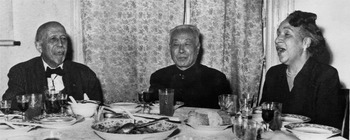
After weeks of luxury in Moscow, the travelers moved on to Beijing where the Chinese rolled out the red carpet. Over the next six weeks, Chinese organizations feted them. The Chinese People's Association for Cultural Exchanges with Foreign Countries (CPACEFC) and the China's Peace Council held a welcoming banquet on February 18. There, Lao She sang Beijing opera for the guests. The Du Boises responded with a spontaneous, vigorous duet of the African American spiritual, “Down by the Riverside,” sometimes known as “Ain't Gonna Study War No More” (People's Daily 1959b; Yu Reference Yu1959) (Figure 2). After a private dinner for the Du Boises the previous night, Premier Zhou Enlai hosted a ninety-first birthday celebration for the aged scholar on February 23 at the Beijing Hotel. Zhou's cosmopolitanism always impressed foreign guests. The Du Boises could see intellectuals fully involved in government practices. In an opening speech, Guo Moruo hailed the support Du Bois and his wife had given to the Chinese liberation movement. Folksingers serenaded the couple with traditional Chinese music. Glasses clinked throughout the evening. Zhou brought a piece of birthday cake to the nonagenarian and wished him longevity. Lao She and other Chinese scholars presented calligraphy scrolls. There was a major interview with Du Bois on the front page of the People's Daily in which he detailed his accomplishments and highlighted his support for China (People's Daily 1959c, d; Yu Reference Yu1959).
The Du Boises sing “Down by the Riverside,” sometimes known as “Ain't Gonna Study War No More.” In the middle is Ding Xilin, Vice Chairman of CPACEFC. [W. E. B. Du Bois Papers, Special Collections and Archives, University of Massachusetts Library, Amherst, MA, Reference no. 688, 718, 731]
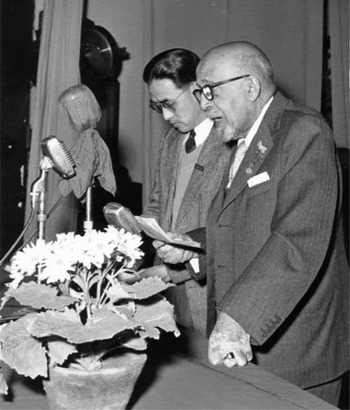
Before the banquet, Du Bois made a major speech at Beijing University, China's most prestigious university, in which he proclaimed that China and Africa had both stood up (People's Daily 1959d) (Figure 3). Du Bois recommended that Africa follow China's leadership and recognize her grasp of the color line. He urged China in turn to recognize that it is “colored and knows (to) what a colored skin in this modern world subjects its owner.” Du Bois answered his own concern by noting “China knows more, much more than this; she knows what to do about it” (People's Daily 1959e). Du Bois thereby accorded to Communist China in 1959 the racial agency and political dignity he found so lacking in the Nationalist government in 1936. In his new vision, China and Black Africa were joined in the present and future battles against European and American imperialism and capitalism. If the Chinese wanted to teach Du Bois about the need for international revolution, he was ready to applaud their efforts and instruct them how to achieve that goal. The People's Daily (1959e) praised his speech and headlined its full coverage with the title, “Du Bois Issues a Call to the African People: Africa, Stand Up! Face the Rising Sun! The Black Continent Could Gain the Most Friendship and Sympathy from China.” This title indicated how much Du Bois and his Chinese host agreed upon achievements and aims.Footnote 9
Du Bois lecturing at Beijing University on February 23, 1959. [W. E. B. Du Bois Papers, Special Collections and Archives, University of Massachusetts Library, Amherst, MA, Reference no. 685]
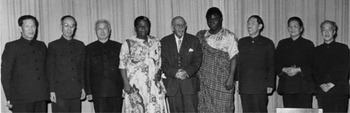
The Du Boises expanded their African contacts during their visit to Beijing. On the second anniversary of Ghanaian independence, China's Afro-Asian Solidarity Committee (Zhongguo Ya Fei tuanjie weiyuanhui) welcomed visitors from Ghana: the general secretary of the Preparatory Committee for the forthcoming Pan-African Conference who served as the editing consultant of Ghana's Pan-African Century Magazine, and the magazine's publisher. The Du Boises were invited to a gathering of Chinese and Ghanaians, where Mao Dun, Minister of Culture and Vice Chairman of the Afro-Asian Solidarity Committee, and who was one of China's most important twentieth-century novelists, welcomed all, characterizing Ghana's independence as a “significant victory in the African people's struggle for national independence and freedom” (People's Daily 1959f). Mao Dun stated the Chinese people “signal great sympathy and support to the people of Africa's struggle … to kick the imperialists out of Africa,” a line consonant with Du Bois's long held beliefs that people of color should unite against White aggressors. Du Bois gave an excited speech in which he declared that while born in America, his ancestors were from Africa. As he had never been to Ghana, it was a “very meaningful event for him to meet friends from Ghana in the New China” (People's Daily 1959f). He wished the Ghanaian people happiness and prosperity and ended his speech by shouting “Long Live Africa!” (Figure 4). Beyond the ideological symmetry, this was the first actual meeting of Ghanaians and W. E. B. Du Bois. Soon, the couple would move to the African country, take up its citizenship, and there establish their lives. Ghana became Du Bois's eventual burial place.
Du Bois with two Ghanaian guests and Chinese hosts in Beijing on March 6, 1959. Third from right is Mao Dun. [W. E. B. Du Bois Papers, Special Collections and Archives, University of Massachusetts Library, Amherst, MA, Reference no. 683]
For now, China was their temporary home. Having made their fealty clear to the Chinese, the Du Boises, in the words of David Levering Lewis (Reference Lewis2000), “moved about Beijing in their ceremonial cocoon [knowing] absolutely nothing about the catastrophe of the Great Leap Forward, Mao's failed economic policies, which would eventually cause famine for more than ten million people” (p. 563). The Du Boises joined other foreign intellectuals who failed to take note of mass starvation (Baldwin Reference Baldwin2002; Brady Reference Brady2003; Lewis Reference Lewis2000). The couple saw only happy people working busily in revolutionary unity. In fairness, one must recall that the worst effects of the Great Leap Forward had yet to impact the Chinese people. The worst came two years later (Spence Reference Spence1999). As in his earlier comments about the Japanese occupation of China, Du Bois was willing to accept oppression if its aims fit his conception of the future.
As they journeyed around China, Graham Du Bois and her husband focused on improved conditions for women. With men called away from home to work on collective farms, women had to take greater roles in farm labor outside of the home. The government encouraged centralization of childcare and meal preparation. People were encouraged to write poetry, once considered solely the province of the elite. As the couple left China, Shirley Graham Du Bois's interpreter, Kwang-li, boasted that her next job would be laying bricks for the new People's Hall, a prospect that made the translator beam with pride (Du Bois Reference Du Bois1959; Reference Du Bois1971). The CCP carefully chose translators who could read the emotional desires of their clients in addition to interpreting their conversations. Certainly, Kwang-li did a good job with Graham Du Bois. According to the People's Daily, in the farewell banquet held by China's Peace Council and the CPACEFC, Graham Du Bois was emotional and chatty. She said poetically, “The China I see is so beautiful. Her children and women, and all the others are so happy. China is a great county” (People's Daily 1959j). She published an article with Impartial Daily (Dagong bao) in Hong Kong on September 20, 1959: “Today, I have seen the People's Republic. I would like to announce to all the black sisters in the United States, West Indies, and Africa, that there are [sic] a new phenomenon in the world now that could inspire your heart and fill it with hopes. The once oppressed, discriminated, and contemptuously treated colored people now got rid of the oppressors, imperialists and slave owners. They have created world records in human relationships, agriculture, industry, construction and overall development” (People's Daily 1960a).
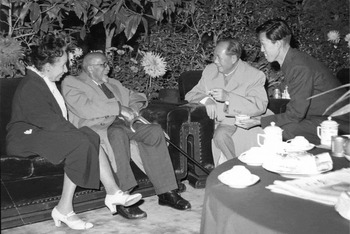
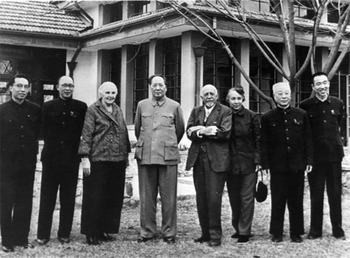
On March 14, the couple received the summa validation of their importance when Mao Zedong hosted them at a luncheon banquet at the Chairman's summer residence in Wuhan. Also present was the writer, Anna Louise Strong, who was along with Agnes Smedley and Edgar Snow, the American writers most revered by the Chinese (Figures 5 and 6). Mao had used Strong to promulgate his famous paper tiger thesis—that imperialists were superficially powerful, but naturally would become overextended and then collapse. Graham Du Bois recalled that Strong talked incessantly. Over a python steak lunch, the Du Boises spoke with the Chairman for several hours about issues concerning African Americans. Du Bois had a private walk in the garden with Mao after which the Chairman gave him a book of his poems (People's Daily 1959g).
Mao talks with the Du Boises in his Wuhan villa on March 14, 1959. [W. E. B. Du Bois Papers, Special Collections and Archives, University of Massachusetts Library, Amherst, MA, Reference no. 692]
The Du Boises with Mao and Anna Louise Strong in Mao's villa in Wuhan on March 14, 1959. [W. E. B. Du Bois Papers, Special Collections and Archives, University of Massachusetts Library, Amherst, MA, Reference no. 673, 678, 696, 738]
That evening Strong created a transcript of the event, which was not published until 1985, fifteen years after her death. Emphasizing its importance, Strong noted that this was the first time Mao met with any American since 1949. She recalled that Chinese officials kept the visitors in the dark whether or where they would meet the Chairman, until they saw him walking down the steps. After a few disarming jokes about relative ages and skin color, Mao expressed his wish to travel to America someday as a tourist, swim in the Mississippi River, watch President Dwight Eisenhower play golf, and visit Secretary of State John Foster Dulles in the hospital. Du Bois responded that Dulles might suffer a stroke, if Mao suddenly appeared. The Chairman said that was far from his desire, since Dulles was so useful to the People's Republic of China, due to his anti-communism and use of militarism to suppress global freedom (Strong and Keyssar, Reference Strong and Keyssar1985).
Observing Du Bois's dismay and skepticism, Mao explained that Dulles helped the masses understand imperialism and capitalism, and taught the Chinese how to avoid the brink of war in conflicts over Taiwan. Du Bois asked if Mao recommended that he vote for Dulles, a dry joke that made Mao admit that he would never do that himself. Du Bois responded that Blacks in America faced annihilation because of Dulles' policies and actions. Mao replied that he had lost many family members in revolution and war, and that the bourgeoisie would be exterminated long before the eighteen million American blacks. “Dulles,” Mao reassured Du Bois, “is doing all he can to exterminate himself. That is why I appreciate him so much.” Mao suggested that the problem was worship of power, which affected both White and Black Americans. Du Bois replied that income rather than fear and power admiration limited American Blacks. The two then discussed how the power of superstition affected decisions of the masses (Strong and Keyssar, Reference Strong and Keyssar1985).
Strong and Mao talked about communes, the need for steel production in China and anxieties about a third World War. Mao declared that China did not want war, but talk of war curbed imperialist agendas. He concluded that at the age of sixty-six, he still hoped to live to see the end of imperialism (Strong and Keyssar, Reference Strong and Keyssar1985). At least from Strong's perspective, Du Bois, and not his wife, was the guest of honor. Shirley Graham Du Bois would have to learn about China from others besides Chairman Mao.
The Du Boises then departed for Chongqing by boat up the Yangzi River (People's Daily 1959h). The Du Boises traveled first class throughout Chinese cities, going to Chengdu, Kunming, Guangzhou, Shanghai, and Nanjing, at each stop hosted by governors and other top officials (Du Bois Reference Du Bois1971).Footnote 10 They laid a wreath at the tomb of Lu Xun, the father of modern Chinese literature. Du Bois also spoke at Shanghai University.Footnote 11
The Du Boises' visit contained much of the “arranged reality” that the CCP and other communist governments created for distinguished political tourists. The banquets and testimonials were ego massages for Du Bois. The private meetings with Zhou and Mao were elite techniques of hospitality. Du Bois had to be impressed with both men's status as scholar/statesmen. But they weren't the only visible Chinese intellectuals. After decades of his own marginality in the United States, Du Bois met intellectuals who were well-integrated into government policies, taken seriously by political figures, and generally well-treated (Brady Reference Brady2003; Hollander Reference Hollander1981). Though one may view the visit to Beijing as managed and the Du Boises as naïve, there were positive benefits of note, including an expanded cultural awareness, particularly for Graham Du Bois.
Graham Du Bois claimed to have been transformed by the visit to the country she admitted that she had little known. Her only previous encounters with Chinese in the United States were in “Chinese restaurants or laundries and those Chinese I knew were either American-born or from Hong Kong or Taiwan” (Graham Du Bois Reference Du Bois1971, p. 266). She was aware, despite her friendship with Huang Hua, a noted Chinese diplomat and graduate of Yenching University, that Orientalism still affected her thinking. At times, Graham Du Bois performed the role of enthusiastic tourist, declaring China a lovely place and describing Chairman Mao's “fairy-like lakeside villa” (Horne Reference Horne2000, p. 158). She expressed enthusiasm about the sights in China, while overlooking the terrible famine that wracked the land. Gerald Horne (Reference Horne2000) has pointed out that Graham Du Bois was repeating her husband's arguments of three decades earlier, though this time the CCP took the role of the heroic movement while racist America became the villain. The trip reaffirmed her socialist visions and made her strongly sympathetic to the Beijing government. During the early years of their marriage, Graham Du Bois had taken a secondary role to her famous husband. In China, she guarded Du Bois's diet and general health. When she returned to the United States, Graham Du Bois declared herself a “new-born woman,” and proclaimed that her husband “supported everything I did, even if I wasn't there when he needed me” (Horne Reference Horne2000, p. 158). Chinese women had told her that she was wasting time washing dishes when she should be writing, playing music, and teaching. Upon return to the United States she quickly hired a housekeeper, became editor of Freedomways Magazine, and plunged into politics (Horne Reference Horne2000).
Shortly after the Du Boises left China, their hosts bestowed lasting gifts by publishing translations of their books. Graham Du Bois's biography of Robeson had been in print in China for ten years. Now, her biographies of Frederick Douglass and George Washington Carver came out in Chinese translations (Gelanmu Reference Gelanmu and Jin1959, Reference Gelanmu1960). The tribute for Du Bois was the first Chinese translation of his most famous book, The Souls of Black Folk, with a Chinese title of Heiren de linghun (Reference Duboyisi1959a). Du Bois contributed a brief foreword to the Chinese edition and added the introduction written for the 1953 Blue Heron Press edition, which had incorporated changes made since the original printing in 1903 and eliminated references that might be regarded as anti-Semitic.Footnote 12
The People's Daily printed a lengthy review, “The Voice from the Heart of Black People,” which detailed the official view of the virtues and a few faults. The reviewer, Huang Xinxi (Reference Huang1959), using a standard to evaluate literature long established by leftist critics, praising the collection's enduring “deep realistic meaning.” Citing Du Bois's brilliant synthesis of Civil War history, Huang argued that the book revealed that Blacks had not obtained real liberation. Evoking Mao's ideology of the revolutionary quality of the peasantry, Huang praised Du Bois's true revolutionary character for opposing the capitulationism of Booker T. Washington.
Pushing the argument about the incomplete liberation of American Blacks and, by implication, their need to learn from the revolutionary Chinese peasantry, Huang emphasized how landless Blacks had thrown off slavery's shackles, but had become entrapped by the capitalists, a message sure to resonate with Maoist intellectuals. Intellectual struggle was not sufficient. Huang emphasized how racial discrimination had adversely affected Black intellectuals, something Du Bois, ever denied major university faculty positions at White universities despite his enormous erudition, could appreciate. Huang advised that through Du Bois's writings, the Chinese people could understand how racial discrimination had limited, oppressed, and destroyed African Americans. Huang also praised Du Bois's account of the loss of his son, a chapter from Souls of Black Folk that so impressed the Chinese that the Commercial Press, the nation's most prestigious imprint, published it as a separate pamphlet the following year (Duboyisi Reference Duboyisi1960).
Huang ended with some mild criticism of the book. As it was written at the beginning of the twentieth century, Du Bois, as he noted himself in the foreword to the Chinese translation, “was not a socialist and did not know much about communism” (Duboyisi Reference Duboyisi1959a). Therefore, Huang submitted, the book inevitably had limitations and some incorrect views, which did not represent the later thoughts of the author. For instance, the book argued that education could overcome racial prejudices and liberate Blacks, and that a Black small-scale agricultural economy could prevent capitalist crimes. Emphasizing the ideological line which the Chinese had pushed throughout the Du Bois's visit, Huang claimed that Du Bois now understood that Blacks' struggle for freedom and rights and the American people's struggle for defending world peace could only gain ultimate victory through the close cooperation with the proletariat and under the leadership of the communist party. Huang noted that Du Bois had won the Lenin Peace Award as recognition for his contribution to the cause of world peace. All this, Huang concluded, demonstrated that the Black liberation movement was marching forward, as was Du Bois, in concert with the CCP.
Huang's reduction of one of the most important works of twentieth-century American literature to the level of the ideological standards of the CCP is reminiscent of Zhou Enlai's unwillingness to compromise at the Bandung Conference in 1955. The party had its position and all works of art or diplomacy had to bend to it. At the same time, Huang's review expressed commonality between the Black and Chinese peasantry and sympathized with their mutual racial oppression. Huang also noted that Du Bois's book was a major intellectual achievement and that Chinese writers could learn from his example.
In his preface, written expressly for the Chinese version and translated anonymously, Du Bois acknowledged two problems with his famous text. The first was his lack of understanding of the significance of psychology for the Black masses and the long revolution necessary to help them. The second issue, sure to please his hosts, was Du Bois's admission that he had little understanding in 1903 about the importance of Karl Marx and Marxist theory (Duboyisi Reference Duboyisi1959). Du Bois (Reference Du Bois2007) had hinted of such a need in Dusk of Dawn, his semiautobiographical work published in 1940. Now he made his admiration for Marx explicit. The color line was now less important than class consciousness, a key change that allowed greater unity for the mutual struggle of African Americans and their Chinese comrades. Du Bois had doubtless been moving in this direction anyway, but the influence of his wife and their experiences in China cannot be underestimated.
The Souls of Black Folk was not the first American classic to have revolutionary influence in China. Huang's emphasis on the revolutionary aspects of Souls of Black Folk resonated in new Chinese reactions to Harriet Beecher Stowe's, Uncle Tom's Cabin (Reference Stowe1852). In the introduction to their 1901 translation, Lin Shu and Wei Yi emphasized the similar histories of Black Americans, Chinese Americans, and the Chinese. They argued that the tortures “Yellow” people faced were even worse than those endured by Black Americans. The translators argued the book was needed by Chinese because “Slavery is looming for our race. We had to yell and scream to wake up the public” (Lin and Wei, Reference Lin and Wei1901, p. 5). In 1907, Zeng Xiaogu staged a performance in Tokyo of a play based on the novel aimed at “waking up” overseas Chinese. The play remained influential at the time of the 1911 Revolution, later became popular around Shanghai in the 1920s, and was performed in Ruijin, the capital of the Jiangxi Soviet, in 1932 to inform the Chinese masses about Black oppression by capitalists. Later, there was a revival of interest in Stowe's novel in China in the early 1960s. Sun Weishi, who was the goddaughter of Zhou Enlai, directed a play based on Uncle Tom's Cabin in 1961. Chinese communists argued that Uncle Tom's Christian consciousness had betrayed him. Now, they contended Du Bois had awakened a new understanding of Black resistance (Tian Reference Tian1961).
Chinese approval of violent Black resistance highlighted the translation and publication in 1959 of Du Bois's lesser-known book, Yuehan Bulang (John Brown) (Duboyisi Reference Duboyisi1959b). Tian Han, a noted playwright, writer, lyricist of “Chee Lai,” and now a high level governmental official, reviewed the book in the People's Daily. Tian hailed Du Bois's history of John Brown's insurrection at Harper's Ferry, Virginia in 1859. Tian quoted Brown's glorious words that became as familiar to Chinese students as to Americans: “I, John Brown, now firmly believe that only blood can wash away the sins of this land” (Tian Reference Tian1961). For Tian, the question was how to instill Brown's consciousness into that of Uncle Tom, the lead character of Stowe's famous novel. In short, Tian wondered how to transfer violent revolutionary leadership into the minds and hearts of the masses. Du Bois's work on John Brown showed the way (Tian Reference Tian1961).
As the Chinese marveled at his past productions, Du Bois poured out new writings. Du Bois continued to expose the Chinese to ideas of African and Asian unity. In addition to his powerful speech at the birthday festivities in Beijing, Du Bois wrote a lengthy poem dated May 1, 1959, which he dedicated to Guo Moruo. Amidst many appeals to African and Chinese unity, he ended the poem with a command: “China save the World! Arise, China!” The poem was subsequently published in China Reconstructs (1959).Footnote 13
As his hosts surely intended, Du Bois took his lessons home. Upon his return to the United States, Du Bois (Reference Du Bois and Aptheker1960) spoke enthusiastically about China before the Afro-American Heritage Association in Chicago. He declared China to be more “astonishing than the Soviet Union,” and forecast that China would soon “achieve perfect communism.” In a nod to his infamous observations about China in 1936, Du Bois recalled that China was then “under the heel of Europe and America” (p. 342). Now China was completely revolutionized and “the white masters were gone” (p. 342), satisfying his anticolonial views. In a speech at the University of Wisconsin, Du Bois blasted American policy toward China, calling it our “most unforgivable deed today” (p. 344). Signaling a new historical approach, Du Bois contended that Chinese in America had been treated worse than Italians or Blacks. “Lazy and jolly Negroes,” infuriated slave owners by their passive resistance but capitalist masters were pleased by “Chinese coolies [who] worked like dumb, driven cattle” (p. 346). Chinese communists would not have found that characterization accurate, but would acknowledge Du Bois's next point that Americans had supported the “murderous traitor,” Chiang Kai-shek, until the Communists drove him into the sea, “where he still squats on an island, protected by our money and guns” (p. 347).
Du Bois (Reference Du Bois1959) published an article on his ten-week tour of China in the National Guardian, a progressive weekly. In it, he praised the Chinese for overcoming class differences and for exorcising the great fears that haunt the western worker: loss of work, no health insurance, anxieties about accidents, lack of vacations. While Americans scrimp, save, steal, gamble and even murder for such necessities, he noted, the Chinese workers, male and female, already enjoyed them. Yes, he acknowledged, American housing and clothing is better than anything available in China, but envy and class-hatred were disappearing in China. Doubtless influenced by his wife, Du Bois next reported that above all, the women of China are free. They do not have to dress for sexual indulgence or beauty parades, but are free to “occupy positions as ministers of state, locomotive engineers, lawyers, doctors, clerks, and laborers” (Du Bois Reference Du Bois1959). Du Bois recalled watching in astonishment a crane in a steel factory and commenting to his wife: “My God, Shirley, look up there… Alone in the engine room was a girl with ribbon braids, running the vast machine.” During the Great Leap Forward, such women were promoted as “Iron Girls” by the Chinese state. Guided by his wife, Du Bois now looked for such examples of women's liberation (Du Bois Reference Du Bois1959).
As an indication of her growing importance, Chinese media attention shifted gradually to Graham Du Bois. Graham Du Bois told a People's Daily reporter at the Asian and African Women's Conference in Accra, Ghana in 1961 that the “days visiting China were among the best days of my life” (Lin Reference Lin1961), and many lively and fresh things about China attracted her and she hoped to return soon. Graham Du Bois added that she and her husband missed the Chinese people and would never forget their friendship. The reporter concluded that these were the words of a “typical” American woman (Lin Reference Lin1961).
Attention reverted back momentarily to Du Bois with the announcement on October 1, 1961 that at the age of ninety-three he had applied for membership in the Communist Party of the United States. Du Bois and Graham Du Bois then immediately departed to live in Accra, Ghana. There he planned, with the support of the government, to finish his long-awaited Encyclopedia Africana. Ensconced in the most exclusive neighborhood in Accra, the couple soon received a pilgrimage of guests, including, frequently, Huang Hua, the Chinese ambassador to Ghana. The Du Boises then also renounced their American citizenship (Lewis Reference Lewis2000). This extraordinary move, made out of frustration and anger, gave symbolic importance to Ghana, their new country of choice. Identifying with an African nation was consistent with the Du Boises' world view. Though the FBI dismissed Ghana's importance for Du Bois and seemed not to worry about the Chinese ambassador, it maintained tabs on the couple's moves. At the same time, Du Bois and Graham Du Bois looked east to China for inspiration. The Chinese returned their gaze.
The People's Daily (1962a) took Du Bois's conversion to communism seriously. Yuan Ying, a writer whose work was standard in middle and high school textbooks, rhapsodized in the newspaper about Du Bois's party membership. Yuan (Reference Yuan1961) recalled Du Bois's speech at Beijing University as an inspiration. He now sent best wishes across the “strong waves of the Pacific, we salute you, respectful comrade Du Bois.” Li Zhun (Reference Li1961), a noted scholar, sent a poem to Du Bois that was published in the People's Daily. In the poem, Li affirmed that Du Bois had regained youth by joining the party: “You are ninety-three years, and I am thirty-three years, your age triples mine. But I feel that you are just as young, young as a new born. Youth is the sister of the truth. Dear comrade Du Bois: Truth is ours, hope is ours, and tomorrow is ours.” Du Bois and Graham Du Bois sent telegrams of gratitude for their opposition to the American laws that sought to imprison Communists. Soon, Guo Moruo invited the couple to come back to China. The Du Boises quickly accepted (People's Daily 1962b, c).
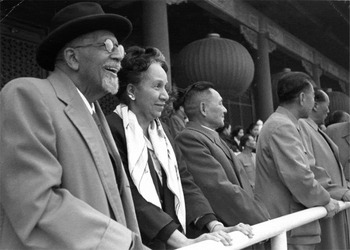
Du Bois and Graham Du Bois returned to China on September 29, 1962 to celebrate the thirteenth birthday of the P.R.C. The ironies of the previous visit returned. While Chinese peasants starved in the countryside, the Du Boises met once more with Mao Zedong and Zhou Enlai and assumed a place of honor in the reviewing stand at Tiananmen Square, becoming the first westerners to take part in this enormous annual celebration (Figure 7). Premier Zhou held a grand reception for the National Day, which was attended by guests from all over the world, including the Du Boises (People's Daily 1962d, e, f, g, h).
The Du Boises at the parade celebrating the thirteenth anniversary of the People's Republic on the balcony of the Tiananmen Podium on October 1, 1962. To the right of the couple are China's top leaders Deng Xiaoping, Zhou Enlai, Mao Zedong, and Liu Shaoqi. [W. E. B. Du Bois Papers, Special Collections and Archives, University of Massachusetts Library, Amherst, MA, Reference no. 695]
The visit was the last W. E. B. Du Bois made to China. The world mourned his death on August 27, 1963 in Ghana, on the very morning of the historic Civil Rights demonstration in Washington, D.C. In Beijing, an audience of ten thousand stood for three minutes of silence in mourning for Du Bois. Mao, Zhou, Song Qingling, and Guo Moruo all sent telegrams of condolence to Shirley Graham Du Bois. Mao recalled Du Bois as one of the great men of our time and hailed him as a sincere friend of China (Horne Reference Horne1986; People's Daily 1963d).Footnote 14
THE TWILIGHT YEARS
The CCP's lauding of Du Bois was in sharp contrast to its condemnation of the non-violent philosophy of Martin Luther King, Jr. Early on, the party praised King for his leadership in the Civil Rights Movement (Leshan 1962, 1963a, b, c; People's Daily 1960b; 1961a, b, c, d; 1963a, b; 1964c). King had little to say about China, though he favored, in a private letter, its inclusion in the United Nations. Despite this small nod, by 1965 the People's Daily coverage of King turned sour. Robert Williams, the exiled Black American nationalist then living in China, declared that “American blacks deeply believe in the truth of Chairman Mao's declaration and their struggles are taking the authentic revolutionary route” (People's Daily 1965a), despite the efforts of right-wing leaders of some Black organizations, including Martin Luther King. Williams derided King for coming to Los Angeles during the riots to help White racists persuade Blacks to end their violent struggle (People's Daily 1965a). Shortly thereafter, the People's Daily referred to King as an Uncle Tom and a “traitor who was the mask of [the American President Lyndon] Johnson and spokesman for the Nazi Los Angeles Police Chief, William Parker” (People's Daily 1965b). The Daily castigated King's philosophy of non-violence and referred to him repeatedly as a “running dog of counter-revolutionaries,” who used slander toward armed Black resistance (People's Daily 1967b, c, d, e, f; Xiang Reference Xiang1966). After King's assassination in 1968, the newspaper (1968b) quoted Robert Williams as saying that the minister believed in non-violence but was murdered by imperialist and racist violence. Chairman Mao taught that if you do not beat down the counter-revolutionaries, they would not stay down.Footnote 15
Joining Williams in support of the CCP was Shirley Graham Du Bois (People's Daily 1968b). In the aftermath of her husband's death, Graham Du Bois tilted sharply toward China. In Ghana, the Chinese ambassador, Huang Hua, cultivated her favor and insured her creature comforts. She continued to live in Ghana and arranged a meeting between Malcolm X and Kwame Nkrumah (Marable Reference Marable2011; People's Daily 1964a, b). When Graham Du Bois was forced to leave Ghana following a military coup in 1967, she moved to Cairo, Egypt, but spent more time in China, which was undergoing the turmoil of the violent Cultural Revolution (1966–1969). She chose the Chinese version of communism over the Soviet brand. She visited China in 1967 on the fourth anniversary of her husband's death (People's Daily 1967a). As her biographer relates, there she had an exceptional meeting with Premier Zhou (Horne Reference Horne2000). One American expatriate recalled that Zhou summoned Graham Du Bois to his office in the middle of the night. She was astonished to see the suave leader's face tense and anxious. He told her that he was worried that the Chinese Revolution might “go down to defeat in the Cultural Revolution. But it's O.K. You'll have your own revolution in Africa and you'll develop your own Mao Zedong” (Horne Reference Horne2000, p. 230). It was an amazing admission to a foreigner and testament to how deeply the highly placed leadership in China trusted her.
Graham Du Bois had earned that respect through her devotion to the Chinese revolution. Her diary from 1967 reveals painstaking notes on the history of the CCP. She made assiduous commentary on visits to the Shanghai Industrial Exhibition, emphasizing the construction of heavy machinery, electronics, toys and athletic equipment, arts and crafts. In these and subsequent entries on visits to communes, Graham Du Bois always credited Chairman Mao's leadership. She filled one section describing how Mao's leadership had transformed the Shanghai Conservatory of Music.Footnote 16 Using today's standards, one may criticize Graham Du Bois for her unquestioning acceptance of Mao and the Cultural Revolution, but at the time, her actions indicated commitment to the international revolution and to China. In that light she toiled even more intensely than the fabled China Hands, or American diplomats of the 1930s and 1940s, to understand China (Spence Reference Spence1969).
Graham Du Bois spent increasing amounts of time in China, taking an appointment on the Permanent Bureau of Afro-Asian Writers. She moved around China, mingling with crowds in the streets, spending days on communes, and traveling with the army and with the Red Guards. Her diaries reveal that she had limited access to Red Guard determinations and condemnations of traitors to the CCP.Footnote 17 Graham Du Bois had to have noticed when Red Guards attacked her old friend, Guo Moruo. Two of his sons committed suicide after being persecuted in the Cultural Revolution. Unlike her Chinese friends, Graham Du Bois was free to roam the world, but she always returned to China.
After spending some time in the Bahamas and in Cairo, Egypt, Graham Du Bois arrived in China in February Reference Du Bois1968 (Horne Reference Horne2000). There, she befriended Robert Williams, author of Negroes with Guns (Reference Williams1962) who was living in Beijing after years in Havana, along with Gora Ebrahim, representative of the Pan Africanist Congress of South Africa. She considered the Cultural Revolution a “breath of fresh air” (Horne Reference Horne2000, p. 163). She joined with other Black Americans in China in admiration for Mao's militancy about race in the United States and supported moves to supply African Americans with guns to fight oppression (Tyson Reference Tyson1999).
Despite her strong support for the Cultural Revolution and though the event left her dumbfounded, Graham Du Bois bent her convictions to support Mao when the Chairman invited Richard Nixon to Beijing in 1972. Her reaction to this seismic shift in policy was to find common ground with the Chinese, which she had been doing since her first arrival in 1959 (Horne Reference Horne2000). In 1970, following considerable negotiations, she was able to return temporarily to her native United States. There she told an audience at a conference on Black women at Yale that they should not worry about their sisters in Africa, North Vietnam, or China, as they are “more liberated than you are” (Johnson Reference Johnson1970, p. 45).
Graham Du Bois crisscrossed the world in the early 1970s. She sold her husband's papers to the University of Massachusetts at Amherst for a sum that gave her a comfortable living. Despite this financial coup, age caught up with her. As her health deteriorated and lung cancer set in, she was advised to slow down. Ignoring this advice, she continued to write, made a short trip to London, and even began to criticize China's foreign policy (Horne Reference Horne2000). But now China was her home, though it was thousands of miles from her family. In 1974, she produced a film entitled “Women of the New China,” in celebration of the twenty-fifth birthday of Communist China. Two years later she joined her Chinese comrades in mourning the deaths of Zhou Enlai and Mao Zedong.Footnote 18
Shirley Graham Du Bois died on March 27, 1977 and was buried in the Babaoshan Cemetery for Revolutionary Heroes in Beijing. The dignitaries present at her funeral service reflected the leadership of the Cultural Revolution. They included the Vice-Premier, Cheng Yonggui, an illiterate farmer whose Dazhai commune was held up as an example of Maoist selflessness and productivity, and Deng Yingchao, the widow of former premier Zhou. The Communist Party Chairman, Hua Guofeng, sent a memorial wreath, as did the embassies of Tanzania, Ghana, and Zambia (Horne Reference Horne2000; The New York Times 1977).
The death of Shirley Graham Du Bois, fourteen years after that of her fabled husband, did not signal an end to their influence. For diplomatic and economic reasons, China has maintained a large presence in Africa, which the Du Boises helped to foster. As I have sought to demonstrate in this article, W. E. B. Du Bois's philosophy of Pan-Africanism extended to Pan-Asianism in the last five years of his life. Shirley Graham Du Bois greatly enabled that transition through her consistent social and political involvement in China. The proliferation of Chinese newspaper articles surrounding their visits to China indicates the breadth of the affection that Chinese Communist Party officials had for the couple and how they in turn influenced Chinese political attitudes toward Africa and African Americans. In addition to showing the mutual importance of W. E. B. Du Bois and the CCP to each other, I have argued for importance and inclusion of Shirley Graham Du Bois in that discourse.



