


1. Introduction
In the past two decades, environmental sustainability has emerged as a critical focus with legislative actions reflecting societal aspirations to become more sustainable. A growing awareness of ecological challenges, particularly among younger generations, has driven the integration of sustainability into the corporate strategy of various organisations in the manufacturing industry sectors. This societal shift is mirrored in legislative measures such as the EU Corporate Sustainability Reporting Directive (CSRD) mandating transparency by requiring companies to report on the environmental and social impacts of their operations and business activities (Reference Kaminska-Witkowska and KazmierczakEuropean Commission, 2024; Kaminska-Witkowska & Kazmierczak, 2024). Industries are responding to these demands by adopting innovative practices for technical solutions. Incentivized by high federal subsidies, the automotive sector adopted a shift toward low-carbon manufacturing and electric vehicles, demonstrating the integration of sustainability through energy-efficient systems and design adaptations of the core technical product from combustion to electric powertrains (Reference Jasinski, Meredith and KirwanJasinski et al., 2021). Similarly, technology leaders such as Google and Microsoft leverage AI-driven systems in data centres to minimize energy use while maintaining operational efficiency (Reference SachinSachin Mishra, 2024). For technical systems, sustainability considerations must be integrated early in the development process, as these foundational decisions critically determine the system's overall environmental impact (Reference Bertoni, Hallstedt, Dasari and AnderssonBertoni et al., 2020). Existing methods such as the Life-Cycle-Assessment (LCA) aim to guide and standardise how the environmental impact of a product is quantified along the product life cycle. However, the practical application of LCA is challenging, particularly due to the reliance on assumptions and estimates of complex technical systems, especially for the operational phase. Despite available frameworks and the technological capabilities to gather and analyze data, a systematic methodological approach is necessary to support the data-driven development of new generations of sustainable complex mechatronic systems in operation (Reference Krause, Dannerbauer, Wagenmann, Tjaden, Ströbel, Fleischer, Albers and BursacKrause et al., 2024).
2. Literatur review
2.1. EcoDesign and life-cycle assessment of technical systems
EcoDesign represents a design approach incorporating environmental considerations into the product development process to mitigate negative environmental impacts throughout the lifecycle of a product. This approach focuses on minimizing resource consumption, energy use, and waste generation while ensuring the product remains functional and economically viable (Reference Schäfer and LöwerSchäfer & Löwer, 2020). EcoDesign as a design approach therefore aims to harmonize environmental considerations while maintaining operational and economic efficiency by aligning organizational strategies with sustainability goals (Reference Wei LunLee, Ying Chung, Shee Tan, Mun HoKoh, Feng Lu and Sze ChoongLowWei Lun Lee et al., 2023). To consider sustainability in product development, appropriate tools and measures are required to systematically evaluate the environmental impact of a product across its life cycle. With the LCA, a standardized approach is available to quantify environmental impacts across all stages of a product's life—from raw material extraction to production, use, recycling, and disposal. Guided and outlined by the (ISO 14040:2006, 2006) and (ISO 14044:2006, 2006) standards, an LCA involves several key phases to ensure a comprehensive and systematic analysis. The first phase defines the goal and scope, establishing the purpose of the assessment and setting system boundaries. In the second phase, a life cycle inventory (LCI) is compiled, which involves collecting and quantifying data on inputs and outputs such as energy, water, and emissions. This is followed by the life cycle impact assessment (LCIA), where the collected data is analyzed to determine potential environmental impacts, such as global warming potential or resource depletion. In the last phase, the interpretation phase synthesizes the findings, identifying significant results and providing recommendations for improving sustainability. These phases ensure a comprehensive and systematic approach to quantifying resource consumption, emissions, and associated environmental effects. Further, the assessment of the environmental impact of a product or service aims to provide critical insights into resource utilization with the respective emissions, to serve as a decision-making foundation for improving the sustainability of a product (Reference Sala, Laurent, Vieira and Van HoofSala et al., 2020). A widely used approach in LCA is the “Cradle-to-Gate” approach, which focuses on environmental impacts from raw material extraction until the product exits the factory gate (Reference Gomes, Silvestre and De BritoGomes et al., 2020). This approach simplifies the evaluation of a product’s environmental impact by focusing solely on its initial life cycle stages, yet it omits the operational phase, which is critical for accurately assessing complex mechatronic systems such as manufacturing machines and machine tools. However, accurately assessing sustainability remains complex, particularly in products with multi-layered supply chains and unpredictable operational phases (Reference Wang, Pan, Wang and ZhouWang et al., 2020). To address this, environmental impacts are categorized into three scopes: Scope 1 (direct emissions), Scope 2 (indirect emissions from purchased energy), and Scope 3 (indirect emissions across the value chain). Scope 3, the most extensive and opaque category, often accounts for the majority of emissions, particularly during the operational phase of machines (Reference ShrimaliShrimali, 2022). To quantify these emissions, the Product Carbon Footprint (PCF) serves as a key metric, enabling organizations to identify emission sources, inform sustainable decision-making, and develop low-carbon strategies. Accurate PCF calculations require precise data on machine specifications, consumption, and operational methods. Estimates are insufficient, necessitating well-defined parameters and robust measurement setups to capture machine emissions accurately. This ensures reliable insights into system-specific emissions, facilitating targeted sustainability improvements (Krause, Wagenmann, et al., 2024b).
2.2. Data analytics in the development process of mechatronic systems
The concept of System Generation Engineering (SGE) describes the systematic creation and evolution of complex technical systems across product generations (Albers et al., 2019). It emphasizes the iterative development of new products by leveraging existing system elements and systematically integrating innovative features. This approach addresses the challenge of balancing customer and market requirements with technical feasibility and innovation potential (Reference Albers, Haug, Fahl, Hirschter, Reinemann and RappAlbers et al., 2018). A central element of the SGE is the recognition that products are not developed from scratch. Instead, new generations of products, or technical systems in general, evolve by refining and reconfiguring technical subsystems and components while addressing dynamic customer needs and emerging technological opportunities. Therefore, new generations of technical systems are based on reference systems serving as the foundational structure. A reference system is thereby defined as a technical system or sub-system of the predecessor generation, a competitor product, or a comparable source of direct inspiration a new system generation is based on. The development process of new system generations is characterized by three types of variation: Carryover Variation (CV), Attribute Variation (AV) and Principle Variation (PV). SGE incorporates function-oriented development, emphasizing the importance of defining and validating product functionalities from a user-centric perspective. By systematically modelling dependencies between product attributes and subsystems, this approach ensures alignment between customer value and technical solutions. Such an approach is particularly vital in industries characterized by high complexity and rapid technological change, where continuous adaptation and improvement are essential (Albers et al., Reference Albers, Rapp, Spadinger, Richter, Birk, Marthaler, Heimicke, Kurtz and Wessels2019, Reference Albers, Kürten, Rapp, Birk, Hünemeyer and Kempf2022; Reference Pfaff, Götz, Rapp and AlbersPfaff et al., 2023). In the current development of technical systems, decision-making and general responsibility shifts more towards the individual developer. The validation of requirements to prioritize and focus development activities becomes an essential element in the development of new generations of technical systems. Data-driven validation methodologies are increasingly critical in the development of complex mechatronic systems, particularly in aligning design decisions to meet real-world operational conditions. Recent advancements in this area emphasize the integration of machine usage data to refine and validate the requirements of the system of objectives (Reference Krause, Dannerbauer, Wagenmann, Tjaden, Ströbel, Fleischer, Albers and BursacKrause et al., 2024). Wagenmann et. al. proposes an approach to address the utilization of field-gathered operational machine data to support decision-making, emphasizing the importance of incorporating domain-specific knowledge in the conduction of data analyses. The proposed methodology is based on the Cross-Industry Standard Process for Data Mining (CRISP-DM) and the generic SPALTEN problem-solving approach, suitable to support decision-making in the development of new generations of complex mechatronic systems (Reference Wagenmann, Krause, Rapp, Albers, Sommer and BursacWagenmann et al., 2022). By addressing key barriers to the effective use of operational data, such as data complexity and organizational integration, these approaches support more informed and efficient decision-making in system design and validation processes (Reference Wagenmann, Krause, Rapp, Hünemeyer, Albers and BursacWagenmann et al., 2022). To utilize field-gathered operational machine data for PCF calculations and consequently sustainability assessments, the development of new generations of technical systems must incorporate data mining strategies into the architecture of the system of objectives.
2.3. Data-driven sustainability in the development of mechatronic systems
The integration of operational data into the development processes of mechatronic systems has emerged as an important strategy for achieving sustainability. Existing methodologies, such as LCA and EcoDesign, serve as essential tools for evaluating environmental impacts and guiding design decisions. However, these methodologies often rely on assumptions or generalized models not reflecting real-world characteristics, particularly during the operational phase of complex systems. Varying machine utilisation rates on the customer shopfloor, changing environments and boundary conditions, such as individual machine configurations, influence resource consumption considerably and pose difficulties in setting assumptions that reflect the broad range of real-world machine operation. Recent advancements in data acquisition and analytics offer an opportunity to enhance these frameworks by leveraging field-gathered operational data, enabling more precise environmental impact assessments and supporting decision-making in the design and development process. Krause et. al. (2024) demonstrates that incorporating such operational machine data into LCA models enhances accuracy, particularly compared to estimation-based approaches. This improvement is critical for the operational phase, where energy use and material utilization often constitute the majority of a system's environmental footprint (Krause et al., Reference Krause, Wagenmann, Ritzer, Albers and Bursac2024a). This underscores the importance of data-driven methodologies in overcoming the limitations of traditional environmental assessment tools. To fully exploit the potential of machine data, new frameworks must integrate data analytics into the development of next-generation mechatronic systems. These frameworks must enable dynamic adjustments of system parameters based on real-world data, fostering a continuous improvement cycle to reduce emissions, optimize energy efficiency, and align with sustainability goals. Adaptive system architectures informed by operational data can identify inefficiencies in real-time and propose actionable changes, ensuring optimal performance and minimal environmental impact. Integrating operational machine data into the development processes of mechatronic systems can enhance sustainability and align current industry strategies with global initiatives in sustainable development. This shift represents a paradigm in engineering practice, driving innovation, improving resource efficiency, and addressing long-term sustainability goals in a systematic and impactful manner (Reference Ryalat, Franco, Elmoaqet, Almtireen and Al-RefaiRyalat et al., 2024). Such an approach is not only essential for meeting stringent regulatory requirements but also critical for sustaining competitive advantage in an industry increasingly centred on efficient resource utilization to reduce operational costs and enhance general manufacturing outputs.
3. Research objectives and methodology
Current literature presents multiple advancements in the systematic application of data-driven methodologies to support product development processes and the availability of standards and guidelines for sustainable engineering. However, a systematic approach using field-gathered operational machine data focusing on enhancing the design of complex mechatronic systems to reduce the environmental impact during operation remains an effort in development practice. Therefore, this research aims to develop a method to support data-driven product development to reduce the environmental impact of new product generations of complex mechatronic systems during operation. This research is structured according to the Design Research Methodology (DRM) framework proposed by (Reference Blessing and ChakrabartiBlessing & Chakrabarti, 2009). To operationalize the aim of this work, the following research questions are formulated:
RQ1: What factors can be identified that influence the data-driven product development to reduce the environmental impact in the operation of new product generations of complex mechatronic systems?
RQ2: How must a method be designed to support the data-driven product development to reduce the environmental impact in the operation of new product generations of complex mechatronic systems?
RQ3: What contribution does the application of such a method provide for a data-driven product development?
The Descriptive Study I aim to answer the first research question by conducting a quantitative survey with 58 participants and following 31 semi-structured guideline-based interviews, both with domain experts of a German machine tool manufacturer. The quantitative survey aims to investigate the subjective perception of individual developers from mechanical, electrical, software and related engineering fields, and whether their development activities influence enhancing the sustainability of new product generations of complex mechatronic systems in operation. The following interviews aim to identify influencing factors for data-driven product development to reduce the environmental impact in the operation of new product generations of complex mechatronic systems. Similar to the survey, the interviews are conducted with developers from mechanical, electrical, software and related engineering fields as well as participants from product management and sustainability management. In the Prescriptive Study a method is developed based on the identified influencing factors as well as existing guidelines and frameworks from literature. The derived method aims to support a data-driven development to reduce the environmental impact of new product generations of complex mechatronic systems in operation by utilizing field-gathered machine data. The method is iteratively developed and refined based on its application and the systematic evaluation of its applicability. The Descriptive Study II aims to answer the third research question by applying the developed method in two conducted Live-labs of the research environment. The first Live-lab is carried out in cooperation with a German machine tool manufacturer and a German University of Applied Science where 14 non-company students with a Data Science major work in groups on three different analysis use cases over a period of three months. Each use case focuses on sustainable machine operation by respectively analyzing occurring error cases, resource utilization and selected core functionalities of the mechatronic system during operation. This study is accompanied by 8 company internal domain experts and conducted in two-week sprints as well as interim status reports. In this Live-lab the participants aim to derive design solutions to enhance the sustainability of complex mechatronic systems in operation based on the analysis of operational-machine data. The second Live-lab is carried out with five participating internal students of the research environment over a period of 10 weeks with a similar aim as the first Live-lab. Here, weekly reports are gathered containing the progress of the project, development activities, met obstacles and proposed solutions. Further, each element of the developed method is rated on a Likert scale between one and five based on understandability, applicability, perceived workload of the method, and perceived support. The derived design solutions of both Live-labs are validated by internal domain experts and rated by the general relevance, potential enhancement of sustainability, economic viability, general feasibility and subjectively perceived degree of innovation.
4. Identified influencing factors
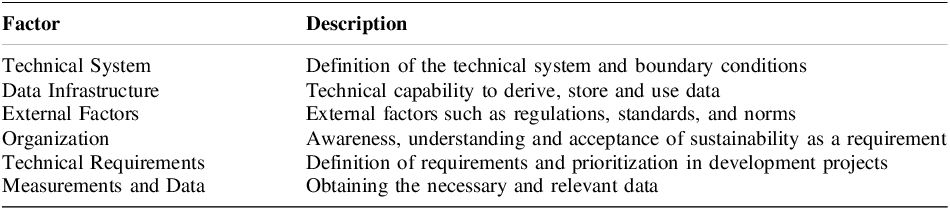
For the derivation of factors that influence the data-driven product development to reduce the environmental impact of new product generations of complex mechatronic systems during operation, a quantitative survey is conducted involving 58 experts from a German machine tool manufacturer. The survey results provide insights into the perceptions, challenges, and opportunities related to sustainability in the development process. The evaluation of the survey data indicated that 81% of participants perceive sustainability and the development of new machine generations optimized for operational sustainability as important to very important. Furthermore, 71% of respondents believe to have at least some degree of influence, up to a high level of influence, contributing to more sustainable machines through their development activities. This highlights a general awareness among developers of their potential role in achieving sustainability goals. However, according to the respondents, the greatest obstacles include missing requirements, limited perceived influence, and conflicting objectives of current development projects with sustainability goals. Despite their subjective perception of influencing development activities, participants still reported feeling that their influence is limited. This apparent contradiction underscores the need for enhanced systematic developer support addressing both, systemic and individual barriers to support engineers in their efforts to design and develop sustainable mechatronic systems or technical systems in general. Overcoming these challenges requires not only organizational support but also methodological frameworks that enable developers to effectively integrate sustainability into the product development process. Based on the obtained responses from 31 conducted semi-structured guideline-based interviews, six factors are identified influencing data-driven product development to reduce the environmental impact of new product generations of complex mechatronic systems in operation, summarized in the following Table 1:
Identified influencing factors

The Technical System describes the necessity of a comprehensive understanding of the individual components, interdependencies, and boundary conditions of the technical system and the defined boundaries of a sustainability assessment. This includes the relationships between subsystems and their contributions to the overall system, ensuring that changes can be introduced while mitigating negative effects. Boundary conditions, such as machine configuration, environmental factors (e.g., temperature), and operational constraints, must be defined to understand the implications of machine operation and its impact on the environment. One participant from the electrical engineering department of the research environment outlined the importance of understanding particularities, such as reoccurring cyclical machine processes (e.g. cooling system) during operation to draw respective conclusions. Additionally, it is essential to determine the level of analysis, focusing on specific subsystems, individual components, or the operation process. The Data Infrastructure describes the capability to collect, store, and make data available for analysis. It emphasizes the importance of ensuring high data quality, with clear documentation and transparency on how respective data is generated. Usability and accessibility are essential to enable accurate data analyses and facilitate effective decision-making in data-driven development activities. During the conducted interviews, two participants emphasized the importance of understanding how data is generated during machine operation to derive reasonable conclusions. Further, continuous validation of analysis results was stated as necessary to minimize potential errors in data understanding and therefore analysis outcomes. External Factors describe the external influences that guide sustainability practices, including regulations, standards, and norms. Regulations and standards ensure the validity and comparability of sustainability assessments, aligning technical development with broader environmental policies. Most of the interview participants stated that customer requirements serve as a critical foundation by incentivizing organizations to prioritize sustainability as a technical objective and incorporate it into development processes and therefore to introduce design changes into the technical system. The Organization describes the systematic integration of sustainability into corporate strategies and practices. This includes the general awareness and acceptance of sustainability as a necessary priority at all organizational levels. Technical Requirements describe the necessity of defining and prioritizing sustainability as a formal design objective within development projects. Despite the perceived importance of sustainability, the participants highlighted the necessity to define and implement technical requirements to operationalize objectives into technical solutions. Measurements and Data describes the necessity to obtain accurate and relevant data to assess resource consumption under real-world conditions. Assessments based on assumptions are insufficient to reflect the complexities during machine operation. To generate reliable data, measurement devices must be integrated into the mechatronic system. Despite resulting in additional costs, one participant stated that resource consumption measurements should be a standard hardware and software feature in the product architecture.
5. Method for sustainable engineering through data-driven design
For the development of a method to support data-driven product development to reduce the environmental impact in the operation of new product generations of complex mechatronic systems, key elements from available standards and norms for sustainability assessment are synthesized. These elements are combined with essential activities of data-driven models and assigned to the respective identified influencing factors. The following Figure 1 illustrates the developed method for sustainable engineering through data-driven design (S3D) as an iterative approach.
Developed method S3D - sustainable engineering through data-driven design

Here, the Infrastructure of the Organization and the Technical System can be understood as specific characteristics of an individual organization. Information or data flows are illustrated as black arrows. Here, data and information are stored in the infrastructure of the organization and are interconnected with the technical system where data is generated. Data can be generated from various sources and therefore must be considered in the infrastructure of the organisation as well as the system architecture of the technical system. Key activities of the developed method are elements where information and data can serve as input or derive as a result of the activity itself. Further, the output from the individual activities serve as input for the respective following activities. The Technical System represents the reference system or reference system element as a sub-system, encompassing the mechatronic system, its operation, or the resulting product as output of the operation as manufacturing process. The machine represents the mechatronic system and constitutes of various subsystems and components in the form of mechanical or digital entities. The operation refers to the machine usage or the operational phase as a manufacturing process. The product is defined as the output generated during operation. Modifications and changes to each, the machine, the operation and the product influences the sustainability and therefore the environmental impact of the mechatronic system in operation. Data generated by the technical system during operation is transferred to the organizational infrastructure. This data is processed and stored for subsequent analysis. The Infrastructure of the Organization refers to the technical infrastructure, incorporating the technical capabilities, expertise, and data management systems required to conduct and support sustainability-focused development activities. This infrastructure ensures that the information generated by the technical system is appropriately transferred, stored, and processed for analysis. Additionally, the infrastructure can influence and modify information to modify the technical system on the respective level. The Definition of the Technical System and Sustainability Variables describes the process of identifying the system boundaries and relevant subsystems required for operation. Sustainability variables are defined according to frameworks such as Life Cycle Assessment (LCA) and Life Cycle Inventory Analysis (LCIA), following standards such as ISO 14040/44 and serve as input for the first element. This step establishes the foundation for sustainability assessments by defining key evaluation criteria and system boundaries. Measurements and Data Mining describe all activities required to gather and process relevant data for sustainability assessments. This involves collecting data from the existing infrastructure, previous analyses, or new measurements, particularly of the resource consumption during machine operation. Data Analysis and PCF Calculation involve analysing the obtained data to evaluate the environmental impact of the technical system. The Product Carbon Footprint (PCF) is calculated to identify key contributors to environmental impact and serves as the basis for identifying systematic technical improvements. Design describes all activities involved to derive design changes and technical solutions to improve sustainability, and therefore the environmental impact, of the mechatronic system during operation. Design changes are assessed for technical and financial feasibility before being prioritized and implemented. Design changes of the technical system can occur by modifications of the resulting product such as adjustments to the geometry, material properties, or part characteristics. Design changes of the operation are thereby described as modifications of the utilization of the mechatronic systems such as changed machine settings. Design changes of the machine as the mechatronic system occur through modifications to sub-systems as physical components or software functionalities. Refinement and Documentation describes the process of consolidating and documenting the knowledge generated during all activities within the method. This element aims to ensure that insights are retained and accessible for future use within the organization.
6. Contribution of the application of the developed method
From the first Live-Lab, conducted in collaboration with a German University of Applied Sciences, seven technical design changes are derived based on the analysis of operational machine data and identified potential optimization potential. Four design changes involve software-based optimizations, two proposed hardware modifications to improve material handling, and one focused on service optimization. From the second conducted Live-Lab, three hardware modification concepts are proposed as suitable design changes concerning the internal cooling system and control elements of individual sub-systems. To verify the relevance of the proposed design changes, an additional evaluation is conducted involving eight domain experts from the research environment. Each derived design change is evaluated by the domain experts based on technical feasibility, potential sustainability impact, economic viability, and the perceived degree of innovation. The obtained evaluation results are illustrated in the following Figure 2. On average, approx. 50% of the derived design change proposals are rated between “good” and “very good” reflecting their high feasibility and potential for a positive impact on sustainability and system performance. Around 30% of the proposed changes received a “neutral” evaluation due to difficulties in assessing the potential effects, mainly concerning software-based modifications. The received evaluation classified as “poor” or “very poor” primarily originates from one derived design change. This particular design change is evaluated as technically infeasible due to the extensive modifications required for the mechatronic system, which offered limited benefits to overall machine operation. The high level of system adaptation necessary outweighed its potential advantages, resulting in its critical evaluation. Hardware-based design changes, in particular, are predominantly rated between “good” and “very good.” These solutions demonstrated great potential to enhance system sustainability, especially concerning an energy-efficient cooling system, which is highlighted for its great contribution to reducing energy consumption and operational inefficiencies.
Evaluation of the derived design changes of applying the S3D method

In the course of the second Live-lab, the evaluation of the developed method was conducted over a 10-week period. The following Figure 3 illustrates the received evaluation regarding several aspects of the method, including its comprehensibility, applicability, workload, and subjectively perceived support of the method. Participants provided weekly laboratory reports and assessed the developed method using a Likert scale where a rating of three indicates a neutral evaluation.
Evaluation of the method S3D - sustainable engineering through data-driven design

The understandability of the method received steadily high ratings, averaging above four throughout the Live-Lab. An exception was observed during the “Analysis and PCF-Calculation” phase. Participants reported that additional detailed guidance on the calculation process for the PCF is necessary to fully comprehend this stage of the method. The applicability of the method is similarly rated but exhibited a slight decline over the course of the Live-Lab. The participants acknowledged the method as applicable but suggested that additional detailed instructions for executing individual phases would enhance its usability. The subjectively perceived support by the method was rated neutral throughout the Live-Lab, with a slight decline noted from the “Measurements and Data Mining” phase onward. Participants highlighted that the method closely aligned and mirrored the activities they had already identified as necessary for the project. As a result, the method was not perceived as offering additional support, as it effectively reflected the preferred approach. The perceived workload associated with the method remained neutral across all phases. Participants indicated that the method did not impose any additional workload beyond the standard efforts required for their tasks. Therefore, the evaluation suggests that the application of the method during development activities aligns with existing workflows and can be integrated into the development process without imposing additional complexity or disrupting practices.
7. Discussion and outlook
This research focuses on the development of a method to support data-driven product development aimed at reducing the environmental impact of new product generations of complex mechatronic systems during operation. The demand for explicit requirements to guide development activities within the research environment reflects the perception, that sustainability can be addressed as a discrete technical requirement separate from other development considerations. However, sustainability should not be an isolated specification; it must be embedded as an objective within the development of technical systems. Similar parallels exist in data-driven development, where operational machine data is utilized for the validation of the system of objectives, enabling development activities focused on important core functionalities. Data-driven sustainability follows a similar approach. To ensure that new generations of mechatronic systems are more sustainable, development must align with designing components and systems that enhance operational efficiency and sustainability. This shift necessitates supporting developers in evolving their approach rather than simply adding more technical requirements. Components and subsystems must be designed to minimize resource consumption, with strategies developed at the system level. Embedding sustainability as a core objective across development activities and domains enables the efficiencies essential for sustainable machine operations. Consequently, systematic methods are needed to ensure that sustainability considerations are effectively integrated into the design of systems and products. The design changes derived during the conducted Live-Labs, particularly those involving hardware components such as the cooling system, were well-received due to their perceived potential to positively impact operational efficiency and overall machine performance, despite potentially high effort required for their implementation. Despite high ratings for comprehensibility and applicability of the method evaluation, the perceived support was rated as neutral. As the Live-Lab progressed, participants described the method as neither supportive nor obstructive. However, a rapid adaptation of the method as an intuitive approach was observed, facilitating fast implementation and integration into development activities. Over time, this integration appears to reduce the need for structured reliance on the method as participants internalized its principles and applied them intuitively. Regardless of the obtained findings, some limitations of the present work result from the rapid adaptation of the method during the second Live-Lab. While this adaptation highlights the method's intuitive nature, it complicates distinguishing between the method's provided support and the competence level of the individual developers applying it, underscoring the necessity for further validation. Initial suggestions indicate positive applicability and support based on the results obtained, but the practical contribution of the method requires additional evaluation. Therefore, further research must focus on validating the method in suitable settings and expanding its application across other organizations within the industry. However, with the application of the developed method, participants were able to systematically prepare a sustainability assessment, obtain and process relevant operational data, conduct resource consumption measurements, and calculate a PCF based on operational machine data. Furthermore, participants derived design changes with the potential to reduce the environmental impact during machine operation. Therefore, the developed method represents a suitable approach for further research and validation as a contribution to support data-driven product development to reduce the environmental impact of new product generations of complex mechatronic systems during operation.


 Open access

