


Introduction
On election day, citizens are confronted with a rather daunting task. First, they have to form their own individual opinion about the main challenges confronting their societies, such as economics, foreign affairs, security, and environmental problems (Powell, Reference Powell2000). Traditionally, therefore, it has been assumed that the “good citizen” is a well-informed citizen, as this is a quintessential requirement for casting a meaningful vote (Schudson, Reference Schudson1998). Second, citizens have to identify the party or candidate that offers the best possible match with their own political preferences (Lau and Redlawsk, Reference Lau and Redlawsk2006). This form of ideologically congruent voting, or “correct voting,” ensures that citizens express their own opinions in an effective manner. A vast literature suggests that politically sophisticated citizens are better able to achieve this form of ideologically congruent voting (Rapeli, Reference Rapeli2018; Stiers, Hooghe and Goubin, Reference Stiers, Hooghe and Goubin2020). Traditionally, the latent factor of “political sophistication” includes items like political interest, news consumption, political knowledge, and frequently having discussions about politics (Luskin, Reference Luskin1990). In factor analyses, these different concepts are usually strongly related, and form one coherent factor (Gallina, Reference Gallina2023). The more recent concept of “news avoidance,” however, implies that political sophistication should no longer be seen as a one-dimensional phenomenon (Skovsgaard and Andersen, Reference Skovsgaard and Andersen2020; Toff, Palmer and Nielsen, Reference Toff, Palmer and Nielsen2023). In the older literature, it was still assumed that citizens who do not pay attention to political news, are simply not interested or do not have sufficient cognitive resources. The more recent phenomenon of news avoidance seems to indicate that even interested citizens, deliberately eschew traditional news outlets to avoid cognitive overload or feelings of anxiety or unease associated with the proliferation of negative news (Toff and Nielsen, Reference Toff and Nielsen2022). Some authors have even suggested that the desire to avoid this kind of emotional distress might lead to a form of selective news avoidance, that is much more targeted than a general trend toward news avoidance (Villi et al., Reference Villi2022).
These rapidly changing habits of news media consumption in advanced industrial societies imply that it is necessary to update the earlier literature on political sophistication and its relation to ideologically congruent, or correct, voting. Within the contemporary literature, there is increasing concern about the widespread occurrence of news avoidance. While some authors claim this trend has strong negative consequences for democratic engagement (Ohme et al., Reference Ohme2023), others are more optimistic and portray this as just another trend in patterns of news consumption and as a consequence of rapid technological innovation (Dalton, Reference Dalton2021; Damstra et al., Reference Damstra2023; Stubenvoll et al., Reference Stubenvoll2024; Woodstock, Reference Woodstock2014). In this paper, we present a very pragmatic test for the democratic consequences of news avoidance. Our assumption is that within a democracy with universal suffrage, the basic requirement is that citizens have the capability to cast a meaningful vote, which expresses their own preferences and might have an effect on the way their societies are being governed in the future (Huber and Powell, Reference Huber and Powell1994). Citizens can only have a meaningful input in the political decision-making process when they use their vote to express their personal preferences. If we find, on the one hand, that news avoidance inhibits congruent voting, we may assume that the phenomenon has detrimental effects on the process of democratic accountability and representation (Przeworski, Stokes and Manin, Reference Przeworski, Stokes and Manin1999). If we find, on the other hand, that news avoidance is not related to congruent voting, then this phenomenon seems to fit in a pattern where citizens, traditionally, do not pay all that much attention to following politics and current affairs (Zaller, Reference Zaller1992). In that case, technological transformations may result in changing patterns of media consumption, but it will not have an important effect on the functioning of electoral democracy. The question is theoretically salient, as some authors have expressed a concern about the rise of news avoidance (Skovsgaard and Andersen, Reference Skovsgaard and Andersen2020), others perceive this as a benign reaction to rapid changes in the information environment (Woodstock, Reference Woodstock2014). Our main research question, therefore, is rather straightforward: is there a significant relation between news avoidance and ideologically congruent voting?
This question is put to the test using recent election survey data from Belgium, where respondents had the opportunity to express their voting preferences, coinciding with the general elections of June 2024. The questionnaire included an amended validated scale on news avoidance (Goyanes, Ardèvol-Abreu and Gil de Zúñiga, Reference Goyanes, Ardèvol-Abreu and Gil de Zúñiga2023). Belgium offers an ideal case to test this relation, as the rather complicated nature of the Belgian party system (Deschouwer, Reference Deschouwer2012) renders it challenging for citizens to arrive at an ideologically congruent vote. We can be confident, therefore, that if Belgian voters succeed in casting an ideologically congruent vote, this will also be the case for voters in less complicated or fragmented party systems. In addition, Belgium has a rather representative media system for West European countries, with a strong presence of public broadcasting (Chan and Yi, Reference Chan and Yi2024). Survey research shows that news avoidance is a generalized phenomenon in Belgium too, especially among younger age groups (Vandenplas et al., Reference Vandenplas2021), and this observation is in line with comparative studies (Toff, Palmer and Nielsen, Reference Toff, Palmer and Nielsen2023; Espeland, Reference Espeland2024). Given these considerations, we can be confident that the relation between news avoidance and ideologically congruent voting can be meaningfully investigated within the Belgian context.
Literature
Political sophistication is a strongly contested concept within the field of political science. Partly, these debates are empirical, and concentrate on the question of how to best measure political sophistication in survey research, and how to avoid potential bias in this regard (Kraft, Reference Kraft2024). More fundamentally, however, the question is about the normative and theoretical relevance of political sophistication. While some citizens are highly interested in politics and current affairs, this is not the case for all of them (Prior, Reference Prior2010). Does this difference matter? It would be rather unrealistic to expect that all citizens are avid news consumers who spend a substantial part of their time and energy in following a continuous stream of current events (Dahl, Reference Dahl1992; Hooghe, Reference Hooghe1999). The notion that citizens should be heavily involved in politics simply does not seem to work in contemporary society:
The good citizen is highly concerned about public affairs and political life; well-informed about issues, candidates, and parties (…) It is clear that few citizens in democratic countries actually measure up to this idealized portrait, and most appear to fall far short of it. (Dahl Reference Dahl1992, 46)
This bleak picture of actual citizen behaviour has become even more salient in contemporary society, where citizens are confronted with an unprecedented proliferation of news about politics with ever shorter news cycles (Lelkes, Sood and Iyengar, Reference Lelkes, Sood and Iyengar2017). A straightforward strategy to prevent the problem of potential news overload is the phenomenon of ‘news avoidance’ (Van den Bulck, Reference Van den Bulck2006). News avoidance can be defined as: “low news consumption over a continuous period of time caused either by a dislike for news (intentional) or a higher preference for other content (unintentional)” (Skovsgaard and Andersen, Reference Skovsgaard and Andersen2020, 463). While it is traditionally assumed that a low level of news consumption is related to a lack of cognitive resources or low levels of education (Zaller, Reference Zaller1992), the concept of news avoidance involves multiple dimensions and motivations that might differ substantially between social groups. We know that education level is highly associated with patterns of news consumption (Bennett and Entman, Reference Bennett and Entman2001). This finding, however, does not imply that highly educated citizens will be automatically interested in political news. Other considerations might play a role, preventing citizens from paying sustained attention to politics and current events.
Especially in recent decades, news avoidance has become an almost ubiquitous phenomenon, partly because of pragmatic, but also because of emotional reasons (Andersen, Toff, and Ytre-Arne, Reference Andersen, Toff and Ytre-Arne2024). On a pragmatic level, the abundance of news outlets means that, even for interested citizens, it has become impossible to fully keep up to date with all current events (Karlsen, Beyer and Steen-Johnsen, Reference Karlsen, Beyer and Steen-Johnsen2020; Palmer and Toff, Reference Palmer and Toff2020). The traditional 24-hour news cycle has rapidly been replaced by a continuous flow of political news, offered by both traditional and social media. Furthermore, news content has become more negative, sensational, and polarizing (Soroka and McAdams, Reference Soroka and McAdams2015). To avoid the emotional distress caused by a continuous stream of negative news outpouring, even politically interested citizens may refrain from closely following political events (Edgerly, Reference Edgerly2022; Betakova et al., Reference Betakova, Boomgaarden, Lecheler and Schäfer2025). Since we know there is an increasingly strong negative bias in political news, focusing on conflict and polarization, we can assume that consuming political news could have negative emotional consequences (Tunney, Thorson and Chen, Reference Tunney, Thorson and Chen2021). Citizens who want to avoid this emotional discomfort, might simply opt to tune out of current affairs altogether (general news avoidance), or at least they might try to avoid this kind of negative news content (specific news avoidance). Within the literature, therefore, it is assumed that emotions are a key determinant of the phenomenon of news avoidance.
While the phenomenon of news avoidance is by now well documented, little is known about the democratic consequences of this trend. News avoidance does not necessarily have a negative effect on the capability of citizens to make a discerning choice on election day (Woodstock, Reference Woodstock2014). As all kinds of information, including political information, are becoming more readily available, it is hardly needed to devote scarce resources of time and attention to keep up-to-date with current events and political information (Kleinberg and Lau, Reference Kleinberg and Lau2021). Even a quick look at one’s smartphone will suffice to be informed about the main current events and the major debates in society (Wojcieszak et al., Reference Wojcieszak2024). News avoidance only becomes problematic from a normative point of view when it prevents citizens from playing a meaningful role in democratic politics. If citizens have sufficient knowledge about politics to cast an ideologically congruent vote, the democratic role of elections remains the same – whether citizens are avid news consumers or not (Kölln, Reference Kölln2018). The first hypothesis guiding our analysis, therefore, is that news avoidance will be negatively related to ideologically congruent voting.
Finding an answer to this fundamental question is a challenge. We know from previous research that citizens do not need to be highly involved news consumers to be able to cast an ideologically congruent vote; having a reasonable amount of political knowledge seems to be more than sufficient to cast an ideologically congruent vote. Focusing on acquiring even higher levels of political knowledge does not seem to have any additional effect on the capability to cast an informed vote (Dalton, Reference Dalton2021; Dassonneville, et al., Reference Dassonneville2020). If citizens surmount this threshold of basic knowledge, this may be considered as positive or interesting, but it is by no means necessary to be able to function as a “good citizen.” Again, this points to the argument that one should not expect most citizens to be heavily involved in politics, as a standard level of knowledge about politics and parties is more than sufficient to be able to cast an ideologically congruent vote. Any consequences of news avoidance, therefore, might be dependent on the pre-existing level of political knowledge.
Our expectation, therefore, is that once citizens have acquired a sufficiently high level of political knowledge, further news consumption (or the opposite phenomenon of news avoidance) will no longer have an additional effect on their capacity for ideologically congruent voting. This implies that any effects news avoidance might have will not be uniform across all respondents. Once citizens have acquired a sufficiently high level of political knowledge to cast an ideologically congruent vote, further information seeking might no longer have an effect, or to express it differently: from that threshold on, news avoidance should no longer have additional negative consequences. Our second hypothesis, therefore is that levels of political knowledge will moderate the relation between news avoidance and ideologically congruent voting. Furthermore, it is important to note that news avoidance is focused on more established forms of information media, like radio, television, or newspapers. The phenomenon of news avoidance might also indicate that citizens use different technological tools to remain up-to-date on current events. In this more optimistic view, news avoidance should not be a reason for concern, as it merely indicates a change in the kind of technology that is being used for remaining up-to-date.
Our main research hypothesis for this paper, therefore, is that news avoidance will be negatively associated with the ability to cast an ideologically congruent vote, and our second hypothesis is that this will be especially the case among citizens with low levels of political knowledge to start with. To develop a comprehensive model, it is necessary to control for more traditional determinants of political sophistication, such as education level and political knowledge. As the expectation is that citizens should have a basic level of political sophistication to cast a meaningful vote, effects of news avoidance are not necessarily homogeneous for all groups in society. The question about the democratic consequences of news avoidance will be applied to recent panel survey data from Belgium, coinciding with the general elections held in June 2024.
Data and methods
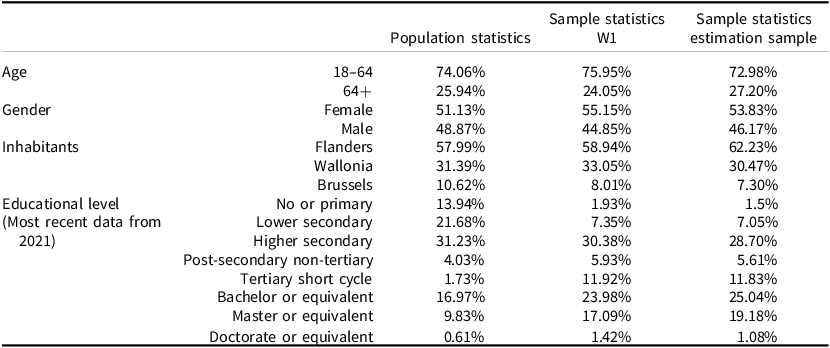
The analysis is based on the results of the Belgian Repeated Election Panel (BelREP) 2024, a panel study that was conducted on the occasion of the Belgian general elections of 9 June 2024 (Stiers et al., Reference Stiers, Hooghe, Voets, De Grauwe, De Keyser and Louw2025). Respondents from the two major language regions of the country were questioned about their media consumption as well as about their vote choice (Hooghe and Stiers, Reference Hooghe and Stiers2025). They were surveyed twice: before the elections (wave 1, from 15 May to 5 June), and in the weeks following the elections (wave 2, from 11 June to 2 July). This panel component gives us the advantage that our independent variables are measured before the election, while the vote choice is probed after the election.Footnote 1 Note that our main variable of interest, news avoidance, was also measured in wave 2 to include an additional test of the robustness of its measurement (see below). The online survey was conducted through the professional survey company Bilendi using a convenience sample. Several steps were taken to ensure the representativeness of the sample (e.g., use of quota, re-contact, incentives, etc.). This has led to a sample that reflects known population characteristics with regard to age, gender and voting behaviour (see Appendix A below for a comparison with population statistics). The main deviation was an overrepresentation of higher educated respondents, which is rather common in survey research. The initial sample consisted of 6,067 respondents, of which 4,515 or ca. 75% also took part in the second wave. All analyses will be conducted only on that group of panel participants, that is still largely representative of the general population.Footnote 2 As is usual in panel surveys, attrition proved to be selective here too. As news avoidance is higher among the group that did not participate in the second wave of the survey, it can be assumed that any effects we do find offer a conservative estimate.
Belgium offers an interesting case to investigate patterns of ideologically congruent voting, as the fragmented nature of the party system renders it quite challenging for voters to identify the political party that is closest to their own political preferences (Stiers, Hooghe and Goubin, Reference Stiers, Hooghe and Goubin2020). Within such a party system, achieving congruent voting clearly is a more cognitive challenging task than, e.g., in a two-party system. It is important to point out that Belgium is a rather complicated federal system, with two distinct party systems. Dutch language political parties only compete in the Dutch language region, while the French speaking political parties only compete in the French language region (Hooghe, Stolle and Stouthuysen, Reference Hooghe, Stolle and Stouthuysen2004). Voters in the two regions are therefore confronted with two different sets of choice options, and therefore in all analyses, the distinction between the regions will be an important control variable.Footnote 3 Previous research has shown that news consumers are more likely to turn out to vote on election day (Martin and Sharma, Reference Martin and Sharma2023). In Belgium, however, this phenomenon does not occur as the country has a system of compulsory voting, with, as a result, a rather stable turnout of 88 per cent. Basically, this means that the vast majority of eligible citizens actually turn out to vote.Footnote 4 Consequently, we have a sufficiently large sample of voters who express a party preference.
The concept of correct voting includes multiple dimensions, and not all of them could be included in this specific survey. In line with previous studies (Stiers, Hooghe and Goubin, Reference Stiers, Hooghe and Goubin2020), we therefore limit the operationalization to the concept of ideologically congruent voting. Measuring ideologically congruent voting implies a combination of two different positions. First, respondents can indicate their own ideological position, and in this case, we rely on the classic left-right ideological scale (Mair, Reference Mair, Dalton and Klingemann2007). While other political cleavages are obviously present, it can still be assumed that the left-right cleavage is the main structuring mechanism in many contemporary democracies. Second, we need a valid assessment of the position of all political parties as it is expressed by the average assessment of all respondents in the survey (not just the voters for that party). As was the case is earlier studies, these judgements by survey respondents are remarkably in line with party positions assigned by experts (Dassonneville et al., Reference Dassonneville2020). In line with previous research, we operationalize congruent voting using a distance measure indicating the absolute difference between the position of the respondent and the position of the party this respondent voted for on a 0–10 left-right scale (Dassonneville et al., Reference Dassonneville2019; Hooghe and Stiers, Reference Hooghe and Stiers2017). Previous research suggests that taking this average assessment is a reliable method to assign an ideological position to the different political parties (Dassonneville et al., Reference Dassonneville2019). Note that a lower number on our congruence variable therefore indicates a higher congruence between voter and party. The average ideological distance between a voter and their party is 1.485 (standard deviation 1.299), with an observed minimum of 0.006 and an observed maximum of 8.557. Overall, it can be observed that a vast majority of Belgian voters indeed cast a vote in favour of a political party that is ideologically related to their preferences.
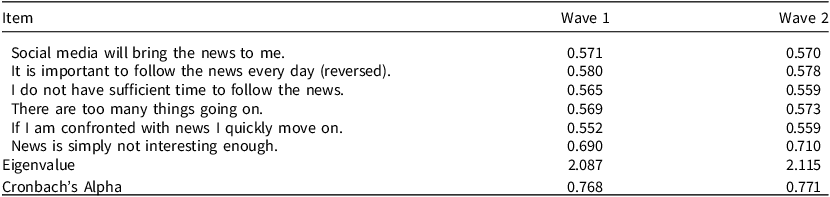
The main independent variable in the analysis is based on an adapted measurement scale of news avoidance (Goyanes, Ardèvol-Abreu and Gil de Zúñiga, Reference Goyanes, Ardèvol-Abreu and Gil de Zúñiga2023). As in this election survey, only one scale could be devoted to the phenomenon of news avoidance, this had to be the most concise measurement instrument possible, with as a result that making further theoretically relevant distinctions in this concept, was not possible within the data from this survey. In this six-item scale, three components of news avoidance were therefore included. Some questions probe into considerations of time pressure, others refer to negative emotions about current events, while the “news finds me” perception (where respondents have the opinion that news will automatically reach them by means of social media), is also included (Strauß, Huber and Gil de Zúñiga, Reference Strauß, Huber and Gil de Zúñiga2021; Andersen et al., Reference Andersen, Shehata, Skovsgaard and Strömbäck2026). Research based on web tracking suggests that these kind of questions on reported media consumption are closely related to actual, observed media consumption (Valli, de León and Makhortykh, Reference Valli, de León and Makhortykh2024). To arrive at a balanced measurement scale, one item (“It is important to follow the news every day”) was added in a positive manner, and despite the fact that this item was formulated in the opposite direction than all the other items, this new item loaded strongly on the extracted factor, showing that respondents answered these questions with sufficient attention. For each statement, respondents could indicate to what extent they agreed on a 1–5 scale, with higher values indicating higher agreement. A factor analysis, presented in Table 1, shows that this scale is strongly one-dimensional, even though the second item was expressed in a positive manner, and was therefore reversed in the coding. Although the survey questionnaire did not include a sufficient number of items to adequately operationalize each and every dimension of news avoidance, the factor analysis shows that this balanced scale is in fact strongly one-dimensional. While we use the measure of the first wave in the analysis below, a robustness test using the measure from the second wave shows an internally coherent measurement scale as well. It is interesting to observe that the “news finds me” item also loads strongly on this scale, despite the fact that Strauß et al. (Reference Strauß, Huber and Gil de Zúñiga2021) assume that this might constitute a distinct factor that is not related to news avoidance. The item with the strongest factor loading is the statement that “News is simply not interesting enough to spend time on it,” which neatly summarizes the main idea of the concept of news avoidance. Note that higher values in this scale denote higher news avoidance. The correlation between a respondent’s score in the first wave and the score in the second wave is 0.75, indicating that this is indeed a rather stable pattern. As the factor loadings of the items are quite similar, we constructed a sumscale, divided by the number of items so the scale ranges from 1 to 5.Footnote 5
Factor analysis of news avoidance

Source: BelREP Panel Study, 2024 (Stiers et al. Reference Stiers, Hooghe, Voets, De Grauwe, De Keyser and Louw2025), n = 5586 (wave 1); 4162 (wave 2).
The most characteristic item in this scale is the statement that news is simply not interesting enough to spend much time on. One might object to this statement, as during the fieldwork for this study, Belgium was the theatre of an intensive electoral campaign, and internationally the wars in Ukraine and in Gaza received substantial news coverage. Nevertheless, it seems that ca. 21 per cent of respondents (strongly) agree with this statement. Levels of news avoidance are about the same in the Dutch and French language groups, even though the media system in both communities is quite distinct.Footnote 6
Besides news avoidance, we include several indicators of political sophistication to test whether the association between news avoidance and ideologically congruent voting is independent from voters’ levels of sophistication. More specifically, we include two indicators of sophistication: political interest and political knowledge. Political interest indicates someone’s motivation to stay informed about politics (Strömbäck and Shehata, Reference Strömbäck and Shehata2019). It is measured on a self-reported scale ranging from 0 (no interest at all) to 10 (a lot of interest). Political knowledge indicates someone’s factual knowledge of Belgian politics, which measures the cognitive dimension of sophistication (Lee and Matsuo, Reference Lee and Matsuo2018). It is measured as the number of correct responses to four factual questions.Footnote 7 For each question, respondents could choose from four possible answers or indicate not to know the answer – which is also coded as an incorrect answer (Jessee, Reference Jessee2017).
In addition, we include various control variables such as socio-demographic characteristics, internal and external efficacy, and region. The socio-demographic characteristics included are gender (1=female), age, and educational level. The measure divides respondents into three groups: the lowly educated (less than completed secondary education – reference category), middle educated (completed secondary education) and the highly educated (higher than secondary education). Internal and external efficacy are included in the analysis because previous studies indicated that ideological proximity can also be influenced by political efficacy (Lau et al., Reference Lau2014). Internal efficacy is measured using two indicators (“I am capable to take part in politics” and “I am capable to play an active part in a group that focuses on political matters” – answers to these questions correlate 0.71). External efficacy consists also of two indicators (“The Belgian political system allows people like me to have a say in what government does” and “The Belgian political system allows people like me to have an influence on politics” – answers to these questions correlate 0.76). Finally, we include a control for region, as both main regions have their own media environment and party system.
Results
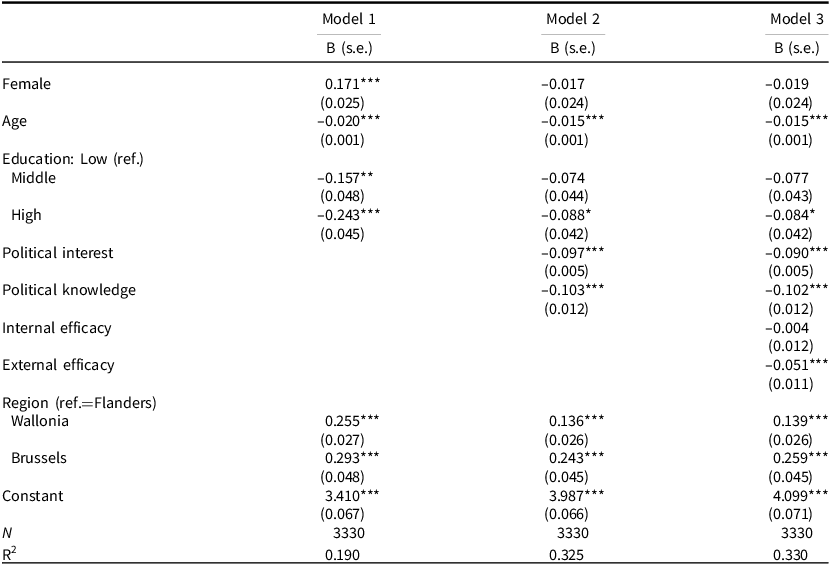
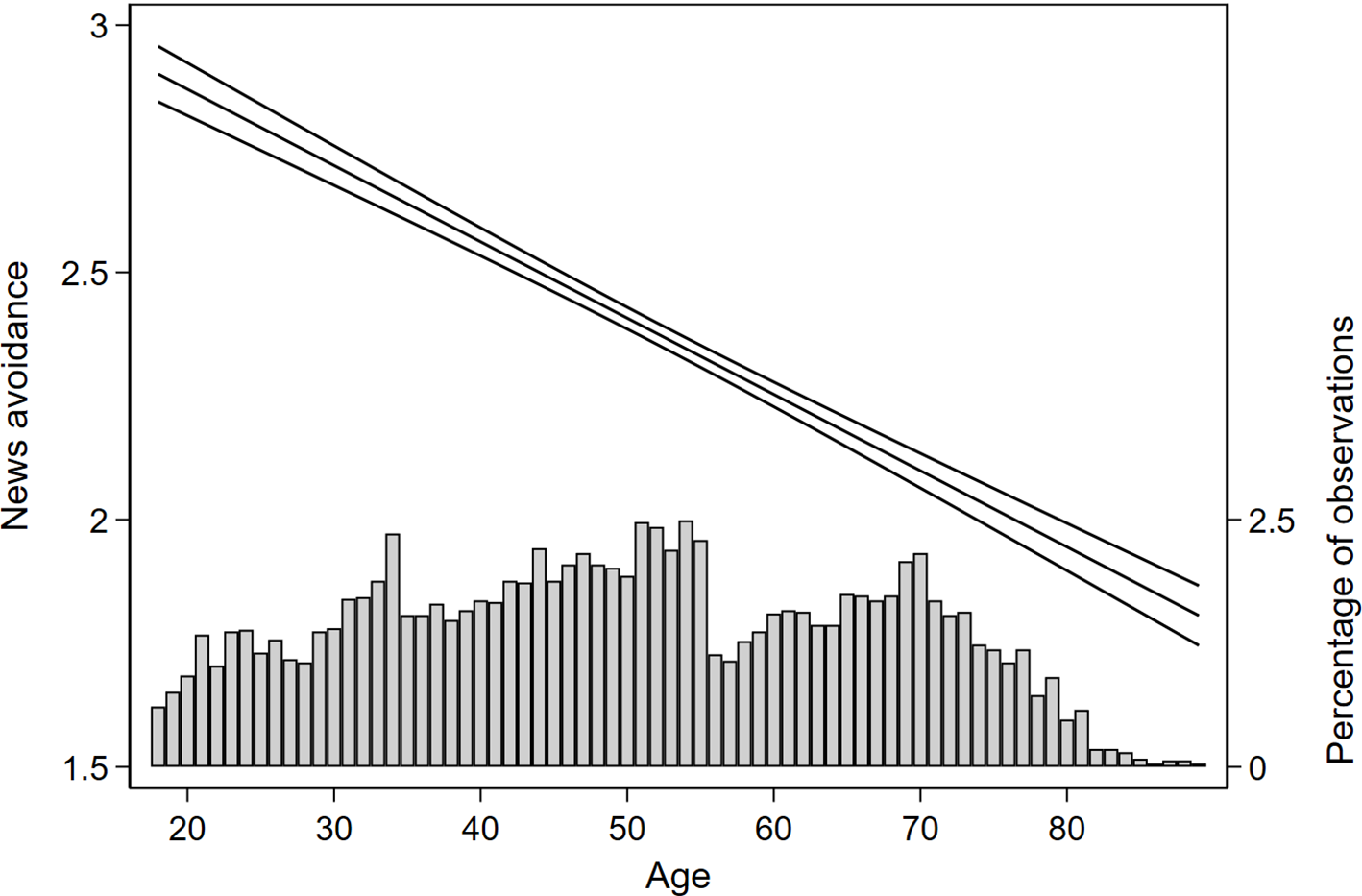
Before testing whether news avoidance is associated with the congruence of the vote, we examine which of our main variables help explaining levels of news avoidance. The results are reported in Table 2. They show that there are several significant predictors of news avoidance. Not surprisingly, those with more political interest and knowledge are less likely to avoid news, and we find the same result for external efficacy as well as among those who are highly educated. A more troubling finding is that, especially the younger age groups are characterized by rather high levels of news avoidance (see Appendix E for a figure displaying this association). As we can assume that this age group is still in the process of forming their opinion about their own political preferences, it is rather surprising that they refrain from seeking more political information which could guide them to a more informed political choice.
Explaining news avoidance

Note: Entries are unstandardized OLS coefficients, standard errors in parentheses. Significance levels: *p < 0.05; **p < 0.01; ***p < 0.001. Dependent variable: news avoidance.
Source: BelREP 2024 (Stiers et al. Reference Stiers, Hooghe, Voets, De Grauwe, De Keyser and Louw2025).
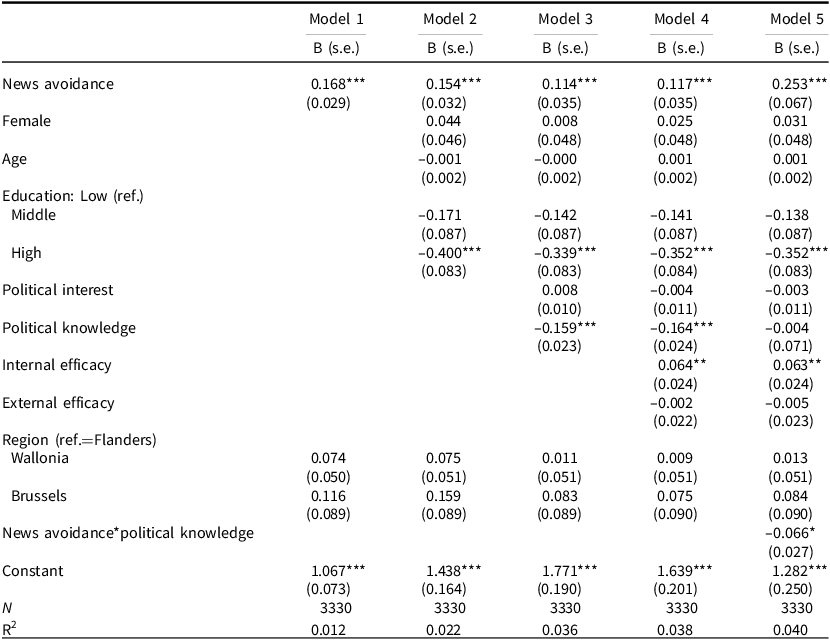
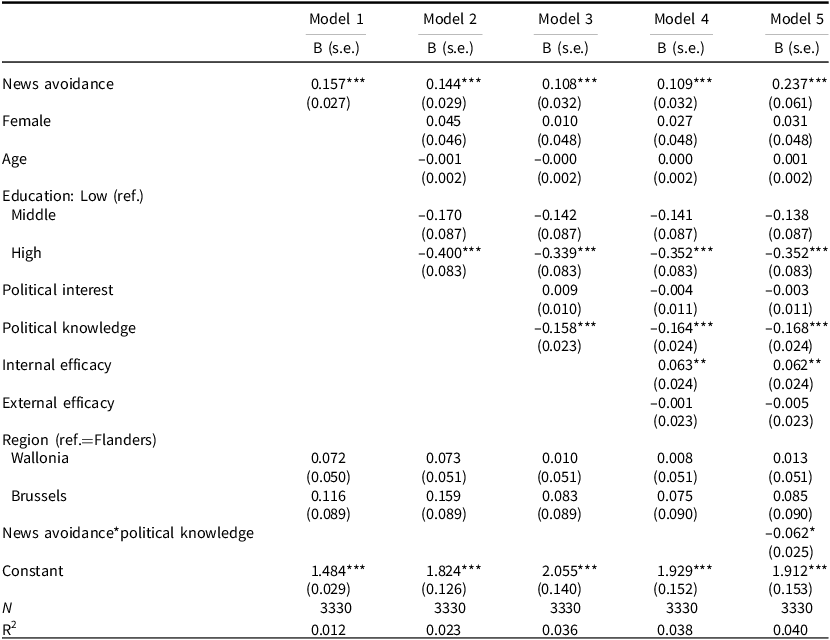
After establishing the correlates of news avoidance, we turn to examining its effect on congruent voting. As our dependent variable, indicating the ideological distance between a voter and a party, is a metric variable, we estimate linear regression models. The results are summarised in Table 3.
The association between news avoidance and ideologically congruent voting
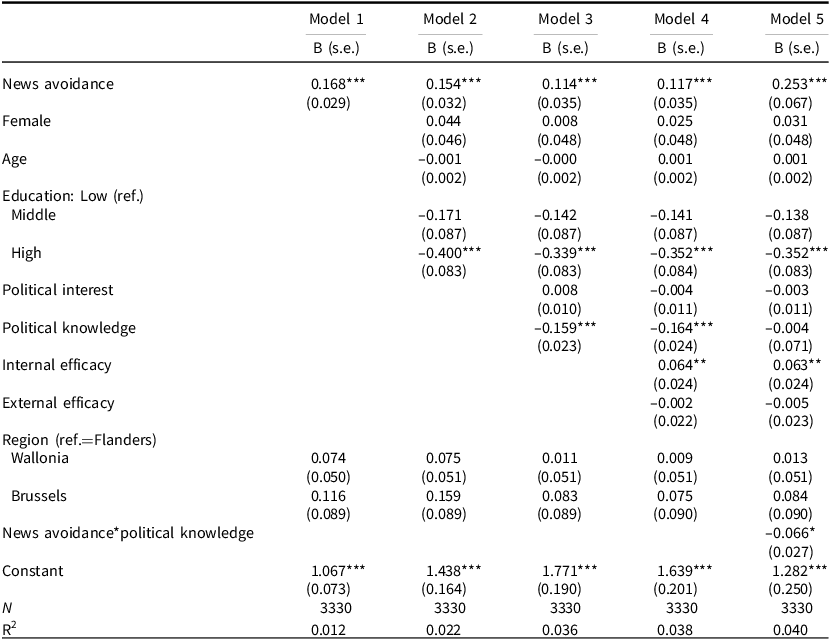
Note: Entries are unstandardized OLS coefficients, standard errors in parentheses. Significance levels: *p < 0.05; **p < 0.01; ***p < 0.001. Dependent variable: ideological distance between respondent and preferred political party.
Source: BelREP 2024 (Stiers et al. Reference Stiers, Hooghe, Voets, De Grauwe, De Keyser and Louw2025).
In Model 1 in Table 3, we only include our indicator of news avoidance, together with a control for region. The coefficient for news avoidance is significant and positive. This indicates that at higher levels of news avoidance, voters span a larger distance to the party they vote for – i.e., the vote is less congruent with their own political opinions. With every one-unit increase in news avoidance, the distance increases with 0.168. Hence, on the full scale of news avoidance the effect is 0.672 – which is about half a standard deviation on the dependent variable. In Model 2, we introduce our socio-demographic controls. These show that the higher educated cast, on average, more congruent votes. For gender and, interestingly, for age, we do not find evidence of significant differences. Importantly, the size of the coefficient of news avoidance remains rather stable. It decreases in Model 3, where we add two measures of sophistication, but it remains positive and significant. As expected, political knowledge is also significantly related to congruent voting: with increasing knowledge comes an increasingly congruent vote. In Model 4, we include additional control variables. Surprisingly, the congruence of voters with more internal efficacy is somewhat lower than those with lower internal efficacy, as this apparently can also indicate a rather idiosyncratic position with regard to electoral politics, that might have a negative effect on ideological congruence (Stapleton and Wolak, Reference Stapleton and Wolak2024).
Finally, in Model 5 we include an interaction effect with level of political knowledge. Our expectation was that beyond a certain threshold of political knowledge, further involvement with political news no longer has an additional effect on the capability to cast an ideologically congruent vote. For those respondents with initially high levels of political knowledge, therefore, news avoidance would not have a detrimental effect on their capability to cast an ideologically congruent vote. The interaction effect is indeed negative and quite strong. Not only is news avoidance negatively associated with political knowledge, but adding insult to injury, we observe that news avoidance has an especially strong effect on those with lower levels of political knowledge, while there is no significant effect among respondents with high levels of political knowledge.
The full effects of the most important variables in Model 3, news avoidance, educational level, and political knowledge, are displayed in Figure 1. It shows that political knowledge remains the most important explanation for ideologically congruent voting, which is in line with earlier studies (Walder and Strijbis, Reference Walder and Strijbis2023). Educational level also increases the congruence of the vote, although the difference is most pronounced for the voters with the highest educational level. Regarding news avoidance, however, the conclusion remains that news avoidance leads to less congruent voting, and this effect remains robust when controlling for very strong alternative determinants of congruent voting.
Effects of main variables on ideological distance between voter and party.
Note: Figures show the congruence of the vote at the different levels of the main variables of interest, derived from Model 4 in Table 3.

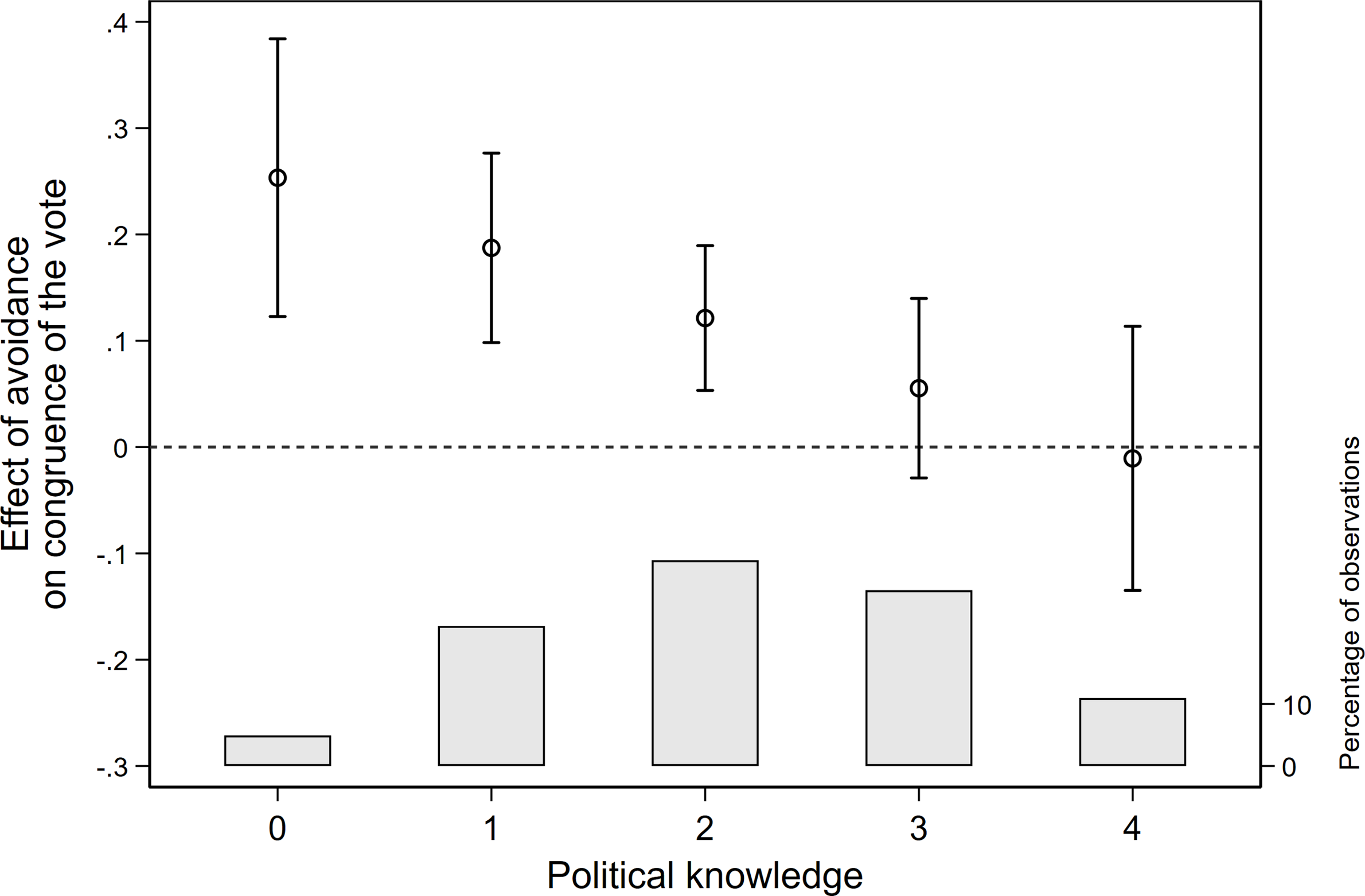
Finally, Figure 2 displays the results of the interaction effect, showing the average marginal effect of news avoidance on congruent voting by level of political knowledge. The figure shows that there is no significant association between avoidance and congruence of the vote at high levels of political knowledge. At lower levels of knowledge, however, there is a strong association, where higher levels of avoidance are related to a lower congruence of the vote. How can we explain this effect? Additional analyses showed that respondents who tend to avoid news consumption indeed score lower on political knowledge. The correlation between both indicators is −0.34. Among those that score 3 or higher on the news avoidance scale, the political knowledge score is on average 1.60, while it is 2.45 for those who score 2 or lower on the avoidance scale. However, the overall effect is even stronger. Those who are inclined to avoid the news not only have lower scores on the political knowledge scale, but we can also observe that the phenomenon of news avoidance has an even stronger detrimental effect on the capability of congruent voting among this group. This suggests some form of a threshold effect: for individuals with relatively high levels of political knowledge, news avoidance does not have any significant effect on their capacity to express a congruent vote. This would imply that this group already has sufficient cognitive resources to make an informed choice, and does not benefit from additional information. If we take a closer look at the results, we can observe that for the respondents with a score of 3 or 4 on our 4-item knowledge test, the effect of news avoidance is no longer significant. For those who already had a lower score, on the other hand, the effect is positive and significant. Note that we conducted additional tests in order to examine which level of knowledge is “sufficient” for news avoidance not to decrease the congruence of the vote. These results consistently point to a substantial difference between respondents answering three or four knowledge questions correctly, and those scoring lower. It seems like a substantial level of political knowledge is therefore essential for congruent voting.
Average marginal effect of news avoidance at different levels of political knowledge.
Note: Results based on Model 5 in Table 3. Dependent variable: ideological distance between voter and preferred party.

Conclusion
Democratic citizenship requires a form of enlightened and informed citizenship: citizens need some form of knowledge and involvement to cast an informed vote (Schudson, Reference Schudson1998). At first sight, the opportunities to acquire political knowledge have sharply increased in recent decades, as the number of information outlets has increased substantially. Rather in contrast to this trend, the phenomenon of news avoidance indicates that citizens increasingly refrain from seeking political news, partly to avoid a news overload or emotional distress. It is important in this regard to remain theoretically neutral, as new forms of communication are often met with scepticism, and in fact this already occurred in the 15th century when the art of book printing made books readily available across Europe (Febvre and Martin, Reference Febvre and Martin1957; Starr, Reference Starr2004). In this article we therefore conducted a very pragmatic test about the democratic and societal consequences of news avoidance: does news avoidance have a negative effect on the process of democratic representation? Representative democracy is essentially based on the consideration that citizens are able to identify the candidate or party that best represents her/his vision on how society should be governed.
The results of the current analysis in Belgium are relevant, both from a theoretical as from a societal perspective. First, it seems that the phenomenon of news avoidance is indeed clearly present in society. Furthermore, it can be observed that this phenomenon is more present among younger age groups, even though these respondents are still in the process of political socialization. The view that is present in the literature, and that assumes that younger age groups simply use other media formats to stay informed, is not supported by the results of the current analysis. Our main finding, however, is that news avoidance is detrimental to the core of the process of democratic representation, an element which had not been investigated so far. As news avoidance has a clear negative effect on ideologically congruent voting, this phenomenon strikes the heart of the process of representative democracy. While in recent literature, the phenomenon of ‘fake news’ and its disruptive effect on elections has received considerable attention, the current analysis suggests that news avoidance might be an equally troublesome phenomenon in this regard. As we had to rely on a rather summary measurement of news avoidance, and we do not have access to long term longitudinal data, this potential implication of our findings should be investigated in a more systematic, long-term manner. It remains to be investigated, furthermore, what exactly causes the trend toward news avoidance. The fact that the Likert-item on news not being “interesting enough” has the strongest factor loading in this scale might suggest that trends toward entertainment apparently are seen as more appealing for media consumption than the informative function of mass media (Postman, Reference Postman1985).
As far as we know, this is the first major study showing that news avoidance has a strong negative effect on the core function of representative democracy. While some studies have suggested that news avoidance only should be seen as a technology-driven adaption, there is now more evidence that this trend might be detrimental to a core function of electoral democracy. The fact that news avoidance is heavily concentrated among young age groups is especially troubling in this regard, as we know that news consumption is also, to a large extent, a matter of life-style habits. Those who do not pick up this habit at a relatively early age, are very likely to continue this form of disengagement later on in their life cycle (Yadamsuren and Erdelez, Reference Yadamsuren and Erdelez2011). The fact that we observe a strong correlation of 0.75 between the news avoidance measurement in both waves of the panel survey, also indicates that this might be an established behavioural pattern. In the same vein, it has been argued that voting, too, is most often a form of habitual behaviour, and those that pick up this habit quite early on, will continue it, even during elections that are not considered as highly salient (Plutzer, Reference Plutzer2002). To a large extent, this corresponds to a virtuous cycle in the formation of good citizenship: for those who have the habit of news consumption, it becomes more easy to vote, and to effectively cast a meaningful vote. The phenomenon of news avoidance, however, completely disrupts this mechanism, as low levels of political knowledge make it much harder to develop an interest in following current events later on in the life cycle (Hasell and Halversen, Reference Hasell and Halversen2024). As news avoidance is concentrated among younger respondents, one might assume that they will never become ‘habitual news consumers’, and it is tempting to predict that this pattern will be continued in the future and consequently further erode the quality of the electoral process. There is a considerable amount of literature on the negative consequences of misinformation and fake news, but the individual level phenomenon of news avoidance has thus far been ignored. Nevertheless, news avoidance has an equally damaging effect on the quality and the functioning of the process of electoral democracy. Among the respondents with rather elevated levels of political knowledge, news avoidance does not seem to have a strong negative effect anymore. As they already have sufficient cognitive resources, it can be assumed that they are sufficiently familiar with politics, and thus able to express a well-informed vote. This is in line with earlier research, suggesting that a ‘sufficient’ level of political knowledge leads to ideologically congruent voting, without any further marginal effects resulting from very high levels of political knowledge (Dassonneville et al., Reference Dassonneville2020).
As a limitation it should be mentioned that Belgium offers a rather complicated party system, which renders the process of ideologically congruent voting more complicated than in two-party systems. In previous research, it has been demonstrated that the concept of ideologically congruent voting can be meaningfully applied in the context of the Belgian party system too (Stiers, Hooghe and Goubin, Reference Stiers, Hooghe and Goubin2020). Therefore, it would be important to also investigate the effects of news avoidance in political systems with a lower number of effective political parties. A further limitation is that, like in most of the research on this topic, we rely on reported behaviour, as respondents indicate to what extent they try to avoid keeping up to date with the news. This kind of measurement is susceptible to errors. Some authors have argued that while the phenomenon of news avoidance refers to attitudes and motivations, it still is possible that in practice those who score high on news avoidance, in fact still consume regularly political news (Toff, Palmer and Nielsen, Reference Toff, Palmer and Nielsen2023). Hence, it would be preferable to observe actual news consumption behaviour, but this would inevitably imply a much more intrusive research design. It also should be noted that in this survey questionnaire, the phenomenon of news avoidance could only be measured with one scale in the questionnaire, with as a result, that we cannot make any further distinctions within that concept, as has been suggested in some of the recent literature (Villi et al., Reference Villi2022). The factor analysis, however, shows that despite these distinctions, the scale is indeed strongly one-dimensional. The results of the current analysis, however, suggest that news avoidance is not just a matter of personal lifestyle choices, as has been suggested in most of the literature. Much more importantly, it calls our attention to the detrimental effects on the fundamental mechanism of representative democracy.
Data availability statement
Replication materials are available on Harvard Dataverse: https://doi.org/10.7910/DVN/U4QVLA.
Acknowledgements
The authors would like to thank Ms. Greet Louw for her cheerful and very accurate support of the BelREP study.
Funding statement
The authors acknowledge the generous support of the FWO Research Foundation Flanders, Grant G059324N, ‘From One Election to the Next’.
Competing interests
The authors declare not to have any competing interests.
Ethical standards
The data collection for the BelREP survey was approved by the Ethical Committee of the University of Leuven, reference PRET G-2024-7856.
Appendix A. Comparison between population and sample statistics
Population and sample statistics
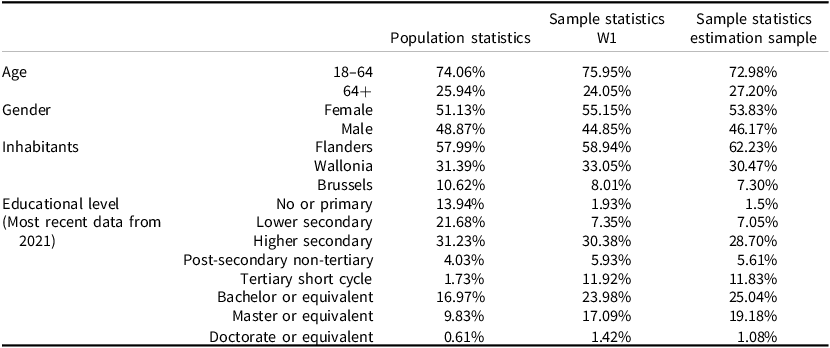
Source of population statistics: Statbel, Belgian Statistical Office. Structure de la Population. www.statbel.fgov.be
Appendix B. Results using factor scores to measure news avoidance
Replication of Table 3 using factor scores to measure news avoidance

Note: Entries are unstandardized OLS coefficients, standard errors in parentheses. Significance levels: *p < 0.05; **p < 0.01; ***p < 0.001. Dependent variable: ideological distance between respondent and preferred political party.
Source: BelREP 2024 (Stiers et al. Reference Stiers, Hooghe, Voets, De Grauwe, De Keyser and Louw2025).
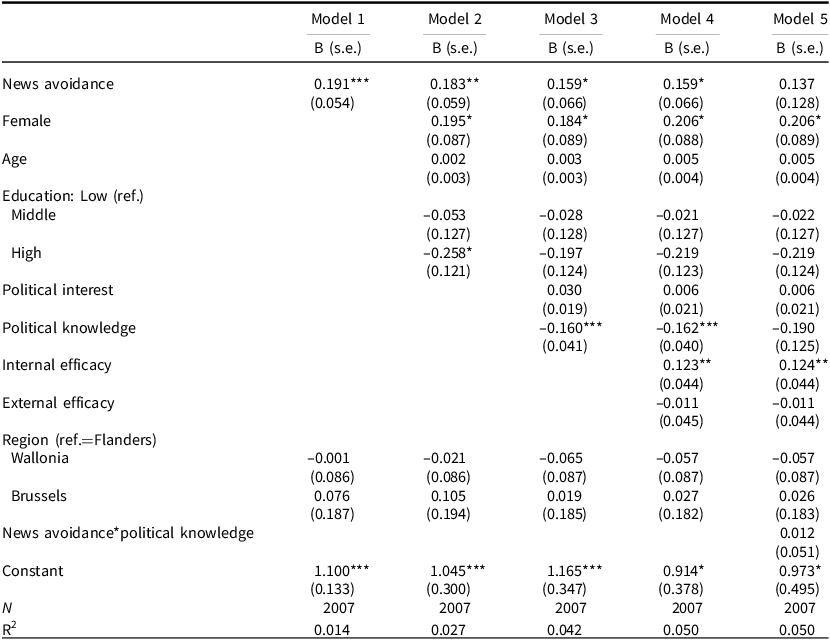
Appendix C. Results using a weight to correct for socio-demographic characteristics and attrition
Replication of Table 3 using a weight

Note: Entries are unstandardized OLS coefficients, standard errors in parentheses. Significance levels: *p < 0.05; **p < 0.01; ***p < 0.001. Dependent variable: ideological distance between respondent and preferred political party.
Source: BelREP 2024 (Stiers et al. Reference Stiers, Hooghe, Voets, De Grauwe, De Keyser and Louw2025).
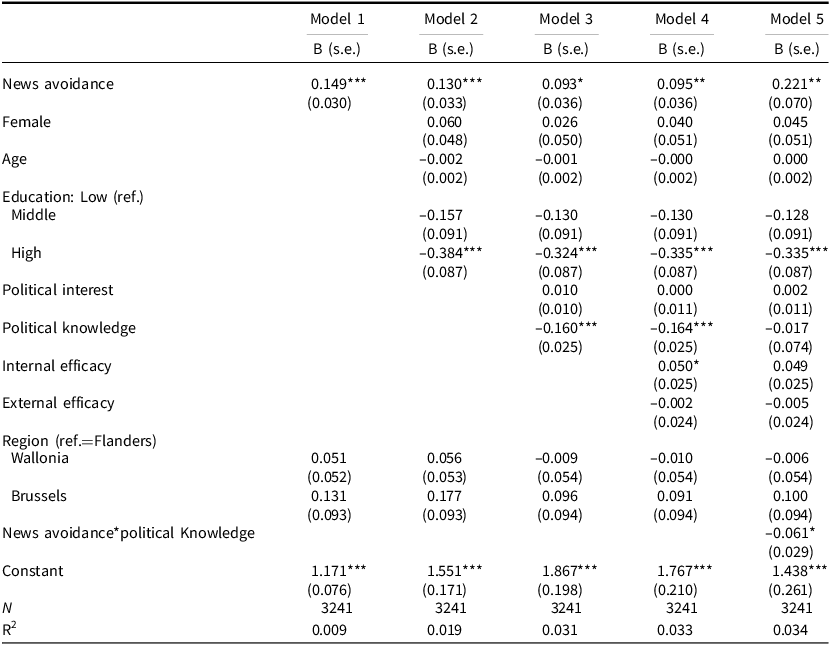
Appendix D. Results using the vote for the European elections
Replication of Table 3 using the European vote
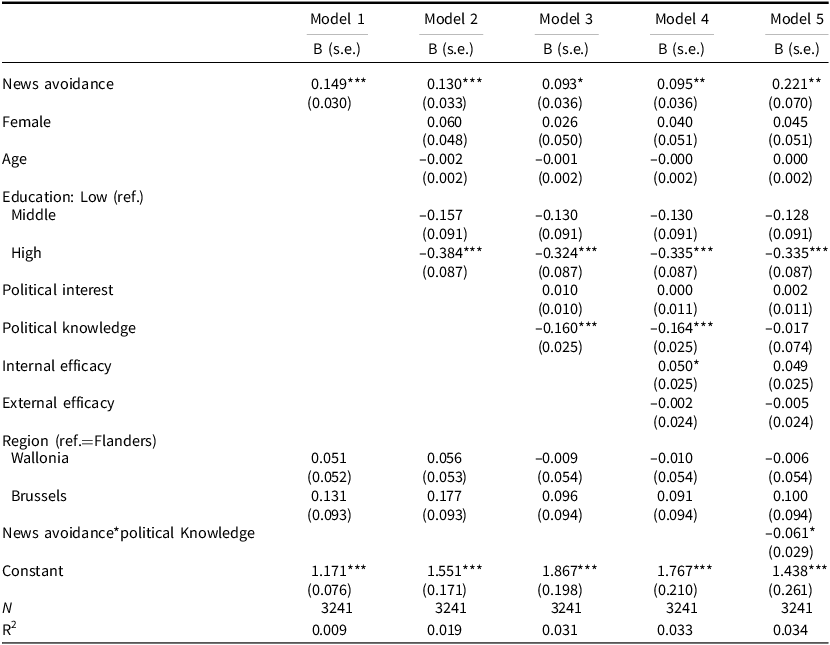
Note: Entries are unstandardized OLS coefficients, standard errors in parentheses. Significance levels: *p < 0.05; **p < 0.01; ***p < 0.001. Dependent variable: ideological distance between respondent and preferred political party.
Source: BelREP 2024 (Stiers et al. Reference Stiers, Hooghe, Voets, De Grauwe, De Keyser and Louw2025).
Appendix E. Age and news avoidance
Age and news avoidance.
Note: Predicted scores on the sumscale of news avoidance (range 1–5), based on Model 3 in Table 2.
Source: BelREP 2024 (Stiers et al. Reference Stiers, Hooghe, Voets, De Grauwe, De Keyser and Louw2025), n = 3330.




 Open access

