


Highlights
-
• Predictors of interest in neurosurgery include participation in relevant case-based discussions and involvement in neurosurgical research.
-
• Work–life balance was the most commonly stated deterrent, while surgical innovation was commonly cited incentive to pursue neurosurgery.
-
• Pre-clerkship neurosurgical electives or medical student interest groups may improve interest.
Introduction
Neurosurgeons and residents commonly cite the field’s operative innovation, endless research opportunities and the ability to provide lasting impact in the lives of their patients when asked about career fulfillment. The sentiment is not limited to neurosurgery as these factors have previously been listed as being among the most admired in other specialties in medicine as well.Reference Alnaami, Ahmad and Khan1,Reference Ekhator and Rak2 Despite these virtues, several studies have highlighted declining interest in neurosurgery.Reference Ekhator and Rak2,Reference Lubelski, Xiao and Mukherjee3 This is in direct contradiction to years past, as neurosurgery was among the most competitive of specialties for residency applications.Reference Lubelski, Xiao and Mukherjee3 Existing literature suggests that the declining interest in neurosurgery among medical students may be secondary to students not being afforded an adequate number of opportunities early in their didactic medical training and a lack of adequate neurosurgical exposure in their respective medical curricula.Reference Agarwal, Norrmén-Smith, Tomei, Prestigiacomo and Gandhi4
Moreover, early-career decisions, often occurring before substantial exposure to surgical specialties, contribute to the challenge of attracting students.Reference Peel, Schlachta and Alkhamesi5 Given that the formative years of training are associated with critical career decisions, this is an important period for medical educators to reassess.Reference Lubelski, Xiao and Mukherjee3,Reference Stumpo, Latour and Traylor6 Additionally, other studies have indicated preconceived perceptions about the field relating to the length of training, concerns about work–life balance and lack of one-on-one mentorship from neurosurgery faculty members as significant deterrents for prospective applicants.Reference Gabriel, Alexander and Kārkliņa7
Mentorship remains important in guiding medical students toward a more complete understanding of specialties, including surgical ones. Positive role models within the field who share similar visions, demographic characteristics, ethnicity and gender with the applicants have been shown to significantly shape and influence students’ career aspirations by instilling confidence,Reference Sandhu, Thompson-Burdine and Nikolian8 reshaping perceptionsReference Shi, Westrup, O’Neal, Hendrix, Dunn and Gernsback9 and fostering a nurturing environment for students who may otherwise be deterred from considering surgical careers.Reference Al-Ageely, Ismail and Al-Araji10
Recently, student-led interest groups have emerged as platforms that foster and connect medical students across different provinces with residents, staff and neurosurgery programs.Reference Arfaie, Laghaei Farimani and Mashayekhi11 The Canadian Medical Student Interest Group in Neurosurgery (CaMSIGN) was founded with the aim of facilitating access to neurosurgical education during the COVID-19 era and has since been involved in various educational initiatives across the country.Reference Arfaie, Laghaei Farimani and Mashayekhi11 An equitable student interest translates to more holistic student recruitment, allowing residency programs to select from a wider pool of applicants with different backgrounds and skill sets. Such platforms provide access to a national body of medical students interested in neurosurgery, offering a unique opportunity to better study patterns in neurosurgery exposure in the medical curricula.
In the current report, we assess Canadian medical students’ varying attitudes and expectations toward neurosurgical training. We hypothesized that an earlier exposure to the field would strongly correlate with higher interest in pursuing a career in neurosurgery. The aim of this study was to identify and quantify the impact of earlier exposure, as well as factors such as demographics, current perceptions toward neurosurgery and the availability of local educational resources on overall interest and familiarity with the field of neurosurgery.
Methods
Survey dissemination and participants
A list of 35 closed-ended and open questions was developed to identify the current landscape of medical students’ interest in neurosurgery. Questions were presented as a combination of open-ended, closed-ended (single choice) or five-point Likert scale (matrix format). Participants were recruited to take part in this quantitative cross-sectional, mixed-method survey from February to September 2024 using email, social media outlets or each individual school’s internal communication. Medical faculties of all Canadian medical schools were contacted to request a systematic distribution of the survey among all enrolled medical students. A participant was defined as a medical student in the first, second or third year who is completing their medical training at any of the accredited Canadian medical schools. The secure REDCap platform was utilized to recruit, collate and store this data. The study was approved by the Research Ethics Board of the University of Toronto (reference no. 45107). The identity of the survey participants was masked by the evaluators.
Data analysis
The primary outcome of this study was overall interest in neurosurgery as a career, rated using a five-point Likert scale. Responses were dichotomized into two categories: high interest (score of 4–5) and low interest (score of 1–3). Early exposure was defined as prior exposure before acceptance into medical school or during the first year of medical training, while late exposure was defined as exposure during the second or third year of medical school. Multivariable logistic regressions were constructed to identify predictors of interest in neurosurgery as a future career. Likert scale points were linearly converted to numeric values between 1 and 5, checkbox options were dichotomized into “yes”/“no” and radio buttons were recorded as distinct categories of the same variable. A full multivariable model was first constructed based on variables that may potentially contribute to overall interest in neurosurgery (i.e., gender, availability of skill workshops, participation in case-based discussions, presence of a home program, access to educational resources). A separate multivariable model with forward stepwise selection of variables using the Akaike information criterion was also constructed to identify the factors that most contributed to overall interest in neurosurgery. Multicollinearity assumptions were verified using variance inflation factors, and no violations were identified. All analyses were conducted using R statistical software (version 4.3.2; RStudio, Inc., Boston, MA).
Results
Participant demographics
A total of 136 students from 14 different accredited Canadian medical schools responded to the survey. This corresponded to a response rate of roughly 1.5% of the estimated 9000 Canadian students currently enrolled in their year 1–3 of medical training. The cohort comprised 57 males (41.9%) and 78 females (57.4%; Figure 1A). Responders’ year of graduation was 2025 for 44 (32.4%), 2026 for 33 (24.3%), 2027 for 38 (27.9%) and 2028 for 21 (15.4%; Figure 1B). All Canadian medical schools, except McMaster University and Northern Ontario School of Medicine, were represented among survey responders. The highest participation rates arose from the University of Toronto, Université de Montréal and the University of Western Ontario with 41 (30.1%), 20 (14.7%) and 19 (14.0%) responders, respectively (Figure 1C).
Responders’ demographic information. (A) Most survey responders (57.4%) were female. (B) Most survey responders’ graduation year was 2025 or 2026. (C) Representation from all but one Canadian medical school was achieved. The most represented schools were the University of Toronto (30.3%), Universtié de Montréal (14.7%) and Western University (14.0%).

Figure 1 Long description
The image contains three donut charts displaying demographic information of survey responders. The first chart, labeled 'Gender,' shows that 57.4 percent of responders are female, 41.9 percent are male, and 0.7 percent prefer not to say. The second chart, labeled 'Expected Year of Graduation,' indicates that 32.4 percent of responders expect to graduate in 2025, 24.3 percent in 2026, 27.9 percent in 2027, and 15.4 percent in 2028. The third chart, labeled 'Responders' Institution,' reveals that the most represented institutions are the University of Toronto with 30.1 percent, Université de Montréal with 14.7 percent, and Western University with 14.0 percent. Other institutions include Université Laval with 5.1 percent, University of British Columbia with 9.6 percent, University of Saskatchewan with 8.8 percent, McGill University with 4.4 percent, University of Alberta with 2.2 percent, Université de Sherbrooke with 2.9 percent, Memorial University of Newfoundland with 1.5 percent, Dalhousie University with 1.5 percent, University of Manitoba with 1.5 percent, and Queen's University with 0.7 percent. The University of Calgary is also represented with 2.9 percent.
Exposure, perception and attitude toward neurosurgery
Overall, 76 (55.9%) responders had prior exposure to neurosurgery, with 11 (8.1%) reporting some exposure prior to medical school. Mean (SD) interest in neurosurgery was 2.9 (1.6), while mean (SD) familiarity with the field was 2.7 (1.2; Figure 2A). Expectedly, early exposure was associated with significantly higher interest in the field compared to late or absent exposure (3.86 ± 1.41 vs. 2.36 ± 1.40, p < 0.001). On the other hand, students with some level of exposure (early or late) were significantly more familiar with the field compared to those with no exposure at all (3.33 ± 1.11 vs. 1.98 ± 0.97, p < 0.001; Figure 2B). Among factors that deterred responders from neurosurgery, work–life balance (94.5%) and family (84.6%) were the most commonly reported options, while surgical innovation was most commonly selected as an attractive neurosurgical topic. Both leadership opportunities (64.3% vs. 41.3%; p < 0.001) and prevalence of morbid outcomes (64.3% vs. 32.5%; p = 0.008) in neurosurgery were more likely to be selected by responders who demonstrated higher interest in neurosurgery as a career (Figure 2C).
Attitudes and perceptions toward neurosurgery. (A) A significant portion of responders had no prior exposure to neurosurgery. A subset of students demonstrated significant interest in neurosurgery, with an even smaller subset reporting being highly familiar with the field (1 = very low, 5 = very high). (B) Students exhibiting higher interest in pursuing neurosurgery were more likely to select leadership as an attractive feature of neurosurgery and morbid outcomes as a potential factor deterring them from neurosurgery.

Figure 2 Long description
The image contains three donut charts. The first chart shows prior exposure to neurosurgery, with segments labeled as Year 1 (28.7 percent), Year 2 (12.6 percent), Year 3 (6.6 percent), Prior to medical school (8.1 percent), and No Exposure (44.1 percent). The second chart illustrates interest in neurosurgery, with segments labeled as 1 (27.9 percent), 2 (19.1 percent), 3 (11.8 percent), 4 (16.2 percent), and 5 (25.0 percent). The third chart represents familiarity with neurosurgery, with segments labeled as 1 (27.9 percent), 2 (19.1 percent), 3 (11.8 percent), 4 (16.2 percent), and 5 (25.0 percent). The bar chart compares attractive and deterrent factors associated with neurosurgery between low interest and high interest groups, with factors including Innovation, Interdisciplinary team, Leadership, Work-life balance, Emotionally detached, Difficult personalities, Morbid outcomes, and Family.
Resource availability
The most abundantly available home-institution resources were shadowing and interest groups, reported by 83.1% and 66.2% of all responders, respectively (Figure 3A). Conversely, one-on-one time with residents and faculty members, access to case-based discussion sessions and mentorship opportunities were only available to 28.7%, 33.1% and 47.8% of responders (Figure 3A). Interestingly, despite 97.8% of participants being enrolled in medical schools with local neurosurgery programs, only 43.4% of all students reported having access to home-institution clerkship rotations. Research experience (i.e., involvement in research projects, number of publications and number of conference presentations) was not significantly different between students who were interested in pursuing a career in neurosurgery and those who were not (p > 0.05; Figure 3B). Surprisingly, a significant portion of students (39.0%) reported discouragement of pursuing neurosurgical research experience from their institutions (Figure 3B).
Access to educational resources and research background. (A) The most accessible educational resources in neurosurgery were shadowing opportunities and interest groups. (B) Academic productivity was not significantly higher among students exhibiting higher interest in neurosurgery as a career. A significant portion of responders reported strong or mild discouragement for neurosurgical research from their medical program.

Figure 3 Long description
The image contains two graphs. The first graph is a vertical bar chart showing the percentage of access to various educational resources in neurosurgery. The resources include shadowing, interest groups, one-on-one resident/faculty access, clerkship rotation at home program, case-based discussion, and mentorship. Shadowing has the highest access percentage, followed by interest groups and mentorship. The second graph is a combination of a bar chart and a pie chart. The bar chart shows research experience and encouragement, with categories for research involvement, publications, and conference presentations. The pie chart illustrates perceived home institution encouragement for neurosurgical research, with segments for highly encouraged, encouraged, neither encouraged nor discouraged, discouraged, and highly discouraged. The bar chart indicates that research involvement is higher among those with high interest compared to low interest. The pie chart shows that a significant portion of responders feel either discouraged or highly discouraged.
Student preferences
Among topics of case-based neurosurgical discussions, knowledge-based exposure was the most commonly selected option, with 127 (93.4%) of all participants showing interest in participating in discussions involving clinical case presentations, diagnosis and patient management (Figure 4A). On the other hand, skill-based discussions (e.g., suturing, surgical technique) were more likely to be selected by students demonstrating higher interest in neurosurgery (82.1% vs. 72.1%; p = 0.023; Figure 4A). Unsurprisingly, students with little interest in a neurosurgical career were more likely to have no specific mentor preferences in terms of practice type (i.e., clinician, scientist, entrepreneur; Figure 4B) and subspecialty (Figure 4C). Among students exhibiting higher interest in pursuing neurosurgery, neuro-oncology (46.4%), functional neurosurgery (39.3%) and vascular neurosurgery (37.5%) were the three most commonly selected mentor subspecialties of choice. These students also most commonly selected surgeon-scientists (46.4%) as preferred mentors (Figure 4B), but half demonstrated no particular preference toward early-career or senior neurosurgeons (50.0%; Figure 4D).
Student preferences. (A) Students with higher interest in neurosurgery demonstrated greater interest toward skill-based case discussions, while knowledge-based exposure was the most popular discussion topic. (B) Students with an interest in neurosurgery exhibited higher interest toward surgeon-scientist mentors. (C) Neuro-oncology was the most commonly selected subspecialty of interest, while students with little interest most commonly had no preference. (D) Responders mostly demonstrated no particular preference toward early-career or senior neurosurgeons, but students with greater interest in neurosurgery were more likely to prefer senior staff mentors.

Figure 4 Long description
The bar graph compares student preferences for neurosurgery discussion topics, mentor practice types, mentor subspecialties, and mentor career stages. The graph is divided into four sections labeled A, B, C, and D. Section A shows student interest in skill-based, knowledge-based, and career oversight discussion topics, with high interest in knowledge-based topics. Section B displays interest in clinical, scientist, entrepreneur, and no preference mentor practice types, with higher interest in surgeon-scientist mentors. Section C illustrates preferences for neuro-oncology, spine, functional, vascular, pediatric subspecialties, and no preference, with neuro-oncology being the most commonly selected. Section D indicates preferences for early career, senior, and no preference mentor career stages, with a slight preference for senior staff mentors among students with greater interest in neurosurgery. The bars are color-coded to represent low interest in red and high interest in blue. All values are approximated.
Predictors of interest in neurosurgery
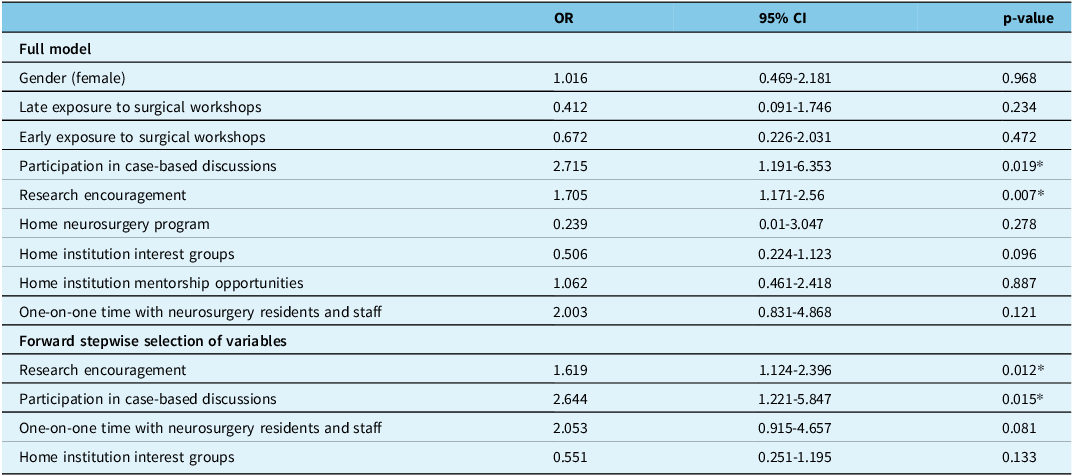
The multivariable logistic regression after forward stepwise selection of variables revealed a higher likelihood of interest in neurosurgery among responders who had participated in case-based discussion on neurosurgical cases (OR = 2.956, 95% CI [1.268–7.160], p = 0.013), had access to one-on-one time with neurosurgery residents and staff (OR = 2.453, 95% CI [1.064–5.798], p = 0.037) and reported greater encouragement for neurosurgical research from their home institution (OR = 1.567, 95% CI [1.083–2.330], p = 0.021). Medical students graduating in 2026 (most in their second year of medical training) also demonstrated a significantly higher interest in neurosurgery (OR = 4.341, 95% CI [1.544–13.078], p = 0.007). Importantly, there was no association between greater interest in the field and gender (OR = 1.016, 95% CI [0.469–2.181], p = 0.968) or presence of home program (OR = 0.239, 95% CI [0.010–3.047], p = 0.278; Table 1).
Multivariable logistic regression model identifying main factors associated with increased interest in pursuing neurosurgery among Canadian medical students

Table 1 Long description
The table presents a multivariable logistic regression model identifying main factors associated with increased interest in pursuing neurosurgery among Canadian medical students. It includes two sections: the full model and the forward stepwise selection of variables. The full model section lists various factors such as gender, exposure to surgical workshops, participation in case-based discussions, research encouragement, home neurosurgery program, home institution interest groups, home institution mentorship opportunities, and one-on-one time with neurosurgery residents and staff. Each factor is associated with an odds ratio (OR), a 95% confidence interval (CI), and a p-value. Notable findings include significant associations with participation in case-based discussions (OR = 2.715, p = 0.019), research encouragement (OR = 1.705, p = 0.007), and one-on-one time with neurosurgery residents and staff (OR = 2.003, p = 0.121). The forward stepwise selection of variables section highlights research encouragement (OR = 1.619, p = 0.012), participation in case-based discussions (OR = 2.644, p = 0.015), one-on-one time with neurosurgery residents and staff (OR = 2.053, p = 0.081), and home institution interest groups (OR = 0.551, p = 0.133). The table provides a detailed analysis of the factors influencing medical students' interest in neurosurgery.
* denotes statistical significance.
Discussion
Despite offering a fulfilling career with cutting-edge innovations, there have been reports of declining interest in neurosurgery among several medical students.Reference Lubelski, Xiao and Mukherjee3 This phenomenon may in part be due to a lack of exposure to the field in medical curricula. Herein, we investigated factors that positively impact medical students’ interest in neurosurgery as a career. Overall, we found that early exposure to neurosurgery is associated with greater interest in the field. More specifically, we report that research encouragement, participation in case-based neurosurgical discussions and one-on-one access to neurosurgery residents and staff were significantly associated with higher interest in the field. Our findings remain well in line with what has been previously demonstrated in the literature.Reference Arfaie, Laghaei Farimani and Mashayekhi11–Reference Tiefenbach, Kaliaperumal and Demetriades13
To our knowledge, this is the largest study, in terms of sample size, assessing medical students’ interest in neurosurgery. This is reflective of a major strength of our study. Our response pool was diverse, which served as an ample, representative sample of Canadian medical students in their first to third year of study. While the majority of respondents had previous exposure to neurosurgery, factors that deterred further pursuit of the field included work–life balance and family, keeping in line with existing literature.Reference Neal and Lyons14 Surgical innovation and novel technologies were listed as common attractive features of neurosurgery.Reference Marcus, Hughes-Hallett, Kwasnicki, Darzi, Yang and Nandi15 We found that of the opportunities and resources available to students, the most common were shadowing opportunities and interest groups. Notably, while the majority of respondents stated that they had a home neurosurgical program, less than half said they had access to home-institution clerkship rotations. This may in part be due to the fact that rotations in neurosurgery are not mandatory in most medical curricula across the country, limiting access and exposure to the field among those who opt not to take neurosurgery electives.
We further found that research experience did not differ between those interested in neurosurgery and those who were not. This is surprising since students who matched into neurosurgery had the highest number of research publications among all US medical graduates.Reference Ahmed and Adashi16 Perhaps this is explained by the smaller number of medical students in total in Canada or speaks more broadly to the lack of research opportunities in Canada compared to the USA. Furthermore, in the absence of other objective metrics with which to evaluate medical students’ residency applications, there has been growing interest in research among Canadian medical students interested in other competitive medical and surgical specialties as well, explaining the smaller gap in research experience between students interested in neurosurgery and those who were not.
Interestingly, a large portion of respondents reported little encouragement for neurosurgical research from their home institutions. The existing literature states that institutions support and encourage students to do research as part of their education.Reference Carberry, McCombe and Tobin17,Reference Rosenkranz, Wang and Hu18 While the result may be different had the study included a greater cohort size, it may point to the difficulties students face when balancing research and medical education, with the latter being a challenging endeavor on its own.Reference Cheung, Bridges and Tipoe19 Several students may also choose to pursue neurosurgery at a later stage during their training, leaving them little time for research with the growing clinical responsibilities. Students in this situation may feel discouraged as they potentially feel behind their peers who pursued research projects earlier in their education.
Although shadowing opportunities and interest groups were abundantly available to most respondents, less than one-third reported access to one-on-one time with neurosurgery staff and residents or participation in neurosurgical case-based discussions. However, the latter were strongly associated with higher interest in the field. It is likely that early exposure and greater interest represent an epiphenomenon, with students with an earlier and stronger interest in neurosurgery seeking earlier exposure compared to their peers. However, previous literature has highlighted the positive impact of early exposure to role models on a favorable perception toward the surgical fields among all medical students.Reference Gawad, Moussa, Christakis and Rutka20 Indeed, participation in technical workshops and clinical case sessions is often one of the only ways for medical students to explore their interest in surgical fields such as neurosurgery prior to clinical rotations. For instance, Zuccato et al. reported an overall improved understanding of neurosurgery among students who participated in the University of Toronto’s Surgical Exploration and Discovery (SEAD) program.Reference Zuccato and Kulkarni21 Interestingly, although overall interest in neurosurgery decreased among most participants, around 21% reported higher interest in pursuing neurosurgery, and 19% expressed desire to further explore the field.Reference Zuccato and Kulkarni21 These findings show that initiatives such as the SEAD program also allow students to make more informed decisions regarding their future careers. Overall, early access to technical workshops, one-on-one time with neurosurgery residents and staff and neurosurgical case discussions are critical determinants of interest in neurosurgery among medical students and represent effective tools for neurosurgery programs aiming to foster early engagement with the field.
Our work shows that involvement in research provides a valuable pathway for medical students to gain early exposure to neurosurgery prior to their clinical rotations. When controlling for other factors, encouragement for research from medical institutions was a significant predictor of interest in the field. Furthermore, neuro-oncology, which has been demonstrated to be the most common area of research among medical students interested in neurosurgery,Reference Barrios-Anderson, Wu and Liu22 was the most popular subspecialty of choice among respondents, particularly among those with an interest in neurosurgery. The importance of research among students stems not only from its integral role in advancing the field of neurosurgeryReference Gélinas-Phaneuf and Del Maestro23 but also from the opportunities it provides for medical students. Research represents the first meaningful exposure to neurosurgery for many medical students and serves as a gateway to connecting with mentors and gaining insight into the specialty. Thus, neurosurgery programs should consider creating accessible research opportunities for medical students at an early stage of their training as an important strategy to enhance exposure and potentially increase interest in the field.
Interestingly, there was no significant association between interest in the field and gender, a fact that may be explained by the growing number of female neurosurgeons.Reference El Naamani, Reyes and Jreij24,Reference Steklacova, Bradac, de Lacy and Benes25 Additionally, our finding that there was no association between greater interest in the field and the presence of a home program was particularly noteworthy. However, with the availability of e-learning, online resources and the possibility of choosing away neurosurgery electives, many medical students are often able to explore the specialty and build meaningful connections regardless of their institution’s offerings.Reference Arfaie, Laghaei Farimani and Mashayekhi11,Reference Kortz, Shlobin, Radwanski, Mureb and DiGiorgio26,Reference Thum DiCesare, Segar, Donoho, Radwanski, Zada and Yang27
The question remains, what can be done at individual neurosurgical programs across Canada to implement these results? Zuckerman et al. (Reference Zuckerman, Mistry and Hanif2016) offer their experience in hosting a neurosurgery elective for pre- clerkship students.Reference Zuckerman, Mistry and Hanif28 Notably, the authors found that the 35 enrolled students were significantly more likely to seriously consider neurosurgery as a future career and have improved perception of the negative stereotypes associated with the field such as quality of life, the ability to have a family and the personalities of attending surgeons.Reference Zuckerman, Mistry and Hanif28 Remarkably, this improved perception was despite the students maintaining their perception of training difficulty. A second strategy was also highlighted by Pugazenth et al. (2022).Reference Pugazenthi, Islam and Sivakumar29 The authors point out that schools with established American Association of Neurological Surgeons (AANS) medical student chapters were more likely to provide students with early exposure to neurosurgery. Therefore, a long-term goal that may be implemented in Canada is to work with the Canadian counterpart of the AANS – the Canadian Neurological Sciences Federation’s Canadian Neurosurgical Society – to establish medical student chapters in each of the medical schools with an associated neurosurgical residency program. A dedicated neurosurgical interest group affiliated with the official national society is a tangible long-term solution that may offer a target strategy to ensure early interest in neurosurgery.
Limitations
Our study was limited by the non-response error and heterogeneity in the pool of students. For example, the University of Calgary and McMaster University each have a three-year program, which may limit their exposure to neurosurgery, compared to their counterparts enrolled in four-year programs. Personal questions regarding socioeconomic status and personal debt were excluded to reduce the risk of participant identification and to minimize social desirability bias. Furthermore, despite our efforts to systematically distribute the survey to all medical students across the country, our overall response rate remained limited (roughly 1.5% of all Canadian students enrolled in year 1–3 of medical training) with overrepresentation from certain medical schools (e.g., University of Toronto, Western University and University of Montreal). This limits the generalizability of our findings and may not accurately reflect the perspectives or experiences of students from underrepresented institutions or regions. The current work also suffers from traditional biases associated with a cross-sectional design. Future studies longitudinally assessing medical students’ interest in neurosurgery throughout their medical training can provide novel insights into changing interest in neurosurgery and help neurosurgery programs tailor mentorship initiatives, curriculum design and outreach efforts aimed at sustaining or increasing interest in the specialty over time. Finally, despite our attempt at a comprehensive assessment of students’ perspectives toward neurosurgery, our survey did not include items directly assessing the impact of factors such as high salaries, prestige or the current lack of job opportunities for neurosurgery graduates on overall perspectives toward neurosurgery.Reference Tso, Max Findlay, Lownie, Chris Wallace, Toyota and Fleetwood30,Reference Elkaim, Niazi and Tso31 Importantly, the latter can deter many talented students interested in neurosurgery from pursuing a career in the field. With little progress being made in the last few years,Reference Elkaim, Niazi and Tso31 assessing medical students’ understanding of the current crisis and their perspectives toward the field can be the subject of future studies.
Conclusion
We conducted the largest study assessing Canadian medical student interest in neurosurgery. We found that earlier exposure to the field is highly associated with greater interest in neurosurgery. Case-based discussions, one-on-one time with neurosurgery staff and residents and earlier and stronger encouragement for neurosurgical research were determinants of higher interest in neurosurgery among Canadian medical students. Institutions looking to increase recruitment of medical students to the field may consider implementing programs that prioritize early, hands-on exposure, mentorship opportunities with neurosurgery staff and residents and structured support for student involvement in neurosurgical research.
Author contributions
SA, FN, RH, ZP and AA wrote and edited the manuscript and contributed to the development of interview instruments equally. RH helped with the statistical analyses. RAB and CM aided in writing the manuscript and developing the survey instrument. FO and SZ contributed to the development of the survey instrument and ensured distribution to the schools and students. SA helped to write the manuscript, contributed to the development of the interview instrument and ensured the distribution of the survey to different medical schools. AK conceptualized the project, edited the manuscript and gave final approval for submission.
Funding statement
The authors have no funding to report.
Competing interests
SA receives royalties from Cambridge University Press.



 Open access

