

Introduction: Making Heritage and History
The increasing interest in mineral resources in Arctic Fennoscandia has been triggered by rising global demand and based on the prior existence of large socio-technical systems for extraction, energy, and transport. In public debates, there has been talk of a “mining boom” (Dale, Bay-Larsen, & Skorstad, Reference Dale, Bay-Larsen and Skorstad2018). Public statistics show the growth in numbers of exploration licenses and applications for mining concessions (SGU, 2012, 2018, 2020). On the ground, it is expressed in prospecting activities, test mining, and consultation meetings with land users and local communities whose future will be affected if new mining commences.
To many residents in the inland communities of the region, future visions of mining may be a promise of employment opportunities and revitalization of settlements otherwise subject to depopulation. To others it may represent a risk for local livelihoods and lifestyles, and a threat of environmental degradation. Social resistance movements, opposing mining projects, have been growing across northern Fennoscandia, organized by a variety of actors from local concerned residents and entrepreneurs to Indigenous and non-Indigenous reindeer herding communities (Mononen & Suopajärvi, Reference Mononen and Suopajärvi2016; Lépy et al., Reference Lépy, Heikkinen, Komu and Sarkki2018; Beland Lindahl et al., Reference Beland Lindahl, Johansson, Zachrisson and Viklund2018; Zachrisson et al., Reference Zachrisson and Beland Lindahl2019). In the public debate, such conflicts have been pointed out as an important factor explaining what the mining industry considers to be too slow permission processes for prospecting and mining, at a time when more minerals are needed to facilitate a global transition to green energy.
A recurring feature in the discourse of competing actors in mining conflicts in the Fennoscandian Arctic is the use of narratives. These are typically about the past and of historical remains, and their purpose is to support competing visions of the future. In this chapter we analyze such practices using the concepts of history making and heritage making. The history and heritage making we analyze concern industrial society. In research and in cultural heritage practice, this field emerged in Britain in the 1950s and developed in the western world in the decades that followed. In Sweden, industrial heritage has increasingly become part of cultural heritage practice since the 1980s. Industrial heritage has been regarded as a tool to bring new life to de-industrializing industrial towns and to support local identity – in other words, to provide societal values out of legacies from the past (Nisser, Reference Nisser1996; Isacson, Reference Isacson2013). In this chapter we will nuance this altruistic understanding of industrial heritage by exploring how actors with competing interests use the industrial past and its remains to build the futures they desire. The aim of the chapter is to understand the role of history and heritage making in conflicts regarding new mining projects. How do competing actors in conflicts connected to mining construct heritage and narratives about history, and why? What are the outcomes of such practices?
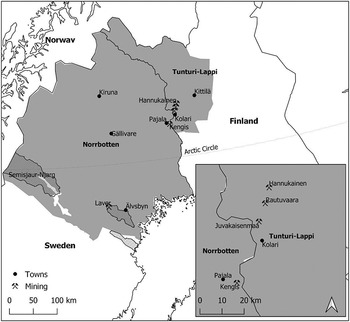
We try to answer these questions by comparing history- and heritage making in two mining regions that have undergone de-industrialization and are subject to re-industrialization: Laver in the Pite river valley in Sweden, and Hannukainen in Kolari municipality in Finland (Figure 10.1). Laver, in Älvsbyn municipality, was a mining settlement. The Swedish mining company Boliden built and operated it between 1936 and 1946. After closure in 1946, the company dismantled the town. When global demand for metals began to surge in the early 2000s, Boliden developed plans to start a new mine at Laver on a fairly large scale. The new project has generated hope for regional economic growth as well as concern for environmental degradation and disruption of Indigenous reindeer herding (Lawrence & Kløcker Larsen, Reference Lawrence and Kløcker Larsen2019).
In Kolari municipality in Arctic Finland, the mining company Rautaruukki Oy first started mining in the underground Rautuvaara mine in 1962 and then in the nearby Hannukainen open pit mine in 1978. Outokumpu Oy owned the mine until mining ceased in 1990. A concentrator plant was kept in operation until 1996 (Pelkonen Reference Pelkonen2018). At the beginning of the 2000s a European exploration and mining company, Northland Resources S.A., planned to re-open the Hannukainen open pit mine, just as in Laver but on a remarkably bigger scale. This became the subject of fierce controversy with local opponents as well as advocates of mining.
Actors on both sides in the controversies have constructed narratives about mining history and connected them with material remains in order to strengthen their positions. In this chapter we will analyze the controversies using concepts from the field of critical heritage studies. We will use the term heritagization, or heritage making, to describe the practice of ascribing historical values to a region, a place, and remains from the past – material and immaterial. We will pay attention to different forms of heritage making. One is official heritagization, meaning processes in which state agencies ascribe heritage values to historical remains and protect them by law. Another is unofficial, when non-state actors, often representatives of local communities, ascribe heritage values to remains and protect them by other means (Harrison, Reference Harrison2013; Sjöholm, Reference Sjöholm2016). A third category is corporate heritage making, when companies ascribe heritage values to their own past (Avango & Rosqvist, Reference Avango, Rosqvist and Nord2021). We will also use the concept of history making, when we can identify the wider process of establishing a particular understanding of the past, often as part of heritage making.
Laver: The Rise and Fall
The Laver area has been inhabited for thousands of years, since the inland ice retreated. The moorlands there are rich in lichen resources. For this reason, the area in and around Laver has been important for Sámi herders whose reindeer graze there during the winter. Archaeological remains reveal that Sámi, now organized in the Semisjaur Njarg Sámi reindeer herding community (RHC), have been part of the region for hundreds of years, and that the area has been used for small-scale farming and forestry for a very long time. Thus, the Laver area forms an important part of the cultural heritage of the Sámi people and of the historical small-scale use of resources that was carried out before industrialization.
There are several factors explaining why Boliden established the copper mine and mining settlement Laver in 1936. The first were concerns within Swedish industry and politics regarding access to metals after the First World War, which had disrupted imports of metals from abroad, causing disruption of production in several branches of industry (Vikström, Reference Vikström2017). To improve access to key metals necessary for Swedish industry, the Swedish state and corporate actors conducted surveys for minerals, particularly in inland areas of the north. The mining company Boliden was formed in the wake of these prospecting activities, and in 1929, Boliden surveyors found copper at Laver. In the early 1930s, the company mapped the mineralization and test mined it. The company was at first hesitant about starting up a mining operation. The size of the rich part of the mineralization was unknown and the cost of establishing a mine was high. The company leadership eventually decided to establish the mine, due to a lack of copper ore at the company’s large smelter facility at Rönnskär. With larger volumes of copper ore available, Boliden would be able to extract more gold from combined gold-copper ores from its other mines in the north (Alerby, Reference Alerby1994).
The mine and settlement were established on a forested hillside and valley floor. The production line for mineral extraction consisted of an open pit mine and an underground mine. The above-ground production line consisted of a hoisting tower, an ore crushing plant, and a concentration plant. Beyond this complex was a large tailing pond in which the company dumped sand from the concentration plant. In other segments of the landscape the company accumulated piles of waste rock (Figure 10.2).

The settlement was built with a high standard of living in order to attract miners to move there for work. The design was commissioned to John Åkerlund, the architect who had designed Boliden’s mining towns in other parts of the Swedish north. The Laver settlement consisted of buildings for housing, one to four stories high, all with central heating. It had shops, hairdressers, a community house with cinema, café and a library, a post office, dance arena, restaurant, and a fire station. When fully built the settlement consisted of thirty-one buildings out of which twenty-three were housing units, home to more than 200 inhabitants.
Mining operations at Laver became short-lived, however, due to several reasons. First, from the beginning of the 1940s the mining operations revealed that the body of relatively rich copper ore became thinner the further and deeper the mining operations advanced. For this reason, the company was unable to mine at the same speed as before. At the same time, from 1941 to 1946, the world market prices for copper decreased, particularly after the end of the Second World War. For these reasons, in 1945, the company reported a 500,000 Swedish Krona deficit and decided to close Laver the following year (Alerby, Reference Alerby1994).
Laver: The Afterlife
Without the mine, Boliden had no intention to maintain their settlement at Laver, and the inhabitants needed to find other jobs. The company dismantled all buildings, moving some of them to new locations. By May 1947, Boliden had finished this process. Up until today the remains from the mining past at Laver have lingered on – foundations from buildings and production facilities, as well as waste. Boliden had extracted 1,573 million tons of copper ore and generated waste rock piles as well as a dam containing 1,2 million tons of tailings, located in a valley downhill south of the former mine, covering an area of 12,2 ha. The tailing impoundment contained several toxic materials (Ljungberg & Öhlander, Reference Ljungberg and Öhlander2001; Alakangas, Öhlander, & Lundberg, Reference Alakangas, Öhlander and Lundberg2010). These, as well as the former settlement, slowly fell out of attention in the years following the closure of Laver. The forces of nature continued to interact with the remains from the former mining operations. During the spring melting seasons in 1951 and 1952, the walls of the impoundment eroded away and as much as a quarter of the tailings (Ljungberg & Öhlander, Reference Ljungberg and Öhlander2001) floated out into the water system downstream. According to Alakangas et al. (Reference Alakangas, Öhlander and Lundberg2010), water running through the tailings was led into a former clarification pond. It took another twenty years before any attempts were made to deal with the toxic waste at the site. Over this period, erosion had dug deep ravines into the released waste. In 1974, bulldozers were used to smooth these out. The tailings were covered with lime and fertilizer and seeded with grass (Ljungberg & Öhlander, Reference Ljungberg and Öhlander2001), and a new wall was constructed three kilometers downstream from the dam that broke (Bast & Schück, Reference Bast and Schück2019). Despite these efforts to contain the tailings, substantial amounts of toxic waste continued to be released annually into the waters: cadmium, copper, sulphur, and zinc (Alakangas et al., Reference Alakangas, Öhlander and Lundberg2010). Even into the 2020s, Boliden conducts work to contain and monitor the waste in the valley south of Laver.
While the residues from the mining process at Laver have remained a challenge for Boliden and responsible state agencies, the remains of the former settlement became subject to official heritage making. This was a result of a growing interest in industrial history from the late 1960s in Sweden, in particular working-class history, and in preserving built environments of industrial society as cultural heritage. Through the 1990s and early 2000s, this interest was institutionalized when the National Heritage Board of Sweden launched programs to include industry in the sphere of heritage protection (Isacson, Reference Isacson2013).
In 2004, this program reached Laver, when the cultural heritage department of the Norrbotten County Administrative Board, together with Norrbotten county museum, placed signboards there. The signboards contained photos of the buildings that used to stand on the house foundations, together with texts about the history of the settlement and the buildings. The texts contained a mix of historical facts and narratives about work, everyday life, and production at Laver. The narratives were about pioneering, welfare, quality of life, and faith in the future. The phrase “Welcome to Laver! Walk through Sweden’s most modern society” captures the nostalgia and communicates a sense of pride over a short-lived industrial wonder. The signboard text highlights how the mineworkers and their families had a strong sense of community and how Boliden provided workers with the possibility to have their own community house with the space for clubs, cinema, dance poll, coffee shop, and library. Only one signboard, located by the edge of the open pit mine, focuses on the history of the mining operations. None of the signboards narrate the history of the environmental consequences of the mine and its afterlife.
So, when Boliden re-established its interest in copper mineralization at Laver, the site was a concern for several categories of actors. On the one hand, there was the mining company and the environmental department of the Norrbotten County Administrative Board, who were responsible for dealing with the toxic legacies of the former mine. On the other was the cultural heritage department of the same county administrative board and the Norrbotten county museum who worked with the site and valued it as cultural heritage. Another central actor in the area was Semisjaur Njarg RHC. The Sámi reindeer herders had continued to use lands in the Laver area for winter grazing through the decades after Boliden closed. Another major land user has been the forestry companies. Since the 1950s the forests around Laver have been significantly affected by industrial logging. At the beginning of the 2000s, Pite river was pointed out as a Natura 2000 area. In the management plan it has been concluded that the environmentally harmful leakage from the old Laver mine needs to be minimized to prevent further damage to the sensitive aquatic environment (Länsstyrelsen i Norrbottens län, 2018).
Laver: The Re-birth
In addition to environmental remediation work, Boliden carried out explorations of mineral resources in the Laver area during the 1970s and the 1990s. Driven by the increasing demand for minerals, Boliden restarted exploration in 2008, and in 2014 the company submitted an application for a mining concession for Laver to the Mining Inspectorate. In their environmental impact assessment (EIA), the company described the planned mining activities and their consequences for the environment. The full extent of the proposed mining project would cover an area of approximately 46 square kilometers, including an open pit mine and all installations (Eriksson & Lindström, Reference Eriksson, Lindström, Hämäläinen and Michaelson2014). If the project is realized to the extent described in the application, it would become the largest mining site in Sweden and one of the largest in Europe. The main reason for this is the relatively low mineral concentration, approximately 0.21 percent, which means that relatively large amounts of ore need to be extracted, most of it ending up as waste rock and concentration plant sand. Figure 10.3 compares the extent of the old Laver mine, which closed in 1946, with the new mine Boliden applied for, which is significantly larger.

Boliden has incorporated the history of Laver to become part of the efforts to gain permission and acceptance for their new mine. In public information about the project, Boliden has described the company’s long history of involvement in the area and underlined its historical record of taking social, environmental, and economic responsibilities. Boliden has described their model society with state-of-the-art housing and central heating as the most modern industrial settlement in Sweden. Boliden has also described how their dam broke in the 1950s, and how the company handled this situation (Boliden 1 and 2). The narratives convey the image of a company that took responsibility in the past and thereby can be expected to do so in the future. Boliden has also declared its intention to preserve the material remains of their former mine as a cultural heritage site – a site to bring visitors to, in order to learn about the history and the future of Laver (Anonymous, interview by Pashkevich, Älvsbyn, October, 2019). This is an example of corporate heritage making, which together with Boliden’s use of history is part of the company’s effort to gain social acceptance and permissions for a new mine.
Besides Boliden, there are also other actors who have used the history and material remains of Laver to build support for a new mine, in particular actors within Älvsbyn municipality to whom the potential economic and social spin-offs of Boliden’s project, including job promises, are values of utmost importance. To these actors, old Laver represents a period in the past when the region prospered, a period that Boliden will bring back to life, a reawakening of the phoenix. Although recognizing the environmental impacts from the historic mine, they argue that the dam break never led to any serious poisoning of the ecosystem. Instead, they place the environmental impacts of the historic mine in a narrative working in favor of the new mine, the argument being that the area has already been heavily affected by mining and forestry. In other words, the new mine will not impact any pristine environment (Anonymous, interview by Pashkevich, Älvsbyn, October, 2019).
Municipal actors have also argued that Boliden has a history of maintaining a trustful relation with Sámi reindeer herders, which will contribute to solving land use conflicts between the reindeer herders and the mining company. Boliden’s long history of presence as a mining company in the region means that the company already knows how to “treat these questions with respect and also in connection to the Indigenous issues.” The continuity and good will of the company also promises a good future relation to workers and local inhabitants. To these supporters of the new mine, history holds promises for Älvsbyn to become the next “mining municipality” of Sweden (Anonymous, interview by Pashkevich, Älvsbyn, October, 2019).
The opponents of Boliden’s proposed mining project, including Sámi reindeer herders and environmental groups, also relate to history and heritage. The proposed Laver mine would be located within a winter grazing area used by the family group of Tjidjack. According to Boliden’s EIA, their planned mine would result in the loss of that grazing area. However, Semisjaur Njarg RHC has argued that the company has underestimated the impacts on reindeer herding, because of shortcomings in the process of developing the EIA. A community-based impact assessment, in which Semisjaur Njarg participated, concluded that the mine would have major impacts on their reindeer herding, which is why the RHC oppose Boliden’s plan (Lawrence & Kløcker Larsen, Reference Lawrence and Kløcker Larsen2019). In their argument against a new mine, Semisjaur Njarg has used land use history and its material representations in the landscape. They highlight how their ancestors have utilized the landscape through history, to substantiate their deep relation to the land. They also point out that there are cultural-historical remains that give evidence to longstanding Sámi use of the area, such as old huts and dwelling hearths, and emphasize how these remains remind today’s reindeer herders in Laver that their family and relatives “have been here for hundreds of years.” In other words, to the reindeer herders, they have a heritage in this area that should be preserved and managed for the benefit of future generations. This is an example of an unofficial heritage making, providing building blocks of a longer and substantially different narrative about the past, an understanding of the region’s history that is hard to harmonize with a future in which these lands would become one of the largest industry areas in Sweden. It should be noted that the material remains that the RHC refer to are also an official heritage site, defined as remains of Sámi land use by heritage expertise and protected by Swedish heritage legislation.
Semisjaur Njarg’s line of reasoning is an example of a broader use of historic arguments by RHCs in ongoing debates in Sweden concerning Sámi land rights. It relates to the historical land use of Indigenous peoples. The Swedish Supreme Court has elucidated that Sámi land rights are based on the long-time use of land, and that these rights therefore should be protected as property rights within the Swedish legal system (Swedish Supreme Court, 1981, 2011, 2020). However, even if the character of Sámi land rights has been elucidated through case law, Sweden has regularly been criticized by international human rights institutions that the Sámi people have too little influence over the issues directly involving them, and that their land rights have not been implemented adequately in the Swedish legal system (CERD, 2018, 2020). The Sámi reindeer herders argue that their long-time use of land needs to be accepted and implemented in the Mineral Act and other legislation. Thus, history and cultural heritage, as described by Semisjaur Njarg in the Laver case, are also central aspects of this ongoing debate about Sámi land rights in Sweden (Allard & Brännström, Reference Allard and Brännström2021).
In addition to the RHC, there is a growing movement in Älvsbyn municipality engaging in ongoing discussions regarding the future of mining in Laver. Pite Älvräddare (in English: Saviors of Pite river) is an organization that is part of the national NGO “Swedish Society for Nature Conservation.” The group was formed in 2015 in response to Boliden’s mining plans. As they are concerned about potential environmental risks, they have worked to build opposition to the new mine, also by history and heritage making. To the River saviors, Boliden’s efforts to deal with the environmental impacts of their historic mine, that is, the tailings outwash from the 1950s, is an act of “greenwashing,” meant to pave the way for gaining the necessary permits for their new mine. They argue that the environmental impacts from the historic mine provide evidence that the new mining operations could have catastrophic consequences for water quality, not only for the surrounding territory of the mine, but for the whole Pite river basin downstream from the mine, including drinking water for the town of Piteå with a population of more than 40,000 inhabitants (Anonymous, interview by Avango, Pashkevich & Rosqvist, Älvsbyn, October, 2019). The risk, they argue, will increase with climate change-induced increase of precipitation, which could force a release of toxic water from the tailings of a future mine.
The group also brings local and regional politicians to the historical remains of the old Laver mining area, along with groups of allied environmentalists, to show material evidence of negative environmental impacts of mining operations. To them, the historical remains of Laver prove that even after almost seventy years, the consequences of mining remain and will remain for many centuries to come. Their strategy can be seen as another example of unofficial heritage making, serving as a resource for building counternarratives about the relation between past and future mining. Interestingly enough, the river saviors do not focus their visits on the remains of the mining settlement, but instead on the remains of the tailing dams that collapsed in the 1950s (Anonymous, interview by Avango, Pashkevich & Rosqvist, Älvsbyn, October, 2019). In other words, they utilize another part of the story of the industrial past and a different material representation of that history – a history and heritage that official and corporate heritage makers have chosen to leave undercommunicated.
Hannukainen: The Rise and Fall of Mining
Kolari municipality is in the Swedish-Finnish cross border region at the Torne River Valley. This region formed a historically and culturally uniform area belonging to the Kingdom of Sweden until the formation of the Grand Duchy of Finland, an autonomous part of the Russian Empire in 1809. Due to this, Finland shares its early mining history with Sweden. Quarrying of iron ore began in Finnish Lapland in 1662 with the exploitation of Juvakaisenmaa along the river Niessajoki in the current municipality of Kolari. Here, small-scale mining continued sporadically until 1917, the same year Finland declared independence. The ore was processed mostly in the ironworks of Kengis (Köngäs) in the current municipality of Pajala in Sweden. Kengis operated until 1879 (Puustinen, Reference Puustinen2003; Finnish Heritage Agency, 2021; GTK Finland, 2021). Furthermore, the Kolari area provided charcoal for Kengis (Kerola et al., Reference Kerola, Heiskari, Koskela and Mansikka2010). The burning of coal is depicted on the current coat of arms of Kolari, recalling the municipality’s long history of mining.
In the second half of the twentieth century, more deposits of iron were discovered in Kolari, and a new mining era began in Finnish Lapland. The most notable mining development was the ironworks and underground mine of Rautuvaara (1962–1988), as well as a concentrator plant for the nearby Hannukainen open pit mine (1978–1990). Both mines were operated by a state-led mining company, Rautaruukki Oy. Mining had considerable local economic, social, and environmental impacts in Kolari. Both mines had an important role for local employment by generating 250 well-paid jobs (Alajärvi et al., Reference Alajärvi, Suikkanen, Viinamäki and Ainonen1990) with at most 143 workers in 1976 (Figure 10.4). In addition, a wide road and the northernmost train station in Finland was built with a railroad connection to Kolari and finally to Rautuvaara ironworks in 1973 (Alajärvi et al., Reference Alajärvi, Suikkanen, Viinamäki and Ainonen1990). The nearby Äkäslompolo village in Kolari, near the mining area, got its first streetlights.
Number of workers in Rautuvaara (from 1961) and Hannukainen (from 1978) mining sites and number of nights spent in accommodation facilities (excluding camping sites) in the province of Lapland and the municipality of Kolari. Tourism in Kolari began before 1993 but data was published only from 1993.

The time when the mines operated was described by locals as a time of prosperity, especially for the municipal center of Kolari (Komu, Reference Komu2019). The mining company offered housing, public services, and arranged social activities (Alajärvi et al., Reference Alajärvi, Suikkanen, Viinamäki and Ainonen1990), as was the custom at the time among big industrial companies in Finland (Hentilä & Lindborg, Reference Hentilä, Lindborg, Hentilä and Ihatsu2009). Most of the local people working in the Hannukainen and Rautuvaara mines were from the southern part of the municipality, even though the mines were in its northern part. While the northern villages could attract tourists with their fells, the southern villages were left with hard work in forestry and agriculture, hardly ideal for their northern climate, which could explain why the mine attracted workers mainly from the south (Komu, Reference Komu2019). By 1990, both mines were closed due to poor profitability, even though the Rautuvaara mine had received financial support from the Finnish state. To object to the closing of the mine, a petition with over 5,000 names was collected in Kolari (Alajärvi et al., Reference Alajärvi, Suikkanen, Viinamäki and Ainonen1990). The southern part of Kolari took the hardest hit and was left with nothing to replace the loss of an income from industry. As it was described by the locals, shops were closed, apartments left empty, and people moved out.
Hannukainen: The Rise of Nature-Based Tourism
After the closing of Rautuvaara mine in 1988 and Hannukainen mine in 1990, the sites were only lightly restored. Locally, it was wondered why the company Rautaruukki Oy wanted to maintain the sites in good condition, and it was rumoured that plenty of ore was left unextracted. After closure, the open pits in Hannukainen and shafts of Rautuvaara were left to become filled with water, and both sites included waste rock storage. The Rautuvaara mining site also consists of an underground mine, tailings, a settling pond, and a reservoir (Kivinen, Vartiainen, & Kumpula, Reference Kivinen, Vartiainen and Kumpula2018). While in operation, mining activities created disturbance to reindeer herding (Bungard, 2021) and often caused the death of reindeer in train and truck accidents during the transportation of the ore to the processing facilities (Heikkinen, Reference Heikkinen2002: 181–182). According to local herders, reindeer also drowned in tailing ponds that were not fenced. However, after the closure of mining operations, the former mining areas remained deteriorating in the landscape, but there are speculations of potential impacts on nature from the waste rock and tailings of the Rautuvaara mine (Närhi et al., Reference Närhi, Räisänen, Sutinen and Sutinen2012; Pelkonen, Reference Pelkonen2018).
In the 1990s and early 2000s, the Hannukainen site was mostly used for small-scale gravel extraction for construction needs and the old mining infrastructure for small-scale businesses. However, the contributions to local infrastructure by the mines facilitated the growth of nature-based tourism in the northern part of the municipality, which saw the emergence of tourism activities as early as the 1930s, making it a “traditional” livelihood in its own right in the region. The first tourists arrived in the northern fell area and in the Äkäslompolo village in Kolari to enjoy local skiing. The interest of tourists for this region also grew with the creation of the Pallas-Ounastunturi National Park in 1938. The residents in northern villages slowly began to switch from agriculture, fishing, and reindeer herding to small-scale homesteads. While tourism continued to be a small business in the Kolari municipality, the first transitions to full-time tourism happened in 1966 (Niskakoski & Taskinen, Reference Niskakoski and Taskinen2012). From the 1980s, tourism in the area started to noticeably grow, and Äkäslompolo began its development into a tourism village, rarely found in Finland. Along with the big tourism companies, there are still many small homestays in Äkäslompolo, often run by the third generation of tourism entrepreneurs (Komu, Reference Komu2019).
Nowadays, tourism is the most important and growing livelihood in Kolari (3,931 inhabitants in 2021, Statistics Finland, 2021), and the municipality’s public image and economy rely heavily on nature-based tourism. As an example, 48 percent of the municipality’s economy and 40 percent of employment came from tourism in 2011 (Matkailun tutkimus- ja koulutusinstituutti, 2013). Ylläs ski resort center has the fourth biggest annual revenue of all ski resorts in Finland (Jänkälä, Reference Jänkälä2019). Pallas-Yllästunturi National Park2 is the third biggest and the most popular national park in Finland with 563,100 visitors in 2020 (Metsähallitus, n.d.). The critical starting point here is that the Hannukainen mine is located 25 kilometers northeast of the municipal center of Kolari, but only 8 kilometers from heartlands of local nature-based tourism locations and the tourism center of Ylläs and the village of Äkäslompolo.
Re-opening Hannukainen: Mobilizing the past
During the 2000s, there have been two efforts made by two different companies to begin mining in the Hannukainen site. However, both efforts are related to and were built from the arguments that refer to a continuity of local mining heritage. In 2005, the European exploration and development company Northland Resources S.A. began exploring the Kaunisvaara area in Sweden, and the Hannukainen site in Finland, for the purpose of re-opening the mine. However, this effort came to an end in 2014, when Northland Resources S.A. declared bankruptcy. However, in 2015, a new company titled Hannukainen mining Oy was established, and it essentially builds its rhetoric from the ground “of being local.” The founder of the mother company Tapojärvi has its roots in the region in a namesake village and a lake close by. Their plans regarding Hannukainen continue to this day, even though locally there are suspicions that question the company’s ability to finance and operate a mine. In addition, processing the ore and tailings at the Rautuvaara site is a part of the mining plans of Hannukainen Oy, and this sets the current “reopening” plans in another kind of historical continuum: locally feared cumulative legacies of several previous mining cycles (Närhi et al., Reference Närhi, Räisänen, Sutinen and Sutinen2012; Howett et al., Reference Howett, Salonen, Hyttinen, Korkka-Niemi and Moreau2015; Pelkonen, Reference Pelkonen2018).
Due to the impacts of the first mining period in terms of employment and other societal values, many locals consider mining as a cultural heritage: an old and valuable part of local identity and history. The traces and memories of rising living standards regarding previous mining cycles are widely recognized in the municipality, but so are the values of tourism and reindeer herding, and of nature preservation in general. In that regard, Komu (Reference Komu2020) stated that the dilemma is about conflicting visions of how to “pursue the good life in the North.” It can be claimed that the battle is also between reclaiming, understanding, and defining which cultural heritage of the region should be prioritized and secured for local wellbeing. The question is: How can the continuity of nature-based tourism, reindeer herding, nature conservation (especially salmon spawning rivers), Sámi heritage sites (Kirkkopahta, Pakasaivo), and industrial development be reconciled for the future (Northland Mines Oy, 2013)?
The point of view of the Municipality administrations is clear, and they continue to be supportive of the mining plans (Sivula, Reference Sivula2021). In the previous municipal strategy, Kolari was characterized as a “mining and tourism municipality” (Municipality of Kolari, 2012). However, tensions between all local livelihoods, reindeer herding, tourism, and mining, have a long temporal continuum and have reflected even political leanings within the municipality. Tourism entrepreneurs feel that their livelihood never gained much respect from the southern part of the municipality or from the local government compared to the prestige given to mining. An opposition alliance against “reopening” the Hannukainen mine has been formed around the village of Äkäslompolo in recent years and especially a party of local tourism entrepreneurs and second-home owners. Finally, also Muonio Reindeer Herding Cooperative (RHC Paliskunta) joined the alliance, even though in previous years they had preferred to negotiate for better terms to keep up good relations with the other people trying to earn their living in the municipality (Komu, Reference Komu2020). In 2017, the herding community gave a public announcement on a Facebook group Pro Ylläs, where they expressed their opposition toward the planned mine. Their public announcement stated that the land use planning decisions made by the local government would designate an area for mining that is currently being utilized by reindeer herding but the decision was made without negotiating with the herding community (Pro Ylläs, 2017). In addition, a petition against the project has been established that has garnered over 50,000 names (Pikkarainen, Reference Pikkarainen2019), along with another Facebook group “Ylläs ilman kaivoksia” (Ylläs without mines) and a webpage “Pro Ylläs – Ylläs ilman kaivoksia” (www.proyllas.fi), and the tourism entrepreneurs took part in a fund-raising campaign to hire experts for the planning process (Similä & Jokinen, Reference Similä and Jokinen2018).
In the discourses of both parties, one element is common: the utilization of the past to point out their respective arguments. The representatives of the Hannukainen Mining Oy emphasize that the new plan for the Hannukainen mine is located on the old and already altered industrial area. They reason that the open pit already exists as well as the tailing ponds and that the mining area will be just expanded. One of the key arguments of pro-mining people is the economic benefits for the municipality and the expected high rate of employment in the mining industry. Representatives of the mining company like to remind people how many good memories and benefits the previous mines brought to the local population. For that matter, it is interesting to see how Hannukainen Mining Oy refers to the past and to the golden era of mining, for example in their advertising brochures. There are many images and newspaper articles to demonstrate how Rautuvaara and Hannukainen mines were economically valuable for the local community (Hannukainen Mining Oy brochure).
They also advertise Hannukainen Mining Oy as part of the local heritage. In fact, even the company logo resembles the official symbol of heritage sites, that is, the looped square/Saint John’s Arms (Hannunvaakuna) (Hannukainen Mining Oy, 2021). However, the company was established for the purpose of the Hannukainen mine, but it is a subsidiary of Tapojärvi Oy that was established in the village of Tapojärvi near Kolari. The owners of Tapojärvi Oy worked as truck drivers for Rautuvaara mine. The key argument on reconciling possibilities of tourism, reindeer herding, and mining is that they all existed side by side in the past and that they, especially tourism, will benefit from forthcoming new income opportunities due to mining. On the contrary, while the attitude toward tourism has been steadily improving, the plans to re-open the Hannukainen mine have brought back all the old juxtapositions between the north and south of the municipality.
The southern part embraces the opportunity to go back to the “good old days.” They need and would benefit from the jobs and economic activity that would arrive with the mine, but the northern part would have no need nor time for mining-related activities due to their own traditional engagements, tourism and reindeer herding, which both rely on renewable nature: the natural heritage of the region (Komu, Reference Komu2019, Reference Komu2020). However, key here is that in the northern fell area people feel that they would have to bear the environmental consequences of mining, such as ruining of near-by waters and salmon spawning sites, and salmon is one of the local attractions. It is feared that the dust, noise, and lights coming from the mine would repel tourists from coming to the area. The people in tourism feel that their livelihood has never been taken as a serious part of local traditions and as a business that generates considerable revenue for the municipality. The employment in tourism is negatively compared to jobs provided by the mining industry, and the development of tourism in the area was described as a constant battle between the conflicting visions of the northern tourism entrepreneurs and the local government, whose members often came from the southern part of the municipality (Komu, Reference Komu2019).
Reindeer herders have highlighted that reindeer herding has been there from time immemorial, and before herding, reindeer hunting, which can be read from the names of places that are still in use in herding, such as the reindeer work fence in Hangasmaa, a name that originally meant deer trap land (Heikkinen, Reference Heikkinen2002). Herders have also pointed out that the negative legacies from previous mines have already spoiled the environment and natural pastures used by reindeer, and these pastures have not yet fully recovered even from the previous mining cycles. In addition, the Rautuvaara tailing ponds are often visited by reindeer, since one major work fence system for reindeer herding is located nearby, and the new mine would severely disturb the utilizations of another traditional work fence system, the main round-up corral in Lamumaa. One of the key arguments of the opponents of mining is that the size and impacts of the suggested new mine are so different, and that local tourism and reindeer herding has changed as well, so the past successes in reconciling with mining are not comparative. For example, while in the past the tourists were domestic, now a large number of tourists come from abroad and are increasingly environmentally conscious. These changes are due to, for example, other cumulative environmental impacts (Österlin et al., Reference Österlin, Heikkinen, Fohringer, Lépy, Rosqvist and Sörlin2023, see Chapter 5). The argument is that mining belongs to the past, and livelihoods that are based on renewable nature are the future.
Conclusion: Narrating Extracted Places with Contested Futures
There are several similarities between the two cases. Especially in the ways stakeholders with different positions on the future of mining construct and relate to the past. In both Älvsbyn and Kolari, pro- and anti-mining activists have built historical narratives to support their positions and have constructed material remains as a cultural heritage representing their versions of history and how it relates to the present and the future.
The histories they construct differ greatly, however, and so does their choice of objects for heritagization. In both cases, the mining companies and their supporters in the local municipalities of Älvsbyn and Kolari produced historical narratives focusing on aspects of local mining history with positive connotations. In Laver, actors in favor of new mining focused on the history of the settlement, emphasizing the material values created by mining operations at the time. These narratives concern the settlement, the high quality of the housing, the high standard of living, the social cohesion and strong sense of community, and how all of that was lost when the company had to close the mine in 1946. When organizing visits to the area, the company and its allies have also taken visitors to the remains of the former settlement, narrating its history on site and presenting their plans for the future mine. In this way, they have constructed a history and heritage representing a lost utopia, serving as a point of departure for a new narrative about rebirth and a bright future to come.
In Kolari, Hannukainen Mining Oy and municipality politicians who were in favor of a new mine also constructed a historical narrative about the values produced during former mining activities. Their story was different, however, because of the differences in context. Kolari was a settlement before the mine and remained a settlement after the mine. Kolari was not abandoned like Laver but remains, with an economy based on other economic activities such as tourism. Therefore, their narrative was not about a lost utopia, but of a time when life in Kolari was good – people had jobs, a sense of security, and the municipality was bustling with activity. That narrative served as a promise of what a new mine would bring to Kolari, if permitted. Another difference is the fact that neither the mining company nor municipality representatives in Kolari seem to have actively used the remains of the former mines to support their story. Moreover, yet another difference is that at Kolari the Hannukainen Mining Oy has pitched itself as a local player, part of the community and its history, and therefore also honestly committed to its welfare in the future. Boliden has not emphasized their local connections as a company, most likely because there is no need for it. It is common knowledge, from the local level to the national level, that Boliden has been operating mining sites on the territory of the Swedish north since the 1920s. Moreover, it is the same company that operated the historic mine at Laver. Boliden has instead emphasized their local connections by describing a close and respectful relation to the Sámi reindeer herding communities that a future mining operation will affect.
Another feature visible in both the Swedish and Finnish cases is the way the companies deprioritized the environmental impacts of their mines from the historical narratives about utopia and the epoch of mining-generated welfare. This does not mean that the companies have tried to cover up this side of the story. To the contrary, both Boliden and Hannukainen Mining Oy have used the history of environmental impacts as part of a narrative with two major conclusions.
First, the mining companies of today have learned from the experiences of the past, are intent on not repeating them, and are equipped with new knowledge on how to minimize impacts, as well as new technology that reduces environmental risk. It’s a story where learning from the mistakes of the past works as a warranty, which makes the sustainability standards of the present stand out in contrast in a positive way for the companies and their supporters. “In the past we made mistakes, today we do it in a sustainable way.” Mining companies also claim that the mining of the future will be closed systems that would never lead to the contamination of the surrounding environment.
Second, the companies and their supporters use the environmental impacts of the past to argue that their new mines will not damage any pristine environments. The historical remains from mining operations in the past represent an actual environmental starting point, an existing footprint, and the companies will establish their new mines inside of these footprints, affecting a landscape already transformed by industrial exploitation.
Another element of this narrative is that the mining companies will remedy the damage that their predecessors made to the environment. Historic waste rock and tailings will be re-processed in the new concentration plants. In this way, the new mining operations will not only reduce ongoing environmental impacts from past mining but will also make it possible to extract more metals out of the historical remains. In these cases, although the companies are relating to and using historical remains from mining, they are not in the business of heritage making. They are, however, in the business of narrative and physical representation. Old tailings and waste rocks are historical remains that the actors in favor of new mining operations want to get rid of, as they represent an understanding of mining as environmental damage. By transforming these historical remains into metal and re-depositing them in new state of the art sand deposits they also transform this understanding of mining. It is a use of history and historical remains, but it is not heritage making. It is not about preserving remains of history; it’s about transforming them.
It is interesting to note that this practice of excluding the more uncomfortable elements of history from corporate heritage making has its similarity in the way the Norrbotten County Administrative Board has narrated Laver. Only one of their historic sign boards at Laver from 2004 concerns the history of mining. The rest narrate the story of the almost utopian settlement, among the house foundations remaining from the former Laver settlement. None of them contains the history of the catastrophic events from the environmental damage caused by dam breaks in 1951 and 1952.
Those opposed to the new mining operations at Laver and Hannukainen have also produced historical narratives of past mining operations and used the material remains from those activities in their strategies to build opposition. At Laver, only the environmentalists, the River Saviours, have focused on the environmental history of Laver. While being largely non-interested in the history of the settlement and the values it created, the organization focuses on the release of toxic waste in the 1950s. Just like the mining company and its supporters, they brought actors they wanted to convince to the remains of the toxic outwash from the old Laver tailing pond. In this way, the organization has produced a history emphasizing events in the past that are easy to use as an argument for caution regarding the potential environmental impacts of a new mine, the potential release of toxic waste from eroded tailings storage, this time with biblical proportions. They connected this history to physical remains of the mining operations in Laver, providing a physical anchor point for their narrative. At Kolari, the mining opposition follows at times a similar line of argumentation, but focusing more on potential dangers, as there has not been a similar kind of major leakage of tailing ponds comparable to Laver, for example.
The opponents of mining in both cases have also emphasized the difference in size between the historic mines and the new mines the companies want to start there. At Kolari, opponents emphasize that Hannukainen Mining Oy’s is planning a new mine that will be significantly larger compared to the old mine. The two Hannukainen water-filled old open pits, Laurinoja (16 ha) and Kuervaara (5 ha) (Kivinen et al., Reference Kivinen, Vartiainen and Kumpula2018), are together 21 ha, but the current plan for Hannukainen mining site will be approximately 200 ha (Hannukainen Mining Oy magazine). So, it will be a roughly ten times bigger project than the historical one. At Laver, the opposition emphasize that Boliden plans a mine that will be nothing like the old one in size. It will be, if permitted, the largest mine and industrial site in Sweden, covering an area of 46 square kilometers. At Laver, concerns about risk pertaining to toxic waste are central in the comparisons the opposition makes with mining in the past. The tailing pond break at the historic Laver mine released extraordinary amounts of heavy metals and sulphur. The risks connected to the new dam breaks jeopardize water quality and the state of the ecosystems of the Pite river. The concerns expressed by Sámi reindeer herders are not even mentioned and taken as an actual concern by local politicians and municipal officials. At Kolari mine, opponents express similar worries, which are connected with perceived risks for release of mine waste, and especially into the Natura 2000-protected Tornio-Muonio River system. In other words, both the proponents and opponents of mining are producing historical narratives, closely connected to historical remains of former mining, when arguing about the future of mining, but they draw very different conclusions.
In this chapter we have shown that history and heritage making may be a starting point for conflicting narratives connected to the results and effects that mining operations bring to the Arctic. The most prominent of them is the promise of a better future and high incomes for Arctic mining towns in transition (Malmgren et al., Reference Malmgren, Avango, Persson, Nilsson, Rodon and Sörlin2023, see Chapter 11). Another one states that the past can also be a source of conflict, based on irreconcilable narratives connecting the past and the future, creating obstacles to a sustainable future. Both cases, and their narratives, have generated not only an infected debate over the future of the region but also tension regarding the history of modern mining operations and the heritage of the regions. In other words, industrial history and heritage are not neutral entities and do not necessarily contribute to bringing new life to de-industrialized settlements nor any shared local identities.


 Open access