


1. Introduction
Engineering design is an iterative process of problem exploration, concept generation and evaluation (Cross Reference Cross1989). This process of design is not linear (Lawson Reference Lawson2006). It is an activity that evolves through time (Dorst & Cross Reference Dorst and Cross2001). Arguably the most critical time is during concept generation (French Reference French1999). The quality and quantity of concepts generated in this intermediate phase ultimately determine the outcome (Shah, Smith & Vargas-Hernandez Reference Shah, Smith and Vargas-Hernandez2003; Bryant Reference Bryant, Stone and McAdams2005; Helm et al. Reference Helm, Jablokow, Daly, Silk, Yilmaz and Suero2016). There are numerous techniques to enhance the concept generation process (Bohm, Vucovich & Stone Reference Bohm, Vucovich and Stone2005; Jablokow et al. Reference Jablokow, Teerlink, Yilmaz, Daly and Silk2015; Helm et al. Reference Helm, Jablokow, Daly, Silk, Yilmaz and Suero2016). Concept generation techniques rely on diverse procedures, classified into broad categories based on their intuitiveness (intuition and logical steps) (Shah, Smith & Vargas-Hernandez Reference Shah, Smith and Vargas-Hernandez2003), their structure (structured, partially structured or unstructured) (Gero et al. Reference Gero, Jiang, Williams, Duffy, Nagai and Taura2012) and the amount of motivation required from the designer (intrinsic motivation or goal-directed motivation) (Taura & Nagai Reference Taura and Nagai2013; Shealy & Gero Reference Shealy and Gero2019).
Recently, design research has shown a growing interest in using neuroscience tools and methods to better understand the cognition of design ideation (Seitamaa-Hakkarainen et al. Reference Seitamaa-Hakkarainen, Huotilainen, Mäkelä, Groth and Hakkarainen2016; Borgianni & Maccioni Reference Borgianni and Maccioni2020; Gero & Milovanovic Reference Gero and Milovanovic2020). The purpose of the research presented in this paper is to explore how three different techniques, brainstorming (Osborn Reference Osborn1953), morphological analysis (Allen Reference Allen1962) and TRIZ (Altshuller Reference Altshuller1984), influence design cognition in the brain. Concept generation techniques shape design outcomes through their steps and procedures, for example, by increasing or decreasing abstract reasoning, memory retrieval or uncertainty processing (Shealy & Gero Reference Shealy and Gero2019). These changes in cognition are observable in the patterns of activation in the brain (Alexiou, Zamenopoulos & Gilbert Reference Alexiou, Zamenopoulos, Gilbert and Gero2011; Hu & Shealy Reference Hu and Shealy2019). For instance, creative tasks rely heavily on the right prefrontal cortex (Gilbert Reference Gilbert, Zamenopoulos, Alexiou and Johnson2010). Neuroscience offers methods to explore activation patterns in brain regions associated with critical cognitive functions for design (Liang Reference Liang2017; Shealy & Gero Reference Shealy and Gero2019). The paper begins by providing the background for why variability in neurocognition is expected when using these concept generation techniques. This is followed by an outline of the methods used to measure cognitive activation during concept generation. Results provide evidence of significant differences in cognitive activation between the three concept generation methods studied: brainstorming, morphological analysis and TRIZ. The paper concludes with a discussion of potential explanation for these differences, and the conclusion presents opportunities for future studies.
2. Background
2.1. Concept generation
Three well-known design ideation techniques: brainstorming (Osborn Reference Osborn1953), morphological analysis (Allen Reference Allen1962) and TRIZ (Altshuller Reference Altshuller1984) encapsulate different characteristics in terms of ideation intuitiveness and motivation as well as technique structuredness, as Table 1 shows. Such techniques can be used either individually or in groups (Gero, Jiang & Williams Reference Gero, Jiang and Williams2013). Brainstorming was originally developed by Osborn (Reference Osborn1953) as a group concept generation technique, but it can also be used by individuals in solitary situations (Harari & Graham Reference Harari and Graham1975). Brainstorming is characterized as intuitive, unstructured and an inner sense–driven process (Shealy & Gero Reference Shealy and Gero2019). Brainstorming requires the designer to be intrinsically motivated (Shai et al. Reference Shai, Reich, Hatchuel and Subrahmanian2009). In practice, it is the fluid ideation of concepts. A general guideline for brainstorming is to generate as many ideas as possible and suspend evaluation until the next design phase (Daly et al. Reference Daly, Yilmaz, Christian, Seifert and Gonzalez2012). Contrary to our use of brainstorming, TRIZ is a logical, structured and problem-driven technique (Gero, Jiang & Williams Reference Gero, Jiang and Williams2013; Shah, Kulkarni & Vargas-Hernandez Reference Shah, Kulkarni and Vargas-Hernandez2000; Shealy & Gero Reference Shealy and Gero2019). TRIZ requires users to decompose and analyse the problem systematically before generating new concepts. TRIZ offers engineering principles and cataloged solutions (i.e., design reference of 39 engineering parameters and 40 innovative principles).
Comparisons of concept generation techniques.
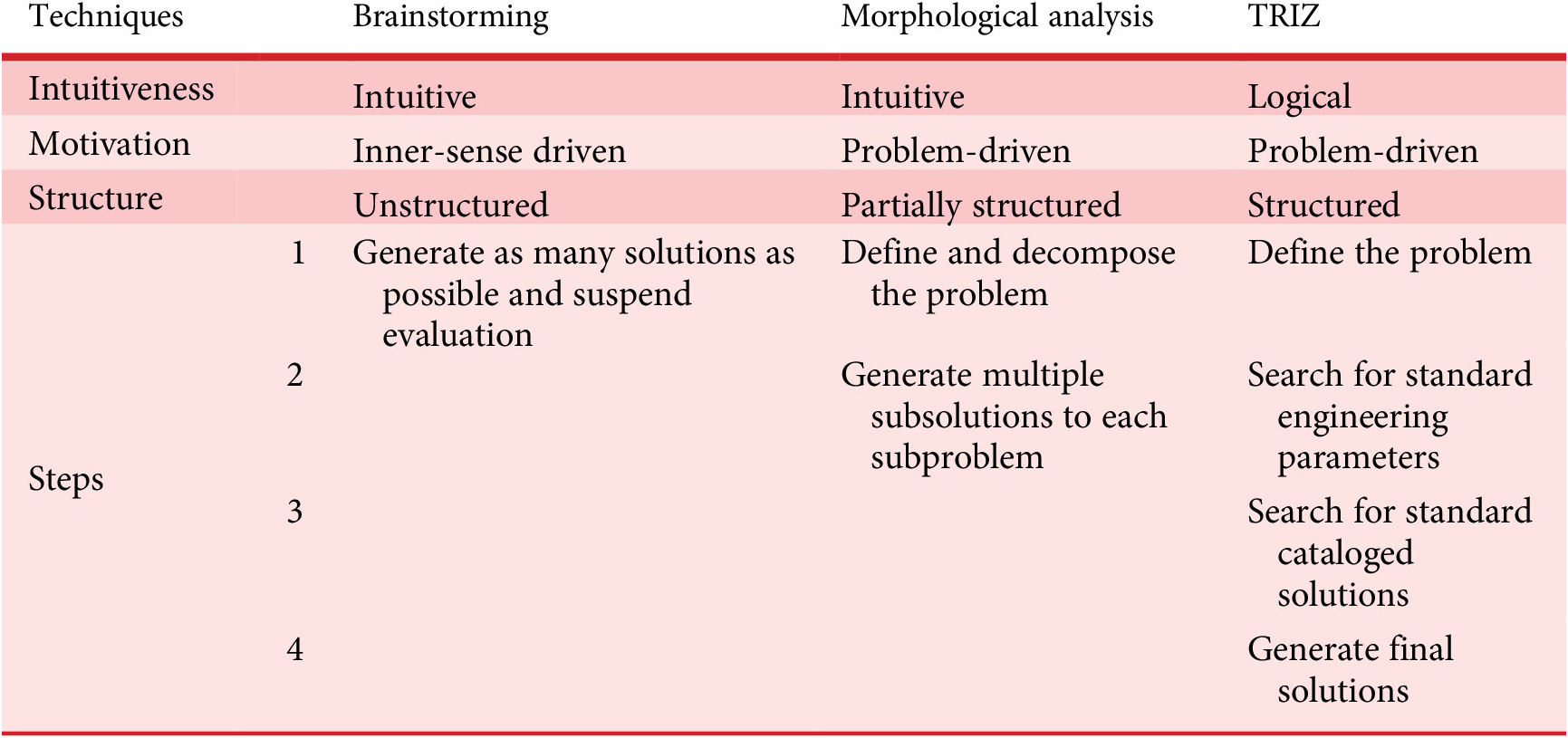
Morphological analysis has some similar attributes to both brainstorming and TRIZ (Gero, Jiang & Williams Reference Gero, Jiang and Williams2013). Morphological analysis, like brainstorming, is an intuitive technique. It relies heavily on association rather than standardized engineering principles (Shah, Smith & Vargas-Hernandez Reference Shah, Smith and Vargas-Hernandez2003). Morphological analysis is also problem-driven, similar to TRIZ. In morphological analysis, a final design is predetermined through decomposition, forced association and a structured combination (Zwicky Reference Zwicky1969).
Concept generation techniques like TRIZ and brainstorming often involve opposing cognitive structures (Gero, Jiang & Williams Reference Gero, Jiang, Williams, Duffy, Nagai and Taura2012). TRIZ tends to increase focus among designers (Gero, Jiang & Williams Reference Gero, Jiang and Williams2013) and can lead to a mental fixation on problem constraints (Gero Reference Gero2011). This fixation occurs because TRIZ is problem-driven and follows logical steps guided by analysis, situational context and constraints (Cross Reference Cross2006; Crilly Reference Crilly2015). Such fixation can unintentionally hinder potential creative leaps that are needed during design (Storm & Hickman Reference Storm and Hickman2015). In contrast to TRIZ, brainstorming enables potential creative leaps by encouraging designers to suspend evaluation and relax constraints. However, the quality of design proposals that are developed through brainstorming is often doubted because of the lack of structure and lack of intermediate evaluation in its process (Howard, Dekoninck & Culley Reference Howard, Dekoninck and Culley2010; Shah, Kulkarni & Vargas-Hernandez Reference Shah, Kulkarni and Vargas-Hernandez2000).
Mental processes in the brain regulate the ability to generate design concepts when using TRIZ and brainstorming (Fink et al. Reference Fink, Grabner, Benedek, Reishofer, Hauswirth, Fally, Neuper, Ebner and Neubauer2009). An assumption about brain function during design is that information is stored in separate cortical modules that have not been previously associated (Alexiou et al. Reference Alexiou, Zamenopoulos, Johnson and Gilbert2009). Composing new concepts elicits connections and communication between disparate regions of the brain (Heilman, Nadeau & Beversdorf Reference Heilman, Nadeau and Beversdorf2003). How and where activations occur in the brain can provide new insight into concept generation (Liu, Nguyen & Zeng Reference Liu, Nguyen, Zeng and Hamza2016; Sweller Reference Sweller1994).
2.2. Cognitive functions in the prefrontal cortex (PFC) relating to concept generation
A critical region for new connections and communication during concept generation is the prefrontal cortex (PFC) (Gibson, Folley & Park Reference Gibson, Folley and Park2009, Gilbert et al. Reference Gilbert, Zamenopoulos, Alexiou and Johnson2010, Goel Reference Goel2014). The PFC is the region of the brain associated with executive control functions (Schneider, Owen & Duncan Reference Schneider, Owen and Duncan2012), attention (Dias, Robbins & Roberts Reference Dias, Robbins and Roberts1996), working memory (Lara & Wallis Reference Lara and Wallis2015), planning and inhibition (Dietrich Reference Dietrich2004). Subregions within the PFC are especially necessary for creative tasks like concept generation (Beaty et al. Reference Beaty, Benedek, Silvia and Schacter2016; Dietrich & Kanso Reference Dietrich and Kanso2010; Dietrich Reference Dietrich2004; Goldschmidt Reference Goldschmidt2016). The right PFC plays an active role in divergent thinking (Aziz-Zadeh, Liew & Dandekar Reference Aziz-Zadeh, Liew and Dandekar2013; Heilman, Nadeau & Beversdorf Reference Heilman, Nadeau and Beversdorf2003; Wu et al. Reference Wu, Yang, Tong, Sun, Chen, Wei, Zhang, Zhang and Qiu2015; Zmigrod, Colzato & Hommel Reference Zmigrod, Colzato and Hommel2015) and sustained attention (Cabeza & Nyberg Reference Cabeza and Nyberg2000). Designers who display high originality in solution generation exhibit strong synchronization within the right PFC (Fink et al. Reference Fink, Grabner, Benedek, Reishofer, Hauswirth, Fally, Neuper, Ebner and Neubauer2009). The left PFC plays a more active role when supporting rule-based design, goal-directed planning (Aziz-Zadeh, Liew & Dandekar Reference Aziz-Zadeh, Liew and Dandekar2013) and making analytic judgments (Hoeft et al. Reference Hoeft, Meyler, Hernandez, Juel, Taylor-Hill, Martindale, McMillon, Kolchugina, Black, Faizi, Deutsch, Siok, Reiss, Whitfield-Gabrieli and Gabrieli2007; Gabora Reference Gabora2010; Luft et al. Reference Luft, Zioga, Banissy and Bhattacharya2017). The left PFC also plays a critical role in solving math problems (Poldrack et al. Reference Poldrack, Wagner, Prull, Desmond, Glover and Gabrieli1999).
The left and right dorsolateral prefrontal cortex (DLPFC) is bilaterally active when performing creativity tasks that require new associations and evaluations (Funahashi Reference Funahashi2017). For instance, activation in the left DLPFC decreases (Tachibana et al. Reference Tachibana, Noah, Ono, Taguchi and Ueda2019) and activation increases in the right DLPFC during improvization (De Dreu et al. Reference De Dreu, Nijstad, Baas, Wolsink and Roskes2012; Kleibeuker et al. Reference Kleibeuker, Koolschijn, Jolles, Schel, De Dreu and Crone2013). The medial PFC (mPFC) and ventrolateral PFC (VLPFC), are also involved in creative design tasks. The function of the mPFC is to learn associations and is observed to play a role in the retrieval of ‘remote’ memories (Euston, Gruber, & McNaughton Reference Euston, Gruber and McNaughton2012). Increased activation in the mPFC is associated with improved ability to simulate future imaginative events (Meyer et al. Reference Meyer, Hershfield, Waytz, Mildner and Tamir2019). The VLPFC is critical for combining existing information into new ideas (Dietrich Reference Dietrich2004; Wu et al. Reference Wu, Yang, Tong, Sun, Chen, Wei, Zhang, Zhang and Qiu2015). The ability to detect similarity between items activates the right VLPFC (Garcin et al. Reference Garcin, Volle, Dubois and Levy2012).
2.3. Identifying coactivation of PFC subregions with brain network
One approach to understand the relationship between patterns of activation in subregions of the PFC is through neural networks. Neural networks are used to describe how and where connections are made spatially between brain regions, and this is used to develop frameworks about brain processing, the activation level of these regions and patterns of coactivation among regions during design (Martindale Reference Martindale1995). For example, distinct patterns of activation in the right parietal and right prefrontal cortex occurred among females during spatial-cognition tasks and left hippocampus in males (Grön et al. Reference Grön, Wunderlich, Spitzer, Tomczak and Riepe2000). The difference in activation patterns by gender is expressed by their neural network connections between brain regions (Grön et al. Reference Grön, Wunderlich, Spitzer, Tomczak and Riepe2000).
Identifying interconnected brain regions that are central for each concept generation technique can also provide evidence about what engineers are doing and thinking during design (Alexiou, Zamenopoulos & Gilbert Reference Alexiou, Zamenopoulos, Gilbert and Gero2011). For instance, TRIZ requires cognitive flexibility to switch between evaluating design principles and imagining the use of these principles with given problem constraints (Savransky Reference Savransky2000). Cognitive flexibility is observed in the brain by higher oscillation between left and right hemisphere dominance in the brain compared to brainstorming (Shealy, Hu & Gero Reference Shealy, Hu and Gero.2018).
A new concept might be missed if requisite brain regions are not sufficiently engaged, and this is also observable in patterns of activation described by neural network connections (Grabner et al. Reference Grabner, Ansari, Koschutnig, Reishofer, Ebner and Neuper2009). For example, an increase in the connections associated with the right DLPFC corresponds to an increase in the number of solutions generated (Hu Reference Hu2018). Performance in the ability to develop new associations when concept mapping is also observable in network connections. Concept maps can reduce the need for coordination in the brain because of a reduction in demand from working memory and an increase in activation in the region of the brain associated with divergent thinking (Hu et al. Reference Hu, Shealy, Grohs and Panneton2019).
2.4. Neuroimaging techniques to measure cognitive activation
Several neuroimaging techniques are available to quantify neurocognitive activation in the brain during concept generation and build models of neural networks. These methods include electroencephalograms (EEGs), functional magnetic resonance imaging (fMRI) and function near-infrared spectroscopy (fNIRS). EEG and fMRI are widely used to study creativity (see Pidgeon et al. Reference Pidgeon, Grealy, Duffy, Hay, McTeague, Vuletic, Coyle and Gilbert2016 for a review) and design studies using such tools focussed on diverse topics such as comparing the neurocognition of mechanical engineers and architects (Vieira et al. Reference Vieira, Gero, Delmoral, Gattol, Fernandes and Fernandes2019a; Reference Vieira, Gero, Delmoral, Gattol, Fernandes, Parente and Fernandes2019b), evaluating mental effort and mental stress while designing (Nguyen & Zeng Reference Nguyen and Zeng2014), the influence of design problem constraints on workload and convergent and divergent thinking (Liu et al. Reference Liu, Li, Xiong, Cao and Yuan2018), the difference between design and problem-solving in the neurological basis (Alexiou et al. Reference Alexiou, Zamenopoulos, Johnson and Gilbert2009), or the role of dorsolateral prefrontal cortex in ill-structured design cognition (Gilbert et al. Reference Gilbert, Zamenopoulos, Alexiou and Johnson2010). fNIRS is a more recently developed neuroimaging technique. It has gained popularity because of its usability in naturalistic environment and resilience to motion artefacts (Balardin et al. Reference Balardin, Morais, Furucho, Trambaiolli and Sato2017; Brockington et al. Reference Brockington, Balardin, Zimeo Morais, Malheiros, Lent, Moura and Sato2018).
EEG has a high temporal resolution (i.e., ability to detect quick changes on the order of milliseconds), mobility and a relatively low initial purchase price (Hu & Shealy Reference Shealy, Hu and Gero.2018). EEG, however, is limited in spatial resolution (i.e., ability to detect where the change in cognitive activation occurs) because the electrical activity measured by EEG goes through multiple layers in the brain and is a mixture of signals from underlying brain sources. The ability to pinpoint specific brain regions with EEG is a challenge (Burle et al. Reference Burle, Spieser, Roger, Casini, Hasbroucq and Vidal2015) and is limited to macro and even hemispherical scales. Recent advances in EEG technology have increased the spatial resolution considerably. In contrast to EEG, fMRI has high spatial resolution with the ability to display cognitive activation in the whole brain. fMRI measures the changes in blood oxygenation level, which is linked to cognitive activity (Gramann et al. Reference Gramann, Jung, Ferris, Lin and Makeig2014). The temporal resolution of fMRI is on the order of seconds due to the blood flow change over time and the time needed for net magnetization recovery before the next sampling (Eysenck & Keane Reference Eysenck and Keane2015). Data collection with an fMRI machine requires participants to remain still and lay down while partially enclosed inside the fMRI scanner and this can be constraining. While studying design with fMRI, a solution is for participants to verbalize their design solutions and subsequently sketch them once out of the fMRI scanner (Hay et al. Reference Hay, Duffy, Gilbert, Lyall, Campbell, Coyle and Grealy2019).
Considering the limited spatial resolution of EEG and less naturalistic experiment environment of fMRI, the study presented in this paper adopted the use of fNIRS. It has relatively high spatial and temporal resolution and is portable. Participants can operate a computer or perform a task in an upright sitting position, similar to EEG. fNIRS has a good spatial resolution compared to EEG but low spatial resolution compared to fMRI. fNIRS does not measure cognitive activity directly rather it measures metabolic demands (oxygen consumption) of active neurons (Herold et al. Reference Herold, Wiegel, Scholkmann and Mueller2018). fNIRS is worn as a cap where light is emitted from sources at specific wavelengths (between 700 and 900 nm) into the scalp. The light scatters before reflecting back to light receivers. The oxy-hemoglobin (oxy-Hb) and deoxy-hemoglobin (deoxy-Hb) absorb more light than water and other tissue in the brain. The change in the difference between the emitted light and reflected light is used to calculate the change in oxygenated blood using a modified Beer–Lambert law. The oxy-Hb and deoxy-Hb are inversely related. Typically, only oxy-Hb is reported because of its relatively higher amplitudes and sensitivity to cognitive activities (Chu et al. Reference Chu, Breite, Ciraolo, Franco and Low2008; Cazzell et al. Reference Cazzell, Li, Lin, Patel and Liu2012; Zhang et al. Reference Zhang, Liu, Pelowski and Yu2017; Hu & Shealy Reference Hu and Shealy2019).
A drawback of fNIRS is the limited power of light emitter, which makes it unable to capture subcortical activation in the brain, unlike fMRI. However, areas relevant for design neurocognition, such as the PFC, associated with executive function and working memory, are sufficiently accessible with fNIRS (Fuster Reference Fuster1988). For example, fNIRS can adequately capture the ability to think in systems (Hu et al. Reference Hu, Shealy, Grohs and Panneton2019) and make decisions (Hu & Shealy Reference Hu and Shealy2019; Shealy & Hu Reference Shealy and Hu.2017).
The research reported in this paper aimed to assess how the attributes associated with the three concept generation techniques change how information is cognitively processed and influence the dominant use of specific regions in the brain. The use of fNIRS enables measuring neurocognitive activation during design. It acts as a proxy for neurocognition by measuring change oxy-Hb (Herold et al. Reference Herold, Wiegel, Scholkmann and Mueller2018). Change in oxy-Hb provides evidence of the changes in cognitive demand patterns and functional coordination (e.g., abstract reasoning and evaluation) when designers generate concepts and how patterns of neurocognition and neurocoordination vary between techniques.
3. Research questions
The study described in this paper aimed to assess how brainstorming, morphological analysis and TRIZ changes how specific brain regions are activated in the PFC. The specific research questions are:
-
1. What is the effect of brainstorming, morphological analysis and TRIZ on cognitive activation in the prefrontal cortex?
-
2. What regions within the prefrontal cortex are most central during concept generation when using brainstorming, morphological analysis and TRIZ?
-
3. How does cognitive coordination across regions in the prefrontal cortex change over time when using brainstorming, morphological analysis and TRIZ?
4. Methods
4.1. Experimental design
Thirty graduate engineering students (all right-handed, 22–26 years old, 10 females and 20 males) were recruited to participate in the study. The procedures followed for this study were approved by the Institutional Review Board. There was no incentive provided for participation. Recruitment occurred through multiple graduate engineering courses at the same institution. All participants reported prior course work in engineering design and were first-year graduate students. Participants completed all three concept generation tasks individually using a different technique (brainstorming, morphological analysis and TRIZ) for each task. None of the participants indicated they had formal training with morphological analysis or TRIZ. Pretask training was provided to introduce the three techniques to participants. The pretask training included verbally explaining the steps of both morphological analysis and TRIZ. Participants were allowed to review the written instructions provided with each design technique. The experiment began with a 15-second baseline period. This baseline asked participants to keep their mind in a rested state. Participants then received one of three engineering design tasks and completed the task at their own pace using one of the three techniques as instructed. The sequence of techniques and design tasks were assigned randomly to each participant. Each participant completed all three design tasks using one of the three techniques. The 15-second baseline period commenced before each design task.
The instructions for brainstorming were for participants to generate solutions for the design task and suspend evaluation of their design. Participants were not provided any additional tool or aid during the brainstorming task. The instructions for morphological analysis were to define and decompose the problem, generate multiple subsolutions and then develop a solution. The instructions for TRIZ were to define the problem, review standard engineering parameters that fit this problem, compare these parameters with cataloged solutions and then generate a solution (see Table 1). The steps for the design process follow previously developed methods (see Gero, Jiang & Williams Reference Gero, Jiang, Williams, Duffy, Nagai and Taura2012; Gero, Jiang & Williams Reference Gero, Jiang and Williams2013 for more details).
The design tasks were not discipline specific and previously demonstrated to require similar cognitive processes to generate a solution (Gero, Jiang & Williams Reference Gero, Jiang and Williams2013). In one of the design tasks, participants were instructed to design a device to assist the elderly with raising and lowering windows. Another design task required participants to design an alarm clock for the hearing impaired. The final design task asked participants to design a kitchen measuring tool for the blind. Participants were instructed to sketch on paper to illustrate their design solutions. Participants were instructed to raise their hand when they were done developing their final solutions and data collection with fNIRS would stop. Observations of participants during the tasks provided some indication about whether participants continued to make progress during the design task. Any participants that appeared to stop during the design or disengage were noted, though this was not an issue for any of the 30 participants. The average time to generate a solution when brainstorming, using morphological analysis and TRIZ, was 7.53 min (SD = 3.25 min), 11.02 min (SD = 4.70 min) and 13.34 min (SD = 5.03 min), respectively. Most participants generated one to three design solutions or subsolutions when using brainstorming, morphological analysis and TRIZ.
Participants were outfitted with the fNIRS cap from LIGHTNIRS fNIRS system (Shimadzu Co., Kyoto, Japan) with a sampling frequency of 4.44 Hz. LIGHTNIRS uses a three-wavelength absorbance calculation (780, 805 and 830 nm) to record a change in participants’ oxygenated hemoglobin. Change in participants’ oxygenated hemoglobin is an indicator of cognitive activation in their PFC as they generated a solution to each design task. The sensor placement on the fNIRS cap is shown in Figure 1. A total of 16 sensors (8 emitters and 8 detectors) were located using the 10/20 international systems and formed a total of 22 channels. A channel is the combination of a light source and a nearby light receiver. This is indicated in Figure 1b with light source and light receiver numbers. It captures the change in oxygenated cortical blood in the brain. These channels cover multiple subregions in the PFC, including dorsolateral prefrontal cortex (DLPFC: channel 1, 2, 3, 9 and 10 in the right hemisphere and channel 5, 6, 7, 13 and 14 in the left hemisphere), ventrolateral prefrontal cortex (VLPFC: channel 16 and 17 in the right hemisphere and channel 21 and 22 in the left hemisphere), orbitofrontal cortex (OFC: channel 18 in the right hemisphere and channel 20 in the left hemisphere) and medial prefrontal cortex (mPFC: channel 4, 11, 12 and 19) in both hemispheres.
A participant with fNIRS cap and sensor configuration.

4.2. Data analysis
Three out of the 30 participants were removed from the analysis because of a weak signal during the experiment. In this study, we compare the idea generation phases for each technique. Therefore, for brainstorming, we considered the entire session, for morphological analysis, we analysed the third step of this technique of multiple subsolutions generation (see Table 1) and for TRIZ, and we analysed the fourth step that focusses on generating final solutions (see Table 1). This way, we are able to compare the ideation phase of each technique.
fNIRS raw data for the remaining 27 subjects were processed using a bandpass filter (frequency ranging between 0.01 and 0.1 Hz, third-order Butterworth filter) to remove high-frequency instrumental and low-frequency psychological noise (Huppert et al. Reference Huppert, Diamond, Franceschini and Boas2009). To reduce motion artifacts, participants were instructed to keep their head motion to a minimum, additionally an independent component analysis with a coefficient of spatial uniformity of 0.5 was applied to remove motion artifacts. The steps of noise and motion artifacts removal are critical to avoid false discovery in brain network and connectivity analysis (Santosa et al. Reference Santosa, Aarabi, Perlman and Huppert2017). The parameters in data processing are based on prior research (Sato, Hokari & Wade Reference Sato, Hokari and Wade2011; Naseer & Hong Reference Naseer and Hong2015). The filtering process was conducted using Shimadzu fNIRS software, and the following analysis was conducted using Python (NetworkX package was used for the network analysis). Only oxygenated hemoglobin (oxy-Hb) in the filtered data is reported in the results because oxy-Hb generally has a higher amplitude and is more sensitive to cognitive activities than deoxygenated hemoglobin (deoxy-Hb) (Chu et al. Reference Chu, Breite, Ciraolo, Franco and Low2008; Cazzell et al. Reference Cazzell, Li, Lin, Patel and Liu2012; Zhang et al. Reference Zhang, Liu, Pelowski and Yu2017; Hu & Shealy Reference Hu and Shealy2019). Then, the baseline correction is applied in which the mean oxy-Hb during the baseline rest period was subtracted from the oxy-Hb during the tasks for each channel.
To answer the first research question, two methods were used to measure neurocognitive activation in the prefrontal cortex when using brainstorming, morphological analysis and TRIZ. First, the positive area under the curve (AUC), as illustrated by the shading in Figure 2, was calculated for each participant when using each design technique. Blood oxygenation level dependent-local field potential (BOLD-LFP) coupling model suggests that positive BOLD responses (i.e., increased oxy-Hb) correspond to actively actuated increase in blood flow in support of neural activity (Ekstrom Reference Ekstrom2010; Bartra, McGuire, & Kable Reference Bartra, McGuire and Kable2013). Therefore, the cumulated amplitudes of oxy-Hb (i.e., AUC) were used as an indicator of cognitive load, which was used in prior literature to evaluate cognitive load (Manfredini et al. Reference Manfredini, Malagoni, Felisatti, Mandini, Mascoli, Manfredini, Basaglia and Zamboni2009; Agbangla, Audiffren & Albinet Reference Agbangla, Audiffren and Albinet2017; Suzuki et al. Reference Suzuki, Suzuki, Shimada, Tachibana and Ono2018). In addition to the positive AUC, the absolute AUC was also calculated. Similar findings between the positive AUC and absolute AUC were observed. The positive AUC is a better predictor to classify high and low mental workload in prior brain–computer interface studies (Verdière et al. Reference Verdière, Roy and Dehais2018). So, the positive AUC results are reported. The positive AUC for all channels was used for comparison between the concept generation techniques and is described in the results as the overall cognitive load in the PFC (Manfredini et al. Reference Manfredini, Malagoni, Felisatti, Mandini, Mascoli, Manfredini, Basaglia and Zamboni2009; Agbangla, Audiffren & Albinet Reference Agbangla, Audiffren and Albinet2017; Suzuki et al. Reference Suzuki, Suzuki, Shimada, Tachibana and Ono2018).
Area under the curve and mean value of Oxy-Hb.

AUC was also used to compare hemisphere asymmetry between the left and right PFC (Toga & Thompson Reference Toga and Thompson2003; Runco Reference Runco and Runco2014). The AUC of 10 channels in the right PFC and 10 channels in the left PFC were averaged respectively to calculate a proxy for cognitive load in the right and left hemispheres. Analysis of variance (ANOVA) was used to measure the statistical difference in the AUC across the PFC and the left and right PFC for each concept generation technique. Significance was defined as p < 0.05. The effect size for the significant difference was measured by η 2 (Eta squared) for ANOVA. The difference is regarded as large when η 2 is greater than 0.138 (Cohen Reference Cohen1977). We performed a normality check using the Shapiro–Wilk test before the ANOVA analysis. The purpose of the normality check was to confirm the data were normally distributed.
The second measure for cognitive activation was the mean value of oxy-Hb illustrated by the dotted line in Figure 2. We created one mean oxy-Hb for each design technique. To do this, we used a fractioning technique based on the function-behaviour-structure (FBS) design ontology framework (Gero Reference Gero2010; Gero, Jiang & Williams Reference Gero, Jiang and Williams2013). The purpose of this fractioning was to normalize the concept generation sessions over time. This normalization was necessary because each concept generation phase had a different length of time. The fractioning technique divided the design session for each design task for each participant into 20 equal and nonoverlapping segments or ventiles. Participants’ mean oxy-Hb was then calculated for each ventile. The length of ventiles varied for each participant because the time they spent during concept generation varied. All of the participants’ ventiles were then averaged together to create an average oxy-Hb for each of the design techniques. The use of 20 segments for the average oxy-Hb follows prior design cognition studies (e.g., EEG studies and design protocol studies) (Gero, Jiang & Williams Reference Gero, Jiang and Williams2013; Jiang et al. Reference Jiang, Gero, Yen and Gero2014; Kan & Gero Reference Kan and Gero2017; Milovanovic & Gero Reference Milovanovic, Gero, Marjanovic, Clarkson, Lindemann, McAloone and Weber2018; Shealy & Gero Reference Shealy and Gero2019). ANOVA was then used to measure the difference in the patterns of oxy-Hb in the PFC for the 20 ventiles (including left and right DLPFC, VLPFC and mPFC). Significance was defined as p < 0.05.
To answer research question 2, graph theory (Wijk, Stam & Daffertshofer Reference Van Wijk, Stam and Daffertshofer2010) was used to understand what regions within the prefrontal cortex are most central and the coordination required between brain regions during concept generation (Bullmore & Sporns Reference Bullmore and Sporns2009; De Vico Fallani et al. Reference De Vico Fallani, Richiardi, Chavez and Achard2014). Pearson’s correlation matrices were developed using the change of oxy-Hb in all channels following the common steps in prior studies (Achard & Bullmore Reference Achard and Bullmore2007; Bullmore & Sporns Reference Bullmore and Sporns2009) during each design task for each participant. Correlation matrices were averaged across participants when using the same design technique. A range of plausible global threshold coefficients (incrementally from 0.6 to 0.7) as used in prior studies (Achard & Bullmore Reference Achard and Bullmore2007; Bullmore & Sporns Reference Bullmore and Sporns2009; Bressler & Menon Reference Bressler and Menon2010) were considered as connective functions (De Vico Fallani et al. Reference De Vico Fallani, Richiardi, Chavez and Achard2014; Fornito, Zalesky & Bullmore Reference Fornito, Zalesky and Bullmore2016; Bassett & Sporns Reference Bassett and Sporns2017). Correlations higher than the threshold coefficients indicate a correlative and potentially functional relationship between synchronized activation of different brain regions. Links were drawn between channels (called nodes in a network) when the correlation coefficient was higher than the threshold. These steps are illustrated in Figure 3. All the links (i.e., connections between channels) and nodes (i.e., 22 channels) form a network. For each ventile during brainstorming, morphological analysis and TRIZ, a PFC functional network was developed based on the participants average Pearson correlation matrix following the steps illustrated in Figure 3.
Brain networks and metrics

The centrality and network density were then calculated to provide descriptive measures of the network. Node centrality describes the nodes with the most edges in the network. Central nodes are critical to efficient communication for task completion (Bullmore & Sporns Reference Bullmore and Sporns2009; Fornito, Zalesky & Bullmore Reference Fornito, Zalesky and Bullmore2016). The density of connections was used to answer research question 3. Network density is the proportion of the number of actual connections to the number of possible connections in a network. It provides an estimate of cognitive coordination within the network (Achard & Bullmore Reference Achard and Bullmore2007). A low network density means low coordination between brain regions. Then the average network density in each ventile for each technique among all participants was calculated. Network densities were compared between the three techniques using ANOVA followed by posthoc analysis using paired t-tests to compare network density between design task for each participant.
5. Results
5.1. TRIZ demands significantly less cognitive load in the prefrontal cortex compared to brainstorming and morphological analysis
The neurocognitive activations when generating new concepts through brainstorming, morphological analysis and TRIZ are significantly different (F(2,57) = 29.5, p < 0.001, η 2 = 0.509) with a large effect size. The positive area under the curve (AUC) of oxy-Hb in the PFC is lower when using TRIZ compared to brainstorming (t = 4.68, p < 0.001) and morphological analysis (t = 7.62, p < 0.001). Morphological analysis elicited significantly more AUC in the PFC than brainstorming (t = 2.94, p = 0.013). AUC is used as one indicator of cognitive load associated with working memory, cognitive flexibility and reasoning. We observed that TRIZ reduces the cognitive load (i.e., the positive AUC) required in the PFC compared to brainstorming and morphological analysis.
These results are consistent when isolating the right PFC. TRIZ reduces the cognitive load (F(2,57) = 36.6, p < 0.001, η 2 = 0.465) required in the right PFC compared to brainstorming (t = 7.38, p < 0.001) and morphological analysis (t = 7.43, p < 0.001). The effect size is large. TRIZ also demands significantly (F(2,57) = 25.5, p < 0.001, η 2 = 0.472) less cognitive load in the left hemisphere when generating concepts compared to when using brainstorming (t = 2.33, p = 0.025) and morphological analysis (t = 6.86, p < 0.001). Morphological analysis elicited significantly more cognitive load in the left PFC than brainstorming (t = 5.13, p < 0.001). To summarize these results, for our participants, TRIZ requires significantly less cognitive load than morphological analysis and brainstorming in the right and left PFC. Morphological analysis demands a higher cognitive load in the left hemisphere compared to brainstorming and TRIZ. These results are illustrated in Figure 4.
Difference in area under the oxy-Hb after baseline correction when using brainstorming, morphological analysis and TRIZ; (a) Average area under the curve (AUC) in the left and right prefrontal cortex (PFC); (b) AUC in the left PFC; (c) AUC in the right PFC.

5.2. Brainstorming, morphological analysis and TRIZ produce significantly different patterns of cognitive activation over time
Consistent with the area under the curve, mean oxy-Hb over time, which is a proxy for cognitive activation, in the right DLPFC (F(2,57) = 58.9, p < 0.001, η 2 = 0.674) and right VLPFC (F(2,57) = 9.78, p < 0.001, η2 = 0.255) is significantly less when using TRIZ compared to brainstorming and morphological analysis. Mean oxy-Hb is significantly different in the right DLPFC between TRIZ and brainstorming (t = 10.39, p < 0.001) and morphological analysis (t = 7.91, p < 0.001). Patterns of cognitive activation are similar when using brainstorming and morphological analysis with no significant difference. TRIZ also demands significantly less cognitive activation in the right VLPFC compared to brainstorming (t = 4.28, p < 0.001) and morphological analysis (t = 3.09, p = 0.008). Figure 5 depicts the patterns of cognitive activation in both the right DLPFC and right VLPFC. Both TRIZ and brainstorming demand more cognitive activation early in the concept generation process, but this activation declines more quickly with TRIZ. Morphological analysis tends to demand more cognitive activation in the middle of the concept generation process with two distinct peaks around ventiles 6 and 12.
Differences in patterns of cognitive activation in the right dorsolateral prefrontal cortex (a) and right ventrolateral prefrontal cortex (b) when brainstorming, using morphological analysis and TRIZ.

Significant differences (F(2,57) = 10.70, p = 0.003, η 2 = 0.181) in patterns of cognitive activation when using brainstorming, morphological analysis and TRIZ are also observed in the left DLPFC. TRIZ (t = 3.43, p = 0.003) and morphological analysis (t = 2.51, p = 0.039) demand more cognitive activation compared to brainstorming with a large effect size (η 2 > 0.138). TRIZ and morphological analysis elicit similar patterns of cognitive activation and produce multiple peaks of cognitive activation in the left DLPFC that is higher in amplitude than brainstorming. Some activation is observed at the beginning and end during brainstorming, but the amplitude of activation is lower compared to TRIZ and morphological analysis, illustrated in Figure 6.
Differences in patterns of cognitive activation in the left dorsolateral prefrontal cortex when brainstorming, using morphological analysis and TRIZ.

A significant and large (F(2,57) = 20.7, p < 0.001, η 2 = 0.420) difference is also observed in the medial PFC (mPFC) (channels 11 and 19). Brainstorming (t = 6.35, p < 0.001) and morphological analysis (t = 4.04, p < 0.001) demand more cognitive activation over time in the mPFC than TRIZ, and the difference is large (η 2 > 0.138). Brainstorming demands more cognitive activation both at the beginning and end of the concept generation process. Neurocognitive activation gradually increases when using morphological analysis for the first 15 ventiles. TRIZ demands more neurocognitive activation early and late in the concept generation process, but the amplitude of activation is less than both brainstorming and morphological analysis, illustrated in Figure 7.
Difference in patterns of cognitive activation (mean value of Oxy-Hb) in the subregions of medial prefrontal cortex among techniques.

5.3. Node centrality varies by hemisphere between brainstorming, morphological analysis and TRIZ
Brain network analysis for the entire length of the design ideation phase suggests that node centrality varies when using brainstorming, morphological analysis and TRIZ. A sequence of increasing threshold coefficients within the range of 0.6–0.7 was used to measure node centrality. The channels with the highest centrality (average under all thresholds) and their associated regions are shown in Table 2. The network graphs in Table 2 illustrate the brain network with a global threshold of 0.6 and 0.7 when using brainstorming, morphological analysis and TRIZ.
Network graphs and centrality when concept generation.

Abbreviations: DLPFC, dorsolateral prefrontal cortex; PFC, prefrontal cortex.
When brainstorming, the most central node is in the right DLPFC. When using morphological analysis, the most central node is in both the right and left DLPFC. When using TRIZ, the most central nodes are in the right DLPFC, left DLPFC and medial PFC. TRIZ also elicits the most network connections compared to morphological analysis and brainstorming. Morphological analysis elicits more network connections than brainstorming. Network connections are one proxy for coordination between brain regions.
5.4. Coordination between brain regions increases when using morphological analysis and TRIZ compared to brainstorming
The network density was calculated for each ventile when using brainstorming, morphological analysis and TRIZ. The purpose of this network density was to understand the coordination between brain regions over time. Figure 8 shows the change in density for each ventile. There are significant F(2,57) = 8.86, p < 0.001, η 2 = 0.237) differences in the network density when using brainstorming, morphological analysis and TRIZ. The density when brainstorming is significantly lower than morphological analysis (e.g., t = −2.71, p = 0.013 when threshold = 0.7) and TRIZ (e.g., t = −4.76, p = 0.001 when threshold = 0.7). Morphological analysis and TRIZ have no significant difference in network density. TRIZ and morphological analysis significantly increase the brain regions that are in coordination during concept generation compared to brainstorming, especially in the early and middle phase of concept generation as Figure 8 shows.
Network density change over time during concept generation (correlation threshold equals 0.7).

6. Discussion
These results offer empirical evidence about the neurocognitive differences when using brainstorming, morphological analysis and TRIZ. The results relate to the structuredness of each technique. Fundamental cognitive functions of the PFC include working memory, cognitive flexibility and reasoning (Lara & Wallis Reference Lara and Wallis2015; Funahashi Reference Funahashi2017). The cumulative cognitive activation (described in the results as the positive area under the curve for oxy-Hb) in the PFC is a proxy for cognitive load associated with the cognitive functions in this region. The results indicate that the use of TRIZ demands less cognitive load in the PFC than brainstorming and morphological analysis. This trend also appears in the right and left PFC. This trend is consistent with prior research that says TRIZ is likely to occupy less space in students’ short-term memory based on self-report surveys and student reflections (Belski Reference Belski2011; Belski & Belski Reference Belski and Belski2015). A reason why TRIZ demands less cognitive load might be that the structuredness of TRIZ offers strong cues and an organized information retrieval process between short-term and long-term memory systems. With reference to the 39 Engineering Parameters and 40 Innovative Principles in TRIZ, students break down the problem, focus on a single principle at a time and attend to one possible solution before moving to the next parameter and principle. This process of shifting attention between principles and solution reduces cognitive complexity in design. This alleviation in cognitive load seems to align with human cognitive structures as cognitive load theory suggests (Jong Reference Jong2010). The lower demand in cognitive load during TRIZ should be further explored. None of the students in this study were familiar with TRIZ. Considering the learning curve for TRIZ and possible higher levels of familiarity with brainstorming, this significant alleviation in cognitive load when using TRIZ is promising and may become even more pronounced with additional practice using TRIZ.
Conversely, the lack of cues while brainstorming might result in less focussed attention. When brainstorming, students in our cohort had significantly higher cognitive load in their PFC. The excess of information or distractions from other thoughts could be the result of the un-structuredness of this technique (Kohn & Smith Reference Kohn and Smith2011). Cognitive resources are limited in short-term memory (Artino Reference Artino2008). Brainstorming appears to consume more of these resources (Kirschner Reference Kirschner2002; Santanen, Briggs & de Vreede Reference Santanen, Briggs and de Vreede2000), and this is consistent with prior results in the literature (Gabora Reference Gabora2010; Lara & Wallis Reference Lara and Wallis2015).
Using morphological analysis also appears to result in a higher cognitive load than TRIZ. Morphological analysis follows a process of breaking down the problem and then concept association, which can stimulate more concepts than brainstorming (Keong et al. Reference Keong, Wah, Aris and Harun2012). However, without any engineering parameters or principles like in TRIZ, each step of morphological analysis requires intuitive thinking, likely demanding more cognitive resources. To summarize these findings, the logical rule–based technique of TRIZ provides a design tool that reduces cognitive load compared to the intuitive techniques of brainstorming and morphological analysis.
The second finding is that each technique relies on specific subregions of the PFC. Previous studies about creative tasks find limited evidence of differential activation between hemispheres and subregions (Colombo et al. Reference Colombo, Bartesaghi, Simonelli and Antonietti2015). Brainstorming and morphological analysis demand more cognitive activation (described as the mean value of oxy-Hb) in the right lateral PFC compared to TRIZ. The right lateral PFC (including DLPFC and VLPFC) is generally associated with divergent thinking (Aziz-Zadeh, Liew & Dandekar Reference Aziz-Zadeh, Liew and Dandekar2013; Wu et al. Reference Wu, Yang, Tong, Sun, Chen, Wei, Zhang, Zhang and Qiu2015; Zmigrod, Colzato & Hommel Reference Zmigrod, Colzato and Hommel2015) and maintaining divergent ideas with sustained attention (Cabeza & Nyberg Reference Cabeza and Nyberg2000). Intuitive ideas that suddenly come to mind are associated with increased activation in the right DLPFC (Pisapia et al. Reference Pisapia, Bacci, Parrott and Melcher2016). The right DLPFC is a critical region for ill-structured design cognition (Gilbert et al. Reference Gilbert, Zamenopoulos, Alexiou and Johnson2010).
The right VLPFC plays a critical role related to hypotheses generation and maintenance of divergent thinking (Goel & Vartanian Reference Goel and Vartanian2005). A possible explanation for the higher activation in the right DLPFC and right VLPFC when using brainstorming and morphological analysis compared to TRIZ is that students tend to continually rely on divergent thinking during brainstorming and morphological analysis to generate multiple new, unconnected concepts. This reliance on divergent thinking appears to lead to higher sustained activation in the right lateral PFC to maintain these isolated small chunks of information in the working memory (Gilbert et al. Reference Gilbert, Zamenopoulos, Alexiou and Johnson2010).
Another possible explanation for the higher activation in the right DLPFC when using brainstorming and morphological analysis is that the problem appears to be more ill-defined for brainstorming and morphological analysis. A design study found that the right DLPFC showed significantly higher activation in ill-structured problems than well-structured problems (Gilbert et al. Reference Gilbert, Zamenopoulos, Alexiou and Johnson2010). Brainstorming begins with a random and intuitive exploration of the solution space without explicit identification of the design problem, and morphological analysis provides no parameters or principles for designers to formulate a problem like TRIZ. This explanation seems consistent with prior findings that reasoning about the design problem is increased when applying TRIZ compared to brainstorming and morphological analysis (Gero, Jiang & Williams Reference Gero, Jiang and Williams2013).
Patterns of high cognitive activation (described in the results as the mean oxy-HB) in the right lateral PFC occur at the beginning of concept generation when using TRIZ. A possible explanation is students might think divergently to generate many ideas, but the pattern of neurocognitive activation shifts from the right DLPFC to the left DLPFC later in the concept generation process when using TRIZ. The left DLPFC is generally associated with making judgments (Birdi, Leach & Magadley Reference Birdi, Leach and Magadley2012) and fixation (Cross Reference Cross2006). The left DLPFC is also associated with controlling convergent judgments about whether ideas generated in the right hemisphere meet constraints (Luft et al. Reference Luft, Zioga, Banissy and Bhattacharya2017). This region also shows more activation in goal-directed planning of novel solutions (Aziz-Zadeh, Liew & Dandekar Reference Aziz-Zadeh, Liew and Dandekar2013). The higher activation in the left DLPFC when using TRIZ compared to brainstorming and morphological analysis might indicate that students reserve cognitive attention to evaluate concepts by applying filters and affirm solutions to satisfy the constraints or meet the design goals. This shift from right to left DLPFC enables cognitive flexibility and might lead to increased attention (Goldschmidt Reference Goldschmidt2016), which seems to support the claim that TRIZ can increase attention (Gero, Jiang & Williams Reference Gero, Jiang and Williams2013).
In contrast, when using brainstorming and morphological analysis, more cognitive resources are allocated to the right DLPFC. Possibly, maintaining divergent thinking in the right hemisphere means fewer resources are available for convergent thinking and evaluating concepts in the left DLPFC. Of course, this result might not be surprising since the general instruction for brainstorming is to suspend or delay judgments when generating solutions (Keong et al. Reference Keong, Wah, Aris and Harun2012). For morphological analysis, students might not have had adequate cognitive resources for concept evaluation allocated to the left DLPFC, which is suggested by the lower activation in this region.
Higher cognitive activation was also observed in the medial PFC (mPFC) when using brainstorming. The function of the mPFC is to learn associations and is observed to play a critical role in the retrieval of « remote » memories (Euston, Gruber, & McNaughton Reference Euston, Gruber and McNaughton2012). The higher activation in this region when brainstorming might suggest more cognitive resources are required to make associations between divergent ideas or linking known concepts with new ones. In the case of morphological analysis, students decomposed the problem based on functions, so the association processing could seem more manageable and require less activation in the mPFC than brainstorming. The fewest cognitive resources were required when using TRIZ. Similar to morphological analysis, this logical process relies on decomposition and analysis.
In addition to the changes in cognitive load and patterns of activation in subregions, the brain network analysis in our dataset revealed potential connections between the structuredness of each concept generation technique and the central regions for cognitive coordination. The right DLPFC is the most central region needed for communication across brain regions during brainstorming. The right and left DLPFC are the two most central regions for communication across the brain during morphological analysis, and the right and left DLPFC and the medial PFC are the most central for communication across brain regions during TRIZ. The same regions were also detected with high centrality for concept generation in a prior study investigating design cognition (Shealy, Hu & Gero Reference Shealy, Hu and Gero.2018).
The common brain region with high centrality when using all three techniques is the right DLPFC. The right DLPFC plays a crucial role in efficient communication (i.e., correlation to other nodes) during concept generation. This finding is consistent with previous research, which finds coordination in the right DLPFC is crucial to design cognition (Gilbert et al. Reference Gilbert, Zamenopoulos, Alexiou and Johnson2010). The differences found in this study, compared to previous studies, is the cognitive correlation (described in the results as the network density) across the PFC is higher for TRIZ and morphological analysis than brainstorming. In other words, using the problem-driven approaches that require decomposition and analysis activate more correlation, which is a proxy for communication across regions in the brain (Achard & Bullmore Reference Achard and Bullmore2007; Bullmore & Sporns Reference Bullmore and Sporns2009). This might be because these techniques direct more reasoning about the problem, binding of different knowledge sets and information retrieval from long-term memory (Heilman, Nadeau & Beversdorf Reference Heilman, Nadeau and Beversdorf2003). Another possible explanation is the relative unfamiliarity with TRIZ among participants, which resulted in higher brain network communication compared to brainstorming.
The results presented in this paper provide new insights to better understand the relationship between concept generation techniques and cognitive processes through the analysis of neurocognitive activation. Brainstorming, morphological analysis and TRIZ change engineering students’ neurocognitive behaviour. There are several limitations to this study that are worth mentioning. fNIRS data only include the change of oxygenated hemoglobin in the PFC. Other brain regions (e.g., parietal cortex) might also contribute to creative design cognition. This limit is characteristic in all neuroimaging studies that do not capture whole-brain activation (Ayaz et al. Reference Ayaz, Shewokis, Curtin, Izzetoglu, Izzetoglu and Onaral2011; Cazzell et al. Reference Cazzell, Li, Lin, Patel and Liu2012). Another limitation is that this study focussed on neurocognitive differences between three distinct design techniques and did not include a comparison of the outcomes among engineering students. Future research could explore neurocognitive differences among students who produce more or less novel design solutions. The 27-person sample size is another limitation (Schönbrodt & Perugini Reference Schönbrodt and Perugini2013), although the number of participants does meet the average sample size of 27 in similar studies (Hu & Shealy Reference Hu and Shealy2019). Future research should replicate the results with a larger sample size (Shrout & Rodgers Reference Shrout and Rodgers2018). Additionally, the evenly fractioned and averaging technique focussed on the group-level analysis of design dynamics while ignoring individual differences. Using a sliding window instead of a nonoverlapping window provides a higher granularity and more continuous data (Allen et al. Reference Allen, Damaraju, Plis, Erhardt, Eichele and Calhoun2014; Zhang & Zhu Reference Zhang and Zhu2020). A sliding window can better capture the temporal dynamics of cognitive activation among individuals and remove the assumption that participants follow a similar path of cognitive activation (Allen et al. Reference Allen, Damaraju, Plis, Erhardt, Eichele and Calhoun2014; Zhang & Zhu Reference Zhang and Zhu2020). Rather than 20 segments, a sliding window may include 300 segments. The downside of a sliding window is handling each participant’s data individually without averaging them together over time. This creates a more complex data set with greater challenges in comparing between and within subjects. Future research can also begin to explore the neurocognitive effects of other design instruments. Many techniques exist for design, and variations within tool use are also rampant. For example, many different TRIZ tools are available (Separation Principles, Su-Fields, Standards, ARIZ). These tools can lead to varying outcomes (Ilevbare, Probert & Phaal Reference Ilevbare, Probert and Phaal2013; Spreafico & Russo Reference Spreafico and Russo2016) and likely lead to varying effects on patterns of neurocognition. In addition, future research can explore the differences between novice and experts during design. Previous neurocognition studies suggest differences in mental abilities based on experience are observable with fNIRS (Harrison et al. Reference Harrison, Izzetoglu, Ayaz, Willems, Hah, Woo, Shewokis, Bunce, Onaral, Schmorrow and Fidopiastis2013).
7. Conclusion
The neuroimaging methods adopted in this study explored how concept generation techniques influence neurocognition during design. Significant differences are observed in cognitive activation when using brainstorming, morphological analysis and TRIZ. Brainstorming and morphological analysis induce more cognitive load across the PFC compared to TRIZ. Higher cognitive activation associated with divergent thinking and ill-defined problem-solving is observed in the right DLPFC and VLPFC when using brainstorming and morphological analysis. TRIZ demands more cognitive activation in the left dorsolateral PFC. This region is associated with controlling judgments and convergent thinking.
Centrality and correlation between regions in the PFC also varied with each technique. The right DLPFC plays a central role in network analysis across brain regions when using all three techniques. The left DLPFC also plays a central role in network analysis across brain regions when morphological analysis and TRIZ are used, and the mPFC also plays a role when using TRIZ. Morphological analysis and TRIZ significantly increase the number of brain regions that correlate during concept generation.
These multiple analyses indicate that TRIZ, compared to brainstorming and morphological analysis, increases correlation, which is a proxy for coordination, between brain regions, and decreases the cognitive load during concept generation. This insight about the neurocognitive benefits of using TRIZ offers new supporting evidence for the use of structured and goal-direct concept generation techniques. It motivates the development of new techniques and offers a more in-depth explanation about how these techniques inform creative thought and behaviour. Future research should explore the correlation between the neurocognitive response, design behaviour and creative design outcomes during concept generation. By combining theory about design behaviour and measurements from neurocognition, this type of study and future studies can contribute to design science by providing a framework and methods to enhance concept generation.
Acknowledgements
This material is based in part on work supported by The National Science Foundation, through Grant EEC-1929892 and EEC-1929896. Any opinions, findings and conclusions or recommendations expressed in this material are those of the author(s) and do not necessarily reflect the views of the National Science Foundation.


 Open access

