

Introduction
The allocation of regulatory authority between central and local governments represents a fundamental institutional design choice with far-reaching implications for policy effectiveness (Acemoglu et al., Reference Acemoglu, Aghion, Lelarge, Van Reenen and Zilibotti2007; Alonso et al., Reference Alonso, Dessein and Matouschek2008; Bardhan, Reference Bardhan2016; Carugati and Pyzyk, Reference Carugati and Pyzyk2025; Crepelle et al., Reference Crepelle, Fegley, Murtazashvili and Murtazashvili2022; Enikolopov and Zhuravskaya, Reference Enikolopov and Zhuravskaya2007; Xu, Reference Xu2011). This question has occupied scholars across organisational theory, public administration, and institutional economics for decades (Altamimi et al., Reference Altamimi, Liu and Jimenez2023; Gennaioli and Rainer, Reference Gennaioli and Rainer2007; Lockwood, Reference Lockwood2002, O’Toole and Meier, Reference O’Toole and Meier2015, Qian and Roland, Reference Qian and Roland1998; Rodden, Reference Rodden2003), yet systematic causal evidence on how governance structure affects regulatory outcomes remains limited. Decentralised systems, which distribute authority across subnational jurisdictions, offer theoretical advantages including policy flexibility, responsiveness to local preferences, and the ability to tailor interventions to heterogeneous conditions (Alfano et al., Reference Alfano, Baraldi and Cantabene2019; Escobar-Lemmon and Ross, Reference Escobar-Lemmon and Ross2014; Kosec and Mogues, Reference Kosec and Mogues2020; Oates, Reference Oates1972; Tiebout, Reference Tiebout1956). However, decentralisation simultaneously creates vulnerabilities to regulatory capture by local interests, coordination failures across jurisdictional boundaries, and incentive misalignments when local officials face competing mandates (Bardhan, Reference Bardhan2002; Kollman and Worthington, Reference Kollman and Worthington2021; Prud’Homme, Reference Prud’Homme1995; Salvino et al., Reference Salvino, Randolph, Turnbull and Tasto2019; Shon and Cho, Reference Shon and Cho2020; Zhang et al., Reference Zhang, Tao and Su2025). Centralised structures that concentrate decision-making authority at higher governmental levels promise policy coherence and reduced susceptibility to local capture but risk rigidity, information loss, and diminished responsiveness to local conditions (Beazer and Reuter, Reference Beazer and Reuter2019; Bo, Reference Bo2020; Burns and Stalker, Reference Burns and Stalker1994; Han et al., Reference Han, Tang and Yu2025; Weber, Reference Weber1947). Understanding when centralisation improves governance effectiveness requires moving beyond theoretical arguments to rigorous empirical analysis that identifies causal effects and illuminates underlying mechanisms.
Environmental regulation provides an ideal domain for examining these institutional trade-offs. The regulation of air pollution involves substantial cross-jurisdictional externalities, as atmospheric pollutants readily disperse across administrative boundaries, creating classic coordination problems under decentralised governance (Kim and Gillingham, Reference Kim and Gillingham2025; Zheng et al., Reference Zheng, Cao, Kahn and Sun2014). Local regulators may systematically underinvest in pollution control when costs are borne locally while benefits accrue regionally or nationally. Moreover, environmental oversight in developing economies often operates in contexts characterised by weak rule of law, powerful local economic interests with stakes in lax enforcement, and acute principal-agent problems as local officials balance competing pressures for economic growth and environmental compliance (Aanesen and Armstrong, Reference Aanesen and Armstrong2013; Gaudet and Lasserre, Reference Gaudet and Lasserre2015). These conditions create opportunities for elite capture, where well-connected individuals and enterprises distort regulatory outcomes through informal networks and corrupt relationships (Blair et al., Reference Blair, Custer and Roessler2024; Costanza, Reference Costanza2016; Paredes et al., Reference Paredes, Gianella and Olivera2024; Zhang et al., Reference Zhang, Tao and Su2025). The presence of these governance failures suggests centralisation might generate substantial improvements by insulating regulators from local political economy pressures, though empirical evidence establishing causality has been constrained by identification challenges.
China’s 2016 environmental regulatory centralisation reform provides an exceptional quasi-experimental opportunity to estimate the causal effect of governance structure on pollution outcomes (Chen et al., Reference Chen, Shi, Zhang and Zhang2024; Kong and Liu, Reference Kong and Liu2024). This reform fundamentally restructured environmental oversight by transferring regulatory authority from local governments to provincial environmental protection agencies, which operate with greater independence from local political and economic pressures. Implemented through staggered provincial adoption between 2016 and 2019, the reform explicitly aimed to address the systematic bias whereby local officials prioritised short-term economic development over environmental protection, a distortion rooted in promotion incentives heavily weighted toward GDP growth (Li and Zhou, Reference Li and Zhou2005; Maskin et al., Reference Maskin, Qian and Xu2000). The reform’s staggered timing across provinces, combined with comprehensive monitoring data at the grassroots level, creates a quasi-natural experimental design that allows credible identification of centralisation’s impact.Footnote 1 This institutional transformation mirrors broader governance questions facing developing economies worldwide as they confront severe environmental degradation while navigating tensions between local autonomy and centralised control.
This study makes several contributions to understanding how institutional design shapes regulatory effectiveness. Methodologically, we exploit the reform’s staggered implementation using difference-in-differences (DiD) estimation with high-resolution particulate matter data obtained from National Aeronautics and Space Administration (NASA) satellite observations spanning 1998 to 2019. We merge pollution measurements with over 635,000 grassroots-level units encompassing villages and urban communities across China, providing unprecedented spatial and temporal coverage for examining environmental governance. Our baseline results demonstrate that centralisation generates substantial reductions in particulate matter concentrations at treated units, with an 18.43% decrease over the four-year period, corresponding to an annualised pollution decline of approximately 4.6%. These estimates prove robust to comprehensive controls for differential trends across regions with varying pre-reform characteristics and weather patterns, addressing concerns about omitted variable bias through grassroots-level fixed effects and interactions between pre-treatment covariates and time indicators.
Beyond documenting this aggregate effect, we conduct mechanism analysis that identifies three channels through which centralisation improves environmental outcomes. First, the reform significantly reduces elite capture by severing the connections between regulatory decisions and local clan networks as well as corrupt officials who previously distorted enforcement outcomes. Second, centralisation corrects systematic data manipulation by local officials facing incentive conflicts, as evidenced by convergence between satellite observations and official measurements following reform implementation. Third, the reform internalises cross-jurisdictional externalities by consolidating regulatory authority at administrative levels whose geographic scope aligns with pollution’s spatial diffusion, confirmed through placebo tests showing null effects for noise pollution with localised impacts. Additional heterogeneity analysis reveals that pollution reductions are concentrated in regions characterised by greater pollution severity and deeper corruption, whereas differences in economic development and industrial structure play a comparatively modest role.
Compared with the existing literature on environmental centralisation in China, our study advances the frontier along three dimensions: data granularity, mechanism identification, and outcome measurement integrity (Tang and Mao, Reference Tang and Mao2024). A pioneering strand of work exploits the National Specially Monitored Firms (NSMF) programme to show that enhanced central information collection reduces firm-level water pollutant emissions (Zhang et al., Reference Zhang, Chen and Guo2018). While this finding underscores the value of central oversight, the NSMF programme operates within – rather than restructures – the decentralised regulatory framework, leaving the fundamental principal-agent relationship between local governments and environmental agencies intact. More recently, Kong and Liu (Reference Kong and Liu2024) exploit the staggered appointment of centralised Environmental Protection Bureau directors to demonstrate that personnel authority reform increases enforcement punishments and fines at the municipal level, identifying incentive realignment, interjurisdictional externality internalisation, and appointee quality as contributing channels. Chen et al. (Reference Chen, Shi, Zhang and Zhang2024) employ a stacked DiD design with station-level monitoring data to document a 4.1% improvement in the Air Quality Index following the verticalization reform, attributing this gain to strengthened pollution-reduction incentives and enhanced inspection intensity. Cao and Wu (Reference Cao and Wu2025) trace the effects of earlier provincial-initiated county-prefecture vertical reforms on firm-level air emissions, showing that centralisation induces pollution abatement through end-of-pipe treatment rather than production curtailment.
Our article departs from and extends this body of work in several important respects. First, whereas prior studies rely on ground-based monitoring station data – which, as we demonstrate, are themselves subject to strategic manipulation by local officials facing conflicting mandates – we employ satellite-derived particulate matter measurements from NASA that are immune to local interference. This distinction is not merely methodological; it enables us to identify data falsification as an independent mechanism through which decentralised governance distorts environmental outcomes, a channel that ground-station-based analyses cannot detect by construction. Second, our analysis operates at an unprecedented spatial resolution, merging pollution observations from over 635,000 grassroots-level administrative units encompassing villages and urban communities across China. This granularity far surpasses the prefecture-level or station-level analyses characteristic of existing studies (Chen et al., Reference Chen, Shi, Zhang and Zhang2024; Kong and Liu, Reference Kong and Liu2024) and allows us to capture within-jurisdiction heterogeneity that coarser units of observation necessarily obscure. Third, and most substantively, we identify elite capture – operating through local clan networks and corrupt officials – as a distinct governance failure that centralisation mitigates, a mechanism absent from the existing literature’s focus on incentive distortion, information asymmetry, and enforcement capacity. Collectively, these contributions move the literature beyond documenting that centralisation reduces pollution toward understanding precisely when, why, and through which institutional pathways it does so.
The remainder of this article proceeds as follows. Section Theoretical framework and hypothesis development presents the theoretical framework and develops the research hypothesis. Section Data and models describes the data sources and empirical methodology. Section Results and discussion reports the empirical results and provides discussion. Section Conclusion and implications for institutional research concludes with implications for institutional research and policy.
Theoretical framework and hypothesis development
Elite capture and environmental governance in decentralised settings
The effectiveness of environmental governance in China’s pre-reform decentralised system was constrained by the phenomenon of elite capture, whereby informal institutions exerted disproportionate influence over local policy implementation (Blair et al., Reference Blair, Custer and Roessler2024; Li et al., Reference Li, Chen, Sullivan, Chen and Qin2023; Zhang et al., Reference Zhang, Tao and Su2025). Drawing on institutional theory and political economy literature, we conceptualise elite capture as a process through which local elites – particularly clan-based networks with deep historical and social roots – leverage their structural advantages to distort the implementation of environmental regulations in ways that serve their parochial interests (Acemoglu and Robinson, Reference Acemoglu and Robinson2008; Acemoglu et al., Reference Acemoglu, Reed and Robinson2014; Olken, Reference Olken2007; Platteau, Reference Platteau2004; Wu, Reference Wu2026; Zhu et al., Reference Zhu, Qiu and Liu2025). These clan forces, which represent informal institutional arrangements that parallel and often supersede formal governmental structures, possess significant social capital, economic resources, and political connections within their localities. This positioning enables them to shape local governance outcomes substantially.
In the context of environmental regulation, elite capture manifests through multiple distortionary mechanisms. Local elites frequently have vested interests in polluting industries that drive regional economic growth and provide employment, creating direct incentives to obstruct stringent environmental enforcement (Higgins et al., Reference Higgins, Balint, Liversage and Winters2018; Noah et al., Reference Noah, Adhikari, Ogundele and Yazdifar2021; Paredes et al., Reference Paredes, Gianella and Olivera2024; Ullah, Reference Ullah2025). The embeddedness of these elites within local social and political networks allows them to exercise influence over local officials through various channels, including social pressure, patronage networks, and rent-seeking arrangements. When local officials depend on elite cooperation for revenue generation, social stability, and career advancement, they face strong incentives to accommodate elite preferences even when these conflict with environmental protection mandates from higher levels of government (Zhang et al., Reference Zhang, Tao and Su2025; Zhu et al., Reference Zhu, Qiu and Liu2025). Consequently, decentralised environmental governance becomes vulnerable to systematic capture, resulting in weak enforcement, selective implementation, and strategic non-compliance with environmental regulations (Kusumawati and Visser, Reference Kusumawati and Visser2016; Persha and Andersson, Reference Persha and Andersson2014; Putzel et al., Reference Putzel, Kelly, Cerutti and Artati2015; Sheely, Reference Sheely2015; Viana et al., Reference Viana, Coudel, Barlow, Ferreira, Gardner and Parry2016).
Centralisation as a constraint on elite capture
The theoretical advantage of centralised environmental governance lies precisely in its capacity to insulate decision-making and implementation from local capture pressures (Chen et al., Reference Chen, Shi, Zhang and Zhang2024; Zhang et al., Reference Zhang, Chen and Guo2018). When environmental authority is consolidated at higher levels of government, the structural relationship between regulators and local elites becomes fundamentally altered. Centralised agencies operate with greater autonomy from local political economies, reducing their dependence on local elite cooperation and diminishing the channels through which elites can exercise influence (Zhu et al., Reference Zhu, Qiu and Liu2025). Furthermore, centralisation enables the deployment of vertical monitoring and enforcement mechanisms that bypass compromised local governance structures (Tan et al., Reference Tan, Liu and Xu2024), allowing upper-level authorities to directly oversee and enforce environmental compliance without relying on potentially captured local intermediaries.
This institutional reconfiguration addresses the collective action problem inherent in decentralised environmental governance (Bodin, Reference Bodin2017; Ostrom, Reference Ostrom1998). While individual localities face strong temptations to prioritise immediate economic gains over environmental quality – particularly under elite pressure – centralised authorities can internalise broader environmental externalities and enforce more consistent standards across jurisdictions. The credibility of enforcement increases substantially when implementation is removed from the immediate sphere of local elite influence, as regulated entities recognise that compliance decisions can no longer be negotiated through local informal channels. Moreover, centralisation facilitates the standardisation of environmental regulations and the professionalisation of enforcement (Chen et al., Reference Chen, Shi, Zhang and Zhang2024; Zhang et al., Reference Zhang, Chen and Guo2018), reducing the discretionary space within which elite capture traditionally operates.
Hypothesis development
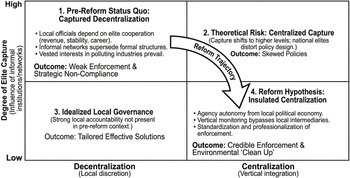
Building on this theoretical framework (Figure 1), we advance our central hypothesis: environmental centralisation reforms improve environmental outcomes specifically by constraining the distortionary effects of elite capture on local governance.
Theoretical framework.

This implies that the treatment effect of centralisation should be heterogeneous and particularly pronounced in contexts where elite capture was previously most severe. In localities where clan-based networks exercised stronger influence over governance structures prior to reform, the shift toward centralised environmental authority should generate larger improvements in environmental quality. These high-capture contexts represent precisely those settings where decentralised governance was most compromised and where centralisation can deliver the greatest marginal benefit by breaking the hold of informal institutions over formal regulatory processes.
Data and models
Data
Air pollution, particularly fine particulate matter (PM2.5), represents a critical public health concern. Exposure to PM2.5 causes approximately 4.2 million premature deaths annually worldwide through various pathways, including strokes, heart disease, lung cancer, and both chronic and acute respiratory diseases such as asthma.Footnote 2 The raw data for the dependent variable, sourced from NASA, is converted from aerosol optical depth (AOD) data to PM2.5 concentrations and refined to a 1 × 1 km spatial resolution (Shen et al., Reference Shen, Li, van Donkelaar, Jacobs, Wang and Martin2024; van Donkelaar et al., Reference van Donkelaar, Hammer, Bindle, Brauer, Brook, Garay, Hsu, Kalashnikova, Kahn, Lee, Levy, Lyapustin, Sayer and Martin2021). Based on the longitude and latitude coordinates of the centre points of the 635,125 villages and communities, we map each unit to its corresponding 1 square kilometre PM2.5 grid cell and extract the grid values as the air quality exposure level for each village or community. The average concentration during this period is 51.4 μg/m3, which is consistent with the previous study but slightly higher due to the extended time span and higher spatial resolution employed in this work (Chen et al., Reference Chen, Shi, Zhang and Zhang2024).
We do not rely on air pollution data disclosed by government environmental monitoring stations for two reasons. First, existing literature suggests that local government officials, motivated by political career advancement, may manipulate pollution data reported by monitoring stations, leading to significant measurement errors (Ghanem et al., Reference Ghanem, Shen and Zhang2020). Second, the government only mandated the disclosure of pollution data from local environmental monitoring stations starting in 2012, resulting in a limited dataset. Given these considerations, NASA-derived data were used for the baseline estimation in this study. This approach ensures a more reliable and precise measure of air pollution at the grassroots level over the extended period analysed.
The key explanatory variable in this study is the implementation of centralisation. The data are sourced from the State Council and provincial governments, and the treatment group definition remains consistent with that used in the existing literature (Chen et al., Reference Chen, Shi, Zhang and Zhang2024). Based on the timeline of centralisation implementation, the provinces included in the treatment group are Hebei, Chongqing, Jiangsu, Shandong, Qinghai, Fujian, Jiangxi, Hubei, Shanghai, Tianjin, Shaanxi, Guangxi, Xinjiang, Guangdong, Inner Mongolia, Ningxia, Guizhou, Henan, Jilin, Yunnan, Beijing, Zhejiang, Anhui, Sichuan, Gansu, Heilongjiang, Shanxi, Liaoning, Hunan, and Hainan. A dummy variable is employed to represent the status of centralisation implementation. For regions that have implemented centralisation in or after a specific year, the variable is set to 1; for other regions, it is set to 0.
To mitigate the impact of omitted variable bias, two categories of control variables are considered: regional characteristics and weather conditions. Regarding factors influencing pollution, this study controls for three primary aspects: regional economic development, structural transformation, and energy consumption. These aspects are critical because economic development drives industrial activity, which can increase pollution (Grossman and Krueger, Reference Grossman and Krueger1995); structural shifts from manufacturing to services can alter pollution levels (Savona and Ciarli, Reference Savona and Ciarli2019); and energy consumption, particularly from fossil fuels, is a direct source of emissions (Pichler and Sorger, Reference Pichler and Sorger2018). The specific regional characteristics controlled for include per capita GDP, the output of the secondary and tertiary industries, and coal consumption, all in logarithmic form. Data for these variables are drawn from the China Statistical Yearbook and the China Energy Statistical Yearbook and are merged at grassroots-level units on an annual basis.
Various weather-related factors, including sunshine duration, wind speed, precipitation, temperature, air pressure, and relative humidity, are also considered, as they can influence fluctuations in air pollution (Zhang et al., Reference Zhang, Tao and Su2025; Chen et al., Reference Chen, Shi, Zhang and Zhang2024). Controlling for these weather characteristics helps to account for natural meteorological conditions that might confound the analysis. The raw data for these weather variables come from ground-based meteorological stations and automatic weather stations. Weather variables at the city level are likewise merged to grassroots-level units on an annual basis. Appendix A, Table A1, presents the summary statistics for the key empirical variables.Footnote 3
Models
Baseline DiD model
For the baseline estimation, we compile a panel dataset at the grassroots-year level and exploit the centralised reform implemented beginning in 2016 as an exogenous shock to estimate the following time-varying DiD model: $\begin{align}\textstyle Pollutio{n_{it}} = {\beta _0} + {\beta _1}Treatmen{t_{it}} + \sum_{i} {{\gamma _i}}\; Regional\_characteristic{s_{2015}} \times {\lambda _t} +\\ \sum_i {{\nu _i}} Weather\_condition{s_{2015}} \times {\lambda _t} + {\phi _i} + {\epsilon_{it}}\end{align}$
where Pollution it denotes the logarithm of PM2.5 in grassroots unit i during year t. Treatment it is a dummy variable that equals 1 if the province to which grassroots unit i belongs implemented centralised reform in year t, and 0 otherwise. Figures A1 through A2 illustrate the relevant institutional background, the changes in power structure before and after the environmental centralisation reform, the spatial distribution of the 635,125 grassroots-level units, and the details of the gradual policy rollout across regions. The core parameter of interest in this study is β 1. If β 1 is significantly less than 0, it indicates that the centralisation reform has significantly reduced pollution. Appendices B and C provide detailed institutional background and original policy documents regarding the implementation of the centralised environmental reform.
To mitigate potential confounding effects stemming from time-varying regional heterogeneity following the centralisation reform, this study adopts the approach proposed by Jensen and Johannesen (Reference Jensen and Johannesen2017) by incorporating interaction terms between pre-reform control variables measured in the year preceding the reform shock and year fixed effects. $\sum\nolimits_i {{\gamma _i}} Regional\_characteristic{s_{2015}} \times {\lambda _t}$
represents the interaction terms between regional characteristics in 2015, prior to the implementation of the centralised reform, and year fixed effects.
$\sum\nolimits_i {{\gamma _i}} Regional\_characteristic{s_{2015}} \times {\lambda _t}$
represents the interaction terms between regional characteristics in 2015, prior to the implementation of the centralised reform, and year fixed effects. $\sum\nolimits_i {{\nu _i}} Weather\_condition{s_{2015}} \times {\lambda _t}$
captures the interaction terms between baseline weather conditions observed in 2015, before the reform took effect, and year fixed effects. This specification allows the model to flexibly control for differential trends across regions with varying pre-reform characteristics, thereby isolating the causal effect of the centralisation reform from potentially confounding regional dynamics that might otherwise be correlated with both the timing of reform implementation and environmental outcomes.
$\sum\nolimits_i {{\nu _i}} Weather\_condition{s_{2015}} \times {\lambda _t}$
captures the interaction terms between baseline weather conditions observed in 2015, before the reform took effect, and year fixed effects. This specification allows the model to flexibly control for differential trends across regions with varying pre-reform characteristics, thereby isolating the causal effect of the centralisation reform from potentially confounding regional dynamics that might otherwise be correlated with both the timing of reform implementation and environmental outcomes.
Additionally, φ i captures grassroots-level fixed effects, which absorb all time-invariant heterogeneity across observational units and thereby mitigate concerns about omitted variable bias arising from unobserved characteristics that remain constant over the sample period. These fixed effects control for a wide array of geographical and structural factors that could potentially influence environmental outcomes, including but not limited to elevation, topographical features, distance to coastline, and other location-specific attributes that do not vary over time. Finally, ϵ it represents the idiosyncratic error term capturing random shocks and measurement error. The empirical specification is estimated using ordinary least squares regression, with robust standard errors clustered at the grassroots level to account for potential serial correlation and heteroskedasticity within each unit over time, thereby ensuring valid statistical inference in the presence of within-cluster dependence in the error structure.
Event study model
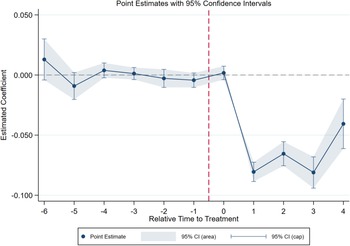
The validity of the DiD estimation framework hinges critically on the parallel trends assumption, which requires that treated and control groups would have followed comparable trajectories in environmental outcomes absent the centralisation reform. Violation of this assumption would confound the estimated treatment effect with pre-existing divergent trends, rendering causal inference untenable. To empirically assess the credibility of this identifying assumption and to trace out the dynamic treatment effects over time, this study employs the following event study specification. $\begin{align}\textstyle Pollutio{n_{it}} = \sum _{k \ge - 6}^4Treatmen{t_{ik}} \times {\delta _k} + \sum_i {{\gamma _i}}\; Regional\_characteristic{s_{2015}} \times {\lambda _t}& +\\ \sum_i {{\nu _i}} Weather\_condition{s_{2015}} \times {\lambda _t} + {\phi _i} + {\epsilon_{it}}\end{align}$
where Treatment ik indicates whether grassroots unit i implemented the centralisation reform in period k. When k is less than 0, δ k represents whether there are differences between the treatment and control groups in the k-th period before the reform. When k is greater than or equal to 0, δ k captures the dynamic effects in each period following the implementation of the reform. If δ k is not statistically significant when k is less than 0, it suggests that the treatment and control groups were comparable prior to the reform. The other variables are consistent with those in equation (1). Given the emphasis in theoretical econometrics on detecting bias in heterogeneous treatment effects (Athey and Imbens, Reference Athey and Imbens2022), this study also employs the method recommended by Rambachan and Roth (Reference Rambachan and Roth2023) and conducts an honest DiD estimation.
Results and discussion
Baseline estimates
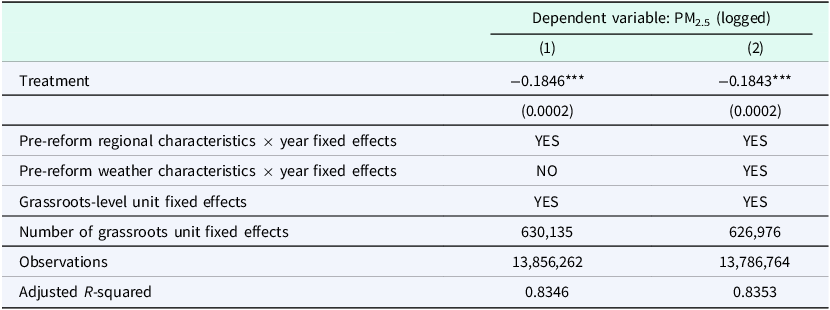
Table 1 presents the baseline estimation results from equation (1), which quantifies the causal effect of the centralisation reform on PM2.5 concentrations. Column (1) includes interaction terms between year fixed effects and pre-reform regional characteristics as measured in 2015, as well as grassroots-level unit fixed effects that account for time-invariant omitted factors. The results indicate that the centralisation reform led to a statistically significant reduction in PM2.5 concentrations of 18.46% at the 1% significance level.
The effect of centralisation reform

Note: This table estimates the impact of the centralisation reform on PM2.5 concentrations using equation (1). The data is aggregated at the grassroots-level unit-year level, with each column representing a separate regression. The dependent variable is the logarithm of PM2.5 concentration, and the key explanatory variable is the post-reform implementation indicator for centralisation. Column (1) controls for the interaction terms between pre-treatment regional characteristics and year fixed effects, incorporates grassroots-level unit fixed effects, and clusters robust standard errors at the grassroots-level unit. Column (2) additionally controls for the interaction terms between pre-treatment weather conditions and year fixed effects, while maintaining grassroots-level unit fixed effects and clustering robust standard errors at the grassroots-level unit. ***, **, and * indicate statistical significance at the 1%, 5%, and 10% levels, respectively.
Column (2) augments this specification by additionally controlling for the interaction between pre-reform weather conditions and year fixed effects, ensuring that the estimated treatment effect is not confounded by differential trends across regions with varying climatic patterns. The coefficient remains highly significant and remarkably stable at −0.1843, representing an 18.43% reduction in PM2.5 concentrations. Given that the reform was implemented progressively across provinces between 2016 and 2019, spanning approximately four years, the annualised marginal effect of pollution reduction can be calculated as 4.61% per year.
Furthermore, the high explanatory power of the model, as reflected in the adjusted R-squared values exceeding 0.83, indicates that the empirical specification successfully captures the systematic variation in pollution outcomes. The large sample size of over 13 million observations drawn from more than 626,000 grassroots-level unit fixed effects provides substantial statistical power and external validity, allowing for reliable inference about the population-level effects of the reform across China’s heterogeneous administrative landscape.
To contextualise the magnitude of this effect, it is instructive to benchmark our estimate against those reported for other major environmental policies implemented in China. For instance, Chen et al. (Reference Chen, Jiang, Liu and Song2022) find that strict fireworks regulation reduced PM2.5 by approximately 8% during festival months, while Lee et al. (Reference Lee, Tran and Yu2023) report that the opening of the Chengdu–Chongqing high-speed rail line lowered PM2.5 along affected highways by 7.1%. Unfried and Wang (Reference Unfried and Wang2024) estimate that China’s 2018 plastic waste import ban reduced PM2.5 by 3.683 μg/m3 in affected cities, and Shen et al. (Reference Shen, Peng, Hui and Fan2025) show that the 2013 Air Pollution Prevention and Control Action Plan decreased PM2.5 concentrations by 3.45% in cities subject to stronger performance measurability. Even the ‘Shifting Freight from Truck to Rail’ policy, which Liang et al. (Reference Liang, Zheng, Wang and Pang2025) identify as having reduced PM2.5 by 13.9% in the Bohai Rim region, yields a smaller point estimate than the centralisation reform examined here. These cross-policy comparisons underscore the potential of institutional reforms in environmental governance to deliver pollution reduction benefits that exceed those achievable through sector-specific regulatory interventions alone.
Mechanism investigation
The theoretical framework elaborated in Section Theoretical framework and hypothesis development posits that environmental centralisation reform improves environmental governance effectiveness by constraining the distortionary effects of elite capture on local governance. Under decentralised regulatory regimes, local elites leverage clan networks and corrupt relationships with officials to exert disproportionate influence over environmental oversight, systematically undermining enforcement efficacy by shielding polluting enterprises from scrutiny or falsifying compliance data to conceal violations (Kusumawati and Visser, Reference Kusumawati and Visser2016; Persha and Andersson, Reference Persha and Andersson2014; Putzel et al., Reference Putzel, Kelly, Cerutti and Artati2015; Sheely, Reference Sheely2015; Viana et al., Reference Viana, Coudel, Barlow, Ferreira, Gardner and Parry2016; Wu, Reference Wu2026). The centralisation reform fundamentally alters the structural relationship between regulators and local elites by transferring supervisory authority from local governments to higher-level governments and implementing unified management protocols, thereby reducing channels through which informal institutions influence formal regulatory processes. To empirically test whether this mechanism explains the pollution reduction documented in the baseline analysis, this study examines the reform’s direct impact on the intensity of local elite capture. If the theoretical framework accurately describes the causal pathway, the centralisation reform should significantly reduce measured elite capture intensity, with the magnitude of reduction matching the severity of governance distortions that institutional reorganisation successfully addresses.
The empirical analysis employs a composite index constructed through standardised additive methodology (Llerena Pinto et al., Reference Llerena Pinto, Mirzabaev and Qaim2025), integrating two complementary dimensions of informal power concentration.Footnote 4 The first dimension captures clan network strength by adopting the measurement approach from existing literature, which uses the annual number of genealogies per ten thousand county-level population as an indicator (Zhang, Reference Zhang2020). The genealogy data are obtained from Wang (Reference Wang2009) and the Comprehensive Catalogue of Chinese Genealogies published by Shanghai Ancient Books Publishing House. This catalogue encompasses genealogical records spanning from 1242 through the Song, Yuan, Ming, and Qing dynasties, as well as the Republic of China and the People’s Republic of China periods, covering 604 distinct surnames. This indicator reflects the density and organisational capacity of kinship-based social structures – structures that, by virtue of substantial social capital, economic resources, and political connections, both shape local governance outcomes and resist environmental regulations that threaten the economic interests of clan members.
The second dimension quantifies official corruption intensity, employing the comprehensive dataset compiled by Wang and Dickson (Reference Wang and Dickson2022). This dataset systematically extracts corruption case information from Tencent, China’s largest internet enterprise platform, using Python web scraping technology, integrating disciplinary action and criminal prosecution records published by party discipline commissions, courts, and procuratorates at all levels from central to local government. This dataset constitutes China’s most comprehensive publicly available corruption investigation database, covering the periods before and after the centralised environment reform, systematically encompassing the rent-seeking arrangements and malfeasance that facilitate regulatory capture. The baseline DiD model estimates using the logarithm of the elite capture index as the dependent variable, substituting it for the PM2.5 concentration variable while maintaining the identical control strategy: incorporating interaction terms between pre-reform regional characteristics and year fixed effects, interaction terms between pre-reform meteorological conditions and year fixed effects, and grassroots unit fixed effects.
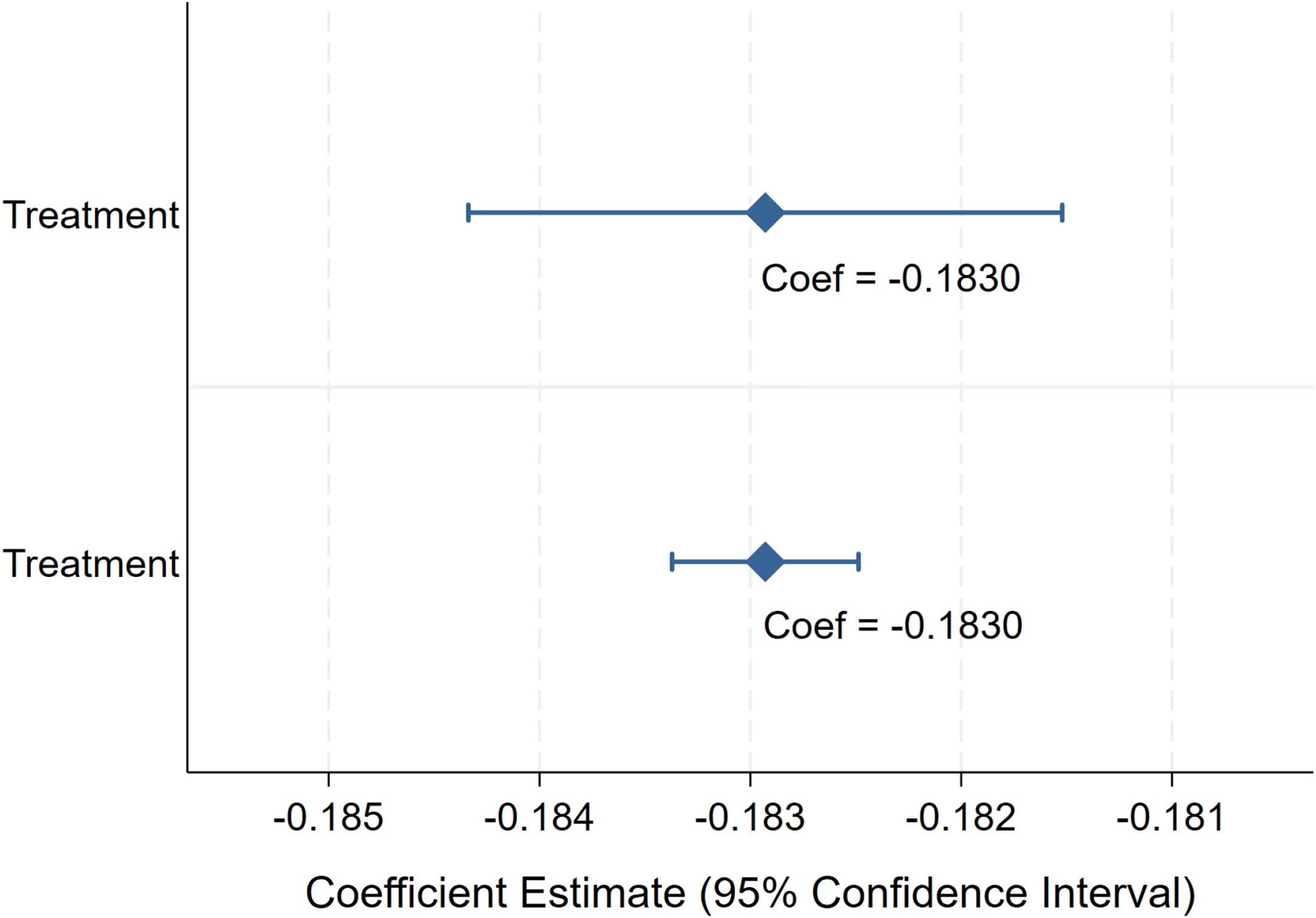
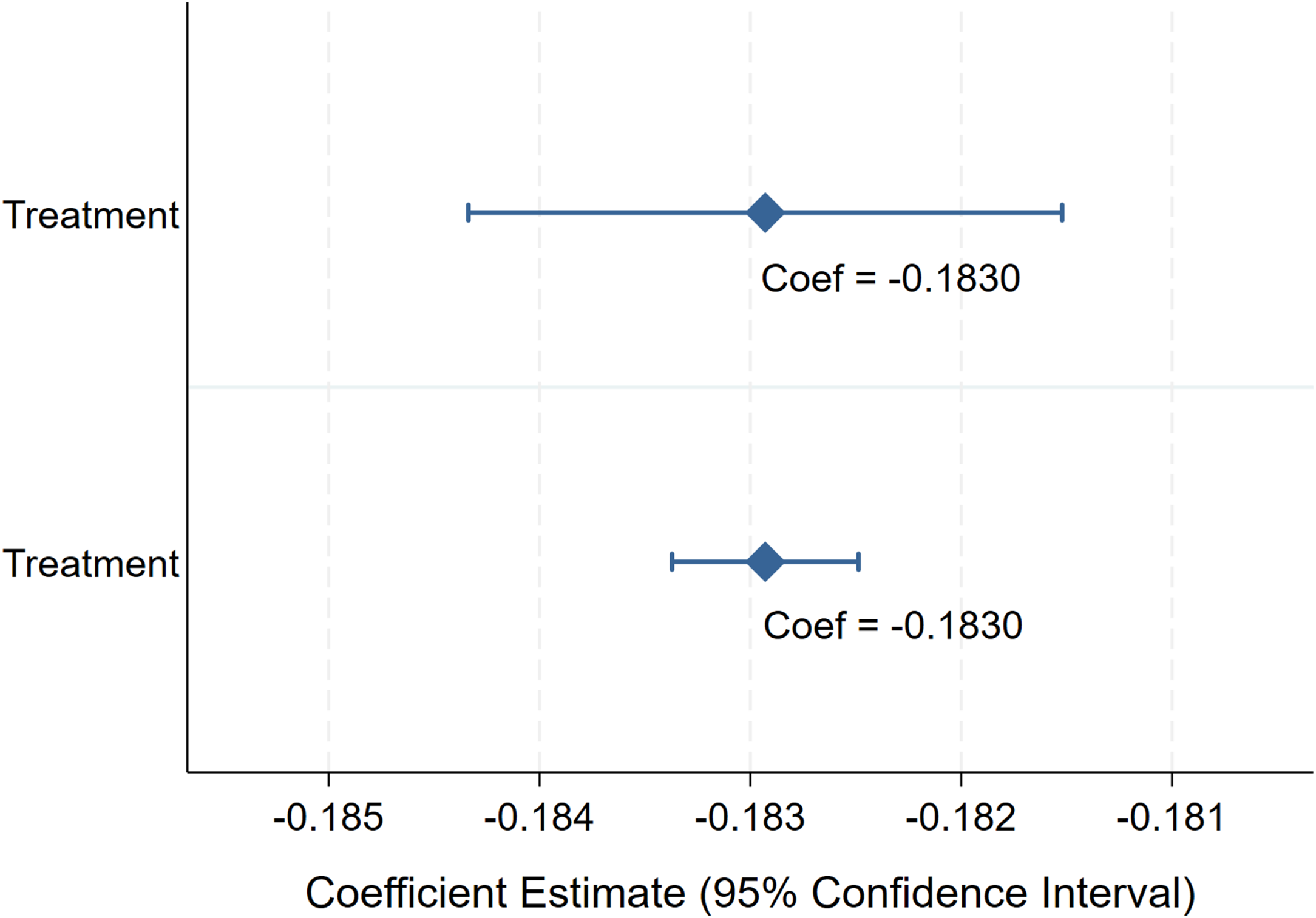
The estimation results provide evidence for the elite capture mechanism. The precisely estimated negative coefficient of 0.1830 indicates that the centralisation reform significantly reduces local elite capture intensity by 18.30%. As shown in Figure 2, the two point estimates remain consistent, with confidence intervals narrowing as the estimation progresses from robust standard errors to clustered standard errors. This finding validates the theoretical prediction that centralisation enhances environmental quality by insulating decision-making and enforcement processes from local capture pressures (Kong and Liu, Reference Kong and Liu2024; Zhu et al., Reference Zhu, Qiu and Liu2025). The reform consolidates monitoring authority at higher-level governments, institutions that operate with less susceptibility to local political–economic influences, successfully curtailing the capacity of clan networks and corrupt officials to distort environmental governance for private gain (Wu, Reference Wu2026).
Testing the elite capture mechanism.
Note: This figure presents the elite capture mechanism of environmental centralisation reform. The key explanatory variable is the post-reform implementation indicator for environmental centralisation, and the dependent variable is the logarithm of the comprehensive elite capture index constructed using standardised additive methods. The control strategy remains consistent with the baseline estimation, including pre-reform regional characteristics × year fixed effects, pre-reform weather characteristics × year fixed effects, and grassroots-level unit fixed effects. The first model employs robust standard errors, while the second model uses robust standard errors clustered at the grassroots level, with 95% confidence intervals reported.
This mechanism operates through multiple mutually reinforcing channels consistent with the theoretical framework: central institutions reduce dependence on local elite cooperation; vertical monitoring systems bypass corrupt local governance structures; standardised protocols compress the discretionary space within which traditional interest capture operates; and enforcement credibility strengthens as regulated entities recognise that compliance decisions can no longer be negotiated through local informal channels. These outcomes demonstrate that institutional design reforms addressing principal-agent problems and elite capture can substantially enhance regulatory effectiveness (Aanesen and Armstrong, Reference Aanesen and Armstrong2013; Gaudet et al., Reference Gaudet and Lasserre2015; Paredes et al., Reference Paredes, Gianella and Olivera2024), confirming that structural reorganisation of environmental governance – rather than merely increasing formal enforcement resources or adjusting baseline standards – serves as the critical driver of environmental improvement, thereby validating the core hypothesis.
Alternative explanations, robustness checks, and heterogeneity analysis
Incentive bias and data manipulation
Under a decentralised regulatory regime, local officials facing dual pressures to promote economic development and achieve environmental targets may simultaneously possess both the motivation and opportunity to manipulate monitoring data – systematically underreporting pollution levels to demonstrate compliance with environmental standards (Ghanem and Zhang, Reference Ghanem and Zhang2014; Ghanem et al., Reference Ghanem, Shen and Zhang2020). The centralisation reform theoretically eliminates this manipulation channel by severing the administrative subordination relationship between monitoring stations and local governments. To verify the extent of incentive-driven bias in environmental data reporting, the empirical estimation employs the baseline model’s DiD framework, replacing the dependent variable with the logged deviation between NASA satellite-estimated PM2.5 values and the annual reported concentration values from grassroots units.Footnote 5 Satellite data provide an objective benchmark unaffected by local political incentives – remote sensing measurements are generated through independent algorithms processing atmospheric optical properties, immune to ground-level interference or human manipulation.
After incorporating the full set of control variables (including interaction terms between pre-reform regional characteristics and year fixed effects, interaction terms between pre-reform meteorological conditions and year fixed effects, and grassroots unit fixed effects), the estimation results reveal a precisely estimated positive coefficient for PM2.5 concentration (approximately 0.398). This positive effect unveils important data quality changes surrounding the data centralisation reform. Prior to reform, local monitoring station PM2.5 data exhibit systematic deviation from NASA objective satellite observations, a deviation potentially stemming from performance assessment pressures and data manipulation incentives facing local governments (Gong et al., Reference Gong, Shen and Chen2025). Under the decentralised system, local officials simultaneously responsible for economic growth and environmental compliance possess strong incentives to underreport pollution levels, resulting in downward bias in official data relative to independent satellite observations. The coefficient estimates of 0.3977 and 0.3982 maintain significant stability regardless of whether meteorological control variables are included and, together with the extremely narrow confidence intervals shown in the Appendix D Figure D1, jointly confirm the robustness of this data quality transformation across different model specifications.
The positive coefficient on the reporting gap term indicates that post-reform local monitoring station data converge closer to objective reality, correcting the previous phenomenon of artificially suppressed pollution data. Specifically, pre-reform local data exhibit negative deviation from satellite data – local monitoring systematically underestimates actual pollution levels – with deviation magnitude far exceeding post-reform deviation. The centralisation reform narrows this gap by enhancing data accuracy, causing the measurement difference between satellite observations and local monitoring to expand in the positive direction. This finding demonstrates that the centralisation reform effectively corrects local officials’ incentive bias and data manipulation behaviour, thereby strengthening the credibility and reliability of environmental monitoring data (Ghanem and Zhang, Reference Ghanem and Zhang2014). The improved consistency between reported data and objective measured values under the centralised regime confirms that this reform successfully eliminates the institutional loopholes that previously facilitated strategic misreporting. Furthermore, this evidence rules out an alternative explanation – that the observed pollution reduction merely represents a statistical artefact produced by changes in reporting methods – thereby reinforcing the validity of the baseline analysis results.
Externality comparison
Compared to other pollutants, air pollution possesses greater negative externalities – particulate matter and other airborne pollutants readily cross administrative boundaries and diffuse into neighbouring jurisdictions (Kim and Gillingham, Reference Kim and Gillingham2025; Zheng et al., Reference Zheng, Cao, Kahn and Sun2014), imposing cost burdens on these jurisdictions that lack the authority to regulate emission sources under decentralised governance structures. The spatial distribution of pollution costs misaligns with the jurisdictional scope of regulatory authority, resulting in systematic underinvestment in pollution control under local government management – because individual localities cannot internalise the full social costs of emissions originating within their borders. Centralisation addresses this coordination failure by consolidating regulatory authority at higher administrative levels, thereby enabling the internalisation of cross-jurisdictional externalities. For empirical testing, this study selects noise pollution as a counterfactual case – an environmental problem characterised by distinctly limited spatial externalities, as sound attenuation properties ensure that noise impacts remain confined to areas immediately surrounding emission sources.
The empirical model employs noise pollution levels as the dependent variable, drawing data from annual environmental noise monitoring in key environmental cities as recorded by the National Bureau of Statistics and the Ministry of Ecology and Environment, measured in equivalent sound level dB(A) units and log-transformed to facilitate comparison with baseline air pollution analyses. This study adopts an identical DiD framework and incorporates comprehensive control variables: interaction terms between pre-reform regional characteristics and year fixed effects, interaction terms between pre-reform meteorological conditions and year fixed effects, and grassroots unit fixed effects. The results reveal that coefficient estimates across both specifications – with and without weather controls – stand at approximately −0.000037 and −0.000033 respectively. These values are substantively negligible, and as the placebo test in Figure D1 demonstrates, the confidence intervals encompass the zero-effect threshold, indicating no statistically significant effect.Footnote 6 Comparing the substantial reduction in air pollution with the minimal impact on noise pollution reveals that when pollution externalities prove comparatively strong or cross-boundary pollution exists, vertical integration through centralisation helps resolve coordination failures arising from regulatory fragmentation.
Robustness checks
We conduct a series of robustness checks to address alternative concerns and validate our baseline findings. Figure 3 employs an event study framework to test the parallel trends assumption, while Appendix E Figure E1 implements the honest DiD estimation to account for potential pre-treatment violations. Table E1 controls for additional environmental policy confounders, including information disclosure policies, air pollution control measures, emissions trading systems, green fiscal policies, and green finance pilot programmes. Table E1 addresses concerns about violation of the stable unit treatment value assumption (SUTVA) by excluding grassroots units adjacent to treated areas and retaining only control units without geographical boundaries touching treatment units. Table E1 demonstrates robustness to alternative clustering specifications of standard errors at different administrative levels. Table E1 excludes grassroots units located in the four municipalities directly under central government administration (Beijing, Shanghai, Tianjin, and Chongqing) to ensure results are not driven by these specially governed regions. Figure E1 examines whether pre-reform socioeconomic characteristics and meteorological conditions predict the treatment indicator, showing that the vast majority of variables are statistically insignificant. The modest selection bias that remains is addressed by Table E1 and Figure E3, which employ propensity score matching to mitigate potential endogenous selection bias in reform adoption. Tables E6 through E9 incorporate population variables and lagged treatment variables into the specification.
Event study for parallel trends.
Note: The estimates are obtained from an event study model. The specification includes controls for pre-reform regional characteristics interacted with year fixed effects, pre-reform weather characteristics interacted with year fixed effects, and grassroots-level unit fixed effects. The figure reports 95% confidence intervals around the point estimates.

Further, Figure E4 and Table E10 report results from a battery of additional robustness checks: adding petroleum output, natural gas output, and the number of green invention patents granted as control variables;Footnote 7 using the logarithm of AOD as the dependent variable;Footnote 8 clustering standard errors at the city and county levels; excluding time-varying weather controls; including province-specific time trends; and using untransformed PM2.5 concentrations. Figure E5 reports results that control for the pre-reform number of corrupt officials and the anti-corruption campaign status – defined as a dummy variable equal to one if the city’s party secretary was subsequently investigated by the discipline inspection commission after a given year – as additional control variables,Footnote 9 and that control for the cosine similarity of secondary-industry structures between treated and control cities.Footnote 10 Across all these alternative specifications and robustness tests, the core conclusions from our baseline estimation remain substantively unchanged and statistically robust.
Heterogeneity analysis
To investigate whether the pollution-reducing effects of environmental centralisation vary systematically across local institutional and economic conditions, we interact the treatment indicator with a set of city-level characteristics. Figure E6 presents the estimated coefficients and 95% confidence intervals for these interaction terms. Two institutional and governance dimensions stand out. First, we construct a dummy variable equal to one if a city’s pollution level falls above the 75th percentile of the national PM2.5 distribution and interact it with the treatment indicator. The resulting coefficient is approximately −0.038 and precisely estimated, indicating that the centralisation reform yields substantially larger air-quality improvements in cities that were the most heavily polluted. This finding is consistent with the logic that vertical oversight shifts regulatory effort toward localities where environmental non-compliance is most severe and, consequently, where the marginal returns to enforcement are highest. Second, the interaction between corruption intensity and treatment produces the largest negative coefficient among all heterogeneity dimensions (approximately −0.044), with a notably tight confidence interval. This result implies that cities characterised by deeper corruption – where local protectionism and regulatory capture had previously blunted environmental enforcement – benefit disproportionately from the removal of local governmental discretion. The centralisation of monitoring authority effectively severs the collusive nexus between local officials and polluting firms, unlocking emission reductions that were politically infeasible under the decentralised regime.
Turning to the economic structure dimensions, both GDP per capita and secondary-sector share, when interacted with the treatment indicator, yield negative but comparatively smaller coefficients (approximately −0.018 and −0.020, respectively). The negative GDP interaction suggests that wealthier cities experience modestly greater reductions in PM2.5 following centralisation, potentially because higher fiscal capacity facilitates faster compliance with newly enforced standards or because these cities possess denser monitoring infrastructure that amplifies the effectiveness of centralised oversight. Meanwhile, the negative coefficient on the secondary-sector share interaction indicates that cities with a larger industrial base, and thus a higher concentration of point-source emitters, also realise somewhat greater pollution abatements, consistent with the expectation that centralised inspectors target emission-intensive manufacturing activities. Nonetheless, the magnitudes of these two economic interactions are roughly half those of the institutional-governance interactions, underscoring a central insight of this study: the heterogeneous gains from centralisation are driven primarily by the correction of governance failures – namely severe pre-existing pollution and entrenched corruption – rather than by differences in economic development or industrial composition alone.
The Chinese experience: contextual specificity and generalisability
Our finding that centralisation substantially reduced pollution must be understood within the distinctive institutional context of China’s governance system. Several features of the Chinese case may have facilitated the reform’s effectiveness in ways that differ meaningfully from other national contexts. China’s existing hierarchical administrative structure, characterised by clear chains of command and established mechanisms for vertical policy implementation, provided favourable institutional infrastructure for centralising environmental regulatory authority (Li and Chen, Reference Li and Chen2024; Flato, Reference Flato2022). The capacity of higher-level governments to deploy substantial technical, financial, and human resources for establishing and operating centralised monitoring networks exceeds what may be available in many resource-constrained settings. The reform occurred within a political economy where local officials face particularly acute incentive misalignments, with strong performance pressures prioritising GDP growth over environmental protection creating systematic local bias against environmental enforcement (Li and Zhou, Reference Li and Zhou2005). This distinctive incentive structure, reinforced by promotion criteria heavily weighted toward economic indicators, may have magnified the governance distortions that centralisation could address (Wu et al., Reference Wu, Nie and Wang2024). Furthermore, the specific manifestation of elite capture documented in our mechanism analysis operates through clan networks and corruption channels that reflect China’s particular social and institutional landscape (Wu, Reference Wu2026). The severity of local governance distortions in the pre-reform baseline was substantial, potentially exceeding comparable problems in contexts with stronger institutional checks and more established rule of law traditions.
Nevertheless, the core mechanisms we identify possess theoretical generalisability that transcends the Chinese context. The fundamental principal-agent problem arising from decentralised environmental monitoring – wherein local regulators face conflicting mandates between economic development and environmental protection – represents a universal governance challenge rather than a China-specific phenomenon (Aanesen and Armstrong, Reference Aanesen and Armstrong2013; Blair et al., Reference Blair, Custer and Roessler2024; Costanza, Reference Costanza2016; Gaudet et al., Reference Gaudet and Lasserre2015; Paredes et al., Reference Paredes, Gianella and Olivera2024; Zhang et al., Reference Zhang, Tao and Su2025). Similarly, the problem of regulatory capture by local economic elites who benefit from lax enforcement afflicts environmental governance across diverse institutional settings, from developing economies to advanced democracies (Higgins et al., Reference Higgins, Balint, Liversage and Winters2018; Noah et al., Reference Noah, Adhikari, Ogundele and Yazdifar2021; Paredes et al., Reference Paredes, Gianella and Olivera2024; Ullah, Reference Ullah2025). Our empirical evidence demonstrates that centralisation meaningfully reduces elite capture and improves data integrity through mechanisms that should operate wherever several conditions exist: significant externalities create misalignment between jurisdictional boundaries and pollution impact zones, local monitoring agents face systematic incentive biases that distort enforcement, and regulatory capture channels allow vested interests to compromise environmental oversight. These conditions are not unique to China but characterise environmental governance challenges globally (Banikoi, Reference Banikoi2024; Horowitz, Reference Horowitz2021; Ostrom and Basurto, Reference Ostrom and Basurto2011). The reform’s success in addressing data manipulation – evidenced by the convergence between satellite observations and official monitoring after centralisation – demonstrates that structural institutional redesign can overcome incentive-driven reporting bias regardless of specific cultural context. The externality mechanism, confirmed through our comparison of air pollution with significant spatial externalities against noise pollution with localised impacts, operates according to economic logic that applies universally across jurisdictional settings.
The question of whether comparable results would emerge in federal democracies such as Germany or the United States merits careful consideration of institutional differences that extend beyond cultural dimensions (Kaasa and Andriani, Reference Kaasa and Andriani2022; Sent and Kroese, Reference Sent and Kroese2022; Tarabar, Reference Tarabar2019). In these contexts, constitutional constraints on centralisation, entrenched federalist traditions, and powerful subnational political actors create structural obstacles to the type of top-down regulatory reform implemented in China. The political feasibility of transferring regulatory authority from state or regional governments to federal agencies faces legal barriers and resistance grounded in sovereignty concerns that differ from China’s unitary state structure. The baseline severity of the governance problems that centralisation addresses may also differ substantially across contexts. In jurisdictions with more developed civil society oversight, independent media scrutiny, and judicial review mechanisms, the scope for data manipulation and elite capture – while not absent – may be more constrained than in the pre-reform Chinese setting. However, these institutional differences do not invalidate the underlying mechanisms but rather suggest that the magnitude of centralisation’s impact depends critically on baseline governance quality. Where federal systems already incorporate robust monitoring independence, interstate coordination mechanisms, and effective accountability structures, marginal gains from further centralisation may be smaller. Conversely, in federal arrangements where subnational capture or interstate externalities generate significant environmental underperformance, centralised or coordinated monitoring could yield substantial improvements even within democratic federal constraints, as evidenced by successful supranational environmental coordination in the European Union (Indset, Reference Indset2023; Puetter and Terranova, Reference Puetter and Terranova2025).
Our findings thus carry qualified lessons for other national contexts that depend critically on the structural conditions present. The Chinese case demonstrates that centralisation can substantially improve environmental outcomes when three conditions hold: severe local incentive misalignments systematically distort enforcement, significant regulatory capture channels compromise monitoring integrity, and substantial cross-jurisdictional externalities create coordination failures under decentralised governance. The reform’s effectiveness in China partly reflects the magnitude of governance distortions present in the pre-reform baseline. In contexts where baseline governance quality is higher, absolute effect sizes may be smaller, though the directional benefits of reducing capture and internalising externalities remain theoretically valid. For federal democracies, the relevant policy implication may involve functional centralisation mechanisms such as federal monitoring standards, interstate compacts, independent monitoring agencies insulated from local political pressure, or regional coordination bodies, rather than complete administrative centralisation. The transportability of our findings to other contexts ultimately depends less on cultural factors or political systems themselves and more on whether the specific governance failures we identify – elite capture, incentive misalignment, and externality-driven coordination problems – constitute binding constraints on environmental performance in those settings. Where these mechanisms operate, institutional reforms that insulate monitoring from local capture and internalise cross-jurisdictional externalities should improve outcomes, though the specific institutional design must adapt to constitutional, political, and administrative constraints that vary across national contexts.
Limitations and future research agenda
Although our analysis employs comprehensive administrative data on official corruption investigations to measure elite capture, we acknowledge that this measurement approach possesses inherent limitations that require future research to address. While we primarily rely on documented corruption cases as a proxy indicator for regulatory capture – an indicator based on datasets of public disciplinary actions and criminal prosecutions across government levels – this approach can only capture instances of misconduct that have been detected and prosecuted. This measurement strategy may systematically underestimate the true magnitude of corrupt behaviour, particularly failing to capture informal rent-seeking arrangements that evade detection or fall below prosecution thresholds. Alternative measurement approaches can provide valuable robustness checks and triangulation for our mechanistic findings. Media-reported corruption cases offer complementary perspectives, capturing incidents that attract public attention before formal investigations, though this indicator may suffer from potential biases arising from regional variations in media coverage and politically prioritised selective reporting. Perception-based indices (such as firm surveys or citizen assessments of local governance quality) can reveal subjective experiences of regulatory environment integrity – experiences that shape firm behaviour even in the absence of formal corruption prosecutions (Gutmann et al., Reference Gutmann, Padovano and Voigt2020). Future research that combines these alternative corruption indicators with our administrative data will enhance confidence in elite capture mechanisms and clarify whether our findings reflect actual reductions in corrupt behaviour, improvements in detection and prosecution capacity under centralised oversight, or a combined effect of both.
The temporal scope of this study, extending from the pre-reform baseline period to 2019, raises urgent questions about long-term dynamics that require future systematic investigation. The selection of 2019 as the analytical endpoint considers both the timeline of the reform’s phased implementation (most provinces completed reforms by that year) and the unprecedented shocks brought by COVID-19 pandemic restrictions in 2020 – when travel limitations and industrial shutdowns (unrelated to governance reforms) led to significant improvements in air quality. Including the pandemic period would confound the identification of reform causal effects, as the mechanisms behind lockdown-induced pollution reductions differ entirely from regulatory centralisation (He et al., Reference He, Pan and Tanaka2020). However, this temporal boundary leaves several key questions about institutional sustainability and adaptive governance unexplored. The reform examined in this study represents only one component in China’s broader environmental policy evolution, which includes earlier initiatives before 2016 and subsequent adjustments based on practical experience. Theoretically, reasonable speculation remains that the 2016 centralisation reform arose from worsening pollution trends, with decentralised governance structures already revealing their inability to respond effectively, suggesting that governance transitions respond endogenously to environmental performance failures. Looking forward, the long-term efficacy of centralised regulatory systems may face its own limitations: initial successes plateau, enforcement capacity becomes constrained, or regulated entities develop sophisticated evasion strategies adapted to centralised oversight. Centralised systems may ultimately require adjustment toward more decentralised or hybrid governance models – for example, integrating local knowledge and stakeholder participation while maintaining regulatory independence – providing an important longitudinal research pathway for tracking institutional evolution beyond the period examined in this study.
The most promising research direction lies in extending the analytical framework to comparative institutional contexts to test the generalisability and boundary conditions of our findings. The 2016 adoption of the Paris Agreement provides a natural opportunity for cross-national analysis: examining whether international climate commitments catalyse similar governance reforms across different political systems and whether the effectiveness of centralised governance in emissions reduction exhibits systematic associations with existing institutional quality, state capacity, or democratic accountability mechanisms (Coen et al., Reference Coen, Kreienkamp, Tokhi and Pegram2022). Through comparative studies of federal democracies (such as Germany and the United States), unitary states with diverse governance traditions, and developing economies at different stages of environmental transition, researchers can clarify which elements of the Chinese experience reflect universal governance principles and which constitute context-specific institutional configurations. Such research can assess whether the mechanisms we identify – reducing elite capture, restructuring incentive mechanisms, internalising externalities – prove equally effective across regime types, or whether democratic accountability, civil society oversight, and judicial independence can substitute for hierarchical central authority. Beyond horizontal comparison, theoretical research that explores dynamic sequencing optimisation between centralisation and decentralisation throughout environmental development processes will deepen understanding of governance as an adaptive process rather than a static institutional choice. This research agenda will test whether effective environmental governance follows predictable evolutionary patterns: centralisation proves most valuable during initial emission reduction phases dominated by local capture and coordination failures, while decentralisation becomes more effective once baseline environmental quality improves and local responsive management capacity develops. Addressing these questions will transform single-country quasi-experimental findings into a universal theoretical foundation, revealing the institutional determinants of environmental governance effectiveness across national contexts and development stages.
Finally, while we document three mechanisms through which centralisation improves air quality, our empirical design does not fully disentangle their relative contributions or potential complementarities. Future research could quantify the share attributable to each mechanism by comparing effect sizes across regions where specific channels are more likely to bind – for instance, high cross-boundary pollution areas versus high-corruption areas. Enriching the measurement of elite capture with alternative proxies such as media-reported corruption incidents, enforcement personnel turnover, or firm-level perception indices would further strengthen the mechanistic evidence and clarify whether observed reductions reflect genuine behavioural change, enhanced detection capacity under centralised oversight, or both.
Conclusion and implications for institutional research
This study provides systematic causal evidence that centralisation of environmental regulatory authority substantially improves air quality outcomes. Leveraging China’s staggered provincial implementation of regulatory centralisation reforms between 2016 and 2019 as a quasi-natural experiment, our DiD analysis demonstrates that transferring regulatory responsibilities from local to higher-level governments produced significant reductions in ambient particulate matter concentrations. This environmental improvement operates through three mutually reinforcing mechanisms that we identify and empirically validate. First, centralisation meaningfully reduces elite capture by insulating regulatory decisions from local clan networks and corrupt relationships that previously distorted enforcement in favour of polluting enterprises. Second, the reform corrects systematic incentive biases that led local officials facing competing mandates for economic growth and environmental compliance to manipulate monitoring data, as evidenced by the convergence between satellite observations and official measurements following centralisation. Third, centralisation internalises cross-jurisdictional externalities by consolidating regulatory authority at administrative levels whose geographic scope better aligns with pollution’s spatial diffusion, a mechanism confirmed through our placebo analysis showing no comparable effect for noise pollution with localised impacts. These findings directly answer our central research question by establishing that institutional reconfiguration moving regulatory authority away from captured local agents and toward more insulated higher-level agencies can generate substantial environmental improvements even absent changes in underlying regulatory standards or enforcement resources.
The implications of our findings for institutional research and environmental policy extend across multiple domains. Our results extend the theoretical understanding of simplified narratives that portray decentralisation as uniformly beneficial for governance outcomes, demonstrating that optimal institutional design depends critically on the specific political economy constraints present in a given context (Alfano et al., Reference Alfano, Baraldi and Cantabene2019; Escobar-Lemmon and Ross, Reference Escobar-Lemmon and Ross2014; Kosec and Mogues, Reference Kosec and Mogues2020; Oates, Reference Oates1972; Tiebout, Reference Tiebout1956). Where elite capture is severe, local incentive misalignments are acute, and cross-jurisdictional coordination problems are substantial, centralisation offers a viable institutional solution for improving regulatory effectiveness (Wu, Reference Wu2026; Zhu et al., Reference Zhu, Qiu and Liu2025). This insight carries relevance beyond environmental protection to other regulatory domains, including financial supervision, food safety oversight, and infrastructure quality control, where similar tensions between local political pressures and regulatory integrity arise. For environmental governance specifically, our findings suggest that institutional reforms addressing the structural foundations of enforcement failure may prove more consequential than marginal adjustments to pollution standards, penalty schedules, or monitoring technology. The documented success of China’s centralisation reform provides an empirical foundation for policy discourse in other developing economies struggling with environmental degradation amid rapid industrialisation, though our analysis of contextual factors cautions against mechanical policy transfer without attention to local institutional preconditions.
Future institutional research should investigate the dynamic evolution of governance effectiveness as economies develop, examining whether centralisation represents an optimal transitional arrangement during periods of severe pollution and weak local capacity, with potential recalibration toward more participatory and decentralised systems as environmental quality improves and institutional maturity develops. Understanding governance not as a static institutional choice but as an adaptive process responding to changing economic conditions, state capacity, and societal demands represents a promising frontier for institutional economics that our findings help to illuminate.
Supplementary material
The supplementary material for this article can be found at https://doi.org/10.1017/S1744137426100563.
Acknowledgements
Jianxian extends sincere appreciation to Editors-in-Chief Professors Geoff Hodgson and Esther-Mirjam Sent for their professional handling of this article and valuable constructive feedback. He also expresses deep gratitude to the seven anonymous reviewers for their positive responses and meticulous comments that significantly enhanced the quality of this work.
Funding
This research was supported by funding from the National Social Science Fund of China (Grant No. 25AZZ002) and the China Postdoctoral Science Foundation (Grant No. 2025M780694). The author acknowledges this financial support with appreciation.



 Open access

