


Daily consumption of folic acid in the periconceptional period is effective at preventing the occurrence and recurrence of fetal neural tube defects (NTD)( Reference Czeizel and Dudas 1 , 2 ). Therefore, government agencies and researchers have promoted folic acid supplementation among women of reproductive age since the early 1990s. China has one of the highest prevalences of NTD, but with considerable regional differences. A large community intervention trial conducted in 1993–1996 in two areas of China with different NTD prevalence found that periconceptional intake of 400 µg of folic acid daily could reduce the risk of NTD by 79 % in areas with a high prevalence (5–6 NTD cases/1000 births) of these defects and by 41 % in areas with a low prevalence (approximately 1 NTD case/1000 births)( Reference Berry, Li and Erickson 3 ). Yet despite years of education and promotion, folic acid supplementation among reproductive-age women has remained low in the high-prevalence area( Reference Ren, Zhang and Li 4 ) and the NTD prevalence has failed to decrease as expected. Thus, the Chinese Ministry of Health launched a nationwide programme in June 2009 to increase the use of folic acid in the preconception period among women in rural areas, where the prevalence of NTD is high and supplementation with folic acid is low. A woman who has a rural household registration and plans to become pregnant is eligible to receive 6 months of folic acid supplement (thirty-one tablets of 400 μg folic acid each per month) for free. Village doctors collect information from women who are newly married or plan to become pregnant, send folic acid supplements to them regularly and supervise their intake( 5 ).
To date, no study has reported the effect of this massive national programme, due in part to a lack of baseline data. Fortunately, in 2002–2004, before the programme began, we conducted a survey in areas with both a high (Shanxi Province) and low (Jiangsu Province) prevalence of NTD. In particular, a population-based birth defects surveillance system in four counties in Shanxi Province showed that the prevalence of NTD was 13·87/1000 births( Reference Li, Ren and Zhang 6 ) in 2003, the highest in the world. In contrast, the prevalence of NTD in Wuxi City, Jiangsu Province, was 0·23/1000 births( Reference Song, Chen and Zhang 7 ) in 2002–2003. We obtained information on folic acid supplementation behaviours, among other variables, as reported elsewhere( Reference Ren, Zhang and Li 4 , Reference Ren, Zhang and Hao 8 ). In 2011–2012, we conducted another survey in the same areas to examine changes in folic acid supplementation behaviours. The present paper aims to report changes in folic acid supplementation after the programme when data are stratified by residence (urban or rural) as well as population prevalence of NTD (high or low). In addition, factors associated with supplementation after implementation of the programme are explored.
Methods
The enrolment of participants and the definition of use of folic acid supplementation were the same in both surveys and were described in the pre-programme survey( Reference Ren, Zhang and Li 4 ). Participants were from Pingding (rural) and Taiyuan (urban) in Shanxi Province, a high-prevalence area; and from Wuxi-xinqu (rural) and Wuxi (urban) in Jiangsu Province, a low-prevalence area. The reasons for selecting these counties and cities have been described elsewhere( Reference Zhang, Ren and Li 9 ) and include the representativeness of the areas in terms of socio-economic development, prevalence of NTD and the willingness of county health authorities to participate( Reference Zhang, Ren and Li 9 ). The initial survey was conducted from 1 December 2002 to 30 April 2004, and the post-survey was conducted from 1 June 2011 to 31 May 2012. To be consistent with the previous study( Reference Ren, Zhang and Li 4 , Reference Ren, Zhang and Hao 8 ), a convenience sampling method was used: each month, the first thirty women in their early second trimester (<20 weeks of gestation). Information on demographic characteristics and the use of folic acid supplements was collected through face-to-face interviews conducted by trained health-care workers. Folic acid supplementation was defined as a self-report of having ever taken folic acid supplements or multivitamins containing folic acid during the current pregnancy. Information on the timing of supplementation and adherence was also collected. Timing of supplementation refers to the time when a woman began to take folic acid (e.g. before or after the last menstrual period). Adherence was self-reported. We defined the periconceptional period as the period from 3 months before to 3 months after the last menstrual period. Distribution of the supplements was targeted at women who were newly married and/or who planned to become pregnant. All supplements contained 400 µg of folic acid. These supplements are registered with China’s Food and Drug Administration.
The study was conducted according to the guidelines laid down in the Declaration of Helsinki and all procedures involving human subjects/patients were approved by the Institutional Review Board of Peking University. Written informed consent for the pre-programme survey and oral informed consent for the post-programme survey were obtained from all participants.
Statistical analyses
To compare the differences in the use of folic acid supplements, the timing of supplementation and adherence between the two samples, we computed percentages. We performed χ 2 analyses to test for differences in the proportions of categorical variables among two or more groups. A two-tailed P≤0·05 was considered statistically significant. Multivariate logistic regression analyses were used to identify variables related to periconceptional use of folic acid in the post-programme survey while controlling for potential confounding variables. The results of logistic regression analyses are presented as odds ratios and their 95 % confidence intervals. Data were analysed using the statistical software package PASW Statistics 18·0.
Results
Characteristics of the participants
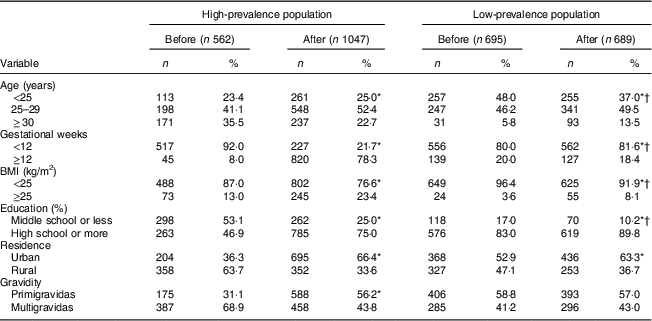
A total of 1257 pregnant women were included in the pre-programme survey and 1736 women were included in the post-programme survey. Basic information for the sample is listed in Table 1. There were some statistically significant differences between populations. Compared with the low-prevalence population, the number of gestational weeks was higher in the high-prevalence population in the post-programme sample, and the pre-pregnancy BMI increased in the post-programme sample in both the low- and high-prevalence populations. In the high-prevalence population, 75 % of women in the post-programme survey finished high school or college compared with less than 50 % in the pre-programme survey. The proportion of urban residents increased from 53 % to 63 % in the low-prevalence population and from 36 % to 66 % in the high-prevalence population. The mean age, gestational weeks and BMI of pregnant women in the post-programme sample were lower in the low-prevalence population (26·8 (sd 3·3) years, 9·8 (sd 2·2) weeks and 20·9 (sd 2·9) kg/m2, respectively) than in the high-prevalence population (27·9 (sd 3·9) years, 14·9 (sd 3·9) weeks and 22·8 (sd 3·4) kg/m2, respectively). Finally, in the post-programme sample, the low-prevalence population had a greater proportion of women with a high school education than the high-prevalence population.
Characteristics of the study sample by the prevalence of neural tube defects, before (2002–2004) and after (2011–2012) a massive folic acid supplementation programme, Shanxi Province and Jiangsu Province, China
Note: Some variables have missing data.
*P<0·05 before and after the programme in the same population.
†P<0·05 between the high- and low-prevalence groups after the programme.
The use of folic acid supplements
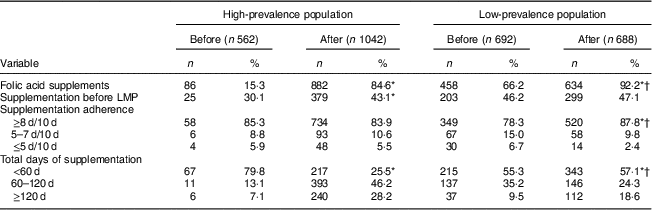
After the programme, more than 80 % of the women reported that they had ever taken a folic acid supplement during the current pregnancy, almost twice the percentage before the programme. The proportion of folic acid supplementation increased from 66 % to 92 % in the low-prevalence population and from 15 % to 85 % in the high-prevalence population. The percentage of folic acid supplementation before the last menstrual period increased significantly in the high-prevalence population (from 30 % to 43 %). Adherence to folic acid intake increased in the low-prevalence population, with 88 % of women reporting using folic acid almost every day after the programme compared with 78 % before the programme. In addition, total days of supplementation increased after the programme from 34·6 (sd 39·9) to 89·6 (sd 56·3) d in the high-prevalence population and from 53·8 (sd 39·0) to 60·9 (sd 49·6) d in the low-prevalence population. The proportion of days of supplementation over 120 d increased after the programme in both populations. The proportions of folic acid supplementation and adherence were significantly higher in the low-prevalence population, but the total days of supplementation were less than in the high-prevalence population (P<0·05; Table 2).
Use of folic acid supplements during early pregnancy by the prevalence of neural tube defects, before (2002–2004) and after (2011–2012) a massive folic acid supplementation programme, Shanxi Province and Jiangsu Province, China
LMP, last menstrual period.
Note: Some variables have missing data.
*P<0·05 before and after the programme in the same population.
†P<0·05 between the high- and low-prevalence groups after the programme.
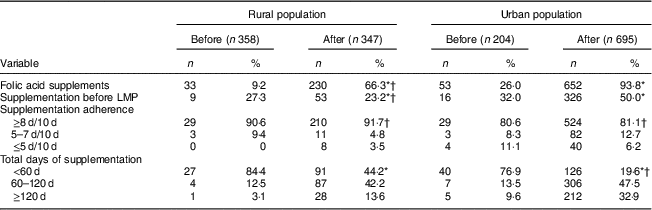
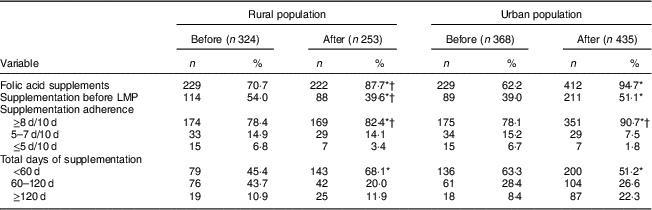
We also analysed supplement use while stratifying the participants by residence (rural/urban) and NTD prevalence (high/low). As shown in Tables 3 and 4, the percentage of folic acid supplementation increased in both urban and rural areas in the two populations after the programme. Although the supplementation rate was similar among urban women in both the high- and low-prevalence populations after the programme (94–95 %), the difference remained among rural women in the high- and low-prevalence populations. The proportion of supplement use increased from 9 % to 66 % in the high-prevalence population and from 71 % to 88 % in the low-prevalence population. In addition, gaps in the supplementation rate between rural and urban areas increased in the high-prevalence population compared with the low-prevalence population after the programme.
Use of folic acid supplements during early pregnancy in the high-prevalence population by residence, before (2002–2004) and after (2011–2012) a massive folic acid supplementation programme, Shanxi Province, China
LMP, last menstrual period.
Note: Some variables have missing data.
*P<0·05 before and after the programme in the same population.
†P<0·05 between urban and rural groups after the programme.
Use of folic acid supplements during early pregnancy in the low-prevalence population by residence, before (2002–2004) and after (2011–2012) a massive folic acid supplementation programme, Jiangsu Province, China
LMP, last menstrual period.
Note: Some variables have missing data.
*P<0·05 before and after the programme in the same population.
†P<0·05 between urban and rural groups after the programme.
The proportion of folic acid supplementation from before the last menstrual period increased significantly (to about 50 %) in urban women in both populations. In contrast, it decreased in rural women in both the high-prevalence (from 27 % to 23 %) and low-prevalence (from 54 % to 40 %) populations. Supplementation adherence showed a consistent increase in both rural and urban women in both populations. A similar trend was observed for total days of supplementation.
The use of folic acid supplements by sociodemographic characteristics
There were significant differences in the use of supplements among different sociodemographic groups. When we pooled the data from the before and after programme surveys together, women with a high school education had a higher proportion of folic acid use than women with a junior high school education or less (78 % v. 42 %, respectively). Women living in rural areas, those who had had a previous pregnancy and those from the high-prevalence population were less likely to take folic acid supplements. Moreover, 80 % of women in the low-prevalence population reported that they had taken folic acid compared with 60 % in the high-prevalence population. Women aged 25–29 years had the highest rate of folic acid supplementation (78 %) compared with women aged 25 years or younger (67 %) and women older than 30 years (60 %). Finally, 80 % of women living in urban areas reported that they had taken folic acid compared with 56 % of women in rural areas.
A multivariate logistic model was used to identify factors associated with likelihood of supplementation with folic acid in the post-programme sample. After we controlled for age and parity, having a pre-pregnancy BMI of more than 25 kg/m2 (OR = 1·64; 95 % CI 1·06, 2·51), having completed high school (OR = 3·66; 95 % CI 2·50, 5·37), living in an urban area (OR = 2·64; 95 % CI 1·81, 3·85) and living in a low-prevalence area (OR = 1·92; 95 % CI 1·33, 2·77) were associated with an increased likelihood of taking periconceptional folic acid supplements (Table 5).
Binary logistic regression results of factors related to periconceptional folic acid use based on the survey after (2011–2012) the massive folic acid supplementation programme, Shanxi Province and Jiangsu Province, China
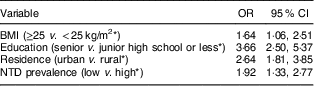
NTD, neural tube defect.
Note: Adjusted for maternal age, BMI, education, residence, previous pregnancy experience, prevalence of NTD.
*Reference group.
Discussion
Periconceptional folic acid supplementation among Chinese women of reproductive age increased dramatically after this programme. The proportion of periconceptional folic acid supplementation increased from 40 % before the programme to more than 80 % after the programme. Although the supplementation rate was similar among urban women in both high- and low-prevalence populations after the programme (94 %), a difference remained among rural women in the two populations. More important, the proportion of pre-pregnancy supplementation decreased among rural women in both the high- and low-prevalence populations. In addition, the gap in supplementation between rural and urban women increased in the high-prevalence population compared with the low-prevalence population.
The overall post-programme rate of periconceptional folic acid supplementation in our study population was higher than rates in settings where no such programmes existed. A recent survey conducted in eighteen European countries showed that 55 % of women reported taking folic acid supplements( Reference Bitzer, von Stenglin and Bannemerschult 10 ) during their current pregnancy. The rate of folic acid supplementation was reported as 33–53·0 % among American women in 2006( Reference Robbins, Hopkins and Mosley 11 , Reference Green-Raleigh, Carter and Mulinare 12 ), 27·5 % among Canadian women in 2002( Reference Morin, De Wals and Noiseux 13 ) and 12 % among Japanese women in 2003( Reference Kondo, Kamihira and Shimosuka 14 ). However, one study, conducted in The Netherlands, has reported a higher rate of supplementation (86 % in 2004) than the current study( Reference van Eijsden, van der Wal and Bonsel 15 ).
An important part of taking folic acid supplements is compliance. Good adherence is essential to elevating and maintaining optimal folate levels. The level of adherence to folic acid intake in our post-programme population was comparable to that in a study of European women( Reference Bitzer, von Stenglin and Bannemerschult 10 ), which showed that 63 % of women took their supplement every day, while 30 % missed 1–2 d and 7 % missed more than 3 d out of 7 d. In our study, 85 % of women took their supplement almost every day, while 10 % missed 3–5 d and 3 % missed more than 5 d out of 10 d.
Because the neural tube closes at the 28th day after conception, before many women even know that they are pregnant, supplementation with folic acid at least 1 month before conception is critical to preventing NTD. Although the overall rate of folic acid supplementation increased after the programme, supplementation before pregnancy among rural women – the target population of the programme – decreased compared with before the programme. Only one-fifth to two-fifths of pregnant women began supplementation before their last menstrual period after the programme. Before the programme was implemented, a mandatory premarital health check-up programme was in effect and women were advised at this check-up to take folic acid supplements. However, these mandatory check-ups became voluntary in October 2003, and only less than 10 % of women choose to have them( 16 ). Therefore, women planning to have a baby have less of a chance to get free folic acid supplements before becoming pregnant. A promotion programme selectively targeting women who plan to become pregnant could have a significant impact in reducing the incidence of NTD( Reference Morin, De Wals and Noiseux 13 ). Moreover, all women who are planning to become pregnant or capable of becoming pregnant should take folic acid supplements. This finding pinpoints the need to identify a mechanism to deliver folic acid supplements to women before they become pregnant.
Disparities in folic acid supplementation remained after the massive supplementation programme. The difference between rural and urban women was much larger in the high-prevalence population than in the low-prevalence population after the programme. In the low-prevalence population, urban residents had more of an advantage in terms of socio-economic status and higher education, and they may have had more knowledge on folic acid( Reference Ren, Zhang and Li 4 ), which may have then positively affected their use of folic acid supplementation. In addition, although the programme was targeted to rural women only, the local governments of low-prevalence areas provided free folic acid supplements for their urban residents, which may have contributed significantly to improvements in folic acid supplementation in urban areas. Future educational campaigns on folic acid supplementation should focus more on women living in rural areas, especially in high-prevalence populations.
Some of the difference in folic acid supplementation rates before and after the programme may have been due to differences in participant characteristics. Particularly in the high-prevalence area, women recruited after the programme were younger, were more likely to be of later gestation, had a higher BMI, were more educated and were more likely to live in urban areas, which would have increased supplementation rates, as shown by the multivariate regression modelling. Economic development and improvements in the standard of living contribute to increased supplementation rates. A woman’s educational level is an important determinant of use( Reference Ren, Zhang and Li 4 , Reference van Eijsden, van der Wal and Bonsel 15 , Reference de Jong-Van den Berg, Hernandez-Diaz and Werler 17 , Reference Timmermans, Jaddoe and Mackenbach 18 ). Knowledge of periconceptional folic acid use, which reflects a woman’s overall health education, depends on educational attainment. In Israel, folic acid supplementation was less successful in women with less than 12 years of education and women aged 17–19 years( Reference Amitai, Fisher and Haringman 19 ). Studies from other developed countries, such as the Netherlands( Reference de Walle, Cornel and de Jong-van den Berg 20 ) and the USA( Reference Farley, Hambidge and Daley 21 ), have revealed obstacles in communicating health-related messages to the young and poorly educated segment of the population. New programmes should target the needs of this particular population. The education of future mothers should begin when these mothers are in junior high and high school( Reference Bitzer, von Stenglin and Bannemerschult 10 , Reference Amitai, Fisher and Haringman 19 ). Mass media (e.g. television, radio, newspapers and journals) can reach not only young and/or pregnant women but also health-care workers and therefore can be helpful in increasing periconceptional use of folic acid( Reference de Walle, van der Pal and de Jong-van den Berg 22 ).
The main limitation of the present study is that participants were not randomly selected. Women who sought prenatal care (and thus were recruited into the study) may have been more highly educated or of a better socio-economic status, which might have resulted in an overestimation of folic acid awareness and use in the population( Reference Ren, Zhang and Li 4 ). In addition, data on folic acid supplementation and adherence were based on self-report. Blood folate concentration is a more objective measure of folic acid supplementation. Future studies should include blood folate parameters in evaluating the impact of behavioural changes of folate supplementation.
Conclusion
In conclusion, periconceptional folic acid supplementation among Chinese women improved substantially after the implementation of a national folic acid supplementation programme. However, many rural women failed to take folic acid before becoming pregnant. Future efforts should target rural women who have lower educational levels. Innovative mechanisms of delivering folic acid supplements to women before they become pregnant are urgently needed.
Acknowledgements
Financial support: This work was supported in part by the National Natural Science Foundation of China (grant nos. 81202265 and 31071315) and by Peking University Health Science Center (Young Teacher Startup grant no. BMU20100089). All of these funders had no role in the design, analysis or writing of this article. Conflicts of interest: None. Authorship: The authors’ contributions were as follows. Study supervision: A.R.; study design: J.L. and A.R.; formulating the research question(s): L.J., Q.M., L.Z. and Z.L.; carrying out the study: J.L., L.J., L.Z. and Z.L.; statistical analysis: J.L.; analysis and interpretation of data: J.L., L.G. and A.R.; drafting of the manuscript: J.L.; critical revision of the manuscript for important intellectual content: J.L., L.J., Q.M., L.G., L.Z., Z.L. and A.R. Ethics of human subject participation: The study was conducted according to the guidelines laid down in the Declaration of Helsinki and all procedures involving human subjects/patients were approved by the Institutional Review Board of Peking University. Written informed consent for the pre-programme survey and oral informed consent for the post-programme survey were obtained from all participants.



