


When we met in 2018, Jaime Mendoza had retired from a long career as a bananero at Dole-Stanfilco, a leading exporter of bananas from the Philippines to Japan.Footnote 1 A common friend in the Bureau of Plant Industries had introduced us when I said that I wanted to understand why plantations for the fruit had moved into the Mindanao highlands. This was most unusual since bananas had historically been an exclusively lowland industry. Indeed, residents on the slopes of the country’s highest peak of Mt. Apo in Davao and Cotabato felt similarly. While getting to know them during fieldwork, I found that they expressed shock and surprise when banana companies started entering their neighborhoods in the early 2000s. These were areas frequently cast in the state imagination as unconducive to big business due to their political instability. Having witnessed many of these developments from inside the industry itself, Jaime agreed to my invitation. He and I met in a building in Damosa, a commercial district in Davao City named for the conglomerate that would eventually launch the region into fame as the country’s “banana capital.” We sat in a conference room on the second floor as he began to recount the story: “All over the world, the banana is just a commodity. The price depends entirely on supply and demand. But in 1994, we [at Dole-Stanfilco] were the ones to start category management and create market segmentation. In Japan, this is the case. It’s very different from what you have in the U.S.”
Jaime was describing a distinguishing feature of the Philippine-Japan banana network, one that marked its break from the American-dominated “Dollar Banana Regime” and European-dominated “African, Caribbean, and Pacific Regime” that structure trade in the tropical commodity around the globe (Raynolds Reference Raynolds, Striffler and Moberg2003). In supermarkets just about anywhere outside of Japan, bananas are displayed in an undifferentiated mound and fetch a uniform price—in the United States, about 49¢ per pound, or 19¢ per piece—regardless of the brand or the country of origin. A small sticker carries the company name, but consumers rarely pay attention to it. Grocery stores swap out one brand for another from week to week, but the typical shopper is unlikely to notice. In the same way that many consumers have no loyalty to brands, fruit jobbers in the wholesale market have no loyalty to companies, and the brand that they find in stores is determined almost entirely by regional distribution routes (Soluri Reference Soluri, Striffler and Moberg2003: 64–65). In most places in the world, therefore, “a banana is a banana is a banana,” to borrow the words of another businessman I met in Davao. In short, it is a fungible commodity.
In Japan, by contrast, bananas range more widely in price from ¥97 to ¥458 (about. US$0.70 to $3.00). They come in attractive packaging that bears a much larger company logo with production information and various illustrations. Looking closely, the astute grocery shopper will notice a peculiar marketing scheme: bananas are labeled and priced by cultivation altitude. The term that appears repeatedly on product packaging and display cases is kōchi saibai banana (高地栽培バナナ) or “highland cultivated bananas,” referring to bananas grown higher than 500 meters above sea level (MASL). Selling for as much as four or five times the price of regular bananas, kōchi saibai banana have since the early 2000s been advertised for their exceptionally rich and creamy sweetness and their soft, chewy mouthfeel, qualities that set them apart from their conventional, lowland counterparts. The difference in taste is measured and presented to shoppers in degrees Brix (°Bx), or tōdo (糖度) in Japanese, a unit commonly used in the food and beverage industry to quantify sugar content. Brand names, too, emphasize elevation: “Dole Skyland,” “Mountain Peak,” “Sun-Blessed Banana,” and “Bananas above the Clouds.” Nowhere else in the world is this the case.
Both industry insiders and outsiders are likely to view this apparent idiosyncrasy as a result of a Japanese attentiveness to taste. Japanese consumers, they might offer, are culturally predisposed to seek out the finer sensorial particularities in food and, not inconsequentially, willing to pay for them. This essay offers an alternative explanation, rooted in social history, that reframes this phenomenon less as an idiosyncrasy and more as a dynamic that pervades the creation of all commodities under capitalism. To this end, Jaime’s words are key: “All over the world, the banana is just a commodity.… We were the ones to start category management and create market segmentation.” In business parlance, the defining feature of a commodity—think corn, wheat, or crude oil—is its fungible, interchangeable nature. This means that it can be substituted for another of its kind because they are considered identical regardless of where, how, or by whom they were cultivated. Fungibility is central to the ways scholars have understood capitalist production. As geographer Susanne Freidberg notes, it is the very notion behind Karl Marx’ adage that “from the taste of wheat, it is not possible to tell who produced it, a Russian serf, French peasant, or an English capitalist” (Reference Freidberg2017: 2). Historian William Cronon’s classic account of grain trading in Chicago demonstrates how the technical invention of this interchangeability “suddenly made it possible for people to buy and sell grain not as the physical product of human labor on a particular tract of prairie earth but as an abstract claim on the golden stream flowing through the city’s elevators” (Reference Cronon1991: 120). Fungibility, then, as it has been understood in business and economic history, is what gives commodities a liquid, immaterial quality, allowing futures to be traded and wholesale markets rather than growers to determine farm-gate prices.
In contrast to fungible commodities, differentiated products—or, to use Jaime’s words, products for which “category management” or “market segmentation” has been introduced—are not perceived to be interchangeable. Differentiation, in the language of industry, is a means of eliminating the condition that makes, say, “a banana a banana a banana.” Product differentiation relies both on changes to production and distribution and the manipulation of consumer perceptions. Competitive marketing strategies play a significant role in this process, appealing to consumers’ senses and imagination, speaking to classed aspirations or nostalgia, and proposing political agendas for redirecting consumer dollars toward social good (Freidberg Reference Freidberg2017; Besky Reference Besky2014; Reference Besky2020; Mutersbaugh Reference Mutersbaugh2005). This strategy, as plantation corporations see it, can be an immensely important, especially for those dealing in cash crops historically pulled toward fungibility. It allows retailers to set their own prices rather than those dictated by the vagaries of supply and demand. At the same time, it presents opportunities to increase profits for smallholders and microprocessers, particularly in moments of overproduction (Roseberry Reference Roseberry1996; Fischer Reference Fischer2022).
In this paper, I recount the social history of the banana’s transition from a fungible commodity into a non-fungible, differentiated product between Japan and the Philippines. My central contention, contra the assertions of plantation representatives, is that invention of kōchi saibai banana is better understood as a project to perpetuate fungibility, rather than one to reduce it. Engaging critical studies of commodities and plantations, I take fungibility as the characteristic that sees people, places, and things as interchangeable and open to the projection of others’ desires. In what follows, I chronicle the various forces responsible for rendering the Philippine highlands and its communities as available to reinvention by the Japanese quest for sweetness, much in the same way that so-called “wastelands” of all kinds have been rendered into tabula rasa for settler and agrarian colonialism (Soluri Reference Soluri2021; Voyles Reference Voyles2015).
This intervention builds on several historical and ethnographic studies that have analyzed the patterns of transformation from one commodity status to the other: the conversion of coffee into “yuppie” equivalents, tea into SFTGFOP grades and its derivatives, and cotton into differentiated fibers (Roseberry Reference Roseberry1996; Besky Reference Besky2016; Caliskan Reference Çaliskan2010). Food items, like cheese differentiated into various artisanal kinds, pigs distinguished by heritage breeds, or tomatoes into heirloom varieties bespeak the same developments (Paxson Reference Paxson2013; Weiss Reference Weiss2016). For bananas, too, organic, fair-trade, and other third-party certification schemes represent attempts by European and American markets to de-fungibilize the world’s most popular fruit while still maintaining its cheapness, with alternatives often being only 20 cents more than conventional counterparts (Murray and Raynolds Reference Murray and Raynolds2000; Raynolds Reference Raynolds2008; Brown Reference Brown2013).
What demands more emphasis in this corpus of work is the fact that fungibility and differentiation are not nearly as distinct, and the transition from one to the other not nearly as teleological, as they may seem. In her study of salmon, Karen Hébert (Reference Hébert2010), for example, has questioned the assumption that commensurability (read: fungibility) and singularizing (read: differentiation or segmentation) are fundamentally distinct processes, noting mirroring processes in the production of the fish as “poundage” and as high-quality, sustainable alternatives. Sarah Besky (Reference Besky2020) has likewise argued that a bag of looseleaf black tea is considered largely undifferentiated and infinitely reproducible even as tea itself is highly variable. Taking cue from these scholars, this essay views the relationship between fungibility and differentiation less as an immediate shift in diametrically opposed statuses, as the language of business might suggest, and more as an overlapping, contradictory transition along a spectrum. Bananas make an intriguing subject for this argument, particularly considering that the industry has long conceived of the fruit as a fungible commodity even as it has historically insisted on the irreplaceability of a singular variety—first the Gros Michel, then the Cavendish—for commercial trade (Soluri Reference Soluri2021; Marquardt Reference Marquardt2001).
A topographic approach attunes ethnographic and historical attention to the spectral quality of these changes in the production, marketing, and consumption of commodities. Here, I adopt topography as a mode of research that emphasizes the forms and features of land, and that dialogues with other ecological approaches to the study of tastes and commodities (McCook Reference McCook, Thurston, Morris and Steiman2013). Thinking about fungibility topographically thus underscores that even fungibilization, often conceptualized as the liquidification or unmooring of solid commodities from their material bases, is contingent on the rearrangement of the physical world, a process that is always already biocultural in nature. A topographical intervention into the study of sweetness, in particular, presents an opportunity to re-engage standard-bearing works like Sidney Mintz’ Sweetness and Power (Reference Mintz1985). This magisterial piece demonstrated how the desire for sugary foods, long considered a biological predilection, was in fact historically situated in a narrative of colonialism, industrialization, agricultural commercialization, and global interdependence. However, while closely attuned to the multi-faceted qualities of sugar, Sweetness and Power largely maintained a flat understanding of sweetness as a taste. The kōchi saibai banana story, therefore, takes what Sweetness and Power has accomplished across the geographical spaces of Great Britain, the Americas, Africa, and the Caribbean, and reconsiders it along the textured topographical landscapes of East and Southeast Asia’s hills and plains.
In chronicling this social history, I borrow from Besky (Reference Besky2020), who has emphasized the dimensions of empire, materiality, and markets in her study of “quality.” I have organized the following essay into three sections, each historizing a fungibilizing force responsible for the industry-wide transformations observable today. The first of these is the Japanese consumer nostalgia for the tastes of the colonial Taiwanese past and, notably, the subsequent notion that that nostalgia could be satiated in the neo-colony of the Philippines. These developments coalesced in the accidental discovery in the 1980s of the formula that linked heightened sweetness to higher cultivation altitudes. The second force is the creation of a new retail lexicon that capitalized on airin shisō, a Japanese mythos romanticizing mountainous regions as spaces of ecological integrity. This retail language created product differentiation in spheres of consumption, even as highland plantation expansion simultaneously worked to flatten and fungibilize mountainous regions laden with cultural significance in zones of production. Finally, the third is the Philippine statal and para-statal aspiration to subdue the Mindanao hinterlands, a process that linked landscape and laborer as two entities reduced to empty vessels for the imposition of other’s desires. I end with reflections on history, and how historical explanation is glossed over by culturally essentializing notions of a Japanese sensitivity to taste.
This work is based on oral histories gathered from Filipino and Japanese plantation managers, employees, retired company executives, ripening and port technicians, wholesale market jobbers, fruit vendors, highland community members, and supermarket shoppers. I carried out fieldwork toward this social history as part of a larger project on the plantation economy, for eighteen months between 2016 and 2018 across sites in Davao, Davao del Norte, Cotabato, and Bukidnon in the Philippines, and Tokyo, Mie, and Fukuoka Prefectures in Japan.
Plantation One and the Lost Tastes of the “Highland Nation”
“Highland operations are abnormal when it comes to banana business,” said Neil Abejuela,Footnote 2 an industry veteran and expert agriculturalist, as he recounted to me the history of kochi saibai banana at his office on the grounds of a highland plantation in Bukidnon Province. In the Philippines as in most banana producing countries, the veteran explained, export-oriented plantations for Cavendish have historically been concentrated in lowland coastal areas. There, easy access to flat terrain, large and contiguous plots of land, concrete roads, and ports allowed for the efficient transport of the fresh and delicate fruit. What the bananero did not say aloud, but that remains a common understanding among industry players like him, is that the uplands are also contentious territories, cast in public discourse as the nation-state’s Other. Historian Filomeno Aguilar captured this idea forcefully when he, engaging Reynaldo Ileto, described Philippine history as “ineluctably structured around the dualism of colonial towns (pueblos) and un-subjugated hinterlands, of loyal subjects and heathen rebels, of orderly insiders and disorderly outsiders” (Aguilar Reference Aguilar1994: 51; see also Contreas Reference Contreas1992). Understood as embodying spaces of resistance and disorder, and as being peopled by political dissidents, outcasts, and extremists, the mountainous stretches of Mindanao have since the darkest years of martial law been described by local and national government units as among the hottest hotbeds of insurgency. For these reasons, alongside those the industry veteran mentioned, the history of Philippine bananas has primarily been told as a story of the lowlands and its accompanying social milieu of economic elite, central state politics, and cultural majorities (Tsurumi Reference Tsurumi1982; David et al. Reference David, Rivera, Abinales and Teves1982; Rivera Reference Rivera1983; Krinks Reference Krinks1983; Reference Krinks1981).
Against this backdrop, the impetus for the banana plantation economy’s incursion into the Mindanao mountains began as both a chance discovery and an outgrowth of a colonial order long in the making. The story, as industry insiders like Jaime and Neil often tell it, began in 1986, when Sumifru Philippines, a subsidiary of the Japanese conglomerate Sumitomo Corporation, launched a new business endeavor to source export Cavendish from the Philippines. When plans to establish its first plantations were underway, the large American conglomerates Dole, Del Monte, and Chiquita already dominated the lowland scene following the land rush of 1969. As a foreign company with no property of its own, Sumifru decided on a joint venture with two prominent Filipino familiesFootnote 3 and acted through the JVA Management Corporation. Together, the three entities bought majority stocks in three banana plantation companies: Davao Fruits Corporation, Hijo Plantations, and Twin River Plantations. Within the industry, Davao Fruits Corporation was unusual in that it controlled a multitude of modestly sized farms scattered around Davao del Sur and Compostela Valley rather than any singular, contiguous plantation along the banana belt like many of its peers. The first of its six banana plantations, for example, was a relatively small 400 to-500-hectare property opened in Brgy. Manuel Guianga in the Calinan district of Davao City (see Map 1). Given the name “Plantation One,” the farm’s elevations ranged from 450 to 800 meters above sea level along the rising piedmont toward Mt. Apo.
Details of the contemporary map of the highland banana industry in Davao City. Areas in purple indicate banana plantations. Elevation, from highland to super highland, is indicated in light yellow/tan to dark brown, respectively (Source: Khalil Angelo Gamela, reproduced with permission).
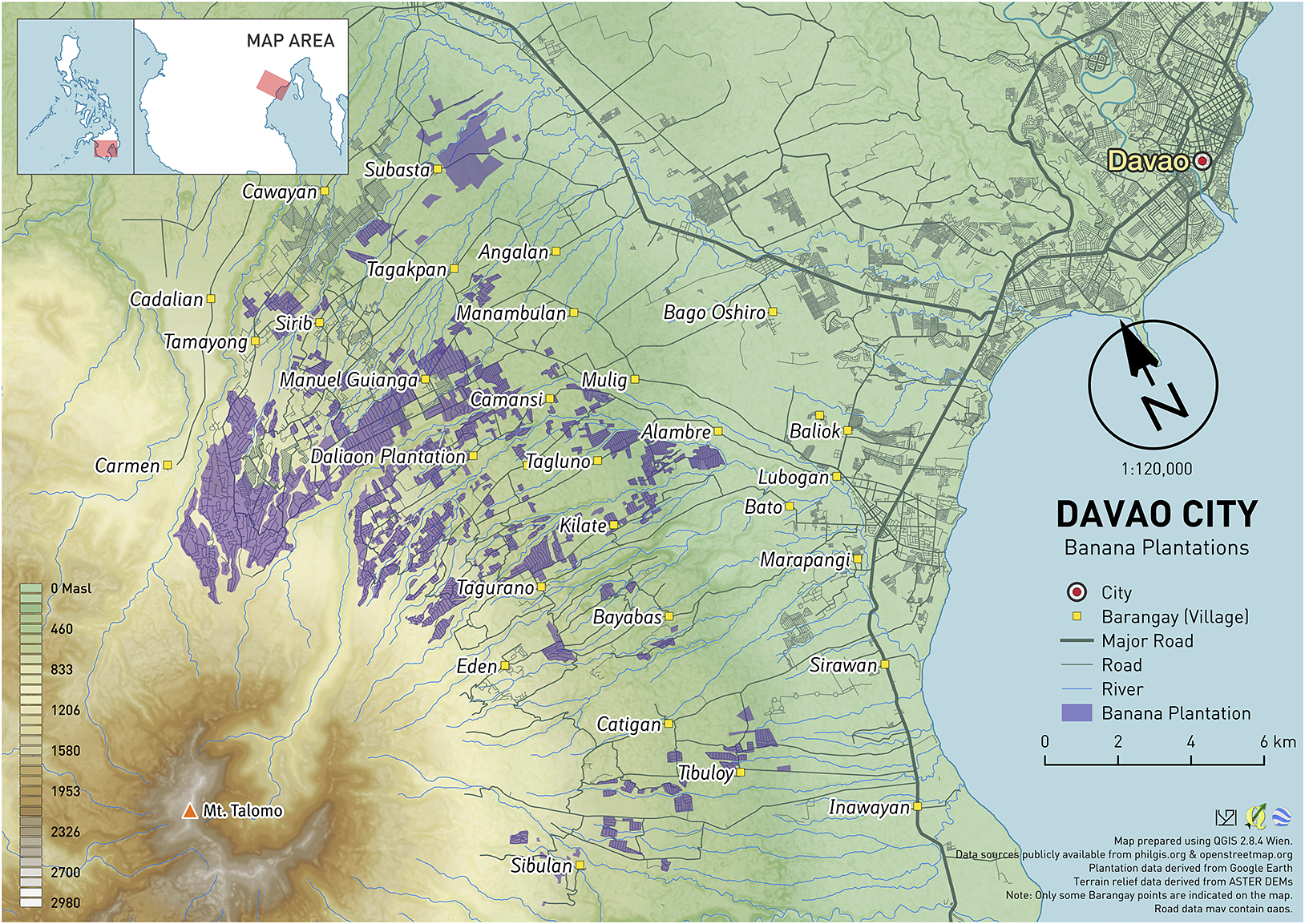
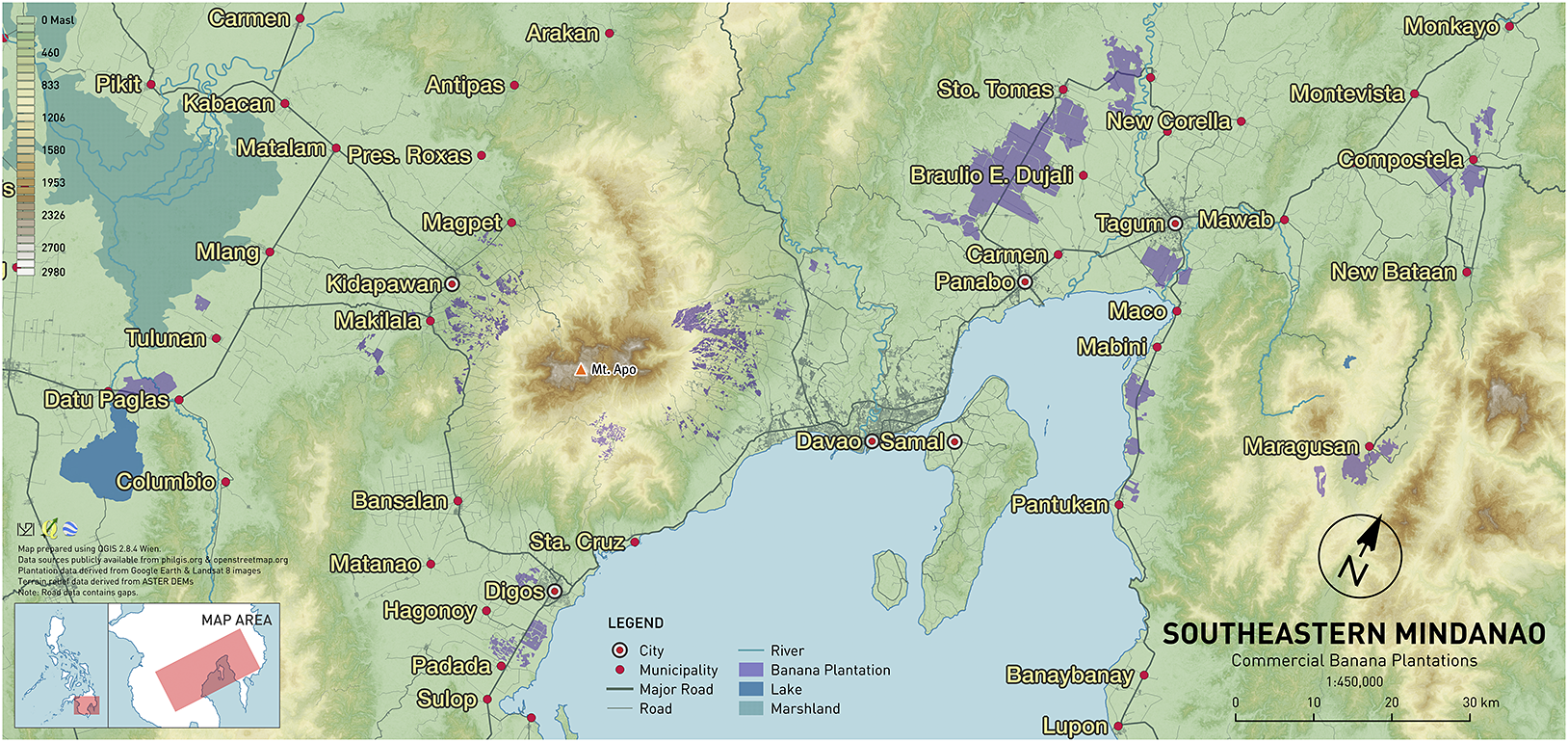
Plantation One, or “P1” as it is still often called, would become the first “highland” banana plantation in the Philippines, but no one knew that at the time. Locals from the area contend that P1 could not have looked less like the banana plantations along the Panabo-Sto. Tomas stretch of Davao del Norte Province, the heart of the banana belt (see Map 2). In the Davao del Norte lowlands, booming demand from the Japanese market had spurred the growth of vast company enclaves on contiguous plots of several thousand hectares. In contrast, Calinan district was a poorly developed area in the rural outskirts of Davao City. Dirt roads covered in large rocks were traversable only on motorcycles and other lightweight vehicles, and crops were hauled from upland farms to local markets on water buffalo-drawn carriages. Pockets of the neighborhood were very underdeveloped and infamous for harboring insurgents in hiding. Cavendish bananas were a highly unusual crop to cultivate at P1’s elevations, and the district was dominated by small farms growing coffee, cacao, coconuts, and durian.
A contemporary map of the highland banana industry in Southeastern Mindanao. Areas in purple indicate banana plantations. Compare the large contiguous plantation in the Panabo-Sto. Tomas stretch to the smaller, non-contiguous patches in the Davao highlands surrounding Mt. Apo. Lowland elevation is indicated in pale green. Highland to super highland is indicated in light yellow/tan to dark brown, respectively (Source: Khalil Angelo Gamela, reproduced with permission).
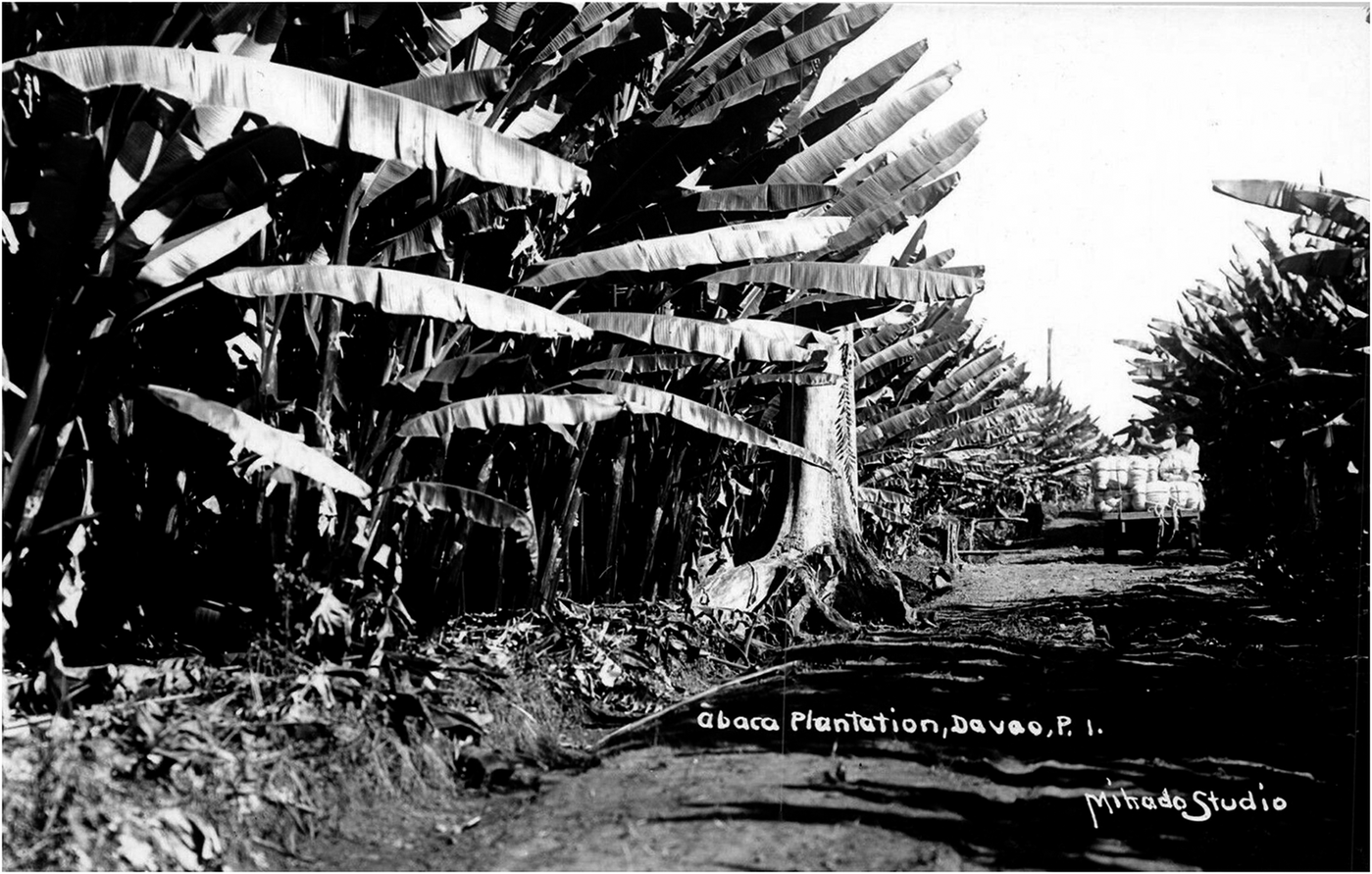
Many Japanese corporate representatives understand Sumifru’s choice to situate P1 in the highland Calinan district as having been a response to the area’s historical connection to Japan. One young executive office manager from an importing company mentioned that Sumifru sought the help of the Japanese community who had lived in the area since before World War II. He was referring to Japanese laborersFootnote 4 who had migrated to Davao’s upland and coastal areas before the war to grow abaca, a species of Musa related to and cultivated similarly to bananas, and process it into military cordage. This aspect of Davao’s history is rich and well-documented (see Figure 1) (Abinales Reference Abinales1997; Reference Abinales2000; Jose and Dacudao Reference Jose and Dacudao2015; Furiya Reference Furiya, Shiraishi and Shiraishi1993; Hayase Reference Hayase1985b; Reference Hayase1985a; Ohno Reference Ohno1992; Yu-Jose Reference Yu-Jose1992; Dacudao Reference Dacudao2023). These migrant laborers chose Calinan district as a home base for their abaca planting because, unlike the lowland areas, Mt. Apo’s gentle slopes were not prone to flooding. They established Brgy. MintalFootnote 5 as the center of the economic thoroughfare, a hamlet that neighbored Brgy. Manuel Guianga, where P1 would eventually be situated. Japanese business in abaca thrived and the industry has since been celebrated for singlehandedly transforming the swampy backwaters of the Moro Province into a metropole connected to the global market.
A Japanese-run abaca plantation, Davao City. Circa early 20th century (Source: public domain).
By the 1980s, when Davao Fruits Corporation was developing P1, very little remained of the once-vibrant Japanese community of Davao. With the fall of the Imperial Japanese Army, Japanese farmers-turned-military men were repatriated,Footnote 6 the demand for military cordage plummeted, and much of the land Japanese businessmen had acquired, both legally and illegally, was confiscated and redistributed.Footnote 7 Nevertheless, the prewar abaca industry had set a precedent for both bananas and plantation economies in the highlands of Davao City. In the words of historian Patricio Abinales, Japanese settlers in Calinan “had laid an economic infrastructure that would define the future of Davao under the new republic” (2000: 92–93). This would not only mark the “origins of plantation-based, settler- and corporation-managed infrastructure” in the Philippines’ southernmost region (ibid.; see also Collier Reference Collier1997), but also set a precedent for an ideology that saw the region as a fungible, open space for the imposition of settler desires.
Sumifru started exporting P1 bananas from Brgy. Manuel Guianga in Davao’s Calinan district to Japan in the latter half of the 1980s. But much to the company’s surprise and dismay, their highlands fruit gained an unflattering reputation everywhere it landed. Tanaka Seika Ltd. in Mie Prefecture was one of the importing and ripening companies that received P1 bananas. I visited their ripening houses to see a retired executive, who told me of his involvement in the discovery of P1. He explained that, in those days, banana boxes were mixed in with those from countless other production sites. They were stacked one on top of the other “like Jenga” in simple ripening rooms where electric fans pushed ethylene gas through the crevices in between boxes. Tanaka Seika’s employees complained about the boxes from Guianga, which inexplicably ripened slower than the others. For several years, the company dubbed P1 bananas as “low quality” and sold them off to unexcited buyers at discounted prices.
One of Tanaka Seika’s ripening technicians, a now-retired managing director named Sumimoto Akira, decided to investigate the issue of P1. Upon opening the boxes, he was surprised to find that the P1 bananas bore a striking resemblance to the Taiwanese bananas he had eaten as a child. They had the same rounded ends, shortened stems, and golden yellow hue, which contrasted with the long, pointed, and dull yellow color of the fruit from lowland Mindanao’s plantation belt. Sumimoto thus decided to perform an experiment: he tried to ripen the boxes of P1 according to Taiwan’s banana specifications—that is, for one day longer and at temperatures 2 degrees higher. He and his colleagues were shocked at the result: their class B bananas from P1 possessed the kind of rich, creamy sweetness and soft, chewy mouthfeel that had been lost with the transition from Taiwanese to Philippine supplies in the 1960s.
Nostalgia for those lost tastes reminiscent of a former colony and a luxury item of a bygone era resuscitated P1 from its “low quality” status and, eventually, turned it into an economic success that would fundamentally change the Japan-Philippine banana industry. From the late Meiji (1868–1912) to the mid-Showa era (1929–1989), Taiwan bananas were luxury items that middle-class consumers of the time typically only enjoyed as a special gift when sick or hospitalized.Footnote 8 “You literally had to be on your deathbed [to have a banana],” elderly grocery shoppers remembered to food ethnographer Jun Akamine (Reference Akamine2013: 4). “I would watch monkeys eating bananas on TV with envy!” (ibid.). Akamine has heard much the same in his interviews with other elderly Japanese consumers. For instance, Ineyama Hideyuki, born in 1931, remembered how his mother would mash up bananas with a fork and feed them the pulp little by little, so they could savor the taste longer (ibid.: 138).
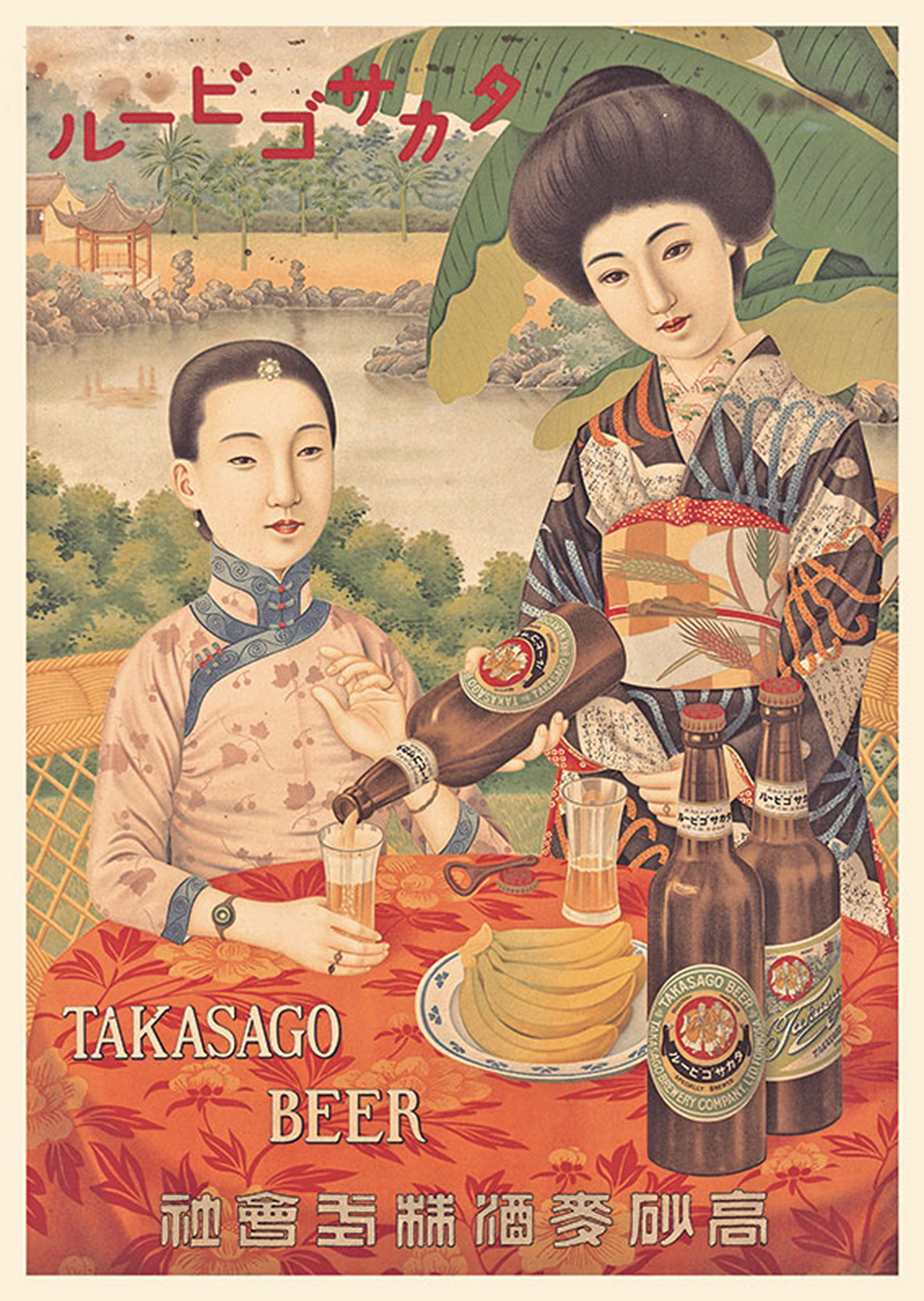
For sixty years before the birth of the Philippine export banana industry in 1963, bananas from colonial Taiwan, then called Takasago (高砂国) or, literally, “Highland Nation,” had been the staple of the Japanese market (see Figure 2). Annexed after Japan’s victory in the First Sino-Japanese War in 1895, Taiwan became a critical node in a string of Japan’s so-called “peaceful expansions.” Private agrarian settler colonialism, intended to differentiate Japan’s activities from state-led military aggression, transformed the island in the South Seas into “a lifeline of food production [for the Japanese homeland]” in rice, sugar, coffee, and tropical fruits (Azuma Reference Azuma2019: 183). The pursuit of sweetness occupied a privileged place in Japan’s twin projects of imperialism and modernization, as several scholars have noted (Tsay Reference Tsay2023: 43; Kushner Reference Kushner, Francks and Hunter2012). From the cultivation of sugar beets in the territory of Hokkaido to the production of sugarcane in Taiwan, so central were these industries that scholar Yanaihara Tadao coined the term “sugar industry imperialism” (tōgyō teikokushugi) to capture the collusion between colonial governance and capitalist enterprise that so characterized the Japanese Empire. Taiwanese bananas, which were closely associated with sweetness, came to represent the empire’s expansion and diversification into tropical zones (Tsay Reference Tsay2023: 46; see also Chen Reference Tsu-yu2010).
A commercial poster for Takasago Beer shows Taiwanese bananas at the center of a table where two women—one Japanese, one Taiwanese—share a drink. (Source: public domain).
Trade in Taiwanese bananas began with the first commercial shipping of seven 70-kilogram baskets, which entered into the port of Kobe in 1903, eight years after Taiwan’s colonization in 1895 (Jimbo Reference Jimbo1962). A novelty at the time, a Taiwanese Cavendish banana variety called beijiaozhong (hokushōshu in Japanese) became a huge success. Its heightened sweetness was the result of growing conditions in the production regions of mountainous Jiji and coastal Kaohsiung, which lay at a latitude and altitude unlike those of other regions of the global banana belt. The township of Jiji in the mountainous and landlocked Nantou County became known as the “Cradle of Taiwan Bananas,” where fruit-marketing cooperatives, transportation infrastructure, and distribution networks in the tropical fruit were concentrated during the colonial period (Koseki Reference Koseki2006: 217–18). With the success of the industry, these developments pushed southward toward the lowland, coastal areas of Kaohsiung around the 1920s following a boom in business and increased exports to other areas under Japanese occupation in Korea, Manchuria, the Republic of China, and Hong Kong (ibid.: 219).
Local Taiwanese banana growers had come to recognize the distinctiveness of “highland cultivated” bananas because of differences between fruits coming from highland Jiji and from lowland Kaohsiung.Footnote 9 However, that distinction was lost by the time the fruit reached the port as exporters sold all “Taiwan bananas” to Japanese buyers at uniform prices controlled by the Taiwan Provincial Fruit Marketing Cooperative (ibid.: 220).
While Taiwan-Japan banana trade fizzled with a 1963 liberalization of the banana market that allowed more competition (Jimbo Reference Jimbo1962), it had set an historical precedent in taste that remained long after. In the latter half of the twentieth century, Taiwan saw gradual production decline due to disease and a general inability of its seasonal supply to keep up with growing, year-long demand. Meanwhile, American corporations with well-established banana businesses in Latin America and newly opened plantations in the PhilippinesFootnote 10 entered the picture to fill in the gap. The concurrent explosion of supply from Mindanao from the 1970s onward meant that Philippine bananas came to replace Taiwanese bananas on supermarket shelves. With the transfer of supply to the Philippines, the once-scarce and prized fruit of the late Meiji period and Taisho era (1912–1926) became a commonplace consumer item from the mid-Showa years onward. But for many Japanese consumers, the drop in price came with a discernible drop in taste.
The generation of Japanese consumers who grew up in the Showa era continued to seek bananas that tasted like those they had enjoyed when younger. So, when Tanaka Banana embarked on a different marketing strategy for P1 bananas in the 1990s, they started selling surprisingly well. “This was not because people were attracted to the highland label,” a Sumifru employee explained to me; in those early years the term kōchi saibai or “highland cultivated” still meant nothing to anybody. “It was because of the claim that it tasted like Taiwan bananas.” Uchida Masakazu, a wholesaler at Kyoto’s fruit market, for instance, described the flavor of Philippines highland bananas thusly: “It’s a taste that I came to know intimately in the days of my youth.” Uchida had had his first bite of the yellow fruit as a fifteen-year-old middle schooler in 1946. He received it as a gift from his father, who worked at a facility where they ripened basket-loads of Taiwan bananas over a gas burner over a period of a few days. In an online interview, he shares fond memories of running to his schoolmates with banana in hand, yelling, “I’ve got a banana! (kore ga banana da zō!).” He recounts slicing up the precious fruit as thinly as he could to treat all of his classmates to a taste (Uchida Reference Uchidan.d.).
The legacy of the colonial order between Japan and Taiwan had not disappeared with the formal end of empire, nor with the decline of Taiwan’s commodities. Instead, it remained embedded in the sensorial regimes of taste, which became the basis for industry-wide changes in the years to come (see also Tsay Reference Tsay2023: 49). As I will elaborate in the next section, satiating that desire would turn on notions of fungibility—that is to say, on the presumed plasticity of Philippine landscapes, the new seat of the Japanese banana trade in the postwar era, as sites for recreating what was once deemed lost.
Sweetio and the Retail Language of Topographic Terroir
News of the sudden success of the “low quality” P1 banana traveled widely within the industry. “Do you know what a Telex machine is?” Neil asked me, as he continued to recount bits of the story. “We used to get these telegram-like messages from the Japanese buyers and trade personnel saying, ‘Please include my share of P1 bananas.’” He had noticed the flood of special requests from their Japanese trading partners and alerted the top management at Davao Fruits Corporation that P1 was very quickly becoming incapable of meeting all the demand. “The Japanese would get back to us saying, ‘Why don’t I have my P1 bananas?’ So, P1, P1, P1, P1!” Neil said emphatically, throwing his arms up in the air. Tanaka Seika, the ripening facility mentioned earlier, had popularized the claim that bananas from Brgy. Manuel Guianga in the Calinan district of Davao City were, to quote a company representative, “the sweetest in the world.” Yet, at the time nobody at Sumifru could pinpoint what it was exactly about P1 that accounted for the distinction.
It would be almost a decade before it was discovered that the plantations’ highland elevations were behind the increase in sugar content. Two men, neither of them from Sumifru or Davao Fruits Corporation, were responsible for investigating the Japanese market’s predilection for P1 bananas and discovering the unique biological link between production altitude and pulp sweetness. The first was a Chinese-Filipino businessman named Paul Cuyegkeng, who was then president of Dole-Stanfilco and is currently the president of Sumifru Corporation. The second was his vice-president, Horiuchi Tatsuo, the current president of the recently founded banana importer Farmind Corporation. Both had heard about P1 through the grapevine and suspected it was the key to a potentially momentous development for the Philippine-Japan banana trade. “Paul always likes to start new things,” an old colleague of Cuyegkeng’s and Horiuchi’s said when speaking of the two entrepreneurs. “They sort of clicked with each other in that sense. They both wanted to make a big change in the industry.”
The colleague recounted the story to me in hagiographic manner, attributing the “big change” brought by highland cultivation to corporate leadership and innovation. In truth, at the time Cuyegkeng and Horiuchi sought “big changes,” the rise of mass consumption in Japan had forced fruit companies into intense competition with each other, compelling them to seek means of differentiation.Footnote 11 In many ways, this had left them desperate to find ways out of the cycles that tethered bananas to cheapness. In the years leading up to the 1990s, rapid postwar industrialization and expanding distribution networks propped up large supermarkets like Tokyo Aoyama, Kinokuniya, and Daiei (Tatsuki Reference Tatsuki1995). This changed the way that bananas were sold to Japanese consumers, who until then had relied on neighborhood yaoya stalls (mom-and-pops) for their fresh fruit and produce. At local yaoya, bananas generally came from a single wholesale supplier. They lost all traces of branding once removed from their carton boxes and displayed in unbagged and unlabeled bunches. As arbiters of quality, yaoya-san fruit vendors might have justified their prices with personalized anecdotes on taste. Modern supermarkets removed the vendors from the equation and promoted a more private shopping experience reliant on product labeling and promotional materials provided at the grocery store.Footnote 12 Japanese supermarket shoppers learned to sift through banana brands from multiple import companies, which were displayed in rows alongside each other. They were laid out not in a mound of unbagged bunches, but in consumer packs on displays that carried a price by brand rather than weight. This new shopping interface effectively pitted importers against each other in a contest for not only shelf space but also cheaper prices. In the absence of a curator like the yaoya vendor to speak to taste and quality, it had become increasingly difficult to convince consumers to select a bunch that cost ¥198 over one that cost ¥195.
Recognizing the lingering nostalgia for the sweetness of Taiwan bananas and faced with tightening price competition, Dole-Stanfilco endeavored to break out of the banana’s status as a fungible commodity. It aimed to create for itself a pricing scheme freed from the push and pull of supply and demand as determined by the wholesale market. Under the leadership of Cuyegkeng and Horiuchi, the company took inspiration from the discoveries made on Plantation One and, between 1993 and 1994, decided to open their own experimental highland plantation.Footnote 13 Company researchers convinced a Taiwanese scientist, Dr. Shin-Chuang Hwang at the Taiwan Banana Research Institute, to sell them five seedlings developed from Taiwanese varieties. They recognized that to grow these seedlings they needed to recreate somewhere in Mindanao a temperature gap similar to that of Taiwan. Dole-Stanfilco’s agriculturalists found what they were looking for on the plateaus of highland Maragusan, east of the cities of Davao and Panabo, and located an average of 600 to 800 meters above sea level. They started with 70 hectares and expanded to the current 900 hectares. Cultivated on the gentle plateaus of Davao de Oro, formerly known as Compostela Valley, Dole’s Maragusan bananas had as much as 22 to 24°Bx, a far cry from the 18°Bx of lowland bananas from Panabo City in Davao del Norte.
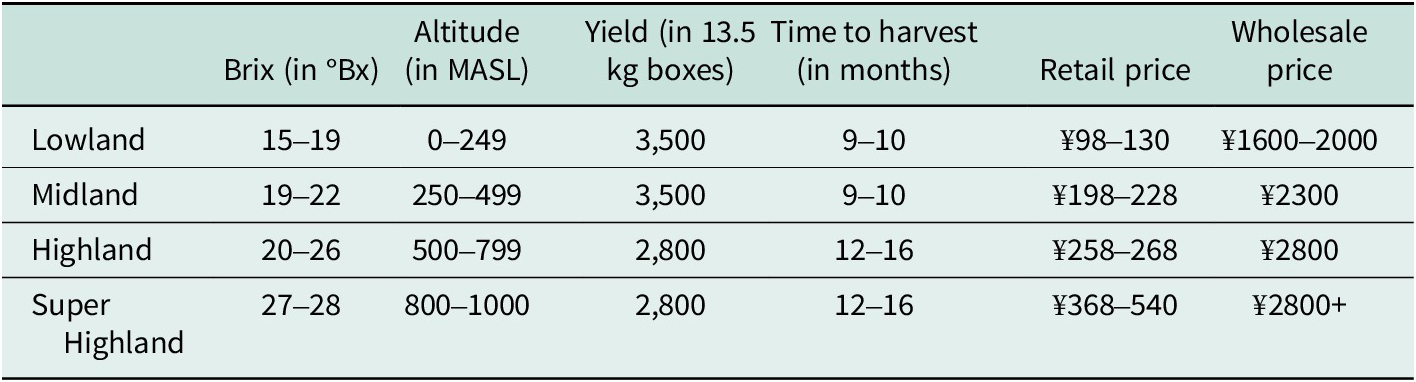
At these experimental farms, Dole discovered that the secret to highland sweetness was not merely elevation per se, but rather an element closely tied to it: the banana cultivation timeline. Increased differences in daytime (high) and nighttime (low) temperatures, a feature of both the Philippine and Taiwanese highlands, meant that bananas grew much slower, lengthening the time between flowering and harvest from nine months at lower elevation to twelve to sixteen months at higher elevation. With the added time, banana plants produced more starches, resulting in fruit pulp that was noticeably sweeter. Upon testing, company managers found that sugar content increased in direct correlation with altitude and the climatic gap: in the coastal flatlands (0–250 meters above sea level) where temperatures were more stable, bananas measured at 15–19°Bx; in the midlands (250+ meters) at 19–22°Bx; in the highlands (500+ meters) and in the super highlands (800+ meters) at 20–26°Bx and 27–28°Bx, respectively (see Table 1).
Approximate differences in the production process and pricing between lowland, midland, highland, and super highland bananas in Japan. Source: author.
In the year 2000, Dole-Stanfilco became the first in the industry to market its Maragusan-grown bananas under the newly invented appellation kōchi saibai or “highland cultivated.” The category was a revision on an older proposition to call the bananas “Super Sweet Taiwan Variety,” a title for which the Taiwanese government claimed property rights. They decided on a product line that would eventually become as recognizable to Japanese consumers as it would to locals in the Philippine highlands: “Sweetio.” The launching of Dole’s Sweetio set off a chain reaction within the industry, compelling every major company to rush to establish plantation properties in the Philippine mountains in order to launch their own highland brands. Sumifru came in second with Kanjukuō, literally, “King of Ripened Sweetness.” The two other major industry leaders, Del Monte and Unifrutti-Chiquita, jumped on the bandwagon with their brands “Highland Honey,” “Chiquita Precious,” “Saikōhō (Mountain Peak),” and “Kin no Fusa (Golden Bunch).” Altogether, it took Dole ten years to launch the highland banana industry, but when they did reverberations were felt across the supply chain.
Having segmented the banana market into classes based on cultivation altitude, companies in the Philippines and Japan became newly open to price “fictions,” which allowed them to charge consumers several times what they had in the past (Guyer Reference Guyer, Hahn and Hart2009; on fictive commodities, see also Polanyi Reference Polanyi1944). But for consumers to adopt the kōchi saibai banana concept and buy into the new pricing ideology, a new marketing language was required. This was essential for a commodity that had come to be considered cheap after the transition from Taiwanese to Philippine supply in the 1960s, even as nostalgia for the taste of a luxury item lingered. As Besky has argued in the case of tea, this language would come to constitute the “set of linguistic, technological, and aesthetic techniques not just for judging quality—as if quality were always just waiting there to be perceived—but for producing it” (2020: 2). In Japan, retailers accomplished this by turning to the language of degrees Brix (°Bx) or tōdo, retail lexicon that exploited long existing cultural ideologies about the essentialized integrity of mountainous landscapes. Important to note at this juncture is how these processes effectively created a disjuncture: At the retail level, it would seem that bananas had become a fully differentiated market. In zones of production, on the other hand, it was clear that that differentiation was predicated entirely on stripping the Mindanao mountainside of cultural meanings that made the bananas different in the first place.
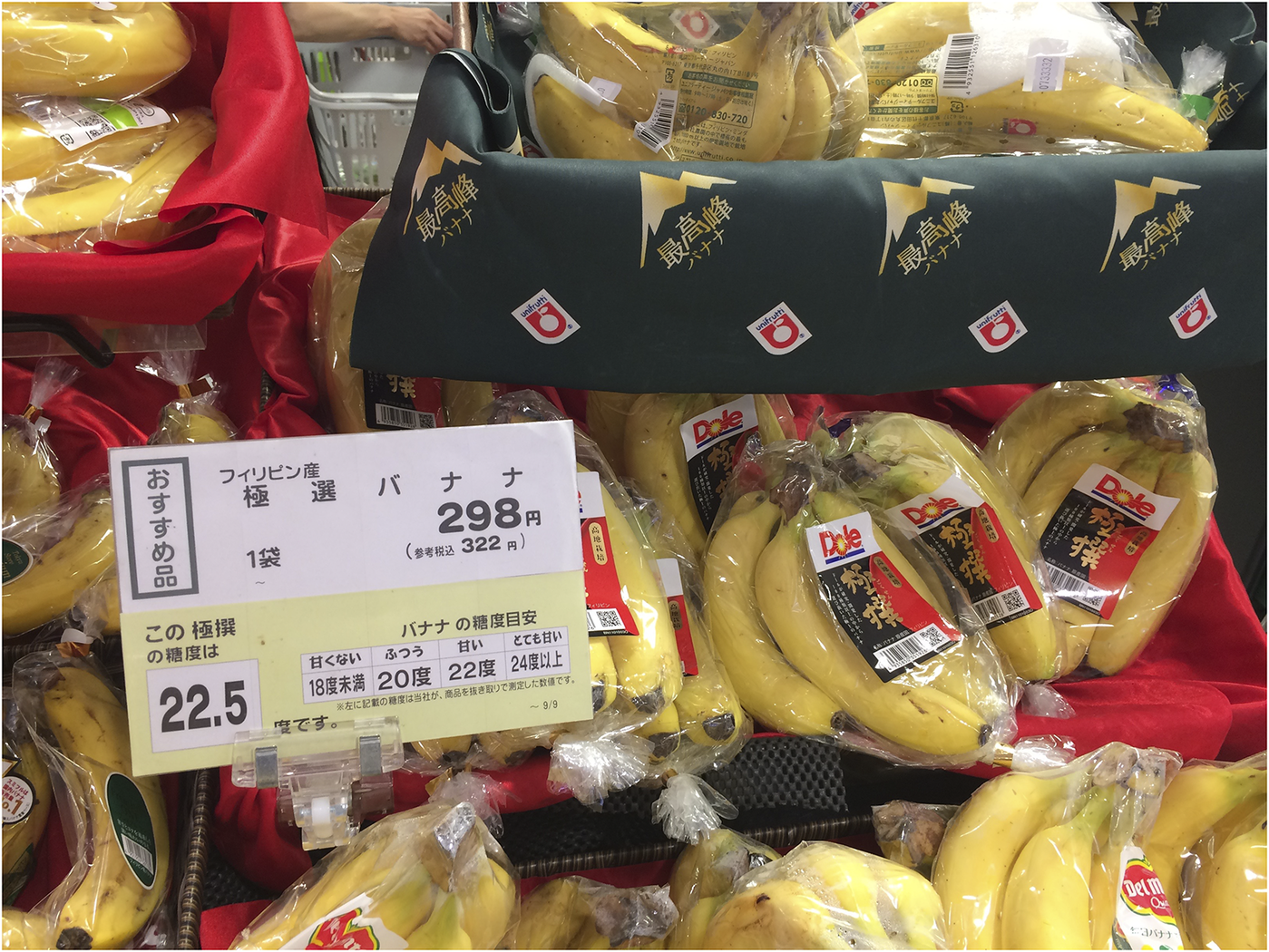
It might surprise newcomers to Japan to learn that in grocery stores around the country it is not uncommon to find fruit labeled with small stickers indicating tōdo sugar content. I have noticed these on everything from cut watermelons, musk melons, and pineapples to grapes, citrus fruits, dragon fruit, pears, figs, kiwi, papaya, peaches, blueberries, and tomatoes, as well. Retailers see tōdo labeling of fruit as a service to their customers in the absence of food samples. In the early 2000s, banana retailers began adopting tōdo measurements on their promotional materials to indicate differences in taste between lowland, midland, highland, and super highland bananas, and to justify a new hierarchy of prices despite uniformity in the commodity’s appearance. Product information on banana display cases included simple charts that placed brands on a sweetness scale. One such display for Dole’s Gyokusen bananas, for example, read: “This Gyokusen product contains 22.5°Bx. The standard sweetness levels of bananas are as follows: ‘Not sweet’ 18°Bx or lower, ‘Regular’ 20°Bx, ‘Sweet’ 22°Bx, and ‘Very Sweet’ 24°Bx above” (see Figure 3). In contrast to tōdo labeling for other fruit, these labels on bananas were primarily intended to justify three- to five-fold increases in price (see Table 1).
Dole’s Gyokusen highland bananas with information on sugar content on sale at a typical middle-class-oriented supermarket in Kamakura (Source: author).
Packaging embellished these measurements with colorful descriptions on taste, production practices, and quality assurance tied to imaginaries associated with highland cultivation. They emphasized the mouthfeel (mocchiri), depth and density of flavor (koku no aru), abundant sweetness (yutaka na amami), and true aroma (honrai no kaori) of highland bananas compared to lowland ones. They capitalized on stereotypical notions of the safety-obsessed Japanese consumer, accentuating the reliable quality (antei shita hinshitsu) typical of corporate-managed farms (kanri saibai, jisha nōen, shitei nōjō) operating on limited plots of land (genten nōchi). They also tapped into idioms of laboriousness (temahima kakete) and sincerity (tansei), virtues associated with the lengthy periods of cultivation (jikkuri saibai) that were necessary in the highlands.
These retail practices resonate with the notion of terroir vis-à-vis other food items, but they also differ from those cases in notable ways. Amy Trubek defined terroir or goût du terroir as “categories for framing and explaining people’s relationship to the land, be it sensual, practical or habitual” (Reference Trubek and Korsmeyer2005: 261; see also Reference Trubek2008). The “taste of place,” she explained, is why someone with an appreciation for French cheese or Italian wine “tastes the earth: rock, grass, hillside, valley, plateau” with every bite or sip (2005: 261). As an analytic, terroir illuminates the feedback loop between knowledge creation, sensual awareness, and bodily sensations in the ways consumers learn to appreciate food. At the same time, following Carolyn Korsmeyer and David Sutton (Reference Korsmeyer and Sutton2011), it is a largely romanticized notion that tends to obscure the realities of industrial agriculture and taste’s role in organizing socio-political life (see also Mintz Reference Mintz1985; Farquhar Reference Farquhar2002; Besky Reference Besky2020; Monterescu and Handel Reference Daniel and Handel2020). Topographical terroir, as manifested in the Japanese consumption of highland bananas, were nowhere near as wrapped up in performances of identity formation and class distinction, as is the case with wines or cheeses that Trubek described. Distinct even from American or European approaches to market segmentation for organic, fair-trade, and other third-party certified bananas, product labeling and advertising for kōchi saibai banana was and remains largely detached from consumer identity politics and social justice (Bryant and Goodman Reference Bryant and Goodman2004). Instead, it capitalizes on a mythos, deeply rooted in Japan, that links the mountainous and forested highlands with ecological integrity, environmental stewardship, and regenerative practice.
Airin shisō or “forest-love thought,” as historian David Fedman points out, is an ideology dating back to Japan’s period of imperial expansion in the late Meiji and Taisho eras (Reference Fedman2020; see also Morris-Suzuki Reference Morris-Suzuki2013). Merging forestry management traditions and ideals of spiritual salvation with imperial and extractive ambitions, forest-love thought imbued the mountainside with an environmentalist sheen and the Japanese Empire an air of benevolence as it encroached into such regions. Even today, as Shisho Satsuka (Reference Satsuka2015) has described, mountain landscapes are wrapped up in social imaginaries of communion with nature and liberation from corporate conventions. The legacy of airin shisō manifests in what Fedman has aptly described as Japan’s green thumb, or the “hoary notion that Japanese society has nurtured over centuries an unusually deep and harmonious relationship with its environment” (2020: 177). Environmental historians of Japan have long argued that claims around the environmental integrity in the naichi (the “inner lands”) rely on externalizing processes of extraction to the gaichi (outer territories), including Ainu land, Korean forests, the Manchurian steppe, Philippine or Indonesian mountain ranges, and Pacific marine habitats beyond Japanese shores (ibid.; Morris-Suzuki Reference Morris-Suzuki2013; Christmas Reference Christmas2019). The bracketing of Japan’s “inside” and “outside” was no less evident after the collapse of formal empire. The colonial model of airin shisō is apparent in the marketing strategies of the Japan-Philippine banana industry and it came as no surprise when, during my fieldwork, several Japanese consumers suggested to me, mistakenly, that they understood that kōchi saibai bananas are more expensive because highland cultivation is “more eko (ecological).”
Tapping into forest-love thought, banana companies set in motion a series of systematic transformations in the Philippines’ plantation zones. Catalyzed by the Japanese market-driven quest for sweetness, banana exporter companies in the Philippines raced up into Mindanao’s highland areas in the early 2000s. By the end of that decade, highland banana expansion would come to mark most of the upland provinces of Mindanao from the foot of Mt. Apo in Davao del Sur and North Cotabato, to the mountainous regions of T’boli in South Cotabato, to the plateaus of Bukidnon and Davao de Oro. It will not surprise any keen observer of commodity exchange that, from where most Japanese consumers stand, it was easy to lose sight of the profound changes this wrought in the Philippines. This despite the fact that supermarket displays and product packaging increasingly offered more information on cultivation practices, more details on production location, and more illustrations of the Mindanao mountainside than they ever had before. It is a truism to say that product labels imperfectly model the landscapes and realities they represent. Less evident is how these images of highland distinction and differentiation, which had such psychological purchase on the consumer imagination, were in fact fungibilizing highland landscapes thousands of miles away.
Landscape and Labor for “Industrial Peace”
When Soping, a resident of highland Cotabato, decided to dedicate her life to environmental advocacy in the 1980s, she was convinced that she was fighting a battle far away. She described her decision as motivated in part by a book called The Human Cost of Bananas, which described the perpetuation of foreign colonization through the export-oriented banana plantations that were concentrated in the coastal areas of General Santos and Davao del Norte (ICL Research Team 1979). Soping lived in Brgy. Batasan of Makilala, a municipality high on the slopes of Mt. Apo, but she felt that was a different world with different problems. She had come of age knowing that her mountain hometown was a place defined by skirmishes between the Philippine Army and ensconced rebels.Footnote 14 She knew Brgy. Batasan, also, as a sometimes frictive, sometimes peaceful meeting ground of Christian migrants like herself, the Indigenous Lumad communities, and the Muslim Maranao tribes (Gaspar Reference Gaspar2011; Alejo Reference Alejo2000). If there was any upside to the unstable peace-and-order situation, she thought, it was that it had kept the lowland banana plantations at bay. So when big banana business began moving up into areas in and around Soping’s community in the early 2000s, she, like many around her, was shocked: “In the year 2000, we didn’t expect it, but suddenly the banana issue came here.” Company canvassers entered the community, striking deals with village captains and cajoling small landholders. This company, which would come to dominate Brgy. Batasan and its environs, was Dole-Stanfilco (see Map 3).
A contemporary map of the highland banana industry in Makilala Municipality. Areas in purple indicate banana plantations. Elevation, from highland to super highland, is indicated in yellow/tan to dark brown, respectively (Source: Khalil Angelo Gamela, reproduced with permission).
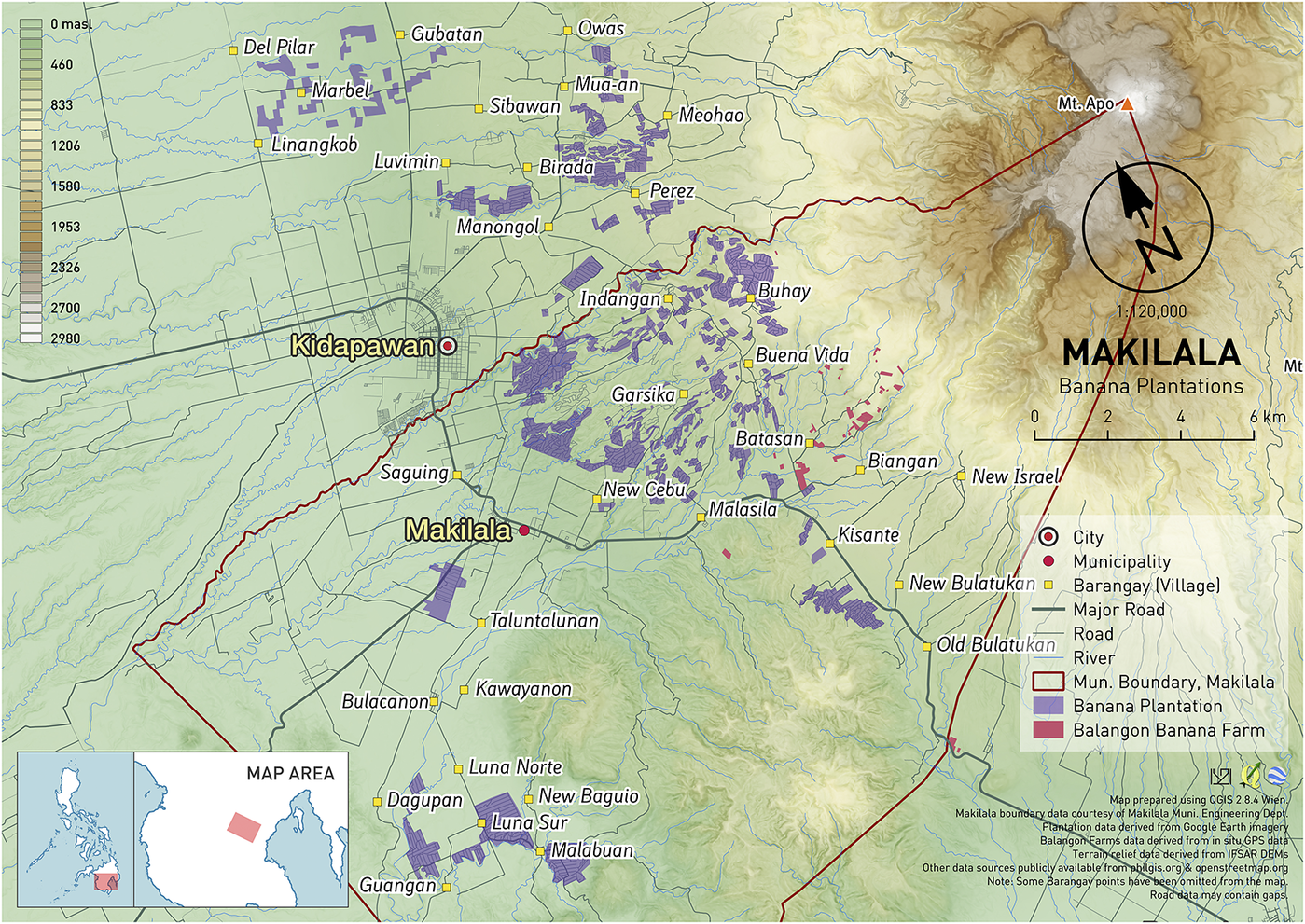
I first met Soping in 2015, and I began documenting the transnational story of highland plantation encroachment into her village and others like it in 2016. That was sixteen years after the industry had invented the kōchi saibai banana concept and fifteen years after a lawyer from DavaoFootnote 15 and a toxicologist from ManilaFootnote 16 had arrived in Makilala hoping to convince locals not to lease their land for Dole’s Sweetio. They contended that pesticides, applied to control diseases like Black Sigatoka, would pose socio-environmental risks to the area. Lowland plantations tended to be contiguous plots of land with minimal (though never negligible) residential areas within them. Pesticide was, and still is, applied there via lightweight aircraft. Given their topographies, plantations in the Makilala highlands would be situated on smaller, incontiguous patchworks of land situated within and among residential communities (see Maps 2 and 3). There, fungicide-spraying aircrafts would be inefficient, and companies were likely to turn instead to ground-based spraying with backpack- or boom-sprayers. Less a difference of volume than of modality, ground-based sprays could bring the harmful effects of toxic pesticides even closer to the human and non-human communities living within the patchwork plantation landscape, heedless of whether people there had volunteered their land for industrial agricultural use.
These apprehensions placed great demands and responsibilities on would-be land lessors and contract-growers. They would have to weigh the promise of regularized income and employment, a rare privilege in the highlands, against the dangers intensive agriculture posed to both their environs and those to which they were ecologically connected. In addition to the contingencies of spraying non-contiguous areas, pesticide drift threatened the integrity of the potable water sources of local households—mountain springs. Forest clearing, clean culture methods, and over-fertilization tied the ecological fate of the area to that of communities downstream in severe ways. Weakened soils would exacerbate landslides, siltation, and flooding, the effects of which were already felt acutely on the coast with every rainy season. None of this speaks to the fact that the Cotabato uplands also encapsulate protected conservation areas of Mt. Apo, the seat of Philippine floral and faunal biodiversity. Nor does it address that many highland areas are ancestral domains, state-recognized traditional territories claimed by and/or titled to Indigenous Peoples, which constitute sacred extensions of their bodies and lives (Theriault Reference Theriault2019).
Local responses to advocacy efforts were mixed,Footnote 17 but they ultimately failed to keep the banana plantations out. In the words of one of the advocates who visited Makilala, “I told them that in ten years they would start seeing what was happening in [lowland plantation communities], but the people were really very attracted by the money. They had already started renting out the lands and taking the cash advances.” When Dole-Stanfilco began its twenty-five-year contract with local landowners in the early 2000s the offer for lease was a meagre ₱1,000 per hectare per month (about US$22–25 at the time) or ₱12,000 per year, paid in five-year advance installments. These shockingly inadequate rates were comparable to those offered in the lowlands, but the pull of immediate cash was particularly magnetic for the upland’s rural poor, many of whom were members of Indigenous Lumad or Muslim tribes.Footnote 18 According to a survey conducted by the Municipal Environment and Natural Resources Office, in the ancestral domains within the municipality of Makilala, 87.1 percent self-identified as “poor,” and 3.7 percent as “poorest of the poor.” The problem was compounded by a lack of local legal literacy and opaque or deceptive corporate expansion tactics.Footnote 19 The same area survey found that 48 percent of eighteen to twenty-two year olds were not in school and, for North Cotabato as a whole, 46 percent said the highest level of education they had attained was elementary school.
To be sure, banana plantation expansion was one development in a longer series of settler movements that would transform upland Mindanao.Footnote 20 Yet of all the industries to have marked these regions, none has been as systematic or as relentless in its fungibilization of the landscape and laborers as the banana plantation. On this, the words of Saidiya Hartman are particularly germane: “The fungibility of the commodity makes the captive body an abstract and empty vessel vulnerable to the projection of others’ feelings, ideas, desires, and values (Reference Hartman1997: 21). By rendering Black labor as exchangeable parts for storing, shipping, selling, and combining with other parts, they write, fungibility sets planters’ purchase over laboring bodies in the same way that it ossified their claims over the yields of the planter’s production (la paperson 2017: 13; see also Rosenthal Reference Rosenthal2018). Adjacent work in critical plantation studies of the Black Atlantic, particularly that of Tiffany Lethabo King, Hortense Spillers, and la paperson, have similarly identified fungibility as core to the ways both commodities, and humans as commodities, become entangled in plantation and post-plantationFootnote 21 landscapes (King Reference King2016; Spillers Reference Spillers1987; la paperson 2017).Footnote 22
In the Mindanao highlands, as in in the lowlands, slavery was never a part of the formula for the plantation project as it was in the Black Atlantic. Instead, fungibility organized the relationship between the human and the natural world through liberal ideals of reformed personhood and citizenship (Paredes forthcoming). For, as soon as efforts to cultivate kōchi saibai banana began, they were folded into the statal and para-statal machinery for enforcing “industrial peace” in the un-subjugated hinterlands. Government officials and corporate representatives saw plantation labor as inculcating an ethic of industriousness within Indigenous Lumad and Muslim communities, which were frequently cast as plagued by ennui and rebelliousness. Key to this was the fact that methods of plantation production had to shift considerably in the mountains, even as fruit care procedures were carried out at a nominally less frenetic pace because the fruit derived its sweetness from extended periods to harvest. Unlike on the flat plains of the Davao coast, Mindanao’s mountainsides were not conducive to setting up cableways and pulley systems, which laborers used to hang and haul the heavy bunches between farm and packinghouse. Instead, procedures in the textured terrain of the foothills had to be much more manual. The plantation’s so-called “rank-and-file” carried the heavy bunches directly on their shoulders to the plantation roads, where the premium fruit was de-handed on site. They also bore the burden of ground-based pesticide application, which required them to spray manually from knapsacks while trapped underneath the plantation’s canopy. Nothing better captures the counterinsurgent intention of enforcing these labor practices than the proliferation of business documents, development reports, and journalistic puff pieces that celebrated plantation work with the idioms of transforming “arms to farms” and “swords to plowshares” (Williams Reference Williams2013; Nuguid-Anden Reference Nuguid-Anden, Shah, Murphy and McIntosh2003).
Plantation-sponsored programming had many disciplinary effects that operated in parallel to state desires for order in the uplands. Entrepreneurship and self-reliance training, as well as awards for employee productivity, bolstered a culture of industriousness. Christian-centered Bible-sharing and First Friday Mass targeted communities whose religious practices, like afternoon prayers, interrupted the rhythms of the industrial estate and whose Indigenous systems of power and authority, like the datu (chieftain) system, were seen as undercutting corporate hierarchies. The provincial government’s population division partnered with plantation corporations’ anti-sexual harassment workshops and gender and sensitivity awareness seminars with an eye toward biopolitical management. Medical missions and campaigns promoting drug-free workplaces fostered planter paternalism as they addressed, albeit temporarily, the healthcare needs of marginalized populations. In step with the disciplinary functions of plantation labor in general, such developmentalist programming fit neatly into state desires to control insurgency in these zones and incorporate the hinterlands into the Philippine body politic. This is a common phenomenon in many other upland regions of Southeast Asia, which have been marked by the state’s “concern to bring these regions to order, control, and development, while deploying the resources for national goals” (Li Reference Li1999: xiv). A billboard adjacent to one of Makilala’s Sweetio plantations captured this poignantly: “It is not anarchy that can solve our problems. Our government is always there to help you” (Dili kagubot ang makasulbad sa atong problema, naa permanente ang atong gobyerno aron mutabang sa inyuha).
Today, the Sweetio plantation nearest Soping is located in the neighboring village of Brgy. Buhay, which sits at an altitude between 600 and 1,000 meters above sea level. The drive up to Buhay travels through dramatic scenery of changing panoramas, a visual display of the fungibilization of culturally meaningful land. Where the drive begins in Brgy. Batasan, modest houses and home-gardens are surrounded by hundred-year-old balete trees, wild fruiting plants, and tropical evergreens. Diverse animal life—butterflies the size of a human palm, metallic blue and red dragonflies, geckoes with bright green tails, and birds of all sizes—give one a sense of proximity to Mt. Apo Natural Park, one of the country’s key areas of biodiversity. These are the environs for which Soping’s ancestors migrated to Mindanao, from Cebu and Bohol in the 1950s and 1960s. Soping’s son recounted this history to me, saying, “My grandmother sent letters back home [to Cebu] saying that the soil was so rich that the leaves of badyang (Alocacia, a large tropical evergreen) grew large enough to cover a whole water buffalo.” Leaving Batasan and driving higher into Brgy. Buhay, deeper into Dole-Stanfilco’s Sweetio plantation, the scenery of tropical forest disappears and the landscape becomes infinitely more monotonous. Plantation roads are noticeably smoother than the public roads elsewhere in the mountainous municipality. The hills are covered in mist. The soil is a chalky light brown, in stark contrast to the moist, coffee grounds-like color in Soping’s personal garden a few hundred meters down. Thick banana pseudostems stick out of the ground like lamp posts on a concrete street. Familiar forms of life, like insects, birds, stray dogs, and rogue native chickens are nowhere to be seen. It is the only place I have been in the Philippine highlands where there are no birdsongs in the nighttime.
Epilogue: Taste as Culture and as History
Plantation management in Mindanao often explained the “success story” of kōchi saibai banana by pointing to a Japanese cultural sensitivity to taste. This was why they believed the strategy of segmenting the banana market into lowland, midland, and highland grades would never catch on elsewhere in the world. Indeed, they described how their business partners from Central and South America were baffled by the developments they saw between the Philippines and Japan. “I mean, we had representatives from Chiquita who came [to Mindanao] and they couldn’t understand the concept,” one businessman currently working for Dole-Stanfilco told me when I met with him and another colleague, a transfer employee from the Japan office, in the company’s Davao headquarters. To test the concept, he continued, Dole had in fact tried to replicate Japan’s highland trend by planting small plots in the uplands of Guatemala and Honduras, aiming to export the bananas grown to the American market. It was a failure. “They [the highland bananas from Latin America] made it to grocery stores in the U.S., but the American consumer was not able to detect the difference,” he said matter-of-factly. His Japanese colleague, who had been mostly silent, chimed in: “See, in Japan, the consumer does not eat fruit for health but for taste. That’s the difference.” Intrigued by the claim, I asked the Japanese businessman why he thought consumers had a special predilection for sweetness. He replied frankly: “I really don’t know, it’s culture.”
In this paper, I have offered a social history to complicate and historicize this facile assertion. Reducing the development of kōchi saibai banana to the quintessential sensitivity of the Japanese palate overlooks the definitive role that three forces have played in the transformation of upland Mindanao: the presumption that the taste of colonial Taiwan could be replicated in the neocolonial Philippines, the creation of a retail language that projected differentiation to consumers, and the aspiration to remake the un-subjugated landscape and laborers in the image of the lowlands. The concept of fungibility, the characteristic of commodities that makes them interchangeable, draws together the narrative threads of these forces. Topography as a mode of ethnographic and historical research focuses these threads on the forms and features of land, even as fungibility itself is frequently synonymized with liquidity and immateriality. Against the understanding that product differentiation reduces fungibility, I have argued that the invention of the highland banana industry extends fungibility insofar as it projects desires onto mountainsides presumed to be devoid of their own meaning. For Philippine-Japan history, this social history recasts a narrative often retold in the framework of marketing geniuses, plantation pioneers, and discerning consumers. For commodity histories in general, it underscores how developments along the spectrum from fungibility to differentiation are less unilinear than they are often portrayed.
Ironically—and against the Japanese businessmen’s essentializing explanations about kōchi saibai banana’s success—the taste for highland sweetness has become less and less meaningful to Japanese consumers with the passing of generations (Iijima et al. Reference Iijima, Konishi, Shimada, Kasai and Hatae2008). Now, more than twenty years after the industry’s momentous move into the Philippine uplands, and more than fifty years after the commercial decline of the Taiwan banana trade, consumers under fifty are less and less willing to pay a premium for kōchi saibai banana. Consumer research shows that many young shoppers no longer even recognize the term. Those who do have a vague understanding that it alludes to high quality but tend to opt for the cheapest option all the same. Perhaps the greatest irony of all, however, is that this decline in consumer interest is unlikely to have any implications for the longevity of the plantation’s presence in upland Mindanao. Industrial agriculture in export bananas from the foot of Mt. Apo in Davao del Sur and North Cotabato, to the mountainous regions of T’boli in South Cotabato, to the plateaus of Bukidnon and Davao de Oro now fulfill social and political roles well beyond that of supplying goods to meet market demands abroad. For this reason alone, they are likely there to stay.
This, too, is a manifestation of the enduring fungibilization that has turned the mountains of Mindanao into interchangeable resources open to the economic aspirations and sensorial desires of outsiders. Locals in Brgy. Buhay know this to be true. They might express their grievances over the chemical impurities in the air, their worries over the effects on children’s health, their disgust at government representatives’ collusion with corporate figures, their frustration at the surge of laborers’ and landowners’ debts, and their fears of being overheard and reported to company security. And yet when I ask them if they would choose a life with or without the plantation, they rarely give a direct answer. I once posed that question to two siblings, both Muslim Maranaos living in the area who were deeply concerned about plantation life’s effects on their family. They glanced at each other, waiting until the brother stepped in to say something that I fear is true: “If the company wasn’t here, another one would be.”
Acknowledgments
A transnational network of friends and interlocutors between the Philippines and Japan made this work possible. I am especially grateful to Betsy Ruizo Gamela, Khalil Angelo Gamela, Paul Komiya, Neil Abejuela, and many others who have chosen to remain anonymous. I have been fortunate to have Patricio “Jojo” Abinales, Carol Hau, Sakura Christmas, Jun Akamine, Masako Ishii, and colleagues at Yale Agrarian Studies and the Departments of Anthropology at Yale University and the University of Michigan as part of this piece’s brain trust for some time. A previous version received the Christine Wilson Graduate Student Paper Prize 2018, and I thank the Society for the Anthropology of Food and Nutrition for their warm enthusiasm about this work. The editors and the anonymous CSSH reviewers offered incisive suggestions that helped me deepen and broaden my argument, and the journal’s staff were instrumental in preparing it for timely publication. Support for this research was generously provided by the National Science Foundation, the Social Science Research Council, the Wenner-Gren Foundation, the Japan Foundation, and the Yale MacMillan Center for International and Area Studies.


 Open access

