


1. Introduction
In many industries, the climate crisis necessitates the implementation of new, more sustainable, technologies to meet sustainability targets. However, major technological leaps typically entail an increased uncertainty (Reference JalonenJalonen, 2011), as unproven solutions need to be integrated into larger systems. Clear examples of this can be found in the aviation industry, where multiple alternative propulsion technologies are being considered to reduce the environmental impact of commercial aviation (Reference Wheeler, Sirimanna, Bozhko and HaranTiwari et al., 2024; Reference Tiwari, Pekris and DohertyWheeler et al., 2021). However, high uncertainty and low technological maturity prevents integration. To mitigate the uncertainty, it is necessary to understand the risks involved with the integration of new technologies such that they can be addressed and reduced. This includes ensuring that the systems can be realized at an acceptable cost, while also meeting performance targets. At the same time, not working towards the integration of new sustainable technologies is a risk itself, as increasingly stringent sustainability regulations and requirements narrow down the available design space over time (Reference Hallstedt and IsakssonHallstedt and Isaksson, 2017). This means that solutions which are viable today risk becoming deprecated or obsolete prematurely. This poses a significant problem for manufacturers in the aviation industry, who are challenged to achieve net-zero emissions by 2050 (ACARE, 2022). At the same time, aircraft systems often have lifecycles exceeding 20 years, making the time to react minimal (Reference Léonard, Hallstedt, Wallin and OlaLéonard et al., 2024). In light of this, there is clearly a need to consider sustainability when integrating new technologies, while simultaneously understanding and minimizing the risks related to manufacturability, and meeting performance targets.
To enable the consideration of sustainability at an early stage there needs to be design support that assists in making better-informed decisions, and in evaluating trade-offs against other aspects. Recent studies suggest that this is one of the missing pieces that is preventing sustainability from being evaluated in the early design phase (Reference Lovdahl, Schulte, Hallstedt and LiteratureHallstedt et al., 2022; Reference Hallstedt, Isaksson, Watz, Mallalieu and SchulteLovdahl et al., 2024). Consequently, there is a need for methods and tools that help designers elicit and trade sustainability against other essential aspects. Aero-engine components are typically optimized for high propulsive performance and low weight under extreme thermomechanical conditions. This often results in complex geometries that are difficult to manufacture, which drives up costs. Hence, identifying concepts that meet performance targets that are also manufacturable is critical. New concepts therefore need to satisfy at least three domains: operational performance, manufacturability, and sustainability. This results in difficult trade-off scenarios, as criteria are often conflicting. The challenge is to capture and evaluate criteria from all three domains in the early design phase, such that designers can make informed decisions while design freedom is still relatively high. If this challenge is overcome, trade-offs among these critical domains can be understood already in the conceptual stages of design, such that risks can be identified and potentially avoided as early in the development process as possible.
With the research presented in this paper, we aim to leverage dependencies and constraints that can be identified already in the pre-embodiment phase. Combined with expert opinion, these dependencies and constraints can be used to identify and evaluate design concepts with regards to sustainability, performance, and manufacturability. The presented method enables technology options to be evaluated based on their relative sustainability impact, and the risk they pose to manufacturability and performance targets.
2. State-of-the-art
Trading performance against other domains in the early design phase has traditionally not been common practice. Instead, design guidelines for “Design for Manufacturing and Assembly” or “Design for Sustainability” have been employed. For manufacturability and assembly, such guidelines include reducing the number of parts, and reusing standard components (Reference NaijuNaiju et al., 2021). Designing for sustainability, on the other hand, includes guidelines such as reducing material use, or designing such that the product can be reused at the end of its life cycle (Reference CeschinCeschin et al., 2019). However, while guidelines such as these can be, and have historically been, very useful, they do not give insight into the trade-offs that are involved with regards to other domains. A clear example of this was demonstrated by Brahma et al. (Reference Brahma, Hallstedt, Wynn and Isaksson2024), who pointed out that designing for reuse risks compromising the performance of the product in favour of maintaining its usefulness after the products life has ended. Thus, there is a need to lift the perspective from single domains, and instead look at how all aspects of the product/system are affected.
In recent years, how to perform manufacturability versus performance trade-off studies has become a topic of research. From the perspective of the aviation industry this is of considerable importance, as recent history has shown multiple occurrences of delays and cost overruns when developing aircraft. These problems have also propagated down to aircraft subsystems, such as aero-engines, where it has been found that the highly optimized and advanced geometries have become increasingly difficult to manufacture (Reference Vallhagen, Isaksson, Söderberg and WärmefjordVallhagen et al., 2013). Thus, evaluating manufacturability alongside performance can potentially assist in avoiding expensive late design changes, as advanced geometries are too often sent back from the manufacturing sub-organizations to the design team due to manufacturability issues (Reference Bonde, Panarotto, Kokkolaras and IsakssonMartinsson Bonde et al., 2021).
Examples of design support targeting this problem includes Siedlak et al. (Reference Siedlak, Schlais, Pinon and Mavris2015), who developed a method for trading aircraft performance, manufacturability, and economics, and utilized a visual tradeoff environment to support decision-making. Looking instead at the manufacturability of aircraft subsystems, the ability to assemble components through welding has been studied. For instance, Stolt et al. (Reference Stolt, André, Elgh, Andersson, Bouras, Eynard, Foufou and Thoben2016) demonstrated how enriching CAD models with information related to welding can assist in manufacturability evaluation, and highlighted the need for a highly automated approach. Such an automated approach was later explored by Martinsson Bonde et al. (Reference Bonde, Brahma, Panarotto, Isaksson, Wärmefjord, Söderberg, Kipouros, Clarkson, Kressin and Andersson2022) who, similarly to Stolt’s concept, utilized enriched CAD-models, and fully automated the process of incorporating weld accessibility evaluation through an automated weld path analysis. The same geometry could be used for evaluating performance, thus enabling trade-offs between the two domains. Another method was demonstrated by Kim et al. (Reference Kim, Kipouros, Brintrup, Farnfield and Di2022), who utilized a multi-objective optimization approach to trade manufacturability against aero performance when developing aircraft wings.
Regarding design methods that enable evaluating and trading sustainability against other domains, there is indeed a knowledge gap in the design community, as pointed out by Hallstedt et al. (Reference Hallstedt, Isaksson, Watz, Mallalieu and Schulte2022) and Lovdahl et al. (Reference Lovdahl, Schulte, Hallstedt and Literature2024). However, to enable trading sustainability against other metrics, sustainability first needs to be abstracted into a format that can be used in such design studies. This area of research has seen a surge of interest in recent times. Han et al. (Reference Han, Jiang and Childs2021) divided sustainability evaluation into four stages: material extraction, production, use, and end of life, and demonstrated how sustainability can be evaluated in relation to these stages. Hallstedt and Isaksson (Reference Hallstedt and Isaksson2017) provided a framework for evaluating the socio-ecological impact of material selection. Al Handawi et al. (Reference Al, Andersson, Panarotto, Isaksson and Kokkolaras2020) demonstrated a methodology for designing for remanufacturing, focusing on how to make aero-engine components more sustainable by prolonging their life. The proposed methodology assists designers in identifying points in the design space that meet current requirements, that simultaneously allow for design alterations to accommodate potential requirement changes. This enables identifying designs that can have their lives extended without risking overdesign. Hallstedt et al. (Reference Hallstedt, Villamil, Lövdahl and Nylander2023) designed a method referred to as Sustainability Fingerprint, which enables qualitative evaluation of design concepts based on their social, ecological, and economical sustainability impact during their life cycle.
Major contributions have been made to enable the quantification and understanding of manufacturability and sustainability already during the early phases of design. However, there is still a need for integrating metrics into a systematic method that considers domain interactions and assess how they can impact the system. In other words, there is a clear need for understanding how trade-off studies can be performed in the early phases of design that incorporates manufacturability, sustainability, and performance.
3. Proposed method
The proposed method leverages multi-domain design assessment as proposed by Isaksson et al. (Reference Isaksson, Kipouros, Martinsson, Panarotto, Kressin, Andersson and Clarkson2021) and enriches it with, among other things, sustainability evaluation through what we refer to as a “relative sustainability fingerprint”. This enables using performance, manufacturability, and sustainability as a basis to evaluate system architecture changes, while at the same time gaining an increased understanding of risk and uncertainties.
3.1. System representation
Initially, a function architecture model is created of the system of interest using an Enhanced Function-Means tree (EF-M) (Reference Müller, Isaksson, Landahl, Raja, Panarotto, Levandowski and Raudbergetsee e.g. Müller et al., 2019), as exemplified in Figure 1. This enables the designer to map out the functions that are to be performed by the system, and alternative means of achieving those functions. A means can represent a physical component, or an abstract design principle. It should be noted that some means may be incompatible with other means. It is thus important to map out any incompatibilities in the EF-M such that infeasible combinations can be avoided.
Enhanced Function-Means tree with alternative means, interactions, and incompatibilities

With all functions and alternative means in place, the designer maps out interactions between means. For example, if means A provides an interface for means B, then they share an interaction. The intensity of this interaction is determined using a scale from 0 to 1. Values that are close to 0 represent decoupled and independent means, and values closer to 1 represents integrated and dependant means. This is referred to as the degree of integration, and can be defined in a Design Structure Matrix (DSM), mapping the relationships among all means of the system.
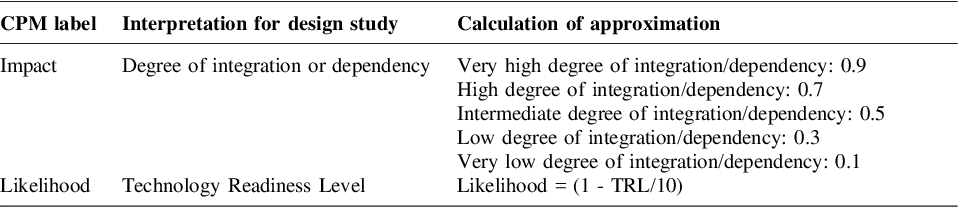
To understand how change can impact the system, the Change Propagation Method (CPM) (Reference Clarkson, Caroline and ClaudiaClarkson et al., 2004) is utilized. CPM models how a change to a part of the system propagates throughout the rest of the system. To enable the use of CPM, the system representation needs to contain information of the likelihood of change. To represent this, the following assumption is made: means of a lower technological maturity are more likely to cause problems. An example of this from the aviation industry is the introduction of a planetary gearbox in the PW1100G engine variant, which resulted in significant manufacturing issues downstream (Reference SingerSinger, 2023). Thus, the likelihood of change being propagated from one means to another can be approximated using Technology Readiness Level (TRL). The likelihood of change propagation is thus set depending on the TRL of a pairing of two means. In CPM terms, it can be said that the impact of change propagation is represented by the degree of integration, and the likelihood of change propagation is represented by the reverse technological maturity. By applying the degree if integration and the likelihood of change to each interaction in the EF-M, using the definitions in Table 1, two DSMs can be extracted for each design: a likelihood DSM, and an impact DSM.
Impact and likelihood evaluation for CPM analysis

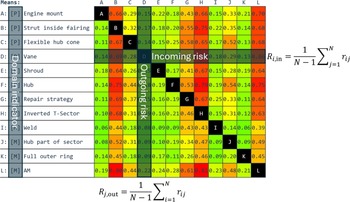
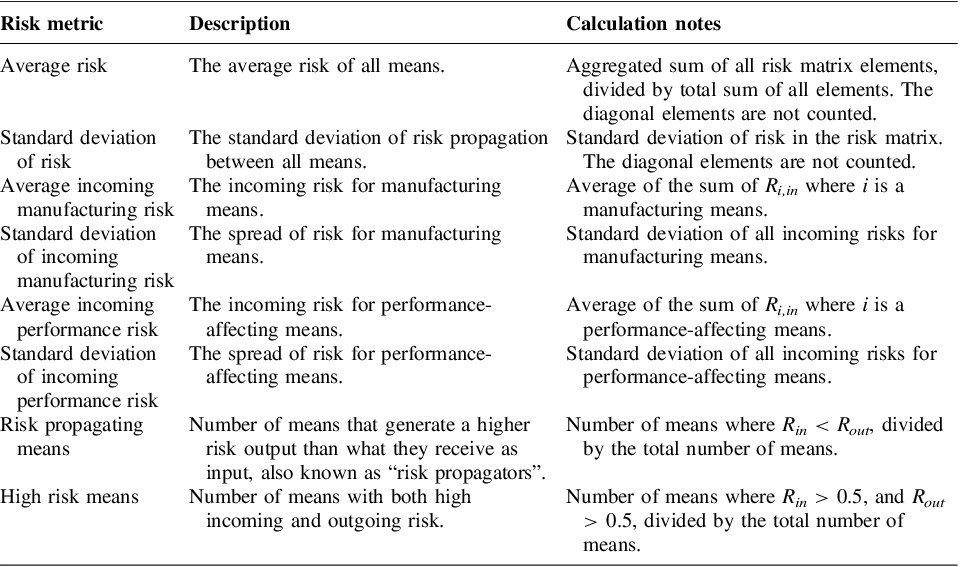
Using the impact and likelihood DSMs as inputs, the method described in Clarkson et al. (Reference Clarkson, Caroline and Claudia2004) can be used to generate a risk matrix for each design alternative. A risk matrix, such as the one in Figure 2, shows how risk can propagate from each means to all other means. The incoming and outgoing risks for each means are described by the rows and columns, respectively. Additionally, each means is flagged with the domain for which it achieves a function. Thus, incoming risks for specific domains can be extracted from the matrix, as well as for individual means. To enable comparing concepts, the risk matrix is post-processed such that eight metrics are extracted, as listed in Table 2. Six of these metrics are purely based on statistical analysis of the results from the CPM analysis for the entire design, and for the performance and manufacturing domains. Additionally, two risk metrics based on the metrics presented in Keller et al. (Reference Keller, Eckert and Clarkson2009), were calculated as shown in Table 2.
Extracting incoming and outgoing risks using change propagation

Utilized risk metrics

3.2. Relative sustainability fingerprint
To gain an understanding of the socio-ecological impact of individual concepts, a method was developed inspired by the sustainability fingerprint tool (Reference Hallstedt, Villamil, Lövdahl and NylanderHallstedt et al., 2023), and the metrics developed by Han et al. (Reference Han, Jiang and Childs2021). Since the proposed method deals with alternative means in a functional architecture, the sustainability evaluation was conducted for each available alternative means. However, this early in development the information necessary to make absolute evaluations of each design alternative may not be available. Consequently, an alternative approach was developed where, rather than relying on absolute values, the evaluation is based on each means relative performance in comparison to its alternatives. This ”relative sustainability fingerprint” functions similarly to a traditional concept selection matrix (Reference PughPugh., 1990). In other words: For each function a reference is determined. This reference can, for instance, be a well-understood existing solution. Then, all alternative means are compared against this reference, as visualized in Figure 3. However, it should be noted that, if more information is available, then this approach can be modified to utilize absolute values.
Sustainability evaluation conducted for each alternative means in the EF-M tree

As can be seen in Figure 3, the method can account for an arbitrary number of criteria in any of the four listed life-cycle phases (material extraction, production, use, and end of life). The resulting table can then be used as a lookup table to automatically identify the sustainability impact for any combination of means. However, care should be taken to ensure that, if a relative approach is used to evaluate alternative means, the results are averaged over the number of utilized means. This is important because the functional architecture can vary between design alternatives, meaning that the number of means in a design can vary, depending on the functional architecture. Thus, if the evaluation is not based on absolute values, then the final calculation for each criterion can be conducted as follows:
 $$S_c = {1 \over M}\mathop \sum \nolimits_{i = 1}^M [s_{ci} ],$$
where
S
c
is the sustainability value for criterion c,
M
is the number of functions for which there are alternative means (in other words, do not count functions which only can be achieved by a single means), and ${s_{ci}}$
is the evaluation value for the means
i
, for the sustainability criterion c. This calculation is thus performed for each criterion (c), to generate an array of results which represents the overall sustainability performance of a specific design solution (combination of means).
${s_{ci}}$
is the evaluation value for the means
i
, for the sustainability criterion c. This calculation is thus performed for each criterion (c), to generate an array of results which represents the overall sustainability performance of a specific design solution (combination of means).
4. Application example: static aero-engine component
To exemplify the proposed method, a case from the aviation industry was considered. The Turbine Rear Structure (TRS) is a static aero-engine component located behind the turbines, as visualized in Figure 4. Its primary functions include deswirling the engine exhaust, providing a housing for one of the engine bearings, providing mounting points for attaching the engine to the wing pylon, and absorbing loads in case of engine failure. The TRS is optimized to minimize weight, maximize aerodynamic performance, and assert safety. Consequently, the geometry is advanced, and difficult to manufacture.
The Turbine Rear Structure (TRS), and its location in a typical aero-engine

Manufacturing alternatives range from forging techniques, to casting, utilizing sheet metal, and additive manufacturing (AM). AM is considered to be of relatively low technological maturity for TRS manufacturing. Furthermore, there are multiple alternative ways of assembling the TRS, which is referred to in the model as “sectorization”. The available sectorization approaches also vary in technological maturity.
From a performance perspective, there are multiple functions that need to be achieved for which there are alternative means. In this example scenario, two different means of absorbing mechanical loads were considered. The first solution, which is the baseline, is to integrate the load-bearing structure into the aerosurface. The second, more novel alternative, is to decouple the aerosurface from the load-bearing structure, and instead place a load-bearing strut at the centre of a fairing. The fairing alternative can withstand higher temperatures, which can potentially be an enabler for certain more sustainable fuel alternatives. Furthermore, two alternative means for reducing thermal stress were examined. Finally, two different lifing strategies were considered. The first strategy involves maximizing the life of the TRS from the start. This entails designing the TRS with thick walls, ensuring that it can fulfil its functionality for as long as needed, at the cost of an increased weight. An alternative strategy involves having thinner walls, resulting in a reduced weight at the cost of an increased need of maintenance and repair.
4.1. Experiment setup
Initially, the TRS was modelled using EF-M. The model, which can be seen in Figure 5, included the functionality and alternative means necessary to manufacture the TRS, the alternative means of achieving the main functionality of the TRS, and two lifing strategies for extending the life of the TRS. Aside from the alternative means, the EF-M also contains all interactions between all alternative means. An alternative way of displaying the interactions between all possible pairings of means is through DSMs, which can be seen in Figure 6, where one DSM shows the likelihood of change propagating, and the other shows the impact of change propagation.
Enhanced function-means tree of a turbine rear structure

DSMs containing the technology maturity (likelihoods), and the degree of integration (impacts) of all potential pairings of means

4.2. Results
After setting up the EF-M and the impact and likelihood DSMs, a total of 136 possible design concepts were identified. Using the DSMs as inputs, one risk matrix was generated for each concept. The relative sustainability fingerprint method was applied automatically for each combination of means through a Python script, and a spreadsheet detailing the relative sustainability of each alternative means. The performance impact (weight and aero performance) was, similarly to the fingerprint analysis, also evaluated using a relative comparison between alternative means. Thus, both the sustainability and performance metrics were calculated as detailed in Section 3.2. Using the results from the sustainability fingerprint analysis, the performance evaluation, and the risk metrics extracted from the risk matrices, a parallel coordinates plot was generated to enable interactive evaluation of all results (see Figure 7) .
Parallel coordinates plot of the design study results, where each line from left to right represents a design concept

The interactive plot enables comparing the design alternatives against each other in search of balanced alternatives. A filter was added to the plot such that it only highlights designs that are expected to result in a reduction in greenhouse emissions in the operational phase, based on the relative sustainability fingerprint analysis. Designs that do not comply with this filter appear as grey in the plot. What becomes clear is that the remaining alternatives are generally high-risk concepts, as indicated by the risk metrics, many of which reside on the upper half of the plot. The mean risk of not meeting manufacturing targets (risk_m_mean) is especially high. Noticeably, several of the remaining alternatives also perform relatively worse in other sustainability metrics, such as material efficiency and manufacturing safety.
5. Discussion
The presented approach supports the designer in representing architectural options of a system, in this case illustrated with a jet engine structural component. Since alternative design variants emerging from the EF-M using this approach include both functional design dimensions and manufacturing dimensions, it represents two important domains for manufacturers. The sustainability domain is included as well, by performing a relative sustainability fingerprint analysis on each alternative means in the EF-M model. This enables designers to explore large numbers (>100) of design concepts, already during the pre-embodiment phase. As such it supports a quantitative and explorative approach, including exploring design trade-offs between sustainability, performance, and manufacturability.
The presented example is realistic in the sense that it captures realistic design and manufacturing alternatives. However, due to proprietary information, the inputs used in the example have been kept at a low resolution, and certain sensitive aspects have intentionally been left out. Nevertheless, the example showcases how the proposed method can be applied and demonstrates that the identified dependencies between means do have an impact on the outcome. Furthermore, it demonstrates that a myopic perspective of sustainability can potentially result in undesirable outcomes in other aspects, including other sustainability metrics.
The relative comparison of sustainability impact for each means provides an approach to dealing with the qualitative nature of information available in early design. A natural addition to the example design study would be to introduce cost considerations. In a sense, it is part of the risk analysis, as higher risk entails the risk of cost-overruns. A more detailed cost analysis could be included by integrating a relative cost evaluation directly into the relative sustainability fingerprint analysis, as an economic sustainability component. However, a thorough analysis of the particularities of the design study results is beside the point of this paper, and has thus been excluded.
A noticeable characteristic of the results generated by the design study is the large dimensionality. To understand even a simplified system as the one in the example, a large set of metrics are needed to cover all critical aspects of the system. An important nuance to note is that, generally, different criteria are likely to be of varying degrees of importance. It could thus be argued that they should be weighted and assembled into a single sustainability metric. This would certainly be more convenient to navigate as a designer, as the number of dimensions could be reduced drastically. However, it can also be argued that such an approach risks obfuscating potential issues in individual dimensions. In other words, critically low results for individual criteria are diluted by other, higher performing, criteria. Perhaps an in-between solution could be devised, that produces only one, or a few, sustainability metrics, while at the same time warning if any criteria have reached critically low levels of performance. Alternatively, a Multidisciplinary Optimization (MDO) approach could be employed, where the system is constrained such that no individual metric dips below critical thresholds.
6. Conclusion and future work
Recent studies suggest that there is a lack of methods and tools that can assist designers in understanding and acting on sustainability trade-offs in the early design phase. Of particular interest is understanding how an improved socio-ecological impact can affect the performance and manufacturability of the system of interest. A method was proposed and demonstrated that enables trade-offs to be made between the three domains (performance, manufacturability, and sustainability) in the early design phase. However, trading large sets of adverse metrics against each other is difficult, even with simplifying assumptions and tools that assist in the analysis process. A potential research opportunity is to consider MDO methods for identifying design candidates that adequately accomplishes all objectives. In future work, we intend to explore how such techniques can be merged with the approach proposed here, in search for a method that can further assist designers in navigating complex design spaces and making trade-off decisions.
Data availability
The data and procedure that was used to process the data to achieve the results presented in this paper are available on Github at this address: https://github.com/johnmartins/iced25-multi-domain-study .
Acknowledgements
The presented research has received funding from the Swedish innovation agency VINNOVA through the D-SIFT project (2024-03148).



 Open access

