

1. INTRODUCTION
Much of the trade between China and North Korea is an exemplar of what is called “informal trade.” We define such trade as “trade in legitimately produced goods and services, which escapes the regulatory framework set by the government, as such avoiding certain tax and regulatory burdens.” (Lesser and Moisé-Leeman Reference Lesser and Moisé-Leeman2009, 9), a definition that echoes seminal work on informal economies (Feige Reference Feige1990; Kar and Freitas Reference Kar and Freitas2013). In this understanding, informal trade can include trade by “unregistered traders or firms operating entirely outside the formal economy,” “formal (registered) firms fully evading trade-related regulations and duties (e.g. avoiding official border crossing posts),” or firms “partially evading trade-related regulations and duties by resorting to illegal practices (e.g. under-invoicing)” (Lesser and Moisé-Leeman Reference Lesser and Moisé-Leeman2009, 10). Seen in this light, trade that does not abide by the regulations and obtain the approval of both the Chinese and North Korean governments can be considered informal trade, even if state entities on one side are involved. While we exclude goods that are illegal in both countries (such as illicit drugs) from informal trade, we include legal goods that are theoretically available for unrestricted trade, and goods that are legal in both countries but are subject to import/export restrictions or bans (Lesser and Moisé-Leeman Reference Lesser and Moisé-Leeman2009, 20) (such as, in the case of North Korea, sanctioned items).
In this article, we ask why Chinese traders between China and North Korea turn to informal trade and what it provides for them. In answering these questions, we catalogue the risks faced by traders in a difficult business environment, explore how they respond to and mitigate those risks with informal trade, and, using a unique set of interviews with dozens of Chinese traders involved with North Korea, provide a new level of specificity on the practice of informal trade between China and North Korea.
Investigating why traders turn to informal trade gives insight into a domain of economic interaction between China and North Korea that, while not totally ignored, has been understudied. Our work builds on previous work on North Korean trade networks, and more generally the DPRK's political economy. Where much of the literature has understandably focused on Chinese firms investing in North Korea through official channels (Yoon and Lee Reference Yoon and Lee2013; Jung and Rich Reference Jung and Rich2016; Szalontai and Choi Reference Szalontai and Choi2013; Wang and Hastings Reference Wang and Hastings2014; Reilly Reference Reilly2014a, Reference Reilly2014b, Reference Reilly2014c; Abrahamian, See, and Wang Reference Abrahamian, See and Wang2014; Kim Reference Kim2006), our work looks at the China–North Korea economic interactions that bypass those official channels. Where Park (J.S. Park Reference Park2009, Reference Park2014) and Park and Walsh (Reference Park and Walsh2016) focus on the overall ability of North Korean state firms to evade sanctions, our work examines the calculations that the ground-level state and private actors make about informal trade, and the means by which they actually move goods across the border. While formal trade necessarily involves some level of bribes, retaliation, and other coping strategies to get through North Korean and Chinese trade institutions and deal with North Korean partners (Haggard, Lee, and Noland Reference Haggard, Lee and Noland2012; Haggard and Noland Reference Haggard and Noland2012; Hastings Reference Hastings2016), this study delves deeper to take into account a fuller range of the coping strategies that Chinese traders have when dealing with North Korea, China, and their North Korean partners, including partially or fully bypassing formal institutions.
In the rest of the article, we generate and then apply a risk-based theory, in the context of the literature on how businesses function in difficult and unpredictable environments that create high levels of risk for investment and trade. North Korea is such an environment, and traders along the China–North Korea border turn to informal trade as a calculated response to certain types of risk they face. We introduce a typology of risks and the mechanisms by which informal trade allows traders to mitigate those risks.
Informal trade is not the answer to all the problems traders face. Yet it can address risks from personnel instability, regulatory and policy instability, and border hold-ups emanating from the North Korean government, and sanctions enforcement (and the accompanying border hold-ups) from the Chinese government. A key finding is that informal trade can be seen as the flip side of formal trade: both formal and informal traders face some of the same relevant risks, and both use the same two risk mitigation strategies. First, both cultivate social networks to carry out contract enforcement and dispute resolution, and to secure information about business opportunities, as well as warnings of and protection from danger. Second, perhaps more interestingly, both also minimize their footprint inside North Korea, thus reducing their physical presence in North Korean territory as well as involvement with North Korean institutions and partners.
Despite their parallel strategies with formal traders, because informal traders partially or fully evade trade regulations or checkpoints (Lesser and Moisé-Leeman Reference Lesser and Moisé-Leeman2009, 9–10), they can mitigate certain risks more cheaply and effectively than formal trade, and they can overcome barriers that would be insurmountable for formal trade. By bypassing trade regulations, border checkpoints, or both, informal trade can maintain stability in trade in the face of border hold-ups and during periods of North Korean policy and regulatory instability, and they can use relatively small (and thus cheap) networks to mitigate the effects of North Korean government personnel instability. Similarly, building social networks and bypassing trade regulations and border checkpoints also allow informal traders to continue to operate during Chinese government sanctions enforcement episodes.
The mechanisms by which informal mitigates risk also provide some amount of protection from smuggling crackdowns, the main risk that accrues to Chinese informal traders but not formal traders: reducing the equipment, goods, money, and personnel present in North Korea to as close to zero as possible shifts the risk of capture and punishment onto Chinese traders’ North Korean partners during North Korean crackdowns, and the social networks built up by informal traders provide information about and protection from Chinese government smuggling crackdowns.
2. THEORY: A TYPOLOGY OF RISKS AND HOW THEY ARE MITIGATED BY INFORMAL TRADE
2.1 Risks in trade with North Korea
There are substantial risks for outsiders trading with North Koreans or doing business with North Korea. Foreign investment in North Korea, which can leave significant capital and/or equipment at risk of expropriation or theft at the hands of the North Korean government or partners, is particularly dangerous; and not investing in North Korea, but instead engaging in trade (such as exports with payment upon delivery), is perhaps the most basic way to minimize risk (Jung and Rich Reference Jung and Rich2016; Haggard, Lee, and Noland Reference Haggard, Lee and Noland2012; Haggard and Noland Reference Haggard and Noland2012). Assuming they are engaging only in trade, the risks faced by Chinese businessmen as they import goods from North Korea and export goods to North Korea, are often similar but can differ substantially, and they emanate from three sources: North Korean partners (Table 1 section 1), the North Korean government (Table 1 section 2), and the Chinese government (Table 1 section 3).
Risk Mitigation Strategies for Chinese Businesses
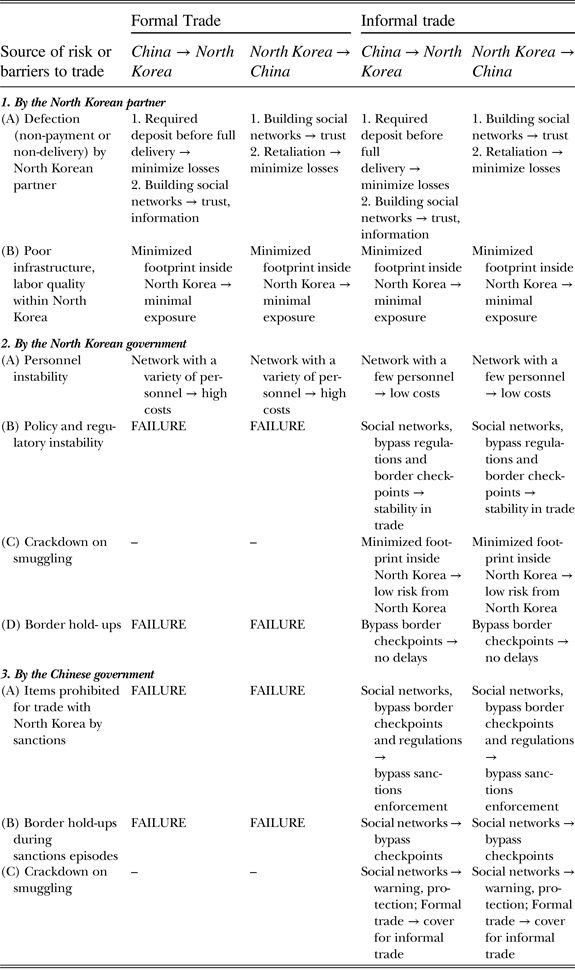
Chinese importers from North Korea must contend with North Korean partners who do not deliver the promised goods (Table 1, 1A), and, depending on their exposure to the production and transportation within North Korea, they face risks from terrible infrastructure and low worker quality (Table 1, 1B). The North Korean government may also change the personnel, inside North Korea and at the border, with whom the Chinese firms must deal (Table 1, 2A), as well as its policy stances about what is allowed to be exported out of North Korea, and who is allowed to export (Table 1, 2B). North Korea's formal state institutions are generally unable to deal consistently with trade or investment, with vague laws, constantly changing regulations, a high level of political risk (inasmuch as the central state can change policy suddenly and without warning, and can purge essentially any official), astronomical levels of corruption, and few mechanisms to resolve business disputes (Haggard, Lee, and Noland Reference Haggard, Lee and Noland2012; Haggard and Noland Reference Haggard and Noland2012; Hastings Reference Hastings2016; Abrahamian, See, and Wang Reference Abrahamian, See and Wang2014). In China, Chinese importers must deal with Chinese government trade regulation enforcement and enforcement of sanctions if they are importing goods that are on the (increasingly lengthy) UN sanctions list (Table 1, 3A), and border delays due to sanctions inspections even if they are not (Table 1, 3B).
For their part, Chinese exporters to North Korea must also deal with Chinese government enforcement of sanctions (although most mundane goods, such as food, are perfectly legal to export to North Korea) (Table 1, 3A), and the consequent border hold-ups, even of legal goods (Table 1, 3B). Exporters face risks from their North Korean partners, although of non-payment for goods rather than for delivery (Table 1, 1A), and to a lesser extent than for importers, of difficult North Korean infrastructure (Table 1, 1B). As with importers, changing North Korean regulations and policies can change who is allowed to import what into North Korea (Table 1, 2B), and changing North Korean government personnel can render it difficult to maintain stability in business transactions (Table 1, 2A). Both importers and exporters must deal, in both China and North Korea, with delays at border checkpoints (Table 1, 2D and 3B) and corrupt customs and border security personnel. For their part, smugglers face a risk from government crackdowns in North Korea (for either importing or exporting goods) and to a lesser extent, in China (Table 1, 2C and 3C). The question is thus how foreign businesses trading with North Korea (in practice almost entirely private Chinese firms because the goods are crossing the Chinese border) mitigate these risks.
2.2 Informal trade and North Korean political economy
The risks outlined above are a function of the North Korean economy as it has developed over the past several decades, and informal trade is a logical outgrowth of those changes. Business takes place in a North Korean business environment that is at once formal and informal, with a blurring of licit and illicit activities, and state and non-state actors. As a result of the collapse of the formal state-controlled economy in the 1990s, segments of the North Korean economy, particularly those segments that reach into China, are heavily marketized, with a mix of state, non-state, and private actors operating (and often competing) with various degrees of approval or disapproval from the central state (Habib Reference Habib2011; Chung Reference Chung2012; H.J. Park Reference Park2009; P. Kim Reference Kim2012; Park and Choi Reference Park and Choi2014; Haggard and Noland Reference Haggard and Noland2007), and with numerous examples of entrepreneurial activity (Kim Reference Kim2012; Seol Reference Seol2014; Moon Reference Moon2008; Kim Reference Kim2011; Im Reference Im2010). A range of private and state actors (Joo Reference Joo2010; Lankov and Kim Reference Lankov and Kim2008) supply the private markets (jangmadang) that provide food and consumer goods in North Korea (Silberstein Reference Silberstein2015; Joo Reference Joo2014; Everard Reference Everard2011; Kim Reference Kim2010; Tudor and Pearson Reference Tudor and Pearson2015; Smith Reference Smith2009, Reference Smith2015; Lankov and Kim Reference Lankov and Kim2008; Yang Reference Yang2009; Yang Reference Yang2010, P. Kim Reference Kim2012; Kim and Song Reference Kim and Song2008).
Ambiguity, shades of gray (in terms of legality, formality, and relationship with the state), and adaptability are the norm. In this environment, ambiguity and informality have become institutionalized, with the central state collecting rents via a ‘food chain’ of state officials who are required to pay money to levels above them in order to do business. Higher-level officials in turn collect rents from officials and citizens below them in order to look the other way at technically illegal business and trade by private citizens, privately operated state firms, and actual state firms engaged in unauthorized trade (Hastings Reference Hastings2016). Much of the economy is thus supported by commerce that is regularized and technically illegal, but also indirectly profitable for the state. There is often little to differentiate the informal economy and the formal economy in North Korea, and the state itself may be experienced as a “mafia” extracting rents from the population regardless of legality in exchange for “protection” (Rasanayagam Reference Rasanayagam2011).
The ecosystem of North Korean actors trading with China reflect this ambiguity, with state trading companies (Greitens Reference Greitens2014; Panel of Experts 2014; Jung Reference Jung2012; Chestnut Reference Chestnut2007; Park Reference Park2014; Park Reference Park2011; Park and Walsh Reference Park and Walsh2016; Park Reference Park2009b; Lankov Reference Lankov2013), private actors (usually individual traders) and firms that have acquired state company status or bought into state trading companies’ trading rights, and state officials acting in a private capacity under the color of law (Lim and Yoon Reference Lim and Yoon2011; Smith Reference Smith2015; Lankov et al. Reference Lankov, Ward, Yoo and Kim2017; Hastings Reference Hastings2016) all vying to make money by doing business with China, sometimes with North Korean government trading licenses, but often by operating in a legal gray area, and often without official imprimatur at all. Such a business environment may change traders’ calculations about whether to engage in formal versus informal trade, and may make the idea of bypassing or subverting formal institutions through informal trade attractive. In the standard narrative, informal trade is used by traders to increase profits at the cost of incurring greater risk (of capture or failure) and uncertainty relative to more staid formal trade with lower risk but also lower profit (Ama et al. Reference Ama, Mangadi, Okurut and Ama2013), with the existence of the border itself creating opportunities for arbitrage (Bruns, Miggelbrink, and Müller Reference Bruns, Miggelbrink and Müller2011). Smuggling (and the underground economy more generally) allows individual firms and companies to evade onerous taxes, regulations, and trade restrictions (Johnson, Kaufmann, and Zoido-Lobatón Reference Johnson, Kaufmann and Zoido-Lobatón1998; Katsios Reference Katsios2006), and to survive through earning income or buying goods when the formal economy is not able to provide (Fleming, Roman, and Farrell Reference Fleming, Roman and Farrell2000). But it is risky, and it comes at the cost of the potential for either capture and total loss, or of substantial rents paid to officials not to enforce the law (Loayza Reference Loayza1997).
Formal trade theoretically gives transparency, reliable rules of the game, and dispute resolution mechanisms, while creating transaction costs associated with playing by the rules (Johnson, Kaufmann, and Zoido-Lobatón Reference Johnson, Kaufmann and Zoido-Lobatón1998; Johnson et al. Reference Johnson, Kaufmann, McMillan and Woodruff2000). Yet given the ambiguity inherent in doing business with and within North Korea, and given that the formal institutions in North Korea are themselves predatory and inefficient, foreign firms doing business in North Korea must come up with informal practices to resolve disputes, enforce contracts, and mitigate the cost and probability of deals falling apart (Haggard and Noland Reference Haggard and Noland2012; Haggard, Lee, and Noland Reference Haggard, Lee and Noland2012; Hastings and Wang Reference Hastings and Wang2017; Wang and Hastings Reference Wang and Hastings2014; Lee and Ulferts Reference Lee and Ulferts2011). They may turn to informal means of governance by building or integrating themselves into social networks that provide information about other actors and punish non-compliance through (in part) reputational costs outside of formal institutions (Clay Reference Clay1997; Greif Reference Greif1993; McMillan and Woodruff Reference McMillan and Woodruff1999a, Reference McMillan and Woodruff1999b; Johnson, McMillan, and Woodruff Reference Johnson, McMillan and Woodruff2002; Milgrom, North, and Weingast Reference Milgrom, North and Weingast1990). With such problematic formal institutions, and informal practices being used even by firms engaged in formal trade, informal trade may come to be seen as legitimate as formal trade (Rasanayagam Reference Rasanayagam2011; Rodrigues Reference Rodrigues2010; Lee Reference Lee2015; Bruns, Miggelbrink, and Müller Reference Bruns, Miggelbrink and Müller2011), with trust-based social networks of private actors and government officials regulating the trade despite its illegality (Titeca and Herdt Reference Titeca and de Herdt2010; Titeca and Flynn Reference Titeca and Flynn2014; Mahmoud Reference Mahmoud2008). In North Korea, informal commerce is how one operates in much of the North Korean economy, and it is how Chinese traders, in facing certain risks, might decide to do business in and with the same economy.
2.3 Informal trade as Chinese traders’ calculated response
As a calculated response to the risks imposed by the North Korean business environment, traders may turn to informal trade when there are costs to playing by the rules, but few benefits, and when informality and ambiguity are the name of the game for state, non-state, and hybrid actors alike. Partially or fully bypassing regulations and laws has costs and risks, but so does not bypassing them. In North Korea, this calculation can be seen in how Chinese traders weigh whether they should engage in formal versus informal trade:
When it comes to risk, normal trade between China and the DPRK is very risky, and few Chinese businessmen can make money in North Korea, so the risk of smuggling is not necessarily greater than for normal trading. (Informal trader #2)
Now, you tell me, comparing the risk of doing legitimate business in North Korea with the risk of smuggling, which is higher? Now since the risk from smuggling is not necessarily higher than for legitimate trade, but smuggling profits are far higher than legitimate trade profits, in that case, if I have a way to do smuggling, why wouldn't I? (Informal trader #10)
Other traders argued that formal investment has a higher probability of losing money than smuggling, and that smuggling is more cost-effective:
Although the risk for smuggling is great, the risk for normal trade is not significantly lower than that of smuggling. Nine out of ten Chinese businessmen who are currently investing in the DPRK lose money, or do some low-risk import and export trade with little profit. (Informal trader #1)
The money from legal business is too slow, and there are fewer earnings. Although the risk from smuggling is larger, relatively speaking the smuggling business is more cost-effective. (Informal trader #5)
Another trader noted that legal business (particularly business with capital investments in North Korea) had such a high risk factor due to potential seizure of their investments (as happened with Xiyang's mine in 2012 (Zhongguo Xiyang Jituan Reference Jituan2012)) that it was less risky to smuggle.
Legal business is very troublesome; the probability of success is not high. [The North Koreans] will let you make profits for two to three years, then wait until you've begun to be at ease about transferring equipment to North Korea, then they will force you to leave, and not give you a visa, so you don't have an opportunity to enter North Korea again. So you lose a lot of money, but what is most important is that you do not have a way to predict when they will suddenly repatriate you. The risk from normal business is far higher than the risk from smuggling (Informal trader #13).
If informal trade can be seen as a calculated response to the risks posed by doing business in and with North Korea, the question arises as to how informal trade is carried out, and how it mitigates the specific risks faced by traders.
2.4 How informal trade mitigates different types of risk
Informal traders’ risk mitigation rests on two strategies. First, informal traders minimize their contact with North Korean institutions, and their presence in North Korea itself. They do this partially by the means with which they move goods across the border—such as by forcing their North Korean partners to move the goods to and from North Korea—and partially by using their North Korean partners as the points of contact with formal institutions (or to avoid formal institutions) within North Korea.
Second, informal traders develop networks over time with Chinese officials, North Korean officials and businesses, and each other. In the absence of institutions to enforce contracts and resolve disputes for trade, traders with North Korea rely heavily on social networks and trust-based ties built on tit-for-tat strategies to find new partners, collect information about the political and economic environment and business opportunities, conduct long-term business, minimize their chances of being cheated, and resolve contract disputes (Informal trader #4; Haggard and Noland Reference Haggard and Noland2012; Wang and Hastings Reference Wang and Hastings2014; Jung and Rich Reference Jung and Rich2016). These are in fact the same strategies used by formal traders when dealing with North Korea (Hastings and Wang Reference Hastings and Wang2017), so in this sense informal trade can be thought as the flip side of formal trade, rather than something fundamentally different.
Yet informal traders depart from formal traders in that they use the above strategies to partially or fully bypass trade regulations and checkpoints (Lesser and Moisé-Leeman Reference Lesser and Moisé-Leeman2009, 9–10). Informal traders who partially bypass trade regulations engage in “customs smuggling,” wherein they move goods through border checkpoints and through customs, but obfuscate the nature and/or value of the goods they are transporting, or ignore the regulations in part. Informal traders who fully bypass trade regulations and checkpoints engage in “river smuggling” or “sea smuggling,” wherein traders move goods across the river or by sea outside the checkpoints and avoid passing through customs entirely. Fully bypassing the checkpoints also has the benefit of allowing trade to continue when the checkpoints are closed or throughput is slowed to a crawl. Whether the traders fully or only partially avoid regulations and checkpoints, they are able to use the shared risk mitigation strategies at somewhat lower cost than formal traders, and to continue trade in situations, such as border hold-ups, North Korean policy changes or Chinese sanctions enforcement, where formal trade is stymied.
For traders engaging in informal trade, the social networks facilitate the movement of goods and people outside of formal customs procedures, and often outside of formal border checkpoints and provide warnings and protection against crackdowns and instability. Because they are not as extensive as the networks needed to support formal trade (there is no need for informal trade networks to finesse regulatory approval, for instance), they are arguably cheaper to maintain than those for formal networks. Minimizing physical presence and social networks in North Korea allows informal traders to reduce exposure to North Korean infrastructure and bureaucracy (and the political risks associated with dependence on them), but also allows them to deal with the risk of capture and punishment that comes from bypassing the law by shifting that risk to their North Korean partners.
Informal traders use these strategies to minimize certain risks from their North Korean partners, the North Korean government, and the Chinese government, as listed in Table 1. Both formal and informal traders must deal with defection by North Korean partners (Table 1 section 1), and the poor infrastructure and labor inside of North Korea. Here, the strategies used by both types of traders are the same, although informal traders’ social networks are likely to be somewhat smaller and cheaper.
The risks presented by the North Korean government (Table 1 section 2), by contrast, mean that informal trade has some advantages relative to formal trade. While both formal and informal traders often need to rebuild social networks in the face of North Korean personnel instability (and the purges of the North Koreans in their networks), informal traders’ social networks are smaller and less costly, given that they need to go through fewer (or no) regulatory hoops, and thus need to recruit fewer officials to look the other way. While formal traders can fail if the North Korean state delays trade at the border, or changes policy on imports or exports or who can engage in trade, informal traders can maintain stability in trade by bypassing North Korean institutions, either by subverting the regulations and policies or by bypassing the border checkpoints entirely. Informal traders can also minimize their risk of capture or punishment in a North Korean government smuggling crackdown by minimizing their physical presence in North Korea (both in terms of the time they are on the ground, and the number of personnel and the amount of equipment that ever enter North Korean territory) and offloading risk onto their North Korean partners.
The Chinese government presents fewer risks to both formal and informal traders (Table 1 section 3), inasmuch as its policies are relatively clear, and, with the exception of occasional sanctions enforcement episodes, the business environment is relatively stable (if not trending in a positive direction). Where the Chinese government does enforce sanctions on specific goods for import from or export to North Korea, formal traders are theoretically constrained from engaging in trade at all, or they see their goods held up at the border while inspections occur, while informal traders are able to use their social networks to bypass inspections and border checkpoints. Similarly, during generalized smuggling crackdowns by the Chinese government, informal traders can reduce their own risk of punishment by using their social networks to warn and protect them, and they can use formal trade as a cover for their informal activities.
We base our theory on three assumptions about China–North Korea trade. First, we assume that China's policy and regulatory environment is relatively stable and predictable, outside of sanctions enforcement episodes (which can introduce uncertainty and are discussed below). Second, we assume that the Chinese government's overall policy is to allow some trade to continue with North Korea, and that the businessmen are facing a trade environment where the Chinese government is not attempting to physically stop all movement of people and goods across the Chinese–North Korean border. As a result, smuggling goods outside of a border checkpoint is still possible (if not exactly encouraged by the Chinese government). Third, we assume that doing business with North Korea, whether through formal trade or smuggling, is inherently risky. All traders are operating in a fundamentally unstable environment. As a result, nothing in this article should be taken to imply that any trade with North Korea is riskless. In the conclusion, we discuss what might happen if these assumptions are relaxed.
3. DATA AND METHODOLOGY
The data for this article come from 48 semi-structured interviews conducted by the authors between 2013 and 2017 with Chinese businessmen engaged in both formal and informal trade, and Chinese government officials (for the anonymized interviewee list and the base questions asked, see the Supplementary Materials). Between 2013 and 2015, as part of a larger project on North Korean trade networks (Hastings Reference Hastings2016; Hastings and Wang Reference Hastings and Wang2017), we conducted interviews with businessmen engaged in formal trade, and in 2016, we interviewed businessmen engaged in informal trade (although in practice, the “legitimate” businessmen also sometimes traded informally, and the informal traders often had legitimate businesses). In 2017, we interviewed formal and informal food traders to gauge their response to the sanctions episodes of 2016 and 2017. Interviewing formal traders allowed us to establish a baseline for the challenges faced by traders, and the risk mitigation strategies they pursued, against which informal trade could be compared.
Fortuitously, the interviews took place soon after sanctions episodes against North Korea in 2013, 2016, and 2017, so we were able to get three waves of firms’ responses to trade restrictions. Both authors conducted interviews, although the majority of the interviews were conducted by Wang. All interviews were conducted in Chinese, in person or by phone. The businessmen themselves were located through networks of firms already familiar to the authors. As such, they do not represent a random sample of Chinese firms doing business with North Korea. We make no claim that the interviewees were necessarily representative of the whole population of Chinese firms doing business in and with North Korea, or that the interviews themselves represent the totality of experiences in informal trading (inasmuch as interviewing the North Korean counterparties was not realistic). Nor, for security reasons, did we conduct interviews with traders engaged in trade of goods that were totally illegal (such as narcotics and weapons). Instead, we have strived to represent the universe of relevant variation in our chosen interviewees, along five axes: location along the China–North Korea border, types of goods being traded, formal versus informal traders, importers versus exporters, and modes of informal trade.
The interviews were conducted in strategic cities in Liaoning and Jilin provinces that represent the full range of variation in ports for trade along the China–North Korea border (notably Shenyang, Dandong, Changchun, Dalian, Yanji, Baishan, Hunchun, and Changbai). We also interviewed across several modes of informal trade. Of the businessmen engaged in informal trade, 11 moved goods through customs checkpoints, six moved goods across the river or through the mountains outside of checkpoints, and one moved goods by sea.
We also attempted to interview traders in different industries that represented the full range of variation in the universe of cross-border economic actors (Seawright and Gerring Reference Seawright and Gerring2008). The 13 informal traders represented a variety of industries, including automobile and electrical products (four), medical materials (two), seafood (two), cigarettes (one), minerals (one), and general import-export (two). The “legitimate” businessmen were often in similar industries, but (not surprisingly) often were more willing to invest in North Korea, with involvement in construction (one), clothing (two), investment (one), auto repair (two), machinery (two), seafood (one), general import-export (five), minerals (two), restaurants (one), tourism (one), and forestry (two). We interviewed an additional 10 traders involved in the food trade in 2017.
The businessmen interviewed from 2013 to 2016 were relatively evenly split between importers and exporters. Seventeen of the businessmen interviewed between 2013 and 2016 were primarily importers from North Korea while 15 were primarily exporters to North Korea. Among formal businessmen, nine were primarily importers from North Korea while eight were primarily exporters to North Korea. Among informal businessmen, seven were primarily exporters to North Korea while eight were primarily importers from North Korea.
Given the constraints on acquiring data on North Korea in general, we treat the interviews as sources of information for a qualitative business case study (Park and Walsh Reference Park and Walsh2016) rather than as a survey. We use the interviews to understand the experiences of a diverse range of traders, and more specifically to establish why traders would deal with North Korea at all given the risks, why they would want to engage in informal versus formal trade, and to identify the range of risks that traders face, the process by which traders engage in business across the border, and, finally, the range of strategies the traders use to mitigate risks. As a result, the “legitimate” businessmen and the informal traders were asked very similar sets of questions, with slight modifications to take into account the formality of their business. Because the scale of informal trade is essentially unknowable, we focus on the uses that economic actors in the China–North Korea relationship have for informal trade, rather than the extent to which it is (or is not) the dominant form of trade across the border.
4. APPLICATION: HOW RISKS ARE MITIGATED IN PRACTICE
4.1. Risks from the North Korean partner
Both formal and informal traders face the problems of their North Korean partner defecting from their business dealings (by not paying for goods exported to North Korea, by expropriating assets, or by not delivering goods exported to China) and of dealing with poor North Korean infrastructure and labor. In this, the formal and informal traders’ strategies for dealing with North Korean partners are virtually identical, and the risks emanating from the North Korean partners are not the driving factor in the calculations made by traders as to whether to pursue informal or formal trade.
First, traders cultivate their social networks. Credibility within the networks is an important commodity for both formal and informal traders to maintain continuity of trade. The Chinese traders and North Koreans establish ongoing trust through successful transactions, and the provision of food, gasoline, generators, and household appliances to the North Korean partners (Informal traders #4, #5, #7, #9; Hastings and Wang Reference Hastings and Wang2017). To maintain trust, the ability to retaliate against defecting partners is important. Chinese traders can refuse to deal again with North Korean partners who do not produce the agreed goods in an acceptable manner. In the case of seafood, allowing the catch to spoil can cause the North Korean partner loss (Informal trader #5).
The UN and individual countries’ sanctions against North Korea have attempted to make North Korean companies’ access to international financial institutions more difficult (Park and Walsh Reference Park and Walsh2016), leading to concerns about successful payments. As with much legitimate trade (Chinese businessmen #6, #15), partners in informal trade can demand deposits before delivery of the goods, with the remaining amount due paid in cash upon receipt (Informal trader #2). For customs smuggling, North Koreans, either the customs officials and border guards involved or the ultimate counterparties, are able to retaliate against defecting Chinese partners by making a note of the car make, license plate, and appearance of the Chinese traders and their associates, and refusing to allow them or their goods through the next time they show up in customs (Informal trader #4). Actors involved in informal trade can also resolve disputes in a more direct way than would be typical for formal traders. The North Korean border guards have been known, for example, to shoot at traders crossing the river illegally (when engaged in river smuggling) if they do not provide the right goods or bribes, particularly cigarettes (Informal trader #7).
Building these social networks can take significant amounts of time, and substantial resources and ingenuity. For formal investments, this can require bribes to essentially every official involved in the process: border guards, customs officials, and local and high-level Party, military, and government officials. One businessman, for instance, bought a military commission for US$100,000 for a North Korean partner with a good family background, which enabled the partner to provide him with political cover (Chinese businessman #13). Another ran a car repair business in Pyongyang that provided free repairs to a bevy of influential officials as a way of cultivating favor for future investments (Chinese businessman #11). Yet another, a timber trader, spent approximately US$100,000 per year on maintaining his relationship with his North Korean partners, and paid for electricity, food, clothes, and consumer goods for the partners and their families (Chinese businessman #9). Xiyang, the Chinese mining company behind an infamous investment that collapsed spectacularly in 2012, maintained that it spent hundreds of thousands of dollars per year in bribes and gifts to its North Korean partners (and their families) to get its operations up and running (21 Shiji Wang 2012).
For informal trade, the social networks to be cultivated need not be as extensive as those for formal trade, reducing the costs and time associated with building them. Because no regulatory or customs approvals are sought, little infrastructure is used, and no capital investment is made, the number of North Korean officials who must become part of the network, and the extent of their involvement, are limited. The cost to develop the network consists only of bribes and gifts for customs officials and border guards, and occasionally gifts for North Korean suppliers and buyers (Informal trader #4). One general-purpose trader, for instance, pointed out that legal investment in North Korea required significant bribes to North Korean customs officials, company officers, and government officials, and the use of inefficient North Korean laborers and terrible infrastructure, while still running the possibility of being defrauded. By contrast, smuggling requires only bribes to customs and border officials and the ability to absorb the costs of the goods being seized (and thus lost) (Informal trader #10).
Second, Chinese businesses reduce their footprint inside North Korea to minimize their exposure to the potential expropriation of difficult to move assets (such as mines), and to diminish their need to use North Korean labor or transport infrastructure (Hastings Reference Hastings2016; Hastings and Wang Reference Hastings and Wang2017). If they must invest in North Korea, they can minimize exposure through investments that have a small, mobile capital outlay within North Korea. The car repair businessman, for instance, shipped all his parts in from China, and employed only four or five Chinese mechanics in his shop in Pyongyang, arguing that the amount that could be lost to North Korean capriciousness was thus minimal (Chinese businessman #11).
Import-export businesses—trade—are the logical endpoint of this strategy (Haggard and Noland Reference Haggard and Noland2012), and both formal and informal traders seek to minimize how exposed they are in North Korea. In formal trade, this manifests as completing business transactions (including payment) at the border ports, with the North Korean counterparties providing the transport and customs clearance into and out of North Korea. Among formal traders involved, for instance, in shipping, automobile parts, timber, scrap metal, and animal products, all noted that they traded their goods with their North Korean partners at ports or border checkpoints, and transacted on the spot in cash or barter upon receipt (Chinese businessmen #6, #8, #9, #14, #17, #19). Informal traders pursue the same strategy as formal traders. For informal traders, minimization of a footprint inside North Korea is useful not only for minimizing the risk of expropriation, and protecting against labor and infrastructure problems, but also for minimizing the risk of capture and punishment during crackdowns, as will be seen below. If they are not physically in North Korea, it is difficult for them to be captured by or lose their assets to the North Korean state.
4.2. Risks from the North Korean government
The North Korean government is prone to sharp and sudden changes in trade policy and personnel, introducing uncertainty into traders’ business dealings and blocking some deals entirely. While formal traders struggle to deal with these uncertainties at great cost, and often fail, informal traders using social networks to partially or fully bypass trade regulations and/or border checkpoints can maintain stability in trade in the face of border hold-ups from personnel and policy instability. Bypassing regulations and checkpoints allows informal traders to minimize their exposure to North Korean institutions, and indeed to reduce their physical presence in North Korea in general, thus offloading risk from crackdowns on smuggling emanating from the North Korean government.
Personnel and policy change in North Korea can cause formal trade to be held up or even cut off entirely. The instability associated with trade has been particularly problematic since the rise of Kim Jong-un at the end of 2011. Along with shuffling and purging customs officials and border guards, Kim has also been erratic on trade policy, resulting in informal trade often becoming a more viable option than money-losing investments or legal import and export (Informal traders #7, #9, #10). In Fall 2012, for example, North Korea suddenly banned seafood exports, resulting in a massive loss for formal seafood traders seeking to import goods into China (Chinese businessman #14). Since the purge of Jang Song-thaek, Kim's uncle, in December 2013, North Korea has also made changes in regulations of taxation, foreign investments, and trade procedures, and purged customs and trade officials (Chinese businessman #14). The North Korean government may also simply close border checkpoints. Traders noted that it is usually the North Korean side that arbitrarily closes the border (in response to Ebola or the death of Kim Jong-il, for instance, or for no apparent reason at all), and the Chinese government reciprocates due to lack of business (Chinese businessmen #21 and #25).
By bypassing the rules and checkpoints to which formal trade must adhere, the social networks that undergird informal trade allow trade to continue unhindered through policy changes and dysfunctional institutions. A seafood trader involved in informal trade noted this is discussing his calculations about formal versus informal trade:
The DPRK to China customs policy is very unstable. Since Kim Jong-un came to power, North Korea's policies and regulations can be said to flip-flop, so if I go through the normal channels of the legal seafood business, I will not only have a lot of competition from Chinese and Russian businessmen, I will also have a lot of political risk …, so the legal seafood business is not as stable as the smuggling business. (Informal trader #3)
Informal traders are not totally immune to personnel instability and policy change, and a number of informal traders complained that the rise of Kim Jong-un, and later the purge of Jang Song-thaek, who had been promoting China–North Korea trade, led to the purge of many Jang Song-thaek supporters in the military, customs services, and border security, as well as more frequent rotations of officials to new positions. This degraded longstanding support networks and increased the need to developing relationships with new officials (and increased uncertainty about the trustworthiness of those officials) (Informal traders #1, #2, #4, #6, #7, #12). This uncertainty had settled down by the middle of 2015, but the bribe levels needed to move items through customs or across the border outside checkpoints doubled (Informal trader #6). Yet, as when dealing with the risks from North Korean partners, while the networks are disrupted by personnel changes, the networks themselves are smaller and less costly for informal traders than for formal traders.
Despite hiccups, as with much of the commerce in the general North Korean economy, the process of informal trade has become regularized through both Chinese and North Korean customs, allowing for a relatively predictable outcome in terms of success and the costs associated with getting the goods across the border. In North Korean customs, traders noted that officials have become familiar enough with the goods passing through the border that they calibrate the bribes requested to the market value of the smuggling operation.
At present, many North Korean customs officials are familiar with China, they're very clear how much profit we make on a given trip, so when they ask for bribes, it will be based on their estimates of our profits. (Informal trader #2)
If [the bribes are] money [rather than barter goods], because I am doing business related to cars, they [North Korean customs officials] will look at the car model, then to take care of me they want approximately 40% of the car's profit. (Informal trader #4)
The ability to ignore hold-ups and continue trade uninterrupted by changes in the political winds is important for a number of businesses, and this figures into the calculations about whether to engage in informal trade. The seafood trader, for example, was able to import seafood from North Korea year-round (instead of relying on seasonal variation in legal seafood availability) and was able to bring the seafood across the border for distribution in China quickly enough that it would not rot after not being refrigerated in North Korea. The hold-ups at the border for formal trade would have rendered the seafood too spoiled to sell (Informal trader #3). The trader noted:
As I am doing informal trade, I always manage to get better quality and a larger quantity of goods … It is notable that there are more North Korean squid imported into China through informal trade than North Korean squid imported into China through normal trade this year [2016]. (Informal trader #3)
Bypassing formal trade regulations entirely by crossing outside of border checkpoints and minimizing contact with North Korean institutions can also allow Chinese traders to maintain stability in trade in the face of North Korean government hostility. One trader engaged in the minerals trade (including slag, iron ore, and precious minerals) found that moving goods across the river allowed regular and predictable transactions. The profits from trading in slag were not particularly high, but informal trade allowed for continuity of supply, inasmuch as the trader could place orders and receive the goods every week on schedule on the riverbank, and minimal competition, given that other Chinese businessmen could not afford the high initial outlays it would take to import tons of minerals away from border checkpoints (Informal trader #7). Likewise, in a bid to avoid North Korean institutions entirely, one general-purpose trader engaged in sea smuggling, in which he took a merchant vessel out into international waters to meet his North Korean partners there for the exchange (usually when he had a large load of goods to sell). The costs for logistics were higher, but this minimized any need for bribes, did not attract notice because both vessels were simply merchant vessels, and decreased risk inasmuch as the transaction took place outside any country's territorial jurisdiction (Informal trader #10).
Through use of social networks and minimizing contact with North Korean institutions, Chinese traders can use informal trade to meet continuing North Korean demand for imports and exports, in response to North Korea's policy instability. Because the North Korean state keeps control over the population by regulating the imported goods to which they have access, and by maintaining the state's ability to extract revenue from exported goods, traders must often move food and medicine into North Korea outside of formal border checkpoints and trade regulations, and, when partnering with North Koreans without official trade licenses, they must smuggle iron ore and other minerals out of North Korea (Chinese government official #1).
One trader, for instance, acquired corn, flour, and sugar from within China, and from Chinese import-export businesses operating in India and Southeast Asia, then smuggled the food into North Korea, primarily in the winter, when the river is frozen, and North Korea is most in need of food. The trader stated that while the Chinese government's food aid was generous, that food aid was given directly to the North Korean government for distribution within North Korea. Smuggling was necessary because the North Korean state controlled its population (both civilians and military units) through access to food, so strongly discouraged private sales of food to private markets, thus creating a large market for smuggled food to be provided to black markets. As long as the goods being smuggled are not politically sensitive (as is the case with seafood), North Korean customs do not focus on combating their movement across the border, and the business model is relatively stable (Informal trader #3). Chinese food smugglers thus dealt primarily with private individuals (Chinese businessman #30) or North Korean officials acting in their own capacity (Informal traders #8, #10). Likewise, a trader smuggling prescription medications (that are otherwise legal in both China and North Korea) would buy medicine from Chinese pharmacies, and move them across the river to his North Korean partners, who sold the medicines to North Korean officials who were sufficiently high up in the North Korean state hierarchy to have enough money to buy medicine (without worrying about food or clothing), but not connected enough to acquire medications through official state networks (Informal trader #9).
Despite mineral exports being the primary legal cash cow for the North Korean state before sanctions restricted their export (Thompson Reference Thompson2011), the North Korean central state has also periodically prevented the legal export of mineral resources (or at least demanded that the profits be shared with the central government) due to national security concerns. One of the explanations given by the North Korean government for Jang Song-thaek's purge was that he had been selling mineral resources to foreign powers (Mansourov Reference Mansourov2013). As a result, Chinese traders who want to import minerals often must bypass regulations and sometimes border checkpoints, and deal with North Koreans who have access to mineral resources but not approval to export it. The main network partners of the iron ore trader, who bought iron ore, slag, and precious metals from boats crossing the river in Changbai, were North Korean military officers (Informal trader #7).
Traders considering informal trade must take into account the risk of smuggling crackdowns from the North Korean side at least as much, or perhaps more, than from the Chinese side. Minimization of a footprint inside North Korea and maintaining relationships with North Korean network partners are useful for mitigating this risk, and in fact Chinese informal traders have set up transactions such that they can effectively offload almost all risk (of capture and punishment) for the transaction on to their North Korean partners by not being in North Korea at all (Informal trader #10).
This can be accomplished when partially or fully bypassing trade regulations and checkpoints. According to one precious metal trader, for instance, his North Korean partners were responsible for getting the smuggled metals (usually gold) past North Korean customs, at which point he took possession and moved it through Chinese customs, thus minimizing the risk to himself (Informal trader #12). As another trader noted:
In terms of smuggling cooperation, we don't need to take the initiative to get in contact with North Korean officials to implement cooperation. Actually, we don't dare take such a risk. In all cases, it is these North Korean officials who take the initiative to contact us. (Informal trader #1)
Fully bypassing checkpoints in the form of river smuggling involves transporting goods across the Yalu or Tumen rivers by boat, usually at night, or walking the goods across in the winter. Informal traders calculate that using the Yalu or Tumen rivers requires smaller networks and fewer bribes (inasmuch as bribes are only needed if border guards happen along the traders or if the traders want information on patrol schedules), and is thus cheaper than building the networks necessary for formal trade. Chinese traders meet North Korean partners halfway across or on the Chinese side of the river (thus requiring North Koreans to use a boat to pick up and drop off goods in China). An informal trader engaged in cigarette production in North Korea noted that his North Korean partners provided the boat, which only docked in China with the goods and then returned to North Korea, minimizing his potential exposure (Informal trader #6). Similarly, food traders did not enter North Korea, but delivered food to the Chinese side of the river, where it was picked up by their North Korean partners (Informal traders #8, #10). Likewise, an iron ore and slag trader did not need to enter North Korea to engage in business. Instead, he would communicate with his North Korean partners three to four days ahead of time, they would arrange a pickup location and time, and then the North Korean partners would transport the ore across the river into China by boat (or by truck in the winter) and receive cash or barter payment on the spot (Informal trader #7).
4.3. Risks from the Chinese government
Given that the Chinese government is generally encouraging of Chinese firms’ trade with and investment in North Korea (Reilly Reference Reilly2014a; Reilly Reference Reilly2014b; Yoon and Lee Reference Yoon and Lee2013), risk from the Chinese government is somewhat less than from the North Korean government or North Korean partners. Nevertheless, traders face risks in the form of Chinese government sanctions enforcement and the accompanying border hold-ups. Fully or partially bypassing trade regulations and border checkpoints allows traders either to evade sanctions or to avoid delays of non-sanctioned items. Social networks also allow informal traders to deal with smuggling crackdowns by providing warnings of or protection against those crackdowns.
China is supposed to be enforcing sanctions that prohibit the trade of a widening range of items with North Korea. Worsening relations between North Korea and China and increasing sanctions enforcement have (at times) hindered formal trade. Traders’ response is informal trade, which allows continuous movement of goods regardless of China–North Korea relations. According to one informal trader:
In recent years, China–North Korea relations have become more tense. The deteriorating situation gave rise to every manner of restrictions on legal China–North Korea trade, so we had no choice but to engage in smuggling. (Informal trader #8)
Sanctions can also cause problems for formal traders, even if their goods are not sanctioned. In general, foreign economic pressure (such as sanctions) can lead to the criminalization of an economy and an increase in informal trade (Farzanegan Reference Farzanegan2013, Andreas Reference Andreas2005). In March 2016, following a fourth nuclear test, the UN Security Council passed the toughest round of sanctions yet against North Korea. Aside from continuing the ban on luxury goods, and making cross-border finance more difficult, the sanctions banned trade in minerals (such as coal and iron ore), though with a large ‘humanitarian’ loophole (Security Council Reference Council2016). This was followed by several rounds of sanctions in 2017, after further North Korean provocations that, among other things, banned seafood and textile exports from North Korea.
Sanctions enforcement in China has traditionally been spotty, but they do have some effect on North Korea, suggesting that there is some constraint on trade. Imported food prices in Pyongyang, for instance, rose in the wake of the 2013 sanctions (Hastings, Ubilava, and Wang Reference Hastings, Ubilava and Wang2018). Moreover, sanctions can lead to losses for formal traders, and ultimately to market exit. At the outset of a sanctions episode, for a period of between a few days or months, according to traders, China appears to slow down all formal trade on the border, by intensifying and dragging out customs inspections to look for sanctioned items in shipments going into North Korea. This has the effect of lengthening the time it takes for shipments to be processed at border checkpoints (Chinese businessmen #22, 27, 29, 30) (Seol Reference Seol2016). While this does not necessarily have a huge impact on the profitability of non-perishable food items (which only need to be shipped every week or so), it could render perishable items inherently unprofitable (Chinese businessman #23). One food trader estimated that customs clearance of food (which has never been sanctioned) can take between 10 days and two weeks during sanctions episodes, introducing delay and uncertainty (Chinese businessman #25).
Sanctions enforcement on other items (such as minerals after 2016) has forced formal traders involved in non-sanctioned items (such as food) out of the market, as trading in food is rendered unprofitable if they are unable also to trade in newly sanctioned items. In part this market exit was due to the inherent uncertainty associated with intermittent sanctions enforcement and customs clearance, and in part because traders lose their social networks that are involved in moving sanctioned and non-sanctioned items alike (Chinese businessman #23). One trader argued that,
Although the impact on food during sanctions is relatively modest, the already tedious process is even more tedious, leaving many people simply unwilling to export food during sanctions. (Chinese businessman #29)
Another trader noted,
Every time our country sanctions North Korea, it will add some embargoed goods, which will lead many merchants simply to withdraw from North Korean trade. (Chinese businessman #30)
As a result, for traders looking to move sanctioned goods, and for those who would otherwise be unprofitable if delayed by Chinese government-induced border hold-ups, partially bypassing trade regulations, or fully bypassing the border checkpoints makes sense. Interviewed in June 2016, informal traders reported either no effect on their business from the imposition of the new sanctions in March 2016 (Informal traders #9, #12, #13) or an increase in profit, as demand for luxury goods and cars moved across the border through informal means increased as formal means to do so were cut off. Car traders, for instance, noticed a greater demand for their services after luxury goods were banned from being exported to North Korea, but no increase in the difficulties associated with informal trade in luxury cars (Informal trader #4). Likewise, while mineral exports from North Korea were not sanctioned at the time of our interviews in 2016, the mineral smugglers we interviewed still moved goods into China by crossing the river and bypassing the border checkpoints entirely (Informal trader #7).
Like North Korea, China does also occasionally prosecute smugglers, and traders must take this account in their calculations, although the crackdown has often been selective. Prior to 2017, according to traders, the Chinese government made an effort to distinguish between illegal goods, and food and general goods, cracking down on smuggling of illegal goods—weapons, drugs, and sanctioned items—and ignoring the smuggling of food and general goods (Chinese businessman #24; Informal trader #2). The traders noted that Chinese customs were largely indifferent to goods entering China from North Korea, and were lackadaisical in attempting to stop sanctioned, non-dangerous goods from entering North Korea (none of the informal traders dealt in goods that would conceivably be used in North Korea's weapons development programs), with food and natural products being viewed as particularly unimportant by Chinese officials (Informal traders #4, #12; Government official #2).
Informal traders use the social networks they have built up to support bypassing regulations and checkpoints to provide them with warning or protection against these crackdowns, no matter how half-hearted. Local Chinese customs officials often network with traders to allow continued trade despite crackdowns (Chinese trading company representative). One trader estimated the amount he needed to bribe Chinese customs to spare him during crackdowns as about 15 percent of his business (Informal trader #10). Another trader had built up amicable relations with local Chinese customs officials over time. In response to annual inspections by higher-level officials from outside northeastern China demanding results from counter-smuggling operations, the trader would allow a portion of his goods to be confiscated to allow his local contacts to provide successful reports to their superiors (Informal trader #7).
Only partially bypassing trade regulations, by relying on social networks and moving goods through checkpoints using illegal methods, can also mitigate risk from a Chinese crackdown on smuggling (Informal trader #12). This is because ‘customs smuggling’ requires the traders to run a legitimate business, thus exposing them to North Korean and Chinese institutions to a greater degree than for other informal traders. To compensate, the informal traders build more extensive networks with customs officials and border guards to get through (relative to moving via the river) and lay out a fairly high level of bribes (in one case, up to and over 40 percent in profits (Informal trader #2)). The precious metals trader, for instance, estimated that his outlay of bribes for Chinese customs officials to move gold into China was approximately 5 to 10 percent of the value of the gold traded (Informal trader #12). At the same time, they do not need any extra logistical support other than what would be required to move legal goods, and they can piggyback their informal trade on their formal trade.
Smuggled goods are thus often hidden inside containers of formally traded goods moving across the border through customs checkpoints. One trader involved in trade in North Korean plant and animal products would generally mix small products (such as Korean ginseng, tiger beard, and bear bile) among the legitimate goods he was trading (Informal trader #2). The precious metals trader, likewise, hid gold among his legal trade goods (usually seafood) when moving through North Korean checkpoints (Informal trader #12). Similarly, a seafood trader moved high-value seafood (which would make a profit, even taking into account spoilage) out of North Korea by packaging it among goods he was moving through North Korean customs (Informal trader #3). The high level of profit for the informally traded goods allow traders to absorb losses associated with formally traded goods, and the formal trade can serve as cover for the informal goods, thus reducing the risk of capture and punishment during Chinese government enforcement actions.
5. CONCLUDING REMARKS
This study has implications for how we think about North Korea's political economy, China–North Korea trade in the face of political tensions and sanctions, and informal trade more generally. Informal trade and formal trade between China and North Korea are often two sides of the same coin. The same people are often conducting both formal and informal trade, often at the same time. Many of the networks, and the techniques to make those networks function, needed to make informal and formal trade work are largely the same. Even the goods smuggled into and out of North Korea are often the same as those moved through legal means. The statistics for formal trade between North Korea and China are difficult enough to find (and believe), let alone for informal trade, so it would be foolhardy to attempt to estimate the impact of informal trade or its magnitude relative to official trade, but our findings do suggest that informal trade can largely be understood within the same parameters as formal trade. Informal traders have calculated that bypassing legal niceties is useful for mitigating some of the risks that traders encounter. In doing so, informal traders can mitigate certain risks more cheaply than formal traders, and can overcome barriers and delays that formal traders cannot.
Yet when our assumptions about China–North Korea trade are relaxed, more research may be needed to evaluate the calculations traders make when considering formal versus informal trade, or no trade at all. From March 2017, for instance, in a change from previous sanctions episodes, Chinese “border defense friends” told informal traders that now was not a good time to smuggle anything (including food), and that “smuggling is smuggling” (that is, no differentiation would be made between “bad” items and “good” items in enforcement). In order to break up the public–private networks supporting informal trade on the Chinese side, the government also transferred out a number of local border security officials. The smuggling networks were significantly disrupted as a result (Chinese businessman #24).
At the same time, some types of informal trade continued to occur. In late 2017, South Korea seized several foreign-flagged ships that had, from October 2017, allegedly transferred oil to North Korean ships at sea in violation of UN sanctions, and US satellites apparently photographed more than 30 ship-to-ship transfer attempts in the same period (British Broadcasting Corporation 2017). In an environment where the Chinese government is hostile to blatantly obvious smuggling across the land and river borders between China and North Korea, it may be that informal traders with access to networks and infrastructure that can fully bypass both border checkpoints and trade regulations are privileged. As a result, the calculations of traders as to whether informal trade is a viable way to mitigate some types of risk may change.
Finally, our study speaks to the larger literature on informal trade. North Korea is not unique in being such a difficult system that in certain circumstances smuggling might be a logical way of doing business. Yet by cataloguing the risks that traders face from their business partners, and the governments and on either side of a border, how those risks can be mitigated, and the costs and advantages in doing so, we can develop a more nuanced understanding of the uses of informal trade has for traders in deeply troubled business environments.



