


INTRODUCTION
Deep brain stimulation (DBS) is a well-established treatment of movement disorders. A significant amount of work has been done to set specific selection criteria to identify the patients who can obtain the best results from this treatment. Common DBS targets for movement disorders patients are the ventral intermediate nucleus of the thalamus (VIM), the globus pallidus pars interna (GPi), and the subthalamic nucleus (STN), but new targets such as the pedunculo-pontine nucleus are being investigated. Algorithms pertaining to the pharmacological interventions following surgeries still need to be established.
During the “DBS Canada Day” symposium held in Toronto July 4-5, 2014, the scientific committee invited experts to share their knowledge of target selection for DBS of patients with Parkinson’s disease (PD). Experts were provided with selected topics for which they were asked to summarize the current literature and highlight what was known and what was still controversial within the field. The topics were divided into three questions.
In this article, we review the present knowledge and try to define the areas where more investigations are needed in three domains: (1) the programming algorithms, (2) the necessary team to run a neurosurgery program and (3) the appropriate scales to better define in a more comprehensive fashion the effect of the brain surgery.
One of the problems that we encountered is to differentiate between what was needed clinically to run a DBS program and what is used in larger academic centers for research purposes. For the three topics, a review of the literature was performed using the PubMed database from 1994 to 2014.
THE PROGRAMMING ALGORITHMS
With the advance in imaging technology, electrophysiology recording techniques, and stimulation devices, we have the possibility to explore different DBS targets and stimulation parameters to maximize benefits and minimize side effects. In the following sections, we review the knowledge about programming for the different indications of DBS.
TREMOR
VIM DBS for tremor was introduced in the 1980s; since then, different configurations and stimulation parameters have been used to improve tremor. Monopolar configuration remains most commonly used in DBS for tremor control. Using narrow pulse width (60 μs) and a frequency of 130 Hz, current intensity is increased progressively until tremor stops or until side effects are encountered. If tremor is not optimally controlled at 3.5 volts, pulse width and then the frequency of the stimulation can be increased.Reference Dowsey-Limousin 1 Paresthesia is the most common side effect because the created electrical field encroaches posteriorly in the thalamic sensory nucleus. It can be transient, lasting from few seconds to minutes, or permanent ,and only resolved with stimulation intensity reduction. Other side effects include dystonia, ataxia, and dysarthria and depend on a number of factors including but not limited to the position of the electrode and the particular anatomy of the individual patient. Stimulation intensity required to suppress tremor is reduced as the stimulation field approaches the optimal stimulation site.Reference Benabid, Pollak and Gervason 2 - Reference Koller, Pahwa and Busenbark 4
There are mixed results in the use of pulse width (60 vs 90 μs) for tremor relief. Increase of the pulse width results in reduction of amplitude threshold and increases the risk of side effects. In one publication with 11 subjects using different stimulation parameters, pulse width of 90 μs in bipolar mode was effective and well-tolerated.Reference O’Suilleabhain, Frawley, Giller and Dewey 5
Patients with VIM DBS can be instructed to switch stimulation off at night to minimize battery usage.Reference Dowsey-Limousin 1 Also reported is a tolerance phenomenon or habituation to chronic VIM stimulation: this is the need to increase stimulation power to achieve tremor control. In one series, this occurred in 73% of essential tremor cases after a mean of 56 months postoperatively.Reference Shih, LaFaver and Lim 6 Studies have attributed long-term stimulation failure to DBS tolerance, natural disease progression, or a combination of both.Reference Benabid, Pollak and Gao 3 , Reference Limousin, Speelman, Gielen and Janssens 7 - Reference Garcia Ruiz, Muñiz de Igneson, Lopez Ferro, Martin and Magariños Ascone 10 However, recent data would support a major role for disease progression and other factors including brain aging and atrophy.Reference Favilla, Ullman and Wagle Shukla 11
PARKINSON’S DISEASE
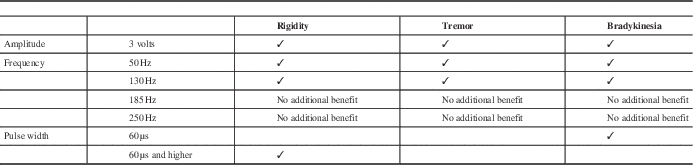
The use of DBS for PD began in the 1990s. Stimulation parameters of the STN to alleviate tremor, rigidity, and bradykinesia have been well-established. Moro et al studied 12 patients using 23 to 26 different monopolar stimulation settings in each patient.Reference Moro, Esselink and Xie 12 Stimulation amplitude of 3 volts and higher provided improvement in tremor, bradykinesia, and rigidity. Stimulation frequency of 50 Hz and 130 Hz improved tremor, rigidity, and bradykinesia. There was no significant improvement at 185 Hz. High-pulse-width stimulation was poorly tolerated in this group of patients. Bradykinesia improved significantly only at 60 μs. No difference was noted in tremor with different pulse widths. Rigidity improved at higher pulse width (Table 1). In another paper, Moro et al evaluated the parameters of a series of 44 patients and reprogrammed them according to a standardized protocol: all patients’ parameters were set at 60 μs and 130 Hz and each contact were assessed at increasing amplitudes of 0.5 volts until side effects occurred. The final voltage was established either at a level lower than the side effect or dyskinesia threshold or at 3.6 volts.Reference Moro, Poon, Lozano, Saint-Cyr and Lang 13 In the past, algorithms for initial programming and troubleshooting have been proposed as expert opinion, but have never been validated.Reference Volkmann, Herzog, Kopper and Deuschl 14 , Reference Volkmann, Moro and Pahwa 15
Effect of stimulation amplitude, frequency, and pulse width on rigidity, tremor, and bradykinesia (modified from Moro et al)Reference Moro, Esselink and Xie 12
The incidence of dysarthria after bilateral STN DBS has been reported as high as 69.7%.Reference Piboolnurak, Lang and Lozano 16 Higher left STN voltage is associated with worse speech.Reference Tripoliti, Zrinzo and Martinez-Torres 17 One report suggested that high stimulation frequency and amplitude increased the risk of speech impairment.Reference Törnqvist, Schalén and Rehncrona 18 Another report suggested that high-frequency stimulation had a negative impact on speech-related velopharyngeal control.Reference Hammer, Barlow, Lyons and Pahwa 19
Axial symptoms such as postural instability and freezing of gait may worsen after STN DBS.Reference Collomb-Clerc and Welter 20 The cause is most likely multifactorial: disease progression, medication reduction, cognitive decline, and stimulation-induced worsening. Low-frequency stimulation has been reported to be effective to improve gait and balance in a small group of patients, but this area remains controversial and deserves further investigation.Reference Moreau, Defebvre and Destée 21 - Reference Zibetti, Moro and Krishna 24
DYSTONIA
GPi DBS has been applied worldwide as a surgical treatment alternative for medical refractory dystonia. The role of stimulation parameters on dystonic symptoms are not as well-established compared with PD and tremor. Unlike PD and tremor, for which the effect of stimulation is observed within seconds to minutes, the effect of GPi DBS on dystonia does not occur until hours, days, or in some cases even months. The Germany Dystonia Study Group proposes to use monopolar stimulation at 130 Hz and 120 µs and to increase the amplitude, testing for the acute effects.Reference Kupsch, Benecke and Müller 25 In terms of configuration of settings, no study is available comparing monopolar versus bipolar stimulation.
The use of high- versus low-frequency stimulation in dystonia has shown mixed results. Alterman et al suggested that the use of 60 Hz stimulation can be beneficial in some patients,Reference Alterman, Shils, Miravite and Tagliati 26 whereas another group preferred high-frequency stimulation.Reference Kupsch, Klaffke and Kühn 27 Moro et al concluded that high amplitude and frequency stimulation predict better outcome in cervical dystonia.Reference Moro, Piboolnurak, Arenovich, Hung, Poon and Lozano 28
Various pulse widths have been recommended in GPi DBS for dystonia. Coubes et al recommend the use of 450 µs.Reference Coubes, Cif, El Fertit and Hemm 29 However, another study comparing 60, 120, and 450 µs did not show significant difference among the three groups.Reference Vercueil, Houeto and Krystkowiak 30
Dystonia is a complex movement disorder with various etiologies, clinical manifestations, ages of onset, and genetic associations. Development of a stimulation algorithm addressing these issues should be considered.
The use of neuroimaging guided programming has been shown effective by Lee et al in PD.Reference Lee, Jeon and Paek 31 Further studies investigating the application of this technique in dystonia and tremor can be considered.
Advances in neurostimulation devices (implanted pulse generators) technology offers the options of current- versus voltage-controlled stimulation. One randomized controlled trial showed similar results between these two modes of stimulation,Reference Okun, Gallo and Mandybur 32 whereas a more recent open-label study found better outcomes with current-controlled stimulation.Reference Lettieri, Rinaldo and Devigili 33
CONCLUSION
There is a major need for data in which each parameter is studied in a similar manner to what O’Suilleabhain et alReference O’Suilleabhain, Frawley, Giller and Dewey 5 have done so that we can have a better idea what the optimal amplitude, monopolar versus bipolar settings, pulse width, and frequency of stimulation we should aim for initially. It is clear that treatment will need to be individualized, but there may be parameters that are preferable in the majority of cases. Furthermore, technological advances are providing new possibilities for DBS programming. The use of interleaved settings may help in cases in which side effects precludes the use of standard parameters.Reference Ramirez-Zamora, Kahn and Campbell 34 The use of current-constant instead of voltage-constant stimulation may have some advantages, but studies on this topic are still needed.Reference Lettieri, Rinaldo and Devigili 33 Mathematical modeling of stimulation is also a promising approach that is starting to be available and would give a boost to the spread of current steering stimulation.Reference McIntyre, Frankenmolle and Wu 35 The available literature on DBS programming for PD, tremor, and dystonia has been recently reviewed and algorithms have been proposed to address specific patient’s issues.Reference Picillo, Lozano, Kou, Puppi Munhoz and Fasano 36 , Reference Picillo, Lozano, Kou, Munhoz and Fasano 37 Although useful, the proposed approaches have not been validated.Reference Bronstein, Tagliati and Alterman 38 By building a Canadian DBS network consisting of homogenous and comparable DBS teams, validation of such procedures may be significantly facilitated.
BUILDING A DBS TEAM
The care of DBS patients can be divided into pre-, intra-, and post-DBS because there are different practitioners and interventions involved in all stages. We currently have clear guidelines for the presurgical evaluation of patients who are considered for DBS surgery,Reference Bronstein, Tagliati and Alterman 38 but there is no absolute consent regarding postsurgical management (i.e. who/when/how to perform DBS programming). Although several studies are available,Reference Fasano, Appel-Cresswell and Jog 39 there are no guidelines concerning the pharmacological modifications following surgery.
An expert consensus stated that for DBS teams to be effective, they should consist of dedicated neurologists, neurophysiologists, functional neurosurgeons, neuropsychologists, and nursing specialists.Reference Castrioto, Volkmann and Krack 40 It has also been reported that programming is best accomplished by highly trained clinicians in technical aspects of DBS as well as disease-related issues and pharmacological management.Reference Moro, Poon, Lozano, Saint-Cyr and Lang 13 , Reference Castrioto, Volkmann and Krack 40 - Reference Hunka, Suchowersky and Wood 42 However, the guidelines and validated algorithms currently available do not cover all aspects of the programming needs, and troubleshooting is typically done based on personal experience and preferences.
The time spent in postoperative care and programming is an important factor to consider. As an example, at the University of Calgary, the required nursing programming time added up to 36 hours for postoperative care in the first year after surgery.Reference Hunka, Suchowersky and Wood 42 The main factors influencing the time requirements are the expertise of each programmerReference Moro, Poon, Lozano, Saint-Cyr and Lang 13 and the time the team spent with patients before surgery.Reference Bel, Maxwell and McAndrews 43
What is the team needed to run a DBS program? There is a wide variety of settings across Canada, ranging from minimal to extensive teams, depending on a number of factors including financial, academic interest, and personnel availabilities. Availability of expertise to fulfill the selection criteria for DBS needs to be mandatory. A movement disorder neurologist should assess candidates to ascertain the precise diagnosis. Other factors that influence the response to surgery such as age, motor status, cognitive functioning, social support, and expectations can be assessed and followed by a variety of discipline personal including neuropsychologists, psychiatrists, occupational therapists physiotherapists, social workers, and nurses, but the need for specific professional personnel is not demonstrated. It also needs to be clear how much personnel is needed depending on the DBS center orientation, be it predominantly care or academic work.
By creating a Canadian DBS network, the minimal personnel required to run an efficient service may be better established and features distinguishing care or academic centers may be delineated. Furthermore, by comparing the different experiences coming from each DBS team throughout the country, it would be also possible to point which is the added value of each specific professional personnel when available (e.g. social workers).
OUTCOME MEASURES FOR DBS IN PD: WHEN
Preoperative evaluation of candidates should probably be done in the 3 months preceding surgery. The timing of the postoperative assessment should take into account some of the following factors: the placebo effect after months of waiting for the intervention, the microlesion effect of lead insertion that can last for as long as 3 months after surgery, and the time for obtaining the full effect after adjustment of stimulation parameters and medication that can take from 3 to 6 months (and even longer in some patients). In that context, postoperative evaluation should probably be performed about 6 months to 1 year after the surgery. Longer term follow-up is possibly influenced by the progression of the disease.Reference Rodriguez-Oroz, Moro and Krack 44
OUTCOME MEASURES FOR DBS IN PD: WHAT
Quantifiable outcome measures are needed to further refine the clinical criteria used to select patients, to detect potential side effects and find solutions to prevent them in the future, to allow comparison between groups (benchmarking), and, in the end, to improve the quality of care. Outcome measures need to be clinically meaningful, especially for patients, and adapted to the clinical context.
Because PD is a complex disease that is also characterized by neuropsychiatric symptoms with significant social impact, measures evaluating cognition and behavior are fundamental. Nondopaminergic motor and nonmotor symptoms of PD that are major determinants of the quality of life of patients are rarely helped by DBS, but may even represent contraindications for DBS (e.g. depression, dementia).Reference Castrioto, Lhommée, Moro and Krack 45 , Reference Fasano, Daniele and Albanese 46 Some symptoms, such as speech, may be worsened with STN DBS. Nonmotor manifestations of PD include symptoms related to dopaminergic deficit (such as depression, anxiety, pain, and apathy) or to a hyperdopaminergic state (including impulse control disorders, punding, and dopamine dysregulation syndrome).Reference Castrioto, Lhommée, Moro and Krack 45 Despite a significant improvement in motor symptoms of PD, many patients seem dissatisfied with the results of surgery and do not return to a functional psychosocial level.Reference Schüpbach, Gargiulo, Welter and Mallet 47 Indeed, DBS mainly improves motor aspects of PD,Reference Drapier, Raoul and Drapier 48 but the patients’ satisfaction after DBS seems to be greatly influenced by nonmotor factors such as depression and apathy and by expectation management.Reference Maier, Lewis and Horstkoetter 49 , Reference Hasegawa, Samuel, Douiri and Ashkan 50
Most of the work in the field of outcome measures has focused for many years on identifying patients who may benefit from DBS, while ensuring neuropsychiatric safety.Reference Lang, Houeto and Krack 51 The Core Assessment Program for Surgical Interventional Therapies in Parkinson’s Disease protocol has been used extensively.Reference Defer, Widner and Marié 52 Studies have mainly focused on the Unified Parkinson’s disease rating scale (UDPRS) activities of daily living and motor score on and off medication as the primary outcome measure. Motor complications, including fluctuations and dyskinesias, are evaluated with UDPRS part IV or patients diaries.Reference Fahn and Elton 53 Some studies used additional motor assessments with timed motor tasks (e.g. bradykinesia, walking). Changes in levodopa-equivalent daily doses are reported using standardized conversion formula.Reference Tomlinson, Stowe and Patel 54
In recent years, the focus of outcome measures has shifted from objective motor parameters to more subjective indicators, including evaluation of quality of life and caregiver burden. For example, some studies have chosen to use a quality of life scale, such as the 39-item Parkinson’s disease Questionnaire (PDQ-39), a disease-specific instrument validated for the assessment of health-related quality of life of PD patients, as the primary criterion of analysis.Reference Peto, Jenkinson, Fitzpatrick and Greenhall 55
In terms of nondopaminergic symptoms, subscores of the UPDRS scale can be used to evaluate the change in speech or gait, but specific scales are probably more useful and can provide a more detailed evaluation.Reference St George, Carlson-Kuhta and Nutt 56 The new Movement Disorders Society version of the UPDRS (MDS-UPDRS) could accurately track motor and nonmotor changes occurring after DBS.Reference Goetz, Tilley and Shaftman 57 , Reference Chou, Taylor and Patil 58 Many validated scales for nonmotor symptoms of PD have been developed in recent years.Reference Mattis 59 - Reference Marinus, Visser and Martínez-Martín 75
Although the UPDRS and the newer MDS-UPDRS are the cornerstones of the motor evaluation of PD patients, a significant amount of work is warranted to establish the best scales to evaluate both the nonmotor symptoms and quality of life. There is a need for a consensus, similar to the recommendations on the minimum criteria for studies reporting on DBS in PD,Reference Vitek, Lyons and Bakay 76 on the scales to be used so that comparison and pooling of data between centers can be performed (Table 2). A similar list of scales could be obtained from the Committee of Rating Scales Development of The Movement Disorders Society (http://www.movementdisorders.org/MDS/About/Committees--Other-Groups/MDS-Committees/Committee-on-Rating-Scales-Development.htm). Recommendations coming from a committee formed by experts and patients would be welcome.
Recommended outcome measures

Med=Medication; SCOPA-PS=The Scales for Outcomes in Parkinson’s disease—PsychoSocial questionnaire; SF-36=36-item Short Form; Stim=Stimulation.
Establishing a Canadian DBS network would boost the initiation of multicenter studies for the comparison and validation of the previously mentioned scales in DBS patients; the work would be significantly facilitated as a greater amount of patients would be available in a short time and both research and clinical centers might be involved.
CONCLUSION
It is clear from the information we have gathered here that there is a great need for more data to determine the optimal programming protocol and the standard measures that should be performed routinely by all centers.
Presently, there are no validated algorithms to guide clinicians with their programming. Studies are needed to look at optimal timing for initial programming, the use of anatomical versus electrophysiological strategies for target localization, and the correct stimulation settings to address patients’ symptoms without causing side effects.
There is a great deal of variability across centers in the composition of the DBS teams—from a few-member team to a full deck of nurses, speech therapists, physiotherapists, occupational therapists, psychologists, social workers, psychiatrists, physiologists, neurologists, and neurosurgeons. There is probably no need to have all these personnel for a program to run efficiently and safely and it is probably unrealistic to think that all DBS programs would be entitled to this type of team on a financial basis. These large teams are nevertheless important for academic centers to study different aspects of DBS treatment. Establishing a minimum number of personnel to run a program would nevertheless raise the important question of how to support these programs across the country.
For PD, most studies looked at motor outcomes such as the UPDRS. A smaller number of studies have looked at nonmotor aspects of the disease or at more specific motor outcomes, such as speech and gait. Rare studies looked at the psychosocial aspect, where many questions are still unanswered. What impact does DBS have on the patient’s spouse, family, and social environment? Why do we sometimes end up in a situation in which the patient feels this surgery was not the hoped-for success whilst the professional team feels the results of the surgery were optimal? These questions are very important because they affect the functional outcome of DBS and the patient’s return to a more normal life.Reference Fasano, Daniele and Albanese 46
We hope our work will be the start for a coordinated work amongst DBS centers to answer the various questions it raised.
ACKNOWLEDGEMENTS
This review is the product of the comprehensive and enlightening discussion between Canadian DBS experts occurred during the ‘DBS Canada Days’, held in Toronto on July 4-5 2014.
Disclosures
The DBS Canada Days symposium was sponsored by Medtronic and all speakers received honoraria and necessary transportation and accommodation. The final report provided has no industry-specific recommendations and was carefully screened to avoid any potential bias.
Michel Panisset, Yu-Yan Poon, Renato Munhoz, and Alejandro Valencia-Mizrachi do not have anything to disclose.
Christopher Honey has the following disclosures: Medtronic, Speaker’s fees, Honoraria; Metronic, Consultant, Consulting fees.
Alfonso Fasano has the following disclosures: Abbvie, Consultant, Consulting fees; Abbvie, Advisor, Honoraria; Boston Scientific, Consultant, Consulting fees; Boston Scientific, Advisor, Honoraria; Metronic, Consultant, Consulting fees; Metronic, Advisor, Honoraria; Metronic, Research support; TEVA Canada, Consultant, Consulting fees; TEVA Canada, Advisor, Honoraria; Novartis, Consultant, Consulting fees; Novartis, Advisor, Honoraria; UCB Pharma, Consultant, Consulting fees; UCB Pharma, Advisor, Honoraria.
Nicolas Jodoin has the following disclosures: Abbvie, Consultant, Consulting fees; Medtronic, Speaker, Speaker’s fees.



