

INTRODUCTION
Political corruption is “the use of public office for private gains” (Bardhan Reference Bardhan1997, 1321). It involves activities in which public officials, legislators, and politicians “use powers delegated to them by the public to further their own economic interests at the expense of the common good” (Jain Reference Jain2001, 73). Usually, these activities are illegal or—when permissible—entail strong public disapproval; for instance, they include taking bribes and kickbacks, engaging in embezzlement, and the looting of public coffers as well as resorting to various forms of nepotism, cronyism, and patronage (e.g., by securing government contracts for friends, family, or political supporters).
Corruption is an ancient phenomenon. It was already described in various religious texts, such as the Bible or the Quran, and discussed by political philosophers throughout history (including Plato, Aristotle, Machiavelli, and Montesquieu; see, e.g., Bardhan Reference Bardhan1997; Jain Reference Jain2001; Miller Reference Miller and Zalta2018). Unjust enrichment and the exploitation of power bothers citizens. As such, corruption is generally understood as a driver of social and political unrest (e.g., Nye Reference Nye1967; Rose-Ackerman and Palifka Reference Rose-Ackerman and Palifka2016).
In this article, we study the effect of corruption on terrorism.Footnote 1 Drawing on rational choice and game theory, we argue that corruption can fuel terrorism by (1) adversely affecting the provision of public goods, which, in turn, aggravates economic grievances, (2) facilitating political dissatisfaction, and (3) undermining counter-terrorism capabilities. Through its empirical focus, our article contributes to the discussion of the corruption–terrorism nexus in two main ways. First, we use data for a sample of 175 countries between 1970 and 2018 and an experimental identification strategy that allows for causal statements. Second, we provide correlational evidence for the mechanisms underlying the corruption–terrorism nexus, examining the impact of corruption on public goods provision, political dissatisfaction, and counter-terrorism capacity.
We also contribute to the broader literature on the role of corruption in conflict (e.g., Dyrstad and Hillesund Reference Dyrstad and Hillesund2020; Fjelde Reference Fjelde2009; Le Billon Reference Le Billon2003). Here, existing research focuses on the impact of corruption on large-scale forms of political instability and violence such as ethnic wars, insurgencies, and civil wars, neglecting the corruption–terrorism relationship. Yet studying the effect of corruption on terrorism is important for three reasons. In contrast to large-scale political violence, terrorism (1) also affects richer economies located in, for example, Northern America and Western Europe, (2) has also become—in contrast to large-scale conflict—more relevant in less developed countries especially in Africa and Asia, and (3) often has an international dimension, for example, as terrorist groups cross borders to attack in other countries or as terrorist violence in one part of the world inspires radicalization and extremism in others (e.g., Gaibulloev and Sandler Reference Gaibulloev and Sandler2019).
Moreover, as there are no existing empirical studies on the effect of corruption on terrorism, our study also adds to the literature on the determinants of terrorism (e.g., Abadie Reference Abadie2006; Auer and Meierrieks Reference Auer and Meierrieks2021; Campos and Gassebner Reference Campos and Gassebner2013; Jetter and Stadelmann Reference Jetter and Stadelmann2019; Lai Reference Lai2007; Piazza Reference Piazza2006; for overviews of this literature, see Gaibulloev and Sandler Reference Gaibulloev and Sandler2019; Krieger and Meierrieks Reference Krieger and Meierrieks2011; Sandler Reference Sandler2018; Schneider, Brück, and Meierrieks Reference Schneider, Brück and Meierrieks2015). In particular, we add to this literature by providing causal estimates of corruption on terrorism via an instrumental variables (IV) approach. This approach is warranted given the potential for endogeneity, especially due to concerns about feedback.
To account for potential endogeneity, we instrument a country’s level of corruption by its exposure to corruption in geographically and economically proximate countries. In so doing, we build on earlier evidence that corruption in proximate countries has predictive power in explaining local corruption (e.g., Becker, Egger, and Seidel Reference Becker, Egger and Seidel2009; Borsky and Kalkschmied Reference Borsky and Kalkschmied2019; Correa, Jetter, and Agudelo Reference Correa, Jetter and Agudelo2016) due to a region-specific demand for corruption control. We probe the soundness of our IV in various ways, for example, by using placebo IVs. In addition, we address concerns about the validity of the exclusion restriction in a number of ways, for example, by accounting for time-variant economic, politico-institutional, and demographic factors at the regional level. Moreover, we apply the plausibly exogenous framework of Conley, Hansen, and Rossi (Reference Conley, Hansen and Rossi2012) and beyond plausibly exogenous framework of van Kippersluis and Rietveld (Reference van Kippersluis and Rietveld2018) that allows us to explicitly relax the exclusion restriction and study how instrument invalidity affects our empirical conclusions.
Leveraging plausibly exogenous variation in the exposure to corruption in geographically and economically proximate countries to provide causal estimates of the effect of corruption on terrorism, we show that political corruption leads to more terrorist activity in the country of interest. Further investigating likely transmission channels, we provide evidence that corruption unfavorably affects the provision of public goods and undermines local military capacity, which, in turn, correlate with increased terrorist activity. In contrast, we find no evidence that corruption contributes to political dissatisfaction and nonviolent political protest. While our article has primarily empirical focus, our findings have immediate policy implications, implying that anti-corruption measures—be they a consequence of domestic policy change or initiatives financed by foreign aid—could also have pacifying effects.
THEORETICAL FRAMEWORK
The role of corruption in terrorism can be understood by considering the basic dynamics and outcomes of a game between a government and its citizenry, which we sketch below. Game-theoretical approaches to terrorism have been used in the literature to explain related phenomena, such as terrorist hostage-takings or counter-terrorism policies (e.g., Bapat Reference Bapat2006; Jacobson and Kaplan Reference Jacobson and Kaplan2007; Lapan and Sandler Reference Lapan and Sandler1988; for overviews, see Sandler and Enders Reference Sandler and Enders2004; Sandler and Siqueira Reference Sandler and Siqueira2009).
As shown in Figure 1, we consider a sequential game, where the government makes the first move, deciding whether to be corrupt (c) or honest (h); this reflects the idea that corruption is a determinant of terrorism. The choice in favor of or against corruption is due to the governments’ utility-maximization calculus, where utility from the spoils of corruption $ {\pi}_c $
(e.g., rents) is compared to the utility from non-corrupt behavior
$ {\pi}_c $
(e.g., rents) is compared to the utility from non-corrupt behavior $ {\pi}_h $
(e.g., in the form of political approval), subject to certain constraints and costs of being corrupt
$ {\pi}_h $
(e.g., in the form of political approval), subject to certain constraints and costs of being corrupt $ {\delta}_c $
(e.g., criminal punishment).Footnote 2 The costs of non-corrupt behavior
$ {\delta}_c $
(e.g., criminal punishment).Footnote 2 The costs of non-corrupt behavior $ {\delta}_h $
could take the form of opportunity costs (e.g., forgone personal rents diverted from public investments) or be more indirect (e.g., greater difficulties to implement a political program by not resorting to corruption). A government will thus turn to corruption when
$ {\delta}_h $
could take the form of opportunity costs (e.g., forgone personal rents diverted from public investments) or be more indirect (e.g., greater difficulties to implement a political program by not resorting to corruption). A government will thus turn to corruption when $ {\pi}_c>{\pi}_h $
.
$ {\pi}_c>{\pi}_h $
.
Game-Theoretical Approach to the Corruption–Terrorism Nexus
Note: Game between a government and its citizens, where the government’s decision whether to be corrupt is a utility function $ \pi $
of the benefits U and the cost
$ \pi $
of the benefits U and the cost $ \delta $
of (not) being corrupt. In a subsequent round, citizens decide on whether they remain peaceful or retaliate with terrorism, where they behave rationally according to a utility function
$ \delta $
of (not) being corrupt. In a subsequent round, citizens decide on whether they remain peaceful or retaliate with terrorism, where they behave rationally according to a utility function $ \varphi $
of the benefits V and the cost
$ \varphi $
of the benefits V and the cost $ \theta $
of (non)violence.
$ \theta $
of (non)violence.

In response, the citizens decide whether to engage in terrorism (t) as an extra-institutional form of (violent) contestation or to remain peaceful (p). That is, they compare the utility of terrorism, $ {\varphi}_t $
, and peaceful contestation,
$ {\varphi}_t $
, and peaceful contestation, $ {\varphi}_p $
, under government corruption or honesty, respectively, choosing the utility-maximizing response. The idea that (potential) terrorists consider the costs and benefits of terrorism is rooted in the rational-economic model of terrorism, as applied in Landes (Reference Landes1978), Sandler, Tschirhart, and Cauley (Reference Sandler, Tschirhart and Cauley1983), and Enders and Sandler (Reference Enders and Sandler1993); more recent discussions can be found in, for example, Sandler and Enders (Reference Sandler and Enders2004), Caplan (Reference Caplan2006), and Schneider, Brück, and Meierrieks (Reference Schneider, Brück and Meierrieks2015). This model assumes that terrorists are rational actors who “maximize expected utility or net payoffs subject to constraints,” as argued by Sandler and Enders (Reference Sandler and Enders2004, 311). This utility maximization implies that—ceteris paribus—terrorist activity will (1) decrease as the material costs of terrorism increase, (2) increase as the benefits from terrorism grow, and (3) increase as the opportunity costs of terrorism decrease, that is, as alternatives to terrorism become less attractive.
$ {\varphi}_p $
, under government corruption or honesty, respectively, choosing the utility-maximizing response. The idea that (potential) terrorists consider the costs and benefits of terrorism is rooted in the rational-economic model of terrorism, as applied in Landes (Reference Landes1978), Sandler, Tschirhart, and Cauley (Reference Sandler, Tschirhart and Cauley1983), and Enders and Sandler (Reference Enders and Sandler1993); more recent discussions can be found in, for example, Sandler and Enders (Reference Sandler and Enders2004), Caplan (Reference Caplan2006), and Schneider, Brück, and Meierrieks (Reference Schneider, Brück and Meierrieks2015). This model assumes that terrorists are rational actors who “maximize expected utility or net payoffs subject to constraints,” as argued by Sandler and Enders (Reference Sandler and Enders2004, 311). This utility maximization implies that—ceteris paribus—terrorist activity will (1) decrease as the material costs of terrorism increase, (2) increase as the benefits from terrorism grow, and (3) increase as the opportunity costs of terrorism decrease, that is, as alternatives to terrorism become less attractive.
Importantly, the government’s choice for or against corruption affects how citizens respond by influencing the respective (opportunity) costs and benefits of terrorism and peaceful contestation (i.e., of participation in the ordinary political process); in Figure 1, subscripts associated with the payoffs, costs, and benefits of terrorism and corruption point to their relationship with the previous government choice for corruption or honesty. In relation to the citizens’ response, we make the following arguments concerning the citizens’ calculus:
-
1. Corruption reduces a country’s counter-terrorism capacity and thus lowers the costs of terrorism, $ {\theta}_{t_c} $
. For instance, higher levels of corruption may imply that fewer public resources are available to finance a country’s police or military. Also, corruption may allow terrorist groups to pay off border guards, the police, judges, or prison guards, which is consequently expected to facilitate terrorist attacks and the cross-border transfer of materiel (arms, explosives, etc.), hamper the legal prosecution of terrorists, or aid the escape of captured terrorists from prison (Rotberg Reference Rotberg2009; Shelley Reference Shelley2014; Thachuk Reference Thachuk2005). An example are the 2004 Russian aircraft bombings (which caused 90 fatalities) conducted by “female suicide bombers who bribed their ways onto the planes” (Thachuk Reference Thachuk2005, 147). By lowering the costs related to financing and organizing terrorism as well as the risk of capture and punishment, corruption may thus lead to more terrorism.Footnote 3 This prediction speaks to the empirical evidence that countries with low levels of counter-terrorism capacity are more likely to face terrorist activity within their borders (e.g., George Reference George2018; Lai Reference Lai2007; Piazza Reference Piazza2008).
$ {\theta}_{t_c} $
. For instance, higher levels of corruption may imply that fewer public resources are available to finance a country’s police or military. Also, corruption may allow terrorist groups to pay off border guards, the police, judges, or prison guards, which is consequently expected to facilitate terrorist attacks and the cross-border transfer of materiel (arms, explosives, etc.), hamper the legal prosecution of terrorists, or aid the escape of captured terrorists from prison (Rotberg Reference Rotberg2009; Shelley Reference Shelley2014; Thachuk Reference Thachuk2005). An example are the 2004 Russian aircraft bombings (which caused 90 fatalities) conducted by “female suicide bombers who bribed their ways onto the planes” (Thachuk Reference Thachuk2005, 147). By lowering the costs related to financing and organizing terrorism as well as the risk of capture and punishment, corruption may thus lead to more terrorism.Footnote 3 This prediction speaks to the empirical evidence that countries with low levels of counter-terrorism capacity are more likely to face terrorist activity within their borders (e.g., George Reference George2018; Lai Reference Lai2007; Piazza Reference Piazza2008). -
2. Corruption may also matter to the benefits of terrorism,
$ {V}_{t_c} $
. The prevalence of corruption points to the existence of rents that could be captured in the wake of a terrorist success. For instance, the model by Kirk (Reference Kirk1983) alludes to the role of rents as a motivating factor in terrorism. What is more, terrorist groups tend to generate income from different sources (e.g., smuggling and kidnapping) that could become more profitable as corruption increases (e.g., Thachuk Reference Thachuk2005). For instance, bribing border guards and customs officials may allow terrorist groups to smuggle contraband (e.g., cigarettes and narcotics). An increase in terrorists’ income, in turn, will increase terrorist attacks (Enders and Sandler Reference Enders and Sandler1993). Importantly, while corruption is expected to increase the benefits of terrorism in such manners, it does not affect the benefits of peaceful political contestation (i.e.,
$ {V}_{p_c} $
) in the same way. -
3. Corruption curtails political participation and reduces public trust in and the legitimacy of political institutions (e.g., Anderson and Tverdova Reference Anderson and Tverdova2003; Chang and Chu Reference Chang and Chu2006; Dimant and Tosato Reference Dimant and Tosato2018). That is, corruption makes it less viable for citizens to achieve their goals through the ordinary political process (meaning a higher
$ {\theta}_{p_c}). $
Conversely, terrorism becomes a more attractive alternative to participating in this process. This argument indeed underlines that political grievances may be relevant to terrorism (e.g., Abadie Reference Abadie2006; Gaibulloev and Sandler Reference Gaibulloev and Sandler2019; Krieger and Meierrieks Reference Krieger and Meierrieks2011; Piazza Reference Piazza2006), while also speaking to earlier contributions that link political dissatisfaction, protest, and low levels of political legitimization to higher levels of terrorist activity (e.g., Campos and Gassebner Reference Campos and Gassebner2013; Masters and Hoen Reference Masters and Hoen2012). -
4. Corruption also adversely affects the provision of public goods. For instance, corrupt politicians may favor public spending that facilitates rent-seeking (e.g., large infrastructure projects; Croix and Delavallade Reference Croix and Delavallade2009). This, in turn, means that public spending for which rent-seeking cannot be easily concealed (e.g., public education) is not prioritized.Footnote 4 There is ample evidence that corruption adversely influences the quantity and quality of public goods (e.g., Bose, Capasso, and Murshid Reference Bose, Capasso and Murshid2008; Mauro Reference Mauro1998; Rajkumar and Swaroop Reference Rajkumar and Swaroop2008). An inadequate provision of public goods (e.g., by denying parts of the population access to education and health) is, in turn, expected to make terrorism more likely by fueling economic grievances related to the access to and distribution of (public) resources. For one, the availability of fewer public goods makes it more difficult for related economic grievances to be addressed politically, lowering the overall utility of peaceful contestation (
$ {\varphi}_p|h $
). This is tantamount to reduced opportunity costs of terrorism as an alternative way to accommodate such grievances. Accordingly, the inadequate provision of public goods incentivizes terrorist activity to address grievances through the use of force, for example, by violently appropriating and redistributing (public) resources, thus increasing the potential benefits of terrorism,
$ {V}_{t_c} $
. Arguing that an unfavorable provision of public goods does not allow for accommodating distributional economic grievances also speaks to the finding that terrorism is associated with economic inequality and exclusion (e.g., Ezcurra and Palacios Reference Ezcurra and Palacios2016; Krieger and Meierrieks Reference Krieger and Meierrieks2019; Piazza Reference Piazza2011; see also, e.g., Dyrstad and Hillesund Reference Dyrstad and Hillesund2020; Muller and Weede Reference Muller and Weede1994). It is also consistent with the notion that some terrorist organizations provide public goods (e.g., health services) to grow popular support (e.g., Berman and Laitin Reference Berman and Laitin2008; Hilsenrath Reference Hilsenrath2005).


In sum, this discussion leads us to two predictions. First, when the government is corrupt, the citizens’ utility of terrorism is relatively greater than the utility of (nonviolent) peaceful contestation, that is, $ {\varphi}_t|c>{\varphi}_p|c $
. Second, the utility of peaceful contestation is relatively greater than that of terrorism, that is,
$ {\varphi}_t|c>{\varphi}_p|c $
. Second, the utility of peaceful contestation is relatively greater than that of terrorism, that is, $ {\varphi}_p|h>{\varphi}_t|h $
, when the government is honest. Thus, consistent with game-theoretical representations that are associated with rational choice theory, our main hypothesis is as follows:
$ {\varphi}_p|h>{\varphi}_t|h $
, when the government is honest. Thus, consistent with game-theoretical representations that are associated with rational choice theory, our main hypothesis is as follows:
Higher levels of corruption lead to more terrorist activity.
Figure 2 summarizes our theoretical arguments in more detail, alluding to additional testable hypotheses associated with the mechanisms underlying the corruption–terrorism nexus (see the Exploration of Mechanisms section). For one, political corruption unfavorably affects the provision of public goods, which, in turn, fuels economic grievances related to, for example, economic inequality and exclusion. At the same time, corruption makes nonviolent political contestation less viable. For instance, corruption may make citizens less trustworthy in political institutions, leading them to perceive the political process as less useful to accommodate their demands in comparison to terrorism. The unfavorable distribution of public goods and associated economic grievances as well as political dissatisfaction, in turn, motivate terrorism. Moreover, corruption affects a country’s capacity to counter terrorism and the income from terrorism (e.g., associated with the capturing of rents), which may also influence terrorist activity.
The Corruption–Terrorism Relationship
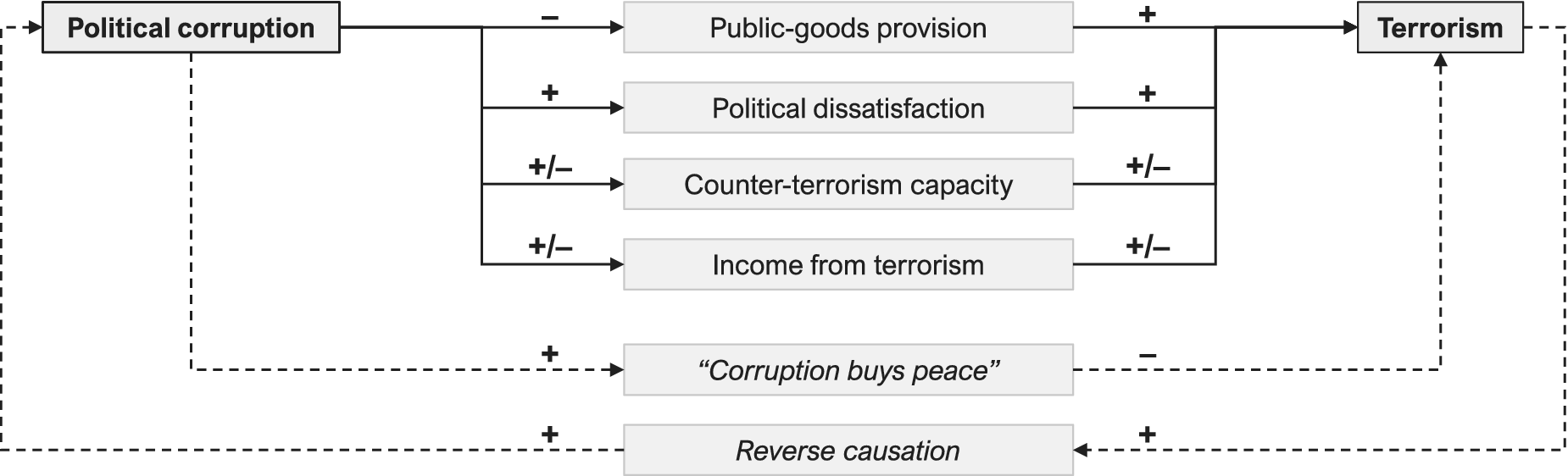
Finally, Figure 2 points to two further aspects of the corruption–terrorism nexus that warrant a brief discussion. First, there is the possibility that corruption could actually discourage terrorism. According to this “corruption buys peace” hypothesis (Le Billon Reference Le Billon2003), the government may use corruption to buy off a potentially violent opposition. This de-escalating effect of corruption does not conflict with $ {\varphi}_p|h>{\varphi}_p|c $
(because citizens are constrained by the government’s decision in the first step of the game) but would instead imply that
$ {\varphi}_p|h>{\varphi}_p|c $
(because citizens are constrained by the government’s decision in the first step of the game) but would instead imply that $ {\varphi}_p|c>{\varphi}_t|c $
. Buying off the opposition could mean that the government shares the spoils of corruption, while the potential terrorists accept these spoils to satisfy their greed and accommodate their grievances. Le Billon (Reference Le Billon2003) argues that many developing countries in Africa and Asia used corruption to buy internal peace after having gained independence (see also Fjelde Reference Fjelde2009). However, Le Billon (Reference Le Billon2003) also stresses that such arrangements did not prove to be stable in the long run. Consequently, corruption may not be able to buy off terrorist opposition. For instance, the economic costs of terrorism tend to be rather small (e.g., Gaibulloev and Sandler Reference Gaibulloev and Sandler2019), which makes it less likely that the government will share the spoils of corruption to prevent terrorism.
$ {\varphi}_p|c>{\varphi}_t|c $
. Buying off the opposition could mean that the government shares the spoils of corruption, while the potential terrorists accept these spoils to satisfy their greed and accommodate their grievances. Le Billon (Reference Le Billon2003) argues that many developing countries in Africa and Asia used corruption to buy internal peace after having gained independence (see also Fjelde Reference Fjelde2009). However, Le Billon (Reference Le Billon2003) also stresses that such arrangements did not prove to be stable in the long run. Consequently, corruption may not be able to buy off terrorist opposition. For instance, the economic costs of terrorism tend to be rather small (e.g., Gaibulloev and Sandler Reference Gaibulloev and Sandler2019), which makes it less likely that the government will share the spoils of corruption to prevent terrorism.
Second, Figure 2 highlights potential feedback between terrorism and political corruption. It is possible that corruption does not only influence terrorism but that terrorism also affects political corruption. For instance, terrorists may use corruption to gain access to government counter-terrorism information, infiltrate prisons that house terrorist operatives, influence judicial decisions concerning terrorist offenders, or smuggle weaponry across the border (e.g., Shelley Reference Shelley2014). At the same time, terrorist groups can raise large amounts of money from various illegal activities (e.g., kidnapping, smuggling, drug trafficking, and extortion), meaning that they also have access to the financial means to engage in corruption in the first place (e.g., Freeman Reference Freeman2011). The possibility of reverse causation is the main motivation for our IV approach described below.
DATA AND EMPIRICAL APPROACH
We test our hypothesis for a sample of 175 countries between 1970 and 2018. A list of countries and the summary statistics are provided in Tables A.1 and A.2 in Appendix A of the Supplementary Material.
Measuring Terrorism
Our main dependent variable is the number of terrorist attacks per country-year observation. We apply the inverse hyperbolic sine transformation to this variable to accommodate the influence of outliers; importantly, and in contrast to the log transformation, the inverse hyperbolic sine transformation is also defined for country-year observations with no terrorist activity (e.g., Burbidge, Magee, and Robb Reference Burbidge, Magee and Robb1988).Footnote 5
The terrorism data are drawn from the Global Terrorism Database (GTD) described in LaFree and Dugan (Reference LaFree and Dugan2007).Footnote 6 The GTD collects information on terrorist activity from reputable media outlets. For a terrorist event to be recorded, it must be documented by at least one high-quality media source and meet the following three criteria: it must (1) be intentional, (2) entail some level of violence or threat of violence, and (3) be committed by non-state actors, meaning that violence by state actors is excluded. Furthermore, the incident must meet at least two of the following three criteria: (1) it must be carried out to achieve a political, economic, religious, or social goal, (2) there must be evidence of an intention to coerce, intimidate, or convey some other message to a larger audience than the immediate victims, and/or (3) the incident must be outside the context of conventional warfare (LaFree and Dugan Reference LaFree and Dugan2007).
Measuring Corruption
Our measure of corruption is the political corruption index from the Varieties of Democracy Dataset (VDEM; Coppedge et al. Reference Coppedge, Gerring, Knutsen, Lindberg, Teorell, Altman and Bernhard2019). Higher values of this index correspond to higher levels of political corruption. This political corruption index is the arithmetic mean of four variables measuring corruption in the (1) executive, (2) legislature, (3) judiciary, and (4) public sector. It covers corruption in the various branches of government and at various levels of government.Footnote 7 The corruption index accounts for corruption aimed at influencing policy- and law-making as well as the implementation of these policies and laws. Finally, it covers different forms of corruption, accounting for both “passive” corruption (such as taking bribes) and “active” corruption, for example, in the form of the embezzlement of public resources by public officials and politicians.
VDEM relies on country- and subject-based expert opinion. For instance, to evaluate the extent of legislative corruption, experts are asked to assess to what extent members of the legislature abuse their position for financial gain. To arrive at representative values of political corruption per country-year observation that can also be compared between countries, VDEM then applies item response theory and subjects the individual expert opinion data to other forms of statistical scrutiny to minimize uncertainty and bias (Coppedge et al. Reference Coppedge, Gerring, Knutsen, Lindberg, Teorell, Altman and Bernhard2019).
Empirical Model
To examine the effect of corruption on terrorist activity, we estimate the following model:
 $$ \begin{array}{c}terroris{m}_{i,t}=\beta \times corruptio{n}_{i,t-1}\\ {}\hskip8.4em +\hskip2pt \delta {X}_{i,t-1}+{\alpha}_i+{\tau}_t+{\varepsilon}_{i,t},& \end{array} $$
where the (inverse hyperbolic sine transformed) number of terrorist incidents ( $ terrorism $
) in country i and year t is a function of the country’s political corruption (
$ terrorism $
) in country i and year t is a function of the country’s political corruption ( $ corruption $
) in the previous year (
$ corruption $
) in the previous year ( $ t-1 $
), a set of controls
$ t-1 $
), a set of controls $ X $
as well as country- and year-fixed effects (
$ X $
as well as country- and year-fixed effects ( $ \alpha $
and
$ \alpha $
and $ \tau $
, respectively) to account for time-invariant factors (e.g., culture and norms that affect corruption and/or terrorism) and global time trends.
$ \tau $
, respectively) to account for time-invariant factors (e.g., culture and norms that affect corruption and/or terrorism) and global time trends.
Below, we consider both a parsimonious and different covariate-adjusted models. Here, the choice of the baseline controls follows the literature on the determinants of terrorism (e.g., Piazza Reference Piazza2008; Krieger and Meierrieks Reference Krieger and Meierrieks2011; Campos and Gassebner Reference Campos and Gassebner2013; Enders, Hoover, and Sandler Reference Enders, Hoover and Sandler2016; Gaibulloev, Piazza, and Sandler Reference Gaibulloev, Piazza and Sandler2017; Gaibulloev and Sandler Reference Gaibulloev and Sandler2019). We include controls for population size and (inflation-adjusted) per capita income. Data on these variables come from the World Development Indicators (WDI; World Bank 2019); both variables are also inverse hyberbolic sine transformed to account for skewness. We also control for democracy, using data from Gründler and Krieger (Reference Klaus and Krieger2016).Footnote 8 Finally, we employ an index of state failure from the Political Instability Task Force (PITF 2019) that indicates the extent of large-scale civil warfare and other forms of political instability (e.g., coup d’états).
Instrumental Variables Approach
The estimates from Equation 1 might be affected by endogeneity bias due to measurement error in the corruption variable, the omission of relevant variables in our empirical model or feedback/reverse causation. To address these endogeneity concerns, we leverage a two-stage least squares (2SLS) IV model of the following form:
 $$ \begin{array}{l}corruptio{n}_{i,t}={\beta}_1\times regcorruptio{n}_{i,t}\\ {}\hskip6.4em +\hskip2pt {\delta}_1\times {X}_{i,t}+{\alpha}_{1,i}+{\tau}_{1,t}+{\varepsilon}_{1,i,t},& \end{array} $$
 $$ \begin{array}{c}terro{r}_{i,t}={\beta}_2\times {\hat{corruption}}_{i,t-1}+{\delta}_2\times {X}_{i,t-1}\\ {}\hskip-1em +\hskip2pt {\alpha}_{2,i}+{\tau}_{2,t}+{\varepsilon}_{2,i,t},& \end{array} $$
where the first-stage regression (Equation 2) predicts potentially endogenous country-year corruption levels using our IV, regcorruption. The predicted country-specific corruption levels are then used in the second stage to explain terrorism (Equation 3). Importantly, the panel structure of our data and the inclusion of country- and year-specific effects can already ameliorate some concerns about a lack of causal identification. Country-fixed effects can account for certain unobserved factors that correlate with our instrument and increase terrorism through means other than increasing national corruption. Year-fixed effects can factor in the possibility that there are changes over time that are spuriously correlated with both the instrument and terrorism.
Construction of Instrument
The instrument regcorruption measures a country’s exposure to regional corruption. That is, similar to other examples in the literature (e.g., Gründler and Potrafke Reference Gründler and Potrafke2019), our instrument is defined as the mean level of political corruption (using the VDEM political corruption index introduced above) in countries that are geographically and economically proximate to the country of interest $ pro{x}_i $
:
$ pro{x}_i $
: $ regcorruptio{n}_{i,t}=\frac{1}{n}{\sum}_{prox=1}^n\hskip0.35em pro{x}_i=\frac{pro{x}_1+pro{x}_2+\cdots +pro{x}_n}{n} $
.
$ regcorruptio{n}_{i,t}=\frac{1}{n}{\sum}_{prox=1}^n\hskip0.35em pro{x}_i=\frac{pro{x}_1+pro{x}_2+\cdots +pro{x}_n}{n} $
.
Geographical proximity involves those countries that are located in the same world region as the country of interest. We use the following six United Nations world regions: the Americas; East Asia and the Pacific; Europe and Central Asia; the Middle East and Northern Africa; South Asia; and Sub-Saharan Africa.Footnote 9 Economic proximity means that only those countries within a specific world region are considered for our IV if they are also in the same income group as the country of interest. We differentiate between low-, middle-, and high-income countries using WDI data. To give an example, France is a high-income country located in the United Nations (UN) world region Europe and Central Asia. We thus consider the mean level of political corruption in all countries in Europe and Central Asia that are also high-income economies. For instance, this includes Germany and Spain but excludes the United States (a high-income country outside Europe and Central Asia) or Bulgaria (which is located in Europe and Central Asia but is not a high-income country).
Instrument Relevance and Exclusion Restriction
For our IV (the mean level of political corruption in geographically and economically proximate countries) to be valid, it should be sufficiently strong. In our case, regional exposure to corruption should predict political corruption. Indeed, considerable empirical evidence suggests that corruption in proximate countries has predictive power in explaining local corruption (e.g., Becker, Egger, and Seidel Reference Becker, Egger and Seidel2009; Borsky and Kalkschmied Reference Borsky and Kalkschmied2019; Correa, Jetter, and Agudelo Reference Correa, Jetter and Agudelo2016; Dimant and Tosato Reference Dimant and Tosato2018; see also the related literature on the spatial contagion of economic reforms such as Gassebner, Gaston, and Lamla Reference Gassebner, Gaston and Lamla2011; Simmons and Elkins Reference Simmons and Elkins2004).
We argue that corruption levels ought to correlate across space to a common demand for corruption control (or a common tolerance for corruption) that is specific to geographically and economically proximate countries (but differs between geographically and economically diverse countries). Why do we expect this demand for corruption control to be is similar across proximate countries? First, geographical proximity is expected to coincide with common political histories and cultures. For instance, countries that are geographically close tend to have similar religious histories. Religion may, in turn, affect corruption, for example, by shaping how strongly religious dogma affects government policy with respect to measures that punish immoral (corrupt) behavior (e.g., Dimant and Tosato Reference Dimant and Tosato2018; La Porta et al. Reference La Porta, Lopez-de-Silanes, Shleifer and Vishny1999; North, Orman, and Gwin Reference North, Orman and Gwin2013). Second, the economic component of the instrument ought to reflect similarities in production, economic needs, and preferences. For instance, economically proximate countries share a similar demand for internationally mobile factors of production (i.e., physical and human capital). Given that capital and talent are attracted to low levels of corruption (e.g., Dimant, Krieger, and Meierrieks Reference Dimant, Krieger and Meierrieks2013; Poprawe Reference Poprawe2015; Wei Reference Wei2000), this may explain why industries in economically proximate countries demand similar levels of corruption control. Finally, both geographical and economic proximity make it more likely that tolerance for corruption aligns, for example, due to close informational ties and low information and transaction costs.
Figure 3 shows that the levels of corruption across countries are not independent of each other (Map A). For instance, corruption tends to be much higher in Sub-Saharan Africa as compared to Western Europe. As expected, this interdependence is also reflected in the IV we construct (Map B). What is more, comparing both parts of Figure 3 strongly suggests that exposure to regional corruption ought to be predictive of local corruption levels. Indeed, the simple pairwise correlation between both corruption variables is $ r=0.70 $
(
$ r=0.70 $
( $ p<0.01 $
) for the largest possible sample (see also Figure B.1 in the Supplementary Material).
$ p<0.01 $
) for the largest possible sample (see also Figure B.1 in the Supplementary Material).
Corruption across Countries and Exposure to Corruption as Instrument
Note: Map A shows the average level of corruption per country, categorized into quartiles. Map B shows the respective countries’ regional exposure in quartiles, that is, the average level of corruption in economically and geographically proximate countries.
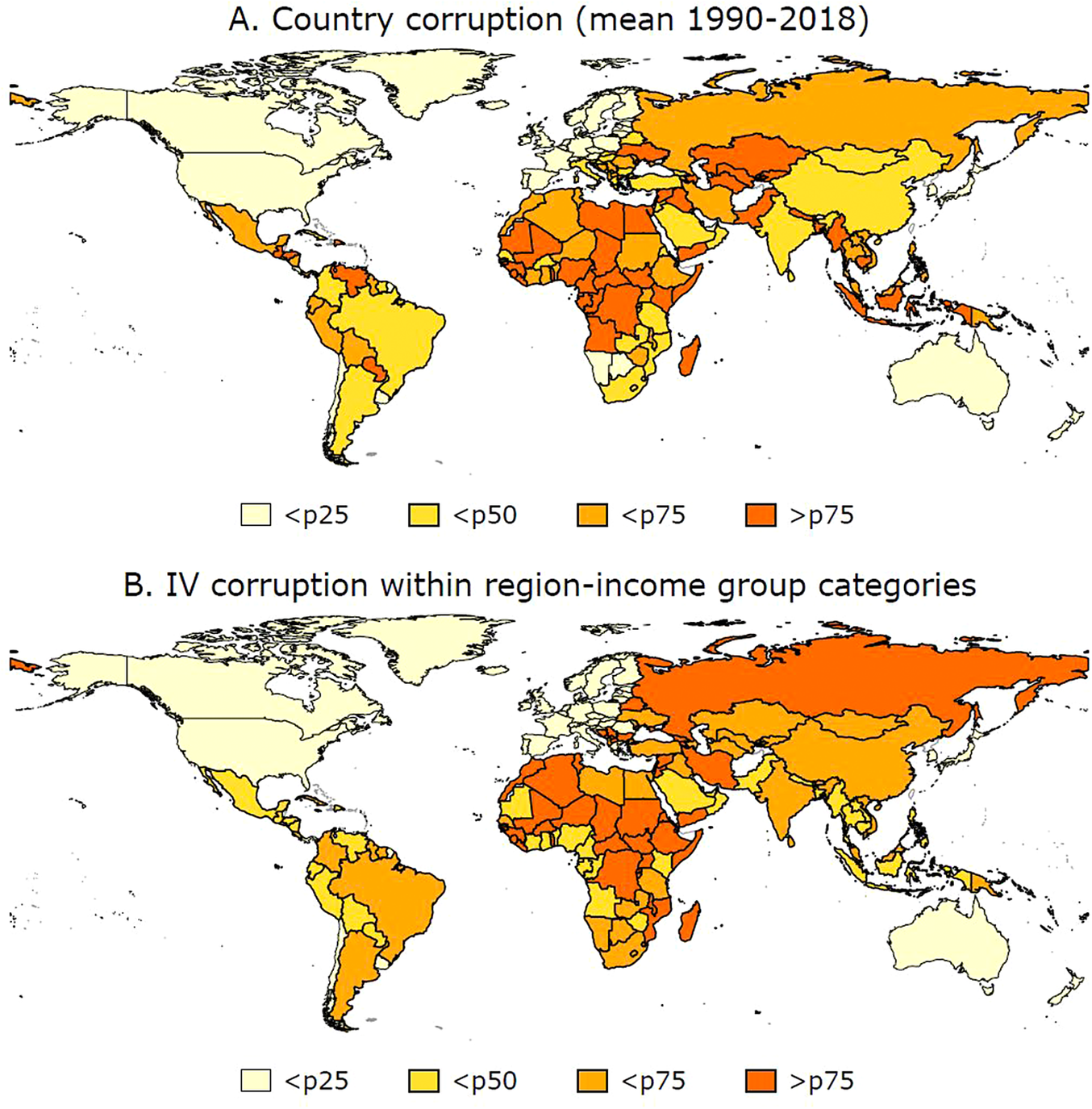
In line with Figure 3, we expect our IV to positively predict local corruption. We assess the strength of our instrument by means of the first-stage F-statistic. The usual rule of thumb to indicate instrument strength ( $ F>10 $
) has received some criticism for being anti-conservative, meaning that instruments may be weak even if
$ F>10 $
) has received some criticism for being anti-conservative, meaning that instruments may be weak even if $ F>10 $
(Lee et al. Reference Lee, McCrary, Moreira and Porter2021). Thus, we also report results for the Anderson–Rubin test that is robust to arbitrarily weak instruments (Anderson and Rubin Reference Anderson and Rubin1949; Lee et al. Reference Lee, McCrary, Moreira and Porter2021). A rejection of the Anderson–Rubin test null hypothesis indicates that the coefficient of the endogenous regressor in the structural equation equals zero, which would support the IV estimates. We also report the Anderson–Rubin confidence set (which inverts the Anderson–Rubin test) to further illustrate the trustworthiness of our IV approach in terms of statistical and economic significance (see Stock, Wright, and Yogo Reference Stock, Wright and Yogo2002 for a further discussion).
$ F>10 $
(Lee et al. Reference Lee, McCrary, Moreira and Porter2021). Thus, we also report results for the Anderson–Rubin test that is robust to arbitrarily weak instruments (Anderson and Rubin Reference Anderson and Rubin1949; Lee et al. Reference Lee, McCrary, Moreira and Porter2021). A rejection of the Anderson–Rubin test null hypothesis indicates that the coefficient of the endogenous regressor in the structural equation equals zero, which would support the IV estimates. We also report the Anderson–Rubin confidence set (which inverts the Anderson–Rubin test) to further illustrate the trustworthiness of our IV approach in terms of statistical and economic significance (see Stock, Wright, and Yogo Reference Stock, Wright and Yogo2002 for a further discussion).
Figure 3 also speaks to our idea that there is a variable, the demand for corruption control, that is similar across countries that are geographically and economically proximate. However, the corruption control demand variable itself is not observed. Rather, we employ our IV (the mean level of political corruption in geographically and economically proximate countries) to use differences in regional corruption to draw conclusions about differences in this underlying “hidden” variable.Footnote 10 In arguing that there is an unobserved variable measuring demand for corruption control, we can address the criticism of “spatial instruments” by Betz, Cook, and Hollenbach (Reference Betz, Cook and Hollenbach2018). They argue that instruments that use realizations of endogenous variables in other spatial units are not valid because of simultaneity in the first-stage equation; in our case, local corruption would affect regional corruption and vice versa. However, as the regionally clustered demand for corruption control is causally prior to regional and local levels of political corruption (in that political demand for corruption control induces policy changes related to corruption control), this simultaneity issue does not emerge.
For our IV approach to be valid and causally estimate the effect of corruption on terrorism, the instrument should only affect terrorism via its effect on local corruption. However, as pointed out by Betz, Cook, and Hollenbach (Reference Betz, Cook and Hollenbach2018), there may be various economic, political, and demographic spillovers that could constitute alternative pathways from the instrument to terrorism. For instance, economic downturns in countries that are geographically and economically proximate to the country of interest are expected to correlate with regional levels of corruption (our IV). At the same time, such downturns could spill-over to the country of interest, affecting both local corruption and terrorism by influencing the opportunity costs of non-corrupt and nonviolent economic activities. Such an alternative pathway from regional corruption to terrorism would violate the exclusion restriction.
To address this concern, we implement two additional robustness checks. For one, we use the plausibly exogenous framework of Conley, Hansen, and Rossi (Reference Conley, Hansen and Rossi2012) and developed further by van Kippersluis and Rietveld (Reference van Kippersluis and Rietveld2018). This method allows us to directly examine how plausible violations of the exclusion restriction matter to causal inference. Allowing for violations of the exclusion restriction and still finding that corruption matters to terrorism would raise confidence in our IV approach. For another, we control for a series of observable time-varying shocks that are correlated across countries that are both geographically close and economically similar. For instance, this includes regional levels of economic growth, political instability, and institutional quality. Finding that corruption (instrumented by regional exposure to corruption) affects terrorism even after accounting for factors that might correlate with our IV (and thus potentially account for further transmission channels from our IV to terrorism) would provide evidence in favor of the exclusion restriction.
EMPIRICAL RESULTS
Main Results
The main empirical results presented in Table 1 can be summarized as follows. First, the OLS models (specifications 1–3) show a positive and statistically significant association between political corruption and terrorism. Second, the effect of corruption on terrorism is more pronounced in our preferred IV models (specifications 4–6). Here, the impact of regional exposure on corruption in the first stage has the expected effect on local corruption and is sufficiently strong, as indicated by the first-stage F-statistic. The additional IV diagnostics are also sound. Third, introducing the baseline controls to the model does not affect our main empirical conclusion that political corruption encourages terrorism. Concerning these controls, terrorism positively correlates with population size, state failure, democracy, and economic development. These associations are also reported in other studies (e.g., Piazza Reference Piazza2008; Krieger and Meierrieks Reference Krieger and Meierrieks2011; Campos and Gassebner Reference Campos and Gassebner2013; Enders, Hoover, and Sandler Reference Enders, Hoover and Sandler2016; Gaibulloev and Sandler Reference Gaibulloev and Sandler2019). However, due to the lack of an identification strategy associated with estimating these associations, they cannot be given a causal interpretation (Keele, Stevenson, and Elwert Reference Keele, Stevenson and Elwert2020).
Effect of Corruption on Terror Attacks
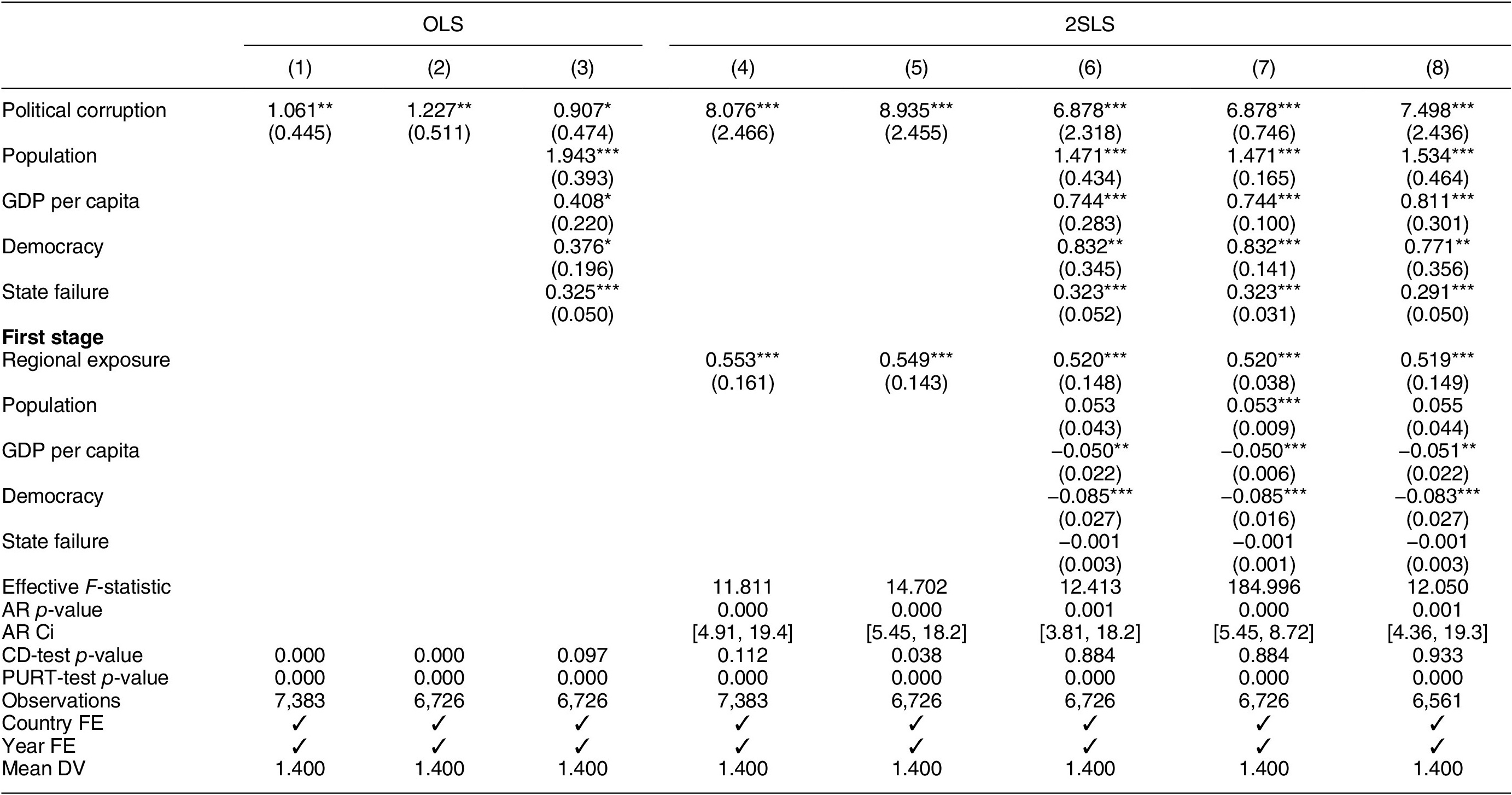
Note: The table presents main specification results (OLS and 2SLS) of the effect of (exposure to regional) corruption on terrorism in the subsequent year. Robust SE clustered at the country level in parentheses (Driscoll–Kraay SE in model 7). Model 8 uses 2-year instead of 1-year lags. Because several countries in the sample gained independence only after 1970, the number of country-year observations varies from 129 in 1970 to 175 in the 2000s. On average, we observe 160 countries per year. Models 1 and 4 show the parsimonious estimates for the largest possible sample. The remaining models restrict the sample to country-year observations without missing control variables to ensure comparability across specifications. CD-test reports the p-values associated with Pesaran’s test for cross-sectional dependence, where the null hypothesis is cross-sectional independence. PURT-test reports the p-values associated with Choi’s Fisher-type panel unit-root test, where the null hypothesis is that all panels contain a unit root (i.e., are nonstationary) against the alternative that at least one panel is stationary. For the PURT-test, we subtract the cross-sectional averages from the series to mitigate concerns about cross-sectional dependence. * $ p<0.10 $
, **
$ p<0.10 $
, ** $ p<0.05 $
, ***
$ p<0.05 $
, *** $ p<0.01. $
Table 1 also reports some diagnostics and initial robustness checks. For one, there may be concerns about the presence of cross-sectional dependence in the regression residuals, which may affect the validity of statistical inference (e.g., Sarafidis and Wansbeek Reference Sarafidis and Wansbeek2012).Footnote 11 The results of a test for cross-sectional independence of the residuals (Pesaran Reference Pesaran2015) show that for some specifications, cross-sectional dependence is indeed present in the residuals, pointing to a potential violation of the assumption of spatial independence of observations. Therefore, we also run a variant of our baseline model using standard errors proposed by Driscoll and Kraay (Reference Driscoll and Kraay1998), which are robust to heteroskedasticity and autocorrelation, but also to general forms of cross-sectional dependence. As shown in specification 7, accounting for residual cross-sectional dependence in this manner produces even smaller standard error estimates. This suggests that our choice of standard errors (i.e., cluster-robust standard errors) produces rather conservative standard error estimates, so that type I errors are less likely to occur. As another way to address the issue of cross-sectional dependence, we also run a common correlated effects regression within a GMM framework following Pesaran (Reference Pesaran2006). As shown in Table C.1 in the Supplementary Material, our main effect of corruption on terrorism is robust to this alternative specification.
For another, there may be concerns about model choice and lag length selection. As a first way to address this concern, we use 2-year instead of 1-year lags for all independent variables. Specification 8 in Table 1 produces results that are very similar to our baseline estimates. In Appendix C.2 of the Supplementary Material, we consider issues of lag length selection more in-depth by discussing and running a series of error-correction models (e.g., Engle and Granger Reference Engle and Granger1987; De Boef and Keele Reference De Boef and Keele2008). These models allow us to examine how the inclusion of lags of the dependent variable, and additional lags of the independent variables, affect our estimates. At the same time, they allow us to address concerns about non-stationarity and cointegration, while also enabling us to study the relationship between corruption and terrorism in the long run. As shown in Table C.2 in the Supplementary Material, our long-run estimates suggest that higher levels of corruption lead to more terrorism. Indeed, these (dynamic) estimates are rather close to our (static but more parsimonious) estimates reported in Table 1, suggesting that the main results are not affected by different lag structures (concerning both lags of the dependent and independent variables) and non-stationarity. This latter finding speaks to the results from panel unit-root tests following Choi (Reference Choi2001), which we report in Table 1 and which suggest that the residuals from our baseline estimates are not affected by non-stationarity, further ameliorating spurious regressions concerns.
Plausibly Exogenous Framework
While the exclusion restriction cannot be tested directly, there are ways to probe it. We first rely on the plausibly exogenous method of Conley, Hansen, and Rossi (Reference Conley, Hansen and Rossi2012). This method relaxes the assumption of perfect instrument exogeneity, instead allowing for violations of the exclusion restriction. The plausibly exogenous methods rests on the following 2SLS model:
 $$ \begin{array}{l}corruptio{n}_{i,t}={\beta}_1\times regcorruptio{n}_{i,t}+{\delta}_1\times {\boldsymbol{X}}_{i,t}\\ {}\hskip6.5em +\hskip2pt {\alpha}_{1,i}+{\tau}_{1,t}+{\varepsilon}_{1,i,t},& \end{array} $$
 $$ \begin{array}{l}terro{r}_{i,t}={\beta}_2\times {\hat{corruption}}_{i,t-1}+\gamma \times regcorruptio{n}_{i,t-1}\\ {}\hskip4.4em +\hskip2pt {\delta}_2\times {\boldsymbol{X}}_{i,t-1}+{\alpha}_{2,i}+{\tau}_{2,t}+{\varepsilon}_{2,i,t}.& \end{array} $$
Regional exposure to corruption—the instrument—can now directly affect terrorism in the country of interest i in the second stage via $ \gamma $
, meaning that the exclusion restriction is violated; in case of
$ \gamma $
, meaning that the exclusion restriction is violated; in case of $ \gamma $
being equal to zero, the exclusion restriction would be valid. By considering different values of
$ \gamma $
being equal to zero, the exclusion restriction would be valid. By considering different values of $ \gamma $
, we can investigate how violations of the exclusion restriction matter to our IV estimates. Below, we use the union of confidence interval approach proposed by Conley, Hansen, and Rossi (Reference Conley, Hansen and Rossi2012). For our analysis, we consider various values of
$ \gamma $
, we can investigate how violations of the exclusion restriction matter to our IV estimates. Below, we use the union of confidence interval approach proposed by Conley, Hansen, and Rossi (Reference Conley, Hansen and Rossi2012). For our analysis, we consider various values of $ \gamma $
, where the upper bound is chosen according to the reduced-form equation. These reduced-form estimates are reported in Panel A of Table 2 and indicate—consistent with our IV approach—that higher levels of regional corruption correlate with higher levels of terrorism in the country of interest. While we assume per the exclusion restriction that this effect is only due to the role of shared tolerance of corruption (approximated by regional corruption) in local corruption, by means of the plausibly exogenous approach, we can assess how robust our findings are to different degrees of instrumental invalidity. As a lower bound, we consider a value of
$ \gamma $
, where the upper bound is chosen according to the reduced-form equation. These reduced-form estimates are reported in Panel A of Table 2 and indicate—consistent with our IV approach—that higher levels of regional corruption correlate with higher levels of terrorism in the country of interest. While we assume per the exclusion restriction that this effect is only due to the role of shared tolerance of corruption (approximated by regional corruption) in local corruption, by means of the plausibly exogenous approach, we can assess how robust our findings are to different degrees of instrumental invalidity. As a lower bound, we consider a value of $ \gamma =-1 $
, which would imply that more regional corruption is associated with less terrorism in the country of interest.
$ \gamma =-1 $
, which would imply that more regional corruption is associated with less terrorism in the country of interest.
Zero-First-Stage Tests
Note: Full sample refers to the baseline sample of 167 countries without missing control variable values; we report the baseline results for comparison. Robust SE clustered at the country level in parentheses. * $ p<0.10 $
, **
$ p<0.10 $
, ** $ p<0.05 $
, ***
$ p<0.05 $
, *** $ p<0.01 $
.
$ p<0.01 $
.
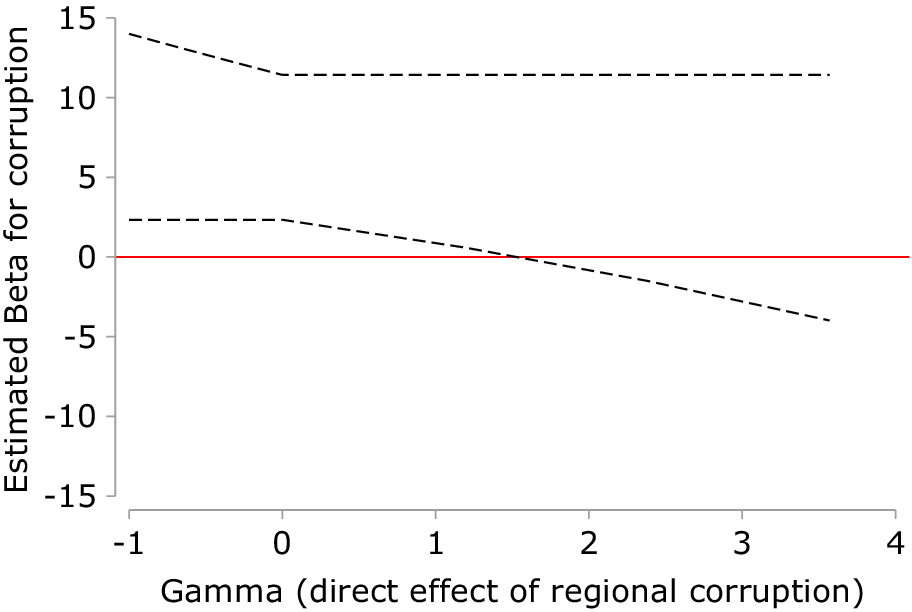
Figure 4 presents the upper and lower bounds for the corruption coefficient, applying the plausibly exogenous approach for our baseline empirical model. There are two conclusions. First, if $ \gamma <0 $
, the upper bound effect of local corruption on terrorism becomes larger. Such a relationship might emerge when regional corruption positively correlates with certain predictors of terrorism. Second, as long as
$ \gamma <0 $
, the upper bound effect of local corruption on terrorism becomes larger. Such a relationship might emerge when regional corruption positively correlates with certain predictors of terrorism. Second, as long as $ \gamma <1.5 $
, the 95% confidence interval does not include zero (for 90% CI, this
$ \gamma <1.5 $
, the 95% confidence interval does not include zero (for 90% CI, this $ \gamma $
threshold is 1.9). Taken together, the results suggest that
$ \gamma $
threshold is 1.9). Taken together, the results suggest that $ \gamma $
has to reach a value that is in excess of 42% of the size of the reduced-form estimate for the coverage area to include zero (53% of the reduced form effect size for the 90% CI). This, in turn, suggests that our IV estimates appear to be robust to high degrees of instrumental invalidity.
$ \gamma $
has to reach a value that is in excess of 42% of the size of the reduced-form estimate for the coverage area to include zero (53% of the reduced form effect size for the 90% CI). This, in turn, suggests that our IV estimates appear to be robust to high degrees of instrumental invalidity.
Testing Instrument Invalidity via Union of Confidence Interval Approach
Note: The figure shows the upper and lower bounds of the 95% confidence intervals based on the union of confidence interval approach with varying degrees of instrument invalidity.
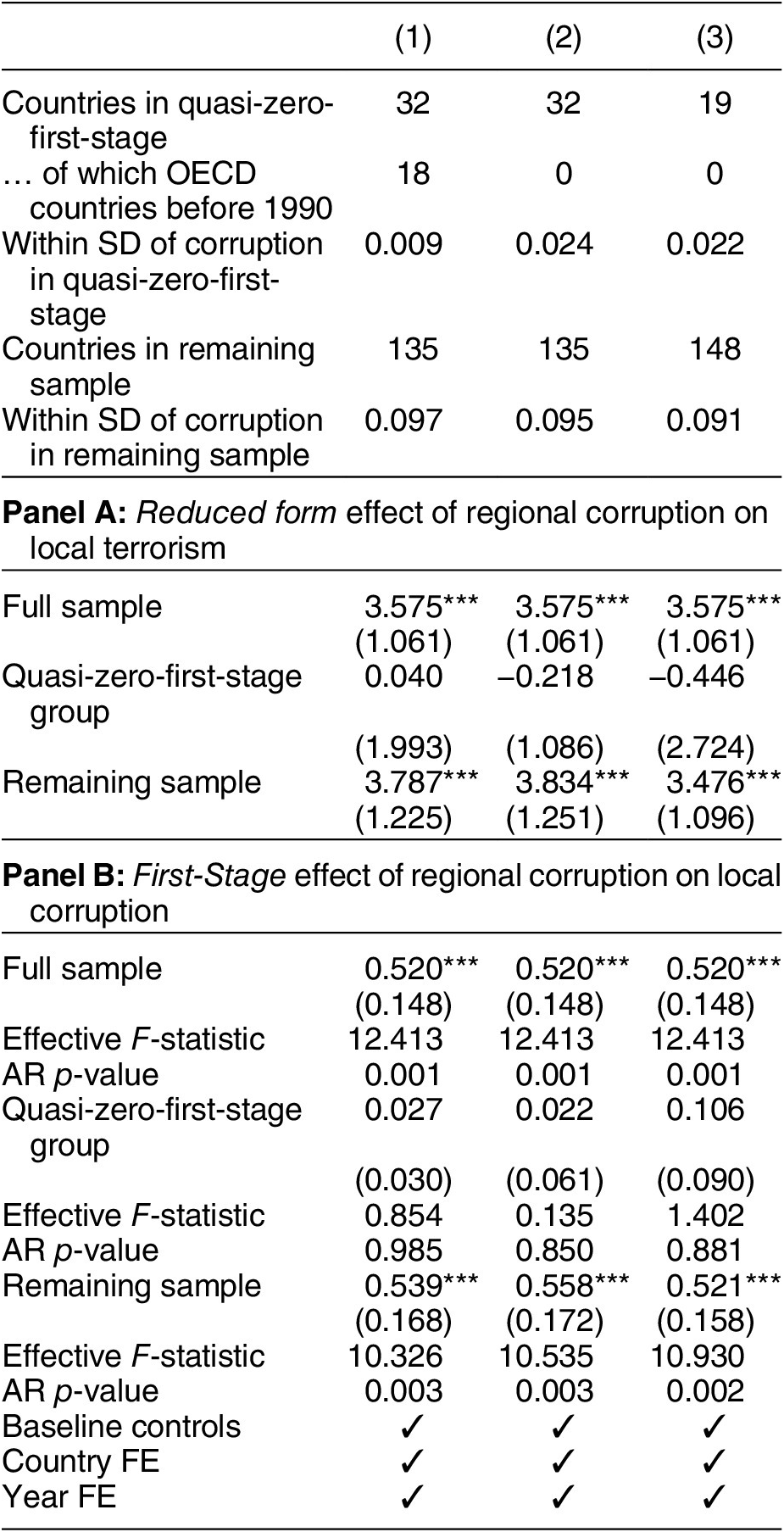
Another informal test of the exclusion restriction is the so-called zero-first-stage test, which considers a sub-sample for which the first stage is zero (van Kippersluis and Rietveld Reference van Kippersluis and Rietveld2018). For this sub-sample, the reduced form should then also be zero if the exclusion restriction is satisfied. Because there are no countries that saw zero changes in corruption over the 1970–2018 period, we construct a “quasi zero-first-stage group,” for which the responsiveness of local to regional corruption (indicated by the respective standard deviation of local corruption per country) over the observation period is as close to zero as possible.
We consider three quasi zero-first-stage country groups that include 32 countries (approximately one-fifth of the total sample) and 19 countries, respectively. The first group includes countries for which local political corruption was the least responsive.Footnote 12 Eighteen out of 32 countries were OECD members before 1990, which could raise concerns that this zero-first-stage may not be informative about the corruption–terrorism nexus in non-OECD countries. Thus, we create a second country group that includes those 32 non-OECD countries (nonmembers before 1990) that saw the lowest levels of responsiveness of their local corruption levels.Footnote 13 Because this group contains several small nations, we define a third zero-first-stage group comprising of those non-OECD countries with the lowest corruption responsiveness and at least two-million inhabitants. Table 2 shows that the effect of regional corruption on local terrorism (reduced form) is not significant in the quasi zero-first-stage samples (Panel A) and that the effect of regional on local corruption (first stage) is similarly imprecisely estimated (Panel B). These findings indicate that the direct effect of regional exposure to corruption on terrorism is negligible. While the zero-first-stage test can never verify the exclusion restriction, our findings support the notion that this restriction is satisfied.
The results from the zero-first-stage test also provide informative values for $ \gamma $
within the plausibly exogenous framework (van Kippersluis and Rietveld Reference van Kippersluis and Rietveld2018). For “true” zero-first-stage cases, the reduced-form estimated effects of regional corruption on terrorism would be equal to
$ \gamma $
within the plausibly exogenous framework (van Kippersluis and Rietveld Reference van Kippersluis and Rietveld2018). For “true” zero-first-stage cases, the reduced-form estimated effects of regional corruption on terrorism would be equal to $ \gamma $
.Footnote 14 For our analysis, we can use the reduced-form estimates for the quasi-zero-first-stage country groups as an input for the plausibly exogenous approach to investigate how such plausible violations of the exclusion restriction affect our 2SLS estimates. Using
$ \gamma $
.Footnote 14 For our analysis, we can use the reduced-form estimates for the quasi-zero-first-stage country groups as an input for the plausibly exogenous approach to investigate how such plausible violations of the exclusion restriction affect our 2SLS estimates. Using $ \gamma =0.040 $
(quasi-zero-first-stage countries in column 1 of Table 2) yields a β associated with political corruption of 6.851 [95% CI: 2.281, 11.421]. Similarly, using
$ \gamma =0.040 $
(quasi-zero-first-stage countries in column 1 of Table 2) yields a β associated with political corruption of 6.851 [95% CI: 2.281, 11.421]. Similarly, using $ \gamma =-0.218 $
yields β=7.152 [95% CI: 2.334, 11.969] and
$ \gamma =-0.218 $
yields β=7.152 [95% CI: 2.334, 11.969] and $ \gamma =-0.446 $
yields β=7.443 [95% CI: 2.335, 12.552]. That is, the implied violations of the exclusion restrictions do not result in the inclusion of zero in the 95% confidence interval associated with
$ \gamma =-0.446 $
yields β=7.443 [95% CI: 2.335, 12.552]. That is, the implied violations of the exclusion restrictions do not result in the inclusion of zero in the 95% confidence interval associated with $ {\beta}_2 $
, meaning that political corruption exerts an unfavorable effect on terrorism when instrumented by regional corruption under plausible violations of the exclusion restriction. Indeed, the same conclusion can also be drawn from Figure 4, where
$ {\beta}_2 $
, meaning that political corruption exerts an unfavorable effect on terrorism when instrumented by regional corruption under plausible violations of the exclusion restriction. Indeed, the same conclusion can also be drawn from Figure 4, where $ \gamma $
-values of
$ \gamma $
-values of $ 0.040 $
,
$ 0.040 $
, $ -0.218 $
, and
$ -0.218 $
, and $ -0.446 $
, respectively, clearly do not include zero.
$ -0.446 $
, respectively, clearly do not include zero.
Finally, van Kippersluis and Rietveld (Reference van Kippersluis and Rietveld2018) argue that incorporating uncertainty around the direct effect of the regional corruption on terrorism is meaningful, given potential differences in covariates between the zero-first-stage and full sample. They suggest—as a rule of thumb—fixing the variance in such a way that the normalized difference in direct effects between the (quasi) zero-first-stage and the full sample does not exceed one-quarter in 95% of cases, meaning that the variance–covariance matrix $ \omega $
is given by
$ \omega $
is given by $ \omega ={(0.125\times \sqrt{s_0^2+{s}_1^2})}^2 $
, where
$ \omega ={(0.125\times \sqrt{s_0^2+{s}_1^2})}^2 $
, where $ {s}_0 $
is the standard error of
$ {s}_0 $
is the standard error of $ \gamma $
in the quasi-zero-first-stage and
$ \gamma $
in the quasi-zero-first-stage and $ {s}_1 $
is the standard error of
$ {s}_1 $
is the standard error of $ \gamma $
for the remaining sample. We can incorporate this uncertainty by applying the local-to-zero approach of Conley, Hansen, and Rossi (Reference Conley, Hansen and Rossi2012). Here, we find that for the first quasi-zero-first-stage country group (with
$ \gamma $
for the remaining sample. We can incorporate this uncertainty by applying the local-to-zero approach of Conley, Hansen, and Rossi (Reference Conley, Hansen and Rossi2012). Here, we find that for the first quasi-zero-first-stage country group (with $ \gamma =0.040 $
),
$ \gamma =0.040 $
), $ \omega =0.655 $
, which yields a
$ \omega =0.655 $
, which yields a $ \beta $
associated with political corruption of 6.226 [95% CI: 0.974, 11.447]. For the first alternative quasi-zero-first-stage country group (with
$ \beta $
associated with political corruption of 6.226 [95% CI: 0.974, 11.447]. For the first alternative quasi-zero-first-stage country group (with $ \gamma =-0.242 $
),
$ \gamma =-0.242 $
), $ \omega =0.043 $
, resulting in
$ \omega =0.043 $
, resulting in $ \beta $
=6.726 [95% CI: 2.414, 11.038], while for the second alternative group (with
$ \beta $
=6.726 [95% CI: 2.414, 11.038], while for the second alternative group (with $ \gamma =-0.446 $
),
$ \gamma =-0.446 $
), $ \omega =0.140 $
, yielding
$ \omega =0.140 $
, yielding $ \beta $
=7.168 [95% CI: 2.697, 11.640]. Hence, allowing for uncertainty does not overrule our finding that more corruption leads to more terrorism, where the difference between covariates for the alternative quasi-zero-first-stage country group (from which OECD members are excluded) appears to be especially benign.
$ \beta $
=7.168 [95% CI: 2.697, 11.640]. Hence, allowing for uncertainty does not overrule our finding that more corruption leads to more terrorism, where the difference between covariates for the alternative quasi-zero-first-stage country group (from which OECD members are excluded) appears to be especially benign.
Robustness of Instrumental Variable Approach
We consider several additional ways to further probe the robustness of our IV results, focusing on instrument construction and potential violations of the exclusion restriction, which we discuss in detail in Appendix B of the Supplementary Material. First, we show in Table B.1 in the Supplementary Material that the results are robust to a more detailed definition of local exposure (18 instead of 6 UN geographical regions), to using yearly or 1995-fixed WDI income levels and to a continuous measure of geographical proximity (log capital distance) instead of world regions. Each of these alternative IV constructions renders effects of political corruption on terrorism comparable to our main specification. Second, we show that random assignment of baseline instrument values to other countries produces zero results. These placebo checks confirm that the geographical and economic ties between regional and local corruption are essential to the relevance and validity of our baseline IV approach. They speak to the notion that there is an unobserved corruption tolerance variable that is non-randomly distributed across geographically and economically proximate countries, which we can capture with our regional corruption instrument. Third, the exclusion restriction may be violated due to shocks that are correlated within regions and simultaneously affect local corruption and terrorism (e.g., Betz, Cook, and Hollenbach Reference Betz, Cook and Hollenbach2018). To address such concerns, we control for a series of time-varying variables that ought to capture the role of regionally correlated economic, political, institutional, and demographic shocks. Controlling for these regional shocks does not affect our main empirical conclusion, which raises further confidence in our assumption that the exclusion restriction is valid (Table B.2 in the Supplementary Material).
Further Robustness Checks
Having provided evidence that our IV approach is sound, we consider further ways to probe the robustness of our empirical findings in Appendix C of the Supplementary Material. In detail, we show that our findings are also robust to changes to our baseline model, for example, in terms of the operationalization of controls (Table C.1). For example, Enders, Hoover, and Sandler (Reference Enders, Hoover and Sandler2016) and Gaibulloev, Piazza, and Sandler (Reference Gaibulloev, Piazza and Sandler2017) suggest that per-capita income and democracy may share a nonlinear relationship with terrorism; our results are robust to the inclusion of such nonlinearities. Similarly, the interpretation of the results does not change with the inclusion of additional control variables (Table C.4). It is also not affected by alternative measurements of the dependent variable, for example, by measuring terrorism in per capita terms (Table C.5); by considering alternative modes of terrorist attacks (e.g., bombings vs. kidnappings; Table C.6); by differentiating between domestic and transnational terrorism as well as between government and civilian terrorist targets (Table C.7); and by dropping potentially influential cases such as countries which exceptionally high levels of terrorist activity or political corruption (Table C.8). Finally, in Appendix D of the Supplementary Material, we investigate the role of specific subtypes of corruption in terrorism. We find that corruption in the executive, legislative, and judicial branches encourages more terrorist activity, which tends to point to a generalized relationship between political corruption and terrorism. However, the effect of public sector corruption on terrorism—while having the expected sign—is not estimated precisely enough to fully support this notion. For this case, IV diagnostics suggest that our IV is too weak to allow for proper identification.
Exploration of Mechanisms
As another important contribution, we study the potential mechanisms through which political corruption may translate into increased terrorist activity. Above, we discussed three transmission channels: (1) an inadequate provision of public goods (which, in turn, exacerbates economic grievances), (2) stronger political dissatisfaction related to the reduced viability of peaceful political contestation, and (3) reduced counter-terrorism capacity. To provide suggestive evidence on their role, we consider the following 2SLS system:
 $$ \begin{array}{c}corruptio{n}_{i,t}={\beta}_1\times regcorruptio{n}_{i,t}+{\delta}_1\times {\boldsymbol{X}}_{i,t}\\ {}\hskip1em +\hskip2.5pt {\alpha}_{1,i}+{\tau}_{1,t}+{\varepsilon}_{1,i,t},& \end{array} $$
 $$ \begin{array}{c}m{v}_{j,i,t}={\beta}_2\times {\hat{corruption}}_{i,t-1}+{\delta}_2\times {\boldsymbol{X}}_{i,t-1}\\ {}\hskip-2em +\hskip2pt {\alpha}_{2,i}+{\tau}_{2,t}+{\varepsilon}_{2,i,t}.& \end{array} $$
Employing our usual IV approach and including the baseline set of controls and fixed effects, we investigate the effect of political corruption on six mediator variables (mv). In addition to estimating the causal effect of corruption on these mediators, we also study the correlation between these variables and terrorism.Footnote 15 The link from the various mediator variables to local terrorism should not be interpreted causally.
First, health inequality and education equality (both VDEM) measure the provision of public goods. Furthermore, these measures relate to their eventual relationship with inequality and exclusion. We expect corruption to reduce health and education equality and lower levels of equality to correlate with higher levels of terrorist activity. Second, we consider political accountability (VDEM) and political protest (Banks and Wilson Reference Banks and Wilson2013). The former variable refers to the extent that citizens, civil society organizations, and the media can hold the government accountable, while the latter measures the number of nonviolent or unorganized political protests (strikes, riots, and anti-government demonstrations). We expect corruption to adversely affect government accountability and lead to more political protest, and low levels of accountability and high levels of political protest to breed terrorism. Third, we employ the indicators military capacity and territorial control using data from the National Material Capabilities Dataset updated from Singer (Reference Singer1988) and VDEM, respectively. The former variable is a composite measure of military capacity that accounts—via principal component analysis—for a country’s total military spending, number of military personnel, and per-capita military spending.Footnote 16 The latter variable indicates the percentage of territory a state has effective control over, where such control may be disputed by, for example, criminals, warlords, or insurgents. Both variables thus relate to a country’s counter-terrorism capacity. We anticipate corruption to lower this capacity and lower capacity to correlate with increased terrorist activity.
The empirical results reported in Table 3 can be summarized as follows.Footnote 17 First, political corruption reduces both health and education equality (Panel A). This is consistent with the idea that corruption undermines (e.g., by distorting public investment) the provision of public goods that could otherwise ameliorate socioeconomic inequality. Countries with inadequate public goods provision also see more terrorism (Panel B). For instance, this finding is in line with earlier contributions stressing the inequality–terrorism nexus (e.g., Ezcurra and Palacios Reference Ezcurra and Palacios2016; Krieger and Meierrieks Reference Krieger and Meierrieks2019). Second, we find no evidence that corruption affects political accountability and protest, nor that a lack of accountability correlates with more terrorism. This may indicate that the role of corruption in the viability of peaceful political contestation is less pronounced, at least concerning the political input (accountability) and output (protest) variables we consider in this article. In line with Campos and Gassebner (Reference Campos and Gassebner2013), there is, however, evidence that more political protest is associated with more terrorist activity. Third, political corruption reduces both military capacity and the state’s territorial control. What is more, both variables negatively correlate with terrorism, which speaks to earlier empirical analyses of the unfavorable relationship between state weakness and terrorism (e.g., Lai Reference Lai2007).
Potential Mechanisms
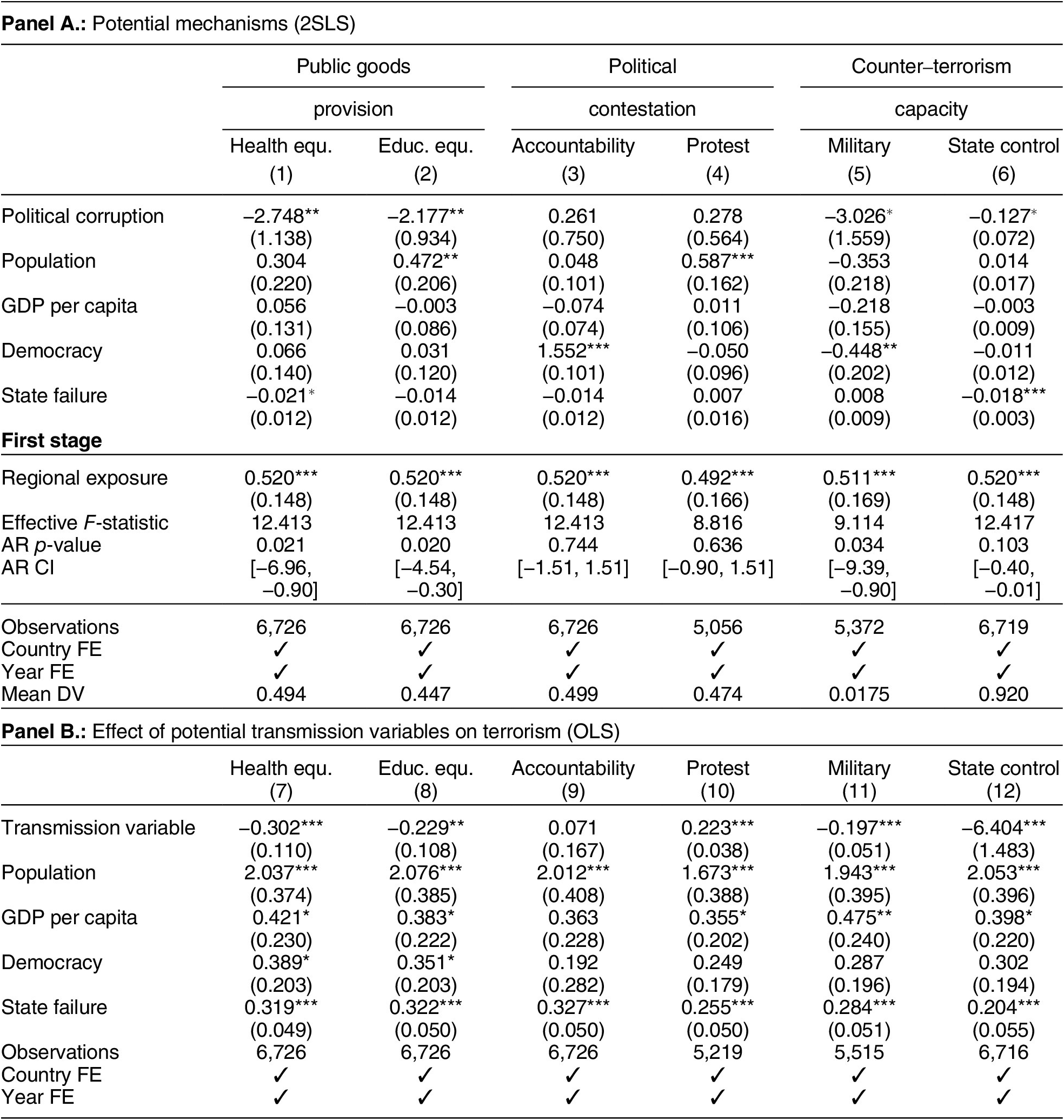
Note: The table explores potential mechanisms by replacing the main outcome (terrorist attacks) with key determinants of public goods (models 1 and 2), political grievances (models 3 and 4), and counter-terrorism capacity (models 5 and 6). OLS and robust SE clustered at the country level in parentheses. * $ {}p<0.10 $
, *
$ {}p<0.10 $
, * $ p<0.05 $
, ***
$ p<0.05 $
, *** $ p<0.01 $
.
$ p<0.01 $
.
Corruption and Other Types of Conflict
In principle, corruption may also matter to other forms of conflict. Estimating a parsimonious specification of our 2SLS model, however, we find no effect of corruption on incidences of ethnic, civil, and international war (Table D.2 in the Supplementary Material; the conflict data are from Marshall Reference Marshall2019). Moreover, in Table 3, we have already shown that corruption does not affect protest (strikes, riots, and demonstrations). These tentative findings suggest differences between the determinants of terrorism and other forms of political violence (see also, e.g., De La Calle and Sanchez-Cuenca Reference De La Calle and Sanchez-Cuenca2012; Sambanis Reference Sambanis, Keefer and Loayza2008). However, we invite future research to undertake more elaborate assessments of whether the violent consequences of corruption go beyond terrorism.
CONCLUSION
Does corruption affect terrorism? To answer this question, we study a sample of 175 countries between 1970 and 2018. To provide causal estimates of the effect of political corruption on terrorism, we leverage plausibly exogenous variation in exposure to corruption in countries that are geographically and economically proximate to the country of interest to indicate region-specific (unobserved) differences in corruption tolerance. As our main empirical finding, we show that higher levels of corruption lead to more terrorist activity. We assess the robustness of this finding in various ways, especially by probing our instrument’s strength and the validity of the exclusion restriction. Our main finding survives these robustness checks as well as others.
Exploring potential transmission channels, we find that corruption adversely affects the provision of public goods and undermines military capacity. An inadequate provision of public goods—through its unfavorable relationship with economic inequality and exclusion—and low counter-terrorism capacity, in turn, are associated with more terrorism. This supports our proposed game-theoretical representation of terrorism, where the government’s choice of corruption encourages terrorism by lowering terrorism’s opportunity costs as well as its direct costs.
Our study does not come without limitations. For instance, while we use high-quality macro data to make general statements about the relationship between corruption and terrorism and recover causal effects, case studies that focus on important country cases (e.g., Colombia or Iraq) could add detailed insights and possibly strengthen the arguments put forward in this study.
Counter-corruption measures (e.g., the creation of anti-corruption agencies and the introduction of transparency laws) are often implemented by governments to attract foreign investors and stimulate economic growth. The results of our empirical analysis imply that such counter-corruption actions may also reduce terrorism. Furthermore, there is evidence that foreign aid reduces corruption (e.g., Okada and Samreth Reference Okada and Samreth2012; Tavares Reference Tavares2003). In light of our findings, providing foreign aid may ultimately also deter terrorism in aid-receiving countries through its favorable effect on local corruption. This may be especially interesting to donor countries due to the international dimension of terrorism, where terrorism in one part of the world can easily motivate radicalization and extremism in others.
SUPPLEMENTARY MATERIAL
To view supplementary material for this article, please visit https://doi.org/10.1017/S0003055424000418.
DATA AVAILABILITY STATEMENT
Research documentation and data that support the findings of this study are openly available at the American Political Science Review Dataverse: https://doi.org/10.7910/DVN/ZTVXNL.
ACKNOWLEDGMENTS
We thank the editors at APSR and four anonymous reviewers for their thoughtful comments and guidance throughout the review process. Their feedback has greatly improved this study. We are also grateful to Monika Bauhr, Patricia Calca, Krzysztof Krakowski, Nils Ringe, Max Schaub, the panelists at the 2022 Annual CES Conference in Lisbon and the 2022 Annual Meeting of the German Economic Association, as well as seminar participants at the University of Regensburg, the University of Essex, and the Helmut Schmidt University Hamburg for valuable feedback on previous versions of the article.
AUTHOR CONTRIBUTIONS
The authors are listed in reverse alphabetical order and contributed equally to this study.
CONFLICT OF INTEREST
The authors declare no ethical issues or conflicts of interest in this research.
ETHICAL STANDARDS
The authors affirm this research did not involve human participants.


 Open access


Comments
No Comments have been published for this article.