


Karst caves contain unique habitats, with dim light, limited nutrient supply, high humidity and relatively narrow temperature fluctuations (Ren et al., Reference Ren, Wang, Ye, Zhang, Han and Huang2021). They are home to entire genera of some organisms, including recently discovered species and probably many more yet to be discovered (Duan et al., Reference Duan, Li, Xu, Zhang and Zhang2021). Most karst cave species have narrow distributions and small populations. In China, most karst caves do not fall within the current system of national nature reserves. Conservation of species with extremely small populations is essential for ecological, economic and human health, and research on this topic has been a focus of conservation biology and restoration ecology (Ren et al., Reference Ren, Zhang, Lu, Liu, Guo and Wang2012). There is little information on the geographical distribution and population size of many karst cave species, hindering their effective conservation. Surveys of karst cave species and investigation of their distribution and current status are the first steps towards their conservation.
The perennial herb Primula esquirolii Petitmengin of the family Primulaceae is endemic to the karst region of Guizhou, China (Chen & Hu, Reference Chen, Hu and Wu1990). The species was first described by M.G.C. Petitmengin based on a collection of the Rev. Fathers J.H. Esquirol and L.F. Martin from the moist walls of a karst cave in limestone country near Gan-pin in the province of Kweichow, China (now Pingba county, Guizhou) on 19 March 1906 (Petitmengin, Reference Petitmengin1907). A portion of these specimens was sent to the Paris Herbarium (P) but probably lost, and the remainder was preserved in the Royal Botanic Garden Edinburgh herbarium (E). During the same period, others also collected the species near the same location (L.F. Martin and E.M. Bodinier, 2068, in 1898, P, US (US Smithsonian Institution herbarium); J.H. Esquirol, 75, in 1903, P; J.H. Esquirol, 2022, in 1910, P; J. Cavalerie, 3804, in 1910, P), but, prior to the current study, the collections of Cavalerie and Esquirol in 1910 were the most recent records of the species. A total of 11 specimens of P. esquirolii are stored at P, US and E (the latter holding the possible type and isotype). The scarcity of specimens has led to difficulty in assessing the status of the species. It is categorized as Endangered on the China Species Red List (Wang & Xie, Reference Wang and Xie2004) and as Data Deficient on the China Biodiversity Red List (Ministry of Environmental Protection of the People's Republic of China and the Chinese Academy of Science, 2013).
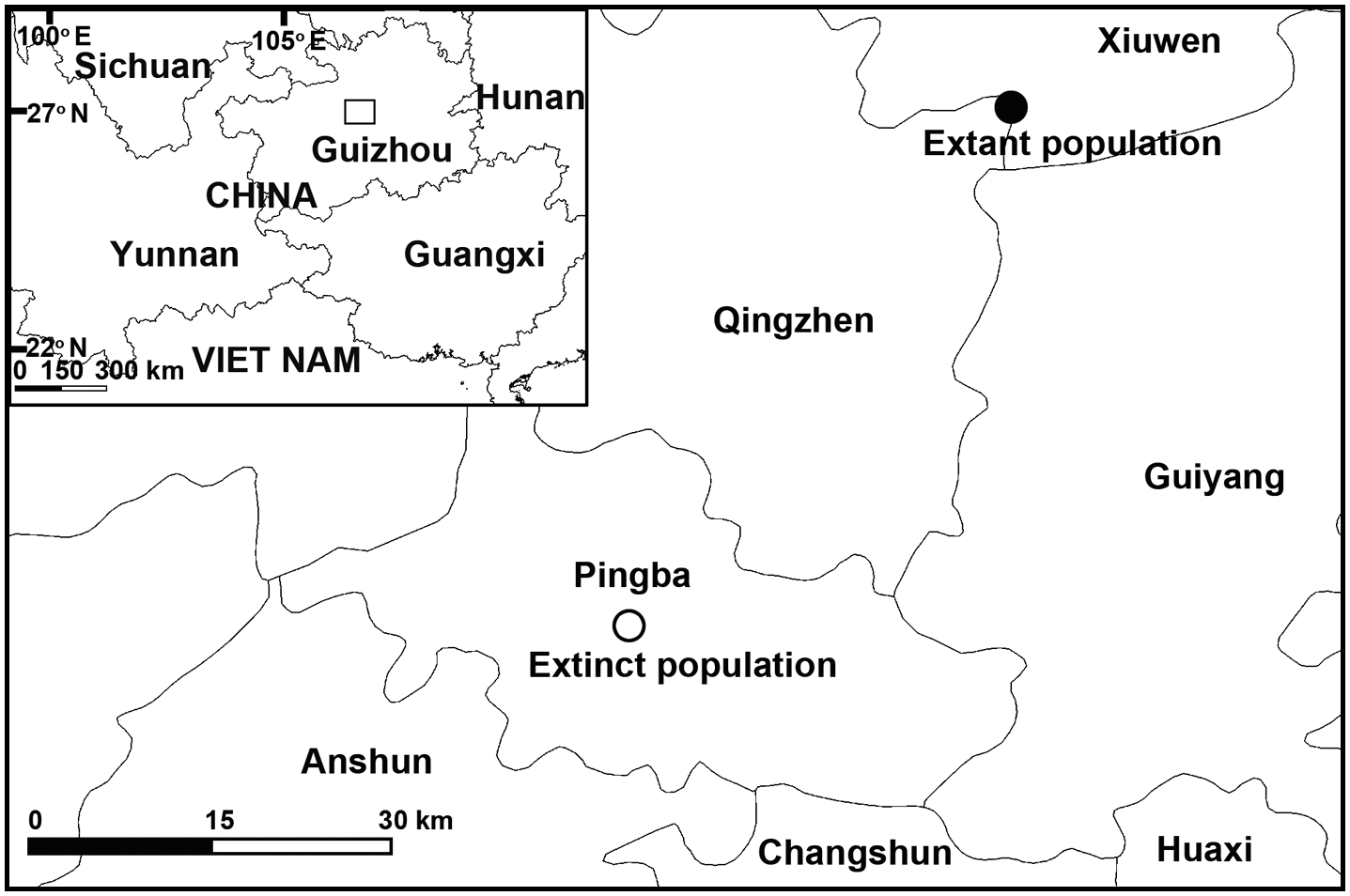
To investigate the current distribution of P. esquirolii, we carried out seven field surveys in Pingba county and adjacent areas during the flowering period of the plant in 2018–2022 (February and March 2018, March 2019, February and March 2020, and February 2021 in Pingba and Qingzhen, and February 2022 in Xiuwen and Pingba). We were unable to find the species in its type location in Pingba county; it appears to have disappeared for unknown reasons. However, we discovered a flowering population of 44 mature individuals in Xiuwen county in February 2022, in an area of c. 50 m2, c. 40 km from the type location. The population is located on moist limestone cliffs at the edge of a hydroelectric station (Fig. 1, Plate 1) in a similar habitat to that described by Esquirol and Martin for the type location. In early descriptions of P. esquirolii, the plants were almost homomorphic (Petitmengin, Reference Petitmengin1907; Smith et al., Reference Wright Smith, Forrest, Fletcher, Cramer and Swann1977), but in the newly found population 37 individuals are long homostylous and seven individuals are heterostylous. All heterostylous individuals show the short-styled morph (thrum; Plate 1). We did not find long-styled (pin) heterostylous individuals. In section Petiolares, P. esquirolii is distinguished by its short or almost obsolete scape, its long and narrow corolla tube and the deficiency of articulated hairs compared to its allies.
Location of the extant Primula esquirolii population in Xiuwen county and of the extinct P. esquirolii population in Pingba county, Guizhou.
Primula esquirolii: (a) site of the extant population, (b,c) natural habitat, (d) flowering individual, (e) left: short-styled flower, right: long homostylous flower, and (f) the possible type of P. esquirolii in the Royal Botanic Garden Edinburgh herbarium (E) (specimen number E00024325).

The genus Primula is a typical heterostylous and obligate outcrossing taxon (Darwin, Reference Darwin1877), with the majority (92%) of c. 400–500 species being distylous (Richards, Reference Richards2003). Evolutionary transition from outcrossing to selfing often occurs in heterostylous plants. Selfing homostyles originate within distylous populations and often evolve into separate species (Zhong et al., Reference Zhong, Barrett, Wang, Wu, Sun and Li2019). In our surveys of nearly 200 species of Primula in China, we have found that homostylous species usually have fewer populations or smaller population sizes than closely related heterostylous species and occur in unique ecological localities. The selfing homostylous lineages often have a high genetic load, which makes them sensitive to environmental changes and renders population expansion over short periods of time difficult, as well as leaving them prone to extinction. The almost homostylous P. esquirolii may thus have a high genetic load and this could have resulted in its small population size and potential sensitivity to habitat loss.
Karst cave organisms are highly adapted to their habitat and restricted in their ranges (Duan et al., Reference Duan, Li, Xu, Zhang and Zhang2021). Disturbances from farming, visitors, tourism infrastructure and changes in water flow can have negative effects on these highly adapted and range-restricted cave-dwelling organisms (Whitte, Reference Whitte2009). Information from informal interviews with local people and our field surveys indicates that the main threats to this species are its small population size and the loss of suitable habitat as a result of human activities such as logging, farming, and reservoir and road construction. These activities have resulted in the destruction of potential P. esquirolii habitat and potentially increased its extinction risk, a matter exacerbated by its small population size.
Narrow endemic plant species require diversified conservation measures. For Parakmeria omeiensis, a Critically Endangered tree species in the family Magnoliaceae, an integrated conservation approach, including strengthening in situ conservation, cultivation of saplings, ex situ conservation and reintroduction, was adopted (Yu et al., Reference Yu, Wen, Li, Xiong, Peng and Li2020); for Begonia jocelinoi, a threatened species endemic to a small locality in the Brazilian Atlantic Forest, in situ and ex situ conservation including studies on phenology, pollination, seed dispersal and population dynamics were recommended (Paglia et al. Reference Paglia, Luber, Mansano and Freitas2022).
Given there are only 44 mature individuals in the currently known population, P. esquirolii should be categorized as Critically Endangered on the IUCN Red List on the basis of criterion B2ab(i,ii,iii,iv): area of occupancy estimated to be < 10 km2 (B2), known to exist at only a single location (a), with continuing decline (b) in extent of occurrence (i), area of occupancy (ii), area, extent and/or quality of habitat (iii) and number of locations or subpopulations (iv). Protection of these known individuals and their habitat is of particular importance, and research into the developmental biology, population genetics, reproductive biology, population ecology and ex situ and in situ conservation of this species is also required. The National Wild Plant Germplasm Resource Centre of China and Guizhou University of Traditional Chinese Medicine collected seeds of P. esquirolii in summer 2022, to study the seed biology of this species, and we plan to study the population genetics and reproductive biology of the species in 2023. In addition, further field surveys in the karst region of Guizhou are required to search for any other previously undiscovered populations.
Acknowledgements
This study was jointly supported by the National Wild Plant Germplasm Resource Centre of China and Guizhou University of Traditional Chinese Medicine for the National Programme of Wild Plants Surveys and Germplasm Conservation (ZWGX-2105).
Author contributions
Fieldwork: all authors; writing: ZW.
Conflicts of interest
None.
Ethical standards
This research abided by the Oryx guidelines on ethical standards.


 Open access

