





Introduction
Attention-deficit/hyperactivity disorder (ADHD) is a prevalent neurodevelopmental condition that typically emerges before the age of 7 (Kieling et al., Reference Kieling, Kieling, Rohde, Frick, Moffitt, Nigg, Tannock and Castellanos2010; McKechnie et al., Reference McKechnie, O’Nions, Dunsmuir and Petersen2023). Emotional symptoms refer to internalizing conditions, including unique and overlapping symptoms of depression and anxiety, such as worry, low mood, and withdrawal (American Psychiatric Association, 2013; Francis et al., Reference Francis, Caruana, Hudson and McArthur2019). Children and adolescents with ADHD have a higher prevalence and levels of emotional symptoms than neurotypical peers (Doering et al., Reference Doering, Larsson, Halldner, Gillberg, Kuja-Halkola and Lundström2022; Gnanavel et al., Reference Gnanavel, Sharma, Kaushal and Hussain2019; Mlodnicka et al., Reference Mlodnicka, Mansolf, Chandran, Aris, Calub, Ahmad, Shapiro, Cochran, Restrepo, Schmidt, Hertz-Picciotto, Bennett, Gold, O’Shea, Leve and Schweitzer2024; Mohammadi et al., Reference Mohammadi, Zarafshan, Khaleghi, Ahmadi, Hooshyari, Mostafavi, Ahmadi, Alavi, Shakiba and Salmanian2021), and this is associated with more adverse outcomes, such as poorer quality of life, increased peer and family relationship difficulties, and reduced psychological well-being later in life (Armstrong et al., Reference Armstrong, Ruttle, Klein, Essex and Benca2014; Becker et al., Reference Becker, Luebbe and Langberg2012; Koyuncu et al., Reference Koyuncu, Ayan, Ince Guliyev, Erbilgin and Deveci2022). Despite these findings, there remains a limited understanding of how emotional symptoms develop in children with ADHD during the transition from middle childhood to early adolescence, particularly in comparison with neurotypical children.
Understanding the development of emotional symptoms from middle childhood to early adolescence is crucial, as this period represents a key transitional phase involving puberty and the shift from primary to high school, accompanied by significant biological, psychological, and social changes (Eccles, Reference Eccles1999; Lane et al., Reference Lane, Brundage and Kreinin2017). These transitions can substantially impact emotional symptoms, particularly in children with ADHD, who already face behavioral and social challenges (Dellapiazza et al., Reference Dellapiazza, Audras-Torrent, Michelon and Baghdadli2021; Powell et al., Reference Powell, Riglin, Hammerton, Eyre, Martin, Anney, Thapar and Rice2020). It is also important to track levels of emotional symptoms from middle childhood. Children with ADHD often encounter challenges in peer relationships, academic performance, and family functioning more frequently and at an earlier stage (mid-to-late childhood) compared to their neurotypical peers (Efron et al., Reference Efron, Sciberras, Anderson, Hazell, Ukoumunne, Jongeling, Schilpzand, Bisset and Nicholson2014; S. Rhodes et al., Reference Rhodes, Booth, McDougal, Oldridge, Rivera-Lares, Revueltas Roux and Stewart2024). These cumulative stressors may heighten their emotional vulnerabilities, and lead to earlier and more severe emotional symptoms than neurotypical children. Previous longitudinal studies have primarily examined predictors of emotional symptoms in adolescents with ADHD or identified the developmental sequences of ADHD and its co-occurring emotional symptoms (Mlodnicka et al., Reference Mlodnicka, Mansolf, Chandran, Aris, Calub, Ahmad, Shapiro, Cochran, Restrepo, Schmidt, Hertz-Picciotto, Bennett, Gold, O’Shea, Leve and Schweitzer2024; Norén et al., Reference Norén Selinus, Molero, Lichtenstein, Anckarsäter, Lundström, Bottai and Hellner Gumpert2016; Speyer et al., Reference Speyer, Eisner, Ribeaud, Luciano, Auyeung and Murray2021). However, limited research has been conducted to explore how emotional symptoms develop over time in children with ADHD, especially during the critical transition period into adolescence. Exploring these trajectories and comparing them to neurotypical children can help identify when emotional difficulties emerge in the ADHD population and how their progression differs in children with ADHD. These insights can inform the optimal timing for screening and intervention, ultimately improving the well-being of children with ADHD.
One study has examined the longitudinal trajectories of anxiety and depression in children with ADHD between ages 7 and 15, suggesting that children with ADHD were more likely to show high and persistent trajectories of anxiety and depression across this age range (Karalunas et al., Reference Karalunas, Antovich, Miller and Nigg2023). However, this study focused on diagnostic-level anxiety and depression, and did not examine early non-specific emotional symptoms – such as persistently low mood or somatic complaints – which may serve as broader early indicators of later emotional difficulties (Malhi et al., Reference Malhi, Coulston, Fritz, Lampe, Bargh, Ablett, Lyndon, Sapsford, Theodoros, Woolfall, Van Der Zypp, Hopwood and Mitchell2014; Matalon et al., Reference Matalon, Kotliroff, Blumberg, Yaphe and Kitai2011). In addition, Karalunas et al. (Reference Karalunas, Antovich, Miller and Nigg2023) oversampled children diagnosed with ADHD, the entropy values for their models were modest, and the lack of weighting analysis in the study may limit the population representativeness of the results (Karalunas et al., Reference Karalunas, Antovich, Miller and Nigg2023). Large-scale population-based datasets based on community populations incorporating complex survey designs (i.e., sampling weights, stratification, and clustering) have become a key research approach in developmental psychopathology, developmental neuroscience, and behavioral genetics (Nigg et al., Reference Nigg, Karalunas, Mooney, Wilmot, Nikolas, Martel, Tipsord, Nousen, Schmitt, Ryabinin, Musser, Nagel and Fair2023). This approach enhances the reproducibility and robustness of research findings by providing more accurate population-level estimates, and reducing selection bias, thereby improving the generalisability of results to broader ADHD populations, in contrast to studies relying solely on clinical samples (Dijkzeul et al., Reference Dijkzeul, Tiemeier, Muetzel and Labrecque2024; S. H. Goodman et al., Reference Goodman, Lahey, Fielding, Dulcan, Narrow and Regier1997; Nigg et al., Reference Nigg, Karalunas, Mooney, Wilmot, Nikolas, Martel, Tipsord, Nousen, Schmitt, Ryabinin, Musser, Nagel and Fair2023; Russell et al., Reference Russell, Bishop, Mallory, Muraco, Goldberg and Allen2020). The Millennium Cohort Study (MCS) is one of the most up-to-date nationally representative datasets in the UK for contemporary children, facilitating international comparative research and providing a unique and valuable resource for analyzing health outcomes (Connelly & Platt, Reference Connelly and Platt2014). To our knowledge, no studies have used the MCS with weighted analyses to examine the developmental trajectories of emotional symptoms in the ADHD population during this transition period. Utilizing the MCS and accounting for complex survey designs offers an opportunity to better understand the association between ADHD and emotional symptoms, as well as their developmental trajectories during the important transitional period from childhood to adolescence in the ADHD population.
Research has consistently shown that emotional symptoms are more prevalent in neurotypical female adolescents than in males (e.g., Gutman & Codiroli McMaster, Reference Gutman and Codiroli McMaster2020; MacLean et al., Reference MacLean, Sweeting and Hunt2010). This raises the question of whether these sex differences extend to children with ADHD, a topic that remains underexplored. Females with ADHD often face the additional challenge of receiving a diagnosis later than males (Young et al., Reference Young, Adamo, Ásgeirsdóttir, Branney, Beckett, Colley, Cubbin, Deeley, Farrag, Gudjonsson, Hill, Hollingdale, Kilic, Lloyd, Mason, Paliokosta, Perecherla, Sedgwick, Skirrow and Woodhouse2020). Such delays may exacerbate their emotional difficulties due to unmet needs and insufficient support during important developmental periods (Attoe & Climie, Reference Attoe and Climie2023; Quinn & Madhoo, Reference Quinn and Madhoo2014). Although some studies have explored gender/sex differences in anxiety and depression among children and adolescents with ADHD, their findings have been inconsistent. For instance, some studies have reported higher levels of anxiety and depression in girls with ADHD compared to boys (e.g., Eng et al., Reference Eng, Phan, Shirtcliff, Eisenlohr-Moul, Goh and Martel2023; Gilbert et al., Reference Gilbert, Boecker, Reiss, Kaman, Erhart, Schlack, Westenhöfer, Döpfner and Ravens-Sieberer2025; Mphahlele et al., Reference Mphahlele, Pillay and Meyer2020); while others have reported conflicting or mixed results, such as higher levels of anxiety in boys with ADHD compared to girls (e.g., Mitchison & Njardvik, Reference Mitchison and Njardvik2019) or no significant sex differences in depression and anxiety levels between boys and girls with ADHD (e.g., Lahey et al., Reference Lahey, Hartung, Loney, Pelham, Chronis and Lee2007). These differences may have arisen from a reliance on clinical samples and the use of small sample sizes in some studies.
Mixed findings on sex/gender differences in anxiety and depression (e.g., Eng et al., Reference Eng, Phan, Shirtcliff, Eisenlohr-Moul, Goh and Martel2023; Gilbert et al., Reference Gilbert, Boecker, Reiss, Kaman, Erhart, Schlack, Westenhöfer, Döpfner and Ravens-Sieberer2025; Lahey et al., Reference Lahey, Hartung, Loney, Pelham, Chronis and Lee2007; Mitchison & Njardvik, Reference Mitchison and Njardvik2019) among children and adolescents with ADHD highlight the need for further research to clarify if and how these differences impact the developmental trajectory of emotional symptoms in this population. While prior studies often use the terms “gender” and “sex” interchangeably, they focus on biological characteristics (e.g., male and female) when examining differences. In this study, “sex” refers to biological characteristics, and this terminology is used consistently throughout the analysis to ensure clarity and accuracy, as the MCS collected the biological sex of cohort members (CMs) at each wave. To date, no studies have comprehensively examined sex differences in the emotional symptoms in children with ADHD, particularly regarding their developmental patterns. Examining sex differences in a large community-based sample can help professionals and parents identify the onset of emotional symptoms in boys and girls with ADHD in a timely manner, facilitating tailored support to meet their specific needs.
This study aims to use the MCS dataset to conduct a secondary data analysis, to examine the association between ADHD and emotional symptoms from middle childhood to early adolescence, comparing these trajectories with neurotypical children. In addition, this study will investigate whether sex influences this association and the developmental pattern of emotional symptoms during this period. Building upon existing empirical findings, the current study hypothesizes the following: (1) Children with ADHD will show higher levels of emotional symptoms at age 7, and maintain higher levels of emotional symptoms at ages 11 and 14, compared to neurotypical children. (2) Female children with ADHD will show higher levels of emotional symptoms at age 7 and maintain these higher levels of emotional symptoms at ages 11 and 14, compared to male children with and without ADHD, and neurotypical female children. The findings from this study are expected to contribute to a deeper understanding of emotional symptom development in children with ADHD and clarify the role of sex during this critical period.
Method
This study was pre-registered on the Open Science Framework (OSF; https://osf.io/txbj3) prior to conducting the analysis. The pre-registration document outlines the planned hypotheses, sampling criteria, data sources, and analytic approach. All analyses adhered to the pre-registered plan.
Participants
Participants (N = 13,416) were drawn from the UK-based MCS, a longitudinal study tracking the lives of approximately 19,000 children born between 2000 and 2002 in the UK (Connelly & Platt, Reference Connelly and Platt2014; Plewis et al., Reference Plewis, Calderwood, Hawkes, Hughes, Joshi and Plewis2007). The MCS uses a stratified cluster sampling method to ensure adequate representation of disadvantaged and ethnic minority groups, with sampling weights applied to correct for non-random attrition (Connelly & Platt, Reference Connelly and Platt2014; Plewis et al., Reference Plewis, Calderwood, Hawkes, Hughes, Joshi and Plewis2007). Further details on the design and data collection procedures of the MCS can be accessed at UK Data Service (https://ukdataservice.ac.uk).
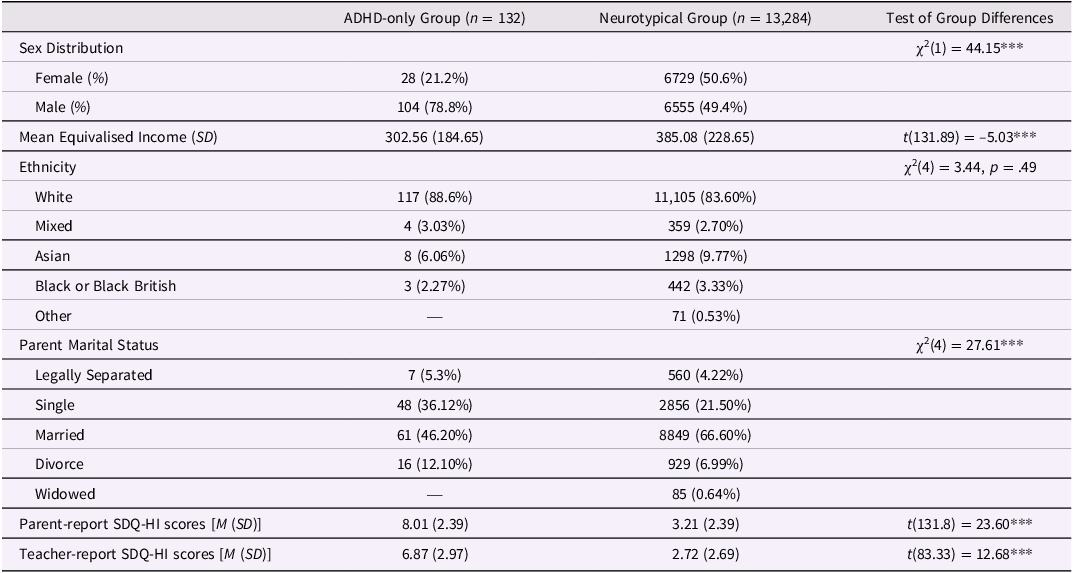
The study used data from Waves 4 (mean age = 6.83, SD = 0.39), 5 (mean age = 10.67, SD = 0.48), and 6 (mean age = 13.79, SD = 0.44) of the MCS. Participants were categorized into two groups based on caregiver-reported diagnoses in Wave 4: the ADHD-only group (n = 132) and the neurotypical group (n = 13,284) in Wave 4. In the MCS, no formal exclusion criteria were applied regarding intellectual disabilities or genetic syndromes. Unweighted demographic information for both groups is provided in Table 1.
Unweighted demographic information by ADHD diagnosis
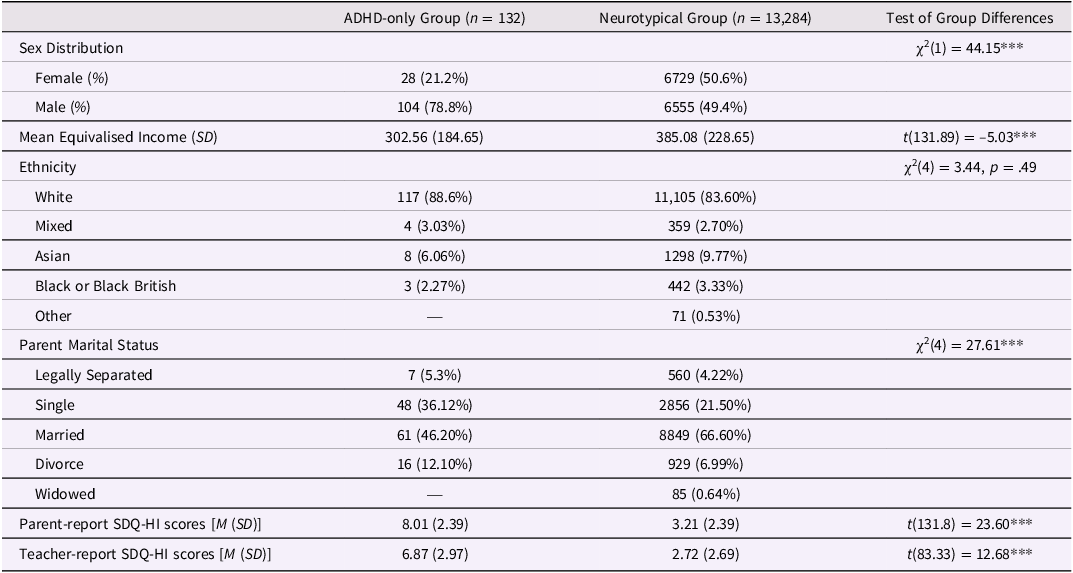
Note. SD = standard deviation; M = mean; SDQ-HI = SDQ hyperactivity/Inattention subscale.
***p < .001.
Measures
ADHD diagnosis
ADHD diagnosis was determined based on caregiver reports collected during Waves 4, 5, and 6, with Wave 4 diagnostic data used to define groups in this study’s initial analysis. The main carer was asked during face-to-face interviews in each participant’s home by trained interviewers, with the questions being read verbatim: “Has a doctor or health professional ever told you that [Cohort Member (CM)] had Attention-Deficit/Hyperactivity Disorder (ADHD)?” Responses of “yes” were used to classify children into the ADHD group.
Before the publication of the Diagnostic Statistical Manual of Mental Disorders 5th edition (DSM-5) in 2013, dual diagnosis of ADHD and autism spectrum disorder was not permitted, despite evidence of co-occurrence (Ramtekkar, Reference Ramtekkar2017). Therefore, in this study, children with ADHD who were also reported to have a diagnosis of autism were excluded from the ADHD-only group. Caregivers were asked the following question during the same interview: “Has a doctor or health professional ever told you that [CM] had Autism, Asperger’s Syndrome or other autistic spectrum disorder?” Participants were classified into the ADHD-only group if their main caregivers reported “yes” to the ADHD diagnostic question and simultaneously reported “no” to the autism diagnostic question at Wave 4. The neurotypical group comprised participants whose caregivers reported “no” to both ADHD and autism diagnostic questions in Wave 4, and who did not receive a new ADHD diagnosis at Waves 5 or 6.
To validate the caregiver-reported ADHD classification, both parent- and teacher-reported SDQ Hyperactivity/Inattention (SDQ-HI) subscales were used. Children were classified as clinical or subclinical based on the borderline cut-off score ( = 6; R. Goodman, Reference Goodman1997; Grasso et al., Reference Grasso, Lazzaro, Demaria, Menghini and Vicari2022). Parent-reported SDQ-HI scores showed strong agreement with the caregiver-reported ADHD diagnosis (89.25% agreement; φ = .22, p < .001), and teacher-reported scores showed a similar pattern (88.43% agreement; φ = .15, p < .001), though with higher levels of missing data (36%). Children in the ADHD-only group had significantly higher SDQ-HI scores than neurotypical children across both informants (ps < .001; see Table 1).
Emotional symptoms
The Emotional Symptoms subscale of the parent-reported Strengths and Difficulties Questionnaire (SDQ-E; R. Goodman, Reference Goodman1997) was used to assess emotional (internalizing) symptoms of participants at ages 7, 11, and 14 years old (Waves 4, 5, and 6). The SDQ-E includes five items, referring to “often complaining of headaches, stomach aches, or sickness,” “having many worries,” “being often unhappy, down-hearted, or tearful,” “being nervous or clingy in new situations,” and “having many fears, being easily scared.” Items were rated by the main caregiver on a 3-point Likert scale (0 = Not true, 1 = Somewhat true, and 2 = Certainly true). A response option of “can”t say” or “not applicable” was also available to the participant’s main caregiver; these responses were treated as missing data in this study. Total scores ranged from 0 to 10, with higher scores indicating higher levels of emotional symptoms in children. A score of 5 or above is considered the clinical threshold in the UK child and adolescent samples (R. Goodman, Reference Goodman1997).
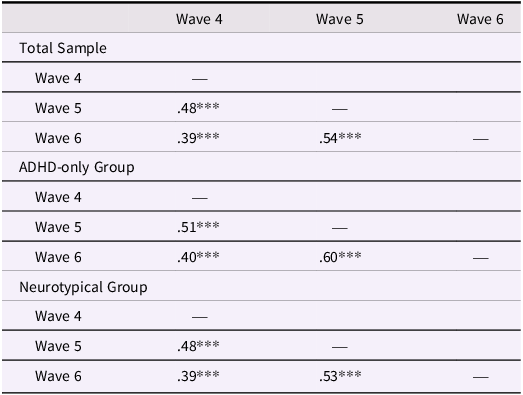
The Strengths and Difficulties Questionnaire (SDQ; R. Goodman, Reference Goodman1997) is a widely used screening tool for assessing child and adolescent mental health. It has demonstrated acceptable psychometric properties – including internal consistency and construct validity – across a range of populations and age groups (see Kersten et al., Reference Kersten, Czuba, McPherson, Dudley, Elder, Tauroa and Vandal2016 for a review), including in the present MCS sample (A. Murray et al., Reference Murray, Speyer, Hall, Valdebenito and Hughes2021; A. L. Murray et al., Reference Murray, Speyer, Hall, Valdebenito and Hughes2022). In this study, internal consistency for the SDQ-E was acceptable (Janssens et al., Reference Janssens, Wijnen, De Pelsmacker and Van Kenhive2008; Tavakol & Dennick, Reference Tavakol and Dennick2011) across waves (Cronbach’s α = .65 at age 7, .71 at age 11, and .72 at age 14). Construct validity was supported by moderate-to-strong correlations of SDQ-E scores across time points for the full sample (r = .39 – .54), as well as within the ADHD (r = .40 – .60) and neurotypical (r = .39 – .53) subgroups (see Table 2). All correlations were statistically significant at p < .001.
Correlations between SDQ-emotional symptoms (SDQ-E) scores across waves 4, 5, and 6 for the total sample, ADHD group, and neurotypical group
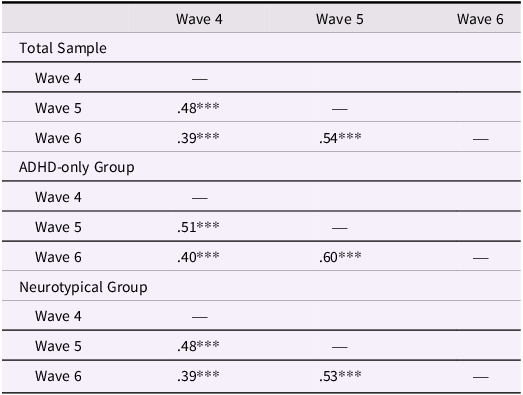
Note. ***p < .001.
Using data from the MCS, prior research has demonstrated measurement invariance of the full SDQ scale across both time and sex, particularly for children aged 5 to 14 years (A. L. Murray et al., Reference Murray, Speyer, Hall, Valdebenito and Hughes2022). These findings support its use for assessing developmental trajectories and between-group differences in mental health in large-scale longitudinal datasets. The present study focused on the five-item Emotional Symptoms subscale (SDQ-E). Confirmatory factor analysis was conducted in Mplus 8.3 (Muthén & Muthén, Reference Muthén and Muthén2017) to test measurement invariance of the SDQ-E across time and sex, using the weighted least squares means and variances adjusted estimator and incorporating complex sampling weights from Wave 6. Configural and metric invariance were supported across both dimensions. Partial scalar invariance was also established across sex and time, guided by modification indices and expected parameter change values. For sex invariance, partial scalar invariance was supported at ages 7, 11, and 14 after freeing the intercept of the item “often complains of headaches/sickness” at each wave (see Supplementary Tables S1 and S2). For longitudinal invariance from ages 7 to 14, partial scalar invariance was supported after releasing intercept constraints on several items (see Supplementary Table S3). Therefore, the parent-reported SDQ-E can be used to estimate developmental trajectories of emotional symptoms and associated sex differences from ages 7 to 14 using latent growth model. Full model fit indices are reported in Supplementary Tables S1–S3.
Data analysis
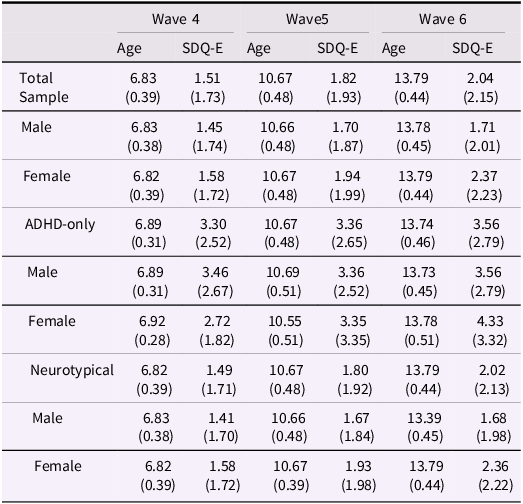
This study employed latent growth curve modeling (LGCM) to explore the association between ADHD and emotional symptoms, as well as how emotional symptoms change from ages 7 to 14. Table 3 displays the emotional symptoms scores for each group across all three waves. Little’s test for missing completely at random (MCAR; Little, Reference Little1988) was significant (p < .05), indicating that the data from the MCS used in this study were not MCAR.
Weighted mean and standard deviations on emotional symptoms scores
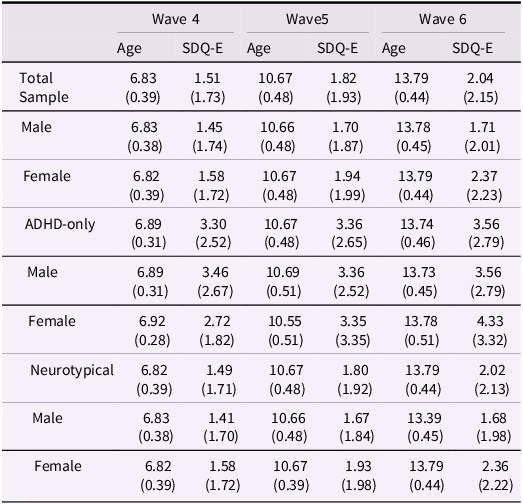
Note. SDQ-E = Emotional Symptoms subscale of the parent-reported Strengths and Difficulties Questionnaire (R. Goodman, Reference Goodman1997).
To handle the missing data across all waves, Maximum Likelihood with Missing Values (MLMV; Baker, Reference Baker2019) estimation was applied. MLMV was selected because it maximizes the use of available data to provide more accurate and unbiased estimates (Bartolucci & Scrucca, Reference Bartolucci and Scrucca2010), enhances statistical power, and ensures more robust estimates. All models were fit in Mplus 8.3 (Muthén & Muthén, Reference Muthén and Muthén2017) using robust maximum likelihood estimation (MLR), with adjustments for the complex survey design of the MCS. This approach, also referred to as pseudo-maximum likelihood estimation (pseudo-ML; Asparouhov, Reference Asparouhov2005), incorporates sampling weights, stratification, and clustering into the estimation process, ensuring unbiased parameter estimates and accurate standard errors when data are missing at random (MAR).
Model fit was evaluated using root mean square error approximation (RMSEA), comparative fit index (CFI), and Tucker Lewis Index (TLI). Values of CFI and TLI greater than or equal to .90, and ideally greater than or equal to .95, were considered indicative of an acceptable model fit (Bentler & Bonett, Reference Bentler and Bonett1980; Bentler, Reference Bentler1990). RMSEA values of .08 or lower, and preferably .06 or lower, were deemed indicative of a good fit (Hu & Bentler, Reference Hu and Bentler1999).
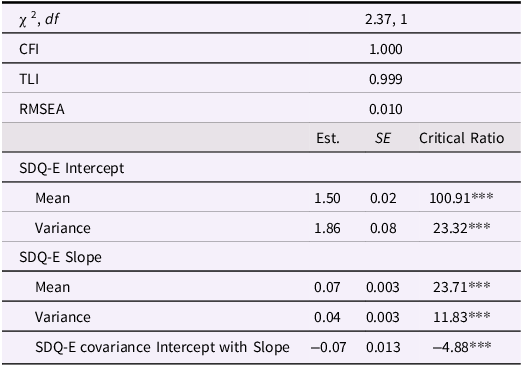
The first step involved fitting an unconditional latent growth curve model (LGCM), which did not include any predictors, to estimate the overall trajectory of emotional symptoms from ages 7 to 14. This model estimated the intercept (i.e., level of emotional symptoms at age 7) and the slope (i.e., rate of change) of emotional symptoms from ages 7 to 14 for the entire sample. The unconditional model showed excellent fit to the data, with χ2(1) = 2.37, p = .12, CFI = 1.000, TLI = 0.999, and RMSEA = 0.010 (see Table 4). The good fit of the unconditional model provides confidence that the basic developmental trajectory of emotional symptoms was captured well, forming a solid basis for subsequent analyses.
Model fit indices and unstandardized parameter estimates for the unconditional model
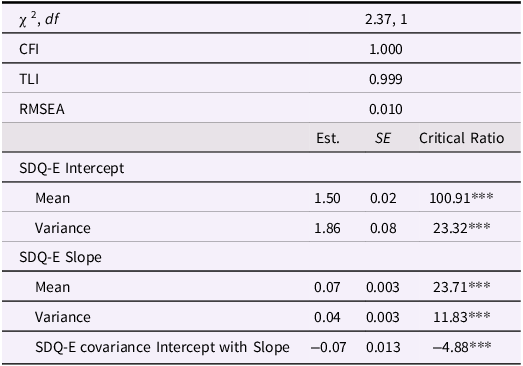
Note. CFI = Comparative Fit Indes; TLI = Tucker Lewis Index; RMSEA = Root Mean Square Error of Approximation; Est. = unstandardized model estimate; SE = standard error of estimated parameter; Critical Ratio = estimate divided by standard error.
*** p < .001.
To examine whether ADHD diagnosis predicted initial emotional symptoms and their change over time, a conditional LGCM was estimated. ADHD diagnosis at age 7 was included as a predictor to examine its influence on both the intercept and slope of emotional symptoms over time. This means that this study examined the prediction from ADHD diagnosis (at age 7) to emotional symptoms by simultaneously regressing the intercept and slope of emotional symptoms on ADHD diagnosis. In a subsequent model, sex was then included as an additional predictor in the model to investigate whether sex differences accounted for the variations in emotional symptoms between the ADHD-only group and the Neurotypical group. In this model, the intercept and slope were simultaneously regressed on the interaction between ADHD and sex. In all conditional models, the intercepts, slopes, variances, and intercept–slope covariances were freely estimated.
Multiple-group LGCMs were then fitted for descriptive purposes to explore group differences. In these configural models, intercepts, slopes, variances, and intercept-slope covariances were also all freely estimated across groups to allow group-specific trajectories. First, a two-group model was estimated comparing children with ADHD and neurotypical children. Figure 1 illustrates the developmental trajectories of emotional symptoms for each group across the three waves. A four-group configural model was then estimated, categorizing participants by ADHD diagnosis and sex (i.e., boys with ADHD, girls with ADHD, Neurotypical boys, and Neurotypical girls). To examine whether developmental trajectories were equivalent across groups, follow-up invariance tests were conducted by constraining the intercept and slope means and variances to be equal across groups. Specifically, equality constraints were imposed on the intercept and slope means and variances in both the two-group model (ADHD vs. neurotypical) and the four-group model (boys with ADHD vs. girls with ADHD vs. neurotypical boys vs. neurotypical girls). Model fit was compared between the constrained and unconstrained models using ΔCFI and ΔRMSEA, with thresholds of ΔCFI < .01 and ΔRMSEA < .015 indicating support for invariance (Chen, Reference Chen2007).
Estimated means from the multiple group model (ADHD diagnosis).

To further clarify the association between ADHD and emotional symptoms, and evaluate the robustness of the model, this study performed two sensitivity analyses. The first focused on diagnostic stability. Participants who lost their ADHD diagnosis at later waves (Waves 5 or 6) or received a new autism diagnosis were excluded. This approach aimed to reduce sample noise and improve diagnostic consistency across groups. The second sensitivity analysis considered emotional symptom trajectories in children who were not diagnosed with ADHD at age 7 but received a diagnosis in Wave 5 or 6, hereafter referred to as the later-diagnosed ADHD group. In this sensitivity analysis, included early diagnosed ADHD (Wave 4), late diagnosed ADHD (Wave 5 or 6), and neurotypical children within the same model, with age of diagnosis treated as a grouping variable. This analysis aimed to explore potential differences in emotional symptom trajectories between children diagnosed with ADHD at later stages and those diagnosed earlier.
All models were checked for convergence using Mplus’s TECH1 and TECH4 outputs. Convergence was confirmed by normal termination, acceptable condition numbers, and the absence of estimation warnings (Muthén & Muthén, Reference Muthén and Muthén2017). Where convergence issues occurred, selected parameters (e.g., residual variances) were constrained to achieve model stability.
Results
The mean scores of emotional symptoms in both the ADHD-only group and the Neurotypical group consistently remained below the recommended clinical cut-off (≥ 5; R. Goodman, Reference Goodman1997; Grasso et al., Reference Grasso, Lazzaro, Demaria, Menghini and Vicari2022) across all three waves (See Table 3). The average proportion of children exceeding the clinical threshold for the SDQ-E across all waves was 31.06% in the ADHD group, and 6.54% in the neurotypical group, a difference that was statistically significant (χ2(1) = 120.42, p < .001).
The model fitting indices and parameter estimates for the unconditional model are presented in Table 4. The significant and positive slope factor indicated that the severity of emotional symptoms increased linearly from age 7 to 14 (p < .001). Both the intercept and slope estimates were significantly different from zero (p < .001), and the variances of these estimates were also statistically significant (p < .001). The significant variances suggest considerable individual differences in the initial levels (levels of emotional symptoms at age 7) and the trajectories of emotional symptoms from ages 7 to 14, justifying the examination of potential predictors for both intercept and slope.
Emotional symptoms in children with and without ADHD
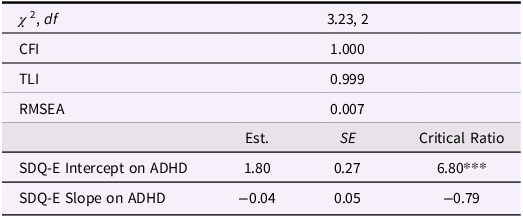
To examine the predictive effect of ADHD diagnosis on emotional symptoms, a single-group model was estimated, and the intercept and slope of emotional symptoms were simultaneously regressed on ADHD diagnosis at age 7. The model fit indices, parameter estimates, and standard errors for this analysis are provided in Table 5, where ADHD diagnosis at age 7 was entered as a predictor variable. This model demonstrated an acceptable fit to the data (χ2(2) = 3.23, p = .20, CFI = 1.000, TLI = 0.999, RMSEA = 0.010). According to the outputs in Table 5, ADHD diagnosis at age 7 significantly predicted the emotional symptoms intercept (p < .001), indicating that children with ADHD had higher initial levels of emotional symptoms than neurotypical children. However, ADHD diagnosis did not significantly predict the slope in emotional symptoms from ages 7 to 14 (p = .43), suggesting that while children with ADHD showed higher emotional symptoms level at age 7, their slope from ages 7 to 14 was not significantly different from their neurotypical peers.
Model fit indices, unstandardized parameter estimates, and standard errors for a conditional growth model with ADHD diagnosis predicting intercept and slope of emotional symptoms
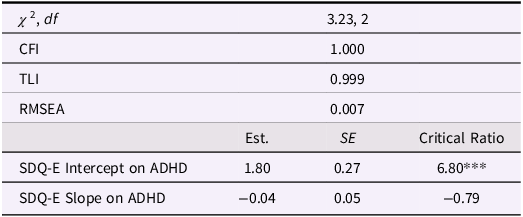
Note. CFI = Comparative Fit Index; TLI = Tucker Lewis Index; RMSEA = Root Mean Square Error of Approximation; Est. = unstandardized model estimate; SE = standard error of estimated parameter; Critical Ratio = estimate divided by standard error.
*** p < .001.
To further examine group differences in emotional symptoms trajectories, a multiple-group model was fit, where intercepts and slopes were estimated separately for the ADHD-only group and the Neurotypical group. Figure 1 displays the estimated emotional symptoms trajectories for the ADHD-only and the Neurotypical groups. The unconstrained model showed acceptable fit (χ2(2) = 4.68, p = .10; CFI = 0.999; TLI = 0.998; RMSEA = 0.014). By running the multiple-group model, the results showed that children with ADHD-only had no significant increase in the level of emotional symptoms from 7 to 14 years of age (estimate = 0.04, SE = 0.05; p > .05); while the level of emotional symptoms increased significantly in neurotypical children (estimate = 0.07, SE = 0.004, p < .001). To formally test whether these developmental trajectories differed across groups, a constrained model equating intercepts, slopes, and variances was estimated. This model demonstrated significantly worse fit than the unconstrained model (ΔCFI = .016 > .010, ΔRMSEA = .034 > .015; Chen, Reference Chen2007), indicating meaningful group differences in both initial levels and rates of change in emotional symptoms.
To empirically assess whether differences existed in the levels of emotional symptoms at each age between children with different diagnoses, separate models were estimated by recentring the data at ages 7, 11, and 14. This approach first involved shifting the intercept parameter to each respective age, enabling a direct comparison of emotional symptom levels at each age. Subsequently, the intercept (i.e., levels of emotional symptoms at ages 7, 11, and 14 respectively) and slope of emotional symptoms were simultaneously regressed on ADHD diagnosis at age 7. In these models, ADHD diagnosis significantly predicted the emotional symptoms intercept (p < .001) and did not significantly predict the slope of emotional symptoms (p > .05). This predictive effects on the intercepts indicated that children with ADHD-only demonstrated consistently higher levels of emotional symptoms from ages 7 to 14 compared to neurotypical children and young people. However, the size of the coefficient for the prediction effect on slope still demonstrated that the level of emotional symptoms increased at a similar rate in the two groups.
Sex differences in emotional symptoms in children with and without ADHD
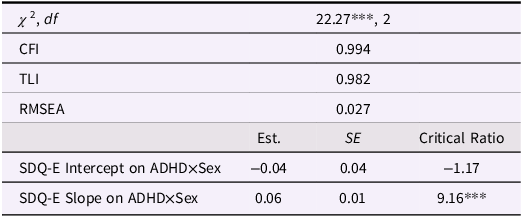
To investigate sex differences in emotional symptoms among children with and without ADHD diagnosis, sex was added as an additional predictor in the LGCM. The intercept and slope of emotional symptoms were simultaneously regressed on ADHD, sex and their interaction. Results are summarized in Table 6, including model fit indices and parameter estimates. This model provided an acceptable fit to the data (χ2(2) = 22.27, p < .001, CFI = 0.994, TLI = 0.982, RMSEA = 0.027). The interaction between sex and ADHD diagnosis at age 7 did not significantly predict the emotional symptoms intercept (p > .05; see Table 6), indicating that there were no significant differences in emotional symptom levels at age 7 between male and female children with or without ADHD. However, the interaction significantly predicted the slope of emotional symptoms (p < .001), suggesting that the effect of sex on the slope in emotional symptoms from ages 7 to 14 differed significantly by the ADHD diagnostic group.
Model fit indices and unstandardized parameter estimates for the interaction between ADHD diagnosis and sex in predicting emotional symptoms
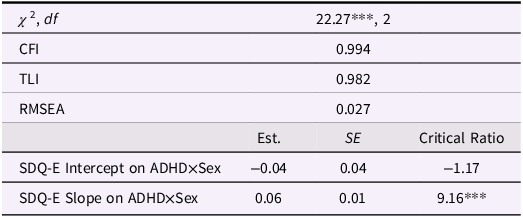
Note. CFI = Comparative Fit Index; TLI = Tucker Lewis Index; RMSEA = Root Mean Square Error of Approximation; Est. = unstandardized model estimate; SE = standard error of estimated parameter; Critical Ratio = estimate divided by standard error.
*** p < .001.
To further examine the developmental trajectories of emotional symptoms among boys and girls with and without ADHD, a multiple-group model was conducted. Figure 2 shows the estimated trajectories of emotional symptoms for boys with ADHD, girls with ADHD, neurotypical boys, and neurotypical girls. The configural model fit was acceptable (χ2(4) = 32.20, p < .001; CFI = 0.993; TLI = 0.978; RMSEA = 0.046). The results from the multiple-group analysis suggested that, at age 7, boys with ADHD had slightly higher levels of emotional symptoms compared to girls with ADHD; however, this difference was not statistically significant (Δ estimate = 0.76, SE = 0.45, p > .05). Boys with ADHD, however, had a significantly higher level of emotional symptoms at age 7 compared to neurotypical boys (Δ estimate = 2.04, SE = 0.32, p < .001). Girls with ADHD also showed a significantly higher level of emotional symptoms at age 7 compared to neurotypical girls (Δ estimate = 1.17, SE = 0.35, p = .001). Similarly, constraining the four-group model resulted in substantially poorer fit (ΔCFI = .076 > .010, ΔRMSEA = .053 > .015; Chen, Reference Chen2007), suggesting that trajectories differed across diagnostic and sex-defined subgroups.
Estimated means of SDQ-E from the multiple group model (ADHD diagnosis×sex).
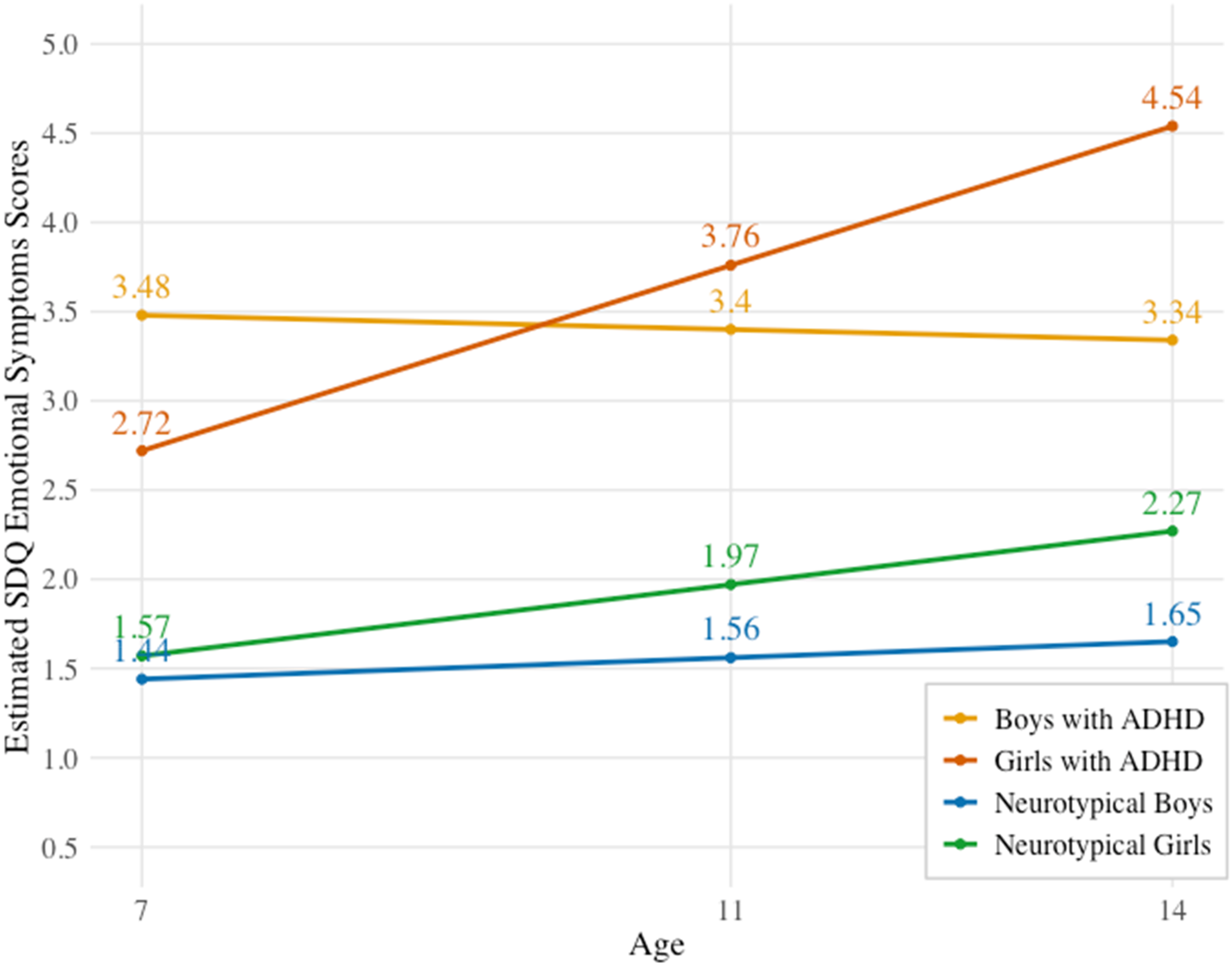
To compare emotional symptom levels at different ages, the intercept parameter was shifted to each respective age (i.e., from age 7 to ages 11 and 14). The results indicated that although girls with ADHD had slightly higher emotional symptoms than boys with ADHD at ages 11 and 14, there were no significant differences between the emotional symptom levels of boys and girls with ADHD at ages 7, 11, and 14 (p > .05). Boys with ADHD had significantly higher emotional symptom levels than neurotypical boys at all three ages (p < .001). Similarly, girls with ADHD had significantly higher emotional symptom levels than neurotypical girls at ages 7, 11, and 14 (p < .05). From ages 7 to 14, emotional symptoms in boys with ADHD did not show a significant change over time (estimate = –0.02, SE = 0.05, p > .05). In contrast, girls with ADHD showed a significant increase in emotional symptoms from ages 7 to 14 (estimate = 0.26, SE = 0.11, p < .05). Girls with ADHD showed a significantly faster increase in emotional symptoms between ages 7 and 14 compared to boys with ADHD (Δ estimate = –0.28, SE = 0.12, p < .05), indicating that sex may be an important factor in the developmental trajectories of emotional symptoms in this population.
Sensitivity analyses
The first sensitivity analysis excluded participants who either lost their ADHD diagnosis at later waves (Waves 5 and/or 6) or received a new diagnosis of autism at later waves. A configural multigroup LGCM was then conducted on the remaining sample (n[ADHD-only] = 106; n[neurotypical] = 13,052). The model reported good fit indices (CFI = 1.000, TLI = 1.000, RMSEA = 0.004), consistent with the main analysis. The trends reported by the model for the ADHD and NT groups were also consistent with the main analysis.
The second sensitivity analysis examined whether emotional symptom trajectories differed between early- and later-diagnosed ADHD groups. A multiple-group LGCM was fitted including three groups: early-diagnosed ADHD, later-diagnosed ADHD, and neurotypical children. Age of diagnosis was used as a grouping variable. The model showed poor fit (CFI = 0.000, TLI = –155.36, RMSEA = 0.674), limiting the interpretability of parameter estimates. These results suggest that differences between early- and later-diagnosed ADHD children may introduce heterogeneity that is difficult to capture within the current model structure. Due to sample size, this study was unable to examine the role of sex or its interaction with age of diagnosis.
Discussion
This study examined the developmental trajectories of emotional symptoms in children with ADHD from middle childhood to early adolescence, with a particular focus on sex differences, using longitudinal data from the MCS. The findings show that children with ADHD consistently had higher levels of emotional symptoms compared to neurotypical children across middle childhood to early adolescence. The study findings also show that girls with ADHD demonstrated a greater increase in emotional symptoms over time during the transition to adolescence than boys with ADHD. By focusing on children who were diagnosed during middle childhood, this study contributes longitudinal evidence on emotional symptoms trajectories in this population. It addresses existing gaps in knowledge by examining early childhood and exploring sex-specific developmental patterns. The findings offer a deeper understanding of the developmental patterns of emotional symptoms in children with early-diagnosed ADHD, highlighting the broader implications for emotional well-being throughout childhood and adolescence in this population. The findings also highlight the importance of sex in shaping developmental trajectories of emotional symptoms.
This study found that children with ADHD showed significantly higher levels of emotional symptoms at ages 7, 11, and 14 compared to neurotypical children, consistent with predictions. This finding aligns with previous longitudinal studies indicating that adolescents diagnosed with ADHD in childhood experience higher levels of emotional symptoms compared to neurotypical peers during adolescence (e.g., Mlodnicka et al., Reference Mlodnicka, Mansolf, Chandran, Aris, Calub, Ahmad, Shapiro, Cochran, Restrepo, Schmidt, Hertz-Picciotto, Bennett, Gold, O’Shea, Leve and Schweitzer2024; Norén et al., Reference Norén Selinus, Molero, Lichtenstein, Anckarsäter, Lundström, Bottai and Hellner Gumpert2016). This study builds upon existing literature by tracking young people with ADHD from middle childhood, demonstrating that higher levels of emotional symptoms emerge as early as middle childhood and persist throughout middle childhood and early adolescence in those with ADHD.
The early emergence and persistence of emotional symptoms in children with ADHD may be explained by the stress-exposure model (Nolen-Hoeksema & Girgus, Reference Nolen-Hoeksema and Girgus1994). Originally developed and validated in neurotypical children and adolescents, this model posits that prolonged exposure to stressors – such as peer and family relationship difficulties, and academic challenges – can exacerbate emotional symptoms (Liu & Alloy, Reference Liu and Alloy2010; Rackoff & Newman, Reference Rackoff and Newman2020; Tsai et al., Reference Tsai, Jaeggi, Eccles, Atherton and Robins2020). Although not explicitly tested in the current study, the model is relevant to children with ADHD, who are known to experience these stressors more frequently and at an earlier age (around age 7) than their neurotypical peers (Efron et al., Reference Efron, Sciberras, Anderson, Hazell, Ukoumunne, Jongeling, Schilpzand, Bisset and Nicholson2014; Kanevski et al., Reference Kanevski, Booth, Stewart and Rhodes2024; Ragnarsdottir et al., Reference Ragnarsdottir, Hannesdottir, Halldorsson and Njardvik2018; S. Rhodes et al., Reference Rhodes, Booth, McDougal, Oldridge, Rivera-Lares, Revueltas Roux and Stewart2024). These early and persistent stressors likely contribute to elevated levels of emotional symptoms observed in middle childhood. Another explanation is that children with ADHD experience cognitive-affective vulnerabilities earlier and more intensely than their neurotypical peers, including difficulties in inhibitory control, working memory (Christoforou et al., Reference Christoforou, Jones, White and Charman2023; Kofler et al., Reference Kofler, Spiegel, Soto, Irwin, Wells and Austin2019; S. M. Rhodes et al., Reference Rhodes, Park, Seth and Coghill2012), and emotion regulation (Graziano & Garcia, Reference Graziano and Garcia2016; Shaw et al., Reference Shaw, Stringaris, Nigg and Leibenluft2014). According to the Cognitive-Affective Developmental Model, these difficulties may increase a tendency to focus more on negative or distressing stimuli and ultimately contribute to the earlier onset and sustained elevation of emotional symptoms over time (Cole et al., Reference Cole, Zapp, Fettig and Pérez-Edgar2016; Segal & Gobin, Reference Segal and Gobin2022). Future research would benefit from testing the stress-exposure and cognitive-affective developmental models in children and adolescents with ADHD to better understand the mechanisms underlying emotional symptom trajectories.
Upon examining developmental trajectories in detail, evidence suggests that although children with ADHD maintained higher levels of emotional symptoms, these levels did not significantly increase over time, and their rate of change was comparable to that of neurotypical children. This trend is similar to findings by Karalunas et al. (Reference Karalunas, Antovich, Miller and Nigg2023), who reported consistently high, rather than increasing, trajectories of anxiety and depression in children with ADHD from ages 7 to 14. While Karalunas et al. (Reference Karalunas, Antovich, Miller and Nigg2023) focused on specific anxiety and depression measures, this study used the SDQ to measure emotional symptoms. Early non-specific emotional symptoms, such as headaches or feeling downhearted, can predict later changes in emotional health (Malhi et al., Reference Malhi, Coulston, Fritz, Lampe, Bargh, Ablett, Lyndon, Sapsford, Theodoros, Woolfall, Van Der Zypp, Hopwood and Mitchell2014; Matalon et al., Reference Matalon, Kotliroff, Blumberg, Yaphe and Kitai2011). Recognizing these early signs in children with ADHD could help earlier monitoring and identify those at greater risk for developing more severe emotional difficulties over time. However, these findings should be interpreted with caution given the sample size imbalance. The sample size of the ADHD group (n = 132) was smaller than the neurotypical group (n = 13,284), and the standard error for the slope estimate in the ADHD group (SE = 0.05) was markedly larger than that in the neurotypical group (SE = 0.004).
Beyond examining the overall developmental patterns of emotional symptoms in children with ADHD, this study also investigated sex differences in these trajectories. Contrary to the hypothesis, there were no significant differences in emotional symptom levels between girls and boys with ADHD at ages 7, 11, and 14. One possible explanation is the small number of girls with ADHD in the sample (n = 28), which may have limited statistical power and reduced estimate precision. The underrepresentation may reflect broader diagnostic biases. Females with ADHD are more likely to present with internalizing symptoms (e.g., anxiety, depression) and emotional dysregulation, which often emerge earlier and more prominently than externalizing and disruptive behaviors (Hinshaw et al., Reference Hinshaw, Nguyen, O’Grady and Rosenthal2022; Quinn & Madhoo, Reference Quinn and Madhoo2014). However, current clinical and social care systems are primarily designed to identify ADHD when overt externalizing symptoms – more common in boys – are present (Young et al., Reference Young, Adamo, Ásgeirsdóttir, Branney, Beckett, Colley, Cubbin, Deeley, Farrag, Gudjonsson, Hill, Hollingdale, Kilic, Lloyd, Mason, Paliokosta, Perecherla, Sedgwick, Skirrow and Woodhouse2020). Because ADHD symptoms in females often deviate from stereotypical expectations, they may be more likely to be initially diagnosed with internalizing conditions or personality disorders rather than ADHD (Mowlem et al., Reference Mowlem, Agnew-Blais, Taylor and Asherson2019; Quinn & Madhoo, Reference Quinn and Madhoo2014; Young et al., Reference Young, Adamo, Ásgeirsdóttir, Branney, Beckett, Colley, Cubbin, Deeley, Farrag, Gudjonsson, Hill, Hollingdale, Kilic, Lloyd, Mason, Paliokosta, Perecherla, Sedgwick, Skirrow and Woodhouse2020). This diagnostic bias may have influenced the present sample, particularly by underrepresenting girls with ADHD who primarily show internalizing symptoms. Measurement invariance findings suggest that boys and girls may interpret or respond to certain SDQ-E items differently (e.g., somatic complaints), particularly in terms of item thresholds. These potential sex-related differences in item functioning, together with the small number of girls with ADHD, indicate that the current findings regarding sex differences in emotional symptoms would benefit from replication in future research with larger, more representative samples of girls with ADHD.
A more detailed analysis of emotional symptom trajectories by sex indicated that girls with ADHD showed a significant increase in emotional symptoms over time, whereas boys with ADHD maintained stable levels of emotional symptoms during middle childhood to early adolescence. These findings align with previous evidence suggesting that, among adolescents affected by ADHD symptoms, females tend to show high and increasing trajectories of internalizing symptoms from ages 10 to 15, while males tend to maintain consistently high but stable levels throughout this period (A. L. Murray et al., Reference Murray, Ushakova, Speyer, Brown, Auyeung and Zhu2022). This study extends previous research by tracking emotional symptom trajectories in boys and girls with ADHD from middle childhood, highlighting the importance of monitoring and support before adolescence.
The observed increase in emotional symptoms among girls with ADHD from childhood to adolescence may be influenced by the onset of puberty, which brings both biological and social changes (Forbes & Dahl, Reference Forbes and Dahl2010). Females are more susceptible to fluctuations in sex hormones (particularly estrogen) during puberty than males, which can influence emotion regulation systems in the brain and heighten the risk of developing emotional symptoms (Galvao et al., Reference Galvao, Silva, Zimmermann, Souza, Martins and Pereira2014; Steiner, Reference Steiner2003). The stress exposure model also provides a socio-environmental perspective for understanding these sex differences (Liu & Alloy, Reference Liu and Alloy2010; Nolen-Hoeksema & Girgus, Reference Nolen-Hoeksema and Girgus1994). Females receive ADHD diagnosis and support later than males, often after developing severe internalizing or hyperactivity-related symptoms, which may delay access to necessary support and interventions (Quinn & Madhoo, Reference Quinn and Madhoo2014; Young et al., Reference Young, Adamo, Ásgeirsdóttir, Branney, Beckett, Colley, Cubbin, Deeley, Farrag, Gudjonsson, Hill, Hollingdale, Kilic, Lloyd, Mason, Paliokosta, Perecherla, Sedgwick, Skirrow and Woodhouse2020). Later diagnosis and challenges in accessing support may expose females with ADHD to greater stressors, such as peer relationship difficulties, family conflict, and academic challenges, increasing their vulnerability to internalizing symptoms (Attoe & Climie, Reference Attoe and Climie2023; Young et al., Reference Young, Adamo, Ásgeirsdóttir, Branney, Beckett, Colley, Cubbin, Deeley, Farrag, Gudjonsson, Hill, Hollingdale, Kilic, Lloyd, Mason, Paliokosta, Perecherla, Sedgwick, Skirrow and Woodhouse2020). Given the elevated emotional symptoms in both boys and girls with ADHD compared to their neurotypical peers, along with the significant increase observed in girls with ADHD during middle childhood to early adolescence, early interventions such as school-based programs (Paulus et al., Reference Paulus, Ohmann and Popow2016) and cognitive-behavioral therapy (CBT) (Coelho et al., Reference Coelho, Barbosa, Rizzutti, Bueno and Miranda2018; Sciberras et al., Reference Sciberras, Mulraney, Anderson, Rapee, Nicholson, Efron, Lee, Markopoulos and Hiscock2018) may help provide tailored support for their distinct developmental needs.
To check the robustness of the main findings (Thabane et al., Reference Thabane, Mbuagbaw, Zhang, Samaan, Marcucci, Ye, Thabane, Giangregorio, Dennis, Kosa, Debono, Dillenburg, Fruci, Bawor, Lee, Wells and Goldsmith2013), two sensitivity analyses were conducted. The first analysis confirmed that excluding children whose diagnosis changed did not alter the trajectories of emotional symptoms, supporting the stability and validity of the results. The second analysis, which included children diagnosed with ADHD later, showed poor model fit, suggesting that differences between later- and early-diagnosed children may introduce variability that is difficult to capture within the current model. For example, children diagnosed at later stages may benefit from early compensatory support at home or in school, which can temporarily mitigate the expression of ADHD symptoms (A. L. Murray et al., Reference Murray, Booth, Auyeung, Eisner, Ribeaud and Obsuth2020), leading to lower levels of emotional symptoms in childhood (Meinzer & Chronis-Tuscano, Reference Meinzer and Chronis-Tuscano2017; Pojanapotha et al., Reference Pojanapotha, Boonnag, Siritikul, Chalanunt, Kuntawong, Wongpakaran and Wongpakaran2021). As they transition into adolescence, the increasing expectation for independence may lead to a decrease in available support or a reluctance to seek help, ultimately contributing to a rise in levels of emotional symptoms during adolescence (Radez et al., Reference Radez, Reardon, Creswell, Orchard and Waite2022). These differences suggest that the trajectory identified in the main analysis may not be generalizable to all children with ADHD, particularly those diagnosed later. Future research would benefit from examining how the timing of diagnosis influences the course of emotional symptom development and from exploring potential interactions with sex. A more nuanced understanding of these variations could provide deeper insights into the heterogeneity of emotional development in ADHD.
Limitations and future directions
This study is the first to investigate the developmental trajectories of emotional symptoms in children with early-diagnosed ADHD, incorporating sex differences, by using a population-representative public dataset. By applying weighted analyses and conducting sensitivity analyses, the study strengthens the robustness and generalisability of the main findings. However, several limitations should be acknowledged.
Firstly, emotional symptoms were assessed solely through the parent-reported SDQ emotional symptoms scores. While the SDQ-E is a validated measure of non-specific internalizing symptoms (e.g., sadness, worry, somatic complaints), it does not cover other dimensions that are highly relevant in ADHD, such as irritability or emotional dysregulation (Astenvald et al., Reference Astenvald, Frick, Neufeld, Bolte and Isaksson2022; Kahle et al., Reference Kahle, Mukherjee, Dixon, Leibenluft, Hinshaw and Schweitzer2021). This limited content scope may have constrained the full characterization of emotional difficulties in this population. In addition, relying exclusively on parent reports may also introduce informant bias, as parents tend to overestimate symptoms (De Los Reyes & Epkins, Reference De Los Reyes and Epkins2023; Fraser et al., Reference Fraser, Cooper, Agha, Collishaw, Rice, Thapar and Eyre2018). Multi-informant approaches, incorporating teacher and/or child reports, provide a more comprehensive understanding of emotional symptoms across different contexts (De Los Reyes & Epkins, Reference De Los Reyes and Epkins2023; Huber et al., Reference Huber, Plötner, In-Albon, Stadelmann and Schmitz2019; A. L. Murray et al., Reference Murray, Booth, Ribeaud and Eisner2018). Although the MCS includes teacher-reported SDQ-E scores at ages 7 and 11 and adolescent self-reports from age 17 onward, only parent-reported data were consistently available across all three waves used in this study, covering the transition from childhood to adolescence. Future research would benefit from incorporating multi-informant approaches and using broader measures of emotional symptoms to more accurately capture the complexity and developmental changes of emotional symptoms in children with ADHD.
A limitation concerns the classification of ADHD diagnosis. In this study, diagnostic status was based on the caregiver’s report of whether the child had ever been diagnosed with ADHD by a doctor or health professional. Although linked with formal clinical diagnoses, caregivers may overlook or underreport ADHD symptoms in girls, who often present with internalizing difficulties rather than overt externalizing behaviors (Hinshaw et al., Reference Hinshaw, Nguyen, O’Grady and Rosenthal2022; Mowlem et al., Reference Mowlem, Agnew-Blais, Taylor and Asherson2019). Stigma may also reduce families’ willingness to seek clinical evaluation, contributing to underdiagnosis or delayed diagnosis (McKenna et al., Reference McKenna, Wanni Arachchige Dona, Gold, Dew and Le2024). Beyond caregiver-level factors, ADHD remains underdiagnosed in the UK more broadly (McKechnie et al., Reference McKechnie, O’Nions, Dunsmuir and Petersen2023), as long waiting lists for children needing ADHD evaluations may delay diagnoses and access to essential support (Roughan & Stafford, Reference Roughan and Stafford2019; Young et al., Reference Young, Asherson, Lloyd, Absoud, Arif, Colley, Cortese, Cubbin, Doyle, Morua, Ferreira-Lay, Gudjonsson, Ivens, Jarvis, Lewis, Mason, Newlove-Delgado, Pitts, Read and Skirrow2021). Additionally, at the time of MCS wave 4 data collection, the DSM-IV criteria were in use, which did not allow dual diagnoses of ADHD and autism (Ramtekkar, Reference Ramtekkar2017). Thus, some children with both conditions may have to be misclassified into the ADHD-only group if ADHD was identified first. Future research would benefit from using validated clinical diagnostic tools, ideally based on DSM-5 criteria, and incorporating multi-informant diagnostic data to enhance classification validity and improve the interpretability of symptom trajectories.
A further limitation is that emotional symptoms trajectories were modeled using only three time points (ages 7, 11, and 14), which restricted the ability to examine potential non-linear patterns. Emotional symptoms may not follow a simple linear trajectory in both ADHD and neurotypical populations and may instead fluctuate or intensify at critical developmental stages, such as school transitions and puberty (Cohen et al., Reference Cohen, Andrews, Davis and Rudolph2018). Although the MCS includes emotional symptom data at age 17 (Wave 7), these were collected solely via adolescent self-reports, whereas the earlier waves relied exclusively on parent reports. Introducing a new informant at the final time point would have compromised longitudinal consistency, especially given the modest agreement between parent and adolescent reports on internalizing symptoms (De Los Reyes & Kazdin, Reference De Los Reyes and Kazdin2005; Van Der Meer et al., Reference Van Der Meer, Dixon and Rose2008). Future studies incorporating additional measurement waves would enable a more precise examination of non-linear symptom trajectories and their underlying mechanisms in ADHD.
This study did not account for the potential influence of whether children with ADHD were receiving ADHD medications, which may have affected their emotional symptom trajectories. Evidence on the effects of ADHD medication on emotional symptoms of children and adolescents with ADHD are mixed: some clinical observations and empirical evidence suggest ADHD medications exacerbate internalizing symptoms in children and adolescents with ADHD (e.g., Oh et al., Reference Oh, Joung and Kim2022; Pozzi et al., Reference Pozzi, Carnovale, Mazhar, Peeters, Gentili, Nobile, Radice and Clementi2019); while other research indicates they have a protective effect by reducing levels of internalizing symptoms and associated risks (e.g., Chang et al., Reference Chang, D’Onofrio, Quinn, Lichtenstein and Larsson2016; Park et al., Reference Park, Lee, Kim, Lee, Yang, Lee, Kim, Lee, Park and Shin2022). Pubertal development was also not included in the current analyses. The onset and progression of puberty, along with associated hormonal changes, may increase the risk of internalizing symptoms, particularly among girls (Chronister et al., Reference Chronister, Gonzalez, Lopez-Paredes, Suarez-Torres, Gahagan, Martinez, Barros, Jacobs, Checkoway and Suarez-Lopez2021). Internalizing difficulties often co-occur with ADHD, and individuals with ADHD – especially girls – may be more vulnerable to emotional problems during this developmental period (Faraone et al., Reference Faraone, Bellgrove, Brikell, Cortese, Hartman, Hollis, Newcorn, Philipsen, Polanczyk, Rubia, Sibley and Buitelaar2024; Friedel et al., Reference Friedel, Vijayakumar, Staniland and Silk2025). Future research should incorporate both medication use and pubertal status to better understand their potential roles in shaping emotional development in children with and without ADHD.
Finally, this study used data collected nearly two decades ago, and it is possible that the lived experiences, diagnostic practices, and service access for youth with ADHD have evolved considerably over time. For example, in the UK, growing awareness among patients, caregivers, and professionals – as well as the refinement of diagnostic criteria – have led to improved detection and a substantial increase in the incidence and prevalence of ADHD diagnoses and prescriptions from 2000 to 2018 across all age groups (McKechnie et al., Reference McKechnie, O’Nions, Dunsmuir and Petersen2023). This time lag may therefore limit the generalisability of our findings to contemporary cohorts of children and adolescents with ADHD. In addition, the ADHD group in this study was substantially smaller than the neurotypical group, and the number of girls with ADHD was particularly limited. These imbalances may have reduced statistical power and constrained the interpretation of subgroup differences, especially sex-related effects. The MCS dataset also did not apply exclusion criteria regarding intellectual disabilities (ID) or genetic syndromes, and relevant diagnostic information was not systematically collected. Co-occurring ID may affect the accuracy of caregiver-reported ADHD diagnoses (Neece et al., Reference Neece, Baker, Crnic and Blacher2013) and children’s presentation of emotional symptoms, as children with both ADHD and ID often have greater emotional difficulties (Ahuja et al., Reference Ahuja, Martin, Langley and Thapar2013; Pearson et al., Reference Pearson, Lachar, Loveland, Santos, Faria, Azzam, Hentges and Cleveland2000). The inability to account for these co-occurring conditions may introduce bias. Future research would benefit from using more recent and representative cohorts, with larger and more diagnostically diverse ADHD samples, including more females, as well as datasets with comprehensive neurodevelopmental profiling.
Conclusion
This study contributes to the existing literature by providing evidence on the developmental trajectory of emotional symptoms in children with early-diagnosed ADHD from mid-childhood to early adolescence, with a particular focus on sex differences, and using weighted analyses to ensure results are population-representative and robust. The findings indicate that children with ADHD consistently had higher levels of emotional symptoms during this period compared to their neurotypical peers, with a significant increase observed over time in female children with ADHD. Despite some limitations, this study provides valuable longitudinal evidence on the mental health development of children with ADHD, supporting the need for timely and targeted intervention strategies, such as mindfulness-based training, cognitive-behavioral therapy (CBT), and school-based support programs that aimed at mitigating emotional symptoms. Future research should incorporate comprehensive and multi-informant assessments of emotional symptoms, and use validated diagnostic tools for ADHD to further explore these developmental patterns.
Supplementary material
The supplementary material for this article can be found at https://doi.org/10.1017/S0954579425100461.
Acknowledgments
The authors would like to express their gratitude to the MCS team for collecting and curating the dataset and for granting access to conduct this research. We also extend our thanks to the CMs and their families across the United Kingdom for their participation.
Funding statement
This research received no specific grant from any funding agency, commercial or not-for-profit sectors.
Competing interests
The author(s) declare none.
Ethical standards
Ethics approval for the MCS was obtained for each wave from an NHS Multi-Centre Research Ethics Committee, and informed consent was obtained from parents, as well as from the children themselves as they grew up (Connelly & Platt, Reference Connelly and Platt2014; Shepherd, Reference Shepherd2012). The current study has also received a favorable ethical opinion from the Edinburgh Medical School Research Ethics Committee of the University of Edinburgh.



 Open access

