




Introduction
The global rise in the population of older refugees and the implications of this demographic shift for their needs, capacities, and well-being have not received commensurate scholarly and policy attention compared to the extensive focus on children and working-age adults in forced migration contexts (Böcker & Hunter, Reference Böcker and Hunter2025). This systemic neglect contributes to exclusionary practices among policymakers, program leaders, and frontline service providers, leaving older refugees inadequately represented in social protection systems and underserved by interventions designed to enhance well-being and quality of life (Chahine & Kienzler, Reference Chahine and Kienzler2022; Ekoh, Reference Ekoh2025). Despite this relative invisibility, research in refugee and forced migration studies has begun to delineate the social, psychological, and emotional challenges facing older refugees, yielding important insights into their lived realities and structural vulnerabilities (Ekoh et al., Reference Ekoh, Iwuagwu, George and Walsh2022; Lin et al., Reference Lin, Kobayashi, Tong, Davison, Arora and Fuller-Thomson2020; Tong et al., Reference Tong, Lung, Lin, Kobayashi, Davison, Agbeyaka and Fuller-Thomson2021). Existing evidence demonstrates that aging under conditions of displacement can intensify psychological distress and undermine health-related and perceived quality of life (Anwar et al., Reference Anwar, Kurt, Yadav, Huda, Ghimire, Bhattacharjee and Mistry2025; Lin et al., Reference Lin, Kobayashi, Tong, Davison, Arora and Fuller-Thomson2020). These experiences are compounded by the intersectional disadvantages associated with age-related physiological decline (Ekoh & Okoye, Reference Ekoh and Okoye2022) and the difficulties of adjusting to unfamiliar sociopolitical, cultural, and environmental contexts, including harsh climatic conditions (Fransen et al., Reference Fransen, Werntges, Hunns, Sirenko and Comes2024; Hachem et al., Reference Hachem, Ali, Al-Omari, Abi Chahine, Fahme and Mehio Sibai2022). Consequently, older refugees frequently experience adverse outcomes, including loneliness and social isolation (Johnson et al., Reference Johnson, Bacsu, McIntosh, Jeffery and Novik2019), declines in cognitive functioning (Kitchens et al., Reference Kitchens, Kirsch and Naseh2025), and technological marginalization (Ekoh et al., Reference Ekoh, Okolie, Nnadi, Oyinlola and Walsh2023).
However, even amid these well-documented challenges, older refugees’ experiences cannot be understood solely through deficit-oriented frameworks. A growing body of knowledge underscores the presence of strengths, gains, and adaptive capacities among older adults living in displacement (Walther et al., Reference Walther, Amann, Flick, Ta, Bajbouj and Hahn2021). The selection, optimization, and compensation (SOC) model (Baltes, Reference Baltes1997) is particularly instructive here, illustrating how older adults facing adversity employ strategies to transform unfavorable circumstances into meaningful, functional, and positive outcomes. Although widely applied within gerontological research (Carpentieri et al., Reference Carpentieri, Elliott, Brett and Deary2017; Regier & Parmelee, Reference Regier and Parmelee2021), the SOC model has been underutilized in scholarship concerning forced migration, resulting in limited attention to the generative roles and contributions of older refugees (Ekoh & Walsh, Reference Ekoh and Walsh2024a, Reference Ekoh and Walsh2024b). This oversight perpetuates a narrow understanding of older refugees as passive recipients of care, obscuring the multifaceted ways they support family members, sustain social networks, and enrich their host communities.
This tendency to undervalue older refugees’ contributions is inconsistent with extensive evidence from the broader gerontological literature, which documents older adults’ meaningful involvement in civic engagement (Butler & Eckart, Reference Butler and Eckart2007), caregiving (Ezulike et al., Reference Ezulike, Lu and Chiu2025), mentorship and community education (Fried et al., Reference Fried, Carlson, Freedman, Frick, Glass, Hill and Zeger2004), and voluntary service (Huang et al., Reference Huang, Song and Feng2025). Failing to recognize that older refugees similarly engage in both tangible and intangible forms of contribution limits opportunities for functional meaning-making (Haug et al., Reference Haug, Danbolt, Kvigne and DeMarinis2016) and undermines emotion-focused coping and resilience, processes that older adults can activate even in markedly stressful conditions (Tippens et al., Reference Tippens, Erwin, Eller, Dutra Gross, Bearss, Kemp and Lakati2023). Therefore, drawing on the documented potential for meaning-making and positive adaptation in later life, we argue that older refugees of African descent in Canada (i) possess distinct pathways through which they construct meaning in their everyday lives and (ii) continue to make significant contributions to their families and communities despite real or perceived constraints associated with displacement.
Guided by this theoretical orientation, our study asks: In what ways do older African refugees in Canada contribute to the sociocultural fabrics of their communities while living in refugee circumstances? The literature on older adults’ societal contributions conceptualizes such engagement through constructs including generativity, wisdom, and family functioning (Erikson et al., Reference Erikson, Erikson and Kivnick1994; Tippens et al., Reference Tippens, Erwin, Eller, Dutra Gross, Bearss, Kemp and Lakati2023). Within African sociocultural contexts, older adults are traditionally regarded as custodians of cultural history and indigenous knowledge, caregivers and grandparents (Akinrolie et al., Reference Akinrolie, Okoh and Kalu2020), community educators, mediators, and conflict arbiters (Adamek et al., Reference Adamek, Gebremariam Kotecho, Chane and Gebeyaw2022). Hence, our study extends this body of scholarship by examining how these sociocultural roles are sustained, reconfigured, or constrained among older African refugees resettled in Canada.
Although the general gerontology literature has extensively documented the contributions of older adults across diverse societies (Carr, Reference Carr2018; Ezulike et al., Reference Ezulike, Lu and Chiu2025; Wiles & Jayasinha, Reference Wiles and Jayasinha2013), a significant gap remains regarding how these dynamics unfold for older refugees – particularly those of African descent whose experiences are further shaped by racialization, cultural displacement, and structural inequities. By grounding our inquiry within a sociocultural frame, we aim to illuminate how older African refugees understand and enact their contributions beyond dominant Western assumptions about productivity and value. Without such culturally relevant knowledge, humanitarian organizations and settlement services risk perpetuating deficit-based approaches that inadvertently reinforce the marginalization of older refugees, especially those racialized as minorities, within both scholarship and practice.
Materials and methods
Study design
This study adopted a participatory qualitative design situated within the participatory research paradigm, which conceptualizes knowledge production as a co-constructed process between researchers and participants (hereafter referred to as co-researchers) and is oriented toward transformative social change (Bush et al., Reference Bush, Singh and Kooienga2019). Informed by Ubuntu principles of reciprocity, relationality, and communal responsibility, this approach intentionally positioned older African refugees as active collaborators rather than passive research subjects (Ekoh & Warria, Reference Ekoh and Warria2023). Consistent with critiques of participatory methodologies, however, our study encountered the well-documented challenges associated with participants’ variable willingness or ability to assume leadership roles within participatory frameworks (Ward et al., Reference Ward, Schulz, Israel, Rice, Martenies and Markarian2018). For some co-researchers, hesitancy to take on directive roles may reflect educational backgrounds, or the profound disruptions to personhood and dignity commonly produced by displacement and forced migration (Khan, Reference Khan2020). We nonetheless recognize that co-researchers’ selective and self-determined forms of engagement constitute legitimate expressions of autonomy, agency, and collective decision-making within participatory research.
Although grounded in participatory principles, the study’s analytic approach is best characterized as abductive rather than strictly inductive or deductive. Our interpretations were not developed solely from the data without prior knowledge, nor were they driven by predefined hypotheses. Instead, the research process integrated iterative movement between empirical material, the researcher’s experience, and existing theoretical and empirical literature. Prior to data collection, we conducted a scoping review (Ekoh et al., Reference Ekoh, Iwuagwu, George and Walsh2022) that synthesized evidence on the challenges faced by older refugees in Western contexts, followed by a subsequent review examining the contributions of older adults in post–forced migration environments (Ekoh & Warria, Reference Ekoh and Warria2023). Together, these reviews highlighted substantial knowledge gaps, particularly the scarcity of empirical work on aging, agency, and contribution among older forcibly displaced persons, and informed the formulation of the research questions guiding this study.
Study setting
The study was conducted in Calgary, Alberta, home to a rapidly growing African population and accessible community networks that facilitated recruitment (Statistics Canada, 2021). Eleven older African refugees (aged 50 and above) participated in the 22 storytelling sessions and two focus groups. Henceforth, we refer to them as co-researchers to reflect the participatory nature of our study (Bush et al., Reference Bush, Singh and Kooienga2019) and elders to recognize their culturally grounded roles as knowledge holders within African communities. The co-researchers originated from five African countries, reflecting diversity across migration histories and socioeconomic status. Inclusion criteria required co-researchers to have migrated to Canada as refugees at an older age (50 years or older) and to have resided in Canada for at least 1 year. These requirements were necessary to ensure they had lived in Calgary long enough to provide valuable data on their experiences, as well as migrated in old age to avoid the confounding effects of long-term integration. Recruitment was carried out by a network sampling approach (also known as snowball sampling) (Palinkas et al., Reference Palinkas, Horwitz, Green, Wisdom, Duan and Hoagwood2015). However, initial connections were made through immigrant-serving agencies and cultural organizations.
Data collection
Data were collected in three phases between November 2023 and January 2024 using storytelling and diagramming methods (timelines and ecomaps). These art-based, multisensory techniques enabled co-researchers to express migration trajectories, dynamics of social networks, and cultural meanings that might otherwise remain inaccessible through conventional interviews (See Ekoh & Sitter, Reference Ekoh and Sitter2023; Ekoh & Walsh, 2024, Reference Ekoh and Walsh2026, for more details on the use of visuals). In Phase 1, co-researchers used storytelling and Timelines to construct or co-create visual timelines mapping significant events from migration to settlement. This process fostered relational trust (Ujamaa: brotherhood) and mutual understanding, consistent with participatory inquiry (Chilisa, Reference Chilisa, Mertens and Ginsberg2009). In phase 2, storytelling and ecomaps were used to illustrate social networks, supports, and the dynamics of care within the social network systems and communities of older African refugees. In Phase 3, Preliminary findings were shared in three feedback group discussion sessions to validate interpretations and ensure cultural accuracy, guided by Africentric ethics of Ukweki (truth and fairness) (Chilisa, Reference Chilisa, Mertens and Ginsberg2009). Three interpreters fluent in Kinyarwanda, Arabic, and Sudanese were employed to avoid linguistic exclusion, and they signed confidentiality agreements. All data will be stored securely for reference and deleted 5 years after the study. We acknowledge that the involvement of interpreters, while essential for ensuring linguistic inclusion, may interrupt the fluidity of participants’ narratives and dilute affective depth, a methodological challenge well documented in participatory research with refugee and immigrant communities (Harris & Roberts, Reference Harris and Roberts2003). At the same time, restricting participation to individuals proficient in English risks reinforcing linguistic hierarchies and systematically excluding those most vulnerable to social marginalization. To minimize the effect of interpretation, we reiterated the importance of preserving the co-researchers’ message for interpreters before each storytelling session. We also checked the meanings with the co-researchers throughout the conversation to ensure the accuracy and depth of the information. Finally, the recorded stories were given to another party who speaks the co-researchers’ languages for translation, to compare the original story with the interpretations, and ensure that important content was not missed.
Ethical approval was obtained from the University of Calgary Conjoined Ethics Board (REB23-0350) before data collection started. The research adhered to principles of voluntary participation, confidentiality, and informed consent. Co-researchers retained ownership of their stories and had the right to withdraw their data within 2 weeks of the field study.
Data analysis
The textual data were transcribed using a parallel transcription framework (Nikander, Reference Nikander2008), which enabled the preservation of linguistic subtleties, culturally embedded meanings, and interactional nuances that would otherwise be lost through conventional transcription. Following transcription, textual narratives were inductively coded in NVivo 14, beginning with descriptive codes and progressing to more abstract, interpretive categories. These coded datasets were subsequently analyzed through a narrative analytic lens (Riessman & Quinney, Reference Riessman and Quinney2005), attending to the storied structure of participants’ accounts, the meanings they attributed to their experiences, and the broader sociocultural contexts shaping their narratives. Visual data, including timelines and ecomaps, were analyzed using case-based analytic techniques (Goldenberg et al., Reference Goldenberg, Finneran, Andes and Stephenson2016). These visual artefacts were examined both independently and in conjunction with accompanying narratives to identify salient individual trajectories, relational dynamics, and collective patterns across participants. Integrating visual and narrative data allowed for a more holistic understanding of older African refugees’ lived experiences and the socioecological systems within which these experiences were embedded.
Our analytic process followed an abductive logic, characterized by iterative movement between empirical data, theoretical frameworks, and prior scholarship. We first read participants’ accounts through preliminary thematic categories, examining how these data resonated with, challenged, or expanded existing literature. We then organized conceptually similar codes into higher-order narrative themes supported by rich excerpts and, where relevant, visual illustrations. Because abductive reasoning requires sustained reflexivity (Timmermans & Tavory, Reference Timmermans and Tavory2012), we engaged in continuous reflection on our positionalities, interpretive assumptions, and potential biases throughout analysis. This reflexive practice was further strengthened through co-researcher engagement in Phase 3, during which participants reviewed and responded to emerging interpretations, contributing directly to the refinement of the final themes. To protect confidentiality while preserving participants’ personhood and dignity, pseudonyms are used throughout the presentation of findings. This aligns with our commitment to humanizing co-researchers and honoring the integrity of their narratives.
As part of the concluding phase of this participatory project, researchers and co-researchers are collaboratively developing a short animated film that visually represents the stories and contributions of older African refugees in Calgary. This animation serves as an innovative knowledge translation tool, designed to center refugee voices, challenge deficit-based narratives, and disseminate findings to academic, community, and policy audiences in an accessible and culturally resonant format.
Reflexivity and ethical considerations
All authors except CW are Africans, with many of us immigrants who share some cultural backgrounds with the co-researchers. This positionality facilitated cultural familiarity and helped us build rapport with them. However, while this shared culture positioned us as partial insiders, we remained conscious that we did not fully share the co-researchers’ lived experiences as older Africans and refugees; hence, our cultural assumptions and prior experiences might shape data interpretation. To minimize this bias, we engaged in ongoing reflexive memos and collaborative analysis, ensuring that the co-researchers’ perspectives remained central to the research process.
Results
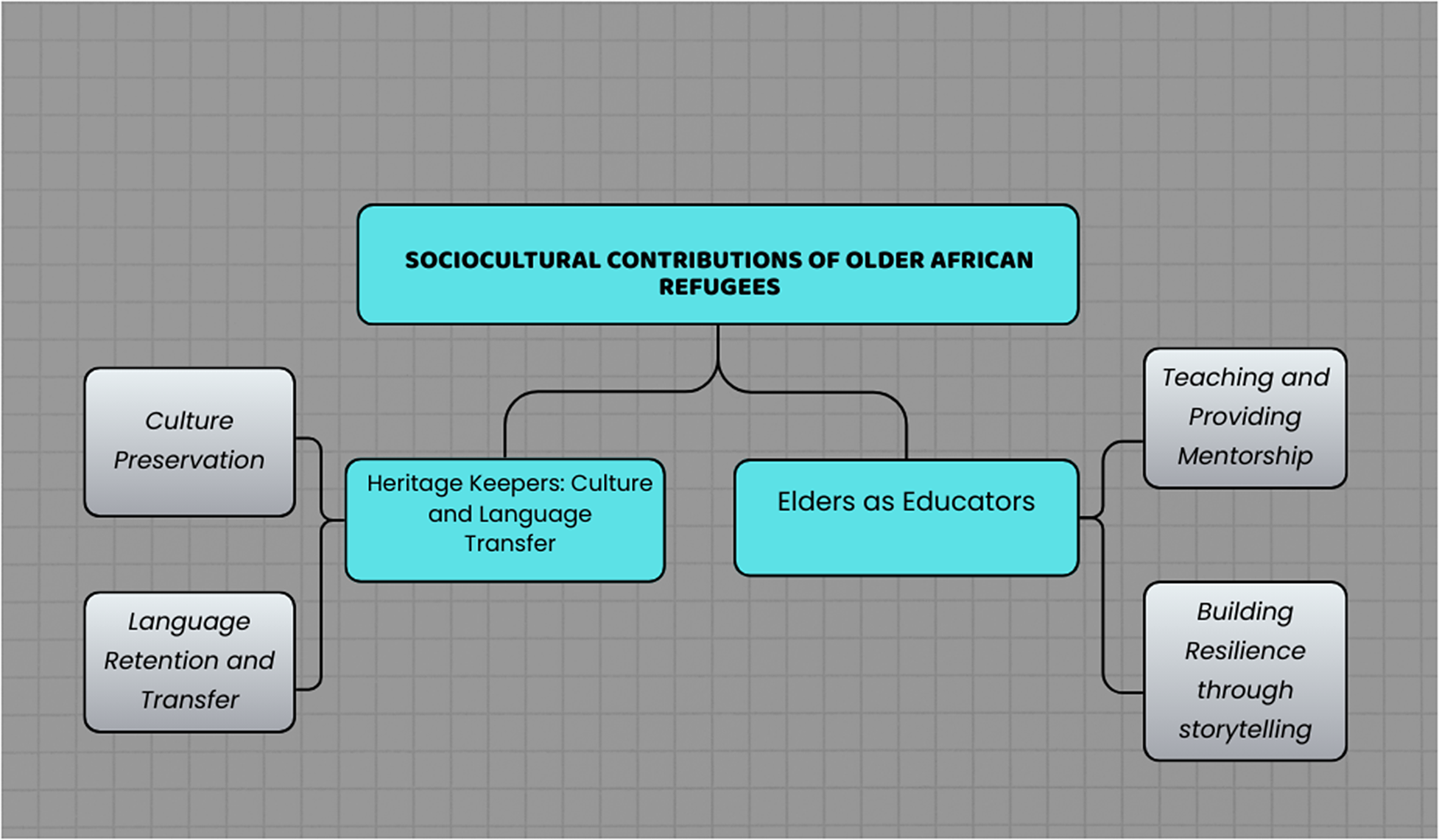
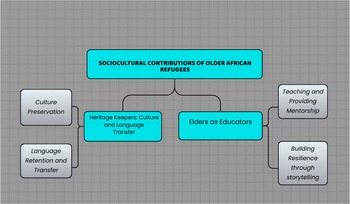
As shown in Figure 1, our results show two major themes and sub-themes. The first major theme presents older African refugees as heritage keepers who preserve culture, maintain and transfer language. The second major present older African refugees as educators who teach and provide mentorship, as well as improve community resilience through storytelling. Below are the demographics of the co-researchers, our knowledge holders.
Themes and sub-themes.
Meet the knowledge holders
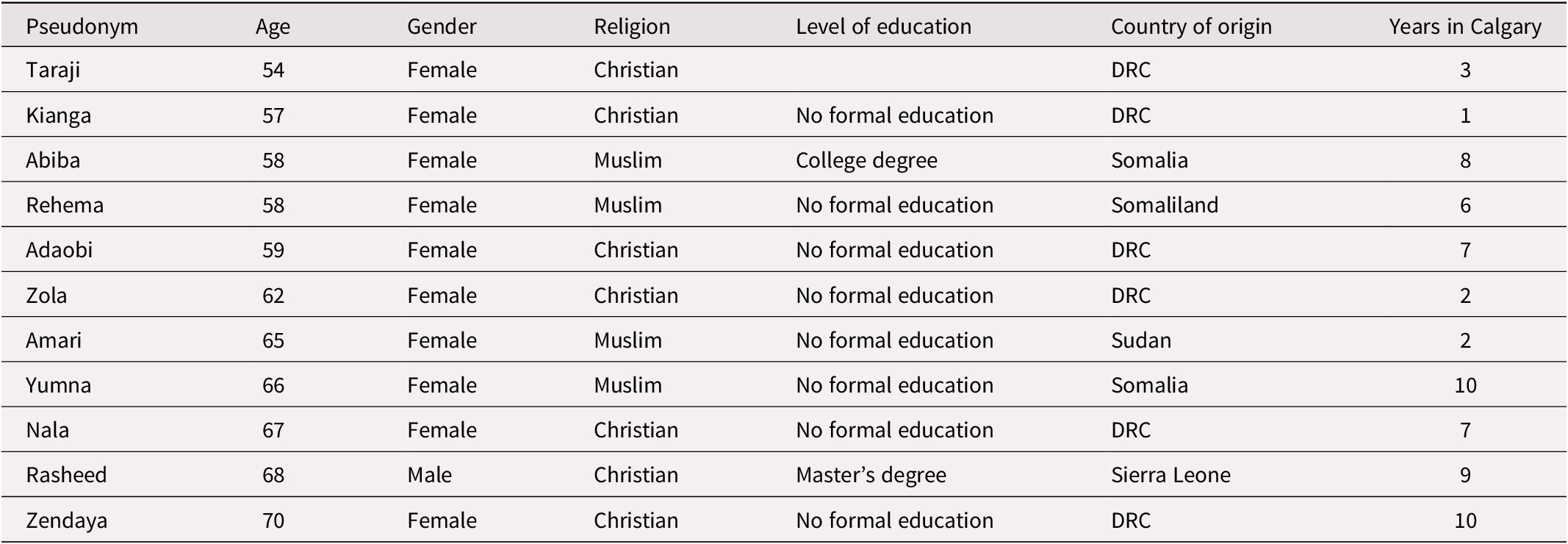
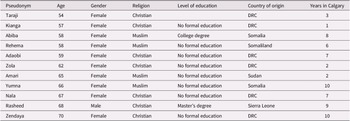
As presented in Table 1, the co-researchers ranged in age from 54 to 70 years. The group was predominantly female, with ten women and one man participating in the study. Overall, co-researchers had limited formal education; however, there were two notable exceptions. Abiba had completed post-secondary training, and Rasheed – the only male co-researcher – held a master’s degree.
Demographic characteristics of the elders
Heritage keepers: culture and language transfer
Across narratives, co-researchers positioned themselves as heritage keepers – custodians responsible for safeguarding and transmitting language, cultural norms, and moral values to younger generations. In the sub-themes below, we discuss the role of older African refugees as custodians of culture and language.
Culture preservation
The co-researchers in their narratives described themselves as custodians of culture even in the diaspora. This role, deeply rooted in African sociocultural traditions, emerged as a central means through which older refugees enact agency, preserve identity continuity, and resist perceived cultural erosion in the Canadian context. Co-researchers consistently emphasized that maintaining cultural and linguistic knowledge is essential for preventing identity loss among African Canadian-born or raised children. As Adaobi explained, elders perceive it as their duty:
I would like to follow them closely, not to be like those people living on the street. To be educated and to teach them the culture. To follow, step by step, to teach them the language and the culture and to obey people.
Another prominent narrative involved the framing of some Canadian culture as morally risky, frequently associated with substance use, disrespect, and other behaviors deemed incompatible with African values. This perception intensified elders’ resolve to shield younger people from what they termed ‘bad cultures’ and to reinforce practices they viewed as ‘the right way’, as Kianga articulated:
If it were possible, our children should not follow the culture found in those countries. They should keep their own culture, not use drugs, drink, or whatever, to avoid the bad cultures we found in these communities. So, it would be better to keep our own culture so that our children will continue to follow the right way, because the way they do it here is bad.
The narratives above demonstrate that cultural transmission functioned not only as heritage preservation but also as a protective strategy against perceived sociocultural threats.
Language retention and transfer
Language retention appeared as a critical component of this safeguarding process. While co-researchers acknowledged the importance of English for educational and settlement purposes, they strongly advocated for the use of native languages within the home. Elders encouraged parents, especially mothers, to prioritize the teaching of their mother tongue, arguing that bilingual or multilingual competence helps children maintain cultural identity and supports intergenerational communication. Kianga storied:
Children should keep the language. If the language spoken in the community here is English, it’s okay. Let them; let our children go to school and learn and use English. But in the houses, it’s better to use the cultural language. For example, children of that age, I can tell them to keep the language and the culture, but for those who are small, even their mothers, who don’t know English, try to talk to them using wrong or bad English, which is going to be worse in terms of culture and language for those young ones. They should keep or teach them the original culture and the original language, and then let them study English at school.
Nala also espoused this sentiment:
I can tell them that wherever you are, even if you are here, even if you are going to school, try to keep your language and your culture. Don’t lose or neglect your language and culture. I can tell the mothers. Those children were born here; they are Canadian. You can teach them English, but make considerable effort to teach them your culture and your language.
In addition to preserving their heritage, they stressed the importance of maintaining their native language to facilitate communication within the family. This emphasis was particularly pronounced among elders with limited English proficiency, who expressed concern that language loss would sever their relationships with grandchildren. Consequently, they asserted that to establish strong connections with their children and grandchildren, it is essential to impart their language to them. To underscore this perspective, Amari remarks:
Masala is the language like that, the mother language. I have to teach the language to the small kids; I have a daughter, and she is married. She has kids, my grandkids; I have to teach them my language because I don’t speak English. I have to teach them the language so they can talk to me. Like my own kids, I taught them the language.
The narrative above highlights how older African refugees understand cultural and linguistic transmission as a multidimensional contribution that sustains family cohesion, reinforces intergenerational identity, and counteracts the assimilative pressures of resettlement.
Elders as educators
Beyond cultural transmission, co-researchers described themselves as educators and moral guides, extending traditional African elder roles into their Canadian resettlement contexts. The sub-themes below present our analysis of how older-African refugees act as educators and mentors, building community and resilience.
Teaching and providing mentorship
Co-researchers articulated a strong sense of responsibility for shaping the behavior, civic orientation, and social development of young people, both within their families and in broader community networks. This mentoring role was framed as essential for helping younger immigrants navigate conflicting expectations between African cultural norms and Canadian social environments. Elders sought to advise youth on respectful interpersonal relationships, adherence to family expectations, and responsible citizenship. Zola described offering guidance:
I can teach them or advise them on just one word, for example, and then raise or educate them to the same level as the children. For example, some children can support the mother and neglect the father, or some can support the father and neglect the mother, so I can advise them to bring them to the same level so they can respect each other. I can advise them to respect the government’s rules so that, in life, they can be good husbands and good wives.
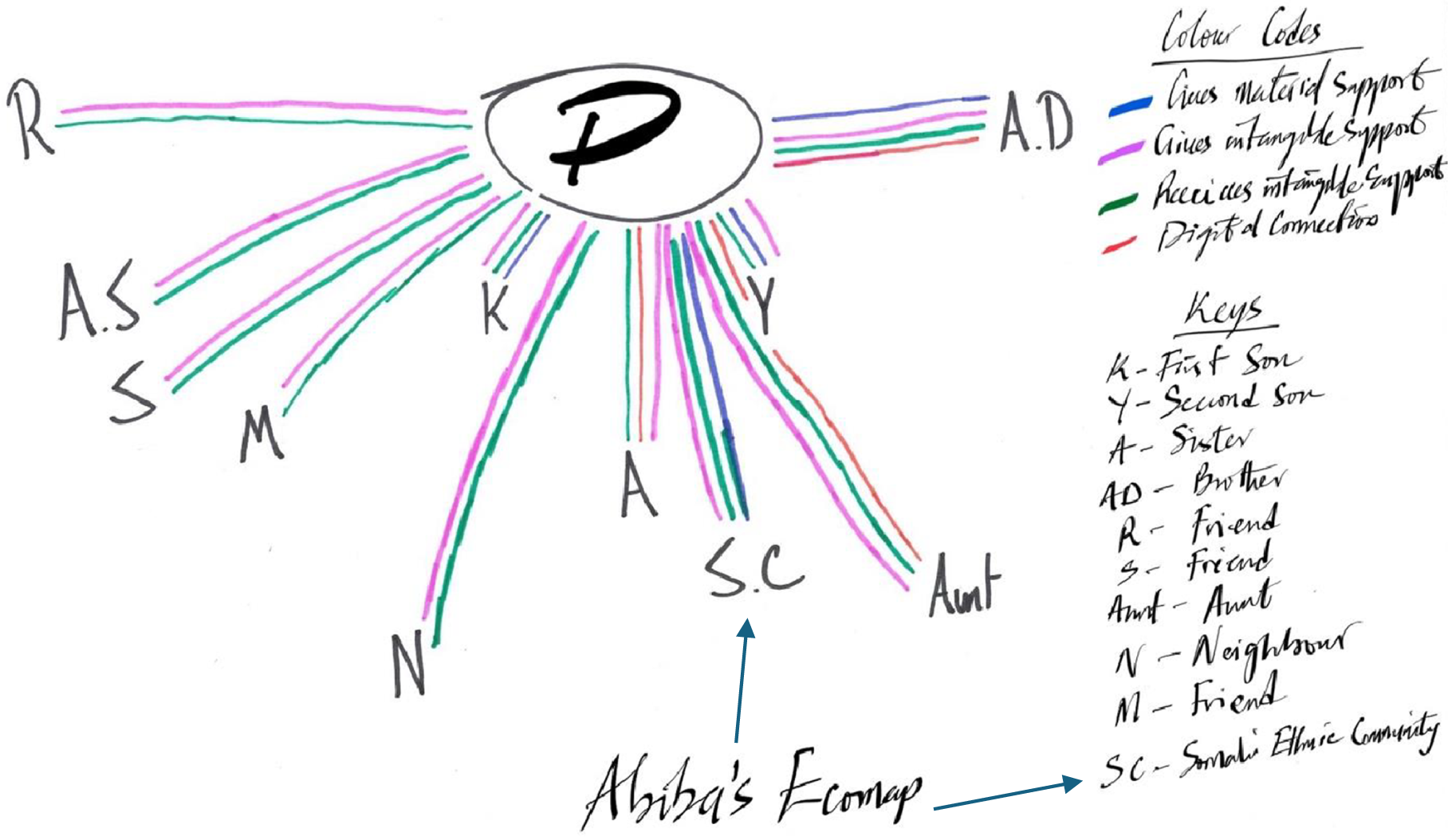
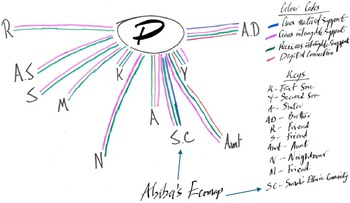
Figure 2 below shows the co-researcher, Abiba, demonstrating the provision of support, including intangible support for cultural interpretation, to the Somali ethnic community in Calgary (indicated by the arrows).
Abiba’s ecomap showing the contribution to her ethnic society in Calgary.
The co-researchers highlighted financial literacy and economic mentorship. They emphasized the need for older adults to guide young newcomers through unfamiliar financial systems that shape long-term settlement outcomes. Drawing on their lived experiences navigating financial structures in multiple countries, elders viewed themselves as uniquely positioned to help youth avoid common economic pitfalls that can hinder social mobility. While other co-researchers were subtle in their narrative around financial mentorship, the sole male co-researcher, Rasheed, was more outspoken. This may be due to his current engagement with a financial institution, his higher level of education, and/or his gender. He argued that without such guidance, young migrants may remain ‘encapsulated into a culture…where the same old practices’ are repeated without awareness of new opportunities. These are excerpts from his extended story.
We provide guidance and mentorship, you understand? And you know, because of our knowledge now of how, for example, the financial industry works, we can bring that along because these are the critical issues that impact people’s lives when they move. This is what really underpins their ability to acclimatise and thrive in society, but in its absence, they just grope around, making the same mistakes others have made before them.
In a separate reflection, he added that newcomers often become confined within familiar cultural circles, which can limit their growth, given that things continue to change and everybody’s success story never remains the same:
I saw that really in a pronounced manner in the [United] States. When you move there, you are moving in with maybe your cousin or somebody you know, and so you are encapsulated into a culture where you know people, and the likelihood that you move out of that box and strive towards success is minimised. So you enter a different phase, but then you are exposed to the same old practices, and you don’t make much progress. These are just some of the challenges, and because there’s no guidance, you keep making one mistake after another.
Building resilience through storytelling
Resilience is widely recognized as a critical determinant of survival, adaptation, and well-being among refugees, particularly in contexts marked by forced displacement and sociocultural disruption. Aligned with the SOC model, co-researchers turn their negative experiences into a tool for strength. They described playing an instrumental role in cultivating resilience among younger family and community members. A central mechanism through which this was enacted was storytelling, a culturally embedded practice that serves both psychosocial and pedagogical functions. Taraji’s narrative illustrates how storytelling operates as a means of cultural continuity and emotional fortification:
Some things that we hold dear, we want to keep. We also started telling stories to our children because those are the things that we don’t want to forget. We don’t want our children to forget. We want them to be aware of that and not forget our stories, our histories, and the things that we went through. This can make them strong.
Adaobi added:
I am the mother in the centre. The way I see that they are surrounding me, it shows that we are in a group, and I want them to stay in the same group so that even if there is somebody who would like to go far from us, we can bring him closer to us so that we stay in a group. I tell them about our experiences and how they have helped us survive. I encourage them through the stories and make them stronger.
Several co-researchers further conceptualized their narrative practices in explicitly therapeutic terms, emphasizing their role in supporting young people’s emotional well-being and navigation of cultural dissonance. Yumna, for example, described these interactions as akin to ‘therapy’ or ‘rehabilitation’, underscoring the restorative and identity-affirming potential of intergenerational dialogue:
Just checking their work. Like giving them a session of remembering them, like it’s a therapy, like telling them where they come from, because when someone doesn’t know where they come from, they don’t know where they are going. They are lost between their culture and their confidence is going very, very low. They feel like they are not worth it, as the other kids that are maybe here are different colours or have been here for centuries, so they don’t feel like they are useful as they might be. They are stuck in between cultures, maybe by giving them a session where you are sitting in front of me, talking about the language. The language is the culture talking to them, and, like, giving them information about our culture and all, at first they won’t be interested, but they’ll definitely get back to it. Yeah, it’s rehabilitation.
Collectively, these narratives underscore the critical roles older refugees play in contributing to community resilience and intergenerational adaptation. By guiding moral behavior, civic engagement, and economic decision-making, elders position themselves as critical agents in enabling younger migrants to thrive in their new environments.
Discussion
Our study explored the sociocultural contributions of older African refugees living in Calgary, Canada, offering a counter-narrative to dominant deficit-based portrayals that depict older refugees primarily as vulnerable, dependent, and socially marginalized. Our findings demonstrate that despite facing structural, linguistic, and sociocultural challenges (Ekoh et al., Reference Ekoh, Iwuagwu, George and Walsh2022; Lin et al., Reference Lin, Kobayashi, Tong, Davison, Arora and Fuller-Thomson2020; Tong et al., Reference Tong, Lung, Lin, Kobayashi, Davison, Agbeyaka and Fuller-Thomson2021), older African refugees make meaningful contributions to their families and communities. These contributions occur through interconnected domains, including heritage preservation, intergenerational mentorship, civic and moral education, emotional and cultural ‘therapy’ through storytelling, and the transmission of resilience.
Consistent with gerontological theories of generativity (Erikson et al., Reference Erikson, Erikson and Kivnick1994) and meaning-making in later life (Haug et al., Reference Haug, Danbolt, Kvigne and DeMarinis2016), co-researchers positioned themselves as heritage keepers, custodians of language, culture, moral values, and collective memory. These findings align with research demonstrating the centrality of elders in African sociocultural contexts as gatekeepers of history, conflict mediators, and educators (Adamek et al., Reference Adamek, Gebremariam Kotecho, Chane and Gebeyaw2022; Fayemi, Reference Fayemi2009). Through active cultural and linguistic transmission, co-researchers sought to ensure the continuity of identity across younger generations while resisting assimilative pressures they believed could lead to cultural erosion. Some Canadian cultures were sometimes perceived as morally perilous, particularly with respect to intergenerational norms of respect, which further motivated co-researchers’ efforts to preserve cultural anchors for their children and grandchildren.
Aligned with the African proverb, which states that ‘Ọ bụrụ na okenye nọ n’ụlọ, nwatakịrị anaghị anwụ n’agụụ amamihe’, meaning that ‘If an elder is in the house, a child does not die of hunger for wisdom’, our findings also uncovered the role of older refugees as educators and mentors. Co-researchers saw themselves as responsible for guiding young people towards responsible adulthood, moral behavior, and civic engagement. These findings resonate with literature on intergenerational socialization among immigrant families, where older adults often facilitate adaptation by transmitting both cultural and instrumental knowledge (Tippens et al., Reference Tippens, Erwin, Eller, Dutra Gross, Bearss, Kemp and Lakati2023). Anchored on the SOC model, co-researchers turned their migration grief and experiences into meaningful, functional, and positive outcomes that help their community and younger people build resilience. A particularly noteworthy contribution involved using storytelling as a psychosocial support method. Storytelling served as an informal therapeutic practice that promotes cultural continuity, emotional grounding, and identity formation in younger people. This aligns with scholarship on narrative resilience, which suggests that stories enable meaning-making, strengthen individual and collective identities, and buffer against structural stressors (Walther et al., Reference Walther, Amann, Flick, Ta, Bajbouj and Hahn2021). For younger African immigrants navigating bicultural tensions, racism, and questions of belonging, elders’ stories offer affirming foundations that reinforce self-worth, cultural pride, and resilience. These insights reflect the SOC model (Baltes, Reference Baltes1997), in which older adults select meaningful roles, optimize available cultural resources, and compensate for losses (e.g., reduced mobility and linguistic barriers) through adaptive strategies such as storytelling and mentorship.
Implications for practice and policy
These findings carry significant implications for gerontological social work, refugee-serving organizations, and policymakers. First, interventions and supports for older refugees must move beyond deficit frameworks that view them primarily as dependents. Older refugees have demonstrated how they use the SOC model to turn their adversity into positive outcomes for community growth; hence, strength-based, culturally grounded approaches should recognize and incorporate the cultural and psychosocial contributions of older refugees. Programs that create structured spaces for intergenerational mentorship, storytelling, and cultural exchange could strengthen resilience within refugee communities while supporting older adults’ sense of purpose and belonging.
Again, resettlement policies and services should acknowledge the centrality of language, culture, and intergenerational connection in older refugees’ well-being. Culturally responsive programming, such as native-language community gatherings, culturally familiar mental health services, and intergenerational activities, can enhance both adaptation and mental health. Furthermore, the findings highlight the need for training practitioners to understand African aging norms, including the roles of elders as moral authorities, educators, and custodians of cultural memory. Without such understanding, service providers risk misinterpreting these roles or overlooking the value of older refugees’ contributions, perpetuating forms of ageism and racialization.
Limitations and implications for future research
While this study is the first to explore the sociocultural contributions of older African refugees, improving our understanding of this marginalized group and providing insights for policy and practice, it is not without limitations. Our study sample size of 11 co-researchers from five African countries does not adequately represent the diverse realities of older refugees of African descent living in Canada. Hence, future research should examine how the contributions identified in this study vary across country of origin, migration history, and length of residence in Canada. Longitudinal studies could explore how older refugees’ contributions evolve as families settle and as younger generations develop hybrid cultural identities. Additionally, comparative studies across refugee groups may reveal culturally specific and cross-cultural patterns of intergenerational mentorship, storytelling, and resilience transmission.
Conclusion
This study challenges prevailing deficit-based narratives by illustrating the diverse and meaningful sociocultural contributions older African refugees make to their families and communities. Through cultural preservation, intergenerational mentorship, settlement guidance, and narrative resilience-building, these older adults play vital roles that strengthen community cohesion and promote well-being across generations. Recognizing and supporting these contributions is essential for developing equitable, responsive, and culturally attuned refugee policies and practices.

 Open access

