




Introduction
Amid the web of identity that shapes social life in urban areas, some residents seek to position themselves as ‘authentic’ locals. The project of authenticity requires the deployment of semiotic resources to separate locals from outsiders. The ‘authentic’ pronunciation of place names is one such resource, particularly salient in the popular imagination. This study examines productions of the city name Chicago, focusing on the phonetic manifestation, phonemic patterning, and meta-linguistic discourse surrounding its primary stressed vowel. Acoustic analysis reveals a phonetic and phonemic divide among locals in productions of this CHICAGO vowel. Qualitative analysis of meta-linguistic comments connects this linguistic contrast to diverging meta-linguistic ideologies of authentic place identity. Drawing upon Gal & Irvine’s (Reference Gal and Irvine2019) axis of differentiation, we argue that contrastive phonetic and phonemic manifestations of CHICAGO construct a dichotomy in which the ‘inauthentic’ versus ‘authentic’ phoneme becomes fully inverted along the same axis of meaning. Within these opposing claims, however, lies a shared project of place authentication that draws upon a single chronotope to variably establish ‘real Chicagoness’, depending on an individual speaker’s orientation towards the chronotopic representation.
Differentiation and authentication in urban contexts
Place identity comprises an individual’s relationship not just to a space but to the stakeholders who occupy it physically and symbolically. Sociolinguists have long sought to understand how place identity emerges through language at both individual and community levels, particularly in contact situations (e.g. Cornips & de Rooij Reference Cornips and de Rooij2018; Carmichael & Reed Reference Carmichael and Reed2025). While local features, place-name productions, and/or participation in regional chain shifts might locate a community within a broader region, individuals’ place identity can emerge through the selective uptake of these features according to intra-community dynamics (Montgomery & Moore Reference Montgomery and Moore2017).
The demographic transformation of a community often coincides with diachronic linguistic change. Speakers who exemplify the community prior to a change promote certain personae, speech styles, and lexical item productions as authentically local, anchoring the present to a nostalgic idealization of the place (Bucholtz Reference Bucholtz2003). Bakhtin (Reference Bakhtin and Holquist1981:84) proposes that chronotopes are produced when ‘spatial and temporal indicators are fused into one carefully thought-out, concrete whole’. Researchers have explored how semiotic material dated to a historical time period, placed within a physical and/or imagined space (Tuan Reference Tuan1991), and evocative of certain personae (Carmichael & Dajko Reference Carmichael and Dajko2016; Britt Reference Britt2018) can coalesce into chronotopic representations (e.g. Agha Reference Agha2007) that are variably accessible to and authenticated by different interlocutors (Blommaert Reference Blommaert2015).
Sociolinguistic work has investigated how phonetic detail can frame relevant stakeholders as authentic place inhabitants (e.g. Reed Reference Reed2020; Regan Reference Regan2022). But social meaning does not exist in a vacuum; as socially meaningful linguistic features are organized as ‘authentic’, they must stand against contrastive forms and meanings along an ideological axis of differentiation (Gal & Irvine Reference Gal and Irvine2019). In Labov’s (Reference Labov1963) study of Martha’s Vineyard, for example, speakers with a stronger orientation towards the island used more centralized productions of /aɪ/ and /aʊ/ compared to those who wanted to leave. Residents metalinguistically characterized certain communities across the island (e.g. up- vs. down-islanders) using the same contrast (Labov Reference Labov1963), revealing how place identity ultimately creates the relevant linguistic contrasts through the process of linguistic differentiation (Gal & Irvine Reference Gal, Irvine and Kroskrity2000). Scholarship on differentiation has analyzed how linguistic contrasts are bundled with other semiotic material in the formation of discursively salient dialects, accents, or languages (Gal & Irvine Reference Gal, Irvine and Kroskrity2000), illuminating ideologies underlying the differentiation and marking of local language varieties in discourse (e.g. Milani Reference Milani2010; Wan Reference Wan2022).
Cities typically feature linguistically, demographically, and ideologically diverse populations inhabiting the same physical space, making them fruitful sites in which to study differentiation. Place authenticity often emerges as salient when cities experience sociopolitical upheaval (e.g. Tillery, Bailey, & Wikle Reference Tillery, Bailey and Wikle2004) or an influx of newcomers (e.g. Tseng & Hinrichs Reference Tseng and Hinrichs2021), among other factors. Though community members may have exposure to the same set of semiotic resources, they vary in the power and positionality needed to claim certain resources—and the place-linked personae they index—as authentically local (Gal & Irvine Reference Gal and Irvine2019). Furthermore, belief in the distinct nature of local speech enables residents to utilize linguistic material as explicit emblems of authenticity (Johnstone Reference Johnstone2013). Thus, authentication (Bucholtz & Hall Reference Bucholtz and Hall2005) is a significant organizing process connecting linguistic distinctiveness with social differentiation.
Within urban communities, residents will often cleave an imagined ‘Other’ through processes of erasure in order to include themselves within the authentically local frame (Gal & Irvine Reference Gal, Irvine and Kroskrity2000). Particularly in cities where authenticated personae represent holdovers from a historical representation of the community, the local features projected as authentic might not cohere with shifting demographic trends. As differentiation proceeds within such a community, we might expect local features, including place-name productions, to exhibit contrastive social meanings and recruitment in processes of erasure. Focusing a zoom lens on differentiation, we analyze here phonetic and phonological variation in the stressed vowel of the place-name ‘Chicago’, illustrating how a single linguistic feature winds around the ideological axis of place authenticity.
The social meaning of place-names
Discourse surrounding place-names is common at a variety of scales, from international geopolitics (Krivoruchko Reference Krivoruchko, Kurzon and Adler2008; Hall-Lew, Coppock, & Starr Reference Hall-Lew, Coppock and Starr2010) and nation making (Herman Reference Herman1999; Kearns & Berg Reference Kearns and Berg2002) down to local street names (Yeoh Reference Yeoh1996; Regan Reference Regan2022). Conflict at these sites can imbue name variants with place-related social meaning, as in US politicians’ stance- and party-based use of phonetic variation in the second vowel of Iraq during the US invasion of Iraq (Hall-Lew et al. Reference Hall-Lew, Coppock and Starr2010). Similar processes have been observed in Wales (Coupland Reference Coupland and Viereck1984) and New Zealand (Kearns & Berg Reference Kearns and Berg2002), where variation in place-name production came to index national identity and postcolonial stancetaking, respectively. Though these productions are often portrayed as static, monolithic markers of place, they become dynamic icons of place identity when they are spoken aloud, injecting ideologies surrounding place authenticity into everyday interaction (Basso Reference Basso1996; Carmichael & Reed Reference Carmichael and Reed2025). If residents care about authentic belonging to a place, then they will care about producing its place-names authentically.
Some sociolinguistic work indicates that phonetic and cross-linguistic phonological realizations of place-names can result in clash, rather than consensus, among locals. In a matched-guise perception study of street names in Austin, Texas, Regan (Reference Regan2022) observed that local/non-local responses for street names whose productions varied between Spanish and English phonology were predicted most robustly by participant ethnicity. While Hispanic Austinites demonstrated no difference in perceived localness between the Spanish/English phonology productions, non-Hispanic Austinites perceived Spanish phonology productions as less local. Across all speakers, Spanish phonology guises were more likely to be judged as speakers from other parts of Texas, while English phonology guises were most likely to be perceived as Austinite. That non-Hispanic listeners maintain non-Austin yet pan-Texan perceptions of Spanish phonology guises illustrates the erasure of incongruencies to make place identity cohere with local demographic trends.
A throughline in this work is authentication (Bucholtz & Hall Reference Bucholtz and Hall2005): people who root their identity in a specific place can stake claims to that identity with place-name productions they and others perceive as ‘authentic’. Yet the production of place-name variation remains understudied, especially within the named communities. In particular, we aim to demonstrate how place authentication almost always entails erasure: whenever semiotic resources are staked out as ‘local’, their contrasts are necessarily positioned as ‘outsider’. Erasure is particularly at issue in diverse urban contexts, where residents encounter a much wider set of semiotic resources that they must cleave to represent an authentic place identity (Johnstone Reference Johnstone, Ziegler, Edler and Oberdorfer2021). We thus examine how residents of one Chicago community produce and discuss the primary-stressed vowel in ‘Chicago’, constructing ideological polarization in ‘authentic’ local identity along an axis of differentiation that operates regardless of the linguistic material projected onto each pole.
We centered our analysis on three overarching questions. First, how do productions of a local place-name vary within a local community? Second, do residents exhibit consensus or variation when discussing the ‘authentic’ production, its social meaning, and its contrastive phonetic and phonemic manifestations? Lastly, what can these phonetic distinctions and metalinguistic discourses reveal about the relationship between identity and shifting ideologies of place? We start out with the rich sociolinguistic context of Chicago, both dialectologically and ideologically.
Vocalic variation in Chicago
Chicago is the largest urban center in the Inland North dialect region (Labov, Ash, & Boberg Reference Labov, Ash and Boberg2006). Residents and non-residents discursively link Chicago with distinctive linguistic features, including the pronunciation of the city name itself. Prominent features of the ideologized ‘Chicago accent’ are those implicated in the Northern Cities Vowel Shift (NCS), a sound change marked by a community-level shift over time toward a fronted and raised TRAPFootnote 1 vowel, a fronted LOT vowel, and a lowered and sometimes fronted THOUGHT vowel, while other mid vowels are variably implicated (e.g. Labov et al. Reference Labov, Ash and Boberg2006; McCarthy Reference McCarthy2011; Wagner, Mason, Nesbitt, Pevan, & Savage Reference Wagner, Mason, Nesbitt, Pevan and Savage2016; Nesbitt Reference Nesbitt2018). LOT and THOUGHT have remained distinct vowel classes in the Inland North even as they have merged in other areas of the Midwestern and Western US (Labov et al. Reference Labov, Ash and Boberg2006). TRAP raising and fronting, as well as LOT fronting, have garnered the greatest amount of meta-linguistic attention in popular discourses of the ‘Chicago accent’, including through parodic performances in popular media (Hallet & Hallet Reference Hallet and Hallet2014). The personae invoked in these performances of the ‘Chicago accent’ are nearly always racialized as white and classed as working class or blue collar (D’Onofrio & Benhem Reference D’Onofrio and Benheim2020).
Decades of research has identified white speakers as the most prominent users of the NCS within the Inland North. This work has typically analyzed other racialized groups as diverging from or conforming to this system (e.g. Gordon Reference Gordon1997; Labov et al. Reference Labov, Ash and Boberg2006; Purnell Reference Purnell2009). This trend mirrors the privileging of white speakers’ systems as prototypical ‘regional dialects’ in other areas (see Wong & Hall-Lew Reference Wong and Hall-Lew2014; King Reference King2021 for further discussion). Van Herk (Reference Van Herk2008) argues that the NCS rapidly progressed among white Inland Northerners as a symbolic form of ‘white flight’ away from the Great Migration of African Americans and their Southern vowel systems. In recent years, however, researchers have documented apparent time reversal of the NCS across the Inland North (e.g. Thiel & Dinkin Reference Thiel and Dinkin2020; Wagner et al. Reference Wagner, Mason, Nesbitt, Pevan and Savage2016), including in Chicago (D’Onofrio & Benheim Reference D’Onofrio and Benheim2020; Durian & Cameron Reference Durian, Cameron, Eren, Giannoula, Gray, Lam and Rio2020).
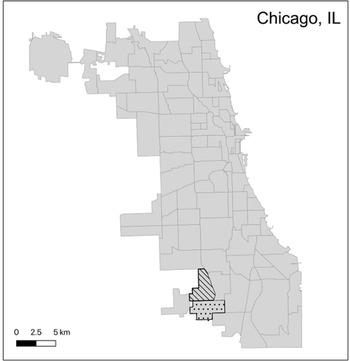
Like most large metropolises, Chicago can be described as a ‘city of neighborhoods’ (Binford Reference Binford, Reiff, Keating and Grossman2004). Its macro-social diversity at the city level belies smaller communities that are more homogeneous along dimensions of race, income level, educational attainment, and so on than city-wide statistics imply. Due to the hyper-local nature of place boundaries, we focus on two neighborhoods on the Far Southwest Side of the city, Beverly Hills (Beverly) and Morgan Park, that are zoned into the same public high school and often paired in local organizations, news, and nonprofit coverage (Figure 1). The racialized makeup of these neighborhoods has shifted from predominantly white Irish Catholic residents pre-1960 to a larger proportion of Black residents following the Civil Rights Act of 1964 (Oswald Reference Oswald2003). Unlike other South Side neighborhoods that experienced white flight during the late twentieth century, activism against aggressive ‘blockbusting’ real estate tactics in Beverly and Morgan Park engendered a racialized balance that is rare for Chicago (Oswald Reference Oswald2003; D’Onofrio & Benheim Reference D’Onofrio and Benheim2020). With the exception of their Hispanic and Asian populations, the demographic breakdown of Beverly (57% white, 31% Black, 7% Hispanic or Latino, 1% Asian, 5% other) and Morgan Park (29% white, 60% Black, 5% Hispanic or Latino, 1% Asian, 5% other) adheres more closely to city-wide demographics (32% white, 28% Black, 30% Hispanic or Latino, 7% Asian, 3% other) than most other neighborhoods (Chicago Metropolitan Area for Planning 2024). The same data reveal a significantly higher proportion of owner-occupied residencies in both Beverly (86%) and Morgan Park (71%) than in Chicago overall (45%). Residents comment on these factors as major determiners of their choice to live in the area (D’Onofrio & Benheim Reference D’Onofrio and Benheim2020).
Map of Chicago community areas featuring Beverly (diagonal hashes) and Morgan Park (dots).
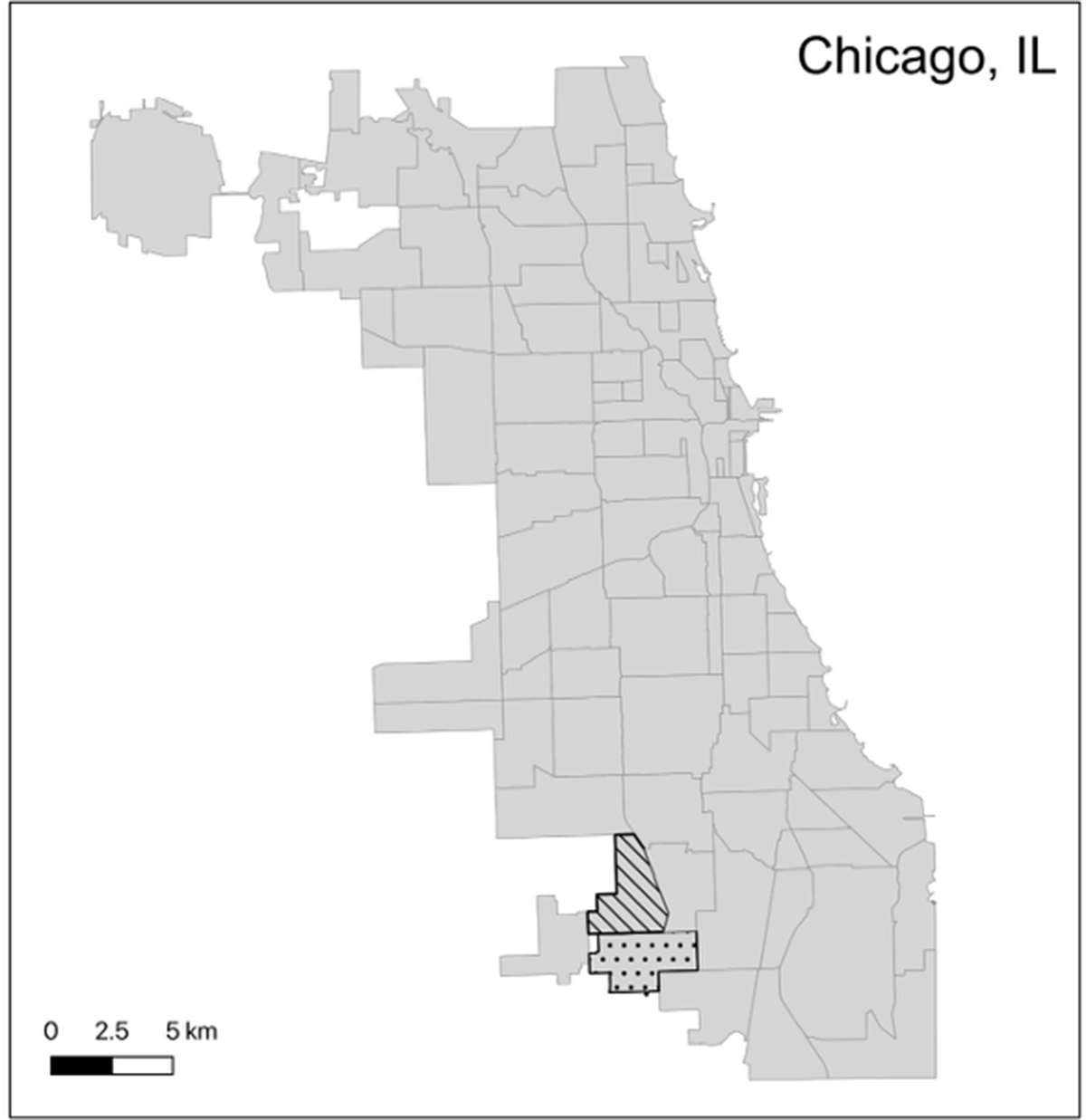
Figure 1 Long description
A map of Chicago, Illinois, showing various community areas. The map highlights two specific regions: Beverly, marked with diagonal hashes and Morgan Park, marked with dots. A scale bar at the bottom left indicates distances of 0, 2.5 and 5 kilometers.
Past work in these neighborhoods observed fronted LOT as well as raised and fronted TRAP among older white speakers, consistent with the NCS (D’Onofrio & Benheim Reference D’Onofrio and Benheim2020). By contrast, Black speakers’ vowel spaces were less Northern Cities shifted than their white counterparts; participants meta-linguistically connect this pattern to their family history in the US South (D’Onofrio, Benheim, & Foster Reference D’Onofrio, Benheim and Foster2020). However, all residents showed apparent time movement away from the NCS with strong reversals of TRAP and LOT (i.e. both vowels lowered and backed in apparent time). D’Onofrio & Benheim (Reference D’Onofrio and Benheim2020) linked reversal to local shifts in the social meanings of the NCS—from pan-Chicago identity to particular white working-class personae—rather than a growing orientation away from Chicago place identity altogether.
Meanwhile, the THOUGHT vowel is typically discussed in the Northern Cities chain shift as taking the place left by fronted LOT by lowering and sometimes fronting over time (Labov et al. Reference Labov, Ash and Boberg2006), though past work in Chicago has shown inconsistencies in this movement (e.g. McCarthy Reference McCarthy2011). In Beverly and Morgan Park, white men and women showed no apparent time change in THOUGHT with respect to either F1 or F2 (D’Onofrio & Benheim Reference D’Onofrio and Benheim2020). Another study in these areas looking only at women showed a significant interaction between race and age, such that white women showed a greater degree of apparent time change than Black women, with THOUGHT fronting (increasing in F2) in apparent time for white speakers (D’Onofrio et al. Reference D’Onofrio, Benheim and Foster2020). This pattern constitutes an advancement of the NCS pattern, unlike the prominent reversals found in other vowels.
The primary stressed vowel in ‘Chicago’ implicates both the LOT and THOUGHT vowel classes. We therefore refer to this vowel as its own class throughout the article: the CHICAGO vowel. The CHICAGO vowel is particularly interesting because it involves both phonetic variation in vowel quality and variable phonemic distinctions among speakers, where some speakers may treat the vowel as a member of the LOT class and others as a member of the THOUGHT class. If speakers exhibited the low-back merger, the phoneme status of the CHICAGO vowel would hypothetically fall into this larger merged class, thus presenting another possibility for variation within the community (i.e. merged versus distinct). The unique social and linguistic context of the place name of Chicago involves (i) the potential for phonemic contestation in the vowel class itself, (ii) its implication in the ongoing and socially meaningful NCS, (iii) sociodemographic shifts heightening claims to place identity and authenticity in these locales, and (iv) use of the city name among residents to authenticate place identity. This makes the CHICAGO vowel a fitting case study for examining how community-based variation in place-name productions map onto ideologies surrounding the feature, and how both are used by locals to demarcate place identity.
Methods
Speaker sample
Data come from fifty-six sociolinguistic interviews with lifelong Chicagoans who grew up in and/or lived in Beverly or Morgan Park at the time of study. One-on-one interviews with speakers were conducted in 2017–2018 by the first author, an Asian-American woman from a different part of the North Central region. Interviews took place at locations convenient to the participants, including a neighborhood community center, local library branches, participants’ homes/places of work, or the researcher’s office. Interviews ranged from approximately forty-five minutes to two hours in length. They consisted of casual conversations about speakers’ life histories, experiences growing up in Beverly/Morgan Park and Chicago more broadly, their views on changes to the neighborhood and city, and a few meta-linguistic questions about the ‘Chicago accent’ at the conclusion of the interview. Participants also completed a map task, word list reading task, and perceptual experiment following their interviews, data from which are not analyzed here.
Participants completed a demographic questionnaire at the beginning of the interview. Providing an open-ended response to ‘What is your race/ethnicity?’, all speakers described their race as white, Caucasian, Black, or African-American, which we group into ‘white’ and ‘Black’ in line with participant discourses. In open-ended responses to ‘What is your gender?’, every speaker responded either ‘male’ or ‘female’, which we use interchangeably with ‘men’ and ‘women’, respectively, based on common usage in the field site. The sample consisted of twenty-four white women, thirteen white men, and thirteen Black women. We refer to these three social groupings (white women, Black women, and white men) as ‘race-gender’ groups throughout the article. This choice does not imply that we have captured every intersection of race and gender within the community (more races and genders than are represented here would be required). Instead, we use this label throughout our analyses to distinguish each group from the other two by its unique combination of participant self-reported race and gender. Within these groups, we aimed for an even spread of ages to facilitate the linear modeling of apparent time shifts, with ages spanning from twenty to seventy-nine over the entire sample.
Despite concerted efforts to recruit a diverse sample, our study lacks Black male speakers and speakers of other racialized and gendered groups. While we find the available comparisons useful for interrogating the questions of place, meaning-making, and authenticity, we do not intend to generalize about groups absent from the sample.
Acoustic analysis
Interviews were conducted in-person and digitally audio-recorded using Zoom H4n Pro recorders and Audio-Technica Pro70 lavalier microphones. Interviews were hand-transcribed in ELAN and force-aligned using FAVE-align (Rosenfelder, Fruehwald, Evanini, Seyfarth, Gorman, Prichard, & Yuan Reference Rosenfelder, Fruehwald, Evanini, Seyfarth, Gorman, Prichard and Yuan2014). Every token of ‘Chicago’ was extracted from the interview speech, and the boundaries of its primary stressed vowel, hereafter the CHICAGO vowel, were hand-adjusted in Praat using the visible beginning of voicing in the waveform and spectrogram, and the end of F2 in the spectrogram. We also hand-checked the discourse surrounding every CHICAGO token to determine whether the speaker was voicing themselves or a separate Goffmanian principal (Goffman Reference Goffman1981), labeling these latter instances as ‘performed’ and excluding them from analysis. Given the significant role of stylization in performances of place (e.g. Johnstone Reference Johnstone2011), we removed these performed tokens as well as all those that were embedded in constructed dialogue. We analyzed the remaining 847 tokens.
We extracted twenty to thirty tokens each of LOT and THOUGHT from each speaker to calculate the distance between CHICAGO tokens and these vowel classes. Tokens preceded or followed by liquids, glides, or vowels were excluded, as were tokens with durations under 60ms. Two tokens per lemma per speaker were selected to avoid potential lexical biases. As with the CHICAGO vowel, boundaries were hand-adjusted. Using the same procedures, we extracted twenty to thirty tokens of additional vowel classes (DRESS, FACE, FLEECE, GOAT, GOOSE, KIT, TRAP) to normalize vowel tokens using the Lobanov method (Lobanov Reference Lobanov1971) in the R (R Core Team 2023) vowels package (Kendall & Thomas Reference Kendall and Thomas2018) for consistency with past NCS studies.
We measured the CHICAGO vowel through acoustic analysis of the vowel class independently and its patterning in relation to LOT and THOUGHT in F1/F2 space. First, we assessed normalized F1 and F2 values of each CHICAGO token at the vowel midpoint. This allowed us to examine vowel quality by speaker and by race-gender group. We also measured F1 and F2 values of speakers’ LOT and THOUGHT tokens according to the same social predictors to examine whether the sociolinguistic patterning of CHICAGO seems to mirror one of these vowel classes.
Second, given that both LOT and THOUGHT are undergoing sound change in this community (D’Onofrio & Benheim Reference D’Onofrio and Benheim2020), we calculated the Euclidean distance in normalized F1/F2 space between each speaker’s mean LOT values and each token of their CHICAGO vowel class to provide by-token measures of CHICAGO-LOT Euclidean distance, following the same procedure for CHICAGO-THOUGHT. Subtracting a given CHICAGO token’s CHICAGO-THOUGHT distance from its CHICAGO-LOT distance yielded its LOT-THOUGHT distance difference (LT Difference). This encompasses in one measure whether a given CHICAGO token falls closer to the speaker’s THOUGHT class than their LOT class (positive LT Difference value) or the inverse (negative LT Difference value), with a difference of zero representing equidistance from the speaker’s LOT and THOUGHT classes.
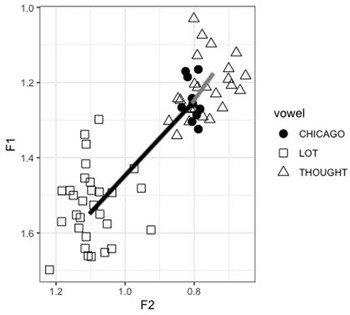
As an illustration, Figure 2 shows all tokens of LOT, THOUGHT, and CHICAGO for one speaker in the sample. LT Difference is calculated by subtracting the Euclidean distance from one CHICAGO token (filled circles in Figure 2) to the mean of the speaker’s THOUGHT tokens (gray line in Figure 2) from the Euclidean distance between that same CHICAGO token and the mean of the speaker’s LOT tokens (black line in Figure 2) in normalized F1/F2 space. In this speaker’s case, the LT Difference has a positive value, which indicates that the CHICAGO token is closer in normalized F1/F2 space to the speaker’s THOUGHT mean than their LOT mean.Footnote 2
CHICAGO-LOT Euclidean distance (black line) and CHICAGO-THOUGHT Euclidean distance (gray line) for one vowel token from one speaker.
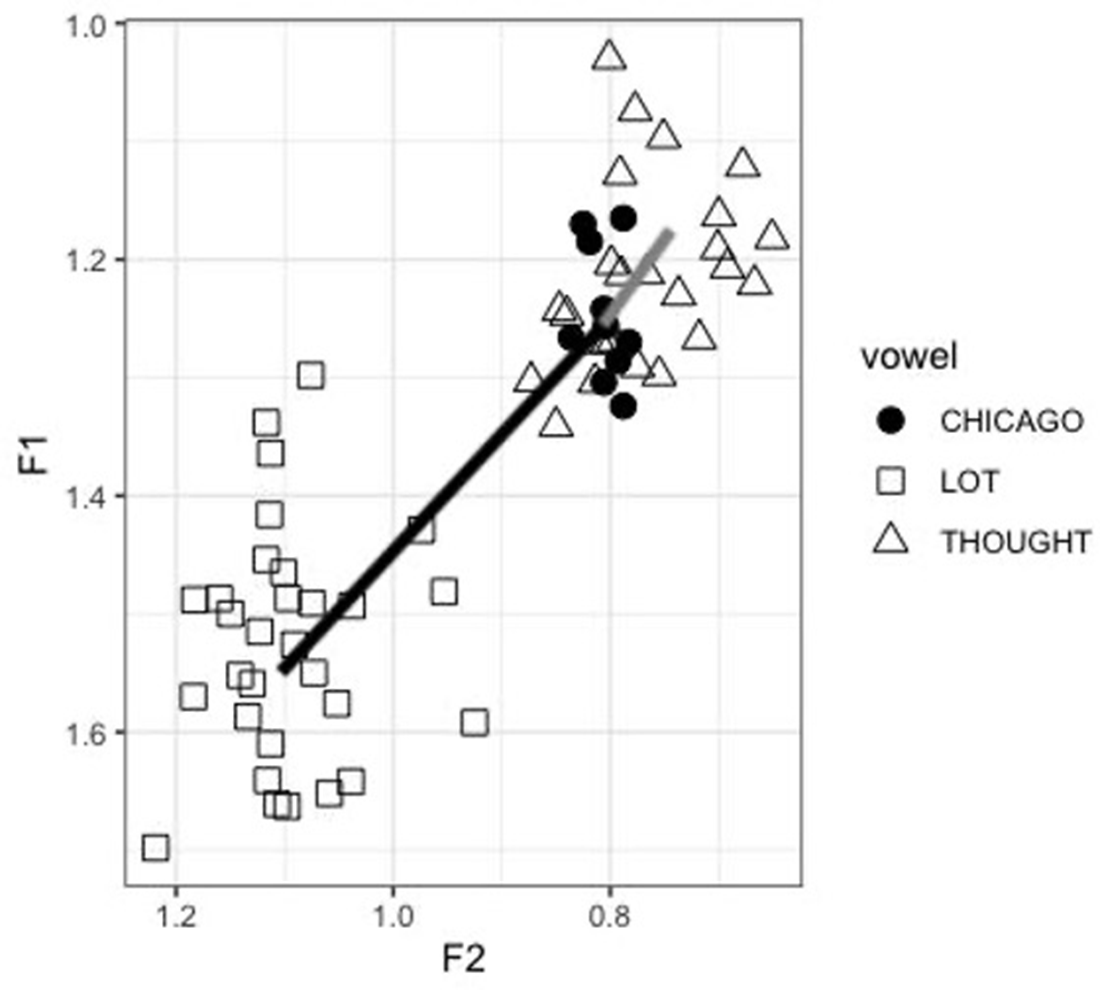
Figure 2 Long description
A scatter plot displays vowel tokens labeled as CHICAGO, LOT and THOUGHT. The x-axis is labeled F2 and the y-axis is labeled F1. CHICAGO tokens are represented by filled circles, LOT tokens by squares and THOUGHT tokens by triangles. The plot shows the distribution of these tokens across the F1 and F2 space, with a black line indicating a Euclidean distance measurement between certain tokens.
Note that we calculated these distances from a speaker’s mean production of the relevant vowel classes, which includes both tokens that match CHICAGO’s following phonological environment (i.e. pre-voiced-velar vowel tokens) and those in other phonological environments measured. This choice was made due to the relatively small number of pre-velar tokens in the LOT and THOUGHT vowel classes: four speakers had zero pre-velar LOT and/or THOUGHT tokens, and many more had either one or two in one of those classes. We opted to perform these measurements using all tokens of LOT and THOUGHT by speaker regardless of phonological environment. This is not intended to offer a completely phonologically congruent distance measure between CHICAGO and the two vowel classes. We further discuss the role of following velar environment in our analyses of LOT and THOUGHT in the Results section.
Statistical analysis of acoustic data
Given popular commentary on the production of CHICAGO, our primary aim in the acoustic analysis was to examine whether social factors conditioned how the CHICAGO vowel was produced. We specifically examined effects of speaker age, as a proxy for apparent time change, and racialized and gendered identity for our three race-gender groups. As discussed above, we assessed three measures of the CHICAGO vowel tokens as dependent variables in our statistical analyses: (i) CHICAGO normalized F1 (vowel height), (ii) CHICAGO normalized F2 (vowel backness), and (iii) LT Difference (CHICAGO-LOT and CHICAGO-THOUGHT Euclidean distance difference measure) as a measure of phonemic patterning. We also analyzed both LOT and THOUGHT midpoint F1 and F2 measurements, each as separate models, to contextualize results of CHICAGO vowel quality.
Each of the measures above served as the dependent variable in a linear mixed effect regression model. In all models, a fixed effect of participant year of birth (a linear predictor, scaled) was included to assess apparent time change. Considering our unbalanced sample, we also included the three Helmert-coded race-gender groups as a categorical fixed effect, using the following contrasts: Black women versus the mean of white women and white men; the mean of white women versus the mean of white men. In all models, we also included logarithmically transformed token duration as a control fixed effect and speaker as a random intercept. We calculated relative word frequency for each token within the interview corpus and submitted logarithmically transformed word frequency as a control fixed effect in the analyses of LOT and THOUGHT. We also included following phonological segment as a random intercept in addition to speaker.
Analysis of meta-linguistic commentary
We juxtapose the quantitative acoustic analysis of CHICAGO with meta-linguistic analysis to assess the ways in which ideologies related to place, differentiation, and authenticity are expressed via commentary on place-name pronunciation. We ask whether this commentary reflects the macro-social patterning of variation attested through spontaneous speech. Toward the conclusion of each interview, speakers were asked to reflect on the pronunciation of the place-name ‘Chicago’, though at times such commentary arose without prompting. The interviewer aimed not to lead the participant toward discussion of the vowel explicitly, nor to produce it herself, but clarified this was an area of interest if participants inquired further. Most participants offered explicit commentary on the CHICAGO vowel, though some participants offered no opinion and others commented on non-vocalic aspects of pronunciation. We gathered all commentary regarding the CHICAGO vowel from written transcripts of the interviews, using the recording where relevant to auditorily clarify which variant was being discussed. We first gathered commonly used descriptors for each of the variants, then culled these into broader stances towards the variants.
Results
Acoustic analysis results
CHICAGO vowel quality
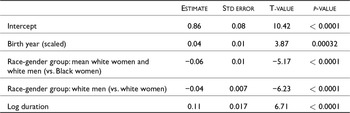
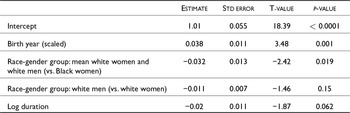
We first analyzed how midpoint Lobanov-normalized F1 and F2 of CHICAGO varied by the macro-social factors of speaker race-gender group and age. In both models, the interaction between the two was tested but did not improve model fit. We report the final model summaries for F1 (Table 1) and F2 (Table 2) below.
Summary of regression model fixed effects predicting Lobanov-normalized F1 of CHICAGO tokens at midpoint (N = 847).
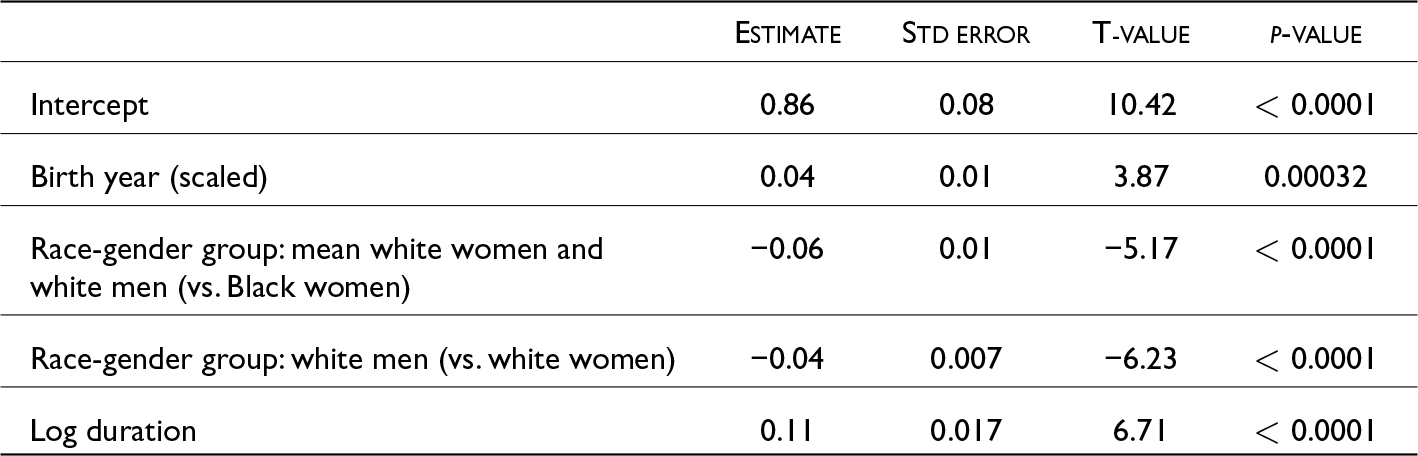
Table 1 Long description
This table presents fixed effects from a regression model predicting the Lobanov-normalized F1 of CHICAGO tokens at their midpoint. The intercept has a positive estimate of 0.86 with a very high t-value, indicating a strong effect. Birth year, when scaled, shows a modest positive effect. Comparisons between race-gender groups reveal significant negative effects, particularly for white men versus white women and mean white women and men versus Black women. Log duration has a positive effect, suggesting longer durations are associated with higher F1 values. All effects are statistically significant, with p-values less than 0.0001, except for birth year, which is slightly higher but still significant.
Summary of regression model fixed effects predicting Lobanov-normalized F2 of CHICAGO tokens at midpoint (N = 847).
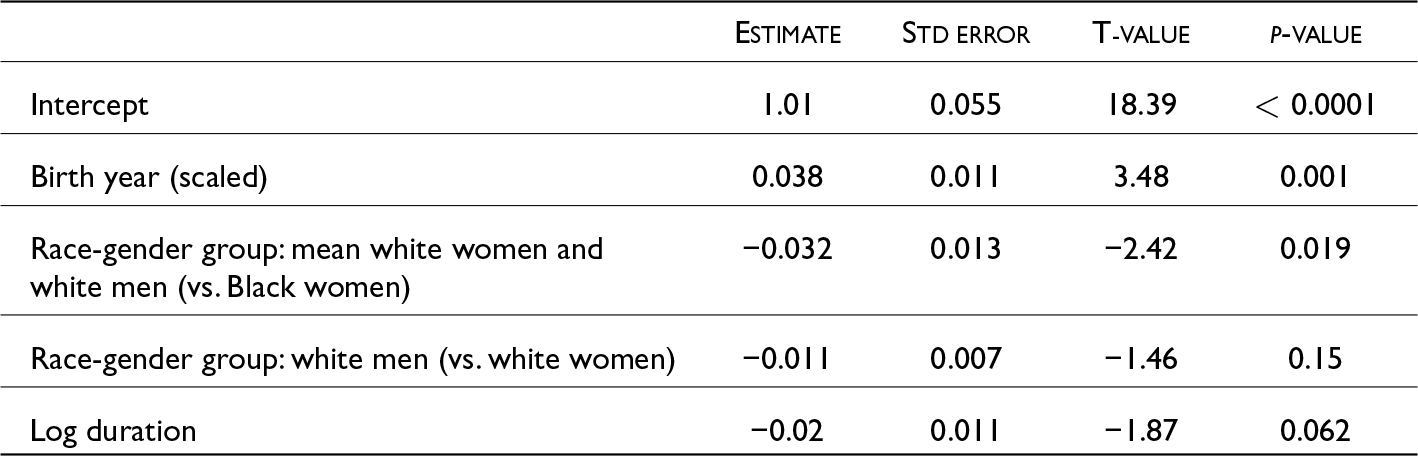
Table 2 Long description
The table presents fixed effects from a regression model predicting the Lobanov-normalized F2 of CHICAGO tokens at their midpoint. The most significant finding is that birth year, when scaled, has a positive effect on F2, with a t-value of 3.48 and a p-value of 0.001. Comparisons between race-gender groups reveal that mean white women and white men have a lower F2 compared to Black women, with a significant negative estimate and a p-value of 0.019. The difference between white men and white women is less pronounced and not statistically significant, with a p-value of 0.15. Log duration also shows a negative effect, but it is not statistically significant, with a p-value of 0.062. These findings suggest that both demographic factors and speech duration influence the F2 of CHICAGO tokens.
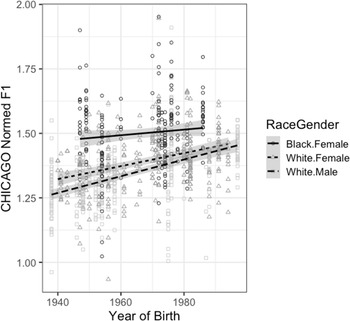
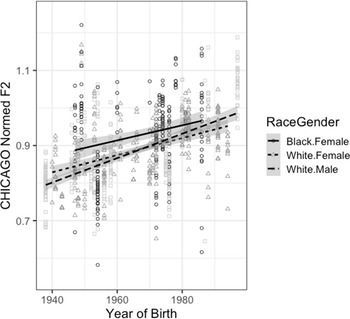
Normalized F1 and F2 both significantly increased as birth year increased, illustrating lowering and fronting of CHICAGO in apparent time (Figures 3 and 4). Black women exhibited significantly greater F1 and F2 than white speakers. White women showed significantly greater F1 than white men but did not significantly differ from white men in F2.
Midpoint Lobanov-normalized F1 measurements for CHICAGO vowel tokens, by speaker birth year and race-gender group. Lines show linear smooths by race-gender group.
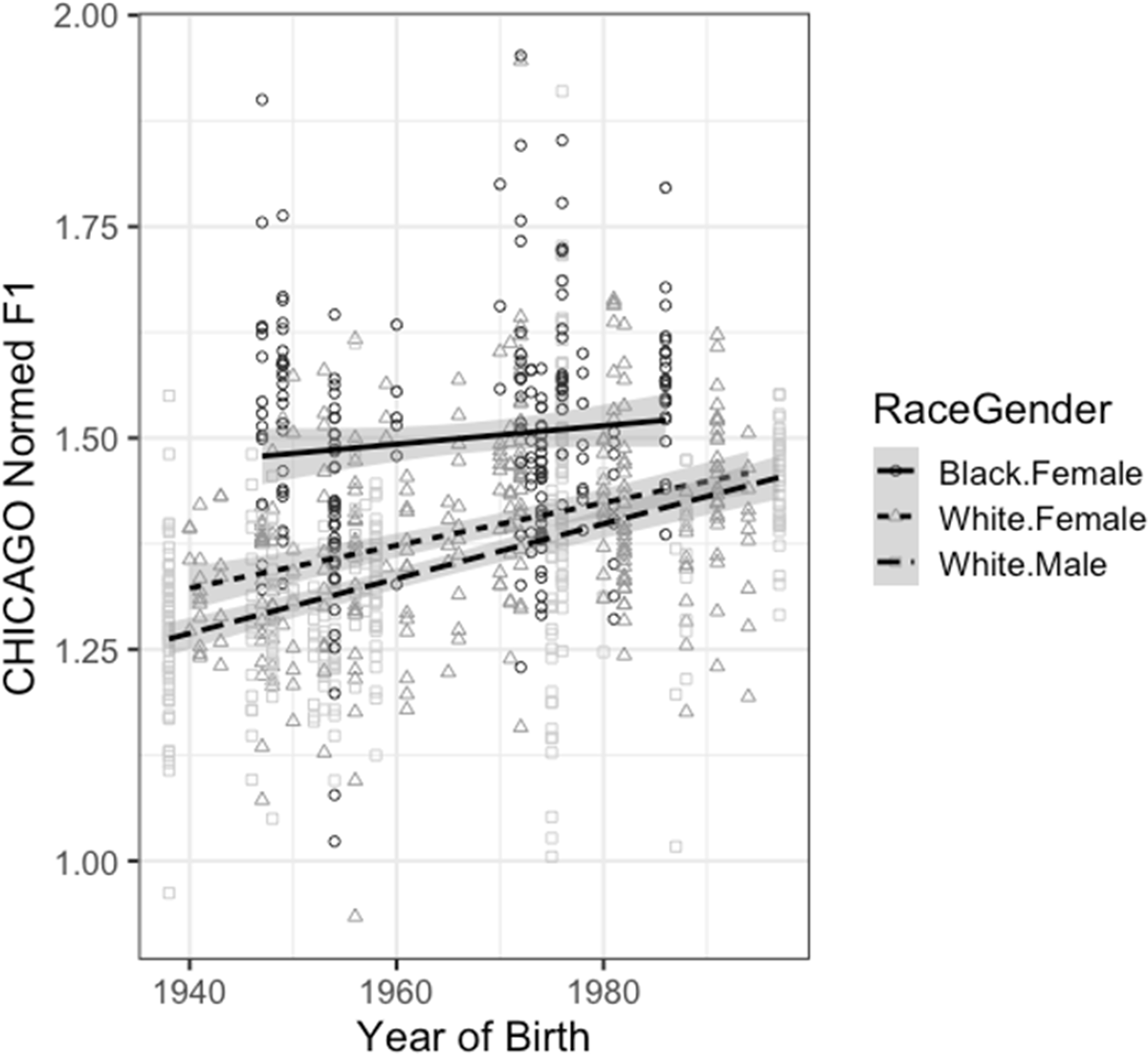
Figure 3 Long description
A scatter plot showing CHICAGO Normed F1 on the y-axis and Year of Birth on the x-axis. Data points are categorized by race-gender groups: Black.Female, White.Female and White.Male. Lines represent linear smooths for each group. The plot indicates trends in F1 values over time, with distinct patterns for each race-gender group.
Midpoint Lobanov-normalized F2 measurements for CHICAGO vowel tokens, by speaker birth year and race-gender group. Lines show linear smooths by race-gender group.
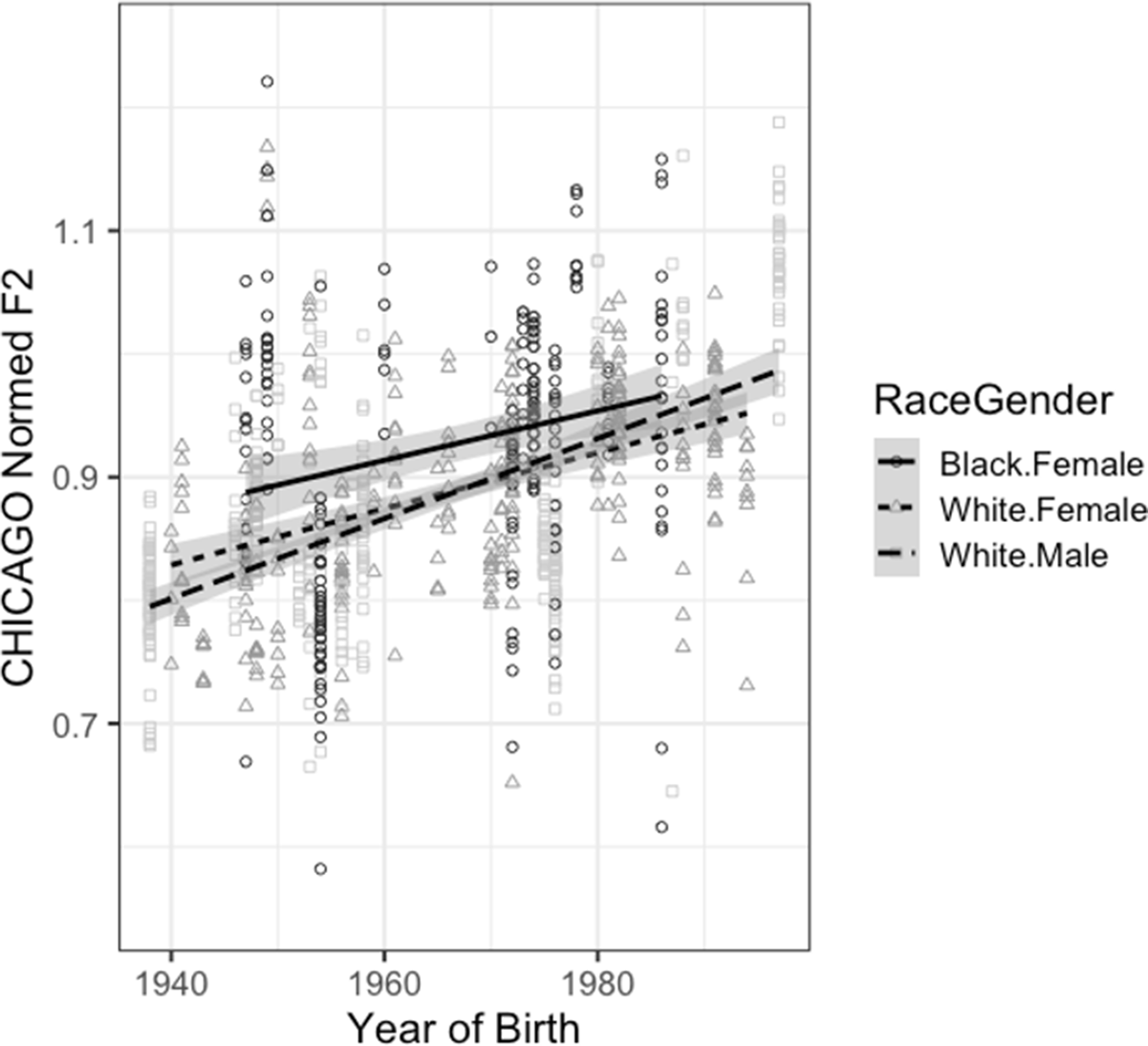
Figure 4 Long description
A scatter plot showing CHICAGO Normed F2 on the y-axis and Year of Birth on the x-axis, ranging from 1940 to 2000. Data points are categorized by race-gender groups: Black Female, White Female and White Male, each represented by different symbols. Three lines indicate linear trends for each group, with Black Female showing the highest F2 values, followed by White Female and White Male. The plot illustrates an overall increase in F2 values over time across all groups.
These data illustrate apparent time change toward lower and fronter CHICAGO for all groups, with white speakers producing it higher and backer (closer to THOUGHT) than Black women.
LOT and THOUGHT vowel quality
We examined midpoint Lobanov-normalized F1 and F2 for LOT and THOUGHT tokens by speaker age and race-gender group (four total models) to contextualize the CHICAGO vowel quality results. In all models, the interaction between age and race-gender group did not improve model fit, nor did the interaction between log-transformed word frequency and speaker age and race-gender group. As described above, we include log-transformed duration and word frequency as control fixed effects in our analysis, in addition to speaker and following phonological segment as random intercepts.
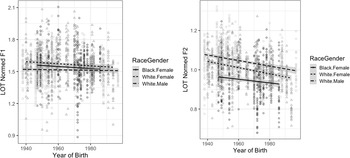
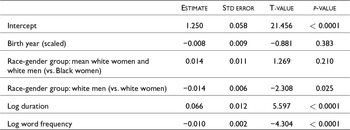
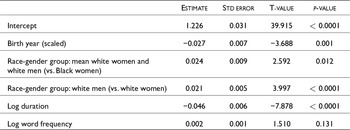
Speaker birth year did not significantly predict LOT F1 (Table 3). LOT F2 significantly decreased with birth year, indicating vowel backing in apparent time (Table 4, Figure 5). Black women did not show significant F1 differences from white men and women but did exhibit significantly smaller F2 values than white speakers, indicating backer LOT vowels. White men showed significantly smaller F1 values and larger F2 values than white women, indicating higher and fronter LOT tokens.
Midpoint Lobanov-normalized F1 measurements (left) and F2 measurements (right) for LOT vowel tokens, by speaker birth year and race-gender group. Lines show linear smooths by race-gender group.
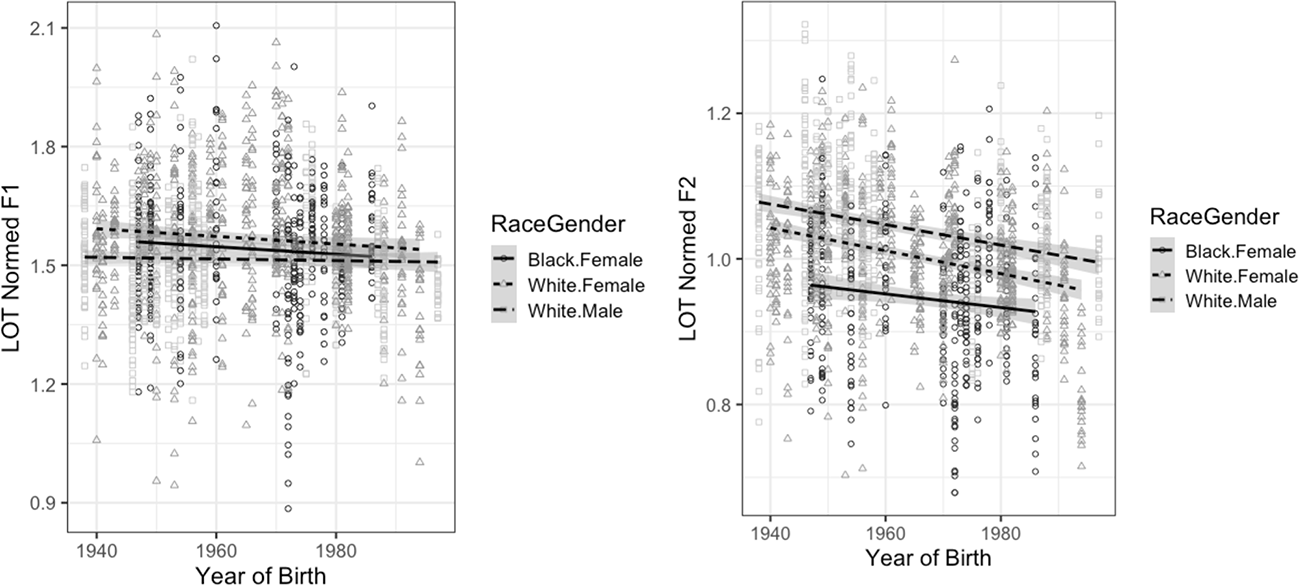
Figure 5 Long description
The image contains two scatter plots. The left plot shows LOT Normalized F1 on the y-axis and Year of Birth on the x-axis. The right plot shows LOT Normalized F2 on the y-axis and Year of Birth on the x-axis. Both plots include data points and linear smooth lines for three race-gender groups: Black Female, White Female and White Male. The plots illustrate trends in vowel measurements over time for these groups.
Summary of linear regression model fixed effects predicting Lobanov-normalized F1 of LOT tokens at midpoint (N = 1521).
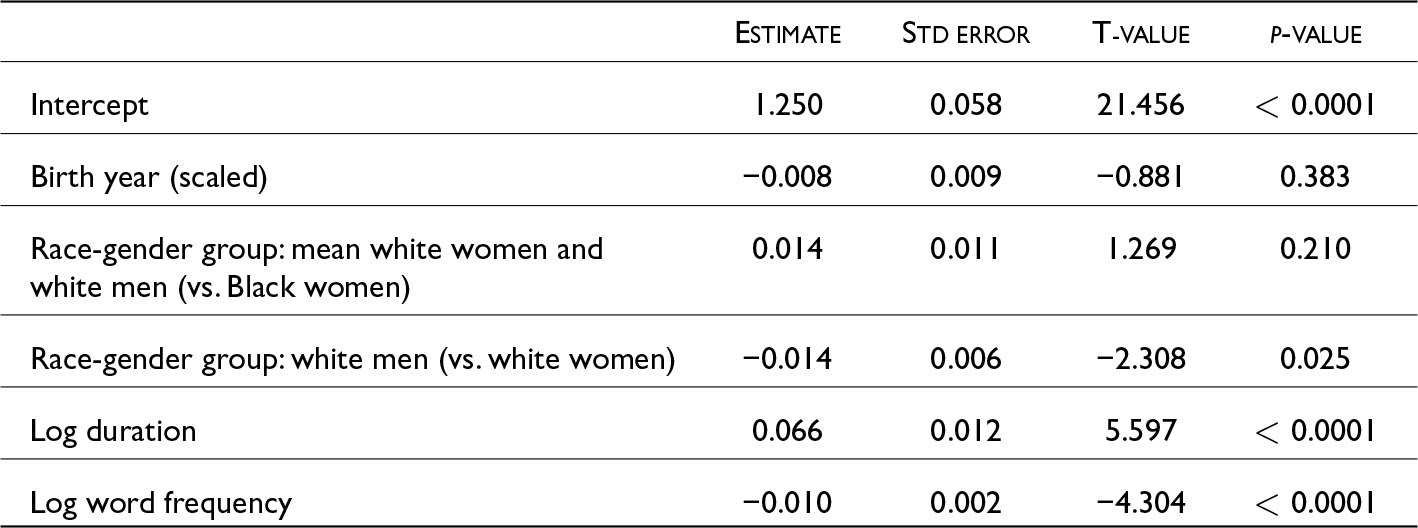
Table 3 Long description
The table presents fixed effects from a linear regression model predicting the Lobanov-normalized F1 of LOT tokens at their midpoint. The most significant predictor is log duration, which has a positive estimate and a highly significant p-value, indicating a strong positive relationship with the F1 of LOT tokens. Log word frequency also significantly predicts F1, but with a negative estimate, suggesting that higher word frequency is associated with lower F1 values. The intercept is significant, indicating the baseline F1 value. Birth year, scaled, and race-gender group comparisons show non-significant effects, suggesting these factors do not strongly influence the F1 of LOT tokens in this model. The comparison between white men and white women shows a small but significant negative effect.
Summary of linear regression model fixed effects predicting Lobanov-normalized F2 of LOT tokens at midpoint (N = 1521).
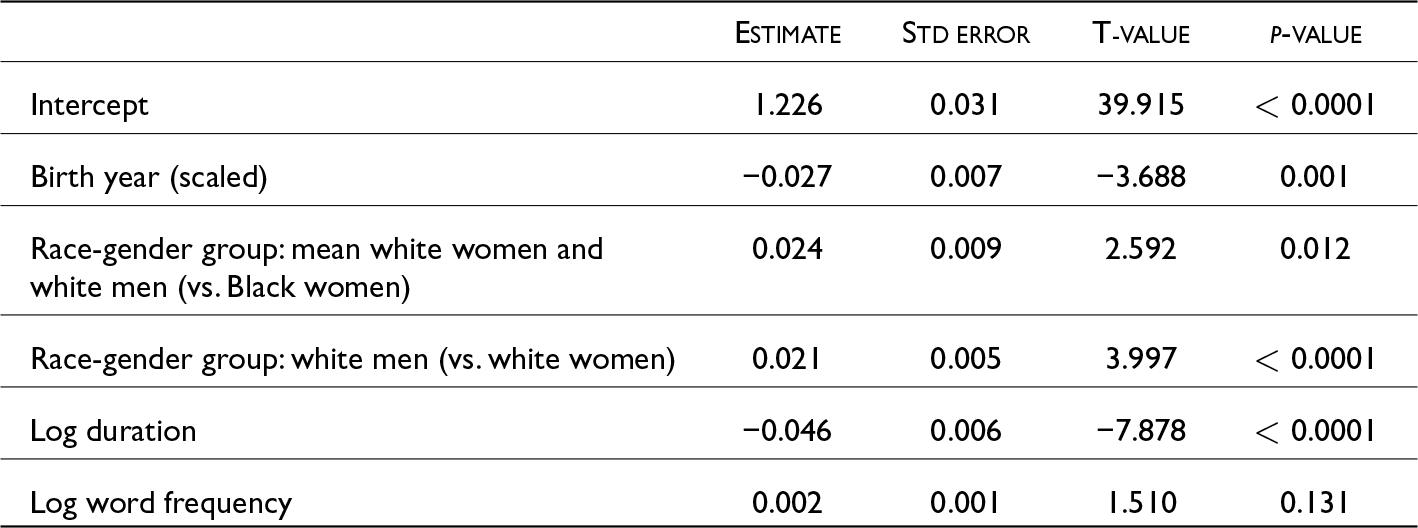
Table 4 Long description
This table presents the fixed effects of a linear regression model predicting the Lobanov-normalized F2 of LOT tokens at their midpoint. The intercept has the highest estimate at 1.226, indicating a strong baseline effect. Birth year, when scaled, shows a negative impact on F2, with an estimate of -0.027, suggesting that more recent birth years are associated with lower F2 values. Race-gender group comparisons reveal that mean white women and white men have a higher F2 than Black women, while white men have a slightly higher F2 than white women. Log duration has a significant negative effect, indicating that longer durations are associated with lower F2 values. Log word frequency has a minor positive effect, but it is not statistically significant. These findings highlight the influence of demographic and linguistic factors on the F2 of LOT tokens.
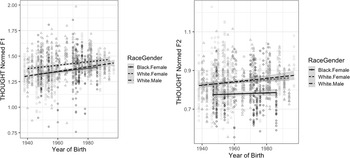
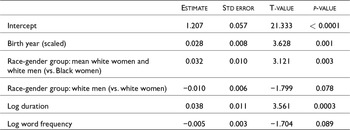
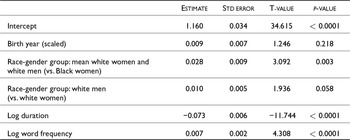
For THOUGHT (Figure 6), birth year significantly predicted increasing F1 (Table 5), but not F2 (Table 6), indicating vowel lowering in apparent time. Black women exhibited significantly smaller F1 (Table 5) and F2 values (Table 6) than white men and women, indicating higher and backer THOUGHT vowels. No significant differences emerged between white men and women in either F1 or F2.
Midpoint Lobanov-normalized F1 measurements (left) and F2 measurements (right) for THOUGHT vowel tokens, by speaker birth year and race-gender group. Lines show linear smooths by race-gender group.
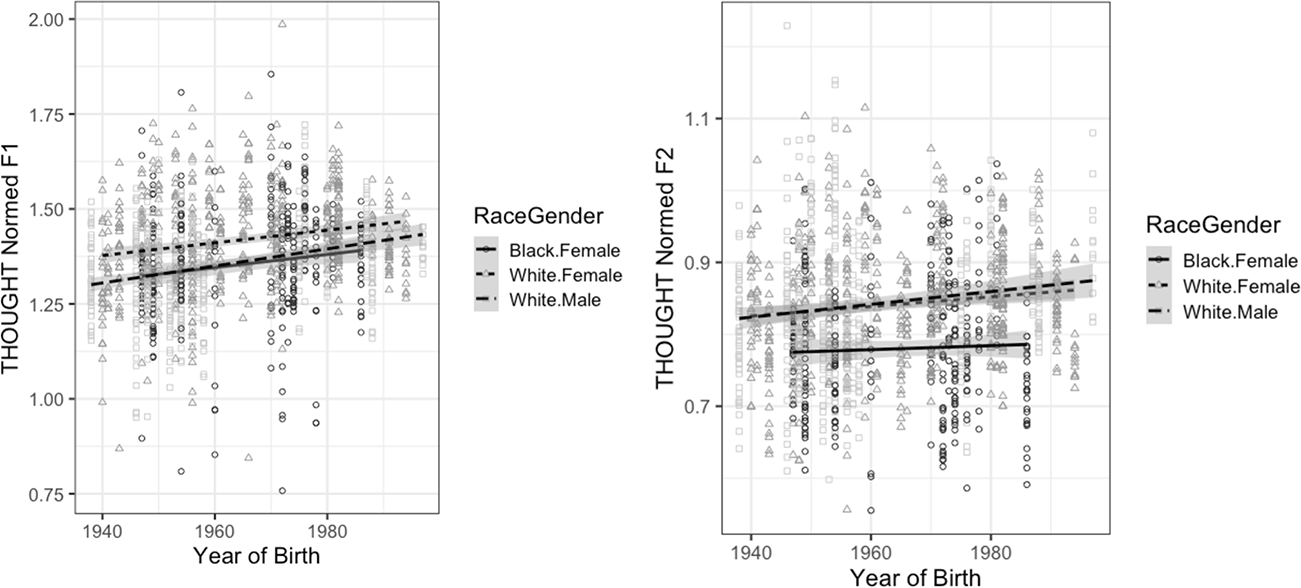
Figure 6 Long description
The image contains two scatter plots. The left plot shows THOUGHT Normalized F1 on the y-axis and Year of Birth on the x-axis. The right plot shows THOUGHT Normalized F2 on the y-axis and Year of Birth on the x-axis. Both plots categorize data by race-gender groups: Black Female, White Female and White Male, with linear trend lines for each group. The data points are scattered across the plots, with trend lines indicating changes over time for each group.
Summary of linear regression model fixed effects predicting Lobanov-normalized F1 of THOUGHT tokens at midpoint (N = 1263).
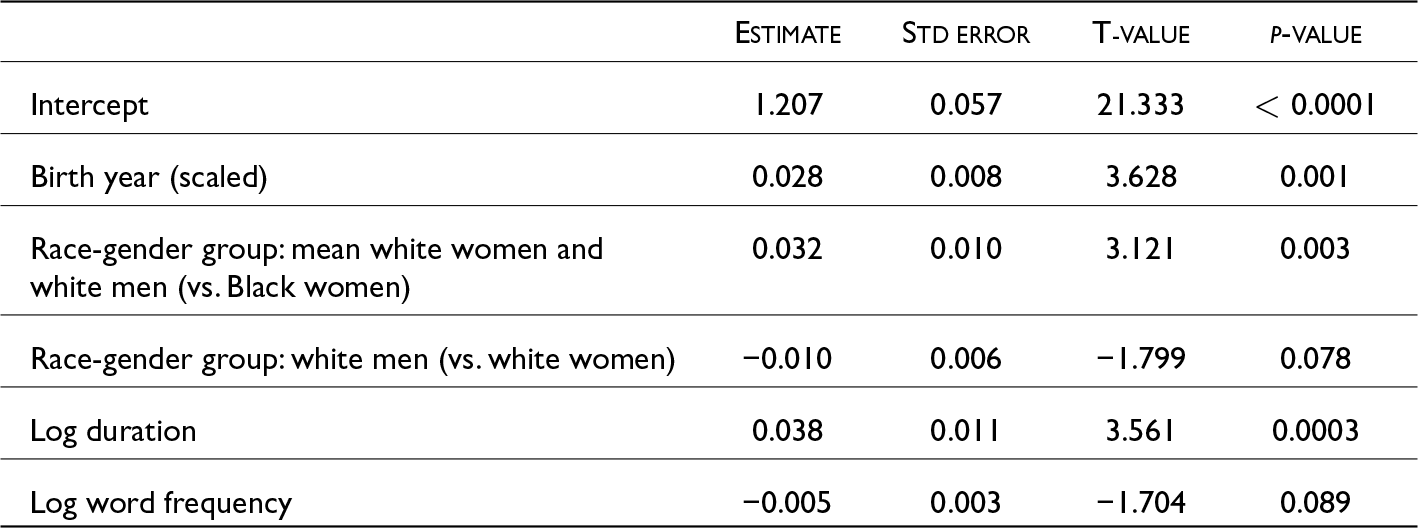
Table 5 Long description
The table presents fixed effects from a linear regression model predicting the Lobanov-normalized F1 of THOUGHT tokens at midpoint. The intercept shows a strong positive effect, indicating a significant baseline influence. Birth year, when scaled, and log duration both have positive associations with F1, suggesting that these factors contribute to higher F1 values. Race-gender group comparisons reveal that mean white women and white men have a positive effect compared to Black women, while white men show a slight negative effect compared to white women. Log word frequency has a minor negative association, indicating less impact on F1. The p-values suggest that most effects are statistically significant, except for the comparison between white men and white women, which is less conclusive.
Summary of linear regression model fixed effects predicting Lobanov-normalized F2 of THOUGHT tokens at midpoint (N = 1263).
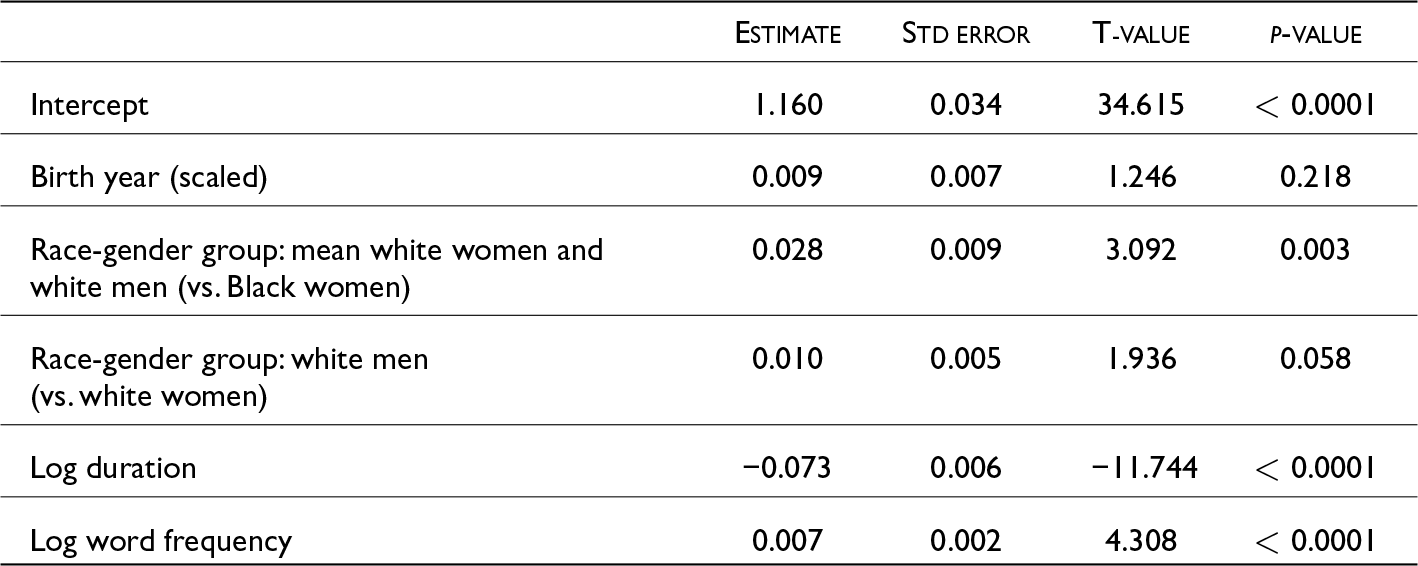
Table 6 Long description
The table presents fixed effects from a linear regression model predicting the Lobanov-normalized F2 of THOUGHT tokens at midpoint. Log duration has a significant negative effect, indicating that longer durations are associated with lower F2 values. Race-gender group comparisons reveal that mean white women and men have higher F2 values compared to Black women, while white men have slightly higher F2 values than white women. Birth year does not significantly affect F2 values. Log word frequency positively influences F2, suggesting more frequent words have higher F2 values. The p-values indicate the statistical significance of these effects, with most findings being significant except for birth year and the comparison between white men and women.
The acoustic analyses of midpoint formant measurements suggest apparent time movement in all three vowel classes: CHICAGO showed lowering and fronting, LOT showed backing, and THOUGHT showed lowering in apparent time. No age effects significantly interacted with race-gender group. Furthermore, CHICAGO does not appear to be neatly tracking the movement of LOT or THOUGHT. While CHICAGO lowers like THOUGHT, it also significantly fronts, whereas THOUGHT does not change in backness, and LOT backs in apparent time.
Similarly, CHICAGO’s race-gender patterning does not seem to closely mimic the patterning of LOT or THOUGHT. Black women exhibited lower and fronter CHICAGO vowels, backer LOT vowels, and higher and backer THOUGHT vowels than white speakers. White women showed significantly lower CHICAGO vowels than white men, following the same pattern shown for LOT height. However, white women also showed backer LOT than white men, an effect not observed in the CHICAGO class.
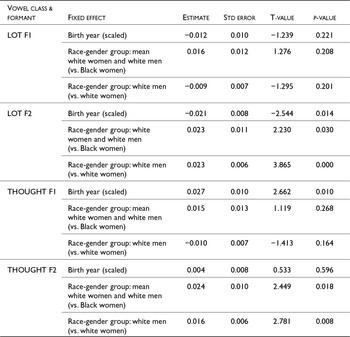
An important caveat is that the lexical item Chicago is anomalous with respect to its high relative word frequency within the corpus. Chicago was the most frequent word analyzed across our quantitative data (log(f) = 7.69), compared to the three most frequent words across the THOUGHT (thought = 6.47, god = 6.42, talk = 6.39) and LOT classes (mom = 6.53, block = 5.98, father = 5.81). Further, while every speaker produced Chicago in their interview, no single THOUGHT or LOT word appeared in every interview. Thus, no direct comparison exists in either class with respect to word frequency. However, to ensure that the differences between CHICAGO and LOT/THOUGHT were not solely attributable to differences in frequency, we fitted post-hoc linear regression models using the same predictors as described above on the LOT and THOUGHT F1 and F2 data for a subset of each that fell in the upper quartile of word frequency within each vowel class (LOT log(f) ≥ 4.710; THOUGHT log(f) ≥ 5.996). Main effects of the social predictors of interest are provided for each of these post-hoc models in Table 7.
Summary of social fixed effects predicting Lobanov-normalized formant values among high frequency word data sets for LOT (N = 398) and THOUGHT (N = 328).
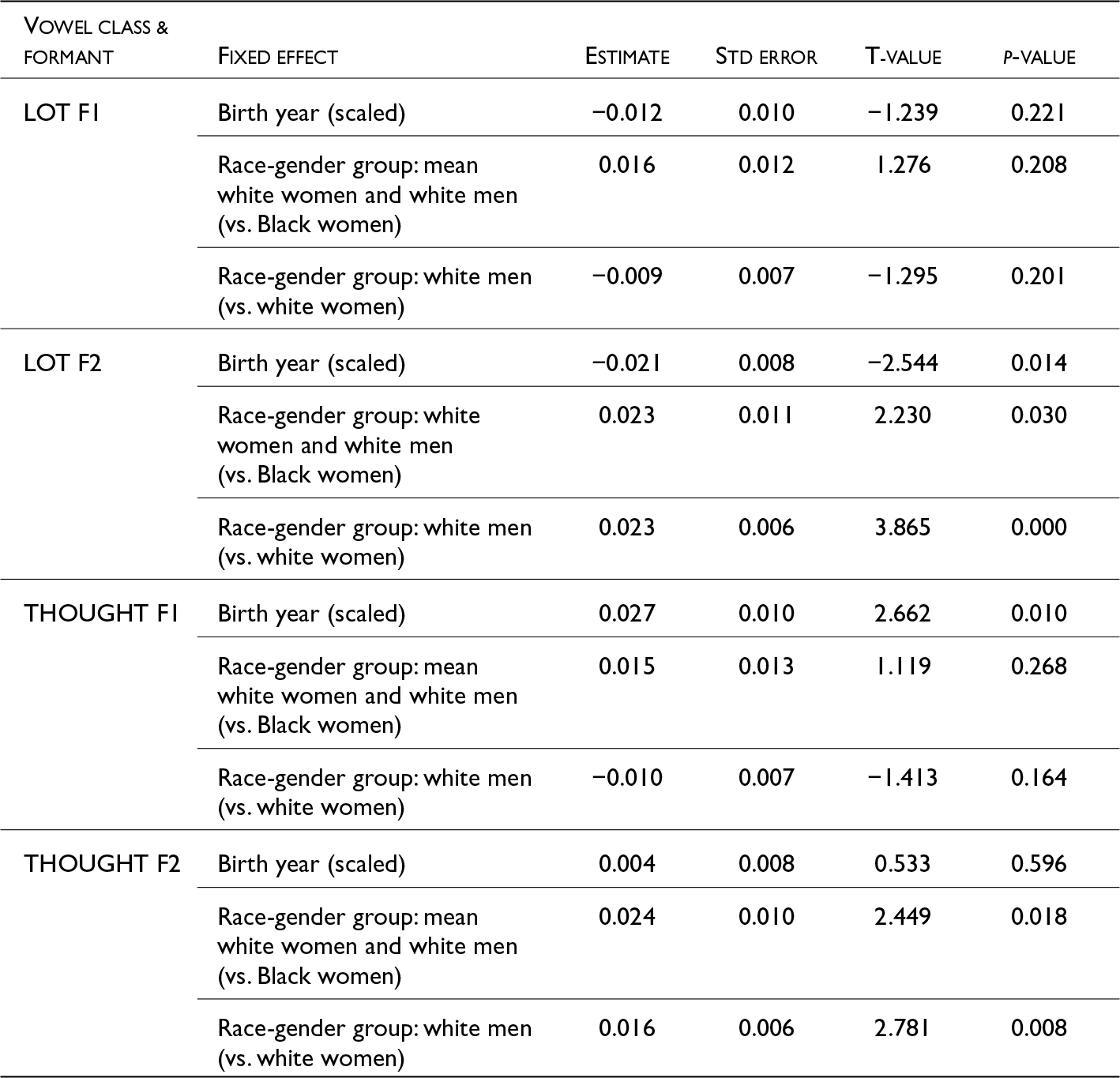
Table 7 Long description
The table analyzes the impact of social fixed effects on Lobanov-normalized formant values for LOT and THOUGHT vowels. Birth year has a significant negative effect on LOT F2 and a positive effect on THOUGHT F1. Race-gender group comparisons show significant differences in LOT F2 and THOUGHT F2, particularly between white men and white women, and between white individuals and Black women. The estimates indicate that white men have higher LOT F2 and THOUGHT F2 values compared to white women. The p-values suggest that these effects are statistically significant, except for some comparisons in LOT F1 and THOUGHT F1. The analysis highlights the influence of birth year and race-gender group on vowel formant values, with some effects being more pronounced than others.
Among high frequency words, birth year effects emerged for the same measurements as in the full dataset, significantly predicting LOT F2 and THOUGHT F1, but not LOT F1 or THOUGHT F2. As in the full dataset containing words at all frequencies, Black women showed significant differences from white speakers in LOT F2 and THOUGHT F2. In contrast to the full dataset, Black women did not differ from the other groups in THOUGHT F1, and white women and men significantly differed from one another in both LOT F2 and THOUGHT F2, but not in F1 of either vowel class. This diverged from the overall dataset wherein Black women showed significantly lower THOUGHT vowels than white speakers, and white women and men significantly differed in LOT F1, LOT F2, and THOUGHT F1, but not THOUGHT F2.
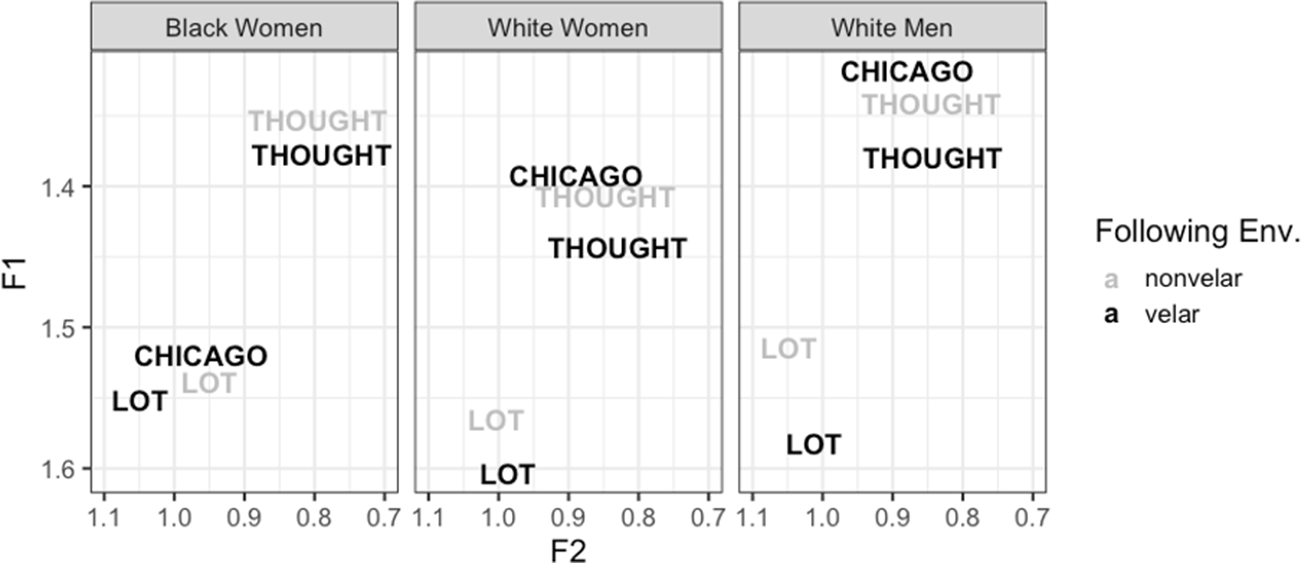
Crucially, neither LOT nor THOUGHT tokens mirror the social patterning of the CHICAGO vowel, even among high word frequencies. Black women exhibited lower and fronter CHICAGO vowels than white speakers, while they showed backer high frequency LOT and THOUGHT vowels than white speakers. White women showed significantly lower CHICAGO vowels than white men, while they showed backer LOT and THOUGHT vowels among high frequency words. To further emphasize the unique behavior of CHICAGO relative to other LOT or THOUGHT tokens, we plot the means of these LOT and THOUGHT tokens by following phonological context (pre-velar, like CHICAGO, or pre-non-velar) by race-gender group, alongside their CHICAGO mean counterparts in Figure 7.
Mean F1 and F2 for CHICAGO, LOT and THOUGHT vowel classes, by vowel following phonological environment (velar versus nonvelar segment) and race-gender group.
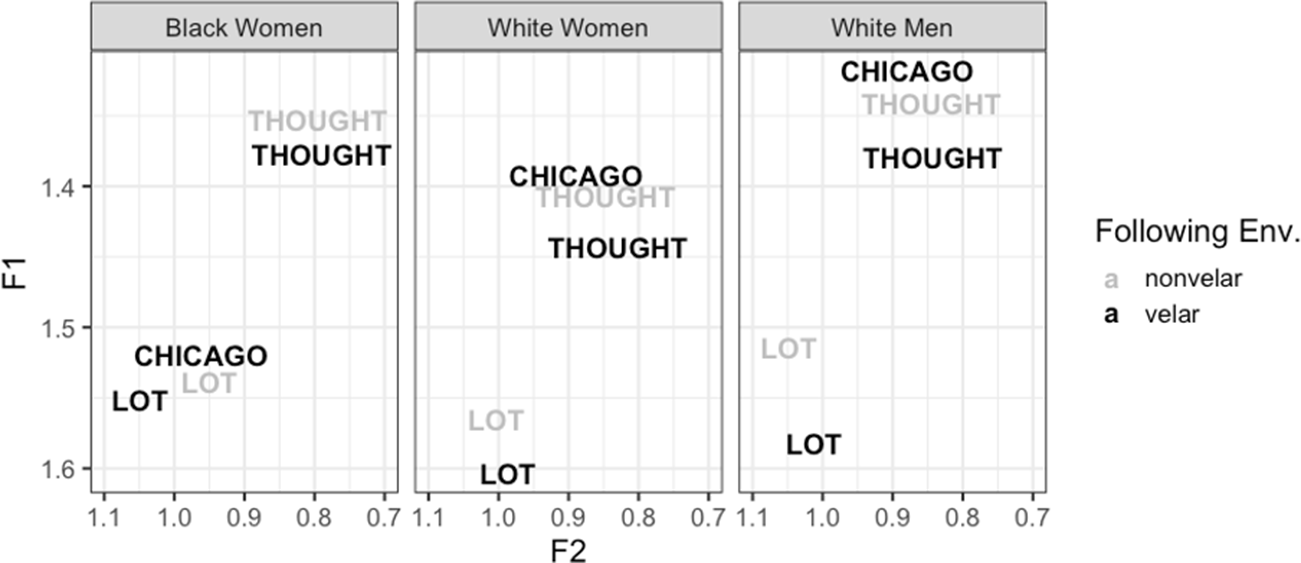
Figure 7 Long description
Three plots display the mean F1 and F2 values for CHICAGO, LOT and THOUGHT vowel classes across different race-gender groups. The x-axis represents F2 values ranging from 1.1 to 0.6 and the y-axis represents F1 values ranging from 1.6 to 1.4. The first plot is labeled 'Black Women' and shows CHICAGO, LOT and THOUGHT vowels. The second plot is labeled 'White Women' and displays CHICAGO, LOT and THOUGHT vowels. The third plot is labeled 'White Men' and includes CHICAGO, LOT and THOUGHT vowels. Each plot distinguishes between nonvelar and velar following environments.
For Black women, CHICAGO’s mean is closer to LOT regardless of LOT’s following phonological environment (Figure 7). For both white women and white men, CHICAGO means are higher and backer, surpassing their groups’ respective THOUGHT vowel means in both following phonological environments. Although low token numbers in pre-velar contexts allow only qualitative observation of aggregate data, Figure 7 supports the observation that the CHICAGO vowel behaves differently from LOT and THOUGHT class vowels, even in analogous phonological contexts. We next turn to a measure designed to capture the relation between CHICAGO, LOT, and THOUGHT in the vowel space.
LOT-THOUGHT Euclidean distance difference (LT Difference) analysis
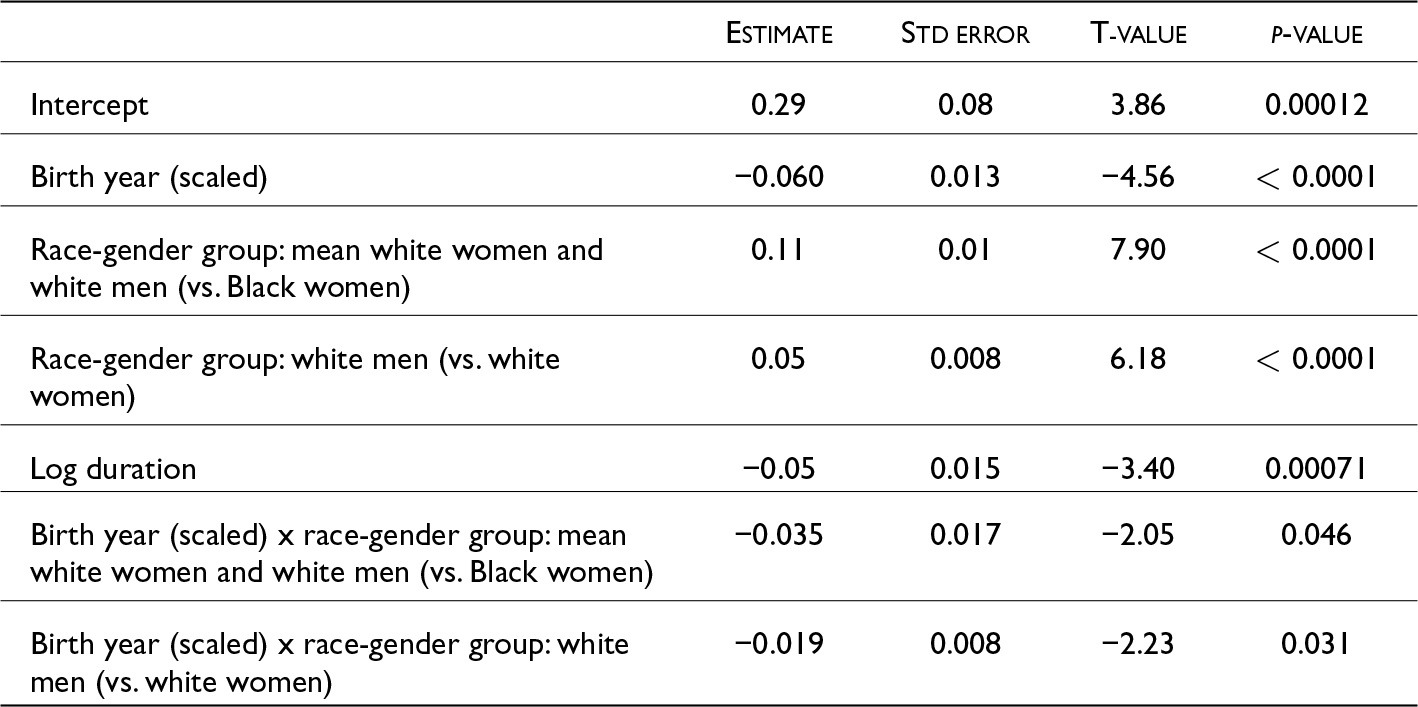
As described above, we devised a by-token measure to examine whether the distance between a given CHICAGO vowel token is closer to that speaker’s mean LOT vowel productions or their mean THOUGHT vowel productions, or LT Difference. We included all phonological environments when calculating means of LOT and THOUGHT for a given speaker. A positive LT Difference value indicates the CHICAGO token fell closer to the speaker’s THOUGHT mean than their LOT mean; a negative value indicates the CHICAGO token fell closer to their LOT mean than their THOUGHT mean. These values were calculated for each CHICAGO token and submitted to a linear mixed effects model (Table 8).
Summary of regression model fixed effects predicting LOT–THOUGHT Euclidean distance difference measurements for CHICAGO vowel tokens (N = 847).
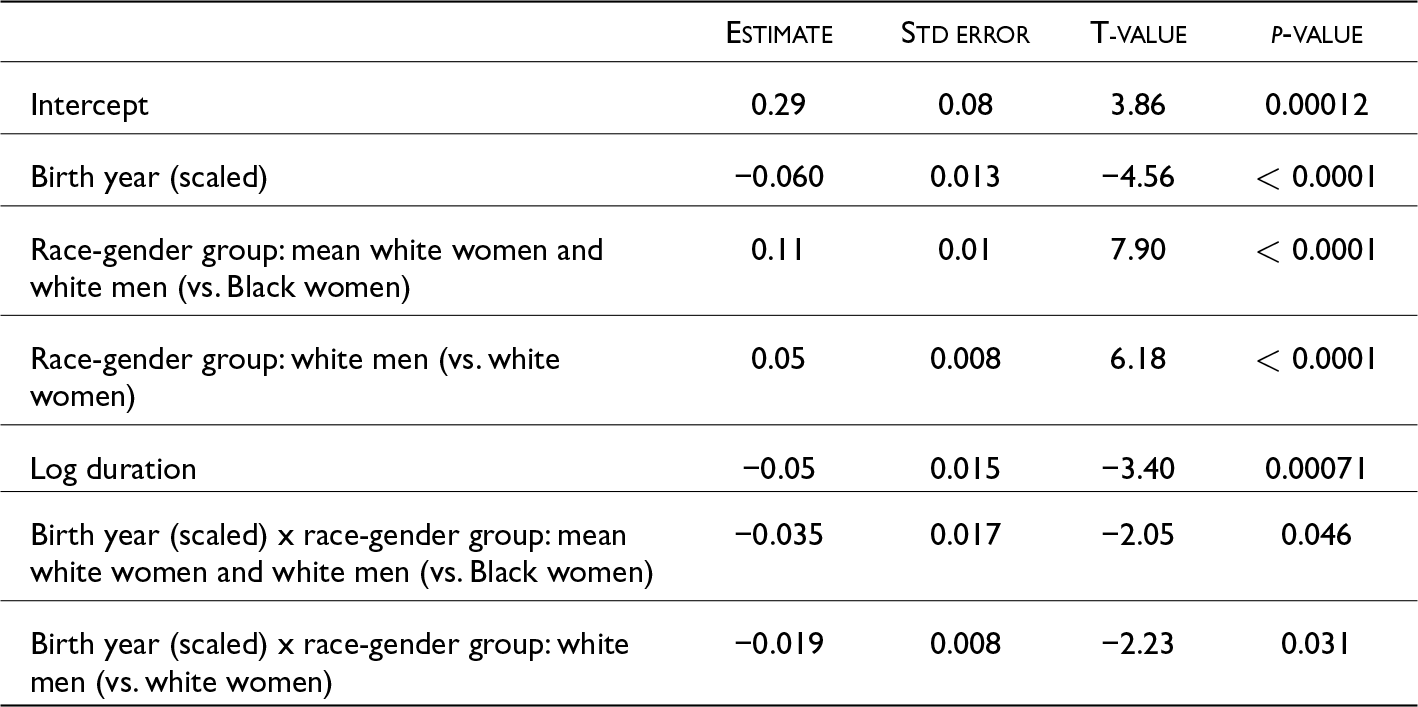
Table 8 Long description
The table presents fixed effects from a regression model predicting vowel distance differences in Chicago. Key findings include a significant inverse relationship between birth year and vowel distance, indicating that more recent birth years are associated with smaller distances. Race-gender group comparisons reveal that both white men and women have significantly different vowel distances compared to Black women, with white men also differing from white women. The interaction between birth year and race-gender group shows nuanced effects, with both interactions being statistically significant. These results suggest complex influences of demographic factors on vowel pronunciation, highlighting the importance of considering both individual and interaction effects in linguistic studies.
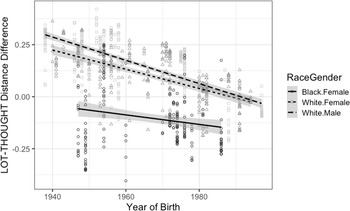
Results from the LT Difference regression model indicated significant effects of speaker age, speaker race-gender group, and their interaction for CHICAGO tokens (Table 8, Figure 8). The model illustrated that LT Difference was decreasing in apparent time, suggesting that speakers were shifting to produce their CHICAGO tokens closer to LOT as compared to THOUGHT. Black women produced CHICAGO vowels significantly closer to LOT than THOUGHT as compared to white speakers, and white women produced CHICAGO significantly closer to LOT than THOUGHT as compared to white men. Finally, LT Difference was the only measure that showed an interaction between birth year and race-gender group, indicating that speaker age had a significantly greater impact on LT Difference measurements for white men than white women, and that age had a significantly greater impact for white speakers as compared to Black women.
LOT-THOUGHT Euclidean distance difference measurements for CHICAGO vowel tokens, by speaker birth year and race-gender group. Lines show linear smooths by race-gender group. Positive LT Difference = closer to THOUGHT, negative = closer to LOT.
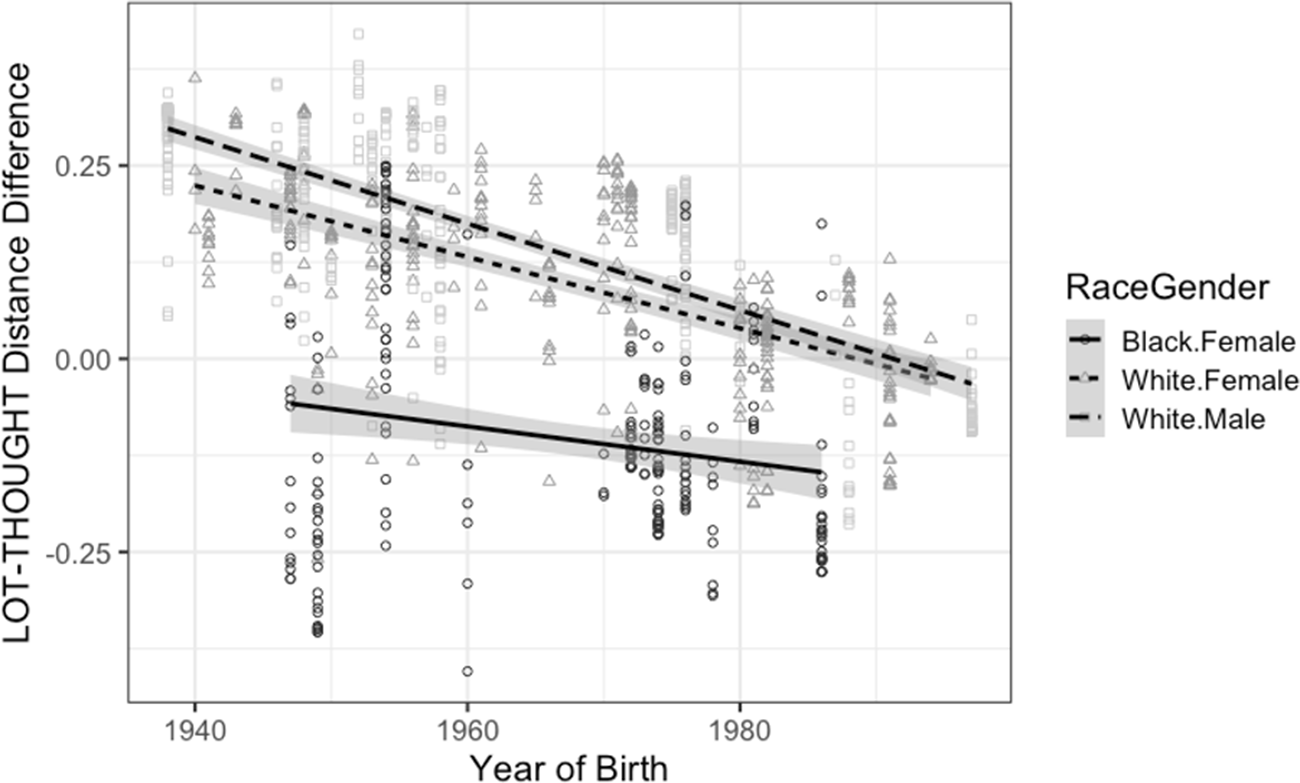
Figure 8 Long description
A graph showing LOT-THOUGHT distance difference on the y-axis and year of birth on the x-axis. Three lines represent different race-gender groups: Black Female, White Female and White Male. The graph shows a decreasing trend in distance difference over time for all groups, with Black Females having the highest values and White Males the lowest. Data points are scattered around the lines, indicating individual measurements.
Every race-gender group showed an apparent time decrease in LT Difference, indicating CHICAGO tokens moving closer to LOT than THOUGHT over time. However, white speakers showed a greater shift by age in LT Difference than Black women (solid line Figure 8), and white men (dashed line) showed a greater shift than white women (dotted line). Black women produced CHICAGO tokens that on average fell below zero (Figure 8, open circles), indicating closer placement to a speaker’s LOT vowel than THOUGHT. By contrast, white speakers, particularly older men, tended to produce CHICAGO tokens that fell above zero, indicating tokens closer to a speaker’s THOUGHT vowel mean (Figure 8), though women were closer to the middle of the scale.
Summary of acoustic results
In sum, we found that the CHICAGO vowel in Beverly and Morgan Park showed an overall apparent time change in F1 and F2, with the vowel lowering and fronting over time. While LOT and THOUGHT were also shifting in apparent time, the directionality differed from that of CHICAGO regardless of word frequency or phonological environment, suggesting that CHICAGO does not simply track with either class. The LT Difference measure suggested that the CHICAGO vowel shifted over time toward speakers’ LOT classes, and away from THOUGHT. This indicates a change in vowel quality and perhaps a phonemic re-classification of CHICAGO.
Race-gender group was also a significant predictor of CHICAGO productions. Black women showed lower and fronter CHICAGO—more advanced in the direction of the apparent time change—than white speakers, and white women showed lower CHICAGO tokens than white men. Furthermore, birth year significantly interacted with race-gender group for the LT Difference measure: younger white speakers in both gender groups produced CHICAGO tokens closer to LOT and further from THOUGHT over time as compared to older white speakers. However, Black women across ages produced CHICAGO closer to LOT than THOUGHT. Interestingly, these patterns parallel the age and race-gender patterns of NCS reversal in the same community (D’Onofrio & Benheim Reference D’Onofrio and Benheim2020; D’Onofrio et al. Reference D’Onofrio, Benheim and Foster2020): while all speaker groups exhibit NCS reversal in apparent time, Black women are most advanced.
Meta-linguistic commentary
We next analyzed meta-linguistic comments surrounding the pronunciation of ‘Chicago’, particularly as they pertained to the CHICAGO vowel. The majority of speakers in our sample (thirty-nine of fifty-six) shared commentary contrasting the two phonemic CHICAGO variants discussed in the acoustic analysis: LOT versus THOUGHT. Nearly all speakers who created this contrast afforded authentic place identity to only one variant. Overall, meta-linguistic commentary revealed that speakers positioned the CHICAGO variants in two main ways: discussing THOUGHT as authentic and correct (THOUGHT-preferring) or LOT as authentic or correct (LOT-preferring), largely along the same age and race-gender group lines observed in the acoustic analysis. Although authentication of place identity predominated in the metalinguistic appraisals of each variant, we describe differing social meanings attributed to the variants below.
THOUGHT as authentic and local
Twenty-five of the thirty-nine speakers who provided metalinguistic commentary on CHICAGO described THOUGHT as local, authentic, and preferred (THOUGHT-preferring). Within this group, eight focused primarily on THOUGHT as authentic, while seventeen additionally contrasted LOT-like productions as inauthentic, incorrect, or outsider. The former group was almost entirely white and generally older than the rest of the sample. Many of their comments positioned THOUGHT as ‘native’-like at various scales, from the city as a whole to the neighborhood area itself. NathanFootnote 3 (white, male, 60 years old) explicitly stated that “[ʃɨkɔɡoʊ] is correct”. Bill (white, male, 79) said that “a real Chicagoan says [ʃɨkɔɡoʊ]”. Narrowing even further, Stan (white, male, 63) said that “if you were down in Beverly everybody, everybody would say [ʃɨkɔɡoʊ]”. Some comments revealed a strong investment in the stance: “I do feel strongly about it, it’s [ʃɨkɔɡoʊ]”, said Todd (white, male, 67). Indicating a clear historical component, Dolly (white, female, 69) related that “some people say [ʃɨkɔɡoʊ], that’s how I always said it. I always said it cuz my parents, we all said that, [ʃɨkɔɡoʊ]”.
The group of seventeen speakers who both preferred THOUGHT and explicitly contrasted it with LOT was also predominantly white and older. In an extended story, Maggie (white, female, 61) described how variation in CHICAGO manifested at her wedding: “My uh girlfriend from [out of state] that was in my wedding, uh, she would say [ʃɨkɑɡoʊ], and the best man like bit her head off one night: ‘It’s not [ʃɨkɑɡoʊ] it’s [ʃɨkɔɡoʊ]’. Poor [name] was like mortified. I mean to me it’s like, you can tell you didn’t grow up here if you say [ʃɨkɑɡoʊ]”. Alan (white, male, 61) claimed that “[ʃɨkɔɡoʊ] is how people from Beverly say it. I hear [ʃɨkɑɡoʊ] from other people from outside of the community”. Not all of the speakers who expressed the contrast were older, however. One of the youngest speakers in the sample, Addison (white, female, 24), claimed [ʃɨkɔɡoʊ] as the correct variant, saying “if you say [ʃɨkɑɡoʊ], get the fuck out of my face”. While all seventeen of these speakers positioned LOT as dispreferred or “outsider”, the manifestation of outsiderness varied across the commentary. When asked who pronounces CHICAGO with a LOT-like vowel, Jeff (white, male, 71) responded “hopefully this doesn’t sound, uh… I wasn’t used to the fact that most Black people came from the South here”. Similarly, Betty (white, female, 76) recognized that, in the city, “many people say [ʃɨkɑɡoʊ] and I think a lot sometimes that’s a South Side thing”. Interestingly, Betty tags the ‘South Side’ as using the incorrect variant despite Beverly itself being located on Chicago’s South Side. The implication here could relate to intersections of race and class ideologically associated with the ‘South Side’ as a discursive object (Moore Reference Moore2016), in contrast with older conceptions of white, middle-class Beverly.
LOT as authentic and local
In contrast with THOUGHT-preferring speakers, fourteen speakers claimed LOT as local and correct (LOT-preferring), with five of those speakers additionally displacing THOUGHT as incorrect or outsider, fully inverting the THOUGHT-preferring stance. This latter position was held by four Black women speakers, generally older, and one young white male. Independently of the interviewer’s prompting, Norma (Black, female, 68) explained that when she heard people say [ʃɨkɔɡoʊ] “it makes me wonder if they’re actually from [ʃɨkɑɡoʊ]”. Shari (Black, female, 39) offers a similarly strong stance: “I am a true /ʃɨkɑɡoʊən/. I think I say it the way it should be said”.
Other speakers who preferred LOT acknowledged variation in the CHICAGO vowel yet still staked out LOT as authentically local. Melinda (Black, female, 45) stated that “you know, it’s just [ʃɨkɑɡoʊ] to me. I heard people call it [ʃɨkɔɡoʊ] and all kinds of stuff, but it’s [ʃɨkɑɡoʊ]”. Similarly, Gavin (white, male, 20) acknowledges transience as one source of vocalic variation, saying, “The biggest thing is vowels, like [ɑ], like [ʃɨkɑɡoʊ]. I can tell with people who have grown up in the area”. He later discusses both variants but confirms that “I do prefer the first one: [ʃɨkɑɡoʊ]”. Nine speakers claimed LOT as local, but the scope of locality was expanded to Chicago as a whole, rather than Beverly or the South Side in particular. Across the LOT-preferring group, THOUGHT was not positioned as outsider to the same extent as THOUGHT-preferring stances against LOT. Many LOT-preferring speakers instead associated THOUGHT’s ‘incorrectness’ with places or people within the Chicago area: in particular, older, white community members and personae. Lisa (Black, female, 36) recognized intra-city variation in pronunciation of the vowel, but affirmed that “[ʃɨkɑɡoʊ] is how people from Chicago say it”. She mentioned hearing THOUGHT-like pronunciations among residents but “not in my circle”. Some younger white speakers explicitly linked their older relatives with THOUGHT. Rebecca (white, female, 26) said that “for some reason my mom says [ʃɨkɔɡoʊ], my grandma says [ʃɨkɔɡoʊ], and I don’t, cuz it’s [ʃɨkɑɡoʊ], and my brother and I are always like, ‘it’s [ʃɨkɑɡoʊ]!’ Like, ‘you’re saying it wrong’”. In the same way, Shannon (white, female, 23) recounted that “a lot of people that I know say [ʃɨkɔɡoʊ], which I feel like is the older way of saying it”.
Additional social meanings of CHICAGO variants
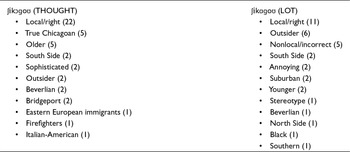
In addition to documenting the place-authenticating metalinguistic positions associated with each variant, we noted descriptor words that emerged in association with each variant (Table 9).
Meta-linguistic descriptor words used in relation to CHICAGO variants, and number of instances used throughout all interviews in the speaker sample.
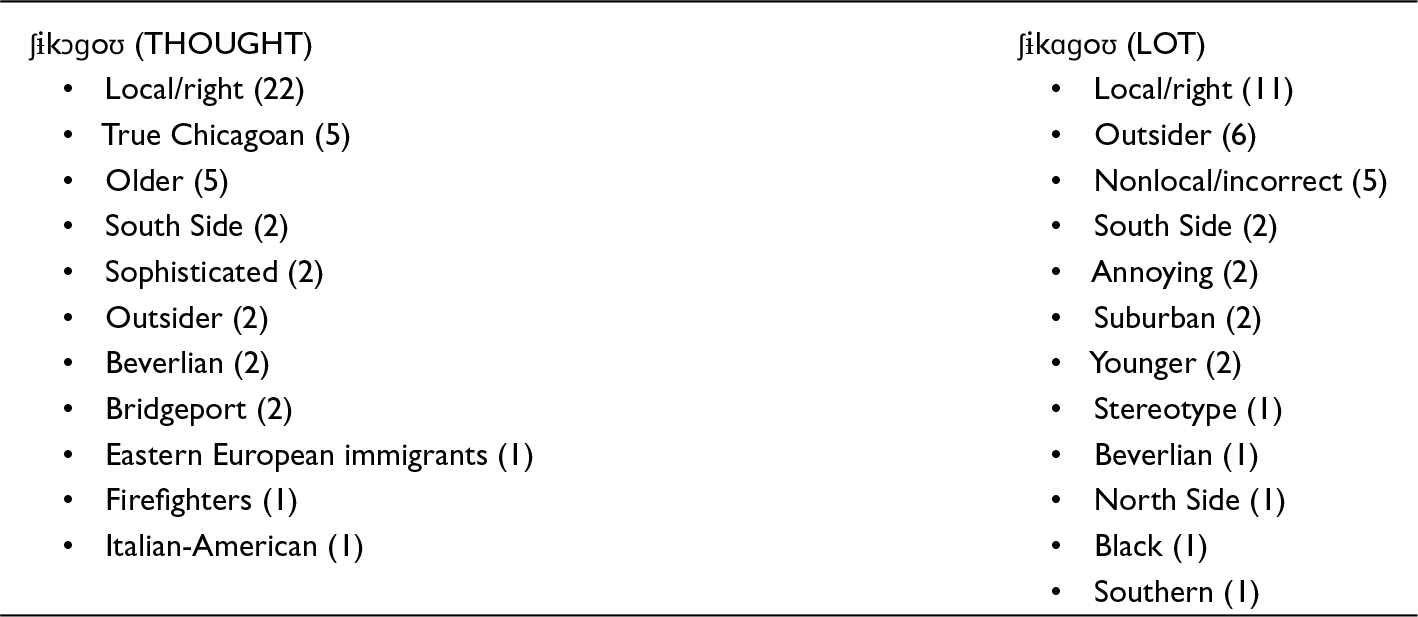
Table 9 Long description
The table compares meta-linguistic descriptors for two Chicago pronunciation variants: ʃɨkɔɡoʊ and ʃɨkɑɡoʊ. The ʃɨkɔɡoʊ variant is most frequently described as 'Local/right' with 22 instances, followed by 'True Chicagoan' and 'Older', each with 5 instances. In contrast, the ʃɨkɑɡoʊ variant is also described as 'Local/right' but with fewer instances (11), and is notably associated with 'Outsider' (6 instances) and 'Nonlocal/incorrect' (5 instances). Both variants share descriptors like 'South Side' and 'Beverlian', but differ in associations such as 'Sophisticated' for ʃɨkɔɡoʊ and 'Annoying' for ʃɨkɑɡoʊ. This suggests differing perceptions and social connotations between the two pronunciations.
As reflected in the broader positioning statements, both THOUGHT- and LOT-like Chicago vowels were at times described as ‘local/right’ or, contrastingly, as ‘outsider’, or ‘nonlocal/incorrect’. Notably, both variants were also described as linked with Beverly, or with the South Side generally, by different speakers. However, other descriptors emerged only in relation to one variant. Only THOUGHT was described as ‘older’, ‘sophisticated’, and associated with Bridgeport, a historically white working-class neighborhood on the South Side. Additionally, linkages between THOUGHT and particular ‘white ethnic’ groups like Eastern Europeans and Italian Americans, as well as local personae, such as firefighters, arose among both THOUGHT-preferring and LOT-preferring speakers. By contrast, LOT was the only variant described as ‘suburban’ and ‘annoying’, and it was also linked with Black speakers, young speakers, and the US South, volunteered again by speakers of both positions.
Discussion and conclusions
Within a single local context, we documented significant phonetic variation in place-name production that is mirrored by contrastive metalinguistic discourses, in which residents identify one variant as authentically ‘local’ and displace the other as ‘outsider’. Acoustic analysis revealed significant apparent time change in CHICAGO vowel quality and phonemic patterning over time among Beverly and Morgan Park residents, with the CHICAGO vowel shifting away from speakers’ THOUGHT classes and toward their LOT classes over time. Black women appeared to be leading the change, followed by white women, and finally white men. Notably, these results illustrate not only a phonetic shift in the vowel’s quality, but also variation in phonemic analysis of the vowel as THOUGHT-classed or LOT-classed. Results from the LT Difference measure suggest that Black women of all ages tended to produce CHICAGO tokens closer to LOT, while white speakers of all ages produced CHICAGO closer to THOUGHT. That these differences are clearly implicated in identity work and take on explicit social meanings suggests that social meanings can attach to higher level phonological representations, contradicting proposals to the contrary (e.g. Eckert & Labov Reference Eckert2017).
Analysis of metalinguistic commentary revealed that the majority of speakers identified THOUGHT-like productions as local, and this group was predominantly older and white, reflecting the convenience sample of participants. Unsurprisingly, these individuals constituted the demographic more likely to produce CHICAGO tokens closer to THOUGHT. This group also exemplifies Beverly and Morgan Park in the mid-twentieth century, when white, Irish Catholic individuals made up the majority of neighborhood residents (Oswald Reference Oswald2003). In this group, metalinguistic commentary surrounding THOUGHT-like pronunciations of CHICAGO was especially likely to invoke chronotopes (Bakhtin Reference Bakhtin and Holquist1981; Agha Reference Agha2007; Britt Reference Britt2018) of authentic Chicago-ness. These ideological depictions of the ‘real’ city emblematize particular neighborhoods (e.g. Bridgeport, Beverly) populated by specific personae (white ethnic, blue collar individuals) who exhibit certain speech patterns (THOUGHT-like productions of CHICAGO, more advanced NCS features) within a historical time period (early-to-mid-twentieth century). Commentary such as Ronald’s (white, male, 69) tethers THOUGHT-like productions in Beverly and Morgan Park to the Mayors Daley, iconic ‘white ethnic’ and working-class Chicago figures: “[ʃɨkɔɡoʊ] is, you know… that’s what the original old Mayor Daley used to call it”. Both Richard J. Daley and his son, Richard M., who served as mayors of Chicago for a collective forty-three years between 1933–2011, hailed from Bridgeport, a historically Irish American, blue collar neighborhood on the South Side. Other speakers render this connection between THOUGHT and Bridgeport explicit, as Mallory (white, female, 29) notes, “I think [ʃɨkɔɡoʊ] sounds very Bridgeport-y”.
Similar to Beverly and Morgan Park, Bridgeport experienced significant demographic shifts since the mid-twentieth century, with an influx of Asian and Hispanic Chicagoans. That older white speakers in our sample worked to historicize Bridgeport as a locus of authenticated ‘true Chicagoan’ personae—exemplified by the Daleys—illustrates the projection of THOUGHT-like CHICAGO as a holdover from a more homogeneously ‘white ethnic’ working class conception of Chicago and the South Side specifically. Paul (white, male, 33) identifies the white South Side as a “lost generation”, clarifying that the “stereotypic South Side accent… I don’t think I’ve ever heard it from a young person… from anybody who’s less than forty-five”. In this way, THOUGHT emerges as iconic of the ‘old’ South Side, indexing white ethnic groups like Irish and Italian Americans, working class identity, and the political ‘machine’ (Flanagan Reference Flanagan, Reiff, Keating and Grossman2005) in Chicago in ways that no longer cohere with contemporary demographic and cultural headwinds of Beverly and Morgan Park, the South Side, and the city more broadly (Oswald Reference Oswald2003; Patillo Reference Patillo2010; Moore Reference Moore2016). Ultimately, a chronotopic framing of the neighborhood underlaid some older white speakers’ preservation of THOUGHT as a means to secure an authenticated status within Chicago. The historicized personae and registers indexed by THOUGHT-like productions likely further motivate these residents’ erasure of their neighbors’ LOT productions as valid local variants.
In contrast to the discursive erasure of LOT-like CHICAGO from authentic Chicago-ness, other speakers affirmed the existence of chronotopically linked THOUGHT-like productions but instead displaced it outside of their own sense of localness. Speakers at the forefront of the shift toward LOT-like CHICAGO productions—older Black women and younger speakers of both racialized groups—were most likely to identify LOT-like CHICAGO as the ‘correct’ local pronunciation. In their commentary, these speakers utilized LOT to counter all-encompassing chronotopic representations of authentic Chicago-ness and make way for new expressions of place authenticity. Through metalinguistic commentary, multiple Black women speakers who otherwise affirmed LOT as ‘correct’ located THOUGHT within “a specific demographic of speakers, particularly Caucasians from a certain area… near Bridgeport” (Melinda, Black, female, 45). Similarly, Irene (Black, female, 57) finds that when she hears people “with a true Chicago accent, you get it, you can place it”, then proceeds to place it at a “white Sox game” and the “Bridgeport area”. Naomi (Black, female, 63) proposes that “even though Chicago as a community has become more diversified… especially when you go into the neighborhoods, you know where you are. I know when I’m in Bridgeport”. Thus, LOT-preferring speakers still identify, without endorsing or authenticating, features of the same THOUGHT-linked chronotope offered by speakers who hold contrastive semiotic mappings. While THOUGHT-preferring and LOT-preferring speakers both associate THOUGHT with the same neighborhood and personae, its n+1st order indexical meanings diverge between the groups: THOUGHT-preferring speakers see Bridgeport as representative of authentic Chicagoness, placing Beverly/Morgan Park (and, therefore, themselves) within that same category; LOT-preferring speakers see the same place as distant from their own conception and experience of being Chicagoan.
Naomi further attributes outsider status as well as specific qualia to THOUGHT-like CHICAGO productions: “[ʃɨkɔːɡoʊ], that’s like putting ketchup on a hot dog”. As residents of Chicago know, topping a hot dog with ketchup is severely tabooed in the city. In this instance, Naomi ideologically links THOUGHT with behavior only outsiders would perform, and that authentic Chicagoans would openly disdain. Naomi lengthens the vowel to stylize her performed ‘incorrect’ token, establishing an iconized reading of the variant that, like squeezing ketchup onto a hot dog, suggests qualia of manner (messy, uncultured) and of setting (baseball games, sports bars, Chicago-style hot dog restaurants). This reading emulates how two other black women locate THOUGHT in liquor stores and “on game day” (Lisa) and at a “white Sox game” (Irene). The speakers who position LOT as authentic ideologize THOUGHT and its qualities as equal to the qualities of speakers who typically produce it: white, older, nonlocal to Beverly and Morgan Park, sports fans. In the process, they work not to erase THOUGHT from Chicago as a whole, but to narrow its indexical associations, locate it outside their local community, and heave off the chronotope limiting their own expression of authentic place identity.
Having outlined the contrastive semiotic mappings enmeshed in CHICAGO, we propose that place authentication, as an ideological project, implicates an axis of differentiation that productively delineates what it also means to be place inauthentic. Beverly and Morgan Park represent communities bordering the suburbs, with a history of racial integration unique within Chicago (Oswald Reference Oswald2003), and sometimes distinguished from the rest of the city as the ‘Far Southwest Side’. For its residents, to achieve positioning as an authentic or inauthentic resident is to achieve significant narrative control or, conversely, to navigate the consequences of being rendered invisible. Indeed, place authenticity, in contrast with the suburbs of Chicago as well as to other locations within the city, is a principal organizer of social life in Beverly and Morgan Park.
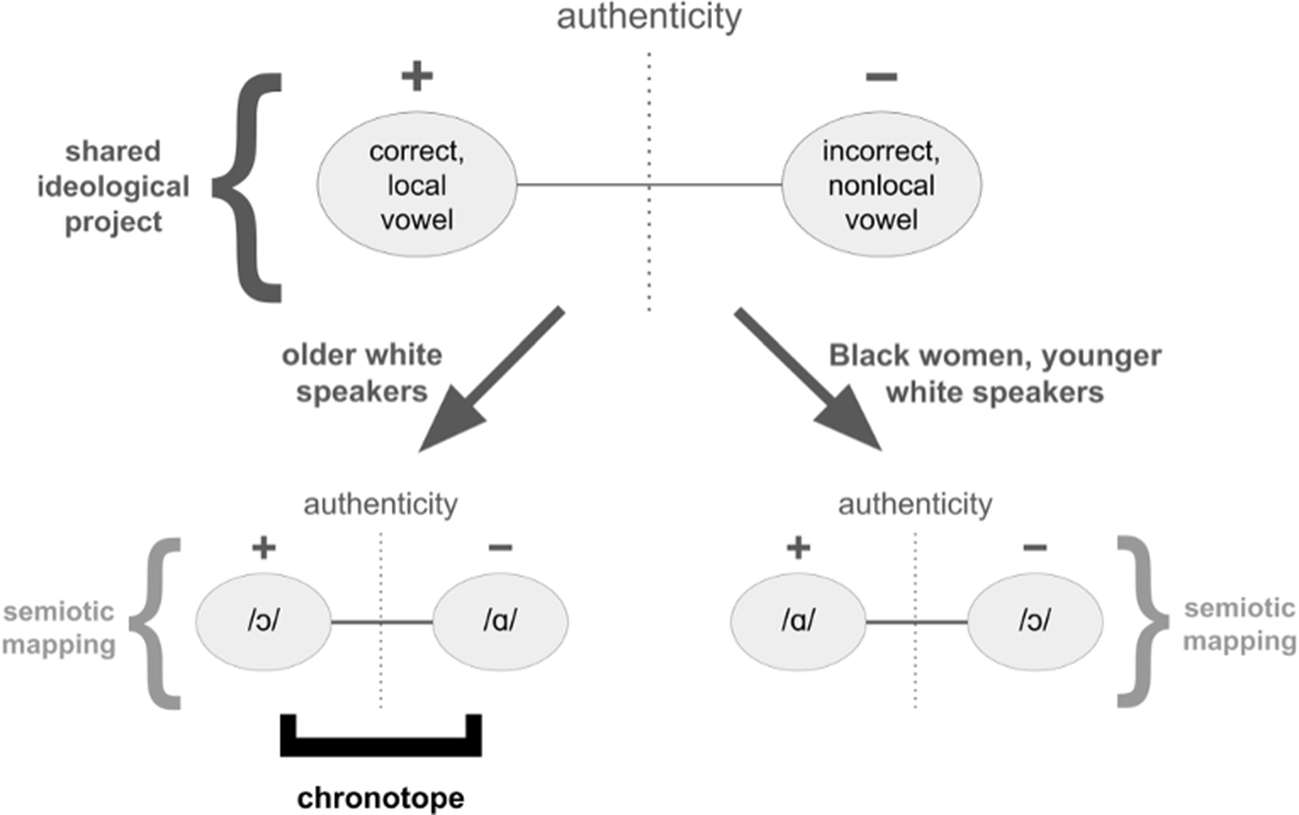
We document a shared ideological project among residents of a place that is ideologically distinguished from its surroundings—a pattern that has predicted sociolinguistic findings in foundational studies as early as Labovian Martha’s Vineyard (1963). However, we do not find acoustic alignment among these residents’ uptake of a highly stereotyped sociolinguistic variable. In fact, our acoustic analysis reveals completely inverse polarization in the way a single variable, the stressed vowel in CHICAGO, is both phonologically classed (as LOT or THOUGHT) and ideologized (as characteristic of authentic local identity) among speakers from the same neighborhood area (Figure 9).
Schematic depiction of inverted semiotic mappings assigned to LOT and THOUGHT in producing authentic place belonging.
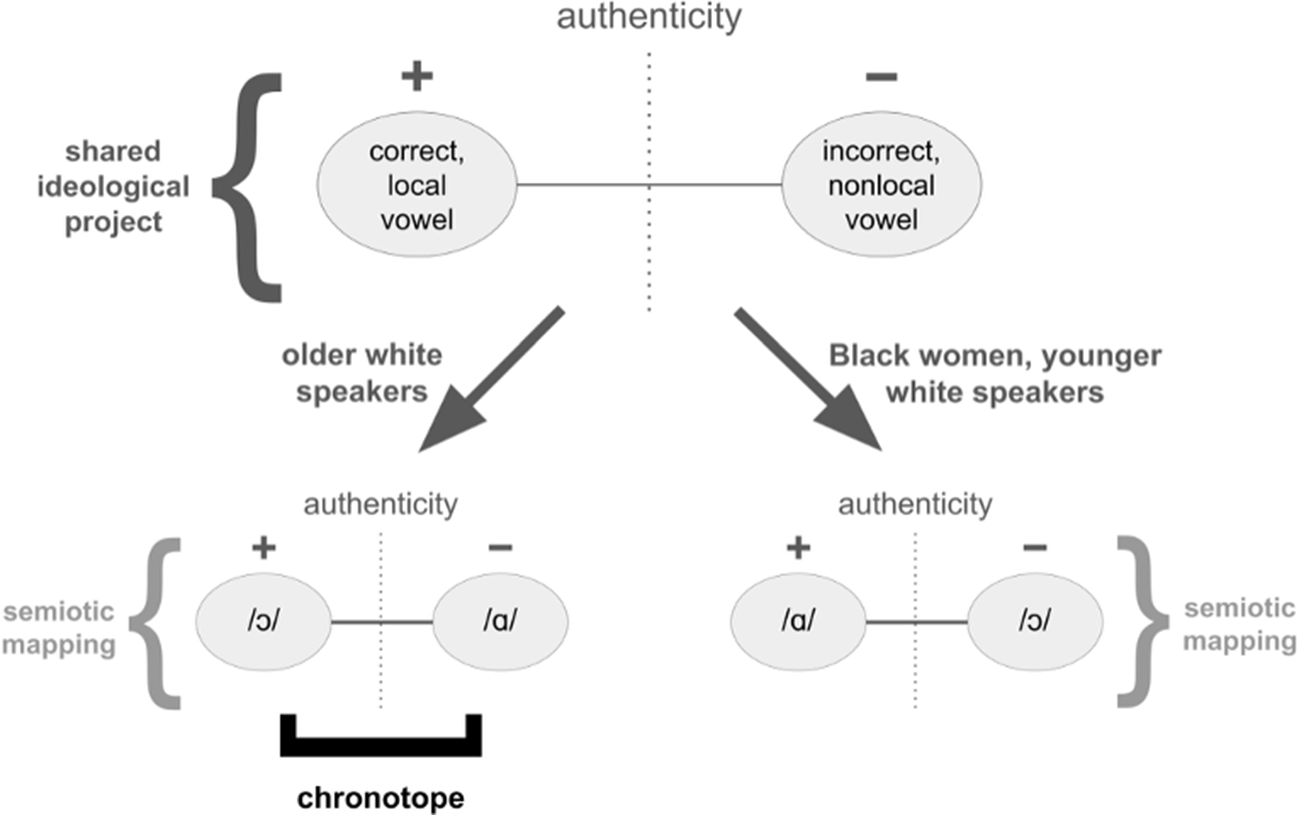
Figure 9 Long description
The diagram illustrates semiotic mappings related to vowel authenticity among different speaker groups. At the top, two ovals are labeled 'correct, local vowel' with a plus sign and 'incorrect, nonlocal vowel' with a minus sign, under the heading 'authenticity'. Below, arrows point to 'older white speakers' on the left and 'Black women, younger white speakers' on the right. Each group is associated with a semiotic mapping. The left mapping shows the vowel symbol 'a' with a plus sign for authenticity and 'a' with a minus sign. The right mapping shows the vowel symbol 'a' with a minus sign and 'a' with a plus sign. The term 'chronotope' is placed below the left mapping, indicating a temporal-spatial context. The diagram is framed by the concept of a 'shared ideological project'.
All interviewees in our sample expressed a strong positive orientation to their local community. Many proudly shared how the neighborhoods’ history of racial integration and present-day diversity distinguishes the area within the South Side and Chicago more broadly. Critically for the present study, the semiotic resource of the stressed CHICAGO vowel is deployed in a shared ideological project of establishing authentic Chicago-ness by use of the ‘correct’ variant. A majority of participants identified one ‘correct’ or local way to produce the vowel that is distinct from one or more ‘incorrect’ or nonlocal variants, and these differing social meanings between productions are rhematized (Gal & Irvine Reference Gal and Irvine2019) onto the speakers who utter them. That is, the belief that vocalic productions can effectively mark authentic/inauthentic status enables the effective judgement of speakers (who variably take up a certain production) as authentic/inauthentic Chicagoans. Authentication as an ideological project thus demarcates insider, local status away from transient, outsider, or otherwise nonlocal identity regardless of the linguistic and other semiotic material projected onto each pole. We present completely inverse semiotic mappings between two variants that co-exist within the same community as evidence for this proposal. Divergent semiotic mappings emerge when the shared project of place authentication takes up the linguistic details of the CHICAGO dichotomy.
Notably, the flexibility in the phonetic material associated with poles on these axes of differentiation allows for reconfiguration of qualities ascribed to ‘authentic locals’ not only across social groups, but also across time within the same group. The significant interaction between speaker age and race-gender group in LT Difference, such that younger white speakers produced CHICAGO tokens closer to LOT over apparent time, points to an ongoing rearrangement of the contrasts implicated in this authenticity work among white speakers. Younger white speakers appear to shift away from the chronotopic mapping between older white speakers’ conceptions of THOUGHT-like CHICAGO as authentic and LOT-like as outsider. This mirrors apparent time shifts away from other linguistic features connected to these chronotopes, like Northern Cities Shifted vowels (e.g. D’Onofrio & Benheim Reference D’Onofrio and Benheim2020). Though these data reveal that community members project the same vocalic contrast in opposing ways, both mappings point to erasure as a means to organize away intra-community incongruencies. We thus argue for conceptions of place-based linguistic features that attend more closely to the dynamic nature of local identity rather than static associations between places and specific social meanings.
Acknowledgements
We are grateful first and foremost to the interviewees who offered their voices, stories, and ideas to this research study. We would also like to thank members of Northwestern's Sociogroup, the audience at NWAV 50, and the editors and reviewers whose feedback greatly improved this work. Ed King provided the initial observation that led to this analysis and the invaluable connection with our field site. This work was funded by a National Science Foundation Collaborative Research Grant (BCS-2017716).

 Open access

