





Food insecurity is defined as ‘the inability to access sufficient, safe, and nutritious food to maintain a healthy and active life’. Notwithstanding the growth in global wealth, many populations are vulnerable to food availability and accessibility(Reference Denny, Marquart-Pyatt and Ligmann-Zielinska1–Reference Pakravan-Charvadeh, Savari and Khan3). Refugees who resettle in new areas or countries, especially in developing countries, are particularly vulnerable to food insecurity(Reference Nunnery and Dharod4,Reference Salman and Resick5) . The term ‘refugee’ refers to ‘a person who is unable or unwilling to return to their country of nationality because of persecution or a well-founded fear of persecution on account of race, religion, nationality, political opinions, or membership in a particular group’(6). About sixty million people have to flee from expulsions or civil wars or abandon their country to escape from poverty worldwide(Reference Vallaster and von Wallpach7). Displacement from their usual environment makes refugees vulnerable to poor quality of life and mental health(Reference Akinyemi, Owoaje and Cadmus8,Reference Hadley, Zodhiates and Sellen9) .
One of the largest refugee groups in the world is from Afghanistan(6). During the 1978 Saur Revolution in Kabul, the Russian invasion in 1979 and the US invasion in 2001, Afghan refugees moved to adjacent countries, particularly Iran and Pakistan, to escape the war. There were about 2·7 million Afghan refugees, at the end of 2018, mainly due to births during the year compared with 2·6 million a year earlier. In 2019, about 1 403 500 Afghan refugees were living in Pakistan as the largest host country(6). About 951 100 Afghan refugees fled to the Islamic Republic of Iran at this time. According to some reports, there are nearly one million illegal and undocumented refugees in Iran(6). Iran has 46 % of all Afghan refugees in Asia, 38 % of all Afghan asylum seekers around the world (among fifty-six countries) and almost 56 % of all illegal Afghan refugees. Given the prevalence of war and the history of displacement in Afghanistan, many human rights reports and academic studies focused on Afghan refugee health status(Reference Khakpour, Iqbal and Ghulam Hussain10). Others have evaluated food in/security status beyond the borders of Afghanistan and its associated obstacles(Reference Hadley and Sellen11–Reference Lawlis, Islam and Upton19).
To our knowledge, this is the first study that determines the associated factors with different dimensions of the food security status of Afghan refugees in Iran. Determining associated factors will allow local and international non-governmental organisations to improve planning for improving refugees’ food security status(Reference Mourao20), make it easier for them to cope with post-resettlement obstacles and help them control post-traumatic stress disorders(Reference Pakravan-Charvadeh and Mohammadi-Nasrabadi21).
Extant studies illustrated that the factors determining food security are complex and interrelated, encompassing political, socio-economic and environmental issues from poverty and inequality to social rights protection, and health, to name but a few(Reference Denny, Marquart-Pyatt and Ligmann-Zielinska1,Reference Khakpour, Khorshahi and Pakravan Charvadeh22) . The results of these studies revealed that some factors have an inverse association with refugees’ food insecurity in a specified study location, while the same factors have a direct association with refugee food insecurity in other locations at the same time. Although the goal of this study is analogous to other studies on refugees’ food insecurity around the world, it is innovative in determining factors associated with the food insecurity of Afghan refugees residing in Iran. The most innovative part of the study is the opportunity to test how three sub-scores, anxiety and uncertainties, insufficient quality and insufficient food intake, are associated with the individual and household characteristics. The lack of the study assessing refugees’ food security may be related to several difficulties in sampling, such as scattered refugees across the country as illegal and undocumented people and the resulting sense of insecurity of Afghan refugees in participating in detailed research that might result in deportation. By using a standard survey to assess food insecurity among Afghan refugee households in urban areas of Tehran province in Iran, four research hypotheses will be addressed in this study as follows:
Hypothesis 1: Most of the Afghan refugee households face food insecurity in the target area.
Hypothesis 2: Households’ characteristics are associated with Afghan refugees’ food security.
Hypothesis 3: Economic factors are indirectly associated with the anxiety and uncertainties of Afghan refugees.
Hypothesis 4: The associations of socio-economic factors with three categories of food insecurity differ.
Methods
Cross-sectional design
A cross-sectional analysis was used to follow our hypotheses (see Fig. 1). In the first stage, the data and information were gathered through a detailed questionnaire. Then, the food insecurity of Afghan refugees’ households was calculated and collapsed into three categories. Then the association of socio-economic factors with Afghan refugees’ categories of food insecurity was calculated through a multivariable regression model.
Cross-sectional design of the study

Study area
Data were collected in urban areas of Tehran province, the most densely populated province in Iran and the second-largest metropolitan area in the Middle East. According to the Iranian Statistical Center, 515 567 Afghan refugees live in this province, a figure that comprises almost 25 % of all the Afghan refugees residing in Iran. Afghan refugees have been prohibited from living in fifteen provinces (Fig. 2, marked in red) and are only able to live in specific regions and counties of twelve provinces(Reference Pakravan-Charvadeh, Vatanparast and Khakpour23). They can live in three provinces without restriction: Tehran, Alborz and Qom.
Map of the location of the studied area in the north of Iran, Tehran province

Study population
We used a two-staged cluster sampling. At first, cities (Shahrestan) were randomly selected within the province of Tehran, and at the second stage, households were selected randomly. We selected five cities, including Shahr-e-Rey, Shahriar, Robat Karim, Eslamshahr and Varamin. Then, we used the official documents of the Afghan refugees in the Iranian health centre in each city to select random sampling. (We considered the number of their recorded documents for arranging and selecting random sampling.) The questionnaire was administered via face-to-face interviews with either the breadwinner of the selected households or a member who could respond on behalf of the household.
Data collection
The study involved a cross-sectional analysis of 317 Afghan refugee families residing in targeted areas of Tehran province. To conduct the interviews, we recruited fifteen Iranian and Afghan interviewers. All interviewers were trained in a session of about 6 h. They learned how to communicate well with Afghan refugees and how to complete the questionnaire. The language of Afghan and Iranian interviewers was Persian. Then they conducted in-person interviews with people from the households. The interviews were completed during a 2-months period (December 2018–January 2019). Informed consent was obtained from each respondent. We described the benefits of this study for respondents as making known the problem of Afghan refugees to governmental administrations and global organisations and contributing to encouraging policymakers to enact laws supporting Afghan refugees in Iran(Reference Pakravan-Charvadeh, Vatanparast and Khakpour23).
Assessment of food insecurity
Food insecurity was assessed through a modified version of the Household Food Insecurity Access Scale (HFIAS) as a standard tool that has been validated in Iran(Reference Rezazadeh, Omidvar and Eini-Zinab24). The tool is a nine-item scale, with a reference period of the past 4 weeks for questions included(Reference Rezazadeh, Omidvar and Eini-Zinab24,Reference Bhalla, Handa and Angeles25) . Using HFIAS, households are asked to respond to each experience as never, rarely, sometimes or often, generating a total score from 0 to 27(Reference Bhalla, Handa and Angeles25). A higher score indicates greater household food insecurity. In the HFIAS scale, food insecurity is collapsed into three categories (i.e. marginal, moderate and severe) that correspond to uncertainty about the food supply, insufficient quality of food and insufficient quantity of food (Fig. 3).
The domains of food insecurity among refugees

We found that the representative of the breadwinner of slightly food-insecure households worries about future access to food or food affordability(Reference Nunnery and Dharod4). Moderate indicates that households lack the means to purchase foods with higher nutritional quality. Severe indicates food shortages and hunger, as adults and children in the household skip meals and/or cut portion sizes due to lack of resources available to purchase needed food ingredients(Reference Nunnery and Dharod4,Reference Coates, Swindale and Bilinsky26) . The state of anxiety and uncertainty of Afghan households was calculated by question 1, insufficient quality was assessed by questions 2–4 and insufficient food intake was surveyed via items 5–9 (Table 1).
The brief results of HFIAS questionnaire

Reference: authors’ results. HFIAS, Household Food Insecurity Assess Scale.
Socio-economic factors
Potential control variables, such as the length of living time in Iran, the frequency of travel to Afghanistan, health and medical conditions of households’ members along with their properties, were added to the questionnaire. We then circulated it to 154 prominent scholars in health economics and public health across the world, including USA, Canada, Australia and Iran, and received suggestions to improve the questionnaire. All factors used in the final questionnaire are demonstrated in Appendix (Table A1). The descriptive statistics were reported as maximum, minimum, mean, SD, skewness and kurtosis for all factors. Finally, the socio-economic factors associated with different categories of food insecurity were examined by using a multivariable regression model.
The model specification
After determining factors which were used in the final multivariable regression model and calculating HFIAS, the variance inflation factors were examined to test multi-collinearity between independent factors(Reference Wang, You and Wang27,Reference Wooldrige28) . The analysis was conducted using the original score. In the first step, factors associated with a total score of food insecurity on Afghan refugee households were determined. Then, three categories of food insecurity – anxiety and uncertainties (original score between 1 and 3), insufficient quality (original score between 1 and 9) and insufficient food intake (original score between 1–15) – were considered as dependent variables in separate multivariable regression models. These relations were regressed upon an entire set of determinants hypothesised to have an association with Afghan households’ food insecurity, anxiety and uncertainties, insufficient quality and insufficient food intake(Reference Tang and Choy29). The associated factors were extracted from the literature and the related papers. To choose the final factors in the regression models, correlation tests between each factor and dependent variable was carried out(Reference Pakravan-Charvadeh, Khan and Flora30).
Results
Demographic characteristics
Most of the breadwinners (head of household) were male (93 %), the average age of the head of the household was 41·5 years and the average size of households was 4·2 person (Table 2). Over half of the respondents (65 %) had a permanent job, 14 % had a seasonal occupation and 21 % was unemployed. Forty-four percent of Afghan households earned a monthly salary between 10 and 35 million Rials (between $45–$160), and only 6 % of the total sample earned a herd of money (More than 35 Million Rial ($160) per month). Afghan households had lived an average of 19 years in the study location. Most Afghan refugees (68·8 %) rented their home, while only 13·9 % of respondents reported owning their home. In our sample, the average amount of Rahn (the amount of deposited money in refundable-deposit-lease-contract, million Rial/year), as a guaranty to ensure the renter will give back home in good condition and pay the monthly rent on time. After finishing the time of contract, he/she will retake this deposited money. This type of contract for renting a home is known ‘Rahn’ in Iran and was 136 million Rials ($618). The average size of the respondents’ house was 74·1 m2, the average distance of Afghan households from the central market was 8·5 km and the frequency of travel to Afghanistan was 1·05 times during their resettlement. One-hundred twelve Afghan households had at least one child under the age of 5 years, 193 households had at least one child between the age of 5 and 18 years, and 123 had at least one child more than 18 years in the home. They had, on average, one boy and one girl and at least one student in their households. Of the breadwinners, 234 (73·8 %) were smokers. Of the mothers, 92·4 % were unemployed and had an average age of 35·7 years; only 15 % of mothers were engaged in handicraft activity. Most respondents (75 %) reported no personal savings. Before migrating to Iran, 25 %, 15 % and 15 % of the respondents lived in Daykundi, Kabul and Herat provinces, respectively, while the remaining 45 % of respondents lived in different locations in Afghanistan such as Mazar-i-Sharif, Kandahar, Bamyan, Balkh, Helmand, Badakhshan, Samangan and Ghazni cities. A majority were employed in shopkeeping or transportation as permanent or seasonal jobs.
Descriptive analysis of independent variables
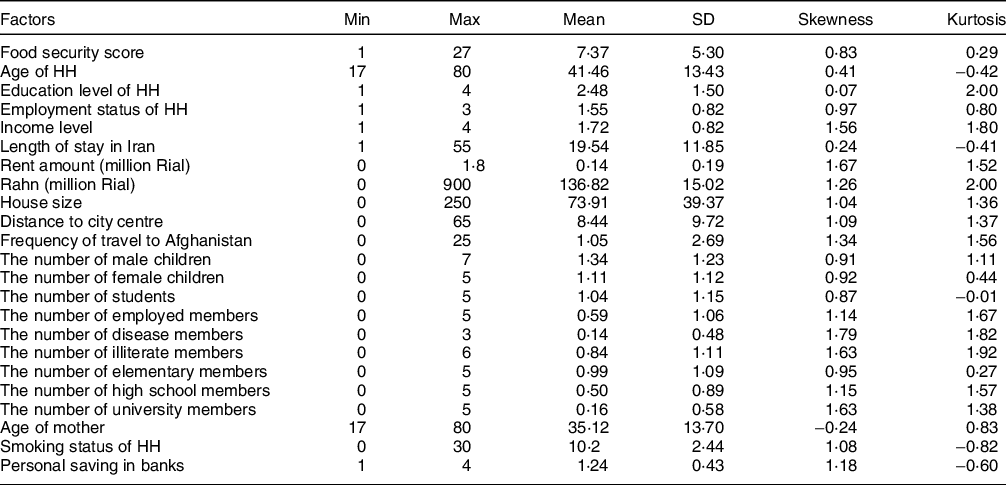
Rial is the Iranian currency. HH, Head of Household.
Food insecurity
Ten percent of interviewed Afghan households worried that they would not have enough food in the next 4 weeks. Thirteen percent of the members of the refugee households did not eat because they lacked the financial resources to obtain enough food (Table 1). The highest and lowest average is related to question 3 (Eat a limited variety of foods) and question 9 (Go a whole day and night without eating), respectively. About 60 % of households had at least one of the different ranges of anxiety, including rarely, sometimes and often. Also, the statistics of kurtosis and skewness show that the distribution of all questions is normal.
Table 3 shows that only 11·3 % of the refugees were food-secure; 11·7 %, 40·7 % and 36·3 % were marginally, moderately and severely food-insecure, respectively. Of the total sample, about 88·7 % face food insecurity from the range of marginal to severe (Fig. 4). All the socio-economic factors analysed have normal distributions.
Food security status of Afghan refugees in urban slums

Reference: authors’ results.
The status of Afghan refugees‘ food insecurity residing in Tehran province, Iran

The description of coefficients
The estimated multivariable regression model considering food security total score as a dependent variable is shown in Table 4. Before the estimation of the model, the multi-collinearity of all factors was tested by using variance inflation factors. All variance inflation factors were less than five, which demonstrated that the estimated model did not have multi-collinearity(Reference Wang, You and Wang27). The dependent variable of the first model was the total score of HFIAS with the observed range of 1–27 in which the lower score is the better food security status vice versa.
Factors associated with food insecurity score of Afghan refugees in urban slums

Rial is the Iranian currency. HH, Head of Household.
**,***Significant level at 5 % and 1 %.
Employment status was significantly and inversely associated with refugee households’ food insecurity (the range of employment is from permanent job to unemployed). The inverse association of income level with food insecurity suggests that higher income level of households, as expected, is associated with greater food security score. House size was inversely and significantly associated with food insecurity, while the distance from the city centre and frequency of travel to Afghanistan had a direct association with food insecurity. Regular frequent travel to Afghanistan and more distance of Afghan household’s house from the central markets was associated with greater food insecurity. A household with more male and female children was more food insecure. The number of elementary, high school and university members of Afghan refugees was significantly and inversely associated with food insecurity. The age of mother was directly associated with food insecurity. Finally, personal saving was inversely associated with food insecurity. Households with more personal savings had better food security than those with lower savings.
To investigate the third hypothesis, multivariable regression models were estimated separately for three categories of food insecurity: anxiety and uncertainties, insufficient quality and insufficient food intake. Three economic and financial factors – income level, house size and personal saving – were associated with the food insecurity of Afghan refugee households. Greater asset of households was associated with less worry about preparing members’ needed foods and less anxiety and uncertainty of inadequate monetary resources. Some factors, including employment status, income level, house size and the number of elementary members, were indirectly associated with insufficient quality, whereas the length of stay in Iran, distance from the city centre, frequency of travel to Afghanistan, the number of male children and age of mother were directly associated (Table 5). Income level, house size, the number of elementary, high school and university members were inversely associated with insufficient food intake.
Factors associated with anxiety and uncertainty, insufficient quality and insufficient food intake of Afghan refugees in urban slums

Rial is the Iranian currency. HH, Head of Household.
**,***Significant level at 5 % and 1 %.
On the other hand, frequently travelling to Afghanistan, the number of male children, the number of disease members and the age of the mother were directly associated with the food insecurity of Afghan refugee households. Income level and house size were associated with all three categories of food insecurity.
Discussion
Understanding Afghan refugee food insecurity status in Iran will provide the Iranian government, internal and international non-governmental organisations, civil society and global institutions with opportunities for improving refugees’ quality of life. In this study, four hypotheses were proposed. The first hypothesis was verified. Of the total sample, about 88 % of Afghan refugee households suffered from food insecurity, and about 36 % of them faced severe food insecurity. This high prevalence of food insecurity showed that the Afghan refugees do not have an appropriate dietary status. As the literature shows, the status of the food security of Iranian households is better than an Afghan household in Tehran province, the target location of this study. Mohammadi et al. (2013) reported that about 44 % of the Iranian population in the same location faced food insecurity(Reference Mohammadi, Omidvar and Harrison31). Also, another study showed that about 48 % of Iranian households faced food insecurity in Tehran province(Reference Pakravan-Charvadeh, Khan and Flora30). Pakravan and Mohammadi-Nasrabadi (2020) reported that about 75 % of Afghan refugees faced food insecurity in Southern areas of Tehran province(Reference Pakravan-Charvadeh and Mohammadi-Nasrabadi21). The comparison between the general population and Afghan refugees showed that Afghan households have low levels of food security and need urgent intervention.
To check the second hypothesis, we found that household characteristics were associated with Afghan refugees’ category of food security. Based on the descriptive analysis and multivariable regression model, a seasonal or permanent job of head of the household was associated with a better food security status of Afghan refugee households. This indirect association may be related to the potential of the heads for gaining enough money to prepare the needed foods for their family(Reference Khakpour, Khorshahi and Pakravan Charvadeh22). The probability of food insecurity was higher(Reference Premji and Shakya32) in a household whose head is unemployed. This result may be related to physical health and poor mental status via paths that include income deficiency, reduction of physical and mental activity, loss of status and self-esteem and unhealthy behaviours. Some authors argue that unemployment is also directly associated with food insecurity, due to the exacerbation of occupation search strategies and the workload of the household(Reference Premji and Shakya32). The size of the house or apartment was also indirectly associated with food insecurity. The measurement of the house or apartment’s area is a proxy for wealth(Reference Pakravan-Charvadeh and Mohammadi-Nasrabadi21,Reference Pakravan-Charvadeh, Vatanparast and Khakpour23,Reference Pakravan-Charvadeh, Khan and Flora30) . Some researchers found a similar association of house or apartment size with food security(Reference Abebaw, Fentie and Kassa33,Reference Migotto, Davis and Carletto34) . Thus, households with higher wealth and assets can easily spend more income on food and have higher food security than their lower-income counterparts.
Distance from the city centre was indirectly associated with the food insecurity of Afghan refugee households. Many poor communities are located a substantial distance from supermarkets and effectively live in a ‘food desert,’ an inhabited area with negligible access to nutritious and healthy food because of geographical position, in-store choice or affordability(Reference Pereira, Larder and Somerset35,Reference Battersby and Crush36) . They are not able to prepare the needed foods whenever they want and need, because these markets are not frequently available(Reference Pakravan-Charvadeh, Hosseini and Salami37). Therefore, they have to pay more to access these markets(Reference Pakravan-Charvadeh, Hosseini and Salami37).
There was a significant direct association between frequent travel to Afghanistan at regular intervals and Afghan refugees’ food insecurity. This finding is consistent with the results of other studies(Reference Akinyemi, Owoaje and Cadmus8,Reference Codjoe, Quartey and Tagoe38,Reference Patton-López, López-Cevallos and Cancel-Tirado39) . There are several explanations for this finding: First, refugees who visit their country and pay money to travel must dedicate a portion of their income to these trips, so some may need to reduce their food and non-food expenditures to fund these travels. Second, when refugees return from Afghanistan, it may take them a long time to reintegrate into Iranian communities. For example, it may be difficult to find stable employment and affordable, healthy food. Third, based on our face-to-face interviews, Afghan refugees who return to their country are more likely to have a household confronting arduous financial obstacles in Afghanistan. As a result, these refugees may assign a portion of their income to help the kindred who is still in Afghanistan. Frequent travels to Afghanistan may make it harder to find a permanent job in Iran. Earlier studies with similar findings(Reference Akinyemi, Owoaje and Cadmus8,Reference Codjoe, Quartey and Tagoe38,Reference Patton-López, López-Cevallos and Cancel-Tirado39) have proffered similar explanations for the food insecurity of refugees who frequently travel to their home countries. When they fail to resettle in a host country for a long period, refugees continue to cope with the loss of their culture, country, profession, language, friends, family and future plans(Reference Akinyemi, Owoaje and Cadmus8) To summarise, all of these reasons may lead to being food insecure. Increasing the number of male and female children was directly associated with Afghan households’ food insecurity. Refugees who have more children are forced to try harder to provide sustainable resources for themselves. In these cases, extra income is needed from the household head or other adults in the household. Due to many restrictions on refugees in Iran, they are not hired for jobs that reflect their skill levels, and most works are in lower-income positions. Household expenditures are increasing much more rapidly than worker wages. As Iran suffers from a high level of unemployment, refugee youngsters have difficulty finding a job. These difficulties have negative consequences on accessibility, and eventually, the food insecurity of refugees who have more male and female children(Reference Pakravan-Charvadeh, Mohammadi-Nasrabadi and Gholamrezai40). Also, the association of number of male children is more strongly related to food insecurity than number of female children, because physiologically male children consume more food compared to female children(Reference Pakravan-Charvadeh, Khan and Flora30). An increase in the number of elementary and secondary members of a household was associated with a lower food insecurity score.
Enhancing the level of education of family members helps them to become familiar with different aspects of dietary diversity and the importance of having an appropriate foodstuff combination. Also, some researchers believed that education level harms food insecurity; others argued that as education costs are high (including providing own uniforms, books and materials), each additional student within a household was indirectly associated with households’ food security due to decrease in the available money for foods(Reference Scearce and Jensen41,Reference Adrian and Raymond42) . There is not the same obstacle in Iran because education is free at elementary and secondary education levels.
Finally, personal saving was inversely associated with the food insecurity of Afghan refugee households. This result may be related to the decrease in anxiety and the stress of providing financial resources for the needed foods. They can access this saving whenever they want and need it. Additionally, the role of personal saving for the reduction of anxiety and stress, which is the third hypothesis, is entirely evident.
The results confirmed the third hypothesis. About 60 % of Afghan households experienced at least one of the different degrees of anxiety. An extensive study of mental health of refugees argued that the prevalence of mental disorders is in the range of 30–40 % among refugees, and about 55 % of refugees had at least one psychiatric disorder(Reference Tinghög, Malm and Arwidson43). Economic and financial assets, including income level, house size and personal saving of Afghan refugee households were inversely associated with anxiety and uncertainty. The first question of the HFIAS questionnaire, which is used to assess the anxiety of a household, is directly related to the potential of the household to acquire foods during the previous month. Therefore, a household’s economic and financial assets, which assess accessibility as a proxy of food security, is an indispensable factor in reducing the stress and anxiety of the households(Reference Coates, Swindale and Bilinsky26,Reference Pakravan-Charvadeh, Hosseini and Salami37) . In the context of the acculturation process, poor economic conditions and an unclear residence permission status are considered as a stressor for refugees and immigrants(Reference Georgiadou, Zbidat and Schmitt44). Many studies confirm the importance of post-migration status for food security status. Steel et al. (2002) claimed that several post-migrations, socio-economic determinants are not associated with mental illness among Vietnamese refugees(Reference Steel, Silove and Phan45). Some authors argued that various socio-economic determinants are associated with the anxiety and stress, as mental disorders, in the Middle East(Reference Alpak, Unal and Bulbul46–Reference Kolltveit, Lange-Nielsen and Thabet48). Finally, the association of socio-economic factors was different for anxiety, insufficient food quality and insufficient food intake. Therefore, the fourth hypothesis was verified by these results. The income level has a similar association with all the dependent variables, including insufficient food intake, insufficient quality and anxiety. House size was indirectly associated with anxiety, insufficient food quality and insufficient food intake.
Limitations
This study has several limitations. First, some Afghan refugees did not trust our interviewers because some of them were illegal and undocumented refugees and were fearful and cautious in answering interviewers’ queries. About 15 % of the selected refugees refused an interview, and we had to substitute a new sampling. We explained that the results would be helpful for their resettlement and for reducing their problems and that the data would be confidential and used in academic research. Second, because of the cross-sectional design, this study does not allow to draw causality. Third, we could not easily find Afghan refugees in specified locations due to the scattered population across the province, and data collection was expensive, complicated and time-consuming. To reduce the time of the study, we recruited several interviewers. Fourth, it was difficult to distinguish between refugees who entered Iran voluntarily and those who had fled to Iran due to fear of the arduous situations and the many restrictions in Afghanistan such as race, religion, nationality and political opinions. We asked them whether they had a passport or not to distinguish these two groups. Finally, distinguishing between Afghan people who were born in Iran and those who were refugees was difficult. To do so, we asked them whether they had an Iranian birth certificate.
Conclusion
A high proportion of Afghan refugees live under severe food insecurity conditions in Tehran province in Iran. To improve food security, interested and related organisations and institutions must develop bi- and multi-lateral collaborations. About three-quarters (77 %) of Afghan refugees need the immediate intervention of the local government or related institutions like the Ministry of Refugees and Repatriations of Afghanistan or the United Nations High Commissioner for Refugees. To improve the food security status of Afghan refugees, determining socio-economic factors play a crucial role because the low-income governments can use policies other than income policy based on the association of these factors with food insecurity. Although the employment of the head of refugee households was directly associated with food security, some Iranians, as in other nations, may believe that Afghan refugees will take the resources of the host country and fill their job positions as intruders. Local non-governmental organisations can conciliate these beliefs and lead to a better understanding of cultures and help refugees find a job without any intellectual engagement among Iranian people. Economic factors, including personal saving, house size and households’ income, were critical factors in decreasing the anxiety and uncertainty of Afghan refugees’ food security. Financial and monetary networks in Iran, and specifically, the Ministry of Economic Affairs and Finance and the Central Bank of Iran, should provide simple access to financial supports like a long-term loan, self-employment packages and opening a bank account for Afghan refugees, benefitting both Iranians and refugees.
Acknowledgements
Acknowledgements: We gratefully acknowledge the non-financial support provided by the Department of Agricultural Economics and Rural Development, Faculty of Agriculture, Lorestan University, Khorramabad, Iran. We also wish to thank the anonymous respondents for their contribution to fill out the online questionnaire. Financial support: This research received no specific grant from any funding agency in the public, commercial or not-for-profit sectors. Conflict of interest: There are no conflicts of interest. Authorship: M.R.P.-C.: He is an assistant professor at Lorestan University in Iran. His interests are agricultural economics, food security analysis, refugee studies and health economics. He received his Ph.D. degree from the University of Tehran, as a high-ranked and prestigious university in Iran. Now, he carries out global research in the field of refugee health status, food security studies, household vulnerability and social welfare. His contribution in this study: Supervision, Formal analysis, Methodology, Writing-Original draft preparation. H.V.: He is a professor at the College of Pharmacy and Nutrition and School of Public Health, University of Saskatchewan. His program of research is focused on food security and nutritional health of at-risk populations particularly refugees and indigenous people in Canada and globally. His graduate and post-graduate training were in the areas of medicine, epidemiology and nutritional epidemiology. His contribution in this study: validation, resource, data mining and final manuscript revision. E.A.F.: He is a professor at the University of South Carolina. He conducts research globally on food insecurity of households, adults and children and on infant and young child feeding, growth, development and nutrition. His graduate training was in biometry, nutrition and human development. His contribution in this study: writing – methodological advice, interpretation, reviewing and editing, responding to the reviewers’ comments. M.K.: She is a Ph.D. graduate from the College of Pharmacy and Nutrition, University of Saskatchewan. Her background is over 10 years of leadership and management experience, over 8 years of research experience, specialised in minorities’ health, specialised in the mixed-method analysis, teaching and facilitation skills and organisational development. Her effective July first affiliation will be: Assistant professor, Department of Health Studies, STFX University, Nova Scotia, Canada. Her contribution in this study: writing-editing English language, contributing to answering the reviewers’ comments. C.F.: A rural sociologist working on the intersection of human and natural communities in a variety of contexts in North and South America, Africa and Europe. She is a Research Professor at Kansas State University. Her major research tool is the Community Capitals Framework, rural studies and social justices. Her contribution in this study: conceptualisation, validation, reviewing and editing. Ethics of human subject participation: This study was conducted according to the guidelines laid down in the Declaration of Helsinki and all procedures involving research study participants were approved by the Ethic Committee of Lorestan University of Medical Science (Approval ID: IR.LUMS.REC.1398.259). Also, verbal consent was witnessed.
Supplementary material
For supplementary material accompanying this paper visit https://doi.org/10.1017/S1368980021004043


 Open access

