


In 2009–2010, the prevalence of obesity in the USA was 18·0 % among children aged 6–11 years, 18·4 % among adolescents aged 12–19 years( Reference Ogden, Carroll and Kit 1 ) and 35·7 % among adults( Reference Flegal, Carroll and Kit 2 ). Obesity represents a major public health concern given its association with serious health outcomes including CVD, diabetes mellitus and some cancers( Reference Wang, McPherson and Marsh 3 ), as well as social stigma( Reference Puhl and Heuer 4 ) and increased medical costs( Reference Cawley and Meyerhoefer 5 ). Interventions have typically addressed two primary causes of obesity: insufficient physical activity and overconsumption of energy-dense foods( Reference Chaput, Klingenberg and Astrup 6 , Reference Glade 7 ). Interventions may be conducted in the community( Reference Cheadle, Samuels and Rauzon 8 , Reference Mehta, Dimsdale and Nagle 9 ), in primary health care( Reference Thande, Hurstak and Sciacca 10 ), through policy change( Reference Lankford, Hardman and Dankmeyer 11 – Reference Frieden, Dietz and Collins 13 ), or through mass-media campaigns including television( Reference Noar 14 ).
Television represents an important component of an obesity-prevention strategy. In a competitive media environment, televised health-promotion campaigns must find effective ways to convey information and inspire behaviour change( Reference Snyder, Hamilton and Mitchell 15 , Reference Randolph and Viswanath 16 ). While the long-term impact of obesity-prevention television campaigns on body-weight outcomes remains unclear( Reference Brown, Soares and Epping 17 ), there is evidence that some recent campaigns with televised components have successfully influenced attitudes related to risk-reducing behaviours such as physical activity and healthy food choices( Reference Wakefield, Loken and Hornik 18 – Reference Jordan, Piotrowski and Bleakley 22 ). The effectiveness of such campaigns depends largely on the level of exposure achieved( Reference Hornik and Kelly 23 ), as well as on the persuasiveness of the messaging. For example, obesity-prevention campaigns may be more effective when they provide concrete behavioural recommendations and when they advocate both dietary change and physical activity( Reference Greaves, Sheppard and Abraham 24 ). The use of certain negative emotional messages and graphic images in public health campaigns remains controversial( Reference Lupton 25 ), but has been shown to improve message salience and to increase message effectiveness in some contexts( Reference Biener and Taylor 26 , Reference Durkin, Biener and Wakefield 27 ). Both sufficient exposure and persuasive messaging are crucial, especially given the relative resources and expertise of the food industry in marketing unhealthy products such as those high in saturated fat, sugar and sodium, and with television serving as the dominant platform for such advertising( 28 – Reference Powell, Harris and Fox 31 ). It is crucial for the public health community to find successful ways to provide counter-information that might inspire viewers to adopt healthier lifestyles.
Historically, obesity-prevention campaigns have achieved significantly lower exposure than other televised health-promotion messages. In our prior study of public health television advertising from 1999 to 2003, we identified obesity-prevention campaigns sponsored by state or community health departments in only eight states, and overall exposure levels were far outweighed by tobacco-prevention advertising( Reference Emery, Szczypka and Powell 32 ). The launch of the Centers for Disease Control and Prevention’s VERB campaign in 2002 represented the first large-scale national obesity-prevention television campaign, reaching thirty-nine annual advertisement exposures per household for the top seventy-five US media markets by 2003( Reference Emery, Szczypka and Powell 32 ). The VERB campaign aired through 2006.
In recent years, a number of additional obesity-prevention television campaigns have been launched by state and community health departments, the federal government and non-profit organizations. Beginning in 2010, the US Department of Health and Human Services (DHHS) awarded grants to thirty communities in twenty-two states and the District of Columbia to allocate towards obesity-prevention efforts through the Communities Putting Prevention to Work (CPPW) programme, funded by the American Recovery and Reinvestment Act. In total, $US 230 million was allocated to obesity-prevention efforts. A number of these efforts included mass-media campaigns that began airing in 2010 or 2011( Reference Banghart 33 , Reference Bunnell, O’Neil and Soler 34 ). At the federal level, First Lady Michelle Obama led the Let’s Move campaign, the television component of which launched in 2010( Reference Stolberg 35 ). Additional campaigns reflected alliances between federal and state departments as well as private sector or non-profit partners( Reference Hersey, Kelly and Roussel 36 ).
There is some evidence that the focus and tone of obesity-prevention messages may be shifting among new campaigns( Reference Katz, Murimi and Pretlow 37 ). For instance, there have been recent calls for obesity-prevention efforts to address the ubiquity of energy-dense foods that are heavily marketed( Reference Klein and Dietz 38 – Reference Chopra 41 ). Some such efforts have focused on reducing sugar-sweetened beverage (SSB) consumption( Reference Jordan, Piotrowski and Bleakley 22 ), with one advertisement from the New York City Department of Health’s Pouring on the Pounds campaign illustrating the connection between SSB and weight gain with graphic images of fat poured out of soda bottles( Reference Chaloupka, Powell and Chriqui 42 ). Some recent campaigns have also raised controversy for their emphasis on body image as a motivator for behaviour change( Reference Katz, Murimi and Pretlow 37 , Reference Walls, Peeters and Proietto 43 , Reference Kliff 44 ). However, messages that emphasize body shape are not necessarily more effective than other message types and could introduce stigma towards obese individuals( Reference Puhl, Luedicke and Peterson 45 – Reference Dooley, Deshpande and Adair 47 ). While recent graphic and body weight-focused campaigns have generated publicity, the messaging styles used in recent obesity-prevention campaigns have not been systematically studied. In order to guide efforts to test the effectiveness of obesity-prevention advertising, research should establish the key differences between commonly used public health messages.
In the present study, we analysed the volume and content of public health obesity-prevention advertising campaigns that aired in 2010 and 2011 and reviewed the literature on public health messaging in order to consider these campaigns’ potential effectiveness. As in our prior study that assessed data from 1999 to 2003, we quantified exposure for all obesity-prevention campaigns sponsored by federal, state and local governments( Reference Emery, Szczypka and Powell 32 ). In the current study, we also expanded our data set to include campaigns sponsored by non-profit organizations and television stations, calculating exposure levels in each of the top seventy-five US media markets for households as well as for specific audience subgroups including adults, children and teens. Since the approaches used in government-sponsored campaigns are likely to be of particular interest to the public health community, we coded all governmental campaigns for their target audience and main message (i.e. healthy eating, physical activity or both), as in our prior study. For all state and local governmental campaigns, we also characterized additional aspects of the informational content and messaging approach, including the presence of references to weight loss and the emotional valence of advertisements. By providing an overview of exposure levels and message types among recent obesity-prevention campaigns, the present study may inform efforts by the public health community to amplify and improve obesity-prevention mass-media campaigns.
Methods
Through Kantar Media, a market research company that monitors advertising across a number of media channels including television, we reviewed a comprehensive database of television advertisements that aired in 2010 and 2011 to identify campaigns sponsored by federal, state and local governments, non-profit organizations and other unpaid public-service announcements (PSA) sponsored by television stations. Among these, we identified all advertisements that advocated healthy eating or exercise, drew attention to obesity or encouraged weight loss. We excluded any advertisements that advocated healthy eating or physical activity in support of some other concrete health goal that did not overlap with obesity prevention, such as those that encouraged healthy diet in order to prevent prostate cancer or to improve performance in school. As previously described( Reference Emery, Szczypka and Powell 32 ), identification of relevant advertisements was typically straightforward based on searches for obesity- and health-related keywords in organization and campaign names. For organizations where we captured any relevant advertisements with our keyword searches, and for all public health departments, we also manually reviewed Kantar’s descriptions of all campaigns to ensure data capture was complete. For example, the Let’s Move campaign was captured by review of all campaigns sponsored by the US DHHS and also by keyword searches for ‘health’ and ‘move’. Where campaign names were ambiguous, we reviewed descriptions of individual advertisements. Typical descriptors of advertisements offered a few words, such as ‘Prevent Childhood Obesity’. When there was ambiguity in this descriptor, the digital copy of the advertisement was reviewed, allowing for inclusion or elimination.
For advertisements identified for inclusion based on our relevance criteria, Nielsen Media Research provided data on gross rating points (GRP), representing the fraction of television households (used to approximate the general audience) reached by each advertisement’s occurrence multiplied by the number of occurrences. We also obtained targeted rating points for viewers aged 2–11, 12–17 or 18+ years. Ratings were captured for network, syndicated and spot television. Ratings were also available for national cable, although they were not available for spot cable campaigns, the minority of cable advertising that airs only in local markets. All ratings were calculated at the level of the designated market area (DMA), a contiguous set of counties comprising a metropolitan area in which the population receives the same (or similar) television offerings. We divided GRP values by 100 to derive the average number of times each campaign was broadcast to a television household (‘exposures’). We examined campaigns that aired in the top seventy-five US DMA, representing approximately 78 % of the US population and encompassing all major metropolitan areas( 48 ).
As in our prior study, video copies of government-sponsored obesity-prevention advertisements were coded by named sponsoring organization, including any private partners listed. We also coded campaign message (physical activity, healthy eating or both) and the target age of the audience, which was typically apparent based on the age of the main character(s) depicted. If the age of the main character(s) was not obvious and the audience was not clearly specified in the narration, the coding rules instructed to code the advertisement as ‘general audience’.
We selected all state and community campaigns for additional in-depth coding, since these represented a manageable set of videos encompassing a variety of executions. We coded eighty-six unique videos representing thirty-four campaigns, with between one and six representative videos coded per campaign. A number of codes addressed the persuasive potential of advertisements, including their elicitation of an emotional response, a feature associated with campaign effectiveness in some public health contexts( Reference Durkin, Biener and Wakefield 27 ). Specifically, advertisements were coded for their overall emotional valence, defined by whether or not the advertisement includes images or narration evoking emotion that is positive (i.e. hope, humour, laughter), negative (i.e. fear, sadness, horror) or neutral. Since graphic imagery is frequently used in fear appeals( Reference Mongeau 49 ), we also coded instances where advertisements contained strikingly vivid, realistic images that illustrated the harmful and life-threatening effects of unhealthy behaviours. Given that some recent health marketing campaigns have drawn publicity for their use of humour( Reference Vega 50 ), we also coded advertisements that had elements perceived as intended to inspire laughter. We further coded for whether advertisements presented negative health consequences of an unhealthy lifestyle, noting mentions of specific disease risks such as diabetes and heart disease; such depictions may or may not employ graphic images or evoke negative emotion( Reference Durkin, Biener and Wakefield 27 ). Since use of statistics in depicting health effects may have implications for message effectiveness( Reference Wilson 51 ), we coded advertisements for inclusion of any statistics about obesity-related diseases, such as prevalence rates or risk levels among obese individuals. We also adapted codes related to adoption type( Reference Snyder, Hamilton and Mitchell 15 ), focusing on whether advertisements promoted adoption/increase of healthy behaviours (such as daily physical activity), cessation/reduction of unhealthy behaviours (such as screen time or unhealthy food consumption), or did both.
We further coded advertisements for additional elements that have recently been emphasized or debated in the public health community’s framing of the obesity epidemic. Given recent calls for obesity-prevention efforts to address sedentary screen time and the ubiquity of heavily marketed unhealthy foods, we coded for any explicit references to screen time and also for any images or mentions of unhealthy food products: ‘fast food’ products sold in restaurants or stores with preheated or precooked ingredients and served to the customer in a packaged form for take-out (e.g. burgers and fries); ‘junk food’ such as bags of chips, cookies, doughnuts or candy; and SSB including sodas, sports drinks, sweetened tea, sweetened fruit drinks and punches. Some messages exclusively advocated behaviours related to SSB consumption and were coded as such. Since emphasis on body weight has recently drawn controversy in obesity-prevention campaigns, we also coded messages for any reference to overweight or obesity and for whether advertisements mentioned weight loss as one of the explicit goals of lifestyle change. We noted whether advertisements focused exclusively on obesity-prevention or whether they also advocated additional behaviour changes such as vaccination or smoking cessation. Finally, we coded advertisements for whether or not they linked to specific information sources or services, such as websites, call lines, health-care providers or social media.
Coding was performed by two experienced coders who referenced a codebook. We considered and piloted some additional message features, such as whether advertisements presented and addressed counter-arguments for behaviour change( Reference Wilson 51 ), but eventually dropped codes where we could not achieve good levels of inter-rater reliability. In other cases, codes were aggregated to improve reliability. For example, positive and neutral emotional valence were initially coded separately but later aggregated since they proved difficult for coders to distinguish. In a double-coded sample of thirty-five videos, κ for our final codes ranged from 0·62 to 1·00, with an average of 0·77 across twenty variables. Since κ is an especially conservative estimate of inter-rater reliability when code frequency is unbalanced( Reference Feinstein and Ciccheti 52 ), we retained codes with relatively low κ (under 0·7) in certain cases where they had low occurrence in the data (use of humour and mentions of screen time). In these cases, κ may also have suffered from the subjectivity involved in identifying humour and from the variety of language through which references to ‘screen time’ can be conveyed. Coding discrepancies in the overlap sample were adjudicated by consensus. Content elements of individual advertisements were aggregated to the campaign level in presenting our results.
Results
Household exposure to televised obesity-prevention advertising increased from 2·3 to 3·0 advertisements per month between 2010 and 2011, a 31 % increase that was driven largely by exposure to federal advertisements (Table 1). Non-profit and state-sponsored advertisements declined (by 60 % and 72 %, respectively), whereas community advertisements were minimal in 2010, but increased by 545 % in 2011, exceeding state advertising. This increase largely reflected CPPW-funded efforts; for the year 2011, eleven CPPW-funded campaigns accounted for approximately 87 % of community exposure (see Appendix). In 2011, federal campaigns accounted for 62 % of exposure, television station-sponsored PSA for 17 %, non-profit organizations for 9 %, community health departments for 8 %, and state health departments for 3 %. The non-profit organizations with highest exposure during the study were America on the Move Foundation, the American Diabetes Association and the American Heart Association. The television station-sponsored PSA with the highest exposure was the More You Know campaign on NBC.
Monthly obesity-prevention advertisements viewed by US households, 2010–2011
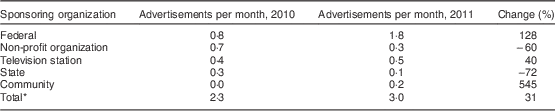
* Exposure levels by sponsoring organization may not sum to total row numbers due to rounding.
Table 2 describes variation in exposure by viewer age and DMA for 2010 and 2011. Adults (18+ years) were exposed to more monthly obesity-prevention advertisements (1·4) than children (1·2) or teens (0·9). Children were the most exposed group for federal campaigns (0·7 advertisements per month). There was wide variation in household exposure by DMA, with an sd of 1·3 monthly advertisements and a sevenfold difference between the most exposed market (Columbus, OH) and the least (Omaha, NE). Variation was highest for community advertising and lowest for federal advertising. Although exposure to state and community campaigns was low when averaged across all seventy-five DMA, mean exposure was considerably higher when considering only the DMA with non-zero exposure levels, with 0·6 state advertisements per month across thirty DMA and 0·5 community advertisements per month across twenty DMA. State and community campaigns represented at least a third of obesity-prevention exposure in a number of markets, reflecting a combination of efforts through CPPW, Champions for Change (in California and Arizona) and other programmes. These markets were: Tucson, AZ; Los Angeles, CA; Fresno, CA; San Antonio, TX; Phoenix, AZ; Sacramento, CA; and Flint, MI.
Monthly obesity-prevention advertisements viewed by US households, by age and designated market area (DMA), 2010–2011

* Calculated for DMA with exposure.
Table 3 shows exposure, main message and targeting of federal campaigns. Increasing federal exposure from 2010 to 2011 corresponds largely to the late 2010 launch of the Let’s Move campaign, which accounted for 69 % of federal exposure by 2011. A number of additional federal campaigns were associated with modest ratings and were typically targeted towards youth. Physical activity was advocated in 83 % of federal campaigns and dietary change in 67 %, with 50 % advocating both.
Gross rating points (GRP) and content for federal televised obesity-prevention campaigns, USA, 2010–2011

WIC, Special Supplemental Nutrition Program for Women, Infants, and Children; DHHS, US Department of Health and Human Services; USDA, US Department of Agriculture; VA, US Department of Veterans Affairs; NFL, National Football League; DMA, designated market area.
* Calculated for DMA with exposure; advertisements per month can be derived by dividing GRP by 100.
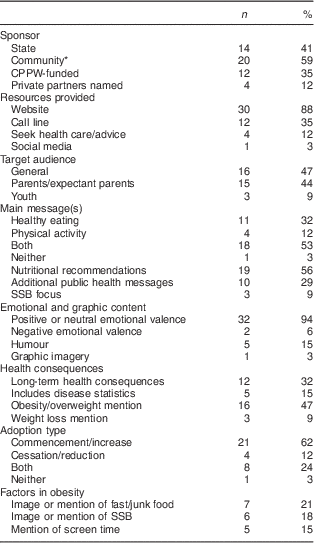
Of a total of thirty-four state and community campaigns that we content-coded (Table 4), nineteen were community efforts, fourteen were state efforts and one was sponsored by the Cherokee Nation in Oklahoma. Only three (9 %) targeted youth while the rest targeted general audiences (47 %) or parents (44 %). Healthy eating was advocated in 85 % of campaigns and physical activity in 65 %, with 53 % advocating both. Fifty-six per cent of campaigns included specific nutritional recommendations, such as counting calories, reducing SSB, drinking low-fat milk, or eating fruits, vegetables or whole grains. Three campaigns (9 %) focused primarily on SSB consumption. The majority of these campaigns directed viewers to additional resources, typically websites. Twenty-nine per cent of campaigns included additional public health messages such as alcohol awareness, breast-feeding benefits or anti-smoking.
State and community televised obesity-prevention campaign characteristics, USA, 2010–2011
CPPW, Communities Putting Prevention to Work; SSB, sugar-sweetened beverages.
* Includes Cherokee Nation, Oklahoma.
The long-term consequences of an unhealthy lifestyle were mentioned in twelve campaigns (32 %); these included diabetes (29 %) and heart disease (15 %). Five campaigns (15 %) included statistics about obesity-related diseases. Obesity or overweight was mentioned in sixteen campaigns (47 %), but only three of these campaigns (9 %) directly encouraged weight loss.
Campaigns typically encouraged initiation of new behaviours (62 %) rather than cessation/reduction of unhealthy behaviours (12 %). Eight campaigns (24 %) did both. The emotional valence of campaigns was neutral or positive in thirty-two campaigns (94 %) and negative in two (6 %). Humour was used in five campaigns (15 %) and graphic imagery was present in only one (3 %).
Discussion
Despite its association with increased sedentary screen time and exposure to advertising for unhealthy foods( Reference Jordan 53 ), ironically television may also play a role in obesity prevention by providing information that empowers viewers to make healthier choices. However, our previous research showed that between 1999 and 2003, average household exposure to televised obesity-prevention advertising was low, with state and community obesity-prevention campaigns airing in a small minority of DMA( Reference Emery, Szczypka and Powell 32 ). While federal obesity-prevention campaign ratings in 2010 and 2011 were exceeded by the VERB campaign in 2002 and 2003, state and community ratings were consistently higher in the current study (a 100 % increase between 2003 and 2010). By 2010–2011, average household exposure to governmental obesity-prevention campaigns was 1·6 advertisements per month. Additional exposure came from non-profit campaigns (0·5 exposures per month) and television station-sponsored PSA (0·4 exposures per month). In total, the average household exposure to public health obesity-prevention messages was 2·6 advertisements per month in 2010–2011. Exposure increased by 31 % across the two years from 2·3 advertisements per month in 2010 to 3·0 in 2011.
The present study suggests some recent shifts in the sponsorship of obesity-prevention messages. Increases in exposure from 2010 to 2011 were driven largely by the introduction of the federal Let’s Move campaign. Between 2010 and 2011, there were declines in advertising sponsored by non-profit organizations and state health departments, but increases in advertising funded by community health departments. Declines in state advertising in part reflect the wane of the Champions for Change campaign in California and Arizona, which garnered high ratings in 2010. The declines in state and non-profit exposure in 2011 also may reflect substitution effects as the federal government and community departments play a larger role in obesity-prevention efforts. Non-profit organizations may increasingly serve as partners for governmental campaigns rather than acting as primary sponsors of advertising( Reference Hersey, Kelly and Roussel 36 ). Different sponsoring organizations were associated with different messaging strategies, with federal campaigns typically targeting youth and state/community campaigns targeting general audiences or parents; this targeting is consistent with our finding that youth were more exposed than adults to federal campaigns. Compared with state/community campaigns, federal campaigns advocated physical activity more (83 % v. 65 %) and advocated dietary change less (67 % v. 85 %).
Beyond achieving sufficient levels of exposure among target populations, public health television campaigns rely upon effective communication strategies to transform attitudes and behaviours. Our content analysis of state and community campaigns reveals several features of these campaigns that may be associated with effectiveness. First, whereas most state campaigns from 1999 to 2003 featured either a physical activity or dietary change message( Reference Emery, Szczypka and Powell 32 ), we found that most campaigns in the current study referenced both obesity-prevention strategies (53 %). Most campaigns also included concrete messages about which foods to seek out or to avoid (56 %). These characteristics have been associated with effectiveness( Reference Greaves, Sheppard and Abraham 24 ). Campaigns were more likely to encourage commencement/increase of healthy behaviours than cessation/reduction of unhealthy behaviours, a characteristic associated with larger effect size among health campaigns( Reference Snyder, Hamilton and Mitchell 15 ). A number of campaigns referenced unhealthy foods (21 %) or SSB (18 %), although implications of the food industry in rising obesity rates varied in explicitness. Among tobacco-prevention campaigns, those highlighting the role of industry have been associated with effectiveness( Reference Jordan 54 ).
Other campaign elements may not be optimal. For example, while the vast majority of advertisements referenced websites, social media resources were provided by only one campaign. Health departments underutilize new media relative to food companies( Reference Malone, Grundy and Bero 55 ), and may be losing out on an important avenue of communication.
The effectiveness of other campaign elements we examined is unclear. In particular, it remains unknown whether negative emotion and graphic imagery in obesity-prevention advertisements are associated with greater persuasive potential than other approaches, although evidence from other areas of public health messaging suggests that such appeals may sometimes be particularly effective, especially when they motivate fear in the context of viewers’ high levels of efficacy( Reference Witte and Allen 56 – Reference Peters, Ruiter and Kok 58 ). While a few recent obesity-prevention campaigns drew controversy for fear appeals( Reference Katz, Murimi and Pretlow 37 ), we found that the majority of state and community campaigns in the present study had positive or neutral emotional valence. Campaigns were in fact more likely to include humour (five campaigns), an approach that is substantially less studied in the context of public health messaging but well established in other areas of advertising( Reference Eisend 59 ). The only campaigns identified with a negative emotional valence were the Change the Future, West Virginia campaign and the Pouring on the Pounds campaign from New York City Department of Health. The latter was the only campaign that included graphic imagery (fat poured from a soda bottle and images of heart attack and amputation). While some prior studies have focused on depiction of negative health effects as a pathway to achieving an emotional reaction or fear response( Reference Biener, Ji and Gilpin 60 ), we further found that a number of campaigns mentioned obesity-related diseases without achieving an overall negative valence and without use of graphic imagery. Even where they do not produce substantial negative emotional arousal, appeals related to the long-term effects of unhealthy behaviours may nevertheless be effective in some contexts( Reference Durkin, Biener and Wakefield 27 ).
Controversy has also emerged over whether campaigns that advocate healthy lifestyles should do so with or without reference to body image and weight( Reference Puhl, Peterson and Luedicke 46 ). Recently, some obesity-prevention advertising generated controversy for its tone with regard to weight status. For example, the Stop Sugarcoating it, Georgia campaign by Children’s Healthcare of Atlanta, which launched in 2010, drew controversy for its portrayal of obese children as victims of bullying and low self-esteem. While some maintain that the campaign’s message is consistent with the serious consequences of childhood obesity, others argue that the advertisements reinforce fat stigma( Reference Katz, Murimi and Pretlow 37 , Reference Kliff 44 ). Campaigns that emphasize weight or size without specifying concrete behaviours such as food choices or physical activity may not only elevate stigma but could also mislead viewers regarding the relationship between weight and health( Reference Puhl and Heuer 4 , Reference Walls, Peeters and Proietto 43 , Reference Oliver 61 ). Such campaigns may also be less motivating than those focused on concrete behaviour changes( Reference Puhl, Peterson and Luedicke 46 ). In the present study, we found that nearly half of the thirty-four content-coded state and community campaigns mentioned obesity or overweight; yet, most advocated behavioural change across the board regardless of weight status, with few advocating weight loss specifically. It is unknown whether non-profit or television station-sponsored PSA campaigns were more likely to emphasize body image.
We found that a number of campaigns reflected alliances between health organizations and private partners. Public–private partnerships reflect the desire of public entities to disseminate their messages more widely and of companies to gain credibility or to position products as healthful( Reference Koplan and Brownell 62 ). Although we did not examine them in the present study, some food companies have produced their own campaigns emphasizing the importance of health. Industry-sponsored healthy lifestyle initiatives and corporate social responsibility campaigns have potential to inspire positive changes, but may also obscure the health impacts of commercial products( Reference Dorfman, Cheyne and Friedman 63 , Reference Kraak, Kumanyika and Story 64 ). This ambiguity extends to television stations, with one study showing that, despite Nickelodeon’s role in sponsoring healthy lifestyle campaigns such as Let’s Just Play, eight of ten foods, beverages and restaurant meals advertised through its television station, magazine or characters were unhealthy( Reference Batada and Wootan 65 ). Likewise, the character Shrek is featured in the DHHS Be a Player campaign, but has also been noted as a spokesperson for companies such as McDonald’s, M&Ms and Kellogg’s, all of which market unhealthy foods to children( Reference Jordan 53 ). It is unknown how dual associations of characters and brands may dilute health-promoting messages.
Considerations of television’s role in obesity have typically focused on the unhealthy effects of increasing screen time and the pervasiveness of obesogenic advertisements. In the USA, youth are exposed to frequent television commercials for foods and beverages, which have been associated with consumption behaviours and body-weight outcomes( Reference Lobstein and Dibb 66 – Reference Andreyeva, Kelly and Harris 69 ). The Federal Trade Commission recently reported that forty-eight food and beverage companies spent $US 1·8 billion on youth-targeted marketing in 2009( 28 ). Despite industry self-regulation through the Children’s Food and Beverage Advertising Initiative, nutritional content analyses show that the vast majority of food and beverage advertising seen by children is for unhealthy products( Reference Kraak, Story and Wartella 70 , Reference Cheyne, Gonzalez and Mejia 71 ). In a recent study of children’s programming, over 95 % of such advertisements were for products high in saturated fat, trans-fat, sugar or sodium( Reference Powell, Schermbeck and Chaloupka 30 ). The Rudd Center reported that, in 2010 and 2011, individuals aged 2–11, 12–17 and 18–49 years were exposed to thirteen, sixteen and twenty advertisements for food and beverages per day, respectively( 72 ). By comparing these exposure levels with the obesity-prevention exposure levels from the present study, we estimate that food and beverage advertisements were viewed over 300 times as often as obesity-prevention advertisements among children aged 2–11 years, over 500 times as often for teenagers aged 12–17 years and over 400 times as often among adults.
Despite increasing exposure between 2010 and 2011, it remains unclear whether public health obesity-prevention campaigns have achieved levels of exposure sufficient to produce significant effects in target populations. In a review article examining effects of anti-tobacco television advertising, researchers argued that campaigns require an average of 4800 GRP per year (forty-eight exposures) in order to achieve significant reductions in adult smoking prevalence( Reference Durkin, Brennan and Wakefield 73 ). In the current study, we note that the only state/community campaigns to achieve a comparable threshold were the Champions for Change campaign in Los Angeles in 2010 and the CPPW-funded Healthy Pima campaign in Tucson in 2011. No federal obesity-prevention campaign achieved this threshold in any of the top seventy-five media markets. Taking all obesity-prevention advertising together, fourteen markets achieved the 4800 GRP threshold in one or more study years, but on average – across all media markets – exposure levels were much lower (thirty-six annual exposures in 2011). Without further research on the relationship between campaign exposure and population obesity rates, it is difficult to evaluate whether obesity-prevention campaigns are achieving appropriate exposure levels. It is important to note that obesity-prevention efforts differ substantially from anti-smoking efforts in that exposure may inspire more incremental changes related to a number of behaviours encompassing both physical activity and dietary choices; these changes may have important impacts on individuals’ health.
The present study has several limitations and raises questions for future research. First, it is a descriptive study of campaign exposure and content, and we do not know whether or how campaigns impacted viewers’ attitudes and behaviours; nor do we capture interventions in the community that may have been made in concert with media campaigns. Second, the present research focused on aggregate exposure and did not examine relative exposure by race or ethnicity. Such examinations would be useful given variation in rates of obesity and targeted food advertising( Reference Grier and Kumanyika 74 ), as well as possible variation in response to advertising. Third, our two-year study period does not allow us to look longitudinally at changes in advertising content over time. Furthermore, while we capture some CPPW-funded efforts, additional campaigns have subsequently launched through CPPW as well as the DHHS Community Transformation Grant Program, which allocated $US 103 million to sixty-one state and local government agencies, tribes and territories, and non-profit organizations in thirty-six states in 2011( 75 ). Fourth, our data set excludes advertisements that were aired only via spot cable, including the Philadelphia Department of Public Health’s campaign focused on SSB consumption( Reference Jordan, Piotrowski and Bleakley 22 ). For this reason, we may have underestimated the true extent of obesity-prevention advertising; however, spot cable likely represents a small minority of such advertising, and we were able to locate all other campaigns from the study period that we identified through our literature review. Fifth, we did not content-code non-profit or television station-sponsored campaigns, which accounted for a non-trivial fraction of obesity-prevention advertising. It is unknown to what extent these campaigns incorporate evidence-based health communication strategies. Finally, although television remains the most dominant advertising medium, it nevertheless provides a limited window by which to estimate the amount of food and obesity-prevention advertising to which households are exposed, with new media playing a growing role especially for youth( 28 , Reference Montgomery and Chester 76 ). Fast-food marketers increasingly leverage websites such as Facebook and Twitter to network with customers and offer promotions, and some have also developed advergames and smart phone applications( Reference Harris, Schwartz and Brownell 77 , Reference Montgomery, Chester and Grier 78 ). While some state and community health departments have adopted social media platforms( Reference Thackeray, Neiger and Smith 79 , Reference Harris, Mueller and Snider 80 ), they underutilize them relative to food companies( Reference Royne and Levy 55 ).
Exposure to televised obesity-prevention advertising appears to be increasing through efforts such as the federal Let’s Move campaign and the CPPW grant programme. Nevertheless, exposure is extremely low relative to food advertising and varies widely by DMA. Despite recent controversy surrounding graphic or potentially stigmatizing obesity-prevention campaigns, we found that most state and community campaigns had neutral or positive emotional valence, advocated concrete behaviour change and did not advocate weight loss specifically. Further assessments of obesity-prevention and obesogenic media messages should examine the behavioural impact of these advertisements in target populations at high risk for obesity and must also account for the increasing role of new media.
Acknowledgements
Acknowledgement: The authors would like to thank Lisa Vera for her helpful suggestions on the manuscript. Financial support: This paper was supported by funding from the National Cancer Institute (NCI; award number R01CA138456). The NCI had no role in the design, analysis or writing of this article. Conflict of interest: None. Authorship: S.L.E. supervised the study; R.K., G.S., L.M.P. and S.L.E. conceived and designed the study; R.K., G.S. and S.L.E. analysed the data; R.K. wrote the paper; R.K., G.S., L.M.P. and S.L.E. provided feedback and suggestions on the manuscript. Ethics of human subject participation: Ethical approval was not required.
Appendix
State and community televised obesity-prevention campaigns, USA, 2010–2011



