





1. Introduction
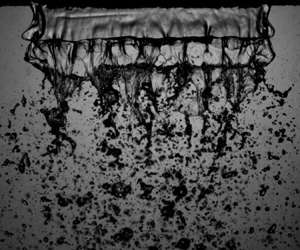
Liquid film air-blast atomization with co-current high-speed gas flows is widely used to produce tiny droplets in numerous applications, including gas turbines, spray painting and spray coating. Figure 1 shows front and side views of a planar liquid sheet with co-current gas flows at a relatively low gas velocity of 40 m s−1, which is smaller than the typical gas velocity in gas turbines. The liquid film oscillates longitudinally due to Kelvin–Helmholtz (KH) instability, transversally due to Rayleigh–Taylor (RT) instability and finally breaks up into droplets. The atomization process is multi-phase and multi-time scale phenomena with various length scales, such as film thickness, atomizer lip thickness, which is the solid wall between the gas and liquid inlet exits, wavelengths of the KH/RT instabilities, bag breakup length, thickness of the boundary layer, turbulence scale and droplet diameter. Due to its complexity, the basic principle of liquid film atomization has not yet been clarified.

Figure 1. Liquid sheet atomization process with co-current gas flows. (a) Front view and (b) side view.
Numerous studies on the flapping and breakup processes of liquid films have been conducted owing to the importance of spray diameter prediction and control for many industrial devices. Squire (Reference Squire1953) visualized a sinusoidal fluctuating liquid sheet in stagnant gas and proposed a model for the longitudinal wavelength λLon of the liquid sheet. Hagerty & Shea (Reference Hagerty and Shea1955) performed a theoretical analysis of sinusoidal and dilational waves of a liquid film. Fraser et al. (Reference Fraser, Eisenklam, Dombrowski and Hasson1962) and Dombrowski & Hooper (Reference Dombrowski and Hooper1962) proposed models for the droplet diameter based on theoretical analysis, where a liquid film in this model disintegrates into ligaments and then into droplets by the Rayleigh instability (Rayleigh Reference Rayleigh1878). The liquid film flapping process with co-current gas flow and with no lip was investigated, and the vortex flow was observed around the film by the numerical simulation (Odier et al. Reference Odier, Balarac, Corre and Moureau2015). Two different conceptual numerical codes were used to simulate the liquid flapping behaviour, and the usefulness of the Eulerian multi-fluid solver was discussed (Zuzio et al. Reference Zuzio, Estivalezes, Villedieu and Blanchard2013). Lohsea and Villermaux reviewed the rupture of the liquid film based on various influences, such as a laser pulse and heterogeneity of the surface tension (Lohsea & Villermaux Reference Lohse and Villermaux2020). Tang et al. simulated the bag breakup of a droplet using the algorithm, in which the liquid film was artificially punctured when it reached a preliminary defined thickness (Tang, Adcock & Mostert Reference Tang, Adcock and Mostert2023). The fragmentation phenomena of films and ligaments are summarized by Villermaux (Reference Villermaux2006), and the droplet diameter distribution formed by the ligament breakup was discussed by Villermaux et al. (Reference Villermaux, Marmottant and Duplat2004). They also showed that the droplet diameter distribution produced by the breakup of the liquid film created by the swirl and fan spray nozzles can be expressed as a compound gamma distribution with two parameters (Kooij et al. Reference Kooij, Sijs, Denn, Villermaux and Bonn2018).
Various empirical correlations for the droplet diameter of air-blast atomizers have been proposed by many researchers and summarized by Lefebvre (Reference Lefebvre1980, Reference Lefebvre1992). However, the previous empirical correlations are mostly available only under limited conditions because these correlations do not take into account all of the complicated atomization processes mentioned above. Therefore, these correlations require parameter tuning for each application and condition.
To develop a mechanistic model for predicting the droplet diameter distribution under a wide variety of conditions, it is necessary to clarify and model all fundamental processes. The flapping phenomena of an air-blasted liquid sheet have been extensively investigated by many researchers. Dumouchel (Reference Dumouchel2008) reviewed atomization characteristics such as the oscillation frequency and breakup length. Using a laser technique, Lozano et al. (Reference Lozano, Barreras, Siegler and Löw2005) measured flapping characteristics and proposed an empirical correlation for λLon. Considering the effect of lip thickness on the length scale of the gas-phase boundary layer, Oshima et al. (Reference Oshima, Sou, Kawabata and Matsuura2017), Oshima & Sou (Reference Oshima and Sou2019) proposed a correlation for λLon based on the lip momentum ratio MRLip as a new dimensionless number using DL because the momentum of the thin liquid film is exchanged downstream of the lip with that of the gas flow. Then, they validated the correlation using their experimental results. Fernandez, Berthoumie & Lavergne (Reference Fernandez, Berthoumie and Lavergne2009) investigated the transversal oscillation phenomenon of a planar liquid film flow and proposed correlations for the transversal wavelength λTra. Oshima & Sou (Reference Oshima and Sou2021) modelled the spanwise oscillation phenomenon based on the RT instability caused by the acceleration of the liquid sheet. Matsuura et al. and Yoshida et al. studied the effect of the discharged gas flow angle on the droplet diameter using annular and planar liquid sheet atomizers (Matsuura et al. Reference Matsuura, Suzuki, Suda, Iino and Hayashi2008; Yoshida et al. Reference Yoshida, Ide, Takahashi, Matsuura, Iino, Kurosawa, Hayashi and Ohta2012). Inoue et al. investigated the spatial spray flux to determine the local mass ratio of fuel to air in the combustor (Inoue et al. Reference Inoue, Yoshida, Kouwa, Iwaki and Itoh2021). After the longitudinal and transversal oscillations, the liquid film is stretched by the gas flow to form bags. It is well known that the breakup of bags efficiently produces tiny droplets, while the remaining liquid becomes large droplets. There have been numerous foundational studies on thin liquid films and ligaments. The bag breakup of a droplet in a gas flow produces numerous tiny droplets, and a large liquid ring remains. Chou & Faeth (Reference Chou and Faeth1998) measured the amount of the remaining liquid ring using several liquids and reported that approximately 52% to 59 % of the original droplet volume became the ring. Taylor (Reference Taylor1959) and Culick (Reference Culick1960) proposed a correlation between the film thickness and its velocity based on the relationship between the shrinking velocity of the edge of a liquid film and film thickness. McEntee & Mysels (Reference McEntee and Mysels1969) reconfirmed the validity of the Taylor–Culick velocity model using soap films with a thickness slightly greater than 0.1 μm. When a thin liquid film ruptures and contracts, the contracting rim velocity reaches the Taylor–Culick velocity (Agbaglah, Josserand & Zaleski Reference Agbaglah, Josserand and Zaleski2013) and RT instability causes the formation of ligaments at the rim. The breakup of a ligament is based on the Rayleigh instability (Rayleigh Reference Rayleigh1878) and Weber's theory (Weber Reference Weber1931; Dombrowski & Johns Reference Dombrowski and Johns1963), which are often used to predict droplet size (Fraser et al. Reference Fraser, Eisenklam, Dombrowski and Hasson1962; Dombrowski & Johns Reference Dombrowski and Johns1963; Inamura et al. Reference Inamura, Shirota, Tsushima, Kato, Hamajima and Sato2012). Finally, the remaining liquid that accumulates at the bag rim breaks up into large droplets.
In the recent work, the bag formation process of a liquid film flow on the wall by the gas flow was observed and the effect of the viscosity on the bag length was examined (Kant et al. Reference Kant, Pairetti, Saade, Popinet, Zaleski and Lohse2023). Jackiw and Asgriz examined the model for predicting droplet diameters in the bag breakup process of a droplet. Based on their visualization and theoretical analysis, they discussed each part of the rim and node. However, the tiny droplets caused by the liquid film rupture were not discussed in detail (Jackiw & Ashgriz Reference Jackiw and Ashgriz2022). The numerical simulation of the pre-filming air-blast atomizer was compared with their experimental results such as breakup length and droplet diameters (Warncke et al. Reference Warncke, Gepperth, Sauer, Sadiki, Janicka, Koch and Bauer2017). The effect of the nozzle structure on the liquid film deformation from the pre-filming air-blast atomizer was investigated by numerical simulation (An et al. Reference An, Dong, Zhang, Geng, Zhou, Qin and Li2023). Thus, there is interest in the deformation and breakup processes of the liquid film from various perspectives.
In the present study, we developed a framework for predicting the droplet distribution based on the phenomenological approach described above rather than empirical correlation. We first predicted the longitudinal and transversal wavelengths of the oscillating liquid film by the KH–RT instability, which corresponds to the bag sizes. Then, we calculated the diameter of the tiny droplets produced at the contracting film edge after the rupture and the diameter of the large droplet transformed from the remaining liquid. To validate the proposed model, high-speed visualizations of the atomization process of a planar liquid film with co-current gas flows were performed, and the diameters using a Phase Doppler Interferometer (PDI) system and image analysis were measured to confirm the atomization model.
2. Development of a model to predict droplet size distribution
An outline of the proposed atomization model is illustrated in figure 2. The KH instability causes longitudinal oscillation of a liquid film near the exit of an air-blast atomizer, and the oscillating liquid sheet fluctuates in the transverse direction due to RT instability. The rectangular element of the fluctuating liquid sheet is stretched downstream by the impact of the co-current gas flow to form a bag. After the bag breaks up, tiny droplets form at the edge of the perforation, and the remaining liquid becomes ligaments, eventually becoming large drops. In the following sections, we explain the correlations used to predict the diameters of the small and large droplets.

Figure 2. Atomization model of an air-blasted liquid film.
2.1. Longitudinal wavelength λLon
The liquid film oscillates longitudinally owing to KH instability, and the longitudinal wavelength λLon is written as follows (Oshima & Sou Reference Oshima and Sou2019):
 \begin{equation}\frac{{{\lambda _{Lon}}}}{{{D_{Lip}}}} = \frac{{14.3}}{{\sqrt {M{R_{Lip}}} }},\end{equation}
where DLip is the lip thickness. MRLip is the lip momentum ratio, which is defined as follows:
 \begin{equation}M{R_{Lip}} = \frac{{{\rho _G}V_G^2{D_{Lip}}}}{{{\rho _L}V_L^2{D_L}}},\end{equation}
where ρG and ρL are the densities of the gas and liquid, respectively, VG and VL are the gas and liquid velocities, respectively, and DL is the initial thickness of the liquid sheet.
2.2. Transversal wavelength λTra
After the longitudinal oscillation of the liquid film by the KH instability, the RT instability induces the spanwise fluctuation of the liquid film, whose acceleration is caused first by the KH instability and then by the drag force of the co-current gas flow. In this study, we tentatively calculate the transversal wavelength λTra as (Oshima & Sou Reference Oshima and Sou2021)
 \begin{equation}{\lambda _{Tra}} = c{\lambda _{KH}},\end{equation}
where λKH is the transversal wavelength based on the acceleration caused by the KH instability, and the coefficient c is given by
 \begin{equation}c = \left\{
{\begin{array}{*{20}{@{}ll}} {0.5},&{\textrm{if}\
{\lambda_{KH}} > 2{\lambda_{Drag}}}\\ 1, &{\textrm{otherwise}}. \end{array}}
\right.\end{equation}
\begin{equation}c = \left\{
{\begin{array}{*{20}{@{}ll}} {0.5},&{\textrm{if}\
{\lambda_{KH}} > 2{\lambda_{Drag}}}\\ 1, &{\textrm{otherwise}}. \end{array}}
\right.\end{equation}When λKH > 2λDrag, the bag can be deformed into two horizontal bags. Here, λDrag is the transversal wavelength due to the acceleration caused by the aerodynamic force of the gas flow. These wavelengths are given by
 \begin{gather}{\lambda _{KH}} = \frac{{2{\rm \pi}}}{{{\omega _{i\_KH}}}}\sqrt {\frac{{3\sigma }}{{{\rho _L}{D_{Lip}}}}} ,\end{gather}
 \begin{gather}{\lambda _{Drag}} = \frac{{2{\rm \pi}}}{{{V_G} - {V_L}}}\sqrt {\frac{{6\sigma {D_L}}}{{{\rho _G}{C_D}}}} ,\end{gather}
where σ is the surface tension, and CD is the drag coefficient with a value of 2.0 (Varga, Lasheras & Hopfinger Reference Varga, Lasheras and Hopfinger2003). The growth rate  ${\omega _{i\_KH}}$ of the horizontal liquid sheet disturbance can be expressed as follows (Squire Reference Squire1953):
 \begin{equation}{\omega _{i\_KH}} = \frac{{k\sqrt {\dfrac{{{\rho _G}\coth (k{D_L})}}{{{\rho _L}}}} }}{{1 + \dfrac{{{\rho _G}\coth (k{D_L})}}{{{\rho _L}}}}}\sqrt {{{({V_G} - {V_L})}^2} - \frac{{\sigma k}}{{{\rho _G}}}\left[ {1 + \frac{{{\rho_G}\coth (k{D_L})}}{{{\rho_L}}}} \right]} ,\ \end{equation}
where k is the wavenumber of λLon, which is given by
 \begin{equation}k = \frac{{2{\rm \pi}}}{{{\lambda _{Lon}}}}.\end{equation}
2.3. Volumes of a bag and ligaments
A bag was formed between the two transverse rims and two vertical rims created by the KH and RT instabilities, as illustrated in figure 2. The distance between the two transverse rims is half that of λLon, and that of the vertical rims is λTra. Therefore, the volume v of liquid forming the bag is expressed as follows:
 \begin{equation}v = {\textstyle{1 \over 2}}{\lambda _{Lon}}{\lambda _{Tra}}{D_L}.\end{equation}
As soon as the bag is perforated, tiny droplets are formed at the hole edge. Finally, the remaining liquid forms a rim, ligament and droplet. It was reported that 44 % of the droplet volume became tiny droplets, and the remaining liquid became a ligament after the bag breakup (Chou & Faeth Reference Chou and Faeth1998). Thus
 \begin{gather}{v_B} = 0.44v,\end{gather}
 \begin{gather}{v_{Li}} = 0.56v,\end{gather}
where vB and vLi are the total volumes of tiny droplets and ligaments, respectively.
2.4. Diameters of tiny droplets generated at the hole edge
A liquid element expands downstream by the co-current gas flow and breaks up. As illustrated in figure 3, the edge of the liquid film with 2r thickness moves toward the rim of the bag with Vcon at a constant velocity after a perforation due to the surface tension force. In other words, the perforation expands, and the liquid film shrinks with Vcon at the terminal velocity given by Culick (Reference Culick1960) as follows:
 \begin{equation}{V_{con}} = \sqrt {\frac{\sigma }{{{\rho _L}r}}} .\end{equation}
The equation takes the time ttrans for the moving velocity of the perforation edge to reach the Taylor–Culick velocity Vcon, which is given as follows:
 \begin{equation}{t_{trans}}\sim O\left( {\sqrt {\frac{{{\rho_L}{r^3}}}{\sigma }} } \right)\!.\end{equation}
Figure 3. Cross-sectional structure of the moving edge of perforation on a bag.
Due to the surface tension, the perforation edge becomes cylindrical, and the wavelength λcap of the neck is given by
 \begin{equation}{\lambda _{cap}} = \frac{{2{\rm \pi}}}{{\sqrt 3 }}r.\end{equation}
Hence, the acceleration aRim is roughly given as
 \begin{equation}{a_{Rim}} = \frac{{{V_{con}}}}{{{t_{trans}}}}.\end{equation}
As shown in figure 4, in the spanwise direction of the perforation edge, periodic waves are caused by the RT instability based on these accelerations, whose wavelength λRim is expressed as
 \begin{equation}{\lambda _{Rim}} = 2{\rm \pi}\sqrt {\frac{{3\sigma }}{{{\rho _L}{a_{in}}}}} ,\end{equation}
where ain denotes acceleration of the perforation edge.

Figure 4. Instability of the moving edge of a perforation.
A tiny droplet was formed by the growth of the two horizontal and vertical waves at the perforation edge. The volume of each droplet is calculated as follows:
 \begin{equation}{V_{drop\_ba}} = 2r{\lambda _{Rim}}{\lambda _{cap}} = 8{{\rm \pi}^2}{r^2}\sqrt {\frac{\sigma }{{{\rho _L}{a_{Rim}}}}} .\end{equation}
The arithmetic mean diameter DBag corresponding to  ${V_{drop\_ba}}$, is expressed as follows:
 \begin{equation}{D_{Bag}} = {\left( {\frac{6}{\rm \pi}{V_{drop\_ba}}} \right)^{1/3}} = {\left( {\frac{{12}}{\rm \pi}r{\lambda_{Rim}}{\lambda_{cap}}} \right)^{1/3}} = 2{\left( {6{\rm \pi}{r^2}\sqrt {\frac{\sigma }{{{\rho_L}{a_{Rim}}}}} } \right)^{1/3}}.\end{equation}
2.5. Diameter of large droplets caused by ligament breakup
Because gas flow does not affect ligament breakup, the Rayleigh or Weber theory (Dombrowski & Johns Reference Dombrowski and Johns1963) is suitable for calculating the droplet diameter. After the bag is ruptured, the remaining liquid, without bag breakup, collects at the transversal and vertical rims and eventually becomes a ligament. The gas flow stretches the bag and the vertical rim between two adjacent bags. The vertical rims are approximately two to four times longer than λLon. Therefore, we estimate the length in this study as 3λLon. Assuming that the ligament is a uniform cylinder, its radius R is determined from vLi using the following equation satisfying the conservation of the mass as follows:
 \begin{equation}R = \sqrt {\frac{{{v_{Li}}}}{{{\rm \pi}(3{\lambda _{Lon}} + {\lambda _{tra}})}}} .\end{equation}
The droplet diameter DLi is obtained by the following Weber theory:
 \begin{equation}{D_{Li}} = 3.76R{(1 + 3Oh)^{1/6}},\end{equation}
where Oh is the Ohnesorge number, which is defined by
 \begin{equation}Oh = \frac{{{\mu _L}}}{{\sqrt {2{\rho _L}\sigma R} }}.\end{equation}
2.6. Summary of a mechanistic model for droplet diameter
The flowchart of the mechanistic model of the droplet diameter distribution is shown in figure 5. The framework enables us to predict droplet diameters via the above phenomenological modelling on the bag and ligament breakups, which can account for the effects of velocity and physical properties of gas and liquid and injector geometries without any tuning parameters.

Figure 5. Flow chart of the mechanistic model of the air-blast liquid sheet atomization.
3. Experimental set-up and conditions
A schematic diagram of the planar air-blast atomizer (Yoshida et al. Reference Yoshida, Ide, Takahashi, Matsuura, Iino, Kurosawa, Hayashi and Ohta2012) is shown in figure 6. In the present study, the thickness of a liquid film is 0.2 and 0.5 mm, the width of the gas flow is 3.0 mm and the thickness of the lip is 0.2 mm. We assembled the experimental apparatus shown in figure 7. Pure water at room temperature was injected into the atmosphere using compressed gas. The liquid mass flow was controlled by a needle valve and measured by a Coriolis flow sensor (KEYENCE, FD-SS20A). The blower (HITACHI, VB-030-E3) ejected the gas flow, whose mass flow rate was controlled by rotational control using an inverter, and was measured with a liquid column manometer.

Figure 6. Planar air-blast atomizer for the liquid film.

Figure 7. Atmospheric experimental apparatus.
The formation and breakup of bags and ligaments were recorded with a high-speed camera (Vision Research, Phantom v211, and MIRO LAB310). Backlight images were taken with a macro lens (Nikon, AI AF Micro-Nikkor 200 mm f/4D IF-ED), a close-up ring and a metal halide lamp (Kyowa, MID-25FC, SIGMA KOKI, SHLA-150). The acquisition rate was 7000–30 000 f.p.s., and the spatial resolution of the images was chosen to be 20–100 μm pixel−1 to sufficiently capture the analysis object.
The droplet diameter and velocity were measured using a PDI system (Artium, PDI-200 MD). The collection angle was approximately 70°. The front and back focal lengths were both 500 mm, and the slit aperture was set to 100 μm. The droplets generated by ligament breakup were non-spherical and had a diameter greater than 150 μm. Because almost all droplet diameters measured by the PDI system were less than 100 μm, we eliminated data whose droplet diameters were greater than 100 μm using a filter. We collected 10 000 droplets at each measurement point and examined the burst signals with an oscilloscope. The diameters of the ligaments and droplets generated by ligament breakup were measured using image analysis. Since the diameters of the ligaments were not uniform, we measured the average diameters for each case. After the ligament breakup, the diameters of two hundred large droplets were measured.
4. Results and discussion
4.1. Visualization of the bag breakup process
The high-speed images of a typical bag breakup process are shown in figure 8. It was found that bag breakup is almost always triggered, not by turbulence or the Van der Waals force, but by the collision of the rapidly expanding thin liquid film and floating droplets. The ruptured liquid film contracted longitudinally and transversely toward the rims of the bag due to surface tension to retain the ligaments. Many tiny droplets formed at the perforation edge because the liquid film was very thin when the bag ruptured.

Figure 8. Bag breakup process initiated by a droplet impingement (DL = 0.5 mm, VL = 1 m s−1, VG = 30 m s−1); (a) t = 0 ms, (b) t = 0.09 ms, (c) t = 0.18 ms, (d) t = 0.27 ms, (e) t = 0.36 ms, (f) t = 0.45 ms, (g) t = 0.55 ms and (h) t = 0.64 ms.
When a floating droplet impacts a thick liquid film with comparatively slow expansion velocity prior to the bag's large expansion, the film does not always rupture. The impingement of a droplet on a thick liquid film is shown in figure 9. The preceding observation indicates that the liquid film will only rupture when it is sufficiently thin and the impact velocity is high. We consider the critical Weber number. As we presume that the velocity of the bag expansion is 1 m s−1 and liquid film thickness is 10 μm, the critical Weber number is approximately 0.1. By taking into account the variations in local gas velocity and local film thickness, the critical Weber number is estimated to be about one.

Figure 9. Disturbance wave of a liquid film by the droplet impact (DL = 0.2 mm, VL = 1 m s−1, VG = 30 m s−1); (a) 0.12 ms, (b) 0.25 ms, (c) 0.37 ms and (d) 0.49 ms.
To estimate the diameters of the small droplets we must estimate the film thickness. The measured contracting rim velocities VCon after film rupture are shown in figure 10. Figure 10(a) shows an example of the measured VCon distribution, and figure 10(b) shows the average VCon in each case. The maximum measurement error in the contraction velocity VCon is estimated to be approximately at most 15 % when we assume that the bag takes the shape of a spheroid and remove the Vcon data that appear near the bottom of the bags. Therefore, the depth of the field and the viewing angle were controlled in the experiment. The measured VCon values ranged from 3 to 12 m s−1. The effects of VL and VG on VCon were insignificant. In this study, we use VCon = 5 m s−1 at DL = 0.5 mm and VCon = 7 m s−1 at DL = 0.2 mm as measured data.

Figure 10. Measured contracting rim velocity VCon. (a) Probability at VL = 2 m s−1, VG = 30 m s−1 and DL = 0.2 mm and (b) average VCon.
4.2. Visualization of the ligament formation process
Figure 11 shows the ligament formation process. The upper images show the original, whereas the lower images highlight the perforations edge and longitudinal rims. At t = 0 ms, we can see the vertical rims between the bags and the perforation edge. The perforation grows over time. As a result, the vertical rim collects the liquid and transforms into a ligament, and the transverse rim becomes a liquid column with a larger diameter. This process creates tiny droplets when the bag is ruptured, and several ligaments and large liquid columns are formed.

Figure 11. Ligament formation process after the bag breakup (DL = 0.2 mm, VL = 1.5 m s−1, VG = 30 m s−1); (a) t = 0 ms, (b) t = 0.14 ms, (c) t = 0.28 ms, (d) t = 0.41 ms and (e) t = 0.55 ms.
4.3. Evaluation of the atomization model by the comparison between predicted and measured droplet diameters
In this section, the estimated droplet diameters obtained with our atomization model are compared with the experimental results to determine the validity of the proposed model. First, the longitudinal and transversal wavelengths λLon and λTra are predicted using (2.1) and (2.3). The validity of λLon and λTra correlations have been confirmed (Oshima & Sou Reference Oshima and Sou2019, Reference Oshima and Sou2021). The bag volume, v, was calculated using λLon and λTra. Figure 12 shows the estimated v. As VL and DL increase, v increases, whereas an increase in VG decreases v. The discontinuity appears at low VG due to the switching in the dominant acceleration for the RT instability, and its effect is involved in the coefficient c of (2.3). It was confirmed that the nonlinear transition of λTra occurred from the measurement (Oshima & Sou Reference Oshima and Sou2021).

Figure 12. Predicted volume of a bag.
The volume of the ligament vLi was obtained from (2.11), which was used to calculate the radius of the ligament R using (2.20). The predicted and measured R are shown in figure 13. The error bar indicates the standard deviations. As VG increases or VL decreases, R also decreases. The R decreases slightly when DL decreases. The mean error of the predictions at DL = 0.5 mm was 16 %, and that at DL = 0.2 mm was 47 %. The predicted and measured results are in good agreement.

Figure 13. Predicted and measured radius of ligament; (a) DL = 0.5 mm and (b) DL = 0.2 mm.
The predicted and measured large droplet diameters DLi obtained by ligament breakup are shown in figure 14. The measured value is the mean diameter D 10 obtained by image analysis, and the error bars represent the standard deviations. Although a simple comparison between the measured and predicted data is not possible due to the large variations in the measured diameters, the predicted and measured data agree that the droplet diameter decreases with increasing VG or decreasing VL and DL. The droplet diameter derived from the transverse rim was strikingly large at a large VL or low VG. The mean diameters D 10 at large VL or low VG were slightly larger than the predicted values. The mean error of the predictions at DL = 0.5 mm was 26 %, and that at DL = 0.2 mm was 31 %. The predicted droplet diameters agreed with the measured values, except in the preceding cases.

Figure 14. Predicted and measured droplet diameter by ligament breakup; (a) DL = 0.5 mm and (b) DL = 0.2 mm.
Finally, we address the predicted diameters of the small droplets. First, the thickness of the liquid film was estimated. In the present study, we use the average value of the measured VCon, i.e. VCon = 5 m s−1 at DL = 0.5 mm and VCon = 7 m s−1 at DL = 0.2 mm. From (2.12), the liquid film thickness 2r can be expressed as follows:
 \begin{equation}2r = \left\{ {\begin{array}{*{20}{@{}ll}} {\dfrac{{2\sigma }}{{{\rho_L}V_{con}^2}}\sim \dfrac{{2 \times 0.072}}{{998 \times {5^2}}}\sim 6\,\mathrm{\mu}\textrm{m},}&{\textrm{when}\ {D_L} = 0.5\ \textrm{mm}}\\ {\dfrac{{2\sigma }}{{{\rho_L}V_{con}^2}}\sim \dfrac{{2 \times 0.072}}{{998 \times {7^2}}}\sim 3\,\mathrm{\mu}\textrm{m},}&{\textrm{when}\ {D_L} = 0.2\ \textrm{mm}}. \end{array}} \right.\end{equation}
Here, we examined the effect of the varying VCon on 2r as a sensitivity analysis. At VCon = 2 and 12 m s−1, the minimum and maximum film thicknesses were 2rmax ~ 36 μm and 2rmin ~ 1 μm, respectively. Therefore, 2r may have a large deviation, and the non-uniformity of the film thickness may cause a large variation in the droplet size distribution.
Next, we estimated the acceleration at the perforation edge. If the film thickness of bag 2r is 6 or 3 μm, the delay time ttrans for the edge velocity to reach its terminal velocity VCon, calculated using (2.13), is as follows:
 \begin{equation}{t_{trans}} = \left\{
{\begin{array}{*{20}{@{}ll}}
{0.58\,\mathrm{\mu}\textrm{s},\ }&{\textrm{when}\ {D_L} =
0.5\ \textrm{mm}}\\
{0.21\,\mathrm{\mu}\textrm{s},}&{\textrm{when}\ {D_L} =
0.2\ \textrm{mm}}. \end{array}}
\right.\end{equation}
\begin{equation}{t_{trans}} = \left\{
{\begin{array}{*{20}{@{}ll}}
{0.58\,\mathrm{\mu}\textrm{s},\ }&{\textrm{when}\ {D_L} =
0.5\ \textrm{mm}}\\
{0.21\,\mathrm{\mu}\textrm{s},}&{\textrm{when}\ {D_L} =
0.2\ \textrm{mm}}. \end{array}}
\right.\end{equation}
The acceleration aRim based on the initial accelerated motion is given as follows:
 \begin{equation}{a_{Rim}} = \left\{ {\begin{array}{*{20}{@{}ll}} {\dfrac{{{V_{con}}}}{{{t_{trans}}}}\sim \dfrac{5}{{5.8 \times {{10}^{ - 7}}}}\sim 8.7 \times {{10}^6}\ \textrm{m}\ {\textrm{s}^{ - 2}},\ }&{\textrm{when}\ {D_L} = 0.5\ \textrm{mm}}\\ {\dfrac{{{V_{con}}}}{{{t_{trans}}}}\sim \dfrac{7}{{2.1 \times {{10}^{ - 7}}}}\sim 3.3 \times {{10}^7}\ \textrm{m}\ {\textrm{s}^{ - 2}},\ }&{\textrm{when}\ {D_L} = 0.2\ \textrm{mm}}. \end{array}} \right.\end{equation}
Therefore, the droplet diameter due to bag breakup can be obtained by solving (2.18), using aRim
 \begin{align}{D_{Bag}} = \left\{
{\begin{array}{*{20}{@{}l}} {2{{\left[ {6{\rm \pi}{r^2}\sqrt
{\dfrac{\sigma }{{{\rho_L}{a_{Rim}}}}} } \right]}^{1/3}} =
2{{\left[ {6{\rm \pi}{{(3 \times {{10}^{ - 6}})}^2}\sqrt
{\dfrac{{0.072}}{{998 \times 8.7 \times {{10}^6}}}} }
\right]}^{1/3}}\sim 15\ \mathrm{\mu}\mathrm{m},}\\ \qquad\qquad\qquad\qquad\qquad\qquad\qquad\qquad {\textrm{when}\
{D_L} = 0.5\ \textrm{mm}}\\ {2{{\left[ {6{\rm \pi}{r^2}\sqrt
{\dfrac{\sigma }{{{\rho_L}{a_{Rim}}}}} } \right]}^{1/3}} =
2{{\left[ {6{\rm \pi}{{(1.5 \times {{10}^{ - 6}})}^2}\sqrt
{\dfrac{{0.072}}{{998 \times 3.3 \times {{10}^7}}}} }
\right]}^{1/3}}\sim 8\ \mathrm{\mu}\mathrm{m},}\\ \qquad\qquad\qquad\qquad\qquad\qquad\qquad\qquad{\textrm{when}\
{D_L} = 0.2\ \textrm{mm}}. \end{array}}
\right.\end{align}
\begin{align}{D_{Bag}} = \left\{
{\begin{array}{*{20}{@{}l}} {2{{\left[ {6{\rm \pi}{r^2}\sqrt
{\dfrac{\sigma }{{{\rho_L}{a_{Rim}}}}} } \right]}^{1/3}} =
2{{\left[ {6{\rm \pi}{{(3 \times {{10}^{ - 6}})}^2}\sqrt
{\dfrac{{0.072}}{{998 \times 8.7 \times {{10}^6}}}} }
\right]}^{1/3}}\sim 15\ \mathrm{\mu}\mathrm{m},}\\ \qquad\qquad\qquad\qquad\qquad\qquad\qquad\qquad {\textrm{when}\
{D_L} = 0.5\ \textrm{mm}}\\ {2{{\left[ {6{\rm \pi}{r^2}\sqrt
{\dfrac{\sigma }{{{\rho_L}{a_{Rim}}}}} } \right]}^{1/3}} =
2{{\left[ {6{\rm \pi}{{(1.5 \times {{10}^{ - 6}})}^2}\sqrt
{\dfrac{{0.072}}{{998 \times 3.3 \times {{10}^7}}}} }
\right]}^{1/3}}\sim 8\ \mathrm{\mu}\mathrm{m},}\\ \qquad\qquad\qquad\qquad\qquad\qquad\qquad\qquad{\textrm{when}\
{D_L} = 0.2\ \textrm{mm}}. \end{array}}
\right.\end{align}The DBag was between 3 μm and 96 μm, since VCon was 2–12 m s−1. It is important to consider the non-uniformity of the bag film thickness when predicting the droplet diameter distribution. The mean droplet diameter decreased with increasing gas flow velocity. Alternatively, it has been reported that the droplet diameter generated by the bag breakup in a cross-flow is generally independent of the Weber number (Ng, Sankarakrishnan & Sallam Reference Ng, Sankarakrishnan and Sallam2008). The bag breakup occurs when the liquid film is sufficiently thin, below the critical Weber number, regardless of how the gas flow is injected. Therefore, the fundamental characteristics of the bag breakup will be common. Measured droplet distributions at x = 0 mm and z = 15 mm are shown in figure 15. We can see a large variation in the droplet diameter since the film thickness and ligament diameter show large variations. We can confirm that the influence of the DL and VL on the diameter is very small, and the modal diameter lies between 8 and 12 μm. The predicted results agree well with the modal diameters.

Figure 15. Droplet size distribution measured by PDI; (a) VL = 0.4 m s−1, VG = 80 m s−1 and (b) VL = 0.4 m s−1, VG = 50 m s−1.
Finally, predicted and measured droplet diameters were compared. Figure 16 shows the relationship between measured D 10 obtained by PDI optical measurements and predicted DBag. As VG increases from 40 to 80 m s−1, measured values of D 10 at DL = 0.2 and 0.5 mm are almost constant. The order of predicted DBag agreed with measured D 10, indicating that the proposed model can capture the atomization phenomenon. However, there is a gap between D 10 and predicted results, which indicates that we have to compare this with the other mean droplet diameter, e.g. modal diameter. The range of modal diameter is in the range of 6–20 μm for all conditions. However, it is difficult to determine at this stage which mean droplet diameter corresponds to the predicted droplet diameter. We will solve the problem in the near future.

Figure 16. Predicted and measured droplet diameter by bag breakup; (a) DL = 0.2 mm and (b) DL = 0.5 mm.
We conclude, based on the above discussion, that the framework of the mechanistic model proposed in this study is plausible and provides an opportunity to predict the droplet diameter distribution produced by each elementary process of the atomization phenomenon.
5. Conclusions
The atomization process of the liquid film induced by the gas flow was investigated. The oscillation and breakup processes of the liquid film were initially discussed and modelled. Second, the bag breakup process was clarified using high-speed imaging. We validated our atomization model by measuring the droplet diameter using image analysis and PDI measurements. Consequently, we reached the following conclusions:
(i) We clarified for the first time that the film rupture is almost always caused by the impact of floating droplets on the expanding film of the bag, which is sufficiently thin.
(ii) The rim contraction velocity was in the range of 3–12 m s−1. The effects of gas and liquid velocities on the contraction velocity were minimal in this study. The average film thickness immediately after bag rupture was 3–6 μm whose value is calculated by (2.12), and there was a considerable variation in film thickness, which may have contributed to the droplet size distribution.
(iii) The liquid at the perforation edge contracted, forming ligaments that fragmented the large droplets along the vertical and transverse rims.
(iv) We developed a mechanistic model for the droplet diameter distribution that provides the first framework for the air-blast atomization process. Its validity was verified by comparing the predicted and measured diameters using high-speed visualizations and optical measurements.
(v) The breakup of the ligament generates droplets of the order of submillimetres, while bag fragmentation generates tiny droplets with diameter in the micrometres range. The proposed model can roughly predict the droplet diameters.
Supplementary movie
A supplementary movie is available at https://doi.org/10.1017/jfm.2024.279.
Acknowledgements
The author would like to thank Mr K. Oishi for his help in the measurement and image analysis.
Funding
This study was supported by a JSPS KAKENHI Grant Numbers JP19K23489, 19KK0110 and JP21K14084.
Declaration of interests
The author reports no conflict of interest.


 Open access

