

Introduction
One evening in 2024 in Maputo, novelist Yvonne Adhiambo Owuor declared “Zheng He is back!” at an academic workshop on culture in China-Africa studies.Footnote 1 The gathering, funded by Yale University in the United States, was held in a geometric cream-and-bronze modernist hall at Eduardo Mondlane University, named after Mozambique’s socialist liberation leader. Just next door, the building for the campus’s Confucius Institute was under construction. Owuor urged the rapt audience, scholars drawn from across five continents, to “screw the nation state!” and instead consider “Afrasian confluences and currents,” cultural continuums, and pluriversal worlds.
Zheng He, it seems, is in fact “back.” Zheng was a Chinese Muslim explorer who reached the East African coast in the early 1400s, charting a cosmopolitan commercial foray that, in retrospect, seemed to foretell a globalized future linking Asia, the Middle East, and Africa via the sea. He appears in Owuor’s Reference Owuor2019 novel, A Dragonfly Sea, through the multi-century story of the descendents of his shipwrecked Chinese sailors on the coast of East Africa. Zheng also jumps outside of the pages of literature; the fictionalized storyline is based on one of Owuor’s real-life interlocutors, a young Kenyan woman from Lamu Island whose medieval Chinese genealogy was confirmed through DNA testing in the early 2000s. This finding was celebrated in Chinese and Kenyan media, and she received a government-sponsored scholarship to study in China (China Daily 2005; Daily Nation 2012).
The centuries-old story of Zheng He’s shipwrecked sailors is both enchanting and seductive in the contemporary world. It is a fantastically true tale of lost Chinese men who spun new lives on the East African Swahili coast some 600 years ago, a story passed down through generations and scientifically confirmed by modern genetics technology. In its reanimated form, it depicts Chinese commercial-led relations as benevolent and historically deep; Afro-Asian interracial marriage and kinship; and the modern, if not predestined, rejoining of a geographically fragmented past previously lost to the sea. Zheng He is an example of a “China-Africa” cultural figure, or perhaps what geographers and sociologists call a “boundary object,” moving across scales with breathtaking speed, from nano-cellular genetics to macroeconomic geopolitics. As neither a military expedition nor a precursor to conquest, Zheng He’s voyages potentially signify the promotion of non-militarized transcontinental trade, a counterweight to European colonial models of economic relation, and a moment of curiosity, encounter, exchange, and hybridity (Yuan Reference Yuan2020). For Owuor, the story serves as a portal to “pluriversal worlds” of envisioning alternative non-Western cosmopolitanisms and longue durée imaginaries of “Afrasia” (Mazrui and Adem Reference Mazrui and Adem2013; Mine Reference Mine2022) or the Indian Ocean.
Yet the recent reanimation of Zheng’s voyages in broader public discourse has also been deeply asymmetrical and significantly retooled to fit modern state agendas. As Anita Plummer (Reference Plummer2019) has demonstrated, Chinese state actors have so far largely driven this new narrative. Plummer observes that while Zheng He appeared in Chinese news media and state discourse concerning Kenya during the 2010s, there were notably few references in published news articles or speeches from Kenyan officials during the same period. Chinese diplomats have simultaneously emphasized premodern commercial histories while deemphasizing modern anti-colonial revolutionary political connections between China and Kenya. In other words, ancient commercial pasts are convenient historical referents for politicians to signal mutual beneficence while masking how African and Chinese states occupy structurally different positions in the deeply unequal modern world economic system.
In this essay, we consider questions of culture and cultural production in “China-Africa” or “Africa-China” studies as an interdisciplinary academic field. Beyond China-Africa contexts, the field offers crucial theoretical insights into how geopolitical relationality is shaped by the racialized, gendered, and cultural narratives of our shared and shifting world. Contemporary Africa-China boundary objects like Zheng He are not simply ornaments that superficially symbolize “real” underlying material conditions, or the “cultural” veneer of renewed economic and political relations. Rather, his historical figure and its resuscitation and deployment in a variety of contexts and for different usages is a cultural flashpoint whereby the qualities, origins, orientations, directions, and power dynamics of Africa-China relationality are worked out in both popular and academic domains.
Since the early 2000s, economic and diplomatic relationships, cross-continental migrations, and material flows have intensified between the People’s Republic of China (PRC) and many African states. Correspondingly, a robust body of academic scholarship emerged to document the vast scales and patterns of these emerging transformations, while also often simultaneously attempting to “correct” polarized media narratives of China as either a benevolent actor or neocolonial menace. Thus, Africa-China studies has brought together scholars across disciplinary traditions, academic institutions, and geographic sites to think “Africa” and “China” together, but not without asymmetries and frictions between the objects of study and subject positions of scholars. Conceptual tensions of the field’s focus have preoccupied much critique: what, in fact, is “China-Africa” or “Africa-China”? Anything moving between the bounded geographical spaces of the modern Chinese nation-state and the entire African continent of over fifty countries? Or everything concerning any relations between distinct groups of “African” and “Chinese” peoples, who together comprise around one third of the world’s population? Underpinning these questions is another one, posed by Owuor to the workshop audience in Maputo: “What does it mean that a formerly oppressed country is becoming a world superpower?” The answer, we suggest, is just as much “in the numbers” of macroeconomic data of transborder capital flows as in the framing and interpretive work of historical imaginaries and cultural ideologies that anchor and generate political and economic interrelationality.
Despite much scholarly debate and critical interventions over the last two decades, some “China-Africa” tropes are stubbornly enduring, like debt trap diplomacy and hard/soft power. In many ways, over a decade of formalized “China-Africa Studies” has seen recurring debates on the applicability and portability of analytical concepts around power and social and economic difference, mainly racism, colonialism, and imperialism. While at times this can feel repetitive, we consider how at a broader level, this multi-directional reflexivity—about the production of a knowledge object (“Africa-China/China-Africa”), its circulation, and its interpretation—in fact produces an important methodological intervention to both outdated forms of Cold War-inflected area studies and emergent forms of hawkish or ethnonationalist scholarship produced in line with any state agenda, whether Western, Asian, or African. Derek Sheridan (Reference Sheridan2024b) conceptualizes Africa-China relationality as the ways African and Chinese actors become linked in interdependent relations that are uneven, unequal, and asymmetric. Given this insight, to understand varied dynamics of social, economic, and political inequality thus requires historically informed and contextually specific knowledge that is generated by empirical research. In essence, it is a study of interrelation and relational formation of a vast and wildly heterogeneous geography of space, time, actors, objects, and processes applicable to other “south-south” formations.
We are two junior scholars trained in cultural anthropology, ethnic studies, and feminist studies who began our research at the tail end of the first wave of Africa-China scholarship marked by the first special forum of ASR on the China Question in 2013. For this second special issue of ASR almost a decade later, we take stock of theoretical and methodological problems and the still-undertheorized place of culture in the study of Africa and China. We begin with the devaluation of “culture” in Africa-China studies in which culture—culturally mediated interactions, objects, and scripts—is everywhere and nowhere, often sidelined as a supplement or ornament to macro political-economic knowledge. Instead, we argue that Africa-China studies demonstrates how the cultural is inseparable from political economy and ideology; it is how all actors, including academics, make sense of and thus shape the world, its histories, and its futures. In line with cultural studies and anthropological theory, we consider how the production and presentation of political-economic data is itself a process of cultural production of Africa-China relationality.
Next, we turn to questions of area, knowledge production, and conceptual friction when scholars from various intellectual traditions and social locations bring theorizations that are sometimes at odds. We explore dissonances around two complementary ideas that grapple with the dynamism of cultural processes—language spheres and diaspora—recasting these dissonances as a problem of “area studies squared.” Africa-China studies is shaped by the methodological limits and colonial inheritances of not one but two historically Western-framed area studies, which are multiplied, compounded, and fragmented in their collision. While these moments of conceptual dissonance are often uncomfortable or confusing, we consider them as generative, illuminating the limits of disciplinary and area studies boundaries while also offering potential new ways of conceptualizing social categories and relationalities as ever-shifting, historically situated, and dynamic.
In the conclusion, we meditate on “Africa-China as method,” an approach based in transregional theorizing and relational analysis, that is not simply a reproduction of Cold War-era, US-based area studies. Rather than approach “Africa” and “China” as coherent, stable, and knowable categories, or African and Chinese people as discrete and monolithic subjects, we instead argue that Africa-China studies offers important insights into Africanness and Chineseness as triangulated (Castillo Reference Castillo2020) and relational, which are at once racialized, gendered, geopolitical, and economic. Put differently, “Africa” and “China” are not identities that map onto areas but illuminate the racial, gendered, and social boundary-making work of geopolitical imaginaries. Thinking with what Jamie Monson and Shobana Shankar (Reference Monson and Shankar2020) have described as the “emergent scholarly borderland” of transregional studies, we aim to sharpen the criticality of Africa-China studies toward the unsettling of knowledge and remapping the world beyond identity, discipline, and area.
Africa-China as method is a continually reflexive process for producing knowledge about historically marginalized peoples and “areas” as objects of study and the uneven relations between them. It underscores the transregional, interdisciplinary, and contingent nature of all knowledge production. Emerging from the specific long-standing debates about “China-Africa,” it seeks to shift away from binary modes of thinking and attend to the relations of power that shape knowledge. As academic knowledge about peoples and areas can be weaponized by modern states, it is our hope that transregional, interdisciplinary approaches informed by cultural analysis produce historically attentive and contextually precise scholarship that is not easily instrumentalized by reductive ethno-nationalist or imperialist projects.
Culture, knowledge, power in Africa-China studies
As a sign of the maturation of the field over the last two decades, numerous centers, conferences, and networks are now dedicated to the study of Africa and China. At the nexus is the Chinese in Africa/Africans in China Research Network (CA/AC Network, n.d.), which started as a small gathering of scholars in 2007 at the University of Johannesburg to counter the polarization of dominant China-in-Africa media narratives through sustained historical, ethnographic, and qualitative research. With funding from the Social Science Research Council, Ford Foundation, and Henry Luce Foundation, the network, which is currently housed at the African Studies Center at Michigan State University, has grown to over 1,000 scholars and practitioners with local chapters in Cameroon, China, Italy, Malawi, Nigeria, Taiwan, Uganda, and the UK. Other programs past and present include the Oxford University China-Africa Network Problems, Harvard University’s Africa-Asia Initiative, the Centre for Asian Studies in Africa at University of Pretoria, the Africa-China Reporting Initiative at the University of Witwatersrand, the Afro-Sino Centre of International Relations in Accra, the Institute for African Studies at Zhejiang Normal University, and the Center for African Studies at Peking University. These centers, which house junior research fellows and PhD students, are incubators for the next generation of the field.
As the field’s institutional sites have proliferated, so too have debates about theory, method, and the politics of knowledge production. For a 2009 special issue of The China Quarterly, Julia C. Strauss and Martha Saavedra problematized how “Africa” and “China” are reified “as relatively undifferentiated, unitary entities” (Reference Strauss and Saavedra2009, 552), underscoring the need to attend to the directionality of Africa-China and China-Africa flows. In their work, they delineated the challenging requirements of doing research across areas, including proficiency in multiple languages, histories, and methods, as well as “access to and agility with multiple trajectories of knowledge, each of which assumes a disciplined practice” (Strauss and Saavedra Reference Strauss and Saavedra2009, 553). In their introduction to the first ASR special issue on China, Jamie Monson and Stephanie Rupp (Reference Monson and Rupp2013) noted the overrepresentation of research on China-in-Africa, international relations, and political economy, and raised questions of scale, comparison, and historical context. With an eye toward the field’s next wave, Monson and Rupp called for more historical and ethnographic work on the everyday and research on the arts, kinship, social networks, language, ethnicity, and racialized identities.
By now, there are numerous ethnographies, histories from below, and discussions of positionality, with a growing body of work in visual, cultural, and literary studies (Driessen Reference Driessen2019; Ke-Schutte Reference Ke-Schutte2023; Anthony, Leeb-Du Toit, Simbao Reference Leeb-Du Toit, Simbao and Anthony2023; Plummer Reference Plummer2022; Yoon Reference Yoon2023). Where there was once a narrowly framed debate about racism, neocolonialism, and south-south cooperation, there are new analytics of racial capitalism, global racial formation, racial triangulation, and Blackness and modes of historical analysis that situate contemporary Africa-China engagements within palimpsestic histories of colonialism and the afterlives of anti-colonial struggles (Huang Reference Huang2024a, Reference Huang2024b; Lu Reference Lu2022b; Castillo Reference Castillo2020; Schmitz Reference Schmitz2021; Sheridan Reference Sheridan2022, Reference Sheridan2024a). Nevertheless, many problems persist as the academic field is constantly interacting with popular media narratives, such as monolithic renderings of “Africa” and “China,” false binaries of hard and soft power, the privileging of macro, quantitative social scientific knowledge production, and empirically driven myth-busting and stereotype debunking over other vernacular, aesthetic, and other modes of knowing. The continued imperative to debunk indicates that old narratives and frameworks fail to capture changing realities, but scholars have not yet come up with compelling paradigms to take their place.
Despite these turns in the field, culture has yet to be taken seriously in a sustained way. In their introduction to Visualising China in Southern Africa, Ross Anthony, Ruth Simbao, and Juliette Leeb-Du Toit argue for more attention toward visual and artistic media in Africa-China studies, noting that “cultural production within the context of an emergent transregional dynamic is a localised response/assessment, but it is also a positioning, or an orientating, within the new global situation” (Reference Anthony, Simbao, Toit, Toit, Simbao and Anthony2023, 2, emphasis added). We extend their intervention from artistic representation to the broader domain of “culture.” Resonant with queer phenomenology, we question how our attention is directed to particular subjects, objects, and relations, making certain ideas feel “out of place” (Ahmed Reference Ahmed2006, 10). Indeed, economic and political phenomena are always presented, positioned, and oriented; Africa-China studies takes a growing set of social, economic, political observations as its empirical starting point and attempts to understand its significance by drawing up different historical genealogies, charting its social complexities, and forecasting its future implications.
Alongside the culture question, a point of constant conversation in the field has been the representational politics of research and how positionality shapes knowledge production. An intervention in changing the field’s name from “China-Africa” to “Africa-China” exemplifies this recurrent interrogation of the symbolic inheritances and hierarchies embedded in scholarly concepts. Until recently, Africa-China studies most commonly went by China-Africa studies, an ordering and orienting that follows from China-in-Africa and primarily focuses on Chinese activities on the continent. In 2013, Adams Bodomo critiqued:
why at all do African scholars … write: “China–Africa” and not “Africa–China”? The Chinese almost always write China before Africa, they don’t write Africa ahead of China and I understand them. Almost all prominent Western scholars, mostly sinologists who think China is more prominent than Africa, also write China before Africa. But to have African scholars, who should be putting Africa first in all worldviews, also doing the same? (Musakwa Reference Musakwa2013)
The reordering of China-Africa as Africa-China has coincided with calls to decolonize African studies, Asian studies, and academic disciplines more broadly, and to “decolonize China-Africa studies” (Lee Reference Lee2021), evening out the asymmetry between a country and a continent. The reordering works to foreground “African agency,” shorthand for the lack of scholarship that centers African worldviews, decision-making, and knowledge production from the continent in discussions about Africa and China (Soulé Reference Soulé2020). The embrace of Bodomo’s call for “Africa-China” is an overdue corrective to the field’s implicit Sinocentrism: a one-dimensional focus on Chinese actors, interests, and voices that eclipses African ones and obscures the dynamic interactions between them (Lee Reference Lee2013; Sheridan Reference Sheridan2024b; Yoon Reference Yoon2023). It is worth noting that the insistence on “African agency” finds no parallel in “Chinese agency,” which is always assumed in this asymmetrical relationship. That is, it is taken for granted that the PRC and Chinese actors are the main drivers of Africa-China relations, and that Chinese actors are the same in their agential capacities. Beyond aspirational signaling, addressing “African agency” requires foregrounding ordinary African voices whose counter-discourses challenge “China” as the main actor in the relationship (Plummer Reference Plummer2022). As Derek Sheridan puts it: “Differentially situated Chinese and African actors are differentially empowered and disempowered in different situations” (Reference Huang2024b, 471). The agency question is inextricable from the culture question; they are symptomatic of the fundamental asymmetries of power endemic to Africa-China knowledge production.
African and Chinese art, as Ruth Simbao has argued since Reference Simbao2012, has the potential to shift debates in Africa-China studies and offer fresh perspectives, exemplifying how humanistic and qualitative analysis importantly generates multiple theoretical lenses. The arts foreground experience and positionality whereby African and Chinese artists make sense of the relationship through aesthetic means, unsettling conceptual framings and challenging familiar narratives and iconography of Africa-China discourse (Anthony, Leeb du-Toit, Simbao Reference Anthony, Simbao, Toit, Toit, Simbao and Anthony2023). Recent scholarship has provided new lenses of interpretation on Afro-Asian solidarity during the 1960s and 1970s by analyzing music, propaganda posters, theatrical performances, and literary translations, which were critical to mediating imaginaries of Africans, Chinese, and Afro-Asian friendship among ordinary people and bolstering cultural diplomatic programs often termed “soft power” today. For example, Duncan Yoon (Reference Yoon2023) has argued that Cold War-era African writers were not merely commenting on political or economic situations but diplomats in their own right, prescient of the neocolonial dynamics of contemporary Afro-Asian relations. Studying the circulation of songs and theatrical performances, Ignatius Suglo (Reference Suglo2022) argues that music played an especially important role of introducing African cultures to ordinary Chinese people and vice versa, linking distant places through shared cultural imaginations. Suglo underscores, “Music sheds light on some of the dynamics for understanding of people and cultures (albeit [un]problematic) that differ from—but inadvertently impact—metanarratives of trade, investments, aid, security, and diplomacy” (Reference Suglo2022, 211). In the Congolese context, where copper-cobalt mines center Africa-China politics and analysis today, Yucong Hao (Reference Hao2023) and Kun Huang (Reference Huang2022) turn to a longer history of Chinese engagement with Congolese decolonization, including mistranslations and appropriations of anti-colonial African authors, texts, tropes, and aesthetics of African decolonization in Maoist China. As these scholars all suggest, Cold War imaginaries and solidarities shape discourses about China and Africa today (Yoon Reference Yoon2023). Cultural studies approaches have complicated statist approaches to Africa-China engagements by offering people-centered insights about power, agency, memory, and history. Yet Despite its contributions, cultural analysis remains on the periphery of the field.
Culture as everywhere and nowhere
Culture, along with language, religion, race, gender, and ethnicity, is often called upon to fill in, debunk, and supplement geopolitical and economic framings. Social frictions between Chinese and Africans are often explained as differences in cultural orientations, language, and cultural stereotypes, rather than structural inequalities or asymmetries in socioeconomic positions. If taken uncritically as an object of analysis, culture—alongside “cultural misunderstandings” and “cultural differences”—often masks racialized relations of power and the “exploitative, asymmetrical relations inherent in the Western studies of non-Western cultures” (Visweswaran Reference Visweswaran2010; Chow Reference Chow, Miyoshi and Harootunian2002, 108). Instances of cultural exchange, cosmopolitanism, and hybridity add color or nuance to the macroeconomic and diplomatic accounts, the value-add of local patina that distinguishes the life-worlds of Chinese investment from the West.
Part of the difficulty of pinning down what constitutes “culture” is its circulation as a term in both popular and academic spheres (Trouillot Reference Trouillot2003), or what classical anthropology calls emic (insider; popular) and etic (outsider; academic) conceptions of “culture.” In popular usage, “culture” often refers to distinct expressive practices tethered to essentialized and ethnoracialized ideas of nationality: dance, music, visual arts, language. When modern nation states promote “cultural exchange” on diplomatic missions, they often refer to programs such as national or ethnic performances and educational exchanges that showcase palatable and politically innocuous forms of difference. The Chinese government’s establishment of Confucius Centers and China Cultural Centers across the world are one widely cited example of this. Less institutionalized domains of popular cultural production, such as mass media, film, and music, foregrounded in this special issue, are less studied yet arguably how most ordinary people experience and actively produce many forms of “cultural exchange.”
If seen as distinct from the realms of “economy” or “politics,” “culture” can be used as a shorthand catch-all for all that seems to be outside of business, politics, policy, and law, but still can be manipulated or shaped to fit state agendas, according to the “soft power” argument. However, cultural theorist Stuart Hall (Reference Hall1997) has importantly argued that what political science might today consider “soft”—the realm of popular culture, music, media, and film—is in fact the contested stage of ideological struggle that is materially imbricated in the political-economic system and its reproduction. Furthermore, Hall argues that culture is a highly contextual, dynamic, and ever-shifting domain of signification, which provides both conceptual maps and language for making social realities. Building on this etic, or analytical, definition of culture, we point to how aesthetics and ideology frame and shape narratives about “hard and soft power” and development.
Feminist critique of hard vs. soft power
Among the many visual artists making work about Africa-China relations, one stands out: Kenyan artist Michael Soi. Soi’s China Loves Africa, a series of satiric paintings about the PRC’s presence on the continent, has graced the cover of books and are peppered throughout conference presentations. The series is full of scenes of Chinese men who share beds with African women, grope them in front of European men, and ogle at and bid on African women’s bodies. Throughout Soi’s oeuvre, Chinese men take the continent’s land, milk its cows, and drink its natural resources, while African people and governments stand by. Evident in his popularity, Soi visualizes powerful cultural scripts of China-in-Africa. Through tropes of seduction, Soi critiques Chinese soft power. The lopsidedness of Chinese and African caricatures and the presence of beer bottles in scenes of seduction foreground questions of agency and consent. There is nothing equitable or mutually beneficial about “friendship” or “win-win cooperation” in these scenes. The Chinese state violates, objectifies, emasculates, and plunders African people, sovereignty, and resources. The sexual scenes exemplify what feminist geographer J.K. Gibson-Graham (Reference Gibson-Graham2006 [1996]) theorized as the metaphorization of globalization as rape, a gendered script whereby omnipotent global markets penetrate passive local places. As Nina Sylvanus observes of early Africa-China scholarship, “Numerous edited volumes and monographs tend to represent this trade as an invasion of a foreign economic structure into the passive body of Africa” (Reference Sylvanus2013, 67). Soi’s work resonates deeply by capturing the gendered structure of feeling of China-in-Africa. His finger is on the pulse of what is explicitly overstated in dominant media narratives and, inversely, underexamined and unsaid in Africa-China studies.
In Africa-China studies and popular media, gendered scripts of China-in-Africa and hard and soft power are ubiquitous. Emphasis on soft power’s difference from hard power is invoked to distinguish Chinese dominance from Western imperialism or neocolonialism. Chinese power is not flexed through “hard” militarized might but “softer” economic means of bilateral trade, loans without conditionalities, and cultural influence in the form of Confucius Institutes, academic centers, and cultural performances to promote Mandarin and “Chinese culture.” The distinction between hard and soft power insists that China is not the neocolonial West; it is fundamentally, even categorically, different but does not name what this difference exactly is. In this way, hard and soft power obfuscate more than they clarify in order to shield Chinese power from criticism. And yet, as we gathered in Maputo, we heard questions about whether soft power can turn into hard power, spurring jokes about flaccidity. The question assumes a categorical neatness between the two, but hard and soft power have historically co-existed. The civilizing mission was the “soft” side of European brutality; the promotion of the American way of life was twin to the US empire of bases. In this sense, characterizing China-in-Africa relations through the lens of soft power can also temporally suggest a future where it will “become hard,” a seemingly natural historical progression in the template of Western imperialism. As the joke makes light, separating hard from soft is futile insofar as they are mutually constitutive, although their interrelation depends on context and cannot be predetermined. Recent scholarship has made this point. As Maria Repnikova (Reference Repnikova2022) surveyed, Chinese scholars and officials disagree on what soft power is—its sources, practices, cultural dimensions—and its relation to hard power. Soft and hard are viewed as symbiotic in how they work; for instance, soft power can be wielded to control public opinion as “sharp power,” although their efficacy and impact can be divergent and varied (Repnikova Reference Repnikova2022, 1–7). In a departure from mainstream international relations theories of power, Lina Benabdallah (Reference Benabdallah2020) conceptualizes a relational power framework that foregrounds the role of social relations, social networks, and social capital as part of Chinese foreign policy in Africa. Despite these scholarly interventions, the hard/soft power binary has been difficult to displace in popular usage, in part through how it coheres through the commonsense of binary gender. Thinking beyond these terms requires a gendered analysis of the field’s categories of knowledge.
In the heyday of globalization scholarship, feminist scholar Carla Freeman (Reference Freeman2001) pointed out a division between universal macro theories of globalization and local case studies of globalization’s lived realities. At play are masculinist macrostructural theories that erase gender and a gendered hierarchy in which masculine/feminine maps onto global/local, production/consumption, formal/informal, and so forth. As Freeman insists, centering gender produces an entirely different analysis. A feminist reconceptualization of globalization entails an interrogation of gender “not only in the practices of men and women in local sites but also in the ways in which both abstract and tangible global movements and processes are ascribed masculine and feminine value” (Freeman Reference Freeman2001, 1013). In the case of Africa-China studies, masculine/feminine similarly maps onto China/Africa, hard/soft, political/social, economic/cultural, social science/arts and humanities, and quantitative/qualitative. Although China has been historically emasculated in relation to Western masculine prowess, as popular cultural representations depict, China is the masculine actor vis-à-vis Africa, and the binary holds. Accordingly, culture and gender become less significant than their geopolitical and economic counterparts. It is as if international relations and global trade did not work through local individuals, social networks, and cultural narratives. Likewise, rethinking Africa-China studies through culture is about not only adding the analysis of cultural texts and practices but also examining the ad-hoc work that “culture” is asked to do and its overall feminized devaluation. Artistic and aesthetic interventions demonstrate the multiple interpretations and meanings of “data,” which are shaped by contingencies of authorship, circulation, audience, and timing.
Data narratives and the debunking reflex
The origins of “China-Africa” as a distinct field of study emerged in tandem with, and in response to, its creation as a Western media object and discourse. In the 2000s, Chinese presence in various parts of Africa featured in major Western media outlets such as The Atlantic, The Economist, The Guardian, and The New York Times. At the outset, prominent journalistic, economic, and political scientific analyses of “China-Africa” as a Western media object made the field particularly attentive to ideologies embedded in data collection and presentation. Take for example, the following “China-Africa” infographics (see Figure 1), which are a typical kind of data representation in Western media on the subject. Entitled “China’s African Trade Takeover,” Statista’s 2019 graphic shows a continental-wide shift in top trade partners from mostly blue (indicating France) to mostly red (China).

Figure 1. Long description
The image contains two panels.
Left Panel: A Statista infographic titled China's African Trade Takeover. It features two maps of Africa.
1. The year 2000 map shows France (blue) as the dominant import source in West and North Africa. South Africa (yellow) is the primary source for Southern African nations. China (red) is limited to a few countries like Sudan and Gambia.
2. The year 2020 map shows a dramatic shift where China (red) has become the top import source for the vast majority of the continent, covering almost all of North, Central, and East Africa. France's influence is reduced to a small number of West African nations, and South Africa's reach is concentrated in the southernmost tip.
Right Panel: A social media post from Friedrich-Naumann-Stiftung für die Freiheit featuring a similar comparison for the years 2000 and 2019.
1. The 2000 map uses dark blue for France, showing heavy concentration in the Northwest.
2. The 2019 map uses bright pink for China, showing it has overtaken nearly the entire continent except for a few coastal West African nations and the Southern tip.
Text in the post notes that E U influence is waning while China's is rising, citing a study of 1000 decision-makers from 25 African countries. Data sources include O E C, World Bank, and Statista research.
In both its word choice and bold red visuals, the figure takes bilateral import partner data to paint an evocative picture of a new dominant player. Its aesthetics represent a much broader pattern of media coverage of Africa, where Africa largely enters Western media as a geopolitical terrain, a pawn in a board game-like strategy for Western dominance and control vis-à-vis China (Obeng-Odoom Reference Obeng-Odoom2024), such as the 2022 headline in The Economist, “Countering China in Africa: The West must try harder to offer African countries alternatives to China.”
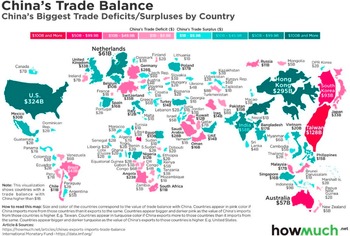
Drawing from similar quantitative data, Figure 2 is a snapshot of Africa’s trade imbalances in one year and contextualized globally, where it is clear that a range of countries across the world have varied trade imbalances with China. It is less clear what a “Chinese takeover” would look like in this landscape and how to simplistically interpret the varied trade imbalances across all the world’s countries. From this vantage point, “Africa” as a continent in relation to China, as a cohesive entity, seems like a reach. Instead, the disaggregation of African countries shows a variegated terrain, of both the nature and scale of their import/export ratios. These are quantitative observations that can only be explained through historical context and qualitative evaluation. To be clear, this is not an argument to dismiss empirical observations of macroeconomic shifts. Instead, the set of infographics raises questions such as: When is it useful to talk about something as an Africa-China phenomenon? When does the term “China-Africa” obscure other salient linkages, for example relations between other Global South sites? While the above example may be overly simplified, many scholars have critiqued Western media depictions and also warned against falling into conceptual traps of imposing overdetermined Western concepts to African-Chinese contexts (Yan and Sautman Reference Yan and Sautman2013). As Yanqiu Zheng and Tatiana Carayannis (Reference Zheng and Carayannis2023) have noted, putting Africa-China studies in conversation with other regions (Latin America, Caribbean, Asia) raises questions around knowledge production and the institutional dynamics of its production. Thus part of Africa-China studies’ initial focus on media framing provides important insights into the ideologies embedded in the gathering and presentation of qualitative and quantitative data.

Figure 2. Long description
A color-coded cartogram where country sizes are scaled by their trade balance with China. A legend at the top shows a scale from 100B and More in dark pink for deficits, through light pink and light turquoise, to 100B and More in dark turquoise for surpluses.
Western Hemisphere: The U.S. is the largest turquoise shape at $324B surplus. Mexico is $30B surplus, Canada $7B surplus, and Brazil is a large pink shape at $43B deficit.
Europe: The Netherlands is a large turquoise shape at $61B surplus. Germany is pink at $28B deficit. The United Kingdom is $33B surplus and Switzerland is $35B surplus.
Middle East and Africa: Saudi Arabia is pink at $28B deficit and Angola is $23B deficit. The U A E is turquoise at $14B surplus.
Asia and Oceania: Hong Kong is the largest turquoise shape in the East at $295B surplus. India is $58B surplus. Major deficits are shown for Taiwan at $128B, South Korea at $93B, Japan at $33B, and Australia at $57B. All these deficit countries are represented by large pink shapes.
In writing against media narratives, whether African, Chinese, or Western, scholars have downplayed the role of cultural narratives in global struggles over power and research agendas. Development narratives are about geopolitics and economics, historically and culturally specific and racially coded (Fennell Reference Fennell2013). As Cobus van Staden observes, Africa-China narratives are part of a “long history of Western self-narration” of development, one that facilitated the colonial plunder of the “Dark Continent” for Euro-American modernization (in Soulé et al. Reference Soulé, Benabdallah, Chen, van Staden and Wu2024, 14). Contemporary discourses about African development are products of colonialism and full of racial codes such as “good governance” and “capacity building” (Pierre Reference Pierre2020). Since the outset, scholars such as Deborah Bräutigam (Reference Bräutigam2009) have responded to Western narratives through high-level and rigorous empirical debunking, as well as amplifying and interrogating Chinese and African counter-narratives. But the exemplary “Chinese debt-trap narrative” remains intransigent to debunking, which attests to the power of narrative in overwriting empirical realities (Soulé et al. Reference Soulé, Benabdallah, Chen, van Staden and Wu2024, 17). Like the language of hard and soft power, images of Chinese “predatory lending” and African vulnerability are difficult to shift. It is necessary to underscore the role of cultural imaginaries, language, and tropes in constituting the parameters within which scholars—no matter how “objective”—work.
Areas studies squared: Epistemological disjunctures
In Africa-China studies, scholars and media bring a multitude of social and institutional positions, intellectual and political traditions, sources of funding, and disciplinary training to explore the varied facets of Africa-China encounters and relations. The life course of area studies in the Western academy has been a somewhat paradoxical one, both complicit with and critical of state agendas. It has been mutually constitutive with colonial and imperial projects over the past century, calcifying institutionally through surges of Cold War-era government funding and forming what Masao Miyoshi and Harry Harootunian have called an “enabling structure of knowledge” (Reference Miyoshi and Harootunian2002, 2). Despite area studies’ origins, its institutional expansion funneled scholars of color into universities in unprecedented ways, as well as others with critical perspectives on area studies, to generate critiques of colonialism, ethnonationalism, and imperialism in the Western university system (Prashad Reference Prashad1999, Reference Prashad2003). One effect of the institutionalization of area studies in the Western academy is the distinct siloing of the world into particular regions (i.e., Africa, Asia, Latin America), constraining knowledge production as expertise in each region’s bilateral relations with the West, rather than interconnection within and among regions.
Institutional siloing shapes intellectual and conceptual debates; pervasive terms such as decolonization, race, racial capitalism, colonialism (neo- and settler), empire, and indigeneity mean vastly different things across academic spaces. The collision, then, of multiple area studies’ conversations and debates in Africa-China studies accentuates and amplifies the ideological fault lines around the politics of knowledge production. For example, consider the cross-talk around Afro-pessimism, which we have observed in academic spaces. In Africa-China studies, Afro-pessimism has surfaced in discussions of postcolonial dependency in relation to the West or PRC and (anti)blackness in Sino-African relations. Yoon (Reference Yoon2023) engages the late literary scholar Pius Adesanmi, who theorized Afro-pessimism to problematize the overwhelmingly negative terms—hopelessness, despair, dysfunction, and failure—ascribed to the postcolonial “African condition” (Adesanmi Reference Adesanmi2004, 227). Others (Huang Reference Huang2024a; Sheridan Reference Sheridan2022) engage the term through Black studies and the prolific work of Frank B. Wilderson III (Reference Wilderson2010). Whereas Adesanmi’s Afro-pessimism describes the enduring narrative tropes of colonialism after decolonization, Wilderson’s Afro-pessimism theorizes slavery as the ontological status of Blackness in the afterlife of slavery. Afro-pessimism is one of many examples of scholars speaking across two different usages of the term, a split that mirrors the divide between Black and African studies.
Like the case of Afro-pessimism, when concepts and terms come together at the conjunction of two areas, each with their own definitions and colonial inheritances, there are frictions in their usage. These frictions are not additive, as if they can be overcome with minor changes in terminology or empirical additions, but compounding, building on each other’s limits to produce slippages and elisions. The theoretical impasses that Africa-China scholars often find themselves at—how to define and deploy these terms, questions of scale and comparison—are a product of “area studies squared.” Here, we turn to two conceptually rich debates from both African and Asian studies around the politics of language spheres (i.e., Anglophone, Francophone, Sinophone) and diaspora. Though often siloed disciplinarily, we consider how the generative cross-pollination of these concepts illuminate epistemological disjunctures, while pointing to ways the field is uniquely positioned to unsettle, deterritorialize, and remake area studies.
Language spheres
In the early aughts when the “rise of China” was new, representations of a Chinese-driven globalization—Chinese diaspora, culture, and an emergent superpower, even empire—leaned toward depicting a monolithic “China” and “Chineseness.” Literary scholar Shu-Mei Shih (Reference Shih2007) theorized ‘”the Sinophone” to interrogate hegemonic, singular notions of these terms, launching the field of Sinophone studies, a postcolonial approach to Chinese diaspora studies. As an alternative to “Chinese diaspora,” the Sinophone is “a network of places of cultural production outside China and on the margins of China and Chineseness, where a historical process of heterogenizing and localizing of continental Chinese culture has been taking place for several centuries” (Shih Reference Shih2007, 4). These marginalized sites of “Chineseness” center Chinese difference and relations of power between Sinitic-speaking, not Chinese-speaking, local sites and the nation-state. They interrogate the Chinese state’s ethnonationalist project in defining its diaspora as “overseas Chinese” and promoting Mandarin, called Putonghua, meaning “common language,” as the standard, normative “Chinese” language of the Han ethnic majority. Sinophone favors multiplicity, localization, and creolization over essentialist and nationalist notions of Chineseness.
Sinitic-speaking communities across the world are highly diverse and localized and do not always express feelings of dislocation, nationalist loyalties, and nostalgia for the homeland. In African contexts, Chinese communities are kaleidoscopic in their local dialects, regional affiliations, ethnic identities, hometown cultures, and political orientations. Like African communities in the PRC, there are multiple types of migration and mobility and place-making practices among Chinese communities in Africa. For instance, South Africa is home to over 300,000 Chinese “new” migrants and multiple generations of South African-born Chinese, Taiwanese, and Hongkongers dating back to the 1870s. The community is culturally, linguistically, and politically striated (Huang Reference Huang2024b; Chen, Huynh, Park Reference Chen, Huynh and Park2010; Park Reference Park2009; Yap and Man Reference Yap and Man1996). Anthropologist Rundong Ning (Reference Ning2024) has theorized “project assemblages” to reject “Chineseness” as a self-evident racial or national category, instead arguing “Chineseness” becomes meaningful in relation to particular capitalist projects.
As scholars at Eduardo Mondlane University shared, Confucius Institutes teach “Chinese culture,” “Chinese people,” and “Chinese language” and expand educational, entrepreneurial, and educational professional possibilities for African students. Importantly, “China” or “Chineseness” presented through cultural programming at Confucius Institutes is often largely uninterrogated, as if self-evident. To address the conflation of the Chinese state-driven cultural programming with a singular understanding of “Chinese” people, language, and culture, one workshop attendee proposed the Sinophone and Sinophone Africa as a conceptual intervention, receiving a mixed response. Among some African scholars, “Sinophone Africa” reiterates the linguistic areas tied to European colonialism and makes Chinese dominance—soft or otherwise—categorically equivalent to Portuguese, French, and British colonialism.Footnote 2
In the African context, long-standing debates around the politics of linguistic spheres are explicitly tied to questions of colonialism and its material legacies. Linguistics was a psychological, symbolic, and pragmatic space of decolonizing ideology, for example, Julius Nyerere’s Swahilization program in Tanzania. Later, Ngũgĩ wa Thiong’o (Reference wa Thiong’o1986) forcefully called for a turn away from colonial languages and instead to express African literature through indigenous languages, igniting significant debates around the contemporary politics of language and linguistic transformation, purity, and creolization. In this context, Anglophone, Francophone, and Lusophone Africa serve as a reminder of European colonial conquest and its postcolonial legacies. Accordingly, Sinophone has different resonances across African and Chinese studies, one colonial and the other critical. In raising this disjuncture around -phone, we point out the difficulties of speaking across area studies and disciplinary conventions, as well as the rich site of language, culture, and power for examining Sino-African encounters (Yoon Reference Yoon2023). To give some examples, in English-speaking southern Africa, Pidgin English emerges from African and Chinese encounters and reflects processes of racialization and power relations (Haruyama Reference Haruyama2023). Similarly, as Jay Ke-Schutte (Reference Ke-Schutte2023) explores in Angloscene, an ethnography of African educational migrants in China, English is still the medium of Sino-African encounters, revealing the enduring primacy of whiteness and Western cosmopolitanism. An approach to language highlights relations of power and the multilingual creolization of culture and identity, leading to more robust understandings of subjectivity, encounters, and “culture.”
A focus on Sinophone cultures also interrogates hegemonic “Chinese culture” as it is deployed in the service of empire and capital (Shih Reference Shih2007, 191–92). Established across unevenly resourced African universities, Chinese state-funded Confucius Centers teach Mandarin language and state-defined Chinese culture to cultivate future generations of African entrepreneurs and bolster Chinese geopolitical and economic dominance (“soft power”) on the continent. Formulated against nationalism, imperialism, and essentialism, the Sinophone offers an antidote to hegemonic “Chinese culture,” acting as a critical site “where powerful articulations against China-centrism can be heard” (Shih Reference Shih2007, 31). In addition to the study of Confucius Institutes, Africa-China scholars might focus on cultural vernaculars, material culture, and independent African and Chinese artists and writers. These creative perspectives on the margins can critique China-centrism and the instrumentalization of “Chinese culture.” Culture and nationalism can both be instrumentalized, even if they are articulated as part of anti-colonial or decolonial projects. In the triad of Anglophone, Francophone, and Lusophone in African studies, Sinophone takes on a quite different meaning than how it originated in Chinese studies. The critical power of language spheres is context-specific, and the frictions do not always need to be smoothed over. In addition to the Sinophone, expanded usages of diaspora illuminate other modes of subjective being, relations of power, and interactions across the intimacies of difference beyond state-driven visions.
Diaspora
The most common academic descriptor of both African people in China and Chinese people in Africa is “migrant,” a racialized term particularly used for non-white, non-Western mobile subjects. In a partial sense, this term describes the largely temporary nature of the vast and varied movements of many people between contemporary Africa and China, and somewhat marks that permanent migration is relatively rare across such trajectories (Lu Reference Lu2022a; Kuang Reference Kuang2008; Olakpe and Triandafyllidou Reference Olakpe and Triandafyllidou2023). For example, Guangzhou, a southern Chinese megacity, exemplifies the ever-shifting nature of African-Chinese mobilities, as it became a prominent nexus of small-scale African and Chinese business during the early 2000s, as captured in Noo Saro-Wiwa’s Reference Saro-Wiwa2023 popular non-fiction book Black Ghosts. African residents and populations in Guangzhou have fluctuated greatly according to global economic, political, and health conditions, including financial crises, immigration enforcement crackdowns by the Chinese state, the 2014 Ebola epidemic, and the 2020 COVID-19 pandemic. However, this dynamism is not easily captured by the term “migrant,” which often evokes precarious, transitory, occasionally legally liminal, employment-bound (i.e., migrant labor), and often aspirationally unidirectional and outward-bound trajectories. Nor do other existing categorizations fit easily, such as “immigrant,” which implies a kind of permanency in migration direction and settlement, or “expat,” a term reserved largely for elite, Western, and white people. Thus, how might we conceptualize the dynamic trajectories and new social circuits generated by highly mobile African and Chinese peoples and rearticulations of “Africanness” and “Chineseness” oriented beyond the West?
“Diaspora” as a concept emerged as a way to describe the dispersed social formation of Jewish peoples and has since been robustly taken up by Black studies scholars. In this context, scholars conceptually foreground cultural and political connections of Black peoples across the circum-Atlantic world, countering essentialist notions of biological racism (Hall Reference Hall1990; Clarke Reference Clarke2004; Clarke and Thomas Reference Clarke and Thomas2006). In this sense, diaspora is not simply about biological descent of a fixed racial group, but rather, it is a social process of recognition, racecraft, inheritance, and interconnection in the context of global white supremacy (Gilroy Reference Gilroy1993; Campt Reference Campt, Clarke and Thomas2006; Ebron Reference Ebron, Oboe and Scacchi2008; Beliso‐De Jesús and Pierre Reference Beliso‐De Jesús and Pierre2020; Massie Reference Massie2022; Fields and Fields Reference Fields and Fields2022). Importantly, Robin Kelley (Reference Kelley, Bobo, Hudley and Michel2004) has noted that diasporic analysis cannot simply be delimited to diasporic bodies, but rather the political, ideological, and social conditions that produce and make diasporic identities meaningful. Black feminist geographer Katherine McKittrick further considers how diasporic linkages refuse “a comfortable belonging to a nation, or country, or a local street … demonstrating that geography, the material world, is infused with sensations and distinct ways of knowing … there exists a terrain through which different geographic stories can be and are told” (Reference McKittrick2006, ix–x). In other words, analytical attention to diasporic peoples, movements, and social worlds illuminates translocal sensibilities, cultural circuits, multi-directional trajectories, and affective linkages that are often flattened in modern narratives of immigration and the nation-state.
By contrast, the term “diaspora” has been much more contentious in Asian studies and critiqued by scholars such as Wang Gungwu (Reference Wang1991), who have suggested that the identification of “Chinese diaspora” affixes an overly static identity to those who happen to be of Chinese descent globally. This is rooted in the ways that Chinese diasporic racialization as foreign can readily and dangerously be taken up in xenophobic, Sinophobic, anti-Asian political rhetoric across different parts of the world (Ang Reference Ang2005; Hu-DeHart Reference Hu-DeHart2015). This critique is particularly notable in southeast Asia where there have been multi-generational populations of “overseas Chinese.” In that context, using the term “Chinese diaspora” to describe such peoples potentially foregrounds ethnic Chinese populations’ connections to the modern PRC at the expense of their social positioning and belonging in various national contexts. Periodic political attempts targeting those of Chinese descent as “foreigners,” such as Chinese expulsions in 1960s Indonesia, highlight the latent dangers of such identifications (Tan Reference Tan2013). Moreover, in recent years, the PRC government has deliberately blurred the lines between huaqiao (Chinese citizens abroad) and huaren (those of Chinese descent outside of China), both as a response to anti-Chinese violence and the return of noncitizen Chinese to China, as well as to extend the PRC’s global presence and enfold diasporas into Chinese nationalism (Suryadinata Reference Suryadinata2017). For these reasons, some scholars use Sinophone instead of diaspora. Yet diaspora continues to have a strong analytical grip in Asian studies and other fields as scholars commit to its anti-essentialist dimensions and make links across diasporic contexts.
Diaspora, when modified by African, Black, and Chinese, has varying meanings, some essentialist and others emancipatory. As a critical category of analysis, diaspora can counter essentialist concepts of modern nationalism. In line with alternative conceptualizations of Black diaspora, historian Shelly Chan suggests, “Not a fixed group, diaspora serves as a tactic for political solidarity, a lens onto cultural hybridity, and a reminder that identity is a process” (Reference Chan2018, 9). Modern nationalism is often deeply invested in historical revisionist understandings of social difference that cohere “national” population narratives, often defined in ahistorical ways along ethnic, racial, and religious majoritarian identities. By destabilizing the linkages between nation and people, diaspora potentially complicates understandings of transnational mobility, identification, and belonging beyond the nation-state form and geopolitical world order.
Africa-China as transregional method
When the Mombasa–Nairobi Standard Gage Railway opened in 2017, Western media outlets noted Zheng He’s statue in the station with skepticism. The New York Times (de Freytas-Tamura Reference de Freytas-Tamura2017) covered the subject as “Kenyans Fear Chinese-Backed Railway is another ‘Lunatic Express,’” representing the railway as a resurrection of British colonialism with a new, glossy Chinese face. In the workshop, Owuor posed: “What fuels the panicky production of “China-Africa”? Is it Bandung Redux?” Such moments, in this case separated by seven decades, represent the potential remaking of the Western-dominant world order. As long as our geopolitical landscape is shaped by centuries of Western imperialism and white supremacy, the debunking reflex, of countering dominant Western media narratives, will remain a central component of Africa-China studies. The debunking reflex, however, is insufficient on its own.
If one of the most important insights of Africa-China studies is the continual nature of the politics of knowledge production, then it is imperative that scholars think about what kind of powers—imperialist, ethnonationalist, already existing or emergent—can instrumentalize their research. Because area studies was historically about putting knowledge about various places of the world into the service of US empire, it is important to consider the ways in which future knowledge production fits into multiple state agendas—African, Chinese, and Western. As postcolonial and feminist critical theorists have shown, modern nationalism relies centrally on ethno-racialized and gendered body politics to produce “permanent minorities” (Mamdani Reference Mamdani2000), and modern nation-states currently form the political enforcement units of global capital, or what Catherine Besteman (Reference Besteman2020) has called the “militarized global apartheid” world order.
To guard against cooptation, it is imperative for scholars to practice a critical consciousness of the knowledge produced and the conditions of its production. We must be attentive to potential state and elite capture of ethnographic findings for security strategy or reductive journalism that fuels ethno-nationalist fervor and racial scapegoating, while continually monitoring local discourses where ever-changing nationalist and geopolitical agendas take shape. These concerns are important to African and Chinese studies on their own, but seem heightened for Africa-China studies given its geopolitical importance. Interdisciplinarity can act as a precautionary antidote, beginning with reading widely across disciplines and genres. What one field takes as a premise or a given, another takes as a central site of investigation. It is also important to read across the division of humanistic and social scientific fields. Currently, humanists must grapple with political economic “data” to contextualize and legitimize their analysis, but the same is not true vice versa. Social scientists often are not required to interrogate their cultural lenses when producing data narratives. It is important to read and cite across scholarly locations, including different kinds of academic and public scholarship produced across institutions in Africa, China, Europe, the United States, and elsewhere. Drawing from feminist theory, we acknowledge that knowledge production is always politically contested, incomplete, and partial. Our goal is not mastery. Through the process of reckoning with asymmetries and hierarchies in the field, we can produce knowledge that is more resistant to facile instrumentalization and weaponization in service of nationalism, empire-making, and scapegoating.
In this essay, we considered Africa-China studies as a field that emerged from a particular geopolitical moment that takes areas as its primary unit of inquiry, and with it the inheritances of area studies and boundary-making practices. Moreover, the complexities of Africa-China studies can be visualized as the infinite reflections resulting from placing two mirrors in parallel that gesture at the open-ended possibilities of theorizing across areas. Putting the two regions into relation disrupts the production of knowledge in a unilateral direction back into the imperial metropole. In The Politics of Imagining Asia, Wang Hui (Reference Wang and Huters2011) notes that the idea of Asia “is at once colonialist and anticolonialist, conservative and revolutionary, nationalist and internationalist, originating in Europe and, alternatively, shaping Europe’s image of itself. It is closely linked to issues relating to both nation-state and empire, a notion of civilization seen as the opposite of the European, and a geographic category established via geopolitics” (Reference Wang and Huters2011, 59). Such insights resonate with the idea of “Africa” and the “Orient” that emerged conceptually alongside the rise of European colonialism and supremacy (Mudimbe Reference Mudimbe1988; Said Reference Said1979). Indeed, the world is not simply composed of natural static regions; rather, the division of the world into regions is a historically recent, geopolitical, racialized, and economic project. Shifting interrelations between regions generates new possibilities and world orders (Chen Reference Chen2010). “Africa” and “China,” or “Africanness” or “Chineseness,” are not stable categories. They take meaning through their relationality and mediation, including what is often not explicitly named: whiteness, or by another name, the West. What emerges from Africa-China studies provides textured dynamics of regional relationality and historical consciousness—the ways that areas and peoples are mapped in relation to each other. When we engage two areas, we unsettle them both and illuminate the contingencies of knowledge formations and geopolitical categories. Thus, Africa-China as method is historically informed while not being structurally overdetermined, attentive to how social differences such as race, nation, and gender are mobilized, and the historical specificity of these categories.
The global academic institutional landscape has morphed during the past decade; there are now tens of thousands more Africans who have gone through higher education in China, where the Chinese state is forming and investing in new ways in area studies and African studies institutions. African institutions, too, are making new centers of knowledge production concerning China, Asia, and Africa’s engagements with other world regions. If the Cold War underpinnings of area studies has taught us anything, area studies scholars must remain critically attentive to how the sources of funding, particularly from the military or state departments, shape and potentially weaponize knowledge production. This lesson is relevant to the growth of new area studies outside of the West. Rather than simply reproducing Cold War-era area studies, we ask what is the work of the hyphen? That is, in Africa(-)China studies, we must bring the relational—socially produced, geopolitically scaffolded—to the forefront.


 Open access

