


The main instrument through which international courts serve their functions, whether settling disputes, interpreting and applying the law, or enforcing compliance, is their decisions. This contrasts with other types of international organizations that typically have a range of instruments to draw upon in fulfilling their governing roles, such as data collection, technical assistance, resource distribution, sanctions, or even interstate negotiations. In other words, international courts uniquely govern by decision. For this reason, understanding what underlies international judicial decision-making is crucial to debates about the legitimacy and performance of ICs.
This book studies international courts, defined as international judicial bodies that (1) take decisions on the basis of international law – as opposed to domestic law; (2) follow predetermined rules of procedure; (3) issue legally binding outcomes; (4) are composed of permanent independent members;Footnote 1 and (5) require at least one party to a dispute is a state or an international organization.Footnote 2 Moreover, it conceives of ICs as a unique type of international organization, which is any association of more than two states that has membership criteria, is a formal entity, and possesses a permanent secretariat or other indication of institutionalization such as headquarters and/or staff.Footnote 3
The aim of this book is to shed light on the decisions of international courts. It does so by focusing on a core feature of judicial decision-making – deference. Judicial deference varies extensively in international adjudication. Yet, why some courts defer more than others or why deference ebbs and flows is not fully understood. This chapter advances an account of deference by international courts, which focuses on their strategic space. It presents a theoretical argument about the factors that structure a court’s strategic space and distinguishes itself from other prominent accounts of judicial decision-making in existing research.
I lay out this approach in three steps. First, I conceptualize judicial deference in terms of if and how a court, through its decisions, either accepts or rejects the exercise of authority by states or other governing entities (e.g., international organization). Based on this definition, I operationalize deference in terms of three features of judicial decisions: case outcomes, legal interpretation and reasoning, and remedies. This threefold view of judicial decisions facilitates a comprehensive assessment of deference. It also helps to elucidate distinctions between deference and other related concepts, namely, judicial activism/restraint and de facto independence.
Second, I develop a theoretical framework that explains judicial deference. Informed by rational institutionalism, this framework centers on the strategic setting in which ICs operate. The key political factors shaping this strategic setting are states’ preferences and the institutional rules governing an IC. I suggest that formal rules that safeguard judicial independence and political fragmentation, as in the heterogeneity of states’ preferences, enable less deferential decision-making. These factors construct a court’s strategic setting by way of their impact on the perceived legitimacy of the court and the credibility of state resistance against the court. Additionally, ICs exercise agency over their strategic setting by adopting practices that also affect perceived legitimacy and the credibility of resistance. I outline the logic behind this argument and identify theoretical expectations, or observable implications, to be evaluated empirically.
Third, I discuss alternative approaches, which offer different expectations about whether and when ICs would be inclined to defer to states. The most prominent of these alternatives looks to an IC’s support network. This approach expects that courts with a strong and active network of proponents will demonstrate less deference, irrespective of states’ preferences and institutional rules. I also consider approaches that emphasize ideational factors, like political norms and legal culture.
Conceptualizing Judicial Deference
Deference is a critical characteristic of international judicial decisions because it relates to the allocation of authority. Accordingly, it has consequences for how ICs fulfill their governing roles, namely, the settlement of international disputes, the clarification of international law, and the enforcement of international legal obligations.Footnote 4 This section conceptualizes deference for the purpose of this book. In doing so, it discusses the advantages of approaching judicial decision-making in terms of deference as conceived here and describes how three features of a judicial decision – case outcome, legal interpretation and reasoning, and remedial orders – are used to operationalize deference.
Judicial deference is defined as a court’s acceptance of the state’s exercise of authority (or that of any other governing entity within the court’s jurisdiction). This definition builds on the concept of deference developed by Efrat and Newman to understand transnational jurisdictional conflicts and whether one state accepts the authority of another state.Footnote 5 Others have adapted Efrat and Newman’s definition to apply to other governing actors. For instance, Pratt used it to describe the allocation of authority among different international organizations, or whether one IO accepts the exercise of authority by another IO.Footnote 6 Like Pratt, I adapt Efrat and Newman’s definition to address other authority actors, specifically, international courts.
While international courts typically review acts or actions of states or their constitutive organs (e.g., legislature, judiciary or executive agency), many international courts review and decide on the acts or actions of supranational or intergovernmental organs.Footnote 7 For example, some judgments of the CJEU concern an act or action of a member state (i.e., infringement) while others address an act or action of a European Union (EU) institution, such as the EU Commission or EU Council (i.e., annulment). For simplicity, the remainder of this chapter discusses deference in terms of the relationship between an IC and states, even though my conceptualization also applies to ICs’ acceptance or not of the exercise of authority by any intergovernmental and supranational organs within their jurisdiction.
I am not the first to study deference by international courts; in fact, international judicial deference has received the attention of legal scholars.Footnote 8 My conceptualization of deference shares similarities with legal approaches but is also unique. Shirlow’s contribution to legal scholarship on deference provides a prominent definition. She defines it as “techniques used by international adjudicators to recognise a domestic actor’s superior ‘authority’ to decide issues relevant to the settlement of the dispute” and thus “deference equates to a recognition of another actor’s decision-making authority.”Footnote 9 Similarly, Cheyne conceives of deference as a court’s “acknowledgement of the primacy of the State to make decisions and the need to avoid substituting the State’s judgment with its own.”Footnote 10 These definitions, like mine, relates to the allocation of authority. However, I do not conceive of deference in terms of the substitution or replacement of authority per se. Rather, I conceptualize deference as acceptance, which according to Efrat and Newman can take two forms: abstention and validation.Footnote 11 A court accepts a state’s exercise of authority either by abstaining from exercising its own authority or by validating a decision or action of the state.
Abstention and validation can be seen in various features of a judicial decision. For instance, dismissal of a legal complaint because it falls outside a court’s jurisdiction is one way a court might abstain. A court can also abstain by not dictating what actions a state must take to remedy a violation. In the first instance, deference affects the outcome of the dispute (who wins or loses), while remedial orders are implicated in the second instance. A decision whereby a court finds a state’s interpretation and application of the law to be valid, and therefore dismisses the state of any wrongdoing, also constitutes deference.
Nondeference occurs when a court rejects the state’s exercise of authority, either by not abstaining or by not validating an act or action taken by the state. It can also be seen in different features of a judicial decision. When a court finds a violation, for example, it has withheld validation of the state’s exercise of authority. If a court agrees that it has jurisdiction, it has not abstained. Likewise, when a court expands an interpretation of the law or specifies how a state must remedy a wrong, it has foregone abstention. In these instances, the court’s decision withholds acceptance while also substituting the state’s judgment with its own.
Conceived as acceptance (validation or abstention), deference can be observed in the outcome of a legal case, in the way in which law is interpreted and reasoned, as well as the remedial orders. This contrasts with prominent legal approaches, which examine deference based on the intensity of judicial scrutiny or standards of review (e.g., margin of appreciation). These approaches focus on questions such as what doctrines lend themselves to deference or nondeference, what is the legal reasoning behind different levels of judicial scrutiny, and what ought to be the standard of review.
The contrasts between legal approaches and my own are primarily analytical. On a practical level, they will typically agree on what decisions are deferential or not because a deferential standard of review will often result in acceptance. As Fahner explains, “the intensity of review affects the likelihood that the adjudicators will find that the decision under review is lawful: if they exercise a low intensity of review, it is likely that the original decision will be approved; conversely, a high intensity of review increases the chances that the original decision will be overturned.”Footnote 12 However, differences can exist on a practical level. For example, according to Shirlow, deference is low in de novo review because the domestic court’s decision is highly scrutinized,Footnote 13 irrespective of whether the IC comes to a similar conclusion as the domestic court. The sheer fact that the court exercises intense review removes authority from the state and constitutes nondeference. My approach, in contrast, focuses on whether the de novo review results in acceptance or rejection of a domestic court’s decision.
Characterizing judicial decision-making in terms of deference has advantages over alternatives. Scholars and policymakers alike typically characterize judicial decisions as “activism” or – conversely – “restraint.” Yet, this way of describing judicial decisions poses problems. Importantly, judicial activism is a term fraught with multiple meanings. The first noted use of “judicial activism” and “restraint” was by Arthur Schlesinger in 1947, who described the justices of the US Supreme Court as either “activists” or “champions of restraint.”Footnote 14 According to him, activist judges used judicial power for “their own conception of the social good” while those who exercised restraint expanded “the range of allowable judgment for legislatures.”Footnote 15 Kmiec identifies five widespread definitions and argues that activism is used to refer to instances where a court: (1) invalidates the decision of another authority (e.g., a legislature); (2) ignores precedent; (3) legislates; (4) departs from accepted interpretive methods; or (5) engages in result-oriented judging.Footnote 16 Others include additional components to determine activism, such as “institutional aggrandizement.”Footnote 17 Attempts to refine the concept have led others to define judicial activism as a departure from “cultural standards of judicial role”Footnote 18 or “prevailing standards of adjudicatory conduct.”Footnote 19 This definition, however, is difficult to apply when considering courts comparatively, as the cultural standards will differ from court to court and with time.Footnote 20 Moreover, judicial activism is laden with political connotations and subjective assessments – it is often in the eye of the beholder.Footnote 21
Criticisms wielded against the WTO’s Appellate Body exemplify the challenges with exploring judicial decision-making through the lens of activism versus restraint. The United States has accused the WTO AB of “judicial activism” and “overreach” because it has created new rights and obligations for members.Footnote 22 A significant part of the charges of overreach by the United States relates to how the AB treats previous decisions as binding precedent.Footnote 23 The application of the term “activism” to the WTO AB is somewhat confusing because adherence to established interpretations is a typical marker of restraint, not activism. Whether we view the WTO AB as activist is further complicated by additional considerations. For instance, decisions of most international courts are formally binding only on the direct parties to a dispute, so departure from this principle is arguably overreach. On the other hand, the AB’s gap-filling might be more indicative of states’ failures to develop the law through intergovernmental negotiations than it is of the AB’s activism.Footnote 24 Overall, this example shows that assessments of activism can be varied and its key markers context dependent or subjective.
Deference is thus useful because it does not suffer from the same politically charged connotations as activism or restraint or from being subjective. It is also beneficial for comparative analysis of the decision-making of international courts and tribunals because it operates with a common benchmark – the acceptance (or not) of the state’s exercise of authority.
Last, I distinguish deference from de facto independence. While both terms refer to judicial behavior, they speak to different units of analysis. As I conceive of it, deference is a characteristic of discrete judicial decisions – although it can be used to describe a body of decisions. On the other hand, de facto independence is a characteristic of a court. While de facto independent courts are less likely to be deferential in any given decision and vice versa, it may in practice make some deferential decisions.
Deference: Three Indicators
Having elaborated on how I define deference, I now turn to how it is operationalized or observed empirically. As alluded to above, an international court makes several determinations that reveal acceptance or rejection of the state’s (or other entity’s) exercise of authority, including the determinations on (1) case outcome, (2) legal interpretation and reasoning, and (3) remedial orders. The first two are determinations about whether there has been a breach of law, while the third concerns the consequences or sanctions against the state for its breach. Each of these determinations roughly speaks to one of the main functions of ICs. Case outcome relates most clearly to a court’s dispute resolution function, legal interpretation and reasoning to clarification and development of law, and remedies to issues of compliance. This leads me to adopt a threefold operationalization of judicial deference, which I describe below.
First, we can observe deference through a case outcome, or in whose favor the court rules (e.g., admissible or not, win or loss). I assume that deference occurs when an IC decides that the respondent state has complied with its legal obligations (validation), or it dismisses a case as being inadmissible or outside its jurisdiction (abstention). Conversely, decisions that declare the respondent state has violated a legal obligation are indicative of nondeference. While case outcomes can provide insights into judicial deference, measuring deference by case outcomes alone “risks missing potentially more interesting and important aspects of international adjudication.”Footnote 25 Also, case outcomes overestimate deference because they capture considerations other than a court’s intention to accept the state’s exercise of authority. For instance, a decision in which a court declares a petition is outside its jurisdiction may indicate that the law clearly denies the court authority rather than being an act of abstention on the part of said court. Similarly, a ruling that finds the state has not violated the law might not be indicative of the court’s acceptance of the state’s exercise of authority but instead that there was poor evidence to support the allegation. Put differently, a case outcome may be a poor indicator of deference in any given legal case, and case outcomes will overestimate judicial deference in the aggregate. Nonetheless, case outcomes, especially in the aggregate, can approximate a court’s tendency to accept or reject states’ exercise of authority, which is necessary for comparative analysis.
To balance the advantages and disadvantages, I combine case outcomes with additional features of judicial decisions to operationalize deference. Namely, deference is also observed through the method of interpretation and legal reasoning applied by a court in any given decision. Treaty interpretation is defined as “the activity through which international tribunals give meaning to a treaty in the context of a particular case or fact pattern.”Footnote 26 There are several methods used to interpret treaties, each of which relies on a specific reference point. For example, judges will often use the text, party intent, or underlying treaty objective as the baseline for understanding treaty obligations. For several methods of interpretation, there is no clear pattern with deference. For instance, interpretative methods based on the text, party intent, or underlying objective of a treaty are not rock-solid ways of identifying deference.Footnote 27 One method that provides the most insight into deference relies on a reference point concerned with the envisaged role of a court, or what Pauwelyn and Elsig label as either a “work-to-rule” approach or alternatively a “gap-filling” approach.Footnote 28 A work-to-rule approach takes the view that a court’s role is typically secondary to the state and applies only what the treaty provides for according to the strictest, most conservative reading. A work-to-rule approach resembles “restrictive interpretation,” in which a court limits the scope of vague provisions or “assumes that state intends to be bound by the least of any obligation which could be read from a provision of doubtful content or ambiguous expression.”Footnote 29 A “work to rule” approach most closely resembles a court abstaining from anything that resembles law-making by way of interpretation or validating any reasonable interpretation given by a state. Conversely, gap-filling assumes a court’s job is to fill in gaps left by a treaty to complete a contract.Footnote 30 Gap-filling is what scholars often associate with judicial lawmaking,Footnote 31 and it is sometimes called purposive or expansive interpretation.Footnote 32 It will typically require a court to not abstain.
A work-to-rule approach is deferential.Footnote 33 Gap-filling is often nondeferential, but not always. Thus, to determine deference in interpretation I look first and foremost at whether there is a work-to-rule approach. On the other hand, if there is what appears to be a nondeferential form of gap-filling, I also consider three other pieces of information: (1) Does the court’s interpretation diverge from the respondent state’s argued position or preferred interpretation in the dispute; (2) does the court rely on legal reasoning or doctrines that are known to reflect deference;Footnote 34 and (3) does legal scholarship or legal opinion view the interpretation or reasoning as deferential. In all instances, I am attentive to whether an interpretation generally broadens or narrows obligations in ways that reflect abstention or validation. Ultimately, determining deference in legal interpretation and reasoning requires qualitative assessment on a case-by-case basis. However, as I use a threefold indicator of deference, I see these challenges as less problematic than if my measure was based solely on this aspect of a judicial decision. Also, as a separate note, this aspect of my measure closely overlaps with what legal scholarship tends to associate with deference.
Third, deference can also manifest in a court’s decision on remedies, or the legal consequences to a state once it has been found to have failed in its obligations. Remedies are also seen as the way in which relief or justice is afforded to a wronged applicant. IR scholars tend to pay little attention to judicial remedies.Footnote 35 Yet, legal remedies are an integral part of an international court’s judgment.Footnote 36 While there is some debate about what remedial powers international courts have, three types are more or less recognized: (1) declaratory judgments, (2) reparations, and (3) consequential orders.Footnote 37 While not all ICs have the power to use all of these remedies – some remedial powers may be proscribed by the constitutive instruments (i.e., founding treaties, statutes, etc.) of an IC – they are generally recognized as the main remedies of international legal practice.Footnote 38 Declaratory judgments are the declaration of wrongdoing by the respondent state. This type of remedy “leaves it to the discretion of the wrongdoing state to take appropriate measures to comply with international law.”Footnote 39 Declaratory judgments are the least intrusive to states because they simply declare wrong-doingFootnote 40 but allow the respondent state to determine how it will remedy the legal violation. In other words, these remedies are acts of abstention by courts and do not impose any particular act or action on the state about providing a wronged party with relief. Reparations include restitution, compensation, and satisfaction.Footnote 41 Restitution is an obligation to restore the status quo before the wrong was committed. Sometimes restitution is materially impossible or would incur a disproportionate burden on the state when compared to the benefit. Compensation is an order obligating a state to monetarily compensate a wronged party for the damage caused. Satisfaction is an obligation that the violating state acknowledge its wrongdoing, express regret, issue an apology, or similar.Footnote 42 Reparations overall are focused on giving relief to the wronged party by committing the state to take some form of action. While reparations limit state discretion on how to offer relief, it does not encroach largely on state sovereignty because there is no mandated change to law or policies. Consequential (or mandatory) orders “direct the respondent state to take or abstain from some form of specific action.”Footnote 43 Consequential orders include orders for specific performance, which aim to ensure the state complies with the underlying obligation, and negative injunctions, which prevent the state from taking certain action. Both reparations and consequential orders reflect a court choosing not to abstain from determining an appropriate remedy. However, as consequential orders are the most intrusive on state sovereignty, removing state policy discretion and replacing state authority with that of the court, I consider consequential orders to be the least deferential type of remedy. Finally, nondeference can become greater in any given decision when a court combines remedies. If a court orders both restitution and compensation, for example, it is less deferential than if it were to only order compensation.
Figure 2.1 depicts this threefold operationalization of deference. A few considerations inform this approach to measuring judicial deference. First is the observation that courts can employ different levels of deference across the three dimensions of a single judgment. For example, they can take expansive interpretations while adopting minimally intrusive remedies. This operationalization helps to capture these nuances. Additionally, this threefold approach facilitates measurement at the level of individual court decisions but can be aggregated to say something about the tendencies of a court for both temporal and cross-sectional comparisons. It provides a comparative metric that is especially workable and appropriate for courts in which individuals or private actors can have standing.Footnote 44 It also bears in mind the newness of the courts being studied. Alternatives such as text analysis based on a dictionary approach might be useful for courts like the ECtHR or CJEU because they have hundreds of judgments and have developed a uniform internal language. Newer courts do not have these advantages. Last, this measure roughly captures the various functions or roles of courts: dispute resolution (case outcome), legal clarification and application (legal interpretation and reasoning), and compliance (remedies). Thus, while other approaches to observing and studying deference can be instructive, this operationalization is adopted to accommodate the comparative research design and aims of this book.
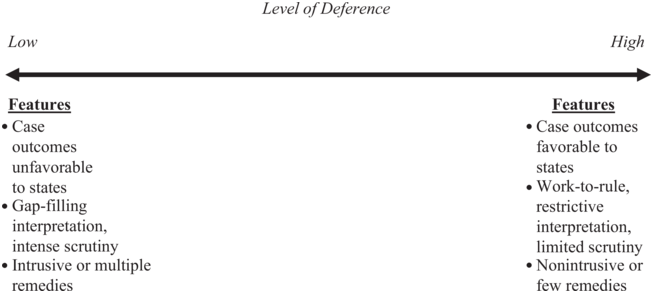
Figure 2.1 Long description
A horizontal arrow labeled Level of Deference stretches from low on the left to high on the right. Left side features include case outcomes unfavorable to states, gap-filling interpretation, intense scrutiny, and intrusive or multiple remedies. Right side features include case outcomes favorable to states, work-to-rule, restrictive interpretation, limited scrutiny, and nonintrusive or fewer remedies.
International Courts and Their Strategic Space: Political Constraints and Judicial Practices
International courts differ in terms of the degree to which they defer to states in their decision-making. For example, the CJEU has been described as being less deferential because it is viewed as making law,Footnote 45 despite its preference for nonintrusive remedies.Footnote 46 In contrast, the ICJ shows more deference because of its restrictive interpretationFootnote 47 and minimally intrusive remedies.Footnote 48 The ECtHR has been less deferential to states in its legal interpretationFootnote 49 while employing less intrusive remedies.Footnote 50 This, however, has varied throughout the Court’s lifetime, across states and individual judgments.Footnote 51 The IACtHR is also known for nondeference due to its intrusive remedies.Footnote 52 How can we explain this variation? What factors influence whether an IC defers to states or not?
To address these questions, I begin with the widely accepted observation that international courts, like their domestic counterparts, operate by their very nature within a strategic space.Footnote 53 Some have labeled this “strategic space”Footnote 54 as “bounded discretion”Footnote 55 or “constrained independence.”Footnote 56 A court’s strategic space derives from its competing incentives, which it has by virtue of being a court. On the one hand, a court has legal incentives – to build and maintain a reputation as a legitimate legal authority. This requires a court to demonstrate legal competence and its respect for the law and legal procedures. The ability to speak as an authority on the law also necessitates the appearance of being neutral. Courts must appear to be unaffected by political pressure and as dealing only in law, not in politics. Without a reputation for neutrality, international courts risk becoming irrelevant and unable to serve their core functions. Thus, ICs have incentives to maintain a reputation as a neutral and expert interpreter of the law.
On the other hand, ICs also have political interests – to maintain the support of those who wield power. Courts are traditionally described as the “weakest” or the “least dangerous” types of governing institutions because they lack the ability to enforce their rulings. Courts must rely upon other political actors or power holders to implement their decisions and to continually support their functioning. This is also the case for international courts. Without compliance and support from power wielders, a court’s ability to serve its core roles in governance can be threatened. Because of their need for compliance and support from power holders, ICs seek to avoid state resistance and defiance. Resistance can come in many forms and can include what others refer to as backlash and pushback.Footnote 57 States can unilaterally resist a court through threats or execution of “exit” and “voice.”Footnote 58 Exit transpires when a state withdraws from the jurisdiction of a court. Voice occurs when a state publicly “attacks” a court, implicitly or explicitly communicating displeasure with a court, or by ignoring it through nonparticipationFootnote 59 or willful noncompliance. States can also resist an IC through collective measures, aiming to rein in or curb a court’s authority by restricting the resources, mandate or authority of a court.Footnote 60 States might also override a court. These possible means of resistance constrain a court politically and give courts reason to accommodate states’ preferences.
To summarize, a court’s competing incentives relate to its perceived legitimacy and the feasibility and credibility of state resistance. International courts formulate and issue their decisions against this backdrop. While it is accepted that this is the context in which judges make decisions, the boundaries of their strategic space and what factors determine the breadth of this strategic space are debated. In the following, I develop a theoretical account to explain variation in courts’ strategic space and its impact on judicial decision-making. This account highlights how two structural factors – formal independence and political fragmentation – combine to affect the strategic space in which courts operate and make decisions. The two political factors are causally linked to an IC’s strategic space, and hence deference, due to their impact on the perceived legitimacy of a court and the feasibility and credibility of state resistance.
The framework also points to a set of intervening factors. These include practices that ICs adopt to purposively broaden their strategic space, namely, persuasive argumentation and public legitimation. Previous state resistance can also intervene to affect the strategic space; when states have previously been successful at implementing resistance, a court’s strategic space narrows. If and how international courts practice persuasive argumentation and public legitimation as well as their past experiences with resistance will be affected by structural conditions. Their impact on a court’s strategic space occurs because they affect the credibility and feasibility of efforts to curb a court. They also have an impact on a court’s strategic space by affecting the legitimacy of ICs and their judgments. In turn, their impact on a court’s strategic space shapes judicial deference.
Structural Factors: Formal Independence and Political Fragmentation
The formal independence of a court facilitates its ability to balance its competing incentives. Judicial independence relates to the ability of courts to deliberate and reach judgments in light of the law and without undue pressure or influence from external sources, governmental or otherwise.Footnote 61 Independence can be conceived as either de facto independence or de jure independence.Footnote 62 De facto independence is a matter of whether a court demonstrates independent behavior in practice. On the other hand, de jure independence, or what I label formal independence, is a feature of institutional design that relates to the availability of ex ante and ex post mechanisms of state control over a court and thereby if and how independence is formally safeguarded. Chapter 3 develops the concept and measurement of formal independence, but in short it is rooted in the codified rules governing a court that determine the extent to which a court enjoys safeguards to independence.
Previous literature suggests that independence has bearing on the performance of international courts.Footnote 63 Although not expressed in the language of independence, research has shown that the formal rules defining state control of a court affect judicial decision-making.Footnote 64 Some scholars have argued that the independence of ICs is associated with judicial activism.Footnote 65 More recent research highlights the relationship between specific elements of formal independence, like reappointment rules, and judicial decision-making.Footnote 66 In addition, formal independence has been shown to facilitate judicial activismFootnote 67 and autonomy of domestic constitutional courts.Footnote 68
Formal independence affects a court’s strategic space, or how ICs experience and perceive the balance of legal and political imperatives, via two mechanisms: (1) the credibility and political feasibility of coordinated resistance against a court, and (2) its legitimacy. First, formal independence shapes the credibility and feasibility of coordinated state resistance (e.g., court reform, removal of judges, budgetary consequences). When formal independence is low, there is a greater availability of possible means for curtailing a court through coordinated action. All else equal, the feasibility and credibility of state resistance will be greater. Conversely, independence-enhancing safeguards reduce the likelihood that states can credibly threaten to or successfully curtail a court because the means of doing so are more limited.
The credibility and feasibility of state resistance can impact decision-making. Credible threats have a chilling effect on judicial decision-making and increase their inclination to exercise caution.Footnote 69 For instance, Stiansen and Voeten show that when democratic states resist a court, the court responds with restraint.Footnote 70 Thus, formal independence shapes decision-making, by way of its impact on the credibility and plausibility of state resistance, such that deference decreases.
Formal independence also has an impact on a court’s strategic space and, therefore, decision-making, because it strengthens a court’s legitimacy – or “beliefs within a given constituency or other relevant audience that a political institution’s exercise of authority is appropriate.”Footnote 71 Formal independence, especially in the absence of a history of practice, can lead stakeholders to believe a court is unbiased and isolated from political pressure and thereby strengthen public trust, confidence, or support for said court. It gives the appearance of independence. This is because independence is typically seen as a crucial property of a legitimate court.Footnote 72 Conversely, rules that limit formal independence can tarnish a court’s legitimacy, giving it the appearance of being politically vulnerable. Legitimacy can also impede state (coordinated and unilateral) resistance. Defiance or resistance against a rightful and appropriate institution creates audience costs for states and can require large amounts of social capital to defy or resist. Endowed with more legitimacy, because of its formal independence, a court will face reduced political constraints and demonstrate less willingness to defer. The impact of formal independence via an IC’s legitimacy is likely to be especially important in its earlier years of operation because, with time, an IC’s performance and practice will also factor into legitimacy assessments.Footnote 73
Another factor affecting the breadth of a court’s strategic space, primarily because of its impact on the credibility of state resistance, is the degree of political fragmentation between those actors who wield control over a court. Comparative judicial politics research illustrates that greater political fragmentation makes it more challenging for those who wield control over a domestic court to curtail or punish it.Footnote 74 On the international stage, political fragmentation – understood as the degree of preference heterogeneity among member states – similarly affects the credibility or feasibility of coordinated resistance against an IC.
The membership of an IC is not a monolith, but a set of multiple principals who have individual preferences. IR scholarship provides ample evidence to suggest that preference heterogeneity affects the coordinated action of states. Generally speaking, states are less likely to cooperate when their preferences diverge.Footnote 75 Intergovernmental decision-making is more cumbersome when there is minimal overlap in states’ preferences because the scope for agreement is narrow.Footnote 76 The degree of heterogeneity of states’ preferences similarly affects how states interact with international bodies to which they have delegated authority.Footnote 77 When states’ preferences diverge, not only is the original act of delegation affected but so is any process of “de-delegation,” “recontracting” or similar.Footnote 78 Political fragmentation is one reason why EU member states have only rarely collectively resisted the CJEU.Footnote 79 Resistance against the Court is complicated by the “joint decision trap,”Footnote 80 meaning that efforts to collectively resist the Court would most likely require the support of some states whose preferences align with the judgment(s) of the Court. While fragmentation is likely to affect an IC’s strategic space primarily because it sends signals about the probability of collective state resistance, fragmentation might also have an impact on how an IC is viewed or its legitimacy. Some research suggests that preference heterogeneity has an impact on how the public views IO decisions, such that fragmentation boosts the legitimacy of an IO’s decision.Footnote 81
Therefore, courts will typically view fragmentation, or heterogeneous preferences among states, as an opportunity to reject the state’s exercise of authority – when deemed appropriate on the basis of law – because state resistance is unlikely to unfold.Footnote 82 These dynamics are, however, slightly complicated by two other considerations: (1) the voting rule by which intergovernmental decisions are taken, and (2) the distance between the court’s preferred position and that of states. For instance, the notion of “majoritarian activism” suggests that a court’s nondeference is enabled by having a majority of states with preferences that overlap with that of the court – as no coordinated resistance can occur when a majority agrees with a court.Footnote 83 Various scholars have modeled one or both of these considerations in relation to the CJEU.Footnote 84 While I do not dispute the relevance of these two considerations, I do not incorporate them into the theoretical model (even though the empirical analysis keeps them in mind). My reasoning is twofold. First, the expectations would only change at the margins. For instance, we would only expect high fragmentation to correspond with deference when the court’s position diverges significantly from a sizeable portion of states and when decisions can be taken by a majority as opposed to consensus. Meanwhile if a court’s preference overlaps with unfragmented preferences of states, deference remains the likely result, even though it will be an act of validation and not abstention. Second, such a model is difficult to apply across international courts given different voting rules and changing state preferences. Parsimony is more amenable to comparative analysis at this stage. All else equal, I expect that a lack of political fragmentation among states will lead an IC to view coordinated responses from states as politically practicable, and therefore to defer.
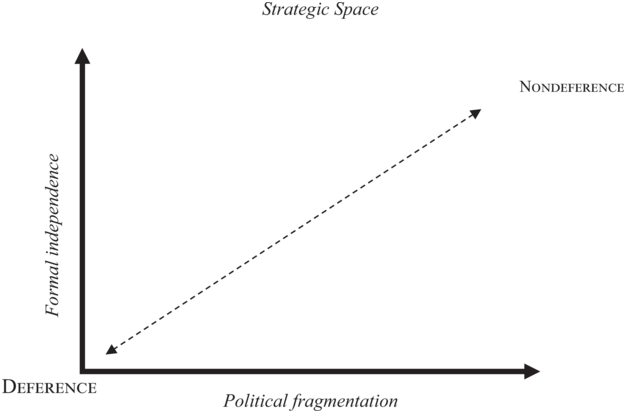
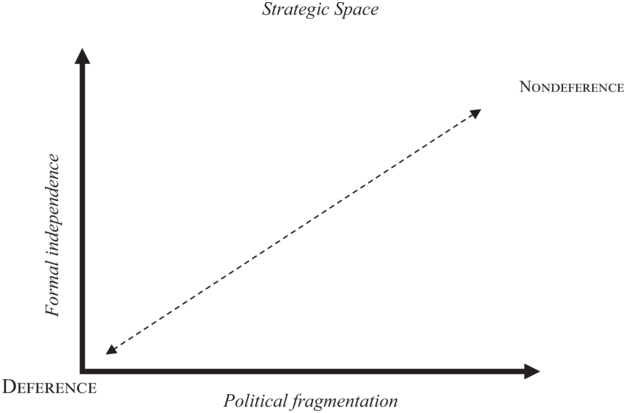
Formal independence and political fragmentation, I argue, combine to shape a court’s strategic space by way of their impact on the political feasibility and credibility of state resistance and a court’s legitimacy. The combined effect of these two structural factors on strategic space and deference is visualized as a two-dimensional space in Figure 2.2. As formal independence and political fragmentation increase so does a court’s strategic space. Where the strategic space is larger, nondeference is more likely. Conversely, deference is more likely when formal independence and political fragmentation are low. Additionally, if formal independence is high, yet fragmentation is low – or vice versa – the gains from independence are partially offset by the absence of fragmentation. In these scenarios, there will be a midrange strategic space.
This account explains variation in aggregate levels of deference across courts, while also offering insights into temporal variation for individual courts. Deference over time for an international court can arise from changes in formal independence and political fragmentation. While formal independence changes infrequently, it is not unheard-of. Occasionally states change rules governing courts that expand their formal independence.Footnote 85 I have not observed in my data any instances where formal independence has decreased. Political fragmentation can also drive changes in deference, and it is more susceptible to fluctuations for two reasons. First, state preferences are not static. A variety of dynamics contributes to changes in state preferences, including developments in: (1) domestic interests, ideas and institutions,Footnote 86 and (2) international institutions, power structures, and social interactions.Footnote 87 Some argue that ICs can also contribute to changes in states’ preferences.Footnote 88 Second, the membership of international courts expands and contacts at times. The latter is a relatively rare phenomenon but not unprecedented.Footnote 89 Several withdrawals from international courts exemplify membership contraction. Zimbabwe withdrew from the jurisdiction of the SADC Tribunal following an initial decision of the Tribunal.Footnote 90 In 2012, Venezuela denounced the American Convention and exited the jurisdiction of the IACtHR, following a series of decisions that placed Venezuela at odds with the Court.Footnote 91 In 1998, Trinidad and Tobago also withdrew from the IACtHR in anticipation of the Court’s decision on the death penalty.Footnote 92 France and the United States withdrew their acceptance of the compulsory jurisdiction of the ICJ. France withdrew from the ICJ’s jurisdiction in 1974 following the Court’s decision in the Nuclear Test cases in 1974, and the United States did the same following the ICJ’s decision in the Nicaragua case in 1995.Footnote 93 In 2012, Colombia also exited the ICJ’s compulsory jurisdiction.Footnote 94 More recent are the withdrawals of Burundi and the Philippines from the International Criminal Court (ICC).Footnote 95 Membership suspension or expulsion can also occur, such as the extraordinary expulsion of Russia from the Council of Europe, and consequently the ECtHR, in 2022. Expansions in membership are more common and apply to many courts, including the European Court of Human Rights and the WTO AB. For example, the membership of the European Court of Justice expanded from its original six members to its highest at twenty-eight members from 2013 to 2019. Changes in membership have occurred in all three ICs that are studied in-depth in this book.
Intervening Factors: Persuasive Argumentation, Public Legitimation, and Past Resistance
Robust formal judicial independence and political fragmentation do not mean unfettered judicial decision-making. At the same time, courts with minimal independence and political homogeneity should not be seen as politically captured or automatically deferential. This is because legal constraints still exist and matter. In addition, courts exercise agency over their strategic space to some degree; they have some capacity to influence their legitimacy and therefore their political constraints. ICs can develop practices that help to (re)constitute their strategic space. I consider two specific practices: persuasive argumentation and public legitimation. I refer to these practices collectively as adaptive practices, as they are simultaneously a court’s adaptation to its political environments while also reflecting efforts to adapt or change that setting. I consider these two practices because they are implicated by the same underlying causal mechanisms of the political feasibility or credibility of state resistance and legitimacy. Persuasive argumentation and public legitimation can be seen as intervening variables in the explanatory model because if and how ICs employ these behaviors is determined, at least in part, by the nature of formal independence and political fragmentation.
Persuasive argumentationFootnote 96 is a tool for ICs to manage political and legal constraints, aiming to persuade states and other power holders to internalize the court’s interpretation of the law and view its judgments as legitimate and authoritative. Elsewhere, it has been argued that international courts change the interests of states.Footnote 97 An IC’s ability to do so is rooted in legal argumentation and what Risse calls “communicative behavior.”Footnote 98 As the well-known adage goes, courts lack the power of the purse and sword, and so their power of influence resides largely in their capacity to persuade and argue. “Rhetoric is certainly a weapon of the weak.”Footnote 99 Persuasive argumentation relates to the use of rhetoric and arguments to persuade or convince others to change their beliefs, preferences, and identities as well as to communicate validity claims (i.e., assertions of moral justification, truthfulness, and trustfulness).Footnote 100 Communicative behaviors – arguing and persuasion – can be instrumental in explaining states behaviors and international decision-making.Footnote 101
Persuasive argumentation is a powerful tool for international courts. First, it can serve as a means by which ICs are able to shape state’s preferences, beliefs, and identities – either because they are authentically persuadedFootnote 102 or because they are rhetorically coerced and rationally persuaded.Footnote 103 In changing states’ preferences, beliefs, or identities, ICs thereby reduce the likelihood of state resistance by bringing states along to view the law as it does. Second, persuasive argumentation can facilitate compliance. As Franck argues, the legitimacy of a norm contributes to the “compliance pull” that it has over actors.Footnote 104 International actors, such as courts, can use argumentation to boost the compliance pull of a norm.Footnote 105 For example, states comply more with the IACtHR when its judgments are linguistically clear and precise.Footnote 106 Similarly, court judgments that are more authoritative and reflect certainty, as conveyed through rhetoric, are more likely to be followed.Footnote 107 Thus, an IC’s persuasive argumentation, or how it employs rhetorical devices and constructs legal arguments, can facilitate compliance or minimize the risk of state resistance.
In addition to the language used, whether affect-laden, precise, or certain, citations are an important means by which judges can communicate to external audiences, including states and legal communities.Footnote 108 Moreover, a court’s citation practices are not only a matter of legal considerations but also nonlegal, political factors.Footnote 109 Citations are used strategically to construct a persuasive and compelling argument.Footnote 110 ICs cite their own jurisprudence, but they also cite other authorities, such as external jurisdictions. While it is normal for international courts to cite external jurisdictions, especially other international courts, they do so to different extents.Footnote 111 External citations can shield a court from the appearance of “making law.” In other words, referencing external jurisprudence signals that a court judgment does not “make law,” but rather brings it into harmony or alignment with already established and esteemed views on the law. In all, we would expect that external citations will be more prevalent when the strategic space of a court is relatively narrow.
The type of external jurisdiction cited, however, may also differ depending on the strategic space. Reference to national jurisprudence might be an especially useful way for an international court to signal its respect for national law and that its decision accords with state authority. The CJEU, for example, “strengthens its own legal legitimacy by making it appear that its own authority flows from the national courts.”Footnote 112 Nods to domestic law, especially when a court has a narrow strategic space, will help to minimize state resistance or preserve and potentially enhance a court’s legitimacy.
ICs with broad strategic space, due to higher formal independence and political fragmentation, are less likely to rely on external citations overall. They should still use external citations to make key decisions of nondeference compelling. However, they can probably rely on their own jurisprudence to construct persuasive arguments more because their political constraints are less pervasive.
Another method for making arguments more compelling, while helping an IC to cope with its political constraints, is to speak with a single voice. Unanimous judgments suggest to a court’s various audiences that there is no dissention among the judges, and that the position of the court holds across the various national, political, and legal identities of the judges. If the court or individual judges are especially concerned about their individual or collective position vis-à-vis states or political power holders, unanimous decisions are preferable. Recent scholarship suggests that unanimous decisions can lead to less resistance of states in the form of better compliance.Footnote 113 Other research suggests unanimous decisions are more likely to be accepted.Footnote 114 For this reason, I expect ICs with narrow strategic space, arising from less formal independence or low political fragmentation, to speak with a single voice (when not formally required to do so) in order to avoid political retribution, especially when not deferring. I should note that not all ICs are allowed to have dissenting or separate written opinions.Footnote 115 Among the courts I look at in-depth, two (the ACtHPR and EACJ) are permitted by their relevant statutes to have dissenting or separate opinions.
Courts can respond to political constraints and thereby seek to alter their strategic space through public legitimation, defined as strategies whereby an institution deliberately seeks to generate and promote public beliefs in the rightfulness of a political institution.Footnote 116 Recent scholarship on international organizations finds evidence of broad efforts by IOs to legitimize themselves in the eyes of stakeholders and to shape how the public views them.Footnote 117 International courts are no exception, as they demonstrate practices of legitimation.Footnote 118 As a case in point, Ecker-Erhardt finds that the ICC, the Council of Europe, and the Organization of American States have the highest degrees of public communication (which he associates with legitimation),Footnote 119 and they each have highly salient ICs attached to them (the ICC’s judicial chambers, ECtHR and IACtHR, respectively).
International courts depend on public support and care about how they are viewed publicly, despite not having a direct electoral connection with the public. Based on the general view that international processes interact with domestic politics,Footnote 120 public support is likely to matter to ICs for a few reasons. First, public support has bearing on state compliance with international judicial decisions. If an international court is viewed favorably by domestic constituencies, state policymakers may incur audience costs if they resist or defy that court.Footnote 121 Conversely, when an IC enjoys minimal public support, states have few domestic incentives to comply. Second, favorable public opinion insulates ICs from political attack.Footnote 122 As Kelemen argues, “the higher the levels of diffuse public support for a court, the greater the costs politicians will face for attempting to undermine that court’s independence or to other wise challenge its rulings.”Footnote 123 When an international court enjoys public esteem, states’ attempts to curb said court or to disobey it come at the risk of politicians losing face for defying what the public views as rightful law. Third, public support can affect judicial decision-making. For example, policy-specific public opinion appears to influence the decisions of the CJEU.Footnote 124 Fourth, public interest in ICs is growing, as can be seen by Google searches,Footnote 125 and outreach by courts can affect the public’s opinion of an IC.Footnote 126 Fifth, international judges often believe public esteem of their court is instrumental to their work. As one international judge said, courts “need to establish their relevance, their integrity, and their effectiveness. To do so, they need to be seen and heard, not just by the legal and diplomatic communities, but also by a broad cross-section of the citizenry.”Footnote 127
Given the significance of the public to ICs, we should expect to see ICs practice public legitimation. This will manifest in broad efforts to “speak” with the public, and not only its core, direct constituency (e.g., lawyers, national judges, advocacy groups). In other words, we should see outreach that targets a public audience or for their communications to be public-oriented. While this may occur through judicial decisions, ICs can rely on a wide array of “off-the-bench” or outreach activities, ranging from its public communication (e.g., social media profiles, press releases) and public events, to communicate with the public.
Public legitimation will target the public while portraying the “rightfulness” of the court through value-laden messages about its processes and outcomes.Footnote 128 It will focus less on conveying the appropriateness of the law and its interpretations, and instead highlight “norm-referential” narratives about the IC.Footnote 129 In particular, their legitimation narratives are likely to reflect on how the IC represents or reflects the people or communities governed by the court, and thus be people-centered.Footnote 130 An IC might also emphasize its commitment to and fulfillment of its political purpose, such as its founding principles or mandate.Footnote 131
Given the significance of the public to ICs, we would expect ICs to develop practices of public legitimation with a goal of broadening its strategic space, or to cope with its political imperatives and impact its legitimacy. As public support is necessary for all courts, public legitimation may be observed to some degree for all courts. However, ICs are more likely to rely on public legitimation when they have low formal independence or homogeneous state preferences. Additionally, if states can exit or withdraw from the court’s jurisdiction (or conversely voluntarily accept its jurisdiction), public legitimation is also likely to be critical. Exit is a unilateral form of resistance, meaning formal independence and political fragmentation are irrelevant, leading a court to rely more on the public to insulate it from exit – or conversely gain accessions. This may mean that people-centered narratives could be especially powerful tools for ICs where unilateral exit from a court’s jurisdiction (or a portion thereof) is an option for states.
Finally, past resistance is likely to affect a court’s strategic space and hence deference. Past resistance gives a court information about the credibility and plausibility of future resistance. Past episodes of resistance, either collective or unilateral, suggest that resistance is possible, especially when successfully implemented. This means that courts will see themselves as more politically vulnerable if they have previously experienced curtailments from states than if they have not. Previous resistance can also have legitimacy costs for courts, adding to their sense of vulnerability and political constraint. The likelihood that a court has experienced past resistance is greater for courts that have lower independence and memberships with homogeneous preferences. This means that past resistance is best understood as an intervening variable, as with persuasive argumentation and public legitimation.
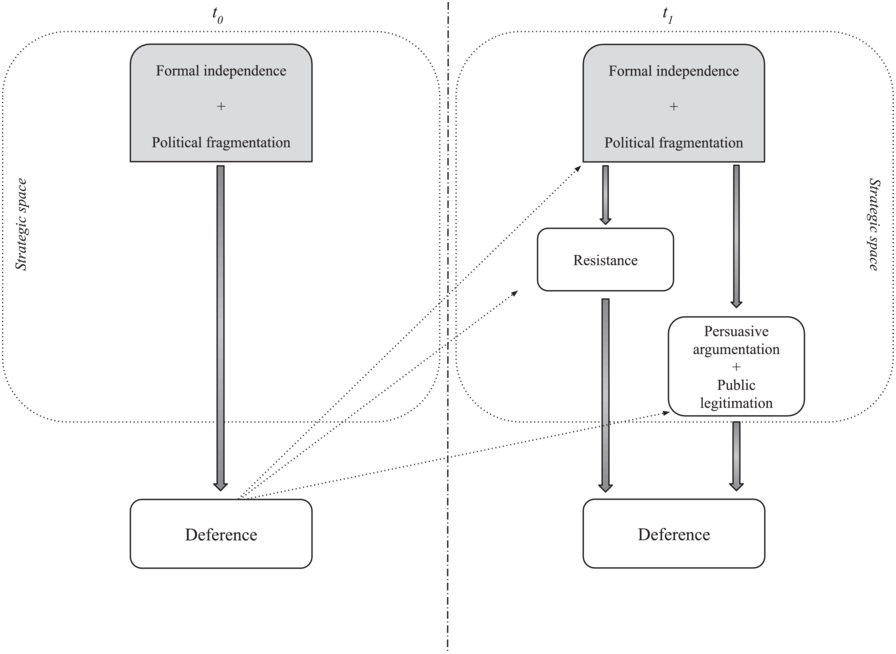
Figure 2.3 depicts in broad strokes the theoretical argument. It shows that formal independence and political fragmentation are the key explanatory variables at t0, all else equal (e.g., the law or legal dispute). These two factors combine to influence a court’s strategic space, and hence its deference. When formal independence and political fragmentation are low, the conditions are ripe for more deference at t0. (Non)deference at t0 can potentially inform state preferences, and subsequently fragmentation, at t1. On rare occasions, (non)deference at t0 might also lead to changes in formal independence at t1.
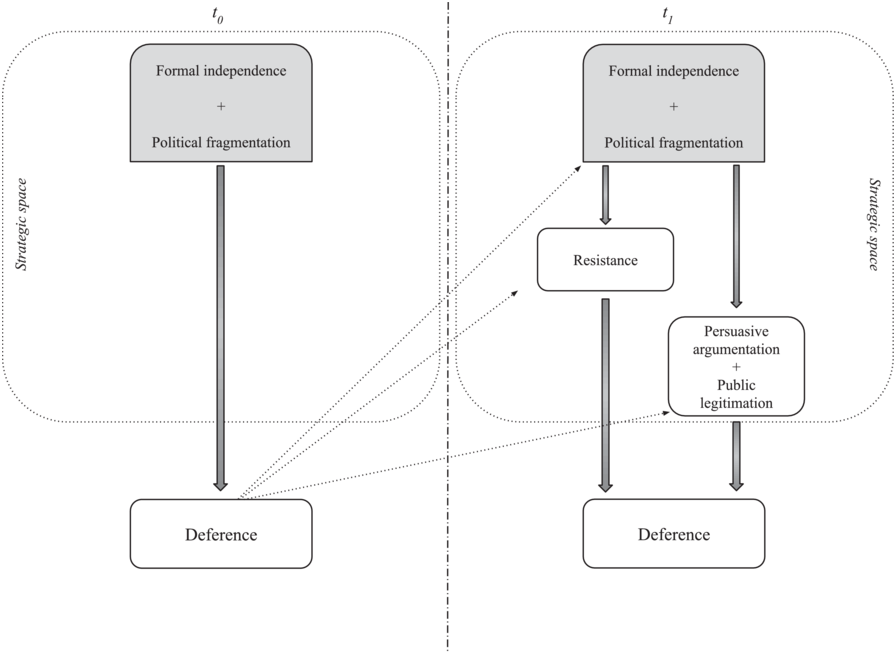
Figure 2.3 Long description
A two-panel diagram compares t 0 and t 1. In t 0, a box labeled formal independence plus political fragmentation connects with a thick arrow to deference. Dotted arrows extend from this deference box to t 1. In t 1, formal independence plus political fragmentation connects downward to resistance, which connects to deference. Resistance also leads to persuasive argumentation plus public legitimation, which connects to deference. Dotted arrows from the deference in t 0 flow to formal independence plus political fragmentation, resistance, and persuasive argumentation plus public legitimation in t 1. Each panel is enclosed in a curved boundary labeled strategic space. A vertical dashed line separates t 0 and t 1.
Also informed by (non)deference at t0 and against the backdrop of formal independence and political fragmentation, a court develops practices of persuasive argumentation and public legitimation at t1. For those courts with previously narrow strategic space, persuasive argumentation will entail references to external jurisprudence and unanimous decisions, and public legitimation that conveys messages about the court’s people-centeredness or commitment to its political purpose. For those with broad space, internal jurisprudence may be more central to their construction of persuasive arguments. Regardless, nondeference will be associated with external citations. Public legitimation is likely to be more people-centered, and less focused on its political purpose, when individual states have exit or entry options. Also, (past) resistance can narrow a court’s strategic space and make deference more likely.Footnote 132
A few additional points should be noted. First, while I study deference as a manifestation of a court’s strategic space, other aspects of a court’s performance also exist within a court’s strategic space. This is why Figure 2.3 situates persuasive argumentation and public legitimation within strategic space. Put differently, these practices are both constituted by and constitutive of a court’s strategic space. The same might be said of efforts to mobilize and socialize pro-compliance constituencies. Second, the intervening variables might be affected by other conditions. For example, a court’s resources influence the extent to which it can employ higher degrees of public legitimation. Third, this model, as depicted by Figure 2.3, does not show all potential feedback loops, such as how (non)deference, persuasive argumentation, or public legitimation could feed into member state preferences and consequently homogeneity or heterogeneity of preferences over time. I recognize that these feedback loops could exist and indirectly contribute to the reconstitution of a court’s strategic space. Fourth, the main causal mechanisms that link these pieces together are the plausibility and feasibility of resistance and perceived legitimacy.
Overall, this framework leads to five core theoretical expectations, summarized by the following hypotheses:
H1: The higher an IC’s formal independence is, the less it will defer.
H2: The more politically fragmented the membership of an IC is, the less it will defer.
H3: The narrower an IC’s strategic space is (as a result of either formal independence or political fragmentation), the more it will rely on persuasive argumentation to facilitate nondeference.
H4: The narrower an IC’s strategic space is (as a result of either formal independence or political fragmentation), the more it will rely on public legitimation to facilitate nondeference.
H5: All else equal, an international court will defer more when it has experienced past resistance.
Aside from these five hypotheses, I have also speculated that persuasive argumentation will rely more on domestic versus international citations when the IC’s strategic space is narrow. Additionally, I have posited that public legitimation and the relevant narratives might also vary depending on whether states can unilaterally exit a court’s jurisdiction. I do not label these expectations as hypotheses as they are more speculative and less theoretically grounded.
This theoretical framework aims to cast a wide net and I claim to offer an account that extends beyond the three ICs that I examine. Nonetheless, the scope of the argument (or limits to its generalizability) is worth recalling at this point. First, the argument is developed with newer international courts in mind. In the long term, these posited dynamics may change, especially as a court develops its own norms, support networks, and jurisprudence.Footnote 133 Second, I recognize these dynamics may be different for courts that have interstate jurisdiction only or that predominantly decide interstate disputes (e.g., ITLOS). This is because these courts weigh state against state. Here other factors may be important additional confounding factors (e.g., relative power and legal capacity of disputing states). Third, the law is an important constraint that also conditions a court’s strategic space. I nonetheless assume that typically there is more than one reasonable way to interpret and apply the law – that is, the law is not determinant – and courts are among the actors engaged in an ongoing process of determining what the law is.
Alternative Accounts
The above puts forward a theory of judicial deference by international courts that is based on the structural political constraints and judicial practices that (re)constitute a court’s strategic space. However, there are other possible theoretical accounts of deference. In the following, I outline these accounts. The first privileges the support networks of courts, while the second emphasizes ideational factors. In contrast to my argument, both accounts are generally skeptical about the centrality of states and institutional design (or at least the aspects of design that define the relationship between states and a court, or the separation of powers). While I articulate them as alternative explanatory accounts, I do not view them as competing. In fact, they are mostly complementary. I, however, leave this issue for now and return to it in the Conclusion.
Support Networks
One prominent account suggests that whether a court tends toward deference is determined by the strength and activity of its support network. When a court has a strong, broad, and active support network, it is less likely to defer. This builds on the perspective that judicial power is socially constructed.Footnote 134 From this perspective, courts draw power from other actors who do have the capacity to induce state compliance and impose costs on states for resistance against a court. If courts have the backing of a robust and vital support network, they have less reason to exercise politically cautious decision-making. In other words, a strong and active support network shields a court and creates the conditions for it to be less deferential, if legally merited.
ICs cultivate the support of these actors and form partnerships (often informally) with them through their jurisprudence. For example, ICs can reveal to wider audiences how the relevant law can serve the interests of constituencies.Footnote 135 Their decisions can implicitly invite litigation in certain areas through assertive statements on jurisdiction or by expanding channels of access, such as for amicus curiae. Courts can also foster relationships with substate and private actors through “off-the-bench” activities.Footnote 136 These can range from the participation of judges in professional associations and legal training opportunities to courtesy calls with national officials.Footnote 137 For example, Burley and Mattli claim that the CJEU courted national judges “through seminars, dinners, regular invitations to Luxembourg, and visits around the community.”Footnote 138 Put differently, support networks are a product of a court’s agency.
Not all aspects of a support network are necessarily the result of a court’s efforts to cultivate partners. Sometimes, formal rules may help a court to cultivate these interlocutors. Rules on access for private litigants in particular provide societal actors with opportunity to mobilize the law.Footnote 139 Also, some partnerships are the result of societal mobilization, where advocacy groups and lawyers identify opportunities provided by the law. That is, they can mobilize law on their own initiative in hopes that a court will provide recourse.Footnote 140 Moreover, some partners were proponents of courts before they were established, such as the Coalition for the International Criminal Court.Footnote 141
Judicial support networks are comprised of various types of actors, but crucial to a network are private, substate, and supranational actors. Private actors include individuals, advocacy groups, NGOs, interest groups, legal professionals, and for-profit actors.Footnote 142 These types of actors have been shown to affect the decision-making of domestic courts and the extent to which they advance rights.Footnote 143 Substate actors include government officials, administrative agencies, and national judiciaries.Footnote 144 Supranational actors, or entities of international organizations, in their capacity as compliance monitors (prosecutors) or administrators can also act as supporters.Footnote 145
These accounts have significant evidence to give them credence. ICs’ abilities to mobilize or benefit from support networks, and the decisions of these actors to engage in international litigation, are crucial to understanding judicial decision-making. However, it remains unclear what explains nondeference in the presence of weak or inactive support networks. Thus, my account seeks to address these instances.
Ideology, Political Norms, and Legal Culture
Existing research suggests that ideational factors contribute to domestic judicial behavior. A well-known explanation for judicial decision-making, called the attitudinal model, comes out of studies on the Supreme Court of the United States, which suggests that judges’ attitudes and policy preferences determine the Supreme Court’s decision-making.Footnote 146 Hönnige finds evidence of the attitudinal model in the French and German constitutional courts.Footnote 147 Voeten finds that political ideology of the appointing states significantly influences the judicial ideology of ECtHR judges and, ultimately, their decision-making.Footnote 148
Other insights consider how political norms and shared conceptions of the role of law and the judiciary’s political functions, rather than the political values and ideology of individual judges, affect judicial decision-making. This approach has been more prominent in scholarship on judicial politics in Latin America.Footnote 149 For example, Hilbink argues that the Chilean judiciary’s institutional ideology, or the shared ideas of the social function and role of the judiciary, significantly affected the way in which the courts responded to the illiberal policies of the Pinochet regime.Footnote 150 She argues, “the Chilean judiciary, historically constructed around the concept of apoliticism, provided professional understandings and incentives that rendered even democratic-minded judges unequipped and disinclined to take stands in defense of liberal democratic principles.”Footnote 151
The role of ideational factors has been less prominent in the study of international law and courts. Nevertheless, there are some important insights. Domestic legal culture has been shown to have bearing on state willingness to accept compulsory jurisdiction of ICs and their design.Footnote 152 Domestic legal culture, however, does not significantly determine judicial decisions in the case of the ECtHR.Footnote 153 Some scholarship following in the tradition of BourdieuFootnote 154 suggests that courts develop their own set of values, norms, and practices – or a sui generis legal culture – which helps to explain international judicial decision-making.Footnote 155
Ideational factors, including ideology, political norms, and legal culture, may affect the courts I examine to some extent, but a few reasons cast doubt on their sufficiency as an explanation for deference. Across the three courts there are important similarities related to ideational factors. First, the judges on all three courts have mixed backgrounds; they come from different domestic contexts and professional backgrounds. This means that the ideological views present on the courts are likely to be similarly mixed. Second, the colonial pasts have had similar lasting impacts on political norms within the regions under analysis. One important legacy of colonialism is the duality of political norms. Namely, beliefs in regionalism, unity, or international cooperation are prominent, yet are also in tension with strong norms of sovereignty, noninterference, and state independence. The courts I study were constituted within this dualism of political norms and function in its shadows. Third, the legal culture(s) relevant to each court have important similarities. Legal culture includes not only the legal order(s) governing a society but also includes beliefs and attitudes about the law and courts, or legal consciousness.Footnote 156 The member states of all three courts encounter dilemmas with regard to the constitutional order and access to courts.Footnote 157 Despite some variation, there is a tendency for African domestic judiciaries to have experience with political interference and vulnerability to executives.Footnote 158 Also, scholars have noted that the public lack confidence or trust in domestic courts.Footnote 159 The Caribbean nations have a better record of democracy and the rule of law than many African states, but scholars have remarked on a lack of faith in the capacity of the constitutional order to guarantee justice and equality in Caribbean states.Footnote 160 Moreover, a shared colonial legacy of African and Caribbean states is legal pluralism.Footnote 161 Also, as new courts, the EACJ, ACtHPR, and CCJ have not yet developed their own set of values, norms, and practices, even though this is an ongoing process. Put simply, there are many parallels in their respective legal cultures.
I do not exclude the possibility that ideational factors contribute to judicial decision-making. Instead, I aim to hold ideational factors more or less constant through the selection of cases.
Conclusion
This chapter has specified the central phenomenon under examination in this book. In contrast to previous work that focuses on judicial activism or restraint to describe judicial decisions, I focus on deference. Judicial deference describes if and how a court either accepts or rejects the exercise of authority by states or other governing entities (e.g., an organ of an international organization). Deference can be indicative of a court either abstaining from exercising its own authority or validating state authority. I put forward an operationalization of deference based on three features of judicial decisions, namely, the case outcome, legal interpretation and reasoning, and remedies.
The chapter presented a theoretical account to explain variation in judicial deference. This account focuses on situating judicial decision-making within the strategic space of international courts. Deference, therefore, will correspond with the breadth of this space. I have argued that the key factors shaping a court’s strategic space are the rules safeguarding judicial independence and the degree of political fragmentation. I have posited that deference is more likely to occur when an IC has weaker safeguards to independence and a politically unfragmented membership, and thus a narrower strategic space. Additionally, I have argued that persuasive argumentation, public legitimation, and prior experiences with state resistance against an IC can all contribute to if and how it defers to states. These factors construct a court’s strategic setting by way of their impact on the perceived legitimacy of the court and the feasibility and credibility of state resistance against the court.
Last, I discussed alternative accounts, which focus primarily on the network of proponents that support an international court and ideational factors, such as political norms and legal culture. As this chapter has suggested, these alternative perspectives are likely to be applicable, yet insufficient, explanations of deference. Consequently, the research design does not treat these approaches as competing explanations, but rather controls for their potential impact to the best extent possible.
As this chapter has argued, formal independence is crucial to understanding judicial decision-making. Chapter 3 shifts attention to formal independence and begins the empirical analysis. It develops the concept of formal independence before introducing how it is measured for the purposes of this book and examines the extent to which formal independence varies across international courts.

 Open access