

INTRODUCTION
Ascension Island (7°57′S 14°22′W) is one of the most remote islands in the Atlantic, being located ~1300 km from St Helena (the nearest island), ~2300 km from Recife (Brazil) and ~1500 km from Cape Palmas (Liberia). Accordingly, the island has been less visited by expeditions or individual naturalists than most other Atlantic islands or archipelagos and for a long time the description of the island's biological diversity remained relatively incomplete. A representative list of the older visiting expeditions and corresponding literature can be found in Manning & Chace (Reference Manning and Chace1990). The onset of main collecting efforts is quite recent, made possible when Ascension became more easily accessible as an important military and space communication base. This finally resulted in some monographic work on major zoological groups such as molluscs (Rosewater, Reference Rosewater1975), echinoderms (Pawson, Reference Pawson1978), fishes (Lubbock, Reference Lubbock1980) and decapod crustaceans (Manning & Chace, Reference Manning and Chace1990).
Shallow-water scleractinian corals have occasionally been observed, collected and reported on in the literature (see historical account below) but have not yet been the subject of a more comprehensive approach. A recent expedition (2012) to Ascension has permitted a reassessment of its shallow-water coral fauna by in situ photography and sampling. The newly obtained data are now combined with information collected from the literature and from investigating museum collections. The present study also sheds light on the true identity of some of the corals mentioned in previous reports, which had remained uncertain or enigmatic.
MATERIALS AND METHODS
In August/September 2012, coral specimens were photographed in situ and collected by one of us (P.W.) from tide pools and by scuba diving in a depth range of 0–25 m. Exact sampling locations are listed in the species sections. Dry samples and samples in ethanol were deposited in the coral collection of Naturalis Biodiversity Center, Leiden, the Netherlands (RMNH Coel. 40158–40172, 41529, 41542).
DNA was extracted from specimens stored in ethanol using the DNEasy Blood and Tissue kit (Qiagen). Amplification of three loci was attempted to assist in species identification, including two nuclear genes, β-tubulin and Pax-C intron, and one mitochondrial gene, cytochrome oxidase I (COI). PCR amplification and sequencing were performed according to published protocols (Kitahara et al., Reference Kitahara, Cairns, Stolarski, Blair and Miller2010; Nunes et al., Reference Nunes, Norris and Knowlton2011). DNA sequences were compared against the NCBI's BLAST database (http://blast.ncbi.nlm.nih.gov/Blast.cgi). Sequences have been deposited in GenBank with accession number KM391402 for Favia gravida specimen RMNH Coel. 40166 and KM391399–KM391401 for three markers of Siderastrea radians specimen RMNH Coel. 40163. Sequences for COI were also obtained for S. radians specimens Coel. 40164 and 40165, but because they were identical to specimen RMNH Coel. 40163, only one sequence was submitted to GenBank.
Searching the literature and museum collections provided many additional, earlier and widely dispersed data on the shallow-water scleractinian fauna of Ascension Island. The following abbreviations stand for the institutions mentioned:
BMNH: The Natural History Museum, London; formerly British Museum (Natural History).
NCBI: National Center for Biotechnology Information, Bethesda, MD.
RMNH: RMNH collection of Naturalis Biodiversity Center, Leiden; formerly Rijksmuseum van Natuurlijke Historie.
USNM: National Museum of Natural History, Smithsonian Institution, Washington, DC.
ZMA: ZMA collection of Naturalis Biodiversity Center, Leiden; formerly Zoölogisch Museum, Amsterdam.
HISTORICAL ACCOUNT OF CORAL RECORDS AT ASCENSION
This historical account is not limited to strictly ‘shallow-water’ corals. The very first recognizable and precisely described scleractinians from Ascension were dredged from deep water.
It is uncertain if Cunninghame's (Reference Cunninghame1699) ‘Corallium album minus Conglomeratum’ from Ascension should be interpreted as a scleractinian. The characterization is too vague, as already stated by Ridley (Reference Ridley1881). The first precise records of deep-water scleractinians from Ascension are two species from the ‘Challenger’ expedition in 1876 (Moseley, Reference Moseley1881): Caryophyllia laevicostata Moseley, Reference Moseley1881 (junior synonym of C. atlantica (Duncan, 1873)) and Solenosmilia variabilis Duncan, 1873 (BMNH; samples re-examined by Zibrowius, Reference Zibrowius1980). In the same year, Ridley (Reference Ridley1881) was the first to report a shallow-water scleractinian which he named Platygyra ascensionis (a junior synonym of Favia gravida Verrill, Reference Verrill1868; see Hoeksema & Wirtz, Reference Hoeksema and Wirtz2013). The coral in question was collected by T. Conry, surgeon on the island and an active naturalist collecting for the BMNH.
Studer (Reference Studer1889) included Ridley's Platygyra ascensionis in his inventory of marine species from Ascension. He did not provide any new record of scleractinians from shore collecting or the few trawls done by the ‘Gazelle’ when visiting the island in 1874 during a circumnavigation. On the way back from Antarctica, in 1904, the ‘Scotia’ dredged material of Cladocora debilis at Ascension (73 m). Not included in Gardiner's (Reference Gardiner1913) report on the corals from the expedition, this sample (BMNH) was first mentioned by Zibrowius (Reference Zibrowius1980).
A collection by the Ascension diving club of the British base, made in 1971/1972 and subsequently sent to the BMNH, includes the scleractinians Favia gravida and Siderastrea radians.
Studying shrimps collected by the Ascension diving club of the British military base and by Smithsonian scientists (including R.B. Manning) in 1971, Chace & Manning (Reference Chace and Manning1972) mentioned Favia living in a ‘coral pool’. Again using material collected by the Ascension diving club (above) and Smithsonian scientists in 1971 and 1976 (above), Kropp & Manning (Reference Kropp and Manning1987) reported cryptochirid crabs from Ascension, one of them from Favia.
Reporting results of a 1976 inshore benthic survey, Price & John (Reference Price and John1980) note that ‘reef building corals are entirely absent around Ascension’, but that inland pools are ‘lined with coral growths’. Favia sp. can thus be seen in their figure 11b, although this photograph is not clear.
On the way to St Helena, in 1983, Den Hartog (Reference Den Hartog1989a) collected Favia gravida from an inland marine pool (RMNH collection of Naturalis Biodiversity Center, Leiden; Hoeksema, Reference Hoeksema2012). When investigating for stygobionts at Ascension in 1989, Stock & Vonk (Reference Stock and Vonk1989) noticed Favia in pools. Their specimens are in the ZMA collection of Naturalis Biodiversity Center, Leiden (Hoeksema, Reference Hoeksema2012).
Irving (Reference Irving1989) described sublittoral communities of Ascension Island, based on dives in 1985 down to a depth of 45 m, and mentioned the presence of Astrangia, Madracis and Siderastrea (no species names were given). He later (Irving, Reference Irving and Sheppard2013) called these species Astrangia solitaria, Madracis decactis and Siderastrea radians, and added a fourth species, Rhizosmilia gerdae; reference samples were deposited at USNM and, according to Werner (Reference Werner1997), also at BMNH.
Finally, Werner's (Reference Werner1997) Master's thesis was based on museum specimens (various collectors, including some of the above-mentioned) of the scleractinian corals Madracis decactis, Favia gravida and Siderastrea radians from Ascension and St Helena Islands.
RESULTS
Cladocora debilis Milne Edwards & Haime, 1849
Family incertae sedis; currently not assigned to a known family.
Cladocora debilis: Zibrowius, Reference Zibrowius1980, p. 31, Plate 11A–L; Cairns, Reference Cairns2000, pp. 88–92, Figure 18, 102–107.
Material (old): Ascension, off Pyramid Point, 7°36′S 14°33′W, 73 m, ‘Scotia’, no station number, 9.6.1904, one branch, BMNH 1929.10.22.36.
Habitat: This old dredge record from moderately deep water is included here because the species can be expected to occur also in shallow water: at Madeira Island, it was found in a dark cave in 7 m depth by P.W. Cladocora debilis is azooxanthellate and ranges into deeper water than the Mediterranean C. caespitosa (Linnaeus, 1767) and the West Indian C. arbuscula (Lesueur, Reference Lesueur1821), which are both typical zooxanthellate shallow-water species.
Morphology: For detailed descriptions of C. debilis with comments on synonymy and distribution see Zibrowius (Reference Zibrowius1980) and Cairns (Reference Cairns2000). The corallum is typically composed of thin slender corallites (generally only about 3 mm in diameter) from which secondary corallites branch at right angle, and occasionally tertiary corallites from the secondary ones. Colonies attached to hard ground are more bushy. Discrete paliform lobes form a single palar crown.
The single record from Ascension (together with another one from St Helena) had first been reported by Zibrowius (Reference Zibrowius1980). The species had been described as Cladocora debilis Milne Edwards & Haime, 1849, from Madeira; C. patriarca Pourtalès, 1874, from Brazil; and C. paulmayeri Döderlein, 1913, from the western Mediterranean. Each of these names has also been used for populations in other areas. Cladocora debilis is known from the western Mediterranean and various areas in the eastern and western Atlantic: Azores (new record: RMNH Coel. 16340–16356), Madeira (RMNH Coel. 12547–12550), Canary Islands (RMNH Coel. 12614–12717, 16338, 16337, 16357), Cape Verde Islands (RMNH Coel. 16337), West Africa from southern Morocco to Gabon, western Atlantic from Florida to Colombia and Brazil through Saint Paul's Rocks in the equatorial Atlantic, Ascension and St Helena.
Family Dendrophylliidae
No species of the conspicuous, well-defined scleractinian family Dendrophylliidae has yet been reported from Ascension Island, whereas a shallow-water dendrophylliid, Balanophyllia helenae Duncan, Reference Duncan1876, is endemic and common at St Helena and well documented by samples deposited in museum collections (BMNH, RMNH Coel. 18002, 18008, etc.; Den Hartog, Reference Den Hartog1989b). However, Irving's (Reference Irving and Sheppard2013) presentation of Ascension corals contains an intriguing illustration (figure 16.4) of two dendrophylliid colonies. Its legend is: ‘The star fish Linckia guildingii with the brown coral Astrangia solitaria’. To the right of the star fish is a large brownish dendroid dendrophylliid colony, maybe 10 cm high or more (there is no scale), with many calices on at least two main stems. Further, next to the starfish, between two arms, is another, low, yellow-orange dendrophylliid colony, comprising at least three clustered calices. There is no trace of any other scleractinian in this photo, in particular none the aspect of which could suggest Astrangia solitaria (Lesueur, Reference Lesueur1817).
Coral samples collected at Ascension in 1985 have been deposited by R. Irving at the Smithsonian Institution (acquisition number 373870) and are registered there under USMN numbers with preliminary identifications made by S.D. Cairns in 1987. These include specimens labelled Astrangia sp. (USNM 78388–78390 – herein referred to as Polycyathus atlanticus, see the account of that species below) but no dendrophylliid species.
The larger brown dendrophylliid in Irving's figure 16.4 may suggest a species of Tubastraea, similar in colony shape and arrangement of lateral calices on the main stem to Tubastraea sp. of the Cape Verde Islands (already known from the ‘Challenger’ expedition but not yet adequately described and identified) or to the Indo-Pacific T. micranthus (Ehrenberg, 1834). As for the other, small dendrophylliid of figure 16.4, it might be a young colony in a different colour morph of the same species (some dendrophylliids do occur in different colours), or a different species. However, all this is speculation in the absence of collected samples.
The starfish in Irving's figure 16.4, called ‘Linckia guildingii’, is another problem. It does not resemble L. guildingi, well known to P.W. from the tropical eastern Atlantic. The photo was therefore sent to the starfish expert Christopher Mah, who wrote ‘Looks like either Linckia multifora or possibly Linckia columbiae’, suggesting that the photo was in fact taken in ‘the tropical Indo-Pacific to the East Pacific’ (C. Mah in litt. to P.W.). Robert Irving has extensively worked at the Pitcairn Islands, Polynesia. Because of the identity of the starfish in his figure 16.4, and because of the dendrophylliid corals near it (Tubastraea?), we suspect that the photo printed as figure 16.4 actually was taken in the Indo-Pacific and not at Ascension Island. Thus we conclude that the photo in question has slipped into Irving's (Reference Irving and Sheppard2013) Ascension paper by mistake and shows marine life photographed somewhere else. Of course, we cannot exclude the possibility that dendrophylliids do exist at Ascension Island but this has yet to be shown.
Favia gravida Verrill, Reference Verrill1868
Family Faviidae
Favia gravida Verrill, Reference Verrill1868, pp. 354–355; Laborel, Reference Laborel1971, pp. 191–195, plate IV 1–6; Laborel, Reference Laborel1974, p. 431.
Favia conferta Verrill, Reference Verrill1868, p. 355.
Platygyra ascensionis Ridley, Reference Ridley1881, pp. 438–440, Figures 1 & 2.
Favia: Chace & Manning, Reference Chace and Manning1972, p. 3.
Favia sp.: Price & John, Reference Price and John1980, p. 263, figure 11b.
Material (2012, P.W.): Ascension, tidal pool, Shelly Beach (07°59.510′S 14°23.695′W), 7 September 2012, four specimens in ethanol (RMNH Coel. 40166). Older samples: Ascension, locality not specified, coll. T. Conry, one small beach-worn colony (BMNH 1881.10.10.1), the true holotype of Platygyra ascensionis Ridley, Reference Ridley1881. – Ascension, locality not specified, one colony mistakenly labelled ‘Coeloria (Platygyra) ascensionis Ridley, Holotype’ [this specimen has no type status but is in fact another, much larger, specimen collected by T. Conry; see discussion below] (BMNH 1884.4.29.1). – Ascension, locality not specified, one hemispheric colony with cryptochirid crypt, labelled ‘Platygyra ascensionis’ (BMNH 1925.3.23.1) [originally probably part of lot 1884.4.29.1-2, collector T. Conry]. – Ascension, Southwest Bay, 3 m, coll. Ascension diving club, three colonies with cryptochirid crypts (BMNH 1980.9.19.1-3). – Ascension, locality not specified, coll. Ascension diving club, one colony with cryptochirid crypts (BMNH 1980.9.19.4). – Ascension, inland tide pool, [i.e. Southwest Bay], coll. Ascension diving club, one colony (BMNH 1980.9.19.5). – Ascension, Northeast Bay, tide pools on rocky point W of Main Beach, coll. R.B. Manning, 19.5.1971 (Asc 18), one colony with cryptochirid crypts (USNM). – Ascension, Shelly Beach, tide pools in flat exposed at lower tide on open beach, coll. R.B. Manning, 23.5.1971 (Asc 23), two colonies with cryptochirid crypts (USNM). – Ascension, Shelly Beach, inland tide pool, coll. R.B. Manning, 23.5.1971 (Asc 19), ~60 colonies and fragments (USNM). – Ascension, Southwest Bay, northern edge, Turtle Shell Beach, tide pool, coll. R.B. Manning, 25.5.1971 (Asc 23), four colonies with cryptochirid crypts (USNM). – Ascension, Mac Arthur Point, intertidal rocks, coll. R.B. Manning et al., 13.7.1976, one colony with cryptochirid crypts (USNM). – Ascension, Shelly Beach, inland tide pool, coll. R.B. Manning et al., 13.7.1976, ~35 colonies and fragments (USNM). – Ascension, Mars Bay, exposed rocky shore with tide pools, coll. J.C. den Hartog, 31.5.1983 (stat. 1), seven colonies with cryptochirid crypts (RMNH Coel. 17341). – Ascension, Shelly Beach, inland tide pool, coll. J.C. den Hartog, 1.6.1983 (stat. 2), 16 colonies (RMNH Coel. 17339). – Ascension, Shelly Beach, easternmost anchihaline coral pool, J.H. Stock 2.11.1989 (89–906), many colonies (ZMA Coel. 8467). – Ascension, same locality as before, J.H. Stock 10.11.1989 (89–933), two colonies (RMNH Coel. 23341), many colonies (ZMA Coel. 8466).
Habitat: Free-living colonies in shallow, tidal, inland rock pools, which are in subterranean connection with the nearby ocean (Chace & Manning, Reference Chace and Manning1972; Price & John, Reference Price and John1980; Hoeksema, Reference Hoeksema2012, Reference Hoeksema2013; Hoeksema & Wirtz, Reference Hoeksema and Wirtz2013). The population in this sheltered environment shows modifications that appear to be related to their special environmental conditions, such as calm water and warming (because of reduced water exchange). Many previous records of the species from Ascension Island concern this easily accessible population in pools (shallow, predominantly free-living; Figure 1).The species also occurs in the normal, attached mode of life as patchy colonies in the open sea, from about high water mark down to at least 5 m depth. In the sublittoral, the attached form of this species is much less common than Siderastrea radians. The occurrence of Favia at Ascension Island has repeatedly been mentioned in ecological and carcinological studies (Chace & Manning, Reference Chace and Manning1972; Price & John, Reference Price and John1980; Kropp & Manning, Reference Kropp and Manning1987; Stock & Vonk, Reference Stock and Vonk1989; Manning & Chace, Reference Manning and Chace1990).
Live coral of Favia gravida specimen in tidal pool at Shelly Beach (photo P.W.).

Morphology (see also Hoeksema, Reference Hoeksema2012, Reference Hoeksema2013): Colonies attached or free-living. Calices ~0.5 cm in length; less elongate than in specimens from Brazil (Amaral & Ramos, Reference Amaral and Ramos2007).
Favia gravida had originally been described by Verrill (Reference Verrill1868) from the Abrolhos Archipelago, Bahia State, Brazil and Verrill's Favia conferta, also from Brazil, is considered synonymous. Modern authors were interested in the diversity of morphotypes found in Brazil (Laborel, Reference Laborel1971; Amaral & Ramos, Reference Amaral and Ramos2007).
Platygyra ascensionis was described by Ridley (Reference Ridley1881) from Ascension on the basis of a single, small, beach-worn colony, collector T. Conry (BMNH 1881.10.10.1; Figure 2A, B). Ridley mistakenly considered this specimen as a ‘portion of what was probably a globose colony’, in fact it is a flat, complete, colony as evident when examining its lower side showing a detachment scar (Figure 2B). Matthai (1928, p. 278) was correct when referring Ridley's P. ascensionis to the genus Favia: ‘judging from the three co-types in the British Museum, it is related to Favia fragum’. However, he was wrong in considering three colonies as ‘co-types’ of Ridley's species, since Ridley's description was based on a single colony (the holotype characterized above). The two other specimens from the same collector (T. Conry) referred to by Matthai were received later (BMNH 1884.4.29.1–2) and, not being included in Ridley's description, cannot be co-types. In 1975 these specimens could not be found under the 1884…… number, but it appears that BMNH 1925.3.23.1 could be one of them, accidentally re-registered under a new number. Another of these old specimens was available for loan to B.W.H. in 2013 under the old BMNH number 1884.4.29.1 (Figure 2C).
Holotype of Platygyra ascensionis from Ascension Island (BMNH 1881.10.10.1; photo H.Z.): (A) upper side showing eroded calices, (B) lower side showing detachment scar indicating that the specimen was free-living. (C) Favia gravida skeleton from Ascension, labelled ‘Coeloria (Platygyra) ascensionis’ (BMNH 1884.4.29.1). Scale bars: 1 cm (photo B.W.H.).

Studying most diverse Favia populations from Brazil, Laborel (Reference Laborel1971) pointed out the wide morphological plasticity of F. gravida. When subsequently he investigated Favia populations from the Gulf of Guinea, he referred these to the same species (Laborel, Reference Laborel1974). He finally had the opportunity to see series of samples from both St Helena and Ascension (especially those collected by Smithsonian scientists in 1971 and 1976). This confirmed his view of an amphi-Atlantic species, very variable in calice shape and size, passing from asteroid to meandroid, these various aspects depending, in his understanding (discussions with H.Z.), on environmental factors combined with genetics.
Favia fragum (Esper, 1788) is a quite distinct species, e.g. its calices commonly are less elongate (compare Roos, Reference Roos1971; Hoeksema et al., Reference Hoeksema, Roos and Cadée2012; see considerations in Laborel, Reference Laborel1971, Reference Laborel1974). Molecular evidence also supports their status as two distinct species (Nunes et al., Reference Nunes, Fukami, Vollmer, Norris and Knowlton2008, Reference Nunes, Norris and Knowlton2011).
Favia gravida occurs in the Atlantic from the coast of Brazil and islands off Brazil (Atol das Rocas, Fernando d Noronha, Abrolhos, Trindade) through the mid-oceanic islands of Ascension and St Helena to the Gulf of Guinea (the islands; the coast of Gabon) (see map in Hoeksema, Reference Hoeksema2012). This distribution does not overlap with that of Favia fragum, the other amphi-Atlantic species, known from the Caribbean and the Cape Verde Islands (Hoeksema et al., Reference Hoeksema, Roos and Cadée2012).
At Ascension, F. gravida colonies are frequently inhabited by a cryptochirid crab, Troglocarcinus corallicola Verrill, 1908 (see Kropp & Manning, Reference Kropp and Manning1987). The deep crypts of the crab, with a lunuliform orifice, are present in many colonies from various localities on the open rocky coast, rock pools included. However, no crypts have been found on the abundant material from the population in the inland pools at Shelly Beach, in contrast to the information by Kropp & Manning (Reference Kropp and Manning1987).
Madracis sp.
Family Pocilloporidae
Madracis: Irving, Reference Irving1989, p. 74.
Madracis decactis: Werner, Reference Werner1997, pp. 18–21(–26); Irving, Reference Irving and Sheppard2013, p. 217, 218, figure 16.3.
Material (2012, P.W.): Ascension, English Bay (07°53.653′S 14°22.950′W), 11 m depth, 4 September 2012, one dry specimen (RMNH Coel. 40158); 30 August 2012, seven specimens in ethanol (RMNH Coel. 40160). – Comfortless Cove (07°54.614′S 14°24.212′W), 29 August 2012, seven specimens in ethanol (RMNH Coel. 40161). – Boatswain Bird Island (07°56.182′S 14°18.516′W), 1 September 2012, one specimen in ethanol (RMNH Coel. 40162).
Older samples: Two samples from Ascension collected in 1985 and donated by Robert Irving are registered Madracis decactis, USNM 78224, USNM 78394. Both were examined on the basis of photos.
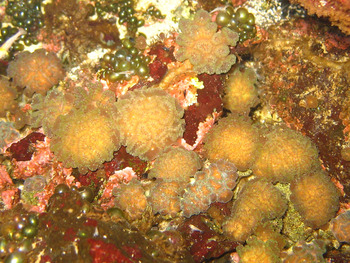
Habitat: A common species on shaded vertical and overhanging walls, from 3 to at least 15 m depth; there are several colour morphs, ranging from brilliant green to brown and blue (Figures 3 & 4).
Three live colonies of Madracis sp. showing encrusting growth form and different colour morphs (A–C), all from English Bay (photos P.W.).

Brown (A) and green (B) variety of Madracis sp. showing expanded polyps, English Bay (photos P.W.).

Morphology: Colonies attached, predominantly encrusting with a tendency to form knobs. Calices 1.8–2.0 mm in maximum diameter, circular to polygonal in outline. Ten septa reach the columella and fuse with it. A second cycle of septa is generally absent though some corallites may show initial formation of rudimentary secondary septa (Figure 5G). The upper edge of the septa is lower than the peripheral corallite edge (Figure 5D–F). Coenosteum absent (Figure 5A–C). While RMNH Coel 40160 shows a rather regular, circular corallite outline and radially arranged septa (Figure 5A, D, G), RMNH Coel 40162 (Figure 5B, E, H) and, even more so, RMNH Coel 40161 (Figure 5C, F, I) have irregularly shaped corallites and columella.
Overviews and close-ups of calices of three specimens of Madracis sp. from Ascension Island showing calicular and septal arrangements: (A, D, G) RMNH Coel. 40160, (B, E, H) RMNH Coel. 40162, (C, F, I) RMNH Coel. 40161. Note that calices are directly adjacent to each other without a coenosteum in between them. Scale bars: 1 mm (photos F.B.).

The species identity of the encrusting Madracis from Ascension (growing into large colonies and showing various colour morphs) remains problematic. It was mentioned by Irving (Reference Irving1989) as Madracis and later (Irving, Reference Irving and Sheppard2013) as M. decactis. Part of Irving's samples is deposited at USNM and detailed photos were available to us: this is the same species as observed and collected in 2013 (P.W.). Werner (1979) had seen only one sample (USNM 78224) and part of his description of (presumed) ‘Madracis decactis’ appears to be based on it.
Lyman's (Reference Lyman1859) original description of Madracis decactis (then Astraea decactis) is open to interpretation since it was not illustrated. Type material (presumed to be from Florida) does not seem to exist any longer. Information that can be deduced from Lyman's text: colony forming an irregular crust; endothecal dissepiments to be seen on cross sections; 10 exsert septa; columella compressed and styliform; calice surrounded by a line of ‘grains’ defining a ‘more or less regular hexagon’. There is no information on the extent of coenosteum, other than the enigmatic expression that calices are ‘nearly circular when not crowded’.
The partly obscure description by Lyman (Reference Lyman1859), the absence of illustrations and the loss of the type material has led to Lyman's species name being used for Madracis populations from all over the tropical Atlantic, including Brazil (Laborel, Reference Laborel1971), the Gulf of Guinea (Laborel, Reference Laborel1974), Ascension and St Helena (Werner, Reference Werner1997) and even the Indo-Pacific (Veron, Reference Veron2000). All this needs to be revisited critically. Should the form illustrated by Roos (Reference Roos1971: Pl. VIIa-b), from Curaçao, represent the true M. decactis (it in fact seems to correspond to the presently prevailing understanding of Lyman's species) then the Madracis from Ascension is a different species. In the current acceptance, M. decactis is characterized by corallites that are typically separated by a (narrow) spinulated coenosteum area above which the usually 10 thick (rarely eight or nine) septa are projecting (Zlatarski & Estalella, Reference Zlatarski and Estalella1982; illustrations in NMiTA, 2013).
The absence of an extended coenosteum between the calices also characterizes Madracis pharensis (Heller, 1868), a species occurring all over the Mediterranean (type locality is in the Adriatic) and widely throughout the Atlantic (present also at St Helena but not yet observed at Ascension). In M. pharensis (see Zibrowius, Reference Zibrowius1980 for the description of Mediterranean colonies) corallites are closely packed, not separated by coenosteum and the septa lie below the edge of the common corallite wall. However, its secondary septa are generally well developed, though shorter than the primaries.
On the basis of these considerations, for the time being, we prefer not to assign Madracis sp. from Ascension (the same species also occurs at St Helena) to any of the known Madracis species.
Molecular studies will probably help to understand the phylogenetic relationship between Madracis sp. from Ascension and its congeners all over the Atlantic; some of these species have even already been analysed from a genetic point of view (Diekmann et al., Reference Diekmann, Bak, Stam and Olsen2001; Frade et al., Reference Frade, Reyes-Nivia, Faria, Kaandorp, Luttikhuizen and Bak2010).
Polycyathus atlanticus Duncan, Reference Duncan1876
Family Caryophylliidae (but needs revision)
Polycyathus atlanticus Duncan, Reference Duncan1876, p. 433, pl. 38, Figures 14–16.
Agelecyathus helenae Duncan, Reference Duncan1876, p. 434, pl. 39, Figures 4–6.
Agelecyathus helenae var. minor Duncan, Reference Duncan1876, p. 434.
Material (2012, P.W.): Ascension, Panam Bay (07°53.654′S 14°23.676′W), 6 September 2012, two specimens in ethanol (RMNH Coel. 40168), three specimens in ethanol (RMNH Coel. 40169). – Ascension, Wigan Pier (07°53.638′S 14°23.010′W), 7 September 2012, three dry specimens (RMNH Coel. 40170). – Ascension, English Bay (07°53.653′S 14°22.950′W), 4 September 2012, one dry specimen (RMNH Coel. 41529). Older samples: Four samples from Ascension collected in 1985 and donated by Robert Irving are registered as Astrangia sp., USNM 78388–78391. Three of these (USNM 78388, 78389, 78390) were examined on the basis of photos.
Habitat: Moderately common below large boulders in at least 10–15 m depth.
Morphology: Small colonies, with rather low subcylindrical corallites on continuous common coenosteum (Figure 6A). Calice inside more or less brownish; four cycles of septa, the fourth often incomplete (Figure 6A–C). More or less rod-like pali, or septal edges more denticulate, low central papillose area without really distinct columella (Figure 6C). More extended colonies covering larger surfaces can be expected (by analogy with unpublished observations made by H.Z. on St Helena material), but have not been collected at Ascension Island.
Two live colonies of Polycyathus atlanticus (A, B) near One Hook, 10–15 m depth (photos P.W.); (C) skeleton cleaned of soft tissues, upper side of one calice RMNH 40169 (photo H.Z.).

Polycyathus atlanticus Duncan, Reference Duncan1876, Agelecyathus helenae Duncan, Reference Duncan1876, with A. helenae var. minor Duncan, Reference Duncan1876, have all been described from St Helena, Agelecyathus helenae and A. helenae var. minor as attached ‘on an Ostrea’. The depth is not indicated, the substrate suggests shallow water. Unfortunately the type material of these taxa is lost. Duncan's descriptions and illustrations correspond to Polycyathus as conventionally understood in more recent publications that provide detailed descriptions and illustrations, e.g. Zibrowius (Reference Zibrowius1980) and Cairns (Reference Cairns2000). Within a Polycyathus species, among specimens from the same habitat and even within a single colony, considerable variation may be found in the size of corallites, number of septa, proportions of pali, etc. This has particularly been shown in the case of Mediterranean Polycyathus (Zibrowius, Reference Zibrowius1980). Abundant material of Polcyathus is now available from St Helena (not to be detailed here), topotypic of Duncan's (Reference Duncan1876) taxa. Considering the variability observed, Duncan's P. atlanticus and A. helenae (including var. minor) are considered to represent but one species, for which the first name, P. atlanticus has to be retained.
Zibrowius (Reference Zibrowius1980) pointed out certain similarities between Polycyathus and Astrangia (conventionally placed in distant families, Caryophylliidae and Rhizangiidae) and the difficulty of placing one or the other species in either genus. If higher and more distinct pali-like rods (decreasing towards the centre) are characteristic of ‘typical’ Polycyathus and a gradient of lower septal dentation is characteristic of ‘typical’ Astrangia, reality often does not follow this clear-cut pattern. In colonies with larger, typical Polycyathus corallites in the centre, low, oblique, peripheral corallites may show a tendency towards Astrangia features. Further, in the case of some species described as Astrangia, one may argue that they would better fit Polycyathus.
At Ascension, Irving (Reference Irving1989) recorded Astrangia from ‘underhangs and shallow caves’, and later (Irving, Reference Irving and Sheppard2013) referred to the same population (‘underhangs, under boulders and shallow caves’) as Astrangia solitaria. Analysis of photos of his 1985 specimens registered at USNM as Astrangia sp. results in some ambiguity: certain corallites are more typically Polycyathus, with higher distinct rod-like pali-structures whereas others have septal edges more simply denticulate. The small and few samples collected by P.W. in 2012 comprise ‘typical-Polycyathus’ corallites. Our impression is that all these samples from Ascension Island (R.I. and P.W.) can be referred to a single, variable species, P. atlanticus, the same that occurs at St Helena.
Some comments are needed in this context on Astrangia solitaria (Lesueur, Reference Lesueur1817). The poor original description and illustration, based on material from Guadeloupe, Lesser Antilles, suggest that it could indeed be the species well presented under that name by Cairns (Reference Cairns2000) as an apparently widespread tropical West Atlantic Astrangia: reptoid colonies with cylindrical corallites budded from narrow stolons. The specific name solitaria may seem in contradiction with the typical colonial nature of Astrangia species. However, it refers to the feature that organic connection between polyps is lost at an early stage and that the stolons between corallites are easily encrusted and concealed. We consider that A. solitaria – as described by Cairns (Reference Cairns2000) – is not represented among the species from Ascension we had the opportunity to examine.
Several species of Polycyathus have been reported from tropical and temperate regions of the Atlantic (East and West, islands and archipelagos). Species distinction is problematic in these cases. Polycyathus atlanticus may also occur outside St Helena and Ascension, and as the oldest described species may have junior synonyms. A special, critical study of Atlantic Polycyathus should, of course, also take into account biological and DNA data.
Rhizosmilia gerdae Cairns, Reference Cairns1978
Family Caryophyllidae (but needs revision)
Rhizosmilia gerdae Cairns, Reference Cairns1978, pp. 219–222, pl. 1, figures 1–7; Cairns, Reference Cairns1979, pp. 142–143, pl. 27, figures 5–8; Cairns, Reference Cairns2000, p. 124.
Material (2012, P.W.): Boatswain Bird Island (07°56.182′S 14°18.516′W), 1 September 2012, five dry specimens and four in ethanol (RMNH Coel. 40171). – Southeast Bay (07°57.266′S 14°18.476′W), 1 September 2012, five dry specimens (RMNH Coel. 40172). Older samples: Two samples from Ascension collected in November 1985 and donated by Robert Irving are registered as Rhizosmilia gerdae, USNM 78392 and USNM 78393. One of these (USNM 78392) was examined on the basis of photos. – A third sample, registered Rhizopsammia sp., USNM 1136486 (collecting date May 1981, collector?) was also examined on the basis of photos (belonging to the same species).
Habitat: Forming flat encrusting colonies to small lumps, usually consisting of several polyps (Figure 7A, B), on dark walls and in small caves in 3 to at least 15 m depth, fairly common; also below large boulders in at least 10–15 m depth. Irving (Reference Irving and Sheppard2013) recorded ‘Rhizosmilia sp. cf. gerdae’ from ‘underhangs, under boulders and shallow caves’, i.e. in similar habitats. The species was not illustrated but photos of samples deposited at USNM show that these indeed belong to the same species as the one collected by P.W. in 2012.
Two live colonies of Rhizosmilia gerdae (A, B), both from Boatswain Bird Island, 10–15 m depth (photos P.W.). Corallite cleaned of soft tissues: (C) calice and (D) basal section showing concentric structure (photo H.Z.).

Morphology: Rather low subcircular corallites rising from a spreading common basal coenosteum on which they are well separated (Figure 7A, B). Sections at their base reveal concentric structures (Figure 7D) such as described by Cairns from West Indian material (increase of diameter by adding exothecal dissepiments over raised costae). Generally 48 septa in four cycles, rarely some reduced S5 (Figure 7C). Typically large paliform lobes in front of the penultimate septa. Columella a small cluster of narrow rods, much lower than the crown of paliform lobes.
All Ascension material is from shallow water where strong hydrodynamics prevail. Low, encrusting colonies appear normal in this environment. This stands in contrast to samples described by Cairns (Reference Cairns1978, Reference Cairns1979, Reference Cairns2000) from the American Atlantic, which were all from deeper water (exceeding 100 m, even down to 300 m), and were characterized as placoid clumps. Further, septa of the 5th cycle are more common there. Our identification of the Ascension 2012 specimens as belonging to this species is surely influenced by Cairns' corresponding identification of previous samples of the same Ascension origin (USNM). But – having in mind Mediterranean–NE Atlantic species of a wide ecological range and considerable morphological plasticity – we tend to agree with Cairns and to consider the sampled Ascension population a shallow-water morph of R. gerdae.
In order to better understand the extent of local intraspecific variation at Ascension, complementary collecting into deeper water would be welcome, as well as DNA data for comparing the remote insular population with West Indian populations. Investigation of the reproductive biology of this species would also be a rewarding subject.
According to Cairns (Reference Cairns1978, Reference Cairns1979, Reference Cairns2000) R. gerdae is widespread in the tropical American Atlantic, from the Yucatan Channel through the Antilles and Florida to the Bahamas. It is not (yet?) known from the other remote Central South Atlantic island, St Helena.
Siderastrea radians (Pallas, 1766)
Family Siderastreidae
Material (2012, P.W.): Near Porpoise Rock (07°54.022′S 14°20.964′W), 10 m depth, 31 August 2012, one dry specimen (RMNH Coel. 40159). – English Bay (07°53.653′S 14°22.950′W), 5 m depth, 4 September 2012, one dry specimen (RMNH Coel. 40542). – Catherine Point, tide pools (07°55.818′S 14°25.173′W), 2 September 2012, seven fragments in ethanol (RMNH Coel 40163). – Mars Bay (07°59.290′S 14°24.205′W), 3 September 2012, one specimen in ethanol (RMNH Coel. 40164). – Comfortless Cove (07°54.614′S 14°24.212′W), 29 August 2012, three specimens in ethanol (RMNH Coel. 40165). Older samples: Ascension, locality not specified, coll. Ascension diving club, one hemispheric colony (BMNH 1980.10.14.1). – Payne Point, shallow water pools, coll. Ascension diving club, x.10.1972, five encrusting colonies or fragments (BMNH 1980.10.14.2–4). – Northeast Bay, tide pools on rocky point west of main beach, coll. R.B. Manning, 19.5.1971 (Asc 5), one colony (USNM). – Rocky Point, northern edge of English Bay, intertidal pools, subtidal rock shore, coll. R.B. Manning, 21.5.1971 (Asc 11), five colonies (USNM). – Rocky Point, northern edge of English Bay, tide pool, coll. R.B. Manning, 22.5.1971 (Asc 15), four colonies, one of them with cryptochirid crypts (USNM). – Turtle Shell Beach, northern edge southwest Bay, tide pool, coll. R.B. Manning, 25.5.1971 (Asc 23), three colonies (USNM). – SW coast, Mars Bay, exposed rocky shore with tidal pools, coll. J.C. den Hartog, 31.5.1983 (stat. 1), one colony (RMNH Coel. 17343).
Habitat: forming light brown to grey crusts and small lumps down to at least 20 m depth (Figure 3).
Morphology: Colonies attached, small and predominantly encrusting (Figure 8). Calices ~3 mm in maximum diameter, slightly polygonal in outline, resembling small pits with thick corallum walls around. A coenosteum is absent. The septa are thick and dense; they reach downward onto a small columella consisting of a cluster of densely packed small pillars. Siderastrea radians at Ascension does not form large colonies as in various other localities across the Atlantic, e.g. the Caribbean (Roos, Reference Roos1971) and the Cape Verde Islands (Boekschoten & Best, Reference Boekschoten and Best1988). Owing to its small calice size, S. radians can be confused with S. stellata Verrill, Reference Verrill1901, which may show sharper corallum wall edges (Veron, Reference Veron2000). The main difference between the two species is that S. stellata, a Brazilian endemic, has a fourth cycle of septa, which is lacking in S. radians (Menezes et al., Reference Menezes, Neves, Barros, Kikuchi and Johnsson2013). A third Siderastrea species has been reported from the southern Atlantic, S. siderea (Ellis & Solander, 1786) from Brazil, but this species has larger calices than S. radians (Neves et al., Reference Neves, da Silveira, Pichon and Johnsson2010).
Two live specimens of Siderastrea radians (A, B) near Porpoise Rock, 5–10 m depth (photos P.W.).

One colony of S. radians in the USNM from Ascension Island shows typical lunuliform crypt apertures. Gall crabs had been extracted from this coral by H.Z., which were identified as Opecarcinus hypostegus (Shaw & Hopkins, Reference Shaw and Hopkins1977) by Kropp & Manning (Reference Kropp and Manning1987) without mentioning the host. So far three species of Atlantic gall crabs have been reported from Siderastrea, but their identity cannot always be confirmed (Van der Meij, Reference Van der Meij2014). The most likely cryptochirid that inhabited the empty pits in S. radians at Ascension is Kroppcarcinus siderastreicola Badaro, Neves, Castro & Johnsson, Reference Badaro, Neves, Castro and Johnsson2012, a species that has also been found in Brazil and the Caribbean (Badaro et al., Reference Badaro, Neves, Castro and Johnsson2012; Van der Meij, Reference Van der Meij2014).
Molecular data
DNA was extracted from three specimens of Siderastrea radians, one specimens of Favia gravida and one specimen of Rhizosmilia gerdae. For all specimens, DNA extractions were highly fragmented and of low molecular weight, as is often observed for ethanol-preserved specimens (Gaither et al., Reference Gaither, Szabo, Crepeau, Bird and Toonen2011). As a result, the success of PCR amplification varied from specimen to specimen. For S. radians, amplification and sequencing was possible for all three genes. For F. gravida, amplification was only possible for COI, and all attempts at sequencing R. gerdae failed.
For S. radians, a 613 bp fragment sequenced for COI had 100% identity with S. radians and S. siderea on BLAST. A 649 bp fragment was sequenced for β-tubulin, which had 98% identity with S. radians and 95% identity with S. siderea on BLAST. For Pax-C, a 217 bp fragment was sequenced with 99% identity with S. radians and 96% identity with S. siderea on BLAST. For the two nuclear loci, sequence similarity with S. radians was greater than S. siderea, confirming the identification of the Ascension specimens as S. radians.
For F. gravida, a 637 bp fragment was sequenced for COI, which had 100% identity with Favia fragum and Colpophyllia natans. A COI sequence for F. gravida was not available in the BLAST database. Slow sequence evolution in the mitochondrial COI gene has been documented for anthozoans (Huang et al., Reference Huang, Meier, Todd and Chou2008), and the lack of divergence between sister taxa such as F. gravida and F. fragum is not unexpected at this locus. Unfortunately, it was not possible to amplify and sequence the β-tubulin gene or Pax-C intron with the present material, due to low quality of the extracted DNA. These two loci are known to differentiate F. gravida from F. fragum (Nunes et al., Reference Nunes, Norris and Knowlton2011). Additional specimens from Ascension, preserved in more appropriate buffers, would be required for confirming the identification of F. gravida using molecular methods (Gaither et al., Reference Gaither, Szabo, Crepeau, Bird and Toonen2011).
DISCUSSION
The results from the 2012 field collection show that there are at least five scleractinian species present in the shallow waters of Ascension, three of which are zooxanthellate (Favia gravida, Madracis sp., Siderastrea radians) and two without zooxanthellae (Polycyathus atlanticus and Rhizosmilia gerdae). Madracis sp. and P. atlanticus are new records for the area. Ascension's shallow-water scleractinian fauna is remarkably poor. This is most probably related to its isolated position and to its young geological age (not more than 2 × 10⁶ years –Ashmole & Ashmole, Reference Ashmole and Ashmole1997). None of its coral species are endemic whereas the fauna of much older St Helena Island, the other very isolated island of the tropical South Atlantic, includes two endemic species, Balanophyllia helenae Duncan, Reference Duncan1876, and Sclerhelia hirtella (Pallas, 1766), both of which can be found in shallow water by snorkelling (Den Hartog, Reference Den Hartog1989b).
Favia gravida and Siderastrea radians are both amphi-Atlantic (Laborel, Reference Laborel1974; Hoeksema, Reference Hoeksema2012), the former occurring at both Ascension and St Helena Islands, the latter presently not known from St Helena Island. A genetic comparison of Ascension material with specimens from both sides of the Atlantic might be able to elucidate from where these species have colonized Ascension Island. Despite being brooders and having a relatively shorter larval dispersal phase when compared with broadcasters (Nunes et al., Reference Nunes, Norris and Knowlton2011), they were able to colonize these distant islands. Rafting could perhaps explain the presence of F. gravida and S. radians at these remote islands. This means of dispersal could be particularly relevant for species occurring in the intertidal zone (Hoeksema et al., Reference Hoeksema, Roos and Cadée2012), but it should be kept in mind that in other climate phases of the Quaternary (and before) currents may have been different in position and intensity.
The presence of Rhizosmilia gerdae, previously only known from the Caribbean (Cairns, Reference Cairns2000) indicates a zoogeographic link with the tropical western Atlantic, a link also shown for several other groups, such as zoantharians (Reimer et al., Reference Reimer, Lorion, Irei, Hoeksema and Wirtz2014), hydrocorals (Hoeksema et al., Reference Hoeksema, Nunes, Lindner and Nunes de Souza2017), fishes (Wirtz et al., Reference Wirtz, Bingeman, Bingeman, Fricke, Hook and Young2017), and heterobranch sea slugs (Padula et al., Reference Padula, Wirtz and Schrödl2014).
ACKNOWLEDGEMENTS
P.W. is grateful to Paul Brickle and the Shallow Marine Surveys Group for the invitation to take part in the August–September 2012 expedition to Ascension Island. The funding for this work came from a grant to Dr Paul Brickle from the Darwin Initiative (EIDCF012). We are grateful to the Shallow Marine Surveys Group and the South Atlantic Environmental Research Institute for organizing the expedition. We are also very grateful to Ascension Island Government, the members of staff at the Conservation Centre and Ascension Island Dive Club for their cooperation, accommodation and hospitality. We are grateful to British Forces South Atlantic Islands for their logistic support. Thanks to Stedson Stroud and Jolene Sim of the Ascension Conservation Department for their help during the expedition. Work by F.L.D.N. was supported by a grant from the Regional Council of Brittany, from the European Funds (ERDF) and supported by the ‘Laboratoire d'Excellence’ LabexMER (ANR-10-LABX-19) and co-funded by a grant from the French government under the programme ‘Investissements d'Avenir’. Stephen D. Cairns discussed Rhizosmilia gerdae with H.Z. and was helpful by sending photos of corals from Ascension deposited at USNM. Thanks also to Christopher Mah for comments on the identity of a starfish species and to Sancia van der Meij for her helpful remarks on the identity of gall crab species. Miranda Lowe (Natural History Museum, London) sent a historical specimen of P. ascensionis on loan to BWH. Finally, we are grateful to two anonymous reviewers for their comments.