


Introduction
Globally, mangrove ecosystems are heavily threatened (Duke et al., Reference Duke, Meynecke, Dittmann, Ellison, Anger and Berger2007). Although aquaculture has been the biggest proximate driver of mangrove loss in many regions (Walters et al., Reference Walters, Rönnbäck, Kovacs, Crona, Hussain and Badola2008; Richards & Friess, Reference Richards and Friess2016), harvesting of mangroves for fuelwood and charcoal production is a growing threat in low-income nations (UNEP, 2014). Deforestation and degradation of mangroves have serious socio-economic implications linked to the loss of important ecosystem services, including the provision of building materials, fuelwood, charcoal, fish and shellfish (Walters et al., Reference Walters, Rönnbäck, Kovacs, Crona, Hussain and Badola2008; Barbier et al., Reference Barbier, Hacker, Kennedy, Koch, Stier and Silliman2011). Other services include storm protection, carbon storage and a range of cultural services (Barbier et al., Reference Barbier, Hacker, Kennedy, Koch, Stier and Silliman2011; Costanza et al., Reference Costanza, de Groot, Sutton, Sander van der Ploeg, Anderson and Kubiszewski2014).
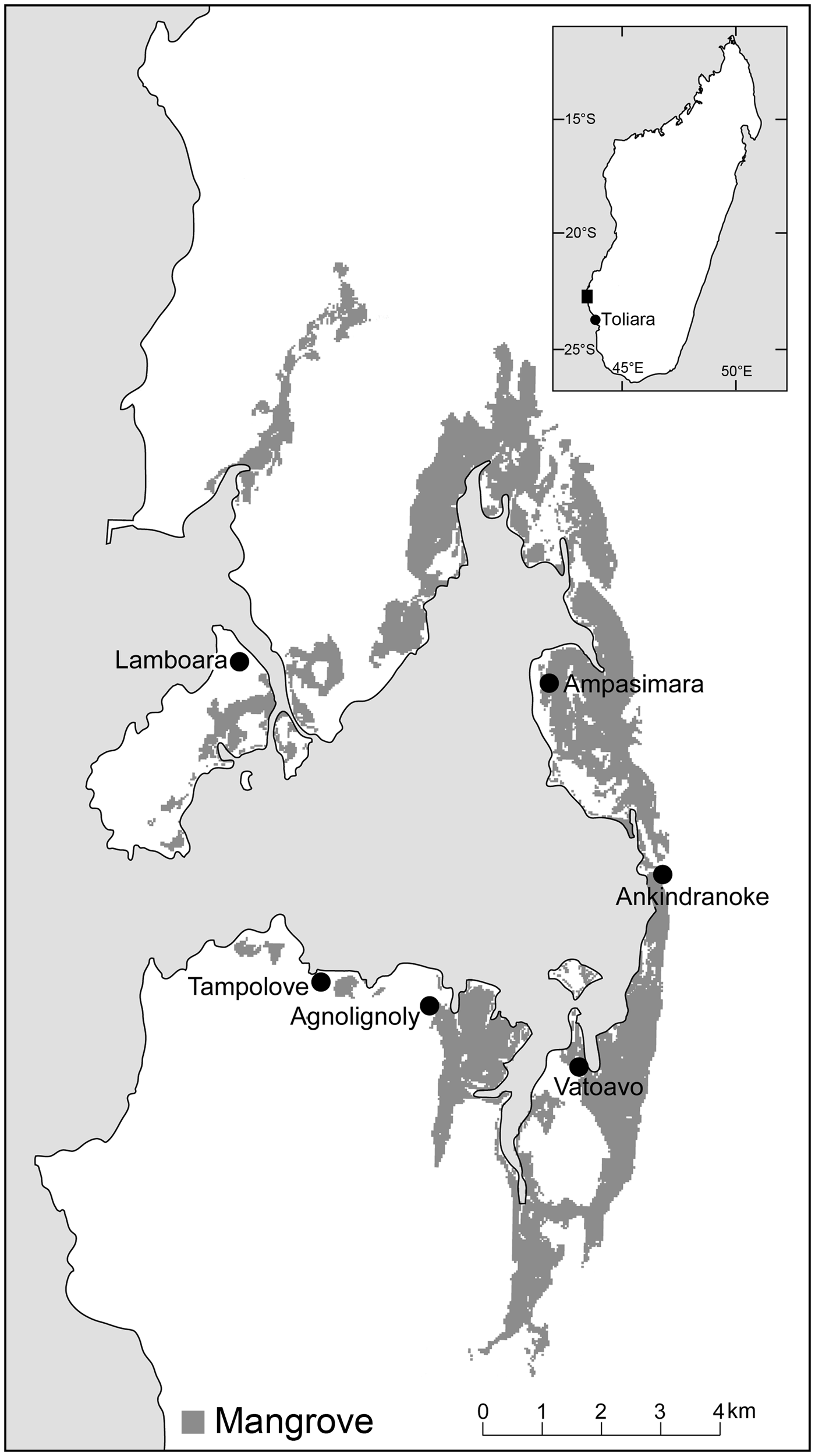
Despite their importance, the socio-ecological dynamics of mangroves are poorly understood (Bandaranayake, Reference Bandaranayake1998; Walters et al., Reference Walters, Rönnbäck, Kovacs, Crona, Hussain and Badola2008). Madagascar's mangrove ecosystems, which make up 2% of global cover, remain particularly understudied (Giri & Muhlhausen, Reference Giri and Muhlhausen2008; Harris, Reference Harris2011). They are increasingly threatened by conversion to agriculture and charcoal production (Giri & Muhlhausen, Reference Giri and Muhlhausen2008; Jones et al., Reference Jones, Glass, Gandhi, Ravaoarinorotsihoarana, Carro and Benson2016), although there are considerable geographical variations in socio-ecological dynamics (Jones et al., Reference Jones, Glass, Gandhi, Ravaoarinorotsihoarana, Carro and Benson2016). Given the central role mangroves play in the livelihoods of many coastal communities in Madagascar, there is a need to better understand the drivers of coastal resource use and the socio-ecological dynamics of the island's mangroves. Here we document research on an emerging threat to mangroves in the Bay of Assassins in south-west Madagascar (Fig. 1): the production of sokay, a sea-shell based lime render produced in mangrove wood kilns and used to improve the durability of houses. We consider data from a vegetation survey conducted in August 2015; 15 semi-structured interviews with key informants (including six involved in lime production) undertaken in four villages (Ampasimara, Lamboara, Tampolove and Vatoavo) in August 2015; and data from surveys and interviews carried out in 2006 (Epps, Reference Epps2007) and 2014 (Blue Ventures, 2015).
The Bay of Assassins, south-west Madagascar (mangrove cover data from Blue Ventures Conservation).
The Bay of Assassins
The Bay of Assassins (Helodrano Fanemotra in Malagasy) is a coastal inlet in south-west Madagascar, 180 km north of the regional capital of Toliara. The inlet is fringed by c. 1,300 ha of mangrove (Jones et al., Reference Jones, Glass, Gandhi, Ravaoarinorotsihoarana, Carro and Benson2016), dominated by Ceriops tagal and Rhizophora mucronata. There are 10 villages around the bay, with a total population of c. 3,000 (Peabody & Jones, Reference Peabody and Jones2013). Small-scale fisheries generate over 80% of household income in these communities (Barnes-Mauthe et al., Reference Barnes-Mauthe, Oleson and Zafindrasilivonona2013).
Coastal areas in Madagascar are increasingly experiencing in-migration, as poor agricultural households move to the coast seeking more secure livelihoods (Bruggemann et al., Reference Bruggemann, Rodier, Guillaume, Andréfouët, Arfi and Cinner2012). Data are scarce, but there is evidence that the Bay of Assassins is experiencing significant in-migration. For example, in the villages of Lamboara and Ampasilava < 30% of inhabitants were born in those settlements (Epps, Reference Epps2007). The region's arid climate and the growth in marketing opportunities for marine produce have encouraged people to turn from inland agriculture to coastal fishing (Aina, Reference Aina2010). Coastal in-migration and the commodification of marine resources in south-west Madagascar have in turn led to increasing pressure on fisheries (Aina, Reference Aina2010; Barnes-Mauthe et al., Reference Barnes-Mauthe, Oleson and Zafindrasilivonona2013).
Mangrove use in the Bay of Assassins
Mangrove wood is harvested for two main purposes: the construction of houses and as a fuel in the construction of kilns to produce lime render. To estimate the effects of harvesting on mangroves we conducted measurements of canopy cover, structure and species composition in 60 randomly selected 7-m radius circular plots within the bay. We counted, identified to species level, and measured the diameter at breast height of every tree (non-harvested and harvested). From our vegetation survey we found that every plot contained harvested trees, even those that were densely vegetated and relatively difficult to access. We found that the majority of tree harvesting involves the select felling of trees within mangrove stands, rather than clear cutting larger areas. Our mangrove plots had a mean canopy cover of 73.5 ± SE 3%, with a mean of 28.7 ± SE 2.5% of trees (> 5 cm dbh) harvested. Although harvesting involves mostly cutting trees at the trunk and thus killing the tree (as Rhizophoraceae do not coppice or re-sprout), the forest is generally cut in a way that leaves the majority of trees intact.
Lime production and use
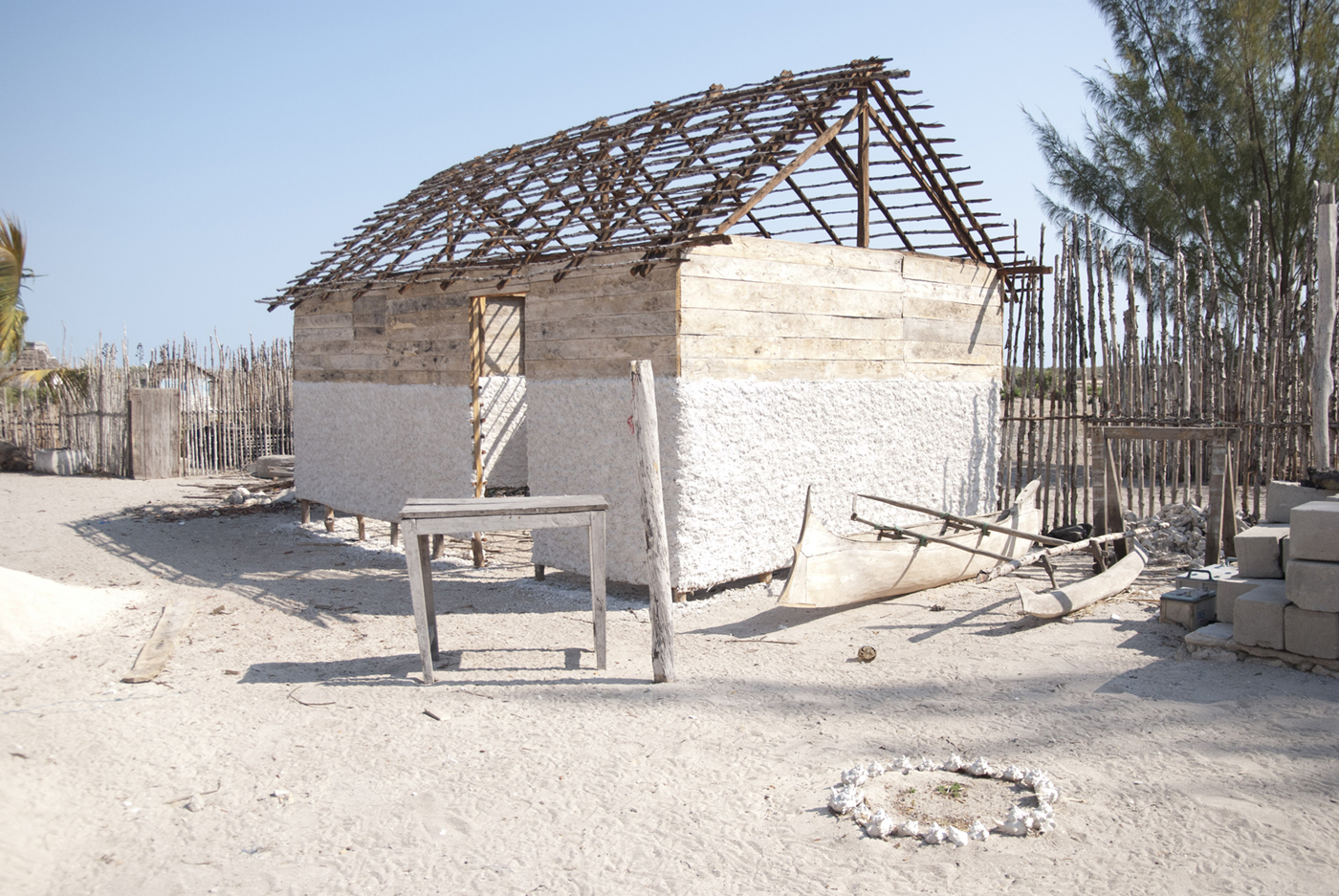
During our visits to four villages we observed that houses in the Bay of Assassins were made from a wide range of materials, including reeds, wooden planks, corrugated iron sheets, and lime render over a wooden frame (Plate 1). Our interviewees stated that lime render was the preferred wall material because of its relative durability. However, lime production is a time consuming process, requiring kiln makers to cut a large volume of mangrove wood and collect sacks of sea shells. This means that the use of lime is limited to wealthier households who can afford to pay others to produce it.
A house wall with wooden frame and lime render.
We observed 10 kilns, at various stages of construction, in four villages. A lime kiln (Plate 2) measures c. 2.6 m in length, 2.3 m in width and 1.2 m in height, using mangrove poles of c. 10 cm diameter. Layers of sea shells are sandwiched between layers of wood. Favoured sea shells are those from gastropods such as Terebralia palustris and Murex ramosus (Epps, Reference Epps2007). However, the kiln makers we interviewed reported that these species were increasingly difficult to obtain and that they were reliant on bivalves such as Donax faba, which are considered inferior because of their smaller and thinner shells.
A lime kiln in the Bay of Assassins.
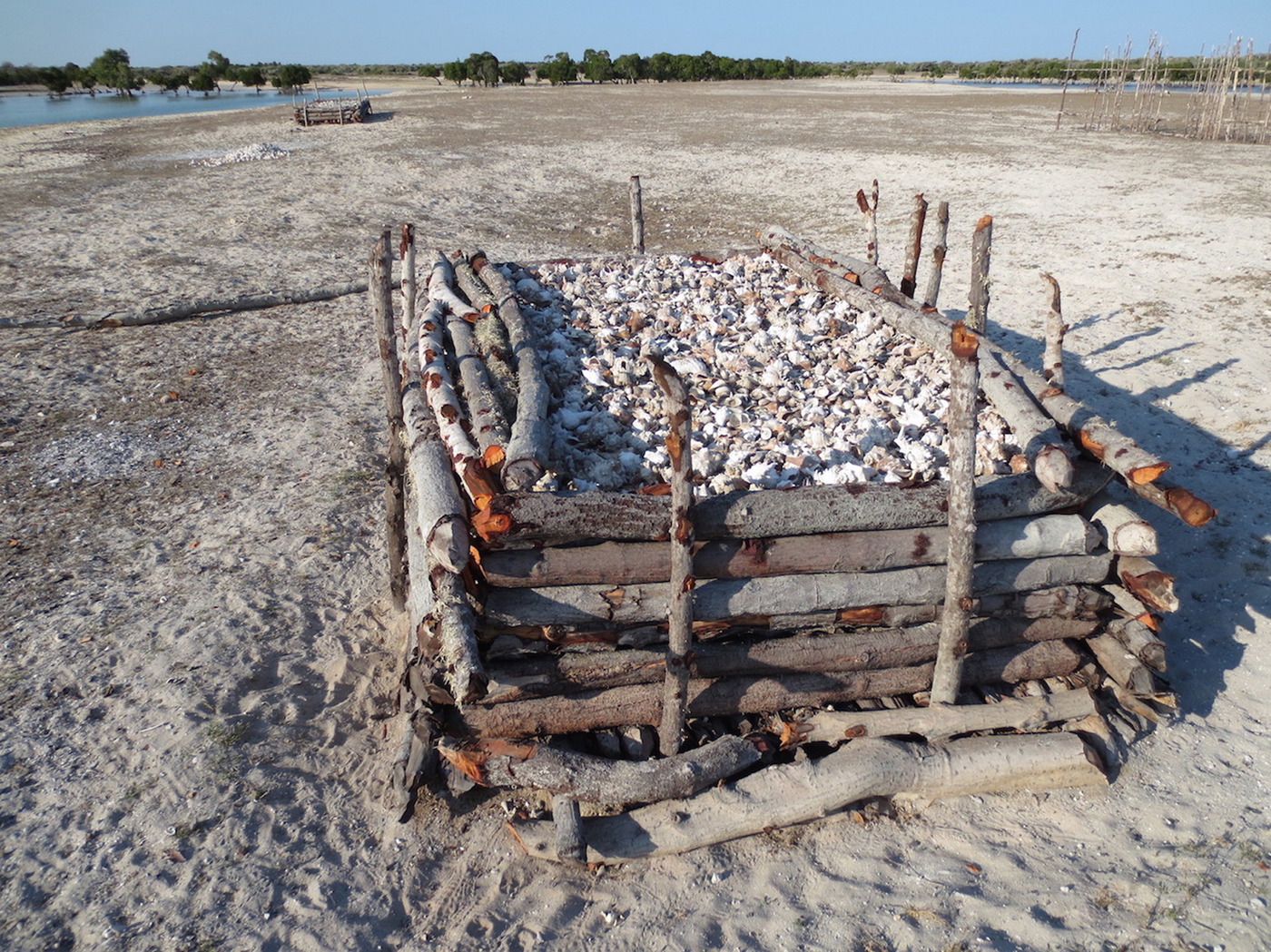
The preferred species of mangrove wood for kiln construction is Rhizophora mucronata, because of its high calorific value, although we noted that other species, such as Ceriops tagal, were also used. Kiln construction requires c. 120 poles of mangrove wood, with a total volume of c. 2.5 m3. A typical kiln produces 35–40 rice sacks of lime. An average sized house requires c. 70 sacks to render. Each sack of lime sells for c. MGA 1,000 (USD 0.3). A house thus costs c. MGA 70,000 (USD 20) to render. To put this in perspective, the average annual income in south-west Madagascar is < USD 200 per person (INSTAT, 2010) and households spend > 70% of household income on food (WFP, 2011).
As well as improving the durability of houses, lime render is also considered a status symbol. Interviews with key informants suggested that lime use had increased over the previous decade. This is supported by previous household surveys. In 2006, 28% of households in Lamboara village owned buildings with lime render invested in their construction (Epps, Reference Epps2007). By 2014 this figure had gone up to 65% (Blue Ventures, 2015). Furthermore, interviews revealed that since 2010 lime producers have sold lime to individuals from outside the Bay of Assassins, providing evidence of a lime commodity network that extends beyond the Bay.
Key informants suggest that growing wealth from sea cucumber (Holothuria spp.) and seaweed Kappaphycus alvarezii aquaculture, along with octopus Octopus cyanea fishing, has contributed to growing demand for lime as some households can afford to pay others in the village to produce it. All three of these marine products have experienced rapid commodification, with fishers now supplying global markets. For example, commercial trade in octopus only started in 1994 in the region, with export trade starting in 2003 and middlemen visiting villages to collect fresh octopus for export (Aina, Reference Aina2010).
Lime production as a threat to mangrove quality and quantity
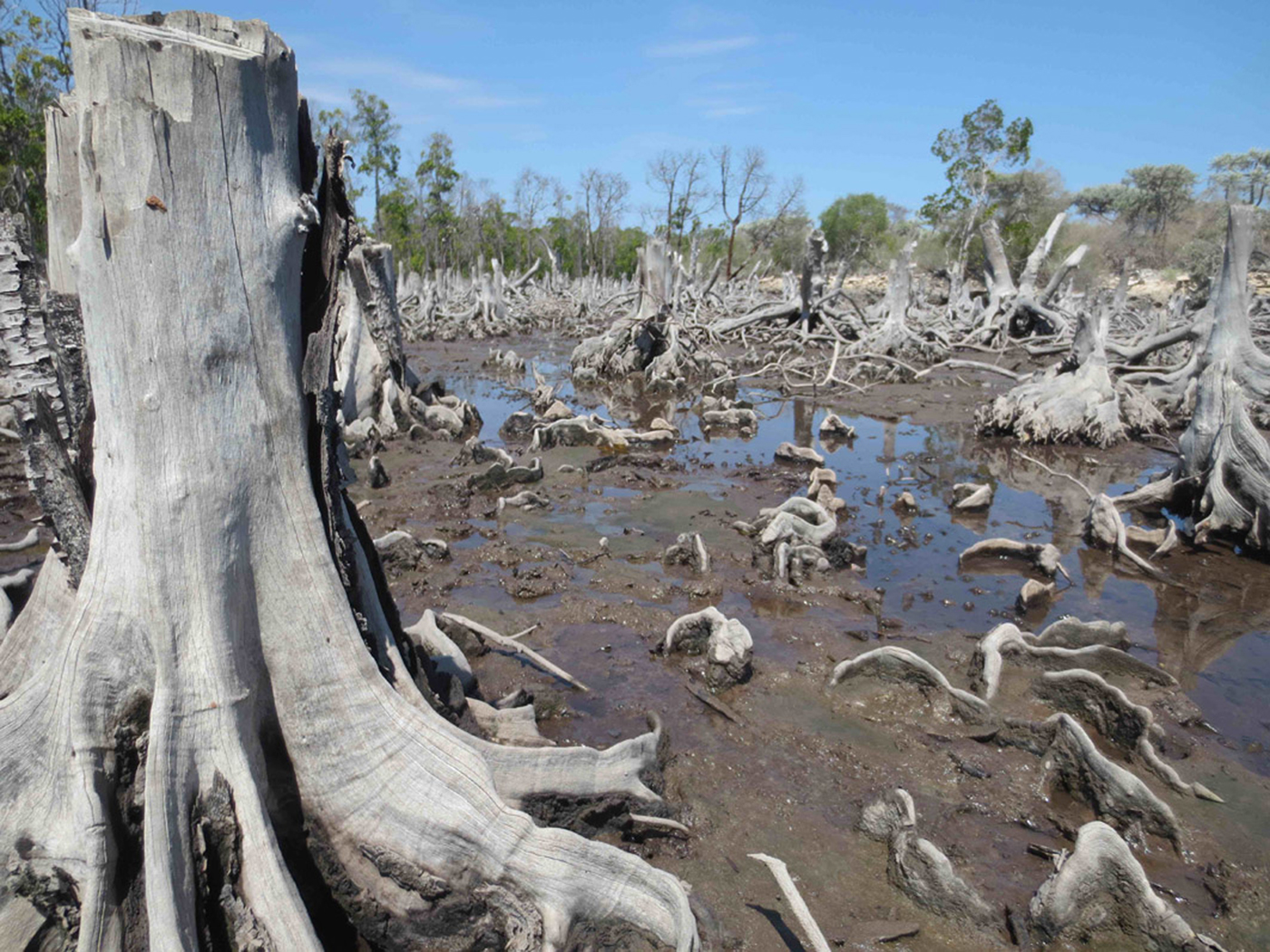
Changes in lime production and use have important implications for mangroves. Our vegetation surveys show that although the mangroves of the Bay of Assassins are heavily harvested, this mostly involves selective cutting, resulting in low-level disturbance. However, recent lime production has led to the clear cutting of mangrove forest in some instances. The area shown in Plate 3 (a total of 1.5 ha) was cleared in 2013 to fulfil a large commercial order from outside the villages. Although this is a small area, there are long-term implications for the site as canopy clearance often results in substantial surface subsidence (sensu Lang'at et al., Reference Lang'at, Kairo, Mencuccini, Bouillon, Skov, Waldron and Huxham2014; Sasmito et al., Reference Sasmito, Murdiyarso, Friess and Kurnianto2016) limiting seedling regeneration, even after 3 years.
Clear cutting of Rhizophora mucronata and Ceriops tagal in response to demand for lime in 2013.
Mangrove use and environmental policy in the Bay of Assassins
We have documented lime production and consumption and how it relates to mangrove forests in the Bay of Assassins. Socio-economic surveys (Epps, Reference Epps2007; Blue Ventures, 2015) and interviews with key informants suggest that the use of lime render has increased as a result of a rise in the income of some households. This relates in part to new sources of income that have been created as villages in the Bay of Assassins have become connected to global commodity chains for octopus, seaweed and sea cucumber.
This research has highlighted the complex relationship between poverty, income growth and resource use. Our findings suggest that it is not simply poverty that drives patterns of mangrove use and change in the Bay of Assassins. Rising incomes have created new pressures in the form of demand for lime render, which is met by other households who produce it commercially. While research on charcoal production in communities inland has found that it is carried out primarily by poor households who have abandoned farming (Gardner et al., Reference Gardner, Gabriel, St John and Davies2016), the socio-economic characteristics of lime producers is not yet known. Mangrove wood use needs to be quantified through a comprehensive household survey and particular attention needs to be paid to differences between households in lime production and consumption, for example according to wealth and migration status. If migration into coastal villages continues, incomes rise, and demand for building timber and lime render grows, how can mangrove harvesting patterns and rates be managed in such a way as to allow mangrove regeneration?
We have also found that lime commodity chains extend outside the villages of the Bay of Assassins. External demand has led to a different harvesting pattern, with mangrove clearance rather than selective cutting. The extent of lime commodity chains and the size of the market for lime is unknown. There is also a need for research on the socio-ecological dynamics of sea-shell collection, particularly the quantity and species of molluscs targeted, how shell collectors are responding to scarcity, and the ecological impacts of shell collection.
Our findings suggest that mangroves must be managed as part of broader landscape-based approaches. There is now abundant research showing that mangroves are interlinked with other ecosystems in important ways; for example, mangroves act as hatcheries for coral reef and pelagic fish species (Nagelkerken et al., Reference Nagelkerken, Blaber, Bouillon, Green, Haywood and Kirton2008). Our documentation of lime production shows that links between ecosystems are also socio-economic. Changes in one system (e.g. growing income from aquaculture) can affect another (e.g. loss of mangrove cover through increased demand for lime). In turn, the loss of mangroves has implications for fisheries because of the role of mangroves in the life cycles of fish and other marine fauna important to the livelihoods of rural households in fishing communities (Duke et al., Reference Duke, Meynecke, Dittmann, Ellison, Anger and Berger2007; Nagelkerken et al., Reference Nagelkerken, Blaber, Bouillon, Green, Haywood and Kirton2008). In the Bay of Assassins livelihoods draw on coral reefs, sea grasses, mangroves and terrestrial dry forests (Epps, Reference Epps2007; Cripps & Harris, Reference Cripps and Harris2009; Peabody & Jones, Reference Peabody and Jones2013). It is therefore crucial that environmental policy considers marine resources (fisheries and aquaculture), terrestrial forests, and mangroves at the same time and examines links between them.
Acknowledgements
This research was funded through an Environment and Sustainability Grant from the Royal Geographical Society (with IBG). We thank Michael Strongoff, Jose Njara Ranaivoson and Helen Scales for field assistance, Al Harris and Blue Ventures for their logistical support, Philip Stickler (Department of Geography, University of Cambridge) for cartographic assistance, and two anonymous reviewers for their helpful comments and suggestions.
Author contributions
IRS and DAF designed the study, carried out the vegetation survey, analysed the data, and drafted the article. All authors contributed field observations and interview data, and read and revised the article.
Biographical sketches
Ivan Scales is a geographer specializing in environment and development issues, mostly in sub-Saharan Africa. His research emphasizes the role of political, cultural and economic factors in shaping the way natural resources are used and contested. He is investigating the diversity of environmental values, agriculture and food security, tropical deforestation, and community-based approaches to conservation. Daniel Friess is a tropical wetland geographer and Assistant Professor at the National University of Singapore. His research focuses on coastal ecosystem services, deforestation threats to mangroves, and wetland vulnerability to sea level rise. Leah Glass’s current research interests include the intrinsic relationship between coastal populations and marine resources, and the spatial analysis of resource dynamics, with a particular focus on mangroves and their fisheries. Lalao Ravaoarinorotsihoarana’s research focuses on the assessment of marine ecosystem services, with a particular focus on mangroves, and the links between these resources and local socioeconomic trends.



