





1. Introduction
‘I have a gut feeling’, we all know what this expression means but describing the instinctive emotion response it refers to with words may result difficult. This expression clearly reflects the interconnection between emotion and language (e.g., Barrett et al., Reference Barrett, Lindquist and Gendron2007) and the fact that emotions are not just mental states but also embodied experiences. This connection between language, emotion and the body is the core of theories of embodied cognition, which propose that emotion concepts are grounded in sensorimotor systems (e.g., Barsalou, Reference Barsalou2008). Consequently, some words feel more prototypical of an emotion than others, like ‘happiness’ compared with ‘fun’, for example. Although there are several features that contribute to the representation of affective meaning in highly emotion prototypical words, such as valence (the hedonic tone associated with a word, ranging from positive to negative) and arousal (the degree of activation of an emotion, ranging from calming to exciting), emotional prototypicality seems to be strongly determined by feelings (subjective response to an emotion) and interoception (internal bodily sensations) associated with words, at least, in a first language (L1) (Ferré et al., Reference Ferré, Guasch, Stadthagen-González, Hinojosa, Fraga, Marín and Pérez-Sánchez2023, for a review, see, Ferré et al., Reference Ferré, Fraga and Hinojosa2025). In line with the claims made by appraisal theories of emotions (Scherer & Moors, Reference Scherer and Moors2019), these features broadly align with the emotion-specific changes in the response components (e.g., interoception) and the subsequent integrated representation of these changes (e.g., feelings), which are driven by assessments of significant events. In a second language (L2), however, it has often been suggested that, when processing emotions, body connections are weaker (or absent) than in an L1 (Dewaele, Reference Dewaele2004; Pavlenko, Reference Pavlenko2012; Toivo et al., Reference Toivo, Scheepers and Dewaele2024). Hence, the question we address in this study is whether the prototypicality of emotion words is determined by the same features in L1 and L2, and, particularly, whether feelings and interoception predict prototypicality to the same extent in L2 as in L1.
According to the prototype theory (Rosch, Reference Rosch, Rosch and Lloyd1978), emotion prototypicality refers to the idea that some emotions are perceived as more representative (i.e., prototypical) of a given emotion category than others. In contrast to valence and arousal, which describe the hedonic quality and affective intensity of emotional experience, prototypicality does not refer to affective properties per se, but to the extent to which a word is perceived as a representative member of the emotion category. Thus, whereas valence and arousal capture how an emotion feels, prototypicality captures how well a word fits our mental concept of what an emotion is. More concretely, in our example, ‘happiness’ would be a better representation of the semantic category of emotion than ‘fun’. Recent studies have attempted to establish the prototypicality of words in various languages (e.g., Basque, Alonso-Arbiol et al., Reference Alonso-Arbiol, Shaver, Fraley, Oronoz, Unzurrunzaga and Urizar2006; French, Niedenthal et al., Reference Niedenthal, Auxiette, Nugier, Dalle, Bonin and Fayol2004; Indonesian, Shaver et al., Reference Shaver, Murdaya and Fraley2001; Italian, Zammuner, Reference Zammuner1998; Spanish; Ferré et al., Reference Ferré, Guasch, Stadthagen-González, Hinojosa, Fraga, Marín and Pérez-Sánchez2023; Pérez-Sánchez et al., Reference Pérez-Sánchez, Stadthagen-Gonzalez, Guasch, Hinojosa, Fraga, Marín and Ferré2021) by asking participants to evaluate the extent to which each word of a list referred to an emotion. For instance, in the study on which ours is based, Pérez-Sanchez et al. (Reference Pérez-Sánchez, Stadthagen-Gonzalez, Guasch, Hinojosa, Fraga, Marín and Ferré2021) asked native Spanish speakers to rate words on a 5-point scale (each word was rated by at least 20 participants) for prototypicality. Half of the words came from previous norming studies in other languages (for details on the materials, see, Pérez-Sánchez et al., Reference Pérez-Sánchez, Stadthagen-Gonzalez, Guasch, Hinojosa, Fraga, Marín and Ferré2021). In addition, they also collected ratings on affective (valence, arousal, happiness, sadness, fear, disgust and anger) and psycholinguistic (Age-of-Acquisition, frequency and concreteness) features for those words that had not been rated in the previous databases (using the original scales). They also computed the variable ‘emotionality’ (i.e., the degree to which a word expresses an emotion, independently of its valence) by subtracting 5 (the midpoint of the original 1-to-9 scale) from the valence score of each word. Their findings corroborated those obtained in other languages. More precisely, these studies identified features that significantly predict prototypicality, like emotionality, emotion-related variables (i.e., the degree to which a word is related to basic emotions: anger, disgust, fear, happiness and sadness), arousal, as well as linguistic features like word and lexical frequency and the age of acquisition of a word (Bradley & Lang, Reference Bradley and Lang1999; Niedenthal et al., Reference Niedenthal, Auxiette, Nugier, Dalle, Bonin and Fayol2004; Pérez-Sánchez et al., Reference Pérez-Sánchez, Stadthagen-Gonzalez, Guasch, Hinojosa, Fraga, Marín and Ferré2021; Zammuner, Reference Zammuner1998). Interestingly for our purpose, Ferré et al. (Reference Ferré, Guasch, Stadthagen-González, Hinojosa, Fraga, Marín and Pérez-Sánchez2023) went further and tried to identify the information participants rely on when making their evaluation. Based on various emotion theories (Barrett et al., Reference Barrett, Lindquist and Gendron2007; Ekman, Reference Ekman1972; Russell, Reference Russell2003; Scherer & Moors, Reference Scherer and Moors2019), they gathered ratings for different variables related to emotional experiences: action, body expression, evaluation, feelings and interoception. The correlation and regression analyses revealed that feelings and interoception were the components that most significantly determined the prototypicality of emotion words with 49% and 11%, respectively. These results support the idea that the combination of internal body sensations with other context information is necessary for an emotional experience to emerge and are in line with the embodied cognition literature (e.g., Barsalou, Reference Barsalou2008).
In L2, however, theories have challenged the idea that L1 and L2 language mechanisms rely on the action-perception and sensory system to the same extent (Pavlenko, Reference Pavlenko2005, Reference Pavlenko2012). The Reduced Embodiment Hypothesis (Pavlenko, Reference Pavlenko2012) proposes that emotional concepts in an L2 are less grounded in sensorimotor, affective and interoceptive experiences than in L1 because (emotion) words in L1 are typically learnt in emotionally rich, socially embedded contexts, such as family interactions, personal experiences or emotionally charged events. This early acquisition leads to deep emotional resonance, where the meaning of a word is tightly associated with body sensations and autonomic responses. In contrast, L2 emotion words are often acquired through formal education, in settings that are emotionally neutral or detached. As a result, L2 emotion words tend to have a shallower affective grounding due to weaker links and less direct association with the motor system, leading to lower physiological and sensory simulations (Perani & Abutalebi, Reference Perani and Abutalebi2005), even if their semantic content is well known and understood. Although a few studies (for a review, see Aguilar et al., Reference Aguilar, Ferré and Hinojosa2024) have demonstrated similar responses to emotional stimuli in L1 and L2 in highly proficient bilinguals (e.g., Conrad et al., Reference Conrad, Recio and Jacobs2011; Eilola et al., Reference Eilola, Havelka and Sharma2007), behavioural and physiological differences have been largely reported (e.g., Dewaele, Reference Dewaele2004; Eilola & Havelka, Reference Eilola and Havelka2011; Harris et al., Reference Harris, Aycicegi and Gleason2003; Jończyk et al., Reference Jończyk, Boutonnet, Musiał, Hoemann and Thierry2016; Opitz & Degner, Reference Opitz and Degner2012; Thoma & Baum, Reference Thoma and Baum2019). These differences are often observed for negative stimuli, probably due to the positive bias, which refers to the fact that individuals usually process and recall positive information more readily than negative information (e.g., Sheikh & Titone, Reference Sheikh and Titone2015; Wu & Thierry, Reference Wu and Thierry2012). Thus, it is often claimed that disembodiment in L2 mainly occurs with negative words (e.g., Dewaele, Reference Dewaele2016; Jończyk et al., Reference Jończyk, Boutonnet, Musiał, Hoemann and Thierry2016, Reference Jończyk, Naranowicz, Bel-Bahar, Jankowiak, Korpal, Bromberek-Dyzman and Thierry2025).
It is important to note as well that, as stated in a recent article, ‘emotion word is an ambiguous concept’ (Wu & Zhang, Reference Wu and Zhang2025), which has been divided into two types of words, that is, emotion-label words (words that directly label an emotional state, e.g., happy, sad) and emotion-laden words (words with acquired affective connotations that do not name an emotion, e.g., death, party). In bilinguals, it has been suggested that these two types of words show partially dissociable behavioural and affective processing patterns within and across languages (e.g., Altarriba & Basnight-Brown, Reference Altarriba and Basnight-Brown2011; Basnight-Brown et al., Reference Basnight-Brown, Altarriba, Schwieter and Schwieter2015; Zheng et al., Reference Zheng, Zhang, Guasch and Ferré2025). Both emotion label and emotion-laden words can activate affective meaning in L2, but not always to the same degree or through the same mechanisms as in L1, suggesting that emotional meaning is not uniformly grounded across lexical categories or languages. In relation to emotion prototypicality, emotion-label words are likely to have more central positions within the emotion category, whereas emotion-laden words may rely more heavily on contextual and associative knowledge. Indeed, emotion-label words seem to be embedded in a complex and dynamic emotion process comprising multiple interacting components like feeling and interoception, whereas emotion-laden words seem to be linked to valence (evaluating how unpleasant a word is) (Betancourt et al., Reference Betancourt, Guasch and Ferré2024). This distinction further implies that different types of emotional words may vary in the extent to which they engage sensorimotor and affective systems, especially in L2, where emotional representations are often less embodied. Note that the words included in the EmoPro database (Pérez-Sánchez et al., Reference Pérez-Sánchez, Stadthagen-Gonzalez, Guasch, Hinojosa, Fraga, Marín and Ferré2021) on which our study is based mainly contains emotion-label words.
Recent studies have tested (dis-)embodied theories in L2 for the interaction between language and various aspects like actions (e.g., Lu & Yang, Reference Lu and Yang2025; Vukovic & Shtyrov, Reference Vukovic and Shtyrov2014) or space (Ahlberg et al., Reference Ahlberg, Bischoff, Kaup, Bryant and Strozyk2017; Dudschig et al., Reference Dudschig, de la Vega and Kaup2014). Regarding the interaction with emotion, the motor response to emotion stimuli has been examined using different techniques. For instance, Foroni (Reference Foroni2015) presented late Dutch-English bilinguals with verbal representation of emotional expression while measuring the activation of facial muscles. Sentences mapped either directly upon the zygomatic muscle (e.g., “I am smiling”) or did not (e.g., “I am frowning”), and appeared either in the affirmative or negative form. Like in L1 (Foroni & Semin, Reference Foroni and Semin2009, Reference Foroni and Semin2013), the participants in L2 activated the zygomatic when reading affirmative sentences relevant to the muscle (although with less intensity). However, in contrast to the results obtained in L1, negative sentences did not trigger inhibition of the zygomatic muscle in L2. The authors concluded that L2 emotion language processing, just like L1, is based on body sensations and simulations of the meaning; however, these simulations are only partial. Similarly, Baumeister et al. (Reference Baumeister, Foroni, Conrad, Rumiati and Winkielman2017) measured facial muscle activity as well as skin conductance level to examine the connection between embodied processes and memory for emotional stimuli in L1 and L2. Spanish-English and English-Spanish late bilinguals were presented with emotional and neutral words in a memory task. The encoding task was to categorise whether a word was ‘associated with an emotion’ or not. The results indicated that, in L1, memory for emotional words was better than for neutral words. This effect was reduced in L2. Regarding body responses, the results only partially demonstrated reduced facial muscle and skin conductance activity in L2 compared to L1. Another technique has recently been tested as a non-verbal, visceral measure of emotional response, that is, grip force and duration, using a handheld dynamometer (Thoma et al., Reference Thoma, Hüsam and Wielscher2023). To do so, the authors collected three types of measures, that is physiological (pupil dilation), visceral (grip force and duration) and verbal (self-report rating scale). In Study 1, German-English late bilinguals’ pupil dilation was measured while they rated the emotionality of neutral or negative sentences using both verbal rating and squeezing. In Study 2, they were presented with low and high emotionality video commercials that they evaluated using the same measures while their pupil size was also recorded. Both pupillometry and grip force (but not duration) showed higher sensitivity to emotion content in L1 than in L2. This effect was not reflected in verbal ratings.
Overall, these findings support the idea of disembodiment in L2 emotion processing by physiologically demonstrating that words feel different in L1 and in L2. However, they did not allow identifying the features underlying such phenomenon. To address this question, based on Ferré et al. (Reference Ferré, Guasch, Stadthagen-González, Hinojosa, Fraga, Marín and Pérez-Sánchez2023), we asked English-Spanish late bilinguals to rate 473 Spanish words selected from the EmoPro database (Pérez-Sánchez et al., Reference Pérez-Sánchez, Stadthagen-Gonzalez, Guasch, Hinojosa, Fraga, Marín and Ferré2021) for prototypicality, valence, arousal, feelings and interoception (Crutch et al., Reference Crutch, Troche, Reilly and Ridgway2013). We were particularly interested in the level of prediction of prototypicality by feelings and interoception, because these two measures (1) reflect an explicit emotional response tightly linked to the body and (2) have not yet been included in large-scale normative databases for emotion word ratings in L2.
Interestingly, to our knowledge, until recently, no ratings of emotion word prototypicality in L2 had been provided. It is only recently that Wu et al. (Reference Wu, Zhang and Meng2025) had late Chinese-English bilinguals rate 1122 English words that the authors previously selected from various databases for valence, arousal, age of acquisition in L1, concreteness, word frequency, social semantics, sensory experience ratings and lexical decision performance. The task was to assess on a 5-point scale the degree to which each emotional word referred to an emotion. They reported correlation between emotion prototypicality and affective-semantic variables. The aim of their study was to provide a normative database for emotion prototypicality on L2 English words. Importantly, commonly used affective ratings such as valence and arousal primarily index the affective meaning of words, that is, how emotional concepts are represented at a semantic level rather than the degree to which these words elicit embodied emotional responses. Valence is primarily evaluative (e.g., good-bad, pleasant-unpleasant) and although arousal is theoretically related to physiological activation (for a review on arousal, see, Smith et al., Reference Smith, Woodard and Pollak2024), arousal ratings in word norming studies primarily capture knowledge about the typical intensity of an emotion concept, rather than the individual’s momentary bodily arousal. Moreover, the focus of the task is crucial (Ferré et al., Reference Ferré, Guasch, Stadthagen-Gonzalez and Comesaña2022; Lee et al., Reference Lee, McVeigh, Garcia, Carrillo, Kim and Satpute2025). For instance, Ferré and colleagues had English native speakers and European Portuguese-English bilinguals rate emotional and neutral words. Half of the participants had to focus on the meaning of words while others concentrated on the feeling produced by the words. The affective ratings were more intense for native than for bilingual speakers, and this difference was greater when the evaluation focused on feelings rather than words’ meaning. These findings suggest that bilinguals may know the meaning of a word but they do not ‘feel’ it as much. As such, valence and arousal may reflect affective-semantic properties of words more than embodied emotional responses. This distinction as well as the focus of the task may help explain why L1-L2 differences are often weak or absent in word-rating studies, yet clearer in psychophysiological and neurocognitive measures (e.g., Foroni, Reference Foroni2015; Harris et al., Reference Harris, Aycicegi and Gleason2003; Opitz & Degner, Reference Opitz and Degner2012). The present study directly addresses this dissociation by combining traditional affective ratings with measures more closely related to body sensation, i.e., feeling and interoception. In addition to testing the embodiment hypothesis via multidimensional ratings, our aim was to provide a validated database for emotion prototypicality in L2 for use in bilingualism/emotion research.
2. Methods
2.1. Participants
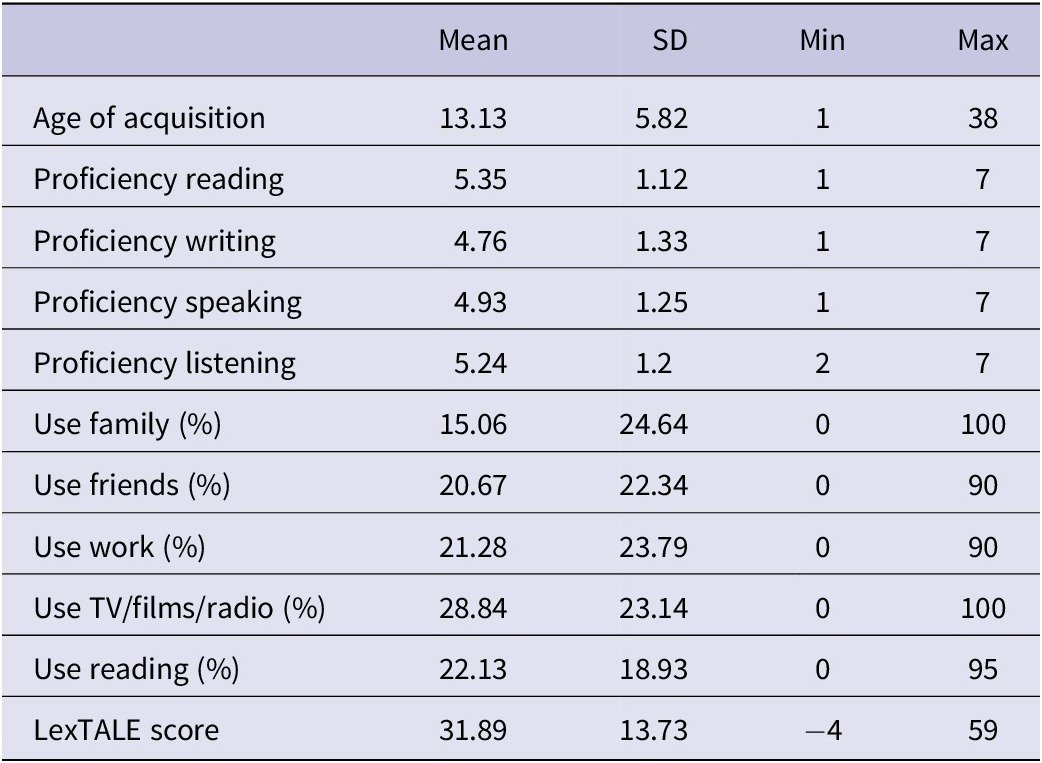
A total of 164 English native speakers (61% female; mean age = 32.58 years, SD = 8.44; age range: 18–50) took part in this study after providing informed consent. They were all L2 learners of Spanish and were residing in the United States (65%), the United Kingdom (27%) or Spain (8%). After providing informed consent, participants completed a sociolinguistic and language history questionnaire. This included questions about their age, gender, education, country of residence, native language, other languages they knew (at least at B1 level) and their detailed Spanish learning history (age of acquisition, mode of learning, months of immersion, their reading, writing, speaking and listening proficiency using a 7-point scale, how often they used Spanish with family and friends, at work, when watching TV, films or series, when listening to the radio and when for reading). They also completed the Spanish LexTALE test to assess receptive vocabulary (Izura et al., Reference Izura, Cuetos and Brysbaert2014). Participants were recruited online via Prolific and paid £9 per hour. Participants’ details are provided in Table 1.
Descriptive statistics of participants’ language history, proficiency, use and LexTALE score
2.2. Materials
The stimulus set comprised 473 Spanish words selected from the EmoPro database (Pérez-Sánchez et al., Reference Pérez-Sánchez, Stadthagen-Gonzalez, Guasch, Hinojosa, Fraga, Marín and Ferré2021). The original database contained 1286 words (mainly emotion-label words); However, to ensure L2 participants’ knowledge of the words, we adapted the list. We first conducted a pre-test with three L2 users of Spanish (B2–C1 level) who were asked to mark all the words from the list they did not know. When a word was identified as unknown by the three participants, it was excluded from the list. Moreover, whenever a word appeared in different forms (e.g., noun, adjective and verb), only the form that had the highest lexical frequency was kept. This selection resulted in the final list. These words covered a wide range of emotional prototypicality (mean = 2.83, SD = 0.84, range = 1.00–4.95), valence (mean = 4.50, SD = 2.14, range = 1.35–8.60) and arousal (mean = 5.85, SD = 1.46, range = 1.50–8.35) values. The words were rated on five affective features: emotional valence, arousal, prototypicality, interoception and feelings. To compare our results with those of L1 users, we used the scales and instructions from previous studies. Emotional valence and arousal were each rated on a 9-point scale ranging from ‘extremely unpleasant’/‘extremely calm’ to ‘extremely pleasant’/‘extremely arousing’ (Ferré et al., Reference Ferré, Guasch, Moldovan and Sánchez-Casas2012). Emotional prototypicality was rated on a 5-point scale, where participants indicated whether the word referred to an emotion, ranging from 1 (‘not an emotion’) to 5 (‘clearly an emotion’) (Pérez-Sánchez et al., Reference Pérez-Sánchez, Stadthagen-Gonzalez, Guasch, Hinojosa, Fraga, Marín and Ferré2021). Interoception and feelings were each rated on a 7-point scale ranging from 1 (“strongly disagree”) to 7 (“strongly agree”), in response to statements about whether the word refers to internal bodily sensations or feelings (Ferré et al., Reference Ferré, Guasch, Stadthagen-González, Hinojosa, Fraga, Marín and Pérez-Sánchez2023).
2.3. Procedure
Six versions of the questionnaire were constructed, each including the entire stimulus set. Each version contained two blocks, one for each variable, with four pages each: three pages containing 60 words each and a fourth page containing 56 or 57 words. Thus, each word was evaluated on two different affective variables by each participant. Across versions, both the combination of affective variables and their order varied (e.g., arousal followed by valence vs. valence followed by arousal), in order to distribute the evaluation of the five affective variables across participants and to control for order and carry-over effects. Word order within each block was randomised. Participants had the option to select ‘I do not know the meaning of the word’ in all blocks. Words were not repeated within a single questionnaire version. After providing informed consent, participants first completed the sociolinguistic and language history questionnaire (see Table 1 for details). Participants were then randomly assigned to one of the six questionnaire versions. After completing their version of the questionnaire, they completed the Spanish LexTALE test. The average completion time was approximately 40 minutes.
2.4. Exclusion criteria
Data from 37 participants were excluded from the initial sample reported in the Participants section; all analyses were conducted on the remaining 127 participants. Participants scoring below 20 on LexTALE-Esp were discarded to ensure at least moderate Spanish lexical proficiency. Izura et al. (Reference Izura, Cuetos and Brysbaert2014) reported that their sample of beginning Spanish learners had an average LexTALE-Esp score of 11.9, corresponding to 20% accuracy. To adopt a slightly stricter criterion and retain only participants with at least moderate proficiency, the threshold was increased to a LexTALE-Esp score of 20, corresponding to 33% accuracy. This decision was made to enhance the reliability and interpretability of the responses by excluding participants whose vocabulary knowledge was too limited. Additionally, for the rating questionnaires, we calculated the personal correlation coefficient for each participant, removing those with values close to zero or negative values (<.10). Values close to zero suggest that a participant responded randomly to the questionnaire, whereas negative values suggest that they interpreted the scale in the opposite direction. We also discarded the data of participants who responded to fewer than 50% of items. Following this process, an average of 25 ratings was obtained for each word in each variable.
3. Results
3.1. Ratings
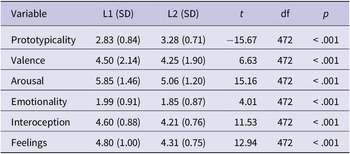
The database is available at https://osf.io/n8t96/. The participants’ ratings were compared with those of L1 Spanish speakers in terms of prototypicality, valence and arousal (Pérez-Sánchez et al., Reference Pérez-Sánchez, Stadthagen-Gonzalez, Guasch, Hinojosa, Fraga, Marín and Ferré2021), as well as interoception and feelings (Ferré et al., Reference Ferré, Guasch, Stadthagen-González, Hinojosa, Fraga, Marín and Pérez-Sánchez2023). The emotionality of the words was also computed for both L1 users and L2 participants as the absolute difference in valence from the neutral point on the scale (value 5). Paired-sample t-tests were conducted to examine the differences between the ratings provided by the L2 participants and the normative ratings from the native speakers (see Table 2).
Descriptive statistics and t-test results for both L1 and L2 groups
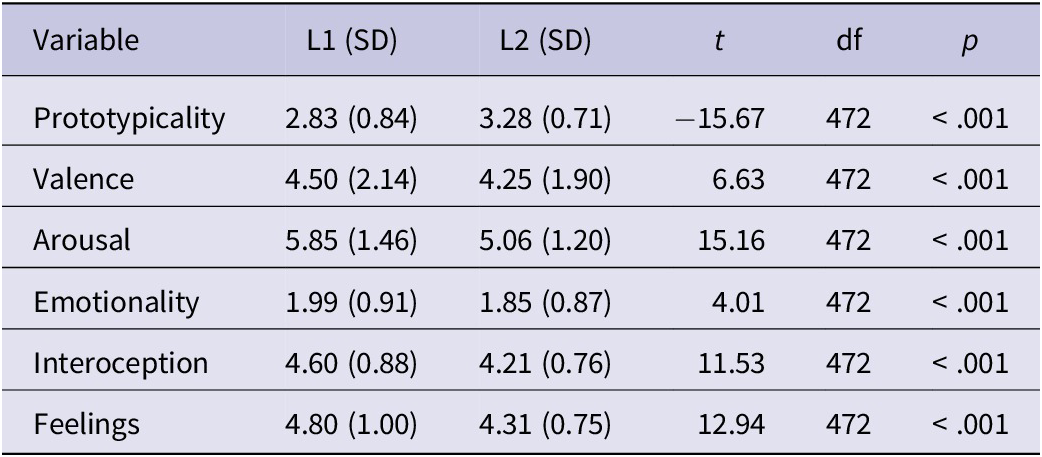
Note: Results are based on paired-sample t-tests comparing L1 and L2 ratings. Bootstrap confidence intervals (5000 resamples) were additionally computed for the mean differences as a robustness check. The bootstrap results closely matched the parametric tests.
All comparisons yielded statistically significant differences (p < .001), indicating systematic discrepancies in the ratings provided by L1 and L2 users. L2 participants rated prototypicality significantly higher. However, they attributed lower ratings than L1 users to all the other features, including feelings and interoception.
3.2. Prediction of prototypicality
For the L2 ratings, a stepwise regression analysis was conducted to predict prototypicality using valence, arousal, emotionality, interoception and feelings as predictors. Predictors were entered sequentially based on their statistically significant contribution to explained variance (ΔR2) and were retained only if they significantly improved model fit. Multicollinearity diagnostics revealed that all VIF values were less than 5, indicating that there was no problematic collinearity among the predictors.
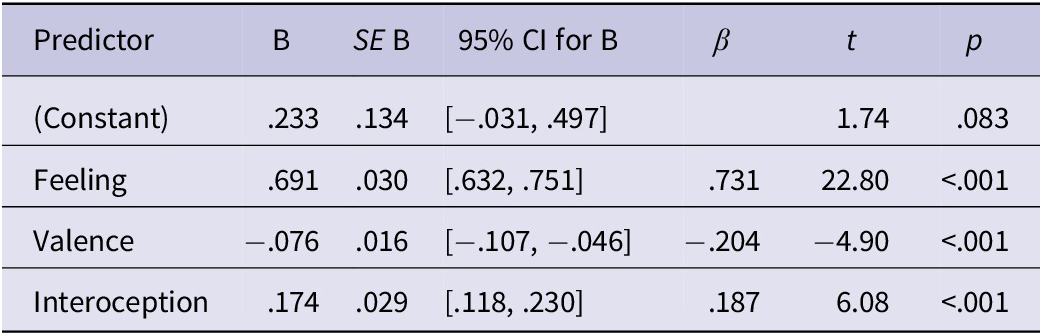
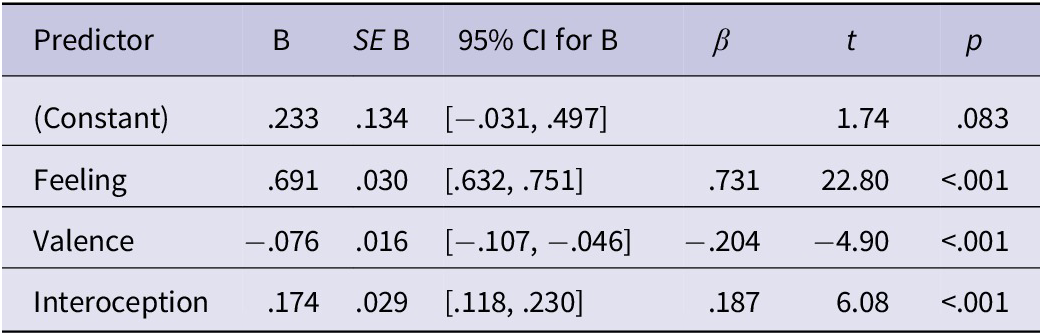
Feeling was the feature that explained most of the variance in L2 prototypicality ratings (55.1%), F(1, 471) = 578.69, p < .001, with a positive effect (β = .731). Valence (10%) produced a significant increase in R 2 of .101, ΔF(1, 470) = 136.28, p < .001, but with a negative association with prototypicality (β = −.204). Interoception (2.7%) contributed an additional ΔR 2 = .027, ΔF(1, 469) = 39.61, p < .001, positively predicting prototypicality (β = .187). Arousal and emotionality did not enter the model (see Table 3 for full regression coefficients).
Coefficients for regression analyses in L2 prototypicality
4. Discussion
The first aim of the study was to test the embodiment hypothesis using multidimensional ratings. More specifically, we investigated whether the prototypicality of emotion words is determined by the same features in L1 and L2, and, particularly, whether feelings and interoception predict prototypicality to the same extent in L2 as in L1. The second aim was to provide a database for emotion prototypicality in L2 Spanish – including new features like prototypicality, feelings and interoception – which can serve as a tool for bilingualism/emotion research.
We directly compared our L2 data to L1 data from previous studies (Ferré et al., Reference Ferré, Guasch, Stadthagen-González, Hinojosa, Fraga, Marín and Pérez-Sánchez2023; Pérez-Sánchez et al., Reference Pérez-Sánchez, Stadthagen-Gonzalez, Guasch, Hinojosa, Fraga, Marín and Ferré2021). Overall, the results showed that emotion prototypicality obtained higher ratings in L2 than in L1, in contrast, all the other features had lower ratings in L2. The lower ratings in L2 for valence, arousal and emotionality are in line with previous findings (Garrido & Prada, Reference Garrido and Prada2021; Imbault et al., Reference Imbault, Titone, Warriner and Kuperman2021). To our knowledge, ratings for feelings and interoception had not been reported in the L2 literature yet, but they are consistent with the idea that ratings for emotion words in L2 are usually less extreme than in L1. In addition, regression analyses revealed that feeling was the strongest predictor of prototypicality in each language (L1: 49%, L2: 55%). In terms of incremental contributions, however, interoception was found to substantially increase the explained variance in L1 prototypicality ratings (ΔR2 = .111, β = .379), whereas it did so to a lesser extent in L2 (ΔR2 = .027, β = .187). In L1, interoception was the second strongest predictor, whereas in L2 it was the third. This suggests that interoception is more strongly associated with prototypicality in L1 than in L2 and implies that L2 users do not rely on body sensation as much as L1 users when evaluating emotional prototypicality. By contrast, valence accounted for a similar negative trend in both models but had a stronger influence in L2 (ΔR2 = 0.101, β = −0.204) than in L1 (ΔR2 = 0.005, β = −0.108). It was the second strongest predictor in L2 but the fourth in L1. This indicates that affective-semantic evaluation has a greater influence on L2 prototypicality ratings than on L1. These findings support the theory of disembodiment in L2 which argues that emotional concepts in an L2 are less grounded in sensorimotor, affective and interoceptive experiences due to the less personal and more formal acquisition context of the L2 than the L1 (Pavlenko, Reference Pavlenko2012). This formal acquisition leads to more ‘prototypical’ representation of the concept of emotion. For instance, L2 users know that ‘happiness’ is an emotion word but they do not seem to feel the emotion viscerally. It has been suggested that L2 users may be aware of this emotion detachment and overcompensate when rating emotional words (Dewaele, Reference Dewaele2016; Mavrou & Dewaele, Reference Mavrou and Dewaele2020). In other words, in L2, emotion words are recognised as semantic concepts but the emotion itself is not physically perceived as in L1, or at least, not to the same extent (Ferré et al., Reference Ferré, Guasch, Stadthagen-Gonzalez and Comesaña2022). This claim is supported by the higher ratings we observed for prototypicality and the stronger influence of valence on prototypicality in L2, which suggest that L2 emotion words are recognised as semantic representatives of the category of emotion.
A speculative alternative is that L2 ratings of prototypicality are higher than L1 ratings because L2 users have less emotional vocabulary and hence, fewer concepts to which to compare the words. This interpretation is consistent with research on L2 lexical development showing that L2 semantic representations are initially less differentiated and less densely interconnected than in the L1 (e.g., Ameel et al., Reference Ameel, Storms, Malt and Sloman2005; Degani & Tokowicz, Reference Degani and Tokowicz2010; Kroll et al., Reference Kroll, Van Hell, Tokowicz and Green2010). Such reduced fine-grained semantic categories may provide fewer internal reference points against which emotion words are evaluated, potentially increasing reliance on prototypical representations. Moreover, some studies have revealed facilitation in the processing of emotion-label words compared to emotion-laden words because the latter do not directly refer to emotions (e.g., Altarriba & Basnight-Brown, Reference Altarriba and Basnight-Brown2011; Basnight-Brown et al., Reference Basnight-Brown, Altarriba, Schwieter and Schwieter2015; Wu & Zhang, Reference Wu and Zhang2025; Zheng et al., Reference Zheng, Zhang, Guasch and Ferré2025). However, given that the words we used were mainly emotion-laden words, this explanation seems unlikely here. Out of the five features that were evaluated, only prototypicality depends mainly on the structure/organisation of conceptual representations in semantic memory (Santi et al., Reference Santi, Raposo, Frade and Marques2016), even though, as mentioned in the Introduction, valence and arousal can be considered as affective-semantic features. Hence, the higher ratings in L2 do not really provide information regarding emotion per se but rather regarding the representation and organisation of the emotional concepts. Thus, although the prototypicality ratings are interesting in terms of concepts, the relevant ratings in terms of emotionality are those of the other features.
The different levels of contribution of feelings and interoception in the ratings of prototypicality also suggest a dissociation between subjective emotional evaluation and embodied somatic representation. Recall that feelings are a subjective interpretation of the response-changes elicited by an emotion whereas interoception is an internal body sensation. Thus, a feeling can be defined as a conscious, subjective experience of emotion and easily expressed using language (e.g., ‘I’m tired’, ‘I’m scared’), in contrast, interoception is a visceral sensation, like a ‘gut feeling’, that is harder to describe with words (e.g., heart racing, sweating). Because feelings can be expressed with language, they can be semantically represented and taught in the classroom with their cross-linguistic equivalent. In contrast, body sensations that cannot be verbalised cannot be explicitly taught and therefore, linguistically encoded in L2. This dissociation may explain why interoception predicts significantly less emotion prototypicality in L2 than in L1 where the links between body sensation have been trained through experience. However, in L2, valence, an affective-semantic feature, was a stronger predictor than in L1.
Indeed, this reduced contribution of interoception ratings to prototypicality in L2 suggests that simulation mechanisms are less active in L2 than in L1. As mentioned above, embodied emotion theories argue that conceptual knowledge about emotions is partially constituted by sensorimotor and interoceptive representations (Barsalou, Reference Barsalou2008; Niedenthal, Reference Niedenthal2007). Our results then support the idea of weaker links and less direct association with the motor system in L2 (Perani & Abutalebi, Reference Perani and Abutalebi2005) and are in line with studies that have reported lower physiological and sensory simulations in L2 than in L1 (Baumeister et al., Reference Baumeister, Foroni, Conrad, Rumiati and Winkielman2017; Eilola & Havelka, Reference Eilola and Havelka2011; Foroni, Reference Foroni2015; Harris et al., Reference Harris, Aycicegi and Gleason2003; Jończyk et al., Reference Jończyk, Boutonnet, Musiał, Hoemann and Thierry2016; Opitz & Degner, Reference Opitz and Degner2012; Thoma & Baum, Reference Thoma and Baum2019). The fact that emotion words trigger an explicit, semantic response rather than a body-related response in L2 is consistent with the idea that implicit linguistic knowledge is incorporated into the limbic system (Lamendella, Reference Lamendella1977). According to this view, since L2 acquisition is less embodied than L1 acquisition and emotion words in L2 are not acquired via experience, they have weaker links to the body emotion memory. Neuroimaging studies also have provided converging evidence for this account. L1 emotional language robustly activates limbic structures, including the amygdala, an area associated with emotion evaluation and memory (Citron, Reference Citron2012; Hinojosa et al., Reference Hinojosa, Moreno and Ferré2020). In a recent fMRI study, Hsu et al. (Reference Hsu, Jacobs and Conrad2015) demonstrated that when German-English late bilinguals were presented with neutral, negative or positive text passages from Harry Potter, there was a stronger hemodynamic response in various brain areas, including the amygdala, when reading in their L1 than in their L2. They concluded that reading novels in L1 provides a stronger and more differentiated emotional experience than in L2. These findings support the idea that information that cannot be linguistically encoded and have weaker connections with the body and autobiographical memory generate a less embodied reaction in L2 than in L1.
It is important to underline, however, that our results do not imply a categorical absence of emotional processing in L2. Rather, they support a partial reduction in embodied resonance. As shown in prior studies, L2 can elicit genuine emotional responses under certain conditions, especially when proficiency is high (Conrad et al., Reference Conrad, Recio and Jacobs2011; Eilola et al., Reference Eilola, Havelka and Sharma2007). A central contribution of the present study is the observation that interoceptive experience plays a significantly reduced role in shaping emotion prototypicality in L2 compared to L1. Although previous research on L2 emotional disembodiment has repeatedly demonstrated attenuated physiological and neural responses to emotional language (e.g., reduced skin conductance, facial mimicry, pupil dilation, grip force and amygdala engagement; Baumeister et al., Reference Baumeister, Foroni, Conrad, Rumiati and Winkielman2017; Harris et al., Reference Harris, Aycicegi and Gleason2003; Hsu et al., Reference Hsu, Jacobs and Conrad2015; Thoma et al., Reference Thoma, Hüsam and Wielscher2023), these findings have primarily established that emotional engagement is reduced, rather than which components of embodied emotion are specifically altered. By directly targeting interoceptive experience, the present results extend this literature by suggesting that L2 emotion words are less strongly anchored in internal bodily signals, which are known to play a central role in emotion construction and conscious feeling (Barrett, Reference Barrett2017; Craig, Reference Craig2009). From this perspective, L2 disembodiment may not simply reflect a global attenuation of emotion, but a reduced integration of interoceptive information into emotion concept representations. This reduced integration is consistent with the typical context of L2 acquisition, in which emotional language is often learned in emotionally poor settings and therefore becomes associated more strongly with abstract semantic knowledge than with visceral bodily states. The present findings thus provide novel evidence that interoception constitutes a critical, and previously underexamined, dimension of L2 emotional disembodiment. Also, our study provides a database that includes new features (i.e., prototypicality, feelings and interoception), which can be useful for research in bilingualism. However, despite their usefulness, verbal ratings have the limitation that they provide an explicit and conscious evaluation. Researchers who seek to obtain implicit and unconscious responses to emotion words should use other methodologies, like pupillometry or grip force, for instance (Thoma et al., Reference Thoma, Hüsam and Wielscher2023).
The reduced emotional response in L2 has implications for everyday life. It has already been observed that language can have effects in advertising with consumers reporting perceiving slogans as more emotional in their L1 than in their L2 (Puntoni et al., Reference Puntoni, de Langhe and van Osselaer2009). This effect was modulated by the frequency with which words had been experienced in L1 and L2, supporting the embodied memory view. Also relevant for advertising, Vidal et al. (Reference Vidal, Costa and Foucart2021) used an evaluative conditioning paradigm (pairing neutral stimuli with emotional or neutral stimuli) to investigate whether evaluations are equally conditioned in L1 and L2. They reported that conditioning occurred both in L1 and L2 but was weaker and more sensitive to memory of the emotional stimuli in L2. In clinical contexts, the emotional detachment associated with processing in an L2 may have relevant implications for psychotherapeutic practice (e.g., Cook & Dewaele, Reference Cook and Dewaele2022; Marcos, Reference Marcos1976; Rolland et al., Reference Rolland, Dewaele and Costa2017) and for the treatment of anxiety disorders (García-Palacios et al., Reference García-Palacios, Costa, Castilla, del Río, Casaponsa and Duñabeitia2018). Finally, the less embodied response in L2 has been suggested to reduce heuristic biases in decision-making (e.g., Hayakawa et al., Reference Hayakawa, Costa, Foucart and Keysar2016; Keysar et al., Reference Keysar, Hayakawa and An2012) and to limit the involvement of emotions in moral judgements (e.g., Costa et al., Reference Costa, Foucart, Hayakawa, Aparici, Apesteguia, Heafner and Keysar2014; Dewaele et al., Reference Dewaele, Mavrou, Kyriakou and Lorette2024; Foucart, Reference Foucart, van Hell and Morgan-Short2023).
In conclusion, this study reports multidimensional ratings of emotion prototypicality that revealed that emotion words are evaluated more as a concept and less as a body sensation, which supports the idea of disembodied emotion in L2. This study also serves as a methodological tool, since it provides a database with new features (i.e., prototypicality, feeling and interoception) for research in bilingualism and emotion.
Data availability statement
The database is available at https://osf.io/n8t96/
Funding statement
This research was supported by the projects MULTIPRAG-PID2023-151322NB-I00 and PID2023-149606NB-I00 (funded by MICIU/AEI/10.13039/501100011033 and by FEDER, U.E), as well as by Universitat Rovira i Virgili (2023PFR-URV-00196) and the Horizon Europe Framework Programme (HORIZON-MSCA-2023-SE-01Ref.101182959).
Competing interests
The authors declare none.

 Open access

