

INTRODUCTION
Many developing countries have experienced complex, often violent, historical paths to stability over the past century. As a result, people's opinions may vary regarding their own state, neighboring countries, and superpower states, depending on their direct and indirect experiences in the past. Exposure to large-scale conflict, in particular, can shape people's perceptions and attitudes in critical ways (Holsti Reference Holsti1992; Lunch and Sperlich Reference Lunch and Sperlich1979). In this study, using data on wartime violence against civilians during the Korean War along with recent survey data, we examine whether such violence affects people's views of their own state and of other participating countries over a half century later.
Many contemporary conflicts involve casualties beyond the combatants themselves. The Korean War constitutes one such example, as civilian deaths surpassed even the number of combatant casualties.Footnote 1 In this article, we argue and provide evidence that the long-term impact of conflict on people's views of the perpetrating states varies according to experiences that an individual, a family, or a community had during and after the war. In the context of the Korean War, where multiple parties, including North and South Korea and the United States, engaged in both battles and civilian massacres, perceptions of those war participants should vary widely across individuals and communities, conditioned by exposure to the violence.Footnote 2
To identify the causal effects of wartime violence against civilians, we employ a difference-in-differences (DID) design comparing a pre-war cohort (born between 1944 and 1953) and a post-war cohort (born between 1954 and 1963) residing in areas exposed to violence and in non-violent areas. This empirical design categorizes the subjects into four groups: (1) pre-war generation in violence-affected areas, (2) post-war generation in violence areas, (3) pre-war generation in areas with no violence, and (4) post-war generation in non-violence areas. Then we compare the differences in attitudes between and pre-war and post-war generations in violence areas and to those in non-violence areas. Substantively, this specification effectively differentiates the direct effect of wartime violence to residents in victimized communities, which only pre-war generation in violence areas could experience, from its indirect effect to later-born residents in the same communities, and then compare those findings to the trends in non-victimized areas. In addition, we can also test how post-war politics, particularly the anti-communist drive in South Korean politics, have affected these cohorts differently in violent and non-violent areas.Footnote 3
Our empirical analysis shows that South Koreans’ contemporary attitudes toward their own state and the surrounding countries vary significantly depending on whether they reside in areas exposed to violence against civilians during the war and whether they were born before or after the war. The majority of violence against civilians during the Korean War was committed by South Korean armed forces. As a result, trauma from the direct exposure to violence has induced pre-war generations in the communities with violence to show a lower level of pride in being South Korean. In contrast, stigma imposed on the victims of such violence by the authoritarian South Korean government in the midst of anti-communist campaigns after the war has led residents in those communities, particularly who were born after the war, to demonstrate their political integrity by supporting the South Korean government. Our analysis also shows that they are also more favorable toward the United States and more hostile to North Korea compared to residents in non-violent areas.
This research contributes to the existing literature in several ways. First, we present systematic analyses of how wartime violence during an international conflict affects people's perceptions in the long run. We analyse and show that experience with wartime violence during the Korean War has an influence on people's views of their own country and involved states even 50 years after the events. More critically, we show that the impact of war and violence differs depending on the individual's or the community's idiosyncratic exposure to war and wartime violence. Moreover, while scholars have focused almost exclusively on war-related public opinion in advanced democracies, our research provides evidence from an emerging state, which was in fact one of the world's poorest countries at the end of the war. Finally, our findings suggest that the psychological aftermath of the Korean War, which has not been properly addressed in post-war South Korea under the existing military threat from North Korea, may provide a critical clue to understanding current social and political phenomena in South Korea.
WARTIME VIOLENCE AND PUBLIC PERCEPTIONS
An extensive literature explores the role of public opinion in the foreign policy making process (Almond Reference Almond1960; Arian, Ahser, and Ventura Reference Arian, Shamir and Ventura1997; Cohen Reference Cohen1995; Eichenberg Reference Eichenberg1989; Everts Reference Everts, Niedermayer and Sinnott1995; Holsti Reference Holsti1992; Isernia, Juhász and Rattinger Reference Isernia, Juhász and Rattinger2002; Jacobs Reference Jacobs1992; Page and Shapiro Reference Page and Shapiro1992; Risse-Kappen Reference Risse-Kappen1991; Rosenau Reference Rosenau1961; Sobel Reference Sobel2001). One issue that lacks sufficient discussion in the literature, however, is how attitudes toward other countries and international matters are formed at the micro level. A number of studies have emphasized the role of elites (Page and Shapiro Reference Page and Shapiro1992) and of the media (Graber Reference Graber1997; Page, Shapiro, and Dempsey Reference Page, Shapiro and Dempsey1987) in shaping public opinion regarding foreign affairs and policy. Yet, public opinion must be a manifestation of the latent views that have formed through each individual's direct and indirect experiences in the past. A nationwide war and the violent events that occur during the war would be critical enough to affect an individual's or a group's collective perception in the long run if they are directly or indirectly exposed.
Recently, scholars have begun to study how public opinion is formed by exploring individual-level factors rather than examining only collective opinions (Zeitzoff Reference Zeitzoff2011). At the same time, the increasing frequency of terrorist attacks and subsequent retaliations to terrorist violence provide scholars with opportunities to investigate how direct experience with violence affects people's political views on foreign entities and conflicts at the micro level. A growing literature examining the impact of terrorist attacks on voters’ perspectives and behaviors clearly demonstrates that such links exist. The literature on micro-level opinions related to conflict covers various settings including Israel (Berrebi and Klor Reference Berrebi and Klor2008; Getmansky and Zeitzoff Reference Getmansky and Zeitzoff2014; Gould and Klor Reference Gould and Klor2010; Jaeger, Klor, Miaari, and Paserman Reference Jaeger, Klor, Miaari and Daniele Paserman2012), Turkey (Kibris Reference Kibris2011), and Spain (Bali Reference Bali2007; Montalvo Reference Montalvo2011).
Another key factor that may shape individuals’ experiences with wartime violence is exposure to massive civilian killings during the conflict. Mass killing is not a rare event during civil conflict. For instance, Harff (Reference Harff2003) finds 35 cases of genocide in 126 instances of civil conflict and regime collapse between 1955 and 2001. Massive violence perpetrated during genocide has particularly strong effects on victims’ and the public's psychology. Moreover, due to the nature of mass killing, the effects of genocide tend to last for long periods in a victimized society. Scholars have studied how these mass killings, often targeting male adults, affect the long-term attitudes of victims and the larger public, both directly and indirectly. For instance, research indicates that experience with the Holocaust affects the psychological status of survivors and communities even six decades after the event (Amir and Lev-Wiesel Reference Amir and Lev-Wiesel2003; Barel et al. Reference Barel, Van IJzendoorn, Sagi-Schwartz and Bakermans-Kranenburg2010). Other cases of genocide have also left long-lasting effects on individuals, cohorts, and communities sharing the experience (Cardozo et al. Reference Cardozo, Vergara, Agani and Gotway2000, Reference Cardozo, Kaiser, Gotway and Agani2003; Scholte et al. Reference Scholte, Olff, Ventevogel, de Vries, Jansveld, Cardozo and Gotway Crawford2004). Scholars also find that traumatic experience at a young age can have significant effects on the psychology of victims (Garbarino, Kostelny, and Dubrow Reference Garbarino, Kostelny and Dubrow1991; Lieberman and Knorr Reference Lieberman and Knorr2007; Osofsky Reference Osofsky1995).
Our study contributes to the growing literature of micro-level analyses of political violence in several ways. The first contribution lies in the time span we examine. While most previous studies focus on the immediate impact of exposure to violence on political attitudes, our analyses account for how intensive experiences with violence that occurred approximately 50 years ago, and the subsequent political campaigns stigmatizing victims, have affected the foundation of public perspectives regarding the principal agents of that violence years later. Given the destructive effects of wartime violence on exposed subjects, both individuals and communities, measures of the immediate effects capture only part of the potentially long-lasting and convoluted impacts. Furthermore, as multiple domestic and international players, including South Korea, the United States, and North Korea, were involved in conflict and civilian killings during the Korean War, the data allow us to analyse public attitudes toward diverse international players whose status and reputations may have changed drastically since the war period.Footnote 4 Our analysis examines whether past experience with wartime violence remains a factor in shaping public views toward involved states, despite the dynamics in international and domestic politics that have occurred during the intervening six decades. Finally, our study is pertinent to the literature on the political effects of the Korean War. Numerous studies investigate the causes and outcomes of the Korean War at the national and international levels (Cumings Reference Cumings1981, Reference Cumings2010; Park Reference Park1996, Reference Park2002, Reference Park2005). Less attention has been given, however, to its micro-level effects, e.g. on villages, communities, and individuals. Recently, since the work of Gijin Kim (Reference Kim2005), a growing body of literature has begun examining the long-lasting effects of the war and war-related violence at the communal or individual level (D. Kim Reference Kim2006, Reference Kim2010; Kim and Lee Reference Kim and Lee2013; Korean Oral History Association 2011; I. Lee Reference Lee2010; Park Reference Park2010). This article, along with Hong and Kang (Reference Hong and Kang2017), which tests the effect of wartime violence on trust in the government, contributes to this growing literature by providing systematic empirical evidence that goes beyond interviews or selective surveys.
VIOLENCE DURING THE KOREAN WAR AND POST-WAR POLITICS
This study investigates the long-term effects of wartime violence on people's perceptions of participating countries in the Korean War. We focus on whether people have different views of the participating countries depending on their direct or indirect experience of wartime violence and post-war politics. We hypothesize two major factors contributing to people's perceptions of those participating countries. The first is exposure to mass violence during the war. As war and violence have been frequent events during the past century, scholars have accumulated much empirical evidence on the trauma effects of wartime violence. Evidence indicates that traumatic events (e.g. war violence) can affect one's attitude over a substantially long period (Amir and Lev-Wiesel Reference Amir and Lev-Wiesel2003; Bramsen and Van Der Ploeg Reference Bramsen and van der Ploeg1999; Kuwert et al. Reference Kuwert, Spitzer, Träder, Freyberger and Ermann2007), even when the traumatic event occurred at a very young age (Garbarino, Kostelny, and Dubrow Reference Garbarino, Kostelny and Dubrow1991; Lieberman and Knorr Reference Lieberman and Knorr2007; Osofsky Reference Osofsky1995), and that trauma is not just held by victimized individuals but is shared by the community (Cardozo et al. Reference Cardozo, Vergara, Agani and Gotway2000, Reference Cardozo, Kaiser, Gotway and Agani2003; Scholte et al. Reference Scholte, Olff, Ventevogel, de Vries, Jansveld, Cardozo and Gotway Crawford2004). In the South Korean context, we expect that the traumatic experience of wartime violence leads pre-war cohorts born in violence-exposed areas to be less sympathetic toward the perpetrators of violence. For instance, a person born before 1950 who lived in a township where the North Korean army committed violence likely shows greater hostility toward North Korea today. In contrast, if a respondent was born in an area exposed to violence carried out by the armed forces of South Korea, that person is likely to show a lower level of pride in South Korea.
As mentioned earlier, the numbers of civilian deaths during the Korean War is estimated to range anywhere from 0.2 million to 2 million, depending on the source. Given that, according to the 1949 census, the total population of South Korea was 20 million just prior to the war, one can conclude that civilian casualties represented between one and 10 percent of the total population at the time. While some of those casualties may be considered collateral damage of the war itself, caused by shortages of food and medical supplies, a considerable proportion of civilian deaths is attributed to civilian massacres committed by the armed forces of various participating countries due to their fear of civilian collaboration with the enemy. In addition, the fact that most violence against civilians targeted the male population between the ages of 15 and 65 intensifies the destructive nature of those killings, as most victims would have been the primary source of income in their households. Lastly, as the Korean War began with military aggression by the North Korean army in June 1950, many cases of massacre, particularly the earlier ones, were committed by the South Korean armed forces with the intention of preventing civilian collaboration with the North Korean army.Footnote 5 As authors claim, victimization by their own government and the armed forces that were supposed to protect them would have intensified the traumatic effect of civilian victimization during the Korean War. Scholars are increasingly finding evidence indicating the degree to which violence has traumatized the lives of victims, survivors, observers, and bystanders who directly experienced or observed the violent events (D. Kim Reference Kim2006; Lee Reference Lee2010; Korean Oral History Association 2011).
The second major factor is the post-war political context in South Korea. Starting at the end of the war, in 1953, South Korea was ruled by three authoritarian regimes, with a one-year interruption of a short-lived democratic government between April 1960 and May 1961. The key commonality between the three authoritarian regimes was the prioritization of anti-communist ideology that emphasized a solitary anti-communist mindset among South Korean citizens and economic strength to deter and defeat future provocation by North Korea. The strong drive against communist North Korea allowed no opinions other than strong support for the legitimacy of the South Korean government, which consequently deprived many citizens of political rights and diverse social demands. The regimes used a variety of legal measures such as the Anti-Communism Law, the National Security Law, and the Emergency Measures Act to sustain a strict anti-communist ideology across changing circumstances. This stringent anti-communist campaign deterred the victims of civilian killings during the war from even speaking about the existence of such violence.Footnote 6 Instead, civilian victims during the war have been stigmatized without proper evidence or trial as sympathizers or collaborators of communist groups, and their family members, relatives, friends, and even neighbors have been suspected and discriminated against under formal and informal “guilt-by-association” practices.Footnote 7 Discrimination includes various forms of interference and repression in victims’ and their family members’ personal lives. It ranged from continuous surveillance, not only by national agencies like the KCIA and the police but also by neighbors, friends, and colleagues, to workplace and job discrimination and bans on traveling abroad.
A critical mechanism that spread the stigma into the communities of victims is the socialization process. The anti-communist campaign was most intense in schools. This influenced the socialization process of young generations, particularly the post-war cohorts. In such circumstances, Ryong-kyong Lee (Reference Lee2003) describes how even family members needed to actively disavow their relationships with victims in order to survive without being labeled as a leftist family in their community. Social pressure is particularly strong in many rural communities, as many of them are familial villages. Through surveys and in-depth interviews with victims’ family members, Lee (Reference Lee2003) finds
when their husbands or fathers had been targeted as a “commie” and killed, remaining members of “commie” families were deprived of their belongings and even their homes by people around them, and were not even allowed to utter a word of complaint. In fact, they were lucky to even keep their lives.
This ostracism in a society that had internalized anti-communist ideology through education in schools and other public institutions, forced the victims and their direct family members to maintain silence and encouraged the people around them to take a strict anti-communist attitude so as not to be labeled a leftist or communist as the victims were. Dong-Choon Kim (Reference Kim2010, 216) states that residents of victimized areas tended to vote for the incumbent party, so as not to be accused of being leftist. To draw a conclusion, in post-war circumstances that stigmatized violence victims, residents of violence areas had to engage in particular efforts to prove their conformity to the South Korean government under an intensive campaign of anti-communist indoctrination, in order to differentiate themselves from the victims of violence who were accused of being communist sympathizers or collaborators.
Following previous work, we hypothesize these two factors discretely and refer to their effects as “trauma” and “stigma” effects. Trauma effects refer to the direct effects of exposure to violence. These effects apply to wartime cohorts in violence-exposed areas whose direct family members (mostly fathers) or they themselves experienced or were even victimized by violence against civilians. In turn, stigma effects indicate the effects of formal and informal discrimination existing in the post-war period generated by the law, institutions, society and culture that repressed family members, relatives, and neighbors of the victims of wartime violence. Various forms of discrimination have incentivized post-war cohorts of violence-exposed areas to differentiate themselves from the victims of violence by showing strong support for South Korea.
A question that follows our stigma argument is why such stigma originating in a war that occurred decades earlier would continue to exist in an almost fully democratized country. A stable democracy emerged in South Korea in 1987 following months-long massive civil protests against the military regime. Despite the democratization that began 30 years ago and the democratic consolidation since then, including political alternation in 1997 and 2007, the issues related to the Korean War and North Korea have continued to be highly politicized. Even in the current period, sympathizing with North Korea is highly sensitive and in some cases illegal in South Korea under the National Security Law. Politicians’ past comments or family history related to North Korea are frequently criticized by the other side and the media. In most elections since democratization, candidates’ perspectives on North Korea have been scrutinized by the media and voters. Often they are at the center of political disputes between the conservative and the liberal parties.
Numerous anecdotal events show the perpetuation of anti-communist frames in democratized South Korea. The second president from the leftist party, President Rho, was often attacked by the opposition for the fact that his father-in-law was a collaborator to North Korea. In 2014, a political party with five legislative members was dismantled by a verdict from the Constitutional Court for undermining the South Korean regime while worshiping the North Korean one, and all five legislative members were disqualified as a result.
More fundamentally, the conservative party (and current incumbent party) functions as a legacy of the former authoritarian ruling party, which drove the anti-communist campaign. Moreover, the military threat from North Korea has not diminished since the end of the war, which ossifies the confrontational security situation and enforces the stigma to persist in a democratic society. These rigid political circumstances have prevented the victims and their relatives from psychological recovery. In 2007, the Truth and Reconciliation Committee published a psychological damage report (Oh et al. Reference Oh, Shin, Lee and Park2007), which examines the psychological conditions of over 500 victims and their family members from the cases the Committee was investigating. The vast majority of the subjects (79 percent) are family members of Korean War violence victims. This report elucidates the severity of psychological impacts the victims and their family members have experienced over decades. Approximately 39 percent of surviving victims and 20 percent of victims’ family members were diagnosed with post-traumatic stress disorder. 40 to 50 percent of Korean War violence subjects are reported mentally unhealthy despite the fact that over 50 years have passed since the event.
South Korean politics underwent sustained post-war instability along with a fierce anti-communist campaign that eventually lasted for over 30 years after the war. These circumstances encouraged South Korean citizens to self-censor their speech and political behaviors during the authoritarian period in the country. Furthermore, as noted, civilian victims during the war have been stigmatized as sympathizers or collaborators to communism, and people related to the victims were often viewed with suspicion and discriminated against under formal and informal guilt-by-association practices. We hypothesize that the anti-communist drive by the authoritarian South Korean government and the stigma that persisted around wartime violence victims have led South Korean people, especially those who resided in exposed communities, to demonstrate their political integrity by supporting the South Korean government and the United States and showing a hostile attitude to North Korea.
Hypothesis 1: Those who have suffered from traumatic experiences of war violence against civilians have less favorable attitudes toward the perpetrator state.
Hypothesis 2: Those influenced by stigmatization in post-war Korean society have more favorable attitudes toward South Korea and the United States, but hostile attitudes toward North Korea.
Our empirical strategy depends on geographic variation across cohorts according to which the experiences of war and wartime violence differ. Geographically, we assume that, whereas all areas were affected by the Korean War, the experience of violence against civilians is limited to areas where the violence occurred. The cohorts who were born in these areas before the end of were directly exposed to such violence, while those born after the end of war were not directly affected by violence that occurred in their towns before their birth. These area-cohort axes divide the Korean population into four groups, which we use in our difference-indifferences analysis.
Table 1 illustrates the group division. Group (a) is the pre-war cohort who experienced both war and violence against civilians. Their experiences are different from the same cohort born in other areas (group (b) in Table 1) who experienced the Korean War but not violence targeting civilians. For this reason, group (a) suffers from the trauma of wartime violence. Post-war cohorts (groups (c) and (d)) did not experience the war or violence against civilians directly. However, in the postwar environment with a strong anti-communist drive throughout the country, the areas exposed to violence against civilians are stigmatized in the sense that victims of anti-civilian violence, i.e. those accused of being North Korean collaborators or sympathizers, lived in those towns. In this regard, group (c) experiences the stigma effects, whereas group (d) does not experience any. In short, the trauma effects affect group (a) only, while the stigma effects apply to both group (a) and group (c). The following empirical analysis employs the different experiences of each group to analyse how past experiences with wartime violence affect long-term attitudes toward the states involved in violence.
Effects of Violence by Area and Cohort

EMPIRICAL ANALYSIS
Violence data
Due to the intensive anti-communist campaigning and the stigmatization of victimized civilians during authoritarian rule, civilian victims from the Korean War had been an open secret for decades. The democratization of South Korea in 1987 discontinued the decades-long anti-communist campaign and liberalized the political culture of the country; victims then began to speak out about the experience after a leftist president was elected in the 1997 election. Several critical cases were publicized starting from the late 1990s. A civil activist group, the Truth Commission on Civilian Massacre in the Korean War, launched the first trial to survey all cases of civilian massacre and published the Report on Civilian Massacres in the Korean War in 2005 (hereafter, the Report). We first incorporate the MKW dataset from the Report. The Report represents the first nationwide effort to investigate civilian killings during the war. Following these efforts by civil society, the South Korean government established the Truth and Reconciliation Commission of the Republic of Korea in 2005 and published the Complete Report of the Truth and Reconciliation Commission in 2010 (hereafter, the Complete Report). Our second dataset, the GKW dataset, is collected from the Complete Report.Footnote 8 Both reports provide detailed information on all investigated cases, including the precise location of incidents, the estimated number of deaths, alleged reasons for the killings, and the perpetrators of the violence.
Nonetheless, the two reports each suffer from limitations and thus complement each other in important ways. For example, while the Report contains all cases of massacre supported by interview or historical evidence, the Complete Report is based on the investigation of the Truth and Reconciliation Commission in cases where a person related to a victim submitted a formal application within the first year after its launch. Except for a few select cases, the commission did not open an investigation if no family member appealed for an investigation or remained alive. As a result, the numbers of cases and involved people are much smaller in the Complete Report (GKW dataset) compared to the Report (MKW dataset). On the other hand, the Complete Report includes cases in which the North Korean military forces were the perpetrating party, while the Report seldom covers violence committed by the North Korean forces. Specifically, in our final datasets, the total number of casualties reported in the MKW dataset is 290,034.Footnote 9 Ninety-five percent of them were killed by the South Korean armies and police forces and 5 percent were killed by the United States military. In the GKW dataset, on the other hand, the total number of reported casualties is 14,824. Sixty-eight percent of them were killed by the South Korean armies and police forces, 23 percent were killed by the North Korean military, and 9 percent were killed by the United States military.
The main analysis of this article focuses on the total number of casualties in the two data sets by Eup-Myun-Dong (EMD), our spatial unit of analysis.Footnote 10 We then create an indicator variable for EMDs in which more than approximately 20 people died from civilian-directed violence. A potential concern with this method is double-counting, as we sum the casualties in both datasets. We note, however, that this concern is not likely to induce any bias in our estimation because our main violence variable is a dummy variable, not a continuous one. We also test different cutoffs to ensure that our findings are not driven by any arbitrary cutoff point.Footnote 11 We investigate whether the identity of perpetrators creates differences in how the trauma and the stigma affect respondents’ attitudes. Unfortunately, the current analysis is limited in two respects. First, all EMDs with violence by the United States also experienced violence by South Korea. Thus, it is difficult to empirically examine the effect of US violence independent from the effect of South Korean violence. Second, the MKW dataset does not record violence committed by North Korea. Therefore, violence committed by South Korea and the United States relies on records in the MKW dataset and the GKW dataset, while violence by North Korea is from the GKW dataset only.
As of 2010, 3,472 EMDs exist in South Korea. Our violence dataset indicates that 1,021 EMDs have at least one death reported from either the MKW dataset or the GKW dataset. Both the MKW dataset and the GKW dataset report the occurrence of violence in just 249 EMDs. In 639 EMDs, the GKW dataset reports violence while the MKW dataset does not. In 133 EMDs, the MKW dataset reports violence but the GKW dataset does not. The average number of deaths at the EMD level is 760 in the MKW dataset and 17 in the GKW dataset.Footnote 12
Survey data
To capture attitudes toward South Korea, the United States, and North Korea, we rely on a series of Korean General Social Surveys (KGSS) conducted annually between 2003 and 2011. This survey has two advantages for studying the effects of violence. Most nationwide surveys in South Korea do not provide detailed geographical information for survey respondents other than the province (out of 16) in which they live. Such a high level of aggregation makes it difficult to examine the effects of violence that occurred at the village level. By contrast, the KGSS discloses the geographic information of respondents at the survey district level. Using this information, we are able to identify respondents’ location at the EMD level. Another advantage is the large sample size of the pooled data set from nine surveys. The sample size of each survey in the KGSS ranges between 1,165 (in 2003) and 1,605 (in 2006), and each survey includes 175 to 200 EMDs. A pooled data set of nine surveys generates 13,493 observations, and we are able to identify the geographic location for 13,148 respondents in 737 EMDs.Footnote 13
To examine attitudes toward South Korea, we construct Pride in SK using the following question. “How much are you proud of being a citizen of South Korea?” The question has four categories of response, from (1) not at all to (4) very much. About 30 percent of respondents labeled themselves very proud of being Korean and 50 percent stated that they are somewhat proud. Eighteen percent said that they have little South Korean pride, and 2 percent declared that they are not at all proud of being a citizen of South Korea.Footnote 14 To examine attitudes toward the United States and North Korea, we use the following question: “Which country do you feel closest to?” This question has five country choices: the United States, Japan, North Korea, China, and Russia. About 55 percent of respondents chose the United States, and 22 percent of respondents chose North Korea. About 8 percent of respondents selected Japan and China, respectively. Only 1 percent selected Russia. We create a binary variable based on the responses to this question, in which 1 denotes a respondent who selected the United States as the closest country, and 0 denotes respondents who selected North Korea. Those who chose the other countries are excluded from our dataset for clarity.
In the empirical estimation, we control for a range of individual-level covariates. Gender, Unemployed, and Married are binary, with 1 denoting female, unemployed, and married. Religious Attendance is a categorical variable ranging from (1) several times a week to (8) never. Social Rank is also a categorical variable ranging from (1) lowest to (10) highest. Education spans five categories from (1) no education to (5) post-graduate.
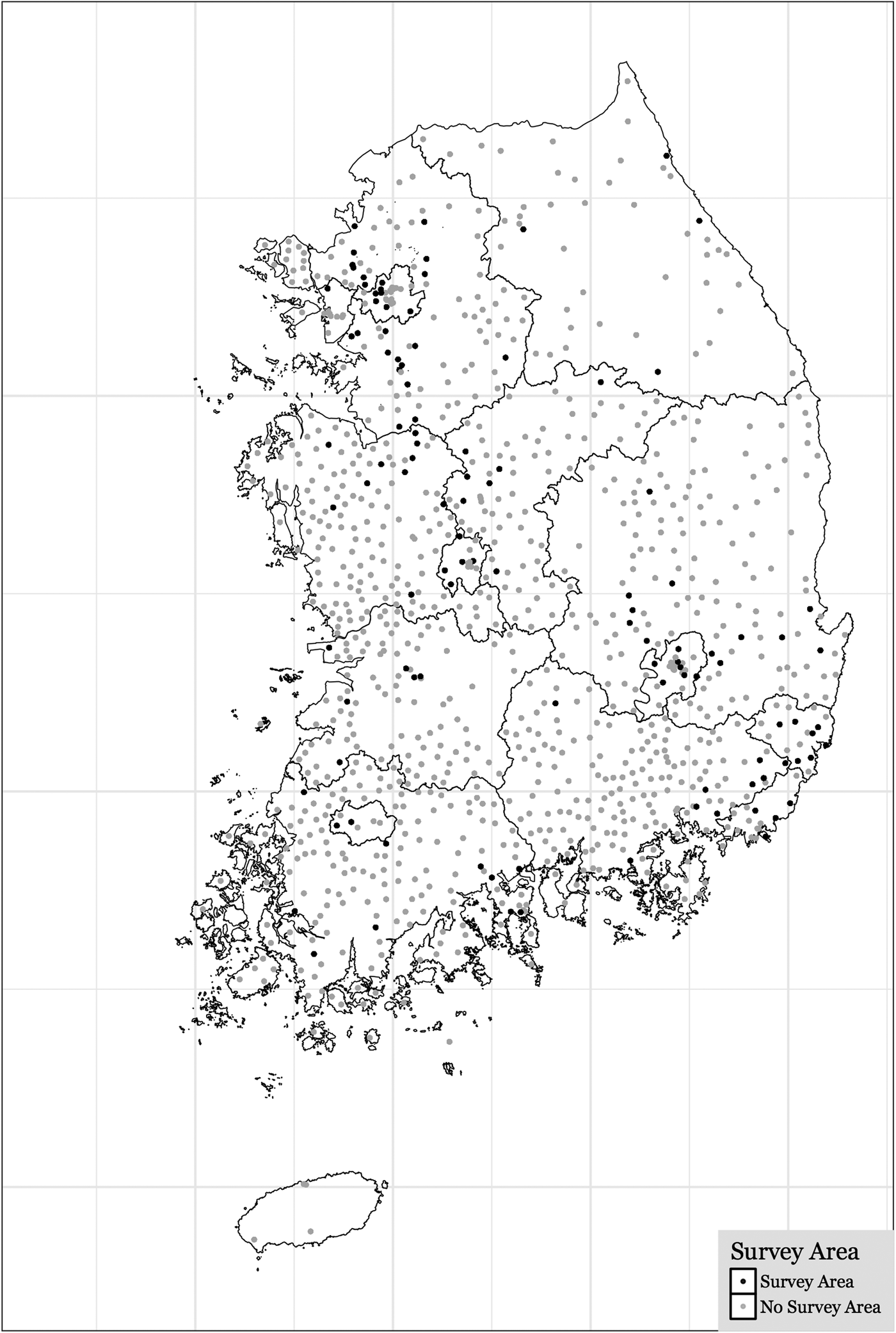
The complete case dataset that deletes cases with missing observations on any variable of interest includes 3,938 respondents from approximately 700 EMDs. Among these, 354 respondents (9 percent) live in 54 EMDs where more than 20 civilian deaths occurred due to violence. Given that some of the survey variables have missing observations, we impute those missing values using a multiple imputation technique. The final sample for Pride in SK includes 4,014 respondents from 710 EMDs, and that for Favor US over NK includes 3,408 from 701 EMDs. Table 2 provides summary statistics of the complete case dataset. Summary statistics of the 10 imputed datasets are provided in Appendix (Table A). Figure 1 depicts the location and the scale of violence against civilians during the Korean War at the EMD level. Circles in black indicate EMDs surveyed in the KGSS, while circles in gray indicate EMDs not included in the survey. In general, the figure shows that violence during the Korean War occurred in a widespread pattern throughout the entire country.
Map Violence against Civilians in the Korean War and Survey Area in KGSS 2003–2011
Summary Statistics of Complete Cases
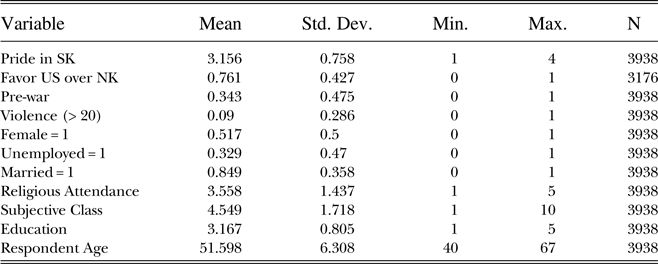
Note: Summary statistics are provided based on the complete cases.
EMPIRICAL RESULTS
Identification Strategy
To examine the effects of violence against civilians during the Korean War on public attitudes toward the state and foreign countries, we adopt the DID framework used in a previous study (Hong and Kang Reference Hong and Kang2017). In particular, we use exposure to violence during the war at the EMD level as an independent variable, and measure public attitudes using the survey data from the 2000s. This raises two concerns regarding causal inference. First, the surveys were administered in the 2000s, so the measure of attitudes from the survey data reflects both trauma effects and stigma effects. Second, unobserved characteristics of EMDs may affect the probability that an EMD was exposed to violence during the war. In other words, a village may have been targeted because its residents had lower levels of pride in South Korea, higher levels of affinity to North Korea or lower levels of affinity to the United States. To the extent that these attributes have lingering effects on public attitudes in the 2000s, the estimated effects of violence may suffer from upward bias.
To address these challenges, we rely on a DID identification strategy, which is a version of a fixed effects estimation used when the treatment is assigned at the group level (Angrist and Pischke Reference Angrist and Pischke2009). In particular, we exploit the fact that only the pre-war cohort, those who were born before the war, was exposed to violence and has suffered from the trauma, but both the pre-war cohort and the post-war cohort commonly have experienced the stigma. Moreover, the impact of group-level omitted variables can be captured by adding group-level fixed effects. The following describes our identification strategy formally.
Let Y ist , the political attitudes of a respondent i, be a function of whether i is from an EMD exposed to violence and whether he/she was born before or after the Korean War as follows:
 $$Y_{ist} = \gamma_{\rm s} + \lambda_{\rm t} + \delta _{Trauma}^t + \delta _{Stigma}^t + \varepsilon_{ist},$$
where E(εist |s, t) = 0, s denotes EMD characteristics (whether exposed to violence or not) and t denotes cohorts (pre-war cohort or post-war cohort). Thus, this equation states that survey respondents’ political attitudes are additively determined by the sum of a time-invariant EMD effect, a cohort effect, trauma effects and stigma effects.
Given that respondents from the EMDs exposed to violence are only affected by trauma effects and/or stigma effects, we have
 $${\rm E}[Y_{ist} \vert s = {\rm Violence},\,\,t = {\rm Pre \hbox{-} War}] = {\rm \gamma} _{{\rm Violence}} + {\rm \lambda} _{{\rm Pre \hbox{-} War}} + \delta _{Trauma}^{\,pre} + \delta _{Stigma}^{\,pre} $$
 $${\rm E}[Y_{ist} \vert s = {\rm Violence},\,\,t = {\rm Post \hbox{-} War}] = {\rm \gamma} _{{\rm Violence}} + {\rm \lambda} _{{\rm Post \hbox{-} War}} + \delta _{Trauma}^{\,post} + \delta _{Stigma}^{\,post} $$
 $${\rm E}[Y_{ist} \vert s = {\rm No}\,{\rm Violence},\,\,t = {\rm Pre \hbox{-} War}] = {\rm \gamma} _{{\rm NoViolence}} + {\rm \lambda} _{{\rm Pre \hbox{-} War}}$$
 $${\rm E}[Y_{ist} \vert s = {\rm No}\,{\rm Violence},\,\,t = {\rm Post \hbox{-} War}] = {\rm \gamma} _{{\rm NoViolence}} + {\rm \lambda} _{{\rm Post \hbox{-} War}}{\rm.} $$
The Armistice in 1953 ended the possibility of violence against civilians so that residents’ experience would have been systematically different depending on whether they were born before or after the Armistice. Only those who were born before the Armistice were exposed to violence directly, so we assume that $\delta _{Trauma}^{post} = 0$
. In contrast, stigma affects all residents in exposed EMDs regardless of whether they were born before or after the Armistice, so we assume that
$\delta _{Trauma}^{post} = 0$
. In contrast, stigma affects all residents in exposed EMDs regardless of whether they were born before or after the Armistice, so we assume that $\delta _{Stigma} = \delta _{Stigma}^{pre} = \delta _{Stigma}^{post} $
.
$\delta _{Stigma} = \delta _{Stigma}^{pre} = \delta _{Stigma}^{post} $
.
Then, using the DID strategy, we identity the causal effects of violence on political attitudes (e.g. Pride in South Korea) as shown in Figure 2. In the Figure, Eq (2) indicates the expected level of pride in South Korea among the pre-war cohort in the exposed EMDs, and Eq (4) indicates the expected level of pride in South Korea among the pre-war cohort in the non-exposed EMDs. Then, Eq (6) defines the observed difference among the pre-war cohort associated with violence status as:
 $$\eqalign{{\rm E}[Y_{ist} \vert s & = {\rm Violence},\,\,t = {\rm Pre \hbox{-} War}] - {\rm E}[Y_{ist} \vert s = {\rm No\; Violence},\,t = {\rm Pre \hbox{-} War}] \cr & = {\rm \delta} _{{\rm Stigma}}\,{\rm +} \,{\rm \delta} _{{\rm Trauma}}\,{\rm +} \,{\rm \gamma} _{{\rm Violence}}\,{\rm -} \,{\rm \gamma} _{{\rm No\; Violence}.}} $$
Summary Plot: Difference-in-Differences Estimate

Similarly, Eq (3) indicates the expected level of pride in South Korea among the post-war cohort in the exposed EMDs and Eq (5) indicates the expected level of pride in South Korea among the post-war cohort in the non-exposed EMDs. Then, Eq (7) defines the observed difference associated with violence status among the post-war cohort as:
 $$\eqalign{& {\rm E}[Y_{ist} \vert s = {\rm Violence},\,\,t = {\rm Post \hbox{-} War}] - {\rm E}[Y_{ist} \vert s = {\rm No}\,{\rm Violence},\,t = {\rm Post \hbox{-} War}] \cr & = {\rm \delta} _{{\rm Stigma}}\,{\rm +} \,{\rm \delta} _{{\rm Trauma}}\,{\rm +} \,{\rm \gamma} _{{\rm Violence}}{\rm -} \,{\rm \gamma} _{{\rm NoViolence}{\rm.}}} $$
Then, Eq (8) defines the difference estimate of two differences Eq (6) and Eq (7) as:
 $$\eqalign{ \{ {\rm E}[Y_{ist} \vert s &= {\rm Violence,}\,\,t = {\rm Pre \hbox{-} War}\left] { - {\rm E}} \right[Y_{ist} \vert s = {\rm NoViolence},\,\,t = {\rm Pre \hbox{-} War}]\} \cr -\{ {\rm E}[Y_{ist} \vert s &= {\rm Violence,}\,t = {\rm Post \hbox{-} War}\left] { - {\rm E}} \right[Y_{ist} \vert s = {\rm NoViolence},\,\,t = {\rm Post \hbox{-} War}]\} \cr & = {\rm \delta} _{{\rm Trauma}{\rm.}}} $$
Thus, the DID framework enables us to identify the effects of trauma (δTrauma) on pride in South Korea. On the other hand, the stigma effect (δStigma) remains unidentified empirically as shown in Eq (6) and in Eq (7), although we can make inferences about its theoretical bounds, which we discuss in detail below.
Following this framework, Table 3 presents mean values of two dependent variables in four treatment conditions. Each treatment condition corresponds to Eq (4), Eq (2), Eq (5), and Eq (3) in Figure 2. Overall, the pre-war generation and residents in communities with violence hold greater pride in South Korea than the post-war generation and residents in communities without violence. The observed difference in the pre-war cohort is about −0.004 and the observed difference in the post-war cohort is 0.138. Thus, the estimate of a trauma effect is about −0.142. Similarly, the pre-war generation and residents in communities with violence favor the United States over North Korea more than the post-war generation and residents in communities without violence. The estimate for the trauma effect on attitudes toward the United States and North Korea is about −0.029. Therefore, the sign of these estimates are consistent with the theoretical expectations.
Summary Statistics by Treatment Status
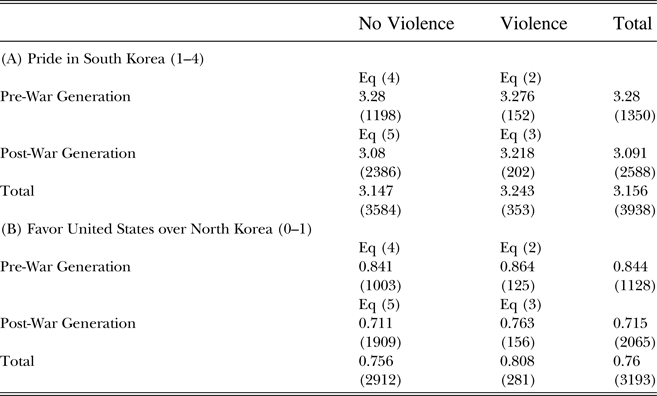
Note: Cell entries indicate mean values of each dependent variable. The number of respondents in each treatment condition is in parentheses.
For more rigorous analysis, however, we use a regression to estimate Eq (1). The regression formulation of the DID model simplifies the construction of DID estimates and standard errors. It is also easy to add other covariates for additional control.Footnote 15 In particular, let Violences be a dummy variable for EMDs that were exposed to violence during the war and Pre-wart be a dummy variable for the cohort born before the war. Then,
 $$\eqalign{{\rm Prid}{\rm e}_{ist}{\rm = \beta_0}\,{\rm +} \,{\rm \beta_1}\,{\rm Violenc}{\rm e}_s + {\rm \beta_2}\,{\rm Violenc}{\rm e}_s \cdot {\rm Pre \hbox{-} Wa}{\rm r}_{_{\rm t}} + {\rm \beta_3}\,{\rm Pre \hbox{-} Wa}{\rm r}_t + {\rm X}_{ist}^{\rm ^{\prime}} {\rm B}\,{\rm + \;} \,{\rm \varepsilon} _{ist}{\rm,}} $$
In this equation, β2, a coefficient of the interaction term between Violence and Pre-war, provides estimates of δTrauma in Eq (8). On the other hand, β1 in Eq (1) is equal to δStigma + γViolence − γNoViolence in Eq (7), which is the observed difference in attitudes among the post-war cohort.Footnote 16
Then, β1 + β2 is the observed difference in attitudes among the pre-war cohort. In estimating Eq (1), we also include various individual-level covariates as well as EMD fixed effects, survey fixed effects, and age fixed effects. Robust standard errors are clustered at the EMD level to account for spatial correlation in patterns of violence as well as the problem of serial correlation.Footnote 17
In general, causal inference using the DID strategy relies on the assumption that the underlying trends in outcome variables would be the same in the treatment and control groups in the absence of the treatment (Angrist and Pischke Reference Angrist and Pischke2009). In the current setting, this assumption implies two things. First, the pre-war cohort and the post-war cohort in exposed EMDs and non-exposed EMDs are comparable except that the pre-war cohort in exposed EMDs experienced trauma but the post-war cohort did not. Second, we also assume that stigma effects are homogeneous across the wartime cohort and the post-war cohort in the exposed EMDs.
It is not possible to determine whether these assumptions are satisfied empirically, particularly in view of the long-time horizon. South Korea went through dynamic social, economic and political changes in the half-century following the war. The extent of stigma toward victims of violence during the war may vary with social and political contexts, as well. Therefore, the commonplace assumption is likely to be violated when we compare those who were born right after the war, who were in their fifties in the 2000s, and those who were born in the 1980s, who were in their 20s in the 2000s. Thus, we constrain our analysis to those who were born 10 years before the end of the war (1944–1953) and those who were born 10 years after the end of the war (1954–1963).
Main Analysis
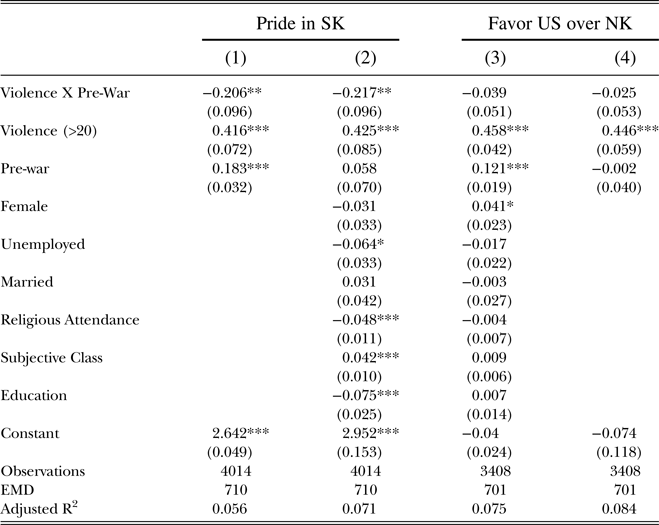
The following analyses are based on the imputed dataset. Table 4 presents the analysis of public attitudes toward South Korea (in Model 1 and Model 2), the United States and North Korea (Model 3 and Model 4). Our main estimates of interest are trauma effects, β2 in Eq 9 and stigma effects, β1 in the same equation. Given that pride in South Korea is coded from less pride to more pride, we expect that β2 should be negative and β1 should be positive. In Model 1, both coefficients have the expected signs and are significant at the 5 percent level. Given that the values of the dependent variable range between 1 (not at all) to 4 (very much), the coefficient of β2, −0.206, indicates that exposure to violence reduces pride in South Korea by about 7 percent.
Effects of Violence on Public Opinion
Note: All models are estimated using ordinary least squares (OLS). Robust standard errors clustered by EMD are in parentheses. Variables not shown include EMD, age, and survey fixed effects. * p < .1, ** p < .05, *** p < .01.
On the other hand, the interpretation of stigma effects requires greater caution. The coefficient on the violence term, β1, captures the observed difference in pride in South Korea within the post-war cohort; its positive sign indicates that residents born after the Armistice in the exposed EMDs tend to have greater pride in the country compared to residents in the non-exposed EMDs. As suggested previously, this observed difference does not directly translate into stigma effects, however, since β1 includes the stigma effects, δStigma, as well as time-invariant heterogeneity between the exposed EMD and the non-exposed EMDs, which is γViolence − γNo Violence. In the current setting, it is difficult to separate the sigma effects from β1 empirically. However, we can construct its theoretical bound depending on how we determine that the unobserved characteristics of EMDs affected the probability that an EMD was exposed to violence during the war.
If violence was completely random from EMD characteristics (e.g. the average level of residents’ pride in South Korea), this indicates that there is no systematic difference between EMDs with and without violence. In that case, β1 is likely to be an unbiased estimate of the stigma effects. On the other hand, if the difference is negative or γViolence − γNo Violence < 0, EMDs with less favorable views toward South Korea would have been more likely to be targeted compared to EMDs with favorable views. If the difference is positive, or γViolence − γNo Violence > 0, this indicates that EMDs with more favorable views toward South Korea were more likely to be targets of violence. Given that violence allegedly aimed to punish possible defectors and collaborators of North Korea, it seems reasonable to consider that EMDs with low levels of pride may have been targeted (γViolence − γNo Violence < 0). In this circumstance, a true estimate of the stigma effects, δStigma would be greater than the estimated coefficient of β1. In other words, the coefficient marks the minimal bound for stigma effects. Thus, stigma effects improve pride in South Korea by at least 14 percent. To the extent that violence served the purpose of punishing EMDs that were less supportive of South Korea, the result indicates that residents in these EMDs would have faced greater pressure to prove their loyalty toward South Korea.
In Model 2, we control for individual-level covariates to address possible omitted variable bias. Note that many of these covariates are post-violence. Thus, including these covariates may introduce post-treatment bias. On the other hand, it is also possible that these covariates affect respondents’ exposure to anti-communist propaganda and their attitudes to relevant countries. The results hardly change in Model 2.
Models 3 and 4 address attitudes toward the United States and North Korea. The variable is coded in a binary format, with 1 denoting that a respondent selected the United States as the most favored country and 0 denoting that a respondent selected North Korea as the most favored country. In both models, the coefficient on the interaction term between violence and war-cohort is insignificant; thus, we do not find any evidence that the traumatic experience of direct exposure to violence during the war has lingering effects on public attitudes toward the United States and North Korea. In contrast, the coefficient on violence is highly significant. The positive coefficient in Model 3 indicates that residents in exposed EMDs tend to maintain favorable attitudes toward the United States over North Korea. Again, the interpretation of these coefficients relies on our understanding of which EMDs were targeted during the war. As long as the violence correctly targeted EMDs, in the sense that residents liked North Korea but disliked the United States, the estimated coefficients of β1 indicate that the stigma of being victims of violence increases the probability that a respondent selects the United States as her/his most favorable country, instead of North Korea, about 0.42.
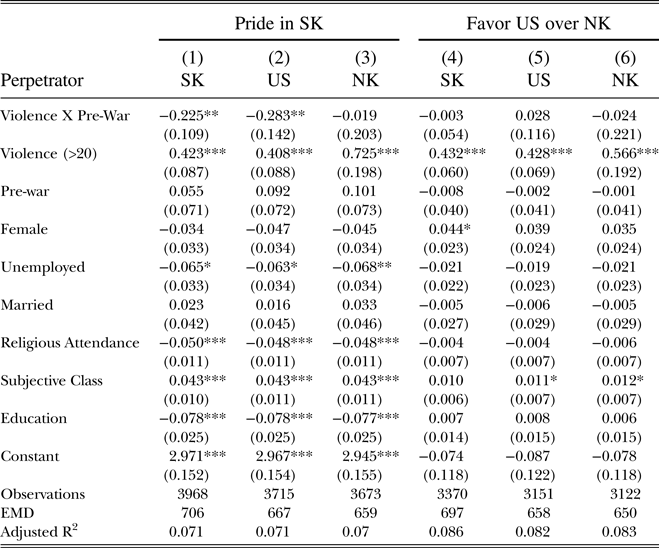
When exposure to violence affects respondents’ attitudes toward perpetrator countries, an interesting question to consider is whether the estimated effects of trauma and stigma vary with the perpetrators of that violence. In particular, the trauma from direct exposure to violence induces negative attitudes toward perpetrators. Respondents in the EMDs targeted by South Korea may thus have negative attitudes toward South Korea, and respondents in the EMDs targeted by North Korea may have negative attitudes toward North Korea. On the other hand, the stigma would have mainly affected the victims of violence by South Korea and the United States but not the victims of North Korean violence. The influence of anti-communist propaganda would have required the former victims to demonstrate their support to the South Korean government, but the victims of North Korean violence would have been relatively free from the anti-communist propaganda in the post-war period in South Korea.
Due to the above-mentioned weakness in the available datasets, the following analysis in Table 5 has limited capacity to examine these questions. In general, the effects of stigma and trauma appear more salient toward South Korea.Footnote 18 The analysis of pride in South Korea shows that negative consequences of traumatic effects appear among victims of the South Korean violence in Model 1. However, neither violence by North Korea in Model 5 nor violence by the United States in Model 6 creates a change in attitudes toward those countries between the pre-war cohort and the post-war cohort in affected EMDs. On the other hand, the positive stigma effects appear in communities with violence by South Korea and the United States in Model 1, Model 3, Model 4, and Model 6. In contrast to our expectations, residents in EMDs affected by North Korean violence have more positive attitudes toward South Korea and the United States compared to residents who were not exposed to any violence in Model 2 and Model 5. One possible explanation is that victims of North Korean violence were also under pressure from the anti-communist propaganda efforts compared to residents in communities with no violence. Various anecdotes suggest that family members of abductees during and after the Korean War had been under surveillance on the suspicion of possible espionage for the benefit of abductees in North Korea. Alternatively, the hostility toward North Korea among victims of its violence is likely to be translated into positive attitudes toward South Korea and the United States. It is beyond the scope of the current analysis to examine this question thoroughly, however, so we leave this task for future research.
Varying Effects by Perpetrators
Note: All models are estimated using ordinary least squares (OLS). Robust standard errors clustered by EMD are in parentheses. Variables not shown include EMD, age, and survey fixed effects. * p < .1, ** p < .05, *** p < .01.
Further Discussion
Our identification strategy relies on several assumptions. In this section, we discuss possible violations of each assumption and their implications for the empirical findings. First, we assume that the post-war cohort did not suffer from traumatic exposure to violence during the war. Existing studies, however, suggest that traumatic experience can be transmitted inter-generationally (e.g., Adelman, Reference Adelman1995; Dekel and Goldblatt, Reference Dekel and Goldblatt2008; Weingarten, Reference Weingarten2004). This indicates that $\delta _{Trauma}^{post} \ne 0$
and
$\delta _{Trauma}^{post} \ne 0$
and $\beta _2 = \delta _{Trauma}^{pre} - \delta _{Trauma}^{post} $
in Eq (8). Given that the effect of trauma over the post-war generation is indirect, it would be reasonable to consider that
$\beta _2 = \delta _{Trauma}^{pre} - \delta _{Trauma}^{post} $
in Eq (8). Given that the effect of trauma over the post-war generation is indirect, it would be reasonable to consider that $\delta _{Trauma}^{pre} \lt \delta _{Trauma}^{post} \lt \,0\,\,{\rm or}\,\delta _{Trauma}^{pre} \gt \delta _{Trauma}^{post} \gt 0$
depending on the variable of interest. In that case, our empirical estimate of β2 indicates the lower threshold of the trauma effect on the pre-war cohort. For example, if we take into account the possibility that the negative effect of trauma on pride in South Korea has been transmitted to the post-war cohort, the estimated trauma effect on pride in South Korea indicates that the effect of trauma on the pre-war cohort would be greater than we find.
$\delta _{Trauma}^{pre} \lt \delta _{Trauma}^{post} \lt \,0\,\,{\rm or}\,\delta _{Trauma}^{pre} \gt \delta _{Trauma}^{post} \gt 0$
depending on the variable of interest. In that case, our empirical estimate of β2 indicates the lower threshold of the trauma effect on the pre-war cohort. For example, if we take into account the possibility that the negative effect of trauma on pride in South Korea has been transmitted to the post-war cohort, the estimated trauma effect on pride in South Korea indicates that the effect of trauma on the pre-war cohort would be greater than we find.
A second key assumption is that the effect of stigma from exposure to violence affects both the pre-war cohort and the post-war cohort to the same extent, or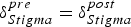 $\delta _{Stigma}^{pre} = \delta _{Stigma}^{post} $
. If they are not the same,
$\delta _{Stigma}^{pre} = \delta _{Stigma}^{post} $
. If they are not the same, ${\rm \beta} _2 = \delta _{Trauma}^{pre} + (\delta _{Stigma}^{pre} - \delta _{Stigma}^{post} )$
. Given that stigma originates from a suspicion about victims’ possible collaboration with North Korea during the war, it is likely that the pressure to prove loyalty to South Korea would have been greater for the pre-war cohort than for the post-war cohort. Thus,
${\rm \beta} _2 = \delta _{Trauma}^{pre} + (\delta _{Stigma}^{pre} - \delta _{Stigma}^{post} )$
. Given that stigma originates from a suspicion about victims’ possible collaboration with North Korea during the war, it is likely that the pressure to prove loyalty to South Korea would have been greater for the pre-war cohort than for the post-war cohort. Thus, $\delta _{Stigma}^{pre} \lt \delta _{Stigma}^{post} \lt \,0\,\,{\rm or}\,\delta _{Stigma}^{pre} \gt \delta _{Stigma}^{post} \gt 0$
depending on the variable of interest. Then, β2 again indicates the lower threshold of the trauma effect on the pre-war cohort.
$\delta _{Stigma}^{pre} \lt \delta _{Stigma}^{post} \lt \,0\,\,{\rm or}\,\delta _{Stigma}^{pre} \gt \delta _{Stigma}^{post} \gt 0$
depending on the variable of interest. Then, β2 again indicates the lower threshold of the trauma effect on the pre-war cohort.
Third, we rely on the current address of the survey respondents in the 2000s to determine whether or not they were exposed to wartime violence or lived in the exposed EMDs after the war. In other words, the current approach does not take into account the possibility that respondents reside in different EMDs in the 2000s relative to where they lived in the past. Unfortunately, the survey asks about respondents’ birth place at the province level only. Thus, it is difficult to address this question empirically. The possibility of migration would affect our estimates in two ways. On one hand, residents living in the exposed EMDs during wartime may have migrated out to non-exposed EMDs. In this circumstance, our empirical estimates may be subject to downward bias because some respondents exposed to violence would be considered not exposed to the war in the current coding scheme. Therefore, correcting the problem due to the out-migration of victims of violence would likely enlarge the difference between those who were exposed to violence and those who were not. On the other hand, residents who lived in non-exposed EMDs during wartime might have migrated into the exposed EMDs. In this case, our estimates of the effects of violence are likely to be spurious. They may not capture the effect of violence, but might instead indicate that certain types of people, namely those who have low pride in South Korea in the pre-war cohort and those who have a high affinity toward the United States and a low affinity toward North Korea among the post-war cohort somehow moved into EMDs exposed to the violence. We do not have any empirical evidence to rule out this possibility. However, the possibility that those people have migrated into exposed EMDs is relatively low given that those EMDs are generally located in rural areas and have suffered from stigma as well as low levels of human capital development.Footnote 19
Finally, it is worth discussing intergenerational transmission of violence trauma. Although our cohort window (± 10 years) is narrower than the usual generation window (± 20–25 years), if there is any vertical transmission of trauma, it would violate our assumption regarding the violence treatment that only pre-war cohorts experience the violence, and our statistical findings may thus require a careful reinterpretation. A vast volume of literature on trauma, particularly war-related trauma, presents strong evidence of intergenerational transmission of posttraumatic stress disorder (Dekel and Goldblatt Reference Dekel and Goldblatt2008; Harkness Reference Harkness, Wilson and Raphael1993; Karenian et al. Reference Karenian, Livaditis, Karenian, Zafiriadis, Bochtsou and Xenitidis2011; Lev-Wiesel Reference Lev-Wiesel2007; Motta et al. Reference Motta, Joseph, Rose, Suozzi and Leiderman1997; Sack, Clarke, and Seeley Reference Sack, Clarke and Seeley1995). Indirect exposure to violence through traumatized parents has been argued to affect the mental health and the social and intellectual functioning of victims’ children. Nevertheless, we argue that in South Korea these intergenerational effects were less likely, because the survivors of wartime violence were not allowed to openly disclose their symptoms of trauma under the political circumstances of post-war South Korea. Rather, trauma caused by violence has been heavily suppressed by an imminent fear of institutional and social stigmatization (Hanley, Mendoza and Choe Reference Hanley, Mendoza and Choe2001, 251–252). As Lee (Reference Lee2003) concludes through a series of interviews, most of the bereaved family members did not share the memory even with their children, both to avoid undermining the anti-communist indoctrination from schools and to protect them from psychological suffering. Although the descendants of victims have suffered from the lack of parents, poverty, and social stigmatization and discrimination, transmission of trauma, as described in previous studies, is rather rare in the Korean case as trauma itself has been concealed for decades.
CONCLUSION
Debates regarding East Asian countries, including Japan, China, Taiwan, and South Korea, frequently center on divided public opinion over those countries’ pasts and the pasts of their neighbors. While scholars agree that public perceptions are often an important and influential factor in shaping the policy decision process, particularly in democracies (Eichenberg Reference Eichenberg1989; Risse-Kappen Reference Risse-Kappen1991), how public perceptions are formed and diversified has remained under-explored. In this paper, we show that violence against civilians during the Korean War has affected victims’ lives, their families, and communities in deep and lasting way, but distinctively between pre-war cohorts and post-war cohorts in their attitudes towards one's own state and neighboring countries.
Specifically, our analyses show that pre-war cohorts in violence exposed communities are less proud of South Korea due to the traumatic effects of violence. In contrast, post-war cohorts in those communities embrace greater pride in South Korea, affinities with the United Sates, and hostility toward North Korea. When the war ended with an armistice rather than an official termination, the post-war authoritarian government in South Korea launched intensive anti-communist campaigns. In this process, the South Korean population has been exposed to, and indoctrinated with, particular political views toward their own government and other involved countries, including the United States and North Korea. Ironically, the influence of anti-communist propaganda was more stringent on residents in violence exposed communities, who suffered from widespread stigma as sympathizers or collaborators of communist groups during the war. As a result, residents in those communities, particularly post-war generations, were under greater pressure to differentiate themselves from the victims by demonstrating their political integrity to South Korea.
People's perceptions are often assumed to be capricious and gullible, even by political scientists. A potential source of this bias may lie in insufficient research on diverse determinants of public perceptions, including historical events and individual experiences with those events. Moreover, the rapid economic development of East Asian countries can result in a de-prioritization of historical, often traumatic, past events, positing them as irrelevant to the present or future. The robust effects of wartime exposure to violence on people's attitudes toward participating countries suggest instead that future research should pay more attention to historical events in studying public psychology and opinion.
SUPPLEMENTARY MATERIAL
To view supplementary material for this article, please visit https://doi.org/10.1017/jea.2017.16.



