





1 Introduction
A topological dynamical system is a pair
$(X,T)$
 , where X is a compact metrizable space and
$T\colon X\to X$
, where X is a compact metrizable space and
$T\colon X\to X$
 is a continuous map. The weak
$^*$
is a continuous map. The weak
$^*$
 topology is the usual choice for the topology on the space of invariant measures
${\mathcal {M}_T}(X)$
topology is the usual choice for the topology on the space of invariant measures
${\mathcal {M}_T}(X)$
 of
$(X,T)$
of
$(X,T)$
 . While this topology is compact and metrizable, it is incompatible with several dynamical properties. For many dynamical systems, the entropy function on
${\mathcal {M}_T}(X)$
. While this topology is compact and metrizable, it is incompatible with several dynamical properties. For many dynamical systems, the entropy function on
${\mathcal {M}_T}(X)$
 endowed with the weak
$^*$
endowed with the weak
$^*$
 topology fails to be continuous: low-entropy measures can approximate high-entropy measures arbitrarily closely, and zero-entropy measures are often dense even when non-zero-entropy measures exist. Similarly, mixing and ergodicity are not preserved under weak
$^*$
topology fails to be continuous: low-entropy measures can approximate high-entropy measures arbitrarily closely, and zero-entropy measures are often dense even when non-zero-entropy measures exist. Similarly, mixing and ergodicity are not preserved under weak
$^*$
 convergence. For shift-invariant measures on a shift (symbolic) space
$\mathscr {A}^{\kern1.5pt\infty} $
convergence. For shift-invariant measures on a shift (symbolic) space
$\mathscr {A}^{\kern1.5pt\infty} $
 over a finite alphabet
$\mathscr {A}$
over a finite alphabet
$\mathscr {A}$
 , Feldman’s
$\bar {f}$
, Feldman’s
$\bar {f}$
 -metric provides a stronger topology that is better adapted to dynamical behaviour. An even stronger topology is given by Ornstein’s
$\bar {d}$
-metric provides a stronger topology that is better adapted to dynamical behaviour. An even stronger topology is given by Ornstein’s
$\bar {d}$
 -metric, which is complete but non-compact (even non-separable). Both metrics,
$\bar {d}$
-metric, which is complete but non-compact (even non-separable). Both metrics,
$\bar {d}$
 and
$\bar {f}$
and
$\bar {f}$
 , work only for finite-state stationary processes (shift-invariant measures on symbolic space
$\mathscr {A}^{\kern1.5pt\infty} $
, work only for finite-state stationary processes (shift-invariant measures on symbolic space
$\mathscr {A}^{\kern1.5pt\infty} $
 ).
).
Here, we introduce Feldman–Katok convergence for invariant measures of topological dynamical systems. This serves as a counterpart to convergence with respect to the
$\bar {f}$
 -metric for not necessarily symbolic systems and measures. This convergence is based on the Feldman–Katok pseudometric
$\overline {fk}$
-metric for not necessarily symbolic systems and measures. This convergence is based on the Feldman–Katok pseudometric
$\overline {fk}$
 measuring the similarity between orbits of a topological dynamical system. It is inspired by the
$\bar {f}$
measuring the similarity between orbits of a topological dynamical system. It is inspired by the
$\bar {f}$
 -pseudometric for infinite sequences of symbols, which is in turn based on edit distance. The edit distance between two strings u and v of length n with entries coming from a finite set of symbols is
$\bar {f}_n(u,v)=k/n$
-pseudometric for infinite sequences of symbols, which is in turn based on edit distance. The edit distance between two strings u and v of length n with entries coming from a finite set of symbols is
$\bar {f}_n(u,v)=k/n$
 , where k is the minimum number of symbols that must be removed from each string to make the remaining parts identical. Thus, two strings (words) are close in the edit metric if you can make them match by removing only a small fraction of their symbols. For infinite sequences of symbols
$x=x_0x_1x_2\cdots $
, where k is the minimum number of symbols that must be removed from each string to make the remaining parts identical. Thus, two strings (words) are close in the edit metric if you can make them match by removing only a small fraction of their symbols. For infinite sequences of symbols
$x=x_0x_1x_2\cdots $
 and
$y=y_0y_1y_2\cdots $
and
$y=y_0y_1y_2\cdots $
 we set

We extend this idea to orbits of arbitrary dynamical systems. The Feldman–Katok pseudometric
$\overline {fk}$
 captures a similar idea of approximate matching with allowed discrepancies. We may ignore some portions of the orbits while requiring the remaining points on each orbit to be matched into pairs close in the usual metric on the space. We discuss the details below. It is not clear whether
$\overline {fk}$
captures a similar idea of approximate matching with allowed discrepancies. We may ignore some portions of the orbits while requiring the remaining points on each orbit to be matched into pairs close in the usual metric on the space. We discuss the details below. It is not clear whether
$\overline {fk}$
 corresponds to a metric on the space of T-invariant measures
${\mathcal {M}_T}(X)$
corresponds to a metric on the space of T-invariant measures
${\mathcal {M}_T}(X)$
 , as it does for the pseudometric
$\bar {f}$
, as it does for the pseudometric
$\bar {f}$
 on
$\mathscr {A}^{\kern1.5pt\infty} $
on
$\mathscr {A}^{\kern1.5pt\infty} $
 given by (2), which corresponds to a metric on the space of shift-invariant measures
${\mathcal {M}}_{\sigma }(\mathscr {A}^{\kern1.5pt\infty} )$
given by (2), which corresponds to a metric on the space of shift-invariant measures
${\mathcal {M}}_{\sigma }(\mathscr {A}^{\kern1.5pt\infty} )$
 given by (5). Nevertheless, we may use
$\overline {fk}$
given by (5). Nevertheless, we may use
$\overline {fk}$
 to define a certain notion of ‘convergence’ for
${\mathcal {M}_T}(X)$
to define a certain notion of ‘convergence’ for
${\mathcal {M}_T}(X)$
 .
.
Roughly speaking, we say that a sequence
$(\mu _n)_{n=1}^{\infty} $
 of T-invariant measures converges in the Feldman–Katok sense if there is a sequence
$(x_n)_{n=1}^{\infty} $
of T-invariant measures converges in the Feldman–Katok sense if there is a sequence
$(x_n)_{n=1}^{\infty} $
 that is a Cauchy sequence with respect to the
$\overline {fk}$
that is a Cauchy sequence with respect to the
$\overline {fk}$
 -pseudometric, such that for each
$n\in \mathbb {N}$
-pseudometric, such that for each
$n\in \mathbb {N}$
 , the point
$x_n$
, the point
$x_n$
 is generic for
${\mu}_n$
is generic for
${\mu}_n$
 .
.
Our definition of
$\overline {fk}$
 and Feldman–Katok convergence draws inspiration from the way Ornstein’s
$\bar {d}$
and Feldman–Katok convergence draws inspiration from the way Ornstein’s
$\bar {d}$
 -metric and the corresponding pseudometric
$\bar {d}$
-metric and the corresponding pseudometric
$\bar {d}$
 for infinite sequences of symbols were generalized to Besicovitch pseudometrics and a metric on the set of invariant measures [Reference Babel, Can, Kwietniak and Oprocha1, Reference Kwietniak, Łącka and Oprocha36, Reference Shields43, Reference Weiss47].
An
$\overline {fk}$
 -Cauchy sequence of generic points naturally determines a measure, which we call the
$\overline {fk}$
-Cauchy sequence of generic points naturally determines a measure, which we call the
$\overline {fk}$
 -limit of the sequence. We also prove that Feldman–Katok convergence is stronger than the standard weak
$^*$
-limit of the sequence. We also prove that Feldman–Katok convergence is stronger than the standard weak
$^*$
 convergence of measures because the
$\overline {fk}$
convergence of measures because the
$\overline {fk}$
 -limit
$\mu $
-limit
$\mu $
 must also be a limit with respect to the weak
$^*$
must also be a limit with respect to the weak
$^*$
 topology of the sequence of measures corresponding to the generic points forming an
$\overline {fk}$
topology of the sequence of measures corresponding to the generic points forming an
$\overline {fk}$
 -Cauchy sequence (Theorem 5.7). The
$\overline {fk}$
-Cauchy sequence (Theorem 5.7). The
$\overline {fk}$
 -limit of a sequence of ergodic points (that is, points generic for ergodic measures) is ergodic (Theorem 7.3), thus ergodicity is closed with respect to the Feldman–Katok convergence. We show that the Feldman–Katok convergence also preserves the loosely Kronecker property: if a sequence of invariant measures converges in the Feldman–Katok sense and each measure in the sequence is loosely Kronecker, then the measure which is an
$\overline {fk}$
-limit of a sequence of ergodic points (that is, points generic for ergodic measures) is ergodic (Theorem 7.3), thus ergodicity is closed with respect to the Feldman–Katok convergence. We show that the Feldman–Katok convergence also preserves the loosely Kronecker property: if a sequence of invariant measures converges in the Feldman–Katok sense and each measure in the sequence is loosely Kronecker, then the measure which is an
$\overline {fk}$
 -limit of a corresponding sequence of generic points is also loosely Kronecker (Theorem 9.1). Moreover, we establish that the Kolmogorov–Sinai entropy function is lower semicontinuous with respect to Feldman–Katok convergence (Theorem 8.1), which immediately implies that this convergence preserves zero entropy.
As an application, we resolve a question about the entropy of non-hyperbolic ergodic invariant measures arising from the original GIKN construction proposed by Gorodetski et al [Reference Gorodetskiĭ, Ilyashenko, Kleptsyn and Nalskiĭ29], which was later axiomatized in [Reference Bonatti, Díaz and Gorodetski8]; see also [Reference Díaz16]. We call such measures axiomatized GIKN measures or GIKN measures for short (see Definition 3.4). We note that the term ‘GIKN construction’ can also be applied to describe other variants of the original method (see [Reference Díaz16]), but to the best of our knowledge, the name GIKN measures has not been used before. This approach was subsequently adapted by many authors, allowing them to find non-hyperbolic measures for systems with partially hyperbolic dynamics (see [Reference Bochi, Bonatti and Díaz5, Reference Bonatti, Díaz and Gorodetski8, Reference Bonatti and Zhang10, Reference Cheng, Crovisier, Gan, Wang and Yang15, Reference Díaz, Gelfert, Rams and Zhang17, Reference Díaz and Gorodetski18, Reference Kleptsyn and Nalskiĭ32], just to name a few). In particular, it is proved in [Reference Cheng, Crovisier, Gan, Wang and Yang15] that for a
$\mathcal {C}^1$
 -generic diffeomorphism, every non-hyperbolic homoclinic class carries an ergodic GIKN non-hyperbolic measure. Furthermore, under mild assumptions, the support of that measure is the whole class. For more on the role of the GIKN construction in finding non-hyperbolic ergodic measures, we refer the reader to Díaz’s survey [Reference Díaz16]. Note that another method for constructing non-hyperbolic ergodic measures with uncountable support has recently emerged [Reference Bochi, Bonatti and Díaz6, Reference Bonatti, Díaz and Bochi7]. It uses the so-called flip-flop families and provides a set of positive entropy supporting only non-hyperbolic measures. There are also ‘mixed’ methods combining the GIKN method and flip-flop families [Reference Bonatti, Díaz and Kwietniak9, Reference Łącka37]. Again, see [Reference Díaz16] for a survey and [Reference Barrientos and Cisneros3, Reference Díaz, Gelfert, Rams and Zhang17] for the latest developments.
The GIKN method in general, and its variant described in [Reference Bonatti, Díaz and Gorodetski8] in particular, is tailored to control Lyapunov exponents and ergodicity; up to now, little has been known about other properties of the resulting GIKN measures. The question of whether all GIKN measures necessarily have zero entropy has circulated in the dynamical systems community for some time (according to Lorenzo J. Díaz, it was raised by Jérôme Buzzi in Orsay, and the first-named author learnt about it from Díaz’s lecture at the ‘Global dynamics beyond uniform hyperbolicity’ conference in Olmué, Chile, in September 2015). Although the repetitive structure inherent in the construction of GIKN measures suggests zero entropy [Reference Bochi, Bonatti and Díaz6], this heuristic argument has not convinced all researchers [Reference Bonatti and Zhang10].
Our main result establishes that GIKN measures (that is, measures fulfilling Definition 3.4) always have zero entropy. The proof relies on demonstrating that this variant of the GIKN construction produces sequences of periodic points that are
$\overline {fk}$
 -Cauchy (Theorem 6.2). Hence, the resulting GIKN measures always emerge as
$\overline {fk}$
-Cauchy (Theorem 6.2). Hence, the resulting GIKN measures always emerge as
$\overline {fk}$
 -limits of zero-entropy periodic measures; furthermore, they are
$\overline {fk}$
-limits of zero-entropy periodic measures; furthermore, they are
$\overline {fk}$
 -limits of measures that are ergodic and loosely Kronecker (therefore with zero entropy). It then follows from the properties of the Feldman–Katok convergence that GIKN measures necessarily inherit ergodicity (Theorem 7.3), zero entropy (by the lower semicontinuity of entropy, Theorem 8.1), and the loosely Kronecker property (by Theorem 9.1), which also implies zero entropy.
In fact, proving that GIKN measures are loosely Kronecker, we provide a full characterization of the former class of measures up to Kakutani equivalence. Kakutani equivalence is a natural equivalence relation between transformations preserving an ergodic non-atomic measure that is weaker than the usual notion of isomorphism; nevertheless, the problem of deciding whether two measure-preserving systems are Kakutani equivalent is, in some sense, as hard as for the usual isomorphism (see [Reference Gerber and Kunde26]). Note that entropy is not an invariant for Kakutani equivalence, but it follows from Abramov’s formula that this relation preserves the classes of zero, positive, finite, and infinite entropy transformations. Loosely Kronecker systems form the Kakutani equivalence class of any aperiodic ergodic rotation of a compact infinite group (the latter systems are known as Kronecker systems). According to Feldman and Nadler [Reference Feldman and Nadler22], the name ‘loosely Kronecker systems’ was suggested by Marina Ratner. Independently, these systems were studied by Katok [Reference Katok30] (partly in collaboration with Katok and Sataev [Reference Katok and Sataev31], who contributed to the subject as well; see also [Reference Sataev42]). Katok called the Kakutani equivalence monotone equivalence, and he called the loosely Kronecker systems standard automorphisms. Every loosely Kronecker system has zero entropy and is loosely Bernoulli; that is, it belongs to a class of measure-preserving systems introduced by Feldman [Reference Feldman21]. Recently, loosely Bernoulli (in particular, loosely Kronecker) systems have gained renewed attention. Glasner, Thouvenot and Weiss [Reference Glasner, Thouvenot and Weiss28] showed that, generically, an extension of an ergodic loosely Bernoulli system is loosely Bernoulli. Gerber and Kunde [Reference Gerber and Kunde25] showed there exist smooth, weakly mixing loosely Kronecker transformations whose Cartesian square is loosely Kronecker, and Trujillo [Reference Trujillo46] showed there exist such transformations that are mixing.
Showing that all GIKN measures are loosely Kronecker means that the ergodic measure-preserving system obtained from a homeomorphism and its GIKN invariant measure is isomorphic to a measure-preserving system arising from taking an aperiodic ergodic group rotation and the first-return transformation induced by the rotation on an appropriately chosen measurable subset of the group of positive Haar measure. This description applies to GIKN measures defined in [Reference Barrientos and Cisneros3, Reference Bochi, Bonatti and Díaz5, Reference Bonatti, Díaz and Gorodetski8, Reference Bonatti and Zhang10, Reference Cheng, Crovisier, Gan, Wang and Yang15, Reference Díaz and Gorodetski18, Reference Gorodetskiĭ, Ilyashenko, Kleptsyn and Nalskiĭ29, Reference Kleptsyn and Nalskiĭ32].
Applications of Feldman–Katok convergence are not restricted to the study of GIKN measures. Since the announcement of the preprint [Reference Kwietniak and Łącka34] in 2017, the Feldman–Katok pseudometric has been used in various contexts. Using the Feldman–Katok pseudometric, the authors of [Reference García-Ramos and Kwietniak24] characterized uniquely ergodic dynamical systems that are loosely Kronecker. Later, Trilles [Reference Trilles45] proved an analogue of this characterization for continuous flows. The Feldman–Katok pseudometric has also been applied in studies of entropy, mean dimension, and pressure [Reference Cai and Li13, Reference Xie, Chen and Yang48, Reference Xie, Chen and Yang49], as well as having spurred investigations of dynamical pseudometrics and related notions [Reference Cai, Kwietniak, Li and Pourmand12, Reference Downarowicz, Kwietniak and Łącka20, Reference Gao and Zhang23].
1.1 Organization of the paper
Section 2 establishes the necessary preliminaries and notation, including the Feldman
$\bar {f}$
 -metric for shift-invariant measures, Kakutani equivalence, and the notion of loosely Kronecker systems, which will play a central role in our classification results. Section 3 presents the GIKN construction following the exposition of Bonatti, Díaz and Gorodetski [Reference Bonatti, Díaz and Gorodetski8]. We also discuss how this construction controls Lyapunov exponents to produce non-hyperbolic ergodic measures. Section 4 introduces the Feldman–Katok pseudometric
$\overline {fk}$
-metric for shift-invariant measures, Kakutani equivalence, and the notion of loosely Kronecker systems, which will play a central role in our classification results. Section 3 presents the GIKN construction following the exposition of Bonatti, Díaz and Gorodetski [Reference Bonatti, Díaz and Gorodetski8]. We also discuss how this construction controls Lyapunov exponents to produce non-hyperbolic ergodic measures. Section 4 introduces the Feldman–Katok pseudometric
$\overline {fk}$
 , extending the ideas from symbolic spaces to general compact metric spaces. We establish the basic properties of the resulting pseudometric. Section 5 develops the theory of
$\overline {fk}$
, extending the ideas from symbolic spaces to general compact metric spaces. We establish the basic properties of the resulting pseudometric. Section 5 develops the theory of
$\overline {fk}$
 -convergence for invariant measures. We prove that
$\overline {fk}$
-convergence for invariant measures. We prove that
$\overline {fk}$
 -Cauchy sequences of generic points determine unique invariant measures (Corollary 5.8) and that
$\overline {fk}$
-Cauchy sequences of generic points determine unique invariant measures (Corollary 5.8) and that
$\overline {fk}$
 -convergence is stronger than weak
$^*$
-convergence is stronger than weak
$^*$
 convergence (Theorem 5.7). Section 6 establishes that every GIKN sequence is
$\overline {fk}$
convergence (Theorem 5.7). Section 6 establishes that every GIKN sequence is
$\overline {fk}$
 -Cauchy (Theorem 6.2), providing the crucial link between the geometric construction and our pseudometric framework. Section 7 proves that
$\overline {fk}$
-Cauchy (Theorem 6.2), providing the crucial link between the geometric construction and our pseudometric framework. Section 7 proves that
$\overline {fk}$
 -limits of ergodic measures are ergodic (Theorem 7.3) by adapting Oxtoby’s criterion for ergodicity [Reference Oxtoby40] to quasi-orbits. This immediately yields the ergodicity of GIKN measures (Corollary 7.4). While most of the results in §§4–7 are rather easy and of technical nature, they are essential for building the Feldman–Katok pseudometric into a useful tool for studying invariant measures. This work pays dividends, as noted in the introduction, in the various subsequent applications. The main novelty comes from the ‘right’ abstraction of
$\bar {f}$
-limits of ergodic measures are ergodic (Theorem 7.3) by adapting Oxtoby’s criterion for ergodicity [Reference Oxtoby40] to quasi-orbits. This immediately yields the ergodicity of GIKN measures (Corollary 7.4). While most of the results in §§4–7 are rather easy and of technical nature, they are essential for building the Feldman–Katok pseudometric into a useful tool for studying invariant measures. This work pays dividends, as noted in the introduction, in the various subsequent applications. The main novelty comes from the ‘right’ abstraction of
$\bar {f}$
 to the general case. The main results (Theorems 8.1 and 9.1) appear in §§8–9. Section 8 demonstrates that the Kolmogorov–Sinai entropy is lower semicontinuous with respect to
$\overline {fk}$
to the general case. The main results (Theorems 8.1 and 9.1) appear in §§8–9. Section 8 demonstrates that the Kolmogorov–Sinai entropy is lower semicontinuous with respect to
$\overline {fk}$
 -convergence (Theorem 8.1), implying in particular that zero entropy is preserved under
$\overline {fk}$
-convergence (Theorem 8.1), implying in particular that zero entropy is preserved under
$\overline {fk}$
 -limits. In §9, we prove that aperiodic
$\overline {fk}$
-limits. In §9, we prove that aperiodic
$\overline {fk}$
 -limits of loosely Kronecker measures are loosely Kronecker (Theorem 9.1), using Katok’s criterion [Reference Katok30]. Combined with our earlier results, this establishes that all GIKN measures are loosely Kronecker and, therefore, ergodic with zero entropy and Kakutani equivalent to ergodic rotations on compact groups (Theorem 9.4). This completely characterizes GIKN measures up to Kakutani equivalence and definitively answers the question about their entropy.
2 Basic definitions and notation
Throughout this paper
$\mathbb {N}=\{1,2,\ldots \}$
 ,
$|A|$
,
$|A|$
 is the cardinality of a set A, and
$\chi _A$
is the cardinality of a set A, and
$\chi _A$
 is its characteristic function. Unless otherwise stated,
$i,j,k,\ell ,m,n$
is its characteristic function. Unless otherwise stated,
$i,j,k,\ell ,m,n$
 denote integers.
Let
$\bar d(A)$
 be the upper density of a set
$A\subset \mathbb {N}\cup \{0\}$
be the upper density of a set
$A\subset \mathbb {N}\cup \{0\}$
 , that is,

The lower density of
$A\subset \mathbb {Z}$
 is
$\underline {d}(A)=1-\bar {d}(\mathbb {Z}\setminus A)$
is
$\underline {d}(A)=1-\bar {d}(\mathbb {Z}\setminus A)$
 . The set
$A\subset \mathbb {Z}$
. The set
$A\subset \mathbb {Z}$
 has density
$\alpha $
has density
$\alpha $
 if
$\bar {d}(A)=\underline {d}(A)=\alpha $
if
$\bar {d}(A)=\underline {d}(A)=\alpha $
 . Given a set Z, we denote by
$Z^{\infty }$
. Given a set Z, we denote by
$Z^{\infty }$
 the family of all Z-valued sequences indexed by
$\mathbb {N}\cup \{0\}$
the family of all Z-valued sequences indexed by
$\mathbb {N}\cup \{0\}$
 . Typically, we write
$\underline {z}=(z_i)_{i=0}^{\infty} $
. Typically, we write
$\underline {z}=(z_i)_{i=0}^{\infty} $
 for elements of
$Z^{\infty} $
for elements of
$Z^{\infty} $
 . By
$\sigma $
. By
$\sigma $
 we denote the shift operator acting on
$Z^{\infty} $
we denote the shift operator acting on
$Z^{\infty} $
 as
$\sigma (\underline {z})=(z_{i+1})_{i=0}^{\infty} $
as
$\sigma (\underline {z})=(z_{i+1})_{i=0}^{\infty} $
 . Whenever Z is a topological space, we endow
$Z^{\infty} $
. Whenever Z is a topological space, we endow
$Z^{\infty} $
 with the product topology.
2.1 Dynamical systems (standing assumptions)
We assume that X is a compact metric space,
$\rho $
 is a metric for X, and
$T\colon X\to X$
is a metric for X, and
$T\colon X\to X$
 is a continuous map. All results remain the same if
$\rho $
is a continuous map. All results remain the same if
$\rho $
 is replaced by another compatible metric. Given
$x\in X$
is replaced by another compatible metric. Given
$x\in X$
 , we distinguish between the orbit of x, which is a set
$\{T^n(x):n\ge 0\}\subset X$
, we distinguish between the orbit of x, which is a set
$\{T^n(x):n\ge 0\}\subset X$
 , and the trajectory of x, which is a sequence
$\underline {x}_T=(T^j(x))_{j=0}^{\infty} \in X^{\infty} $
, and the trajectory of x, which is a sequence
$\underline {x}_T=(T^j(x))_{j=0}^{\infty} \in X^{\infty} $
 .
.
2.2 Note on invertibility
Observe that by default we consider transformations that are not necessarily invertible, but some of the results we invoke from the literature assume invertibility. It is easy to see that in all such cases, it is enough to apply the theorem we need to use the natural extension of non-invertible transformations.
2.3 Measure-preserving systems
Most of the standard texts on ergodic theory work with measure-preserving transformations of standard Lebesgue spaces. The latter are measure spaces arising as completions of probability measures on Polish metric spaces endowed with their Borel
$\sigma $
 -algebras. In this approach, it is hard to consider different measures on the same underlying space, since the
$\sigma $
-algebras. In this approach, it is hard to consider different measures on the same underlying space, since the
$\sigma $
 -algebra depends non-trivially on the measure. This is the primary reason why we work in the Borel category. If necessary, when we work with a single invariant Borel measure
$\mu $
-algebra depends non-trivially on the measure. This is the primary reason why we work in the Borel category. If necessary, when we work with a single invariant Borel measure
$\mu $
 , we can take the completion of our measure space to obtain a Lebesgue space. All properties of measure-preserving systems considered here remain the same for the original system and its completion, that is, a measure-preserving system
$(X,\mathscr {X},\mu ,T)$
, we can take the completion of our measure space to obtain a Lebesgue space. All properties of measure-preserving systems considered here remain the same for the original system and its completion, that is, a measure-preserving system
$(X,\mathscr {X},\mu ,T)$
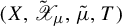
 has one of these properties if and only if the completed system
$(X,\tilde {\mathscr {X}}_\mu ,\tilde \mu ,T)$
has one of these properties if and only if the completed system
$(X,\tilde {\mathscr {X}}_\mu ,\tilde \mu ,T)$
 has the property.
2.4 Invariant measures and generic sequences
We write
$\mathscr {X}$
 for the Borel
$\sigma $
for the Borel
$\sigma $
 -algebra of X and
${\mathcal {M}}(X)$
-algebra of X and
${\mathcal {M}}(X)$
 for the set of all Borel probability measures on X. By
${\mathcal {M}_T}(X)$
for the set of all Borel probability measures on X. By
${\mathcal {M}_T}(X)$
 we denote T-invariant measures in
${\mathcal {M}}(X)$
we denote T-invariant measures in
${\mathcal {M}}(X)$
 . We write
${{\mathcal {M}}_T^e}(X)$
. We write
${{\mathcal {M}}_T^e}(X)$
 for the set of ergodic invariant measures. The quadruple
$\mathbf {X}=(X,\mathscr {X},\mu ,T)$
for the set of ergodic invariant measures. The quadruple
$\mathbf {X}=(X,\mathscr {X},\mu ,T)$
 is a measure-preserving system, which is invertible, whenever T is a homeomorphism. We give
${\mathcal {M}}(X)$
is a measure-preserving system, which is invertible, whenever T is a homeomorphism. We give
${\mathcal {M}}(X)$
 the weak
$^*$
the weak
$^*$
 topology. Recall that
$(\mu _n)_{n=1}^{\infty} $
topology. Recall that
$(\mu _n)_{n=1}^{\infty} $
 converges to
$\mu $
converges to
$\mu $
 in
${\mathcal {M}}(X)$
in
${\mathcal {M}}(X)$
 if and only if
$\int \varphi \,d\mu _n\to \int \varphi \,d\mu $
if and only if
$\int \varphi \,d\mu _n\to \int \varphi \,d\mu $
 for every continuous
${\varphi \colon X\to \mathbb {R}}$
for every continuous
${\varphi \colon X\to \mathbb {R}}$
 . The weak
$^*$
. The weak
$^*$
 topology on
${\mathcal {M}}(X)$
topology on
${\mathcal {M}}(X)$
 is compact and compatible with the Prokhorov metric

where
$B^\varepsilon =\{y\in X\,:\,\operatorname {\mathrm {dist}}(y,B)<\varepsilon \}$
 denotes the
$\varepsilon $
denotes the
$\varepsilon $
 -hull of B. For
$x\in X$
-hull of B. For
$x\in X$
 , let
$\hat \delta (x)\in \mathcal M(X)$
, let
$\hat \delta (x)\in \mathcal M(X)$
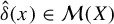 be the Dirac measure supported on
$\{x\}$
be the Dirac measure supported on
$\{x\}$
 . Let
${\mathfrak {m}}(\underline {x},n)$
. Let
${\mathfrak {m}}(\underline {x},n)$
 denote the n-empirical measure of
$\underline {x}=(x_j)_{j=0}^{\infty} \in X^{\infty }$
denote the n-empirical measure of
$\underline {x}=(x_j)_{j=0}^{\infty} \in X^{\infty }$
 , that is,
${\mathfrak {m}}(\underline {x},n)=(1/n)(\hat \delta (x_0)+\hat \delta (x_1)+\cdots +\hat \delta (x_{n-1}))$
, that is,
${\mathfrak {m}}(\underline {x},n)=(1/n)(\hat \delta (x_0)+\hat \delta (x_1)+\cdots +\hat \delta (x_{n-1}))$
 . Given
$x\in X$
. Given
$x\in X$
 , we put
${\mathfrak {m}}_T(x, n)={\mathfrak {m}}(\underline {x}_T,n)$
, we put
${\mathfrak {m}}_T(x, n)={\mathfrak {m}}(\underline {x}_T,n)$
 . A measure
$\mu \in {\mathcal {M}}(X)$
. A measure
$\mu \in {\mathcal {M}}(X)$
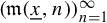
 is generated by
$\underline {x}\in X^{\infty} $
is generated by
$\underline {x}\in X^{\infty} $
 if
$\mu $
if
$\mu $
 is the limit of some subsequence of
$({\mathfrak {m}}(\underline {x},n))_{n=1}^{\infty }$
is the limit of some subsequence of
$({\mathfrak {m}}(\underline {x},n))_{n=1}^{\infty }$
 . The set of all measures generated by
$\underline {x}$
. The set of all measures generated by
$\underline {x}$
 is denoted by
$V({\underline {x}})$
is denoted by
$V({\underline {x}})$
 . We say that
$\underline {x}\in X^{\infty} $
. We say that
$\underline {x}\in X^{\infty} $
 is a generic sequence for
$\mu $
is a generic sequence for
$\mu $
 (respectively, an ergodic sequence) if
$V({\underline {x}})=\{\mu \}$
(respectively, an ergodic sequence) if
$V({\underline {x}})=\{\mu \}$
 for some (ergodic)
$\mu \in {\mathcal {M}}(X)$
for some (ergodic)
$\mu \in {\mathcal {M}}(X)$
 . We write
$\operatorname {\mathrm {Gen}}(\mu )$
. We write
$\operatorname {\mathrm {Gen}}(\mu )$
 for the set of all sequences in
$X^{\infty} $
for the set of all sequences in
$X^{\infty} $
 that are generic for
$\mu $
that are generic for
$\mu $
 . For
$z\in X$
. For
$z\in X$
 we define
$V_T({z})=V({\underline {z}_T})$
we define
$V_T({z})=V({\underline {z}_T})$
 , and we call z a generic point (ergodic point) if
$\underline {z}_T$
, and we call z a generic point (ergodic point) if
$\underline {z}_T$
 is a generic sequence (respectively, ergodic) sequence. Note that every invariant measure has a generic sequence in
$X^{\infty} $
is a generic sequence (respectively, ergodic) sequence. Note that every invariant measure has a generic sequence in
$X^{\infty} $
 [Reference Kwietniak, Łącka and Oprocha36, Reference Sigmund44], while a non-ergodic invariant measure may have no generic points. Furthermore, one can choose a generic sequence that is a quasi-orbit. A quasi-orbit is built from long pieces of orbits in such a way that the set of positions at which a quasi-orbit switches from one piece of orbit to another has zero asymptotic density.
Definition 2.1. We say that
$\underline {z}=(z_n)_{n=0}^{\infty} \in X^{\infty} $
 is a quasi-orbit for T if
$\bar d(\{n\ge 0\,:z_{n+1}\neq T(z_n)\})=0$
is a quasi-orbit for T if
$\bar d(\{n\ge 0\,:z_{n+1}\neq T(z_n)\})=0$
 .
.
It is easy to see that every measure generated by a quasi-orbit for T must be T-invariant. Furthermore, the GIKN construction yields a quasi-orbit that is generic for the invariant measure it produces. We work with that quasi-orbit to demonstrate the properties of the underlying measure.
2.5 Symbolic systems
Let
$\mathscr {A}$
 be a finite set with the discrete topology. We endow
$\mathscr {A}^{\kern1.5pt\infty} $
be a finite set with the discrete topology. We endow
$\mathscr {A}^{\kern1.5pt\infty} $
 with the product topology and call it the full shift over the alphabet
$\mathscr {A}$
with the product topology and call it the full shift over the alphabet
$\mathscr {A}$
 . The shift map is the map
$\sigma \colon \mathscr {A}^{\kern1.5pt\infty} \to \mathscr {A}^{\kern1.5pt\infty} $
. The shift map is the map
$\sigma \colon \mathscr {A}^{\kern1.5pt\infty} \to \mathscr {A}^{\kern1.5pt\infty} $
 given by
$\sigma ((x_n)_{n=0}^{\infty} )=(x_{n+1})_{n=0}^{\infty} $
given by
$\sigma ((x_n)_{n=0}^{\infty} )=(x_{n+1})_{n=0}^{\infty} $
 . The set of (ergodic) shift-invariant measures is denoted by
${\mathcal {M}}_{\sigma }(\mathscr {A}^{\kern1.5pt\infty} )$
. The set of (ergodic) shift-invariant measures is denoted by
${\mathcal {M}}_{\sigma }(\mathscr {A}^{\kern1.5pt\infty} )$
 (
${\mathcal {M}}^e_{\sigma }(\mathscr {A}^{\kern1.5pt\infty} )$
(
${\mathcal {M}}^e_{\sigma }(\mathscr {A}^{\kern1.5pt\infty} )$
 ). When
${\mathscr {A}=\{0,1,\ldots ,k-1\}}$
). When
${\mathscr {A}=\{0,1,\ldots ,k-1\}}$
 for some
$k\in \mathbb {N}$
for some
$k\in \mathbb {N}$
 , we write
$\Omega _k=\{0,1,\ldots ,k-1\}^{\infty} $
, we write
$\Omega _k=\{0,1,\ldots ,k-1\}^{\infty} $
 . We call the elements of
$\mathscr {A}^n$
. We call the elements of
$\mathscr {A}^n$
 words of length n over
$\mathscr {A}$
words of length n over
$\mathscr {A}$
 . Let
$\mathscr {A}^+=\bigcup _{n\ge 1}\mathscr {A}^n$
. Let
$\mathscr {A}^+=\bigcup _{n\ge 1}\mathscr {A}^n$
 and
$|u|$
and
$|u|$
 stand for the length of
$u\in \mathscr {A}^+$
stand for the length of
$u\in \mathscr {A}^+$
 . Every word
$u\in \mathscr {A}^+$
. Every word
$u\in \mathscr {A}^+$
 determines a cylinder set
$[u]\subset \mathscr {A}^{\kern1.5pt\infty} $
determines a cylinder set
$[u]\subset \mathscr {A}^{\kern1.5pt\infty} $
 consisting of all sequences in
$\mathscr {A}^{\kern1.5pt\infty} $
consisting of all sequences in
$\mathscr {A}^{\kern1.5pt\infty} $
 whose first
$|u|$
whose first
$|u|$
 symbols coincide with u. Cylinders form a clopen base for the topology of
$\mathscr {A}^{\kern1.5pt\infty} $
symbols coincide with u. Cylinders form a clopen base for the topology of
$\mathscr {A}^{\kern1.5pt\infty} $
 and generate the Borel
$\sigma $
and generate the Borel
$\sigma $
 -algebra
$\mathscr {B}$
-algebra
$\mathscr {B}$
 of
$\mathscr {A}^{\kern1.5pt\infty} $
of
$\mathscr {A}^{\kern1.5pt\infty} $
 . Given two n-words
$u=u_0u_1\cdots u_{n-1}$
. Given two n-words
$u=u_0u_1\cdots u_{n-1}$
 and
$w=w_0w_1\cdots w_{n-1}$
and
$w=w_0w_1\cdots w_{n-1}$
 over
$\mathscr {A}$
over
$\mathscr {A}$
 , we define the Hamming distance between u and w as

The edit metric between two strings (words) of length n equals
$1-k/n$
 , where k is the minimum number of symbols that must be removed from each string so that the remaining strings are identical. In other words, the edit distance between u and w is given by

where k is the largest among those integers
$\ell $
 such that for some
${0\le i_1<i_2<\cdots <i_\ell <n}$
such that for some
${0\le i_1<i_2<\cdots <i_\ell <n}$
 and
$0\le j_1<j_2<\cdots <j_\ell <n$
and
$0\le j_1<j_2<\cdots <j_\ell <n$
 we have
$u_{i_s}=w_{j_s}$
we have
$u_{i_s}=w_{j_s}$
 for
$s=1,\ldots ,\ell $
for
$s=1,\ldots ,\ell $
 . For two infinite sequences
${\omega }=\omega _0\omega _1\omega _2\cdots $
. For two infinite sequences
${\omega }=\omega _0\omega _1\omega _2\cdots $
 ,
${\omega }'=\omega ^{\prime }_0\omega ^{\prime }_1\omega ^{\prime }_2\cdots $
,
${\omega }'=\omega ^{\prime }_0\omega ^{\prime }_1\omega ^{\prime }_2\cdots $
 in
$\mathscr {A}^{\kern1.5pt\infty} $
in
$\mathscr {A}^{\kern1.5pt\infty} $
 we set


The functions
$\bar {d}$
 ,
$\bar {f}$
,
$\bar {f}$
 , and
$\hat {f}$
, and
$\hat {f}$
 are pseudometrics on
$\mathscr {A}^{\kern1.5pt\infty} $
are pseudometrics on
$\mathscr {A}^{\kern1.5pt\infty} $
 . Furthermore,
$\bar {f}({\omega },{\omega }')\le \hat {f}({\omega },{\omega }')$
. Furthermore,
$\bar {f}({\omega },{\omega }')\le \hat {f}({\omega },{\omega }')$
 and
$\bar {f}({\omega },{\omega }')\le \bar {d}({\omega },{\omega }')$
and
$\bar {f}({\omega },{\omega }')\le \bar {d}({\omega },{\omega }')$
 for
$\omega ,\omega '\in \mathscr {A}^{\kern1.5pt\infty} $
for
$\omega ,\omega '\in \mathscr {A}^{\kern1.5pt\infty} $
 , and
$\bar {f}$
, and
$\bar {f}$
 ,
$\hat {f}$
,
$\hat {f}$
 are uniformly equivalent pseudometrics on
$\mathscr {A}^{\kern1.5pt\infty} $
are uniformly equivalent pseudometrics on
$\mathscr {A}^{\kern1.5pt\infty} $
 (see [Reference Ornstein, Rudolph and Weiss39]).
2.6 Processes
We write
$\mathbf {P}^m(X)$
 for the set of all Borel measurable partitions of X into at most m sets, called atoms. For
$\mathcal P\in \mathbf P^k(X)$
for the set of all Borel measurable partitions of X into at most m sets, called atoms. For
$\mathcal P\in \mathbf P^k(X)$
 we write
${\mathcal {P}}=\{P_0,\ldots ,P_{k-1}\}$
we write
${\mathcal {P}}=\{P_0,\ldots ,P_{k-1}\}$
 regardless of the actual number of non-empty elements in
$\mathcal P$
regardless of the actual number of non-empty elements in
$\mathcal P$
 and we agree that
$P_j=\emptyset $
and we agree that
$P_j=\emptyset $
 for
$|{\mathcal {P}}|\le j<k$
for
$|{\mathcal {P}}|\le j<k$
 . Let
$\mathbf {X}=(X,\mathscr X, \mu , T)$
. Let
$\mathbf {X}=(X,\mathscr X, \mu , T)$
 be a measure-preserving system and let
$\mathcal P=\{P_0,P_1,\ldots , P_{k-1}\}\in \mathbf {P}^k(X)$
be a measure-preserving system and let
$\mathcal P=\{P_0,P_1,\ldots , P_{k-1}\}\in \mathbf {P}^k(X)$
 . We identify
$\mathcal P$
. We identify
$\mathcal P$
 with a function
$\mathcal P\colon X\to \{0,\ldots , k-1\}$
with a function
$\mathcal P\colon X\to \{0,\ldots , k-1\}$
 defined by
$\mathcal P(x)=j$
defined by
$\mathcal P(x)=j$
 for
$x\in P_j$
for
$x\in P_j$
 . The pair
$(\mathbf {X},\mathcal P)$
. The pair
$(\mathbf {X},\mathcal P)$
 is called a process (see [Reference Glasner27, pp. 273]). A coding of
$\underline {x}=(x_j)_{j=0}^{\infty }\in X^{\infty }$
is called a process (see [Reference Glasner27, pp. 273]). A coding of
$\underline {x}=(x_j)_{j=0}^{\infty }\in X^{\infty }$
 is
${\mathcal {P}}(\underline {x})=(\mathcal P(x_j))_{j=0}^{\infty }\in \Omega _k$
is
${\mathcal {P}}(\underline {x})=(\mathcal P(x_j))_{j=0}^{\infty }\in \Omega _k$
 . The map
$\underline {{\mathcal {P}}}\colon X\to \Omega _k\text { given by } \underline {{\mathcal {P}}}(x)=\mathcal P(\underline {x}_T)$
. The map
$\underline {{\mathcal {P}}}\colon X\to \Omega _k\text { given by } \underline {{\mathcal {P}}}(x)=\mathcal P(\underline {x}_T)$
 defines a homomorphism of
$\mathbf {X}$
defines a homomorphism of
$\mathbf {X}$
 and
$(\Omega _k,\mathscr {B}, \mu _{\mathcal P}, \sigma )$
and
$(\Omega _k,\mathscr {B}, \mu _{\mathcal P}, \sigma )$
 , where
$\mu _{\mathcal P}=\underline {{\mathcal {P}}}_*(\mu )$
, where
$\mu _{\mathcal P}=\underline {{\mathcal {P}}}_*(\mu )$
 is the pushforward of the measure
$\mu $
is the pushforward of the measure
$\mu $
 . For
$n>0$
. For
$n>0$
 and
$\underline {x}\in X^{\infty }$
and
$\underline {x}\in X^{\infty }$
 let
$\varphi ^n_{\mathcal P}(\underline {x})=\mathcal P(x_0)\mathcal P(x_1)\cdots \mathcal P(x_{n-1})\in \, \{0,1,\ldots , k-1\}^n$
let
$\varphi ^n_{\mathcal P}(\underline {x})=\mathcal P(x_0)\mathcal P(x_1)\cdots \mathcal P(x_{n-1})\in \, \{0,1,\ldots , k-1\}^n$
 . Let
$\mathcal P^n$
. Let
$\mathcal P^n$
 be the nth join of
$\mathcal P$
be the nth join of
$\mathcal P$
 given by

Note that for
$x\in X$
 we may write
$\varphi ^n_{\mathcal P}(\underline {x}_T)=\mathcal P^n(x)$
we may write
$\varphi ^n_{\mathcal P}(\underline {x}_T)=\mathcal P^n(x)$
 , because
$\varphi ^n_{\mathcal P}(\underline {x}_T)=i_0i_1\cdots i_{n-1}$
, because
$\varphi ^n_{\mathcal P}(\underline {x}_T)=i_0i_1\cdots i_{n-1}$
 if and only if
${\mathcal {P}}^n(x)=P_{i_0}\cap T^{-1}(P_{i_1})\cap \cdots \cap T^{-n+1}(P_{i_{n-1}})$
if and only if
${\mathcal {P}}^n(x)=P_{i_0}\cap T^{-1}(P_{i_1})\cap \cdots \cap T^{-n+1}(P_{i_{n-1}})$
 . The measure-preserving system
$(\Omega _k,\mathscr {B}, \mu _{\mathcal P}, \sigma )$
. The measure-preserving system
$(\Omega _k,\mathscr {B}, \mu _{\mathcal P}, \sigma )$
 is called the symbolic representation of
$\mathbf {X}$
is called the symbolic representation of
$\mathbf {X}$
 with respect to the partition
$\mathcal P$
with respect to the partition
$\mathcal P$
 , and
$\mu _{\mathcal P}$
, and
$\mu _{\mathcal P}$
 is the symbolic representation measure of
$\mu $
is the symbolic representation measure of
$\mu $
 . We endow
$\mathbf P^k(X)$
. We endow
$\mathbf P^k(X)$
 with the distance
$d_1^\mu $
with the distance
$d_1^\mu $
 given for
${\mathcal {P}},\mathcal {Q}\in \mathbf {P}^k(X)$
given for
${\mathcal {P}},\mathcal {Q}\in \mathbf {P}^k(X)$
 by
by

Note that the definition of
$d^\mu _1$
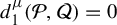
 takes into account the order of the partition’s elements. We tacitly identify Borel partitions
${\mathcal {P}},\mathcal {Q}\in \mathbf {P}^k(X)$
takes into account the order of the partition’s elements. We tacitly identify Borel partitions
${\mathcal {P}},\mathcal {Q}\in \mathbf {P}^k(X)$
 with
$d^\mu _1({\mathcal {P}},\mathcal {Q})=0$
with
$d^\mu _1({\mathcal {P}},\mathcal {Q})=0$
 . With this identification
$d^\mu _1$
. With this identification
$d^\mu _1$
 is a complete metric for
$\mathbf {P}^k(X)$
is a complete metric for
$\mathbf {P}^k(X)$
 .
.
2.7 Entropy
For a finite measurable partition
$\mathcal P$
 and
$\mu \in {\mathcal {M}}_T(X)$
and
$\mu \in {\mathcal {M}}_T(X)$
 we denote by
$h(\mu , \mathcal P)$
we denote by
$h(\mu , \mathcal P)$
 the entropy of
$\mathcal P$
the entropy of
$\mathcal P$
 with respect to
$\mu $
with respect to
$\mu $
 and T and by
$h(\mu )$
and T and by
$h(\mu )$
 the entropy of
$\mu $
the entropy of
$\mu $
 with respect to T, that is,
$h(\mu )=\sup _{\mathcal P}h(\mu , \mathcal P)$
with respect to T, that is,
$h(\mu )=\sup _{\mathcal P}h(\mu , \mathcal P)$
 , where
$h(\mu , \mathcal P)=\inf _{n\in \mathbb {N}}-\sum _{P\in \mathcal P^n}\mu (P)\log \mu (P)$
, where
$h(\mu , \mathcal P)=\inf _{n\in \mathbb {N}}-\sum _{P\in \mathcal P^n}\mu (P)\log \mu (P)$
 . The real-valued function
$\mathcal P\mapsto h(\mu ,\mathcal P)$
. The real-valued function
$\mathcal P\mapsto h(\mu ,\mathcal P)$
 is uniformly continuous on
$\mathbf {P}^k(X)$
is uniformly continuous on
$\mathbf {P}^k(X)$
 equipped with
$d^\mu _1$
equipped with
$d^\mu _1$
 [Reference Glasner27, Lemma 15.9 (5)].
2.8 Faithful coding
For
${\mathcal {P}}\in \mathbf {P}^k(X)$
 we define
$\partial {\mathcal {P}}=\partial P_0\cup \cdots \cup \partial P_{k-1}$
we define
$\partial {\mathcal {P}}=\partial P_0\cup \cdots \cup \partial P_{k-1}$
 . A partition
${\mathcal {P}}\in \mathbf {P}^k(X)$
. A partition
${\mathcal {P}}\in \mathbf {P}^k(X)$
 with
$\mu (\partial {\mathcal {P}})=0$
with
$\mu (\partial {\mathcal {P}})=0$
 is called faithful for
$\mathbf {X}$
is called faithful for
$\mathbf {X}$
 .
.
Lemma 2.2. If
$\underline {x}\in X^{\infty} $
 is generic for
$\mu \in {\mathcal {M}_T}(X)$
is generic for
$\mu \in {\mathcal {M}_T}(X)$
 and
${\mathcal {P}}\in \mathbf {P}^k(X)$
and
${\mathcal {P}}\in \mathbf {P}^k(X)$
 is such that
${\mu (\partial {\mathcal {P}})=0}$
is such that
${\mu (\partial {\mathcal {P}})=0}$
 , then
$\omega ={\mathcal {P}}(\underline {x})\in \Omega _k$
, then
$\omega ={\mathcal {P}}(\underline {x})\in \Omega _k$
 is a generic point for the measure
$\mu _{{\mathcal {P}}}$
is a generic point for the measure
$\mu _{{\mathcal {P}}}$
 on
$\Omega _k$
on
$\Omega _k$
 .
.
Proof. Note the following two properties of the boundary operator
$\partial $
 :
$\partial (Y\cap Z)\subset \partial Y\cup \partial Z$
:
$\partial (Y\cap Z)\subset \partial Y\cup \partial Z$
 for
$Y,Z\subset X$
for
$Y,Z\subset X$
 and
$\partial T^{-1}(U)\subset T^{-1}(\partial U)$
and
$\partial T^{-1}(U)\subset T^{-1}(\partial U)$
 for any
$U\subset X$
for any
$U\subset X$
 . Using this and
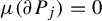
$\mu (\partial P_j)=0$
. Using this and
$\mu (\partial P_j)=0$
 for every
$0\le j < k$
for every
$0\le j < k$
 , we see that

In other words,
$\mu (\partial {\mathcal {P}}^m)=0$
 for all
$m\ge 1$
for all
$m\ge 1$
 . Then for every
$m\ge 1$
. Then for every
$m\ge 1$
 and
$0\le j_0,j_1,\ldots , j_{m-1}< k$
and
$0\le j_0,j_1,\ldots , j_{m-1}< k$
 we have

Note that
$\omega ={\mathcal {P}}(\underline {x})$
 is an orbit for
$\sigma $
is an orbit for
$\sigma $
 and observe that
$\omega $
and observe that
$\omega $
 is generic for a
$\sigma $
is generic for a
$\sigma $
 -invariant measure
$\mu '$
-invariant measure
$\mu '$
 such that

Hence,
$\mu '$
 and
$\mu _{{\mathcal {P}}}$
and
$\mu _{{\mathcal {P}}}$
 agrees on cylinders in
$\Omega _k$
agrees on cylinders in
$\Omega _k$
 . This implies
$\mu '=\mu _{{\mathcal {P}}}$
. This implies
$\mu '=\mu _{{\mathcal {P}}}$
 .
.
2.9 Kakutani equivalence
Kakutani equivalence serves as a natural equivalence relation among transformations that preserve an ergodic non-atomic measure, weaker than the conventional concept of isomorphism (however, in some sense equally hard; cf. [Reference Gerber and Kunde26]). Although entropy does not remain invariant under Kakutani equivalence, Abramov’s formula implies that this relation retains the categories of zero, positive and finite, as well as infinite entropy transformations. Let
$\mathbf {X}=(X,\mathscr X, \mu , T)$
 be a measure-preserving system. For a set
$E\in \mathscr X$
be a measure-preserving system. For a set
$E\in \mathscr X$
 with
$\mu (E)>0$
with
$\mu (E)>0$
 and
$x\in E$
and
$x\in E$
 we define the return time
$n(x)=\inf \{k>0: T^k(x)\in E\}$
we define the return time
$n(x)=\inf \{k>0: T^k(x)\in E\}$
 . This function is finite for
$\mu $
. This function is finite for
$\mu $
 -almost every
$x\in E$
-almost every
$x\in E$
 , and we define the induced transformation
$T_E\colon E\to E$
, and we define the induced transformation
$T_E\colon E\to E$
 by
$T_E(x)=T^{n(x)}(x)$
by
$T_E(x)=T^{n(x)}(x)$
 . Measure-preserving systems
$\mathbf {X}=(X,\mathscr X, \mu , T)$
. Measure-preserving systems
$\mathbf {X}=(X,\mathscr X, \mu , T)$
 and
$\mathbf Y=(Y,\mathscr Y, \nu , S)$
and
$\mathbf Y=(Y,\mathscr Y, \nu , S)$
 are Kakutani equivalent (recall that Katok calls this relation monotone equivalence) if there exist
$E\in \mathscr X$
are Kakutani equivalent (recall that Katok calls this relation monotone equivalence) if there exist
$E\in \mathscr X$
 with
$\mu (E)>0$
with
$\mu (E)>0$
 and
$F\in \mathscr Y$
and
$F\in \mathscr Y$
 with
$\nu (F)>0$
with
$\nu (F)>0$
 such that
$T_E$
such that
$T_E$
 is isomorphic with
$S_F$
is isomorphic with
$S_F$
 .
.
2.10 Loosely Bernoulli systems
Feldman [Reference Feldman21] studied the isomorphism problem in ergodic theory. He introduced a new property (called loose Bernoulliness) for finite partitions of a measure-preserving system
$(X,B,\mu ,T)$
 . He used it to construct important examples of K-automorphisms which are loosely Bernoulli but not Bernoulli. In particular, these measure-preserving systems have positive entropy. The definition of loosely Bernoulli partition follows Ornstein’s definition [Reference Ornstein38] of very weak Bernoulli partition with the Hamming distance of strings of symbols of length n replaced by the weaker edit metric
$\bar {f}_n$
. He used it to construct important examples of K-automorphisms which are loosely Bernoulli but not Bernoulli. In particular, these measure-preserving systems have positive entropy. The definition of loosely Bernoulli partition follows Ornstein’s definition [Reference Ornstein38] of very weak Bernoulli partition with the Hamming distance of strings of symbols of length n replaced by the weaker edit metric
$\bar {f}_n$
 . Feldman’s idea was subsequently extended by Ornstein, Rudolph and Weiss [Reference Ornstein, Rudolph and Weiss39]. It turns out that, in each of three entropy classes, the Kakutani equivalence class of loosely Bernoulli transformations is the simplest one (see [Reference Ornstein, Rudolph and Weiss39] for more details). Positive and finite (respectively, infinite) entropy transformations Kakutani equivalent to a Bernoulli shift coincide with loosely Bernoulli and positive and finite (respectively, infinite) entropy transformations. Zero-entropy loosely Bernoulli transformations form the Kakutani equivalence class of any ergodic rotation of a compact infinite group (Kronecker system). According to Feldman and Nadler [Reference Feldman and Nadler22], members of the latter equivalence class are called loosely Kronecker following a suggestion of Marina Ratner. We adapt this terminology and provide a characterization of these systems in §2.13 (cf. Theorem 9.2).
2.11 Feldman’s
$\bar {f}$
 and Ornstein’s
$\bar {d}$
metrics for shift-invariant measures on
$\mathscr {A}^{\kern1.5pt\infty} $
and Ornstein’s
$\bar {d}$
metrics for shift-invariant measures on
$\mathscr {A}^{\kern1.5pt\infty} $


Let
$\mu $
 and
$\mu '$
and
$\mu '$
 be ergodic shift-invariant measures on
$\mathscr {A}^{\kern1.5pt\infty} $
be ergodic shift-invariant measures on
$\mathscr {A}^{\kern1.5pt\infty} $
 . By
$\mu _n$
. By
$\mu _n$
 (respectively,
$\mu ^{\prime }_n$
(respectively,
$\mu ^{\prime }_n$
 ) we denote the restriction of
$\mu $
) we denote the restriction of
$\mu $
 (respectively,
$\mu '$
(respectively,
$\mu '$
 ) to the set of all n-cylinders, that is, these are measures that
$\mu $
) to the set of all n-cylinders, that is, these are measures that
$\mu $
 (respectively,
$\mu '$
(respectively,
$\mu '$
 ) defines on
$\mathscr {A}^n$
) defines on
$\mathscr {A}^n$
 via the projections onto first n coordinates. A joining of
$\mu $
via the projections onto first n coordinates. A joining of
$\mu $
 and
$\mu '$
and
$\mu '$
 is any
$\sigma \times \sigma $
is any
$\sigma \times \sigma $
 -invariant measure on
$\mathscr {A}^{\kern1.5pt\infty} \times \mathscr {A}^{\kern1.5pt\infty} $
-invariant measure on
$\mathscr {A}^{\kern1.5pt\infty} \times \mathscr {A}^{\kern1.5pt\infty} $
 whose marginals are
$\mu $
whose marginals are
$\mu $
 and
$\mu '$
and
$\mu '$
 . We write
$J(\mu ,\mu ')$
. We write
$J(\mu ,\mu ')$
 for the set of all joinings of
$\mu $
for the set of all joinings of
$\mu $
 and
$\mu '$
and
$\mu '$
 . Similarly,
$J_n(\mu ,\mu ')$
. Similarly,
$J_n(\mu ,\mu ')$
 denotes the set of all measures
$\unicode{x3bb} _n$
denotes the set of all measures
$\unicode{x3bb} _n$
 on
$\mathscr {A}^n\times \mathscr {A}^n$
on
$\mathscr {A}^n\times \mathscr {A}^n$
 whose marginals are
$\mu _n$
whose marginals are
$\mu _n$
 and
$\mu ^{\prime }_n$
and
$\mu ^{\prime }_n$
 .
.
Define


One can prove (see [Reference Ornstein, Rudolph and Weiss39]) that (5) defines a distance between measures
$\mu $
 and
$\mu '$
and
$\mu '$
 on
$\mathscr {A}^{\kern1.5pt\infty} $
on
$\mathscr {A}^{\kern1.5pt\infty} $
 known as the
$\bar {f}$
known as the
$\bar {f}$
 -metric. Ornstein’s
$\bar {d}$
-metric. Ornstein’s
$\bar {d}$
 -metric on
${\mathcal {M}}_\sigma (\mathscr {A}^{\kern1.5pt\infty} )$
-metric on
${\mathcal {M}}_\sigma (\mathscr {A}^{\kern1.5pt\infty} )$
 is defined analogously with the Hamming distance
$\bar {d}_n$
is defined analogously with the Hamming distance
$\bar {d}_n$
 on
$\mathscr {A}^n$
on
$\mathscr {A}^n$
 replacing the edit distance
$\bar {f}_n$
replacing the edit distance
$\bar {f}_n$
 in (4) (see [Reference Shields43]).
2.12 Properties of
$\bar {f}$

The following result is a direct corollary of [Reference Ornstein, Rudolph and Weiss39].
Lemma 2.3. For every
$\varepsilon>0$
 there is a
$\delta>0$
there is a
$\delta>0$
 such that if
$\mu $
such that if
$\mu $
 and
$\mu '$
and
$\mu '$
 are shift-invariant ergodic measures on
$\mathscr {A}^{\kern1.5pt\infty} $
are shift-invariant ergodic measures on
$\mathscr {A}^{\kern1.5pt\infty} $
 and there are generic points
$\omega $
and there are generic points
$\omega $
 for
$\mu $
for
$\mu $
 and
$\omega '$
and
$\omega '$
 for
$\mu '$
for
$\mu '$
 with
$\bar {f}(\omega ,\omega ') < \delta $
with
$\bar {f}(\omega ,\omega ') < \delta $
 , then
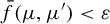
$\bar {f}( \mu , \mu ' ) < \varepsilon $
, then
$\bar {f}( \mu , \mu ' ) < \varepsilon $
 .
.
Note also that the entropy function
$\mu \mapsto h(\mu )$
 is uniformly continuous with respect to the
$\bar {f}$
is uniformly continuous with respect to the
$\bar {f}$
 -metric on the space of shift-invariant measures on
$\mathscr {A}^{\kern1.5pt\infty} $
-metric on the space of shift-invariant measures on
$\mathscr {A}^{\kern1.5pt\infty} $
 (for ergodic measures this is [Reference Ornstein, Rudolph and Weiss39, Proposition 3.4]; the assumption of ergodicity can be removed thanks to the main result of [Reference Downarowicz, Kwietniak and Łącka20]).
2.13 Loosely Kronecker systems
An ergodic measure-preserving system
$\mathbf {X}=(X,\mathscr {X},\mu ,T)$
 is loosely Kronecker if it has zero entropy and for every finite Borel partition
${\mathcal {P}}$
is loosely Kronecker if it has zero entropy and for every finite Borel partition
${\mathcal {P}}$
 of X and every
$\varepsilon>0$
of X and every
$\varepsilon>0$
 there are
$n>0$
there are
$n>0$
 and a set
$A_n$
and a set
$A_n$
 of atoms of
${\mathcal {P}}^n=\bigvee _{j=0}^{n-1}T^{-j}({\mathcal {P}})$
of atoms of
${\mathcal {P}}^n=\bigvee _{j=0}^{n-1}T^{-j}({\mathcal {P}})$
 such that
$\mu (A_n)>1-\varepsilon $
such that
$\mu (A_n)>1-\varepsilon $
 and
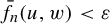
$\bar {f}_n(u,w)<\varepsilon $
and
$\bar {f}_n(u,w)<\varepsilon $
 for
$u,w\in A_n$
for
$u,w\in A_n$
 (here, as usual, we identify atoms of the partition
${\mathcal {P}}^n$
(here, as usual, we identify atoms of the partition
${\mathcal {P}}^n$
 with words of length n over the alphabet
$\{0,1,\ldots ,|{\mathcal {P}}|-1\}$
with words of length n over the alphabet
$\{0,1,\ldots ,|{\mathcal {P}}|-1\}$
 ).
).
3 GIKN construction
We present the original construction of Gorodetski et al from [Reference Gorodetskiĭ, Ilyashenko, Kleptsyn and Nalskiĭ29] following the exposition provided by Bonatti et al in [Reference Bonatti, Díaz and Gorodetski8]. Recall that X is a compact metric space,
$\rho $
 is a metric for X, and
$T\colon X\to X$
is a metric for X, and
$T\colon X\to X$
 is a continuous map. By definition, each GIKN measure is the weak
$^*$
is a continuous map. By definition, each GIKN measure is the weak
$^*$
 limit of measures supported on a sequence of periodic points with special properties. Each periodic orbit in this sequence can be divided in two parts: the shadowing part and the tail. Their key features are as follows.
-
(1) The shadowing part takes a large proportion (growing to $1$
as n goes to
$\infty $
) of each periodic orbit in the sequence. Furthermore, the images of each point on the shadowing part of the nth orbit are
$\gamma _n$
-close to the
$(n-1)$
th orbit for the number of iterates equal to the primary period of the
$(n-1)$
th orbit, and the series formed by
$\gamma _n$
s is summable. This is used to show that the limit measure is ergodic. -
(2) There is a fixed (centre) direction such that the Lyapunov exponent in that direction along the sequence of periodic orbits decreases to zero. To achieve this, each periodic orbit spends a small proportion of its primary period (this part of the orbit is called the tail) in a region that is far from the previous orbits and is chosen so that the Lyapunov exponent in the centre direction along the whole orbit has a smaller absolute value than the same exponent for the previously constructed orbits. This also guarantees that the limit measure is non-atomic.


3.1 Topological backbone of the GIKN construction
In this subsection, we sketch the main features of the GIKN construction. Our results about
$\overline {fk}$
 -limits like Theorems 8.1 and 9.1 apply to any measure defined in this way, because the GIKN construction leads to
$\overline {fk}$
-limits like Theorems 8.1 and 9.1 apply to any measure defined in this way, because the GIKN construction leads to
$\overline {fk}$
 -convergent sequences of periodic orbits (see Theorem 6.2).
Definition 3.1. We say that a T-periodic orbit
$\Gamma $
 is a
$(\gamma ,\kappa )$
is a
$(\gamma ,\kappa )$
 -good approximation of a T-periodic orbit
$\Lambda $
-good approximation of a T-periodic orbit
$\Lambda $
 if there are a subset
$\Delta $
if there are a subset
$\Delta $
 of
$\Gamma $
of
$\Gamma $
 with
$|\Delta |/|\Gamma |\ge \kappa $
with
$|\Delta |/|\Gamma |\ge \kappa $
 and a constant-to-one surjection
$\psi \colon \Delta \to \Lambda $
and a constant-to-one surjection
$\psi \colon \Delta \to \Lambda $
 (called a
$(\gamma ,\kappa )$
(called a
$(\gamma ,\kappa )$
 -projection) such that for each
$y\in \Delta $
-projection) such that for each
$y\in \Delta $
 and
${0\le j <|\Lambda |}$
and
${0\le j <|\Lambda |}$
 we have

Definition 3.2. We call a sequence
$(\Gamma _n)_{n\in \mathbb {N}}$
 of T-periodic orbits with
$|\Gamma _n|\nearrow \infty $
of T-periodic orbits with
$|\Gamma _n|\nearrow \infty $
 as
${n\to \infty }$
as
${n\to \infty }$
 a GIKN sequence if there are sequences of positive real numbers
$(\gamma _n)_{n=1}^{\infty} $
a GIKN sequence if there are sequences of positive real numbers
$(\gamma _n)_{n=1}^{\infty} $
 and
$(\kappa _n)_{n=1}^{\infty} $
and
$(\kappa _n)_{n=1}^{\infty} $
 such that the following conditions hold:
-
(1) for each $n\ge 1$
,
$\Gamma _{n+1}$
is a
$(\gamma _n,\kappa _n)$
-good approximation of
$\Gamma _n$
; -
(2) $\sum _{n=1}^{\infty} \gamma _n<\infty $
; -
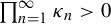
(3) $\prod _{n=1}^{\infty} \kappa _n>0$
.



By an abuse of terminology, we will also refer to the sequence of ergodic measures
$(\mu _n)_{n=1}^{\infty} $
 , where
$\mu _n$
, where
$\mu _n$
 is supported on
$\Gamma _n$
is supported on
$\Gamma _n$
 , as a GIKN sequence of measures.
The following is a slightly reformulated version of [Reference Bonatti, Díaz and Gorodetski8, Lemma 2.5]. The proof that
$\mu $
 is ergodic in [Reference Bonatti, Díaz and Gorodetski8] invokes [Reference Gorodetskiĭ, Ilyashenko, Kleptsyn and Nalskiĭ29, Lemma 2].
Theorem 3.3. Let
$(\Gamma _n)_{n\in \mathbb {N}}$
 be a GIKN sequence of T-periodic orbits. If
$(\mu _n)_{n=1}^{\infty} $
be a GIKN sequence of T-periodic orbits. If
$(\mu _n)_{n=1}^{\infty} $
 is the associated sequence of ergodic measures, then
$(\mu _n)_{n\in \mathbb {N}}$
is the associated sequence of ergodic measures, then
$(\mu _n)_{n\in \mathbb {N}}$
 weak
$^*$
weak
$^*$
 converges to an ergodic measure
$\mu $
converges to an ergodic measure
$\mu $
 supported on the topological limit of
$(\Gamma _n)_{n\in \mathbb {N}}$
supported on the topological limit of
$(\Gamma _n)_{n\in \mathbb {N}}$
 , that is,

Definition 3.4. We say that
$\mu $
 is an axiomatized GIKN measure (or a GIKN measure for short) if it is a weak
$^*$
is an axiomatized GIKN measure (or a GIKN measure for short) if it is a weak
$^*$
 limit of a GIKN sequence.
With this terminology, Theorem 3.3 states that every GIKN sequence determines a GIKN measure.
3.2 Lyapunov exponents
We discuss how the GIKN construction is used to find non-hyperbolic measures. This part is logically independent of the rest of the paper.
Let M be a smooth Riemannian manifold with
$\dim M=m$
 . If
$f\colon M\to M$
. If
$f\colon M\to M$
 is a diffeomorphism and
$\mu $
is a diffeomorphism and
$\mu $
 is an ergodic f-invariant measure, then there exist a set
$\Lambda \subset M$
is an ergodic f-invariant measure, then there exist a set
$\Lambda \subset M$
 of full
$\mu $
of full
$\mu $
 -measure and real numbers
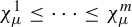
$\chi ^1_\mu \le \cdots \le \chi ^m_\mu $
-measure and real numbers
$\chi ^1_\mu \le \cdots \le \chi ^m_\mu $
 such that for every
$x\in \Lambda $
such that for every
$x\in \Lambda $
 and non-zero vector
$v\in T_xM$
and non-zero vector
$v\in T_xM$
 one has

The number
$\chi ^i_\mu $
 is the ith Lyapunov exponent of the measure
$\mu $
is the ith Lyapunov exponent of the measure
$\mu $
 . If there exist a closed f-invariant set
$\Xi \subset M$
. If there exist a closed f-invariant set
$\Xi \subset M$
 and a continuous
$Df$
and a continuous
$Df$
 -invariant direction field
$\mathcal E=(E_x)_{x\in \Xi }\subset T_\Xi M$
-invariant direction field
$\mathcal E=(E_x)_{x\in \Xi }\subset T_\Xi M$
 with
$\dim E_x=1$
with
$\dim E_x=1$
 for
$x\in \Xi $
for
$x\in \Xi $
 , then for every measure
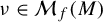
$\nu \in {\mathcal {M}}_f(M)$
, then for every measure
$\nu \in {\mathcal {M}}_f(M)$
 with
$\operatorname {\mathrm {supp}}\nu \subset \Xi $
with
$\operatorname {\mathrm {supp}}\nu \subset \Xi $
 there is a Lyapunov exponent
$\chi ^{\mathcal E}(\nu )$
there is a Lyapunov exponent
$\chi ^{\mathcal E}(\nu )$
 of
$\nu $
of
$\nu $
 associated with
$\mathcal E$
associated with
$\mathcal E$
 in the following sense: for
$\nu $
in the following sense: for
$\nu $
 -almost every
$x\in M$
-almost every
$x\in M$
 and a non-zero vector
$v\in E_x$
and a non-zero vector
$v\in E_x$
 one has

Furthermore, if
$(\mu _n)_{n\in \mathbb {N}}$
 is a sequence in
${\mathcal {M}}^e_f(\Xi )$
is a sequence in
${\mathcal {M}}^e_f(\Xi )$
 ,
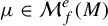
$\mu \in {\mathcal {M}}^e_f(M)$
,
$\mu \in {\mathcal {M}}^e_f(M)$
 and
$\mu _n\to \mu $
and
$\mu _n\to \mu $
 as
$n\to \infty $
as
$n\to \infty $
 in the weak
$^*$
in the weak
$^*$
 topology (this implies that
$\operatorname {\mathrm {supp}}\mu \subset \Xi $
topology (this implies that
$\operatorname {\mathrm {supp}}\mu \subset \Xi $
 as well), then
$\chi ^{\mathcal E}(\mu _n)\to \chi ^{\mathcal E}(\mu )$
as well), then
$\chi ^{\mathcal E}(\mu _n)\to \chi ^{\mathcal E}(\mu )$
 as
$n\to \infty $
as
$n\to \infty $
 [Reference Gorodetskiĭ, Ilyashenko, Kleptsyn and Nalskiĭ29, Lemma 1].
Theorem 3.5. Assume that
$f\colon M\to M$
 is a diffeomorphism of a smooth Riemannian compact manifold with a closed f-invariant set
$\Xi \subset M$
is a diffeomorphism of a smooth Riemannian compact manifold with a closed f-invariant set
$\Xi \subset M$
 and a continuous
$Df$
and a continuous
$Df$
 -invariant direction field
$\mathcal E=(E_x)_{x\in \Xi }\subset T_\Xi M$
-invariant direction field
$\mathcal E=(E_x)_{x\in \Xi }\subset T_\Xi M$
 with
$\dim E_x=1$
with
$\dim E_x=1$
 for
$x\in \Xi $
for
$x\in \Xi $
 . Let
$(\Gamma _n)_{n\in \mathbb {N}}\subset \Xi $
. Let
$(\Gamma _n)_{n\in \mathbb {N}}\subset \Xi $
 be a sequence of f-periodic orbits and suppose that
$|\Gamma _n|$
be a sequence of f-periodic orbits and suppose that
$|\Gamma _n|$
 increases to infinity as
$n\to \infty $
increases to infinity as
$n\to \infty $
 . For each n let
$\mu _n$
. For each n let
$\mu _n$
 be the ergodic measure supported on
$\Gamma _n$
be the ergodic measure supported on
$\Gamma _n$
 . Furthermore, assume that the following conditions hold.
-
(1) There exist sequences of positive real numbers $(\gamma _n)_{n=1}^{\infty} $
and a constant C such that for each n the orbit
$\Gamma _{n+1}$
is a
$(\gamma _n,1-C|\chi ^{\mathcal E}(\mu _n)|)$
-good approximation of
$\Gamma _n$
. -
(2) There exists a constant $0<\alpha <1$
such that $$ \begin{align*} |\chi^{\mathcal E}(\mu_{n+1})|<\alpha|\chi^{\mathcal E}(\mu_n)|. \end{align*} $$
-
(3) $\gamma _n< ({\min _{1\le i\le n}d_i})/({3\cdot 2^n})$
, where
$d_i$
denotes the minimal distance between different points in
$\Gamma _i$
.








Then
$(\Gamma _n)_{n\in \mathbb {N}}\subset \Xi $
 is a GIKN sequence and
$(\mu _n)_{n\in \mathbb {N}}$
is a GIKN sequence and
$(\mu _n)_{n\in \mathbb {N}}$
 weak
$^*$
weak
$^*$
 converges to a GIKN measure
$\mu $
converges to a GIKN measure
$\mu $
 that is ergodic and has uncountable support equal to the topological limit of
$(\Gamma _n)_{n\in \mathbb {N}}$
that is ergodic and has uncountable support equal to the topological limit of
$(\Gamma _n)_{n\in \mathbb {N}}$
 . Furthermore,
$\mu $
. Furthermore,
$\mu $
 is non-hyperbolic, since
$\chi ^{\mathcal E}(\mu )=0$
is non-hyperbolic, since
$\chi ^{\mathcal E}(\mu )=0$
 .
.
4 Feldman–Katok pseudometric
In this section, we first recall the definition of the Besicovitch pseudometric, then introduce the Feldman–Katok pseudometric, which extends
$\bar {f}$
 to general metric spaces.
For symbolic dynamical systems (subsystems of the full shift
$(\mathscr {A}^{\kern1.5pt\infty} ,\sigma )$
 ) the metrics
$\bar {d}$
) the metrics
$\bar {d}$
 and
$\bar {f}$
and
$\bar {f}$
 on
${\mathcal {M}}_\sigma (\mathscr {A}^{\kern1.5pt\infty} )$
on
${\mathcal {M}}_\sigma (\mathscr {A}^{\kern1.5pt\infty} )$
 defined in §2.11 are related with identically denoted pseudometrics on
$\mathscr {A}^{\kern1.5pt\infty} $
defined in §2.11 are related with identically denoted pseudometrics on
$\mathscr {A}^{\kern1.5pt\infty} $
 given respectively by (1) and (2). This connection is described in more detail in [Reference Ornstein, Rudolph and Weiss39, Reference Shields43, Reference Weiss47]. From the point of view of ergodic theory there is no need to extend
$\bar {d}$
given respectively by (1) and (2). This connection is described in more detail in [Reference Ornstein, Rudolph and Weiss39, Reference Shields43, Reference Weiss47]. From the point of view of ergodic theory there is no need to extend
$\bar {d}$
 and
$\bar {f}$
and
$\bar {f}$
 from
$\mathscr {A}^{\kern1.5pt\infty} $
from
$\mathscr {A}^{\kern1.5pt\infty} $
 to more general metric spaces. It turns out, however, that for some geometric applications an extension of
$\bar {d}$
to more general metric spaces. It turns out, however, that for some geometric applications an extension of
$\bar {d}$
 , called the Besicovitch pseudometric, is very useful (see [Reference Babel, Can, Kwietniak and Oprocha1, Reference Babel and Łącka2, Reference Kwietniak, Łącka and Oprocha36] and references therein). However, we are not aware of any analogue of the
$\bar {f}$
, called the Besicovitch pseudometric, is very useful (see [Reference Babel, Can, Kwietniak and Oprocha1, Reference Babel and Łącka2, Reference Kwietniak, Łącka and Oprocha36] and references therein). However, we are not aware of any analogue of the
$\bar {f}$
 -pseudometric for general metric space in the literature.
4.1 Besicovitch pseudometric
$D_{\mathrm {B}}$

For
$\underline {x}=(x_j)_{j=0}^{\infty} ,\,\underline {z}=(z_j)_{j=0}^{\infty} \in X^{\infty }$
 we define the Besicovitch pseudometric
$D_{\mathrm {B}}$
we define the Besicovitch pseudometric
$D_{\mathrm {B}}$
 on
$X^{\infty} $
on
$X^{\infty} $
 as
as

It is known [Reference Kwietniak, Łącka and Oprocha36] that
$D_{\mathrm {B}}$
 is uniformly equivalent to
$D_{\mathrm {B}}'$
is uniformly equivalent to
$D_{\mathrm {B}}'$
 given by

Given
$T\colon X\to X$
 , the Besicovitch pseudometric
$D_{\mathrm {B}}$
, the Besicovitch pseudometric
$D_{\mathrm {B}}$
 on X is defined by
$D_{\mathrm {B}}(x,y)=D_{\mathrm {B}}(\underline {x}_T,\underline {z}_T)$
on X is defined by
$D_{\mathrm {B}}(x,y)=D_{\mathrm {B}}(\underline {x}_T,\underline {z}_T)$
 . If
$X=\mathscr {A}^{\kern1.5pt\infty} $
. If
$X=\mathscr {A}^{\kern1.5pt\infty} $
 and
$\rho $
and
$\rho $
 is any metric compatible with the topology on
$\mathscr {A}^{\kern1.5pt\infty} $
is any metric compatible with the topology on
$\mathscr {A}^{\kern1.5pt\infty} $
 , then the Besicovitch pseudometric
$D_{\mathrm {B}}$
, then the Besicovitch pseudometric
$D_{\mathrm {B}}$
 and the
$\bar {d}$
and the
$\bar {d}$
 -pseudometric are uniformly equivalent on
$\mathscr {A}^{\kern1.5pt\infty} $
-pseudometric are uniformly equivalent on
$\mathscr {A}^{\kern1.5pt\infty} $
 .
.
4.2 Pseudometric
$\overline {fk}$

Fix
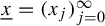
$\underline {x}=(x_j)_{j=0}^{\infty} $
 ,
$\underline {z}=(z_j)_{j=0}^{\infty} \in X^{\infty }$
,
$\underline {z}=(z_j)_{j=0}^{\infty} \in X^{\infty }$
 ,
$\delta>0$
,
$\delta>0$
 , and
$n\in \mathbb {N}$
, and
$n\in \mathbb {N}$
 .
.
Definition 4.1. An
$(n,\delta )$
 -match between
$\underline {x}$
-match between
$\underline {x}$
 and
$\underline {z}$
and
$\underline {z}$
 is an order-preserving bijection
$\pi \colon \mathcal {D}(\pi )\to \mathcal {R}(\pi )$
is an order-preserving bijection
$\pi \colon \mathcal {D}(\pi )\to \mathcal {R}(\pi )$
 such that
$\mathcal {D}(\pi ),\mathcal {R}(\pi )\subset \{0,1,\ldots ,n-1\}$
such that
$\mathcal {D}(\pi ),\mathcal {R}(\pi )\subset \{0,1,\ldots ,n-1\}$
 and for every
$i\in \mathcal {D}(\pi )$
and for every
$i\in \mathcal {D}(\pi )$
 we have
$\rho (x_i,z_{\pi (i)})<\delta $
we have
$\rho (x_i,z_{\pi (i)})<\delta $
 . The fit
$|\pi |$
. The fit
$|\pi |$
 of
$\pi $
of
$\pi $
 is the cardinality of
$\mathcal {D}(\pi )$
is the cardinality of
$\mathcal {D}(\pi )$
 .
.
Definition 4.2. An
$(n,\delta )$
 -match is maximal if its fit is the largest possible. If there is no
$(n,\delta )$
-match is maximal if its fit is the largest possible. If there is no
$(n,\delta )$
 -match
$\pi $
-match
$\pi $
 with
$|\pi |\ge 1$
with
$|\pi |\ge 1$
 , then the empty match
$\pi _\emptyset $
, then the empty match
$\pi _\emptyset $
 with
$|\pi _\emptyset |=0$
with
$|\pi _\emptyset |=0$
 is the maximal one. The
$(n,\delta )$
is the maximal one. The
$(n,\delta )$
 -gap between
$\underline {x}$
-gap between
$\underline {x}$
 and
$\underline {z}$
and
$\underline {z}$
 is given by

Note that if
$X=\mathscr {A}^{\kern1.5pt\infty} $
 for some finite alphabet
$\mathscr {A}$
for some finite alphabet
$\mathscr {A}$
 and we endow
$X=\mathscr {A}^{\kern1.5pt\infty} $
and we endow
$X=\mathscr {A}^{\kern1.5pt\infty} $
 with the standard metric given by

then (with a minor abuse of notation) we have
$\bar {f}_{n,1}(\underline {x},\underline {z})=\bar {f}_n(x_0x_1\cdots x_{n-1},z_0z_1\cdots z_{n-1})$
 for any
$\underline {x},\underline {z}\in \mathscr {A}^{\kern1.5pt\infty} $
for any
$\underline {x},\underline {z}\in \mathscr {A}^{\kern1.5pt\infty} $
 .
.
We note some properties of the
$(n,\delta )$
 -gap function
$\bar {f}_{n,\delta }$
-gap function
$\bar {f}_{n,\delta }$
 that hold for any
$\underline {x}$
that hold for any
$\underline {x}$
 ,
$\underline {z}\in X^{\infty }$
,
$\underline {z}\in X^{\infty }$
 ,
$\varepsilon ,\delta>0$
,
$\varepsilon ,\delta>0$
 , and
$n\in \mathbb {N}$
, and
$n\in \mathbb {N}$
 . The proofs are left to the reader.
Fact 4.3. If
$0<\delta <\delta '$
 , then
$\bar {f}_{n,\delta '}(\underline {x},\underline {z})\le \bar {f}_{n,\delta }(\underline {x},\underline {z})$
, then
$\bar {f}_{n,\delta '}(\underline {x},\underline {z})\le \bar {f}_{n,\delta }(\underline {x},\underline {z})$
 .
.
Fact 4.4. If
$q\in \mathbb {N}$
 , then
$\bar {f}_{n,\delta }(\underline {x},\underline {z})\le \bar {f}_{n+q,\delta }(\underline {x},\underline {z})+q/n$
, then
$\bar {f}_{n,\delta }(\underline {x},\underline {z})\le \bar {f}_{n+q,\delta }(\underline {x},\underline {z})+q/n$
 .
.
Fact 4.5. If
$\bar {f}_{n,\delta }(\underline {x},\underline {z})<\varepsilon $
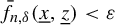 , then
$D_{\mathrm {P}}({\mathfrak {m}}( \underline {x}, n), {\mathfrak {m}}( \underline {z}, n))< \max \{\delta ,\varepsilon \}$
, then
$D_{\mathrm {P}}({\mathfrak {m}}( \underline {x}, n), {\mathfrak {m}}( \underline {z}, n))< \max \{\delta ,\varepsilon \}$
 .
.
Definition 4.6. The
$\bar {f}_\delta $
 -pseudodistance between
$\underline {x}$
-pseudodistance between
$\underline {x}$
 and
$\underline {z}$
and
$\underline {z}$
 is given by

Fact 4.7. If
$i\in \mathbb {N}\cup \{0\}$
 , then
$\bar {f}_\delta (\underline {x},\underline {z})=\bar {f}_\delta (\underline {x},\sigma ^i(\underline {z}))$
, then
$\bar {f}_\delta (\underline {x},\underline {z})=\bar {f}_\delta (\underline {x},\sigma ^i(\underline {z}))$
 . In particular,
$\bar {f}_\delta (\underline {x},\sigma ^i(\underline {x}))=0$
. In particular,
$\bar {f}_\delta (\underline {x},\sigma ^i(\underline {x}))=0$
 .
.
Fact 4.8. Assume that
$\underline {x}$
 and
$\underline {z}$
and
$\underline {z}$
 are periodic with a common period N. If
$p^{(n)}$
are periodic with a common period N. If
$p^{(n)}$
 denotes the fit of a maximal
$(nN,\delta )$
denotes the fit of a maximal
$(nN,\delta )$
 -match, then the sequence
$(p^{(n)})_{n=1}^{\infty} $
-match, then the sequence
$(p^{(n)})_{n=1}^{\infty} $
 is subadditive, that is,
$p^{(\ell )}+p^{(m)}\ge p^{(\ell +m)}$
is subadditive, that is,
$p^{(\ell )}+p^{(m)}\ge p^{(\ell +m)}$
 for every
$\ell ,m\in \mathbb {N}$
for every
$\ell ,m\in \mathbb {N}$
 .
.
Fact 4.9. If
$\underline {x}$
 and
$\underline {z}$
and
$\underline {z}$
 are periodic sequences with a common period N, then

for every
$0\le q<N$
 .
.
Definition 4.10. The Feldman–Katok pseudometric on
$X^{\infty }$
 is given by

The Feldman–Katok pseudometric on X, also denoted by
$\overline {fk}$
 , is defined for
$x,z\in X$
, is defined for
$x,z\in X$
 by
by

The symbols
$\bar {f}_{n,\delta }(x,z)$
 and
$\bar {f}_{\delta }(x,z)$
and
$\bar {f}_{\delta }(x,z)$
 have the obvious meaning.
Fact 4.11. If
$\underline {x},\underline {z}\in X^{\infty }$
 and
$\bar {f}_\delta (\underline {x},\underline {z})\le \varepsilon $
and
$\bar {f}_\delta (\underline {x},\underline {z})\le \varepsilon $
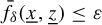 , for some
$\delta ,\varepsilon>0$
, for some
$\delta ,\varepsilon>0$
 , then
$\overline {fk}(\underline {x},\underline {z})\le \delta +\varepsilon $
, then
$\overline {fk}(\underline {x},\underline {z})\le \delta +\varepsilon $
 .
.
Proof. If
$\bar {f}_\delta (\underline {x},\underline {z})\le \varepsilon $
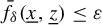 , then
$\bar {f}_{\delta +\varepsilon }(\underline {x},\underline {z})<\delta +\varepsilon $
, then
$\bar {f}_{\delta +\varepsilon }(\underline {x},\underline {z})<\delta +\varepsilon $
 by Fact 4.3. Thus,
$\overline {fk}(\underline {x},\underline {z})\le \delta +\varepsilon $
by Fact 4.3. Thus,
$\overline {fk}(\underline {x},\underline {z})\le \delta +\varepsilon $
 .
.
Remark 4.12. By Fact 4.11 the set
$\{\delta>0:\bar {f}_{\delta }(\underline {x},\underline {z})<\delta \}$
 is non-empty for every
${\underline {x},\underline {z}\in X^{\infty }}$
is non-empty for every
${\underline {x},\underline {z}\in X^{\infty }}$
 . Furthermore,
$0\le \bar {f}_\delta (\underline {x},\underline {z})\le 1$
. Furthermore,
$0\le \bar {f}_\delta (\underline {x},\underline {z})\le 1$
 for all
$\underline {x},\underline {z}\in X^{\infty }$
for all
$\underline {x},\underline {z}\in X^{\infty }$
 and
$\delta>0$
and
$\delta>0$
 . Together with Fact 4.11, this implies that
$0\le \overline {fk}(\underline {x},\underline {z})\le 1$
. Together with Fact 4.11, this implies that
$0\le \overline {fk}(\underline {x},\underline {z})\le 1$
 for every
$\underline {x},\underline {z}\in X^{\infty }$
for every
$\underline {x},\underline {z}\in X^{\infty }$
 .
.
Fact 4.13. The function
$\overline {fk}$
 is a pseudometric on
$X^{\infty} $
is a pseudometric on
$X^{\infty} $
 , as well as on X.
Definition 4.14. We say that
$x,y\in X$
 are orbitally related and write
$x\stackrel {T}{\sim }y$
are orbitally related and write
$x\stackrel {T}{\sim }y$
 if
${T^i(x)=T^j(y)}$
if
${T^i(x)=T^j(y)}$
 for some
$i,j\ge 0$
for some
$i,j\ge 0$
 .
.
Fact 4.15. If
$x\stackrel {T}{\sim }x'$
 and
$y\stackrel {T}{\sim }y'$
and
$y\stackrel {T}{\sim }y'$
 , then
$\overline {fk}(x,y)=\overline {fk}(x',y')$
, then
$\overline {fk}(x,y)=\overline {fk}(x',y')$
 .
.
Proof. It is enough to prove that
$\bar {f}_\delta (x,y)=\bar {f}_\delta (x',y')$
 for every
$\delta>0$
for every
$\delta>0$
 . Thus, we fix
$\delta>0$
. Thus, we fix
$\delta>0$
 . If
$x\stackrel {T}{\sim }x'$
. If
$x\stackrel {T}{\sim }x'$
 and
$y\stackrel {T}{\sim }y'$
and
$y\stackrel {T}{\sim }y'$
 , then there are
$i,j,m,n\ge 0$
, then there are
$i,j,m,n\ge 0$
 such that
$T^i(x)=T^j(x')$
such that
$T^i(x)=T^j(x')$
 and
$T^m(y)=T^n(y')$
and
$T^m(y)=T^n(y')$
 . Using Fact 4.7 repeatedly, we have

and similarly,
$\bar {f}_\delta (x',y)=\bar {f}_\delta (x',y')$
 .
.
By Fact 4.15 the Feldman–Katok pseudometric depends on the separation between forward orbits of given points, rather than on the points alone.
4.3 Comparison with the Besicovitch pseudometric
We note that our results about the Feldman–Katok pseudometric generalize those known for Besicovitch pseudometric (see [Reference Babel, Can, Kwietniak and Oprocha1, Reference Buldağ, Jacelon and Kwietniak11, Reference Kwietniak, Łącka and Oprocha36] for more details). In particular, any sequence of generic points converging in the Besicovitch pseudometric provides an example of an
$\overline {fk}$
 -convergent sequence of measures.
Lemma 4.16. If
$\underline {x},\underline {z}\in X^{\infty }$
 , then
$\overline {fk}(\underline {x}, \underline {z})\leq D_{\mathrm {B}}'(\underline {x}, \underline {z})$
, then
$\overline {fk}(\underline {x}, \underline {z})\leq D_{\mathrm {B}}'(\underline {x}, \underline {z})$
 , where
$D_{\mathrm {B}}'$
, where
$D_{\mathrm {B}}'$
 is given by (6).
Proof. Define

If
$D_{\mathrm {B}}'(\underline {x}, \underline {z})<\delta $
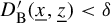 for some
$\delta>0$
for some
$\delta>0$
 then for all n large enough
$\bar {d}_{n,\delta }(\underline {x}, \underline {z})<\delta $
then for all n large enough
$\bar {d}_{n,\delta }(\underline {x}, \underline {z})<\delta $
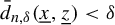 . It follows that there exists an
$(n, \delta )$
. It follows that there exists an
$(n, \delta )$
 -match of
$\underline {x}$
-match of
$\underline {x}$
 with
$\underline {z}$
with
$\underline {z}$
 . Therefore,
$\overline {fk}(\underline {x}, \underline {z})\leq D_{\mathrm {B}}'(\underline {x}, \underline {z})$
. Therefore,
$\overline {fk}(\underline {x}, \underline {z})\leq D_{\mathrm {B}}'(\underline {x}, \underline {z})$
 .
.
5
$\overline {fk}$
-convergence of measures and its properties

The relationship between
$\overline {fk}$
 and some metric on either
${{\mathcal {M}}_T^e}(X)$
and some metric on either
${{\mathcal {M}}_T^e}(X)$
 or
${\mathcal {M}_T}(X)$
or
${\mathcal {M}_T}(X)$
 is not clear, while the pseudometric
$\bar {f}$
is not clear, while the pseudometric
$\bar {f}$
 defined on
$\mathscr {A}^{\kern1.5pt\infty} $
defined on
$\mathscr {A}^{\kern1.5pt\infty} $
 in (2) relates to a metric on
${\mathcal {M}}_{\sigma }(\mathscr {A}^{\kern1.5pt\infty} )$
in (2) relates to a metric on
${\mathcal {M}}_{\sigma }(\mathscr {A}^{\kern1.5pt\infty} )$
 given by (5). Nonetheless, using
$\overline {fk}$
given by (5). Nonetheless, using
$\overline {fk}$
 , we can still introduce a form of ‘convergence’ in
${\mathcal {M}_T}(X)$
, we can still introduce a form of ‘convergence’ in
${\mathcal {M}_T}(X)$
 .
.
Definition 5.1. We say that a sequence of measures
$(\mu _n)_{n=1}^{\infty} \subset {\mathcal {M}_T}(X)$
 converges in
$\overline {fk}$
converges in
$\overline {fk}$
 or
$\overline {fk}$
or
$\overline {fk}$
 -converges to
$\mu \in {\mathcal {M}_T}(X)$
-converges to
$\mu \in {\mathcal {M}_T}(X)$
 if there exists a sequence of quasi-orbits
${(\underline {x}^{(n)})_{n=1}^{\infty} \subset X^{\infty} }$
if there exists a sequence of quasi-orbits
${(\underline {x}^{(n)})_{n=1}^{\infty} \subset X^{\infty} }$
 with
$V({\underline {x}^{(n)}})=\{\mu _n\}$
with
$V({\underline {x}^{(n)}})=\{\mu _n\}$
 such that for some
$\mu $
such that for some
$\mu $
 -generic quasi-orbit
$\underline {z}\in X^{\infty} $
-generic quasi-orbit
$\underline {z}\in X^{\infty} $
 we have
$\overline {fk}(\underline {z},\underline {x}^{(n)})\to 0$
we have
$\overline {fk}(\underline {z},\underline {x}^{(n)})\to 0$
 as
$n\to \infty $
as
$n\to \infty $
 .
.
Keeping in mind that we are interested in the GIKN construction, we will examine properties of the
$\overline {fk}$
 -convergence in a special case, where the quasi-orbits
$(\underline {x}^{(n)})_{n=1}^{\infty} \subset X^{\infty} $
-convergence in a special case, where the quasi-orbits
$(\underline {x}^{(n)})_{n=1}^{\infty} \subset X^{\infty} $
 are actually orbits (for each
$n\in \mathbb {N}$
are actually orbits (for each
$n\in \mathbb {N}$
 ,
$\underline {x}^{(n)}$
,
$\underline {x}^{(n)}$
 is the orbit of a
$\mu _n$
is the orbit of a
$\mu _n$
 -generic point).
5.1 ‘Completeness’ of
$\overline {fk}$
-convergence

Since
$\overline {fk}$
 is a pseudometric on
$X^{\infty} $
is a pseudometric on
$X^{\infty} $
 , given
$T\colon X\to X$
, given
$T\colon X\to X$
 , such notions as
$\overline {fk}$
, such notions as
$\overline {fk}$
 -Cauchy sequence or
$\overline {fk}$
-Cauchy sequence or
$\overline {fk}$
 -limit have obvious meaning. The first important feature of the
$\overline {fk}$
-limit have obvious meaning. The first important feature of the
$\overline {fk}$
 -convergence is that it has enough ‘completeness’ for our purposes: an
$\overline {fk}$
-convergence is that it has enough ‘completeness’ for our purposes: an
$\overline {fk}$
 -Cauchy sequence of orbits defines a quasi-orbit which is its
$\overline {fk}$
-Cauchy sequence of orbits defines a quasi-orbit which is its
$\overline {fk}$
 -limit.
Definition 5.2. We say that a sequence of quasi-orbits
$(\underline {x}^{(n)})_{n=1}^{\infty} \subset X^{\infty} $
 is
$\overline {fk}$
is
$\overline {fk}$
 -Cauchy if for every
$\varepsilon>0$
-Cauchy if for every
$\varepsilon>0$
 there is
$N\in \mathbb {N}$
there is
$N\in \mathbb {N}$
 such that
$\overline {fk}(\underline {x}^{(k)},\underline {x}^{(\ell )})<\varepsilon $
such that
$\overline {fk}(\underline {x}^{(k)},\underline {x}^{(\ell )})<\varepsilon $
 for
$k,\ell \ge N$
for
$k,\ell \ge N$
 .
.
Repeating the proof of [Reference Blanchard, Formenti and Kůrka4, Proposition 2], we get the following fact.
Lemma 5.3. If
$(x^{(n)})_{n=1}^{\infty} \subset X$
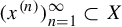 is an
$\overline {fk}$
is an
$\overline {fk}$
 -Cauchy sequence on X, then there is a quasi-orbit
$\underline {z}=(z_j)_{j=0}^{\infty} \in X^{\infty} $
-Cauchy sequence on X, then there is a quasi-orbit
$\underline {z}=(z_j)_{j=0}^{\infty} \in X^{\infty} $
 such that
$\overline {fk}(\underline {x}^{(n)}_T,\underline {z})\to 0\text { as }n\to \infty $
such that
$\overline {fk}(\underline {x}^{(n)}_T,\underline {z})\to 0\text { as }n\to \infty $
 .
.
In fact, the proof of Lemma 5.3 yields that there are
$0=m_0<m_1<m_2<\cdots $
 and a subsequence
$(x^{(n_j)})_{j=1}^{\infty} $
and a subsequence
$(x^{(n_j)})_{j=1}^{\infty} $
 of
$(x^{(n)})_{n=1}^{\infty} $
of
$(x^{(n)})_{n=1}^{\infty} $
 such that
$\bar {d}(\{m_j:j\ge 0\})=0$
such that
$\bar {d}(\{m_j:j\ge 0\})=0$
 and
$\underline {z}$
and
$\underline {z}$
 is given by
$z_n=T^n (x^{(n_j)})$
is given by
$z_n=T^n (x^{(n_j)})$
 for
$m_{j-1}\le n <m_{j}$
for
$m_{j-1}\le n <m_{j}$
 . We do not know whether under the assumptions of Lemma 5.3 there is a point whose orbit is an
$\overline {fk}$
. We do not know whether under the assumptions of Lemma 5.3 there is a point whose orbit is an
$\overline {fk}$
 -limit of the
$\overline {fk}$
-limit of the
$\overline {fk}$
 -Cauchy sequence. We can prove this only by imposing an extra assumption on
$T\colon X\to X$
-Cauchy sequence. We can prove this only by imposing an extra assumption on
$T\colon X\to X$
 . It turns out that the asymptotic average shadowing property is a sufficient requirement. Let us recall its definition.
Definition 5.4. A sequence
$\underline {z}=(z_j)_{j=0}^{\infty} \in X^{\infty }$
 is an asymptotic average pseudo-orbit for
$T\colon X\to X$
is an asymptotic average pseudo-orbit for
$T\colon X\to X$
 if
if

We say that
$\underline {z}=(z_j)_{j=0}^{\infty} \in X^{\infty }$
 is asymptotically shadowed on average by
$x\in X$
is asymptotically shadowed on average by
$x\in X$
 if
if

A system
$(X,T)$
 has the asymptotic average shadowing property if every asymptotic average pseudo-orbit of T is asymptotically shadowed on average by some point.
Note that if
$\underline {x}_T$
 and
$\underline {z}$
and
$\underline {z}$
 satisfy (7), then
$D_{\mathrm {B}}'(\underline {x}_T,\underline {z})=\overline {fk}(\underline {x}_T,\underline {z})=0$
satisfy (7), then
$D_{\mathrm {B}}'(\underline {x}_T,\underline {z})=\overline {fk}(\underline {x}_T,\underline {z})=0$
 as well (see (6) and Lemma 4.16). The asymptotic average shadowing property was introduced by Gu [Reference Rongbao41] and is implied by most versions of the specification property considered in the literature (see [Reference Can and Trilles14, Reference Kulczycki, Kwietniak and Oprocha33, Reference Kwietniak, Łącka and Oprocha35, Reference Kwietniak, Łącka and Oprocha36]).
Corollary 5.5. If
$(X,T)$
 satisfies the asymptotic average shadowing property, then
$\overline {fk}$
satisfies the asymptotic average shadowing property, then
$\overline {fk}$
 is a complete pseudometric on X.
Proof. Fix an
$\overline {fk}$
 -Cauchy sequence
$(x^{(n)})_{n=1}^{\infty} \subset X$
-Cauchy sequence
$(x^{(n)})_{n=1}^{\infty} \subset X$
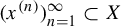 . Note that the quasi-orbit
$\underline {z}\in X^{\infty }$
. Note that the quasi-orbit
$\underline {z}\in X^{\infty }$
 provided by Lemma 5.3 is an asymptotic average pseudo-orbit and satisfies
$\overline {fk}(\underline {x}_T,\underline {z})=0$
provided by Lemma 5.3 is an asymptotic average pseudo-orbit and satisfies
$\overline {fk}(\underline {x}_T,\underline {z})=0$
 . Pick an
$x\in X$
. Pick an
$x\in X$
 that asymptotically average-shadows
$\underline {z}$
that asymptotically average-shadows
$\underline {z}$
 . Then

Therefore, x is an
$\overline {fk}$
 -limit of
$(x^{(n)})_{n=1}^{\infty} $
-limit of
$(x^{(n)})_{n=1}^{\infty} $
 in X.
in X.
It turns out that the set of generic quasi-orbits is
$\overline {fk}$
 -closed. More is true:
$V({\underline {x}})$
-closed. More is true:
$V({\underline {x}})$
 depends
$\overline {fk}$
depends
$\overline {fk}$
 -continuously on
$\underline {x}$
-continuously on
$\underline {x}$
 when we consider
$V({\underline {x}})$
when we consider
$V({\underline {x}})$
 as a point in the space of non-empty closed subsets of
${\mathcal {M}}(X)$
as a point in the space of non-empty closed subsets of
${\mathcal {M}}(X)$
 endowed with the Hausdorff metric
$D_{\mathrm {H}}$
endowed with the Hausdorff metric
$D_{\mathrm {H}}$
 induced by the Prokhorov metric
$D_{\mathrm {P}}$
induced by the Prokhorov metric
$D_{\mathrm {P}}$
 (the latter space is called the hyperspace of
${\mathcal {M}}(X)$
(the latter space is called the hyperspace of
${\mathcal {M}}(X)$
 ).
).
Fact 5.6. If
$\overline {fk}(\underline {x},\underline {z})<\varepsilon $
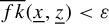 for some
$\varepsilon>0$
for some
$\varepsilon>0$
 , then
$D_{\mathrm {H}}(V({\underline {x}}),V({\underline {z}}))<\varepsilon $
, then
$D_{\mathrm {H}}(V({\underline {x}}),V({\underline {z}}))<\varepsilon $
 , where
$D_{\mathrm {H}}$
, where
$D_{\mathrm {H}}$
 is the Hausdorff metric on the hyperspace of
${\mathcal {M}}(X)$
is the Hausdorff metric on the hyperspace of
${\mathcal {M}}(X)$
 endowed with
$D_{\mathrm {P}}$
endowed with
$D_{\mathrm {P}}$
 .
.
Proof. If
$\overline {fk}(\underline {x},\underline {z})<\varepsilon $
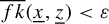 , then for some
$\overline {fk}(\underline {x},\underline {z})\le \delta <\varepsilon $
, then for some
$\overline {fk}(\underline {x},\underline {z})\le \delta <\varepsilon $
 we have
$\bar {f}_\delta (\underline {x},\underline {z})<\delta <\varepsilon $
we have
$\bar {f}_\delta (\underline {x},\underline {z})<\delta <\varepsilon $
 . Therefore,
$\bar {f}_{n,\delta }(\underline {x},\underline {z})<\delta $
. Therefore,
$\bar {f}_{n,\delta }(\underline {x},\underline {z})<\delta $
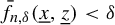 for all n large enough and
$D_{\mathrm {P}}({\mathfrak {m}}(\underline {x}, n), {\mathfrak {m}}(\underline {z}, n))< \varepsilon $
for all n large enough and
$D_{\mathrm {P}}({\mathfrak {m}}(\underline {x}, n), {\mathfrak {m}}(\underline {z}, n))< \varepsilon $
 by Fact 4.5. This implies that
$D_{\mathrm {H}}(V({\underline {x}}),V({\underline {z}}))<\varepsilon $
by Fact 4.5. This implies that
$D_{\mathrm {H}}(V({\underline {x}}),V({\underline {z}}))<\varepsilon $
 .
.
Although the proof of the following fact is short, its importance justifies calling it a theorem.
Theorem 5.7. Let
$(\underline {x}^{(n)})_{n=1}^{\infty} \subset X^{\infty }$
 be such that for each
$n\in \mathbb {N}$
be such that for each
$n\in \mathbb {N}$
 there is
$\mu _n\in {\mathcal {M}}(X)$
there is
$\mu _n\in {\mathcal {M}}(X)$
 with
$\underline {x}^{(n)}\in \operatorname {\mathrm {Gen}}(\mu _n)$
with
$\underline {x}^{(n)}\in \operatorname {\mathrm {Gen}}(\mu _n)$
 . If
$\underline {x}\in X^{\infty }$
. If
$\underline {x}\in X^{\infty }$
 and
$\overline {fk}(\underline {x},\underline {x}^{(n)})\to 0$
and
$\overline {fk}(\underline {x},\underline {x}^{(n)})\to 0$
 as
$n\to \infty $
as
$n\to \infty $
 , then there exists
$\mu \in {\mathcal {M}}(X)$
, then there exists
$\mu \in {\mathcal {M}}(X)$
 such that
$\mu _n\to \mu $
such that
$\mu _n\to \mu $
 as
$n\to \infty $
as
$n\to \infty $
 in
${\mathcal {M}}(X)$
in
${\mathcal {M}}(X)$
 and
$\underline {x}\in \operatorname {\mathrm {Gen}}(\mu )$
and
$\underline {x}\in \operatorname {\mathrm {Gen}}(\mu )$
 .
.
Proof. By Fact 5.6,
$\overline {fk}(\underline {x},\underline {x}^{(n)})\to 0$
 as
$n\to \infty $
as
$n\to \infty $
 implies that
$V({\underline {x}^{(n)}})\to V({\underline {x}})$
implies that
$V({\underline {x}^{(n)}})\to V({\underline {x}})$
 as
$n\to \infty $
as
$n\to \infty $
 in the hyperspace of
${\mathcal {M}}(X)$
in the hyperspace of
${\mathcal {M}}(X)$
 . Since
$\underline {x}^{(n)}$
. Since
$\underline {x}^{(n)}$
 is generic for
$\mu _n$
is generic for
$\mu _n$
 , we have
$V({\underline {x}^{(n)}})=\{\mu _n\}$
, we have
$V({\underline {x}^{(n)}})=\{\mu _n\}$
 for
$n\in \mathbb {N}$
for
$n\in \mathbb {N}$
 . The family of all singletons is closed in the hyperspace and homeomorphic with
${\mathcal {M}}(X)$
. The family of all singletons is closed in the hyperspace and homeomorphic with
${\mathcal {M}}(X)$
 . Thus,
$V({\underline {x}})$
. Thus,
$V({\underline {x}})$
 must also be a singleton, that is,
$V({\underline {x}})=\{\mu \}$
must also be a singleton, that is,
$V({\underline {x}})=\{\mu \}$
 for some
$\mu \in {\mathcal {M}}(X)$
for some
$\mu \in {\mathcal {M}}(X)$
 and
$\mu _n\to \mu $
and
$\mu _n\to \mu $
 as
$n\to \infty $
as
$n\to \infty $
 in
${\mathcal {M}}(X)$
in
${\mathcal {M}}(X)$
 .
.
An immediate consequence of Lemma 5.3 and Theorem 5.7 is the following corollary.
Corollary 5.8. An
$\overline {fk}$
 -Cauchy sequence of generic points uniquely determines an invariant measure.
Corollary 5.8 allows us to justify the correctness of the next definition.
Definition 5.9. An invariant measure determined by an
$\overline {fk}$
 -Cauchy sequence of generic points is called the
$\overline {fk}$
-Cauchy sequence of generic points is called the
$\overline {fk}$
 -limit of the corresponding sequence of measures.
6 Every GIKN sequence is
$\overline {fk}$
-Cauchy

All examples of
$(\gamma ,\kappa )$
 -good approximations found in the literature support the conjecture that each pair of periodic orbits satisfying Definition 3.1 is always
$(\gamma +(1-\kappa ))$
-good approximations found in the literature support the conjecture that each pair of periodic orbits satisfying Definition 3.1 is always
$(\gamma +(1-\kappa ))$
 -close with respect to
$\overline {fk}$
-close with respect to
$\overline {fk}$
 . However, the definition of a
$(\gamma ,\kappa )$
. However, the definition of a
$(\gamma ,\kappa )$
 -good approximation does not ensure that the
$(\gamma ,\kappa )$
-good approximation does not ensure that the
$(\gamma ,\kappa )$
 -projection
$\psi $
-projection
$\psi $
 appearing in Definition 3.1 is a match as in Definition 4.1. This is because a match must be order-preserving, and Definition 3.1 does not stipulate this requirement from a projection. Therefore, the following technical lemma is necessary.
Lemma 6.1. If a T-periodic orbit
$\Gamma $
 is a
$(\gamma ,\kappa )$
is a
$(\gamma ,\kappa )$
 -good approximation of a T-periodic orbit
$\Lambda $
-good approximation of a T-periodic orbit
$\Lambda $
 , then for any choice of
$x\in \Gamma $
, then for any choice of
$x\in \Gamma $
 and
$z\in \Lambda $
and
$z\in \Lambda $
 , one has
$\overline {fk}(x,z)<\gamma +(1-\kappa )$
, one has
$\overline {fk}(x,z)<\gamma +(1-\kappa )$
 .
.
Proof. It follows from Fact 4.15 that it is enough to find
$x_0\in \Gamma $
 and
$z_0\in \Lambda $
and
$z_0\in \Lambda $
 such that
$\overline {fk}(x_0,z_0)<\gamma +(1-\kappa )$
such that
$\overline {fk}(x_0,z_0)<\gamma +(1-\kappa )$
 .
.
Let
$\psi \colon \Delta \to \Lambda $
 be the
$(\gamma ,\kappa )$
be the
$(\gamma ,\kappa )$
 -projection from
$\Gamma $
-projection from
$\Gamma $
 to
$\Lambda $
to
$\Lambda $
 . Pick any
$x_0\in \Delta $
. Pick any
$x_0\in \Delta $
 and let
${z_0=\psi (x_0)\in \Lambda }$
and let
${z_0=\psi (x_0)\in \Lambda }$
 .
.
By Fact 4.11 it is enough to show that
$\bar {f}_\gamma (x_0,z_0)<1-\kappa $
 . Define
$q=|\Lambda |$
. Define
$q=|\Lambda |$
 . Furthermore, since
$x_0$
. Furthermore, since
$x_0$
 and
$z_0$
and
$z_0$
 are periodic, we conclude from Fact 4.9 and Fact 4.4 that it is sufficient to find for any multiple p of
$|\Gamma |$
are periodic, we conclude from Fact 4.9 and Fact 4.4 that it is sufficient to find for any multiple p of
$|\Gamma |$
 and
$|\Lambda |$
and
$|\Lambda |$
 a
$(p+q,\gamma )$
a
$(p+q,\gamma )$
 -match
$\pi $
-match
$\pi $
 of
$x_0$
of
$x_0$
 with
$z_0$
with
$z_0$
 such that
$|\pi |\ge \kappa p$
such that
$|\pi |\ge \kappa p$
 . Let p be a multiple of
$|\Gamma |$
. Let p be a multiple of
$|\Gamma |$
 and
$|\Lambda |$
and
$|\Lambda |$
 . For
$j\ge 1$
. For
$j\ge 1$
 define
$x_j=T^j(x_0)$
define
$x_j=T^j(x_0)$
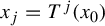 and
$z_j=T^j(z_0)$
and
$z_j=T^j(z_0)$
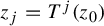 . Note that
$(z_j)_{j=0}^{\infty} $
. Note that
$(z_j)_{j=0}^{\infty} $
 is a q-periodic sequence. We will abuse the notation and treat
$\{x_0,\ldots ,x_{p-1}\}$
is a q-periodic sequence. We will abuse the notation and treat
$\{x_0,\ldots ,x_{p-1}\}$
 ,
$\{z_0,\ldots ,z_{p-1}\}$
,
$\{z_0,\ldots ,z_{p-1}\}$
 as sets with p elements, still denoted by
$\Gamma $
as sets with p elements, still denoted by
$\Gamma $
 and
$\Lambda $
and
$\Lambda $
 . Furthermore, we extend
$\psi $
. Furthermore, we extend
$\psi $
 to a function from
$\Delta \subset \{x_0,\ldots ,x_{p-1}\}$
to a function from
$\Delta \subset \{x_0,\ldots ,x_{p-1}\}$
 to
$\{z_0,\ldots ,z_{p-1}\}$
to
$\{z_0,\ldots ,z_{p-1}\}$
 where
$|\Delta |=r$
where
$|\Delta |=r$
 and
$r/p\ge \kappa $
and
$r/p\ge \kappa $
 .
.
We are going to define the match
$\pi $
 by performing an inductive construction with at most
$|\Delta |$
by performing an inductive construction with at most
$|\Delta |$
 steps. At each step we will extend the domain of
$\pi $
steps. At each step we will extend the domain of
$\pi $
 by at least one element. Enumerate elements of
$\Delta $
by at least one element. Enumerate elements of
$\Delta $
 as
$y_0,\ldots ,y_{r-1}$
as
$y_0,\ldots ,y_{r-1}$
 in such a way that the order induced by this indexing of
$\Delta $
in such a way that the order induced by this indexing of
$\Delta $
 coincides with the one induced by enumerating the elements of
$\Gamma $
coincides with the one induced by enumerating the elements of
$\Gamma $
 as
$x_0,\ldots ,x_{p-1}$
as
$x_0,\ldots ,x_{p-1}$
 . By definition,
$x_0=y_0$
. By definition,
$x_0=y_0$
 . Let
$\theta \colon \{0,\ldots ,r-1\}\to \{0,1,\ldots ,p-1\}$
. Let
$\theta \colon \{0,\ldots ,r-1\}\to \{0,1,\ldots ,p-1\}$
 be a function such that
$\theta (s)$
be a function such that
$\theta (s)$
 for
$0\le s< r$
for
$0\le s< r$
 is the position of
$y_s$
is the position of
$y_s$
 in the sequence
$x_0,\ldots ,x_{p-1}$
in the sequence
$x_0,\ldots ,x_{p-1}$
 , that is,
$\theta (s)=j$
, that is,
$\theta (s)=j$
 if and only if
$y_s=x_j$
if and only if
$y_s=x_j$
 .
.
We begin with
$\mathcal {D}(\pi )=\{0\}$
 and
$\pi (0)=0$
and
$\pi (0)=0$
 . By definition,
$z_{\pi (0)}=\psi (x_0)=z_0$
. By definition,
$z_{\pi (0)}=\psi (x_0)=z_0$
 , hence
$\rho (x_0,z_{\pi (0)})<\gamma $
, hence
$\rho (x_0,z_{\pi (0)})<\gamma $
 , and
$\pi $
, and
$\pi $
 is a
$(p+q,\gamma )$
is a
$(p+q,\gamma )$
 -match.
Now assume that we have already performed some number of steps of our construction and we have obtained a
$(p+q,\gamma )$
 -match
$\pi $
-match
$\pi $
 such that
$0\le s < r$
such that
$0\le s < r$
 is the largest integer satisfying
$|\pi |\ge s+1$
is the largest integer satisfying
$|\pi |\ge s+1$
 ,
$\theta (s)\in \mathcal {D}(\pi )$
,
$\theta (s)\in \mathcal {D}(\pi )$
 ,
$\pi (\theta (s))\le \theta (s)$
,
$\pi (\theta (s))\le \theta (s)$
 and
$z_{\pi (\theta (s))}=\psi (y_s)$
and
$z_{\pi (\theta (s))}=\psi (y_s)$
 . It follows from our construction that
$s+1$
. It follows from our construction that
$s+1$
 is always greater than or equal to the number of steps performed. We can extend
$\pi $
is always greater than or equal to the number of steps performed. We can extend
$\pi $
 by setting
$\pi (\theta (s)+i)=\theta (s)+i$
by setting
$\pi (\theta (s)+i)=\theta (s)+i$
 for
$0< i <q$
for
$0< i <q$
 . Now there are two cases to consider: either the domain of
$\pi $
. Now there are two cases to consider: either the domain of
$\pi $
 contains
$\{\theta (0),\ldots ,\theta (r-1)\}$
contains
$\{\theta (0),\ldots ,\theta (r-1)\}$
 and we are done, or there is
$s< t< r$
and we are done, or there is
$s< t< r$
 which is the smallest integer such that
$\pi $
which is the smallest integer such that
$\pi $
 is not defined at
$\theta (t)$
is not defined at
$\theta (t)$
 . Clearly, in the latter case
$\theta (t)-\theta (s)\ge q$
. Clearly, in the latter case
$\theta (t)-\theta (s)\ge q$
 . Since
$(z_j)_{j=0}^{\infty} $
. Since
$(z_j)_{j=0}^{\infty} $
 is a q-periodic sequence there exists
$1\le \ell \le q$
is a q-periodic sequence there exists
$1\le \ell \le q$
 such that
$z_{\theta (s)+\ell }=\psi (y_t)$
such that
$z_{\theta (s)+\ell }=\psi (y_t)$
 , and
$\pi (\theta (s))<\theta (s)+\ell \le \theta (t)$
, and
$\pi (\theta (s))<\theta (s)+\ell \le \theta (t)$
 . We want to set
$\pi (\theta (t))=\theta (s)+\ell $
. We want to set
$\pi (\theta (t))=\theta (s)+\ell $
 , but to keep
$\pi $
, but to keep
$\pi $
 increasing we need to remove first at most
$q-1$
increasing we need to remove first at most
$q-1$
 elements from
$\mathcal {D}(\pi )$
elements from
$\mathcal {D}(\pi )$
 as defined so far, namely those in
$\mathcal {D}(\pi )\cap \{\theta (s)+\ell ,\ldots ,\theta (s)+q-1\}$
as defined so far, namely those in
$\mathcal {D}(\pi )\cap \{\theta (s)+\ell ,\ldots ,\theta (s)+q-1\}$
 . But then we can set
$\pi (\theta (t)+i)=\theta (t)+i=\theta (s)+\ell +i$
. But then we can set
$\pi (\theta (t)+i)=\theta (t)+i=\theta (s)+\ell +i$
 for
$1\le i <q$
for
$1\le i <q$
 , because

For our new
$\pi $
 we see that the largest integer s in
$\{0,1,\ldots ,r-1\}$
we see that the largest integer s in
$\{0,1,\ldots ,r-1\}$
 satisfying
$|\pi |\ge s+1$
satisfying
$|\pi |\ge s+1$
 ,
$\theta (s)\in \mathcal {D}(\pi )$
,
$\theta (s)\in \mathcal {D}(\pi )$
 ,
$\pi (\theta (s))\le \theta (s)$
,
$\pi (\theta (s))\le \theta (s)$
 and
$z_{\pi (\theta (s))}=\psi (y_s)$
and
$z_{\pi (\theta (s))}=\psi (y_s)$
 is larger than or equal to t. Thus, in a finite number of steps our procedure will produce a
$(p+q,\gamma )$
is larger than or equal to t. Thus, in a finite number of steps our procedure will produce a
$(p+q,\gamma )$
 -match
$\pi $
-match
$\pi $
 with
${|\mathcal {D}(\pi )|\ge \kappa p}$
with
${|\mathcal {D}(\pi )|\ge \kappa p}$
 .
.
As a consequence, we see that a GIKN measure is the
$\overline {fk}$
 -limit of periodic measures, which immediately implies [Reference Bonatti, Díaz and Gorodetski8, Lemma 2.5], except for conclusions about ergodicity and support (see also [Reference Gorodetskiĭ, Ilyashenko, Kleptsyn and Nalskiĭ29, Lemma 2]).
Theorem 6.2. If
$(\Gamma _n)_{n\in \mathbb {N}}$
 is a GIKN sequence of T-periodic orbits and
$\mu _n$
is a GIKN sequence of T-periodic orbits and
$\mu _n$
 denotes the ergodic measure supported on
$\Gamma _n$
denotes the ergodic measure supported on
$\Gamma _n$
 for
$n\in \mathbb {N}$
for
$n\in \mathbb {N}$
 , then for any choice
$x_n\in \Gamma _n$
, then for any choice
$x_n\in \Gamma _n$
 the sequence
$(x_n)_{n=1}^{\infty} $
the sequence
$(x_n)_{n=1}^{\infty} $
 is
$\overline {fk}$
is
$\overline {fk}$
 -Cauchy and
$\mu _n\, \overline {fk}$
-Cauchy and
$\mu _n\, \overline {fk}$
 -converges to some
$\mu $
-converges to some
$\mu $
 . In particular, a GIKN measure is an
$\overline {fk}$
. In particular, a GIKN measure is an
$\overline {fk}$
 -limit of periodic measures.
7
$\overline {fk}$
-limit of ergodic measures is ergodic

We are going to show that an
$\overline {fk}$
 -limit of a sequence of ergodic measures must be ergodic. To this end, we first present a criterion for the ergodicity of a measure generated by a quasi-orbit. We obtain this by an easy adaptation of an analogous criterion for orbits given by Oxtoby [Reference Oxtoby40].
7.1 Auxiliary terminology and results
For
$k\in \mathbb {N}$
 ,
$\underline {x}=(x_j)_{j=0}^{\infty} \in X^{\infty }$
,
$\underline {x}=(x_j)_{j=0}^{\infty} \in X^{\infty }$
 , and
$\varphi \in \mathcal {C}(X)$
, and
$\varphi \in \mathcal {C}(X)$
 let
$A_k(\varphi ,\underline {x})$
let
$A_k(\varphi ,\underline {x})$
 denote the Birkhoff average along
$x_0,x_1,\ldots ,x_{k-1}$
denote the Birkhoff average along
$x_0,x_1,\ldots ,x_{k-1}$
 , that is,

For
$x\in X$
 we write
$A_k(\varphi ,x)$
we write
$A_k(\varphi ,x)$
 for the Birkhoff average along an orbit segment of length k, that is,
$A_k(\varphi ,x)=A_k(\varphi ,\underline {x}_T)$
for the Birkhoff average along an orbit segment of length k, that is,
$A_k(\varphi ,x)=A_k(\varphi ,\underline {x}_T)$
 .
.
Recall that a sequence
$\underline {x}\in X^{\infty }$
 (respectively, a point
$x\in X$
(respectively, a point
$x\in X$
 ) is generic for some measure
$\mu $
) is generic for some measure
$\mu $
 if and only if for every
$\varphi \in \mathcal C(X)$
if and only if for every
$\varphi \in \mathcal C(X)$
 the sequence
$A_k(\varphi ,\underline {x})$
the sequence
$A_k(\varphi ,\underline {x})$
 (respectively,
$A_k(\varphi ,x)$
(respectively,
$A_k(\varphi ,x)$
 ) converges as
$k\to \infty $
) converges as
$k\to \infty $
 . We denote the corresponding limit by
$\varphi ^*(\underline {x})$
. We denote the corresponding limit by
$\varphi ^*(\underline {x})$
 (respectively,
$\varphi ^*(x)$
(respectively,
$\varphi ^*(x)$
 ). It is easy to see that for any
$\ell \in \mathbb {N}$
). It is easy to see that for any
$\ell \in \mathbb {N}$
 , we have
$\varphi ^*(\underline {x})=\varphi ^*(\sigma ^\ell (\underline {x}))$
, we have
$\varphi ^*(\underline {x})=\varphi ^*(\sigma ^\ell (\underline {x}))$
 (respectively,
$\varphi ^*(x) =\varphi ^*(T^\ell (x))$
(respectively,
$\varphi ^*(x) =\varphi ^*(T^\ell (x))$
 ). For a generic sequence
$\underline {x}$
). For a generic sequence
$\underline {x}$
 we put

Furthermore, for a generic point x and
$\ell \in \mathbb {N}$
 , we define

Fix
$\alpha>0$
 ,
$k\in \mathbb {N}$
,
$k\in \mathbb {N}$
 , and
$\varphi \in \mathcal {C}(X)$
, and
$\varphi \in \mathcal {C}(X)$
 . We say that
$\ell \ge 0$
. We say that
$\ell \ge 0$
 is a starting point of an
$(\alpha ,\varphi )$
is a starting point of an
$(\alpha ,\varphi )$
 -bad k-segment in a generic sequence
$\underline {x}=(x_j)_{j=0}^{\infty} $
-bad k-segment in a generic sequence
$\underline {x}=(x_j)_{j=0}^{\infty} $
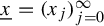 if
$A_k^*(\varphi ,\sigma ^\ell (\underline {x}))>\alpha $
if
$A_k^*(\varphi ,\sigma ^\ell (\underline {x}))>\alpha $
 .
.
The following characterization of ergodic sequences slightly generalizes the one presented by Oxtoby in [Reference Oxtoby40, §4]. It states that a generic sequence
$\underline {x}=(x_j)_{j=0}^{\infty} $
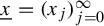 generates an ergodic measure if for every
$\varphi \in \mathcal {C}(X)$
generates an ergodic measure if for every
$\varphi \in \mathcal {C}(X)$
 and
$\alpha>0$
and
$\alpha>0$
 the upper density of the set of integers
$\ell $
the upper density of the set of integers
$\ell $
 being starting points for an
$(\alpha ,\varphi )$
being starting points for an
$(\alpha ,\varphi )$
 -bad k-segments converges to zero as k goes to
$\infty $
-bad k-segments converges to zero as k goes to
$\infty $
 . Replacing
$\underline {x}$
. Replacing
$\underline {x}$
 by
$\underline {x}_T$
by
$\underline {x}_T$
 , we obtain a criterion for ergodicity of a measure given by a generic point due to Oxtoby. We omit the proof as it follows the same lines as in [Reference Oxtoby40].
Theorem 7.1. (Oxtoby’s criterion)
Let a quasi-orbit
$\underline {z}=(z_j)_{j=0}^{\infty} \in X^{\infty }$
 be generic for some
$\mu \in {\mathcal {M}}_T(X)$
be generic for some
$\mu \in {\mathcal {M}}_T(X)$
 . Then
$\mu $
. Then
$\mu $
 is ergodic if and only if for every
$\varphi \in \mathcal {C}(X)$
is ergodic if and only if for every
$\varphi \in \mathcal {C}(X)$
 and
$\alpha>0$
and
$\alpha>0$
 we have

Let
$n\in \mathbb {N}$
 ,
$x\in X$
,
$x\in X$
 and
$\underline {z}\in X^{\infty }$
and
$\underline {z}\in X^{\infty }$
 . For an
$(n,\delta )$
. For an
$(n,\delta )$
 -match
$\pi $
-match
$\pi $
 of
$\underline {x}_T$
of
$\underline {x}_T$
 with
$\underline {z}$
with
$\underline {z}$
 and
$k\le n$
and
$k\le n$
 we define for every
$\ell \in \mathcal {D}(\pi )\cap \{0,1,\ldots ,n-k\}$
we define for every
$\ell \in \mathcal {D}(\pi )\cap \{0,1,\ldots ,n-k\}$
 a set
a set

and the
$(k,\delta )$
 -match
$\pi ^{\prime }_\ell \colon \mathcal {D}^{\prime }_\ell \to \pi (\mathcal {D}^{\prime }_\ell )$
-match
$\pi ^{\prime }_\ell \colon \mathcal {D}^{\prime }_\ell \to \pi (\mathcal {D}^{\prime }_\ell )$
 induced by
$\pi $
induced by
$\pi $
 at
$\ell $
at
$\ell $
 setting
$\pi ^{\prime }_\ell (i)=\pi (i)$
setting
$\pi ^{\prime }_\ell (i)=\pi (i)$
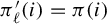 for
${i\in \mathcal {D}(\pi ^{\prime }_\ell )}$
for
${i\in \mathcal {D}(\pi ^{\prime }_\ell )}$
 . It is easy to see that
$\pi ^{\prime }_\ell $
. It is easy to see that
$\pi ^{\prime }_\ell $
 is indeed an
$(k,\delta )$
is indeed an
$(k,\delta )$
 -match of
$T^\ell (x)$
-match of
$T^\ell (x)$
 with
$z_{\pi (\ell )}$
with
$z_{\pi (\ell )}$
 satisfying
$\mathcal {D}(\pi ^{\prime }_\ell )=\mathcal {D}^{\prime }_\ell $
satisfying
$\mathcal {D}(\pi ^{\prime }_\ell )=\mathcal {D}^{\prime }_\ell $
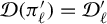 and
$\mathcal {R}(\pi ^{\prime }_\ell )=\pi (\mathcal {D}^{\prime }_\ell )$
and
$\mathcal {R}(\pi ^{\prime }_\ell )=\pi (\mathcal {D}^{\prime }_\ell )$
 .
.
We also need the following technical lemma, which asserts that if an orbit
$\underline {x}_T$
 and a quasi-orbit
$\underline {z}$
and a quasi-orbit
$\underline {z}$
 are sufficiently
$\overline {fk}$
are sufficiently
$\overline {fk}$
 -close, then for any
$\varphi \in \mathcal C(X)$
-close, then for any
$\varphi \in \mathcal C(X)$
 and
$k\in \mathbb {N}$
and
$k\in \mathbb {N}$
 one can find a match
$\pi $
one can find a match
$\pi $
 which allows one to find a match
$\pi $
which allows one to find a match
$\pi $
 of
$\underline {x}_T$
of
$\underline {x}_T$
 and
$\underline {z}$
and
$\underline {z}$
 so that the averages of
$\varphi $
so that the averages of
$\varphi $
 over k segments in
$\underline {x}_T$
over k segments in
$\underline {x}_T$
 and
$\underline {z}$
and
$\underline {z}$
 are also small for most of k-segments.
Lemma 7.2. Fix
$\varphi \in \mathcal C(X)$
 and
$\varepsilon>0$
and
$\varepsilon>0$
 . Let
$\delta>0$
. Let
$\delta>0$
 be such that
$y,y'\in X$
be such that
$y,y'\in X$
 and
${\rho (y,y')<\delta }$
and
${\rho (y,y')<\delta }$
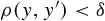 imply
$|\varphi (y)-\varphi (y')|<\varepsilon $
imply
$|\varphi (y)-\varphi (y')|<\varepsilon $
 . If
$\underline {z}=(z_j)_{j=0}^{\infty} \in X^{\infty }$
. If
$\underline {z}=(z_j)_{j=0}^{\infty} \in X^{\infty }$
 is a quasi-orbit and
$x\in X$
is a quasi-orbit and
$x\in X$
 satisfies
$\overline {fk}(\underline {x}_T,\underline {z})<\delta $
satisfies
$\overline {fk}(\underline {x}_T,\underline {z})<\delta $
 , then for every
$k\in \mathbb {N}$
, then for every
$k\in \mathbb {N}$
 there exists
$N\in \mathbb {N}$
there exists
$N\in \mathbb {N}$
 such that for every
$n\geq N$
such that for every
$n\geq N$
 there are an
$(n,\delta )$
there are an
$(n,\delta )$
 -match
$\pi $
-match
$\pi $
 of
$\underline {x}_T$
of
$\underline {x}_T$
 with
$\underline {z}$
with
$\underline {z}$
 and a set
$A\subset \mathcal D(\pi )$
and a set
$A\subset \mathcal D(\pi )$
 with
$|A|>n(1-2\sqrt {\delta }-2\delta )-k$
with
$|A|>n(1-2\sqrt {\delta }-2\delta )-k$
 satisfying

Proof. Fix
$k\in \mathbb {N}$
 ,
$\varphi \in \mathcal C(X)$
,
$\varphi \in \mathcal C(X)$
 and
$\varepsilon>0$
and
$\varepsilon>0$
 . Choose
$N\in \mathbb {N}$
. Choose
$N\in \mathbb {N}$
 such that for every
$n\geq N$
such that for every
$n\geq N$
 there exists an
$(n,\delta )$
there exists an
$(n,\delta )$
 -match
$\pi $
-match
$\pi $
 of
$\underline {x}_T$
of
$\underline {x}_T$
 with
$\underline {z}$
with
$\underline {z}$
 satisfying
$|\pi |>n(1-\delta )$
satisfying
$|\pi |>n(1-\delta )$
 and
and

Fix
$n\geq N$
 . Define

Note that
$|A_Z|\le n\delta $
 . To estimate
$|A_R|$
. To estimate
$|A_R|$
 , define
$\mathcal {R}^{c}(\pi )=\{0,1,\ldots ,n-1\}\setminus \mathcal {R}(\pi )$
, define
$\mathcal {R}^{c}(\pi )=\{0,1,\ldots ,n-1\}\setminus \mathcal {R}(\pi )$
 , and note that

On the other hand, for each
$m\in \mathcal {R}^c(\pi )$
 the set
$\{j\in A_R\,:\,\pi (j)\le m <\pi (j)+k\}$
the set
$\{j\in A_R\,:\,\pi (j)\le m <\pi (j)+k\}$
 has at most k elements; hence, each
$j\in A_R$
has at most k elements; hence, each
$j\in A_R$
 implies that there are at least
$\sqrt {\delta }$
implies that there are at least
$\sqrt {\delta }$
 members of
$\mathcal {R}^c(\pi )$
members of
$\mathcal {R}^c(\pi )$
 . Thus,
$|\mathcal {R}^c(\pi )|\ge |A_R| \sqrt {\delta }$
. Thus,
$|\mathcal {R}^c(\pi )|\ge |A_R| \sqrt {\delta }$
 . This, together with
$|\mathcal {R}^c(\pi )|<n\delta $
. This, together with
$|\mathcal {R}^c(\pi )|<n\delta $
 , gives us
$|A_R|< n\sqrt \delta $
, gives us
$|A_R|< n\sqrt \delta $
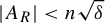 . An analogous reasoning leads to
$|A_D|< n\sqrt \delta $
. An analogous reasoning leads to
$|A_D|< n\sqrt \delta $
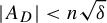 . Define

Then
$|A|> n(1-2\sqrt \delta -2\delta )-k$
 and for every
$j\in A$
and for every
$j\in A$
 we have:
-
(i) the $(k,\delta )$
-match
$\pi ^{\prime }_j$
induced by
$\pi $
at j satisfies
$|\pi ^{\prime }_j|>(1-2\sqrt {\delta })k$
; -
(ii) $A_k(\varphi ,z_{\pi (j)})=A_k(\varphi ,\sigma ^{\pi (j)}(\underline {z}))$
.




Therefore,

and the lemma follows.
7.2
$\overline {fk}$
-limits of ergodic measures are ergodic

We prove the main theorem of this section. As the GIKN sequence of periodic orbits is
$\overline {fk}$
 -Cauchy by Theorem 6.2, we see that our Theorem 7.3 generalizes [Reference Gorodetskiĭ, Ilyashenko, Kleptsyn and Nalskiĭ29, Lemma 2]. Furthermore, since
$\overline {fk}\le D_{\mathrm {B}}$
-Cauchy by Theorem 6.2, we see that our Theorem 7.3 generalizes [Reference Gorodetskiĭ, Ilyashenko, Kleptsyn and Nalskiĭ29, Lemma 2]. Furthermore, since
$\overline {fk}\le D_{\mathrm {B}}$
 , this result also extends [Reference Kwietniak, Łącka and Oprocha36, Theorem 15].
Theorem 7.3. If
$(x^{(p)})_{p=1}^{\infty }\subset X$
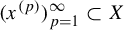 is an
$\overline {fk}$
is an
$\overline {fk}$
 -Cauchy sequence of ergodic points then it determines an ergodic measure.
Proof. By Fact 5.6 there exists a measure
$\mu \in \mathcal {\mathcal {M}}_T(X)$
 such that
$\mu _p\to \mu $
such that
$\mu _p\to \mu $
 as
$p\to \infty $
as
$p\to \infty $
 in the weak
$^*$
in the weak
$^*$
 topology on
${\mathcal {M}}_T(X)$
topology on
${\mathcal {M}}_T(X)$
 . We will apply Oxtoby’s criterion (Theorem 7.1) to show that
$\mu $
. We will apply Oxtoby’s criterion (Theorem 7.1) to show that
$\mu $
 is ergodic. Let
$\underline {z}=(z_j)_{j=0}^{\infty} $
is ergodic. Let
$\underline {z}=(z_j)_{j=0}^{\infty} $
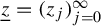 be a quasi-orbit such that
$\bar {f}(\underline {x}^{(p)}_T,\underline {z})\to 0$
be a quasi-orbit such that
$\bar {f}(\underline {x}^{(p)}_T,\underline {z})\to 0$
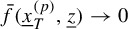 as
$p\to \infty $
as
$p\to \infty $
 provided by Lemma 5.3. Clearly,
$\underline {z}$
provided by Lemma 5.3. Clearly,
$\underline {z}$
 is generic for
$\mu $
is generic for
$\mu $
 . Fix
$\varphi \in \mathcal {C}(X)$
. Fix
$\varphi \in \mathcal {C}(X)$
 and
$\alpha>0$
and
$\alpha>0$
 . We need to show that for every
$\eta>0$
. We need to show that for every
$\eta>0$
 and all sufficiently large k the set of js initiating an
$(\alpha ,\varphi )$
and all sufficiently large k the set of js initiating an
$(\alpha ,\varphi )$
 -bad k-segment in
$\underline {z}$
-bad k-segment in
$\underline {z}$
 has upper density smaller than
$\eta $
has upper density smaller than
$\eta $
 .
.
Note that for every
$i,j,k,p\in \mathbb {N}$
 we have

By Theorem 5.7 and Fact 5.6 we can choose
$P(\alpha )\in \mathbb {N}$
 such that for every
$p\geq P(\alpha )$
such that for every
$p\geq P(\alpha )$
 one has
$|\varphi ^*(x^{(p)})-\varphi ^*(\underline {z})|\leq \alpha /3$
one has
$|\varphi ^*(x^{(p)})-\varphi ^*(\underline {z})|\leq \alpha /3$
 .
.
Let
$\delta _0>0$
 be such that
$2\sqrt \delta _0+2\delta _0<\eta /4$
be such that
$2\sqrt \delta _0+2\delta _0<\eta /4$
 and
$4\sqrt \delta _0||\varphi ||_{\infty }<\alpha /6$
and
$4\sqrt \delta _0||\varphi ||_{\infty }<\alpha /6$
 . Pick
$\delta <\delta _0$
. Pick
$\delta <\delta _0$
 such that for all
$y,y'\in X$
such that for all
$y,y'\in X$
 with
$\rho (y,y')<\delta $
with
$\rho (y,y')<\delta $
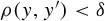 one has
$|\varphi (y)-\varphi (y')|<\alpha /6$
one has
$|\varphi (y)-\varphi (y')|<\alpha /6$
 . Note that our choice of constants is motivated by Lemma 7.2. Choose
$p\geq P(\alpha )$
. Note that our choice of constants is motivated by Lemma 7.2. Choose
$p\geq P(\alpha )$
 such that
$\bar {f}(\underline {z},x^{(p)}_T)<\delta $
such that
$\bar {f}(\underline {z},x^{(p)}_T)<\delta $
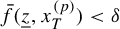 . Pick
$K>0$
. Pick
$K>0$
 such that for all
$k\geq K$
such that for all
$k\geq K$
 the upper density of the set of is initiating an
$(\alpha /3,\varphi )$
the upper density of the set of is initiating an
$(\alpha /3,\varphi )$
 -bad k-segment in
$x^{(p)}_T$
-bad k-segment in
$x^{(p)}_T$
 is smaller than
$\eta /2$
is smaller than
$\eta /2$
 . We are going to prove that each
$k\ge K$
. We are going to prove that each
$k\ge K$
 is ‘sufficiently large’ to imply that the upper density of the set of js initiating an
$(\alpha ,\varphi )$
is ‘sufficiently large’ to imply that the upper density of the set of js initiating an
$(\alpha ,\varphi )$
 -bad k-segment in
$\underline {z}$
-bad k-segment in
$\underline {z}$
 is smaller than
$\eta $
is smaller than
$\eta $
 . To this end fix any
$k\ge K$
. To this end fix any
$k\ge K$
 . Let N be sufficiently large to guarantee that
$k/N<\eta /4$
. Let N be sufficiently large to guarantee that
$k/N<\eta /4$
 and for every
$n\ge N$
and for every
$n\ge N$
 we have
-
(i) there exists an $(n,\delta )$
-match
$\pi $
of
$\underline {z}$
with
$x^{(p)}$
such that
$|\pi |>(1-\delta )n$
, -
(ii) $|\{0\leq j<n\,:T(z_{j+i})\neq z_{j+i+1}\text { for some }0\leq i<k\}|<n\delta $
, -
(iii) $|\{0\le i<n\,:\, i$
initiates an
$(\alpha /3,\varphi )$
-bad k-segment in
$x^{(p)}_T\}|< n\eta /2$
.






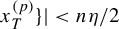
We are going to show that for each
$n\ge N$
 the number of
$0\le j<n$
the number of
$0\le j<n$
 such that

is larger than
$(1-\eta )n$
 . To this end let
$\tilde \pi $
. To this end let
$\tilde \pi $
 be any extension of
$\pi $
be any extension of
$\pi $
 to a bijection from
$\{0,\ldots ,n-1\}$
to a bijection from
$\{0,\ldots ,n-1\}$
 onto
$\{0,\ldots ,n-1\}$
onto
$\{0,\ldots ,n-1\}$
 . It follows from the proof of Lemma 7.2 that conditions (i) and (ii) guarantee that the number of integers
$0\leq j<n$
. It follows from the proof of Lemma 7.2 that conditions (i) and (ii) guarantee that the number of integers
$0\leq j<n$
 for which

is larger than
$n(1-2\sqrt \delta -2\delta )-k$
 and hence larger than
$n(1-\eta /2)$
and hence larger than
$n(1-\eta /2)$
 . Some of these js may initiate an
$(\alpha /3,\varphi )$
. Some of these js may initiate an
$(\alpha /3,\varphi )$
 -bad k-segment in
$x^{(p)}_T$
-bad k-segment in
$x^{(p)}_T$
 , but condition (iii) bounds from the above the number of such js by
$n\eta /2$
, but condition (iii) bounds from the above the number of such js by
$n\eta /2$
 . Therefore, setting
$i=\tilde \pi (j)$
. Therefore, setting
$i=\tilde \pi (j)$
 in (8), we see that the number of integers
$0\leq j<n$
in (8), we see that the number of integers
$0\leq j<n$
 for which all summands on the right-hand side of (8) are bounded above by
$\alpha /3$
for which all summands on the right-hand side of (8) are bounded above by
$\alpha /3$
 is larger than
$n(1-\eta )$
is larger than
$n(1-\eta )$
 . Since this holds true for any
$n\ge N$
. Since this holds true for any
$n\ge N$
 we see that upper density of the set of all js initiating an
$(\alpha ,\varphi )$
we see that upper density of the set of all js initiating an
$(\alpha ,\varphi )$
 -bad k-segment in
$\underline {z}$
-bad k-segment in
$\underline {z}$
 is smaller than
$\eta $
is smaller than
$\eta $
 , hence the Oxtoby criterion yields that
$\underline {z}$
, hence the Oxtoby criterion yields that
$\underline {z}$
 is an ergodic sequence.
The ergodicity of GIKN measures is now a straightforward corollary; hence [Reference Bonatti, Díaz and Gorodetski8, Lemma 2.5] is recovered, except for the statement about the support (which can now be proved in the same way as in [Reference Bonatti, Díaz and Gorodetski8], since the proof of that part of [Reference Bonatti, Díaz and Gorodetski8, Lemma 2.5] is independent of the rest).
Corollary 7.4. Every GIKN measure is ergodic.
8 Lower semicontinuity of entropy in
$\overline {fk}$

We are going to show that the function assigning the entropy of the associated measure to a generic point is lower semicontinuous with respect to
$\overline {fk}$
 .
.
Theorem 8.1. If a sequence of measures
$(\mu _n)_{n=1}^{\infty} $
 converges in
$\overline {fk}$
converges in
$\overline {fk}$
 to
$\mu _0\in {\mathcal {M}_T}(X)$
to
$\mu _0\in {\mathcal {M}_T}(X)$
 , then

Before proceeding with the proof, we first note the following technical result allowing us, given an
$\overline {fk}$
 -converging sequence of invariant measures, to replace any partition with a faithful partition without much change in the
$\bar {f}$
-converging sequence of invariant measures, to replace any partition with a faithful partition without much change in the
$\bar {f}$
 -distance between codings of generic points of the measures in the sequence.
Lemma 8.2. If
$\delta>0$
 ,
${\mathcal {P}}\in \mathbf {P}^k(X)$
,
${\mathcal {P}}\in \mathbf {P}^k(X)$
 and
$(\mu _j)_{j=0}^{\infty }\subset {{\mathcal {M}}_T^e}(X)$
and
$(\mu _j)_{j=0}^{\infty }\subset {{\mathcal {M}}_T^e}(X)$
 , then there are
$\gamma>0$
, then there are
$\gamma>0$
 and
$\mathcal {R}\in \mathbf {P}^{k+1}(X)$
and
$\mathcal {R}\in \mathbf {P}^{k+1}(X)$
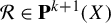 with
$d^{\mu _0}_1({\mathcal {P}},\mathcal {R})<\delta $
with
$d^{\mu _0}_1({\mathcal {P}},\mathcal {R})<\delta $
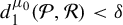 satisfying that if
$\underline {x}\in X^{\infty} $
satisfying that if
$\underline {x}\in X^{\infty} $
 is generic for
$\mu _0$
is generic for
$\mu _0$
 ,
$j\in \mathbb {N}$
,
$j\in \mathbb {N}$
 , and
$\underline {z}\in X^{\infty} $
, and
$\underline {z}\in X^{\infty} $
 is generic for
$\mu _{j}$
is generic for
$\mu _{j}$
 with
$\overline {fk}(\underline {x},\underline {z})<\gamma $
with
$\overline {fk}(\underline {x},\underline {z})<\gamma $
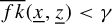 , then
$\bar {f}(\mathcal {R}(\underline {x}),\mathcal {R}(\underline {z}))<\delta +\overline {fk}(\underline {x},\underline {z})$
, then
$\bar {f}(\mathcal {R}(\underline {x}),\mathcal {R}(\underline {z}))<\delta +\overline {fk}(\underline {x},\underline {z})$
 and
$\mu _j(\partial \mathcal {R})=\mu _0(\partial \mathcal {R})=0$
and
$\mu _j(\partial \mathcal {R})=\mu _0(\partial \mathcal {R})=0$
 . The same holds if we replace
$\bar {f}$
. The same holds if we replace
$\bar {f}$
 by
$\bar {d}$
by
$\bar {d}$
 and
$\overline {fk}$
and
$\overline {fk}$
 by
$D_{\mathrm {B}}$
by
$D_{\mathrm {B}}$
 .
.
Proof. Fix
$\delta>0$
 . Using regularity of
$\mu _0$
. Using regularity of
$\mu _0$
 for each
$1\le j\le k$
for each
$1\le j\le k$
 , we can find a compact set
$R_j\subset P_j$
, we can find a compact set
$R_j\subset P_j$
 such that
$\mu _0(P_j\setminus R_j)<\delta /(8k^2)$
such that
$\mu _0(P_j\setminus R_j)<\delta /(8k^2)$
 . For
$1\le i < j\le k$
. For
$1\le i < j\le k$
 the sets
$R_i$
the sets
$R_i$
 and
$R_j$
and
$R_j$
 are compact and disjoint, hence

Set
$\tilde \gamma =\Delta /2$
 . For each
$1\le j\le k$
. For each
$1\le j\le k$
 and
$0\le c<\tilde \gamma $
and
$0\le c<\tilde \gamma $
 let
$R^c_j$
let
$R^c_j$
 be the closed c-hull around
$Q_j$
be the closed c-hull around
$Q_j$
 , that is,
$R^c_j=\{x\in X: \operatorname {\mathrm {dist}}(x,Q_j)\le c\}$
, that is,
$R^c_j=\{x\in X: \operatorname {\mathrm {dist}}(x,Q_j)\le c\}$
 , and set
$R^c_0=X\setminus (R^c_1\cup \cdots \cup R^c_k)$
, and set
$R^c_0=X\setminus (R^c_1\cup \cdots \cup R^c_k)$
 . For each
${0\le c<\tilde \gamma }$
. For each
${0\le c<\tilde \gamma }$
 define the partition
$\mathcal {R}^c=\{R^c_0,R^c_1,\ldots ,R^c_k\}$
define the partition
$\mathcal {R}^c=\{R^c_0,R^c_1,\ldots ,R^c_k\}$
 . It is easy to see that
${d_1^{\mu _0}({\mathcal {P}},\mathcal {R}^\alpha )<\delta /2}$
. It is easy to see that
${d_1^{\mu _0}({\mathcal {P}},\mathcal {R}^\alpha )<\delta /2}$
 and
$d_1^{\mu _0}(\mathcal {R}^\alpha ,\mathcal {R}^\beta )<\delta /2$
and
$d_1^{\mu _0}(\mathcal {R}^\alpha ,\mathcal {R}^\beta )<\delta /2$
 for any
$0\le \alpha ,\beta <\tilde \gamma $
for any
$0\le \alpha ,\beta <\tilde \gamma $
 .
.
For
$1\le j\le k$
 and
$0<c<\tilde \gamma $
and
$0<c<\tilde \gamma $
 define a set
$\partial _c Q_j =\{x\in X: \operatorname {\mathrm {dist}} (x,Q_j)=c\}$
define a set
$\partial _c Q_j =\{x\in X: \operatorname {\mathrm {dist}} (x,Q_j)=c\}$
 . Note that
$\partial _c Q_j$
. Note that
$\partial _c Q_j$
 contains (but need not be equal to) the topological boundary of the set
$R^c_j=\{x\in X: \operatorname {\mathrm {dist}} (x,Q_j)\le c\}$
contains (but need not be equal to) the topological boundary of the set
$R^c_j=\{x\in X: \operatorname {\mathrm {dist}} (x,Q_j)\le c\}$
 . Consider a family of closed sets
$\mathcal {C}=\{\partial _c Q_1\cup \cdots \cup \partial _c Q_k: 0<c<\tilde \gamma \}$
. Consider a family of closed sets
$\mathcal {C}=\{\partial _c Q_1\cup \cdots \cup \partial _c Q_k: 0<c<\tilde \gamma \}$
 . Since elements of
$\mathcal {C}$
. Since elements of
$\mathcal {C}$
 are pairwise disjoint, only countably many of them can have positive
$\mu _j$
are pairwise disjoint, only countably many of them can have positive
$\mu _j$
 measure for some
$j\in \mathbb {N}\cup \{0\}$
measure for some
$j\in \mathbb {N}\cup \{0\}$
 . Therefore, the set E of all parameters
$0<c<\tilde \gamma $
. Therefore, the set E of all parameters
$0<c<\tilde \gamma $
 such that for each
$c\in E$
such that for each
$c\in E$
 the set
$\partial _c Q_1\cup \cdots \cup \partial _c Q_k\in \mathcal {C}$
the set
$\partial _c Q_1\cup \cdots \cup \partial _c Q_k\in \mathcal {C}$
 is a
$\mu _j$
is a
$\mu _j$
 -null set for
$j\in \mathbb {N}\cup \{0\}$
-null set for
$j\in \mathbb {N}\cup \{0\}$
 has at most countable complement in
$(0,\tilde \gamma )$
has at most countable complement in
$(0,\tilde \gamma )$
 . Thus, we can pick
$\alpha ,\beta \in E$
. Thus, we can pick
$\alpha ,\beta \in E$
 with
$\alpha <\beta $
with
$\alpha <\beta $
 and
$\beta -\alpha>\tilde \gamma /2$
and
$\beta -\alpha>\tilde \gamma /2$
 . Set
$\gamma =\tilde \gamma /2$
. Set
$\gamma =\tilde \gamma /2$
 . Let
$\underline {z}\in X^{\infty} $
. Let
$\underline {z}\in X^{\infty} $
 be a generic sequence for
$\mu _j$
be a generic sequence for
$\mu _j$
 for some
$j\in \mathbb {N}$
for some
$j\in \mathbb {N}$
 and
$\bar {f}(\underline {x},\underline {z})<\gamma $
and
$\bar {f}(\underline {x},\underline {z})<\gamma $
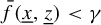 . Note that
$\beta -\alpha>\bar {f}(\underline {x},\underline {z})$
. Note that
$\beta -\alpha>\bar {f}(\underline {x},\underline {z})$
 . Define
$x"=\mathcal {R}^\alpha (\underline {x})$
. Define
$x"=\mathcal {R}^\alpha (\underline {x})$
 ,
$z'=\mathcal {R}^\beta (\underline {z})$
,
$z'=\mathcal {R}^\beta (\underline {z})$
 and
$x'=\mathcal {R}^\beta (\underline {x})$
and
$x'=\mathcal {R}^\beta (\underline {x})$
 (all three points are considered as elements of the shift space over the alphabet
$\{0,1,\ldots ,k\}$
(all three points are considered as elements of the shift space over the alphabet
$\{0,1,\ldots ,k\}$
 ).
).
We claim that
$\bar {f}(x",z')< \bar {f}(\underline {x},\underline {z})+\delta /2$
 . Indeed, if for some
$m,n\ge 0$
. Indeed, if for some
$m,n\ge 0$
 and
${1\le j\le k}$
and
${1\le j\le k}$
 we have
$x_n\in R^\alpha _j$
we have
$x_n\in R^\alpha _j$
 and
$\rho (x_n,z_m)<\bar {f}(\underline {x},\underline {z})<\beta -\alpha $
and
$\rho (x_n,z_m)<\bar {f}(\underline {x},\underline {z})<\beta -\alpha $
 , then
$\mathcal {R}^\beta (z_m)=j$
, then
$\mathcal {R}^\beta (z_m)=j$
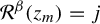 . Furthermore, genericity of
$\underline {x}$
. Furthermore, genericity of
$\underline {x}$
 for
$\mu _0$
for
$\mu _0$
 and
$\mu _0(\partial R^\alpha _0)=0$
and
$\mu _0(\partial R^\alpha _0)=0$
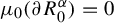 implies that
$d(\{n\ge 0: x_n\in R^\alpha _0\})=\mu _0(R^\alpha _0)<\delta /2$
implies that
$d(\{n\ge 0: x_n\in R^\alpha _0\})=\mu _0(R^\alpha _0)<\delta /2$
 . This proves the claim.
Using again that
$\underline {x}$
 is generic for
$\mu _0$
is generic for
$\mu _0$
 , and
$\partial \mathcal {R}^\alpha $
, and
$\partial \mathcal {R}^\alpha $
 ,
$\partial \mathcal {R}^\beta $
,
$\partial \mathcal {R}^\beta $
 are
$\mu _0$
are
$\mu _0$
 -null, we easily obtain that
$\bar {d}(x',x")\le d_1^{\mu _0}(\mathcal {R}^\alpha ,\mathcal {R}^\beta )$
-null, we easily obtain that
$\bar {d}(x',x")\le d_1^{\mu _0}(\mathcal {R}^\alpha ,\mathcal {R}^\beta )$
 . Together with the claim above and
$\bar {f}(x',x")\le \bar {d}(x',x")$
. Together with the claim above and
$\bar {f}(x',x")\le \bar {d}(x',x")$
 , this completes the proof for the
$\bar {f}$
, this completes the proof for the
$\bar {f}$
 case. The
$\bar {d}$
case. The
$\bar {d}$
 -part follows in the same way.
Proof of Theorem 8.1
Fix
$\varepsilon>0$
 . Let
${\mathcal {P}}=\{P_1,\ldots ,P_k\}$
. Let
${\mathcal {P}}=\{P_1,\ldots ,P_k\}$
 be a measurable partition of X with
$h(\mu _0,{\mathcal {P}})\ge h(\mu _0)-\varepsilon /3$
be a measurable partition of X with
$h(\mu _0,{\mathcal {P}})\ge h(\mu _0)-\varepsilon /3$
 . Let
$\zeta>0$
. Let
$\zeta>0$
 be so small that
$\bar {f}(y,y')<\zeta $
be so small that
$\bar {f}(y,y')<\zeta $
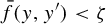 for two shift generic points
$y,y'\in \{0,1,\ldots ,k\}^{\infty} $
for two shift generic points
$y,y'\in \{0,1,\ldots ,k\}^{\infty} $
 implies that the entropies of the corresponding measures differ by at most
$\varepsilon /3$
implies that the entropies of the corresponding measures differ by at most
$\varepsilon /3$
 (the existence of such a
$\zeta $
(the existence of such a
$\zeta $
 is guaranteed by [Reference Ornstein, Rudolph and Weiss39, Proposition 3.4] and [Reference Downarowicz, Kwietniak and Łącka20]).
Since the function
$\mathcal P\mapsto h(\mu ,\mathcal P)$
 is uniformly continuous on
$\mathbf {P}^{k+1}$
is uniformly continuous on
$\mathbf {P}^{k+1}$
 [Reference Glasner27, Lemma 15.9 (5)], we may pick
$0<\delta <\zeta /2$
[Reference Glasner27, Lemma 15.9 (5)], we may pick
$0<\delta <\zeta /2$
 such that for any partition
$\mathcal {S}=\{S_0,S_1,\ldots ,S_k\}$
such that for any partition
$\mathcal {S}=\{S_0,S_1,\ldots ,S_k\}$
 with
$d_1^{\mu _0}({\mathcal {P}},\mathcal {S})<\delta $
with
$d_1^{\mu _0}({\mathcal {P}},\mathcal {S})<\delta $
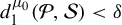 we have
$|h(\mu _0,{\mathcal {P}})-h(\mu _0,\mathcal {S})|<\varepsilon /3$
we have
$|h(\mu _0,{\mathcal {P}})-h(\mu _0,\mathcal {S})|<\varepsilon /3$
 .
.
Use Lemma 8.2 to find
$\gamma>0$
 for
$\mu _0$
for
$\mu _0$
 ,
$\delta /2$
,
$\delta /2$
 and
${\mathcal {P}}$
and
${\mathcal {P}}$
 . Let
$N\in \mathbb {N}$
. Let
$N\in \mathbb {N}$
 be such that
$\overline {fk}(\underline {x},\underline {x}^{(N)}_T)<\min \{\gamma ,\delta /2\}$
be such that
$\overline {fk}(\underline {x},\underline {x}^{(N)}_T)<\min \{\gamma ,\delta /2\}$
 . Take the partition
$\mathcal {R}$
. Take the partition
$\mathcal {R}$
 provided by Lemma 8.2 for
$\underline {x}$
provided by Lemma 8.2 for
$\underline {x}$
 ,
$\underline {x}^{(N)}_T$
,
$\underline {x}^{(N)}_T$
 and
$\mu _N$
and
$\mu _N$
 . Let
${x'=\mathcal {R}(\underline {x})}$
. Let
${x'=\mathcal {R}(\underline {x})}$
 and
$x^{\prime }_N=\mathcal {R}(x^{(N)}_T)$
and
$x^{\prime }_N=\mathcal {R}(x^{(N)}_T)$
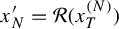 . It follows from Lemma 8.2 that
$x^{\prime }_N$
. It follows from Lemma 8.2 that
$x^{\prime }_N$
 is a generic point for some measure
$\mu ^{\prime }_N$
is a generic point for some measure
$\mu ^{\prime }_N$
 with
$h(\mu ^{\prime }_N)=h(\mu _N,\mathcal {R})\le h(\mu _N)$
with
$h(\mu ^{\prime }_N)=h(\mu _N,\mathcal {R})\le h(\mu _N)$
 . By Lemma 8.2 we see that
${\bar {f}(x',x^{\prime }_N)<\delta }$
. By Lemma 8.2 we see that
${\bar {f}(x',x^{\prime }_N)<\delta }$
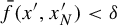 . Therefore,
$|h(\mu ^{\prime }_0)-h(\mu ^{\prime }_N)|<\varepsilon /3$
. Therefore,
$|h(\mu ^{\prime }_0)-h(\mu ^{\prime }_N)|<\varepsilon /3$
 , hence

This completes the proof.
Note that by [Reference Downarowicz, Kwietniak and Łącka20] entropy is uniformly continuous if
$X=\mathscr {A}^{\kern1.5pt\infty} $
 and we equip
${\mathcal {M}}_{\sigma }(\mathscr {A}^{\kern1.5pt\infty} )$
and we equip
${\mathcal {M}}_{\sigma }(\mathscr {A}^{\kern1.5pt\infty} )$
 with the
$\bar {f}$
with the
$\bar {f}$
 -metric (which, as we noted above, is uniformly equivalent with
$\overline {fk}$
-metric (which, as we noted above, is uniformly equivalent with
$\overline {fk}$
 induced by a standard metric on
$\mathscr {A}^{\kern1.5pt\infty} $
induced by a standard metric on
$\mathscr {A}^{\kern1.5pt\infty} $
 ). This is also the case when the entropy function
${\mathcal {M}_T}(X)\ni \mu \to h(\mu )\in \mathbb {R}$
). This is also the case when the entropy function
${\mathcal {M}_T}(X)\ni \mu \to h(\mu )\in \mathbb {R}$
 is upper semicontinuous with respect to the weak
$^*$
is upper semicontinuous with respect to the weak
$^*$
 topology on
${\mathcal {M}_T}(X)$
topology on
${\mathcal {M}_T}(X)$
 . For example, this happens if X is a manifold and T is of class
$\mathcal {C}^{\infty} $
. For example, this happens if X is a manifold and T is of class
$\mathcal {C}^{\infty} $
 or, more generally, if T is asymptotically h-expansive (see [Reference Downarowicz19]).
Corollary 8.3. If
$(X,T)$
 is such that the function
${\mathcal {M}_T}(X)\ni \mu \to h(\mu )\in \mathbb {R}$
is such that the function
${\mathcal {M}_T}(X)\ni \mu \to h(\mu )\in \mathbb {R}$
 is upper semicontinuous with respect to the weak
$^*$
is upper semicontinuous with respect to the weak
$^*$
 topology on
${\mathcal {M}_T}(X)$
topology on
${\mathcal {M}_T}(X)$
 , then for every
$\varepsilon>0$
, then for every
$\varepsilon>0$
 there is
$\delta>0$
there is
$\delta>0$
 such that for
$\mu ,\mu '\in {\mathcal {M}_T}(X)$
such that for
$\mu ,\mu '\in {\mathcal {M}_T}(X)$
 whenever there are
$\underline {x}\in \operatorname {\mathrm {Gen}}(\mu )$
whenever there are
$\underline {x}\in \operatorname {\mathrm {Gen}}(\mu )$
 and
$\underline {x}'\in \operatorname {\mathrm {Gen}}(\mu ')$
and
$\underline {x}'\in \operatorname {\mathrm {Gen}}(\mu ')$
 with
$\overline {fk}(\underline {x},\underline {x}')<\delta $
with
$\overline {fk}(\underline {x},\underline {x}')<\delta $
 , then
$\lvert h(\mu )-h(\mu ')\rvert <\varepsilon $
, then
$\lvert h(\mu )-h(\mu ')\rvert <\varepsilon $
 .
.
Without extra assumptions, the entropy function need not be continuous with respect to
$\overline {fk}$
 -convergence.
Example 8.4. Let
$\mathscr {A}=\{0\}\cup \{1/k:k\in \mathbb {N}\}$
 with the topology inherited from
$[0,1]$
with the topology inherited from
$[0,1]$
 . Consider
$X=\mathscr {A}^{\kern1.5pt\infty} $
. Consider
$X=\mathscr {A}^{\kern1.5pt\infty} $
 with any metric compatible with the product topology. Let
$\xi ^{(n)}$
with any metric compatible with the product topology. Let
$\xi ^{(n)}$
 be a measure on
$\mathscr {A}$
be a measure on
$\mathscr {A}$
 uniformly distributed on
$\{1/\ell : 2^n\le \ell <2^{n+1}\}$
uniformly distributed on
$\{1/\ell : 2^n\le \ell <2^{n+1}\}$
 and
$\mu ^{(n)}$
and
$\mu ^{(n)}$
 denote the product measure on X. It is easy to see that
$\mu ^{(n)}$
denote the product measure on X. It is easy to see that
$\mu ^{(n)}$
 is a shift-invariant measure on
$\mathscr {A}^{\kern1.5pt\infty} $
is a shift-invariant measure on
$\mathscr {A}^{\kern1.5pt\infty} $
 and the sequence
$(\mu ^{(n)})_{n\in \mathbb {N}}$
and the sequence
$(\mu ^{(n)})_{n\in \mathbb {N}}$
 converges in
$\overline {fk}$
converges in
$\overline {fk}$
 to the measure concentrated on a
$\sigma $
to the measure concentrated on a
$\sigma $
 -fixed point
$(0,0,\ldots )\in \mathscr {A}^{\kern1.5pt\infty} $
-fixed point
$(0,0,\ldots )\in \mathscr {A}^{\kern1.5pt\infty} $
 . Furthermore,
$h(\mu ^{(n)})=n\log 2$
. Furthermore,
$h(\mu ^{(n)})=n\log 2$
 , which means that the entropy function cannot be upper semicontinuous.
9 GIKN construction leads to loosely Kronecker measure
We are going to show that the
$\overline {fk}$
 -limit of loosely Kronecker measure is either a periodic measure or a loosely Kronecker measure. Since the GIKN construction yields a measure with uncountable support, every GIKN measure must be loosely Kronecker.
Theorem 9.1. An aperiodic
$\overline {fk}$
 -limit of periodic measures (loosely Kronecker measures) is loosely Kronecker.
We present the proof at the end of this section. But first, we recall Katok’s criterion for standardness (loosely Kronecker) and formulate two technical lemmas we will need for the proof.
9.1 Katok’s criterion
Let
$\mathbf {X}=(X,\mathscr X, \mu , T)$
 be a measure-preserving system and let
$\mathcal P=\{P_0,P_1,\ldots , P_{k-1}\}\in \mathbf {P}^k(X)$
be a measure-preserving system and let
$\mathcal P=\{P_0,P_1,\ldots , P_{k-1}\}\in \mathbf {P}^k(X)$
 . Following Katok [Reference Katok30, Definition 9.1], we say that the process
$(\mathbf {X}, \mathcal P)$
. Following Katok [Reference Katok30, Definition 9.1], we say that the process
$(\mathbf {X}, \mathcal P)$
 is
$(n,\varepsilon )$
is
$(n,\varepsilon )$
 -trivial if there exists a word
$\omega \in \{0,1,\ldots , k-1\}^n$
-trivial if there exists a word
$\omega \in \{0,1,\ldots , k-1\}^n$
 such that
$\mu _{{\mathcal {P}}}(B_{\varepsilon }[\omega ])\geq 1-\varepsilon $
such that
$\mu _{{\mathcal {P}}}(B_{\varepsilon }[\omega ])\geq 1-\varepsilon $
 , where
$B_{\varepsilon }[\omega ]=\{\omega '\in \{0,1,\ldots , k-1\}^n\,:\,\bar {f}_{n}(\omega , \omega ')<\varepsilon \}$
, where
$B_{\varepsilon }[\omega ]=\{\omega '\in \{0,1,\ldots , k-1\}^n\,:\,\bar {f}_{n}(\omega , \omega ')<\varepsilon \}$
 . For every
$n\ge 1$
. For every
$n\ge 1$
 ,
$\varepsilon>0$
,
$\varepsilon>0$
 and
$\omega \in \{0,1\ldots ,k-1\}^n$
and
$\omega \in \{0,1\ldots ,k-1\}^n$
 we clearly have

Therefore, (cf. [Reference Katok30, Lemma 9.1]) if
$\omega \in \{0,1,\ldots ,k-1\}^n$
 and
$\beta>0$
and
$\beta>0$
 are such that

then the process
$(\mathbf {X}, \mathcal P)$
 is
$(n, \sqrt \beta )$
is
$(n, \sqrt \beta )$
 -trivial. Conversely, if the process
$(\mathbf {X}, \mathcal P)$
-trivial. Conversely, if the process
$(\mathbf {X}, \mathcal P)$
 is
$(n,\varepsilon /2)$
is
$(n,\varepsilon /2)$
 -trivial, then there is
$\omega ^{(n)} \in {\mathcal {P}}^n$
-trivial, then there is
$\omega ^{(n)} \in {\mathcal {P}}^n$
 such that

A process
$(\mathbf {X},{\mathcal {P}})$
 is M-trivial [Reference Katok30, Definition 9.2] if for any
$\varepsilon>0$
is M-trivial [Reference Katok30, Definition 9.2] if for any
$\varepsilon>0$
 there exists
$N=N(\varepsilon )$
there exists
$N=N(\varepsilon )$
 such that for every
$n\geq N$
such that for every
$n\geq N$
 the process
$(\mathbf {X},\mathcal P)$
the process
$(\mathbf {X},\mathcal P)$
 is
$(n,\varepsilon )$
is
$(n,\varepsilon )$
 -trivial.
Theorem 9.2. [Reference Katok30, Theorem 4, (1)
$\Leftrightarrow $
(2)]

An aperiodic measure-preserving system
$\mathbf {X}$
 is loosely Kronecker if and only if for every finite partition
${\mathcal {P}}$
is loosely Kronecker if and only if for every finite partition
${\mathcal {P}}$
 of X the process
$(\mathbf {X},\mathcal P)$
of X the process
$(\mathbf {X},\mathcal P)$
 is M-trivial.
9.2 Proof of Theorem 9.1
In the proof of our main theorem, we will need the following fact.
Lemma 9.3. Let
$\mu \in {{\mathcal {M}}_T^e}(X)$
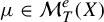 and
$\varepsilon>0$
and
$\varepsilon>0$
 . If
${\mathcal {P}},\mathcal {R}\in \mathbf {P}^k(X)$
. If
${\mathcal {P}},\mathcal {R}\in \mathbf {P}^k(X)$
 are such that
$d^\mu _1({\mathcal {P}},\mathcal {R})<\varepsilon /3$
are such that
$d^\mu _1({\mathcal {P}},\mathcal {R})<\varepsilon /3$
 , then there is
$N\in \mathbb {N}$
, then there is
$N\in \mathbb {N}$
 such that for every
$n\ge N$
such that for every
$n\ge N$
 we have

Proof. Let
${\mathcal {P}}=\{P_0,P_1,\ldots ,P_{k-1}\}$
 ,
$\mathcal {R}=\{R_0,R_1,\ldots ,R_{k-1}\}$
,
$\mathcal {R}=\{R_0,R_1,\ldots ,R_{k-1}\}$
 and
$\Delta =(P_0 \div R_0)\cup (P_1 \div R_1)\cup \cdots \cup (P_{k-1} \div R_{k-1})$
and
$\Delta =(P_0 \div R_0)\cup (P_1 \div R_1)\cup \cdots \cup (P_{k-1} \div R_{k-1})$
 . Observe that the ergodicity of
$\mu $
. Observe that the ergodicity of
$\mu $
 implies that for
$\mu $
implies that for
$\mu $
 -almost every
$x\in X$
-almost every
$x\in X$
 we have

It follows from the Egorov theorem that there are a measurable set
$G\subset X$
 and
$N\in \mathbb {N}$
and
$N\in \mathbb {N}$
 such that
$\mu (G)>1-\varepsilon /3$
such that
$\mu (G)>1-\varepsilon /3$
 and for all
$n\geq N$
and for all
$n\geq N$
 and
$x\in G$
and
$x\in G$
 one has
$\bar {d}_n({\mathcal {P}}^n(x),\mathcal {R}^n(x))<d^\mu _1({\mathcal {P}},\mathcal {R})+\varepsilon /3$
one has
$\bar {d}_n({\mathcal {P}}^n(x),\mathcal {R}^n(x))<d^\mu _1({\mathcal {P}},\mathcal {R})+\varepsilon /3$
 . Notice that
$\bar {f}_n({\mathcal {P}}^n(x),\mathcal {R}^n(x))\le \bar {d}_n({\mathcal {P}}^n(x),\mathcal {R}^n(x))$
. Notice that
$\bar {f}_n({\mathcal {P}}^n(x),\mathcal {R}^n(x))\le \bar {d}_n({\mathcal {P}}^n(x),\mathcal {R}^n(x))$
 for all
$n\in \mathbb {N}$
for all
$n\in \mathbb {N}$
 . Therefore, if
$d^\mu _1({\mathcal {P}},\mathcal {R})<\varepsilon /3$
. Therefore, if
$d^\mu _1({\mathcal {P}},\mathcal {R})<\varepsilon /3$
 and
$n\ge N$
and
$n\ge N$
 , then

The rest of this section is devoted to the proof of Theorem 9.1.
Proof of Theorem 9.1
Let
$\mu =\mu ^{(0)}$
 be an
$\overline {fk}$
be an
$\overline {fk}$
 -limit of a sequence of loosely Kronecker measures
$\mu ^{(1)},\mu ^{(2)},\ldots .$
-limit of a sequence of loosely Kronecker measures
$\mu ^{(1)},\mu ^{(2)},\ldots .$
 Then there are a sequence
$(x^{(n)})_{n=1}^{\infty} \subseteq X$
Then there are a sequence
$(x^{(n)})_{n=1}^{\infty} \subseteq X$
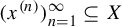 and a generic quasi-orbit
$\underline {x}$
and a generic quasi-orbit
$\underline {x}$
 for
$\mu ^{(0)}$
for
$\mu ^{(0)}$
 such that
$\overline {fk}(\underline {x},\underline {x}^{(n)}_T)\to 0$
such that
$\overline {fk}(\underline {x},\underline {x}^{(n)}_T)\to 0$
 as
$n\to \infty $
as
$n\to \infty $
 and
$x^{(n)}$
and
$x^{(n)}$
 is a generic point for
$\mu ^{(n)}$
is a generic point for
$\mu ^{(n)}$
 for
$n\in \mathbb {N}$
for
$n\in \mathbb {N}$
 . Then
$\mu ^{(0)}$
. Then
$\mu ^{(0)}$
 is ergodic. If
$\mu ^{(0)}$
is ergodic. If
$\mu ^{(0)}$
 is a periodic measure, then there is nothing to show. Assume that
$\mu ^{(0)}$
is a periodic measure, then there is nothing to show. Assume that
$\mu ^{(0)}$
 is aperiodic.
To apply Katok’s criterion (Theorem 9.2) we need to show that for every finite partition
$\mathcal P$
 of X the process
$(\mathbf {X},\mathcal P)$
of X the process
$(\mathbf {X},\mathcal P)$
 , where
$\mathbf {X}=(X,X_{\mathscr {B}},\mu ^{(0)},T)$
, where
$\mathbf {X}=(X,X_{\mathscr {B}},\mu ^{(0)},T)$
 , is M-trivial. To this end we choose a partition
${\mathcal {P}}\in \mathbf {P}^k(X)$
, is M-trivial. To this end we choose a partition
${\mathcal {P}}\in \mathbf {P}^k(X)$
 and fix
$\varepsilon>0$
and fix
$\varepsilon>0$
 .
.
We use Lemma 2.3 to find
$0<\alpha <\varepsilon /6$
 such that
$\bar {f}(\underline {\omega },\underline {\omega }')<\alpha $
such that
$\bar {f}(\underline {\omega },\underline {\omega }')<\alpha $
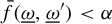 for some
$\underline {\omega }\in \operatorname {\mathrm {Gen}}(\xi )$
for some
$\underline {\omega }\in \operatorname {\mathrm {Gen}}(\xi )$
 ,
$\underline {\omega }'\in \operatorname {\mathrm {Gen}}(\xi ')$
,
$\underline {\omega }'\in \operatorname {\mathrm {Gen}}(\xi ')$
 , where
$\xi $
, where
$\xi $
 and
$\xi '$
and
$\xi '$
 being shift-invariant ergodic measures on
$\Omega _{k+1}$
being shift-invariant ergodic measures on
$\Omega _{k+1}$
 implies that
$\bar {f}(\xi ,\xi ')<\varepsilon /3$
implies that
$\bar {f}(\xi ,\xi ')<\varepsilon /3$
 .
.
We take
$\delta <\min \{\alpha /2,\varepsilon /9\}$
 . We apply Lemma 8.2 to
$(\mu ^{(n)})_{n=0}^{\infty} $
. We apply Lemma 8.2 to
$(\mu ^{(n)})_{n=0}^{\infty} $
 to find
$\gamma =\gamma (\mu =\mu ^{(0)},\delta ,{\mathcal {P}})$
to find
$\gamma =\gamma (\mu =\mu ^{(0)},\delta ,{\mathcal {P}})$
 and a partition
$\mathcal {R}\in \mathbf {P}^{k+1}(X)$
and a partition
$\mathcal {R}\in \mathbf {P}^{k+1}(X)$
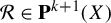 with
$d_1^{\mu ^{(0)}}({\mathcal {P}},\mathcal {R})<\delta $
with
$d_1^{\mu ^{(0)}}({\mathcal {P}},\mathcal {R})<\delta $
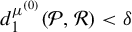 and
$\mu ^{(n)}(\partial \mathcal R)=0$
and
$\mu ^{(n)}(\partial \mathcal R)=0$
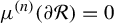 for
${n=0,1,\ldots .}$
for
${n=0,1,\ldots .}$
 Let N be such that
$\overline {fk}(\underline {x},x^{(N)}_T)<\min \{\gamma ,\alpha /2\}$
Let N be such that
$\overline {fk}(\underline {x},x^{(N)}_T)<\min \{\gamma ,\alpha /2\}$
 . It follows from Lemma 8.2 that

By Lemma 2.2, the point
$\mathcal {R}(\underline {x}^{(N)}_T)$
 is generic for
$\mathcal {R}$
is generic for
$\mathcal {R}$
 -representation measure of
$\mu ^{(N)}$
-representation measure of
$\mu ^{(N)}$
 denoted by
$\mathcal {R}_*\mu ^{(N)}=\mu ^{(N)}_{\mathcal {R}}$
denoted by
$\mathcal {R}_*\mu ^{(N)}=\mu ^{(N)}_{\mathcal {R}}$
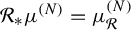 and
$\mathcal {R}(\underline {x})$
and
$\mathcal {R}(\underline {x})$
 is generic for the
$\mathcal {R}$
is generic for the
$\mathcal {R}$
 -representation
$\mu ^{(0)}_{\mathcal {R}}=\mathcal {R}_*\mu ^{(0)}$
-representation
$\mu ^{(0)}_{\mathcal {R}}=\mathcal {R}_*\mu ^{(0)}$
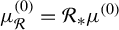 of
$\mu ^{(0)}$
of
$\mu ^{(0)}$
 . Inequality (9) and our choice of
$\alpha $
. Inequality (9) and our choice of
$\alpha $
 imply that
$\bar {f}(\mu ^{(0)}_{\mathcal {R}},\mu _{\mathcal {R}}^{(N)})<\varepsilon /3$
imply that
$\bar {f}(\mu ^{(0)}_{\mathcal {R}},\mu _{\mathcal {R}}^{(N)})<\varepsilon /3$
 . Hence, by the definition of the
$\bar {f}$
. Hence, by the definition of the
$\bar {f}$
 -metric, we find
$M'=M'(\varepsilon )>0$
-metric, we find
$M'=M'(\varepsilon )>0$
 satisfying that for every
$m\ge M'$
satisfying that for every
$m\ge M'$
 there is a coupling
$\unicode{x3bb} _{m}$
there is a coupling
$\unicode{x3bb} _{m}$
 of
$\mathcal {R}_*\mu |_{\mathcal {R}^m}$
of
$\mathcal {R}_*\mu |_{\mathcal {R}^m}$
 and
$\mathcal {R}_*\mu ^{(N)}|_{\mathcal {R}^m}$
and
$\mathcal {R}_*\mu ^{(N)}|_{\mathcal {R}^m}$
 for which we have

Using that
$\mu ^{(N)}$
 is loosely Kronecker or periodic, we find
$M"=M"(\varepsilon )$
is loosely Kronecker or periodic, we find
$M"=M"(\varepsilon )$
 such that for every
$m\ge M"$
such that for every
$m\ge M"$
 there is
$\omega ^{(m)}\in \mathcal {R}^m$
there is
$\omega ^{(m)}\in \mathcal {R}^m$
 satisfying

With the above notation, let
$m\ge \max \{M',M"\}$
 . Using (10) and (11), we get (below,
${\mathcal {R}^{2m}=\mathcal {R}^m\times \mathcal {R}^m}$
. Using (10) and (11), we get (below,
${\mathcal {R}^{2m}=\mathcal {R}^m\times \mathcal {R}^m}$
 )
)

By Lemma 9.3, since
$\mathcal {R}$
 is a partition satisfying
$d^{\mu ^{(0)}}_1({\mathcal {P}},\mathcal {R})<\delta <\varepsilon /9$
is a partition satisfying
$d^{\mu ^{(0)}}_1({\mathcal {P}},\mathcal {R})<\delta <\varepsilon /9$
 , there exists
$M\in \mathbb {N}$
, there exists
$M\in \mathbb {N}$
 such that for every
$m\ge M$
such that for every
$m\ge M$
 we have

Combining (11) with (12), we see that if
$m\ge N=\max \{M,M',M"\}$
 , then

Since
$\varepsilon>0$
 was arbitrary, we have proved that
$(\mathbf {X},{\mathcal {P}})$
was arbitrary, we have proved that
$(\mathbf {X},{\mathcal {P}})$
 is M-trivial. Since
${\mathcal {P}}$
is M-trivial. Since
${\mathcal {P}}$
 was also arbitrary and
$\mu ^{(0)}$
was also arbitrary and
$\mu ^{(0)}$
 is aperiodic we conclude, using Theorem 9.2, that
$\mu ^{(0)}$
is aperiodic we conclude, using Theorem 9.2, that
$\mu ^{(0)}$
 is loosely Kronecker (standard).
As a consequence of Theorems 6.2, 7.3, and 8.1 (combined with Theorem 3.5 for the second part), we get the following result, which we also call a theorem due to its importance.
Theorem 9.4. If
$\mu $
 is an aperiodic GIKN measure resulting from a GIKN sequence
$(\Gamma _n)_{n\in \mathbb {N}}$
is an aperiodic GIKN measure resulting from a GIKN sequence
$(\Gamma _n)_{n\in \mathbb {N}}$
 , then
$\mu $
, then
$\mu $
 is a loosely Kronecker measure (hence, ergodic and with zero entropy). In particular, under the assumptions of Theorem 3.5 the resulting measure
$\mu $
is a loosely Kronecker measure (hence, ergodic and with zero entropy). In particular, under the assumptions of Theorem 3.5 the resulting measure
$\mu $
 is either a non-hyperbolic periodic measure or a non-hyperbolic loosely Kronecker measure (hence,
$\mu $
is either a non-hyperbolic periodic measure or a non-hyperbolic loosely Kronecker measure (hence,
$\mu $
 is ergodic and has zero entropy). In all cases above,
$\mu $
is ergodic and has zero entropy). In all cases above,
$\mu $
 is supported on

Theorem 9.4 may replace [Reference Bonatti, Díaz and Gorodetski8, Lemma 2.5] and it reveals more information about the resulting measure. This applies, for example, to [Reference Cheng, Crovisier, Gan, Wang and Yang15, Theorem B] or [Reference Cheng, Crovisier, Gan, Wang and Yang15, Proposition 1.1]. Similar strengthenings are possible for results from [Reference Barrientos and Cisneros3, Reference Bochi, Bonatti and Díaz5, Reference Bonatti, Díaz and Gorodetski8, Reference Bonatti and Zhang10, Reference Díaz, Gelfert, Rams and Zhang17, Reference Díaz and Gorodetski18, Reference Gorodetskiĭ, Ilyashenko, Kleptsyn and Nalskiĭ29, Reference Kleptsyn and Nalskiĭ32]. We leave the details to the reader, as presenting them here would require repeating a lot of material from these papers without introducing anything new.
Acknowledgements
First and foremost, we would like to thank Christian Bonatti, not only for many discussions related to this paper but also for his contagious and inspiring enthusiasm for mathematical research. We would like to express our equally deep gratitude to Lorenzo J. Díaz and Katrin Gelfert for their constant support, inspiration, and encouragement throughout this work. Their enthusiasm for this research motivated us to resubmit this project. We are grateful for all the many thoughtful conversations that shaped our thinking along the way and for the many remarks that helped us improve this paper. We would like to thank François Ledrappier (for bringing the
$\bar {f}$
 -metric to our attention), Tomasz Downarowicz, and Benjy Weiss (for their patient and lucid answers to our multiple questions about ergodic theory), Dawid Bucki, Melih Emin Can, Philipp Kunde, Michal Kupsa, Anthony Quas, and Alexandre Trilles (for their clarifications and discussions regarding the
$\bar {f}$
-metric to our attention), Tomasz Downarowicz, and Benjy Weiss (for their patient and lucid answers to our multiple questions about ergodic theory), Dawid Bucki, Melih Emin Can, Philipp Kunde, Michal Kupsa, Anthony Quas, and Alexandre Trilles (for their clarifications and discussions regarding the
$\bar {f}$
 -metric). Special thanks go to Anton Gorodetski for a very encouraging and enlightening conversation in Trieste. The research of Dominik Kwietniak was supported by the National Science Centre (NCN) under grant no. DEC-2012/07/E/ST1/00185 and his stay at the Federal University of Rio de Janeiro, where part of this research was conducted, was supported by CAPES/Brazil grant no. 88881.064927/2014-01. Many thanks to Maria José Pacifico who made this stay possible. Martha Łącka acknowledges the support of the National Science Centre (NCN), Poland, grant no. 2015/19/N/ST1/00872 and doctoral scholarship no. 2017/24/T/ST1/00372.


 Open access

