




Introduction
The prevalence of dementia is increasing. In 2024, 8.7 out of every 100 people in Canada over the age of 65 were living with dementia (Alzheimer Society of Canada, 2024). The number of people living with dementia in Canada is expected to reach 1 million by 2030 and 1.7 million by 2050 (Alzheimer Society of Canada, 2024). Dementia may contribute to changes in behaviour, personality, and difficulty completing daily activities (Cipriani et al., Reference Cipriani, Lucetti, Nuti and Danti2014).
People living with dementia may present with ‘wandering’ behaviour, a general term used to describe repetitive and frequent locomotion paired with disorientation to time or space (Cipriani et al., Reference Cipriani, Lucetti, Nuti and Danti2014). Consequently, people living with dementia are at risk of becoming lost and going missing during a wandering event. There is emerging literature estimating proportions of those with dementia who engage in wandering behaviour; however, these estimates are typically based in small sample sizes (Chung & Lai, Reference Chung and Lai2011; Okita et al., Reference Okita, Hanyu, Hirao, Shimizu, Umahara and Sakurai2016; Schonfeld et al., Reference Schonfeld, King-Kallimanis, Brown, Davis, Kearns, Molinari, Werner, Beattie and Nelson2007; Song & Algase, Reference Song and Algase2008). Poor prevalence estimates are further compounded by inconsistent definitions of ‘wandering’, which includes missing, and elopement (Cipriani et al., Reference Cipriani, Lucetti, Nuti and Danti2014). Incidents are likely underestimates of actual prevalence as not all cases are reported due to reluctance of family and care providers to contact police (Shalev Greene et al., Reference Shalev Greene, Clarke, Pakes and Holmes2019). Estimates of wandering behaviour range from 3 to 60 per cent of people living with dementia, depending on the data source (Cruz et al., Reference Cruz, Perez, Jantzi, Liu and Hirdes2024; Neubauer et al., Reference Neubauer, Azad-Khaneghah, Miguel-Cruz and Liu2018). Some of these people will become missing. One study reports that approximately 40 per cent of people with dementia will go missing at least once (McShane et al., Reference McShane, Gedling, Keene, Fairburn, Jacoby and Hope1998). The prevalence of missing occurrences is also not well documented, nor are data shared among first responder services (Cruz et al., Reference Cruz, Perez, Jantzi, Liu and Hirdes2024).
The management of dementia-related missing incidents requires efficient coordination between first responders and those who report the person missing. The more time that passes during a missing incident, the higher the risk for adverse health outcomes, such as injury or death, for the missing person with dementia (Neubauer et al., Reference Neubauer, Azad-Khaneghah, Miguel-Cruz and Liu2018). According to a Swedish study, the duration of police search is the strongest predictor of harm in the missing person, with odds of harm increasing by the hour (Larsson et al., Reference Larsson, Årestedt, Svensson, Andersson and Wolmesjö2025). There is 5.2 times increased odds of a person being injured if the duration between last contact and call to police is more than 8 hours (Larsson et al., Reference Larsson, Årestedt, Svensson, Andersson and Wolmesjö2025). Survival from a dementia-related missing incident drops significantly after 24 hours, with one study reporting survival rates of 54 per cent when 24 hours or more has passed from the time last seen (Koester & Stooksbury, Reference Koester and Stooksbury1995).
Educational materials on ways to manage risks of going missing typically include promotion of exercise, medication management, falls prevention, conditions for safe driving, and environmental modifications, such as securing locks on doors and installing door alarms (Alzheimer’s Greater Los Angeles, 2015; Byszewski et al., Reference Byszewski, Aminzadeh, Robinson, Molnar and Dalziel2011; Neubauer et al., Reference Neubauer, Miguel-Cruz and Liu2021). Nevertheless, despite precautions, a person living with dementia can still leave a secured home or facility and go missing.
Also, existing resources may not emphasize the unique personhood and ways to support autonomy among persons with dementia. Persons living with dementia are entitled to be involved in discussions on wandering, safety, and ways to continue meaningful activities that bring risks (Adekoya et al., Reference Adekoya, Daum, Miguel-Cruz and Liu2025 ). For example, a person who enjoys walking every day to manage stress may consent to wearing or carrying a GPS-enabled device in case the person gets lost.
The focus of this paper is a newly developed tool using realistic case scenarios to promote awareness about risks of going missing among people living with dementia and to facilitate planning to mitigate these risks before an incident occurs. Case scenarios can impart information on contextual factors related to a missing incident such as weather conditions, time of day, medical conditions, the person’s home characteristics, and how they are rescued (or recovered). Case scenarios have been used in dementia-related health care pedagogy and in conversations between service providers and clients (Conway et al., Reference Conway, Harkin and Ryan2024; McCrow et al., Reference McCrow, Beattie, Sullivan and Fick2013; Michael et al., Reference Michael, O’Callaghan and Clayton2016). For example, narrative-based learning has been used to humanize and increase empathy among nursing students by offering opportunity for reflection and learning through storytelling, videos, and case vignettes of those with dementia (Conway et al., Reference Conway, Harkin and Ryan2024). Additionally, the utility of case scenarios as a tool to facilitate sensitive conversations in health care has been explored as an avenue to improve information processing in advanced care planning among clients with cancer (Michael et al., Reference Michael, O’Callaghan and Clayton2016).
Awareness is a first step to knowledge building through education materials, a precursor to acquiring and applying knowledge (Bloom, Reference Bloom1956). For instance, readers may become aware of the risks of going missing, while others may gain knowledge on how to minimize the risk, and how to respond if a missing incident occurs. Each person living with dementia and care partners may gain new learning from reading the case scenarios when shared with them during a medical appointment, discussed with a service provider, or as handout.
Realistic and relatable case scenarios can bring awareness about the possibility going missing, especially among individuals who have never experienced an incident. As such, case scenarios can be used to facilitate conversations between clients and service providers about health plans (Alzheimer Society British Columbia, 2014; McCrow et al., Reference McCrow, Beattie, Sullivan and Fick2013; Michael et al., Reference Michael, O’Callaghan and Clayton2016). Scenarios could be written in a narrative format to share information that aims to enhance human-centred storytelling and outline lived experiences rather than facts alone, a valued addition to didactic communication in health care (Dudley et al., Reference Dudley, Squires, Petroske, Dawson and Brewer2023). The narrative format tells a story that is relatable to readers, which may improve comprehension and engagement in reading the material (Dahlstrom, Reference Dahlstrom2014). Personhoods are captured beyond living with a dementia condition, such as hobbies and interests, increasing relatability of the material. Case scenarios can also promote application of knowledge to future situations by anchoring readers in narratives that may simulate reality more effectively than didactic and factual information alone (Dahlstrom, Reference Dahlstrom2014).
Purpose
This paper describes the process of developing 10 case scenarios, based in real events, involving people living with dementia who became lost and went missing. The final product is 10 educational case scenarios that use a narrative format to promote awareness and mobilize knowledge on contextual factors involved in a missing incident and ways to manage the risk. The target audiences are (1) persons living with dementia and their care partners, and (2) service providers who can use these scenarios as a knowledge and awareness raising tool in their interactions with people living with dementia and care partners. The case scenarios can facilitate information sharing of what may happen before, during, and after a dementia-related missing person event and provide strategies how to manage the risk of going missing.
Developing the case scenarios
Case scenarios were developed using iterative and inductive processes, as outlined in Figure 1. This project obtained ethics clearance from the University of Waterloo’s Human Research Ethics Board (Protocol #43164). Three female researchers (CD, ER, and VV), experienced with qualitative research methods, and with backgrounds in health sciences (ER, VV) or occupational therapy (CD), conducted a qualitative summative and conventional content analysis (Hsieh & Shannon, Reference Hsieh and Shannon2005). This approach was used to describe patterns and obtain frequency counts by category of 515 electronic free-text notes from hotline calls made to MedicAlert Foundation Canada® about dementia-related missing incidents. The free text summary notes were written by hotline call operators to describe events of the missing incident. Summary notes ranged from 19 to 410 words, with an average of 120 words. The three members of the research team copied the de-identified summary notes from Excel to Word documents and selected cases based on the following inclusion criteria: the MedicAlert® subscribers were (a) 40 years or older; (b) went missing unintentionally; and (c) indication that the subscriber was lost (disorientation, confusion, spatial navigation challenges). These cases were imported into NVivo 12 (QSR International Pty Ltd., 2018) for analysis, and the same three researchers inductively created preliminary codes and a coding hierarchy from 50 cases collaboratively. The coding hierarchy was refined with another 50 cases collaboratively. To ensure trustworthiness, several rounds of inter-rater calibration among the three researchers were conducted. They applied the coding framework independently to five summaries at a time, and they reviewed and discussed differences in coding to ensure that the coding hierarchy was robust. This process was repeated until 95 per cent coding agreement was reached. The three researchers then independently coded the free text notes and identified essential elements and characteristics of the missing incidents inherent in them. Additional trustworthiness strategies included weekly peer debriefing and keeping an audit trail of major decisions and reflections. Seven major categories were generated from the data: demographic information, language and communication, living situation, strategies to manage risk of going missing, circumstances leading to a missing incident, factors around being found, and information about repeat missing incidents. The data showcase complexity and variability in what may happen during a missing person event.
Generating the case scenarios using MedicAlert® data (August 2022 to March 2023).

Figure 1. Long description
The flowchart begins on the left with two primary data input streams.
Top stream:
1. A box labeled n equals 515 Hotline-call summary notes from MedicAlert Foundation Canada®.
2. An arrow points to a pill-shaped node for 8 draft case scenarios.
3. This leads to a grey box for 5 key informant interviews.
4. A magnifying glass icon precedes a box containing n equals 1555 Police reports and n equals 205 Search and rescue notes.
Bottom stream:
1. A box labeled n equals 2 Stories from families.
2. An arrow points to a pill-shaped node for 2 draft case scenarios.
Both streams converge into a large grey box titled Dialogic consultations. Inside this box, three diamond shapes represent Researchers, Families, and Key informants. A circular arrow indicates an iterative process involving 10 draft case scenarios.
Final output:
An arrow leads from the consultation box to a final pill-shaped node on the far right labeled 10 final case scenarios.
Generation of eight prototype case scenarios (April 2023 to October 2023)
Three female researchers from the team (AA, CD, VV), including one with a background in nursing (AA), then generated the eight prototype personas and scenario. The scenarios reflect a range of characteristics of missing incidents frequently seen in the content analysis, such as being found uninjured and close to home, and include unique aspects of missing incidents, such as internalized stigma among persons living with dementia and their care partners. The case scenarios are a combination of what was found in the data, not about one specific case but a combination of cases. The process of developing the eight case scenarios was collaborative between research team members, iterative, and dialogic, involving meetings between those involved in the analysis and the case scenario writers. Each case scenario was formatted to describe the missing incident persona (i.e., demographics, health conditions, type of dementia, supports, living environment), what led to and occurred during the incident, and how it was resolved (i.e., how the person was found, the condition in which they were found). We also identified resources that related directly to overarching themes contained within the scenarios which could provide readers with further information.
Comprehensibility and relevance review (October 2023 to March 2024)
After receiving informed consent, the eight prototype case scenarios were shared with five research study participants (a person living with dementia, care partner, MedicAlert® staff member, first responder, and a service provider) who provided feedback on the usability of the case scenarios. This step received clearance (#45659) from the University of Waterloo Human Research Ethics Board. A researcher (VV) conducted 60-minute semi-structured interviews with each participant to obtain suggestions on how to improve usability and dissemination of the case scenarios. Purposive sampling (Emmel, Reference Emmel2013) was used to recruit the participants by reaching out to existing professional networks including dementia advocacy organizations, first responder groups, and Alzheimer Societies. Inclusion criteria involved: (1) proficiency in written and spoken English, (2) have experiences with dementia, and (3) ability to provide informed consent. For the person living with dementia, a teach-back method was used to determine the ability to provide informed consent by understanding the study’s purpose, risks, and benefits (Kripalani et al., Reference Kripalani, Bengtzen, Henderson and Jacobson2008). Recruitment posters were sent to potential participants via email. All prospective participants contacted enrolled in the study within the proposed timeframe. Participants resided or worked in Ontario or Alberta and had between 12 and 35 years of experience with dementia. Interview questions centred around comprehensibility, relevance, and content editing suggestions for each of the eight case scenarios. The semi-structured interview guide consisted of 38 questions including demographic questions, five questions related to all eight case scenarios, followed by four comprehensibility questions for each of the case scenarios. Probing questions were used to clarify and elicit further information from participants. Interviews were held in person or through video-teleconference and were audio-recorded, transcribed, and de-identified. The interviews were analysed using qualitative description to outline key recommendations from participants without interpretation from the researcher (Sandelowski, Reference Sandelowski2000).
Participants noted that the case scenarios could be a useful tool to mobilize information about the risk of going missing in a personally relevant way for care partners and people living with dementia. Participants also suggested maintaining the narrative format and detail while simplifying the format such as breaking up the text into smaller segments, including more white space and customizing the case scenario narrative specifically for people living with dementia and their care partners. Some participants expressed the importance of expanding the breadth of contextual factors (e.g., unresolved cases) related to a dementia-related missing incident beyond those found within the MedicAlert® database by including cases involving non-MedicAlert® subscribers.
Three researchers (AA, CD, VV) guided improvements to the subsequent versions of the case scenarios based on feedback received. Five of the eight scenarios reviewed by the five participants, from the MedicAlert® databases, were edited to expand beyond MedicAlert® data; we included additional photographs for visual narration, reduced the text into short segments, and improved the layout to enhance comprehensibility and relevance in all case scenarios.
Expanding and editing the case scenarios (March 2024 to August 2025)
To expand the scenarios beyond the characteristics of missing incidents in MedicAlert® subscribers, two researchers (CD, VV) developed four scenarios based on cases that we observed in three Canadian police departments and one scenario from one search and rescue data set which were analysed in a different study, receiving a third ethics clearance from University of Waterloo Human Research Ethics Board (Protocol #43630). The case scenarios incorporate characteristics of missing incidents analysed from a total of 1760 missing incident cases involving people living with dementia, including 1555 police reports (273 cases from Edmonton Police Services, 681 from Waterloo Region Police Service, 601 cases from Service de Police de la Ville de Montréal), and 205 search and rescue notes.
Upon further consultation among team members, dementia advocates, first responders, and service providers, one researcher (CD) led the creation of two additional case scenarios that were written to reflect circumstances that can occur when a person living with dementia goes missing and is not found. These scenarios were co-written with two families, one in British Columbia and one in Nova Scotia, each with a family member who remains missing despite extensive efforts by police, search and rescue teams, and community. These two scenarios share the detailed and compelling accounts of families, raising awareness of the real-life experiences and risk of going missing among people living with dementia. Multiple sources of data helped to capture a range of data about missing incidents as care partners of those living with dementia may be reluctant to report the person with dementia missing (Shalev Greene et al., Reference Shalev Greene, Clarke, Pakes and Holmes2019).
The content, wording, and photographs in the 10 case scenarios were reviewed at least three times by each team member and by family members in the cases written by family of those who went missing. In addition to suggestions sought from the five participants about the scenario prototypes, we also sought specific feedback from a search and rescue expert and a service provider about the contents of some cases. For example, we requested recommendations for an appropriate resource specific to Canada, and we asked the search and rescue expert to validate the response time in a rural search. After such details were integrated, we worked with a professional design firm to prepare the final layout. Following this, written permission to release the case scenario and photographs embedded within it was sought from the two families. Finally, an audit was completed by the professional design firm on all scenarios to ensure compliance with the Accessibility for Ontarians with Disabilities Act (2005).
Final 10 case scenarios (August 2025)
Each of the 10 case scenarios is 5–10 pages in length and written in English. Together, the scenarios are compiled in a 77-page booklet, available electronically and can be printed (Aging Innovation Research Program, 2025). The cases can be found here: https://uwaterloo.ca/managing-risks-of-disappearance-in-persons-living-with-dementia/stories-about-missing-incidents. The booklet begins with definitions of commonly used terms, and a table of contents, the scenarios, and resources follow. Each case scenario can also be used as standalone, allowing readers to selectively read the scenarios of interest to them.
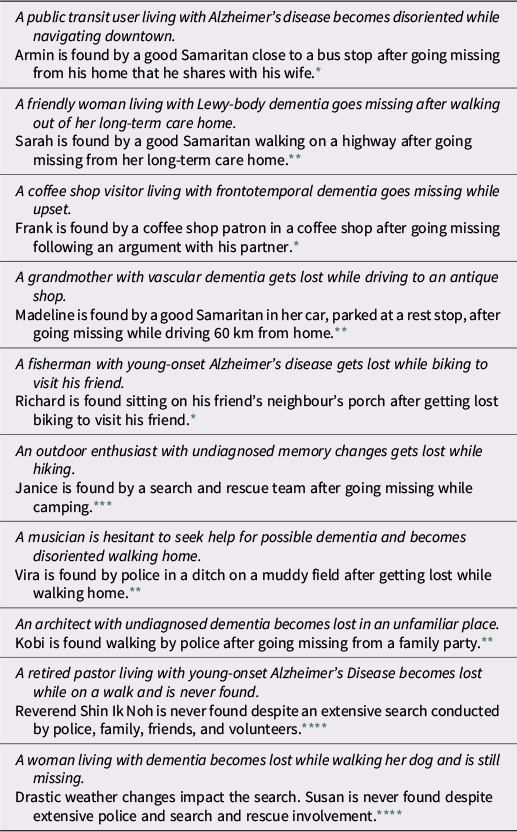
Eight of the 10 case scenarios contain characteristics of missing incidents that were derived, analysed, and synthesized from multiple data sources. These eight case scenarios, combining elements from multiple data sets, were chosen to saturate the variety of missing incidents observed based on the content analysis. For example, multiple types of dementia, living situations, and ways of getting lost and being found are showcased. Two case scenarios were written based on the experiences of specific missing incidents, as reported by family, since the persons living with dementia were never found. Table 1 provides an overview of the 10 case scenarios and the data sources used in each case.
Case scenarios
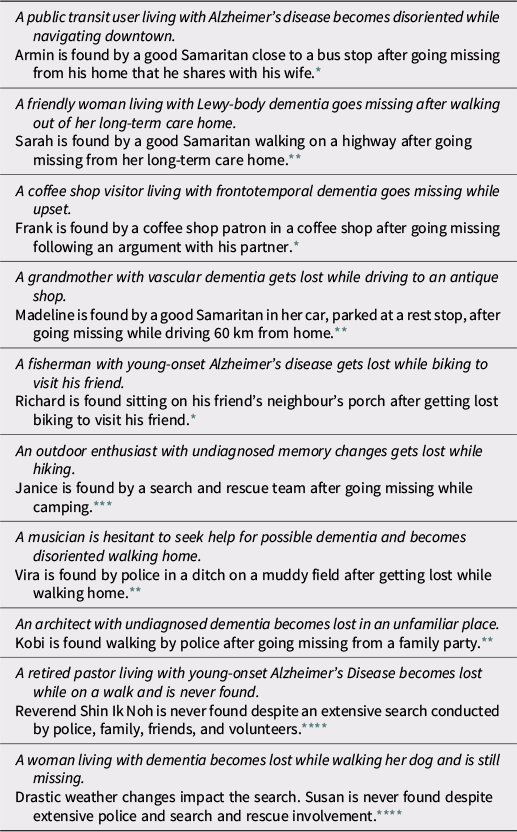
Table 1. Long description
Medic Alert data: A public transit user living with Alzheimer’s disease becomes disoriented navigating downtown. A coffee shop visitor living with frontotemporal dementia goes missing while upset. A fisherman with young-onset Alzheimer’s disease gets lost while biking to visit his friend. Police data: A friendly woman living with Lewy-body dementia goes missing after walking out of her long-term care home. A grandmother with vascular dementia gets lost while driving to an antique shop. A musician is hesitant to seek help for possible dementia and becomes disoriented walking home. An architect with undiagnosed dementia becomes lost in an unfamiliar place. Search and rescue data: An outdoor enthusiast with undiagnosed memory changes gets lost while hiking. Real life cases: A retired paster living with young onset Alzheimer’s Disease becomes lost while on a walk and is never found. A woman living with dementia becomes lost while walking her dog and is still missing.
* Missing incident cases based in MedicAlert® data.
** Missing incident cases based in police data.
*** Missing incident based in SAR data.
**** Missing incident cases based on real-life cases.
Content and format of the case scenarios
The case scenarios are written in a narrative format to humanize the experience of people living with dementia and offer a reflective opportunity for learning (Conway et al., Reference Conway, Harkin and Ryan2024). Although this increases the length of each case scenario, the case scenarios preserve the unique personhood of each persona.
The eight cases, which combine elements from missing incident cases found in multiple data sets, are fictional personas with pseudonyms. The two case scenarios based on real-life cases use the actual names of the people who were never found. The case scenarios include the following sections: personal information, background, information about the day of the incident including getting lost and being found, what occurred after the incident, and resources. The titles of the case scenarios include the persona’s interests, beyond the diagnosis and intentionally highlight personhood among people with dementia. The title of each case scenario also includes the type of dementia the persona is living with and the circumstances of how they got lost. The titles are meant to help readers identify stories that are relatable.
Personal information gives a glimpse of the person with dementia, including age, gender, living situation, social support, health history, and interests. Background provides information on the person’s context which could include their circle of support and home environment, routines, and history of missing incidents. The day of the incident includes information on what circumstances led to the missing incident and information related to the search. After the incident section summarizes the steps taken after the incident was resolved to reduce the risk of repeated incidents. Each case scenario includes descriptions and links to resources for further learning. These resources are specific to the case scenario and reinforce key messages. Additional resources are also included at the end of the booklet containing all case scenarios. Examples include a sample ‘In Case of Emergency Card’, safety considerations when participating in leisure activities, locator devices, and a toolkit with strategies to reduce the risk of getting lost.
Accessible design of the case scenarios
Dementia-friendly design of health education materials could minimize information overload among people with dementia (Hoffman et al., Reference Hoffman, Vordenberg, Leggett, Akinyemi, Turnwald and Maust2024). Dementia-friendly design was considered alongside the Accessibility for Ontarians with Disability Act (i.e., accessibility that applies to services, public spaces, transportation, employment as well as information and communications). For example, the Dementia Engagement and Empowerment Project (DEEP) principles were used to create comprehensible case scenarios for people with dementia (Innovations in Dementia, 2013). The case scenarios use simple language, short paragraphs, white space, relevant pictures, and headings (Innovations in Dementia, 2013). Pictures used in the case scenarios were carefully selected to show personhood in the people living with dementia. Stock and artificial intelligence generated photos were selected to match characteristics (including age, gender, race, environment, interests) of the person living with dementia. Real photos provided by family were used for the last two cases that are still missing. Photos in the case scenarios could challenge stereotypes of what someone with dementia looks like and reflect reality for end users (Hoffman et al., Reference Hoffman, Vordenberg, Leggett, Akinyemi, Turnwald and Maust2024).
Discussion and implications
In this paper, we describe the process of developing 10 case scenarios involving actual individuals living with dementia who became lost and went missing. These scenarios provide a means of delivering a relatable, realistic, and understandable narrative to people living with dementia and care partners to promote awareness and knowledge about the risk of going missing. Narrative communication in health care involves a beginning, middle, and end; provides character information (person profile and background); and offers resolution to a conflict (i.e., being found), providing a believable communication tool for health-related education, especially when readers find protagonists relatable to their lives (Hinyard & Kreuter, Reference Hinyard and Kreuter2007). Narrative health communication is easier to understand and retained longer than didactic communication (Dahlstrom, Reference Dahlstrom2014; Dudley et al., Reference Dudley, Squires, Petroske, Dawson and Brewer2023). Information about missing incidents shared through case scenarios is an alternative to traditional didactic communication between a service provider and client.
Additionally, written information is better remembered than spoken information during a health service appointment (Kessels, Reference Kessels2003). Some clients may not be able to process and retain education materials during sessions with their clinician (Kessels, Reference Kessels2003). Factors that may contribute to impaired recall of health information obtained during a health service appointment include memory function, anxiety during the appointment, and perceived importance of the information (Kessels, Reference Kessels2003). Care partners have expressed that they would like information about behavioural symptoms and resources provided to them by service providers in both written and verbal formats (Wald et al., Reference Wald, Fahy, Walker and Livingston2003). Therefore, the case scenarios could supplement dialogue around the risk of going missing. They may also be shared with others in the person’s circle of support, beyond those who were at the appointment, allowing for a wider breath of enhanced awareness and knowledge than only dialogue between the client and service provider (see Supplementary material).
As demonstrated in the case scenarios, a coordinated response involving first responders is critical when someone with dementia is missing. Missing incidents are emergencies, and time is of the essence in commencing a search. The scenarios outline the importance of reporting the incident to first responders immediately when a missing incident occurs so that police and search and rescue personnel can implement a coordinated, systematic, and evidence-informed search. For example, in An outdoor enthusiast with undiagnosed memory changes gets lost while hiking, volunteer search and rescue organizations worked with police to strategize a co-ordinated campground search where the person went missing. Research shows that the longer a person with dementia is missing, the decreased likelihood of them being found uninjured (Cruz et al., Reference Cruz, Perez, Jantzi, Liu and Hirdes2024; Neubauer et al., Reference Neubauer, Miguel-Cruz and Liu2021).
Stigma and discrimination are experienced by some people living with dementia (Mann, Reference Mann2020). This discrimination may be a barrier to their ability to fully participate in daily activities. Although the Canadian Charter of Rights for People with Dementia was developed to protect the rights of, and empower and support people living with dementia, stigma still exists, including internalized stigma (Mann, Reference Mann2020). The case scenarios challenge stigma by showcasing the personhood in each scenario and emphasize quality of life when one lives with dementia. For instance, some people living with dementia are assumed to be suffering (Karlawish, Reference Karlawish2025). Suffering is a subjective experience and cannot be assumed upon a person with dementia (Karlawish, Reference Karlawish2025). The people in the case scenarios each convey diverse interests, living situations, and preferences. For example, in A grandmother with vascular dementia gets lost while driving to an antique shop, Madeline is presented as an avid coin collector who enjoys shopping at antique shops and spending time with loved ones. She learns how to continue doing the things she wants to do safety after she gets lost while driving. Taken together, the case scenarios challenge common stereotypes of people living with dementia, who are assumed by some to have limited capacity, lack quality of life, and hence be less of a person compared to others without dementia (Gerritsen et al., Reference Gerritsen, Oyebode and Gove2018). Through the case scenarios, people living with dementia and care partners can obtain knowledge on what may happen during a missing incident from an evidence-informed lens, countering negatively biased dementia-related missing incident cases spread on popular media (Robertson et al., Reference Robertson, Pröllochs, Schwarzenegger, Pärnamets, Van Bavel and Feuerriegel2023). In addition, the case scenarios shed light that people with dementia can still enjoy a good quality of life and maintain their personhoods when considering safety in their daily activities.
Engagement of clients and care partners in conversations around the care process by providing realistic information enhances health care service (Wald et al., Reference Wald, Fahy, Walker and Livingston2003). Despite this, there is an identified need for service providers to receive additional resources and training to support care provided to people living with dementia (Breen et al., Reference Breen, Savundranayagam, Orange and Kothari2022). Service providers may use the case scenarios to share resources with their clients living with dementia and their care partners on how to reduce the risk of going missing. In the case scenarios, we present a range of circumstances, including an individual who goes missing from a long-term care facility, that may be relevant to service providers, such as personal care attendants. Service providers can draw upon the most relevant case scenarios for their clients and share contextualized resources from the case scenarios that manage the risk of going missing.
Reflections
Every person living with dementia is unique. As such, their risk of going missing and how to manage this risk is unique to their situations. The 10 case scenarios capture possible experiences of those living with dementia, as analysed through MedicAlert®, police, search and rescue, and personal accounts about going missing. However, not all missing people have a MedicAlert® subscription or are reported to the police or search and rescue. Indeed, it has been documented that missing person incidents involving people living with dementia are underreported to police (Shalev Greene et al., Reference Shalev Greene, Clarke, Pakes and Holmes2019). The case scenarios may include a range of demographic characteristics related to going missing but do not capture the experiences of every person living with dementia who goes missing. For example, they may not accurately portray the experiences of those from all ethnocultural groups, rural areas, and diverse living situations. Although the case scenarios are available in English, translation into French and other languages used in Canada is in process. The impact of these case scenarios on awareness of risks of going missing, and strategies to mitigate risks, would rely on future evaluations by organizations that use this tool.
While the case scenarios aim to promote knowledge and awareness related to missing incidents, when someone living with dementia goes missing, their care partners may be under stress during the incident. Realistic case scenarios help care partners and people living with dementia to learn what a missing incident may look like and how it may be resolved. These case scenarios may help people living with dementia and care partners manage the risk of going missing before they happen and learn ways to respond to a missing incident in the moment to minimize risk of injury in the person with dementia.
Conclusion
The 10 case scenarios provide a relatable, realistic, and understandable tool for people living with dementia and their care partners to increase their awareness and knowledge about the risk of going missing. The case scenarios are stories created from real-life cases of people with dementia who went missing and offer ways to manage the risk of going missing, all while maintaining the personhood of the people living with dementia. Case scenarios offer a way to share health information about the risk of going missing when living with dementia by also highlighting missing incidents as emergencies and dispelling myths around what people living with dementia can do. Case scenarios can serve as an educational tool for health professionals, first responders, and service providers to use to raise awareness and enhance knowledge during conversations with people living with dementia and their care partners.
Supplementary material
The supplementary material for this article can be found at http://doi.org/10.1017/S0714980826100762.
Acknowledgements
We thank the families who shared their stories, and study participants who provided feedback on iterations of the case scenarios.
Financial support
Funding for this project was provided by The Search and Rescue New Initiatives Fund (SAR NIF).
Competing interests
The authors declared no potential conflicts of interest with respect to the research, authorship, and/or publication of this article.



 Open access

