





Introduction
The 1987 Philippine Constitution mandates the state to protect and advance the right of the people to a balanced and healthful ecology. This commitment was operationalised through Republic Act 9729 or the Climate Change Act of 2009, which mainstreams climate change considerations across government planning, policy, and programme implementation. The law also explicitly assigns the Department of Education (DepEd) a central role in integrating climate change principles and concepts into the basic education curriculum. When the Philippines implemented the K to 12 programme in 2013, climate change topics were embedded across subjects to equip learners with the knowledge, skills, and dispositions needed to respond to climate-related challenges (Bramaje & Espinosa, Reference Bramaje and Espinosa2013). Usual teaching strategies include lectures and activities guided by climate change education (CCE) toolkits and formulation of co-curricular activities through environmental school organisations and schoolwide greening activities. These policy directions reflect the assumption that schools are key sites for cultivating environmental awareness, responsibility, and behavioural change. Although CCE has been integrated in the curriculum, it appears that school efforts are not enough to elicit appropriate climate change responses from learners. Literature from Southeast Asia has pointed this out. Key factors identified include teacher’s limited knowledge and capacity to teach CCE, curriculum’s over emphasis on cognitive knowledge, and examination orientation of the curriculum that usually neglects socio-emotional and behavioural learning aspects (Karim et al., Reference Karim, Othman, Zaini, Rosli, Wahab, Al Kanta, Omar and Sahani2022; Martha et al., Reference Martha, Besra and U.H.Rilfi2025; Salingatag & Akut, Reference Salingatag and Akut2025; Zaini & Osman, Reference Zaini and Osman2024).
Outside the schools, the Climate Change Act underscores the importance of multisectoral engagement in climate action. Agencies such as the Department of Social Welfare and Development and the Department of the Interior and Local Government (DILG) are mandated to support climate-related capacity-building and community-level initiatives, particularly for vulnerable populations. The DILG, which oversees 82 provinces and 42,011 barangays, plays a critical role in mobilising local government units (LGUs) and communities. These institutional arrangements recognise that CCE cannot be confined to schools alone but must involve families, communities, and local governance systems. Available literature on this aspect underscores strengthening governance and this includes provision of adequate investments to CCE initiatives, enhancing sectoral coordination, and fostering multilevel collaboration (Han, Reference Han2015; Martha et al., Reference Martha, Besra and U.H.Rilfi2025; Zaini & Osman, Reference Zaini and Osman2024) However, while such policies emphasise collaboration, empirical understanding of how these multi-level efforts shape learners’ environmental practices remains limited.
The present study systematically reviews CCE initiatives within Philippine basic education by analysing DepEd climate-related programmes and issuances and examining how these initiatives interact with family and community contexts. Sixteen years after the enactment of RA 9729, there is a need to critically assess whether these programmes produce sustained environmental behaviours and how institutional and socioecological conditions enable or constrain their impact. Rather than focusing solely on knowledge and awareness outcomes, this study foregrounds behavioural continuity and environmental well-being as key indicators of meaningful climate learning.
Existing research in the Philippine context provides important insights into the integration of climate change and sustainability in education. Valencia (Reference Valencia2018) documents efforts to introduce Education for Sustainable Development in Grades 11 and 12, while Marpa (Reference Marpa2020) identifies the embedding of climate-related topics in science and social studies curricula. Vidal and Dela Cruz (Reference Vidal and Dela Cruz2025) points to significant gaps in students’ understanding of climate vulnerability and disaster risk management, particularly in adaptation and mitigation strategies. Studies examining behavioural outcomes report mixed results, with varying levels of awareness and pro-environmental practices among learners (Laureano et al., Reference Laureano, Espinosa and Avilla2015; Punzalan, Reference Punzalan2020; Rogayan & Nebrida, Reference Rogayan and Nebrida2019). Emerging work conducted by Malaluan et al. (Reference Malaluan, Espinosa and Duad2023) highlights the importance of linking scientific understanding to tangible behavioural change. Based on the Programme for International Student Assessment 2018 data, the Philippines ranked last among 79 participating nations. The results highlighted a significant “learning crisis,” which is increasingly complicated by the country’s high vulnerability to climate change.
Beyond formal education, multiple social institutions shape students’ climate-related attitudes and behaviours. Simon et al. (Reference Simon, Aruta, Fryer and Bridges2024) show that family discussions and media exposure significantly influence support for decarbonisation policies among university students in Hong Kong. Intergenerational learning plays a critical role in sustaining environmental behaviour. Children often communicate climate knowledge to family members, shaping household practices and fostering shared environmental responsibility (Trott, Reference Trott2021; Vuong et al., Reference Vuong, Duong, La, Li and Nguyen2023). A study by Wang et al. (Reference Wang, Long, Chen and Li2022) in China revealed that family parenting style significantly predicts children’s willingness to save energy. However, family influence is not uniformly supportive. Economic constraints, cultural norms, competing priorities, and exposure to misinformation may weaken the reinforcement of school-based environmental learning. This highlights the need to understand climate education as a relational and socially mediated process rather than a purely cognitive or school-driven intervention.
A case study by Kim (Reference Kim2024) in South Korea, specifically on a “green church,” illustrates how youth ministry programmes cultivate ecological awareness and responsibility among the youth. In Pakistan, a survey of university students showed that increased media awareness develops perceptions and helps mitigate the impact of climate change (Ahmed & Ahmed, Reference Ahmed and Ahmed2026). Youth engagement in development projects on climate change, such as in the case of the Dominican Republic and Chile, show that the youth are able to disseminate climate change adaptation concepts and practical techniques, increasing uptake of adaptation measures (Adaptation Fund, 2022). School-based instruction provides structured and scientifically grounded knowledge about climate change (Espinosa et al., Reference Espinosa, Monterola and Punzalan2013; Vuong et al., Reference Vuong, Duong, La, Li and Nguyen2023), although inconsistencies and mixed messaging remain global challenges (Plutzer et al., Reference Plutzer, Branch and Townley2024). In Indonesia for instance, a 2023 study says that 49.7% of adolescents surveyed had poor climate change literacy. Those found with high literacy came from public and religious schools and were raised by educated parents while those with low literacy came from private and vocational schools and whose parents have low education (Martha et al., Reference Martha, Besra and U.H.Rilfi2025). A systematic review of CCE studies conducted by Malaysian researchers also yields the same results. Knowledge and attitude about climate change play a pivotal role in shaping responses to climate change but they are also greatly influenced by socio-demographic factors such as gender, age, education, income, and ethnicity (Zaini & Osman, Reference Zaini and Osman2024). A meta-synthesis of international studies also indicates that while students’ climate knowledge levels are often comparable, their attitudes and behavioural intentions vary depending on contextual and cultural factors (García-Vinuesa et al., Reference García-Vinuesa2024).
Research focusing on inter-institutional collaboration in Philippine CCE remains limited. Existing studies emphasise the importance of partnerships with LGUs and civil society organisations (Indal & Arriola, Reference Indal and Arriola2024; Nocum et al., Reference Nocum, Pabillan, Lingga and Kristyano-Islam Peace Library Inc2024; Uri & Regio, Reference Uri and Regio2023). Nocum’s work in the Bangsamoro Autonomous Region in Muslim Mindanao underscores inclusive decision-making and youth participation, while Indal and Arriola identify coordination, awareness, and engagement challenges in local climate initiatives. Baring et al. (Reference Baring, Fides and Guanzon2020) similarly advocate for reframing schools as collaborators rather than saviours in community-based climate action.
Despite these advances, there remains limited empirical research examining how CCE in Philippine basic education operates across the interconnected domains of school, home, and community, and how alignment or misalignment across these contexts shapes learners’ environmental awareness, behaviours, and resilience. Much of the literature continues to privilege school-based interventions while underexamining structural inequalities, governance conditions, and socioecological constraints that influence behavioural sustainability.
Addressing this gap, the present study adopts an integrated framework grounded in action competence, intergenerational learning, community-based environmental education, and socioecological systems thinking. It advances the concept of socioecological alignment to examine how coherence across school, family, and community practices supports the development of sustained environmental responsibility. By analysing policy frameworks and practitioner perspectives, the study seeks to illuminate the institutional, relational, and structural conditions that shape climate learning in climate-vulnerable and resource-constrained contexts.
To evaluate the impact of CCE initiatives, the study addresses the following research questions:
-
1. What effects do educational curricula, activities, and projects (including extracurriculars) have on learners’ knowledge and awareness of climate issues, and how do these affect their peers?
-
2. How do these educational initiatives influence perceptions of environmental risks and the willingness of individuals (learners and their communities) to adopt resilient practices in their lifestyles and adapt to climate change?
-
3. In what ways does integrating environmental issues into curricula and activities contribute to changing learners’ perceptions of environmental well-being?
By situating these questions within a socioecological and intergenerational perspective, this study contributes to understanding how CCE can more effectively cultivate sustained environmental responsibility and action among Filipino learners.
Theoretical framework
CCE is increasingly understood as a socially embedded and relational process shaped not only by formal schooling but also by the cultural, structural, and ecological contexts in which learners develop. Contemporary scholarship recognises that children’s environmental identities, values, and action tendencies emerge through interactions across family, school, and community settings rather than through isolated curricular exposure. Long-standing work in environmental education situates learning within dynamic social and relational fields that extend beyond classrooms (Chawla & Cushing, Reference Chawla and Cushing2007; Jorgenson et al., Reference Jorgenson, Stephens and White2019). However, much of the existing literature continues to privilege school-based interventions while underexamining how structural inequalities, cultural and family norms, and institutional conditions shape the sustainability of environmental behaviours, particularly in climate-vulnerable and resource-constrained contexts. To address this gap, this study integrates action competence, intergenerational learning, community-based environmental education, and socioecological systems perspectives as a coherent analytical framework for examining how climate learning is negotiated across interconnected social environments.
The concept of action competence, first articulated by Jensen & Schnack (Reference Jensen and Schnack1997, Reference Jensen and Schnack2006), provides a foundation for understanding how learners move beyond knowledge acquired from school toward meaningful environmental participation. Rather than viewing environmental behaviour as a linear outcome of knowledge or attitudes, action competence emphasises learners’ capacity to critically interpret environmental problems, imagine alternative futures, and engage in democratic and collective action. Central to this perspective is the recognition that opportunities to act are unevenly distributed and shaped by contextual realities, including access to resources, institutional support, and social recognition. This insight is particularly relevant in developing contexts where environmental risks are often disproportionately borne by vulnerable communities. Thus, action competence is not simply an individual attribute but a socially mediated capacity that emerges through participation in culturally meaningful and contextually grounded practices.
Complementing action competence, intergenerational learning offers a lens for understanding how environmental knowledge, values, and practices circulate across family networks. Research demonstrates that parents and extended kin shape children’s ecological habits through modelling, discourse, and daily routines, while children also influence household behaviours through reciprocal exchanges of climate knowledge and experiences (VanderVen, Reference Vanderven1998; Williams & Chawla, Reference Williams and Chawla2015). This perspective highlights the relational and dynamic nature of environmental socialisation, where routines around water use, waste management, disaster preparedness, and food production serve as critical sites for the development of environmental responsibility. Importantly, intergenerational learning also reveals how structural constraints – such as poverty, time scarcity, and limited access to infrastructure – mediate the extent to which families can sustain environmentally responsible practices. In this sense, environmental behaviour should be understood not as a function of awareness alone but as shaped by broader socio-economic and cultural conditions.
Environmental engagement is likewise profoundly shaped by the communities in which children live. Community-based environmental education positions learning as relational, place-based, and grounded in local ecological knowledge and practices. Gruenewald’s (Reference Gruenewald2003) work on place-conscious education underscores how local contexts provide opportunities for experiential learning, enabling children to connect environmental issues with lived realities. Similarly, Chawla (Reference Chawla2020) highlights how participation in community greening initiatives, disaster preparedness, and shared environmental narratives strengthens children’s sense of competence and resilience. These perspectives challenge technocratic models of climate education that focus primarily on cognitive outcomes, instead emphasising collective action, cultural meaning, and local relevance. Community structures also mediate the continuity of environmental practices, as institutional stability, governance capacity, and resource availability influence whether learners encounter consistent environmental messages across contexts.
To integrate these dimensions, this study adopts a socioecological systems perspective, which conceptualises environmental learning as emerging from interactions across multiple, interrelated systems. Bronfenbrenner’s (Reference Bronfenbrenner1979) ecological systems theory highlights how the microsystem (family routines, classroom practices), mesosystem (home–school relationships), exosystem (local government programmes, community initiatives), and macrosystem (cultural norms, socio-economic structures, and policy environments) collectively shape learners’ environmental engagement. This perspective offers a powerful lens for examining why school-based climate initiatives often struggle to produce sustained behavioural change, particularly when environmental practices promoted in school are not reinforced in the home or community. It also enables attention to the broader political and institutional contexts that shape climate learning, including governance fragmentation, programme discontinuity, and infrastructural inequities.
Bringing these perspectives together, this study conceptualises CCE as a process of socioecological alignment across school, family, and community contexts. Action competence provides the outcome orientation, intergenerational learning highlights relational processes, community-based education foregrounds place and participation, and socioecological systems theory situates these within broader structural and institutional environments. The sustainability of environmental behaviour depends not only on knowledge acquisition but also on the coherence of environmental messages and practices across these interconnected systems. Misalignment – where schools promote environmental responsibility but families and communities face structural barriers or institutional instability – can undermine learners’ emerging agency. Conversely, alignment across systems can strengthen environmental identity, resilience, and long-term action.
This integrated framework provides a robust lens for analysing how Philippine CCE initiatives shape learners’ awareness, behaviours, and environmental well-being. By foregrounding relational, structural, and intergenerational dimensions, the study contributes to advancing theory in environmental education and offers insights applicable to other climate-vulnerable and resource-constrained contexts. It positions families and communities not merely as supportive actors but as central arenas where environmental agency is negotiated, sustained, and transformed.
Methodology
This study employed a qualitative, interpretive research design to examine how CCE initiatives in Philippine basic education shape learners’ environmental awareness, behaviours, and perceptions of environmental well-being within the interconnected contexts of school, home, and community. Consistent with socioecological and intergenerational perspectives, the methodological approach was designed to capture the multilayered influences of families, educators, local institutions, and community structures on children’s climate-related engagement, as well as the structural and contextual conditions that enable or constrain the sustainability of environmental practices.
The research design consisted of two complementary phases. First, a systematic review of policy documents and official issuances from the Department of Education (DepEd) and related agencies was conducted to map national mandates, programmatic priorities, and institutional expectations related to CCE. A total of 109 issuances – including department orders, memoranda, advisories, and programme guidelines – were screened and analysed. This phase provided a macro-level understanding of how CCE is framed within the Philippine policy environment, particularly in terms of school–community partnerships, family engagement, and multisectoral collaboration. It also enabled the identification of policy assumptions regarding behavioural change, intergenerational learning, and inter-institutional coordination, which informed the subsequent qualitative inquiry.
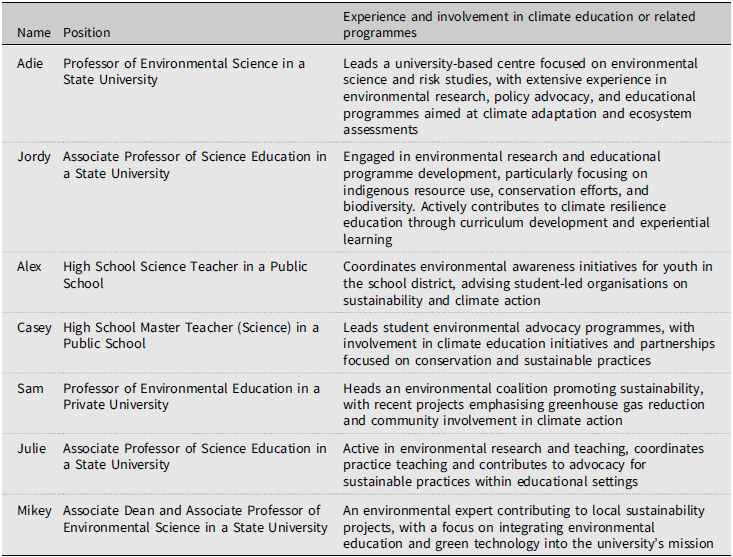
The second phase involved key informant interviews (KIIs) with educators and school-level actors who were directly involved in implementing climate-related initiatives. Participants included teachers, school leaders, and programme implementers engaged in initiatives such as Youth for Environment in Schools-Organization (YES-O), Gulayan sa Paaralan (Vegetable Garden in Schools), Wash, Sanitation, and Hygiene (WASH) programmes, and local environmental campaigns (Table 1). These actors were purposively selected because of their sustained engagement in programme design, delivery, and monitoring, positioning them as knowledgeable observers of how learners’ environmental behaviours are shaped by institutional interventions as well as by everyday socioecological realities. Semi-structured interviews allowed participants to narrate their experiences, describe patterns of alignment and discontinuity between school practices and household routines, and reflect on the role of LGUs, barangay initiatives, and community organisations in reinforcing or weakening environmental learning.
Profile of key informants with pseudonyms

The decision to prioritise educator and implementer perspectives was grounded in the study’s aim to analyse systemic and institutional dynamics rather than individual learner experiences. These participants functioned as mediating actors situated at the intersection of policy, school practice, and community engagement, providing insight into how CCE is translated, negotiated, and sustained across contexts. Nevertheless, the absence of direct student and parent voices is acknowledged as a limitation. While educators’ accounts offer valuable system-level perspectives, they may not fully capture the lived experiences and interpretations of learners and families. Future research may extend this work through participatory, ethnographic, and intergenerational approaches that foreground the perspectives of children, parents, and community actors.
Interview questions were aligned with the study’s theoretical framing. Prompts explored learners’ engagement in environmental activities; the continuity or discontinuity of practices across school and home settings; the role of community norms and governance structures; and the socio-economic and infrastructural conditions shaping environmental behaviour. This alignment ensured that data collection remained analytically connected to action competence, intergenerational learning, and socioecological systems perspectives.
Data analysis followed an iterative thematic approach combining deductive and inductive coding. Deductive codes were derived from the integrated theoretical lenses guiding the study, while inductive codes emerged from participants’ narratives. The coding process involved multiple cycles of reading, comparison, and refinement to identify patterns related to alignment and misalignment across socioecological systems. Particular attention was given to structural constraints, institutional continuity, governance instability, and the socio-cultural mediation of environmental practices. To enhance transparency and analytical rigour, emerging themes were continuously compared with insights from the policy document review, enabling methodological triangulation between institutional discourse and practitioner experience.
Ethical procedures were observed throughout the research process. Participants provided informed consent prior to the interviews, and anonymity was maintained through the use of pseudonyms. Interview data were stored in password-protected digital files accessible only to the research team. Institutional ethical clearance was secured in accordance with university research guidelines. Given that the study focused on educators and programme implementers rather than minors, risks to participants were minimal.
Although the study did not include direct observation of environmental practices in homes or communities, the integration of policy analysis and practitioner narratives provided a multi-level understanding of climate education processes. This approach enabled the study to illuminate the gap between institutional intentions and everyday realities, particularly in contexts characterised by resource constraints, socio-economic inequalities, and uneven governance capacity. Overall, the methodology offers a robust foundation for examining CCE as a socially embedded and relational process shaped by the interaction of policy, practice, and lived experience.
Findings and discussion
The following section presents an analysis of the qualitative and empirical data gathered regarding CCE within the Philippine basic education system. By adopting a socioecological lens, this study explores how environmental learning transcends the classroom, moving through the Home–School–Community nexus. The findings are organised into four interconnected themes that track the journey of a learner’s ecological identity – from initial exposure in formal schooling to the reinforcing (or conflicting) realities of household dynamics and community governance.
School-based climate programmes as foundations for early environmental learning
The findings demonstrate that Philippine schools remain central in introducing climate change concepts, pro-environmental practices, and early forms of ecological agency among learners. Education has long been recognised as a key mechanism for cultivating environmental awareness, risk perception, and decision-making related to climate issues (Genizera et al., Reference Genizera, Tosino, Santacera and Moncera2022). Consistent with this, DepEd’s CCE programmes – such as tree planting, recycling drives, waste segregation, and school-based WASH activities – serve as initial catalysts for learners’ understanding of climate change and their ability to connect environmental concepts to everyday life. This was echoed by respondent Casey, who observed that, “there are numerous education initiatives, training programmes, and orientations – even at the kindergarten level,” affirming that structured school-based engagements are already in place from the earliest levels of formal schooling. From the perspective of action competence, these structured school activities provide the initial opportunities for learners to develop environmental awareness and participatory dispositions.
However, the sustainability of these early engagements is shaped by broader structural and institutional conditions. Respondent Adie underscored this when she noted that, “there needs to be continuous follow-up; it cannot be that once a policy is in place and people are already segregating, it is simply left at that,” pointing to how environmental behaviours cultivated in school settings regress without sustained institutional support. Sectoral initiatives such as UNICEF’s WASH programme, for example, support children’s foundational hygiene practices through improved access to water and sanitation. Yet structural gaps across school contexts limit the full realisation of these goals. Culang et al. (Reference Culang2021) identify persistent deficiencies in WASH facilities in low-and middle-income municipalities, particularly in Zambales where menstrual hygiene standards remain a concern. Likewise, Ellis et al. (Reference Ellis, Haver, Villasenor, Parawan, Venkatesh, Freeman and Caruso2016) similarly documented how unreliable water access, inadequate disposal mechanisms, and insufficient latrines in schools across Metro Manila, Masbate, and South Central Mindanao pose structural barriers to girls’ menstrual hygiene management. These challenges underscore that environmental behaviour is not solely a matter of awareness but is mediated by material conditions, institutional capacity, and resource distribution.
Evidence also points to variability in knowledge acquisition and awareness among students. At Batanes State College, for instance, students displayed moderate knowledge of climate change, but this did not significantly differ across personal backgrounds (Castillo & Nozaleda, Reference Castillo and Nozaleda2022). Similar observations have been recorded elsewhere, such as in the University of Nueva Caceres, where pre-service teachers exhibited poor attitudes toward CCE despite curricular exposure (Competente, Reference Competente2019). Julie, another respondent, similarly questioned whether institutional efforts genuinely reach learners, asking, “They provide training and conferences to build awareness and knowledge, but once the teacher is in the classroom, is this translated into practice? Is it shared with the students?” These findings suggest that school-based knowledge transmission, while necessary, is insufficient for fostering sustained environmental behaviour. From a socioecological perspective, environmental learning is shaped by multiple overlapping systems rather than by schooling alone.
Despite these limitations, school programmes remain essential entry points for climate awareness. The structured, collective, and institutionalised nature of DepEd initiatives creates a shared space for environmental learning that can potentially be carried into home and community settings. Adie captured this well, arguing that “the linkage must be taught properly to children,” and that environmental concepts need not stand as a separate course but must be integrated across all disciplines – “including values education, mathematics, and science, not only STEM subjects” – so that learning permeates beyond the classroom and into the everyday life. The challenge, however, lies in ensuring that these initial engagements are supported by coherent environmental practices across broader social systems.
Home environments, intergenerational dynamics, and the continuity of environmental behaviours
The study reveals that the home plays a decisive role in shaping whether climate-related behaviours initiated in school are sustained. Intergenerational learning theory suggests that environmental values and practices develop through modelling, routines, and everyday socialisation. Participants consistently emphasised the significance of continuity between school and household practices, highlighting how alignment across these contexts strengthens learners’ environmental engagement.
Casey emphasised this misalignment between home and school, asserting:
“The home and school must go hand in hand. If the government truly wants children to absorb the importance of the environment, any concrete programme must simultaneously engage both the home and the school. Because without that, there are countless education initiatives, training programmes, and orientations yet the home does not follow through.”
Mikey added that there are economic limitations in terms of access to sustainable energy:
“Limitation in the access to sustainable alternatives. One of my examples earlier is that even if they know that solar panels are good for the environment, not everyone actually has the luxury and access to it.”
These perspectives reflect broader socioecological challenges rather than individual or familial deficits. Structural constraints – including poverty, time scarcity, competing livelihood demands, and uneven access to infrastructure – shape the capacity of households to reinforce environmental practices. In many low-income contexts, families prioritise immediate survival needs, which may limit their ability to engage in consistent environmental routines. These realities complicate expectations that households will automatically reinforce school-based environmental learning.
This interpretation resonates with earlier findings from Competente (Reference Competente2019), which identified gaps in teacher attitudes toward CCE and pointed to broader systemic inconsistencies that extend beyond individual actors. When learners return to homes where water conservation, waste segregation, or gardening are not consistently practiced, environmental learning becomes disjointed. However, this fragmentation reflects structural and socio-economic constraints rather than resistance or indifference.
The significance of familial reinforcement is further supported by the observation that Filipino youth who directly experience climate consequences – often in the context of localised disasters affecting households – are more likely to engage in mitigation actions (Simon et al., Reference Simon, Pakingan and Aruta2022). These lived experiences shape children’s risk perception and resilience. Yet, without supportive socio-material conditions, these insights do not always translate into sustained behavioural change. Thus, intergenerational learning is mediated by broader socioecological realities that shape the feasibility and continuity of environmental practices.
Home–school discontinuities therefore constitute a critical barrier to achieving the transformative, action-oriented learning envisioned in both national policy frameworks and global sustainability agendas. These findings highlight the need to reconceptualise CCE not as a school-driven process but as a relational and socioecological endeavour.
Community structures, programme continuity, and contextual constraints on learners’ environmental engagement
The influence of community structures, governance, and institutional continuity emerged as a central factor shaping learners’ environmental agency. Participants emphasised that while schools introduce climate concepts, the surrounding community determines whether these behaviours become embedded in everyday life.
Casey’s narrative captures these institutional dynamics:
“There is no continuity in programs for climate change…. Time, commitment, and let’s say funds because you know that for project focus that is extensive, you need a big amount of funds which is impossible in our means because once the administrator changes, the focus of the program also changes… so they don’t understand. So, if there is an admin change, they would say, this is what I want.”
Alex similarly laments the discontinuity of projects once there is change in school leadership:
“There is a change in school heads (or school leadership). So the projects are not sustained, for instance, in our school our school head is quite old and does not want any event regarding (environmental) activities.”
This discontinuity reflects broader governance challenges common in decentralised and resource-constrained contexts. The case of YES-O’s “Wednesday for the Environment” initiative piloted in the DepEd Division of City Schools Manila during the pandemic illustrates this pattern. Despite initially fostering interest in home-based urban gardening among Kinder to Grade 3 learners, the programme ceased upon the retirement of its lead organiser. This highlights the fragility of environmental initiatives that rely on individual leadership rather than institutionalised support.
Empirical evidence similarly suggests that community-level support significantly influences the effectiveness of CCE. Genizera et al. (Reference Genizera, Tosino, Santacera and Moncera2022) found that DepEd’s climate initiatives positively correlate with improved learning environments, but outcomes vary depending on community engagement and continuity. Simon et al. (Reference Simon, Pakingan and Aruta2022) also observed that Filipino youth’s climate experiences are shaped by local vulnerabilities and collective responses. These findings align with socioecological perspectives that emphasise the role of community infrastructures, governance capacity, and social norms in shaping environmental behaviour.
Similarly, inconsistent waste management systems, weak environmental governance, and limited community engagement generate mixed messages that undermine learners’ developing environmental identities. Mikey’s account highlights these contextual challenges, pointing to the difficulty of sustaining environmentally responsible practices due to cultural expectations and financial costs. Julie likewise observed persistent gaps in public waste management practices despite existing systems. Sam has the same sentiment:
“…we have a solid waste management law but how committed has the government been in enforcing it? For a while no plastic (is being used) but now everybody is using plastic.”
In relation to Sam’s musings, Adie emphasised the need to follow up on people’s adherence to environmental policy:
“There is a need for continuous follow up, it is not sufficient that just because there is an existing policy (on waste segregation), people are already segregating, that they can be left by themselves. No…people return to their old habits.”
These insights underscore that environmental learning is embedded within broader political, economic, and cultural systems. Without stable institutional support, sustained funding, and coherent governance, learners encounter fragmented environmental messages across contexts.
Lived experiences, action competence, and the socioecological alignment needed for sustainability
Across the findings, learners’ environmental behaviours appear to be shaped by their lived experiences of climate risks and by the degree of alignment across school, home, and community systems. From the perspective of action competence, meaningful environmental engagement emerges through experiential learning, contextual relevance, and opportunities for participation.
Students who directly experienced climate-related disasters were more likely to engage in mitigation actions (Simon et al., Reference Simon, Pakingan and Aruta2022), illustrating how lived experiences can serve as catalysts for environmental agency. However, transformative learning requires sustained reflection and reinforcement. Mezirow’s (Reference Mezirow1997) Transformative Learning Theory suggests that critical experiences must be supported by structured opportunities for reflection, dialogue, and action. Similarly, Ajzen’s (Reference Ajzen1991) Theory of Planned Behaviour highlights the importance of perceived behavioural control, which is shaped by access to resources, social support, and institutional conditions.
Participants consistently emphasised the importance of internalising climate concepts through coherent environmental messaging. Jordy reflected on the need to change one’s character:
“Sometimes I reflect. Perhaps the first thing to change is character. Your character, that you truly love (or care for) the environment. If your love for the environment is intense, and you are willing to sacrifice in order to implement (environmental) projects, and that you are able to communicate with the community that these would be for their benefit, it will be implemented.”
Sam highlighted the need for sustained engagement to shape learners’ mindsets, while other participants described how fragmented or contradictory environmental cues weaken behavioural continuity. Julie mused on the lack of good role models in order to sustain environmental behaviour:
“Modelling of proper and positive environmental behaviour from famous personalities, adults, schools and government officials, community, parents at home, all of them. You can’t see the proper modelling of environmental behaviours.”
These findings suggest that environmental learning is not only cognitive but relational and systemic.
The interplay of these systems reveals that CCE can only achieve its intended outcomes when supported by stable socioecological environments. This includes continuity of community programmes, family engagement, infrastructural support, and culturally grounded environmental practices. Central to this discussion is the concept of action competence, which suggests that environmental education is most effective when it moves beyond rote memorisation toward purposeful, informed agency. However, as the data suggests, the transition from “knowing” to “doing” is not a linear path. It is a complex negotiation mediated by material conditions, institutional stability, and intergenerational relationships. The findings therefore underscore that action competence is not merely an individual outcome but a collective and structural process.
Overall, the results demonstrate that school-based CCE in the Philippines effectively initiates environmental awareness but does not consistently lead to sustained behaviour. Learners’ practices are shaped by alignment across socioecological systems, including family routines, community infrastructures, governance stability, and lived experiences of climate risk. When these systems reinforce each other, learners develop stronger environmental responsibility and resilience. Conversely, misalignment across contexts constrains the transformative potential of CCE. These insights highlight the importance of multi-level, intergenerational, and community-anchored approaches to climate education, particularly in climate-vulnerable and resource-constrained settings.
Implications for policy and practice
The findings suggest that CCE in the Philippines cannot achieve its intended outcomes unless it is embedded within a coherent and sustained network of school, home, and community influences. While DepEd’s programmes provide critical entry points for environmental awareness and structured learning, the sustainability of environmental behaviours depends on the degree of alignment across socioecological systems, including household practices, community infrastructures, and local governance conditions. This perspective underscores the need to move beyond school-centric approaches and to adopt a whole-of-community framework that recognises environmental learning as relational, intergenerational, and contextually mediated.
First, CCE policies must explicitly position families as co-educators and partners in environmental learning rather than as passive recipients of school-based initiatives. This is going to be challenging since Philippine schools have always been the major actor in CCE resulting in very few, if any, household, community, and city level interventions formulated. However, it is about time to recognise that although programmes such as YES-O, Vegetable Garden in Schools, and WASH offer valuable foundations, their impact is constrained when environmental practices are not reinforced within everyday household routines. Policy frameworks may therefore incorporate structured family engagement strategies, including take-home environmental tasks, community-based learning projects that involve parents and guardians and household-level adaptation planning. These strategies should be designed with sensitivity to socio-economic realities, recognising that families face varying capacities, time constraints, and resource limitations. Flexible and culturally responsive approaches – such as locally relevant environmental practices and peer-supported family learning – can enhance participation without imposing unrealistic expectations.
Second, local governments and barangays should be actively engaged as central actors in sustaining CCE. The discontinuity of environmental initiatives due to administrative turnover, shifting local priorities, or limited funding highlights the fragility of school-based programmes when community support is unstable. National policy may therefore strengthen vertical and horizontal coordination by establishing long-term LGU commitments to CCE, including multi-year programme planning, protected local budgets, and accountability mechanisms that transcend leadership changes. Formalising school–LGU partnerships through joint planning, monitoring, and reporting structures can support programme continuity and ensure that environmental values promoted in schools are reinforced by visible community practices, such as waste management systems, urban greening, and disaster preparedness initiatives.
Third, schools should expand experiential and community-grounded learning opportunities that cultivate action competence. Findings indicate that learners demonstrate stronger environmental engagement when they participate in real-world activities and observe tangible outcomes within their communities. Education stakeholders may therefore integrate context-based and place-responsive pedagogies into CCE, including community clean-ups, mangrove restoration, household energy audits, and intergenerational climate storytelling. These approaches can strengthen learners’ sense of agency, connect environmental knowledge with lived realities, and promote sustained behavioural change. Partnerships with civil society organisations and local environmental groups can further support the scalability and continuity of these initiatives.
Fourth, addressing infrastructure and resource inequities should be recognised as a core dimension of climate justice in education. Persistent gaps in WASH facilities, sanitation, water access, and school environments undermine the credibility and feasibility of environmental practices taught in classrooms. Policy frameworks may therefore prioritise investments in climate-resilient and environmentally supportive learning environments, particularly in underserved and high-risk communities. Such investments should be coordinated with local governments and communities to ensure contextual relevance, sustainability, and shared ownership.
Fifth, teacher professional development should extend beyond content knowledge to include competencies in family engagement, community partnership, and socioecological facilitation. The persistence of weak attitudes toward CCE among pre-service teachers (Competente, Reference Competente2019) and the observed discontinuities across social contexts indicate the need for teacher education programmes to prepare educators as facilitators of multi-level environmental learning. Professional development may therefore include training in participatory pedagogy, community mapping, stakeholder engagement, and culturally grounded environmental practices.
Finally, a comprehensive national monitoring and evaluation framework should be established to assess the effectiveness of CCE across school–home–community pathways. Existing evaluation systems often focus on school-level outputs, such as the number of activities conducted, rather than on sustained behavioural outcomes or socioecological alignment. A more holistic framework could incorporate indicators related to family engagement, community participation, programme continuity, and the availability of supportive infrastructures. These indicators would enable policymakers to identify gaps, strengthen coordination, and scale effective models across diverse contexts.
Taken together, these implications highlight the importance of reimagining CCE as a multi-level governance and community-based endeavour. Strengthening socioecological alignment across families, schools, and local institutions can enhance the sustainability of environmental behaviours and contribute to the development of action competence, resilience, and environmental responsibility. These insights may also inform climate education reforms in other climate-vulnerable and resource-constrained settings, where similar challenges of governance fragmentation, inequality, and institutional discontinuity shape the effectiveness of environmental learning.
Conclusions
This study examined how CCE initiatives in Philippine basic education shape learners’ environmental awareness, behaviours, and perceptions of environmental well-being within the interconnected systems of home, school, and community. The findings reveal that while DepEd programmes – such as YES-O, WASH, Vegetable Garden in Schools, and various localised climate initiatives – effectively introduce learners to environmental concepts and early pro-climate practices, these interventions alone are insufficient to sustain environmental responsibility over time. Learners’ ability to internalise and act on climate knowledge is shaped by the degree of alignment across socioecological contexts, including family routines, intergenerational interactions, community infrastructures, and the continuity of local governance support.
Across the narratives, the family emerges as a critical site where environmental learning is reinforced, negotiated, or constrained. When households model practices such as water conservation, waste management, gardening, and disaster preparedness, learners are more likely to develop enduring pro-environmental behaviours. Conversely, when environmental practices at home diverge from those promoted in school, learners encounter fragmented and contradictory messages. These discontinuities do not simply reflect individual or familial dispositions but are embedded in broader socio-economic realities, including resource limitations, livelihood pressures, and unequal access to environmental infrastructure. This underscores the need to move beyond deficit perspectives and to situate environmental behaviour within wider structural and relational conditions.
Community structures and governance arrangements similarly shape the sustainability of climate learning. Inconsistent environmental programmes, shifting administrative priorities, and limited institutional capacity disrupt the continuity of climate-related engagement. The discontinuation of initiatives such as “Wednesday for the Environment” illustrates how gains in environmental awareness can be weakened when institutional support is unstable. These findings highlight that climate education is not only a pedagogical concern but also a governance challenge that requires stable, coordinated, and long-term institutional commitment.
Taken together, the results advance a conceptual understanding of CCE as a process of socioecological alignment across school, home, and community systems. Rather than viewing environmental behaviour as an outcome of knowledge transmission alone, the study demonstrates that sustained action competence emerges when environmental messages, practices, and opportunities for participation are coherently reinforced across these interconnected domains. Alignment strengthens learners’ environmental identities, resilience, and agency, while misalignment constrains the transformative potential of school-based interventions. This conceptual framing contributes to environmental education theory by integrating action competence, intergenerational learning, community-based education, and socioecological systems perspectives into a relational and multi-level model of environmental learning.
The study also highlights the importance of experiential and contextually grounded learning. Learners who encounter climate risks in their lived environments, participate in community initiatives, and engage in intergenerational dialogue develop stronger motivation to act. However, these experiences must be supported by enabling social, cultural, and institutional conditions to translate into sustained behavioural change. This insight reinforces the need for climate education approaches that are participatory, place-responsive, and sensitive to local realities.
Overall, the findings suggest that CCE should be reconceptualised as a whole-of-community endeavour that integrates families, schools, and local institutions within a coherent and supportive socioecological ecosystem. Strengthening these linkages is essential for cultivating action competence, resilience, and long-term environmental responsibility among learners. As climate risks intensify and inequalities deepen, this integrated and relational approach offers a promising pathway for advancing climate education not only in the Philippines but also in other climate-vulnerable and resource-constrained contexts. By foregrounding socioecological alignment as a key condition for sustainable environmental engagement, this study contributes to ongoing efforts to rethink climate education as a transformative and justice-oriented process.
Acknowledgements
The authors would like to express their sincere gratitude to the key informants who generously shared their time, insights, and experiences. Their contributions were invaluable in providing rich, contextually grounded perspectives that informed this study.
Financial support
This research received funding from the Philippine Normal University.
Ethical standards
This study has been cleared by the Philippine Normal University Research Ethics Committee (REC) with REC code 02212023-066.
Author Biographies
Allen A. Espinosa is a Professor of Science Education at the College of Advanced Studies and a Fellow of the Educational Policy Research and Development Office of the Philippine Normal University. His current research interests include policy research, teacher education, information disorder, and social justice in education.
Ma Arsenia C. Gomez is an Associate Professor of social science education at the Faculty of Behavioral and Social Sciences of Philippine Normal University. She teaches Asian Studies, Comparative Politics, and Multicultural Studies. Her research interests include teacher education, Muslim Studies, and multicultural education.
Praksis A. Miranda is an Associate Professor of social science education at the Faculty of Behavioral and Social Sciences of the College of Teacher Development and a Fellow at the Research Management Office of the Philippine Normal University. His research interests are gender and education, social sciences, flourishing and wellbeing, and interdisciplinary studies.
Nikolee Marie A. Serafico-Reyes is an Associate Professor of social science education from the Faculty of Behavioral and Social Sciences and a faculty researcher from the Educational Policy Research and Development Office at Philippine Normal University. Her research interests are on curriculum history, social studies, and history education.
Marie Grace Pamela G. Faylona is a professor of social science education at the College of Advanced Studies, and the programme lead of Social Sciences of Philippine Normal University and the Department of Education Linking Standard Quality Assurance Program. Her research interests encompass social science education research, sociocultural anthropology, environmental archaeology, prehistory, and heritage studies.
Adonis P. David is professor of counselling and psychology at the College of Advanced Studies of the Philippine Normal University, Philippines. His current research interests centre on the psychological well-being of teachers and counsellors, teachers’ adoption of technology, and graduate teacher education curriculum.
Leah Amor S. Cortez is a science educator with over two decades of experience in teaching, academic management, and community engagement. She serves as the Vice President for Student Success and Stakeholders Services of the Philippine Normal University. She holds a PhD and MS in Biology from De La Salle University–Dasmariñas and a BS Biology degree from Philippine Normal University, and teaches specialised Life Science courses using innovative, learner-centred approaches.
Ryan V. Lansangan is the Science Academic Coordinator and Chair of the Research Management of the University of Santo Tomas Junior High School Department. His research interests include science education, learning assessment, and metacognition.
Arlon P. Cadiz is a Public School District Supervisor in the Curriculum Implementation Division, Schools Division Office of City of San Jose Del Monte. His research interests include science education, learning systems, teacher education, and environmental education.
Joefrey Rosario Chan is a Senior High School Master Teacher II at Manuel G. Araullo High School of the Department of Education-Schools Division Office of Manila. Currently, his research interests include brain-based education, science education, and teacher education.
Joanna Marie A de Borja is currently a Science teacher at Mobridge-Pollock School District, South Dakota, USA. Her current research interests include science education, teacher education, and policy research.

 Open access

