

Introduction
This article explores the views of people living with dementia towards voluntary assisted dying (VAD). The topic warrants attention because the meaningful and active engagement of people living with terminal conditions in end-of-life decision-making has a profound effect on their quality of life and the quality of their death (Dementia Australia 2022; Lewis et al. Reference Lewis, Triandafilidis, Curryer, Yeun-Sim Jeong, Goodwin, Carr and Davis2023; Palliative Care New South Wales 2023). This is particularly important for people living with dementia, a leading cause of death in Australia and one of the most prevalent terminal conditions (Australian Institute of Health and Welfare 2024). Inherent in meaningful engagement in decision-making about end-of-life care is the recognition that people living with dementia are experiential experts in their own lives who, with individualized support, have the ability to make decisions about their care, an ability developed across their lifespan (Donnelly et al. Reference Donnelly, Begley and O’Brien2018; Harrison Dening et al. Reference Harrison Dening, Sampson and De Vries2019).
Engagement in end-of-life decision-making supports people living with dementia to realize their fundamental human right to choose end-of-life care that aligns with their needs and preferences (Daly et al. Reference Daly, Bunn and Goodman2018). Viewing end-of-life decision-making through a rights-based lens recognizes the worth and dignity of people living with dementia and their equal right to autonomy and quality of life (United Nations 2006). In the context of end of life, the right to bodily autonomy is particularly pertinent, to ensure that every person is empowered to have choice and control over their care (United Nations Population Fund 2023). The right to autonomy also obligates formal and informal care-givers to actively support the person to prepare for their end of life (Cox and Pardasani Reference Cox and Pardasani2017; Houska and Loučka Reference Houska and Loučka2019). Rights-based approaches to end-of-life decision-making that prioritize individual needs and preferences are supported by key stakeholder groups (Australian Law Reform Commission 2014; Dementia Australia 2022; OPAN (Older Persons Advocacy Network) 2022b) and have substantial benefits for the person, including increased decisional certainty, reduction of death anxiety, reduction of symptoms of depression and improvement in functional capacity (Harrison Dening et al. Reference Harrison Dening, Sampson and De Vries2019).
For people living with dementia, their right to make decisions about their care is enshrined in the United Nations Convention on the Rights of People with Disabilities (UNCRPD) (United Nations 2006), which recognizes the right to equal legal capacity, realized through the provision of tailored supports (Arstein-Kerslake Reference Arstein-Kerslake2016). Realizing their right to make decisions about their care and receiving care in line with their needs and preferences, however, can become increasingly complicated owing to the cognitive changes experienced by the person as their condition progresses. To better support people living with dementia to make choices about their care, a recent partnership of key dementia stakeholders highlighted the need for a spectrum approach to decision-making, which encompasses avenues for independent, supported and substitute decision-making (Sinclair et al. Reference Sinclair, Field, William, Blake, Bucks, Auret, Clayton and Kurrle2018). These guidelines, along with advice for advance care planning, are recommended best practice for end-of-life decision-making in Australia for all people living with dementia, at any stage of the condition (Australian Institute of Health and Welfare 2024; Dementia Australia 2019; Sinclair et al. Reference Sinclair, Field, William, Blake, Bucks, Auret, Clayton and Kurrle2018).
Despite the efforts of many health-care practitioners to provide care in line with best practice guidelines, people living with dementia regularly experience barriers to making informed decisions about their end-of-life care that result in unmet needs. These barriers can arise from functional changes that impact cognition and communication, along with having limited knowledge about/access to advance care planning supports (Banovic et al. Reference Banovic, Zunic and Sinanovic2018; National Institute for Health and Care Excellence 2018). In some cases, barriers to end-of-life decision-making can also be attributed to health-care practitioners lacking the confidence, time and skills to initiate these important conversations (Davies et al. Reference Davies, Sampson, West, DeSouza, Manthorpe, Moore, Walters, Dening, Ward and Rait2021), along with a lack of understanding and consideration of the individual needs and preferences of people living with dementia (Triandafilidis et al. Reference Triandafilidis, Carr, Davis, Jeong, Hensby, Wong, Attia and Goodwin2024). Stigmatizing views about dementia can also be problematic in end-of-life care settings, where beliefs about ageing, capacity and death held by those supporting people living with dementia to make choices can create barriers that impact their care (Donnelly et al. Reference Donnelly, Begley and O’Brien2018; Sánchez-Izquierdo et al. Reference Sánchez-Izquierdo, Santacreu, Olmos and Fernández-Ballesteros2019). Peak bodies have expressed concerns that unmet needs arise as access to advance care planning is often missed (Palliative Care Australia 2024), is inequitable or is delivered inconsistently (Dementia Australia 2019). Consequently, people with dementia often face unwanted or unnecessary treatment and increased risk of hospitalization at end of life, resulting in dying experiences that are inconsistent with their needs and preferences (Dementia Australia 2019). This gap in service delivery places them at risk of experiencing compromised autonomy, reduced independence, decreased sense of self-worth, negative quality of life outcomes and poorer quality of death (Daly et al. Reference Daly, Bunn and Goodman2018; Lewis et al. Reference Lewis, Triandafilidis, Curryer, Yeun-Sim Jeong, Goodwin, Carr and Davis2023; OPAN [Older Persons Advocacy Network] 2022b).
The complexity of rights-based approaches to end-of-life care is notably experienced in the context of VAD. In Australia, the question of VAD access for people living with dementia is a controversial one. Voluntary assisted dying is now available across most Australian states and territories for people with a terminal condition who meet rigorous eligibility criteria, having been adopted to address concerns for the safety of the person (White et al. Reference White, Willmott, Del Villar, Hewitt, Close, Greaves, Cameron, Meehan and Downie2022, Reference White, Willmott, Downie, Lewis, Kitzinger, Kitzinger, Chambaere, Pope, Deliens, Gupta, Jackson, van der Heide, Close, Del Villar, Rutherford, White and Willmott2021). Despite dementia being a terminal condition, however, the stringent safeguards surrounding capacity and prognosis mean that Australians living with dementia are ineligible to choose VAD as part of their end-of-life care (White et al. Reference White, Willmott, Del Villar, Hewitt, Close, Greaves, Cameron, Meehan and Downie2022, Reference White, Willmott, Downie, Lewis, Kitzinger, Kitzinger, Chambaere, Pope, Deliens, Gupta, Jackson, van der Heide, Close, Del Villar, Rutherford, White and Willmott2021). This complexity is navigated differently in some international contexts, with jurisdictions such as Switzerland, Luxembourg, Belgium and Colombia implementing models that allow people living with dementia who have decision-making capacity to safely access VAD (Trejo-Gabriel-Galán Reference Trejo-Gabriel-Galán2024). In these jurisdictions, people who are deemed no longer legally competent to make decisions about VAD become ineligible to request it (Trejo-Gabriel-Galán Reference Trejo-Gabriel-Galán2024). Voluntary assisted dying is also available to people who no longer have decisional capacity through an advance request in the Netherlands (Trejo-Gabriel-Galán Reference Trejo-Gabriel-Galán2024). Additionally, Canadians living with dementia have the option to waive their final consent if they risk losing decisional capacity during the eligibility assessment process (Alzheimer’s Society 2025). While the issue of VAD is thus accompanied by significant legal and ethical challenges (Trejo-Gabriel-Galán Reference Trejo-Gabriel-Galán2024), the importance of these policy approaches is highlighted by a small body of international VAD research that captures the VAD needs and preferences of people living with dementia (Lemos Dekker Reference Lemos Dekker2021; Thériault et al. Reference Thériault, Guay and Bravo2021; Van Rickstal et al. Reference Van Rickstal, De Vleminck, Chambaere and den Block2023). The participants in these studies valued having the option to choose VAD as part of their end-of-life care, as they believed that it would help to manage their fears associated with perceived future suffering, along with loss of dignity, autonomy and control (Lemos Dekker Reference Lemos Dekker2021; Thériault et al. Reference Thériault, Guay and Bravo2021; Van Rickstal et al. Reference Van Rickstal, De Vleminck, Chambaere and den Block2023). This growing body of international research challenges the credibility deficit that is often used as justification for excluding people living with dementia from research participation based on an assumed incapacity to act as a ‘reliable giver of information’ (Diaz-Gil et al. Reference Diaz-Gil, Brooke, Kozlowska, Jackson, Appleton and Pendlebury2023; Kidd and Carel Reference Kidd and Carel2017, 177).
There are increasing calls in Australia from the general public (National Seniors 2021), peak body (Dementia Australia 2023) and advocacy groups (OPAN [Older Persons Advocacy Network] 2022a; Voluntary Assisted Dying NGO Network 2024) for people living with dementia to have the same end-of-life care rights as other Australians living with a terminal condition, including having access to VAD. Despite this public advocacy for change, there is an absence of Australian research that centres the voices of people living with dementia as key stakeholders in the discourse and, because of this absence, their VAD preferences and needs are unknown (Matthys et al. Reference Matthys, Cash and Moorhead2024). Without a clear understanding of the VAD needs and preferences of Australians living with dementia, there is a risk that future policy and practice will fail to meet their needs, and may limit their choices (Matthys et al. Reference Matthys, Cash and Moorhead2024).
Research aims
In light of current gaps in Australian literature, this study aims to position people living with dementia in Australia as key stakeholders in the VAD research narrative, by capturing their perspectives about this important end-of-life care choice. To address this aim, the study is framed by the following question: What are the VAD needs and preferences of Australians living with dementia?
Research design
A survey was conducted as part of a wider mixed-methods research project exploring the meaning of VAD to Australians living with dementia. The mixed-methods design was adopted in line with best practice for research engagement with vulnerable communities, specifically the need for inclusive research design that fosters choice in how the participants engage in research (Liamputtong Reference Liamputtong2007). The survey was underpinned by a critical and phenomenological conceptual framework, where concepts derived from existentialist phenomenology (Kidd and Carel Reference Kidd and Carel2017) and critical social gerontology (CSG) (Cahill Reference Cahill, Torres and Donnelly2022; Harbison Reference Harbison, Torres and Donnelly2022) were adopted, with a focus on the human rights of people living with dementia. Through the critical and phenomenological framework, the research design of this study makes a novel contribution to the VAD discourse as it challenges the stereotypy of illness associated with dementia (Kidd and Carel Reference Kidd and Carel2017). Reframing the narrative to portray participants as people who are able to make a valued contribution to the current VAD discourse gives them back individual control, choice and agency (Cahill Reference Cahill, Torres and Donnelly2022). The CSG lens was also selected to position social gerontology as a discipline of significance in the Australian VAD debate by providing an alternate perspective to the medico-politico-legal lens that is commonly adopted in VAD research.
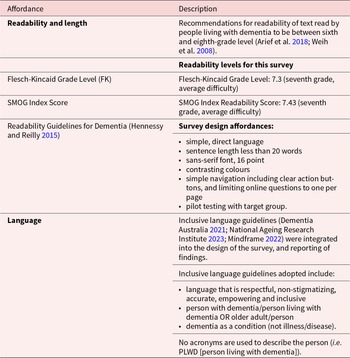
In keeping with the conceptual framework, the selection of the online survey method in the current study presents a source of diversified knowledge in a research narrative which has a tendency to limit people living with dementia to participating in qualitative research (Bravo et al. Reference Bravo, Trottier, Rodrigue, Arcand, Downie, Dubois, Kaasalainen, Hertogh, Pautex and den Block2019; Conway et al. Reference Conway, MacEachen, Middleton and McAiney2023). Additionally, collecting data via an online survey was selected as it provides a safe, non-stigmatizing space for sharing sensitive information, where the participants had control over their responses to the questions (Liamputtong Reference Liamputtong2007). The survey first underwent pilot testing with five participants from the target population who self-selected to participate. Of particular importance for promoting equitable participation was feedback from pilot participants relating to survey acceptability, relevance, comprehension and length (Thomas Reference Thomas2011). The final survey design (Supplement 1) was based on the pilot results, along with the readability and language guidelines outlined in Table 1.
Summary of affordances built into survey design

Ethical considerations
Inclusive, rights-based ethical considerations designed to uphold participant autonomy formed the basis of the research design and focused on the following ethical dimensions: enhanced informed consent (Evans et al. Reference Evans, Yorganci, Lewis, Koffman, Stone, Tunnard, Wee, Bernal, Hotopf and Higginson2020), voluntary participation (Darlington et al. Reference Darlington, Arthur, Woodward, Buckner, Killett, Lafortune, Mathie, Mayrhofer, Thurman and Goodman2021), confidentiality, and risk and harm. Cognitive screening of participants was not undertaken, as screening processes have been demonstrated to cause unnecessary participant exclusion and reification of capacity-related stigma (Diaz-Gil et al. Reference Diaz-Gil, Brooke, Kozlowska, Jackson, Appleton and Pendlebury2023; O’Connor et al. Reference O’Connor, Liddle, O’Reilly, Meyer, Cartwright, Chisholm, Conway, Fielding, Fox, MacAndrew, Schnitker, Travers, Watson, While and Bail2022).
Sampling
Adults living in Australia with a diagnosis of dementia were eligible to participate. Participants were recruited using non-probability, voluntary response self-selection sampling, which involved interested individuals choosing to complete the online survey in response to written advertisements about the research. Self-selection sampling is used in dementia research where consent and capacity are assumed through the completion and return of the survey (Darlington et al. Reference Darlington, Arthur, Woodward, Buckner, Killett, Lafortune, Mathie, Mayrhofer, Thurman and Goodman2021). This model is typically reliant on participants having higher levels of cognitive capacity to participate, and, while no exclusion criteria were outlined in relation to staging/progression of the participants’ dementia, it was anticipated that participation would likely be limited to those in the earlier stages of dementia (Al Baghal Reference Al Baghal2017; Darlington et al. Reference Darlington, Arthur, Woodward, Buckner, Killett, Lafortune, Mathie, Mayrhofer, Thurman and Goodman2021). To maximize opportunities for participation, the recruitment strategy was co-designed with Dementia Advocates (Dementia Australia 2024) and distributed widely via diverse networks.
Data collection
Data were collected through a 28-item survey (Supplement 1) between August 2023 and March 2024. The survey was composed of 25 closed-ended questions, which collected demographic data, along with data exploring the participants’ VAD needs and preferences. Views about VAD access generally, and VAD access through advance care directives, were collected by asking participants to nominate one of three provided statements to determine their personal access preferences, along with their support for other people living with dementia having the option to access VAD (Alzheimer’s Society 2024). Participants were then asked to consider eight statements exploring their views on the importance of different health and social factors relevant to VAD identified in a review of the literature, and to indicate their level of agreement with these statements based on a five-point Likert scale (strongly disagree–strongly agree). These questions were developed to explore the participants’ access needs and the impact of barriers to accessing VAD previously identified by people living with terminal conditions. Questions were also asked about the experiences of health services access for people living with dementia more broadly, such as geographical location (Willmott et al. Reference Willmott, Haining and White2023), relationships with health-care practitioners (White et al. Reference White, Jeanneret and Willmott2023), inclusion in the contemporary VAD discourse (Matthys et al. Reference Matthys, Cash and Moorhead2024), access to information and health decision-making (Lewis et al. Reference Lewis, Triandafilidis, Curryer, Yeun-Sim Jeong, Goodwin, Carr and Davis2023; White et al. Reference White, Jeanneret and Willmott2023) and professional/organizational conscientious objection to VAD (White et al. Reference White, Jeanneret and Willmott2023). Additionally, participants were given the option to respond to three open-ended questions seeking their views about VAD access, advance care directives and the most important message they wanted to share about VAD access for people living with dementia. These questions were included to foster reciprocity and respect for the participants (Diaz et al. Reference Diaz, Gove, Nelson, Smith, Tochel, Bintener, Ly, Bexelius, Gustavsson, Georges, Gallacher and Sudlow2021).
Data analysis
The closed-ended questions were analysed in IBM® SPSS® using descriptive statistics, where tabular reports were generated to show the frequency of the responses received. The responses to the open-ended questions were analysed using reflexive thematic analysis (Braun and Clarke Reference Braun and Clarke2022), supported by NVivo 14. The reflexive thematic analysis was undertaken using a six-phase approach: (1) familiarizing with the dataset; (2) coding; (3) generating initial themes; (4) developing and reviewing themes; (5) refining, defining and naming themes; and (6) writing up (Braun and Clarke Reference Braun and Clarke2022). Through this approach, data were read multiple times and coded at the semantic level. Coded data were then assigned to candidate themes, which were further reviewed and collapsed into themes related to a central organizing concept. The thematic analysis was completed by the first author, and themes were confirmed through discussion with the second and third authors.
Results
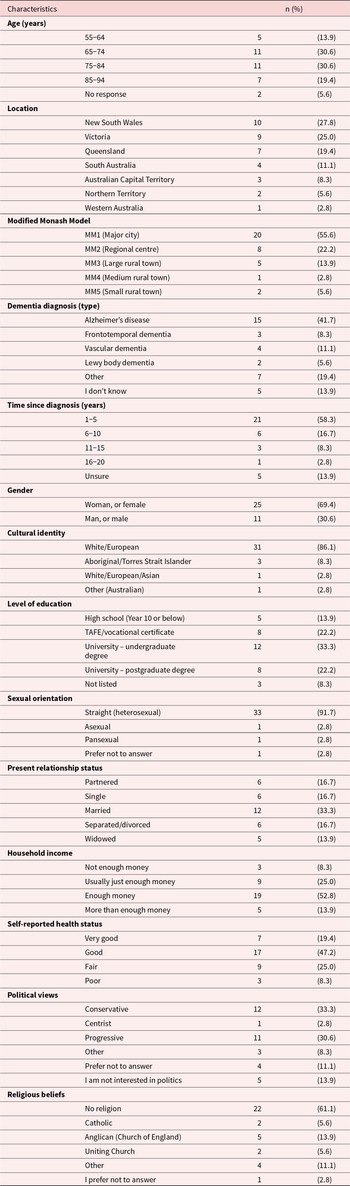
Thirty-six Australians living with dementia completed all or most of the survey. As shown in Table 2, the participants’ ages ranged from 55 years to 94 years, where the mean age of the participants was 75 years. Alzheimer’s disease was the most common type of dementia reported by participants (41.7%, n = 15), and the mean time since diagnosis was five years (range 1–20 years). Responses were received from participants from all Australian states and territories, except Tasmania. The categorization of location was informed by the Modified Monash Model, where just over half of the participants (55.6%, n = 20) lived in a major city (Department of Health and Aged Care 2023). In keeping with the general demographics of Australia, the majority of participants were White/European (86.1%, n = 31), identified as heterosexual (91.7%, n = 33) and held post-secondary qualifications (77.8%, n = 28). The most common gender identity of participants was woman, or female (69.4%, n = 25). Of the participants who disclosed their political beliefs, 33.3 per cent (n = 12) identified as conservative, 30.6 per cent (n = 11) as progressive and 2.8 per cent (n = 1) as centrist. In a similar way to political views, participants held differing religious beliefs, with 61.1 per cent (n = 22) reporting having no religious beliefs and 25 per cent (n = 9) reporting religious beliefs that can be categorized broadly as of the Christian faith.
Description of participant characteristics (n = 36)
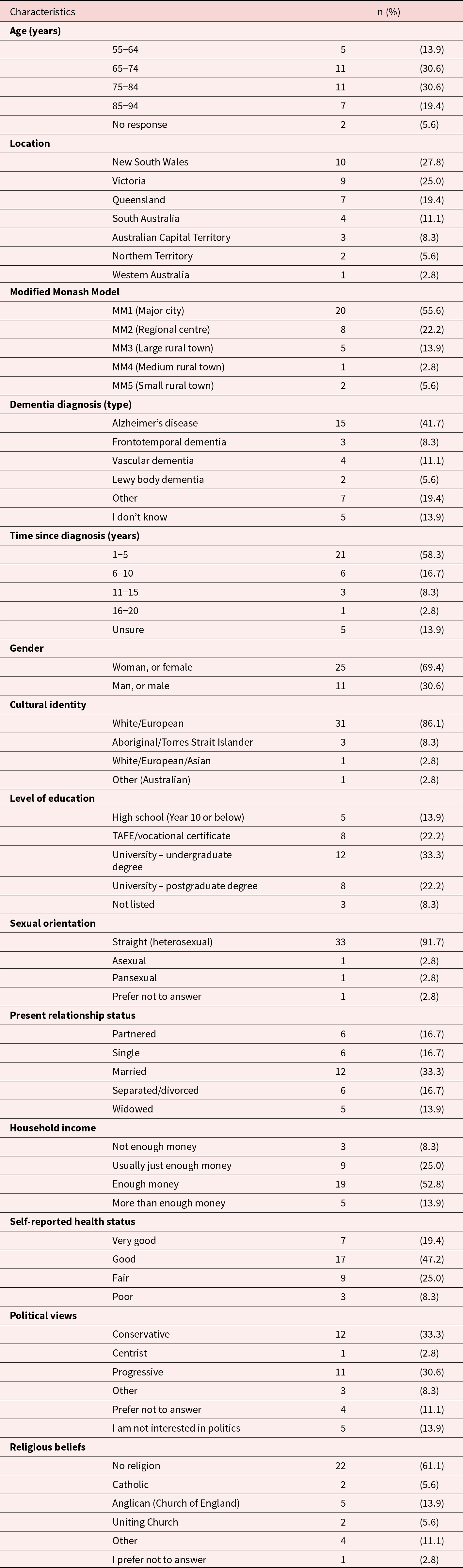
Note: The Modified Monash Model (Department of Health and Aged Care 2023) defines the remoteness of a location – MM1: major city; MM2: regional centres, population > 50,000; MM3: large rural town, population 15,000–50,000; MM4: medium rural town, population 5,000–15,000; MM5: small rural town.
Findings from descriptive analysis of closed-ended questions
Preferences for voluntary assisted dying access
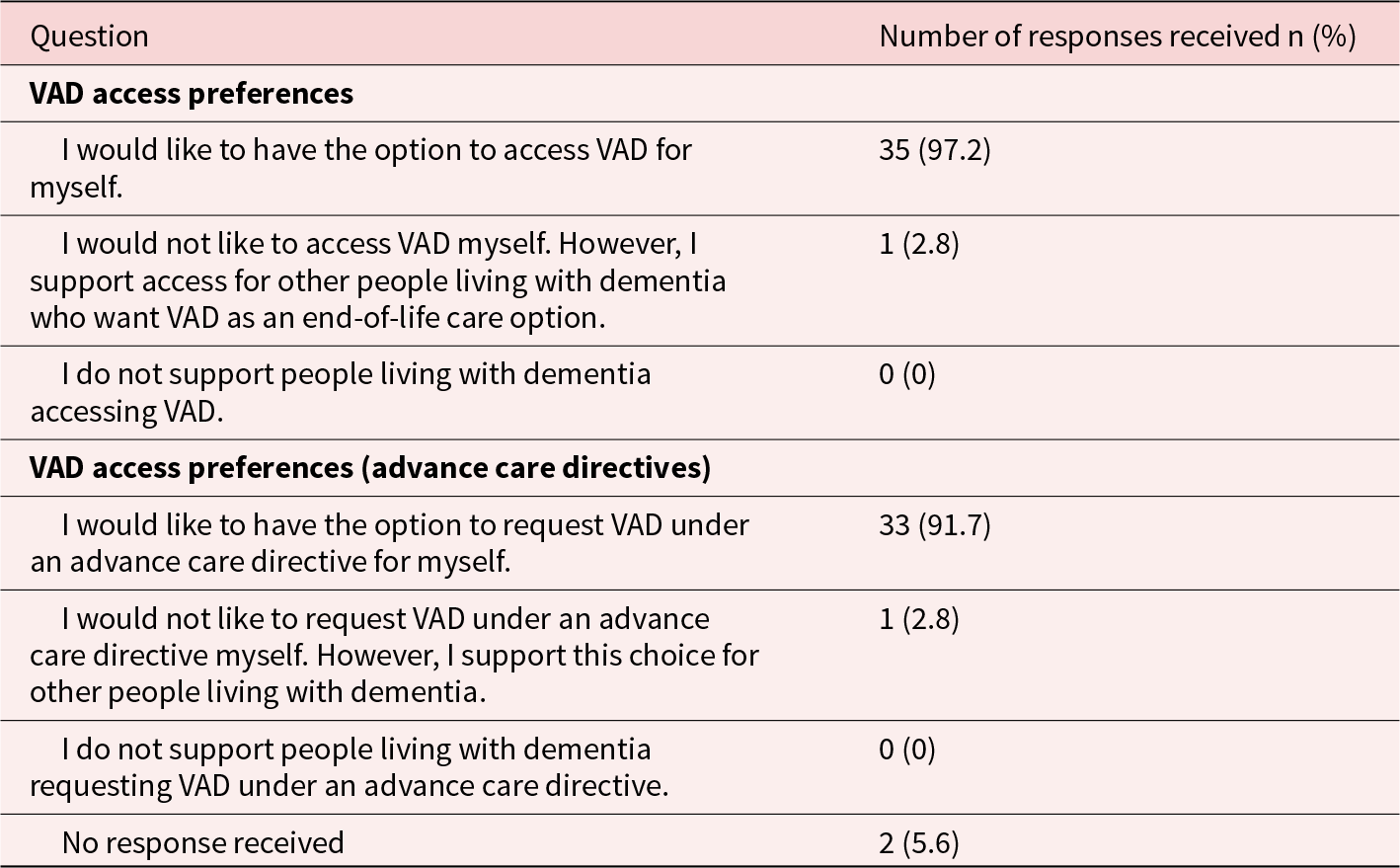
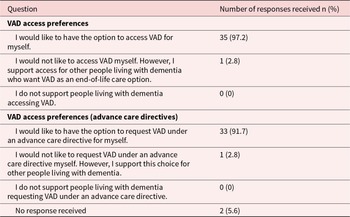
Participants were asked to consider their dementia diagnosis and to select the statement that best describes their preferences for VAD access. The majority of participants (97.2%, n = 35) indicated that they would like to have the option to access VAD for themselves. One participant indicated that they would not like to access VAD themselves, but they supported access for other people living with dementia who want VAD as an end-of-life care option. No participants indicated that they were unsupportive of VAD access for people living with dementia. None of the demographic factors appeared to influence preferences about access to VAD.
Preferences for VAD access using advance care directives
The participants also held strong views about VAD access being available for people living with dementia through advance care directives. Responses to this question were received from 94.4 per cent (n = 34) of participants. Of these 34 participants, 91.7 per cent (n = 33) would like to have the option to request VAD under an advance care directive and 2.8 per cent (n = 1) would not like to request VAD under an advance care directive themselves but support this choice for people living with dementia. No participants were opposed to people living with dementia requesting VAD under advance care directives. None of the demographic factors appeared to influence preferences for VAD access using advance care directives. A summary of these findings is provided in Table 3.
Voluntary assisted dying (VAD) access preferences (n = 36)
Voluntary assisted dying access needs
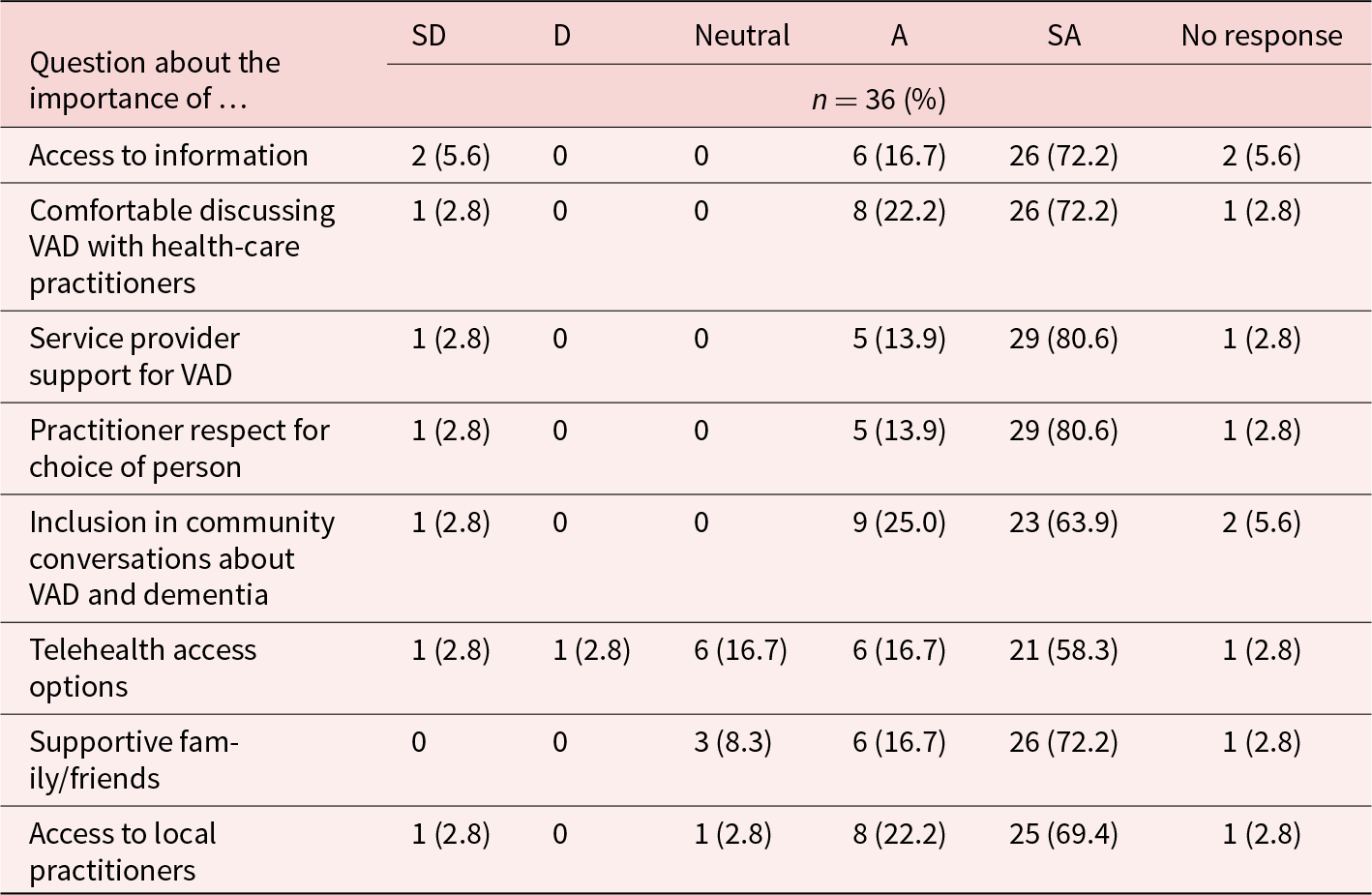
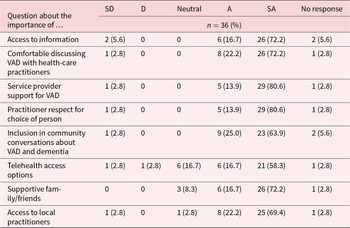
The participants then answered questions to determine the perceived importance of health and social factors relating to VAD. The strongest agreement reflected in participant responses related to questions about choice, specifically the importance of their end-of-life care choices being respected by health-care practitioners and family/friends, and of respect for their choices being demonstrated through support for VAD by service providers. The majority of participants also identified having access to authorized VAD practitioners in their local area as important. A summary of these findings is outlined in Table 4.
Voluntary assisted dying (VAD) needs
Themes derived from open-ended questions
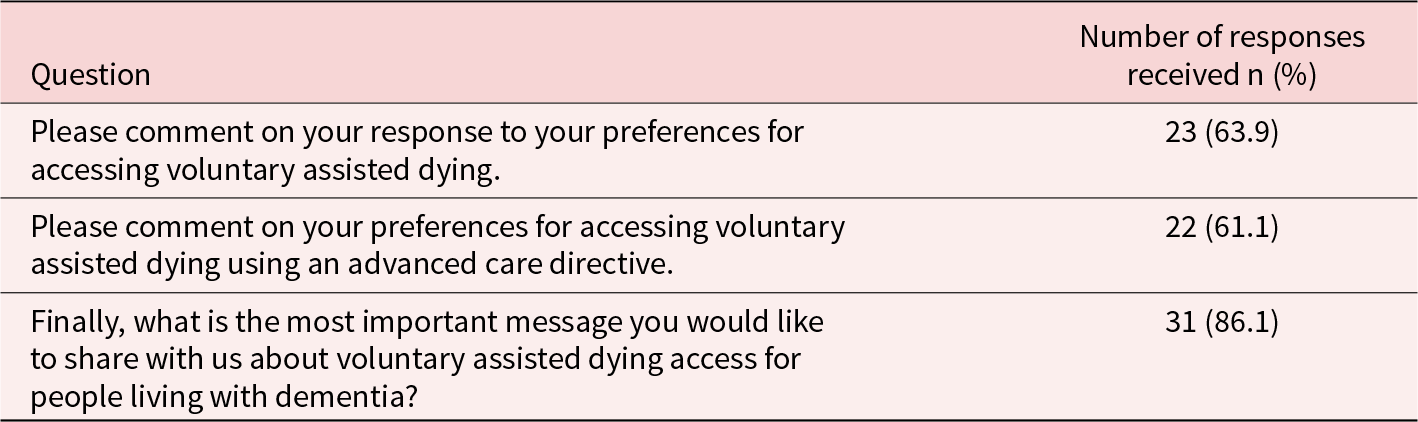
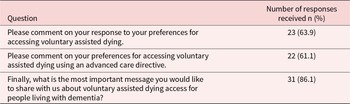
Participants were given the option of responding to three open-ended questions. A summary of these questions and total responses received is outlined in Table 5.
Summary of responses received: open-ended questions (n = 36)
Two themes emerged from the thematic analysis. The first theme, VAD access is my choice, explored the relationship between VAD preferences and autonomy and human rights. The second theme, Anticipated end-of-life experiences, unpacked suffering, dignity and the concept of a good death in the context of VAD. While there was a degree of commonality across the responses, each of these participants has a unique understanding of what access to VAD means to them; as such, each response was nuanced and highly specific to the person. The participants’ responses also demonstrated their concerns about the foreseeability of relinquishing their right to make decisions about their own end-of-life care, and the potential consequences of this denial of their perceived right to access an end-of-life care service that is available to other people living with a terminal condition. All participant names are pseudonyms.
Voluntary assisted dying access is my choice
The first theme, which was raised by the 28 participants, captures their preference for VAD access and how it is a matter of autonomy. These participants consistently raised the importance of personal choice in decision-making and how this choice is a human right. Across the responses received were 58 individual statements about choice that were explored across four categories: autonomy through advance care directives (n = 28); general statements about autonomy (n = 21); discrimination (n = 6); and autonomy and decisional capacity (n = 5). A key concern for these participants was the denial of their human right to VAD as a needs-based end-of-life care option.
Autonomy and advance care directives
Autonomy was raised by 28 participants, who discussed the importance of having the option to outline their wishes in an advance care directive:
My body, my choice. I may in the future not be able to choose VAD because I could wake up one morning with sudden deterioration in my mental competency so would not be able to make a competent choice for VAD. So making it part of my ACD while competent should ensure my wishes are carried out when no longer deemed competent. (Mary, 71)
Participants also outlined the circumstances under which they would like their advance care directive enacted and provided recommendations to guide substitute decision-making:
If we can determine a benchmark appropriate to enabling the alternate decision-maker to take action – e.g. if I can’t eat, drink, swallow, I would like my directive to be actioned e.g. assisted dying. Perhaps once 75% of ADL reached, this could be [the] benchmark. (William, 81)
Finally, participants shared details about their current advance care directives. One participant spoke about the financial implication of not having local access to VAD: ‘I presently have an ACD, but it doesn’t include VAD. It would be a lot simpler (and cheaper) if I could access VAD in Victoria (instead of travelling to Zurich)’ (Joseph, 75). Another participant spoke broadly about perceived barriers to engaging in developing an advance care directive: ‘I once saw the advance care directive form and it was many pages long and too daunting to contemplate filling in. It really does not need to be so hard’ (Dolores, 76).
In summary, this sub-theme has highlighted the importance of autonomy to the participants in the context of making advance requests for VAD. The participants acknowledge that developing an advance directive may be challenging, both in terms of the need for support to complete the paperwork and in terms of identifying a potential benchmark for enacting advance care directives. Additionally, concerns were raised about the financial implications associated with the current restrictions on VAD access in Australia. Despite these barriers, being able to choose VAD through an advance care directive was important to participants, as they value having bodily autonomy as the condition progresses.
General concerns about autonomy
General concerns about the importance of autonomy in the context of VAD were raised by 21 participants. Some of these participants viewed VAD through the lens of a personal choice: ‘It should be MY choice’ (Rose, 86). Similarly, some participants spoke of the importance of control in their end-of-life decision-making: ‘I wish to have control over my life and death as far as is possible’ (Dolores, 76). Realization of the right to autonomy was also viewed by two participants as achievable with the support of their chosen family ‘My daughter will support whatever my decision is. This gives me great comfort’ (Dolores, 76). Participants also spoke about the importance of VAD access for them through the lens of self-determination and their right to participation in public life, how access to VAD would have a positive impact for community and would allow them to give back to dementia research: ‘I want to donate my brain to dementia science and voluntary assisted dying would enable that to happen. It would be then that it would happen seamlessly’ (Sue, 74).
Participants also spoke about the intersection of their right to autonomy with paternalism: ‘Why should total strangers have the right to force me to live if I don’t want to?’ (Gregory, 70). Concerns about paternalism were also raised in the context of specific VAD opponents and the impact of these stakeholders on their right to autonomous end-of-life decision-making:
I don’t make judgement on other people’s beliefs or support of voluntary assisted dying. But no politician, religious group or opponent of assisted dying should have any say in how my life should end if it comes to me making a decision whilst I still can or having made preparations if my quality of life has to all intents and purposes ended. (Wayne, 63)
This sentiment was shared by other participants, who raised concerns about the intersection of paternalism and their right to supported decision-making in the context of end-of-life care:
The matter of consent in advance will not be settled while prevailing attitudes of paternalism exist. We can choose to terminate a pregnancy but not ourselves. Dementia does not fit the medical model of 12 months left to live. The old men still in charge will not permit the medical model to be adapted for us. Most people diagnosed early enough in the trajectory make our own plans. They usually include active neglect etc. The only legal way out for us is to starve to death. This is inhuman. (Eloise, 59)
The importance of choice and control resonated with participants across this sub-theme. The participants suggested that, with appropriate support, making choices about VAD is achievable. However, the participants raised concerns about what they perceive to be a paternalistic standpoint of key VAD stakeholders, which they believe has an impact on their right to autonomy.
Discrimination
Six participants raised concerns about discrimination and human rights. One participant outlined in detail their concerns about discrimination based on a dementia diagnosis as compared with other people who are living with a terminal condition:
There should be no obstruction to non-judgemental access to VAD for dementia sufferers who should be treated with the same considerations for VAD as those with diagnosis of other terminal conditions such as cancer, lung failure, heart failure, neurological conditions, etc. The brains of dementia sufferers die a slow death and along the way [is] an ongoing cascade of whole of body systems being affected, ending in the slow death of the person who once was, becoming just a husk, with associated trauma and heartbreak to loved ones and dear friends. Who in their right mind would want to live like that? For what purpose? (Mary, 71)
This contention was supported by another participant, who linked discrimination on the basis of a dementia diagnosis to the need for supported decision-making:
Research already suggests that the rates of ‘self-harm’ are higher than average amongst people recently diagnosed with dementia than the general public. It is discriminatory to disallow people living with dementia access to assisted dying just because they have dementia. They just need better support to make these decisions. (Harold, 70)
The participants in this sub-theme have raised concerns about the discriminatory nature of Australian VAD safeguards. In particular, the participants noted the lack of consistency in access for people living with terminal conditions, where VAD is available to some dying people, but not all. Furthermore, the participants indicated that people with dementia need better access to supported decision-making; without these supports, they experience what they perceive as unnecessary discrimination based on cognitive capacity.
Autonomy and decisional capacity
While 94.4 per cent of participants supported access to VAD through advance care directives for people living with dementia, the need for decisional capacity when accessing VAD was explicitly raised by five participants. Three of these participants clearly voiced their position of support for VAD access through advance care directives in instances where they may no longer have the requisite decisional capacity, and decision-making by a delegate is permitted: ‘I believe this access should be available before I am palliative, and/or that a person of my choice (legal representative) can action it, if I no longer have capacity’ (Linda, 66). In contrast, two participants spoke of the need for ongoing capacity to support decision-making: ‘I strongly support providing voluntary assisted dying for people, even those with dementia, who can lucidly express the desire for accessing voluntary assisted dying’ (Martin, 85). This sub-theme demonstrates a divergence in the views of participants towards autonomous decision-making, and making VAD access requests when they no longer meet the decisional capacity criterion.
Overall, the theme of VAD access is my choice presents a nuanced account of the needs and preferences of people living with dementia. Specifically, this theme highlighted the importance of autonomy to the participants, and how VAD can facilitate choice and control over their deaths. While the participants had an appreciation of the eventual changes in their cognitive capacity that may limit their choices surrounding VAD, they believed that they should have the right to make these decisions while they are able. Moreover, the participants raised concerns about discrimination and paternalistic attitudes held by other VAD stakeholders that they believe have a direct impact on the choices available to them.
Anticipated end-of-life experiences
The second major theme, Anticipated end-of-life experiences, explores participants’ perceptions of a good death considered in the context of VAD and their concerns about dying from dementia. Twenty individual responses are included in this theme, which is broken down into three categories: past, present and future experiences of suffering (n = 12); human dignity, and VAD promoting flourishing at end of life (n = 5); and VAD as an alternative to dying in residential care (n = 3).
Past, present and anticipated future experiences of suffering
The 12 participants who shared their preferences for VAD access did so in the context of suffering and fear: witnessing past suffering of people living with dementia; their living experiences of personal suffering because of dementia; and anticipated future suffering. Two participants reflected on their lived experiences of bearing witness to the progression of dementia: ‘I saw what my dad went through with a diagnosis of dementia and I fear that’ (Sue, 74). One participant shared their desire to access VAD through the lens of their living experience of dementia: ‘I suffer every day with dementia. I want my suffering to end’ (Judy, 65). A further nine participants shared their beliefs about their anticipated future living with dementia and used language including non-verbal, peg-fed, no quality of life, no longer communicate, unimaginable pain, a ‘shell’ of a human and cognitive void to describe their fears. One participant concisely summarized these perceptions:
I already suffer dysphagia at 55, I will eventually lose control of all of my muscles and will have no idea how to eat, drink, recognize a toilet or people, require people to change my incontinence wear due to no bowel or bladder control. I will have no quality of life – how can anyone say this is living. I don’t believe in quantity over quality, I’m afraid. (Ellen, 55)
Suffering was also considered by four participants in the context of the potential burden of dementia on the family and friends: ‘I have lived a wonderful life and don’t believe I should be allowed to suffer for my remaining days nor let my family suffer such a degrading death’ (Ellen, 55).
The participants in this sub-theme indicated that their preference for VAD was related to their understanding of the progressive nature of the condition and the suffering they anticipate experiencing owing to a loss of functional and cognitive capacity. These participants contextualize their perception of suffering differently; some participants have a lived experience of caring for a family member who died from dementia, while others were themselves suffering because of the condition. However, they share the view that they would consider choosing VAD so that both they and their families would not experience the types of suffering they believe that dementia will cause.
Human dignity, and VAD promoting flourishing at end of life
Five participants shared their views about the importance of human dignity and the potential for VAD access to promote flourishing at end of life. Three of the participants spoke broadly about the perceived indignity of dying from dementia: ‘Give us all the support you can. Nobody should have to live with this indignity against their will and wishes’ (Helen, 79). Additionally, one participant spoke about human dignity as a precursor to a good death: ‘This should be a choice made available to those of us who would like to die with the dignity we deserve rather than a demoralizing death caused by this insidious disease’ (Ellen, 55). One participant spoke about the indignity of capacity-related stigma as it relates to end-of-life decision-making: ‘Having dementia, as I understand it, does not mean that I am unable to make rational decisions. People living with dementia have feelings and should have the right to choose their own time of death through the dignified manner of VAD’ (Grace, 87). Finally, two participants explored the potential for VAD to promote flourishing at end of life: ‘It would mean I would be able to live a reasonable life until the disease really takes over’ (Ruth, 87).
This sub-theme has highlighted the importance of human dignity to the participants, and their perception that indignity is inherent in the experience of dying from dementia. Avoiding experiencing this indignity is a priority for these participants and they believe that by enacting what they characterize as a right to choose VAD, they will be able to live a good life.
Voluntary assisted dying as an alternative to dying in residential aged care
The final anticipated end-of-life experience that three participants believed would contribute to them potentially seeking VAD is the prospect of living with, and dying from, dementia as an end-user of Australian residential care services. Two participants discussed their anticipated future residential care experiences as a person living with dementia in the context of dignity ‘I am paranoid about finishing up in a nursing home – losing all my dignity and self-respect. I want to be remembered as I am now’ (Ruth, 87). The final participant considered dementia as a disability and spoke of the lack of support for people living with dementia in community, and the potential for admission into a residential care facility that is not designed to meet their needs:
Demand for VAD would drop significantly if we were not placed into cold storage in institutions, designed for days gone by. We need access to palliative-style care when care needs exceed the four hours a day, five days a week of support currently available. There is no disability support available for people diagnosed with dementia or other disability after age 65 except residential facility. (Eloise, 59)
The participants in this sub-theme raised concerns about their perceived end-of-life experience as an end-user of the Australian residential care system, and how their future need to access residential care influenced their VAD preferences. This sub-theme is complex and highlights the disconnect between the expectation of the participants as end-users of the Australian residential care system to be treated with dignity, respect and from within a disability model of care, and their perception of care that they anticipate receiving. As such, this sub-theme suggests that to ensure that they will die with dignity, they would prefer to access VAD than to enter residential care.
In summary, the participants in this theme shared the meaning of anticipated end-of-life experiences for them, where motivations for VAD access were grounded in fears of living with, and dying from, dementia. The participants raised concerns about physical and cognitive changes associated with dementia, through the lens of past experiences of bearing witness to end of life with dementia; present experiences of suffering caused by symptoms of the condition; and anticipated future suffering and indignity.
Discussion
This is the first known Australian study to explore the needs and preferences of people living with dementia for VAD access, and is among a growing number of international studies (Lemos Dekker Reference Lemos Dekker2021; Thériault et al. Reference Thériault, Guay and Bravo2021; Van Rickstal et al. Reference Van Rickstal, De Vleminck, Chambaere and den Block2023) that meaningfully include their voices in VAD research. By centring their voices in VAD research through an inclusive approach to research design, this study has identified valuable, contextually relevant insights into the VAD needs and preferences of Australians living with dementia. The participants in the current study were diverse in terms of geographical location, religion and political beliefs, yet all participants were supportive of people living with dementia having the option to choose VAD, including having a choice in how/when they access VAD, which may include access through an advance care directive. The influence of demographic factors on the views of people living with dementia in international jurisdictions appears to be similar to that of the participants in the current study (Lemos Dekker Reference Lemos Dekker2021; Thériault et al. Reference Thériault, Guay and Bravo2021; Van Rickstal et al. Reference Van Rickstal, De Vleminck, Chambaere and den Block2023). However, the influence of personal beliefs and demographic factors on the VAD needs and preferences of people living with dementia appears to be in stark contrast to the views of other stakeholders who are entrusted with their care. Previous studies of health-care professionals in Australia (Haywood et al. Reference Haywood, Thompson, Breen and O’Connor2022; O’Connor et al. Reference O’Connor, Martin, Willmott, Haywood, Lawrence and Breen2021) and internationally (Quah et al. Reference Quah, Chua, Lua, Wan, Chong, Lim and Krishna2023; Tomlinson and Stott Reference Tomlinson and Stott2015) have identified that a complex range of ethical, professional, personal and emotional factors, along with political and religious views, shape their perceptions of VAD access generally. This finding highlights two key factors associated with VAD access for Australians living with dementia. First, this finding suggests that the motivations for VAD access by the participants in the current study lies outside of the demographic factors noted as influencing the views of other key stakeholders. Second, the discordance in views between key stakeholders and people living with dementia creates a differential impact in policy and practice settings which further marginalizes people living with dementia, as they currently lack the epistemic respect to influence policy and practice (Kidd and Carel Reference Kidd and Carel2017). Given the gap between the views of people living with dementia and other key stakeholders, this finding suggests that differing priorities across stakeholder groups may be problematic were VAD legally available to Australians with dementia, potentially posing complex barriers to access.
Despite the demographic diversity of the participants in the current study, the findings highlight their shared overarching need to live well and to die well, and to be treated in a dignified manner that respects their rights, just as other Australians are treated when planning for the end of their lives. The importance of quality of life and a good death expressed by the participants in the current study is shared by their counterparts in international jurisdictions (Lemos Dekker Reference Lemos Dekker2021; Thériault et al. Reference Thériault, Guay and Bravo2021; Van Rickstal et al. Reference Van Rickstal, De Vleminck, Chambaere and den Block2023) and with other Australians living with a terminal condition (Lewis et al. Reference Lewis, Harrison, Hanly, Psirides, Zammit, McFarland, Dawson, Hillman, Barr and Cardona2019). The participants’ need to live and die well, and for dignified and respectful treatment, is, in part, grounded in their fear of future suffering, which is a driving reason behind the participants wanting to access VAD. Fear of future suffering is a concern commonly identified by people living with dementia, and has been identified previously as a clear motivation for wanting to access VAD. In a recent ethnography of people living with dementia and informal care-givers living in the Netherlands, the participants associated suffering with their fear of losing control and autonomy, which they believed would likely result in a loss of dignity and increased burden. In some instances, this fear was also linked to past experiences of witnessing the progression of dementia (Lemos Dekker Reference Lemos Dekker2021). In a similar way, fear of suffering as a motivation to access VAD is evident in interviews with people living with dementia in Quebec, Canada (Thériault et al. Reference Thériault, Guay and Bravo2021), and with people living with younger onset dementia and their informal care-givers in Belgium (Van Rickstal et al. Reference Van Rickstal, De Vleminck, Chambaere and den Block2023). In these interviews, many participants raised concerns about future suffering in the context of the physical and cognitive decline that accompanies advanced dementia. The fear of dying from dementia reported in the current study was also linked to anticipated suffering owing to poor end-of-life experiences as current or future users of Australian residential care. The fear of residential care for people living with dementia is reported in research from the Netherlands (Lemos Dekker Reference Lemos Dekker2021) and Belgium (Van Rickstal et al. Reference Van Rickstal, De Vleminck, Chambaere and den Block2023), where participants believed that residential care would have a negative impact on their self-determination and right to make choices about their care, a view that shaped their preferences for VAD. However, in the Australian context, it is posited that this fear is also related to recent reports of substandard care experienced by many people living with dementia in residential care, including abuse, mismanagement of palliation and dementia care, and restrictive practices (Pagone and Briggs Reference Pagone and Briggs2021). As such, the findings of this study suggest that the lack of VAD access leaves Australians living with dementia in an impossible situation: simultaneously navigating fears associated with living with a terminal condition, within a system that oftentimes fails to uphold their right to receive care that aligns with their needs and preferences (Pagone and Briggs Reference Pagone and Briggs2021; United Nations 2006).
To realize what they perceive as their right to choose VAD to ameliorate suffering, the participants in the current study identified the importance of approaches to policy and practice that ensure that their needs are met. Participants in the current study prioritized their need to receive VAD through local services that facilitate supported decision-making, and for their choices to be respected by their health-care practitioners and service providers. The needs of the participants in the current study are similar to those of other Australians living with terminal conditions, who also prioritize their quality of life, information access and choice and control over their care (Lewis et al. Reference Lewis, Harrison, Hanly, Psirides, Zammit, McFarland, Dawson, Hillman, Barr and Cardona2019). Although potentially complex, it is evident from international examples that implementing supportive care systems to meet the VAD access needs of Australians living with dementia is an achievable goal. Successful exemplars are grounded in relational autonomy (Council of Canadian Academies 2018) and collaborative approaches (Pope and Brodoff Reference Pope and Brodoff2024) that centre people living with dementia in decisions about their care. Emerging international approaches are also inclusive and highlight the value of novel approaches to substitute decision-making and advance care planning for people living with dementia who wish to access VAD, but require significant support to do so (Lemos Dekker Reference Lemos Dekker2021). These findings suggest that the participants in this study welcome the design of supportive systems of care informed by international best practice, and are ready and willing to collaborate with key stakeholders to achieve this goal.
The findings of the current study have also highlighted the concerns of participants who believe that they are faced with a system that is unable to meet their needs at end of life. The participants in the current study prioritized their autonomy and the right to make choices about their end-of-life care, but believe that policy and practice decisions about VAD discriminate against them owing to their disability. The seriousness of the discrimination claims made by the participants in the current study resonates with Australian legal scholarship, where recent research has warned that excluding people living with dementia from VAD access could form the basis of future legal action to challenge this discrimination (Baird Reference Baird2024). This finding amplifies the importance of recognizing that people living with dementia have the same right to autonomy and risk in decision-making as other people living with terminal conditions (Harbison Reference Harbison, Torres and Donnelly2022). Their right to equal recognition before the law is enshrined under the UNCRPD (United Nations 2006), where state parties are obliged to ensure that tailored and proportional safeguards that respect the preferences of the person, and support them to freely make choices about their care, are in place. This right extends to more complex cases of VAD where people living with advanced dementia require a third party to advocate for their needs and preferences through substitute decision-making (Arstein-Kerslake Reference Arstein-Kerslake2016; Sinclair et al. Reference Sinclair, Field, William, Blake, Bucks, Auret, Clayton and Kurrle2018) whilst upholding their right to be free from undue influence and abuse (United Nations 2006). The complexity of this finding highlights the critical importance of the experiential knowledge of people with dementia in the context of VAD, and how their knowledge, alongside rights-based and international approaches that manage the delicate balance of autonomy, non-discrimination and safety, can form the basis of contextually relevant policy and practice.
Although most participants in the current study were in the earlier stages of the condition (<20 years since diagnosis), the findings of this study have challenged the discriminatory views that the participants perceive are held against them, which result in barriers to VAD access. The current study has highlighted that by first recognizing the capability of people with dementia, and affording them the right of risk in the context of VAD research, their contributions have set the benchmark for what is possible when inclusive approaches to VAD are prioritized. This finding challenges the dominant medico-legal and political approaches to VAD in Australia (Cahill Reference Cahill, Torres and Donnelly2022). Rather than continuing with the current approach to VAD eligibility that champions much of the same experiences that people living with dementia face at end of life, the findings of this study indicate a pressing need for a rights-based approach that deconstructs the institutions and environments that the person living with dementia navigates (Cahill Reference Cahill, Torres and Donnelly2022). Meeting this challenge requires a fundamental reconceptualization of how people living with dementia are viewed, as well as an overhaul of how we work alongside them, and to place them at the centre of questions about how we can facilitate their need for autonomy, quality of life and a good death (Arstein-Kerslake Reference Arstein-Kerslake2016; Cahill Reference Cahill, Torres and Donnelly2022).
Strengths and limitations
This is the first known study to explore the needs and preferences of people living with dementia in Australian VAD research and is among the few international studies to prioritize their voices in this space. A key strength of this study is the decision to collect data using a survey. The use of a survey, in particular the integration of open-ended survey questions, allowed the participants to express profound and painful feelings more safely than in an interview or focus group setting. Additionally, this study adds to an emerging body of literature demonstrating that people living with dementia have the capability to participate both in survey research and in heavily contested spaces where their voices are otherwise absent, therefore providing a springboard for novel avenues of future dementia research.
The study also has several limitations. While this study has shown that people living with dementia can engage in survey research, a limitation of this study relates to sample size. Voluntary assisted dying research presents researchers with unique recruitment challenges when engaging potential end-users as research participants (Thériault et al. Reference Thériault, Guay and Bravo2021). Although the results of this study should be interpreted with some caution owing to sample size, it is important to also note that, given the highly individualized and personal nature of end-of-life decision-making for each and every person, generalizability is not the most useful metric for interpreting these results (Etz and Arroyo Reference Etz and Arroyo2015). Second, the participants in this study were heterogeneous in terms of their religious and political beliefs, largely reflecting Australian demographics, and were fairly homogenous with regards to gender and education levels. It must be noted that the voices of Aboriginal and Torres Strait Islander peoples, culturally and linguistically diverse (CALD) groups, lesbian, gay, bisexual, transgender, intersex, queer and asexual (LGBTIQA +) groups, and regional and remote communities were underrepresented in this study, reflecting a shortcoming of the sampling procedure of self-selection. The final limitation of this study relates to participant bias. The participants in this study self-selected and likely did so because they hold strong views in support of VAD. This is a common phenomenon across VAD research, where people with strong supporting or opposing views are more likely to participate in research (Thériault et al. Reference Thériault, Guay and Bravo2021).
Implications for policy and practice
Legal access to VAD for eligible Australians living with terminal conditions is still in its infancy, and exploration of adopting more equitable, rights-based policy and practice positions that include people living with dementia continues to be a divisive discourse. From the outset of these conversations, it is vital that people living with dementia are treated as key stakeholders, and this study is an important first step towards their meaningful inclusion in a research narrative where their voices have been largely excluded (Matthys et al. Reference Matthys, Cash and Moorhead2024). In particular, this study demonstrates the value of inclusive research design and the capability of people living with dementia to contribute to this important area of end-of-life care research. Despite the small sample size, the seriousness and the urgency of the findings of this study justify the recommendation for future VAD dementia research aiming to better understand the views towards and experiences of VAD of people living with dementia and how these views and experiences inform their preferences for VAD. This study also highlights the importance of the active and meaningful engagement of people living with dementia in end-of-life care planning through supported decision-making. However, given the apparent discordance between the priorities of people living with dementia and their health-care practitioners, further research into how VAD services can be delivered in a way that balances the interests of both parties is warranted. Finally, this study highlights the pressing need for further research into VAD access for Australians living with dementia in the context of human rights, to ensure that policy and practice is grounded in an end-user-informed, rights-based position.
Supplementary material
The supplementary material for this article can be found at https://doi.org/10.1017/S0144686X25100330
Acknowledgements
The authors would like to express their gratitude to the participants who engaged in this study. Additionally, the authors wish to thank the Dementia Advocates and industry partners who supported this project. The corresponding author receives financial support from the Australian Government Research Training program scholarship.
Author contributions
The corresponding author, AM, led the conceptualization, the formal analysis, the investigation and the methodology, with support from the other two authors, BC and BM. Authors BC and BM had equal responsibility for supervision of AM. The lead author, AM, led the writing of the original draft, with support from BC and BM, and all three authors reviewed and edited the manuscript.
Financial support
No funding was received for this research project.
Competing interests
The authors declare that they have no known conflict of interests.
Ethical Standards
This study was approved by the Charles Sturt University Human Research Ethics Committee (H23635).


 Open access

