

In northern Belize, Postclassic (AD 900–1542) social organization diverged from earlier systems of governance, yet long-standing religious practices continued. Postclassic pilgrims visited abandoned sacred sites where they reset and reinterpreted monuments, deposited scatters of incensarios and votive offerings, and, occasionally, created small altars—piles or stacks of rock—as part of their rituals. As part of the special section on the southeastern Three Rivers adaptive region (TRR) of the Maya Lowlands (see Houk et al. Reference Houk, Thompson and Novotny2026), we report evidence from two Maya sites in northwestern Belize—Kaxil Uinik and Ayiin Winik—for Late Postclassic monument veneration, including the first documented Late Postclassic altar, in the study area (Figure 1). Data collected by the Chan Chich Archaeological Project (CCAP) and the Belize Estates Archaeological Survey Team (BEAST) fit into a broader pattern of postabandonment visitation (see Stanton and Magnoni Reference Stanton and Magnoni2008).
Map showing the locations of sites mentioned in the text. Map by Amy E. Thompson. (Color online)

Postclassic Monument Veneration
Archaeologists have long recognized that the ancient Maya visited and reset monuments at abandoned Classic period settlements (e.g., Satterthwaite Reference Satterthwaite, Shook, Coe, Broman and Satterthwaite1958). Maya communities moved, reinterpreted, and reused monuments for a variety of reasons, from trophies of conquest, to ritually animate or terminate buildings, or to co-opt or claim the power of the monument as a symbol (e.g., O’Neil Reference O’Neil2024; Rice Reference Rice, Arnauld and Breton2013; Schwarz Reference Schwarz2023). A common thread of these actions is their intentional display of former symbols of power in new contexts to renegotiate meaning and memory (see Hammond and Bobo Reference Hammond and Bobo1994). While Postclassic manifestations of power shifted away from the formal, state-controlled religious spectacles common in the Classic period (AD 250–810), community-driven integrative rituals persisted. This is observed through votive offerings deposited at the mouths of caves, on sacred hill/mountaintops, and at monuments and buildings in abandoned cities (see Lorenzen Reference Lorenzen2003; Stanton and Magnoni Reference Stanton and Magnoni2008).
Occasionally, Postclassic people constructed small, somewhat informal altars at these locations to center their rituals. Here, we are making a distinction between altars built at Postclassic villages (e.g., see Chase and Chase Reference Chase and Chase1988:43) and those constructed at pilgrimage sites like Xunantunich and Chan (see Brown Reference Brown2011; Kosakowsky et al. Reference Kosakowsky, Novotny, Keller, Hearth, Ting and Robin2012).
The Postclassic in the Study Area
Like most of the southern Maya lowlands, the TRR experienced a drastic population decline and abandonment of most major centers by the end of the Terminal Classic (AD 810–900) period (Adams et al. Reference Adams, Robichaux, Valdez, Houk, Mathews, Demarest, Rice and Rice2004). A small community persisted for a century or two at Akab Muclil (Figure 1; Houk et al. Reference Houk, Sullivan and Valdez2008), but archaeologists have not documented any Maya occupation between circa AD 1000 and 1800 in the southeastern TRR. Nevertheless, Late Postclassic Maya visited multiple former city centers in the region (see Houk et al. Reference Houk, Sullivan and Valdez2008) and left artifacts on or near monuments and on large, abandoned structures (e.g., Hammond and Bobo Reference Hammond and Bobo1994; Houk et al. Reference Houk, Sullivan and Valdez2008; Zaro and Houk Reference Zaro and Houk2012). In the TRR, Late Postclassic monument veneration is documented at Río Azul (Adams Reference Adams1999), Dos Hombres (Houk et al. Reference Houk, Sullivan and Valdez2008), Chan Chich (Houk Reference Houk2015:198), and La Milpa (Hammond and Bobo Reference Hammond and Bobo1994), among other sites. Researchers have largely interpreted these examples as votive offerings left by visitors/pilgrims, as there is no evidence of full-time occupants at these sites. Hammond and Bobo (Reference Hammond and Bobo1994) offer the most detailed and thoughtful analysis of monument veneration in the eastern TRR. Using stratigraphy, monument position, and artifact analysis they conclude that Late Postclassic pilgrims moved or reerected multiple stelae and stela fragments at La Milpa, possibly as late as AD 1500–1600+ (Hammond and Bobo Reference Hammond and Bobo1994:24–32). Our case studies, from Kaxil Uinic and Ayiin Winik, reveal similar patterns of Late Postclassic monument veneration and resetting but also document the first reported Postclassic altar in the region.
Kaxil Uinic
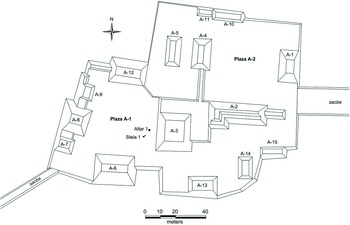
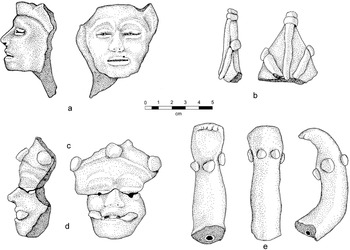
Kaxil Uinic is a minor center, 2 km west of Chan Chich (Figure 2). J. Eric S. Thompson (Reference Thompson and Eric1939:280) first recorded a broken, carved stela and plain altar at the site in 1931, and the Rio Bravo Archaeological Project (RBAP) reported on both monuments at the western base of Structure A-3 in 1990 (Guderjan et al. Reference Guderjan, Lindeman, Ruble, Salam, Yaeger and Guderjan1991:59). The stela is broken in two, 2.5 m south/southwest of the altar. During the CCAP investigations of the site in 2012, Harris (Reference Harris2013:36) found one fragment laying flat and oriented east-west, with faint traces of carving on its upward facing surface, and the other sitting upright and oriented perpendicular to Structure A-3. Careful examination of the fragments’ shapes and orientation determined that the upright fragment is the original top of the monument, and the base fell backward (Harris Reference Harris2013). Excavations around the stela recovered 24 Late Postclassic Chen Mul modeled incensario sherds, including a realistic looking face (Figure 3a), which may be colonial in age (Harris Reference Harris2013; Houk et al. Reference Houk, Harris, Kelley and Sisneros2013). Because CCAP recovered the incensario sherds from around the upright fragment, it is improbable that Thompson or RBAP repositioned the stela; instead, the evidence suggests that Late Postclassic visitors reset the monument and deposited the offerings.
Map of Kaxil Uinic’s site core showing the locations of Stela 1 and Altar 1 based on field and lidar data. Map by Brett A. Houk.

Illustrations of incensario sherds recovered from excavations around Kaxil Uinic Stela 1: (a) possible colonial incensario fragment; (b–e) Chen Mul modeled sherds. Illustration by Margaret Greco after Houk et alia (Reference Houk, Harris, Kelley and Sisneros2013:Figure 4). Courtesy CCAP.

Ayiin Winik
Ayiin Winik is a larger site with a spacious plaza flanked by monumental architecture including an unusual double ballcourt. Two seasons of investigations show that the Main Plaza and site core date to the Late Classic (AD 600–810). Ayiin Winik’s Southern Acropolis is a large hilltop group comprising Courtyards B-1 and B-2 separated by Structure B-1, a small temple-pyramid (Figure 4). The final phase of Structure B-1 dates to the Late Classic, but the building contains a looted Early Classic tomb. Stela 1 on the north side of Structure B-1 was originally over 2.3 m tall but is now broken into two large fragments: one upright and one recumbent. The apparently uncarved monument would have originally faced north into Courtyard B-1. While documenting the monument in 2023, we recovered incensario sherds, including Chen Mul Modeled sherds, in the topsoil around the recumbent fragment.
Map of Ayiin Winik’s site core and the Southern Acropolis. Map by Brett A. Houk.

In 2024, BEAST excavated a unit encompassing both the upright fragment of Stela 1 and a small cluster of limestone blocks that we assumed were monument fragments, approximately 75 cm north of the stela. However, excavators noted clustered ceramic incensario fragments on and around the small pile of limestone blocks. This feature is 125 cm in diameter and is interpreted to be a Late Postclassic altar (Figure 5). Rather than a single stone, this altar is a pile of limestone blocks likely scavenged from the surrounding buildings.
Photograph of the Ayiin Winik Postclassic altar and upright Stela 1 fragment. Camera facing south. (Courtesy BEAST) (Color online)

Ceramics were the only artifacts present around the altar. These include Terminal Classic types consistent with the latest occupation at the site and 25 sherds identified as Late Postclassic Chen Mul Modeled incensario fragments. Excavators recovered the latter on the surface or shallowly buried. Because the Chen Mul incensario fragments were on top of and immediately surrounding the altar, we attribute them to a Late Postclassic visitation to the site.
Our excavations and careful examination of the stela determined that the vertical fragment of Stela 1 is the top of the monument. Visitors to the site reset this fragment to directly face the Late Postclassic altar, which offset its orientation relative to the surrounding Late Classic architecture. Terminal Classic and Postclassic artifacts identified around the edges of the recumbent slab, but not under it, indicate that the stela fell and fractured before Postclassic visitors deposited offerings.
Discussion
During the Terminal Classic, the Maya abandoned major centers within the TRR as Classic period political systems collapsed, and evidence to date suggests the region and most surrounding areas lay largely abandoned until colonial times (Houk Reference Houk2015; Houk et al. Reference Houk, Sullivan and Valdez2008). Postclassic people, however, still visited or passed through the region, stopping to venerate former sacred locations. Postclassic activity is most often evidenced by the presence of ceramics and other small offerings at monuments and abandoned structures (see Stanton and Magnoni Reference Stanton and Magnoni2008). Less frequently, Postclassic visitors constructed formal ritual places in the form of stone altars. The few published examples of these pilgrimage-site altars typically reorient and repurpose fragments of older monuments in their construction.
This pattern is perhaps most dramatically demonstrated at Chan in the Belize River valley. In the Central Plaza, two Postclassic mosaic altars were built facing a reset fragment of Stela 1 (Kosakowsky et al. Reference Kosakowsky, Novotny, Keller, Hearth, Ting and Robin2012). These altars are intercardinally oriented with the Middle Preclassic foundational caches and burial below the altar, despite no indications of the burial on the surface (Kosakowsky et al. Reference Kosakowsky, Novotny, Keller, Hearth, Ting and Robin2012). This coordination suggests Postclassic visitors had a long-standing social memory of Preclassic ancestors that they called on to reinterpret Classic period symbols of power across the plaza.
Brown (Reference Brown2011) documented a variation of this pattern at Xunantunich. The Postclassic altar and locus of postabandonment ritual there was Structure E-2, the eastern building of a Preclassic E Group, 1 km from the Late Classic site core. The Postclassic altar is a small, 1 m cube made of vertical limestone slabs filed with rubble. Archaeologists found lithic bloodletting tools and Postclassic ceramics in the soil from the altar to the base of Structure E-2 (Brown Reference Brown2011). Again, these postabandonment activities seem to purposefully renegotiate the experience and interpretation of earlier structures.
While examples of Postclassic monument veneration are present at other sites in the eastern TRR (see Houk et al. Reference Houk, Sullivan and Valdez2008), Ayiin Winik hosts the first Postclassic altar documented in the area. The Ayiin Winik feature is far from any documented Late Postclassic settlements—the nearest being Ka’kabish and Lamanai (McLellan Reference McLellan2020) to the northeast and small settlements in the Belize River valley (Hoggarth et al. Reference Hoggarth, Culleton, Awe and Kennett2014) to the south, both approximately 50 km away. Intriguingly, context and artifacts associated with the Ayiin Winik and Kaxil Uinic monument resetting closely resemble Late Postclassic veneration at La Milpa, 25 km to the north. There, Hammond and Bobo (Reference Hammond and Bobo1994:30–31) speculated the pilgrimages and rituals represented a revitalization movement spurred by the Spanish’s placing Chetumal under encomienda control in 1544.
Dating the Postclassic in the southeastern TRR is entirely based on ceramics and poorly refined lithic tool chronologies, but the available information suggests these site visits took place in the Late Postclassic period. However, the precise dating of Postclassic ceramic types also requires refinement. Recent radiocarbon dating in the Belize River valley challenges the accuracy of the Early Postclassic ceramic typology widely used to argue for occupation continuity (see Hoggarth et al. Reference Hoggarth, Culleton, Awe and Kennett2014). Work by Hoggarth et alia (Reference Hoggarth, Culleton, Awe and Kennett2014) indicates that Baking Pot, the site with the strongest radiocarbon sequence and one long thought to have Early Postclassic occupation based on ceramic typologies, experienced a hiatus following Late Classic abandonment until the Late Postclassic.
Across the southern lowlands and in the TRR, Postclassic people renegotiated their relationship to the abandoned cultural landscape by visiting, modifying, and venerating sacred locations (Houk et al. Reference Houk, Sullivan and Valdez2008; Stanton and Magnoni Reference Stanton and Magnoni2008). The data from Kaxil Uinic and Ayiin Winik suggest that people visiting these sites were part of this broader Postclassic pattern. Postclassic visitors to these sites reset monuments to create new contexts for votive offerings, and, at Ayiin Winik, constructed a new altar to center their rituals. We further suggest that other crudely constructed Late Postclassic altars may have gone unrecognized and recommend that future studies look for similar features near Classic period monuments that evidence postabandonment manipulation. Additionally, careful documentation of artifact and monument context are necessary to refine age estimates for such ephemeral Postclassic activity, which will be necessary to better understand the timing and purpose of these pilgrimages. Further research is also needed to understand the potential associations or alignments with earlier architecture, as well as explore the possible impetus for these practices.
Acknowledgments
Thanks to Texas Tech University, the Alphawood Foundation, and the Belizean Institute of Archaeology for their support. Additionally, this research would not be possible without assistance from our Belizean collaborators and permission from the landowners, Bowen & Bowen Ltd, and Belize Maya Forest Trust. Tomás Gallareta Cervera wrote the Spanish abstract. Three anonymous reviewers provided helpful comments.
Funding Statement
Field school fees supported the 2012 season. A grant from the Alphawood Foundation to Houk supported the 2024 season.
Data Availability Statement
The field data used in this study are published in Matthew Harris’s master’s thesis, available through Texas Tech University’s library, and project field reports, available at https://www.depts.ttu.edu/sasw/Research/CCAP.php.
Competing Interests
The authors declare none.



 Open access

