


Introduction
Global biodiversity is declining because of human activities (Vitousek, Reference Vitousek1994). The main drivers of species loss are land-use change, pollution, climate change, habitat fragmentation and infrastructure development (Alkemade et al., Reference Alkemade, van Oorschot, Miles, Nellemann, Bakkenes and ten Brink2009). The road network is a major threat to biodiversity: directly by irreversibly altering habitats and wildlife behaviour, and causing direct mortality through vehicle collisions (hereafter roadkill), and indirectly by leading to fragmentation of landscapes and wildlife populations (Forman & Alexander, Reference Forman and Alexander1998; Coffin, Reference Coffin2007; Kociolek et al., Reference Kociolek, Clevenger, St Clair and Proppe2010). Roadkill affects animals across a broad range of taxa, from small invertebrates to large vertebrates. It is of particular concern when rare, threatened or declining species are involved, for which continuous exposure to road mortality can lead to regional extinction (Grilo et al., Reference Grilo, Borda-de-Água, Beja, Goolsby, Soanes, le Roux and Koroleva2021).
Despite the negative impacts of roads on wildlife populations, studies on this threat are relatively scarce in the Global South. Latin America hosts a number of global biodiversity hotspots, but the region also has the world's highest road occupancy levels (Fay et al., Reference Fay, Andres, Fox, Narloch, Straub and Slawson2017), and further large road development projects are planned (Meijer et al., Reference Meijer, Huijbregts, Schotten and Schipper2018). It is estimated that 12 million birds and 5 million mammals are being killed per year on roads in this region (Medrano-Vizcaíno et al., Reference Medrano-Vizcaíno, Grilo, Pinto, Carvalho, Melinski, Schultz and González-Suárez2022). Despite this impact on wildlife, a recent review showed that across Latin America, few studies have been conducted compared with more developed regions, with the majority (86%) focused on South America and only a few examining the issue in Central America (Pinto et al., Reference Pinto, Clevenger and Grilo2020). Although conservation research in general has benefitted from advances and innovations in science and technology, investment in research and development is limited in Central America compared to other Latin American countries (Padilla-Pérez & Gaudin, Reference Padilla-Pérez and Gaudin2014). The output of scientific research thus remains low in Guatemala, El Salvador and Honduras (hereafter referred to as northern Central America; Morales-Marroquín et al., Reference Morales-Marroquín, Solis Miranda, Pinheiro and Zucchi2022), and there is a lack of scientific data on roadkill (but see Rojas & Avendaño, Reference Rojas and Avendaño2018), making this region a critical focus for investigation (Medrano-Vizcaíno et al., Reference Medrano-Vizcaíno, Grilo and González-Suárez2023b).
Here we aim to address this knowledge gap by taking advantage of citizen science-based projects in El Salvador, Guatemala and Honduras. Using the iNaturalist (2017) platform, these projects have collected data submitted by amateur naturalists and experts since 2017. Citizen science is on the rise, yet the adoption of such datasets may be hindered by the perception that the data are of lower quality than those collected with standardized methods by expert scientists (Crall et al., Reference Crall, Newman, Stohlgren, Holfelder, Graham and Waller2011; Follett & Strezov, Reference Follett and Strezov2015). However, studies have shown that citizen science projects can complement systematic surveys and improve our understanding of road impacts on wildlife (Wiggins et al., Reference Wiggins, Newman, Stevenson and Crowston2011; Bird et al., Reference Bird, Bates, Lefcheck, Hill, Thomson, Edgar and Stuart-Smith2014; Périquet et al., Reference Périquet, Roxburgh, le Roux and Collinson2018; Medrano-Vizcaíno et al., Reference Medrano-Vizcaíno, Brito-Zapata, Rueda-Vera, Jarrín-V, García-Carrasco and Medina2023a). Citizen science projects have helped to identify roadkill patterns, geographical hotspots and at-risk species across large spatial scales, where rigorous scientific surveys are logistically and financially unfeasible (Vercayie & Herremans, Reference Vercayie and Herremans2015; Heigl et al., Reference Heigl, Horvath, Laaha and Zaller2017; Périquet et al., Reference Périquet, Roxburgh, le Roux and Collinson2018). In addition, citizen science not only assists in assessing the magnitude of wildlife roadkill and identifying affected species, but also provides an opportunity to engage the public, offering environmental education and raising awareness among communities (Vercayie & Herremans, Reference Vercayie and Herremans2015; Medrano-Vizcaíno et al., Reference Medrano-Vizcaíno, Brito-Zapata, Rueda-Vera, Jarrín-V, García-Carrasco and Medina2023a). Thus, our objective was to compile the first database of wild vertebrate roadkill for northern Central America and to encourage collaboration between the public, policymakers and researchers to systematically gather data and develop conservation strategies for the affected species.
Study area
The northern Central American countries form a biogeographically important region, with diverse flora and fauna, regional endemic species and global biodiversity hotspots (Haffer, Reference Haffer1985; Peterson et al., Reference Peterson, Escalona-Segura and Griffith1998; Olson & Dinerstein, Reference Olson and Dinerstein2002; Rovito et al., Reference Rovito, Vásquez-Almazán, Papenfuss, Parra-Olea and Wake2015; Fig. 1). The vegetation is characterized by a diverse array of vegetation communities, such as rainforests, cloud forests, dry forests, savannah woodlands and mangrove swamps (Piperno, Reference Piperno2006). The landscapes are also marked by extensive agricultural areas, featuring crops such as coffee, bananas, maize and sugar cane (Imbach et al., Reference Imbach, Beardsley, Bouroncle, Medellin, Läderach and Hidalgo2017). The terrain varies, with elevations ranging from sea level along the coastlines to towering peaks reaching > 4000 m. The main topographic feature of the region is the Central American Cordillera, situated along the Pacific coast, with plains extending towards the Atlantic (Taylor & Alfaro, Reference Taylor, Alfaro and Oliver2005). The climate follows neotropical patterns with distinct wet (May–October) and dry (November–April) seasons (Hastenrath, Reference Hastenrath1967). The road network in the region includes both paved and unpaved roads, with estimated lengths of 16,860 km (road density rd = 0.15 km/km2) in Guatemala, 16,893 km (rd = 0.15 km/km2) in Honduras, and 9,847 km (rd = 0.47 km/km2) in El Salvador (SACDEL, 2004; MCIYV, 2015; INE, 2021a). Over a period of 4 years (2016–2020), Honduras and Guatemala showed a 40 and 26% increase in their vehicle fleets, respectively, and El Salvador's vehicle fleet increased by 59% in just 7 years (2016–2023; Instituto Nacional de Estadística de Guatemala, unpubl. data; Viceministerio de Transporte de El Salvador, unpubl. data; INE, 2021b). El Salvador has the highest road density and probably the highest vehicle density (vehicles per km2) in Central America.
Roadkill records in countries of northern Central America. Land-cover data with 10 m resolution were obtained from Zanaga et al. (Reference Zanaga, Van De Kerchove, De Keersmaecker, Souverijns, Brockmann, Quast and Wevers2021). Tree cover includes forest and mangroves; open areas include shrubland, grassland, cropland and bare ground/sparse vegetation. (Readers of the printed journal are referred to the online article for a colour version of this figure.)

Methods
During 2017–2020, we initiated three independent projects in Honduras, El Salvador and Guatemala on the citizen science platform iNaturalist (2024a,b,c) to collect roadkill records of vertebrates. On iNaturalist, users can create projects to group observations based on specific characteristics, such as wildlife roadkill in our case. In our projects, users could contribute new or existing records, with species identification initially proposed by users and reviewed by a global community, including amateur naturalists and specialists. An observation was categorized as ‘research grade’ (i.e. reliable identification) when 2–3 users agreed on the taxon identification. However, some inexperienced users may have mistakenly classified observations as research grade; we therefore reviewed the photographs of each record to ensure the species identification was correct. If the carcasses photographed were too deteriorated to be identified to species level, we assigned the lowest possible taxonomic level (genus, family, order or class). We retained records without photographs if they had been submitted by a specialist, and excluded any duplicate or doubtful records (e.g. where an animal may have died because of other causes such as electrocution).
Distinguishing between the Virginia opossum Didelphis virginiana and southern opossum Didelphis marsupialis can be challenging because there are few morphological differences between these species (Cervantes et al., Reference Cervantes, Arcangeli, Hortelano-Moncada and Borisenko2010), and because roadkill carcasses can show severe degradation. Consequently, we treated all observations of these two species as Didelphis spp. for further analyses.
Because the data available on iNaturalist had been collected in a non-systematic manner, all analyses were merely descriptive. We report the total number and percentage of observations by species, genus, class and country. In addition, we identified the type of road where roadkill occurred by cross-referencing photographs uploaded with the records with satellite and street view images from Google Earth (Google, Reference . and .2020a) and Google Maps (Google, 2020b), categorizing roads as paved or unpaved and noting the number of lanes per direction. We also reviewed the IUCN Red List (IUCN, 2023) and local lists of threatened and endangered fauna in the three study countries (CONAP, 2021; WCS, Reference WCS2021; MARN, 2023) to classify the recorded species by their global and local conservation status. We created a roadkill map per country in ArcMap 10.5 (Esri, USA), using the geographical coordinates provided in the records where these were available and consistent with road locations.
Results
A total of 737 observations were submitted to the roadkill projects on iNaturalist. After data curation and verification, we included 670 of these records in the further analyses, of which 293 (44%) were mammals, 200 (30%) reptiles, 145 (21%) birds and 32 (5%) amphibians. The observations covered a period of 11 years, from 2011 to 2023. Identification to species level was possible for 485 observations (122 species), and 126 observations were identified only to genus level (10 genera). Thirty-seven observations were identified to class level only. Of the 122 species identified, 46 (38%) were birds, 47 (38%) reptiles, 24 (20%) mammals and 5 (4%) amphibians. Among the most common roadkill species were opossums Didelphis spp. and Philander vossi, Central American boa Boa imperator, neotropical whip snake Masticophis mentovarius, black vulture Coragyps atratus, hooded skunk Mephitis macroura, northern tamandua Tamandua mexicana, Mesoamerican cane toad Rhinella horribilis and jaguarundi Herpailurus yagouaroundi (Table 1). Seven species recorded are of global conservation concern: Carr's snail sucker Sibon carri, Central American snapping turtle Chelydra rossignonii, margay Leopardus wiedii, neotropical river otter Lontra longicaudis, Espinal's coffee snake Ninia espinali, eastern meadowlark Sturnella magna and Yucatán black howler monkey Alouatta pigra, and four have not been evaluated (Table 2). Forty-six species are listed either as Vulnerable, Threatened or Endangered nationally (Table 2).
The top 10 species of birds, reptiles, mammals and amphibians most frequently recorded during 2011–2023 in the iNaturalist roadkill projects in northern Central America.

National and global conservation status of vertebrates recorded as roadkill during 2011–2023 in northern Central America. Species marked with an asterisk (*) are among the top 10 most frequently recorded species (Table 1).

1 EN, Endangered; LC, least concern; NE, Not Evaluated; NT, Near Threatened; TH, Threatened; VU, Vulnerable.
2 D, decreasing; I, increasing; S, stable; U, unknown.
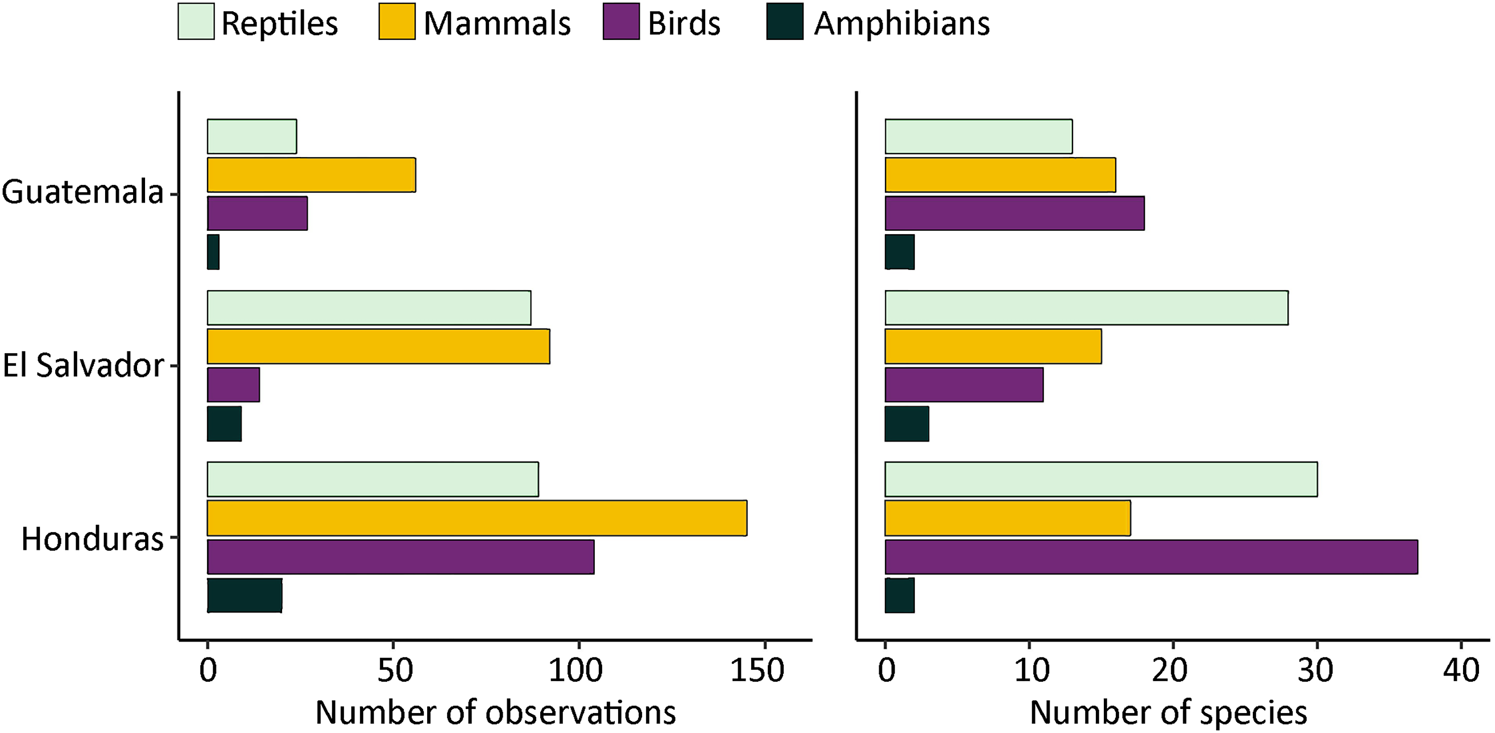
Honduras had the highest number of roadkill records (n = 358, 54%), followed by El Salvador (202, 30%) and Guatemala (110, 16%). Ninety-five users submitted observations across El Salvador (34, 36%), Guatemala (28, 29%) and Honduras (33, 35%). In 2011, four observations were submitted by three users, which increased to a maximum of 269 observations by 45 users in 2021. Mammals were the most recorded group in all three countries, with Honduras recording the highest number of bird species, Guatemala and Honduras the most mammals, and Honduras the most reptiles (Fig. 2). Opossums Didelphis spp. were the most common species recorded across all three countries, followed by the Central American boa in El Salvador and Honduras, and the northern tamandua in Guatemala. The vast majority (92%) of roadkill records were on paved roads, and most (69%) of these occurred on roads with one lane per direction. No records were submitted from unpaved roads with two lanes per direction.
Number of roadkill observations recorded (during 2011–2023) and vertebrate species identified by citizen science projects in northern Central America.

Discussion
Our study marks a first step towards understanding the impact of roadkill mortality on wildlife in northern Central America, particularly in El Salvador and Honduras, where there was no previous information about roadkill in the scientific literature. Mammals were the most affected group, with seven globally and 46 locally threatened species killed on roads in the region. Our study highlights the importance of citizen science projects to obtain data at larger spatial and temporal scales, and the ability of such projects to provide crucial data on rare and at-risk species (Vercayie & Herremans, Reference Vercayie and Herremans2015; Périquet et al., Reference Périquet, Roxburgh, le Roux and Collinson2018). However, there are limitations in our data, particularly with respect to the reliability of species identification, uneven sampling effort across areas and a bias towards larger species. Increasing user participation in citizen science projects is expected to expand coverage in the future, particularly in underrepresented areas such as rural, unpaved roads in our study region. However, because of the underlying recording biases, the true impact of roads on wildlife is inevitably underestimated by the data available through opportunistic sampling by citizen scientists, and further systematic surveys are needed for comprehensive estimates.
When compared to systematic studies carried out in Central America, our findings agree with those of Gálvez (Reference Gálvez2021) in Panama, who found that mammals were among the most affected group along a two-lane paved road transect of c. 12.7 km over a 3-year monitoring period. However, two other systematic studies in Guatemala and Costa Rica found that amphibians were the group most affected by roadkill, although their data collection was limited to 5 and 3 months, respectively, within a single year (Rojas-Chacón, Reference Rojas-Chacón2011; Rojas & Avendaño, Reference Rojas and Avendaño2018). Comparison with other Central American studies is challenging, as they focused on specific taxonomic groups such as mammals (Artavia et al., Reference Artavia, Jiménez, Martínez-Salinas, Pomareda, Araya-Gamboa and Arévalo-Huezo2015; Contreras & González, Reference Contreras and González2018), or amphibians and reptiles only (Arévalo et al., Reference Arévalo, Honda, Arce-Arias and Häger2017; Monge-Velazques et al., Reference Monge-Velázquez, Langen and Sáenz2022), rather than a broader assessment of vertebrates.
Our findings, however, align with research in other regions, with mammals being the taxonomic group most frequently recorded as roadkill, and opossums Didelphis spp. being particularly affected (Main & Allen, Reference Main and Allen2002; Coelho et al., Reference Coelho, Kindel and Coelho2008; Ferreira da Cunha et al., Reference Ferreira da Cunha, Alves-Moreira and Silva2010; Gálvez, Reference Gálvez2021; Medrano-Vizcaíno et al., Reference Medrano-Vizcaíno, Brito-Zapata, Rueda-Vera, Jarrín-V, García-Carrasco and Medina2023a). Didelphis are abundant and opportunistic species that have a broad diet and utilize a variety of habitats, including buildings and human-dominated areas, making them prone to frequent road crossings (Ryseri, Reference Ryseri1995; Adler et al., Reference Adler, Arboledo and Travi1997; Cordero-Rodríguez, Reference Cordero-Rodríguez2000) and putting them at high risk of collisions with vehicles. In addition, our study found the gray four-eyed opossum P. vossi and Mesoamerican cane toad frequently observed as roadkill; these species have also been recorded as common victims of vehicle collisions in previous studies (Artavia et al., Reference Artavia, Jiménez, Martínez-Salinas, Pomareda, Araya-Gamboa and Arévalo-Huezo2015; De La Ossa-Nadjar & De La Ossa V., Reference De La Ossa-Nadjar and De La Ossa2015; Rojas & Avendaño, Reference Rojas and Avendaño2018; Monge-Velásquez et al., Reference Monge-Velázquez, Langen and Sáenz2022). All of these species are common in agricultural and open areas (Reid, Reference Reid1997; Köhler, Reference Köhler2008). Grassland, agriculture and open areas are associated with a high frequency of vertebrate roadkill (Orłowski & Nowak, Reference Orłowski and Nowak2006; Seo et al., Reference Seo, Thorne, Choi, Kwon and Park2015; Medrano-Vizcaíno & Espinosa, Reference Medrano-Vizcaíno and Espinosa2021), probably because of the availability of food resources such as crops and small mammals, which increases the abundance of medium-sized generalist and synanthropic species (Adler et al., Reference Adler, Arboledo and Travi1997; Dotta & Verdade, Reference Dotta and Verdade2011; González-Gallina et al., Reference González-Gallina, Benítez-Badillo, Rojas-Soto and Hidalgo-Mihart2013).
After mammals, reptiles and birds were the most frequently recorded vertebrate groups. The reptiles recorded were mainly snakes, which are known to be attracted to roads for thermoregulation (Sullivan, Reference Sullivan1981; Rosen & Lowe, Reference Rosen and Lowe1994). We found the Central American boa and the neotropical whip snake commonly recorded as roadkill, corroborating findings of earlier studies (Carvalho et al., Reference Carvalho, Custódio and Marçal-Junior2017; Monge-Velázquez et al., Reference Monge-Velázquez, Langen and Sáenz2022). These snakes are large and slow-moving, making them vulnerable to vehicle collision when utilizing or attempting to cross roads (Rosen & Lowe, Reference Rosen and Lowe1994; Quintero-Ángel et al., Reference Quintero-Ángel, Osorio-Dominguez, Vargas-Salinas and Saavedra-Rodríguez2012).
Amongst the birds, the black vulture was the most frequently recorded species, which has also been reported in other studies in the neotropical region (Medrano-Vizcaíno et al., Reference Medrano-Vizcaíno, Brito-Zapata, Rueda-Vera, Jarrín-V, García-Carrasco and Medina2023a). Scavengers are prone to becoming victims of roadkill because their scavenging behaviour frequently leads them to feed on carcasses on roads (Hubbard & Chalfoun, Reference Hubbard and Chalfoun2012; Cuyckens et al., Reference Cuyckens, Mochi, Vallejos, Perovic and Biganzoli2016). In addition, as reported in previous studies (Medrano-Vizcaíno et al., Reference Medrano-Vizcaíno, Grilo, Pinto, Carvalho, Melinski, Schultz and González-Suárez2022, Reference Medrano-Vizcaíno, Brito-Zapata, Rueda-Vera, Jarrín-V, García-Carrasco and Medina2023a), we found other widely distributed species such as the groove-billed ani Crotophaga sulcirostris and eastern meadowlark as frequent roadkill victims. These species inhabit grassland and open areas, which are associated with high roadkill rates. Unlike some previous studies that reported amphibians as frequent roadkill victims (Puky, Reference Puky, Irwin, Garrett and McDermott2005; Attademo et al., Reference Attademo, Peltzer, Lajmanovich, Elberg, Junges, Sanchez and Bassó2011; Ribeiro-D'Anunciação et al., Reference Ribeiro-D'Anunciação, Silva-Lucas, Xavier-Silva and Bager2013), our records showed this to be the least frequently encountered taxonomic group. This may be attributed to lower numbers of records during the wet season, when amphibians are particularly abundant and roadkill likelihood is higher (Braz & Rodrigues-França, Reference Braz and Rodrigues-França2016; Arévalo et al., Reference Arévalo, Honda, Arce-Arias and Häger2017). In addition, their small size and short carcass persistence may lead to underreporting (Guinard et al., Reference Guinard, Julliard and Barbraud2012; Teixeira et al., Reference Teixeira, Coelho, Esperandio and Kindel2013).
In summary, our study, by utilizing data gathered through citizen science projects, offers important insights into vertebrate roadkill in northern Central America, highlighting the impact of roads on > 100 wildlife species, including some of conservation concern. Several species recorded as the most frequently affected in our study, such as the black vulture (Cathartiformes), northern tamandua (Pilosa) and the pauraque Nyctidromus albicollis (Caprimulgiformes) are listed as priority taxa for conservation and research (Medrano-Vizcaíno et al., Reference Medrano-Vizcaíno, Grilo, Pinto, Carvalho, Melinski, Schultz and González-Suárez2022, Reference Medrano-Vizcaíno, Grilo and González-Suárez2023b), highlighting the need to further study the impacts of roads on those groups and in understudied areas such as northern Central America. However, data limitations such as spatial bias, species misidentifications and a focus on charismatic and larger-bodied species, must be acknowledged. Continued long-term, standardized monitoring on roads is therefore crucial, with a focus on identifying the most affected species and areas, especially those within conservation priority regions. The nature of the data utilized in our study does not allow us to identify these key areas. However, based on previous research and our personal observations, we recommend that roads crossing national parks, forests or wetlands should be prioritized for monitoring, as rare and threatened species usually occur in these landscapes, thus these areas are of particular importance for conservation. Of the various habitats present in our study area, wetlands are probably the most underrepresented in our dataset. However, roads near wetlands have high numbers of roadkill and can function as ecological traps for many species (Ashley & Robinson, Reference Ashley and Robinson1996; Smith & Dodd, Reference Smith and Dodd2003; Bueno et al., Reference Bueno, Sousa and Freitas2015; Monge-Velásquez et al., Reference Monge-Velázquez, Langen and Sáenz2022), especially for anurans and turtles. For instance, McCranie (Reference McCranie2018) reports that a population of white-throated mud turtle Kinosternon albogulare, which occurred in large puddles on a road in Gracias a Dios, Honduras, was decimated because of a sharp increase in vehicle traffic on that road.
The fact that common and abundant generalist species dominate roadkill records potentially leads to an underestimation of the impact of roads on less common, locally or globally threatened species (Table 2). This includes species with unknown population trends, such as Julio's casquehead iguana Laemanctus julioi and the Honduran emerald spiny lizard Sceloporus hondurensis. Roadkill poses a significant threat to threatened and declining species, emphasizing the need to pay close attention to each species, as even small losses can elevate the extinction risk for rare and threatened species (Grilo et al., Reference Grilo, Borda-de-Água, Beja, Goolsby, Soanes, le Roux and Koroleva2021). Finally, we highlight that, aside from the deployment of some wildlife-crossing warning signs (the effectiveness of which is unknown), none of the three study countries have actively implemented mitigation measures for avoiding animal roadkill. Given their commitments to biodiversity conservation (Convention on Biological Diversity and Agenda 2030 for Sustainable Development), we urge northern Central American countries to adopt mitigation strategies, including protective barriers, wildlife crossings and other strategies in both existing and new road projects.
Author contributions
Study design: DJA-A, GF, BIE-A, CF; fieldwork: all authors; data analysis: DJA-A, GF; writing and revision: all authors.
Acknowledgements
We thank the many observers who contributed to these projects with their valuable observations, particularly Sergio Isac Zuniga Martinez, Carlos Peña and Bianca Bosareyes; and David Kramer for his review of the text. This research received no specific grant from any funding agency, or commercial or not-for-profit sectors.
Conflicts of interest
None.
Ethical standards
No specimens were collected during this research, which otherwise abided by the Oryx guidelines on ethical standards.
Data availability
The data that support the findings of this study are openly available in Mendeley Data at doi.org/10.17632/n634dgmbk2.1.



 Open access

