




On the 29 December 1569, the feast day of St Thomas of Canterbury, the twelfth-century English martyr, thirty English and Welsh Catholic clerics, laymen and their households joined together in the medieval dining room of the English Hospice in Rome for a feast in honour of their patron saint (festa S. Thomae).Footnote 1 Precise details of the food purchased for the dinner are preserved in the Hospice archives, records that were part of a growing policy of financial management that spread across Europe in the sixteenth century.Footnote 2 At first glance, the single page document seemed to supply only detailed information about the food consumed—meats, enriched with spices, cheeses and an assortment of fruits—which was to be served on a mixture of Italian and English crockery and plate. On closer inspection, a marginal note on the page also listed some of the men who came together for this feast. They included exiled Catholic bishops, diplomats and other clerical and lay actors who had been forced out of England by the nascent Elizabethan Protestant state. The deposed clerics included Thomas Goldwell (1500-1585), bishop of St Asaph, and Dr Nicholas Morton (1520/21-1587), Prebendary of York, while Sir Richard Shelley (c. 1513-1587) was an aristocratic diplomat. They and others had made their way to Rome in the 1560s, fleeing the imposition of the Acts of Supremacy and Uniformity, statutes that had made Queen Elizabeth the highest ecclesiastical authority in England and enforced religious worship based on a reformed liturgy.Footnote 3 Goldwell, Morton and Shelley were leading English Catholics who were part of the small group of Englishmen in Rome assembling at the Hospice for the dinner.
This article aims to show how the archival records of the 1569 feast link the commensal meal to patterns of membership of a political and faith-based community at a critical moment in the lives of English Catholics abroad. Feasting was an integral part of Judeo-Christian culture and spirituality, with biblical references reinforcing the centrality of food and faith as recorded in the first books of the Old Testament.Footnote 4 Making connections between the Hospice inventory and the men participating in the shared meal are central to the aim of this article: to situate the dinner in the context of the religious politics of the diners.Footnote 5 The Roman feast and the individuals who attended it are located in the material and spiritual environments of the Counter-Reformation and Renaissance city.
Opening with a reading of the importance of the hospice and the cult of St Thomas Becket for émigré Catholics in the 1560s, the article examines the dinner itself on multiple levels: the participants, its institutional location, an analysis of the food consumed and the utensils and artefacts used. From the spatial, material and sensory aspects of this event, it goes on to discuss the potential connections between the timing of the meal, the social actors involved and the papal politics surrounding Elizabeth’s excommunication. Adopting this approach involves negotiating some of the established historiography of English Catholics in exile in a different way.Footnote 6 Many accounts initially concentrated on the heroic activities of martyrs and the missionary expeditions for the reconversion of England, launched from the 1580s onwards. The Venerable English College, which took over the buildings of the Hospice in 1579, was the starting point for the ill-fated journeys spearheaded by Edmund Campion and Robert Persons which featured prominently in this foundational approach. Histories of English Catholicism have productively expanded since the pioneering work of John Bossy and Eamon Duffy begun more than fifty years ago. Their aim was to revalidate Catholicism in the English historical mainstream.Footnote 7 This article examines Englishmen away from home, and specifically in Rome in the mid-sixteenth, prior to the foundation of their college. Katy Gibbons and Liesbeth Corens have examined Catholics in their transnational settings and this article conceptualises post-Reformation English Catholicism in terms of the broader processes of European movement across time and place.Footnote 8 Frederick Smith has drawn attention to exiled Marian priests’ responses to earlier Henrician reforms from the 1530s onwards; building on his research it is possible to understand the activities of English Catholics at a crucial later moment, in the 1560s.Footnote 9
In terms of the Hospice itself, a series of essays on its development were published in 1962.Footnote 10 Anthony Kenny, and more recently Lucy Underwood, examined the English College student membership at the end of the sixteenth century, investigating the autobiographies of seminarians who made their way to Rome.Footnote 11 Underwood, in particular, has shown how the Roman activities of the later seminarians at the college intervened in religious diplomacy, and in the policies of the global Catholic Church.Footnote 12 She has also shown how sermons written by college students at the end of the century invoked the memory of St Thomas.Footnote 13 This productive attention to individual lives has informed this article. Finally, this article probes the interaction between religious politics and the urban cultures of the city. Building on Thomas McCoog, Michael Questier and Michael Carafiello’s research on the character of English Catholic resistance, the methodologies of cultural history have been used to problematise national boundaries and established periodisations.Footnote 14 The argument is focused on a single episode: the feast commemorating the murder of St Thomas and its consequences as a form of micro-history, set in its wider frames of reference.Footnote 15 Following the emphases of Filippo de Vivo and John-Paul Ghobrial, it argues for the ‘close study of individuals, localities and events’ to demonstrate how ‘large-scale phenomena can be analysed in small spaces’.Footnote 16 This approach enriches historians’ understanding of the émigré Catholic community in Rome, both in terms of celebratory practices and in the context of contemporary papal politics.
The English Hospice and its residents
The English Hospice had been founded in 1362 by a group of English merchants in Rome. It had been run as a confraternity providing lodgings and support for English and Welsh travellers who were in the city as pilgrims, traders, clerics and diplomats. In 1373 the Hospice was dedicated to the English saint, Thomas of Canterbury, who was its patron.Footnote 17 Prior to the Henrician break with the papacy, the hospice had occupied a significant position as the official English embassy in the city, cementing strong politico-religious links between the English crown and the Holy See. Apart from a brief Catholic resurgence under Queen Mary, these connections were ruptured after the accession of Elizabeth I in 1559.
The English Hospice and its residents have not had the same level of historical attention as the role of the later College in Rome’s Counter-Reformation politics.Footnote 18 Hospice residents in the 1560s have been described in unflattering terms as indolent. Kenny, one of the institution’s historians, once asked rhetorically: ‘what did they do?’ He contrasted their perceived lack of energy with later dynamic missionary projects emerging from the institution’s successor. Kenny has cast contemporary hospice officials and residents not only as lazy, but also as avaricious benefice-hunters.Footnote 19 Most historians looking for the main intellectual Catholic thrust against Elizabethan Protestantism in the 1560s have focused on the influence of the Louvainist writers, identifying figures such as Nicholas Sanders, Thomas Harding and Thomas Stapleton as more prolific and intellectually engaged with arguments countering Protestantism.Footnote 20 Yet the hospice was an environment where residents’ plans for the reconversion of England were hatched. Sanders, author of numerous tracts including De Visibili Monarchia Ecclesiae (1571), one of the most widely read Catholic polemics against the Elizabethan state, had spent a number of years as Hospice warden and official in the early 1560s, when he was ordained by Goldwell.Footnote 21 His book provided the Roman curia with first-hand information about contemporary political and religious currents at home.
By 1569, ten years into Elizabeth’s reign, there was a small number of Marian clerics and some laymen living in the Hospice. They comprised half of the thirty men who assembled for the feast. It is productive to unpack their biographies: Maurice Clenock (c. 1525-1580?), the bishop-elect for Bangor, came from Oxford in 1565 with other Marian priests and remained a long-term Hospice resident.Footnote 22 In his autobiography he stated that he had attended the university for twelve years, where he took degrees in divinity and canon law, also studying law at Louvain, Bologna and Padua after he left England.Footnote 23 In Rome, he was educated in sciences and humanities by Italian Jesuits, including Ferdinando Capece and Giovan Paolo Navarola.Footnote 24 Clenock epitomised English Catholic intellectual vigour during the early post-Reformation period. He was one of the best educated and well-connected clerics and had been one of Cardinal Reginald Pole’s chaplains in the 1550s.Footnote 25 Later, he was to become the first rector of the English College, when he was involved in major disagreements between Welsh and English residents.Footnote 26 Clenock was one of Elizabeth I’s strongest opponents, not least because she had deprived him of his bishopric. In the 1570s he was part of unsuccessful attempts to overthrow her with an invasion of England.Footnote 27
Clenock shared Hospice accommodation with several other exiled former Marian priests of varying seniority. The clerics included Henry Henshaw (d. c1598), Edmund Daniel, (1542-1578) William Knott, Thomas Kyrton (d. 1579) and his servant Nathan Sheppard, his brother Henry Kyrton and William Giblet (1535-1590). Many of these men had held prominent positions in England prior to Elizabeth’s accession. Henshawe, who had studied at Oxford and was STL (sacra theologia licentiatus), had been a priest in the diocese of Lincoln, a canon of Wolverhampton and rector of Twyford.Footnote 28 Daniel, of Merton College, Oxford, had been a former subdean of the royal chapel and Dean of Hereford, and was imprisoned before fleeing England.Footnote 29 He was to die soon afterwards in Rome.Footnote 30 There were also less well-known Hospice residents, both priests and laymen. The latter comprised Yorkshiremen George Neville and Edward Alport, while Cornishman Robert Talcarne, who made a successful business and entrepreneurial career in Rome, rented an adjacent hospice house.Footnote 31 All of these regular hospice residents attended the feast.
St Thomas of Canterbury
For those who assembled at the hospice in 1569, the feast of St Thomas had a special resonance. Eamon Duffy has shown how the number of festivals and feast days grew in England from the late Middle Ages onwards.Footnote 32 Prominent among them was the feast of St Thomas, part of an expansion that was both ritualistic and secular.Footnote 33 Duffy has focused on the spectacular, artistic and architectural impact of these festivals, with less emphasis on the role of food.Footnote 34 However, feasting and its associated festivals were fundamental to early religious beliefs. Scriptural references to feasting with celebrations honouring Jehovah were repeated across the Old Testament. Leviticus cited examples of sheafs of the first harvest, with details of the food consumed: offerings of lamb, fine flour mingled with oil and an ordinance that wine was to be drunk. Another chapter stipulated that ‘new meat’, including bullocks, rams and goats, were to be prepared.Footnote 35 Food rituals were at the core of Judeo-Christian practice.
The Hospice dinner commemorated the assassination in 1170 of Thomas of Canterbury, who was murdered for opposing Henry II’s interference in papal policy, and he was quickly canonised in 1173. The rapid elevation of St Thomas after his murder showed how the saint’s day and his associated cult involved the assertion of papal authority over royal power, as Stephen Wilson has argued.Footnote 36 In the intensely disputed religious context of the sixteenth century, St Thomas took on renewed significance. Henry VIII’s final clause in a proclamation of 1538 against traditional ceremonies and customs was a sweeping attack on the memory of St Thomas. The king ordered Becket’s shrine at Canterbury to be pillaged, and his bones scattered.Footnote 37 His ordinance denounced the saint as a ‘maintainer of the throne of the Bishop of Rome, the rebel against the King.’ ‘Thomas’ was no longer to be treated as a saint and his images were taken down and ‘avoided out’ of all churches, chapels and other places, while his offices, antiphons and collects were prohibited.Footnote 38
The commemoration in 1569 therefore had an earlier genealogy in terms of the political resonances of the saint’s cult. In the 1530s Cardinal Pole highlighted the barbarity of Henry VIII’s action in desecrating Becket’s shrine at Canterbury in his Apologia (1539), which Pole had intended to send to the Emperor Charles V.Footnote 39 Pope Paul III’s Bull of 1538 excommunicating the English king emphasised that Henry had dug up the bones of St Thomas and scattered the ashes to the winds.Footnote 40 As Peter Marshall has argued, Henrician exiles like Pole, Goldwell and Clenock played a key role in establishing ‘places and patterns’ for the future, in other words in projecting the contemporary cult of St Thomas for Catholic belief and politics.Footnote 41
Recent scholarship documenting Catholics’ use of saints and their cults in the early modern period has shown that they were often deployed in dual ways—to justify both particular and universally valid narratives.Footnote 42 Those gathered at the dinner in late December 1569 were honouring Thomas specifically as their own patron saint, but they also saw themselves as inheritors of his tradition of Catholic opposition to the English crown’s claims to ecclesiastical supremacy. English residents at the successor college continued to celebrate the feast of St Thomas on the 29 December well after 1569. In 1580 on St Thomas’s day, Cardinal Philip Buoncompagni, a nephew of Pope Gregory XIII, paid his first visit to the College as its new Protector after the death of the previous Protector of England, Cardinal Giovanni Morone. The annual letters of the College recorded that Buoncompagni was received with ‘rejoicing’ in the great hall by the students, where that celebratory dinner was held.Footnote 43 The saint’s day was also acclaimed by English Catholic exiles further afield. In Paris, the saint’s cult had special resonance for the English in the French capital because Becket had stayed at the Abbey of Saint-Victor, near Paris, before making his return from exile.Footnote 44 In 1585, the abbey’s French librarian, Guilllame Cotin, reported that ‘the English Catholics came in very great multitude’ there on the saint’s feast day. As both an exile and a martyr, the cult of St Thomas epitomised the continuation and adaptation of Catholic ritual.Footnote 45
Counter-Reformation Rome
The Englishmen who gathered in Rome in 1569 were located spatially and spiritually in the expanding Counter-Reformation city. In the 1560s Rome was being transformed into Caput Mundi and Roma Sancta, the epicentre of world Catholicism.Footnote 46 The growing prestige and power of the church across the sixteenth century was reflected in massive building works, exemplified by the reconstruction of St Peter’s. Rome also became a magnet for new religious orders such as the Jesuits and the Oratorians, themselves a response to the challenges posed by religious reformers in northern Europe. The deliberations of the Council of Trent (1545-63) focused European Catholics’ attention on the need to mount an energetic intellectual rejoinder to Protestant expansion. In Rome, one result was the establishment of colleges dedicated to a renewed vision of Catholicism through spiritual and educational provision.
The English Hospice occupied a privileged and long-standing position in the city’s urban fabric which was visible in its built environment and associated cartographic representations. It was a collection of houses in Rome’s central area, on what is now the Via Monserrato, near the traditional papal route, Via Papalis, connecting the Vatican to the pope’s church, St John the Lateran.Footnote 47 The Hospice was equally close to landmarks of the burgeoning Renaissance city. The recently constructed Palazzo Farnese on the Piazza del duca (marked 1 on Figure 1), was less than fifty metres to the east, with its monumental scaling enhanced by fountains based on classical discoveries.
Antonio Tempesta, Detailed View of the English College, 1593, marked 5, in Michael E. Williams, The Venerable English College Rome, 2nd edition (Leominster: Gracewing, 2008), 48.
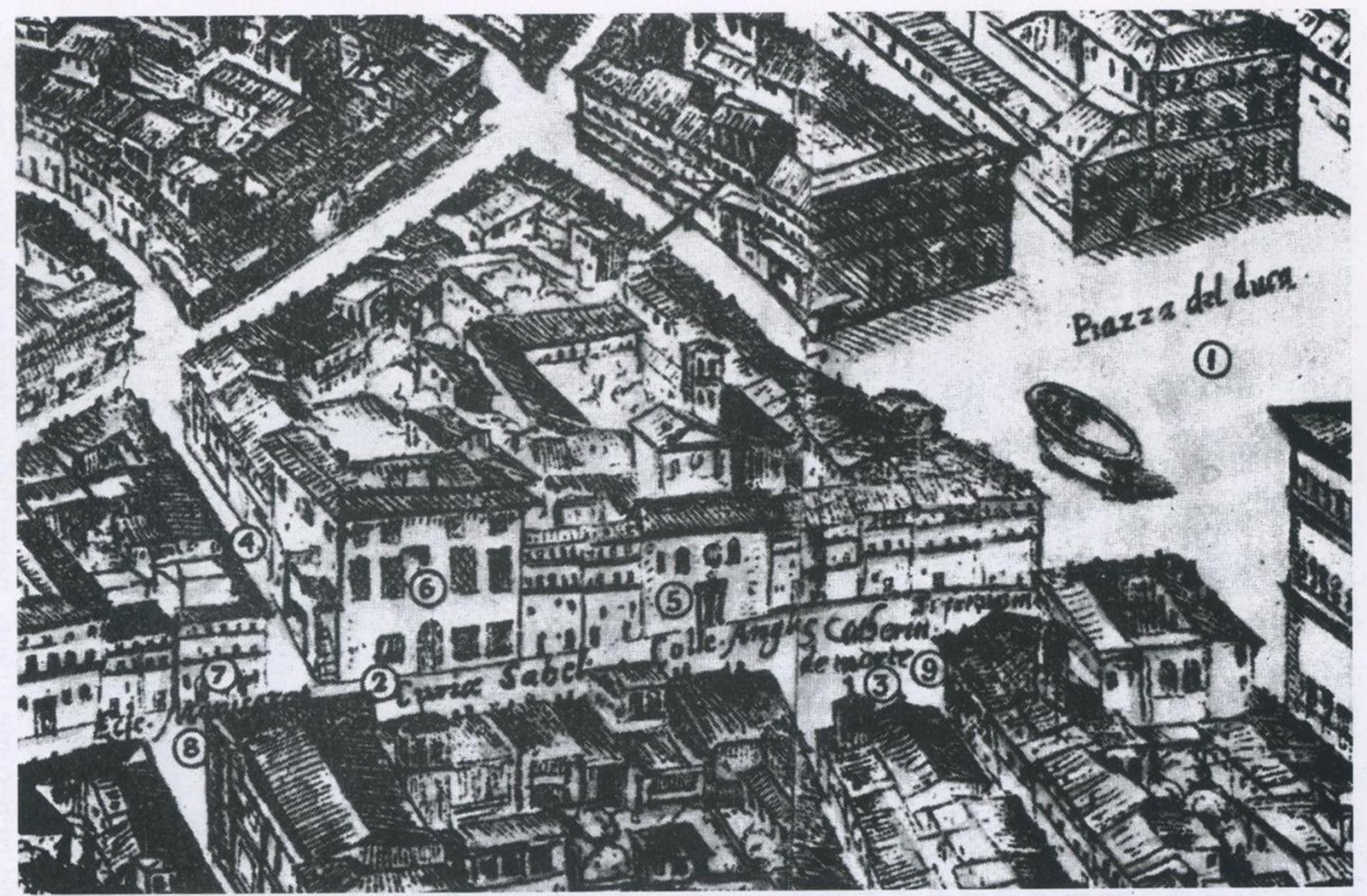
Figure 1 Long description
The illustration shows a detailed view of the English College in Rome, dated 1593. The college is depicted as a collection of buildings in the central area of Rome, near the Via Monserrato. The illustration is marked with several numbered locations, including the Piazza del duca, which is marked as number 1. The surrounding area features various buildings and streets, providing a comprehensive view of the urban fabric of the time. The illustration captures the architectural style and layout of the college and its vicinity, offering historical insight into the built environment of Renaissance Rome.
During the second half of the sixteenth century Rome was mapped extensively, and the position of the Hospice was visualised in cartographic drawings.Footnote 48 It was clearly rendered by the Italian mapmaker and engraver, Antonio Tempesta, in his 1593 map of Rome (Figure 1). In the Tempesta detail, the English College, as it had by then become, was drawn and marked 5 by a later hand, as a part of both the renovated and the established papal city. Tempesta combined a bird’s-eye view with an axonometric depiction of college buildings in three dimensions, which included the college Church of St Thomas and the Trinity fronting the street.Footnote 49 The drawing reveals how perspective, reinforced by spatial depth and densely hatched shading, introduced the idea of built solidity and with it a rendering of political and administrative power.Footnote 50
Sixteenth-century Rome was not just architecturally magnificent, it was also a major site of renewed political action. The city drew in visitors and scholars from diverse parts of Europe who coalesced around their faith and allegiance to the pope. The city produced urban ‘hotspots’ in the churches and hospitals of the ‘nations’, as Laurie Nussdorfer has demonstrated. These institutions, associated with particular countries or state affiliations, became battlegrounds for political conflicts across Europe and beyond.Footnote 51 Historians who have examined the influence of Rome on English Catholics have done so mainly from a top-down perspective, exploring the interaction between papal policy and Elizabethan high politics.Footnote 52 The location of the English Hospice in the centre of the city and its use by the diners in 1569 exemplifies Nussdorfer’s idea of localised hotspots, where political strategies were developed with implications that often went beyond the immediate environment.
The feast and its guests
Exiled English Catholics were confronted by twin issues: how could they pursue their own religious observance, and what form should their opposition take to a church they considered heretical?Footnote 53 The interpretation of the nature of their resistance presented in this article complements and develops prevailing historical arguments about English Catholic resistance in the 1560s, which have suggested that opposition was principally contained in written polemics.Footnote 54 The feast revealed a different dynamic; it exemplified faith-based action. The records of the hospice meal honouring St Thomas in 1569 demonstrate how sources other than printed texts provide information about the way English Catholics responded to Elizabethan politics at home.Footnote 55
From the foundation of the hospice, the commemoration of St Thomas was regularly celebrated as a major feast day. As Maurice Whitehead has documented, each year on 29 December, all English and Welsh residents and visitors to Rome, were invited together with cardinals and other dignitaries to dine at the institution.Footnote 56 In 1550 and 1552 Cardinal Pole visited the hospice with his retinue on St Thomas’s day.Footnote 57 Nearly one hundred years later, on 29 December 1644, the English diarist, John Evelyn recorded: ‘We were invited by the English Jesuits to dinner, being their great feast of Thomas of Canterbury. We dined in their common refectory, and afterward saw an Italian comedy acted by their alumni before the Cardinals’.Footnote 58 As these examples demonstrate, celebrations honouring St Thomas were ongoing, with invitations regularly issued to eminent outside visitors. This was certainly the case in 1569.
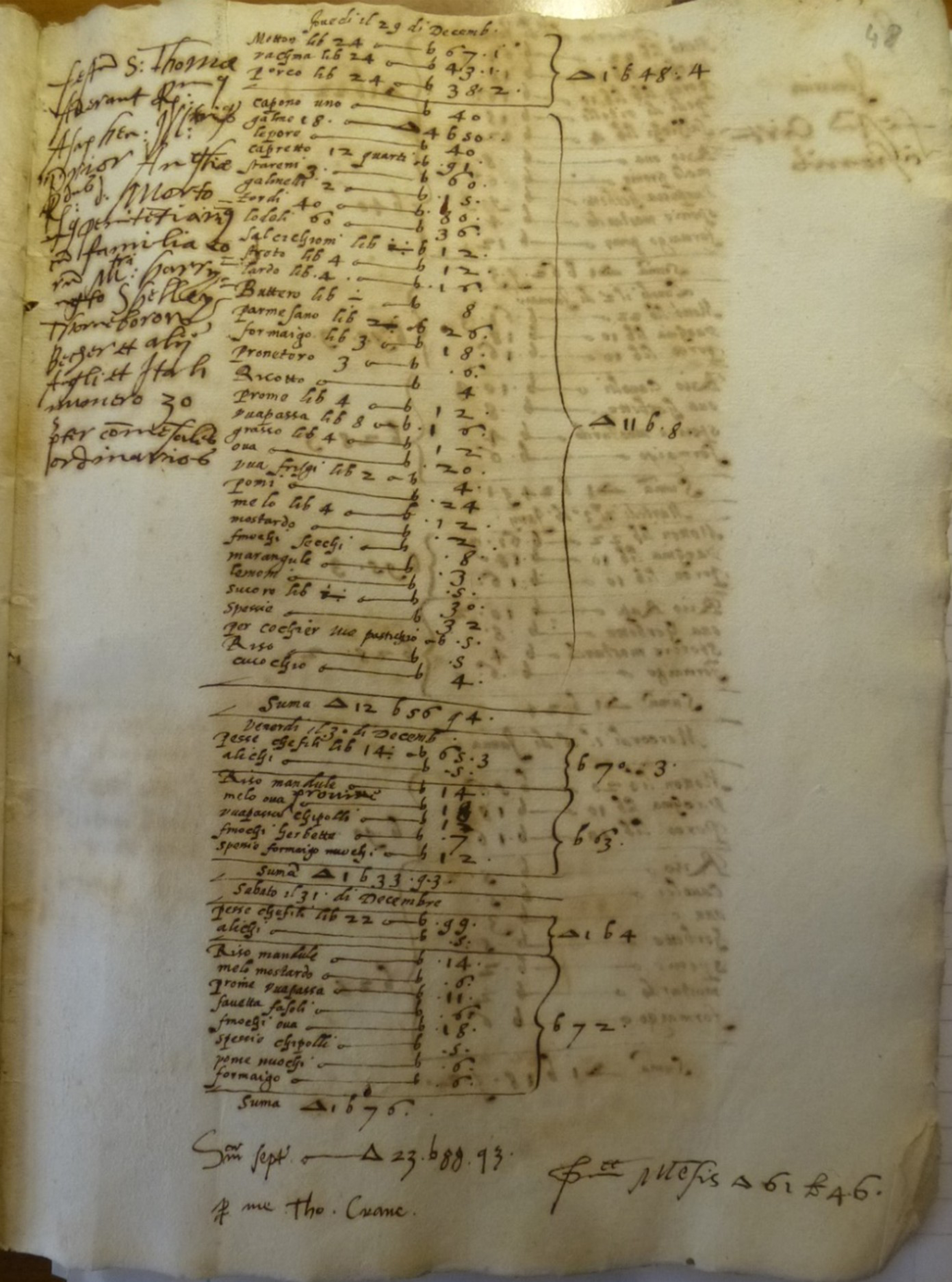
Figure 2 shows the Hospice page entry documenting the feast.Footnote 59 What does it reveal? At first sight, it appears to be part of the regular daily records of expenditure on comestibles. However, this page documented no ordinary meal. It was the detailed inventory of the large financial outlay on the copious amounts of food consumed at the feast. But something more historically significant appears on the top left part of the page. A written marginal note lists the names of six men with their servants or households (familia). These individuals were the eminent Englishmen in Rome who were not Hospice residents, but who were invited to the dinner. The scribe also noted that thirty men in total were catered for by the provisioning.
Detail from the food inventory page for the feast of St Thomas Becket 29 December 1569. Venerable English College Archives, Rome. AVCAU, Liber 31, fol. 48r (© the Venerable English College, Rome).
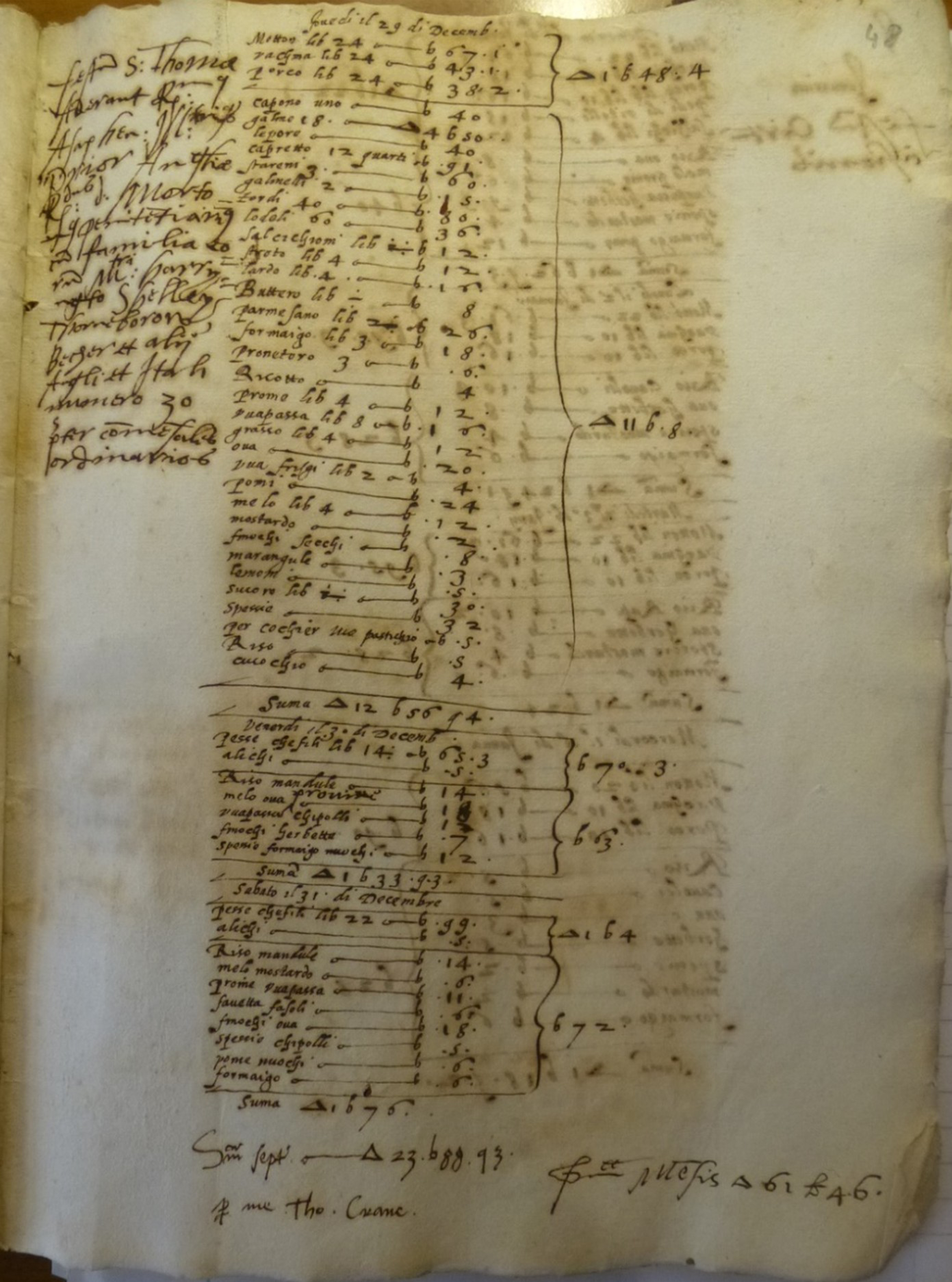
Figure 2 Long description
The image shows a handwritten document on aged paper, detailing the food inventory for the feast of St Thomas Becket on December 29, 1569. The document lists various food items along with their quantities and costs. The text is written in Italian and includes columns for different categories of food. The document appears to be part of an archive, specifically from the Venerable English College in Rome. The handwriting is detailed and meticulous, indicating careful record-keeping.
The six listed men appeared in order of precedence: the Most Reverend Bishop of St Asaph [Goldwell], the Illustrious Prior of the English [Sir Richard Shelley], the reverend Morton, described as penitentiary and his household, followed by Maestri Harrington, [Richard] Shelley and [Edward] Bromborough. Of these, three were exiled clerics (Goldwell, Morton and Bromborough), two were lay aristocrats (Sir Richard Shelley and his nephew), while the status of the other is unknown. Goldwell at the time lived in the house of the Theatines not far from the hospice.Footnote 60 His links with English Catholicism went back before the dissolution of the monasteries and his movements into and out of Rome from the 1530s onwards connected the new expatriate culture to earlier traditions of pre-Reformation England. His personal connection with Pole, along with his attendance at the Council of Trent in 1561, showed how he represented both the continuity and the dynamic evolution of Catholic academic and spiritual leadership through the sixteenth century.Footnote 61
The most elevated lay figure in terms of rank and status was Sir Richard Shelley, Grand Turcopolier of the Knights of St John.Footnote 62 Also named among the six were Nicholas Morton and his brother Thomas Morton.Footnote 63 Nicholas Morton had recently returned from a visit to England, dispatched by Pius V to sound out the northern lords regarding their position on Queen Elizabeth.Footnote 64 He was noted in the record of church history, Annales Ecclesiastici, as returning to the city ‘full of encouragement’ about the situation in the north and with a request for papal assistance.Footnote 65 Harrington and Sir Richard Shelley’s nephew were lay hospice visitors, while Bromborough was Edward Bromborough, an exiled cleric, who had also been a fellow of New College, Oxford, and would set out with Campion and Persons for England in 1580.Footnote 66 These dinner guests complemented the dozen or so permanent residents at the hospice who have already been profiled.
There were other Englishmen in Rome, who may have attended the dinner and made the number up to thirty as written in the marginal note, but here the evidence is sketchier. A few of them had joined the relatively newly-formed Jesuit order. John Henning, Thomas Langdale and Christopher Perkins were among this cohort in the city.Footnote 67 Perkins was a Jesuit novice and he had received a doctorate in Civil Law and studied philosophy at the Roman College, subsequently being transferred by the Jesuits to Dillingen in 1572.Footnote 68 At the time of the feast, these Jesuits were young and probably lacked sufficient status to be named individually on the hospice guest list.Footnote 69 No evidence has been found of their presence at the feast. Ranging more widely, there were also young students at the German College, Germanikum, who had not been admitted to the hospice: John Gibbons had joined the Germanikum in October 1569 and his younger brother Richard was also in Rome.Footnote 70 There may have been other Englishmen in the city who have not been recorded in any documents, for example tradesmen or sailors.
Centred in the middle of the page of the inventory were the foods purchased: twenty-four pounds of mutton, beef and pork, one capon, eighteen chickens, a quantity of hare, twelve quarters of goat, pullets and sausages cooked with both butter and lard. Cheeses included parmesan and the soft Italian cheese, ricotta. There was an assortment of fruits: currants, raisins, apples and dried fennel, almonds and lemons. Flavours were enriched by sugar and spices.Footnote 71 Written up in Italian rather than Latin (the lingua franca for more elevated transactions at the Hospice), each food item had its quantity and associated costs given in scudi and in the lower denominations of baiocchi and quatrini.
A financial summary was given separately on the right-hand side of the same page. The total expenditure of the feast—12 scudi, 56 baiocchi and 4 quatrini—was recorded two-thirds of the way down. The food purchased for the next two days followed, a mere 1 scudo and 33 baiocchi and 1 scudo 7 baiocchi respectively, as if to underline the abundance of the feast when compared to provisioning on normal days. Confirming the accuracy of the accounting record, the entries were witnessed by hospice official, Thomas Crane, who underwrote the work of the scribe.Footnote 72
The cost of this dinner was substantial. The 12 Roman scudi outlay on purchasing comestibles for the event totalled 8% of the institution’s annual receipts and twelve times the cost of a normal day’s victualing. Feasts at the English Hospice throughout the sixteenth century were renowned for their abundance. These excesses came in for external criticism. The papal inspector Cesare Spetiano, who led a visitation to the hospice in 1576 and was later to become bishop of Novara, provided a report on the activities of hospice residents in which he drew his superior Cardinal Morone’s attention to the expenditure involved in feeding what was a relatively small number of residents and guests.Footnote 73 The costs of this feast and the number of men who assembled for it were also significant when compared to other days that were celebrated at the hospice throughout the year. For example, in 1570 various feast days were noted in the hospice records: Pentecost, Trinity, Corpus Christi and the Annunciation. But the expenditure was modest in respect of the outlay on 29 December 1569, and there were at most one or two invited additional guests.Footnote 74
The level of provisioning for the feast of St Thomas was not unusual for a religious community in Italy at the time. Salvatore Musumeci has shown that there were strong correlations between the diets of religious confraternities and aristocratic houses.Footnote 75 English Hospice residents’ consumption (and spending) matched that of the upper strata of Roman society and equivalents at home. Elite English clergymen frequently attended banquets in the city and they actively participated in associated food rituals.Footnote 76 The dining habits of the hospice celebrants, however, contrasted sharply with the advertised diet of the ‘notoriously ascetic’ Pius V. As Deborah Krohn’s study of Bartolomeo Sappi (the ‘personal cook’ to Pope Pius V), has revealed, his food intake supposedly ‘consisted of eggs, broth, little meat, and water tinted with wine’.Footnote 77
The dinner was held in the ‘winter hall’ at the rear of the hospice compound, which included kitchens, dining areas and courtyards. Other inventory records from the 1560s and 1570s describe the architecture, furniture, crockery and decorations held in these buildings.Footnote 78 The advantages and shortcomings of the use of inventories in early modern history have been widely discussed.Footnote 79 Inventories provide a snapshot of artefacts frozen in time, but very rarely do they give an idea of why and how objects were used. They tend to remove ‘things’ from their contexts and while they may establish a value for the items recorded, it is difficult to attribute any form of personal or supra-personal significance to their placement.Footnote 80
The hospice inventories across the later sixteenth century provide a level of detailed description that was characteristic of the records of contemporary confraternities and aristocratic houses. Crockery and cutlery were stored in the adjacent ‘butterie’ and on side-tables in the hall. Carpets decorated some cupboards, two of them holding thirteen silver spoons, twelve silver forks and twenty-one knives. There were diaper cloths for the upper table and even two for the servants’ table, as they ate separately. A total of fifty-six napkins, fifteen of which were well-worn, were listed, along with twenty-three ‘latine’ spoons, tin plates, seven latine candlesticks and the common bell.Footnote 81 Hangings were draped throughout the room and trestles held up a smaller side table.Footnote 82 For those who missed out on the silverware, they had the use of latine spoons, while the dining room was lit by latine candlesticks and other lanterns.Footnote 83 ‘Latine’ could have referred to latten, a yellow alloy resembling or identical with brass, hammered into thin sheets and used especially to make monumental church ornaments. The inventory lists also included the common bell that may have called the assembled guests to dinner.Footnote 84
It was the use of the crockery that had particular social and symbolic meaning for the guests, showing how the inventory touched on the realities of English Catholics in exile. Hospice archives reveal that the food was probably delivered on four boards, using earthenware or clay containers (tondi di terra and scudelli di terra).Footnote 85 The dinner itself was served on pewter dishes, or on a mixture of Italian plates of various sizes (piatti mezzari and grandi). Responding to historians’ criticisms of inventory records, tracing the trajectory of the plate and the men from England to Rome highlights the interconnectedness of objects and people, where social relationships were increasingly defined by long-distance cultural and religious movement.
One particular item, a treasured English plate, was identified in the records in English as ‘one sort brought out of Englande’.Footnote 86 This points to the significance of domestic objects and how they carried special weight, acting as modes of communication and potential memory cues.Footnote 87 It had a resonance because of its association with the homeland.Footnote 88 For the English in Rome, the plate provided a tangible connection to life in their country of origin, an experience familiar to many migrants. One of these connections involved the transnational movement of objects, another was the translation of faith.
The diners were enjoying a meal that broadly followed a southern European diet: mediterranean provisions included figs and artichokes, but pork, butter and lard were also used liberally, as well as Italian foods found locally. In the colonial context of the Spanish conquistadores in South America, Rebecca Earle has shown how a southern-mediterranean diet affirmed their Catholic belief systems.Footnote 89 But at the Hospice, a more complex picture emerges from the menu. Traces of the diners’ English tastes and their sense of belonging were evident in the culturally hybrid character of the meal. Analysis of the food consumed at the dinner, the financial records of expenditure and the accompanying atmosphere of the meal sheds light on the interaction between material culture and lived religion. It endorses historian Willem Frijhoff’s approach to church history that focuses on religious faith arising from daily rituals and on understanding religious lives as shaped by broader cultural histories.Footnote 90
The hybridity of the meal and its setting were characteristic aspects of the sixteenth-century exile experience. First, the Roman location gave added weight to the English community in the city as they participated in the transnational workings of the Catholic church. Second, the dinner involved the development of a survival strategy for the continuation of their faith.Footnote 91 Historians have argued that displaced communities tended to adopt more militant or adversarial positions whilst abroad. Many letters, poems and chronicles testified to this, and the celebratory meal was an event that shaped a new self-image of the refugee exile.Footnote 92
For early modern English Catholics eating was a way to commingle with fellows and with God.Footnote 93 This commensality was linked to the prototypical meal, the eucharist, which as Carolyn Walker Bynum has argued, ‘hovered in the background of any banquet’.Footnote 94 At the same time, food cultivated senses other than taste and could lead to a state of ecstatic spirituality. The feast was a religious holy day and hospice statutes insisted that the chaplains and their associates were to attend high Mass.Footnote 95 Special music accompanied the service that was regularly sung on St Thomas’s day across Europe.Footnote 96 When King Henry V had attended the Council of Constance in the fifteenth century, ‘four trumpeters blew their trumpets through the city’ to announce the feast of St Thomas and the patriarchs and all the bishops and scholars were invited to dinner.Footnote 97
Religious music was a key part of the saint’s commemorations, including antiphons with short chants sung as refrains, together with rhymed offices, and these would have augmented the Hospice celebrations. One Mass for 29 December, composed at the time of Becket’s canonisation in 1173 and possibly used in the sixteenth century, consisted of the introit ‘Gaudeamus omnes in Domino’ (Let us all rejoice in the Lord) and the gradual ‘Posuisti Domine’ (I lay before thee Lord), followed by an Alleluia, ‘Gloria et honore coronasti eum’ (Glory and honour crowned to him).Footnote 98 In 1569, Hospice inventories listed choir books in the Roman usage (usum Romanum), while a new breviary appeared in 1572, part of the roll out of liturgical reforms enforced after the Council of Trent.Footnote 99
Musical commemorations for St Thomas were transnational, aurally connected across European space and time. One of the many musicians who visited the Hospice included Tomás Luis Victoria, who came to Rome in 1565 and was ordained priest by Goldwell in the Hospice church in 1575. Victoria may have influenced sixteenth-century compositions celebrating the saint.Footnote 100 Sensory stimulation of this sort was strongly opposed by the Protestant clergy in England. The reforming bishop of Durham, James Pilkington, railed in 1562 against the visual, aural and olfactory excesses of the Catholic Church.Footnote 101 The sensory aspects of the feast, the foodstuffs and the environment provided multi-faceted stimuli for the Hospice’s community.Footnote 102
Papal politics and sacred food
The feast of St Thomas in 1569 occurred at a particular moment in English Catholic history. Micro-historians do not conventionally link localised incidents like the dinner to the domain of high politics. But the celebration in Rome took place just after the northern rebellion had failed in the north of England and only weeks before Pius V’s excommunication of Queen Elizabeth, an event that had international consequences. What, if any, were the potential connections between these different episodes? Here the arguments are necessarily more conjectural, but they can be addressed in three related ways. First, by profiling the social actors who participated in both the feast and in the wider spheres of Counter-Reformation and Elizabethan politics. Second, by examining the chronological convergence between the timing of the feast and political events. Third, by tracing the food-related connections between the celebration at the dinner and Catholic ritual and liturgy.
Just over a month after the feast, in early February 1570, Pius V convened a meeting with twelve of the dinner guests via his intermediary, the judge of the Apostolic Chamber, Alessandro Riario. The men were called to testify in the excommunication trial of the queen, conducted by Riario.Footnote 103 Excommunication had been discussed earlier at the Council of Trent in 1563, when the matter was blocked by the Emperor Ferdinand I who feared that it would only stir up German Protestants.Footnote 104 The pope’s immediate predecessor, Pius IV, had pursued a policy of compromise, but Pius V acted differently and now called for the excommunication trial.Footnote 105
As Auditor General of the chamber from 1565 to 1578, Riario was one of the highest juridical authorities in the church after the pope.Footnote 106 By the mid-sixteenth century Roman ecclesiastical courts of this sort took precedence over all other jurisdictions.Footnote 107 In terms of the localised urban politics of the city, the hearing was held less than 100 metres from the English Hospice in the Judicial Palace of the Curia, the Renaissance Palazzo della Cancelleria.Footnote 108 This building had been the Riario family palace, which after 1517 was incorporated into the Apostolic Chancellery. The original manuscripts of the witness testimonies made in front of Riario have been lost, but a record of them was made by the Oratorian, Giacomo Laderchi in the early eighteenth century, in his continuation of Cesare Baronio’s Annales Ecclesiastici.
The Englishmen called by Riario were not chosen randomly; they presented a distinctive profile in terms of their status, religious commitment and academic authority. All were described by Laderchi as ‘viri docti et promoti in facultatis suis’, learned men and in advanced stages of their careers. They included the senior clerics Bishop Goldwell and Bishop-elect Clenock, along with dispossessed priests: Morton, Henshawe, Daniel, Bromborough, Giblet, Allott, and Richard Hall (c1535? -1589), as well Thomas Kyrton, the priest and his brother, Henry, who was not ordained and was a Bachelor of Law. Two lay aristocrats also gave evidence, Richard Shelley and his nephew.
All of the men who were called had been present at the feast only five weeks previously, and they were either hospice residents or visitors named in the inventory records. No other individuals were summoned by the papal interrogator, and equally significant were those who were omitted. The latter included lesser ranking hospice clerics and the laymen residing there, suggesting that social status and religious seniority were significant factors in the selection of witnesses. Furthermore, Riario did not call any other Englishmen in Rome; for example, no Jesuits gave evidence. At the time, there was a policy against Jesuits being involved in politics, as exemplified in General Mercurian’s later response to the founder of the Douai College, William Allen in his entreaties for missionary support.Footnote 109 The English Jesuit students were relatively young in the late 1560s, which would also tend to support arguments about the seniority of those who testified.
All the witnesses had fled England from 1559 onwards and they had personal and career reasons for contesting the queen’s authority. The clerics had been deprived of their ecclesiastical positions and had been subject to persecution in England, even though they had been part of the upper strata of English society under Henry VIII and Mary I. They were highly educated, with degrees from Oxford and Cambridge, some subsequently continuing their studies on the continent. Nicholas Morton was a case in point. He had received a Bachelor of Theology from Trinity College, Cambridge, in 1554, and was one of its original fellows. Elizabeth’s accession ended his career, and he left England in 1561. Arriving in Rome, he was made English penitentiary at St Peter’s and took a doctorate.Footnote 110 Edmund Daniel had been an Oxford fellow and had held senior clerical positions before his imprisonment and flight to Rome.Footnote 111 Hall had been a member of Clare College, Cambridge, and after at Christ’s College. Elected fellow of Pembroke Hall, he was forced to flee to avoid persecution, travelling first to Flanders before coming to Rome to complete his theological studies. He was to return to Flanders in 1570.Footnote 112 Collectively, these men were a link between the pre-Reformation and post-Reformation Catholic Church in England. They gathered in Rome for the feast at a moment when the outcome of the Protestant settlement in England remained uncertain.Footnote 113
However, it is Morton’s sequence of movements and their timing that point to a potential connection between the feast and political and religious events in England. Only recently arrived back in Rome, he informed Pius V of the readiness of the northern earls to rise up against Elizabeth, a rebellion that occurred in November 1569.Footnote 114 However, by the date of the feast the Catholic uprising had failed, and its leaders had fled into Scotland. This was unknown to the diners as the news had not yet reached Rome.Footnote 115 Morton’s memoirs also reveal his longer-term interventions calling for papal action against Elizabeth. In the mid-1560s, the last years of Pius IV’s pontificate, he had made a proposal for the ‘reduction’ of England to the ancient faith.Footnote 116 When his plea was not taken up, he re-presented it to the new pope, Pius V, who welcomed it, asking Morton to sound out the situation in England.Footnote 117
Morton was not alone in his long-standing petitioning among the group called by Riario. During the early 1560s Shelley and Clenock had also urged the papacy to act against Elizabeth more than once. Clenock had demanded ‘strong measures’ against the English queen before 1563 and Shelley sent a series of requests to the pope urging the conversion of England.Footnote 118 He even wrote to William Cecil, Elizabeth’s treasurer, suggesting a moderate accommodation with Catholics at home.Footnote 119 Along with status seniority, a history of resistance to the English crown at the highest levels characterised the profile of Riario’s witnesses.
Hospice diners’ audiences with Riario were structured according to precedence and he followed the rules laid down by Canon Law.Footnote 120 Sir Richard Shelley was the first to testify on 5 February, as he was the most elevated of the witnesses. Shelley was not only from an aristocratic background, but as the last English Grand Prior of the Knights of Malta he bridged secular and religious high politics.Footnote 121 The following day, petitions were heard from the clerics: Goldwell, Morton and Clenock. These men were followed on 7 February by the Hospice’s chaplains: Henshawe, Daniel, Bromborough and Giblet. On 9 February, Riario called Allott and Hall.Footnote 122 Allott had been chaplain to Lord Morley and Sir Thomas Wharton.Footnote 123 On 10 February Riario heard testimonies from Sir Richard Shelley’s nephew, also called Richard Shelley, and the two Kyrton brothers.Footnote 124
Cardinal Riario posed a range of witness questions in his interviews, in the form of nineteen articles that were drawn up against Elizabeth. They were designed to draw attention to the queen’s usurpation of the headship of the church, the fate of the Marian bishops and priests and the abolition of Catholic sacraments.Footnote 125 The detailed exchanges between Riario and the diners highlight the connections made between the religious connotations of food at the Eucharist—what Bynum has characterised as the prototypical meal—and food practices at the 1569 dinner. This has been central to the food-related arguments made in the article. Several of the witness statements focused on the queen’s behaviour at the Mass.
Historians of the excommunication have noted the role of these English and Welsh witnesses, but have focused mainly on the publication of the papal bull and its impact on Catholics at home.Footnote 126 However, article 9 of the trial was concerned with the organisation and etiquette of the sacred meal, the centrepiece of the Mass. Hospice witnesses were asked pointedly if the queen had celebrated the Lord’s Supper in a heretical manner [more haereticorum].Footnote 127 Three of the respondents, Goldwell, Daniel and Hall, addressed this issue specifically in their answers, and in doing so they focused their religious anxieties on the personal habits of the queen.
With his long-standing connection to papal Rome, Goldwell saw himself as the embodiment of universal English Catholic values.Footnote 128 When Riario asked him if he had known that the Queen of England had allowed the Lord’s Supper to be celebrated heretically, he testified emphatically:
Indeed, I know this and it is evident to all, from the report of men worthy of faith, who came from that kingdom [England] to this one [Rome]. And I know that she makes a kind of Supper, what they call the Lord’s Supper, on a wooden table, without any portable altar, and those who receive communion, from one side of the table, each take a piece of bread; but on the other side, they take wine. And, as I understood, the Queen says, nay, it is publicly preached in the sermons, that Catholics, as to this Supper, are subject to several obnoxious errors; especially that we say that the substance of bread and wine is not there; and that is what I know, and now likewise the matter was and is the truth.Footnote 129
Goldwell’s evidence drew attention to key issues of doctrine for Catholics and Protestants alike: the contested character of ritual, the material surrounds (tables and portable altar), the potentially irregular naming of the ‘Lord’s Supper’ and crucially the issue of transubstantiation, as opposed to consubstantiation. He was dismissive of the queen’s eucharistic celebration as full of doctrinal errors, almost a mockery of the Mass.
When Daniel testified, Riario asked him specifically if the supper was conducted heretically. He gave a report of the queen’s actions: ‘I did not see myself that the Supper was celebrated in this way, but I heard from many of my associates who were in the church that they were ordered to serve in that way, and not in the Catholic way.’Footnote 130 Daniel’s commitment to ‘the Catholic way’ again rejected the irregular performance of the liturgy at Elizabeth’s court. His evidence cited one occasion when the queen attended a Mass in 1559, celebrated by the bishop of Carlisle. The bishop wanted to elevate the host, but the queen opposed it and the cleric refused to continue with the service. On the following day, Daniel himself was asked by the queen’s dean if he would celebrate without elevating, but he also refused.Footnote 131
Richard Hall went much further in his responses to Riario than the other witnesses. He testified that in England the Lord’s Supper had been confined to history [Dominicae Coenae historia recitabatur], as it was now retitled Communion [Communio vocabatur]. His evidence, which once again focused on the queen, scrutinised her habits during Lent. It was designed to show how personal food consumption was intimately related to religious observance, or in this case the lack of it:
Now (nine years have now passed) since… I attended a sermon in the Queen’s Palace in London, in which the Lenten fast was enforced, and it was said that it was a free ceremony, which no one was bound to follow, except by some law of the Queen, which at that time permitted the eating of fish, so that meanwhile lamb, kids, calves and animals of this kind would be fed and matured for use, and other arguments similar to these were brought forward which I now [do not] remember. And a sermon of this kind was held at the time of Lent. I saw that the aforesaid Queen was present at the whole sermon. And the preacher, not only was he not reproved for these things, nay, they all followed him. He was a pretended Bishop of Hereford, raised to that office by the Queen’s authority.Footnote 132
John Scory, bishop of Hereford had been a friar in the Dominican house at Cambridge and was an eager convert to the Reformation, when he became an outspoken Protestant divine and writer. In 1559, Scory preached before the queen and took part in a staged disputation with Catholic bishops. Later the same year he was involved in drawing up a list of exiled Catholic scholars who were abroad, presenting it to the Privy Council.Footnote 133
Hall was concerned with the laxity of the English court’s Lenten eating habits, but he also singled out Scory as the type of reformed cleric who, as bishop of Hereford, was willing to celebrate the Mass without elevating the Host. The forty-day fast had been abolished by Henry VIII in 1538, and while the king’s original intervention had more to do with the high price of fish during Lent, the matter became a focus for religious ideologies.Footnote 134 Hall suggested that the abstention from meat was a ‘free ceremony’, consequently it was no real prohibition or fasting at all. His references to lamb, goat and calves insinuated that enforcement was so lenient that these meats were provided and possibly eaten during the Lenten weeks, and he concluded his account by castigating Scory as a pseudo-bishop endorsed by the queen.
Pius V judged the testimony of those who had participated in the dinner ‘sufficient to prove the guilt of the accused’.Footnote 135 Almost immediately after the trial, on 25 February, he issued the bull of excommunication, Regnans in Excelsis, permitting no response from the royal ex-communicant in England.Footnote 136 The bull was arguably the single most important event when ‘the rupture between Elizabeth and the Catholic Church was completed’.Footnote 137
One final piece of papal evidence suggests a further possible link between the cult of St Thomas and the queen’s excommunication. This was contained in a letter sent by Pius V to the northern English earls in response to their rebellion. A few days before his bull, on 15 February 1570, the pope wrote to the leaders of the revolt, the Earls of Westmoreland and Northumberland. In the letter, he invoked the authority of Thomas of Canterbury as the exemplar of Catholic resistance and as the guiding light of their opposition. Pius praised the earls’ constancy as: ‘further confirmed by the recent … example, of Blessed Thomas, archbishop of Canterbury.’Footnote 138 The use of the term ‘recent’ [recenti] was telling, given the Hospice’s celebratory feast. The pope went on to urge the rebels to ‘imitate’ the same constancy, to be strong and steadfast in their spirit, and not to desist from their initiatives.Footnote 139 Pius V did not invoke the events of the 29 December 1569 directly, but St Thomas and the associated cult of the saint provided a deep context for the papal letter.
Conclusion
Examining in-depth the feast of St Thomas, the article has highlighted the behaviours and political activities of the English Catholics in Rome. It has shown how a study of the material and spiritual practices associated with hospitality and commensality can illuminate the lived religion of this émigré community.Footnote 140 Bringing together disparate strands of social and cultural enquiry—on inventory records, the urban environment and culinary history—it has probed the faith-based practices of an influential group of Englishmen, whose intellectual and political influence was considerable.
The celebratory Hospice feast was not just a secular banquet. Food abundance and the accompanying sensory stimuli crystalised a powerful version of post-Reformation Catholic piety, centred on saintly commemoration. The witnesses who responded to Riario’s searching enquiries on behalf of the pope represented a distinctive profile in terms of seniority, status and Catholic intellectual authority. They focused on the spiritual impropriety of the English court, scrutinising the queen’s behaviour and with it contested understandings of Catholic as opposed to Protestant food practices at the Lord’s table. These distinctions have conventionally been understood doctrinally, but the 1569 Hospice dinner augments the centrality of food rituals in the Counter-Reformation as forms of lived religious experience and political action.
The dinner guests on this occasion were part of what was becoming a minority church in England, but they were also members of the dominant faith-based community across Europe and the wider Catholic world. Rome provided the location for the oppositional politics of Hospice residents, but so too did England, as it existed in their social imagination and as the locus for a hoped-for revival of Catholicism at home. In 1569, the diners used the commemorative feast of St Thomas to look both ways; forwards towards a modernising Catholicism and back to a pre-Reformation world of uncontested beliefs.

 Open access

