


For many years, cafeterias in schools, workplaces and hospitals have offered trays to diners. Recently, there has been interest in whether removing trays from all-you-can-eat cafeterias – going ‘trayless’ – might reduce the amount of food that diners take, eat and waste( Reference Horovitz 1 , 2 ).
But what is left behind? Whereas a diner with a tray may have selected a salad, an entrée and a dessert, a trayless diner with only two hands may choose to leave one of these food items behind. Moreover, given this limit, diners might be prompted to return to the buffet line multiple times. While trayless dining might reduce waste per buffet trip( Reference Foderaro 3 , Reference Karstens and Moe 4 ), how would additional trips influence food choice, nutrition and waste?
Methods
A between-subjects field study was conducted in a university cafeteria which alternated between tray and trayless service on two spring semester Tuesday evenings two weeks apart. In the study, which was approved by Cornell University's Institutional Review Board, the two dinner menus were identical and included salad, a featured entrée and a dessert. On the first evening (the control evening) trays were available as they typically are every night for this particular cafeteria. On the second evening of the study, no trays were available.
After diners (average age 19·1 years) completed their meal, their dishes were collected as they dropped them off at the ‘tray return’ area. Of the 417 people who took the featured entrée, we noted whether they had taken salad, a dessert or neither. Instead of using the Quarter Waste Method to estimate waste( Reference Hanks, Wansink and Just 5 ), precise measures of each remaining food item on each person's plate were taken and recorded. To reduce the likelihood of response bias following these measures, an independent group of diners on the same days (n 338) were asked how many trips they had taken to the buffet line. In comparing the day trays were available with the day when they were not available, the two variables of primary interest were: (i) the percentage of people taking each of the three target foods (salad, entrée and dessert) on the two days; and (ii) how many grams of each food each person wasted on each of the two days. The first comparison was made using χ 2 tests and the second comparisons were made using ANOVA and two-tailed tests of significance.
Results
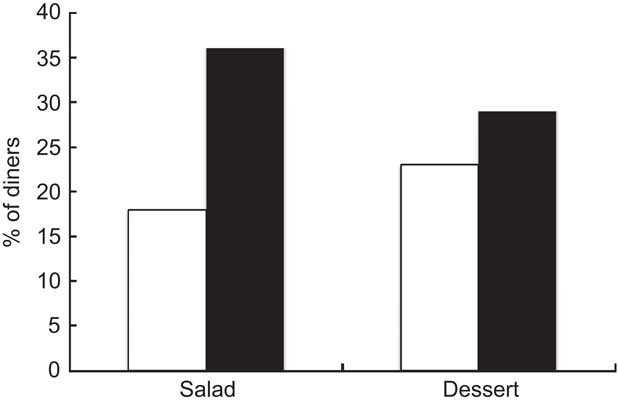
Not having a tray appeared to make students more reluctant to take salad (Fig. 1). When there were no trays, 18·3 % fewer students took salad (from 36·2 % to 18·4 %; χ 2 = 5·29, P = 0·003), resulting in an overall salad decrease of 65·2 %. In contrast, 24·7 % fewer students left the dessert behind (from 28·7 % to 22·4 %), which was not statistically significant (χ 2 = 1·151, P = 0·283).
When cafeterias go trayless, a smaller percentage of diners take salad; field study conducted among undergraduate students (n 417; average age 19·1 years) on two evenings with identical menus, one with tray service ( ) and one without (
 ), in a university cafeteria, north-eastern USA
Trayless diners returned for more food 47 % more often than those with trays (1·01 v. 1·48 trips; χ 2 = 9·311, P = 0·002). Interestingly, trayless diners were less likely to eat all of the entrée (38·8 % v. 85·7 %; χ 2 = 63·439, P < 0·01), dessert (52·9 % v. 90·7 %; χ 2 = 10·004, P < 0·01) or salad (53·6 % v. 91·7 %; χ 2 = 9·362, P < 0·01) they may have taken. Among diners who did not eat all of their food, trayless diners tended to throw away marginally more of their entrée (80·14 v. 60·56 g; F(1,127) = 3·72, P = 0·056) and their dessert (75·43 v. 44·43 g; F(1,21) = 3·83, P = 0·060) but not their salad (44·00 v. 53·50 g; F(1,20) = 0·32, P = 0·577).
Discussion
Going trayless may lead diners to select less healthy foods and it may not reduce waste as much as is believed( 2 , Reference Halenda 6 ). In the present study, trayless dining decreased the percentage of diners who took a salad by 65·2 % but did not decrease the percentage of diners who took a dessert. Yet, even if going trayless did reduce waste – which we cannot confirm – it may be at the expense of nutrition( Reference Wansink, Just and Shimizu 7 ). It would be useful to confirm this with more studies that examine a wider range of foods in a wider range of cafeterias, including both all-you-can-eat and à la carte cafeterias( Reference Just and Wansink 8 ).
Instead of eliminating trays, there may be other alternatives. While creative education efforts such as ‘waste not’ tray decals or wall posters might raise awareness, it may be more effective to simply help make diners slim by design( Reference Wansink 9 ). This could be done by redesigning the shape of a tray (square or pentagon-shaped instead of rectangular) or by simply making them smaller, which would reduce waste but not healthy food intake( Reference Wansink and Just 10 ). In other cases, full-size trays should be used in vegetarian or salad bar cafeterias that serve healthier food or in cafeterias that cater to those with other nutritional concerns such as athletes, the elderly or the hospitalized.
Acknowledgements
Sources of funding: The Robert Woods Johnson Foundation provided support for this study through the Healthy Eating Grant Program. The Foundation had no role in the design, analysis or writing of this article. Conflicts of interest: The authors have no conflicts of interest. Authors’ contributions: study design, B.W. and D.R.J.; data collection, B.W.; data analysis, D.R.J.; manuscript writing, B.W. and D.R.J.; both authors had full access to the study's data and take responsibility for the integrity of the data and the accuracy of the analysis. Acknowledgments: Jennifer Cole Nobel, Laura E. Smith and Josh Baylin helped with data collection; Mitsuru Shimuzu helped with data collection and analysis; Julia Hastings-Black and Kelsey Gatto provided editorial assistance.



