




Non-technical Summary
Study of a late Carboniferous (approximately 300–323 million years ago) pterioid bivalve documents great change in characters of the species during growth from the juvenile to adult. This transformation of a species during growth upsets current methods of determining species relationships and evolutionary patterns in that group of clams. A new genus and species is recognized, and another species is assigned to it. Patterns of shell encrustation show the species lived above or on the sea floor, attached to other organisms. The results of this study suggest there was a large turnover in bivalve faunas from the Devonian to Carboniferous.
Introduction
Pteriomorph bivalves are a diverse and common component of Carboniferous and Permian bivalve faunas in North America in basin and shallow mud-bottom marine deposits, yet many of them remain poorly documented and undescribed. The late Paleozoic was a time of change among pteriomorphs as species adapted to different lifestyles by utilizing byssal attachment to different degrees, ranging from permanent epifaunal attachment to semi-infaunal life habit and including free-living lifestyle like the free-swimming pectinoids that clap the valves together to move through water (Stanley, Reference Stanley1970).
Larger late Paleozoic pteriomorphs are better documented (rounded pectinids, Newell, Reference Newell1937; thick-shelled myalinids, Newell, Reference Newell1942; elongate pinnids, Yancey, Reference Yancey2024), but the many smaller pterioids are not adequately documented. With little known about these small to mid-sized species, their taxonomy and relationships to Devonian ancestors and to descendant large alate species of the Permian remains unsettled. Many species are known only by their outline shape and/or details of surface ornamentation. Work on late Paleozoic pterioid bivalves (Boyd and Newell, Reference Boyd and Newell2001; McRoberts and Newell, Reference McRoberts and Newell2005; Tëmkin and Pojeta, Reference Tëmkin and Pojeta2010; Yancey, Reference Yancey2024) reveals the presence of groups of poorly documented species that deserve generic status, including new genus Willipteria presented here. Redescription of some previously described genera, especially the supposed sister taxa Leptodesma and Leiopteria (Rode, Reference Rode2004) is needed to understand their relationship to the new genus. Leptodesma is commonly used as a form genus name for small pterioids of Carboniferous and Permian age.
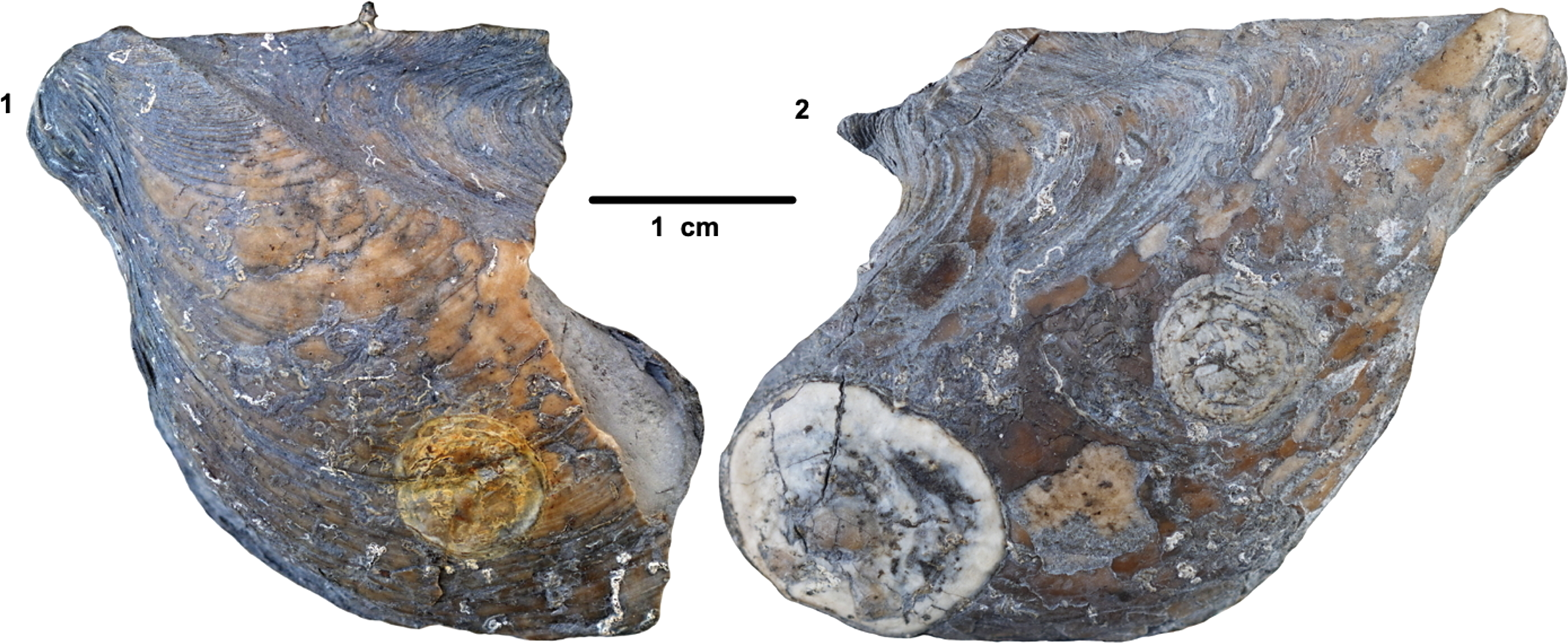
The primary purpose of this report is to describe some well-preserved specimens of a pterioid species (Fig. 1) characterized with a wide, thickened ligament plate containing a clinovincular ligament (new term) and having ontogenetic change involving loss of dentition at maturity from a juvenile shell with hinge teeth. Comparison of the new species with previously named pterioid species reveals that most of them are defined on whole shell outline, shape of the central shell body, or shell surface ornamentation, with no data on the hinge or ontogeny. Hinge and internal features are inferred or assumed to be present when the species is assigned to a genus. That practice makes accurate comparison unreliable. Thus, the second purpose of this report is to redescribe Leptodesma based on the type lot of its genotype species, L. potens Hall, Reference Hall1883. That description is presented here.
(1, 2) Views of left and right valves of adult Willipteria nestelli n. gen. n. sp. with extensive faunal encrustation of both valves; large scars are from inarticulate brachiopods, stem projecting from hingeline of left valve is the base of a fenestellid bryozoan colony, and meandering white marks are tolypamminid foraminfers; large adult specimen; specimen is shown in probable life orientation when suspended by byssal attachment above seafloor; holotype, NPL 90420 Finis cycle, Graham Formation, Jacksboro, Texas, USA; late Pennsylvanian, basal Virgilian (Gzhelian) stage.
Hinge ontogeny of Willipteria n. gen
Examination of a growth series of Willipteria nestelli n. gen. n. sp. reveals that there was substantial ontogenetic change in its hinge characters during life. This is a surprising, but understandable, aspect of pterioid growth for species that grew to larger size and gained greater mass during adult growth. Hinge change occurs during bivalve larval metamorphosis (Malchus, Reference Malchus2004) but the species described here shows that further hinge change can be expected for species growing to large size as adults when movement of valves places greater force on the hinge during opening and closing of the valves.
Juveniles of W. nestelli n. gen. n. sp. have dentition consisting of 2 small cardinal teeth at the beak and a small but long posterior lateral tooth (Fig. 2.2, 2.3). During growth from juvenile to adult the hinge stops secreting teeth, and the teeth are submerged in smooth, non-dentate shell, producing an edentulous hinge (lacking teeth). This occurs during the associated process of widening and thickening of the hinge plate where multiple pairs of lamellar and fibrous ligament sheets are added to the ligament. This enlargement of the hinge produced a ligament plate on adult shells like that on thick-shelled myalinid bivalves (Newell, Reference Newell1942) and monopteriid bivalves (Yancey, Reference Yanceyin press).
Comparable overgrowth and loss of juvenile teeth during widening and thickening of a hinge is illustrated in a growth series of Leptodesma falcata Boyd and Newell, Reference Boyd and Newell2001 (Boyd and Newell, Reference Boyd and Newell2001, fig. 3). On that species, hinge teeth are overgrown and absent on larger specimens, a change that occurs in the same manner as occurs on W. nestelli n. gen. n. sp. Because hinge teeth of W. nestelli n. gen. n. sp. are located on an actively secreting surface of a valve, it is reasonable that thickening of shell could cover and obscure dentition during growth. An adult hinge with multiple pairs of lamellar and fibrous ligament sheets attached to a heavy, thickened hinge plate can hold the valves in position better than the teeth present on a smaller shell.
(1–3) Hinge of Willipteria nestelli n. gen. n. sp. (1) Left valve showing small umbo and right valve (behind) showing wavy segment of clinovincular ligament (L) close to beak of the shell; black wedge in lower left corner of photo is an open fracture in shell produced during sediment compaction; P = prodissoconch; paratype, NPL 90424. (2) Small posterior lateral tooth (LT) on left valve of juvenile specimen; paratype, NPL 90434. (3) Cardinal teeth (CT) and narrow ligament (L) on left valve and prodissoconchs (p) of both valves of juvenile specimen; paratype, NPL 90436. All from Finis cycle, Graham Formation, Jacksboro, Texas, USA; Late Pennsylvanian, basal Virgilian (Gzhelian) stage.

The occurrence of a hinge with dentition consisting of cardinal teeth and a posterior lateral tooth on a shell like the one described here has been documented for species described by Boyd and Newell (Reference Boyd and Newell2001) and Tëmkin and Pojeta (Reference Tëmkin and Pojeta2010). Those two examples occur on species placed in families Pterineidae and Bakevelliidae, respectively, and this type of dentition occurs in reduced form on species of the Pteriidae (Morton, Reference Morton1995; Harper and Checa, Reference Harper and Checa2020). Variants of this simple dentition pattern probably occur on other small and/or juvenile pterioid bivalves of Carboniferous and Permian age.
Ligament of Willipteria n. gen.
Willipteria n. gen. has a clinovincular ligament configuration on the ligament plate (Fig. 2.1), a common type of ligament on late Paleozoic pterioid species. Clinovincular is defined as a ligament area consisting of multiple pairs of lamellar and fibrous ligament sheets inclined at a low angle to the hinge axis and sloping toward the posterior, with new pairs of lamellar and fibrous ligament sheets inserting at or near the beak during growth. During growth, the functional part of each ligament pair migrates toward the posterior while previously formed portions of a ligament pair are broken and no longer connect the valves.
Pterioid bivalves of the late Paleozoic are usually stated to have a duplivincular ligament, meaning simply that the ligament contains duplicated pairs of the lamellar and fibrous sheets of a ligament. Using this generalized concept of duplivincular obscures the varied configurations of these sheets present on bivalves. Personal observation shows that many Carboniferous and Permian pterioid bivalves that grew to large size and have greater shell mass acquired a clinovincular ligament with ligament grooves aligned in a low-angle opisthocline slope toward the posterior on the shell. This type of ligament occurs on families Myalinidae, Monopteriidae, Alatoconchidae, the new genus Willipteria, species of Middle Devonian thick-shelled pterioids (Bailey, Reference Bailey1983), and species of Early Devonian thick-shelled pterioids (Johnston, Reference Johnston1993). It is associated with species having a terminal beak or a nearly terminal beak. The insertion of new pairs of ligament sheets occurs near the beak on pterioid bivalves, probably for functional reasons. Shell growth to larger size and greater shell mass places greater stress on that part of the bivalve shell hinge, promoting repeated insertion of sheets of newly formed ligament at that position on the hinge.
The clinovincular ligament contrasts with the model of sharp, inverted-V chevron-shaped alignment used to characterize the general duplivincular ligament configuration (Malchus, Reference Malchus2004; Carter et al, Reference Carter, Harries, Malchus, Sartori and Anderson2012). Waterhouse (Reference Waterhouse2008) proposed the term chevron-duplivincular for that ligament configuration, having an equilateral inverted-V chevron shape. Use of the term duplivincular or chevron-duplivincular is best reserved for the alignment of that ligament present on arcoid bivalves.
Additional well-defined terms are needed for ligaments composed of multiple sheets, beyond the broadly defined term of duplivincular as discussed by Malchus (Reference Malchus2004) and Carter et al. (Reference Carter, Harries, Malchus, Sartori and Anderson2012). The term monovincular was proposed by Johnston and Collom (Reference Johnston and Collom1999) for a ligament surface without indication of insertion of lamellar ligament. This is consistent with documentation by Carter (Reference Carter and Carter1990, p. 198, fig. 27) of a ligament with multiple sheets of fibrous ligament without lamellar interlayers. It is an unexpected type of ligament; one associated with bivalves with very large ligament plates. Waterhouse (Reference Waterhouse2008) proposed the term replivincular for ligament plates with multiple pairs of ligament sheets inclined toward the umbo (in contrast to away from the umbo), but Carter et al. (Reference Carter, Harries, Malchus, Sartori and Anderson2012) redefined replivincular as ligament plates with variable radial-inclined pseudoresilifers.
The Willipteria n. gen. ligament was subject to some disruption during juvenile growth. The 2–3 mm anterior portion of the ligament on some juvenile shells of W. nestelli n. gen. n. sp. grew with low-amplitude folds in ligament sheets rather than having the straight linear alignment of the posterior portion of the ligament (Fig. 2.1). When present, this variability occurs adjacent to the beak and/or above the cardinal teeth of the juvenile, suggesting that the presence of cardinal teeth interferes with orientation of new ligament sheets. The presence of cardinal teeth projecting into the plane of commissure at a high angle to the hinge line (Fig. 2.3) would produce stress on the hinge near the beak different from those on distal portions of the hinge line. Disappearance of dentition by overgrowth removes the difference, allowing the regular opisthocline alignment of ligament sheets to occur along the entire hingeline of adult shells.
Occurrence of Willipteria n. gen.
Willipteria n. gen. is known to occur in three formations in north and west Texas: in the Finis Shale near Jacksboro, Jack County, north Texas; in the Salesville Formation of Palo Pinto County, north Texas (herein); and in the Word Formation of west Texas (Boyd and Newell, Reference Boyd and Newell2001). The north Texas occurrences are in shell-rich mudstones beneath limestone beds, but the Word Formation occurrence is within a formation composed of limestone. The description of growth stages and hinge characters of the new genus is based on a sample of 34 specimens from the upper gray shale portion of the Finis Shale exposed at several locations near Jacksboro, Texas (Fig. 3).
Biotic communities of the Finis Shale and enclosing strata at Jacksboro, Texas (modified from Lobza et al., Reference Lobza, Schieber, Nestell, Embry, Beauchamp and Glass1994): A = platy algae; B = high-diversity Lagerstätte; C = Hustedia–Rhipidomella; D = Crurithyris–Glabrocingulum; E = Crurithyris–Paraconularia; F = myalinid; * = source of Willipteria n. gen. specimens.

The upper beds of the Finis Shale contain a preservational Lagerstätte (see Roden et al., Reference Roden, Hausmann, Nutzel, Seuss, Reich, Ulrichs, Hagdorn and Kiessling2020) with an abundance and high diversity of very well-preserved fossils that lived in an environment with abundant food available and a diversity of substrate present on a mud and shell-rich seafloor. It is the source of many fossil specimens described as new species. The Lagerstätte interval is 1.0–1.5 m of gray shale just below the base of the Jacksboro Limestone (Fig. 3). Shell accumulation persisted under conditions of mud deposition and diagenetic conditions in the sediment that were appropriate for skeletal remains to be protected from diagenetic alteration and dissolution. Bivalved species (bivalves, rostroconchs, brachiopods) and sturdy shells (gastropods, cephalopods) usually have interiors filled with carbonate concretion that resisted sediment compaction and preserves original shell morphologies of the fossils. Nearly all echinoderms occur as disarticulated remains. The fossil remains were buffered from acidic pore fluids normally produced during decay of soft tissue (Berner, Reference Berner1980; Sundby, Reference Sundby2006) and the muddy sediment remained oxidized, indicating extensive bioturbation and sediment mixing. After the gray shale was covered with carbonate sediment of the Jacksboro Limestone, chemical buffering persisted and the clay matrix around Finis fossils kept them preserved from further alteration other than fracturing of weak shell during sediment compaction and conversion of aragonite to calcite. The underlying black shales of the lower Finis Shale strata contain diagenetic pyrite and have indications of anoxia developing in the newly deposited mud sediment.
The stratigraphic succession of biotic communities of the Finis Shale and enclosing strata present in the vicinity of Jacksboro, Texas, are shown in Figure 3, which is a modified version of the community designations of Lobza et al. (Reference Lobza, Schieber, Nestell, Embry, Beauchamp and Glass1994). The gray shale Lagerstätte is an amalgamation of many populations rather than the type of community seen in other strata. It contains a sampling of species that lived in a broad range of environments that were present in the area.
Materials and methods
The study of Willipteria n. gen. is based on a sample of 34 well-preserved shells collected from the high-diversity unit within the Finis Shale exposed over a 4 km distance along Jack Creek, northeast of Jacksboro, Jack County, Texas, USA. Specimens were collected as loose shells and shells with concretion-filled interiors weathered from the shale or by screening large bulk samples.
The study of Leptodesma is based on the type lot of the genotype species Leptodesma potens Hall, Reference Hall1883. That includes specimens from four collecting localities in Chautauqua and Alleghany counties in southwestern New York state, designated as cotypes in the collections of the American Museum of Natural History, New York. The description presented here is based on the only multi-specimen sample among the four collection sites in the type lot. That sample is from Chautauqua Creek, near Summerdale, New York, and consists of five whole valves and some partial valves, mostly embedded in a slab of shale matrix. All specimens were examined with a Zeiss Stemi binocular microscope and photographed with a Sony A6100 digital camera mounted on an Olympus Auto Bellows.
Repositories and institutional abbreviations
Specimens of Willipteria n. gen. are deposited in collections of the University of Texas Non-Vertebrate Paleontology Laboratory (NPL), Austin, Texas, USA. Specimens of Leptodesma potens are kept in the collections of the American Museum of Natural History (AMNH), New York, New York, USA.
Systematic paleontology
Suborder Malleidina Gray, Reference Gray1854
? Family Pterineidae Meek, Reference Meek1864
Willipteria new genus
Type species
Willipteria nestelli new species.
Diagnosis
Alate, retrocrescent growth pterioids with a half-heart shaped anterior auricle, a wide ligament plate with many grooves produced by pairs of lamellar and fibrous ligament sheets in a clinovincular configuration; beak located very close to anterior end of the hinge line; juveniles with a single posterior lateral tooth and a pair of cardinal teeth present that were overgrown and obscured during life; and having anisomyarian musculature.
Etymology
First part of name Willi from the personal name Robert R. Williams and second part of name from pteria (wing).
Remarks
The new genus Willipteria is based on species that have a clinovincular ligament and ontogenetic change from dentition on the juvenile shell, consisting of a pair of small cardinal teeth and a posterior lateral tooth, changing to edentate hinge lacking dentition on the mature shell. Cardinal teeth and the posterior lateral tooth are overgrown by shell added to the toothed hinge zone of the inner shell surface as the ligament plate widens at the expense of dentition. Another feature of this genus is the semi-irregular growth of an anterior auricle that on average projects farther on the left valve than the right valve auricle. This appears to be related to byssal attachment and contact with attachment surface of the right valve to the extent of interference in growth of the part of the valve. The anterior auricle is composed of shell layers of varying thickness and outline, producing a rough surface for that part of the shell.
Willipteria n. gen. is based on two species of Carboniferous and Permian pterioid bivalves that have good documentation of their hinge structure. In addition to W. nestelli n. gen. n. sp., Leptodesma falcata Boyd and Newell, Reference Boyd and Newell2001, has a clinovincular ligament and similar juvenile small cardinal teeth and small posterior lateral tooth. Its teeth also became overgrown on the adult shell. The two species are related and belong in the same genus, here established as Willipteria n. gen. Anisomyarian musculature for the genus is documented by occurrence on Willipteria falcata (Boyd and Newell, Reference Boyd and Newell2001) n. gen. n. comb. The presence of cardinal and lateral dentition that is overgrown during ontogeny shows that L. falcata does not belong in genus Leptodesma (see section Comparison of Willipteria n. gen. to Leptodesma) and species L. falcata is transferred to Willipteria n. gen.
Willipteria nestelli new species
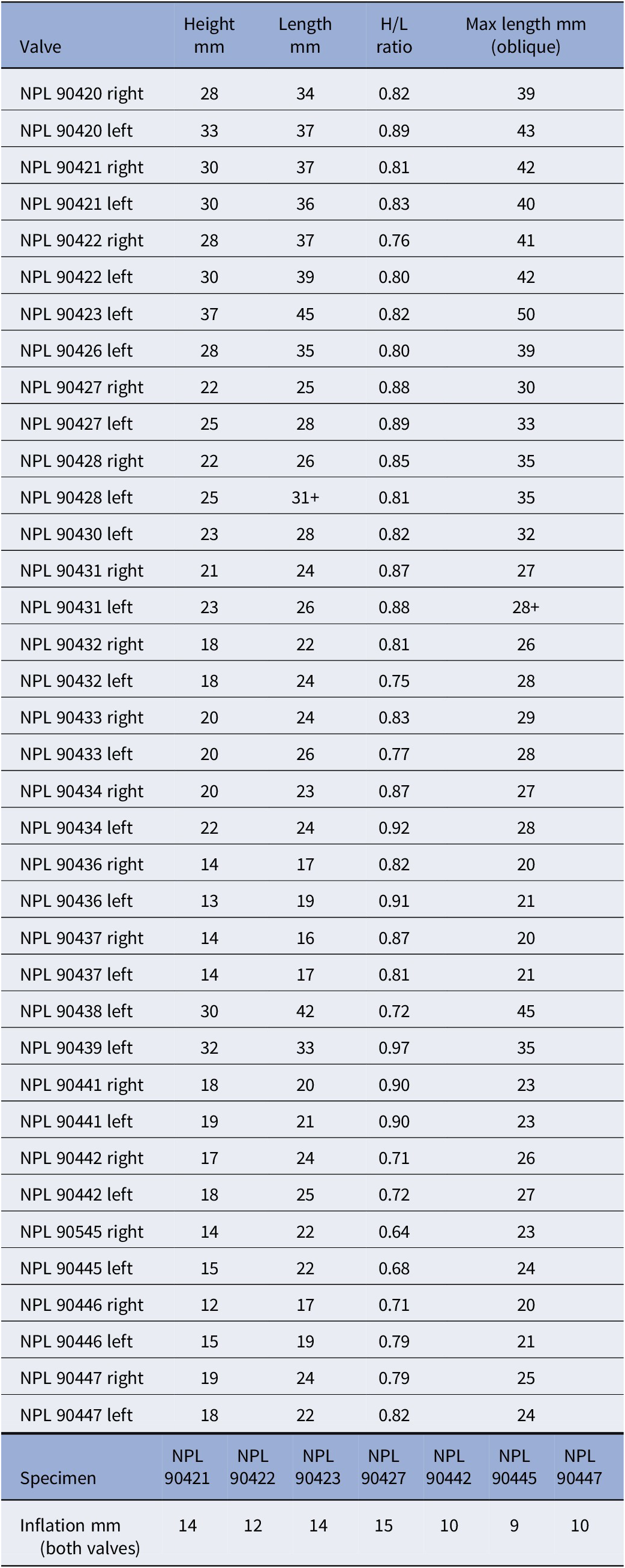
Shell dimensions of type specimens of Willipteria nestelli n. gen. n. sp. Height is dorsal–ventral and length is anterior–posterior; oblique is measured from anterodorsal to posteroventral on inflated shell body. Inflation index (last 2 rows) is reported for the four well-preserved bivalved specimens that provided the most accurate data
Reference Dickins1983 Leptodesma sp. Dickens, p. 60, pl. 1, fig. 7.
Types
Holotype NPL 90420, paratypes NPL 90421–90443, Finis Shale, Finis cycle, Graham Formation, Cisco Group, Jacksboro, Jack County, Texas, USA.
Diagnosis
Medium size alate shells (to 5 cm length) with wide hinge plate and many ligament grooves of a clinovincular ligament configuration; alignment of ligament grooves sometimes wavy and irregular on the anterior portion of the ligament plate; small cardinal and posterior lateral teeth present on juvenile shell and overgrown on adult shell, resulting in loss of dentition; right valve a little smaller than left valve; right valve has less-developed concentric shell lamellae on the shell surface than the left valve.
Occurrence
Finis Shale, Finis cycle, Graham Formation, Cisco Group, Jacksboro, Jack County, Texas, USA; Late Pennsylvanian, basal Virgilian (Gzhelian) stage.
Description
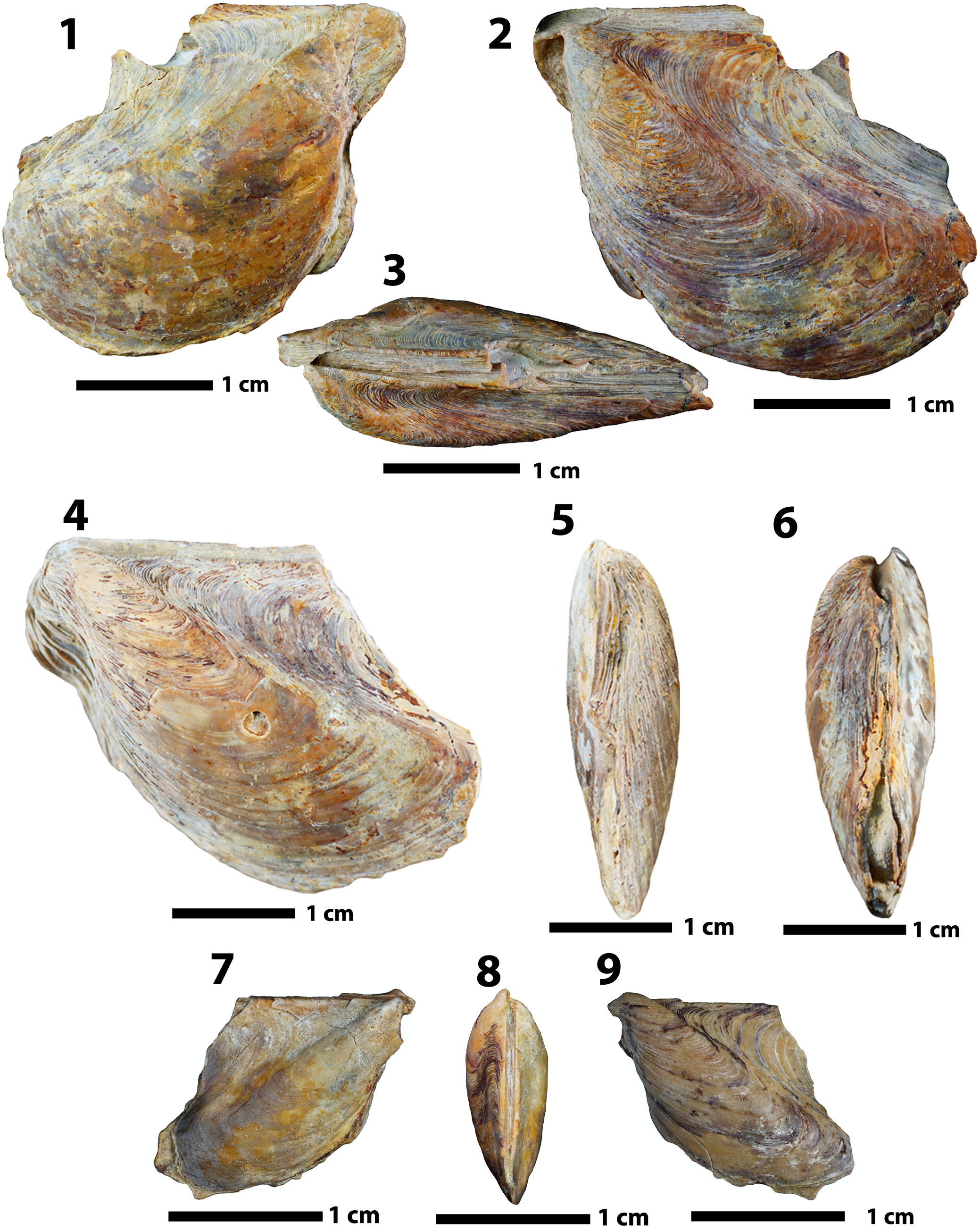
Medium size shells (5 cm maximum dimension) (Table 1) with oblique posteroventral elongation (retrocrescent) growth; shell shape remains the same during growth; height/length (dorsal–ventral/anterior–posterior) ratio 4:5 (avg: 0.84); tiny subterminal beak; minor inequivalve condition with left valve slightly larger; moderate shell inflation (W/H = avg. 0.67 on combined valves) (Table 1), the same for young and old; triangular inflated central shell body with linear margins angled 40–45° apart; posterior sinus margins separating hingeline from central shell body are angled 35–40° apart; at full growth the dorsoposterior margin of the central shell body has a minor upward turn on last-grown portion of shell; central shell body has rounded posterior and posteroventral margins; short prong-like posterior wing on hingeline, about 25–30% of total hingeline length; anterior auricle of half-heart shape growing to 5 mm maximum length and meets central shell body at ~30° angle on right valve; anterior auricle with shingled growth on left valve; long, wide ligament plate (to 4 mm height) containing ~3 grooves/mm; clinovincular ligament with up to 12 pairs of ligament sheets; two small cardinal teeth on juvenile shell with anteriormost tooth with minor inclination toward the posterior and other tooth sloped down ~45° toward posterior; single posterior lateral tooth on juvenile shell; prodissoconch minute (P1 = 0.4 mm; P2 ≈ 1 mm), triangular, located within 2 mm of the anterior end of hingeline, projecting slightly dorsal to edge of hinge plate; shell with small, regular commarginal growth lamellae; lamellae on right valve less prominent than on left valve; large byssal notch on right valve, shallow on left valve; lacks radial ornament; shell layers shingled, partly variable in development; some layers composed primarily of thick columnar prismatic calcite shell, an unusual condition (Fig. 4).
View of prism ends of coarse columnar prismatic calcite outer shell layer of right valve, with encrusting tolypamminid foraminfers (replaced with iron oxide); inclined white zone across photo is the edge of a growth lamella; paratype, NPL 90426, Finis cycle, Graham Formation, Jacksboro, Texas, USA; Late Pennsylvanian, basal Virgilian (Gzhelian) stage.

(1–9) Views of adult and juvenile shells of Willipteria nestelli n. gen. n. sp. (1–3) Right valve, left valve, and dorsal view of paratype, NPL 90421; (4–6) left valve, anterior view, and posterior view of paratype, NPL 90422; (7–9) right valve, posterior, and left valve views of juvenile specimen; paratype, NPL 90437. All from Finis cycle, Graham Formation, Jacksboro, Texas, USA; Late Pennsylvanian, basal Virgilian (Gzhelian) stage.
Etymology
Named for Merlynd Nestell, professor at University of Texas, Arlingtion, Texas, active in documenting the microfauna, stratigraphy, and promoting the study of fossils in the Pennsylvanian strata of north-central Texas, USA.
Occurrence and specimens examined
Thirty-four specimens from the Finis Shale, Finis cycle, Graham Formation, Cisco Group, Jacksboro, Jack County, Texas, USA; Late Pennsylvanian, basal Virgilian (Gzhelian) stage. Two specimens of Willipteria sp. n. gen. are known from the Salesville Formation near Mineral Wells, Palo Pinto County, Texas, of early Missourian (Kasimovian) age.
Remarks
A major character of this species is the occurrence of an inflated triangular central shell body separate from the compressed anterior auricle and compressed posterior wing. The anterior auricle and posterior wing are very flattened and contained very little tissue during life. Retrocrescent growth of the central shell body occurs along an axis of about 50–60° from the posterior hingeline.
A distinguishing character is the presence of a clinovincular ligament on a wide ligament plate with up to 12 ligament grooves that commonly have irregular or wavy, low amplitude folding of ligament grooves on the anterior 2 cm of the ligament plate. Other distinguishing characters are the occurrence of low but sharp raised commarginal growth lamellae on the left valve and subdued development of lamellae on the right valve, half-heart shape of the anterior auricle, and the greater growth of ventral shell margin on the left valve and probable flexible right valve shell. No internal ridges are known and there is no radial ornament.
It is surprising that a robust shell of this size has not been described or recognized previously in other deposits, but that lapse is consistent with the general lack of attention given to pterioids of this size range. The seemingly disparate characters of Willipteria n. gen. have allowed the genus and its species to be overlooked and remain unknown until a collection of well-preserved bivalved specimens became available.
Most late Paleozoic pterioid bivalves have a thin outer columnar prismatic shell layer and a thicker (recrystallized) inner aragonite shell layer, assumed to have been nacreous (Carter, Reference Carter and Carter1990; Nagel-Myers et al., Reference Nagel-Myers, McRoberts and LaPointe2018). Although that holds true for many species, some individuals of Willipteria nestelli n. gen. n. sp. have the outer columnar prismatic shell layer thickened (to 0.5 mm layer thickness) to the extent that portions of the shell layer are composed primarily of columnar prismatic calcite (Fig. 4). Some of this difference can be attributed to random variability but the extent of variability suggests change in shell secretion during an episode of adaptation to changing environmental conditions..
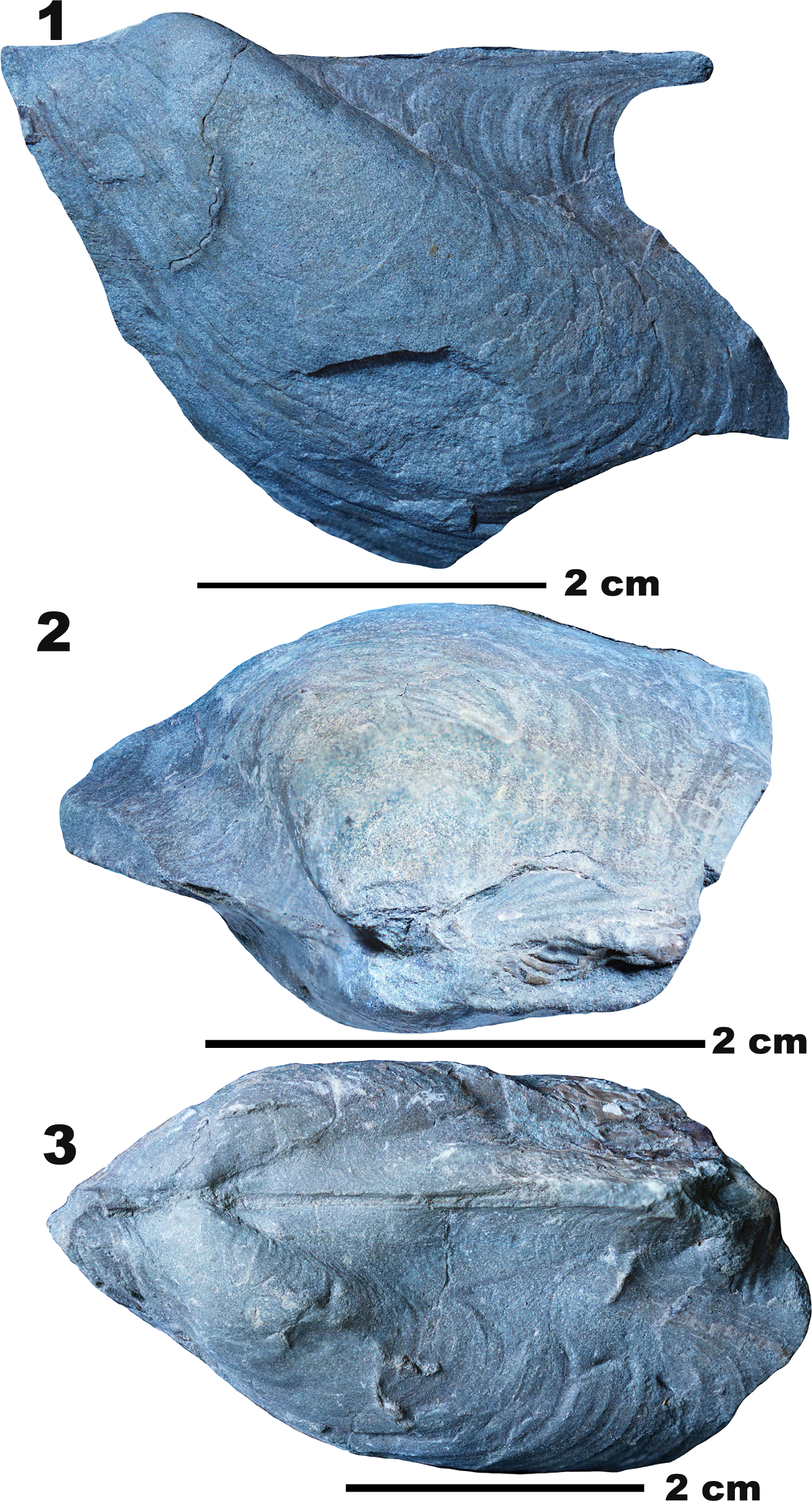
(1–3) Views of Leptodesma potens and Leptodesma mortoni. (1) Left valve of Leptodesma potens showing posterior auricle, reduced anterior auricle, and ovoid shape of main shell body; cotype AMNH-FI-140055. (2) Dorsal view of Leptodesma potens showing inflated shell body and inclined condition auricles; cotype AMNH-FI-140056. (3) Dorsal view of Leptodesma mortoni with small, narrow hinge containing a single groove on each ligament plate; cotype AMNH-FI-6098-2. Leptodesma potens from Chautauqua Creek, near Summerdale, Chautauqua County, New York, and Leptodesma mortoni from Little Genesee, Alleghany County, New York, USA. All from Late Devonian, Famennian Stage. Photographs made by T. Yancey, published with permission of American Museum on Natural History. All scale bars = 2 cm.
The minor inequivalve condition of W. nestelli n. gen. n. sp. is like that described by Harper and Checa (Reference Harper and Checa2020) on modern pterioid species. They documented how differences in shell microstructure can allow the right valve to be more flexible than the left valve, enabling a tight closure of the valves. The same ability to obtain tight closure can occur if the smaller valve has a substantial organic-rich fringe that provides flexibility for the valve with smaller mineral shell size. The highly inequivalved W. falcata n. gen. n. comb. described by Boyd and Newell (Reference Boyd and Newell2001) probably had an organic-rich fringe but W. nestelli n. gen. n. sp. is only slightly inequivalved and could have had effective closure with greater flexibility of the smaller valve.
Willipteria nestelli n. gen. n. sp. is distinguished from W. falcata n. gen. n. comb. by its shorter posterior wing and shorter posterior sinus and by a shell height nearly as great as shell length, in contrast to the much longer length (relative to height) of W. falcata n. gen. n. comb.
The illustration of a type locality specimen of W. nestelli n. gen. n. sp. by Dickins (Reference Dickins1983) in a publication focused on Australian Permian bivalves is a marvelous indicator of how researchers are interconnected. A photo sent to Dickins by N. Newell as an example of a so-called transitional ligament type was used as an illustration of ligament. The work presented here documents the presence of dentition on the juvenile hinge of the species and a better genus assignment is now available.
Leptodesma Hall, Reference Hall1883
Type species
Leptodesma potens Hall, Reference Hall1883, by subsequent designation Miller, Reference Miller1889.
Diagnosis
Alate pterioid with wide subterminal beak projecting above hingeline; thin shell; very narrow hinge plate; short posterior prong-like auricle; small anterior auricle present on juvenile shell that disappears on mature shell; auricles inclined away from plane of commissure with tight closure at hingeline.
Remarks
This revision of Leptodesma includes observations on the ligament plate, auricles, and shell inflation that were not included in the original description of the genus (Hall, p. xiii, 1884), which states, “similar to Leiopteria, except that the anterior is always nasute and acute instead of auriculate and rounded. Hinge narrow with a slender lateral tooth just posterior to beak and nearly parallel to the hingeline. Ligamental area narrow, extending the entire length of the hinge, marked by fine, sharp, longitudinal striae. Test with concentric striae.” Hall also mentioned occasional occurrence of slight radial striae on valves but none is seen on specimens of the type lot. There is no evidence for the presence of a lateral tooth.
Uncertainty about the Leptodesma genus concept persists from the date of first publication. Hall (Reference Hall1884, p. 175) presented a genus concept for Leptodesma as a group (“assemblage of forms”) of species in the Late Devonian “Chemung” Group strata of New York that vary from alate to rounded, with some species approaching the shape of mytilid or modiomorphid bivalve. He stated that the “wing becomes nearly obsolete” and the “anterior end rounded”, despite the implication that the anterior auricle was quite similar to that of Leiopteria. It suggests that Hall was aware that the proposed genus was unlike other genera present in the Devonian strata being documented but not ready to make a more detailed study. That lack of action left Leptodesma as a poorly described genus.
Leptodesma potens Hall, Reference Hall1883
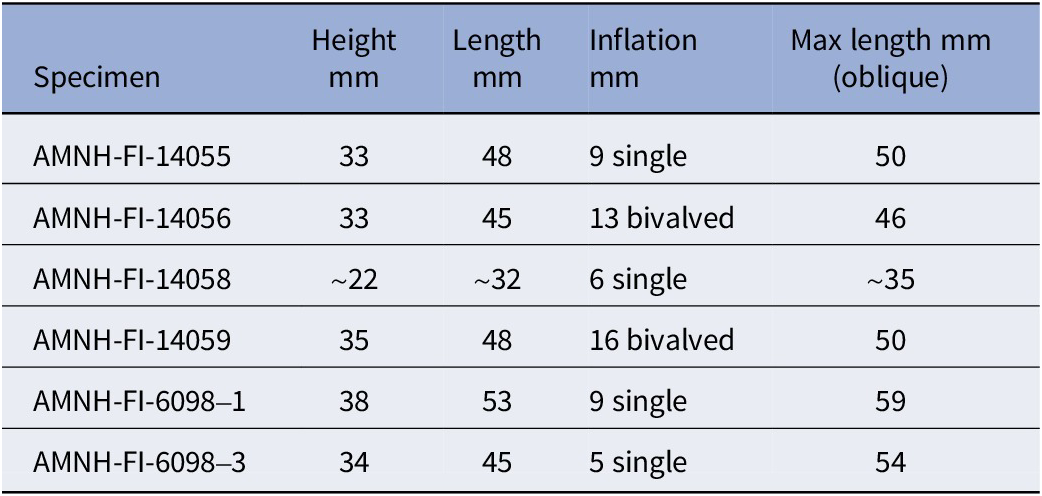
Shell dimensions of type specimens of Leptodesma potens Hall, Reference Hall1883. Height is dorsal–ventral and length is anterior–posterior; oblique is measured from anterodorsal to posteroventral on central shell body. Inflation is on single valve or bivalved specimen but may be undervalued due to partial compression
Reference Hall1883 Leptodesma potens Hall, pl. 21, figs. 21, 30; pl. 22, figs. 11, 12, 19, 21.
Reference Hall1884 Leptodesma potens; Hall, pl. 21, figs. 21, 30; pl. 22, figs. 11, 12, 19–21; pl. 89, fig. 7.
Types
Cotypes AMNH-FI-14055–14059, Ellicott Member, Chadakoin Formation, Conneaut Group (“Chemung” of Hall), Chautauqua Creek, near Summerdale, Chautauqua County, New York, USA.
Occurrence and specimens examined
Five specimens and some partials from the Ellicott Member, Chadakoin Formation, Conneaut Group (“Chemung” of Hall), Chautauqua Creek, near Summerdale, Chautauqua County, New York, and one specimen from near Cassadaga Lake in Chautauqua County, New York, USA; late Devonian, Famennian Stage.
Diagnosis
Alate pterioid with a central shell body that changes shape from triangular as juvenile to ovoid at maturity; wide subterminal beak projecting above hingeline; very narrow hinge plate; short posterior prong-like auricle; posterior sinus below posterior auricle; small anterior auricle present on juvenile shell that disappears on mature shell; auricles inflated away from tight closure along the hingeline.
Description (revised)
Medium-sized, nearly equivalved, moderately inflated shell with retrocrescent growth; main shell body changes shape from triangular as juvenile to ovoid at maturity; valves thin (< 0.5 mm); beaks 1 cm wide and project ~0.5 cm above the hingeline; short (1.5 cm), narrow, prong-like posterior auricle; posterior sinus present between hingeline and main shell body; on young shell the posterior sinus triangular has 30° angle between hingeline and margin of main shell body; boundary between central shell body and posterior sinus sharp and well defined; anterior auricle and shell of the posterior sinus inflated above plane of commissure; anterior auricle weakly developed or present only on juvenile shell; when anterior auricle becomes indistinct at maturity the anteroventral margin of shell acquires a straight-line segment inclined ~45° to hingeline; hingeline lacking teeth at maturity (juvenile condition not known); ligament plate on hinge very narrow (0.3 mm); shell surface marked with semi-regular, slightly raised growth lines; other ornament lacking.
Remarks
The shell exterior has closely spaced, slightly developed commarginal growth lines with no indication of lamellae. Molds of the shell within the shale matrix show shell thickness to be thin (< 0.5 mm). Leptodesma potens is edentulous on all specimens examined and has a very narrow hinge plate on the dorsal margin of the valves. The ligament plate is 0.3 mm high on mature shells and shows no indication of multiple ligament grooves. On early growth, the central shell body is triangular and mostly distinct from the anterior auricle, but during mature growth the shell body becomes ovoid, and the anterior auricle becomes indistinct and merges with the curvature of the main shell body as a continuous single curved line.
Data missing from the description of L. potens are the characters of the shell interior (musculature, presence/absence of internal ridges) and knowledge of the juvenile hinge (presence/absence of teeth). Hall (Reference Hall1883) included eight specimens from four widely separated collection sites in the type lot of specimens of L. potens. Three localities are each represented by a single specimen. The only sample containing multiple specimens (five whole or nearly whole specimens plus partials) is the sample from the Ellicott Member of the Chadakoin Formation on Chautauqua Creek, near Summerdale, Chautauqua County, New York (AMNH-FI-14055–14059). It is a rock slab containing close-packed specimens, including two bivalved specimens, that represent a population of individuals. They consist of well-preserved internal and external molds. The species redescription and the selection of specimens chosen for redescription are from that sample. A specimen of L. mortoni Hall, Reference Hall1883 (AMNH-FI-6098-2) is included in this study (Fig. 6.3) to illustrate the Leptodesma hingeline. The relocation of the Chautauqua Creek collection site is based on the work of Baird et al. (Reference Baird, Harper, Over, Hannibal, McKenzie, Tesmir, Ver Straeten, Over and Woodrow2023) who provided a detailed stratigraphy of the “Chemung” strata yielding the fossils described by Hall (Reference Hall1883, Reference Hall1884). Determination of the probable collection site was possible from additional comments made by Gordon Baird (6 September 2024).
Comparison of Willipteria n. gen. to Leptodesma
Willipteria nestelli n. gen. n. sp. has an outline shape similar to many pterioid species assigned to genus Leptodesma, a commonly used genus name in late Paleozoic bivalve studies. However, Leptodesma has been used as a form genus for species known primarily from variations in shell outline and surface ornamentation. Although W. nestelli n. gen. n. sp. may have some relationship to Leptodesma, Leptodesma has a very narrow hinge plate and is not known to have ontogenetic change from toothed to edentulous hinge condition. To document the differences of the two genera, Willipteria n. gen. was compared to type specimens of the genotype species of Leptodesma, L. potens Hall, Reference Hall1883.
A major difference is the presence of a narrow ligament plate on Leptodesma in contrast to the wide ligament plate with clinovincular ligament of Willipteria n. gen. The ligament of Leptodesma was apparently composed of a single pair of lamellar and fibrous ligament sheets that extended along the hingeline and did not become clinovincular. Leptodesma is thin shelled; Willipteria n. gen. has a thick shell. Another important difference is the ontogenetic loss of anterior auricle on Leptodesma as the juvenile anterior auricle present merges with the anterior margin of the mature shell. Other differences are the inflated condition of auricles on Leptodesma and the lack of a well-marked boundary between the central shell body and anterior auricle. The inflated auricles contrast with the closely pressed auricles of Willipteria n. gen. with little space between them. There is no evidence of dentition on the hinge of L. potens in contrast to the ontogenetic change of Willipteria n. gen. The hinge plate on Leptodesma is so narrow that ontogenetic change like that of Willipteria n. gen. is unlikely. Although Leptodesma is not completely described, it is much different from Willipteria n. gen.
Epifaunal life habit of Willipteria n. gen.
Willipteria n. gen. has an inequivalved shell condition with the right valve less inflated and its concentric lamellae ornament less developed on the right valve than on the left valve. The inequivalved condition of W. nestelli n. gen. n. sp. and W. falcata n. gen. n. comb. is consistent with these species having an epifaunal attachment above the sea floor or a reclining life habit on the sea floor. Wear patterns are consistently greater on the right valve than on the left valve, a consequence of preferential byssal attachment with the right side having increased contact with the attachment surface. On W. nestelli n. gen. n. sp. the amount of epizoic encrustation is similar on the right and left valve surfaces of juvenile and adult specimens (Fig. 1). This points to a preferred attachment to a structure or organisms above the sediment surface or on irregular shell substrate and in a position with full exposure to sea water for an epifaunal life habit.
A byssal opening is present on both valves of Willipteria n. gen. but it is unequal on opposing valves with a deeper notch on the right valve than on the left valve. On some specimens the anterior auricle extends farther on the left valve than on the right valve, providing cover for the proximal portion of byssal strands as they extend through the byssal opening. The result is a consistent right-valve-against-substrate attachment style for the bivalve.
The presence of abundant encrusting tolypamminid foraminferids and basal-attachment secretions of bryozoan colonies on both valves of W. nestelli n. gen. n. sp. is evidence of life attached to large organisms living exposed above the sediment surface (Fig. 1). Some specimens have tiny juveniles of brachiopods encrusting the shell, one specimen has attached Petrocrania inarticulate brachiopods, and another specimen has an attachment base of a gorgonoid octocoral. That makes it a two-tier encrusting assemblage with arborescent growth on and away from the bivalve shell surface on a bivalve growing attached to substrate. Similar examples of epizoan overgrowth on exposed epifaunal invertebrate shells is documented by Lescinsky (Reference Lescinsky1997).
The shell wall of W. nestelli n. gen. n. sp. is 0.5–1.5 mm thick on adult shells, which is thick for an epibyssate shell but consistent with a relatively large byssal opening for strong byssal attachment. The type of organism or substrate on which W. nestelli n. gen. n. sp. attached is unknown, but the shell size suggests that it attached to solid skeleton. It also should have been present in reef or bioherm environments as well as bioclast-rich mud substrate present beneath limestones. Sediments of bioherm environments tend to be more cemented and bivalves are not easily extracted from them, so bivalve specimens worthy of systematic description are seldom collected.
Inference about the life mode of mid to late Paleozoic pterioid bivalves is discussed by Pojeta (Reference Pojeta1971), Stanley (Reference Stanley1972), Bailey (Reference Bailey1983), and Johnston (Reference Johnston1993). Johnston (Reference Johnston1993) presented a detailed analysis of the evidence for epibyssate versus endobyssate pleurothetic life position of Devonian pterioids and concluded that most pterioids were and are epibyssate. The evidence for Willipteria n. gen. life mode as epibyssate agrees with Johnston’s (Reference Johnston1993) conclusion on life mode and shows that a pterioid with a moderately thickened shell could have lived as an epibyssate species. That would include a life habit of a reclining position on the seafloor. In contrast, the more inflated shape of Leptodesma potens suggests the possibility of life position for that species with the shell partly embedded in seafloor sediment.
Anterior auricle on pterioids
The anterior auricle on Willipteria n. gen. has a half-heart shape, like a heart cut into half by a vertical cut though the center, producing a rounded top with a triangular, sloping, straight side. On Willipteria n. gen. this is a flat structure attached to the inflated central shell body and is different from a simple round ear-shaped auricle having a notch between the ear and the shell body, which is thought to be present on species of Leiopteria and some other pterioid species. Some pterioid species, such as Leptodesma longa (Geinitz, Reference Geinitz1866) and Leptodesma ohioense (Herrick, Reference Herrick1887), lack a distinct anterior auricle entirely. Instead of an auricle they have a rounded anterior corner formed on the edge of the inflated shell body. Juvenile Leptodesma potens has a small triangular anterior auricle that disappears with growth and merges with the main shell body at maturity. This ontogenetic change indicates shape of anterior auricle is important for a species but is less important for higher level taxonomic distinction. The use of anterior auricle shape to distinguish Leptodesma from Leiopteria is a weak basis for genus recognition and needs to be supplemented with complete genus diagnoses.
Discussion
Documentation of ontogenetic change in the hinge structure of two species of oblique-(retrocrescent-) growth late Paleozoic pterioid bivalves reveals that knowledge of ontogeny is an important component of description of pterioid species and genera. This was not considered necessary in previous taxonomic studies that focused on differences in shell outline and auricles, assuming that those characters are adequate to determine relationships of species. A pressing need in pterioid descriptions is data on variability in shell shape within a population, a type of data seldom included in species descriptions, especially in species described in studies published during the 1800s. As McAlester (Reference McAlester1962, p. 11–12) stated “modern revision …. is an urgent necessity.” Similar statements were presented by Hind (Reference Hind1901), Pojeta et al. (Reference Pojeta, Zhang and Yang1986), Johnston (Reference Johnston1993), Boyd and Newell (Reference Boyd and Newell2001), and Tëmkin and Pojeta, (Reference Tëmkin and Pojeta2010).
Another concern is the uncertainty about distinction between Leptodesma and Leiopteria Hall (Reference Hall1883). Leptodesma was defined by Hall in the context of it being different from Leiopteria by difference in the shape of the anterior auricle (Hall, Reference Hall1884, p. xiii). This has been accepted by later authors but Hall’s statement that Leptodesma always has a pointed nose-like (“nasute and acute”) anterior hingeline termination in contrast to a rounded ear-like (“auriculate and rounded”) one is an exaggeration, as indicated by his statement that some Leptodesma species acquire a rounded anterior termination of the hingeline (Hall, Reference Hall1884, p. 175). The shape of the anterior auricle is often variable on species in both genera and at maturity (see Fig. 6.1) the type species for the Leptodesma (L. potens) has a square junction of the shell body with the anterior end of the hingeline. Some other species assigned by Hall (Reference Hall1883) to Leptodesma have a rounded corner on the anterior end of the hingeline instead of an acute corner. Despite this overlap, Leptodesma and Leiopteria continued to be considered as valid by later workers (Ehlers and Wright, Reference Ehlers and Wright1959; Rode, Reference Rode2004), separated by more oblique shape and less pronounced byssal sinus in Leptodesma (Rode, Reference Rode2004). The presence of a short partition in the beak and oblique slender lateral teeth in Leiopteria (Hall, Reference Hall1883) is not supported by later work. Ehlers and Wright (Reference Ehlers and Wright1959, p. 6) stated that those characters “are neither discernable in his types nor in individuals in our collection.”
As noted by McAlester (Reference McAlester1962), species of these genera need large samples to obtain reliable species descriptions. The documentation of pterioid hinge characters changing during ontogeny shows that the status of pterioid genera based on New York Devonian species must be revised in the manner of work like that of McAlester (Reference McAlester1962), Bailey (Reference Bailey1983), and Nagel-Myers et al. (Reference Nagel-Myers, McRoberts and LaPointe2018). Some of them have been given better genus descriptions (e.g., McAlester, Reference McAlester1962, on Actinopteria and Cornellites; Bailey, Reference Bailey1983, on Cornellites, as Ptychopteria (Cornellites); Rode, Reference Rode2004, on Leptodesma (Leiopteria); Nagel et al., 2018, on Actinopteria).
Describing the ontogenetic change as one of conversion from toothed hinge to toothless hinge sounds like a major change but it is a transition to be expected when the hingeplate is thickened as a species increases the size of its shell. As the juvenile hinge plate thickens, secretion on areas with teeth changes to secreting a smooth, edentulous surface and the cardinal teeth are engulfed and disappear from the surface of the hinge. The same happens to the posterior lateral tooth until there is no trace of it on the posterior hinge plate. The presence of a clinovincular ligament on pterioids with a wide hinge plate is also to be expected. Insertion of new pairs of ligament sheets occurred at or near the beak, to compensate for broken ligament during life. As the ligament plate thickened and widened, active growth on a ligament pair occurred at the posterior edge of the sheet and new growth migrated posteriorly while earlier formed portions of a ligament unit break. Functional ligament is maintained by having multiple sites of newly formed ligament migrating to the posterior along the hingeline.
Small to mid-sized pterioid bivalves of the late Paleozoic are conventionally placed in family Pterineidae, a generalized family that includes multiple poorly documented genera. Family Pterineidae is based on a Devonian genus of thick-shelled, quadrate (non-retrocrescent) species with a heavy hinge plate and large arrays of hinge teeth. Genus Willipteria n. gen. described here has distinctive hinge characters that are inconsistent with taxa placed in family Pterineidae as represented by genus Pterinea. Therefore, it is questionably assigned to family Pterineidae.
Conclusions
Willipteria, a new genus of alate pterioids, is erected for species that transform from juveniles with tooth-bearing hinge to an edentulous condition as adults and has a wide clinovincular ligament on an alate retrocrescent-growth shell with concentric growth lamellae and slightly inequivalved. This shows that ontogenetic change is an important factor in determination of pterioid taxonomy and phylogeny. An edentulous hinge is produced by overgrowth of shell teeth during hinge thickening. For Willipteria n. gen. this was accompanied by widening of the ligament plate and adding multiple units of ligament sheets on the hinge. When teeth are present on the hingeline the ligament sheets tend to have wavy configuration over the top of the cardinal teeth, producing a short segment with very low amplitude folding on the anterior end of the ligament plate.
Willipteria n. gen. is compared to Leptodesma, a genus name commonly used for small alate pterioids of Carboniferous age. Study of the type lot of genotype species L. potens shows that Leptodesma is not closely related to Willipteria n. gen. A partial revised description of Leptodesma is presented, but a comprehensive redescription cannot be made until juvenile specimens of L. potens and other species assigned to the genus are available for study.
What emerges from this study of pterioid shell growth is that varied ligament conditions and tooth configuration can be produced by relatively simple ontogenetic change. It implies that ligament condition is as much a structural grade as a stable phyletic character for determining relationship at a taxonomic level above the genus. Distinction among types of ligaments containing multiple pairs of lamellar and fibrous ligament is also relevant to discussions of the origin of ligament configurations presented by several authors (Dickins, Reference Dickins1983; Newell and Boyd, Reference Newell and Boyd1987; Waller, Reference Waller and Morton1990; Tëmkin, Reference Tëmkin2006). Ligaments consisting of multiple pairs of ligament sheets appear to be a derived condition, not a primitive ligament condition.
Acknowledgments
R. Williams collected 16 of the specimens and B. Neuman, faculty member of Texas A&M University, collected 16 specimens used in this study, E. Heuer, former faculty member of Texas Christian University, Fort Worth, Texas, collected one specimen, and the largest specimen with many encrusting organisms was collected by M. Kaasa, former graduate student at Texas A&M University, College Station, Texas. Study of the type lot of Leptodesma potens was arranged by curator B. Hussaini of the American Museum of Natural History, New York, after L. Amati, State Paleontologist, New York State Museum, Albany, New York, informed me that some type specimens had been sold by J. Hall to the American Museum of Natural History. Permission to publish photos made courtesy of the American Museum of Natural History. Relocation of collection sites for Hall’s (Reference Hall1883) report was possible from discussions with Gordon Baird, State University of New York, Fredonia, and D.J. Over, Geneseo Honors College, Geneseo, New York. The attention of fossil collectors in Texas to obtaining a range of sizes of the species made it possible to record details of changes in dentition and ligament during growth. The Geology and Geophysics Department of Texas A&M University provided research facilities for preparing fossil specimens and the written report presented here. The work was done as part of the normal activities of a faculty position at Texas A&M University. No monetary funding was needed or provided to complete the study.
Competing interests
The author declares none.


 Open access

