




Introduction
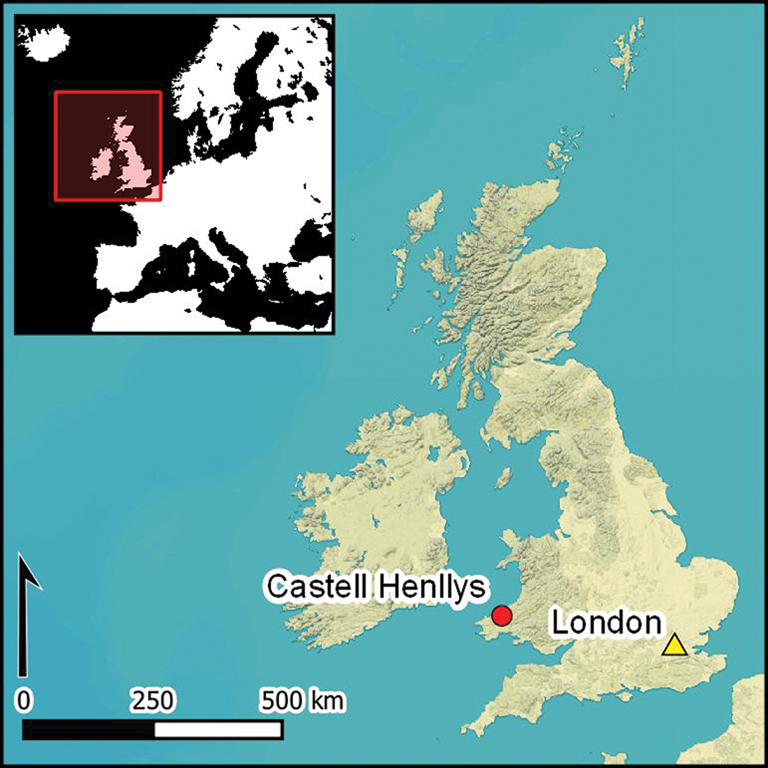
The extensive use of plastic as a highly adaptable material for objects and packaging forms part of our society's dependency on oil—an addiction with many implications, including the acceleration of climate change (Boetzkes Reference Boetzkes and Mauch2016). Indeed, plastic has been proposed as one of the signatures of the Anthropocene (Zalasiewicz et al. Reference Zalasiewicz2016, Reference Zalasiewicz2017; Elias Reference Elias2018; Westermann Reference Westermann, Edelstein, Geroulanos and Wheatley2020), and some scholars advocate that contemporary society should be termed the Plastic Age (e.g. Miller Reference Miller2007; Thompson et al. Reference Thompson, Swan, Moore and Vom Saal2009; Riede et al. Reference Riede, Vestergaard and Fredensborg2016). In this context, the results of our excavations inside two reconstructed roundhouses at Castell Henllys, Wales, which have each stood for over 30 years, are informative. They indicate the potential that archaeology of the recent past offers to the Anthropocene debate by considering how modern material culture, including plastics and plasticised items such as sweet wrappers, can become integrated within the archaeological record.
Much ecological and Earth science research has focused on plastic refuse in the marine environment (Hammer et al. Reference Hammer, Kraak and Parsons2012), and on the worryingly high presence of plastic, including microdebris, in the riverine, marine and terrestrial environments (Williams & Simmons Reference Williams and Simons1996; Hammer et al. Reference Hammer, Kraak and Parsons2012; Liboiron Reference Liboiron2016; Rillig et al. Reference Rillig, Ingraffia and de Souza Machado.2017; Carpenter & Wolverton Reference Carpenter and Wolverton2017; Worm et al. Reference Worm, Lotze, Jubinville, Wilcox and Jambeck2017). With the exception of a new marine study by Schofield et al. (Reference Schofield, Wyles, Doherty, Donnelly, Jones and Porter2020), equivalent analysis using archaeological methods has not been integrated into relevant discussions, thereby reducing consideration of how plastics enter the terrestrial environment. The current study provides an example of litter-discard on a well-maintained heritage site, from which modern refuse is systematically cleared away to retain the illusion for visitors of an Iron Age environment. Unlike some other contemporary archaeology studies in which plastic has been noted in zones where modern refuse may collect, such as areas where the urban homeless may reside (Crea et al. Reference Crea, Dafnis, Hallam, Kiddey and Schofield2014), or in landfills (Rathje et al. Reference Rathje, Hughes, Wilson, Tani, Archer, Hunt and Jones1992; Lehmann Reference Lehmann2015), this study concentrates on what might be considered a ‘benign’ environment. The high prevalence of plastic at Castell Henllys is therefore particularly poignant.
‘Plastic’ is a term that covers a wide range of products, with varying characteristics in production and use, and with very different levels of both opportunity for recycling and patterns of discard (Kershaw Reference Kershaw2018). Although there are various options for recycling, a significant amount of plastic is either non-recyclable, or escapes from the recycling loop into the environment (Clift et al. Reference Clift, Baumann, Murphy and Stahel2019). Of particular relevance to the Castell Henllys assemblages are plastic food packaging and food-consumption products, such as straws and spatulas, cling film, bottle tops and plasticised sweet wrappers that are widely used and discarded in the environment (Griffin et al. Reference Griffin, Lewis, Bennett, Hamill and Kee1996; Kershaw Reference Kershaw2018: tab. 2.2).
Castell Henllys is an extensively excavated Iron Age (late first millennium BC) hillfort that has been a location for public interpretation for 40 years. Long-term experimental reconstructions of Iron Age timber roundhouses constructed on the sites of the original excavated structures, utilising site-specific archaeological evidence (Figure 1), are notable features of the fort today (Mytum Reference Mytum, Stone and Planel1999, Reference Mytum2013a). This site is an iconic, regional tourist attraction, but it is also frequently visited by school trips, as the Iron Age Celts are part of the Welsh history curriculum (Mytum Reference Mytum2000). Pembrokeshire Coast National Park, which gained control of the site in 1992 after the original owner, Hugh Foster, died, have provided educational resources and allocate dedicated costumed staff to interpret the remains and provide activities for the children. This has ensured year-round use of the site and a steady number of visitors to the reconstructed roundhouses.
View of the Cookhouse (right) and the Earthwatch roundhouse (left) prior to their dismantling and excavation (photograph by H. Mytum).
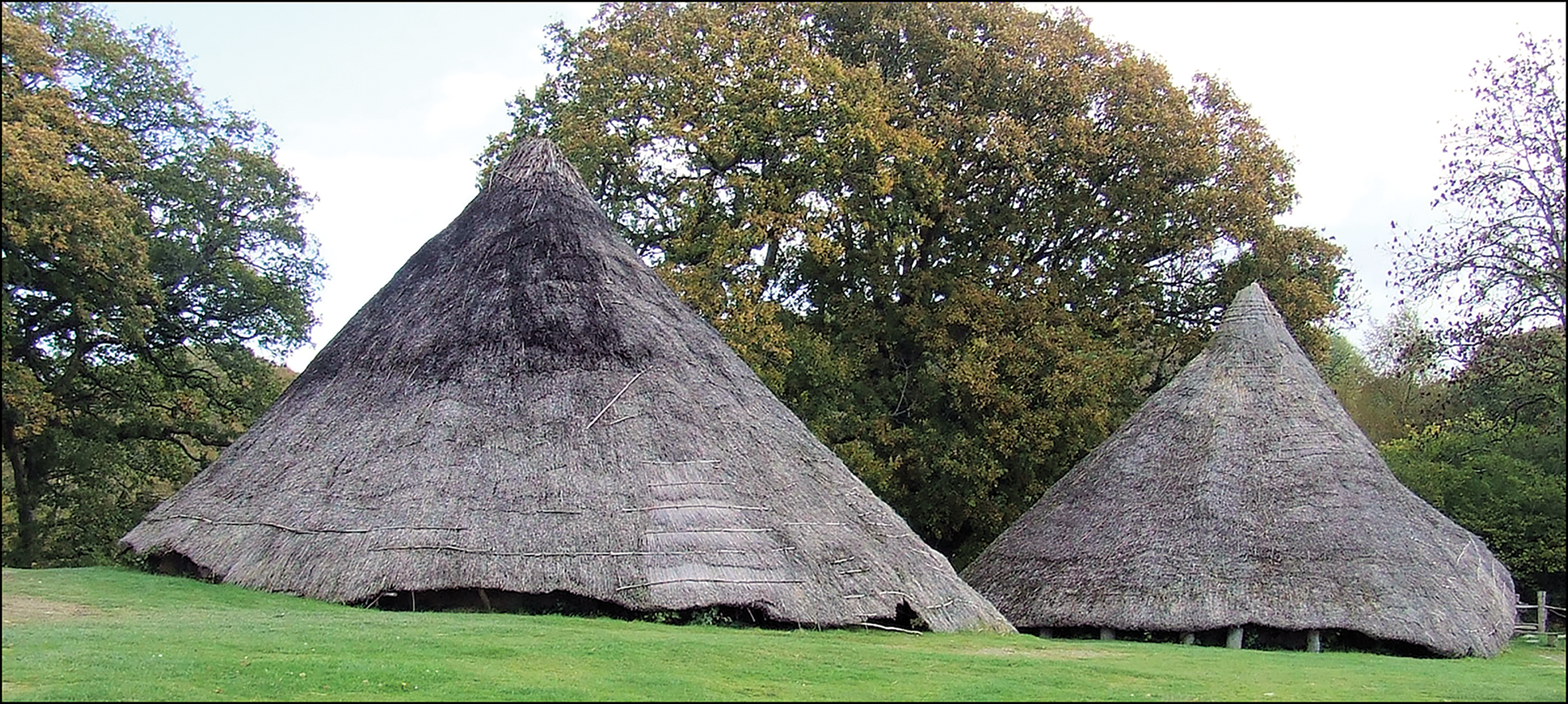
Two of the Castell Henllys roundhouses came to the end of their heritage-interpretation lives in 2017 and 2018, after 35 and 30 years of use respectively. During prehistory, such buildings could have continued in use as they were, or with a small amount of maintenance to refurbish them. Modern health-and-safety concerns, however, led the National Park to dismantle and rebuild them. Fortunately, appreciating the value of an archaeological perspective for the redesign and rebuilding, and the research significance, of these long-term experimental structures, the National Park arranged for both roundhouses to be excavated after dismantlement. Investigation of the structural evidence has, as expected, illuminated decay processes and demonstrated how archaeological signatures of reconstructed buildings can help in the interpretation of later prehistoric structural remains (Mytum & Meek Reference Mytum and Meek2020).
These excavations of experimental structures complement others undertaken at Butser Ancient Farm and St Fagan's National History Museum, where broadly similar results on artefact deposition and building decay have been noted (Bell Reference Bell, Allen, Sharples and O'Connor2009, Reference Bell, Chapman and Wylie2014). Given that the usage of the two roundhouses was well documented through their lifespans—as also seen at St Fagans (Bell Reference Bell, Chapman and Wylie2014)—we anticipated that the artefact assemblages and distributions at Castell Henllys could act as valuable tests for correlating accidental discard with activity patterns. This was indeed the case, although the composition of the finds assemblages—notably in the sheer quantity of the plastic recovered—was unexpected, and emphasises the ubiquity of this material over the last 30 years. It is this aspect of the excavation results that forms the focus of this article.
The archaeological study of contemporary material culture was first approached from a comparative perspective in order to illuminate past behaviours based on the production, use and discard of modern, sometimes industrially produced, material culture (Rathje et al. Reference Rathje, Hughes, Wilson, Tani, Archer, Hunt and Jones1992; Rathje & Murphy Reference Rathje and Murphy2001). Most experiments on site-formation processes have used replica artefacts, such as lithics or ceramics, and have generally considered the modification and movement of these artefacts, rather than the development of deposits incorporating them—although there are notable exceptions (e.g. Wilk & Schiffer Reference Wilk and Schiffer1979; Banerjea et al. Reference Banerjea, Bell, Matthews and Brown2015; Lewis & Waites Reference Lewis and Waites2019). There has been even less archaeological interest in how contemporary debris can illuminate tourist behaviour and heritage management. This study provides an example of the value of such research.
The roundhouses and their use-lives
The first roundhouse to be completely excavated and rebuilt at Castell Henllys (Mytum Reference Mytum1986) was a double-ring roundhouse, featuring a conical roof supported on the exterior wall and an interior ring-beam suspended on an inner ring of timber uprights. The roundhouse was erected in 1982 and dismantled in 2017. This structure, approximately 9.5m in diameter, was called the ‘Cookhouse’ in the National Park public interpretation, and had been used for the demonstration of a domestic Iron Age roundhouse interior with a central hearth and peripheral features, such as beds and storage areas (Figure 2). Light largely entered the roundhouse from the doorway to the south-west, with the doors being kept open whenever the site was accessible to the public. Even with a fire lit in the central hearth, the light levels fall away considerably from the doorway and immediately around the hearth, although to a lesser extent than in the second roundhouse discussed below.
Plan of the Cookhouse structural elements and some of the internal features (figure by R. Philpott).
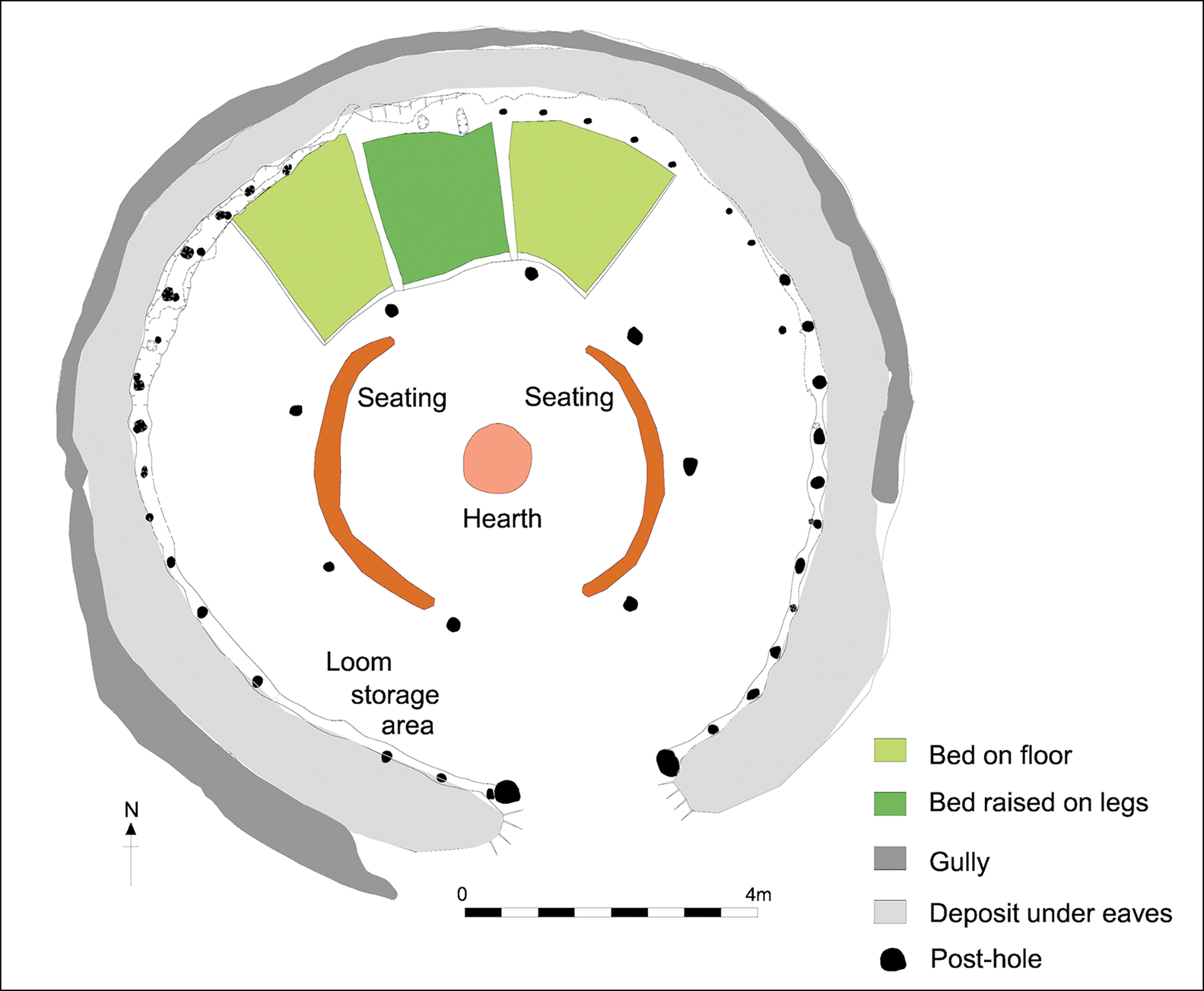
The main interpretation activities in the Cookhouse were linked to cooking and weaving, with a portable loom stored within the structure and sometimes taken outside for demonstrations. Many school pupils had their faces decorated with paints in Celtic designs (Mytum Reference Mytum2000) by staff standing just outside the roundhouse; the materials for this activity were stored within the building. Despite the Cookhouse being the most frequently visited roundhouse at the site, relatively little debris accumulated within it, as the public would enter for a brief inspection of the interior, or circulate around by the inner ring of posts, and perhaps sit round the hearth and absorb the atmosphere, rather than participating in any activities that could easily generate refuse to be discarded. The replacement of timbers after approximately 20 years (Mytum & Meek Reference Mytum and Meek2020) and the repatching of the entrance flooring that repeatedly wore away offered no significant opportunities for artefact deposition. Although there was periodic rearrangement of interpretative items within the roundhouse, the basic layout of the central hearth and its surrounding seats, with beds to the rear, remained the same throughout the building's use.
The Earthwatch roundhouse (named after the Earthwatch organisation whose volunteers helped with the reconstruction) was erected in 1984, and dismantled and excavated in 2018. It had originally been designed with no internal earth-fast posts, which created a large open space measuring approximately 11m across. Once the National Park took over the site, however, roof props set on stone footings were considered necessary for public safety, and this altered the use of the internal space (Figure 3). Of even more importance, however, was the provision of curved benches around the hearth and also against the wall on the southern and western portions of the house, on which visitors—particularly school parties—could sit (Mytum Reference Mytum2013b). Here, they were told stories about the Iron Age, and, in bad weather, would eat their packed lunches.
Plan of the Earthwatch roundhouse structural elements and the benches (figure by R. Philpott).
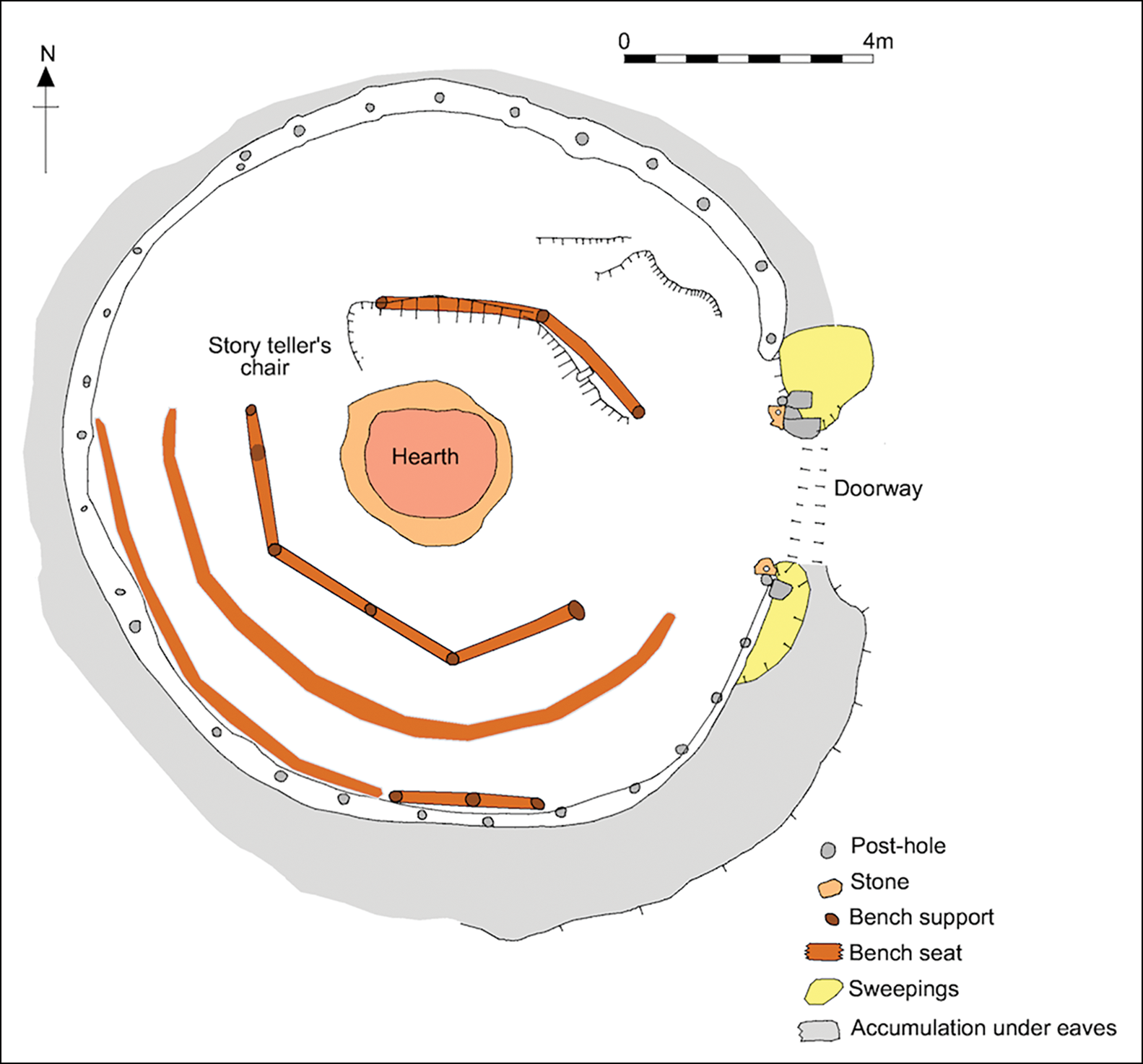
The floor within the Earthwatch roundhouse sloped steeply down from north to south, and on at least two occasions, the southern area was raised to improve access to this part of the structure. These interventions effectively sealed the earlier floor and any refuse on it. The area within 0.5m of the exterior wall was extensively excavated. This area was located in the darkest part of the building, where it would be expected that debris would accumulate—particularly beneath the benches set against the wall. The Earthwatch roundhouse floors were clay, and were heavily worn in places where the soft gravel subsoil was scuffed by school parties, and where insufficient patching was undertaken. Nevertheless, the artefacts reveal both a distribution of small items trodden into the floor and larger assemblages found against the wall on the southern side. Some items also entered the archaeological record of the Earthwatch roundhouse by the process of sweeping the floor, with piles of debris accumulating immediately adjacent to the exterior of both door posts, beneath the eaves of the thatched roof (Figure 3). Only a tiny proportion of items had a legible date: the oldest ‘best before date’ on a wrapper was February 2002, and January 1999 on a Duracell AAA battery.
The other major location for finds was within a thick accumulation of ash in the central hearth. The hearth itself was defined by a drystone wall, which created an elevated position for the fire in order to protect children from falling into the flames. Some debris in the hearth (such as numerous nails and staples) derived from the burning of scrap wood, with the metal fittings remaining within the ash. The materials that had not been consumed by the fire may have been thrown in by visitors or by heritage staff after tidying up the floor, in anticipation that they would be burnt. Nevertheless, a considerable amount of material accumulated within the ash, either being added when there was no fire, or placed on the cooler periphery and becoming incorporated within the ash so that it never caught light. Regardless of the motivation and method of deposition, the ash deposits accumulated a considerable quantity of plastic and plasticised debris that would have normally become incorporated into the terrestrial environment when the ash was removed and dumped elsewhere.
Both roundhouses were partially demolished before excavation, with the portable internal fittings, such as looms and beds, taken out before the thatching was removed and the roofing dismantled. With both roundhouses, parts of the standing walls were taken down (or fell down), but there was no effort to clear away all the debris from the dismantling. Hence, there was, in effect, a thin sealing deposit of superficial debris covering the latest floor surfaces.
Methodology
Artefacts recovered from each roundhouse during initial cleaning of surface deposits following demolition were recorded by quadrant, either within or outside the wall line of the building. Thereafter, all finds from within secure contexts were three-dimensionally recorded. Where the finds occurred in dense concentrations, they were recorded by further subdividing the relevant areas into 0.3m-wide circles. Artefacts from small closed contexts, such as postholes, were collected without further spatial definition, and the hearth ash deposits were recorded by quadrant. This level of spatial recording has enabled the analysis of material loss and its integration within the various deposits that formed within and around the roundhouses. The main interest here, however, is the overall proportions of materials and the range of the debris represented in the assemblages. The artefacts have been individually catalogued, and assemblages subdivided as far as possible to the level of separate artefact types. For some categories, such as cling film, plastic sheeting and sweet and straw wrappers, however, it was only possible to count the fragments. Some wrappers were sorted by colour in the large assemblages, and this study does not claim to identify the minimum number of snack bars or sweet packets. The figures thus represent plastic fragments rather than original plastic or plasticised items. This method of quantification has also been applied in ecological studies measuring plastic waste (Williams & Simmons Reference Williams and Simons1996; Eriksen et al. Reference Eriksen2014; Cózar et al. Reference Cózar, Sanz-Martín, Martí, González-Gordillo, Ubeda, Gálvez, Irigoien and Duarte2015).
The Cookhouse assemblage
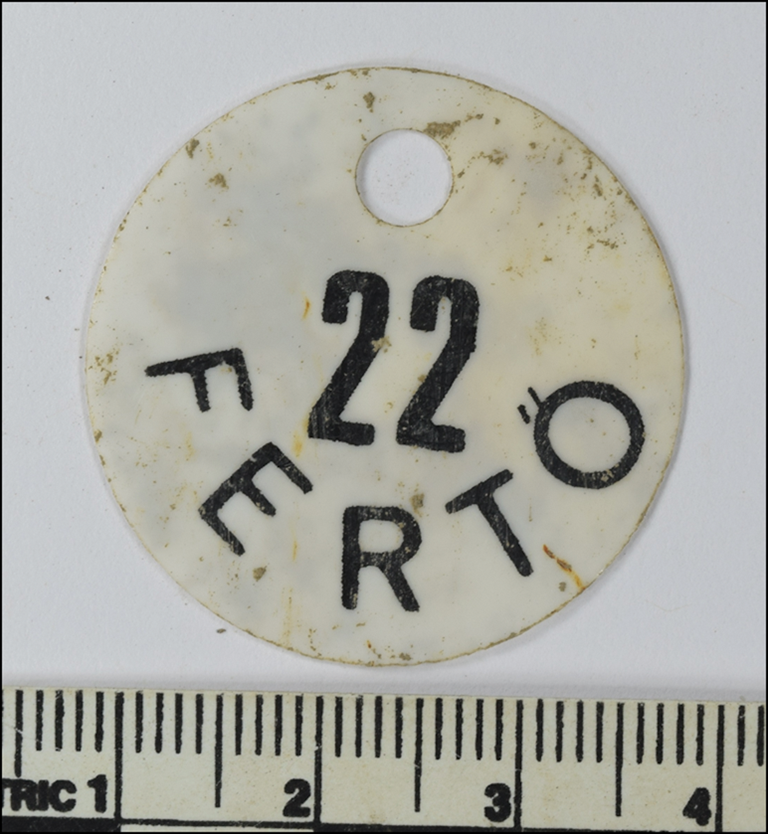
The assemblage from the Cookhouse comprises a diverse collection of materials relating to its initial construction, maintenance and use by staff, and casual losses by visitors (Table 1). Roundhouse construction was represented by five circular, perforated, white plastic tags, each with a number and the word ‘fertö’ in black (Figure 4). These tags derived from bundles of reed imported from Hungary to augment those sourced from the nearby Nevern Estuary. These tags all accumulated in the eaves-drip gully dug where the thatch came down closest to the ground. The gully was not maintained and silted up, thereby sealing in the tags. This represents the construction phase of the roundhouse, as well as the lack of gully maintenance and the speed with which it filled with silt, wind-blown leaves and other items of refuse.
Plastic disc from a bundle of Hungarian thatching reed, lost in 1982 (photograph by A. Fairley).
Roundhouse finds.

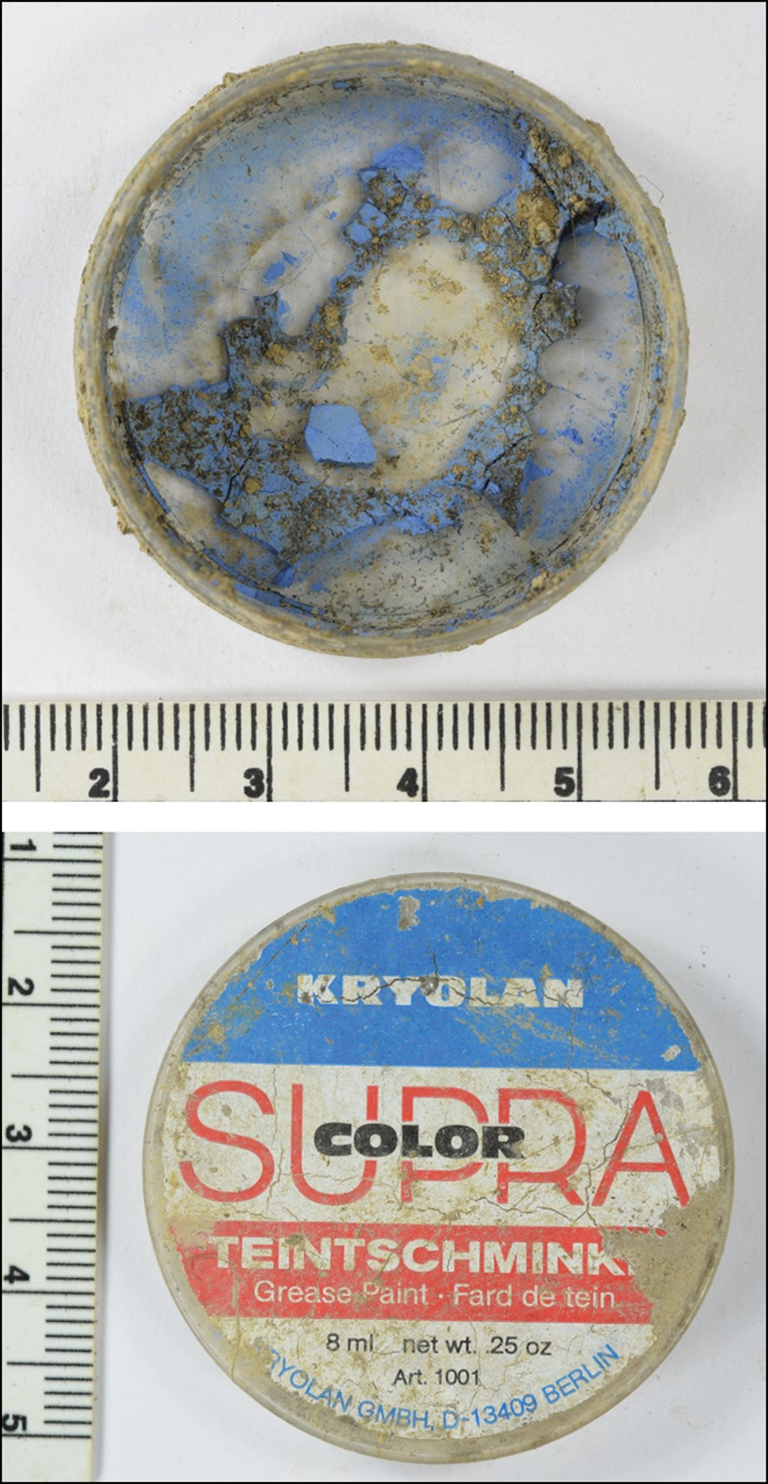
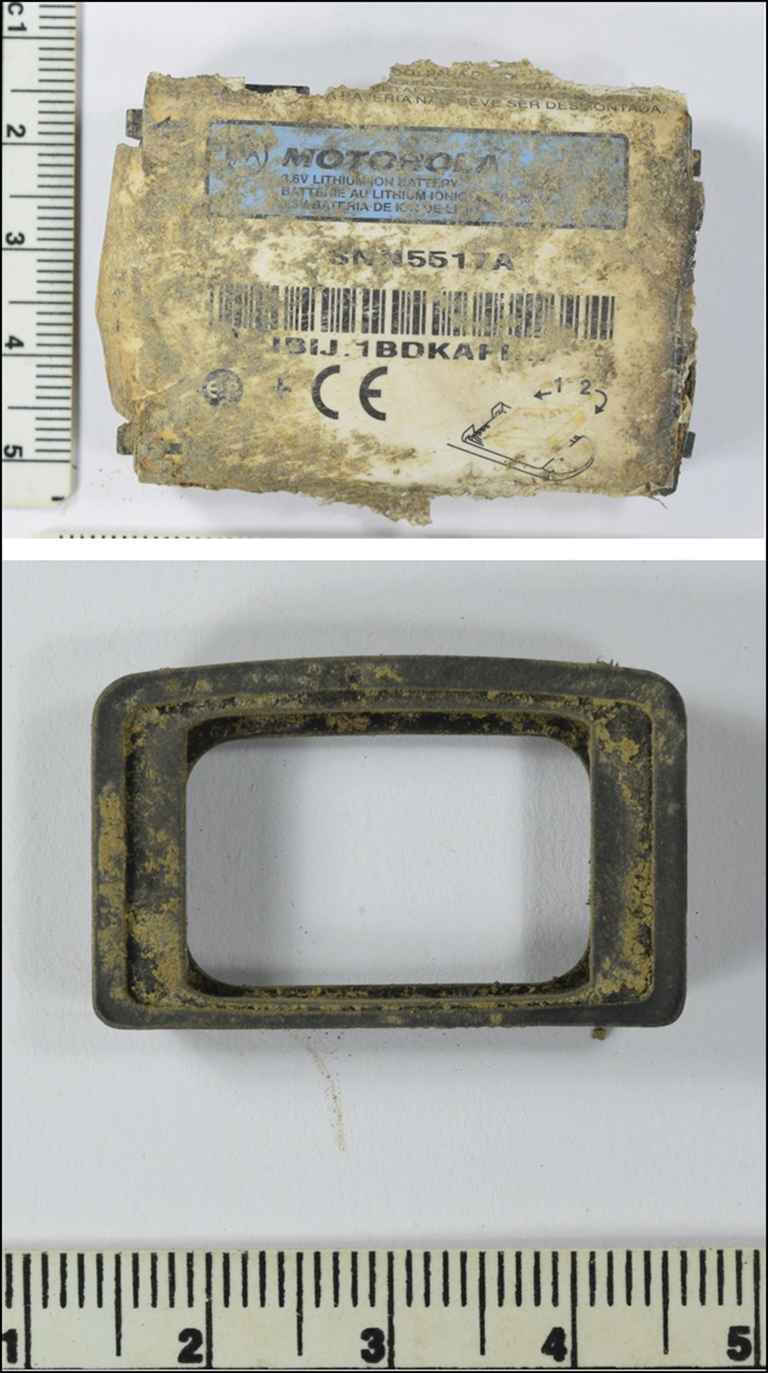
The floor of the roundhouse was kept relatively clean, with most debris accumulating around the edges of the building and under furniture. Some items were explicable in terms of location: loom weights lying where the loom was stored; tools left at the base of the wall and forgotten; and a metal bowl containing small plastic tubs of face paint and a tin of beeswax placed under the raised bed at the rear of the roundhouse (Figure 5). The latter was subsequently buried under gravel sweepings from the floor that were not cleared out of the structure, but pushed under the bed. The floor-level hearth, which had undergone a series of refurbishments, contained very little debris, as it was regularly cleaned out and the ash deposited elsewhere. Other finds represent casual losses as visitors moved about the interior, including coins, a plastic camera viewfinder and a mobile phone battery (Figure 6).
Face-paint containers from the Cookhouse, associated with heritage-interpretation activities (photographs by A. Fairley).
Mobile phone battery and camera eyepiece from the Cookhouse, associated with visitors (photographs by A. Fairley).
The amount of refuse in the Cookhouse was limited, and only a few sweet and snack wrappers were recovered. This partly reflects discard rates: visitors did not regularly sit to consume such products in this space, and it was easier for staff to notice litter in this relatively well-lit roundhouse. Despite having the most occupants living in this roundhouse during the TV reality series Surviving the Iron Age (Firstbrook Reference Firstbrook2001), there was no clear evidence of their presence. The darkest areas on either side of the door against the wall, and on either side of the beds at the rear zone farthest from the door, were the areas least visited by tourists, but they still accumulated some items.
The Earthwatch roundhouse assemblage
The Earthwatch roundhouse floors were less clean than those of the Cookhouse, with items found trampled into the surface. Most refuse deposits, however, accumulated near the walls, particularly on the darkest, southern side of the building. The assemblage from this roundhouse was substantial, including over 2000 plastic or plasticised fragments. The composition of the assemblage reflects the mix of the visitors and their activities within the roundhouse. These can be divided into three categories: the consumption of food, drinks and sweets; other visitor losses; and materials associated with operating the heritage attraction, and probably including the period when the television series was being made and people were living in the roundhouse.
Evidence for food consumption is strongly represented by plastic items, although a complete carving knife, a metal fork and spoons were also recovered. The most ubiquitous packaging item was cling film (Table 1), occurring in pieces of varying size, and difficult to quantify due to its fragile nature. Also notable were plastic items for consuming food, such as small spatulas (e.g. ‘Lunchatool’), forks and spoons (Figure 7). Two CheeStrings, two Pepperami and one Lunchables pizza wrappers, along with one Dairylea Dunkers foil cover, reflect similar, small-sized products. One ketchup wrapper was recovered, but most food was ready to eat without the addition of further elements. A complete Golden Wonder noodles foil lid and two other foil-lid fragments were also found (with many other foil items often associated with plastic containers or sweets), but no food pots. A healthier eating choice is represented by 21 plasticised apple stickers, revealing a range of popular apple varieties, including Braeburn, Cox, Golden Delicious, Granny Smith, Pacific Beauty, Pink Lady and Royal Gala.
Plastic items associated with the consumption of packed lunches in the Earthwatch roundhouse (photographs by A. Fairley).

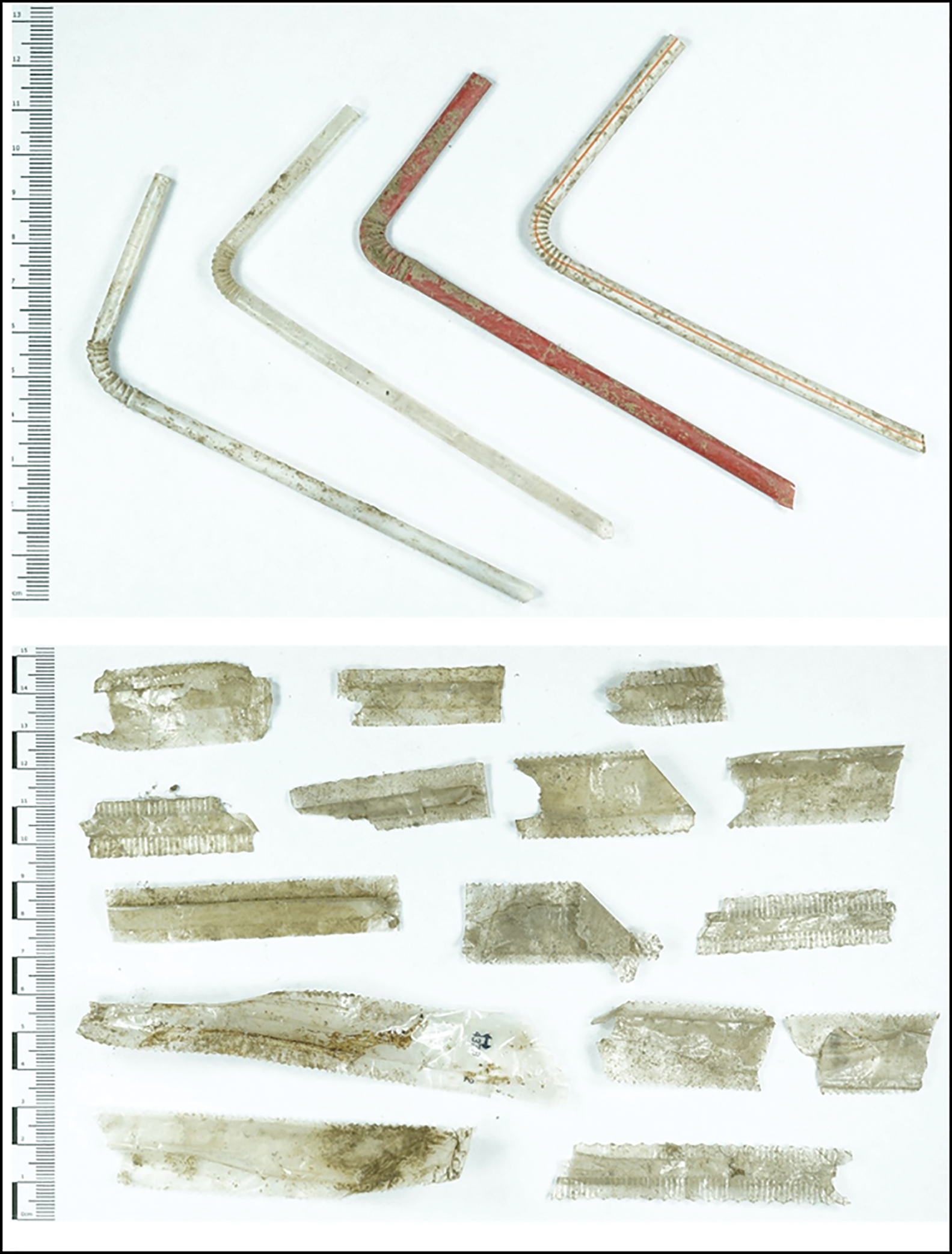
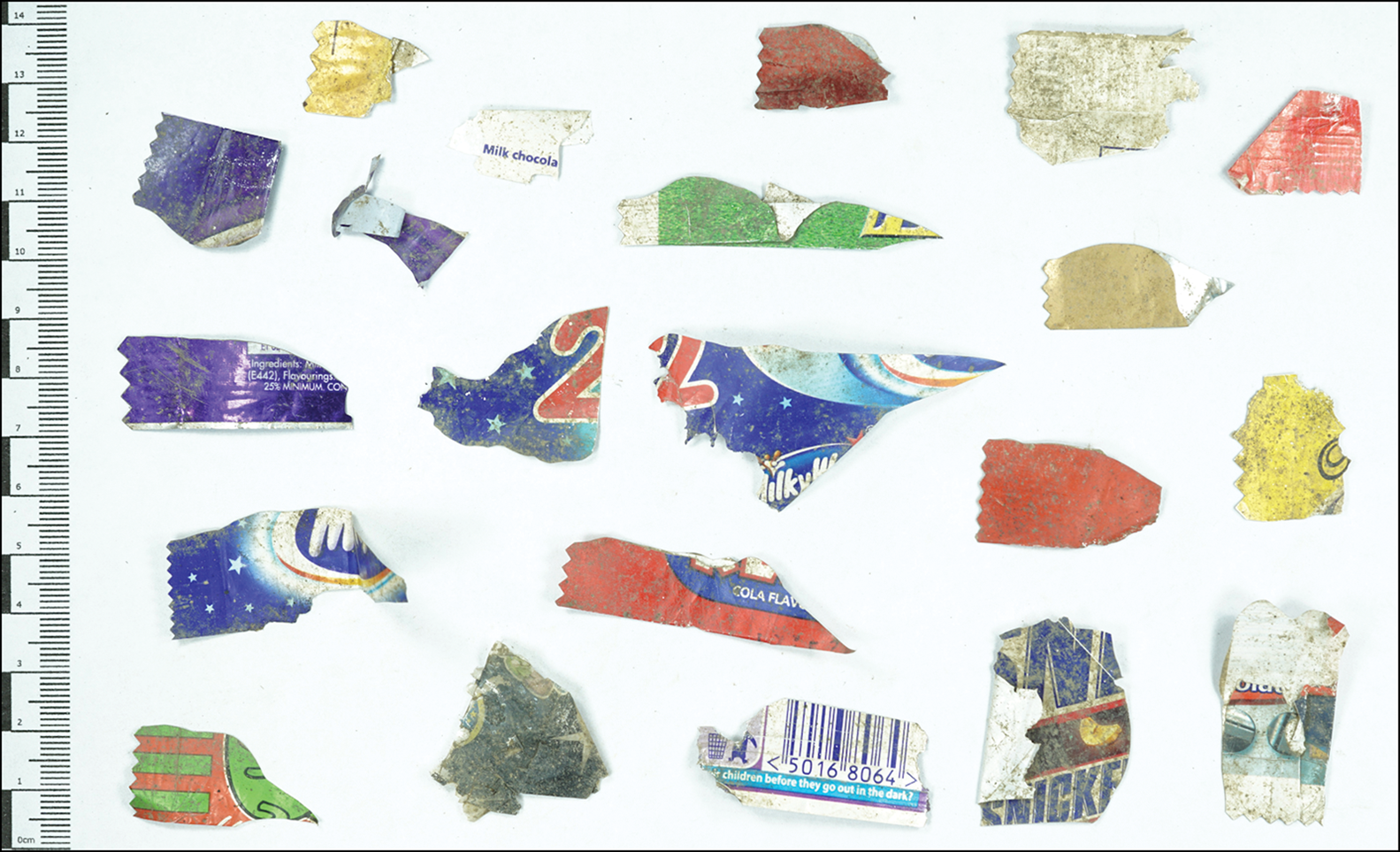
No plastic drinks bottles were recovered, as any discarded would easily have been seen and recovered by visitors and heritage staff. The tear-off sealing strips and the bottle caps themselves, however, were common. Although four metal bottle caps and three caps or wrappers for wine bottles reflect alcohol consumption, almost all such finds relate to soft drinks. While a Volvic water bottle label and Calypso Tom & Jerry drink top were attributable to brands, most of the 34 bottle caps were not. In addition, sealing strips and pull-off covers from bottle mouths were found. The other major drinks-related find category was plastic straws from drinks cartons and the packaging for such straws that would have been fixed to the side of the carton. There were 18 plastic straws and 210 fragments of straw packaging (Figure 8), but not a single drinks carton. Sweet wrappers were the most common single find (Table 1), many of which are plasticised paper, ranging from large fragments of snack bar wrappers (including Dairy Milk, Mars, Milky Way, Snickers, Toffee Crisp and Twix) to the individual sweet wrappers or bags (e.g. Campino, Fox's Glacier mint, Fruity Pops, Haribo, Juicy Chews, Maoam Bloxx chews and Polo Smoothies). Most wrappers, however, were small items that were torn off and lost, while the main part of the covering was retained or easily noticed and recovered. Some of the fragments could still be identified through a distinctive design feature.
Examples of plastic straws and straw-wrapper fragments from the Earthwatch roundhouse (photographs by A. Fairley).
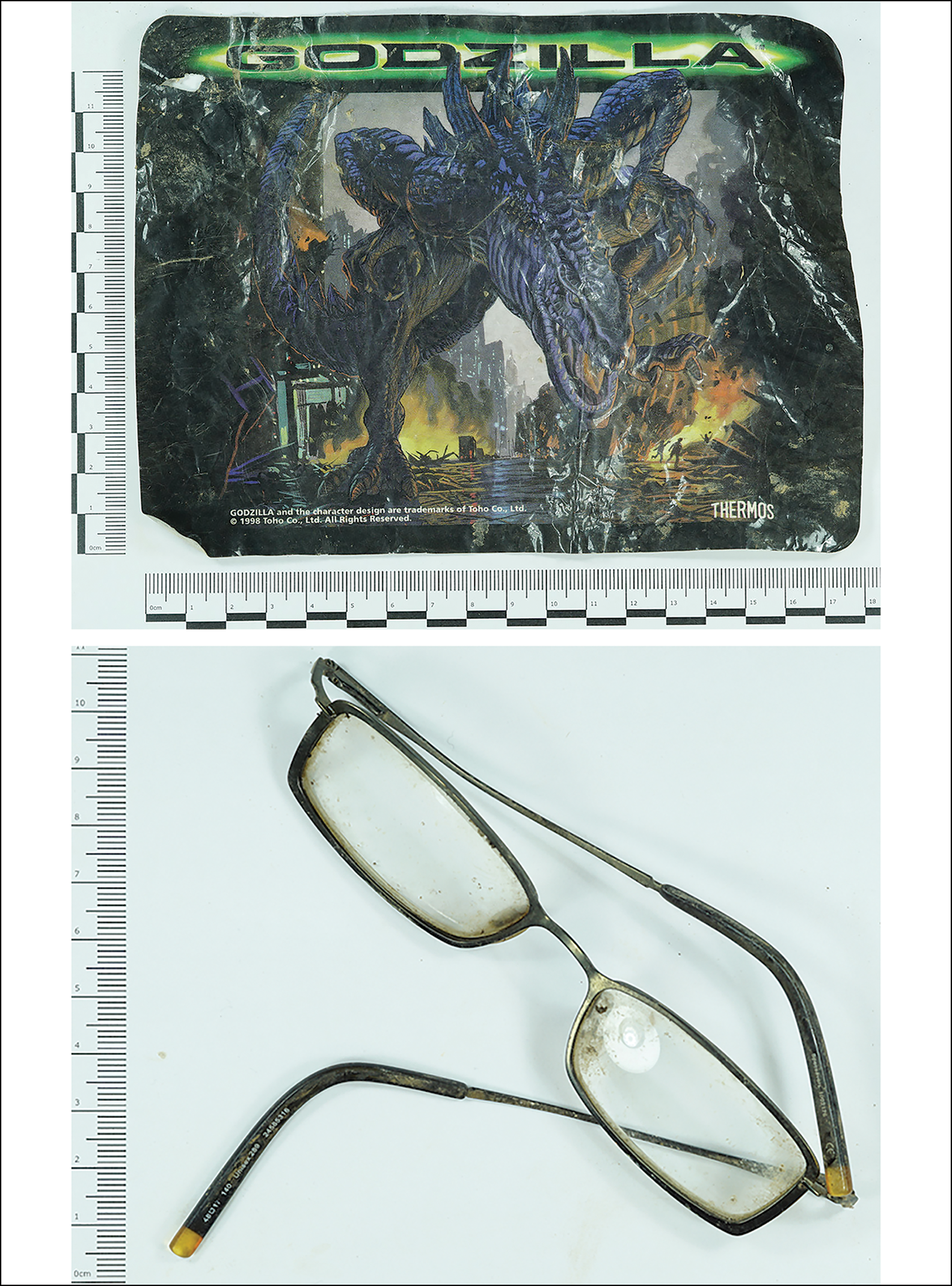
The operation of the heritage attraction sometimes involved the use of plastic sheeting; for example, to protect items in the roundhouses during rethatching, and plastic string or rope used by staff before being replaced by a more authentically Iron Age alternative. A small number of plastic clothing items were found, comprising a button and toggle from a waterproof jacket, and personal items include a pair of children's spectacles and five hair bobbles and bands.
The large number of items from the Earthwatch house is reflective of discard rates: children, in particular, sat and consumed sweets and packed lunches regularly in this space, and the lower light levels within the building made it harder for staff to notice any litter. Additionally, the built-up hearth and the repeated raising of the floor to the south created artefact traps where material could accumulate (Wilk & Schiffer Reference Wilk and Schiffer1979).
Fragmentation
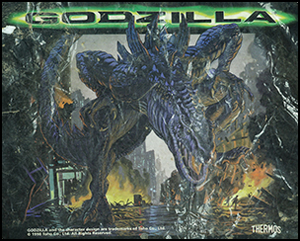
The process by which the items became fragmented can be identified through analysis of the pieces of litter compared with the complete items from which they came. The primary pattern was human agency: tearing open a chocolate bar wrapper, for example, or removing a straw wrapper from its drinks carton as part of the process of piercing the carton with the straw (Figure 9). Relatively few whole wrappers were recovered, suggesting that these were either retained by the consumer, or easily collected by the heritage staff, although some larger fragments were crumpled up and therefore less visible. Torn fragments—the by-products of opening packets—may have been dropped accidentally, but they could have been deliberately discarded, as this socially unacceptable behaviour would be difficult to observe inside the roundhouses. Some packaging may have been torn into small pieces by fidgeting children, and some items were probably deliberately deposited, including an almost complete Godzilla-themed thermos wrapper (Figure 10). Other larger items, such as a complete pair of child's spectacles, however, were presumably lost accidentally (Figure 10). Another process of fragmentation was rodent activity, in which refuse including plastic and plasticised items were taken down into burrows made in the soft deposits where upright structural timbers had rotted below ground. Thus, both human and rodent agency incorporated plastic and other refuse within archaeological deposits as they formed.
Examples of the small fragments of sweet wrappers recovered from the Earthwatch roundhouse (photograph by A. Fairley).
Top) Godzilla-themed thermos wrapper; bottom) child's plastic spectacles; recovered from the Earthwatch roundhouse (photographs by A. Fairley).
Narrow rings of plastic used to seal bottle caps also occur. These disposable items are similar to the aluminium ring-pulls that were also found (MNI: six of the older detachable types and ten of the fixed type, the latter of which had been wrenched off and, in many cases, then folded). Although attached ring pulls should reduce discard, clearly, some consumers relish the challenge of separating these from the can. There was also, however, a substantial number of plastic bottle tops, which would have rendered the containers unusable. These were probably dropped before rolling away into a dark space. While many items reveal fragmentation caused by deliberate human agency and rodent action, some of the observed breakage may have been due to trampling. There is no obvious evidence of plastic decay in the relatively short period that the items have been buried.
Conclusions
The artefact assemblages from the Cookhouse and Earthwatch roundhouses at Castell Henllys reveal many aspects of the last 30 years of heritage activity, and, by extension, the ways in which late twentieth- and early twenty-first-century life is creating distinct patterns that represent part of the Anthropocene signature. One of the most significant features of the assemblages is that they show common patterns of behaviour by visitors and staff in the two structures, although distinct differences in light levels and the organisation of activities have also played their part in the formation processes. The assemblage from the better-lit Cookhouse contains fewer lost items, and more clearly represents the initial thatching using reed bundles with plastic tags, and subsequent face-painting activities that took place immediately outside. In contrast, the Earthwatch roundhouse vividly reveals the consumption of packed lunches by schoolchildren. It is notable that children are major contributors to plastic pollution in this context, partly because of the targeted marketing of the sweets and snacks they consume: the brightly coloured, plasticised wrappings, the packaged snack foods such as Dairylea Dunkers, and small drinks cartons with plastic straws are specifically designed and sold to parents for inclusion in packed lunches. At Castell Henllys, these items comprise the dominant archaeological signature of contemporary heritage-visiting activity. The National Park plans to use the evidence for the ubiquity of plastic identified by our excavations as part of its education campaign to encourage visitors and school parties to care for the environment and not to leave any litter behind.
The archaeological study of all periods is dependent on material culture that has become incorporated into deposits and is available for recovery in the present. What is distinctive about recent deposits is the quantity and range of materials, including the presence of high levels of plastics, including plasticised packaging, especially, in this case, from sweets and drinks. Whether or not the Anthropocene should be defined by the presence of plastics, the examination within a highly controlled, long-term experimental and interpretative context discussed here has at least provided incontrovertible evidence to support the use of the term the ‘Plastic Age’ for the late twentieth and early twenty-first century. With many initiatives now pushing to switch from disposable plastic and plasticised items, this may be a narrow but archaeologically distinctive chronological horizon.
Acknowledgements
Fieldwork was greatly facilitated by Delun Gibby and Andrew Muskett and all the site interpretation staff, especially Liz Moore. The local volunteers and students ensured that we achieved a great deal in each season in the spirit of collaborative exploration. Rob Philpott, Martha Crocker, Ellis Cuffe and Anna Fairley assisted with the post-excavation processes.
Funding statement
The Pembrokeshire Coast National Park funded the fieldwork.


 Open access

