





Dementia is a neuropsychiatric syndrome characterised by cognitive decline and progressive deterioration of daily function, often associated with behavioural disturbances(Reference Abraha, Rimland and Trotta1). The WHO states that more than 55 million people worldwide live with dementia,(2) and this figure is estimated to reach 66 million by 2030(Reference Wortmann3). Although age is the foremost risk factor for dementia(2), modifiable risk factors include poor nutrition and nutrition-related diseases such as obesity, hypercholesterolaemia, hypertension and diabetes(2).
Investigations of single nutrient effects have yielded mixed results to date and translate poorly into implementable population interventions as nutrients are not consumed isolated but within a synergistic matrix of other nutrients in food affecting their metabolism, absorption and utilisation(4). This has prompted a redirection of focus towards the relationship between overall diet quality and neurological decline(4,Reference Johnson5) . Because of this, there is a need for consistent and coherent methods in assessing diet quality and diet patterns in relation to cognition. Numerous diet patterns have been explored in relation to their association with neurocognitive decline in populations with lower incidence of cognitive impairment(Reference Smith, Blumenthal and Babyak6–Reference Scarmeas, Luchsinger and Schupf9). The Mediterranean and Dietary Approaches to Stop Hypertension (DASH) diets and the hybrid Mediterranean-DASH Intervention for Neurodegenerative Delay (MIND) diet have all been explored. High levels of adherence to the Mediterranean and DASH diets have shown associations with cognitive health protection(Reference Smith, Blumenthal and Babyak6–Reference Scarmeas, Luchsinger and Schupf9). However, the MIND Diet score appears to show a more consistent protective association for neurocognitive health potentially due to higher specificity(Reference de Crom, Mooldijk and Ikram10–Reference Morris, Tangney and Wang12).
To date, most studies of dietary patterns and cognitive function have explored diet quality over time using specific dietary indices like MIND and variable quality measures for cognitive impairment(Reference McBean and O’Reilly13). Diet quality indices based on national dietary guidelines represent a potentially impactful way to examine the longer-term influence of compliance with dietary guidelines on the maintenance of cognitive health. The landmark FINGER study used the Finnish dietary guidelines as part of the multidomain intervention to prevent cognitive decline in an at-risk older adult population and the Index Diet Quality (IDQ) is a validated index to assess this dietary pattern(Reference Leppala, Lagstrom and Kaljonen14,Reference Ngandu, Lehtisalo and Solomon15) . The Dietary Guideline Index (DGI) is a similarly validated index used to evaluate compliance with Australian dietary guidelines(16).
Food-based dietary guidelines (FBDG) are used to promote population health through the prevention of malnutrition, and this is linked to reduced chronic disease risk. Dietary pattern indices based on dietary guidelines have the potential to be used to more easily assess dietary quality in populations and provide information on their risk of developing chronic diseases over time such as diabetes and heart disease. If dietary guideline adherence was associated with cognitive impairment to a similar extent as nutritional indices specifically targeted to dementia, this would represent an opportunity for improved dementia prevention measures worldwide. Therefore, we aimed to investigate if dietary quality was associated with cognitive impairment over 12 years in community-dwelling older adults when measured using the neuroprotective, specific MIND index and the FBDG-based, non-specific DGI and IDQ indices for dietary patterns.
Methods
Study population
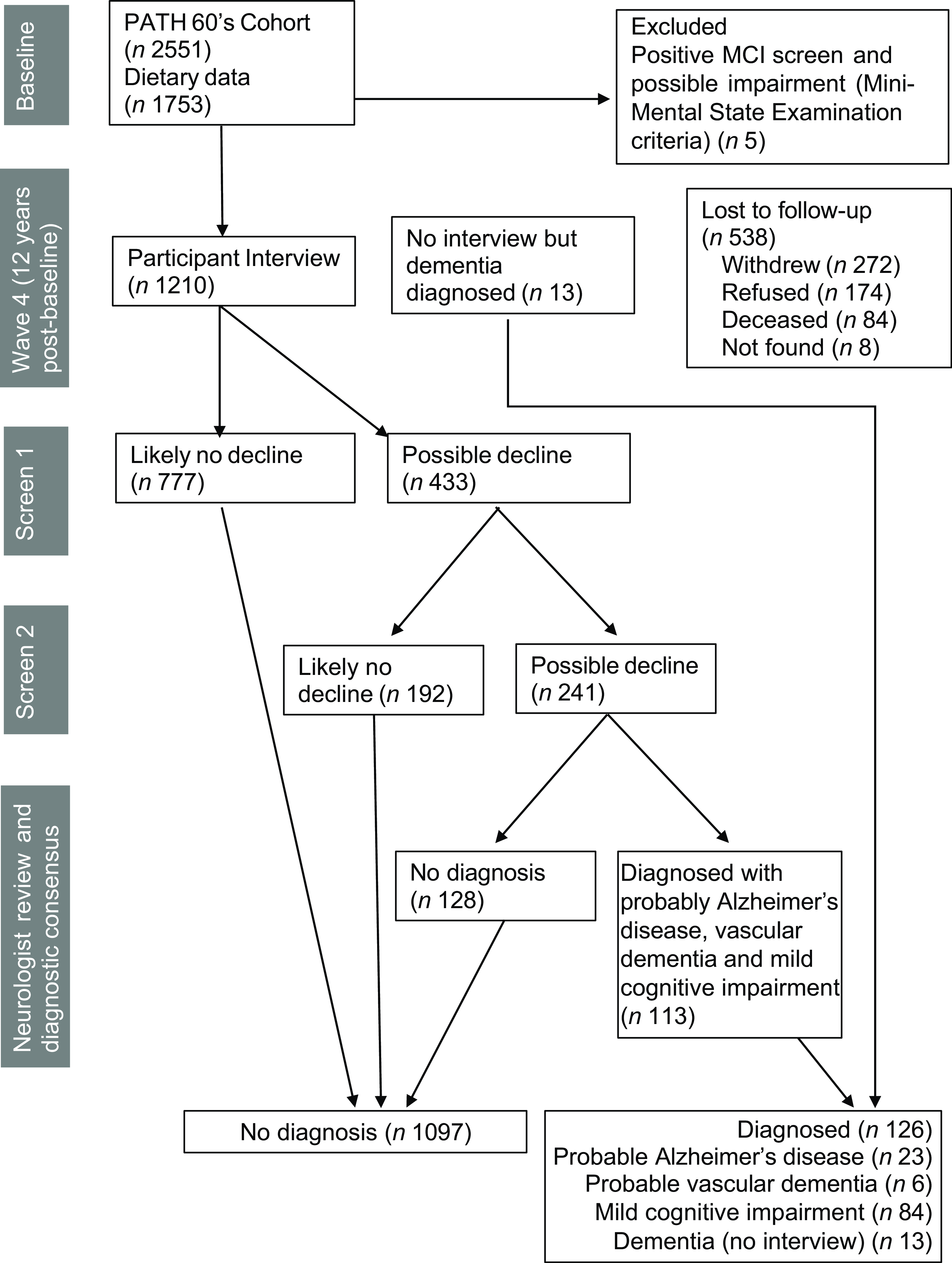
The PATH (Personality and Total Health Through Life Cohort) study is a 12-year, prospective, longitudinal cohort study with 4 waves of data collection (wave 1: 2001–2002, wave 2: 2005–2006, wave 3: 2009–2010 and wave 4: 2013–2014). A total of 2551 participants aged 60–64 years were recruited by simple random sampling from electoral rolls from the city of Canberra and the adjacent town of Queanbeyan, Australia, to investigate the relationship between health and ageing(Reference Hosking, Eramudugolla and Cherbuin17,Reference Anstey, Christensen and Butterworth18) . This study was conducted according to the guidelines laid down in the Declaration of Helsinki, and all procedures involving human subjects/patients were approved by the Australian National University’s Human Research Ethics Committee, Human Ethics Protocol 2016/445. Written informed consent was obtained from all subjects/patients. Figure 1 illustrates the flow of participants within the PATH cohort for the present study. Only participants from a subsample provided dietary data (n 1753) and were considered for the current analysis. Furthermore, any participants with a prevalent diagnosis of mild cognitive impairment(Reference Kumar, Dear and Christensen19) were excluded (n 5) due to the potential impact it could have on dietary recall. An additional 538 participants were lost to follow-up at wave 4 and no data could be collected. However, 13 of those were identified as dementia cases through medical records and therefore entered the analysis, which was conducted with a final study sample of 1223 participants.
Participant flow for the PATH Study with diagnosed outcomes, adapted(Reference Hosking, Eramudugolla and Cherbuin17).

Dietary intake and diet quality
Participants completed the dietary intake assessment at baseline only. The self-reported dietary intake over the previous 12 months was assessed using the Commonwealth Scientific and Industrial Research Organization semi-quantitative FFQ including 183 food and beverage items(Reference Baghurst and Record20). This FFQ was validated against weighed dietary intakes in Australia(Reference Lassale, Guilbert and Keogh21). Intake of different food items was converted into daily equivalent frequencies for scoring of diet quality.
Three dietary quality indices were individually calculated using the baseline FFQ data. The MIND diet score(Reference Morris, Tangney and Wang22) consists of fifteen separate items: ten cognitive health-promoting food groups (green leafy vegetables, other vegetables, nuts, berries, beans, whole grains, fish, poultry, olive oil and wine) and five food groups linked with cognitive impairment (red meats, butter and margarine, cheese, pastries and sweets, and fried or fast food). Each item adds 0, 0·5 or 1 point to the MIND diet score referring to pre-specified low, moderate and high intakes(Reference Morris, Tangney and Wang22). The final score is a sum of all items and initially ranges from 0 to 15. In the PATH study, the baseline FFQ did not have a question item on butter/ margarine or olive oil, so the MIND dietary score ranges from 0 to 13.
The DGI(16) assesses adherence to the 2013 Australian FBDG(Reference McNaughton, Ball and Crawford23). The DGI consists of thirteen items scored from 0 to 10 based on the level of recommendation reached. The 13 items are then summed to deliver a total diet score, the higher scores indicating higher diet quality. The DGI assesses consumption of 5 core food groups (fruit, vegetables, grains, dairy and meats/alternatives), fluids and discretionary foods. The DGI also includes components for dietary variety, lean proteins, lower-fat dairy, wholegrain cereals and unsaturated fats/oils.
The IDQ assesses adherence to Finnish FBDG(Reference Leppala, Lagstrom and Kaljonen14). The IDQ consists of 15 items covering 5 food categories (wholegrains; fat-containing foods; dairy products; vegetables, fruits and berries; and sugar-containing products) and a single item on meal pattern. Each item is scored between 0 and 1 and then summed to give a total maximum score of 15 with higher scores indicating higher dietary guideline adherence. The baseline FFQ did not contain meal pattern information, so the IDQ dietary scores were calculated with a maximum of 14.
Cognitive impairment and dementia
Cognitive testing and the Mini-Mental State Examination were administered across waves 1–4 of the study. A detailed description of the diagnostic tests has been previously published(Reference Eramudugolla, Mortby and Sachdev24). In brief, at wave 4 by which participants were aged 72–76 years, information on cognitive function was received through interviews conducted with a consenting proxy nominated by the participant(Reference Eramudugolla, Mortby and Sachdev24). The interview contained the Bayer Instrumental Activities of Daily Living(Reference Hindmarch, Lehfeld and de Jongh25) and the short 16-item Questionnaire of Cognitive Decline in the Elderly(Reference Jorm26). Longitudinal assessment data was screened for cognitive impairment which was defined as performance one sd below sex and education stratified sample means. Other information for participants who were screened included medical and psychiatric history, neuropsychiatric symptoms and behavioural changes. A casefile was made for each participant who had cognitive impairment. The casefiles consisted of survey responses, cognitive testing data and interview responses. Diagnosis of Alzheimer’s disease or vascular dementia was made according to National Institute of Neurological Disorders criteria(Reference Roman, Tatemichi and Erkinjuntti27) or mild cognitive impairment according to Winblad criteria(Reference Winblad, Palmer and Kivipelto28) depending on each casefile. Participants with a diagnosis of dementia and mild cognitive impairment were analysed as a common group. In this study, waves 1 and 4 were examined for each of the three diet scores.
Covariates
Participants’ characteristics including date of birth (for calculation of age), sex, years of education and smoking history were collected at baseline. BMI was calculated from measured weight and height using standard cut-points for overweight and obesity. Physical activity (categorised as mild, moderate and vigorous according to the Whitehall study(Reference Singh-Manoux, Hillsdon and Brunner29)), mental activity participation (number of mental activities undertaken in the last 6 months based on a shortened version of the RIASEC activity scales(Reference Bielak, Anstey and Christensen30)), energy intake (calculated based on FFQ data), depressive symptoms and health status including variables on BMI, heart disease, diabetes and stroke were all self-reported variables. Hypertension was also examined according to a systolic blood pressure reading of ≥ 140, diastolic blood pressure of ≥ 90 or self-reported use of blood pressure medication. APOE ε4 status was measured in a blood sample taken at baseline. Covariates used in this study are replicates of those used by Hosking et al.(Reference Hosking, Eramudugolla and Cherbuin17) and Morris et al.(Reference Morris, Tangney and Wang12).
Statistical analysis
Baseline characteristics are presented as means (sd) for normally distributed, median (IQR) for non-normally distributed and percentages for categorical variables. The baseline characteristics were compared between tertiles of MIND, DGI and IDQ using the chi-squared test for categorical variables and Kruskal–Wallis test for non-normally distributed variables. Pearson correlation coefficients were calculated to examine the correlation between the three dietary scores.
Missing values were investigated using logistic regression with models predicting the missingness of each variable by missing values of the other variables. Complete cases (n 1223) were used in the analysis as this is appropriate when covariate missingness is not related to the outcome in large samples(Reference Allison31). Kruskal–Wallis tests assessed the strength of associations between the dietary indices and compared the differences across the tertiles. Chi-squared tests examined any associations for categorical variables.
OR and 95 % CI of developing dementia or mild cognitive impairment after 12 years were estimated using logistic regression with diet scores as tertiles and low adherence as the reference category. Three separate models were generated: Model 1 (basic adjusted) contained dietary score, energy intake (kcal), age (years), sex and APOE ε4 status (allele presence), Model 2 (lifestyle adjusted) included model 1 and education (years attained), mental activity, physical activity (none/mild, moderate, vigorous), smoking status (yes/no) and depression (number of symptoms over the previous month) And Model 3 (fully adjusted) also included cardiovascular-related diseases (BMI (kg/m2), diabetes, hypertension, heart disease and stroke (yes/no)).
Logistic regression models had the interaction term for the mean-centred dietary index by APOE ε4 status added as the final entry step. Separate models were estimated for diet scores as continuous variables. All analyses were conducted using IBM SPSS Statistics Version 27.
Results
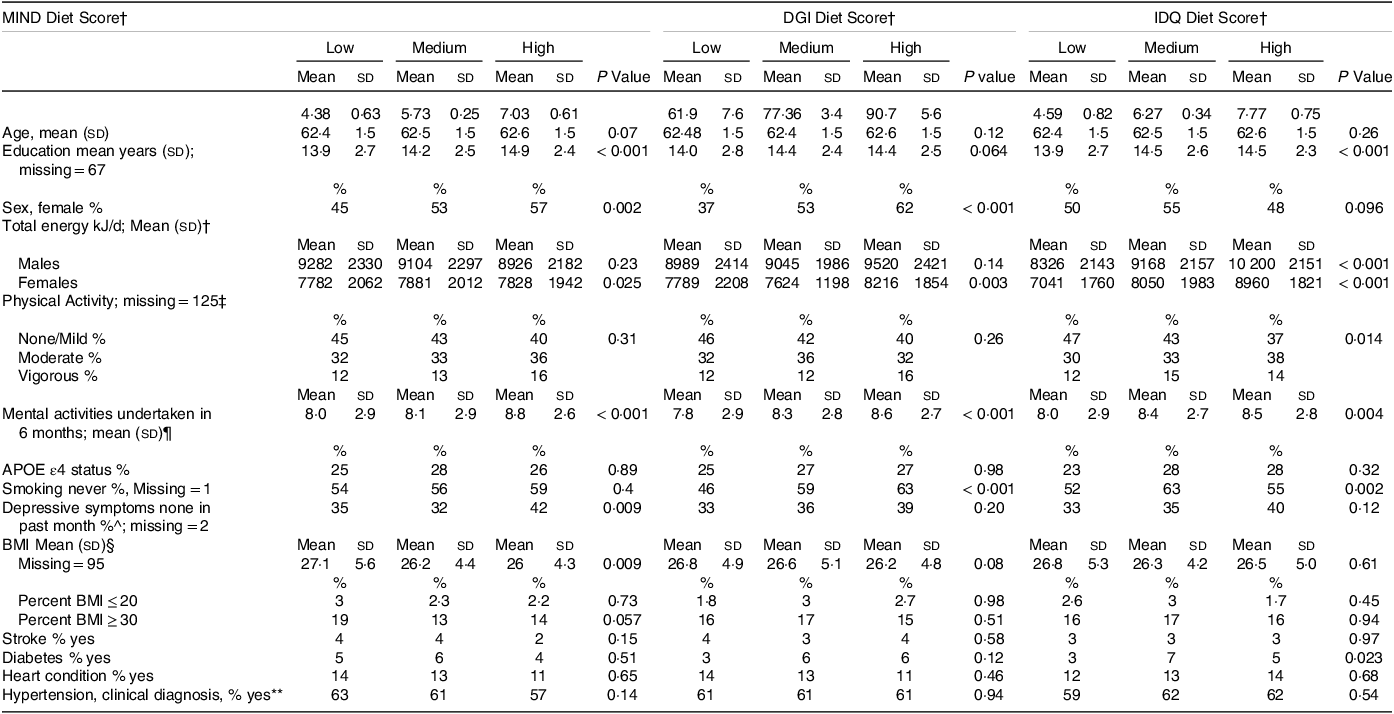
At the 12-year follow-up, one in ten participants with baseline dietary data had developed mild cognitive impairment or dementia (Fig. 1, n 126). Baseline participant characteristics (n 1223) according to dietary score tertiles are presented in Table 1. Participants with higher scores for any of the three dietary quality scores were more likely to have higher education levels, be female, have a lower BMI and be a non-smoker. Participants’ mean (sd) MIND diet quality score was 5·53 (1·2) with a range of 1·50 to 9. The mean IDQ was 6·03 (1·49) and ranged from 1·25 to 11·25 while the DGI mean was 76·8 (12·9) with a range from 39 to 117·5. The 3 dietary scores were moderately correlated, the MIND and DGI (r = 0·36, P < 0·01), the MIND and IDQ (r = 0·32, P < 0·01), and the DGI and IDQ (r = 0·56, P < 0·01).
Baseline characteristics of Personality and Total Health participants across tertiles of the MIND, the DGI and the IDQ diet scores* (n 1223)
(Percentages; mean values and sd)

Abbreviations: DGI, Dietary Guideline Index; IDQ, Index Diet Quality; MIND, Mediterranean-DASH diet Intervention for Neurological Delay.
* For continuous variables, non-parametric tests (Kruskal–Wallis tests) compared distributions across the tertiles of dietary variables; chi-squared tests were used for categorical variables.
† Calculated from the Commonwealth Scientific and Industrial Research Organisation semi-quantitative FFQ(Reference Baghurst and Record20), data not available on olive oil and butter so MIND range was 0–13, values are mean (sd).
‡ Self-report frequency and intensity categorised into mild, moderate and vigorous according to Whitehall criteria(Reference Winblad, Palmer and Kivipelto28).
§ Self-report kg/m2.
^ Goldberg depression scales(Reference Goldberg, Bridges and Duncan-Jones32).
¶ Assessed with the RIASEC activity scales(Reference Bielak, Anstey and Christensen30,Reference Parslow, Jorm and Christensen33) .
** Systolic BP ≥ 140, diastolic BP ≥ 90, or self-report use of BP medication.
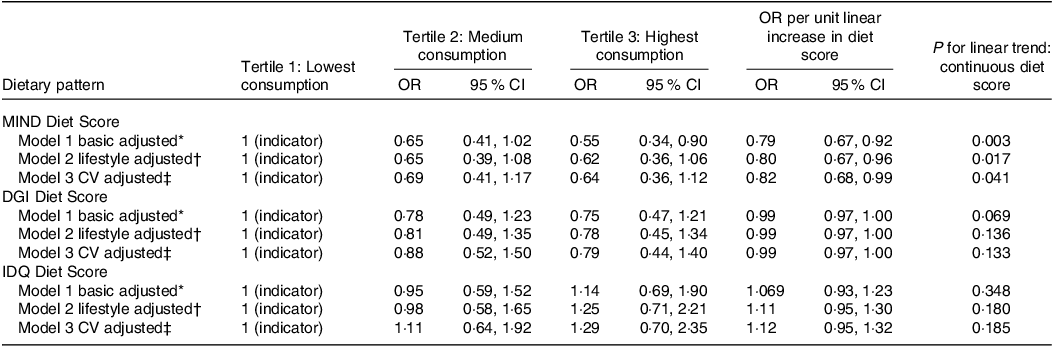
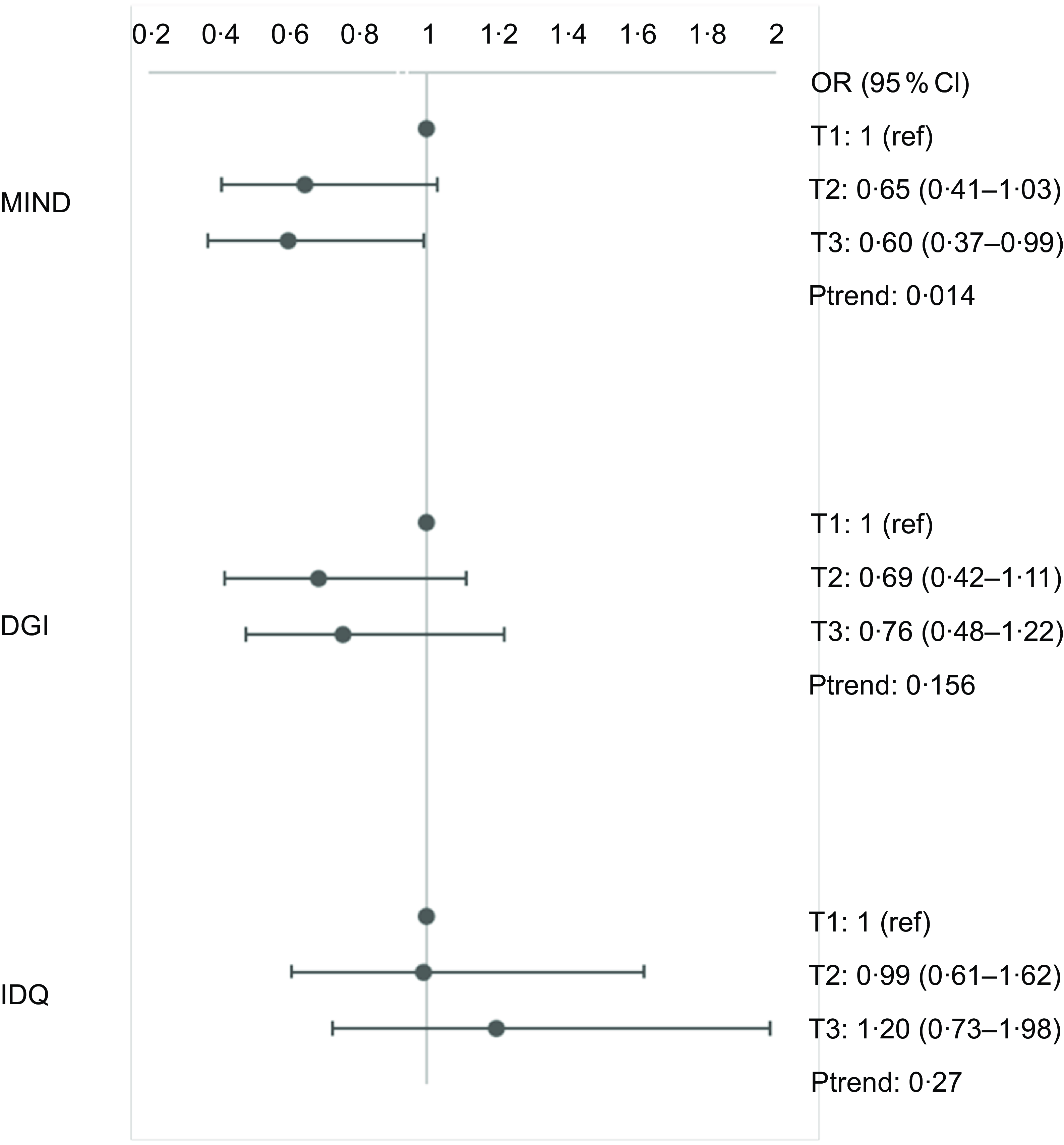
Within the logistic regression models, only the APOE ε4 and the mental activities variables made significant contributions. In model 1, which was adjusted for age, sex, diet score, and total energy intake, a high MIND diet adherence was associated with significantly lower odds of developing mild cognitive impairment or dementia by 45 % (OR = 0·55, 95 % CI = 0·34, 0·90) (Table 2) and the fully adjusted model (Fig. 2). The OR per unit linear increase in MIND dietary score for each model was significant. DGI and IDQ were not associated with cognitive impairment across tertiles and all statistical models. Model 1 was repeated with the APOE e4 carrier/homozygote status as an interaction term (Table 3). The OR in non-carriers for the MIND score was more protective than in the full sample (Table 2 linear increase), and the interaction term indicated an effect which was much closer to the null in APOE ε4 carriers.
OR and 95% CI of estimated effects for intake tertiles of the MIND, the DGI and the IDQ diet scores on the incidence of cognitive impairment in the Personality and Total Health study (n 1175) (OR and 95 % CI)

Abbreviations: DGI, Dietary Guideline Index; IDQ, Index Diet Quality; MIND, Mediterranean-DASH diet Intervention for Neurological Delay.
*Model 1: Diet score, age, sex, APOE ε4 Status and energy intake; †Model 2: Model 1 plus physical activity, education, mental activity, smoking status, and depression; ‡Model 3: Models 1–2 plus BMI and binary variables for cardiovascular factors including diabetes, stroke, heart disease and hypertension.
OR and 95 % CI for the estimated effect of the MIND diet, Dietary Guideline Index and Index Diet Quality on the 12-year incidence of cognitive impairment in the PATH Through Life study for fully adjusted model. Abbreviations: DGI, Dietary Guideline Index; IDQ, Index Diet Quality; MIND, Mediterranean-DASH diet Intervention for Neurological Delay.

OR and 95% CI of estimated effects for the MIND, the DGI and the IDQ diet scores on the incidence of cognitive impairment in the Personality and Total Health study (n 1175) between APOE carriers and non-carriers (OR and 95 % CI)

Abbreviations: DGI, Dietary Guideline Index; IDQ, Index Diet Quality; MIND, Mediterranean-DASH diet Intervention for Neurological Delay.
* Model 1: Diet score, age, sex, APOE ε4 Status and energy intake.
Discussion
After covariate adjustment, no significant relationship existed between either IDQ or DGI FBDG indices and the odds of reducing cognitive impairment development. As previously shown(Reference Hosking, Eramudugolla and Cherbuin17), we also found that the MIND diet index was associated with 40 % reduction in the odds of developing cognitive impairment over a 12-year period for the highest tertile of dietary adherence.
Using FBDG as diet quality scores to explore their potential association with the prevention of cognitive decline is a relatively new area of research. Within Australia, there is a mixed picture. Early work proposed a possible link between the Australian DGI and cognitive function in older Victorian adults assessed using a lower quality, single test for cognition, even though the main analysis showed no association between DGI at baseline and cognitive function 4 years later(Reference Milte, Ball and Crawford34). Zabetian-Targhi et al. explored DGI’s association with brain structure or cognition in 345 Tasmanian adults with a mean age of 69·9(Reference Zabetian-Targhi, Srikanth and Beare35). The mean DGI in this relatively small cohort was 54·8 (10·7), which was lower than our population, and no relationship was seen with cognitive function(Reference Zabetian-Targhi, Srikanth and Beare35). These results are consistent with other studies that have examined adherence to DGI dietary guidelines in the Sydney Memory and Aging Study over 6 years(Reference Richard, Laughlin and Kritz-Silverstein36,Reference Chen, Liu and Sachdev37) . Another longitudinal analysis did not observe associations with Mediterranean or DASH dietary scores but did identify specific food groups being linked to improved global cognition and lower decline(Reference Chen, Liu and Sachdev38). Findings are also not consistent across countries. Cognitive function/decline was not associated either with the Alternative Healthy Eating Index or Canadian Healthy Eating Index(Reference Richard, Laughlin and Kritz-Silverstein36,Reference Shatenstein, Ferland and Belleville39) . In the Netherlands, the Doetinchem Cohort found better cognition and slower cognitive decline over 20 years with higher adherence to the Dutch Health Council FBDG alongside the WHO Healthy Diet Indicator and the modified Mediterranean Diet Score(Reference Nooyens, Yildiz and Hendriks40). Taking this evidence altogether it appears that adhering to FBDG, as assessed using dietary scoring indices, may not support reducing cognitive impairment. This finding is not completely unexpected as FBDG were developed to prevent malnutrition, rather than prevent chronic disease.
A potential mechanism behind the relationship seen for the MIND diet score but not for the other two FBDG may relate to the specific assessment of green leafy vegetables. Healthy diets are characterised by higher intakes of fruits and vegetables, which are rich in anti-inflammatory and antioxidant nutrients, and therefore have the potential to reduce oxidative stress and inflammation in the brain thereby impacting the process that speeds up cognitive decline(Reference Esfahani, Wong and Truan41). Several studies show that the strongest associations between eating vegetables and improved cognitive function over time come from green leafy vegetable consumption(Reference Morris, Evans and Tangney42,Reference Kang, Ascherio and Grodstein43) . Green leafy vegetables are rich sources of vitamin E and folate, which are known to be significantly reduced in Alzheimer’s disease patients and associated with healthier brain imaging and cognitive function(Reference Zhang, Bao and Liu44). Interestingly, a recent three-year RCT of 604 individuals with a family history of dementia was unable to show a difference between those on the MIND diet compared with a control diet with mild energy restriction, despite better cognitive performance over time(Reference Barnes, Dhana and Liu45). It may be those with genetic risk factors gain less benefit from the MIND diet compared with the more general population. This aligns with our findings on the APOE carriers.
The key strengths of this study are the large sample size, the well-validated FFQ, the prospective cohort design with long duration of follow-up and low loss to follow-up over the 12-year duration (21 %). The screening and diagnostic tests for cognitive decline and impairment are another strength of the study, as observational studies commonly use more basic measures of cognitive function, which are less sensitive(Reference McBean and O’Reilly13). The covariates used in our study are well established, having previously been used in the original PATH study(Reference Hosking, Eramudugolla and Cherbuin17) and a USA-based study looking at the MIND diet and occurrence of Alzheimer’s disease(Reference Morris, Tangney and Wang12). We were also able to adjust for a wide variety of confounders within our analysis including lifestyle factors as well as education. In the case of our analysis, the MIND dietary score remained associated with cognition after these adjustments.
A study limitation was that each dietary score used different scoring methods. The DGI used a continuous scale to show the extent to which participants were compliant with each specific guideline item, while the MIND and IDQ used pre-specified values that were based on absolute intakes. The relative adherence to the dietary patterns is what can be explored across all three dietary scores using tertiles. Another limitation is that the FFQ did not have a question item assessing olive oil intake, which resulted in the inability to assess its potential neuroprotective effect in the diet(Reference McBean and O’Reilly13). It also impacted the calculation of the MIND dietary scores and may mean that the population had better adherence to this pattern than was observed. Furthermore, although the PATH study was prospective in nature, we did not have dates of diagnosis for cases of cognitive decline. Therefore, it was not possible to take into account the time until the onset of the cognitive impairment (survival analyses). Finally, the study included only older Australian adults and generalisability to other countries is unclear.
Conclusions
Adherence to DGI and IDQ was not associated with cognitive function in this cohort of 1223 older Australian adults. Our results suggest that healthy diets defined by adherence to FBDG may not be an appropriate tool for interventions to prevent cognitive impairment. The added value of dietary scores specifically developed to prevent neurocognitive decline was supported by the current work. Participants with high-quality diets as assessed by the MIND dietary score were less likely to develop cognitive impairment later in life. Further research including well-designed, longer-term clinical studies is needed to see if the MIND diet could potentially be used to reduce the risk of developing cognitive impairment in older adults without genetic disposition.
Acknowledgments
The authors thank the PATH study participants and acknowledge the PATH interviewers and study team for their contributions. Ricardo Segurado is thanked for his contribution to the formal analysis.
The original PATH study was supported by grants #229936, #179839, #418039 and #1002160 from the Australian National Health and Medical Research Council.
S. O’R.: Methodology, visualisation, supervision, writing – original draft; A. G.: Formal analysis, visualisation, writing – original draft; J. W.: visualisation, writing – original draft; N. C.: supervision, writing – review and editing; R. E.: Data curation, investigation, writing – review and editing; K. A.: project administration, funding acquisition, supervision, conceptualisation, methodology, writing – review and editing.
The authors each report no conflicts of interest.


 Open access

