


Introduction
With an area of 1,640,000 km2 Iran is a vast country with a diversity of landscapes, flora and fauna (> 8,000 species of plants and > 1,674 species of vertebrates; Zehzad et al., Reference Zehzad, Kiabi and Madjnoonian2002; Firouz, Reference Firouz2005; Darvishsefat, Reference Darvishsefat2006); c. 7% of the country’s territory is afforded various levels of protection (Darvishsefat, Reference Darvishsefat2006). Preservation of the biodiversity of Iran would benefit from the selection and priority conservation of flagship species, especially carnivores, which can provide habitat connectivity because of their relatively large home ranges (Linnell et al., Reference Linnell, Swenson and Andersen2000) The leopard Panthera pardus saxicolor is a flagship species (Breitenmoser et al., Reference Breitenmoser, Breitenmoser-Wursten, Morschel, Zazanashvili and Sylven2007) and, with the extinction of the lion Panthera leo persica and tiger Panthera tigris virgata, is the only extant large felid in Iran. Although this subspecies also occurs in neighbouring countries its stronghold is in Iran; it is categorized as Endangered on the IUCN Red List (Khorozyan et al., Reference Khorozyan, Malkhasyan and Asmaryan2005; Khorozyan, Reference Khorozyan2008).
The leopard population in Iran is estimated to be 550–850 (Kiabi et al., Reference Kiabi, Dareshouri, Ghaemi and Jahanshahi2002) and its range extends over 850,000 km2 wherever sufficient prey and protected habitat is present (Kiabi et al., Reference Kiabi, Dareshouri, Ghaemi and Jahanshahi2002; Firouz, Reference Firouz2005). It is essential to count and determine the population structure of this predator so as to verify its status, monitor population viability, identify the effects of natural and human factors on the species and to determine the impact of the decline of the leopard on the ecosystem.
As leopards are wide-ranging their occupancy, which is that part of the range (extent of occurrence) actually inhabited and used by the species, must be sufficiently large to fulfil the species’ ecological requirements. To assess the spatial distribution and viability of the species it is important to estimate population occupancy, study the relationship of the species with habitat fragmentation, examine the effects of study design on occupancy estimation, and to identify sites visited by leopards (Linkie et al., Reference Linkie, Dinata, Nugroho and Haidir2007; Gruber et al., Reference Gruber, Reineking, Calabrese, Kranz, Poledníková and Poledník2008).
Bamu National Park is one of the most important habitats for the leopard in Iran. The Park has a long history of conservation, access for research is relatively easy compared to other leopard habitat in Iran, and sightings of leopards in the area are relatively common. However, fragmentation from human encroachment is ongoing and there is a high rate of poaching in the area. Here we report the population size and structure, and occupancy and visitation rates, of the leopard in Bamu National Park. The study was designed to provide data for future research on, and conservation of, the species. This is the first study of a leopard population in Iran using camera-trapping and modelling, and is one of only a few carried out on this species worldwide (Henschel & Ray, Reference Henschel and Ray2003; Kostyria et al., Reference Kostyria, Skorodelov, Miquelle, Aramilev and McCullough2003; Spalton et al., Reference Spalton, Al Hikmani, Willis and Said2006).
Study area
The 486 km2 Bamu (also transliterated as Bamoo or Bamou) National Park is in Fars Province, north-east of Shiraz (Fig. 1; Darvishsefat, Reference Darvishsefat2006). Established in 1967 and upgraded to National Park in 1970, it encompasses three parallel mountain ridges extending in an east-west direction and the hilly plains between (Plate 1). Topographically Bamu is confined to the northern macro-slope of the Zagros Mountains. Elevations are 1,600–2,700 m. Climate is semi-arid temperate and continental (Darvishsefat, Reference Darvishsefat2006). Mean annual precipitation and temperature are 400 mm and 16oC, respectively. The general vegetation type is arid scrubland dominated by almonds Amygdalus spp. and thorns Crataegus spp.. The flora comprises 350 vascular plant species, including 51 endemics, and the fauna includes 143 species of vertebrates (Darvishsefat, Reference Darvishsefat2006). The western part of Bamu is separated by the Isfahan–Shiraz highway and its large mammalian fauna has been depleted by poaching (Area 6 in Fig. 1). Only the eastern part (356 km2) is effectively protected (Nowzari et al., Reference Nowzari, Behrouzi’rad and Hemami2007). The leopard prey species in eastern Bamu are wild sheep Ovis spp., wild or bezoar goat Capra aegagrus, wild boar Sus scrofa, Indian porcupine Hystrix indica and Cape hare Lepus capensis; all are relatively common. The goitered gazelle Gazella subgutturosa is confined to the 60-km2 Chahmahaky Plain (Nowzari et al., Reference Nowzari, Behrouzi’rad and Hemami2007).
The location of the camera-trap stations in Areas 1–5. White circles are the stations with captures of leopards Panthera pardus saxicolor, with individual IDs, and black circles are the stations without captures. Leopard IDs: M1, adult male; M2, subadult male; F1, female with cub; F2 and F3, adult females; F4, subadult female. The circle on the inset indicates the location of Bamu National Park in southern Iran.

A typical landscape in Bamu National Park. Photo: Mani Kazerouni.

Methods
Camera-trapping was carried out in eastern Bamu during 28 September–20 October 2007, 2–23 November 2007, 19 December 2007–11 January 2008, 4–24 February 2008 and 25 February–17 March 2008 for a total of 106 days, using passive camera-traps (Stealth Cam MC2-GV; Stealth Cam LLC, Grand Prairie, USA) with 35 mm film. In total we used 30 camera-traps but two failed and eight were stolen. For convenience the area was divided into five topographically distinct areas and these were camera-trapped sequentially (Areas 1–5 in Fig. 1), as in other camera-trapping studies (Henschel & Ray, Reference Henschel and Ray2003; Karanth et al., Reference Karanth, Chundawat, Nichols and Kumar2004; Soisalo & Cavalcanti, Reference Soisalo and Cavalcanti2006). To maximize capture probabilities over the largest possible area, camera-traps were set up along established leopard trails on ridge tops and in valleys as evenly and closely as possible so as to capture all leopards (Fig. 1). The spacing between camera-traps was 2–2.5 km, which corresponds to the diameter of the smallest leopard home range (8 km2; Marker & Dickman, Reference Marker and Dickman2005). Cameras were mounted at c. 40 cm above the ground on posts made of flat stones and sometimes on trees. Each camera-trap station consisted of 2 camera-traps placed on the opposite sides of a trail so as to photograph both flanks of leopards (Henschel & Ray, Reference Henschel and Ray2003). The camera-traps were set for 24-hour operation, two photographs per sensing, and with a 1-minute delay between subsequent photographs. Sites of all camera-traps were recorded with a global positioning system, and a map of locations drawn using the geographical information system ArcGIS v. 9.0 (ESRI, Redlands, USA).
The design of our study was identical to that described in Karanth et al. (Reference Karanth, Chundawat, Nichols and Kumar2004). As we had 20 camera-traps and had to cover five areas with similar sampling effort, we set up the camera-traps in 20 sites (10 camera-trap stations, with 2 cameras per station) within each area, for 21 successive days, which corresponded to battery life. Thus there were 21 sampling occasions each of which combined captures from 5 days of camera-trapping (1 day from each area).
Photo-captured animals were sexed from external genitalia (males), presence of cubs (females) and general appearance (much larger body size, plump muzzle, wider chest and front limbs in males). Individuals were recognized from unique spot and rosette patterns on flanks and limbs (Henschel & Ray, Reference Henschel and Ray2003).
Analysis
We constructed an X-matrix of capture histories for individual leopards, excluding the dependent cub (0 = no captures, 1 = captures) and used the software CAPTURE v. 2.0 (Colorado State University, Fort Collins, USA) to estimate leopard abundance and check the hypothesis of population closure (Karanth, Reference Karanth1995). Population density was estimated by dividing the estimator of population size by the effective sampled area that included the area confined within the outer camera-trap stations and the boundary strip. The boundary strip was calculated as half of the mean maximum distance moved (MMDM), i.e. the arithmetic mean of the maximum distances moved (MDM) by individuals between recaptures (Henschel & Ray, Reference Henschel and Ray2003; Karanth et al., Reference Karanth, Chundawat, Nichols and Kumar2004; Jackson et al., Reference Jackson, Roe, Wangchuk and Hunter2006; Soisalo & Cavalcanti, Reference Soisalo and Cavalcanti2006).
Independent captures were defined as (1) consecutive photographs of different individual leopards; (2) consecutive photographs of individual leopards taken > 0.5 hours apart; and (3) non-consecutive photographs of individual leopards. A relative abundance index was calculated as the ratio of independent captures to 100 trap-nights of sampling effort. Sampling effort was calculated as the sum of days that all camera-trap stations operated (O’Brien et al., Reference O’Brien, Kinnaird and Wibisono2003).
To estimate the minimum values of sampling effort (trap-nights), sampling efficiency (number of independent pictures) and study area required to obtain an accurate estimate of leopard density, we plotted these variables against density across the progressive sum of the land mass of the sampling areas (Yasuda, Reference Yasuda2004; Maffei & Noss, Reference Maffei and Noss2008). The sequence of increasing areas was: Area 1 (78.8 km2), Areas 1–2 (157.3 km2), Areas 1–3 (202.1 km2), Areas 1–4 (279.8 km2), and Areas 1–5 (356.1 km2). Correlations between sampling effort, sampling efficiency and study area were examined over the individual areas to check for any collinearity.
We determined the naïve and actual estimates of leopard occupancy (ψ) as described by Linkie et al. (Reference Linkie, Dinata, Nugroho and Haidir2007). For this, we used the single-season subprogramme of the software PRESENCE v. 2.0 (Proteus, Dunedin, New Zealand). In the naïve estimate non-detections mean true absence whereas in the actual estimate non-detections mean either true absence or non-detection at presence (false absence). In the data input matrix we inserted 1s (leopard captures = detections) and 0s (no captures = non-detections) across the 21 sampling occasions (see above) and the 50 camera-trap stations (10 stations per area × 5 areas, see above). We used six pre-defined models that consider detection probability (p) either constant or survey-specific and the sampled population as consisting of 1–3 arbitrary groups (MacKenzie et al., Reference MacKenzie, Nichols, Royle, Pollock, Bailey and Hines2006).
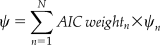
PRESENCE was run with 15,000 bootstraps, with at least 10,000 required for the best performance (D. MacKenzie, pers. comm.). The best output models were those that had the lowest value of Akaike’s information criterion (AIC) and the highest AIC weight (sum of AIC weights of all models = 1; Table 1). Weighted means of p and ψ were calculated as:

Results of occupancy modelling (see text for details) of the leopard Panthera pardus saxicolor population in Bamu National Park.

1 Akaike’s information criterion
2 Detection probability
3 Occupancy
4 Calculated as the arithmetic mean of the survey-specific p values
where n = 1, 2,…N indicates the number of the best output models (MacKenzie et al., Reference MacKenzie, Nichols, Royle, Pollock, Bailey and Hines2006; Linkie et al., Reference Linkie, Dinata, Nugroho and Haidir2007). In this study N = 4 (Table 1).
To calculate the number of camera-trap stations (s) that need to be set up to reach the best precision of ψ (SE = 0.05), we used the equation:
![$$s \,= {\psi \over {\rm SE^2 }}\left[ {(1 - \psi) + {{(1 - p)} \over {p - Kp(1 - p)^{K - 1} }}} \right]$$](https://static.cambridge.org/binary/version/id/urn:cambridge.org:id:binary:20170719041033247-0801:S0030605310000827:S0030605310000827_eqn3.gif?pub-status=live)
where ψ and p are the weighted mean ψ and weighted mean p, respectively, SE is the desired standard error of ψ, K is the optimum number of days that a given camera-trap station operates and p* = 1 – (1 – p)K (MacKenzie & Royle, Reference MacKenzie and Royle2005; MacKenzie et al., Reference MacKenzie, Nichols, Royle, Pollock, Bailey and Hines2006; Linkie et al., Reference Linkie, Dinata, Nugroho and Haidir2007). We compared the number of days a camera-trap station operated in this study (21 days, see above) and K from the reference table in MacKenzie & Royle (Reference MacKenzie and Royle2005) and MacKenzie et al. (Reference MacKenzie, Nichols, Royle, Pollock, Bailey and Hines2006) to check the closeness of these parameters to each other.
Visitation rates were estimated by modelling in DoubleTrack Excel workbook (Gruber et al., Reference Gruber, Reineking, Calabrese, Kranz, Poledníková and Poledník2008). This simulates visitation rates to particular sites based on occurrence of fresh and/or aged signs (faeces, tracks); this can be extended to photo-captures. To estimate the area-specific visitation rates we inserted 1s for captures and 0s for no captures across the 10 observations (camera-trap stations) and the time interval of 21 days for each of the five study areas. Statistical analysis was carried out with Excel 2003 (Microsoft Corp., Santa Rosa, USA) and SPSS v. 13.0 (SPSS Inc., Chicago, USA).
Results
The total sampling effort of 1,012 trap-nights yielded 31 independent leopard pictures (22% of all wildlife photographs), resulting in a relative abundance index of 3.06 captures per 100 trap-nights. The total number of leopard photographs was 72 but only 27 independent captures were used in the X-matrix because of recaptures within an occasion. We identified seven individual leopards across the 21 sampling occasions: one adult male, one subadult male, one adult female with cub, two adult females and one subadult female (Plate 2).
Examples of leopard photo-captures in Bamu National Park: (a) adult female, (b) adult male, (c) adult female and (d) subadult female. Photos: Plan for the Land Society.
Sampling efforts in each of the five areas differed significantly (χ2 = 14.51, df = 4, P = 0.006) but this variation did not affect the numbers of individuals captured (r 2 = 0.39, F 1,3 = 1.95, P = 0.257) or the numbers of independent leopard photographs obtained in each area (r2 = 0.25, F 1,3 = 1.02, P = 0.387). These differences in sampling effort were caused by difficult access to some parts of the study area, trails closed in winter, theft and malfunctioning of some camera-traps.
The model M(o), implying constant capture probabilities for individual leopards, had the best fit (model selection criterion = 1.0) and the model M(h) of heterogeneity in capture probabilities was ranked second (0.97). We chose M(h) because its population estimator is robust and most relevant to solitary felids in comparison with M(o) (Karanth et al., Reference Karanth, Chundawat, Nichols and Kumar2004; Maffei et al., Reference Maffei, Cuellar and Noss2004). The wide-ranging adult male had a much higher chance of being photographed (12 out of 21 sampling occasions, 57.1%) in comparison with his conspecifics (females on 2–4 occasions, 9.5–19.0%; subadult male on three occasions, 14.3%). The goodness-of-fit of M(h) was statistically significant (χ2 = 27.13, df = 20, P = 0.13). The jackknife was the best estimator of population abundance. The assumption of population closure was not violated (z = -0.22, P = 0.41).
The number of leopards in Bamu estimated by the M(h) model and jackknife estimator was 6.00 ± SE 0.24 individuals (95% confidence interval 6–6). The narrow confidence interval is probably an artefact of the small sample size (Karanth, Reference Karanth1995; Haines et al., Reference Haines, Janecka, Tewes, Grassman and Morton2006). Average capture probability for individual leopards in a sampling occasion (p̂) was 0.21. The MDMs were 0.62–12.38 km and the MMDM was 5.01 ± SE 1.72 km. The boundary strip was 2.50 ± SE 0.86 km. The effective sampled area was 321.12 km2 and thus the leopard density was 1.87 ± SE 0.07 individuals per 100 km2. This density was attained at a minimum sampling effort of 400 trap-nights, minimum sampling efficiency of seven independent pictures and a minimum study area of 150 km2 (Fig. 2). Sampling effort, sampling efficiency and study area were uncorrelated (P was 0.25 to 0.93).
Curvilinear relationships between leopard density and (a) sampling effort, (b) area size and (c) number of independent pictures in Bamu National Park (Fig. 1).

The best-fit occupancy models show that detection probability for leopards at camera-trap stations was constant; the population was represented by a single group and leopard occupancy was similar across the models (Table 1). Weighted mean occupancy was 0.56 and therefore leopards occupied c. 56% of the study area in Bamu. Because of low detection probability, estimated occupancy was, at 47%, higher than the naïve estimate of occupancy (19 out of 50 camera-trap stations, i.e. 38%).
The 21-day duration of camera-trapping at each camera-trap station was almost the same as the K that equals 20 daily surveys per site with p = 0.1 and ψ = 0.6, the tabulated ad hoc values of p and ψ closest to the empirical ones estimated in this study (MacKenzie & Royle, Reference MacKenzie and Royle2005; MacKenzie et al., Reference MacKenzie, Nichols, Royle, Pollock, Bailey and Hines2006). Therefore in equation (3) we used K = 21 days. To achieve a model precision of SE = 0.05, based on the weighted mean ψ = 0.56 and weighted mean p = 0.05 (Table 1), 368 camera-trap stations would be required in the study area.
Visitation rates ranged from a minimum of 0.01 visits per day in Area 1 to a maximum of 0.05 visits per day in Area 3 and the rates in Areas 2, 4 and 5 were 0.02 visits per day. Visitation rates were not correlated with the numbers of individual leopards camera-trapped in the areas (r 2 = 0.43, F 1,3 = 2.31, P = 0.226).
Discussion
Our results indicate there are seven leopards in Bamu National Park. In the late 1970s their number was estimated to be 15–20 (Kiabi et al., Reference Kiabi, Dareshouri, Ghaemi and Jahanshahi2002). Whether these figures indicate a population decline cannot be ascertained as the two studies used different methodologies. Our estimates show that camera-trapping over 150 km2 for 400 trap-nights that obtains seven photographs of leopards gives the same unbiased estimate of leopard density as does a survey covering all of Bamu (Fig. 2). We did not find the thresholds or curve asymptotes that would indicate a stabilization of leopard densities in relation to increase in study area, sampling effort and sampling efficiency. Although this could indicate an insufficiently large study area and overestimation of density (Maffei & Noss, Reference Maffei and Noss2008), lack of stabilization in this case is most likely caused by differences in leopard numbers photo-captured in each area, which inevitably affects area-specific densities in a small population.
Low detection probability (Table 1) brings about a high rate of non-detections in the areas of actual presence (false absence) that, if ignored, underestimates leopard occupancy by 47%. Thus the area inhabited by leopards in this protected area is much larger than that predicted from photographic capture sites alone; a pattern commonly found in rare and elusive species (MacKenzie et al., Reference MacKenzie, Nichols, Royle, Pollock, Bailey and Hines2006; Linkie et al., Reference Linkie, Dinata, Nugroho and Haidir2007).
At 1.87 ± SE 0.07 per 100 km2 the leopard density in Bamu is higher than elsewhere in Iran and than in two other areas where it was estimated by camera-trapping: Jabal Samhan Nature Reserve in Oman (0.4 individuals per 100 km2; Spalton et al., Reference Spalton, Al Hikmani, Willis and Said2006) and the Russian Far East (1.1–1.2 individuals per 100 km2; Kostyria et al., Reference Kostyria, Skorodelov, Miquelle, Aramilev and McCullough2003). Intensive year-round use of territorial markers such as scrapes is further evidence of high leopard density in Bamu (Ghoddousi et al., Reference Ghoddousi, Kh. Hamidi, Ghadirian, Ashayeri, Hamzehpour and Moshiri2008a). This density is, however, lower than in an equatorial rainforest in Gabon (2.7–12.1 individuals per 100 km2) where the same photographic capture-recapture technique was employed (P. Henschel, pers. comm.).
Poaching and habitat fragmentation are threats to the existence of leopards in Bamu (Ghoddousi et al., Reference Ghoddousi, Kh. Hamidi, Ghadirian, Ashayeri, Moshiri and Khorozyan2008b). Although this National Park is well-protected, with numerous and capable game wardens (46 covering the 356.1 km2), occasional cases of poaching still occur. Rapid industrial and agricultural development beyond its boundaries makes Bamu an isolated island surrounded by the Isfahan–Shiraz highway and a refinery to the west, Shiraz city and its suburbs to the south, and agricultural lands to the north and east (Fig. 1; Ghoddousi et al., Reference Ghoddousi, Kh. Hamidi, Ghadirian, Ashayeri, Moshiri and Khorozyan2008b). Habitats in Bamu are affected by illegal grazing in the north-east and unregulated local tourism along the Park edge. Such intensive fragmentation and encroachment limits space and dispersal routes for leopards in Bamu (Ghoddousi et al., Reference Ghoddousi, Kh. Hamidi, Ghadirian, Ashayeri, Moshiri and Khorozyan2008b).
We detected spatial segregation of individual leopards in relation to human factors. The subadult male was photo-captured only in south-western Bamu, which is the part of Bamu most fragmented by industrial barriers. The subadult female and an adult female were photo-captured in the south-east close to agricultural lands. The adult male and most of the adult females shared the central part of Bamu, least affected by human pressures (Area 3).
The relatively high leopard density in Bamu could be a result of a connection with other areas of Fars Province by corridors such as along the Kor river from the easternmost part of Bamu to Bakhtegan National Park and Wildlife Refuge, where the presence of leopards has been confirmed (Darvishsefat, Reference Darvishsefat2006). Leopard conservation measures in Bamu, partly already underway, need to focus on mitigation of the effects of habitat fragmentation and degradation, and anti-poaching activities and awareness-raising.
The Persian leopard project in Bamu is ongoing and is now focused on capacity building and educational programmes for villagers and farmers around the National Park. In spring 2009, with the collaboration of governmental organizations and international funders, 1,400 students in 14 villages around Bamu were educated on the importance of the leopard and the National Park. Research priorities in Bamu are a detailed study of the species’ spatial distribution and a radio telemetry study of possible connections to other populations.
Acknowledgements
We thank the personnel and volunteers of the Plan for the Land Society and the Fars office of the Department of Environment, especially H. Zohrabi (Head of the Biodiversity Bureau), for their continued support of this project. We thank B.H. Kiabi, B.F. Dareshouri and P. Henschel for provision of information, D. MacKenzie for assistance in using PRESENCE, and B. Gruber for his DoubleTrack workbook. Financial support for this project was generously provided by individual Iranian donors.
Biographical sketches
Arash Ghoddousi is a member of Plan for the Land Society and coordinator of the Persian leopard project in Iran. Since 2005 he has been carrying out research on threatened mammals and their conservation and is a member of the IUCN/SSC Cat Specialist group. Amirhossein Khaleghi Hamidi is a research associate of the Persian leopard project. He is also involved in wildlife management and community-based conservation of large carnivores in Iran. Taher Ghadirian is a wildlife specialist involved in several research projects on the Asiatic cheetah and Persian leopard. Delaram Ashayeri is a field zoologist and manager of a community-based Asiatic cheetah conservation project, and she also participates in the Persian leopard and other wildlife projects. Igor Khorozyan carries out research on the Persian leopard and its conservation in Armenia. He cooperates with the Plan for the Land Society and prepared the Persian leopard assessment for the 2008 IUCN Red List.



