




1. Introduction
In the tradition following Chomsky (Reference Chomsky1981), case-marking is analysed as the morphological consequence of a dependency between a syntactic terminal (‘X0’) and a nearby syntactic phrase (usually an NP/DP, henceforth just ‘NP’), in which X0 transmits a feature or feature value to NP. For instance, in a nominative case-marking system T might transmit a nominative feature to some nearby NP. Agreement systems are analysed similarly: an X0 must form a dependency with a nearby NP. But once the dependency is established, the direction of feature transmission is the reverse of case-assignment. In a nominative-aligned agreement system, T will seek out a nearby NP, and $ \phi $
-features will be transmitted from the NP back to T. In this way, both case-marking and agreement dependencies are dependencies between a syntactic head (X0) and an NP, and both kinds of dependency are established because of features of the X0 – I refer to such features as dependency-forming features.
$ \phi $
-features will be transmitted from the NP back to T. In this way, both case-marking and agreement dependencies are dependencies between a syntactic head (X0) and an NP, and both kinds of dependency are established because of features of the X0 – I refer to such features as dependency-forming features.
A strand of recent work (Marantz 1991/Reference Marantz and Reuland2000, Bobaljik Reference Bobaljik, Adger, Harbour and Béjar2008 a.m.o.) argues that either one or both of these kinds of dependencies are established in the post-syntactic, morphological part of the derivation (aka the ‘PF branch’).Footnote 2 In this article I provide novel support for this position. I argue that the dependency-forming properties of X0 – i.e. whether or not X0 attempts to form case-assignment or agreement dependencies with NPs – may be altered by rules which make reference to the morphosyntactic context of X0. In just the same way that the morphological exponence of a particular syntactic terminal is mutable and manipulable through contextual rules of allomorphy (and in some frameworks the same is true about terminals’ semantic interpretation), so too can the dependency-forming properties of those terminals be altered in particular contexts. This kind of behaviour is readily explainable, perhaps even expected, if case/agreement dependencies between X0s and NPs are formed in the morphological component of the derivation. But this behaviour is harder to account for if these dependencies can only be formed in the syntactic derivation, in which the properties of terminals are generally not assumed to be manipulable by rules that refer to context.
The empirical base of this paper comes from Choctaw (Muskogean), which shows active alignment in its agreement system, illustrated in (1): agents are generally indexed on the verb with an erg affix, and non-agents are indexed differently, with an abs affix (or a dat affix, not shown). As (1c) shows, a transitive verb can index both of its arguments.Footnote 3

I assume that the distinction between an erg-marked and an abs-marked argument is related, at least in part, to the argument’s syntactic position. Following Kratzer (Reference Kratzer, Rooryck and Zaring1996) I assume that, cross-linguistically, external arguments are merged in Spec-VoiceP, where they receive a (proto-)agent thematic role, and internal arguments, by contrast, are merged in a position below Voice, where they are assigned a thematic role by the lexical verb (or at least by functional material closer to the root). The syntactic structure I assume for a simple transitive VoiceP is shown in (2) – all trees are head-final because this article is primarily concerned with Choctaw, a head-final language.

All that is needed to implement an active case or agreement system, then, is to have some way of ensuring that the choice of erg vs abs morphology tracks the external vs internal position of the argument. I propose that this should be implemented through the dependency-forming features of the Voice heads. On the one hand, there is $ {\mathrm{Voice}}_{\left[+\mathrm{N}\right]} $
– the Voice head that introduces an NP (i.e. an external argument) in its specifier. In an active alignment system,
$ {\mathrm{Voice}}_{\left[+\mathrm{N}\right]} $
– the Voice head that introduces an NP (i.e. an external argument) in its specifier. In an active alignment system, $ {\mathrm{Voice}}_{\left[+\mathrm{N}\right]} $
is equipped with a dependency-forming feature (i.e. a
$ {\mathrm{Voice}}_{\left[+\mathrm{N}\right]} $
is equipped with a dependency-forming feature (i.e. a $ \phi $
-probe or a case-assignment feature) that causes it to establish an agreement or case-assignment dependency with its specifier, as exemplified in (3). In Choctaw, a language with an active agreement system, this dependency-forming feature is a
$ \phi $
-probe or a case-assignment feature) that causes it to establish an agreement or case-assignment dependency with its specifier, as exemplified in (3). In Choctaw, a language with an active agreement system, this dependency-forming feature is a $ \phi $
-probe, annotated as ‘[u
$ \phi $
-probe, annotated as ‘[u $ \phi $
]’. The dashed arrow indicates the dependency that it forms. The
$ \phi $
]’. The dashed arrow indicates the dependency that it forms. The $ \phi $
-features that are copied from the NP onto Voice as a consequence of this dependency are then exponed as erg agreement.
$ \phi $
-features that are copied from the NP onto Voice as a consequence of this dependency are then exponed as erg agreement.

On the other hand, there is $ {\mathrm{Voice}}_{\left[-\mathrm{N}\right]} $
– the Voice head that cannot introduce an NP in its specifier.
$ {\mathrm{Voice}}_{\left[-\mathrm{N}\right]} $
– the Voice head that cannot introduce an NP in its specifier. $ {\mathrm{Voice}}_{\left[-\mathrm{N}\right]} $
in Choctaw is not equipped with a [u
$ {\mathrm{Voice}}_{\left[-\mathrm{N}\right]} $
in Choctaw is not equipped with a [u $ \phi $
] feature, and thus no argument gets indexed by erg agreement. This is schematised in (4).
$ \phi $
] feature, and thus no argument gets indexed by erg agreement. This is schematised in (4).

Additionally, it appears that in Choctaw, internal arguments are targeted by a separate $ \phi $
-probe, spelled out as abs or dat agreement – a more detailed analysis is provided in Section 2.1.
$ \phi $
-probe, spelled out as abs or dat agreement – a more detailed analysis is provided in Section 2.1.
So far so typical: what is illuminating about Choctaw’s agreement system, for the purposes of this article, are the exceptions. In particular, I show that there are a number of instances in which an argument is indexed with erg agreement, but nonetheless shows hallmarks of being an internal argument, rather than an external argument as expected. As a preview, some examples of the verbs in question are shown in (5).

In this article I provide evidence that in these cases an agreement dependency is, exceptionally, established between specifier-less Voice ( $ {\mathrm{Voice}}_{\left[-\mathrm{N}\right]} $
) and an internal-argument NP, as in (6).Footnote
4
$ {\mathrm{Voice}}_{\left[-\mathrm{N}\right]} $
) and an internal-argument NP, as in (6).Footnote
4

My proposal is that there is no ‘special’ $ {\mathrm{Voice}}_{\left[-\mathrm{N}\right]} $
head merged in (6), which is different from the
$ {\mathrm{Voice}}_{\left[-\mathrm{N}\right]} $
head merged in (6), which is different from the $ {\mathrm{Voice}}_{\left[-\mathrm{N}\right]} $
head in (4). Rather, the typical morphological features of
$ {\mathrm{Voice}}_{\left[-\mathrm{N}\right]} $
head in (4). Rather, the typical morphological features of $ {\mathrm{Voice}}_{\left[-\mathrm{N}\right]} $
may be manipulated by particular rules that are sensitive to context, in just the way that other morphological properties may change in certain contexts. So in Choctaw, by default,
$ {\mathrm{Voice}}_{\left[-\mathrm{N}\right]} $
may be manipulated by particular rules that are sensitive to context, in just the way that other morphological properties may change in certain contexts. So in Choctaw, by default, $ {\mathrm{Voice}}_{\left[-\mathrm{N}\right]} $
lacks a [u
$ {\mathrm{Voice}}_{\left[-\mathrm{N}\right]} $
lacks a [u $ \phi $
] feature and so does not attempt to form a dependency. But, it may also be afflicted by the rule in (7): this rule states that, in the context of certain morphosyntactic items (some roots and functional heads, to be determined),
$ \phi $
] feature and so does not attempt to form a dependency. But, it may also be afflicted by the rule in (7): this rule states that, in the context of certain morphosyntactic items (some roots and functional heads, to be determined), $ {\mathrm{Voice}}_{\left[-\mathrm{N}\right]} $
sprouts a [u
$ {\mathrm{Voice}}_{\left[-\mathrm{N}\right]} $
sprouts a [u $ \phi $
] feature (a
$ \phi $
] feature (a $ \phi $
-probe). This rule can be thought of as a dissociated feature insertion rule, in the sense of Embick & Noyer (Reference Embick, Noyer, Ramchand and Reiss2007).
$ \phi $
-probe). This rule can be thought of as a dissociated feature insertion rule, in the sense of Embick & Noyer (Reference Embick, Noyer, Ramchand and Reiss2007).

Furthermore, through a short survey of recent work in case and agreement, I argue that $ {\mathrm{Voice}}_{\left[+\mathrm{N}\right]} $
(the Voice head that introduces an external argument) is sometimes subject to a rule like (8) that does the reverse of (7): it removes a dependency-forming feature. This can be considered, essentially, a morphological impoverishment rule.
$ {\mathrm{Voice}}_{\left[+\mathrm{N}\right]} $
(the Voice head that introduces an external argument) is sometimes subject to a rule like (8) that does the reverse of (7): it removes a dependency-forming feature. This can be considered, essentially, a morphological impoverishment rule.

This accounts for mismatches that go in other directions: external arguments that are treated by case/agreement as though they were internal arguments.
Thus both the case-assignment and agreement-seeking properties of functional heads, i.e. their dependency-forming properties, are subject to contextual manipulation by rule, and are not projected exceptionlessly from the lexicon. This behaviour receives a simple account if these dependencies are formed postsyntactically, and can be afflicted by ‘standard’ feature manipulation operations like insertion and impoverishment. It is harder to explain if these dependencies are part of the narrow syntactic derivation.
This article is organised as follows. Section 2 introduces Choctaw agreement and provides a basic syntactic analysis. Section 3 provides four tests for internal vs external argument status in Choctaw, other than agreement. Section 4 then applies these tests to three interesting classes of verbs, showing that their erg-indexed subjects are underlyingly internal arguments. Section 5 fleshes out the analysis of these configurations – that they instantiate the low ergative structure in (6) – and discusses some precedents, including some involving case-assignment rather than agreement. Section 6 buttresses the analysis with two pieces of evidence that erg-indexing, even in low ergative configurations, really does involve a relation between Voice and the argument. Section 7 then provides some cross-linguistic evidence for the existence of the reverse arrangement: when Voice does introduce an NP in its specifier, but exceptionally fails to form a dependency with it. Section 8 concludes.
2. Agreement in Choctaw
Choctaw is a Muskogean language indigenous to the southeastern United States, and is spoken today in Mississippi and Oklahoma. All data reported here comes from fieldwork with speakers who grew up and reside in Mississippi, unless otherwise noted. The language has fairly rigid SOV order, free argument drop and complex verbal morphology. A monoclausal transitive sentence with two overt arguments is given in (9).

This sentence shows that Choctaw NPs may be marked with nominative or oblique case. Overt subjects are obligatorily marked with nominative case. Case-marking on non-subjects is more complex, but some objects, such as alla-m- $ \underline{a} $
‘that kid’ in (9), are marked with oblique case.Footnote
5
$ \underline{a} $
‘that kid’ in (9), are marked with oblique case.Footnote
5
The focus of this article, however, is Choctaw’s active agreement system, which is mismatched with the nominative-oblique case-marking system. Agreement affixes come in three classes, and the choice of which class to use with a particular argument is determined, broadly, by the thematic role of the argument. A table of agreement forms is provided in (10). The erg, abs, and dat series are traditionally known as ‘Class I’, ‘Class II’, and ‘Class III’ respectively; the irr (irrealis) series replaces the erg class for negated and exhortative verbs, and is in complementary distribution with it.

Note that there are no 3rd-person erg or abs affixes, illustrated in (2). Following Ulrich (Reference Ulrich1986), I treat the 3rd-person dat and irr affixes as defaults rather than specifically 3rd-person, and so they are glossed here as ‘dat/irr’ (rather than ‘3.dat/3.irr’).
Turning now to the distribution of the agreement forms, they exhibit an active alignment, also known as ‘agentive’, ‘semantic’, or ‘split-S’ alignment. Agents and initiators are indexed by erg (=ergative) forms, as shown in (11).

Themes and experiencers tend be indexed by abs (=absolutive) affixes, as in (12).

And a heterogeneous class of arguments, including all applied oblique arguments, are indexed by dat (=dative) affixes, as in (13).

Verbs with multiple arguments may show multiple agreement markers, as in (14).

The sentences in (12)–(14) show that choice of affix class does not correlate with grammatical role (i.e. subject vs object status): objects may be indexed by abs affixes, as in (12a), or dat affixes, as in (13a); and similarly subjects too may be indexed by abs, as in (12b-c), or dat affixes (13b-c). Straightforward evidence that grammatical role (reflected through case-marking) is not matched with choice of agreement marker comes from focused pronouns, which carry case-marking and trigger agreement.Footnote 6 For example, (15a) shows an abs affix sa- being used to index an oblique-marked object, and (15b) shows the same affix being used to index a nominative-marked subject.

Next, I provide a simple analysis of these phenomena, expanding on the analysis provided in the introduction.
2.1. Basic analysis
We have seen that in Choctaw, the choice of agreement used to index an argument (erg vs abs vs dat) is linked quite closely (though not without exception) to that argument’s thematic role. Active alignment systems like Choctaw’s fit neatly with theories that ‘sever’ certain kinds of argument from the verb root. Chomsky (Reference Chomsky1995) and Kratzer (Reference Kratzer, Rooryck and Zaring1996) influentially proposed that external arguments – a class of arguments which bear agent or agent-like thematic roles – are merged as the specifier of a dedicated functional head v or Voice (I use ‘Voice’ here). By contrast the verb root and any internal arguments are merged within the complement of Voice. I also assume that the verb stem can be further decomposed into a root and a verbalising head v (Marantz Reference Marantz, Dimitriadis and Siegel1997). (16) schematises the syntactic structure of a prototypical transitive VoiceP, containing an internal and an external argument.

Assuming a structure like this, the difference between erg-indexing and abs / dat-indexing can be reduced, at least in part, to a difference in the syntactic position of the argument: arguments in the external argument position are erg; arguments in one of the internal argument positions are abs or dat. In this way, the correlation between thematic role and choice of agreement affix falls out from the assumption that arguments get their thematic roles by virtue of being in particular syntactic positions.
In the introduction I sketched an implementation of this analysis in which the difference between an argument that is indexed by erg agreement and one that is not is in whether or not that argument is targeted by the $ \phi $
-probe on Voice, annotated as [u
$ \phi $
-probe on Voice, annotated as [u $ \phi $
].Footnote
7 Essentially, the Voice head that introduces a specifier (
$ \phi $
].Footnote
7 Essentially, the Voice head that introduces a specifier ( $ {\mathrm{Voice}}_{\left[+\mathrm{N}\right]} $
) launches a
$ {\mathrm{Voice}}_{\left[+\mathrm{N}\right]} $
) launches a $ \phi $
-probe, which subsequently establishes a dependency with the NP in Spec-VoiceP. The tree in (17), repeated from (3), illustrates this. Recall also that, in keeping with the findings of Bobaljik (Reference Bobaljik, Adger, Harbour and Béjar2008), these agreement dependencies are established in the morphological branch of the derivation.Footnote
8
$ \phi $
-probe, which subsequently establishes a dependency with the NP in Spec-VoiceP. The tree in (17), repeated from (3), illustrates this. Recall also that, in keeping with the findings of Bobaljik (Reference Bobaljik, Adger, Harbour and Béjar2008), these agreement dependencies are established in the morphological branch of the derivation.Footnote
8

Conversely the Voice head that does not introduce a specifier ( $ {\mathrm{Voice}}_{\left[-\mathrm{N}\right]} $
) lacks [u
$ {\mathrm{Voice}}_{\left[-\mathrm{N}\right]} $
) lacks [u $ \phi $
] and does not launch a
$ \phi $
] and does not launch a $ \phi $
-probe. Any internal arguments, merged inside the complement of Voice, are then targeted only by probes other than Voice, and the morphological spellout of these probes corresponds to abs or dat agreement affixes. Specifically, I assume that abs / dat agreement is the spellout of a
$ \phi $
-probe. Any internal arguments, merged inside the complement of Voice, are then targeted only by probes other than Voice, and the morphological spellout of these probes corresponds to abs or dat agreement affixes. Specifically, I assume that abs / dat agreement is the spellout of a $ \phi $
-probe on v or Appl. A diacritic is required to differentiate those
$ \phi $
-probe on v or Appl. A diacritic is required to differentiate those $ \phi $
-probes that spell out as abs from those
$ \phi $
-probes that spell out as abs from those $ \phi $
-probes that spell out as dat: I differentiate v from v-dat, and Appl from Appl-dat, where they arise later in this article. The trees in (18) illustrate
$ \phi $
-probes that spell out as dat: I differentiate v from v-dat, and Appl from Appl-dat, where they arise later in this article. The trees in (18) illustrate $ \phi $
-agreement by v and Appl with internal arguments. For the rest of this article, I do not represent the dependency-forming features of v/Appl (i.e. the [u
$ \phi $
-agreement by v and Appl with internal arguments. For the rest of this article, I do not represent the dependency-forming features of v/Appl (i.e. the [u $ \phi $
] feature) except where it is directly relevant.Footnote
9
$ \phi $
] feature) except where it is directly relevant.Footnote
9

Setting aside for a moment the other functional heads in the extended projection of the verb, I have asserted that in Choctaw there is a ‘link’ between whether or not a Voice head introduces a specifier (i.e. whether it is [+N] or [–N]) and whether or not it has a $ \phi $
-probe ([u
$ \phi $
-probe ([u $ \phi $
]):
$ \phi $
]): $ {\mathrm{Voice}}_{\left[+\mathrm{N}\right]} $
has a
$ {\mathrm{Voice}}_{\left[+\mathrm{N}\right]} $
has a $ \phi $
-probe;
$ \phi $
-probe; $ {\mathrm{Voice}}_{\left[-\mathrm{N}\right]} $
does not. This captures the observation that external arguments are generally indexed by erg agreement and other arguments are not, and accordingly I propose that these are the ‘default’ behaviours of the two Voice heads in Choctaw. In the rest of this article, I discuss deviations from this default behaviour, and claim that these deviations should be attributed to some special rule.
$ {\mathrm{Voice}}_{\left[-\mathrm{N}\right]} $
does not. This captures the observation that external arguments are generally indexed by erg agreement and other arguments are not, and accordingly I propose that these are the ‘default’ behaviours of the two Voice heads in Choctaw. In the rest of this article, I discuss deviations from this default behaviour, and claim that these deviations should be attributed to some special rule.
Finally, throughout this section I have been assuming that heads can establish agreement dependencies with their specifiers (as in (18)), or with phrases that they c-command (as in (6)). Specifically, I assume that the search space of a dependency-forming feature (an agreement-seeking or case-assignment feature) on X0 consists of every node dominated by XP, aka the m-command domain of X0 (Chomsky Reference Chomsky1986). So a dependency-forming feature on X0 will first search Spec-XP, and then work down through X0’s c-command domain.
2.2. Agreement markers or argument-doubling clitics?
Tyler (Reference Tyler2019a) proposes that Choctaw verb agreement is best characterised as clitic-doubling rather than (simple) $ \phi $
-agreement. In his analysis, NPs are first assigned case by functional heads in the extended projection of the verb (v, Appl, Voice), and those case-bearing NPs then undergo clitic-doubling at clitic-hosting functional heads. NPs’ case features are preserved on the clitics that double those NPs, and are realised only on the clitics. The case features are not realised on the NPs themselves. Thus in Tyler’s analysis, the distinction between arguments indexed by erg, abs or dat agreement is that each of them has a different case feature (or no case feature at all). The differing assumptions of the two analyses are shown in (19).
$ \phi $
-agreement. In his analysis, NPs are first assigned case by functional heads in the extended projection of the verb (v, Appl, Voice), and those case-bearing NPs then undergo clitic-doubling at clitic-hosting functional heads. NPs’ case features are preserved on the clitics that double those NPs, and are realised only on the clitics. The case features are not realised on the NPs themselves. Thus in Tyler’s analysis, the distinction between arguments indexed by erg, abs or dat agreement is that each of them has a different case feature (or no case feature at all). The differing assumptions of the two analyses are shown in (19).

The clitic-doubling analysis is fairly inter-translatable with the agreement analysis employed here. In both analyses, Choctaw verb agreement is the morphological reflex of a dependency between a functional head (Voice, v or Appl) and a NP. However, the agreement analysis does not require us to posit any further syntactic or morphological machinery before spellout. By contrast, the clitic-doubling analysis requires us to posit an additional syntactic step in which the NPs are clitic-doubled at some clitic-hosting functional head.Footnote 10 Furthermore, in the clitic-doubling analysis, NPs must be capable of bearing more than one case feature: NPs must be able to bear one case feature that distinguishes whether they are indexed by erg vs abs vs dat clitics, and they must be able to bear another feature, which distinguishes whether they are marked as nom vs obl. However, the increased amount of technology in the clitic-doubling analysis does allow for simplification in another domain: the clitic-doubling analysis means that abs-indexed arguments need not enter a relation with any particular functional head: they can be analysed as simply lacking a case feature.Footnote 11
In Section 7, I will argue that agreement dependencies and case-assignment dependencies are fundamentally similar, in that they are postsyntactic dependencies established between functional heads and arguments, and they are both manipulable by morphological rules. Thus the broad conclusion of this article is not changed by whether the dependencies that Choctaw Voice enters into are agreement dependencies or case-assignment dependencies. However, for now I couch my argument in terms of the agreement analysis, since there is less machinery to assume and it is more ‘surface true’.
Now that we have introduced some basic assumptions about how active agreement works in Choctaw, I present the argument for low ergative configurations, in which internal arguments are, unexpectedly, targeted by Voice’s $ \phi $
-probe (schematised in (6)). As foreshadowed in the introduction, these are the configurations which provide evidence that agreement is a contextually manipulable property of functional heads.
$ \phi $
-probe (schematised in (6)). As foreshadowed in the introduction, these are the configurations which provide evidence that agreement is a contextually manipulable property of functional heads.
The logic of the argument is as follows. In the Section 3, I describe four diagnostics for internal argumenthood other than choice of agreement morphology. Then in Section 4, these diagnostics are applied to several intransitive verbs with erg-indexed subjects. The subjects of these verbs pattern like internal arguments, and I argue that this is because they are internal arguments – it is the erg agreement that is misleading. In Section 5 I augment the simple analysis provided here, in order to account for these ‘mismatched’ arguments.
3. Diagnosing internal arguments
We saw in the previous section that external arguments in Choctaw are generally indexed by erg agreement. I proposed that this is because they are merged in Spec-VoiceP and targeted by Voice’s $ \phi $
-probe. Internal arguments are generally indexed by abs or dat agreement. I proposed that this is because they are targeted by
$ \phi $
-probe. Internal arguments are generally indexed by abs or dat agreement. I proposed that this is because they are targeted by $ \phi $
-probes within the complement of Voice. Some authors have taken the choice of agreement affix to be, essentially, the final word on the internal vs external status of an argument (e.g. Davies Reference Davies1981, Reference Davies1986). Others, such as Munro & Gordon (Reference Munro and Gordon1982), have advocated a view that allows mismatches between an argument’s thematic role and choice of agreement morphology, although they do not apply diagnostics in the manner I do here. My purpose in the next two sections is to build on this insight and to formalise and constrain it.
$ \phi $
-probes within the complement of Voice. Some authors have taken the choice of agreement affix to be, essentially, the final word on the internal vs external status of an argument (e.g. Davies Reference Davies1981, Reference Davies1986). Others, such as Munro & Gordon (Reference Munro and Gordon1982), have advocated a view that allows mismatches between an argument’s thematic role and choice of agreement morphology, although they do not apply diagnostics in the manner I do here. My purpose in the next two sections is to build on this insight and to formalise and constrain it.
In this section, I describe four properties that correlate with internal argumenthood, other than choice of agreement affix. These properties can all be adapted as diagnostics, with varying degrees of applicability. They are: surviving the (anti)causative alternation (§3.1), rejecting the auxiliary tahli (§3.2), conditioning pluractional allomorphy (§3.3), and being compatible with applied dative subjects (§3.4). All of these properties function as unidirectional implicational statements: if a particular property holds of a verb or its subject, then the subject of that verb is an internal argument.Footnote 12 However, if the property does not hold, then we cannot make any inferences about the argument structure of the verb.
In the Section 4, I show that some arguments indexed by erg agreement pattern like internal arguments according to (some of) the diagnostics outlined here. This constitutes the evidence for the low ergative configuration in (6), which in turn forms the evidence that the dependency-forming properties of functional heads like Voice many be manipulated in certain contexts.
3.1. Surviving the causative alternation
Choctaw has a semi-productive morphologically marked causative alternation, and many Choctaw verbs come in transitive/intransitive pairs (Ulrich Reference Ulrich1986, Broadwell Reference Broadwell2006, Tyler Reference Tyler2020). The most common markers for the transitive and intransitive alternants are the suffixes -li and -a, shown in (20), although other markers are common too, shown in (21) (the transitivity suffix -li should not be confused with the homophonous 1sg.erg suffix -li).Footnote 13 Note that here and elsewhere, I gloss the root separately from the transitivity suffix only where it is relevant to the point at hand, owing to the multi-functionality of suffixes like -li (transitive/intransitive) and -chi (transitive/causative).


I assume that in alternating pairs, the argument which is maintained in both the transitive and the intransitive alternants is the internal argument (though see below for a potential challenge to this assumption). The external argument appears only in the transitive alternant, as its subject. Following work on the causative alternation by Schäfer (Reference Schäfer2007), Alexiadou et al. (Reference Alexiadou, Anagnostopoulou and Schäfer2015) and others, I model the alternation as the stacking of different Voice heads, which have different morphological realisations, on top of the same ‘common base’ constituent, a vP, which includes at least the verb root and the internal argument. The head ‘ $ {\mathrm{Voice}}_{\left[+\mathrm{N}\right]} $
’ obligatorily introduces a NP specifier and ‘
$ {\mathrm{Voice}}_{\left[+\mathrm{N}\right]} $
’ obligatorily introduces a NP specifier and ‘ $ {\mathrm{Voice}}_{\left[-\mathrm{N}\right]} $
’ obligatorily lacks a NP specifier. The transitive and intransitive structures for fakohli/fakooha ‘peel off’ are shown in (22).
$ {\mathrm{Voice}}_{\left[-\mathrm{N}\right]} $
’ obligatorily lacks a NP specifier. The transitive and intransitive structures for fakohli/fakooha ‘peel off’ are shown in (22).

I assume that $ {\mathrm{Voice}}_{\left[+\mathrm{N}\right]} $
and
$ {\mathrm{Voice}}_{\left[+\mathrm{N}\right]} $
and $ {\mathrm{Voice}}_{\left[-\mathrm{N}\right]} $
have multiple root-conditioned morphological realisations, inclluding as Ø, accounting for the variation we see in (20-21).Footnote
14
$ {\mathrm{Voice}}_{\left[-\mathrm{N}\right]} $
have multiple root-conditioned morphological realisations, inclluding as Ø, accounting for the variation we see in (20-21).Footnote
14
The diagnostic based on this pattern goes like this: if an argument survives the causative alternation, then the argument is an internal argument. But note that if an intransitive verb does not participate in the causative alternation, this diagnostic will not help us determine the internal vs external status of its subject.
It is necessary to address two issues that have the potential to weaken this diagnostic. Firstly, the ‘common base’ assumption may not hold for all roots. It could be the case, with some roots, that while the object of the transitive alternant is indeed an internal argument, the subject of the intransitive alternant, which appears to pattern semantically with the transitive object, is nonetheless syntactically an external argument (i.e. base-generated in Spec-VoiceP). Legate (Reference Legate2014: 119ff.) has shown that in Acehnese, the intransitive counterpart to many transitive verbs is syntactically unergative rather than unaccusative, even though the subject of the intransitive patterns semantically with the transitive object. I believe that verb pairs like this do exist in Choctaw – e.g. chalhaakachi ‘rattle’ (intr./tr.) – but so far I have only noted this pattern in the class of sound emission verbs (which also have the interesting property of being morphologically labile – that is, they do not morphologically distinguish the transitive and intransitive alternants). For now, I assume that, by default, the common base assumption does hold for all Choctaw roots, but I acknowledge that the existence of Acehnese-type patterns weakens the assumption.
The second confounding issue is that Choctaw allows virtually all verbs, including unergatives, to be productively causativised with the suffix -chi. This is shown below for a transitive verb (23) and an unergative verb (24).


On the evidence of the morphology alone, it is therefore possible that when the transitive counterpart of an intransitive verb is formed with -chi as in (24) (and several of the at-issue examples in Section 4 are formed like this), the transitive alternant is a syntactic causative – that is, a causative built on top of a ‘complete’ VoiceP projection, whose structure would look like that in (25). The fact that a syntactic causative can be built on the underlying intransitive does not tell us anything about the internal vs external status of the underlying intransitive.Footnote 15

We must therefore be careful to exclude the possibility that a transitive alternant formed with -chi is a syntactic causative. Each time the diagnostic is applied (in Sections 4.1 and 4.2), I provide evidence that the transitive alternant in question is a true lexical causative – that is, one with a structure like (22a) – and not a syntactic causative.
3.2. Rejecting tahli
Choctaw has a pair of verbs tahli/taha, meaning something like ‘finish’, which can take a participial phrase formed with -t as their complement. Broadwell (Reference Broadwell and Wilkins1988, Reference Broadwell2006) shows that in this auxiliary-like usage, the choice of tahli vs taha depends to an extent on the participial verb. He terms this ‘auxiliary selection’, by analogy with a similar phenomenon in European languages. And although I follow Broadwell in referring to tahli/taha as ‘auxiliaries’, it is important to note that the choice of auxiliary is less categorical than in European languages. As shown in (27), verbs with erg subjects generally appear with tahli and, occasionally, with taha (though judgements on the acceptability and function of the latter are not totally clear to me at this stage).Footnote 16 By contrast, verbs with abs or dat subjects can only appear with taha, and uniformly reject tahli, as shown in (28).Footnote 17 , Footnote 18


The pattern of (in)compatibility with tahli in (27-28) can be put to use as a diagnostic for whether the subject of the main verb is an internal or external argument: if the verb can appear in the complement of tahli, its subject is likely an external argument; if it rejects tahli, its subject is likely an internal argument. Compatibility with taha cannot be used as a diagnostic in the same way, since (27) shows that taha may be accepted with some verbs whose subject is an external argument (and see Note 15).
It is necessary at this point to address the confounding factor of stativity. Where tahli appears, its complement is typically the participle of an eventive verb (as in (27)), by virtue of the fact that a great many erg-subject verbs are eventive. And when taha appears, its complement is often the participle of a stative verb, by virtue of the fact that a great many abs/dat-subject verbs are stative (e.g. awaata ‘it is wide’ in (21c)). However, these correlations are not exceptionless. In the examples in (28), the verb in the complement to taha can have an eventive interpretation, yet tahli is still ruled out. And in (29a), ittola ‘fall’ can only have an eventive interpretation, yet still occurs only with taha. Conversely, the example in (29b) shows that stative erg-subject verbs like achokmahni ‘like’ can co-occur with tahli.

I do not address here the aspectual interpretation of the participle morphology, nor the aspectual interpretation of the resulting sentence with taha/tahli. For now, I simply note that the acceptability of tahli appears to relate to the internal vs external status of the subject of the main verb and cannot be reduced to whether or not the main verb is stative (though this does affect the choice of auxiliary in those environments where either is possible, cf. example (27) and Note 15).
I also do not provide an explanation for why different classes of verb pattern differently in compatibility with tahli – see Sorace (Reference Sorace2000), McFadden (Reference McFadden2007) and J. Baker (Reference Baker2018) for discussion of typological and theoretical issues in auxiliary selection (if this is indeed an instance of auxiliary selection). Nonetheless, as noted above, compatibility with tahli can be used as a diagnostic for argument structure: if a verb can appear in the complement of tahli, its subject is an external argument; if it rejects tahli, its subject is likely an internal argument, though there are doubtless other aspect-related factors involved.
3.3. Pluractional allomorphy
Many Choctaw verbs exhibit allomorphy conditioned by pluractionality (Broad-well Reference Broadwell and Wilkins1988, Reference Broadwell1993, Reference Broadwell2006). What renders a verb pluractional varies across languages (see Cusic Reference Cusic1981, Wood Reference Wood2007, Henderson Reference Henderson2012), but the relevant considerations for Choctaw seem to be, informally, the plurality of the event and the plurality of the internal argument.
The pairs of verbs in (30) and (31) illustrate one common allomorphy pattern for transitive change-of-state verbs (Broadwell Reference Broadwell2006: 135): in non-pluractional environments, the stem ends in -ffi; in pluractional environments (plural object or pluractional event), the stem ends in -hchi (or -hlichi).


Pluractional allomorphy in transitives is only ever sensitive to the plurality of the event (as in (30)) or the abs object argument (as in (31)), never to the plurality of the erg transitive subject argument.
A large number of intransitive verbs exhibit pluractional allomorphy too. An example is given in (32), which showcases a common morphological pattern for intransitive change-of-state verbs (Broadwell Reference Broadwell2006: 135) – the non-pluractional stem ends in -fa and the pluractional stem ends in -hli.

Most verbs that undergo this particular alternation (-fa/-hli) also have causative counterparts, which participate in the -ffi/-(hli)chi alternation in (30-31). As per the diagnostic outlined in Section 3.1, the subjects of these intransitive verbs can be classified as internal arguments.
So we know that: (a) the pluractional alternation in transitive verbs can be conditioned by the number of the object, but not by the number of the subject, and (b) with intransitive verbs, most of those that show the pluractional alternation also participate in the causative alternation. These findings can be combined into the generalisation that pluractional allomorphy is only ever found when there is an internal argument. To frame this property as a (unidirectional) diagnostic for the status of intransitive verbs: if an intransitive verb exhibits pluractional allomorphy, its subject is an internal argument.Footnote 19
3.4. Compatibility with applied dative subjects
Many intransitive verbs with abs subjects can have an applied subject added to them, which is indexed by dat agreement. The addition of this applied subject causes the original abs subject to become the object. The pairs of sentences in (33-35) show that applied dative subjects can be added to various abs-subject intransitive verbs, yielding a small and identifiable set of interpretations. In each (b) example, the applied subject (which may be a null pro) and the dat prefix that indexes it are bolded.


Applied dative subjects can also be used to express predicative possession relations, when added to quantifier and positional verbs – these are discussed in Sections 4.1 and 4.2. Tyler (Reference Tyler2020) posits the structure in (36).

This structure predicts that we should be unable to add dative subjects to unergative verbs. This is because unergative subjects are merged in Spec-VoiceP, above Spec-ApplP and, thus, the applied argument would not be permitted to move over the external argument to the subject position. This prediction is true, as shown in (37).

Thus we can use a verb’s (in)compatibility with an applied dative subject as a test for the internal vs external status of its subject: if an intransitive verb admits an applied dative subject, the subject of that intransitive verb is an internal argument.
To sum up, in this section we have seen four properties which can be used to diagnose internal argumenthood, other than choice of agreement morphology. They are: surviving the causative alternation (§3.1), rejecting the auxiliary tahli (§3.2), conditioning pluractional allomorphy (§3.3), and being compatible with an applied dative subject (§3.4). And for most verbs, these properties correlate well with whether the subject argument is indexed by erg agreement or by abs/dat agreement. This is summarised in the table in (38).Footnote 20

In the next section I focus on a set of verbs where this correlation breaks down. Using the diagnostics described above, I argue that there is a distinct set of internal argument subjects which are nonetheless indexed by erg agreement, as in the configuration in (6). The fact that this configuration emerges in certain morphosyntactic environments is the foundational piece of evidence for my claim that the dependency-forming properties of functional heads (i.e. case and agreement properties) may be conditioned by their morphosyntactic environment.
4. erg internal arguments
Section 3 outlined four properties that generally correlate with internal argument status. In this section, I examine three kinds of verb whose subject argument is indexed with erg agreement, but which nonetheless pattern in other ways like an internal argument. I propose that these verbs instantiate the low ergative structure in (39), first introduced in (6).Footnote 21

The arguments I identify as low ergative are the subjects of positional verbs (§4.1), the subjects of quantifier verbs (§4.2), and the subjects of transitive psych verbs in absolutive promotion contexts (§4.3). In each case, we see that the subject of the verb is indexed by erg agreement, but behaves like an internal argument according to (at least some of) the diagnostics provided in Section 3.
4.1. Positional verbs
Many positional verbs index their subjects with erg morphology, as in (40).

There are at least three pieces of evidence that the erg subject of these verbs is an internal argument, and thus that these verbs have a low ergative structure.
The first piece of evidence is their participation in the causative alternation. Some alternating pairs of positional verbs are shown in (41) (as in (20-21), the transitivity suffix is glossed separately from the root).

Note that the transitive members of these pairs end in -chi, which is the default causative suffix. As noted in Section 3.1, these transitives could therefore be analysed as productively derived syntactic causatives rather than lexical causatives. However, we can marshal two pieces of evidence that the transitive verbs in (41) are lexical causatives and not syntactic causatives. For one thing, the transitive suffix (-chi) replaces the intransitive suffix -li and is added directly onto the root. This is expected if -chi is the exponent of a Voice head that merges directly with vP, creating a lexical causative (rather than a functional head which merges with an already-built VoiceP, which would create a syntactic causative).Footnote 22 For another thing, the transitive positional verbs in (41) are interpreted as encoding direct causation rather than indirect causation (see Miyagawa Reference Miyagawa1984 for discussion of this distinction in Japanese causatives). Some transitive positional verbs with clear direct causation readings are shown in (42).

The second piece of evidence that the subjects of intransitive positional verbs are internal arguments comes from the root allomorphy diagnostic (§3.3): many intransitive positional verbs (possibly all) exhibit allomorphy or suppletion conditioned by the number of the subject (Broadwell Reference Broadwell2006: 336). Some examples are given in (44).Footnote 23

Following the diagnostic in Section 3.3, the subjects of these verbs are internal arguments.
The third piece of evidence for the internal-argument status of the erg subjects of positional verbs is that they are compatible with applied dative subjects. When dative subjects are added to positional verbs, the resulting construction has a predicative possession interpretation. Applied dative subjects and their associated agreement markers are bolded in (45).

Compatibility with applied dative subjects was argued in Section 3.4 to be a property of verbs without external arguments, thus the subject of intransitive positional verbs is not an external argument.
Thus we have seen that the erg subjects of positional verbs are good candidates for low ergative arguments, on account of their pluractional allomorphy, their participation in the causative alternation, and the fact that they accept applied dative subjects. Regarding the remaining test for internal argument status – whether or not it rejects the auxiliary tahli – the data is a little more complex, and I briefly outline the pattern in the following subsection.
4.1.1. Tahli with positional verbs
Positional verbs can have eventive or stative readings. One way to force a stative reading is to put it in a particular morphophonological template known as the n-grade, in which the penult is nasalised and carries a pitch accent (see Nicklas Reference Nicklas1974, Ulrich Reference Ulrich1986 and Broadwell Reference Broadwell2006: ch.10 for detailed discussion of Choctaw’s verb grades). By contrast, verbs in the zero-grade (i.e. unmodified), either have an obligatory eventive reading, or convey that the state is notably temporary. The zero-grade and n-grade forms of some positional verbs are contrasted in (46).

This contrast is relevant to the choice of auxiliary. Verbs in the n-grade reject tahli, as in (47a); verbs in the zero-grade can appear with tahli, as in (47b).

In light of these facts, we might only be justified in claiming that that positional verbs in the n-grade have internal argument subjects. This more limited conclusion is supported by the observation that, to my knowledge, we only ever see positional verbs take applied dative subjects when they are in the n-grade (Broadwell Reference Broadwell2006: 340) (e.g. (45)). This pattern also suggests that there is a more complex aspectual interaction between the auxiliary and the main verb, which I do not explore further here.
4.2. Quantifier verbs
Quantifier verbs in Choctaw uniformly take erg subjects, as shown in (48).

We can marshal three pieces of evidence for the claim that the subjects of quantifier verbs are internal arguments, despite their erg agreement.
First, quantifier verbs participate in the causative alternation, marked by the presence/absence of -chi. Some examples are given in (49).

There is a lot to be said about the syntax of quantifier verbs – see Broadwell (Reference Broadwell2006: ch.14) for an overview of the Choctaw facts, and Munro (Reference Munro, Paperno and Keenan2017) for Chickasaw. But, essentially, intransitive quantifier verbs can be used as main verbs, as in (48), or as participial adjuncts to verbs, where they quantify over the subject, as in (50).Footnote 24

Transitive quantifier verbs are generally found as participial adjuncts to transitive clauses and they quantify over the object of the clause they adjoin to.Footnote 25 To capture the intuition of what transitive quantifier verbs mean, Broadwell (Reference Broadwell2006: 227) offers the translation ‘doing it to all/some/two/… of them’, illustrated in the literal translations of the examples in (51).

What is relevant for our purposes is that the argument that gets quantified by intransitive quantifier verbs is the subject, but the argument that gets quantified by transitive quantifier verbs is the object. By the logic of the ‘common base’ approach to the causative alternation discussed in Section 3.1, this implies that the erg subject of the intransitive quantifier verbs is an internal argument.
Since the transitive quantifier verbs are formed with the default causative suffix -chi, it is necessary to show that they are lexical causatives and not simply syntactic causatives of unergatives (following the discussion in Section 3.1). One piece of evidence is that the -chi suffix triggers stem allomorphy: for instance, toklo ‘be two’ becomes toklí-chi, containing an unexpected stem-final $ \underline{i} $
.Under Harley’s (Reference Harley, Miyagawa and Saito2008) analysis of Japanese causatives, which builds on earlier work by Miyagawa (Reference Miyagawa1980, Reference Miyagawa1984), the functional head implicated in syntactic causatives is too distant from the root to condition allomorphy on it – specifically, it is separated from the root by a phase boundary. By contrast, the functional head implicated in lexical causatives (transitive Voice) is within the same phase as the root, and so can condition root allomorphy (Marantz Reference Marantz, Matushansky and Marantz2013). A further argument that transitive quantifier verbs are not syntactic causatives is simply that they do not have causative interpretations. Toklíchi, the transitive counterpart of toklo ‘be two’, means (roughly) ‘do it to two of them’; it does not mean ‘cause to be two in number’.Footnote
26
$ \underline{i} $
.Under Harley’s (Reference Harley, Miyagawa and Saito2008) analysis of Japanese causatives, which builds on earlier work by Miyagawa (Reference Miyagawa1980, Reference Miyagawa1984), the functional head implicated in syntactic causatives is too distant from the root to condition allomorphy on it – specifically, it is separated from the root by a phase boundary. By contrast, the functional head implicated in lexical causatives (transitive Voice) is within the same phase as the root, and so can condition root allomorphy (Marantz Reference Marantz, Matushansky and Marantz2013). A further argument that transitive quantifier verbs are not syntactic causatives is simply that they do not have causative interpretations. Toklíchi, the transitive counterpart of toklo ‘be two’, means (roughly) ‘do it to two of them’; it does not mean ‘cause to be two in number’.Footnote
26
Returning to the evidence that the erg subjects of intransitive quantifier verbs are internal arguments, the second piece of evidence is that these verbs appear only with taha and cannot appear with tahli, as in (52).

The third piece of evidence for the internal argument status of the subjects of intransitive quantifier verbs comes from their ability to take applied dative subjects. Like positional verbs (§4.1), quantifier verbs with applied dative subjects receive predicative possession interpretations, as in (53).

In this subsection I have presented three pieces of evidence that intransitive quantifier verbs instantiate the low ergative structure in (39), with their subjects being internal rather than external arguments: they participate in the causative alternation, they reject the auxiliary tahli, and they are compatible with applied dative subjects. Regarding the remaining diagnostic for internal argument status – pluractional allomorphy/suppletion – there is no evidence for this in the quantifier verbs. However, this is not surprising since quantifier verbs, by their nature, often restrict the number of their argument (e.g. achaffa ‘be one’, lawa ‘be many’, talhappi ‘be five’, and so on).
4.3. Psych verbs undergoing absolutive promotion
Subject-experiencer psych verbs usually index their subject with dat or abs agreement. The relevant class here are those with abs subjects, as in (54), discussed in detail by Tyler (Reference Tyler2019a).

These verbs behave typically for verbs with internal-argument subjects. Some of them participate in the -a/-li causative alternation, as exemplified in (55).Footnote 27

And they uniformly reject the auxiliary tahli, as exemplified in (56)

What is relevant to our investigation of low ergatives is that abs subject psych verbs may also take a dative object argument. The example in (57) shows that the dative object is interpreted as a stimulus or subject-matter argument, following Pesetsky (Reference Pesetsky1996).

Crucially, the subject of these verbs, usually indexed by abs agreement, may exceptionally be indexed by erg agreement in the presence of the dative object. Tyler (Reference Tyler2019a) termed this phenomenon absolutive promotion, by analogy with a similar process documented in Western Basque (Rezac Reference Rezac2008, Arregi & Nevins Reference Arregi and Nevins2012). To illustrate that the abs $ > $
erg switch can only occur when a dative object argument is present, consider (58-59). (58) shows that in the absence of a stimulus argument, the abs agreement morphology indexing the experiencer cannot be swapped for erg agreement. But (59) shows that once a dative stimulus argument is added, speakers have the option of swapping out the abs affix for an erg one.
$ > $
erg switch can only occur when a dative object argument is present, consider (58-59). (58) shows that in the absence of a stimulus argument, the abs agreement morphology indexing the experiencer cannot be swapped for erg agreement. But (59) shows that once a dative stimulus argument is added, speakers have the option of swapping out the abs affix for an erg one.


I propose that psych verbs undergoing absolutive promotion constitute another instance of low ergative, where a non-external argument is targeted by Voice’s $ \phi $
-probe, although the structure is a little different from that in (39).
$ \phi $
-probe, although the structure is a little different from that in (39).
Tyler (Reference Tyler2019a) proposes that non-promoted transitive psych verbs associate with the syntactic structure in (60) (agreement dependencies are also shown – the experiencer argument is targeted by an abs probe on Appl; the stimulus argument is targeted by a dat probe on v).

That subject-experiencer psych verbs involve specifier-less $ {\mathrm{Voice}}_{\left[-\mathrm{N}\right]} $
is supported by the fact that several of these verbs take part in the -a/-li causative alternation discussed in Section 3.1, with the experiencer becoming the object, as in (55).
$ {\mathrm{Voice}}_{\left[-\mathrm{N}\right]} $
is supported by the fact that several of these verbs take part in the -a/-li causative alternation discussed in Section 3.1, with the experiencer becoming the object, as in (55).
I propose that in absolutive promotion contexts, $ {\mathrm{Voice}}_{\left[-\mathrm{N}\right]} $
exceptionally launches a
$ {\mathrm{Voice}}_{\left[-\mathrm{N}\right]} $
exceptionally launches a $ \phi $
-probe and forms an agreement dependency with the closest argument in its domain – the experiencer. The result of this operation is schematised in (61) (note that Appl-abs appears to no longer form a dependency with the experiencer argument here, since there is no abs agreement with it – see Section 5.2 for discussion).
$ \phi $
-probe and forms an agreement dependency with the closest argument in its domain – the experiencer. The result of this operation is schematised in (61) (note that Appl-abs appears to no longer form a dependency with the experiencer argument here, since there is no abs agreement with it – see Section 5.2 for discussion).

The examples in (62) show that both with and without absolutive promotion, transitive psych verbs appear only with the auxiliary taha, and reject tahli, as we would expect if the erg subject remained an internal argument (see §3.2).

We have therefore seen that psych experiencers in absolutive promotion contexts are another likely case of low ergative. They pass two of the diagnostics provided in Section 3: participating in the causative alternation and rejecting the auxiliary tahli. What’s more, these arguments are indexed by abs clitics in all non-promotion environments, providing a piece of evidence for the internal argument status of the subject that is inapplicable to the two other verb classes discussed in this section. Regarding the two remaining tests for internal argument status, psych experiencers do not condition pluractional allomorphy, nor do they admit applied dative subjects. The pluractional allomorphy diagnostic is unidirectional, and so the fact that these verbs do not exhibit it does not tell us anything about their argument structure. And the fact that these verbs fail to admit applied dative subjects could be attributed to these verbs already having an applied argument – the abs/erg experiencer – prevents a further ApplP from merging into the structure. I do not investigate this further here.
4.4. Summary of low ergative subjects
I have proposed that external arguments are uniformly indexed by erg agreement, while internal arguments (including themes and psych experiencers) may be indexed by abs, dat or, crucially, erg agreement. The evidence for erg-indexed internal arguments came from applying the diagnostics in Section 3 to three classes of verbs. The table in (63) shows how the subjects of positional, quantifier and psych verbs exhibit a number of the characteristic properties of internal argument subjects.Footnote 28

Not every cell on this table is neatly explained. Nonetheless, taken together I believe that the evidence here points to the subjects of certain erg-subject verbs in fact being internal arguments.
5. Analysis: contextually manipulable case/agreement behaviour of functional heads
I proposed in Section 4 that internal-argument subjects get indexed by erg agreement because they are targeted by a $ \phi $
-probe on
$ \phi $
-probe on $ {\mathrm{Voice}}_{\left[-\mathrm{N}\right]} $
. This is schematised for canonical internal arguments in (64) and for psych experiencers in absolutive promotion contexts in (65).
$ {\mathrm{Voice}}_{\left[-\mathrm{N}\right]} $
. This is schematised for canonical internal arguments in (64) and for psych experiencers in absolutive promotion contexts in (65).


This agreement dependency is exceptional, because, as outlined in Section 2.1, $ {\mathrm{Voice}}_{\left[-\mathrm{N}\right]} $
typically lacks a [u
$ {\mathrm{Voice}}_{\left[-\mathrm{N}\right]} $
typically lacks a [u $ \phi $
] feature and consequently does not enter into any agreement dependencies. My proposal for how the configurations in (64-65) arise is that a functional head’s dependency-forming features, including the agreement-seeking feature [u
$ \phi $
] feature and consequently does not enter into any agreement dependencies. My proposal for how the configurations in (64-65) arise is that a functional head’s dependency-forming features, including the agreement-seeking feature [u $ \phi $
] but also case-assignment features (to be discussed in Section 7), may be added or removed from functional heads, by rule, in the morphological derivation. So for example,
$ \phi $
] but also case-assignment features (to be discussed in Section 7), may be added or removed from functional heads, by rule, in the morphological derivation. So for example, $ {\mathrm{Voice}}_{\left[-\mathrm{N}\right]} $
does not, by default, have a [u
$ {\mathrm{Voice}}_{\left[-\mathrm{N}\right]} $
does not, by default, have a [u $ \phi $
] feature and, as a consequence, verbs without external arguments generally do not display erg agreement. But in the context of some roots and some functional heads,
$ \phi $
] feature and, as a consequence, verbs without external arguments generally do not display erg agreement. But in the context of some roots and some functional heads, $ {\mathrm{Voice}}_{\left[-\mathrm{N}\right]} $
acquires a [u
$ {\mathrm{Voice}}_{\left[-\mathrm{N}\right]} $
acquires a [u $ \phi $
] feature and so does launch a
$ \phi $
] feature and so does launch a $ \phi $
-probe. A rule that would add a [u
$ \phi $
-probe. A rule that would add a [u $ \phi $
] feature to
$ \phi $
] feature to $ {\mathrm{Voice}}_{\left[-\mathrm{N}\right]} $
in those contexts is given in (66).
$ {\mathrm{Voice}}_{\left[-\mathrm{N}\right]} $
in those contexts is given in (66).

I propose that a diverse range of syntactic terminals, encompassing both roots and functional heads, can be put in the structural description (i.e. after the ‘/’) of a rule like (66). We saw in Sections 4.1 and 4.2 that positional and quantifier roots appear in low ergative structures. These examples motivate the rule in (67).Footnote 29

And we saw in Section 4.3 that in the context of a dat-indexed stimulus argument the typically abs subject of a subject-experiencer psych verb may instead be indexed by erg agreement (aka ‘absolutive promotion’). This motivates the rule in (68).

I do not claim that the rule in (68) is the only way to capture absolutive promotion in rule form – I only aim to show that it can be done in this system.
Finally, recall from Section 2.2 that, in Tyler’s (Reference Tyler2019a) analysis of Choctaw’s argument-indexing morphology, erg, abs, and dat morphemes are distinguished by the case features of the argument they index. Under such an analysis, the rules in (67-68) would manipulate the case-assignment features (‘[erg]’) of $ {\mathrm{Voice}}_{\left[-\mathrm{N}\right]} $
, rather than the agreement-seeking features (‘[u
$ {\mathrm{Voice}}_{\left[-\mathrm{N}\right]} $
, rather than the agreement-seeking features (‘[u $ \phi $
]’).
$ \phi $
]’).
In the remainder of this section I address three issues. In Section 5.1, I discuss in more detail the properties of rules like (66-68), and compare my analysis with some other recent analyses where X0-NP dependency-formation is made dependent on multiple terminals rather than one. In Section 5.2, I address the issue of what happens to the ‘expected’ abs agreement on v or Appl, when there is exceptional erg agreement with that same argument. Finally, in Section 5.3, I consider an alternative conception of erg agreement, as the reflex of dependent ergative case, and argue that it requires unwieldy assumptions.
5.1. On the rules
Rules like (66-68) are, essentially, dissociated feature insertion rules, on which see Embick & Noyer (Reference Embick, Noyer, Ramchand and Reiss2007), Choi & Harley (Reference Choi and Harley2019), Rolle (Reference Rolle2020). They involve the postsyntactic insertion of material onto an unreduced and unflattened syntactic structure and they take place early in the morphological derivation (Choi & Harley Reference Choi and Harley2019 refer to similar rules, evocatively, as ‘node-sprouting’ rules).Footnote 30 Given that rules like (66-68) must precede the establishment of agreement dependencies, which themselves must be able to ‘see’ hierarchical syntactic structure, I propose that the rule in (66) takes place at the earliest stage in the morphological derivation (for evidence that agreement dependencies are established postsyntactically, see Bobaljik Reference Bobaljik, Adger, Harbour and Béjar2008).Footnote 31
Following Choi & Harley’s (Reference Choi and Harley2019) account of dissociated feature insertion, I assume that all the terminals spelled out in the same phase as Voice are visible to the rule (see also Marantz Reference Marantz, Matushansky and Marantz2013). Concretely, this means that a rule affecting a Voice head can be triggered in the context of a particular root, even if one or more functional heads (e.g. v, Appl) linearly intervene between Voice and the root. The ability of Voice and the root to interact in this way could be attributed to syntactic head-movement, which might gather the root and Voice into the same complex head by the point of spellout (and perhaps arrange them linearly adjacent to each other). Alternatively, it could simply be that the locality restrictions on an early-in-the-derivation operation like this one are quite loose, encompassing the entire phase – indeed, this is the account provided by Choi & Harley. For now, I leave the representation of the conditioning environment in its simple, relatively theory-neutral state. Note also that the root sensitivity of the rule requires that roots are individuated in the syntax – see Harley (Reference Harley2014) for recent arguments in favour of this position.
The rules in (66-68) are conceptually similar to some other recent proposals, where the establishment of a dependency between a verb and an argument (typically a case-assignment dependency rather than an agreement dependency) is dependent on multiple pieces of structure. One proposal comes from Deal (Reference Deal2010) and Clem (Reference Clem2019a, Reference Clemb), who argue that ergative case-marking in several languages (Deal discusses Nez Perce; Clem, Amahuaca) requires the case-marked NP to enter an agreement dependency with, and acquire features from, two separate functional heads (transitive v(=Voice) and T). Another proposal on these lines is made by Svenonius (Reference Svenonius, Kaiser, Hiietam, Manninen and Vihman2006): the idea is that a case-assigning functional head must establish a chain with some other particular functional head before it can assign its case (Akkuş Reference Akkuş2019 puts this to use in accounting for the distribution of ergative case-marking in Iranian languages).
I have opted to stick with a ‘simple’ implementation, using dissociated feature insertion rules rather than these alternative technologies, simply because rules like (66-68) come ‘for free’ with typical assumptions about the architecture of Distributed Morphology, combined with Bobaljik’s claim that agreement takes place late in the morphological derivation. We do not need to assume multiple agreement as in Deal and Clem’s analysis, or the existence of machinery such as case-assignment-by-chain as in Svenonius’s analysis: a serial morphological module that is equipped with dissociated feature insertion and ‘late Agree’, in that order, is already powerful enough.
Indeed, it is possible that a Deal/Clem-style or a Svenonius-style account is not sufficiently powerful to account for the range of cross-linguistic dependencies anyway. It seems that in addition to rules that add dependency-forming features to functional heads in certain contexts, we need rules that remove those features too. One such rule is argued by Wood (Reference Wood2015) to be operative in Icelandic -st anticausative constructions. First note that in Icelandic, when dative direct objects become the subject of a passive, they retain their dative case. This is exemplified with the pair of sentences in (69).

Wood attributes this argument’s dative case to a special property of v. In keeping with his notation, I notate this special v as v [dat].
Now observe that when the dative argument becomes the subject of a -st anticausative, as in (70), it takes on nominative case, the ‘default’ case, instead.

Building on a proposal by Sigurðsson (Reference Sigurðsson2012), Wood (Reference Wood2015: 129ff.) proposes that in the context of anticausative morphology (the -st suffix in (70)), the usual dative-assigning property of v [dat] is removed by an impoverishment rule. I reproduce his rule in (71).

This impoverishment rule, like the feature insertion rules proposed above for Choctaw, operates in the postsyntactic, morphological branch of the derivation. Other authors have implemented this idea in slightly different ways (McFadden Reference McFadden2004, Sigurðsson Reference Sigurðsson2012), but the basic intuition remains the same: rules, which are operative in the postsyntax and make reference to morphosyntactic context, can manipulate the dependency-forming features of functional heads (in this instance a case-assignment feature). In Section 7, I argue that we need feature-removing rules like (71), in order to account for some lexically specific patterns within alignment systems that are broadly ergative or active. The accounts of Deal/Clem and Svenonius are too circumscribed to provide a simple account of these phenomena. Ultimately, however, it is not one of the goals of this article to delimit the possible space of contextual dependency-formation rules. The rules as employed here are very powerful and it is possible – even desirable – that the role of morphosyntactic context in dependency-formation ought to be more limited, but this requires cross-linguistic investigation.
5.2. Keeping arguments and agreement morphemes in a one-to-one correspondence
I have proposed that in the context of some roots and functional heads, $ {\mathrm{Voice}}_{\left[-\mathrm{N}\right]} $
in Choctaw exceptionally sprouts a
$ {\mathrm{Voice}}_{\left[-\mathrm{N}\right]} $
in Choctaw exceptionally sprouts a $ \phi $
-probe. This accounts for the appearance of erg agreement with roots and configurations whose subject we would expect to be indexed with abs agreement. However, there’s an issue: why are these ‘low ergative’ subjects not also indexed by abs agreement? After all, the rules in (67-68) add a
$ \phi $
-probe. This accounts for the appearance of erg agreement with roots and configurations whose subject we would expect to be indexed with abs agreement. However, there’s an issue: why are these ‘low ergative’ subjects not also indexed by abs agreement? After all, the rules in (67-68) add a $ \phi $
-probe to
$ \phi $
-probe to $ {\mathrm{Voice}}_{\left[-\mathrm{N}\right]} $
, but they do not remove one from v, or Appl. Instead, there seems to be a ‘conspiracy’ to keep arguments and agreement morphemes in a one-to-one correspondence.
$ {\mathrm{Voice}}_{\left[-\mathrm{N}\right]} $
, but they do not remove one from v, or Appl. Instead, there seems to be a ‘conspiracy’ to keep arguments and agreement morphemes in a one-to-one correspondence.
There are at least two broad ways to patch this hole in the theory. The more stipulative option is simply to assert that there are additional rules that remove a $ \phi $
-probe from v or Appl in the same contexts that trigger
$ \phi $
-probe from v or Appl in the same contexts that trigger $ {\mathrm{Voice}}_{\left[-\mathrm{N}\right]} $
to sprout a
$ {\mathrm{Voice}}_{\left[-\mathrm{N}\right]} $
to sprout a $ \phi $
-probe. These rules have to be learned in the same way that the probe-adding rules in (67-68) have to be learned, and the one-to-one argument-agreement correspondence comes out as, basically, an accident. I think we ought to rule this option out on the grounds that it misses the ‘one-to-one’ generalisation. The alternative option is to encode the one-to-one argument-agreement correspondence via some more general principle or constraint. Here I sketch three options, which invoke the Activity Condition, Last Resort licensing, and Kinyalolo’s Constraint. I suggest that the latter option shows most promise, at least for Choctaw.
$ \phi $
-probe. These rules have to be learned in the same way that the probe-adding rules in (67-68) have to be learned, and the one-to-one argument-agreement correspondence comes out as, basically, an accident. I think we ought to rule this option out on the grounds that it misses the ‘one-to-one’ generalisation. The alternative option is to encode the one-to-one argument-agreement correspondence via some more general principle or constraint. Here I sketch three options, which invoke the Activity Condition, Last Resort licensing, and Kinyalolo’s Constraint. I suggest that the latter option shows most promise, at least for Choctaw.
Taking the first of these first, the Activity Condition essentially states that after an XP has been targeted for agreement once, it cannot enter into any further agreement dependencies relations (Chomsky Reference Chomsky, Martin, Michaels and Uriagereka2000). So if the internal argument exceptionally enters into an agreement dependency with $ {\mathrm{Voice}}_{\left[-\mathrm{N}\right]} $
, which results in morphological erg agreement, it becomes incapable of entering an agreement dependency with v or Appl, and no abs agreement morphology is generated. The problem with this analysis is that it is possible for a single NP in Choctaw to be indexed by multiple agreement affixes, provided that those affixes are on different morphological words. So for instance, Tyler (Reference Tyler2019b) shows that most of the time, when a verb like taha/tahli (see Section 3.2) takes a participial complement, subject agreement can show up just once: only on the higher verb or only on the participle. But in some environments – in particular in the presence of an object agreement marker – speakers may realise the subject agreement marker on both verbs:
$ {\mathrm{Voice}}_{\left[-\mathrm{N}\right]} $
, which results in morphological erg agreement, it becomes incapable of entering an agreement dependency with v or Appl, and no abs agreement morphology is generated. The problem with this analysis is that it is possible for a single NP in Choctaw to be indexed by multiple agreement affixes, provided that those affixes are on different morphological words. So for instance, Tyler (Reference Tyler2019b) shows that most of the time, when a verb like taha/tahli (see Section 3.2) takes a participial complement, subject agreement can show up just once: only on the higher verb or only on the participle. But in some environments – in particular in the presence of an object agreement marker – speakers may realise the subject agreement marker on both verbs:

The second possible way of capturing the one-to-one argument-agreement correspondence would be a licensing requirement on verbs’ arguments, which can only be satisfied if the argument enters an agreement dependency with some functional head. This requirement must be coupled with a Last Resort licensing mechanism, which steps in when the typical dependency-forming features of functional heads have failed to form a dependency with every argument. In such an analysis, what is ‘special’ about the low ergative configurations is not that $ {\mathrm{Voice}}_{\left[-\mathrm{N}\right]} $
exceptionally agrees with the internal argument, but rather that v fails to agree with it. Then,
$ {\mathrm{Voice}}_{\left[-\mathrm{N}\right]} $
exceptionally agrees with the internal argument, but rather that v fails to agree with it. Then, $ {\mathrm{Voice}}_{\left[-\mathrm{N}\right]} $
must step in as the Last Resort and agree with the internal argument; else it would go unlicensed. The empirical difficulty with an analysis of this nature is that sometimes, Choctaw arguments do appear without being indexed by verbal agreement. One environment where this happens is where a ditransitive verb would violate Choctaw’s clitic co-occurrence restrictions, if the agreement morphemes were realised, as in (73) (see Tyler Reference Tyler2019a for discussion of clitic co-occurrence restrictions, and their repairs, in Choctaw monotransitives).
$ {\mathrm{Voice}}_{\left[-\mathrm{N}\right]} $
must step in as the Last Resort and agree with the internal argument; else it would go unlicensed. The empirical difficulty with an analysis of this nature is that sometimes, Choctaw arguments do appear without being indexed by verbal agreement. One environment where this happens is where a ditransitive verb would violate Choctaw’s clitic co-occurrence restrictions, if the agreement morphemes were realised, as in (73) (see Tyler Reference Tyler2019a for discussion of clitic co-occurrence restrictions, and their repairs, in Choctaw monotransitives).

Another context where an argument is present but does not necessarily get indexed by overt agreement is when the argument is a focused pronoun. Broadwell & Martin (Reference Broadwell, Martin and Peterson1993) show that, at least for some Choctaw speakers, in the presence of a focused pronoun, erg subject agreement and abs object agreement are optional (though the variety documented by Tyler Reference Tyler2019b does not permit focused pronouns to be omitted in this way). In sum, there is evidence against the idea that all Choctaw arguments must be in an agreement dependency.Footnote 32
The third option, which I believe is most promising, invokes Kinyalolo’s Constraint, which suppresses the realisation of all but one featurally identical agreement morphemes within a single morphological word (Kinyalolo Reference Kinyalolo1992, Carstens Reference Carstens2003, Reference Carstens2005, Baker Reference Baker, Cuervo and Roberge2012, Baker & Kramer Reference Baker and Kramer2018, Tyler & Kastner Reference Tyler and Kastner2022). In an analysis that employs this constraint, both $ {\mathrm{Voice}}_{\left[-\mathrm{N}\right]} $
and the lower head (v or Appl) would agree with the internal argument. Then, at some later point in the morphological derivation, after it has been established that the v/Appl and
$ {\mathrm{Voice}}_{\left[-\mathrm{N}\right]} $
and the lower head (v or Appl) would agree with the internal argument. Then, at some later point in the morphological derivation, after it has been established that the v/Appl and $ {\mathrm{Voice}}_{\left[-\mathrm{N}\right]} $
heads are realised within the same morphological word, the exponent of v/Appl’s agreement features are suppressed, because having identical agreement features within the same morphological word violates Kinyalolo’s Constraint.
$ {\mathrm{Voice}}_{\left[-\mathrm{N}\right]} $
heads are realised within the same morphological word, the exponent of v/Appl’s agreement features are suppressed, because having identical agreement features within the same morphological word violates Kinyalolo’s Constraint.
An account based on Kinyalolo’s Constraint does not have the downsides of the other analyses: it permits configurations like (72) in which one argument is indexed by multiple agreement morphemes, provided that the agreement morphemes are in separate words; and it also permits configurations like (73) where, under particular circumstances, an argument is not indexed at all. I leave this explanation here, since I’m not able to distinguish between the predictions of more fine-grained potential analyses.
5.3. Against a dependent case analysis
I have assumed thus far that erg-indexed NPs in Choctaw are those which enter into an agreement dependency with Voice. This follows in the tradition of inherent ergative theory, which holds that ergativity (ergative case or ergative agreement) is tightly bound to an agentive thematic role, which is itself tightly bound to the external argument position (here, Spec-VoiceP) (Butt Reference Butt1995, Woolford Reference Woolford1997, Reference Woolford2006, Legate Reference Legate2008, Reference Legate2012, a.m.o.). However, there are other analyses of ergative alignment which divorce the property of being morphologically ergative from the property of having an agent role or being in the external argument position.
The main alternative to inherent ergative theory is dependent ergative theory (Marantz 1991/Reference Marantz and Reuland2000, Bittner & Hale Reference Bittner and Hale1996, Baker Reference Baker2015, Baker & Bobaljik Reference Baker, Bobaljik, Coon, Massam and Travis2017, a.m.o.). The idea is that where two as-yet-caseless NPs in the same clause are in an asymmetric c-command relation, ergative is assigned to the higher of the two. This higher argument is often an external argument, as in a canonical agentive transitive, but need not be. Note that this theory is typically framed in terms of ergative case-marking, but it can be augmented to account for ergative agreement patterns too, by having agreement probes that are sensitive to the case of arguments (Bobaljik Reference Bobaljik, Adger, Harbour and Béjar2008).
Dependent ergative theory accounts well for canonical ergative alignment systems, where the ergative status of a subject argument strictly depends on the presence of an object, and is less strictly tied to its agentive semantics. However, it is not well-suited to active alignment systems, where the ergativehood of the subject is not tied to the presence of an object. In order to fit a dependent-ergative analysis to an active system like that of Choctaw, we are forced to propose that unergative predicates like (74) have concealed null objects represented by pro object (a famous version of this analysis is given by Hale & Keyser Reference Hale, Keyser, Hale and Keyser1993).
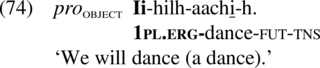
One obvious problem is the lack of evidence for these null objects, at least in Choctaw. What is more, it is not the case that adding an object would be sufficient to make the subject ergative anyway (outside of the absolutive promotion – see Section 4.3): various transitive verbs have subjects indexed by abs or dat agreement – see the examples in (12c) and (34b). Additionally, Preminger (Reference Preminger2012) outlines various conceptual and empirical problems in applying the ‘concealed object’ analysis to Western Basque, a language with (matched) active case and agreement.
But if there really is a good case for assimilating active systems to dependent ergative systems more broadly, then these null objects could be seen as a small, harmless price to pay in service of a nice, explanatory typology. The problem is that if Choctaw really does have ‘low ergatives’ – internal arguments that trigger ergative agreement – then it is not clear where the required null objects would be, structurally. The lowest argument ‘slot’ in the syntactic structure of the clause is already occupied by the internal argument (the erg NP) and so there does not seem to be anywhere lower for the null object to merge. I thus believe that a dependent analysis of Choctaw ergative, which would have to make use of ‘concealed objects’ as in (74), is not only unnecessary for Choctaw, but is incorrect.
In the next section, I support my analysis of low ergative in Choctaw: I provide two arguments that erg agreement crucially requires a dependency between the targeted NP and the Voice head, rather than some lower functional head.
6. Evidence that Voice is involved in low ergative
I have proposed that in Choctaw ‘low ergative’ configurations, a $ \phi $
-probe is exceptionally added to
$ \phi $
-probe is exceptionally added to $ {\mathrm{Voice}}_{\left[-\mathrm{N}\right]} $
, and it forms a dependency with the closest internal argument. In this section, I provide two pieces of evidence that low ergative configurations involve a dependency between the NP and Voice, rather than some lower syntactic head that is more local to the NP (e.g. v).
$ {\mathrm{Voice}}_{\left[-\mathrm{N}\right]} $
, and it forms a dependency with the closest internal argument. In this section, I provide two pieces of evidence that low ergative configurations involve a dependency between the NP and Voice, rather than some lower syntactic head that is more local to the NP (e.g. v).
6.1. Intervening dative arguments block low ergative
Agreement dependencies are known to be sensitive to intervention – put informally, a probe cannot ignore its closest eligible goal and form a dependency only with a more distant goal. We can show that low ergative – an agreement dependency between $ {\mathrm{Voice}}_{\left[-\mathrm{N}\right]} $
and an NP in its c-command domain – is sensitive to intervention.
$ {\mathrm{Voice}}_{\left[-\mathrm{N}\right]} $
and an NP in its c-command domain – is sensitive to intervention.
The relevant configuration is in fact the one we saw in Section 3.4: verbs with applied dative subjects, exemplified in (75a). The example in (75b) shows that the basic verb here, ittola ‘fall’, takes abs subject agreement.

In Section 3.4 I proposed, following Tyler (Reference Tyler2019a), that verbs with dative subjects have the structure in (76): the applied dative subject is introduced in the specifier of Appl-dat, and Appl-dat enters an agreement dependency with it.

As shown, v typically agrees with the theme argument, and so a 1st/2nd-person theme argument will get indexed by abs agreement (provided it does not run afoul of Choctaw’s Person Case Constraint (PCC) restrictions, discussed momentarily). But of particular interest to us is what happens with low ergative roots – i.e. when the root forces a [u $ \phi $
] feature to sprout onto
$ \phi $
] feature to sprout onto $ {\mathrm{Voice}}_{\left[-\mathrm{N}\right]} $
, by the rule in (66). I aim to show in this section that the dative argument intervenes in the formation of the agreement relation, and blocks it, as in (77).Footnote
33
$ {\mathrm{Voice}}_{\left[-\mathrm{N}\right]} $
, by the rule in (66). I aim to show in this section that the dative argument intervenes in the formation of the agreement relation, and blocks it, as in (77).Footnote
33

Quantifier and positional verbs allow us to test this claim: (a) they instantiate low ergative structures and (b) they accept applied dative subjects, as shown for kahmáya ‘lie.pl’ in (78).

Therefore we might expect that we could make the object (the possessee) 1st- or 2nd-person (e.g. ‘the doctor has me/you’), and inspect whether it is indexed by erg or abs agreement. If erg appears, then the agreement dependency between $ {\mathrm{Voice}}_{\left[-\mathrm{N}\right]} $
and the object has been formed as usual. If abs, then it has been blocked.
$ {\mathrm{Voice}}_{\left[-\mathrm{N}\right]} $
and the object has been formed as usual. If abs, then it has been blocked.
We can see from the examples in (79) that the object cannot be indexed by erg agreement. This observation supports the claim that $ {\mathrm{Voice}}_{\left[-\mathrm{N}\right]} $
cannot form a dependency with the object.
$ {\mathrm{Voice}}_{\left[-\mathrm{N}\right]} $
cannot form a dependency with the object.

However, the examples in (80) show that the object cannot be indexed with abs agreement either.

Fortunately, this is what we would expect given Choctaw’s PCC restrictions, which rule out most combinations of abs and dat agreement morphemes, in contexts where the dat argument c-commands the other argument (Tyler Reference Tyler2019a).
Thus we have seen some indirect evidence that a dative argument, merged between $ {\mathrm{Voice}}_{\left[-\mathrm{N}\right]} $
and the internal argument, can prevent a
$ {\mathrm{Voice}}_{\left[-\mathrm{N}\right]} $
and the internal argument, can prevent a $ \phi $
-probe on Voice from successfully agreeing with the internal argument.
$ \phi $
-probe on Voice from successfully agreeing with the internal argument.
6.2. Low ergative does not survive a change in Voice head
I now present a second piece of evidence in support of the claim that low ergative configurations involve a dependency between an internal argument and $ {\mathrm{Voice}}_{\left[-\mathrm{N}\right]} $
. The evidence comes from the causative alternation: when
$ {\mathrm{Voice}}_{\left[-\mathrm{N}\right]} $
. The evidence comes from the causative alternation: when $ {\mathrm{Voice}}_{\left[-\mathrm{N}\right]} $
is removed and replaced by
$ {\mathrm{Voice}}_{\left[-\mathrm{N}\right]} $
is removed and replaced by $ {\mathrm{Voice}}_{\left[+\mathrm{N}\right]} $
, which introduces an external argument, the internal argument is no longer indexed by erg agreement.
$ {\mathrm{Voice}}_{\left[+\mathrm{N}\right]} $
, which introduces an external argument, the internal argument is no longer indexed by erg agreement.
As discussed in Section 4, many intransitive verbs instantiating ‘low ergative’ structures participate in the causative alternation. With the transitive alternant of a low ergative verb, the internal argument goes from being the subject to being the object. And importantly for this discussion, it goes from being indexed by erg agreement to being indexed by abs agreement. An example of an intransitive-transitive pair, with a 1st-person internal argument, is given in (81). The intransitive quantifier verb mó̱ma ‘be all’ alternates with its transitive counterpart momíchi ‘do to all of them’ (see Section 4.2).

The change in how the internal argument is indexed (from erg to abs) is a consequence of the change in Voice head (from $ {\mathrm{Voice}}_{\left[-\mathrm{N}\right]} $
to
$ {\mathrm{Voice}}_{\left[-\mathrm{N}\right]} $
to $ {\mathrm{Voice}}_{\left[+\mathrm{N}\right]} $
) (see Section 3.1). Although both of these Voice heads have a
$ {\mathrm{Voice}}_{\left[+\mathrm{N}\right]} $
) (see Section 3.1). Although both of these Voice heads have a $ \phi $
-probe,
$ \phi $
-probe, $ {\mathrm{Voice}}_{\left[+\mathrm{N}\right]} $
introduces an NP in Spec-VoiceP, which will always be the target of
$ {\mathrm{Voice}}_{\left[+\mathrm{N}\right]} $
introduces an NP in Spec-VoiceP, which will always be the target of $ {\mathrm{Voice}}_{\left[+\mathrm{N}\right]} $
’s probe (on the assumption that probes search their m-command domain, see Section 2.1). Thus the internal argument can never be targeted by
$ {\mathrm{Voice}}_{\left[+\mathrm{N}\right]} $
’s probe (on the assumption that probes search their m-command domain, see Section 2.1). Thus the internal argument can never be targeted by $ {\mathrm{Voice}}_{\left[+\mathrm{N}\right]} $
’s
$ {\mathrm{Voice}}_{\left[+\mathrm{N}\right]} $
’s $ \phi $
-probe. Crucially, if low ergative was associated with a functional head lower than Voice, then we would expect that the internal argument of a transitivised low ergative verb like momíchi (as in (81b)) could still be indexed by erg agreement.
$ \phi $
-probe. Crucially, if low ergative was associated with a functional head lower than Voice, then we would expect that the internal argument of a transitivised low ergative verb like momíchi (as in (81b)) could still be indexed by erg agreement.
The behaviour of alternating intransitive verbs with low ergative subjects (e.g. (81)) can be compared with that of alternating intransitives with dat-indexed subjects. Unlike the $ \phi $
-probe on Voice which is responsible for erg agreement, the
$ \phi $
-probe on Voice which is responsible for erg agreement, the $ \phi $
-probe responsible for dat agreement is lower in the structure (below VoiceP), and as a result it survives the change brought on at the VoiceP level by the causative alternation.Footnote
34 This is illustrated in (82): the internal argument of
$ \phi $
-probe responsible for dat agreement is lower in the structure (below VoiceP), and as a result it survives the change brought on at the VoiceP level by the causative alternation.Footnote
34 This is illustrated in (82): the internal argument of $ \underline{i} $
-pitiipa/
$ \underline{i} $
-pitiipa/ $ \underline{i} $
-pitiibli ‘worsen/reinjure (oneself)’ is indexed by dat agreement in both the intransitive and transitive alternants.
$ \underline{i} $
-pitiibli ‘worsen/reinjure (oneself)’ is indexed by dat agreement in both the intransitive and transitive alternants.

In summary, we have seen two pieces of evidence that low ergative configurations involve a dependency between $ {\mathrm{Voice}}_{\left[-\mathrm{N}\right]} $
and the internal argument.
$ {\mathrm{Voice}}_{\left[-\mathrm{N}\right]} $
and the internal argument.
7. Conditioning the dependency-forming behaviour of Voice cross-linguistically
I have proposed that the dependency-forming properties of Voice heads are not fixed, but may be conditioned and manipulated by rules that make reference to the morphosyntactic context that the Voice head finds itself in. Specifically, in order to account for ‘low ergatives’ in Choctaw, I have proposed that a [u $ \phi $
] feature (a
$ \phi $
] feature (a $ \phi $
-probe) may be inserted at an otherwise-non-agreeing specifier-less
$ \phi $
-probe) may be inserted at an otherwise-non-agreeing specifier-less $ {\mathrm{Voice}}_{\left[-\mathrm{N}\right]} $
, by dissociated feature insertion. But this proposal has consequences beyond Choctaw.
$ {\mathrm{Voice}}_{\left[-\mathrm{N}\right]} $
, by dissociated feature insertion. But this proposal has consequences beyond Choctaw.
In this section I expand the analysis by exploring the possibility, discussed in Section 5.1 with respect to Wood’s (Reference Wood2015) analysis of Icelandic -st anticausative constructions, that postsyntactic rules may also remove dependency-forming features from $ {\mathrm{Voice}}_{\left[+\mathrm{N}\right]} $
(the Voice head that introduces an external argument). Such rules are essentially impoverishment rules, the counterpart to dissociated feature insertion rules. So if the relevant dependency is an agreement dependency, a language may have a special rule that removes the [u
$ {\mathrm{Voice}}_{\left[+\mathrm{N}\right]} $
(the Voice head that introduces an external argument). Such rules are essentially impoverishment rules, the counterpart to dissociated feature insertion rules. So if the relevant dependency is an agreement dependency, a language may have a special rule that removes the [u $ \phi $
] feature responsible – the results of this are schematised in (83a). Likewise if the dependency is one of case-assignment, a language may have a special rule that removes the [erg]-assigning feature, with the result schematised in (83b) (note the similarity to Wood’s rule in (71)). More broadly, rules of this nature essentially result in the reverse situation from the one I have argued for in this article thus far: they create external arguments that have the alignment properties of internal arguments.Footnote
35
$ \phi $
] feature responsible – the results of this are schematised in (83a). Likewise if the dependency is one of case-assignment, a language may have a special rule that removes the [erg]-assigning feature, with the result schematised in (83b) (note the similarity to Wood’s rule in (71)). More broadly, rules of this nature essentially result in the reverse situation from the one I have argued for in this article thus far: they create external arguments that have the alignment properties of internal arguments.Footnote
35

The configurations in (83) encompass both unergative and transitive verbs whose subjects are marked like internal arguments. I discuss these options in turn.
The examples in (84) illustrate unergative verbs whose subjects are marked like internal arguments in Crow and Mohawk, two languages with an active agreement system. In each case, the author of the article explicitly mentions the example in order to illustrate the possibility for individual verbs to buck the semantic generalisation about what conditions the agreement split in that language (note that in (84b), Mithun glosses the patientive agreement as ‘patient case’ – I reproduce her gloss).Footnote 36

Similarly, the examples in (85) illustrate agentive transitive verbs whose subjects are marked like internal arguments, in three languages with active alignment systems. Mohawk has an active agreement system, yet the subject of the verb meaning ‘throw’ appears with the agreement markers typically reserved for patient/theme arguments. Similarly, while Hindi and Warlpiri both have active case systems, the subjects of the verbs meaning ‘bring’ and ‘provoke’ appear with absolutive case, rather than expected ergative case.Footnote 37

Ideally, we would be able to employ diagnostics specific to Mohawk, Hindi, or Walpiri, which would enable us to identify external arguments in each of these languages (‘semantic eyeballing’ can only get us so far). But again, in each of these cases, the author of the article has brought up this example to illustrate the point that there are lexical exceptions to the semantic generalisations governing active alignment.
The account provided here allows us to easily capture these exceptional cases. Typically, $ {\mathrm{Voice}}_{\left[+\mathrm{N}\right]} $
(merged in unergatives and agentive transitives) comes equipped with a [u
$ {\mathrm{Voice}}_{\left[+\mathrm{N}\right]} $
(merged in unergatives and agentive transitives) comes equipped with a [u $ \phi $
] agreement feature or a [erg] case-assignment feature, and forms the appropriate dependency with the argument in Spec-VoiceP. But sometimes, in the context of particular roots or functional heads, the [u
$ \phi $
] agreement feature or a [erg] case-assignment feature, and forms the appropriate dependency with the argument in Spec-VoiceP. But sometimes, in the context of particular roots or functional heads, the [u $ \phi $
] or [erg] feature is removed by a rule like (86), and no dependency is formed.
$ \phi $
] or [erg] feature is removed by a rule like (86), and no dependency is formed.

The analysis does have one outstanding issue, however: what causes abs agreement or abs case to show up on the external argument? The external argument is outside the m-command domain of v, the head which I have held responsible for forming an abs dependency with the internal argument in Choctaw. So in languages which exhibit the ‘mismatched’ configuration in (83), v cannot be responsible. One possibility is that in such languages, the abs-related head is located above Voice – and, indeed, there are various analyses that link absolutive case and agreement, in some languages, to a functional head in the inflectional domain (e.g. Bittner & Hale Reference Bittner and Hale1996, Aldridge Reference Aldridge2008 and others argue that T assigns absolutive).
An alternative explanation, which covers at least those mismatches found in case systems, would hold that abs-hood, rather than reflecting the presence of a special [abs] feature gained via a dependency with an abs-related head, is instead the absence of an [erg] feature and reflects nothing more than the absence of a dependency with an erg-related head. This is the approach pursued in Arregi & Nevins’s (Reference Arregi and Nevins2012) analysis of Basque alignment, and in Tyler’s (Reference Tyler2019a) analysis of Choctaw, discussed in Section 2.2. I set this question aside for now.
8. Conclusion
In this article I have argued that a functional head’s dependency-forming features – a cover term for the features that govern whether the head assigns case and forms agreement relations – may be manipulated in the postsyntax by the standard Distributed Morphology operations of dissociated feature insertion and impoverishment. I have focused solely on the properties of Voice, but as we saw in Section 2.1, other functional heads may need to be equipped with dependency-forming features too (in Choctaw: at least v and Appl). It is a task for future work to determine whether these and any other functional heads are also contextually manipulable in the way the Voice head is.
In this final section, I briefly sketch what an alternative analysis of Choctaw, and other languages with lexical alignment ‘mismatches’, might look like. In this alternative analysis, dependency-forming features are immutable properties of functional heads. To account for a verb-specific or configuration-specific mismatch, then, the obvious move would be to expand the range of primitive functional heads available in that language, as in (87)–(88). Voice would not just split into two flavours according to its specifier requirement (‘[+/–N]’), but one or both of the Voice heads would then split again into two more flavours, according to whether or not it had a dependency-forming feature (annotated as [u $ \phi $
] or [erg]). In Choctaw, the head in (87c) does not appear to be attested (hence the parentheses), but I argued in Section 7 that it may well be attested in other languages (Crow, Mohawk).
$ \phi $
] or [erg]). In Choctaw, the head in (87c) does not appear to be attested (hence the parentheses), but I argued in Section 7 that it may well be attested in other languages (Crow, Mohawk).


This is clearly undesirable from the outset – any language with any lexical alignment mismatches will make use of a larger range of functional heads. It is also an unfortunate analysis in some other ways. First, we end up with extra functional heads that differs from other heads only minimally. For instance, the two heads in (87a–b) differ only in the terms of whether or not they have a [u $ \phi $
] feature, but they are otherwise identical, not only in their label (‘Voice’) and specifier requirement (‘[–N]’), but also their morphological and semantic properties. This problem multiplies in languages where both a dependency-forming and a non-dependency-forming flavour of
$ \phi $
] feature, but they are otherwise identical, not only in their label (‘Voice’) and specifier requirement (‘[–N]’), but also their morphological and semantic properties. This problem multiplies in languages where both a dependency-forming and a non-dependency-forming flavour of $ {\mathrm{Voice}}_{\left[+\mathrm{N}\right]} $
can be identified (e.g. a language that has both (87c) and (87d)).
$ {\mathrm{Voice}}_{\left[+\mathrm{N}\right]} $
can be identified (e.g. a language that has both (87c) and (87d)).
Second, if we accept the conclusion of Bobaljik (Reference Bobaljik, Adger, Harbour and Béjar2008) that case and agreement dependencies are computed in the postsyntax (something I adopt here), then those pairs of heads in (87-88) that are distinguished only by the presence vs absence of a dependency-forming feature are not distinct for the purposes of the syntactic derivation.
Third, the approach in (87-88) deprives us of any easy way to state what is the default and what is the exception. For instance, there is no way to encode that in Choctaw, (87a) is the default while (87b) is exceptional. By contrast, in the model outlined in this article, the ‘exceptional’ heads in (87b–c) and (88b–c) may only emerge when the default Voice heads are manipulated by special rules.
Fourth, and perhaps most significantly, the ‘immutable’ approach to dependency-forming features does not follow how we treat variation in the properties of functional heads along other dimensions. Generally, we are happy to acknowledge that while functional heads do serve to bundle together a set of commonly co-occurring syntactic, morphological, and semantic properties, they do not do so exceptionlessly. Contextual allomorphy provides an outlet for variation in the form of a head X0, without junking the idea that the set of surface forms are all realisations of X0. Likewise, contextual allosemy (Marantz Reference Marantz, Matushansky and Marantz2013, Wood & Marantz Reference Wood, Marantz, D’Alessandro, Franco and Gallego2017) allows X0 to have multiple possible context-dependent interpretations, while its syntactic and morphological behaviour remains uniform. An analysis without allomorphy or allosemy would result in an undesirable proliferation of mostly identical functional heads. So, if it is correct to think of case and agreement dependencies as created in the morphology rather than the syntactic derivation, then we should want to treat contextual variation in dependency-forming features as though it were any other type of allomorphy.


 Open access

